Created at BIDMC Multidisciplinary input Nursing  Geriatrics  Hospital Medicine  Pharmacy  IS  Dept of Health Care Quality
Hospitalization is a vulnerable time for elderly patients Older patients are at risk for: Delirium (acute confusional state) Physical deconditioning Medication side-effects Loss of function
The GRACE initiative will address unique concerns of vulnerable elders  Identify delirium (confusion) as soon as it develops  Target finite resources Implement programs to maintain function and prevent delirium
Three-pronged initiative Provider Order Entry (POE) Pharmacy Bedside
Bedside component For patients  ≥ 80 years Roll-out on 11R, CC7, Farr 2 anticipated in Oct/November  2 nd  wave to rollout  on all other floors (except Deac-4, Oncology and ICUs) 1-2 mo later Springtime rollout planned for subset of 65-79 year old patients
Bedside component Mainly the domain of nursing Nurses will be the primary “go-to” for this component but are encouraged to work with and utilize help from physicians, PT, NPs, PAs and PCTs
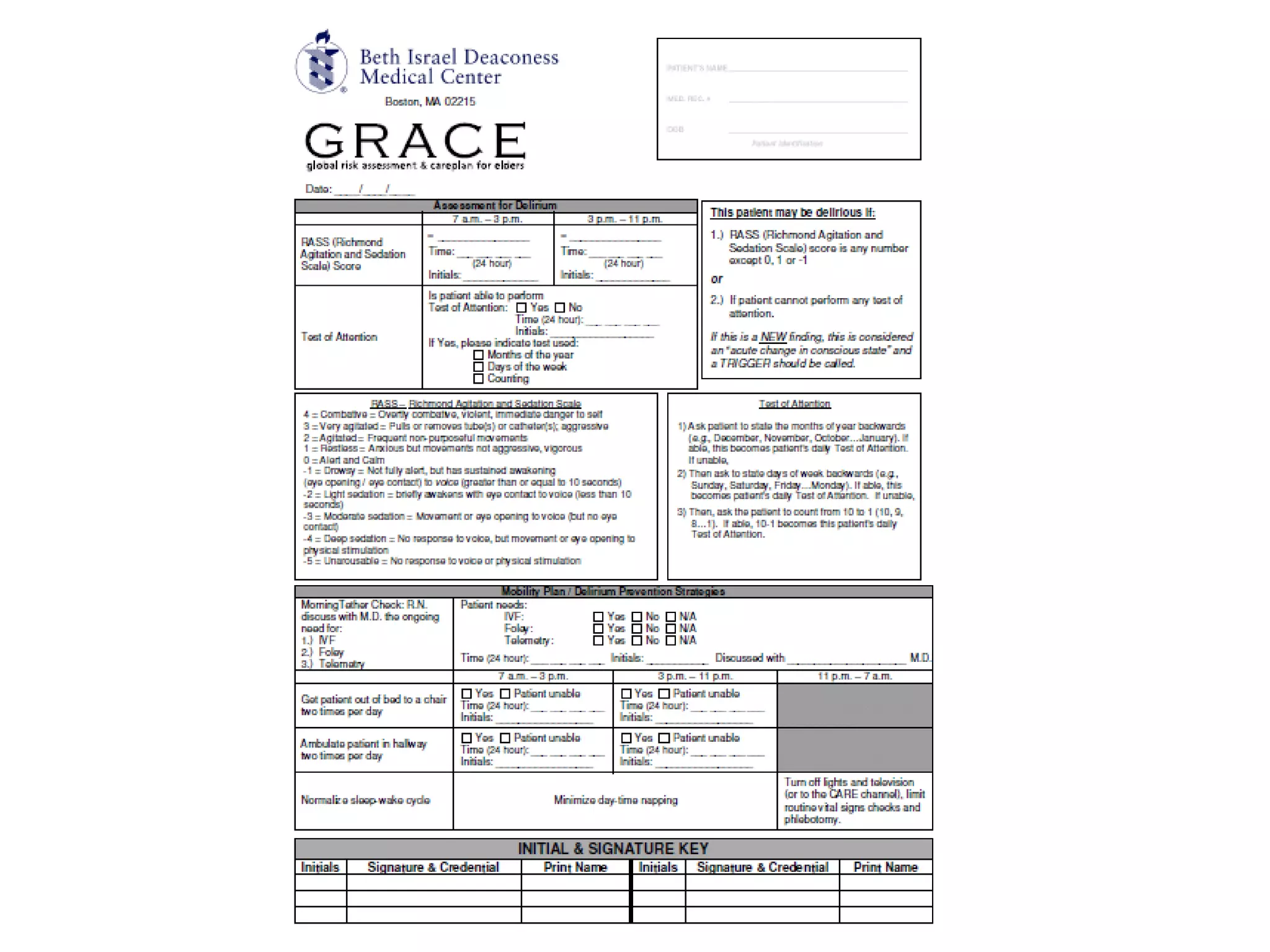
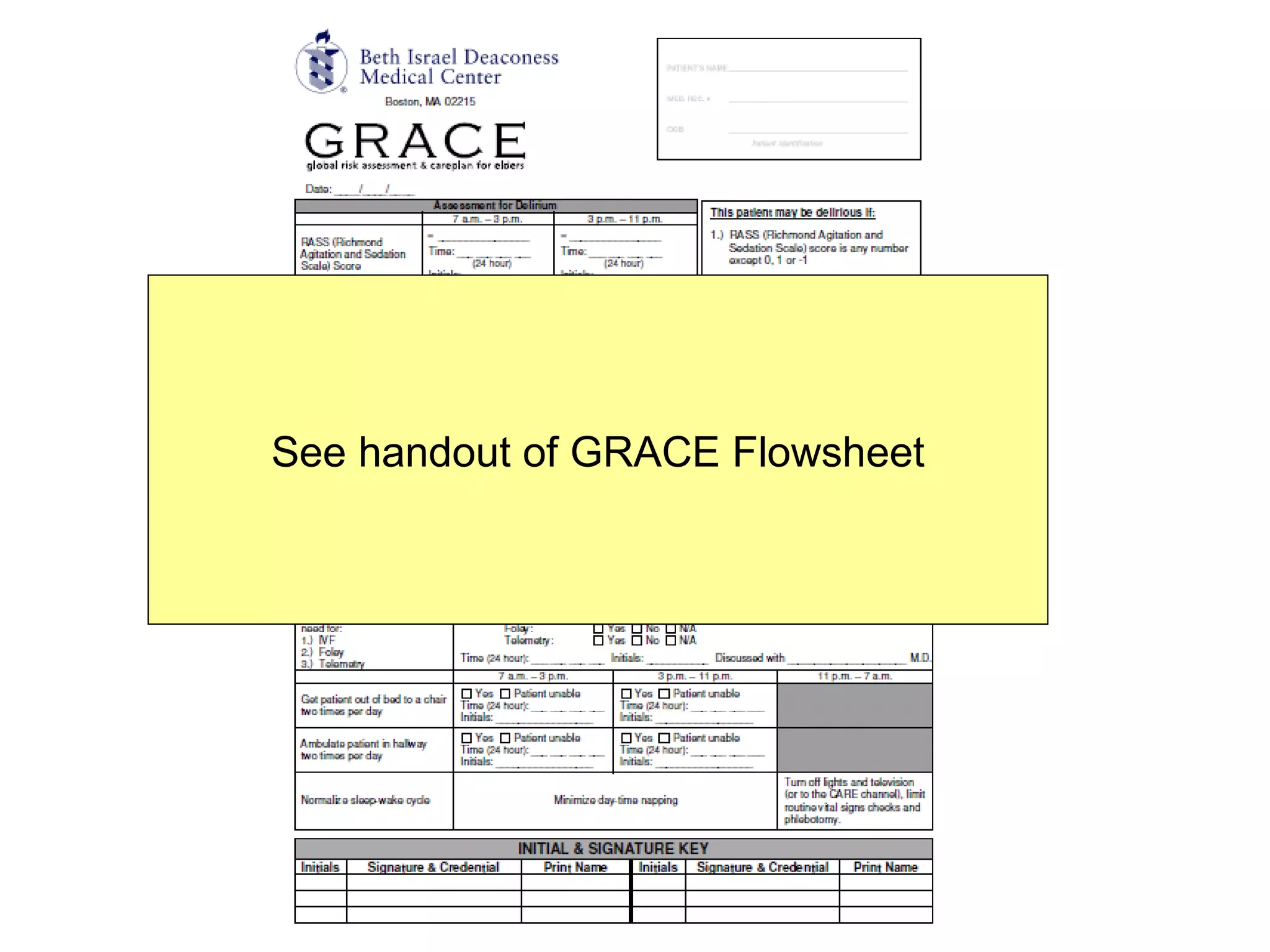
Bedside GRACE flow sheet One sheet per day  goes in blue vital signs book/clipboard Use 1 copy of form each day for any patient admitted to your unit 80 years or older
 
See handout of GRACE Flowsheet
Bedside GRACE flow sheet Multiple components 2 part Delirium screen  Morning “tether check” Mobility protocol Sleep protocol
Bedside GRACE flow sheet Multiple components 2 part Delirium screen   Morning “tether check” Mobility protocol Sleep protocol
2 Part Delirium (confusion) Screen 1) RASS Score – two times per day 2) Test of attention – once per day
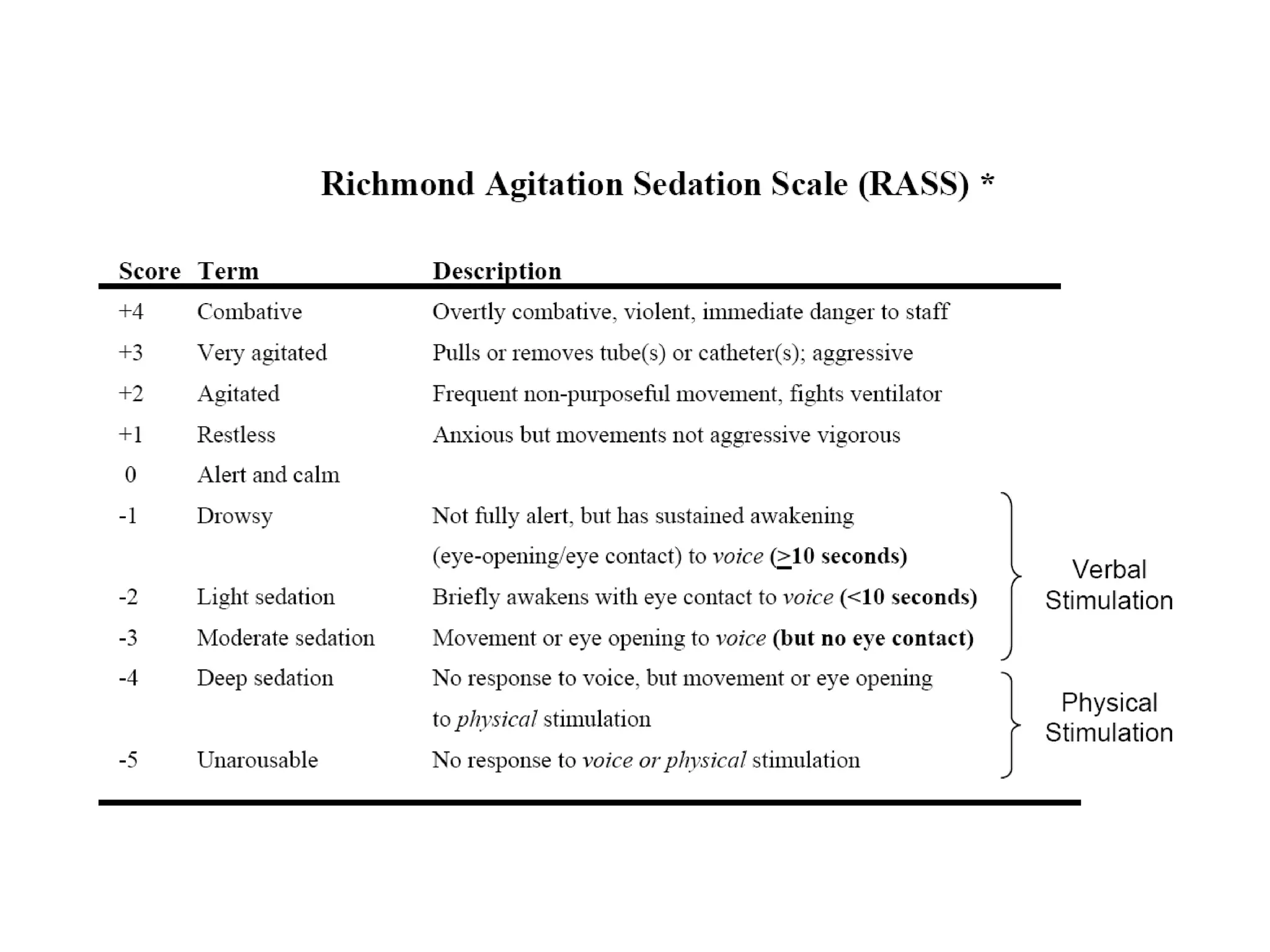
2 Part Delirium (confusion) Screen RASS Score Use the Richmond Agitation and Sedation Scale  First part of the delirium screen
 
2 Part Delirium (confusion) Screen 1) RASS Score  Scored two times per day Once between 7 am - 3 pm  Once between 3 -11 pm
2 Part Delirium (confusion) Screen 1) RASS Score Scored two times per day Once between 7 am - 3 pm  Once between 3 -11 pm Write RASS score on Flowsheet
2 Part Delirium (confusion) Screen 1) RASS Score Scored two times per day Once between 7 am - 3 pm  Once between 3 -11 pm Write RASS score on Flowsheet Any score that is NOT a 0, 1 or -1, if a NEW score to that patient, is considered a positive screen for delirium    Trigger
Daily screen for delirium (confusion) 2) Test of attention – once per day This is the second component of the delirium screen.  RASS score is the first.
Test of Attention  (second part of delirium screen) 1) Ask patient to state the months of year backwards ( e.g. , December, November, October…January). If able, this becomes patient's daily Test of Attention. If unable, 2) Then ask to state days of week backwards ( e.g. , Sunday, Saturday, Friday…Monday). If able, this becomes patient's daily Test of Attention. If unable, 3) Then, ask the patient to count from 10 to 1 (10, 9, 8…1). If able, 10-1 becomes this patient's daily Test of Attention.
Daily screen for delirium (confusion) 2) Test of attention – once per day Record which test of attention the patient could do .
Daily screen for delirium (confusion) 2) Test of attention – once per day Record which test of attention the patient could do .  If unable to do the test of attention from the previous day, or unable to perform any test of attention, this is a positive screen for Delirium!    Trigger!
Bedside GRACE flow sheet 2 part Delirium screen  Morning “tether check” Mobility protocol Sleep protocol
Morning “Tether Check” Background:  Foleys, telemetry, IV lines and restraints are considered “tethers” A patient with 1 or more tethers is at increased risk for falling or developing delirium in the hospital We want to minimize the use of tethers in our most vulnerable patient population
Morning “Tether Check” Each morning, the need for a tether must be documented. Who can complete this section of the flowsheet? RN after conversation with MD/NP/PA MD/NP/PA can do so independently If no MD/NP/PA has completed it, day RN should speak with the responsible MD/PA/NP and review with him/her the need for any tethers that are in use.
Bedside GRACE flow sheet 2 part Delirium screen  Morning “tether check” Mobility protocol Sleep protocol
Mobility Protocol Background: Bedrest causes patients to lose function Increases risks of pressure ulcers, pneumonia Older patients are most vulnerable to losing function while in the hospital Loss of function leads to placement in nursing homes after discharge from the hospital
Mobility Protocol Get patient out of bed to chair two times  per day unless patient unable Ambulate patient in hallway two times per day, unless patient unable Q: Who can do it?  A:  RN, or PCT, PT, or MD
Bedside GRACE flow sheet 2 part Delirium screen  Morning “tether check” Mobility protocol Sleep protocol
Sleep Protocol Background:  Sleep deprivation can cause confusion in older patients Designed to normalize the sleep-wake cycle for elderly patients in the hospital Minimize noise, lights, lab draws, routine VS checks between 11 pm and 7 am
It is our hope that the bedside flowsheet will be utilized by all members of the care team, including nurses, doctors, PT, OT etc. Nurses, however, are the cornerstone to bedside care and have primary “ownership” for the completion of this form.
Thank you! Melissa Mattison, MD [email_address] Pager 90141 Angela Botts, MD [email_address] Pager 31458 Daniele Olveczky, MD [email_address] Pager 38743 Julie Moran, MD jamoran @bidmc.harvard.edu Pager 33000 Christine Kristeller, RN [email_address] Pager 39232 Questions:

Grace Rollout

  • 1.
  • 2.
    Created at BIDMCMultidisciplinary input Nursing Geriatrics Hospital Medicine Pharmacy IS Dept of Health Care Quality
  • 3.
    Hospitalization is avulnerable time for elderly patients Older patients are at risk for: Delirium (acute confusional state) Physical deconditioning Medication side-effects Loss of function
  • 4.
    The GRACE initiativewill address unique concerns of vulnerable elders Identify delirium (confusion) as soon as it develops Target finite resources Implement programs to maintain function and prevent delirium
  • 5.
    Three-pronged initiative ProviderOrder Entry (POE) Pharmacy Bedside
  • 6.
    Three-pronged initiative ProviderOrder Entry (POE) Pharmacy Bedside
  • 7.
    Bedside component Forpatients ≥ 80 years Roll-out on 11R, CC7, Farr 2 anticipated in Oct/November 2 nd wave to rollout on all other floors (except Deac-4, Oncology and ICUs) 1-2 mo later Springtime rollout planned for subset of 65-79 year old patients
  • 8.
    Bedside component Mainlythe domain of nursing Nurses will be the primary “go-to” for this component but are encouraged to work with and utilize help from physicians, PT, NPs, PAs and PCTs
  • 9.
    Bedside GRACE flowsheet One sheet per day goes in blue vital signs book/clipboard Use 1 copy of form each day for any patient admitted to your unit 80 years or older
  • 10.
  • 11.
    See handout ofGRACE Flowsheet
  • 12.
    Bedside GRACE flowsheet Multiple components 2 part Delirium screen Morning “tether check” Mobility protocol Sleep protocol
  • 13.
    Bedside GRACE flowsheet Multiple components 2 part Delirium screen Morning “tether check” Mobility protocol Sleep protocol
  • 14.
    2 Part Delirium(confusion) Screen 1) RASS Score – two times per day 2) Test of attention – once per day
  • 15.
    2 Part Delirium(confusion) Screen RASS Score Use the Richmond Agitation and Sedation Scale First part of the delirium screen
  • 16.
  • 17.
    2 Part Delirium(confusion) Screen 1) RASS Score Scored two times per day Once between 7 am - 3 pm Once between 3 -11 pm
  • 18.
    2 Part Delirium(confusion) Screen 1) RASS Score Scored two times per day Once between 7 am - 3 pm Once between 3 -11 pm Write RASS score on Flowsheet
  • 19.
    2 Part Delirium(confusion) Screen 1) RASS Score Scored two times per day Once between 7 am - 3 pm Once between 3 -11 pm Write RASS score on Flowsheet Any score that is NOT a 0, 1 or -1, if a NEW score to that patient, is considered a positive screen for delirium  Trigger
  • 20.
    Daily screen fordelirium (confusion) 2) Test of attention – once per day This is the second component of the delirium screen. RASS score is the first.
  • 21.
    Test of Attention (second part of delirium screen) 1) Ask patient to state the months of year backwards ( e.g. , December, November, October…January). If able, this becomes patient's daily Test of Attention. If unable, 2) Then ask to state days of week backwards ( e.g. , Sunday, Saturday, Friday…Monday). If able, this becomes patient's daily Test of Attention. If unable, 3) Then, ask the patient to count from 10 to 1 (10, 9, 8…1). If able, 10-1 becomes this patient's daily Test of Attention.
  • 22.
    Daily screen fordelirium (confusion) 2) Test of attention – once per day Record which test of attention the patient could do .
  • 23.
    Daily screen fordelirium (confusion) 2) Test of attention – once per day Record which test of attention the patient could do . If unable to do the test of attention from the previous day, or unable to perform any test of attention, this is a positive screen for Delirium!  Trigger!
  • 24.
    Bedside GRACE flowsheet 2 part Delirium screen Morning “tether check” Mobility protocol Sleep protocol
  • 25.
    Bedside GRACE flowsheet 2 part Delirium screen Morning “tether check” Mobility protocol Sleep protocol
  • 26.
    Morning “Tether Check”Background: Foleys, telemetry, IV lines and restraints are considered “tethers” A patient with 1 or more tethers is at increased risk for falling or developing delirium in the hospital We want to minimize the use of tethers in our most vulnerable patient population
  • 27.
    Morning “Tether Check”Each morning, the need for a tether must be documented. Who can complete this section of the flowsheet? RN after conversation with MD/NP/PA MD/NP/PA can do so independently If no MD/NP/PA has completed it, day RN should speak with the responsible MD/PA/NP and review with him/her the need for any tethers that are in use.
  • 28.
    Bedside GRACE flowsheet 2 part Delirium screen Morning “tether check” Mobility protocol Sleep protocol
  • 29.
    Bedside GRACE flowsheet 2 part Delirium screen Morning “tether check” Mobility protocol Sleep protocol
  • 30.
    Mobility Protocol Background:Bedrest causes patients to lose function Increases risks of pressure ulcers, pneumonia Older patients are most vulnerable to losing function while in the hospital Loss of function leads to placement in nursing homes after discharge from the hospital
  • 31.
    Mobility Protocol Getpatient out of bed to chair two times per day unless patient unable Ambulate patient in hallway two times per day, unless patient unable Q: Who can do it? A: RN, or PCT, PT, or MD
  • 32.
    Bedside GRACE flowsheet 2 part Delirium screen Morning “tether check” Mobility protocol Sleep protocol
  • 33.
    Bedside GRACE flowsheet 2 part Delirium screen Morning “tether check” Mobility protocol Sleep protocol
  • 34.
    Sleep Protocol Background: Sleep deprivation can cause confusion in older patients Designed to normalize the sleep-wake cycle for elderly patients in the hospital Minimize noise, lights, lab draws, routine VS checks between 11 pm and 7 am
  • 35.
    It is ourhope that the bedside flowsheet will be utilized by all members of the care team, including nurses, doctors, PT, OT etc. Nurses, however, are the cornerstone to bedside care and have primary “ownership” for the completion of this form.
  • 36.
    Thank you! MelissaMattison, MD [email_address] Pager 90141 Angela Botts, MD [email_address] Pager 31458 Daniele Olveczky, MD [email_address] Pager 38743 Julie Moran, MD jamoran @bidmc.harvard.edu Pager 33000 Christine Kristeller, RN [email_address] Pager 39232 Questions: