3rd Scottish Linked Data Interest Group workshop 
Linking Data… 
what about Know-How? 
Paolo Pareti 
PhD student at Edinburgh University 
10 September 2014
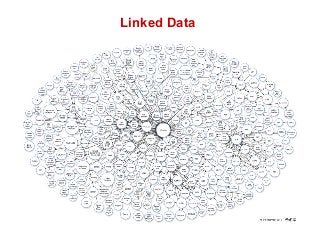
Linked Data
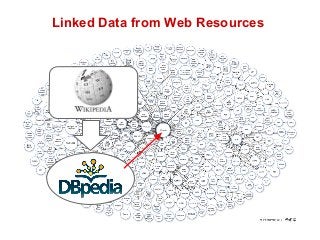
Linked Data from Web Resources
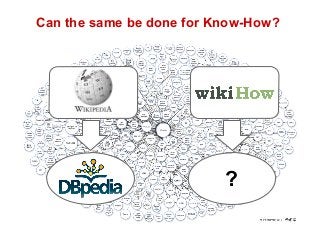
Can the same be done for Know-How? 
?
What?
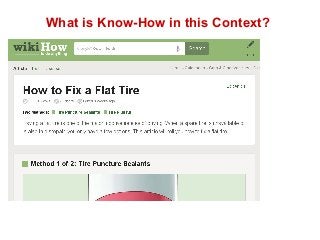
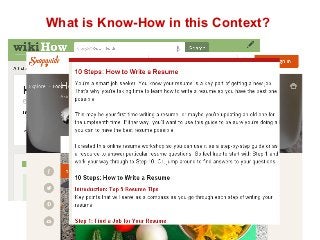
What is Know-How in this Context?
What is Know-How in this Context? 
Focus on Human Know-How: 
● instructions created by humans for humans 
● tasks where humans are (so far) the main agents
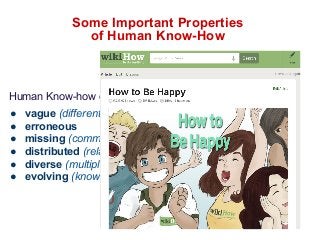
Some Important Properties 
of Human Know-How 
Human Know-how can be: 
● vague (different interpretations) 
● erroneous 
● missing (common sense is often assumed) 
● distributed (related knowledge in different repositories) 
● diverse (multiple approaches, possibly contradicting) 
● evolving (knowledge changes, new knowledge is created)
Some Important Properties 
of Human Know-How 
Human Know-how can be: 
● vague (different interpretations) 
● erroneous 
● missing (common sense is often assumed) 
● distributed (related knowledge in different repositories) 
● diverse (multiple approaches, possibly contradicting) 
● evolving (knowledge changes, new knowledge is created)
Why?
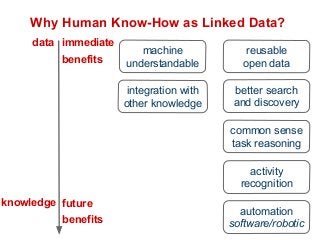
Why Human Know-How as Linked Data? 
machine 
understandable 
integration with 
other knowledge 
reusable 
open data 
better search 
and discovery 
common sense 
task reasoning 
activity 
recognition 
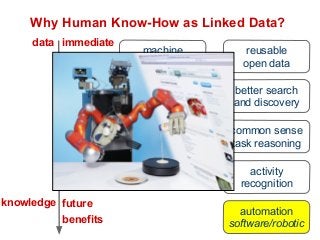
automation 
software/robotic 
immediate 
benefits 
future 
benefits 
data 
knowledge
Why Human Know-How as Linked Data? 
machine 
understandable 
integration with 
other knowledge 
reusable 
open data 
better search 
and discovery 
common sense 
task reasoning 
activity 
recognition 
automation 
software/robotic 
immediate 
benefits 
future 
benefits 
data 
knowledge
How?
How can Know-How be Represented? 
How to notify a client that the 
requested order has been dispatched?
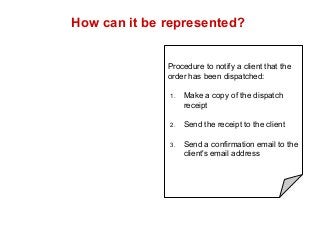
How can it be represented? 
Procedure to notify a client that the 
order has been dispatched: 
1. Make a copy of the dispatch 
receipt 
2. Send the receipt to the client 
3. Send a confirmation email to the 
client's email address
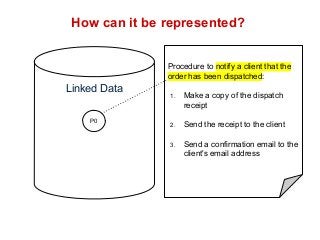
How can it be represented? 
Procedure to notify a client that the 
order has been dispatched: 
1. Make a copy of the dispatch 
receipt 
2. Send the receipt to the client 
3. Send a confirmation email to the 
client's email address 
Linked Data 
P0
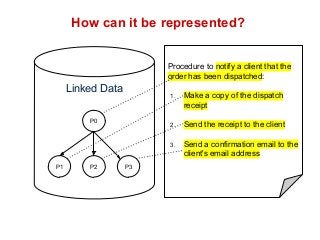
How can it be represented? 
Procedure to notify a client that the 
order has been dispatched: 
1. Make a copy of the dispatch 
receipt 
2. Send the receipt to the client 
3. Send a confirmation email to the 
client's email address 
Linked Data 
P0 
P1 P2 P3
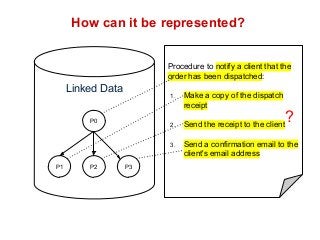
How can it be represented? 
Procedure to notify a client that the 
order has been dispatched: 
1. Make a copy of the dispatch 
receipt 
2. Send the receipt to the client 
3. Send a confirmation email to the 
client's email address 
Linked Data 
P0 
P1 P2 P3 
?
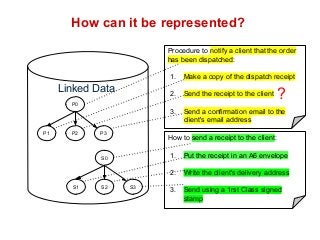
How can it be represented? 
Procedure to notify a client that the order 
has been dispatched: 
1. Make a copy of the dispatch receipt 
2. Send the receipt to the client 
3. Send a confirmation email to the 
client's email address 
Linked Data 
P0 
P1 P2 P3 How to send a receipt to the client: 
1. Put the receipt in an A6 envelope 
2. Write the client's delivery address 
3. Send using a 1rst Class signed 
stamp 
S0 
S1 S2 S3 
?
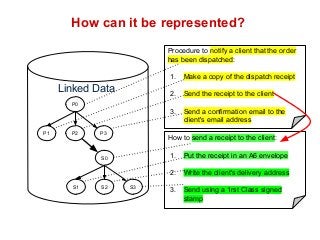
How can it be represented? 
Procedure to notify a client that the order 
has been dispatched: 
1. Make a copy of the dispatch receipt 
2. Send the receipt to the client 
3. Send a confirmation email to the 
client's email address 
Linked Data 
P0 
P1 P2 P3 How to send a receipt to the client: 
1. Put the receipt in an A6 envelope 
2. Write the client's delivery address 
3. Send using a 1rst Class signed 
stamp 
S0 
S1 S2 S3
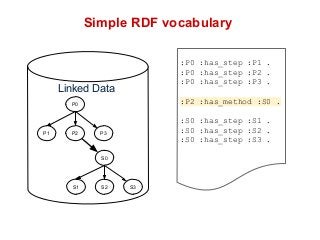
Simple RDF vocabulary 
Linked Data 
P0 
P1 P2 P3 
S0 
S1 S2 S3 
:P0 :has_step :P1 . 
:P0 :has_step :P2 . 
:P0 :has_step :P3 . 
:P2 :has_method :S0 . 
:S0 :has_step :S1 . 
:S0 :has_step :S2 . 
:S0 :has_step :S3 .
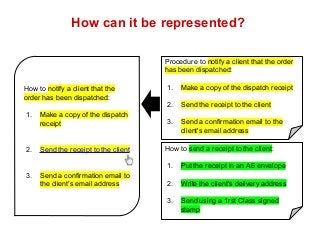
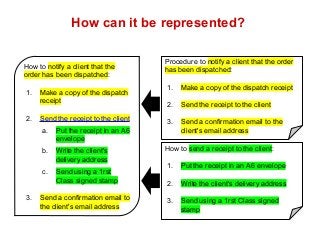
How can it be represented? 
Procedure to notify a client that the order 
has been dispatched: 
1. Make a copy of the dispatch receipt 
2. Send the receipt to the client 
3. Send a confirmation email to the 
client's email address 
How to send a receipt to the client: 
1. Put the receipt in an A6 envelope 
2. Write the client's delivery address 
3. Send using a 1rst Class signed 
stamp 
How to notify a client that the 
order has been dispatched: 
1. Make a copy of the dispatch 
receipt 
2. Send the receipt to the client 
3. Send a confirmation email to 
the client's email address
How can it be represented? 
Procedure to notify a client that the order 
has been dispatched: 
1. Make a copy of the dispatch receipt 
2. Send the receipt to the client 
3. Send a confirmation email to the 
client's email address 
How to send a receipt to the client: 
1. Put the receipt in an A6 envelope 
2. Write the client's delivery address 
3. Send using a 1rst Class signed 
stamp 
How to notify a client that the 
order has been dispatched: 
1. Make a copy of the dispatch 
receipt 
2. Send the receipt to the client 
a. Put the receipt in an A6 
envelope 
b. Write the client's 
delivery address 
c. Send using a 1rst 
Class signed stamp 
3. Send a confirmation email to 
the client's email address
Really?
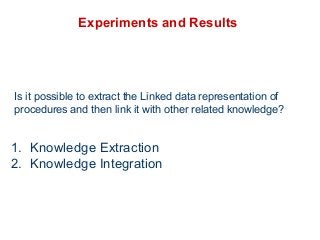
Experiments and Results 
Is it possible to extract the Linked data representation of 
procedures and then link it with other related knowledge? 
1. Knowledge Extraction 
2. Knowledge Integration
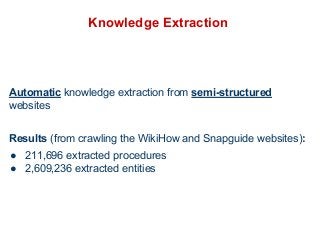
Knowledge Extraction 
Automatic knowledge extraction from semi-structured 
websites 
Results (from crawling the WikiHow and Snapguide websites): 
● 211,696 extracted procedures 
● 2,609,236 extracted entities
Knowledge Integration 
Two kinds of integration of know-how: 
● with existing Linked Data 
● with other know-how
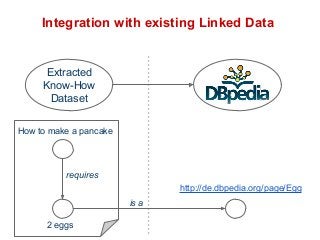
Integration with existing Linked Data 
Extracted 
Know-How 
Dataset 
How to make a pancake 
requires 
2 eggs 
http://de.dbpedia.org/page/Egg 
is a
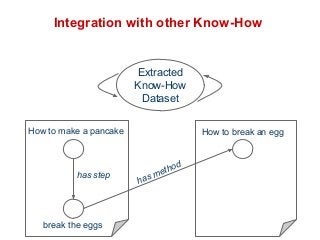
Integration with other Know-How 
Extracted 
Know-How 
Dataset 
How to make a pancake 
has step 
break the eggs 
has method 
How to break an egg
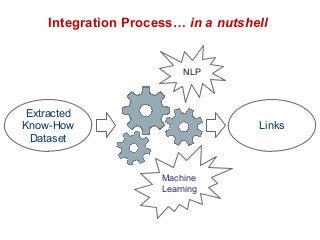
Integration Process… in a nutshell 
Extracted 
Know-How 
Dataset 
Links 
NLP 
Machine 
Learning
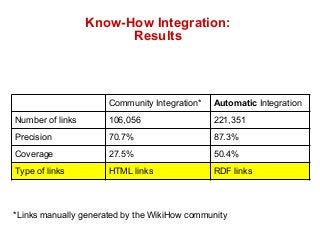
Know-How Integration: 
Results 
Community Integration* Automatic Integration 
Number of links 106,056 221,351 
Precision 70.7% 87.3% 
Coverage 27.5% 50.4% 
Type of links HTML links RDF links 
*Links manually generated by the WikiHow community
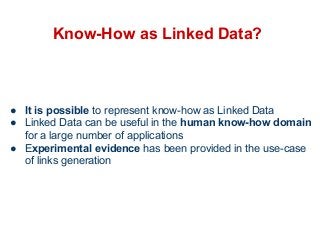
Know-How as Linked Data? 
● It is possible to represent know-how as Linked Data 
● Linked Data can be useful in the human know-how domain 
for a large number of applications 
● Experimental evidence has been provided in the use-case 
of links generation
References: 
Pareti Paolo, Ewan Klein, and Adam Barker. "A semantic web of know-how: 
linked data for community-centric tasks." Proceedings of the companion 
publication of the 23rd international conference on World wide web companion. 
International World Wide Web Conferences Steering Committee, 2014. 
Pareti Paolo, Ryutaro Ichise, Benoit Testu, Ewan Klein, and Adam Barker 
“Integrating Know-How into the Linked Data Cloud” Knowledge Engineering and 
Knowledge Management (EKAW 2014), 24 - 28 November 2014, Linköping, 
Sweden (forthcoming)

Integrating Know-How in the Linked Data Cloud

  • 1.
    3rd Scottish LinkedData Interest Group workshop Linking Data… what about Know-How? Paolo Pareti PhD student at Edinburgh University 10 September 2014
  • 2.
  • 3.
    Linked Data fromWeb Resources
  • 4.
    Can the samebe done for Know-How? ?
  • 5.
  • 6.
    What is Know-Howin this Context?
  • 7.
    What is Know-Howin this Context?
  • 8.
    What is Know-Howin this Context?
  • 9.
    What is Know-Howin this Context? Focus on Human Know-How: ● instructions created by humans for humans ● tasks where humans are (so far) the main agents
  • 10.
    Some Important Properties of Human Know-How Human Know-how can be: ● vague (different interpretations) ● erroneous ● missing (common sense is often assumed) ● distributed (related knowledge in different repositories) ● diverse (multiple approaches, possibly contradicting) ● evolving (knowledge changes, new knowledge is created)
  • 11.
    Some Important Properties of Human Know-How Human Know-how can be: ● vague (different interpretations) ● erroneous ● missing (common sense is often assumed) ● distributed (related knowledge in different repositories) ● diverse (multiple approaches, possibly contradicting) ● evolving (knowledge changes, new knowledge is created)
  • 12.
  • 13.
    Why Human Know-Howas Linked Data? machine understandable integration with other knowledge reusable open data better search and discovery common sense task reasoning activity recognition automation software/robotic immediate benefits future benefits data knowledge
  • 14.
    Why Human Know-Howas Linked Data? machine understandable integration with other knowledge reusable open data better search and discovery common sense task reasoning activity recognition automation software/robotic immediate benefits future benefits data knowledge
  • 15.
  • 16.
    How can Know-Howbe Represented? How to notify a client that the requested order has been dispatched?
  • 17.
    How can itbe represented? Procedure to notify a client that the order has been dispatched: 1. Make a copy of the dispatch receipt 2. Send the receipt to the client 3. Send a confirmation email to the client's email address
  • 18.
    How can itbe represented? Procedure to notify a client that the order has been dispatched: 1. Make a copy of the dispatch receipt 2. Send the receipt to the client 3. Send a confirmation email to the client's email address Linked Data P0
  • 19.
    How can itbe represented? Procedure to notify a client that the order has been dispatched: 1. Make a copy of the dispatch receipt 2. Send the receipt to the client 3. Send a confirmation email to the client's email address Linked Data P0 P1 P2 P3
  • 20.
    How can itbe represented? Procedure to notify a client that the order has been dispatched: 1. Make a copy of the dispatch receipt 2. Send the receipt to the client 3. Send a confirmation email to the client's email address Linked Data P0 P1 P2 P3 ?
  • 21.
    How can itbe represented? Procedure to notify a client that the order has been dispatched: 1. Make a copy of the dispatch receipt 2. Send the receipt to the client 3. Send a confirmation email to the client's email address Linked Data P0 P1 P2 P3 How to send a receipt to the client: 1. Put the receipt in an A6 envelope 2. Write the client's delivery address 3. Send using a 1rst Class signed stamp S0 S1 S2 S3 ?
  • 22.
    How can itbe represented? Procedure to notify a client that the order has been dispatched: 1. Make a copy of the dispatch receipt 2. Send the receipt to the client 3. Send a confirmation email to the client's email address Linked Data P0 P1 P2 P3 How to send a receipt to the client: 1. Put the receipt in an A6 envelope 2. Write the client's delivery address 3. Send using a 1rst Class signed stamp S0 S1 S2 S3
  • 23.
    Simple RDF vocabulary Linked Data P0 P1 P2 P3 S0 S1 S2 S3 :P0 :has_step :P1 . :P0 :has_step :P2 . :P0 :has_step :P3 . :P2 :has_method :S0 . :S0 :has_step :S1 . :S0 :has_step :S2 . :S0 :has_step :S3 .
  • 24.
    How can itbe represented? Procedure to notify a client that the order has been dispatched: 1. Make a copy of the dispatch receipt 2. Send the receipt to the client 3. Send a confirmation email to the client's email address How to send a receipt to the client: 1. Put the receipt in an A6 envelope 2. Write the client's delivery address 3. Send using a 1rst Class signed stamp How to notify a client that the order has been dispatched: 1. Make a copy of the dispatch receipt 2. Send the receipt to the client 3. Send a confirmation email to the client's email address
  • 25.
    How can itbe represented? Procedure to notify a client that the order has been dispatched: 1. Make a copy of the dispatch receipt 2. Send the receipt to the client 3. Send a confirmation email to the client's email address How to send a receipt to the client: 1. Put the receipt in an A6 envelope 2. Write the client's delivery address 3. Send using a 1rst Class signed stamp How to notify a client that the order has been dispatched: 1. Make a copy of the dispatch receipt 2. Send the receipt to the client a. Put the receipt in an A6 envelope b. Write the client's delivery address c. Send using a 1rst Class signed stamp 3. Send a confirmation email to the client's email address
  • 26.
  • 27.
    Experiments and Results Is it possible to extract the Linked data representation of procedures and then link it with other related knowledge? 1. Knowledge Extraction 2. Knowledge Integration
  • 28.
    Knowledge Extraction Automaticknowledge extraction from semi-structured websites Results (from crawling the WikiHow and Snapguide websites): ● 211,696 extracted procedures ● 2,609,236 extracted entities
  • 29.
    Knowledge Integration Twokinds of integration of know-how: ● with existing Linked Data ● with other know-how
  • 30.
    Integration with existingLinked Data Extracted Know-How Dataset How to make a pancake requires 2 eggs http://de.dbpedia.org/page/Egg is a
  • 31.
    Integration with otherKnow-How Extracted Know-How Dataset How to make a pancake has step break the eggs has method How to break an egg
  • 32.
    Integration Process… ina nutshell Extracted Know-How Dataset Links NLP Machine Learning
  • 33.
    Know-How Integration: Results Community Integration* Automatic Integration Number of links 106,056 221,351 Precision 70.7% 87.3% Coverage 27.5% 50.4% Type of links HTML links RDF links *Links manually generated by the WikiHow community
  • 34.
    Know-How as LinkedData? ● It is possible to represent know-how as Linked Data ● Linked Data can be useful in the human know-how domain for a large number of applications ● Experimental evidence has been provided in the use-case of links generation
  • 35.
    References: Pareti Paolo,Ewan Klein, and Adam Barker. "A semantic web of know-how: linked data for community-centric tasks." Proceedings of the companion publication of the 23rd international conference on World wide web companion. International World Wide Web Conferences Steering Committee, 2014. Pareti Paolo, Ryutaro Ichise, Benoit Testu, Ewan Klein, and Adam Barker “Integrating Know-How into the Linked Data Cloud” Knowledge Engineering and Knowledge Management (EKAW 2014), 24 - 28 November 2014, Linköping, Sweden (forthcoming)