Neil Gaiman and Ancient Mythology

Loading...

Flash Player 9 (or above) is needed to view presentations.
We have detected that you do not have it on your computer. To install it, go here.

0 comments

Post a comment

    Post a comment
    Embed Video
    Edit your comment Cancel

    Favorites, Groups & Events

    Neil Gaiman and Ancient Mythology - Presentation Transcript

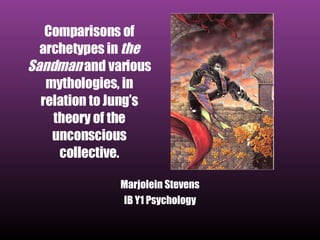
    1. Comparisons of archetypes in the Sandman and various mythologies, in relation to Jung’s theory of the unconscious collective. Marjolein Stevens IB Y1 Psychology
    2. What is Jung’s theory of the collective unconscious? Jung’s theory of unconscious collective states that there is “a biologically-based portion of the unconscious which reflects universal themes and ideas, not individual experience. (240)” So basically, nature over nurture: there’re some ideas we’re just born with, no matter where or when we’re from.
    3. What are archetypes? Archetypes are images of universal meaning. For example, the cycle of birth and death has been revisited in many religions and philosophies for many years. Carl Jung argued that archetypes were not independent inventions, but rather operated independent of human consciousness, and were in fact an inheritance from the collective unconscious.
    4. Desire, despair, destiny, dream, death, delirium, and destruction; also known as The Endless in Neil Gaiman’s Sandman series. In the Sandman, the Endless govern the ways of the universe .
      • Desire has a certain cruel streak and creates attractions.
      • Despair is responsible for depression, disease, and particularly enjoys creating self-loathing.
      • Destiny is chained to his book from which he reads fate.
      The Endless
      • Dream, or the Sandman himself, controls the world of dreams; both good ones and nightmares. He can give a person dreams, and he can take them away.
      • Death is responsible for the trafficking of human souls; she picks them up and takes them to where they belong.
      • Delirium is strange and eccentric; her job is to influence that element of craziness in life.
      • Destruction’s job is easy: destroy and decay.
    5. Greek Mythology
      • Ares, god of war. Enjoyed violent and bloody battles. Comparable to Destruction.
      • Charon, boatman who rows the dead across the river Styx if they were buried properly. Comparable to Death.
      • Eros, god of passionate love (cupid). Comparable to Desire.
    6. Norse Mythology
      • Hel, daughter of Loki, responsible for disease and famine. Comparable to Despair.
      • Loki, famous trickster, cunning and a shape-shifter. Could be compared to Delirium.
    7. Other Mythologies
      • Hindu Mythology: Varuna, a Vedic god who keeps the cosmos in order and is the embodiment of destiny and truth. Comparable to Destiny.
      • Egyptian Mythology: Bes, god who sent sweet dreams and banished nightmares. Comparable to Dream.
    8. So how are these archetypes?
      • There are quite a few basic archetypes that the Endless fit into.
      • Death naturally fits into the archetype of the presence of death
      • Delirium, Desire, Destruction, and Despair are all tricksters; masters of deception
      • The Shadow, the dark unwanted side of our unconscious, is represented by many of the Endless, especially Despair and Destruction
      • Death also falls into a certain Mother image, because, despite her occupation, she acts very motherly and cheerful, taking care of her subjects
    9. Why do comic book writers transfer ancient mythology into their comic books?
      • Comic book writers, such as Neil Gaiman, use archetypes to make their readers feel more comfortable with the world the writer has created. The mythology behind the modern tales make them seem more powerful and therefore somewhat invincible. It also relates to the reader’s “collective unconscious,” and therefore makes the comics applicable to a wider audience.
    10. References
      • Banks, Amanda (1998, January). Folklore and the comic book. Retrieved November 17, 2008, from Newfolk Web site: http://www.temple.edu/isllc/newfolk/comics1.html
      • The Endless. (2008). In Wikipedia [Web]. Wikimedia Foundation, Inc.. Retrieved November 17, 2008, from http://en.wikipedia.org/wiki/The_Endless Glassman
      • Gaiman, N. (1993). Sandman: Fables and Reflections . New York, NY: DC Comics.
      • Gaiman, N. (1999). Sandman: The Dream Hunters . New York, NY: DC Comics.
      • Glassman, W. E., & Hadad, M. (2004). Approaches to Psychology .New York: Open University Press.
      • Keenan, S. (2000). Gods, Goddesses, and Monsters: A Book of World Mythology . New York, NY: Scholastic, Inc..

    + MarjoleinsMarjoleins, 2 years ago

    custom

    824 views, 0 favs, 1 embeds more stats

    An exploration of archetypes in terms of ancient my more

    More info about this document

    © All Rights Reserved

    Go to text version

    • Total Views 824
      • 823 on SlideShare
      • 1 from embeds
    • Comments 0
    • Favorites 0
    • Downloads 2
    Most viewed embeds
    • 1 views on http://www.squidoo.com

    more

    All embeds
    • 1 views on http://www.squidoo.com

    less

    Flagged as inappropriate Flag as inappropriate
    Flag as inappropriate

    Select your reason for flagging this presentation as inappropriate. If needed, use the feedback form to let us know more details.

    Cancel
    File a copyright complaint
    Having problems? Go to our helpdesk?

    Categories