The NCQA Baseline
   Assessment Tool


. . . and How Sharing Information
   Production Process Metadata
  Fosters Process Improvement
The BAT and Information
   Production Process Metadata
• What is the Baseline Assessment Tool?
• What is this Metadata all about?
  How it relates to:
  – Quality Management and Process Improvement
  – Information Production Processes
  – HEDIS/QARR
• Process Improvement Details Useful for
  the BAT
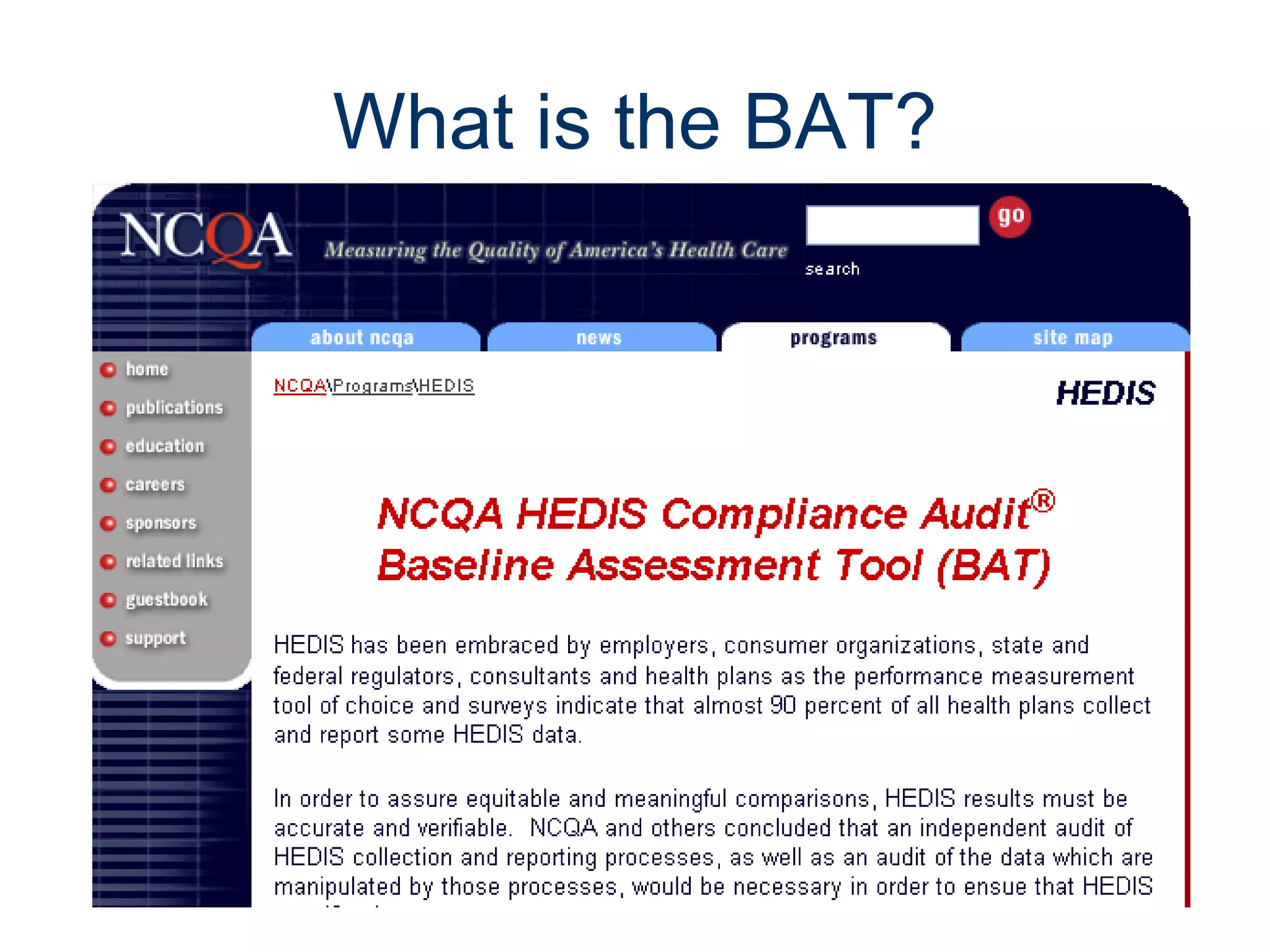
What is the BAT?
The NCQA Baseline
         Assessment Tool
• The BAT collects information that helps
  the NCQA assure that health plan
  information systems can generate reliable
  quality measures for HEDIS/QARR
• Supports the NCQA's HEDIS Compliance
  Audit, an audit for compliance with HEDIS
  specifications for measures.
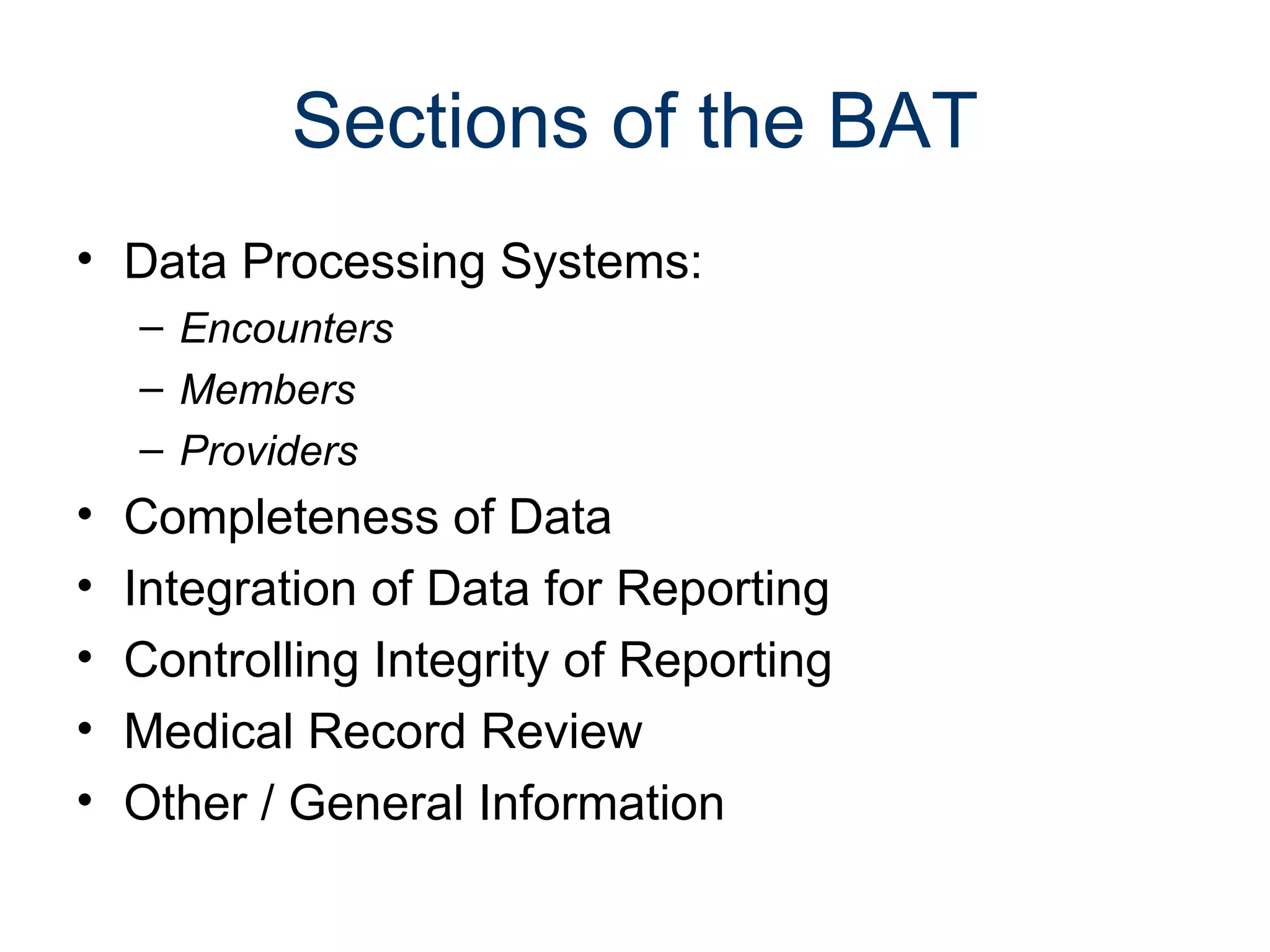
Sections of the BAT
• Data Processing Systems:
    – Encounters
    – Members
    – Providers
•   Completeness of Data
•   Integration of Data for Reporting
•   Controlling Integrity of Reporting
•   Medical Record Review
•   Other / General Information
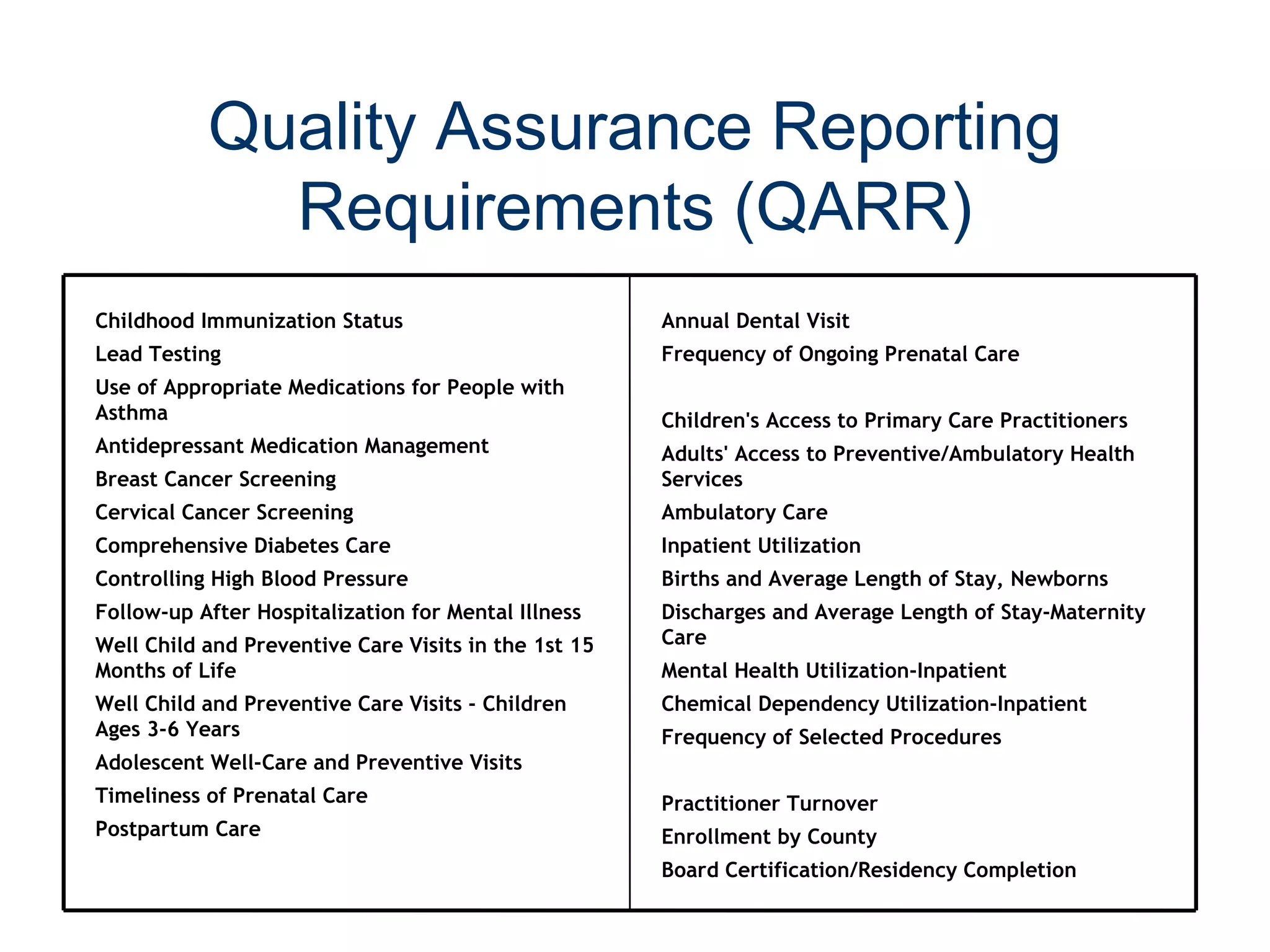
Quality Assurance Reporting
             Requirements (QARR)
Childhood Immunization Status                         Annual Dental Visit
Lead Testing                                          Frequency of Ongoing Prenatal Care
Use of Appropriate Medications for People with
Asthma                                                Children's Access to Primary Care Practitioners
Antidepressant Medication Management                  Adults' Access to Preventive/Ambulatory Health
Breast Cancer Screening                               Services
Cervical Cancer Screening                             Ambulatory Care
Comprehensive Diabetes Care                           Inpatient Utilization
Controlling High Blood Pressure                       Births and Average Length of Stay, Newborns
Follow-up After Hospitalization for Mental Illness    Discharges and Average Length of Stay-Maternity
Well Child and Preventive Care Visits in the 1st 15   Care
Months of Life                                        Mental Health Utilization-Inpatient
Well Child and Preventive Care Visits - Children      Chemical Dependency Utilization-Inpatient
Ages 3-6 Years                                        Frequency of Selected Procedures
Adolescent Well-Care and Preventive Visits
Timeliness of Prenatal Care                           Practitioner Turnover
Postpartum Care                                       Enrollment by County
                                                      Board Certification/Residency Completion
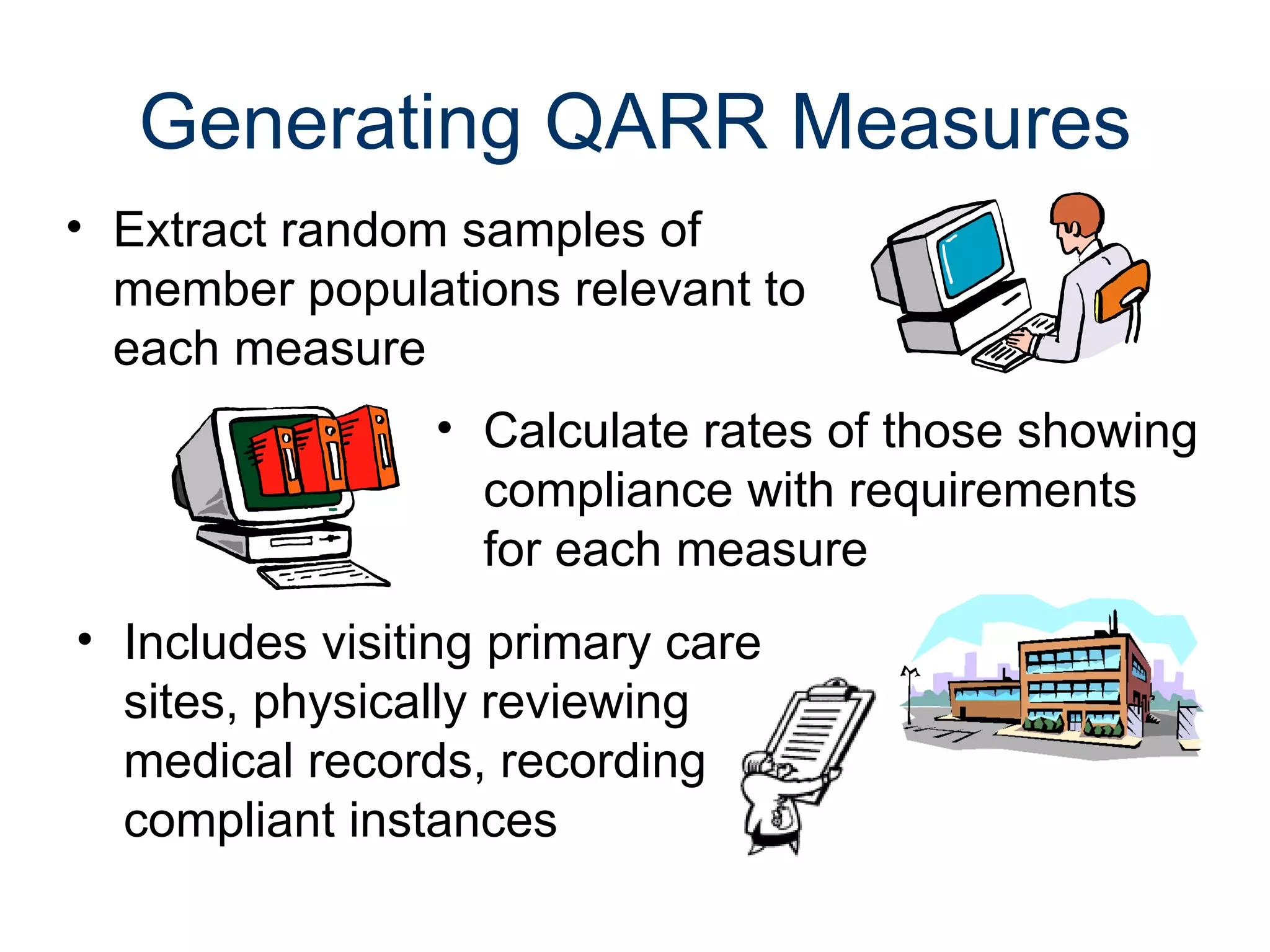
Generating QARR Measures
• Extract random samples of
  member populations relevant to
  each measure
                • Calculate rates of those showing
                  compliance with requirements
                  for each measure
• Includes visiting primary care
  sites, physically reviewing
  medical records, recording
  compliant instances
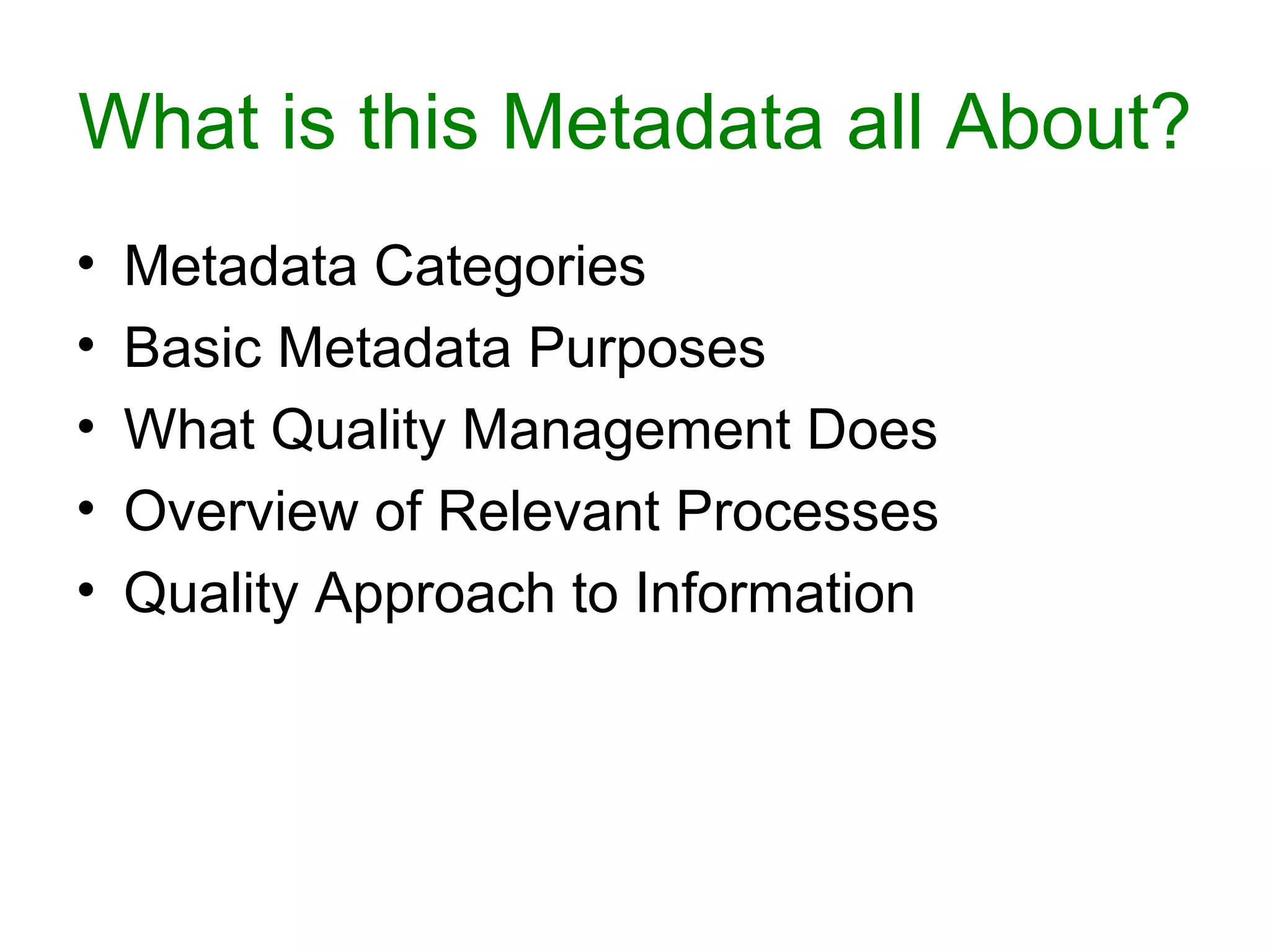
What is this Metadata all About?
•   Metadata Categories
•   Basic Metadata Purposes
•   What Quality Management Does
•   Overview of Relevant Processes
•   Quality Approach to Information
Metadata Categories
• Production Process Factors
   –   People
   –   Process
   –   Tools
   –   Materials
• Quality Measures
   – Timeliness
   – Completeness
   – Accuracy
• Barriers to Quality (Root Causes)
• Improvement Processes
   – Quality Assessment
   – Cleanup and Transfer
   – Process Improvement
Basic Metadata Purposes:
• Create common understanding
• Foster process improvement
• Enable information stewardship
Metadata Creates
       Common Understanding
Between:
• Information Producers:
  – Business Process: data acquisition, entry and
    updating
  – Technical Process: developers and analysts
• Information Stakeholders:
  – Anybody who uses the information for business
Metadata Fosters
Information Process Improvement
• Establishes common understanding, from an
  enterprise standpoint, of all stakeholder
  requirements for information
• Fosters collaboration, empowerment,
  teamwork, professionalism, pride of
  workmanship
• Makes environment of information
  stewardship possible
Information Stewardship

 Willingness to be accountable for a
 set of business information for the
well-being of the larger organization,
by operating in service of (rather than
 under control of) those around us.
What Quality Management Does:
• Brings producers and stakeholders together
• Makes sure stakeholder requirements are fully
  represented
• Assures completeness and objectivity of measures so
  they are reliable basis for understanding and managing
  functionality and performance
• Establishes factual basis
• Makes process improvement possible
• Makes cross-functional teamwork possible
• Makes performance management possible
• Makes resource management possible
The Definition of Quality

Meeting and exceeding stakeholder
  (customer) expectations and
          requirements
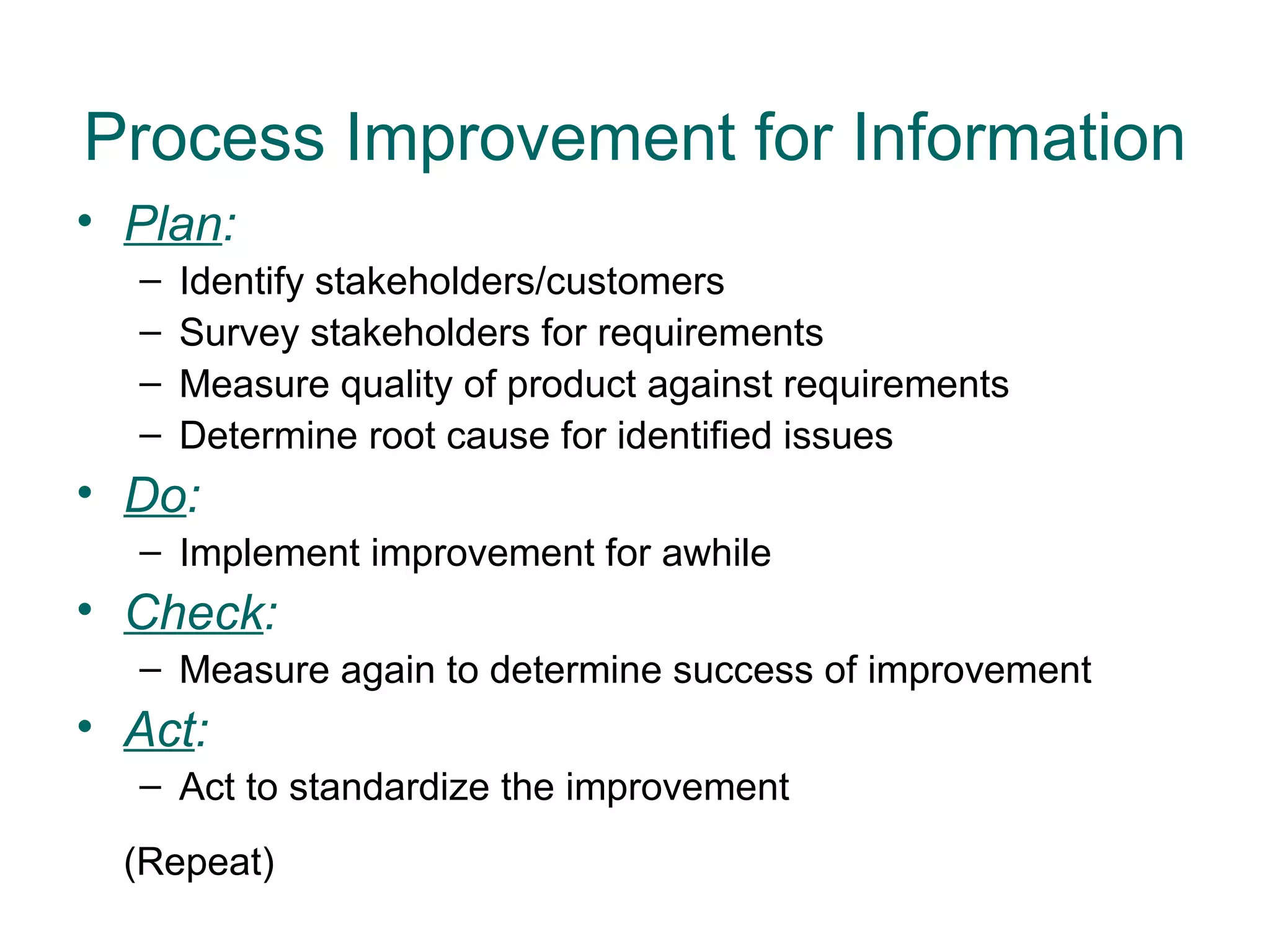
Process Improvement:
      PDCA (Shewhart Cycle)
• Plan an improvement based on factual
  basis
• Do it for awhile
• Check it for improvement
• Act to standardize the improvement

 (Repeat)
Process Improvement:
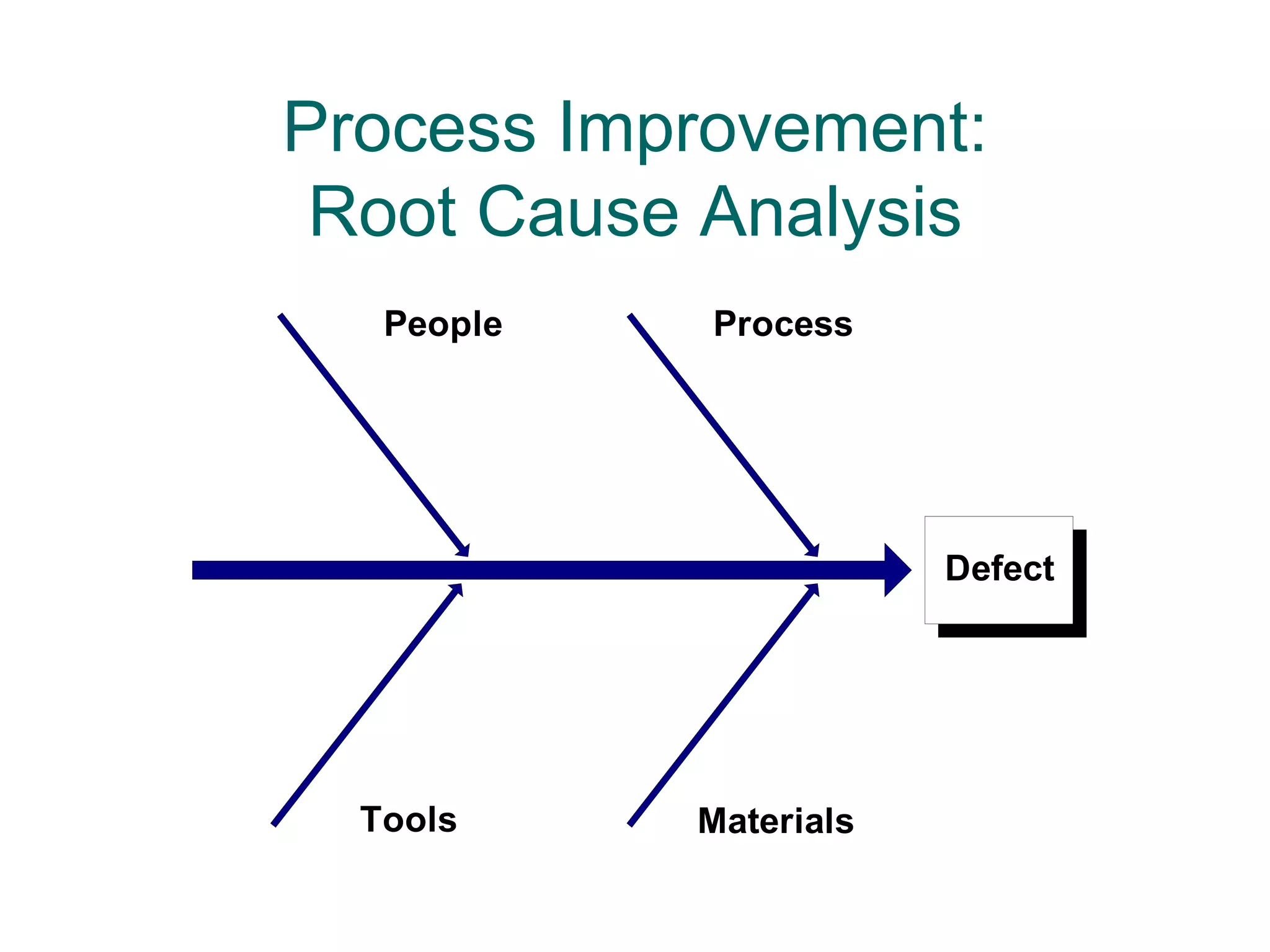
 Root Cause Analysis
   People   Process


                        Defect


  Tools     Materials
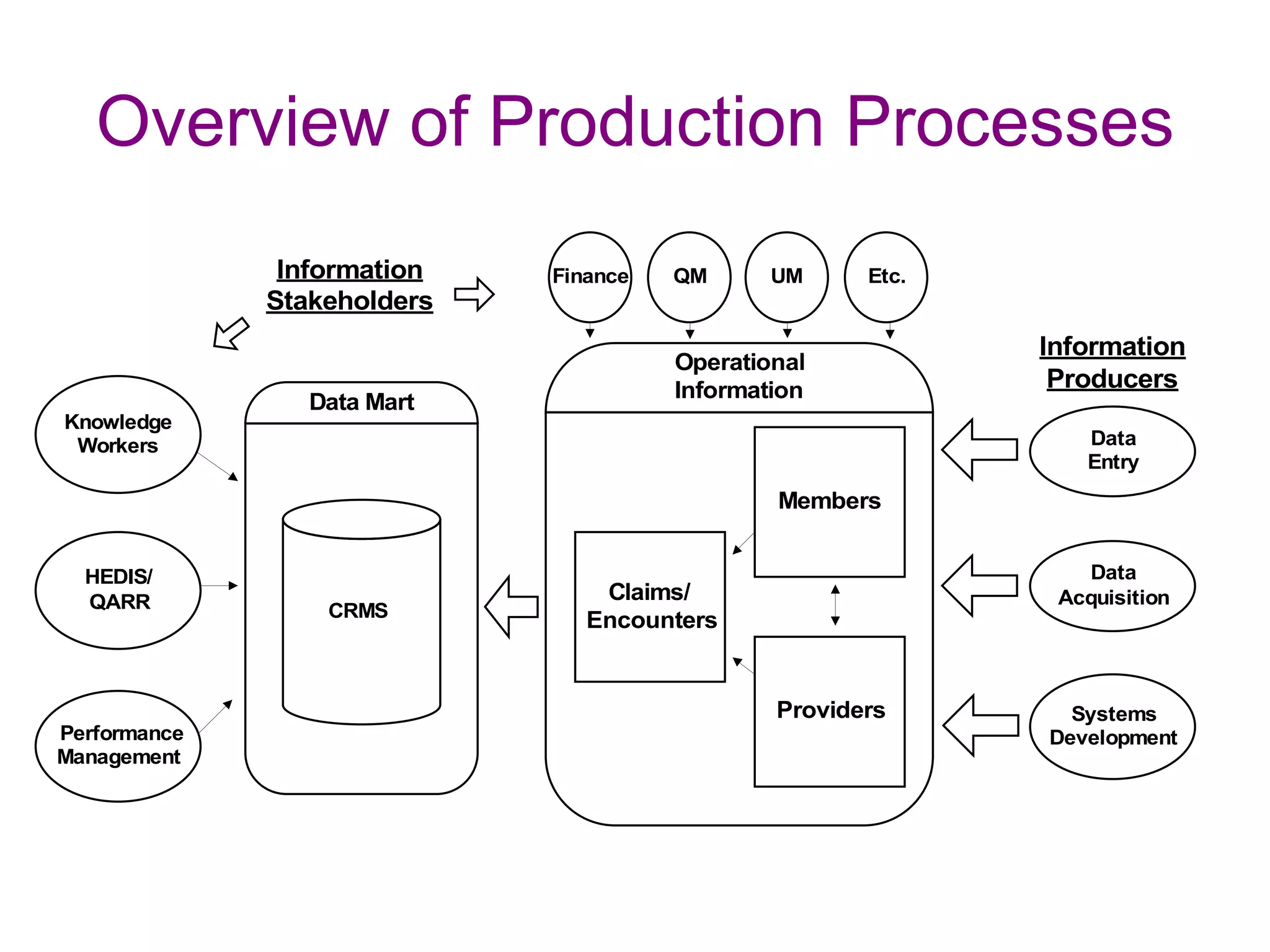
Overview of Production Processes
               Information   Finance   QM      UM     Etc.
              Stakeholders
                                                             Information
                                       Operational
                                       Information            Producers
                 Data Mart
Knowledge
 Workers                                                        Data
                                                                Entry
                                               Members


  HEDIS/                                                        Data
  QARR                           Claims/                      Acquisition
                  CRMS          Encounters


                                               Providers       Systems
Performance                                                  Development
Management
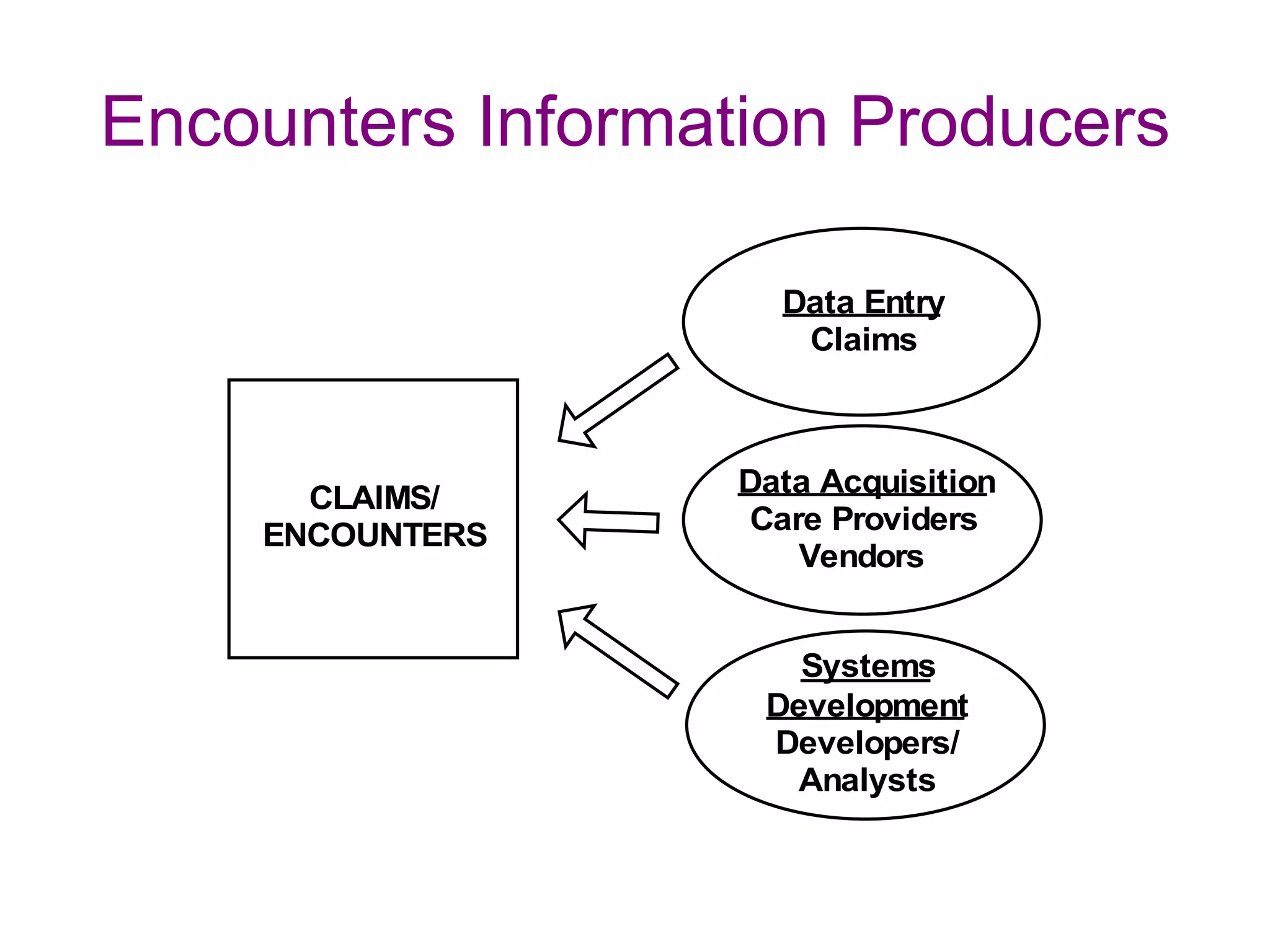
Encounters Information Producers

                     Data Entry
                      Claims


                   Data Acquisition
      CLAIMS/
    ENCOUNTERS     Care Providers
                      Vendors


                      Systems
                    Development
                    Developers/
                      Analysts
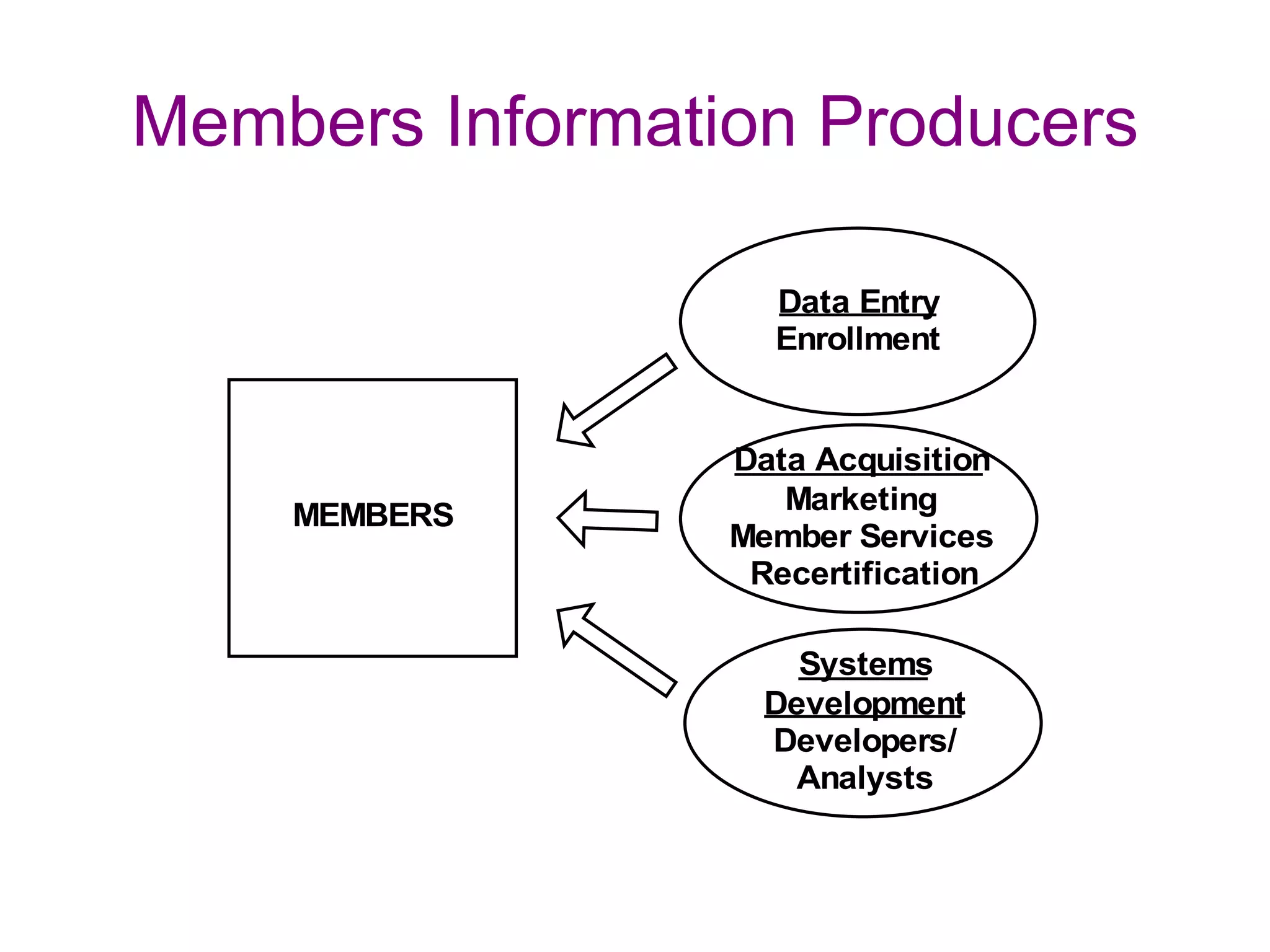
Members Information Producers

                   Data Entry
                   Enrollment


                 Data Acquisition
    MEMBERS         Marketing
                 Member Services
                  Recertification

                     Systems
                   Development
                   Developers/
                    Analysts
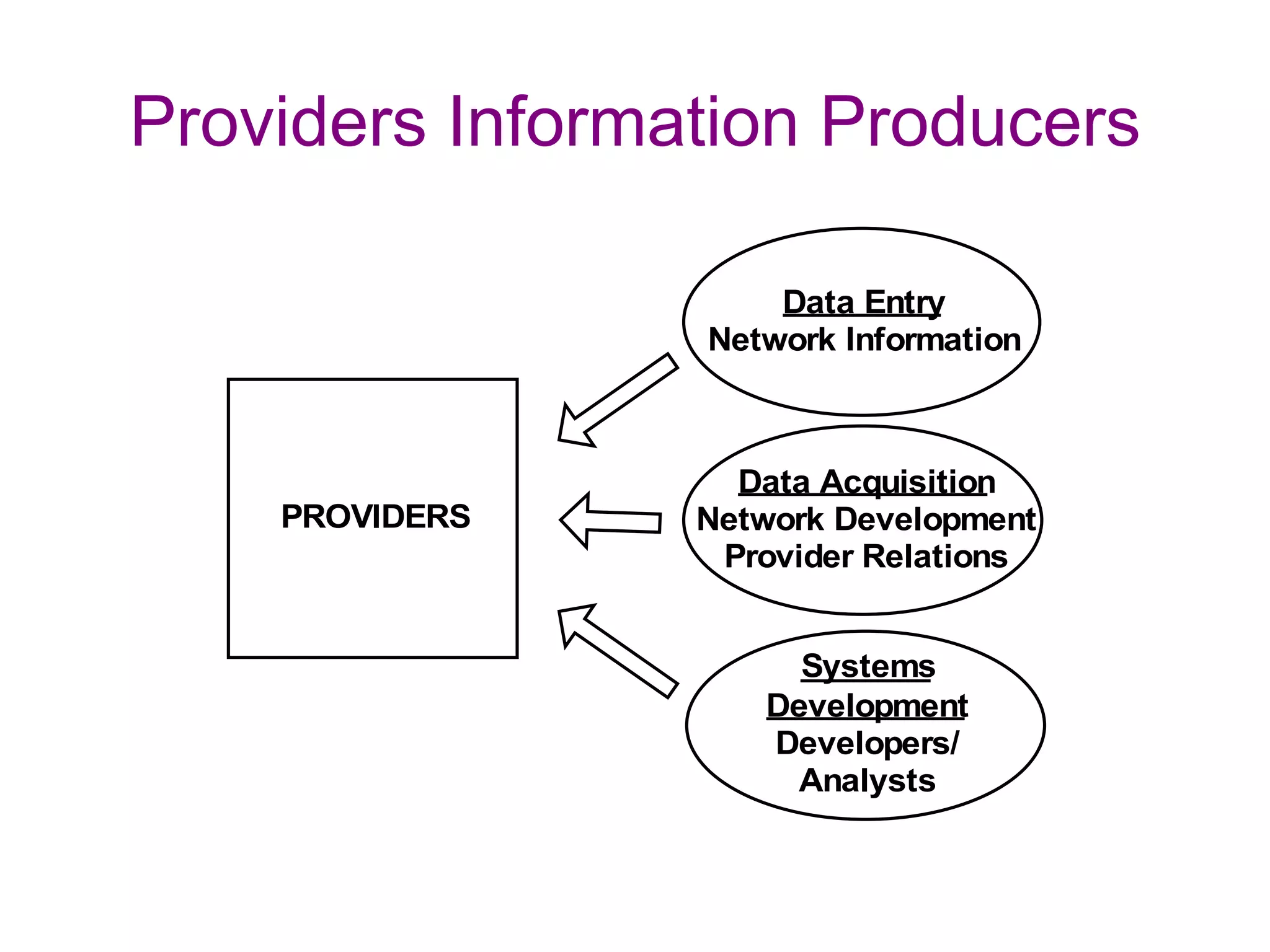
Providers Information Producers

                     Data Entry
                 Network Information


                   Data Acquisition
    PROVIDERS    Network Development
                  Provider Relations


                      Systems
                    Development
                    Developers/
                      Analysts
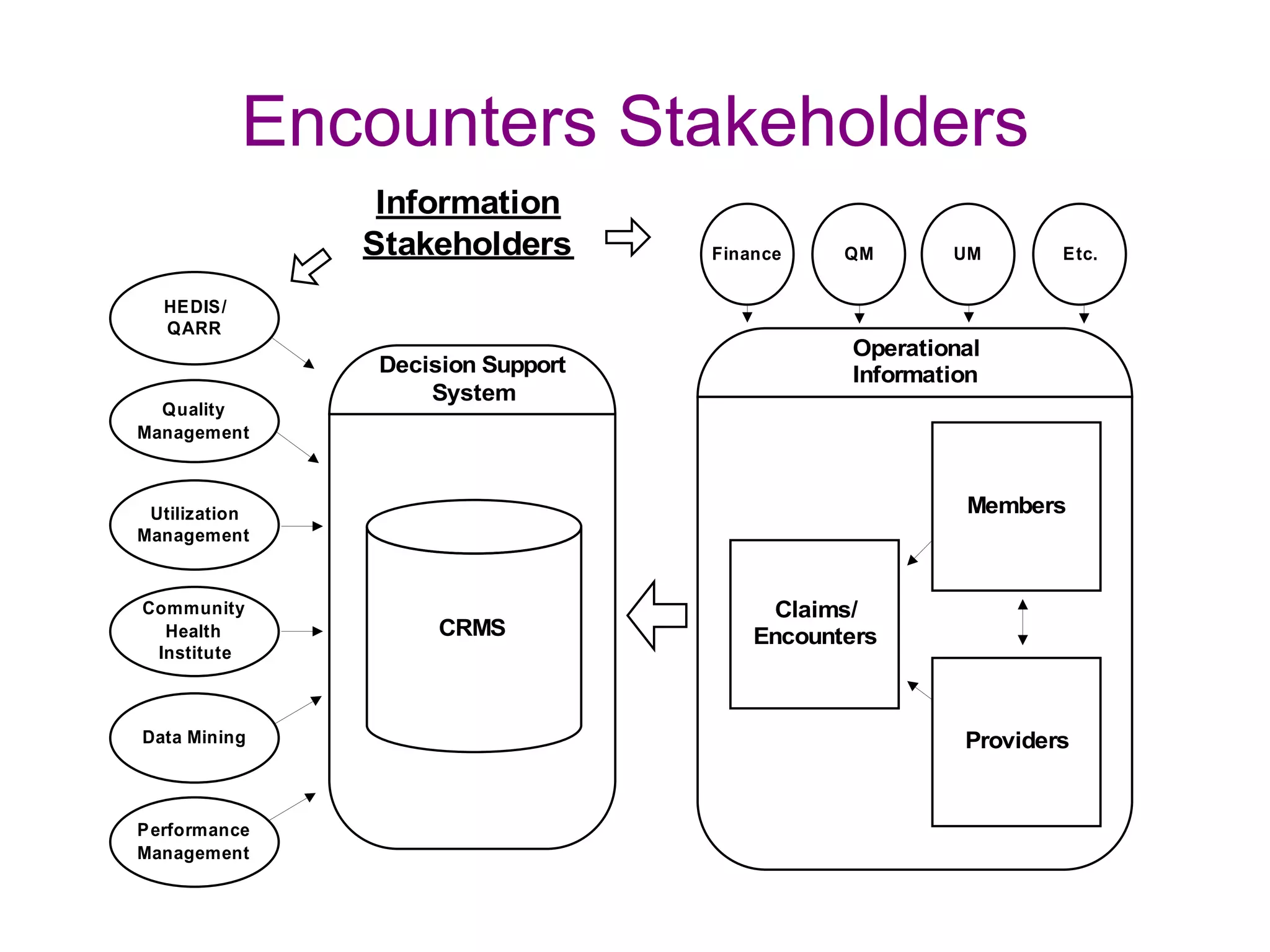
Encounters Stakeholders
                Information
               Stakeholders       Finance    QM      UM       Etc.

  HEDIS/
  QARR
                                             Operational
               Decision Support              Information
                   System
  Quality
Management


 Utilization                                          Members
Management


Community                               Claims/
  Health            CRMS              Encounters
 Institute


Data Mining                                           Providers


P erformance
Management
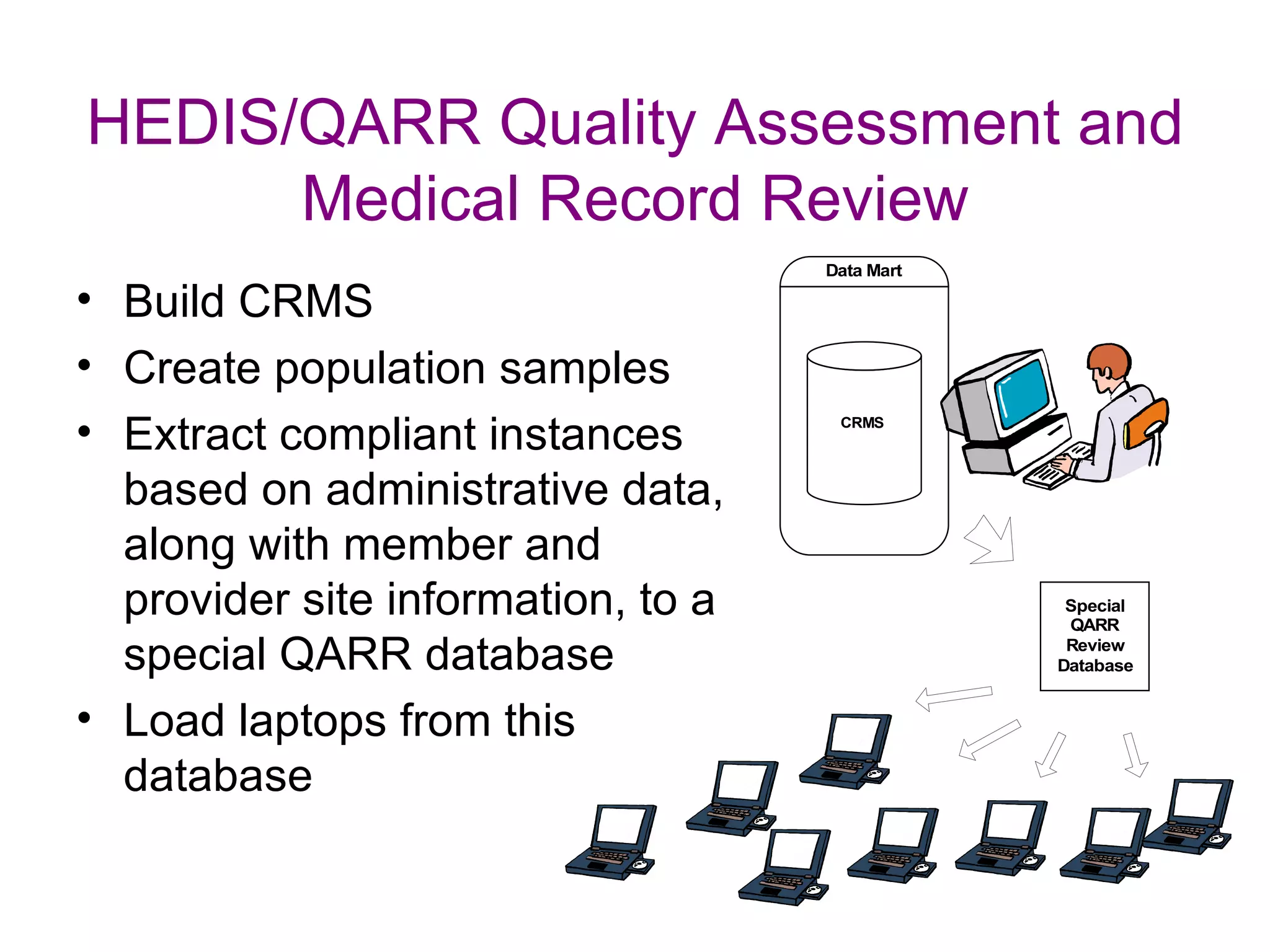
HEDIS/QARR Quality Assessment and
      Medical Record Review
                                    Data Mart

• Build CRMS
• Create population samples
• Extract compliant instances        CRMS


  based on administrative data,
  along with member and
  provider site information, to a                Special
                                                 QARR

  special QARR database                          Review
                                                Database


• Load laptops from this
  database
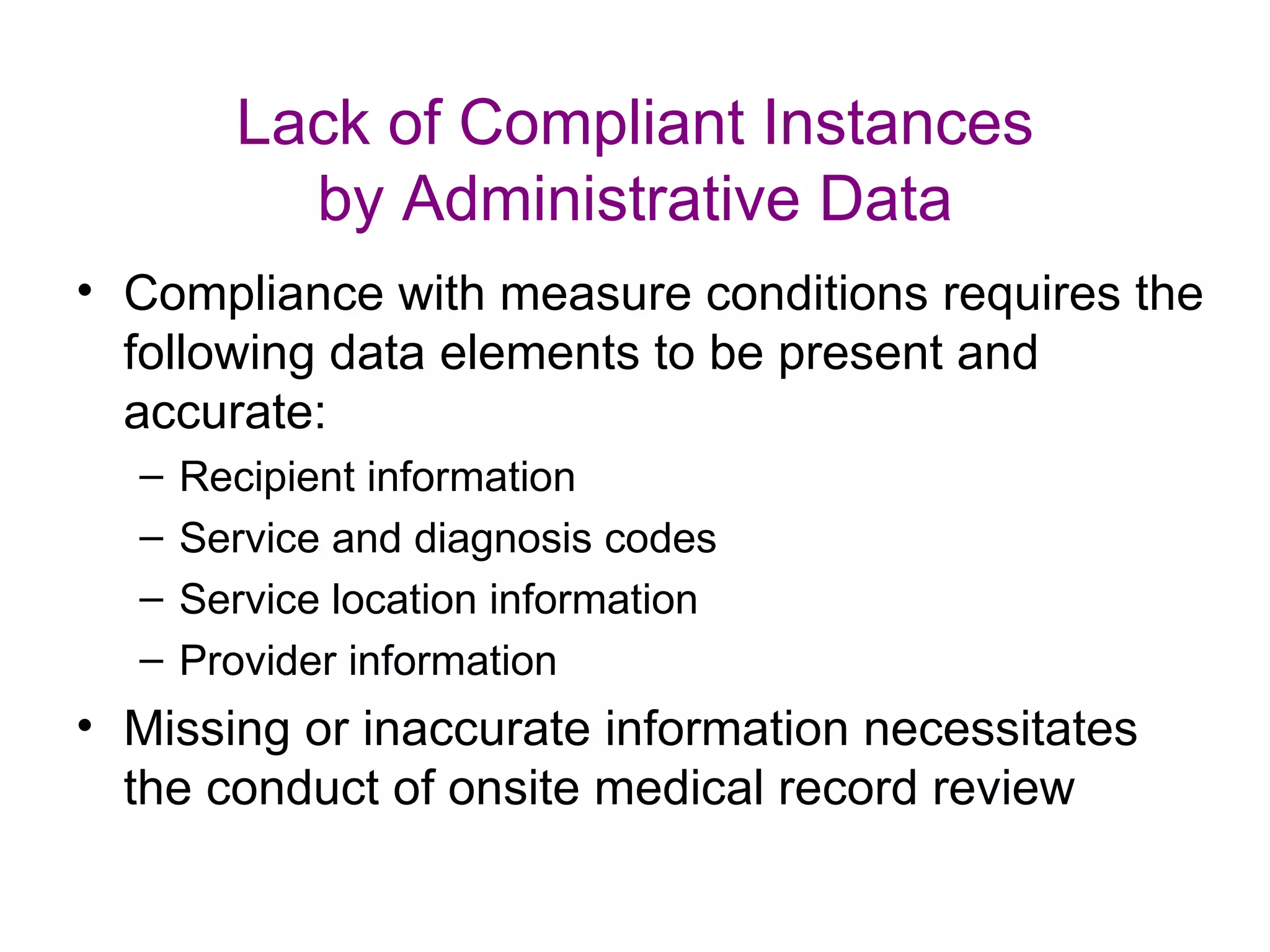
Lack of Compliant Instances
          by Administrative Data
• Compliance with measure conditions requires the
  following data elements to be present and
  accurate:
  –   Recipient information
  –   Service and diagnosis codes
  –   Service location information
  –   Provider information
• Missing or inaccurate information necessitates
  the conduct of onsite medical record review
HEDIS/QARR Quality Assessment and
      Medical Record Review
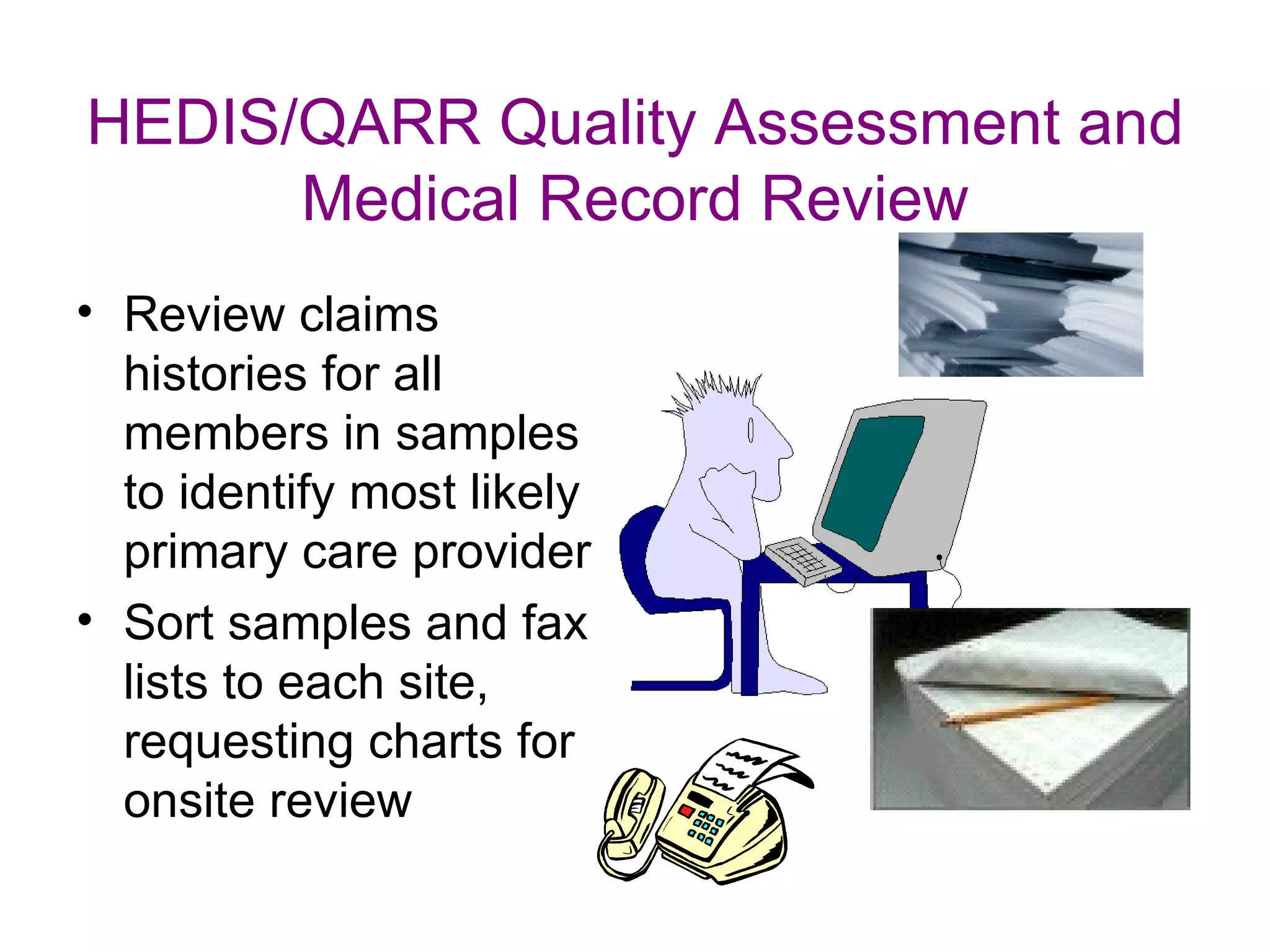
• Review claims
  histories for all
  members in samples
  to identify most likely
  primary care provider
• Sort samples and fax
  lists to each site,
  requesting charts for
  onsite review
HEDIS/QARR Quality Assessment and
      Medical Record Review


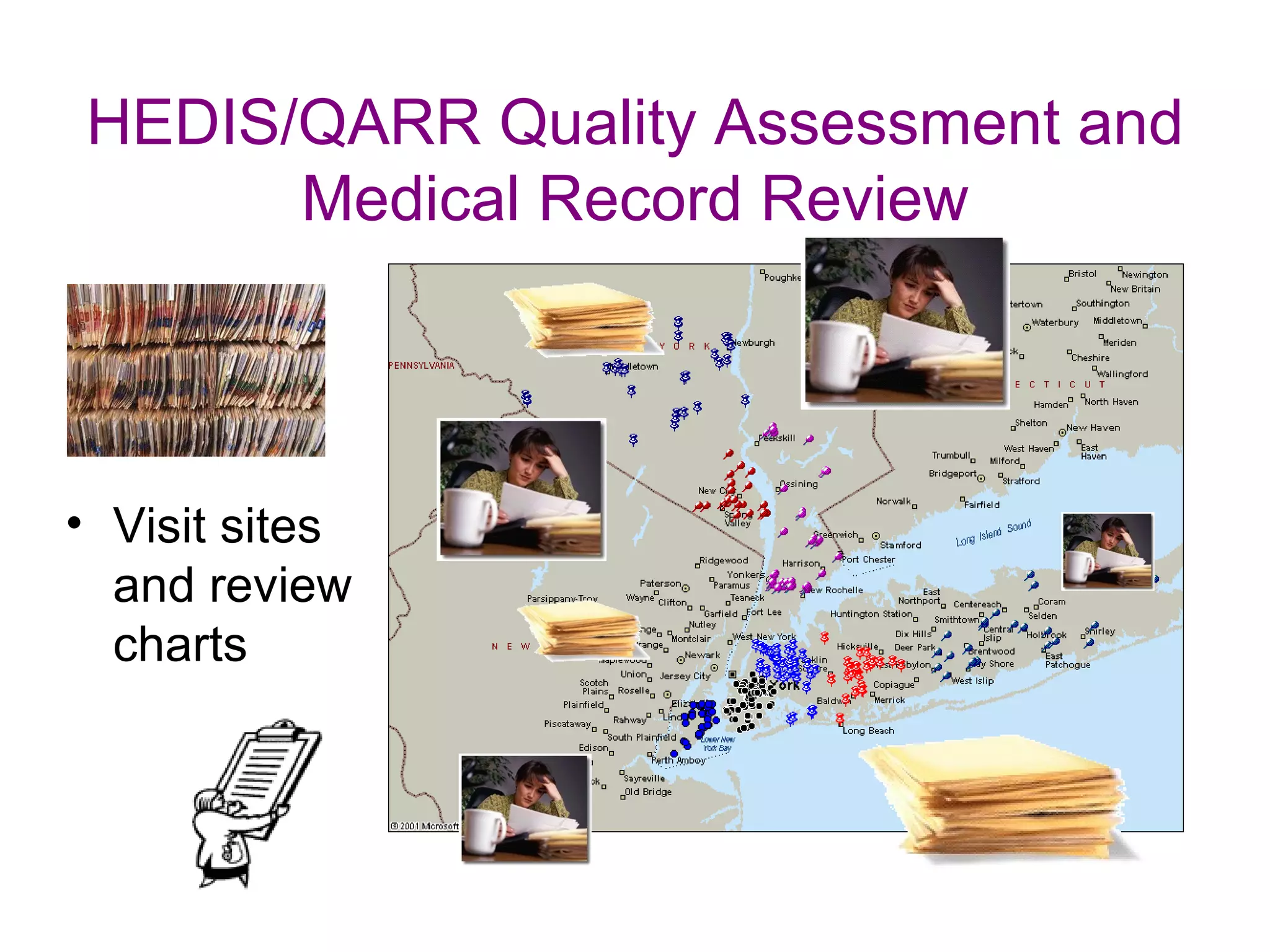
• Visit sites
  and review
  charts
HEDIS/QARR Quality Assessment and
      Medical Record Review
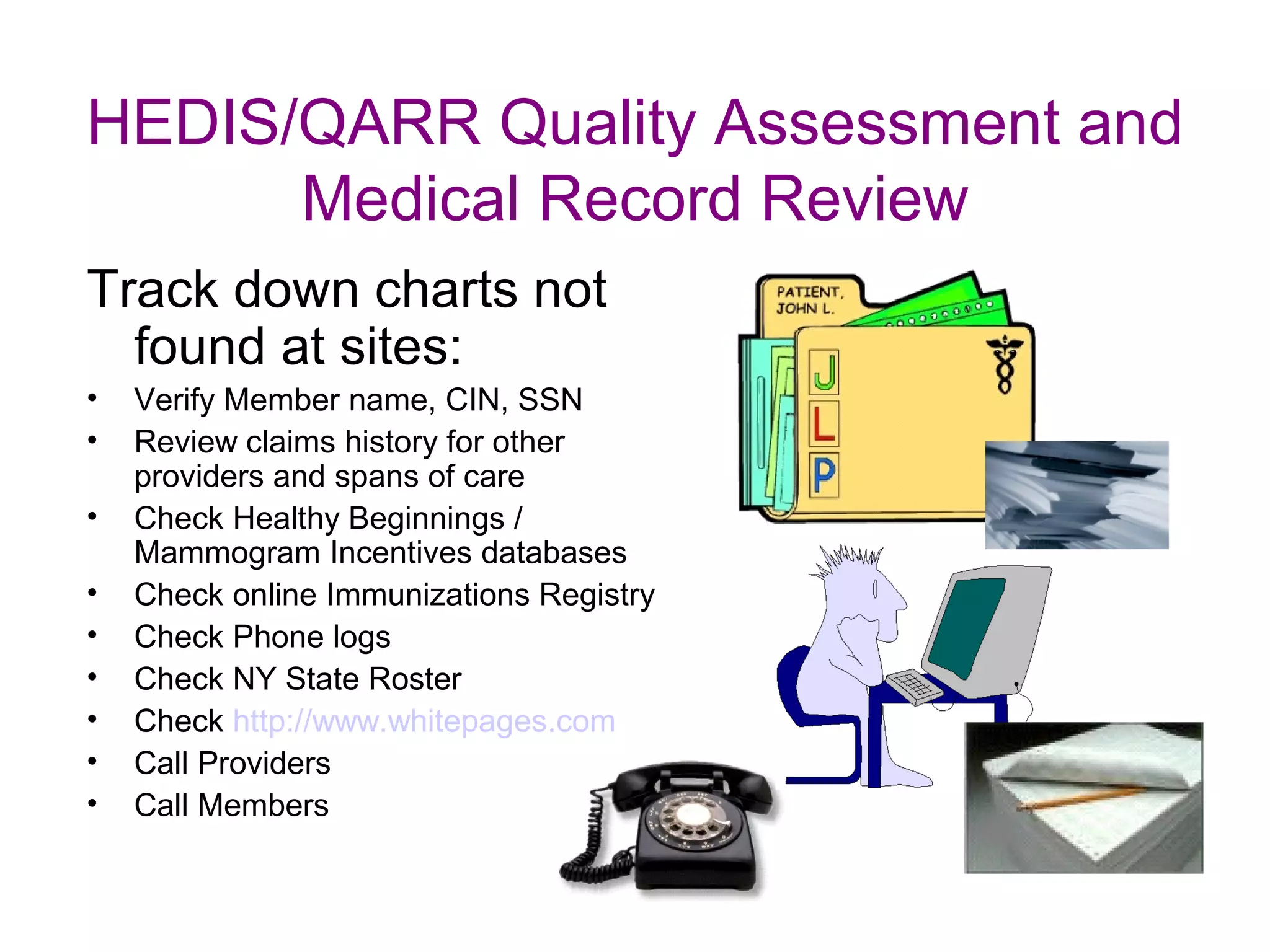
Track down charts not
  found at sites:
•   Verify Member name, CIN, SSN
•   Review claims history for other
    providers and spans of care
•   Check Healthy Beginnings /
    Mammogram Incentives databases
•   Check online Immunizations Registry
•   Check Phone logs
•   Check NY State Roster
•   Check http://www.whitepages.com
•   Call Providers
•   Call Members
HEDIS/QARR Quality Assessment and
      Medical Record Review


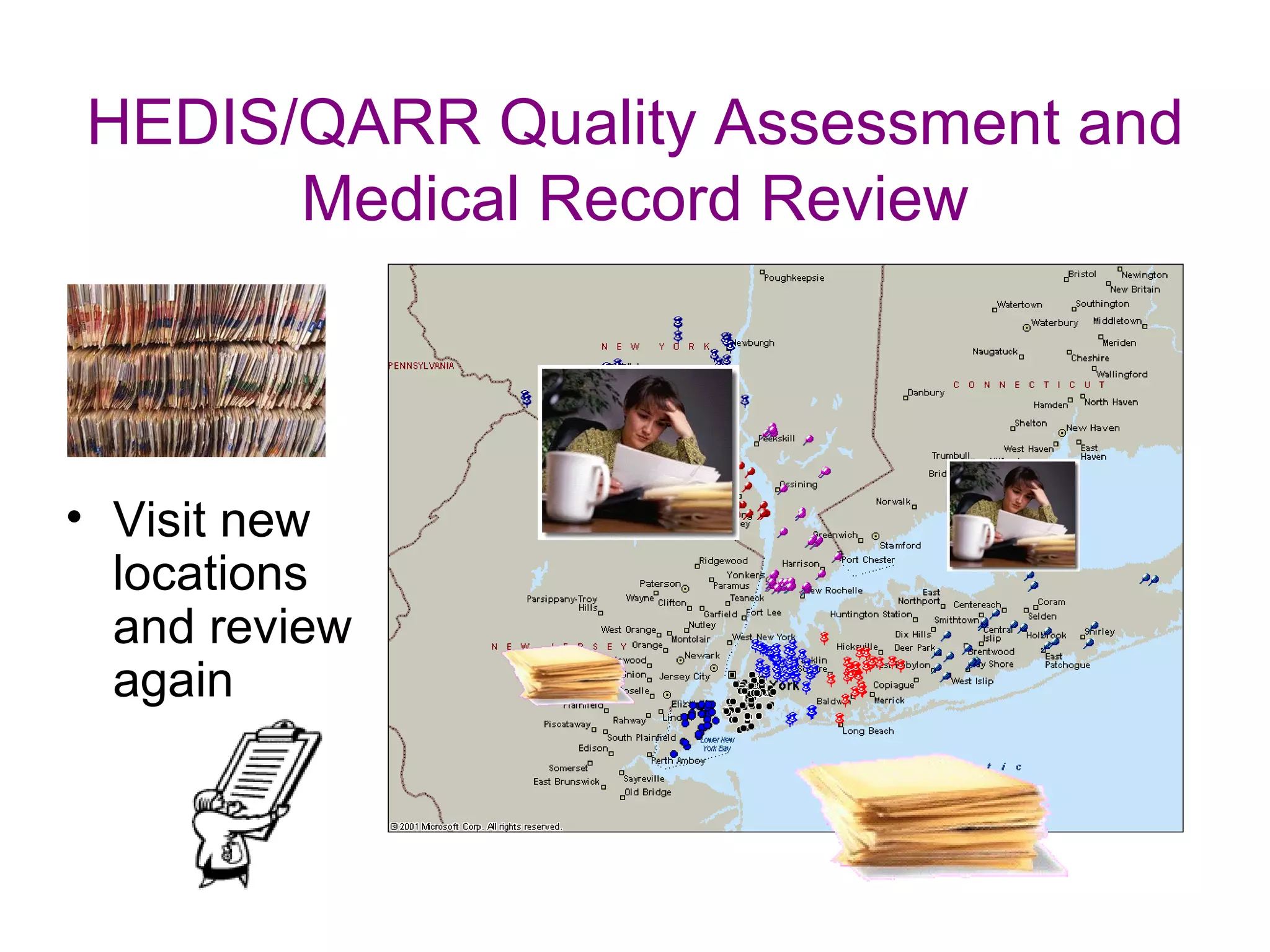
• Visit new
  locations
  and review
  again
HEDIS/QARR Quality Assessment and
      Medical Record Review
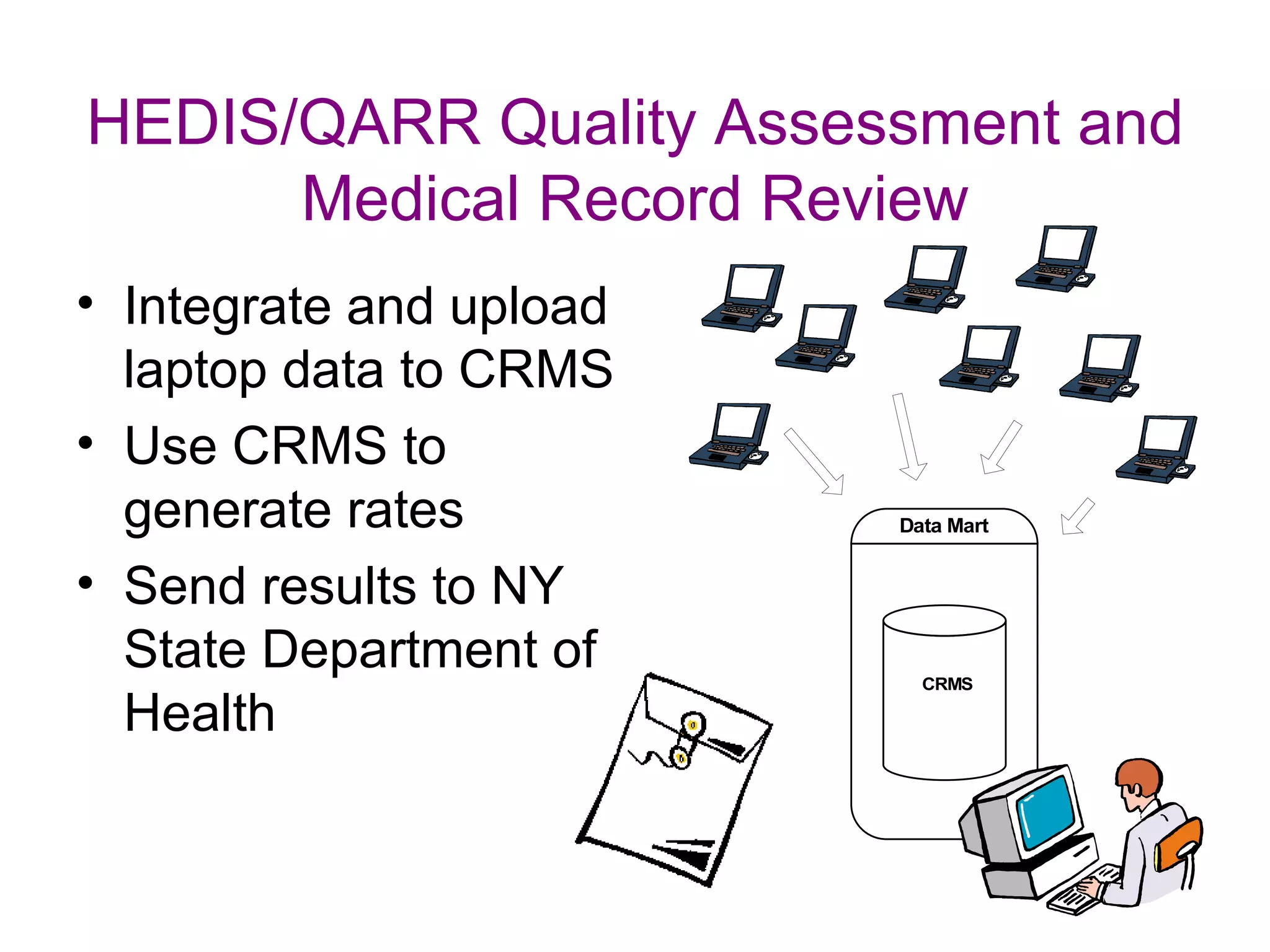
• Integrate and upload
  laptop data to CRMS
• Use CRMS to
  generate rates         Data Mart


• Send results to NY
  State Department of      CRMS

  Health
HEDIS/QARR Quality Assessment and
      Medical Record Review
• Massive costs due to nonquality data
• Nurses to sites throughout network, three
  times
• Hunting down members, what provider
  they're getting care from, missing or
  miscoded services and diagnoses
• 4300+ members in samples
Quality Approach
             to Information
• Foster common understanding between producers
  and stakeholders by use of shared metadata
• Accuracy can’t be automated; only people can
  assess and correct for accuracy
• Information is an enterprise resource
• Measure information quality in voice of downstream
  customers/stakeholders
• To improve a production process, measure its
  product
• Improve information quality at the point of capture
Foster Common Understanding
   Between Producers and
        Stakeholders
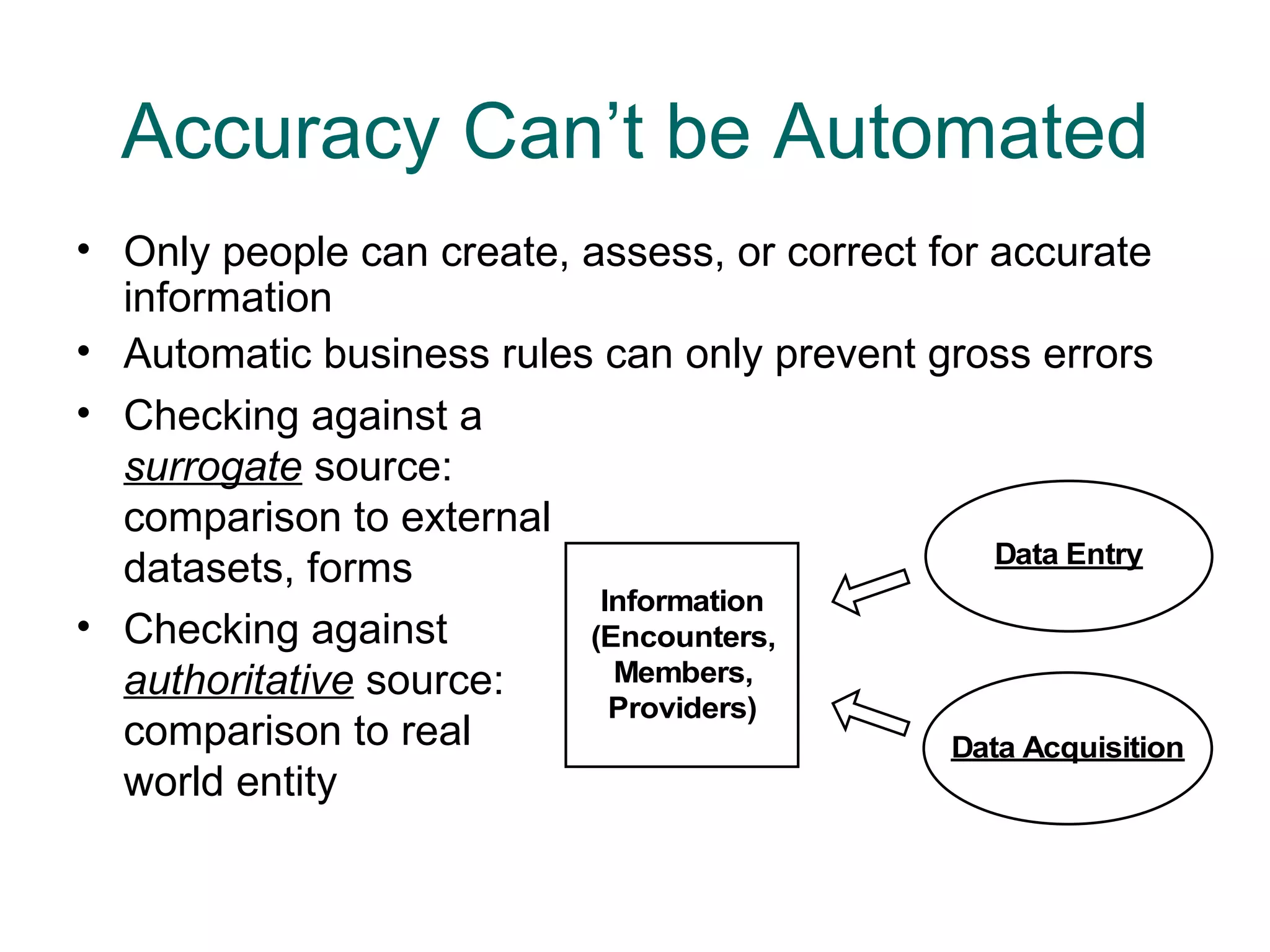
Accuracy Can’t be Automated
• Only people can create, assess, or correct for accurate
  information
• Automatic business rules can only prevent gross errors
• Checking against a
  surrogate source:
  comparison to external
                                                 Data Entry
  datasets, forms
                           Information
• Checking against        (Encounters,
  authoritative source:     Members,
                            Providers)
  comparison to real                          Data Acquisition
  world entity
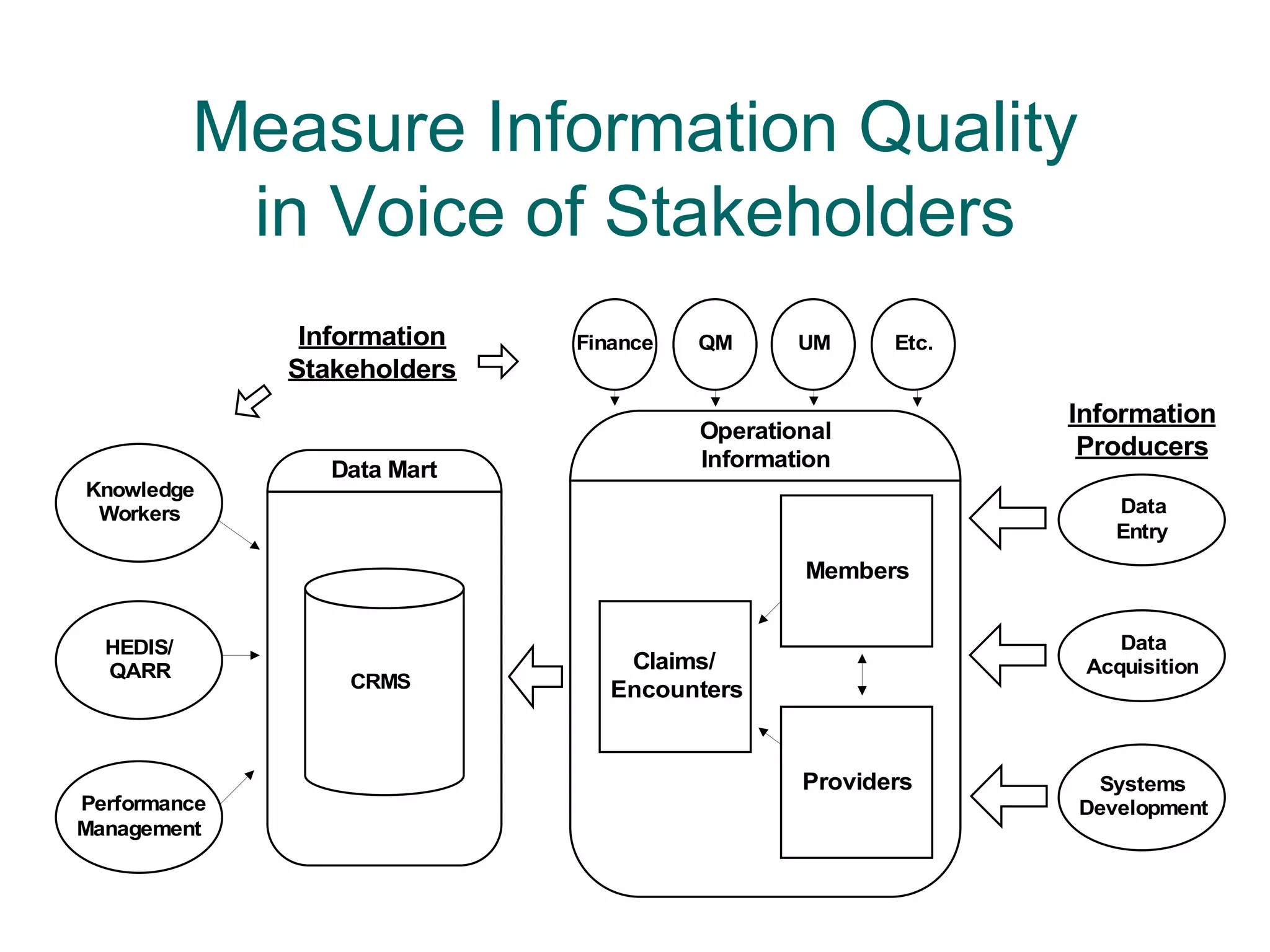
Measure Information Quality
            in Voice of Stakeholders
               Information   Finance   QM      UM     Etc.
              Stakeholders
                                                             Information
                                       Operational
                                       Information
                                                              Producers
                 Data Mart
Knowledge
 Workers                                                        Data
                                                                Entry
                                               Members


  HEDIS/                                                         Data
  QARR                           Claims/                      Acquisition
                  CRMS          Encounters


                                               Providers      Systems
Performance                                                  Development
Management
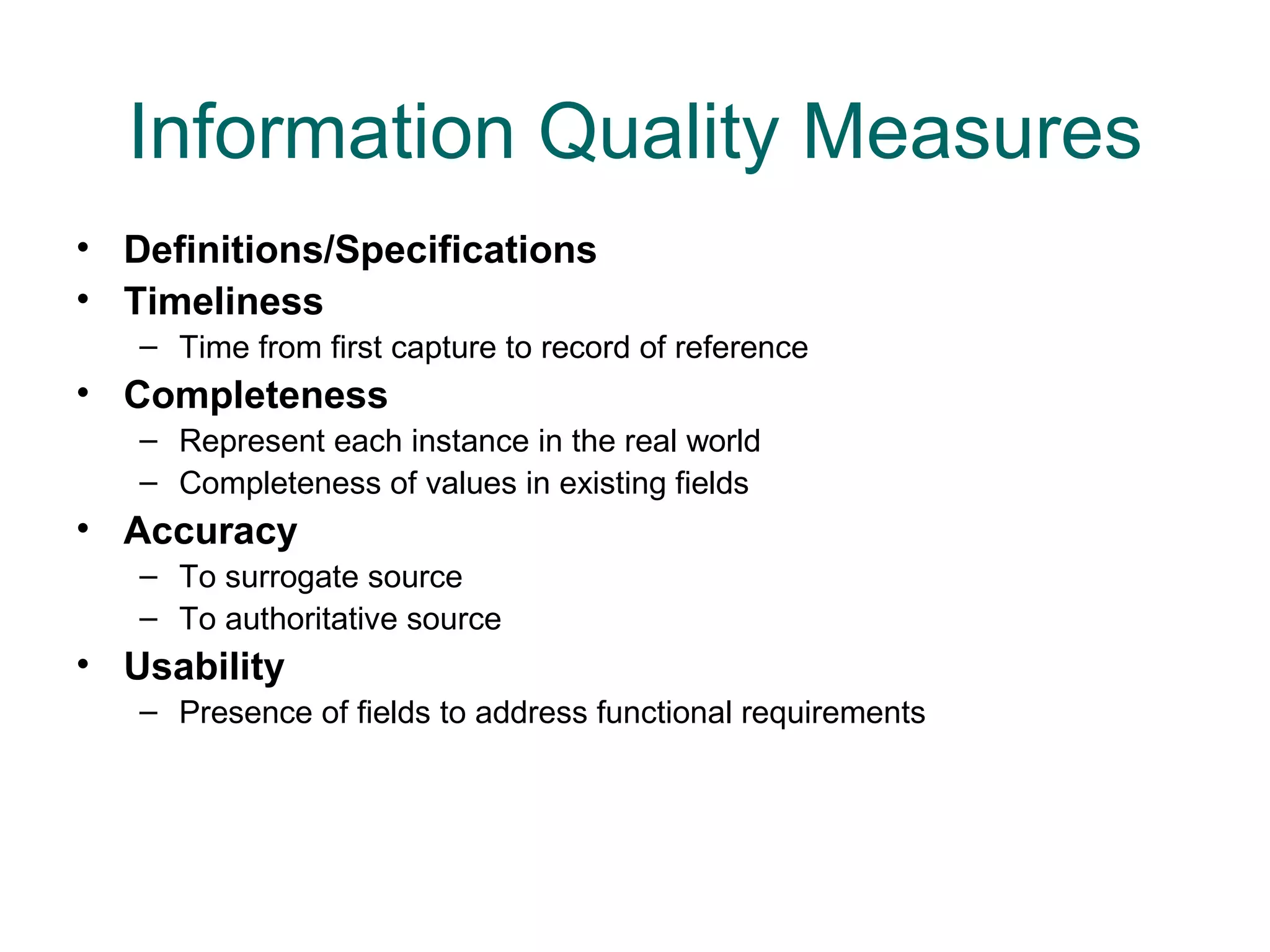
Information Quality Measures
• Definitions/Specifications
• Timeliness
   – Time from first capture to record of reference
• Completeness
   – Represent each instance in the real world
   – Completeness of values in existing fields
• Accuracy
   – To surrogate source
   – To authoritative source
• Usability
   – Presence of fields to address functional requirements
Measure the Product
         to Improve its Process
• Purpose is not to
  improve a product by
  measuring it, but to
  improve its production
  process
• Product is of concern only from a limited
  perspective
• Quality measures show how well processes for
  producing information are functioning; i.e., how
  well they address all stakeholder requirements
Applications are not
        the Product to Measure
• Assessing applications addresses
  narrow requirements, not
  downstream requirements for the
  information
• Address information as the product, understood as
  an enterprise resource
• Measure the information that applications work on to
  assess development
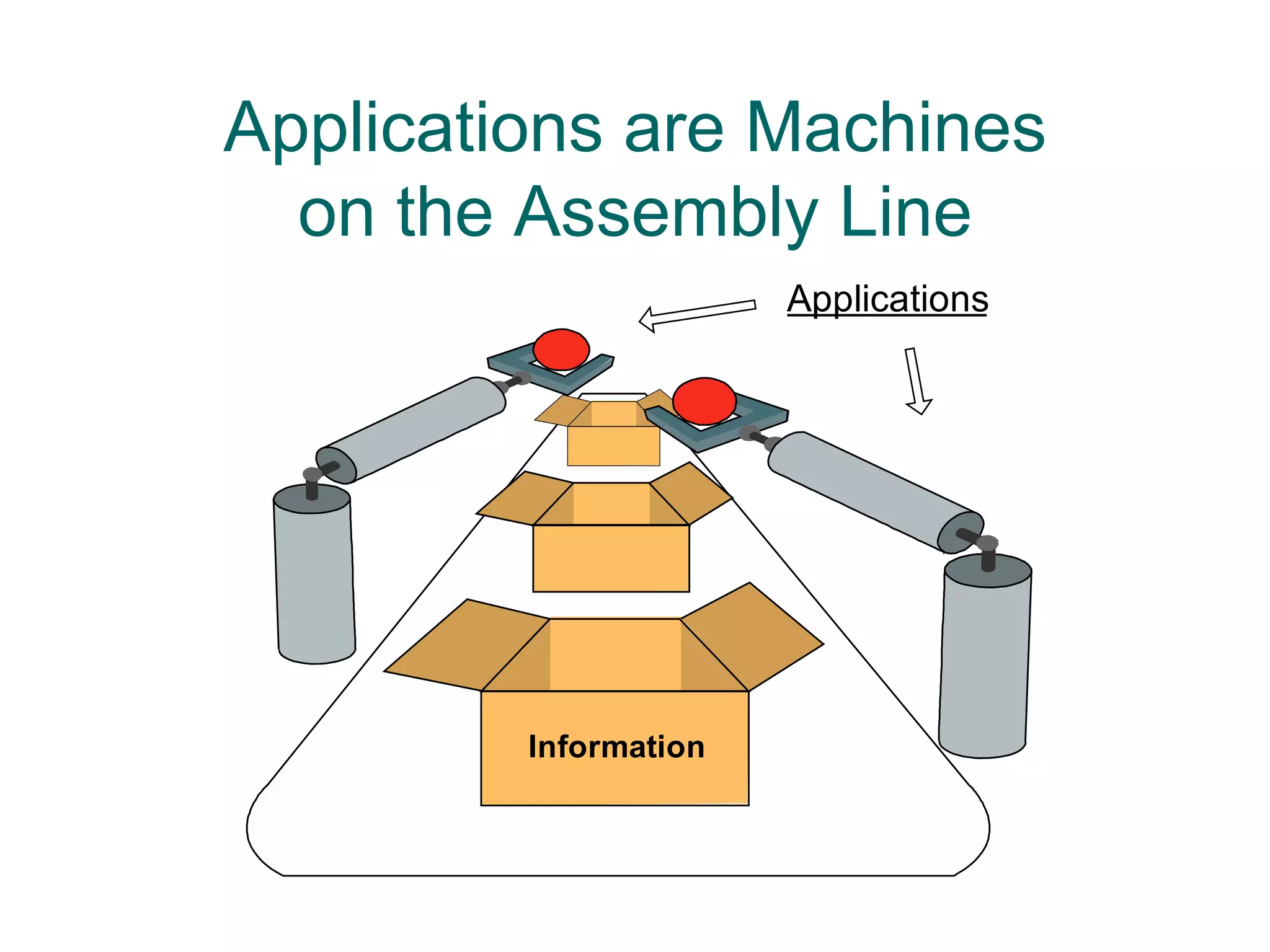
• Applications are machines on the assembly line, not
  the product
Applications are Machines
  on the Assembly Line
                       Applications


         Information
Improving Information (the Product)
     is not the Chief Concern
• Right product to measure, but wrong purpose
• Improving the product doesn't prevent errors
  or assure ongoing quality
• Improve production processes
• Information product improvement is all cost
  basis/scrap and rework
• Correction of issues preventable by process
Three Ways to Correct
       Information Quality
• As a one-time process
• As a regular conversion process
• At the point of capture
As a One-time Process for a
        Special Table
• Not preventative; same problems recur
  because information production process
  has not changed
• Quality of data decays; not addressing
  changes in the information
• Creates a redundant table for the entity
  (encounters, services, providers,
  members)
As a Regular Conversion for a
 Data Mart or Data Warehouse
• Performed under constraint of a regular
  load for up-to-the-moment, daily analysis
• Too late: requires automatic, estimated
  corrections
• Corrections need to feed back to
  operational tables
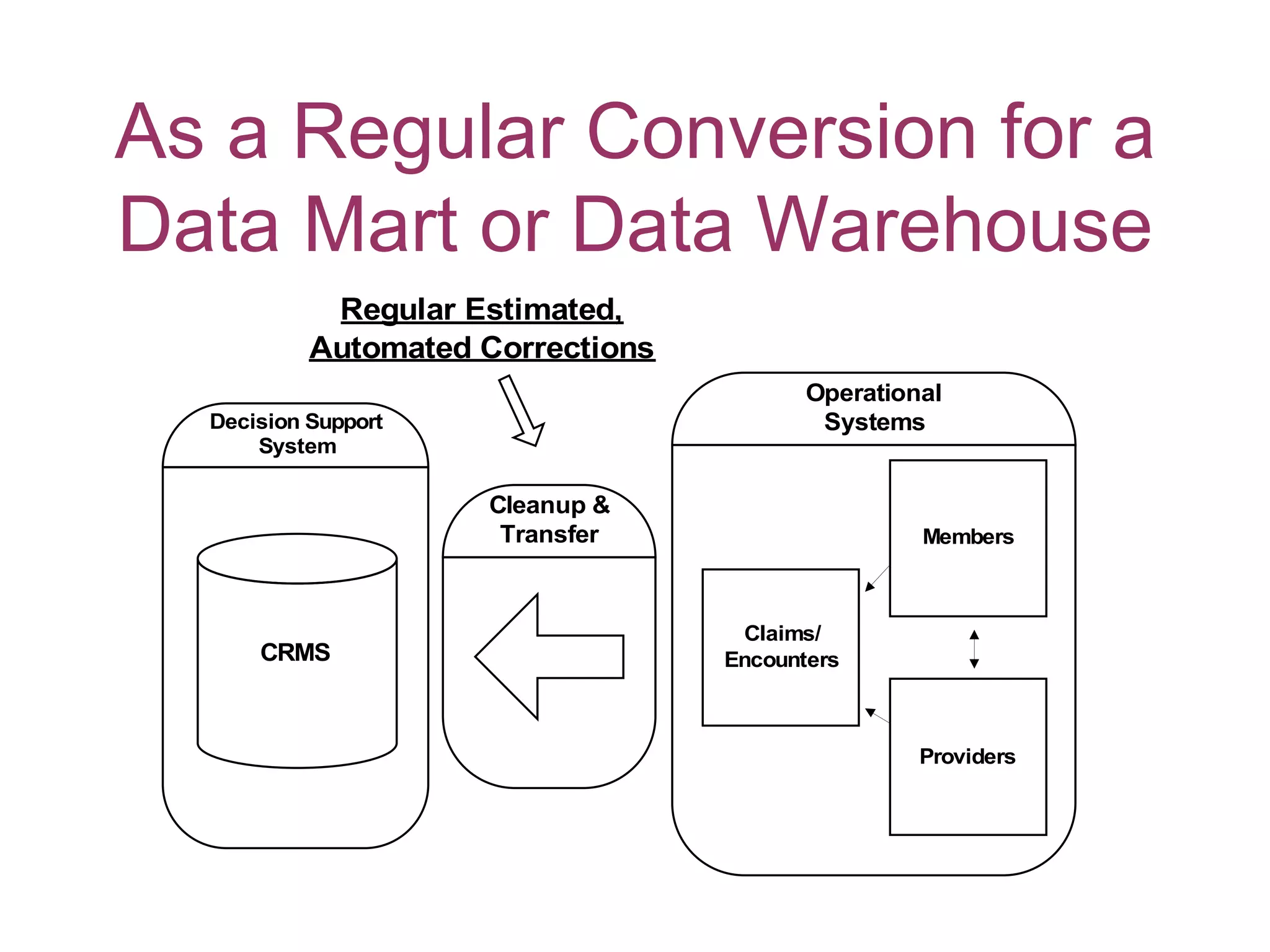
As a Regular Conversion for a
Data Mart or Data Warehouse
            Regular Estimated,
           Automated Corrections
                                          Operational
  Decision Support                         Systems
      System

                     Cleanup &
                      Transfer                     Members


                                    Claims/
      CRMS                         Encounters


                                                   Providers
At the Point of Capture
• Actual process improvement
• Actually preventative
• Based on understanding of information as
  enterprise resource
• Information producers assess and improve
  business and technical/development
  processes based on understanding of
  stakeholder requirements
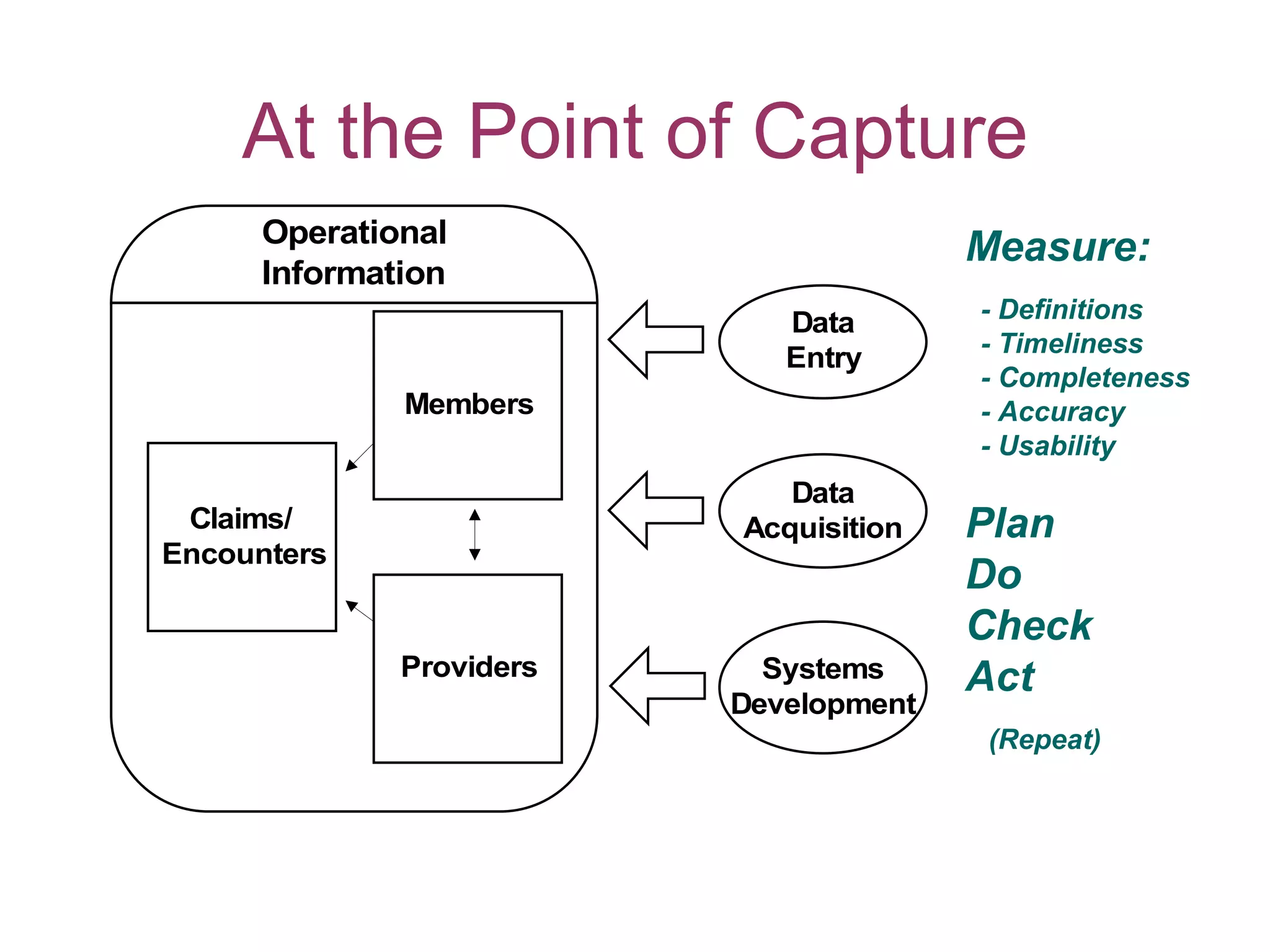
At the Point of Capture
      Operational
                                        Measure:
      Information
                             Data       - Definitions
                                        - Timeliness
                             Entry
                                        - Completeness
              Members                   - Accuracy
                                        - Usability
                             Data
 Claims/                  Acquisition   Plan
Encounters
                                        Do
                                        Check
              Providers     Systems     Act
                          Development
                                         (Repeat)
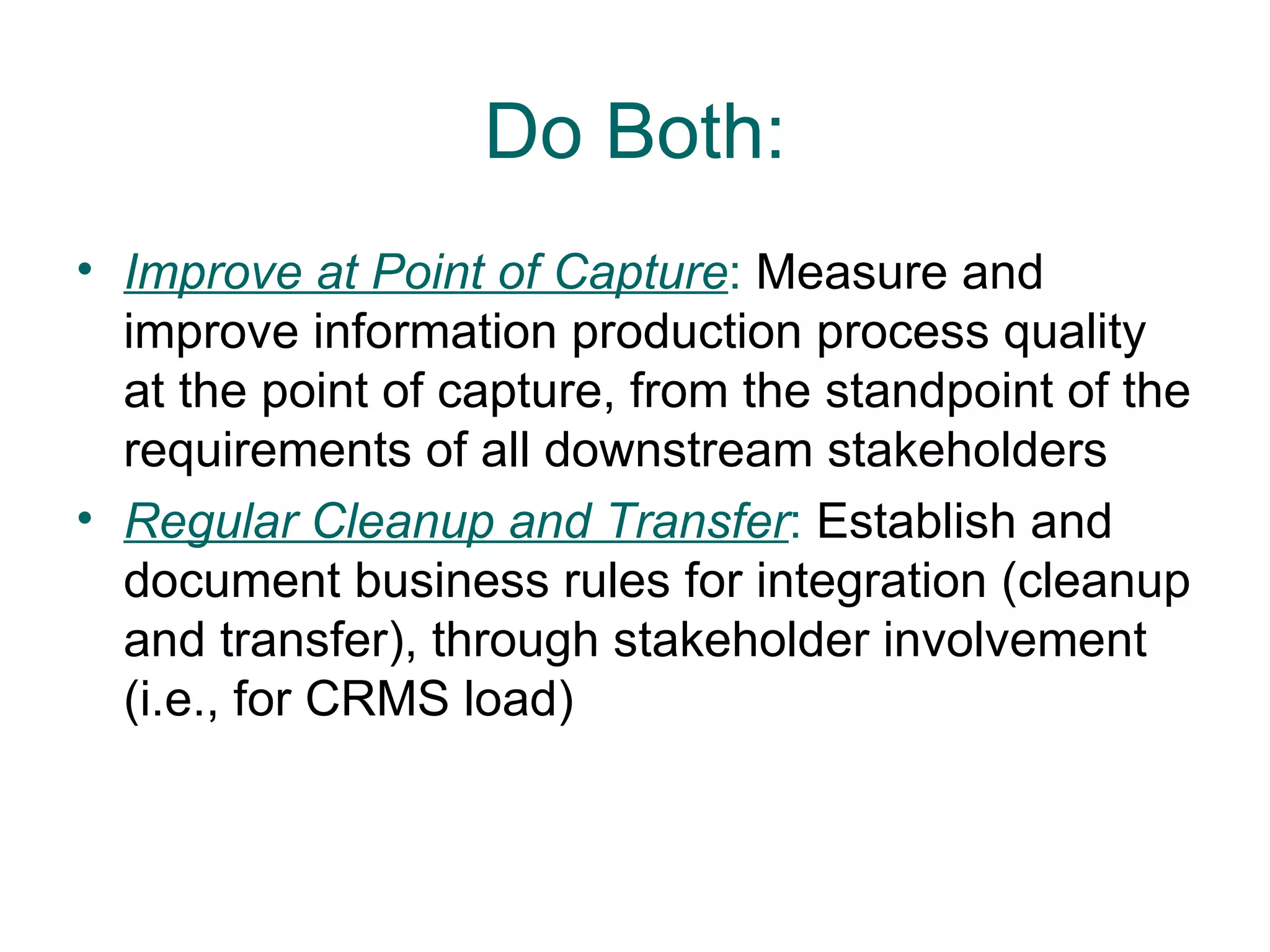
Do Both:
• Improve at Point of Capture: Measure and
  improve information production process quality
  at the point of capture, from the standpoint of the
  requirements of all downstream stakeholders
• Regular Cleanup and Transfer: Establish and
  document business rules for integration (cleanup
  and transfer), through stakeholder involvement
  (i.e., for CRMS load)
Process Improvement for Information
• Plan:
  –   Identify stakeholders/customers
  –   Survey stakeholders for requirements
  –   Measure quality of product against requirements
  –   Determine root cause for identified issues
• Do:
  – Implement improvement for awhile
• Check:
  – Measure again to determine success of improvement
• Act:
  – Act to standardize the improvement
  (Repeat)
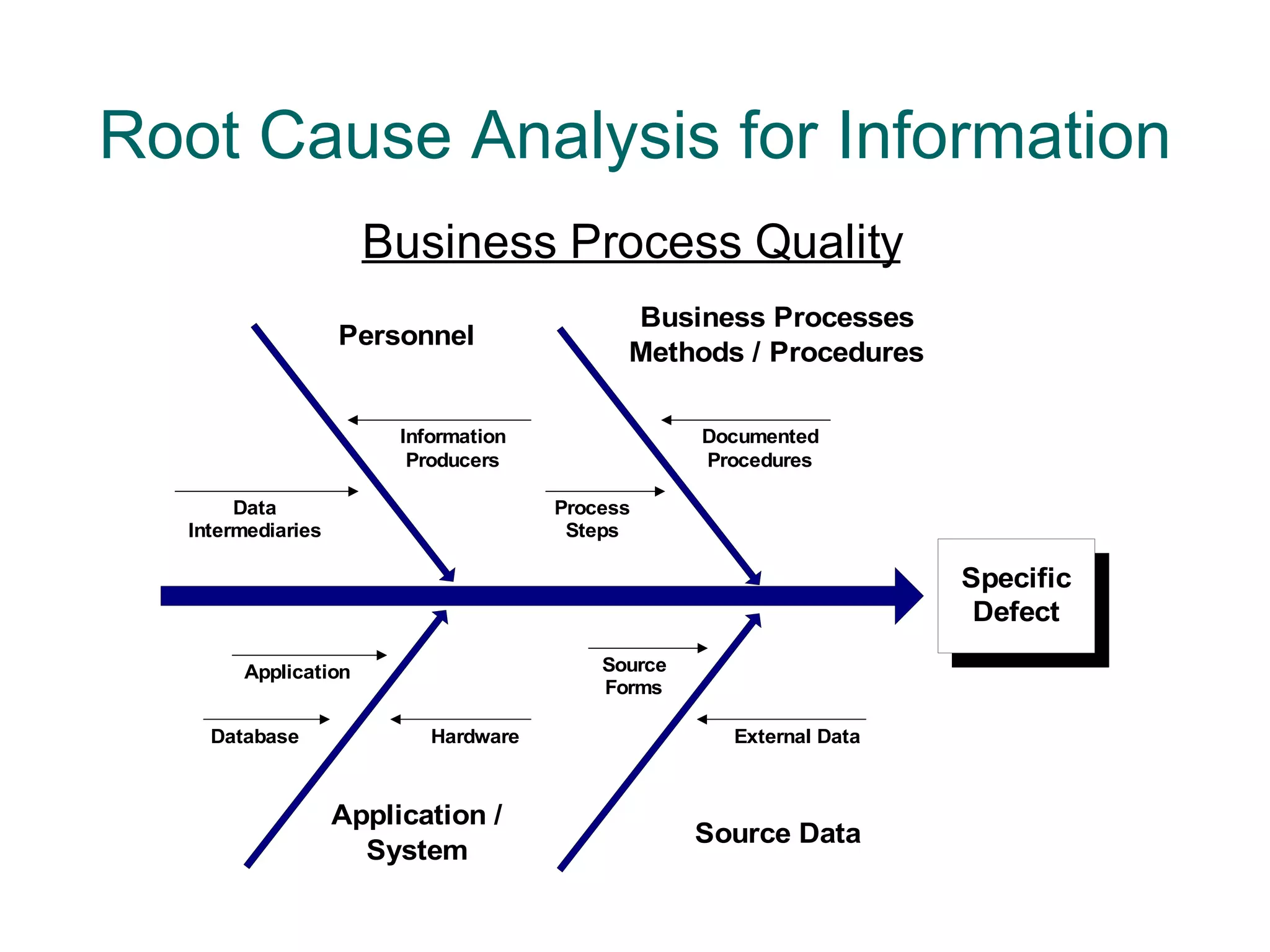
Root Cause Analysis for Information
                     Business Process Quality
                                            Business Processes
                   Personnel
                                            Methods / Procedures

                        Information                Documented
                         Producers                 Procedures

       Data                           Process
  Intermediaries                       Steps

                                                                     Specific
                                                                      Defect

       Application                        Source
                                          Forms

    Database               Hardware                  External Data


                   Application /
                                                   Source Data
                     System
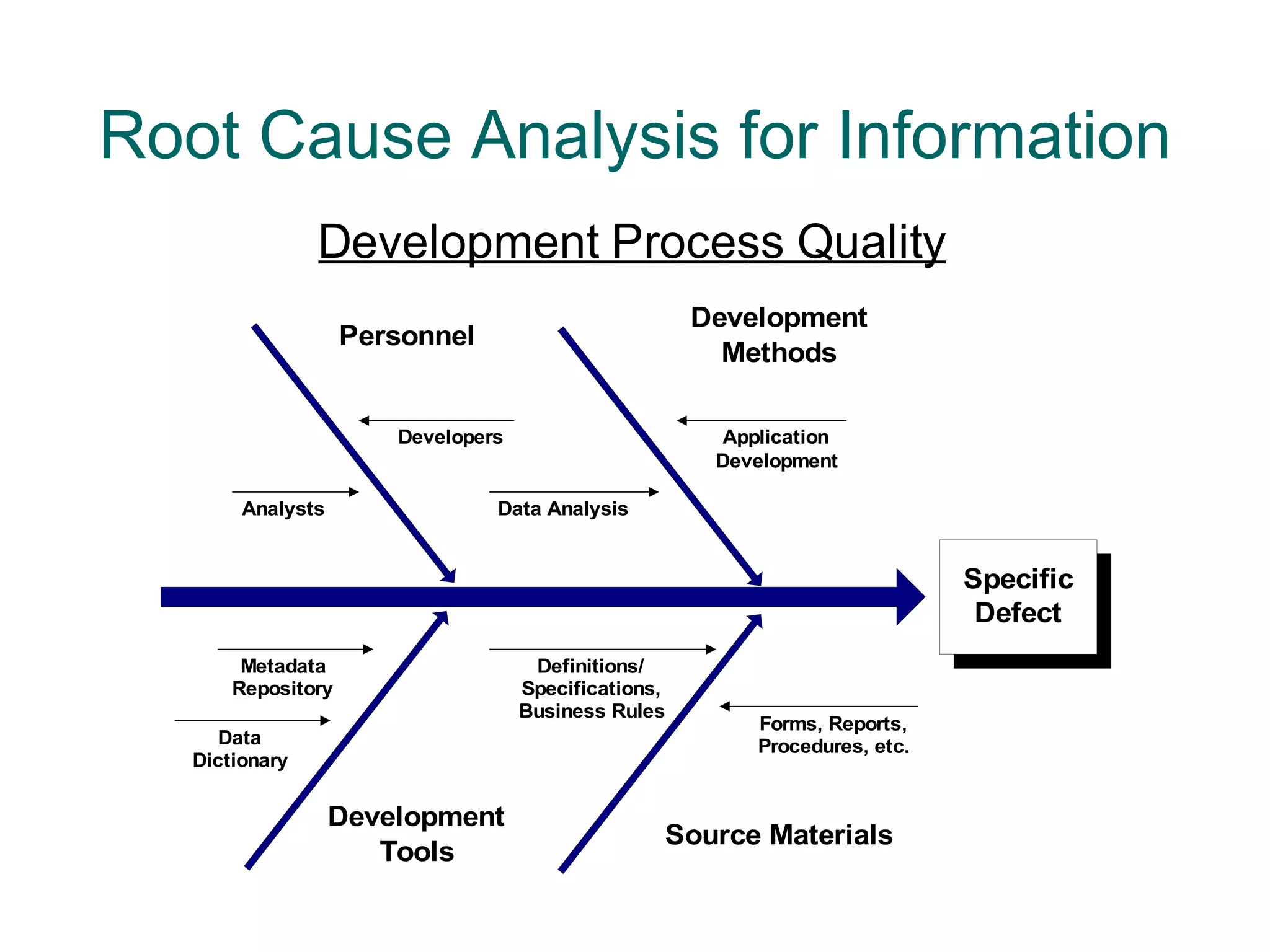
Root Cause Analysis for Information
                Development Process Quality
                                                      Development
                    Personnel
                                                        Methods

                       Developers                      Application
                                                       Development

        Analysts                Data Analysis


                                                                             Specific
                                                                              Defect
        Metadata                     Definitions/
       Repository                   Specifications,
                                    Business Rules
                                                          Forms, Reports,
     Data                                                 Procedures, etc.
   Dictionary

                   Development
                                                  Source Materials
                      Tools
Process Improvement Details
Useful for the NCQA Baseline
      Assessment Tool
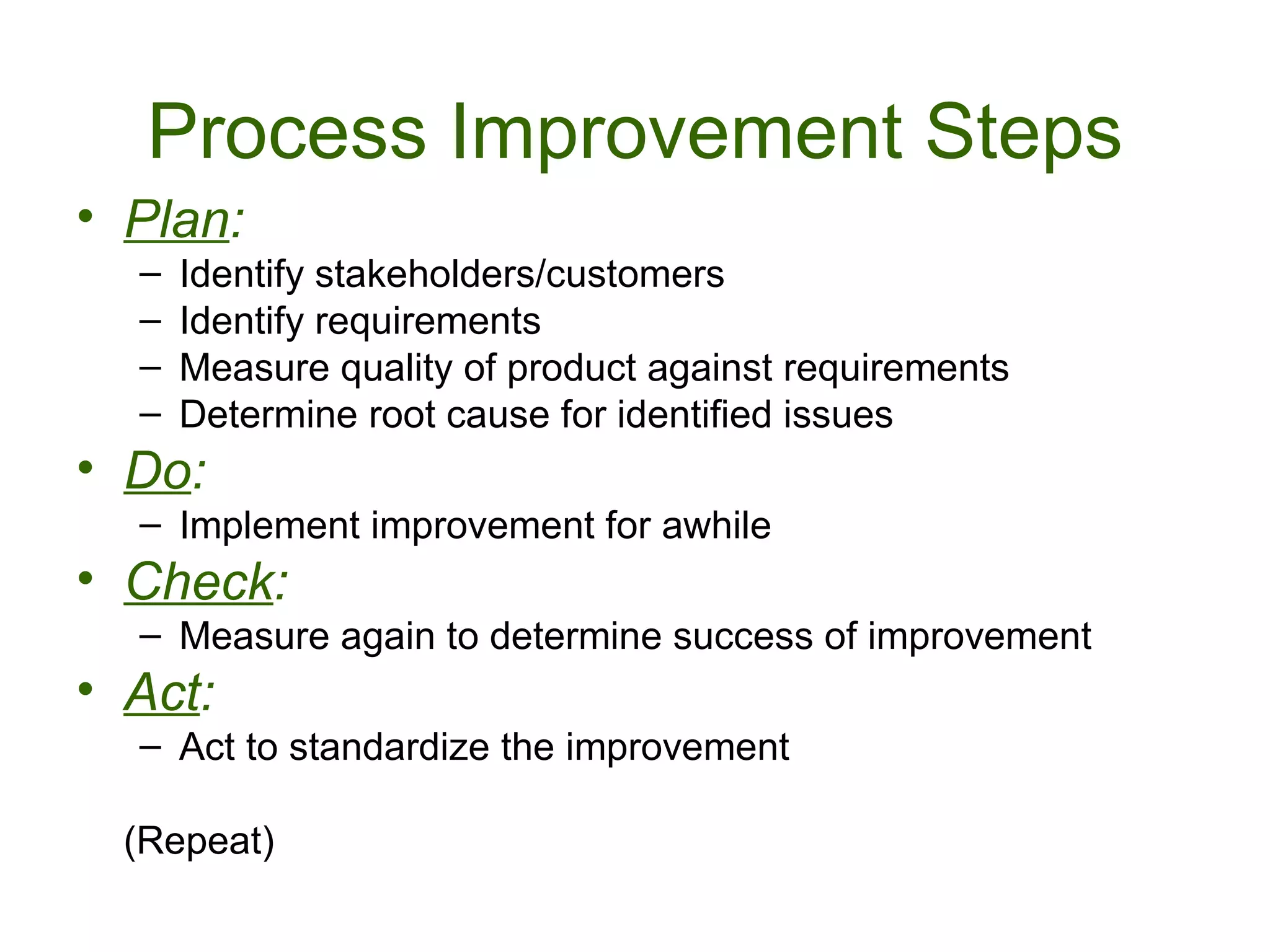
Process Improvement Steps
• Plan:
  –   Identify stakeholders/customers
  –   Identify requirements
  –   Measure quality of product against requirements
  –   Determine root cause for identified issues
• Do:
  – Implement improvement for awhile
• Check:
  – Measure again to determine success of improvement
• Act:
  – Act to standardize the improvement

  (Repeat)
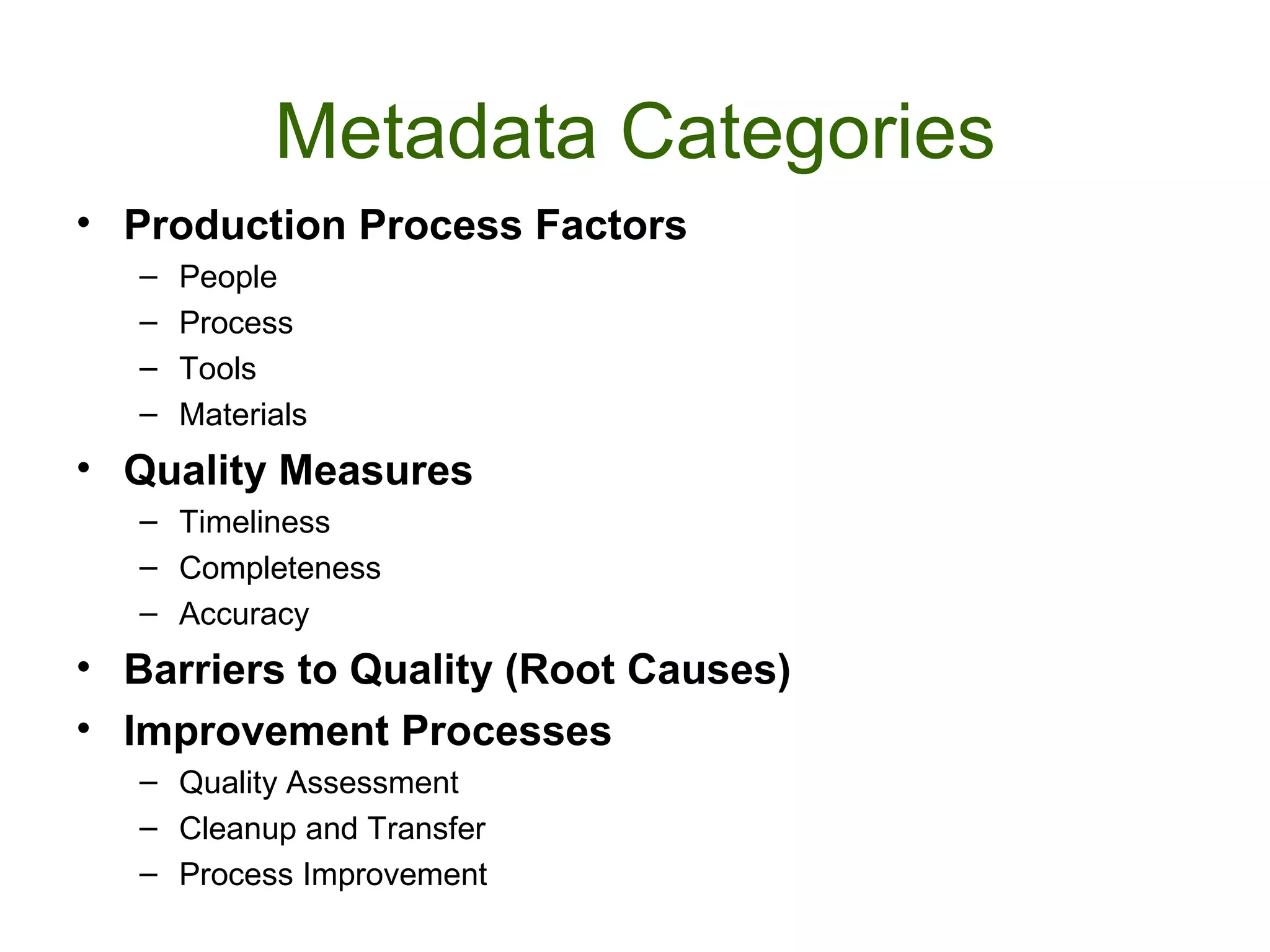
Metadata Categories
• Production Process Factors
   –   People
   –   Process
   –   Tools
   –   Materials
• Quality Measures
   – Timeliness
   – Completeness
   – Accuracy
• Barriers to Quality (Root Causes)
• Improvement Processes
   – Quality Assessment
   – Cleanup and Transfer
   – Process Improvement
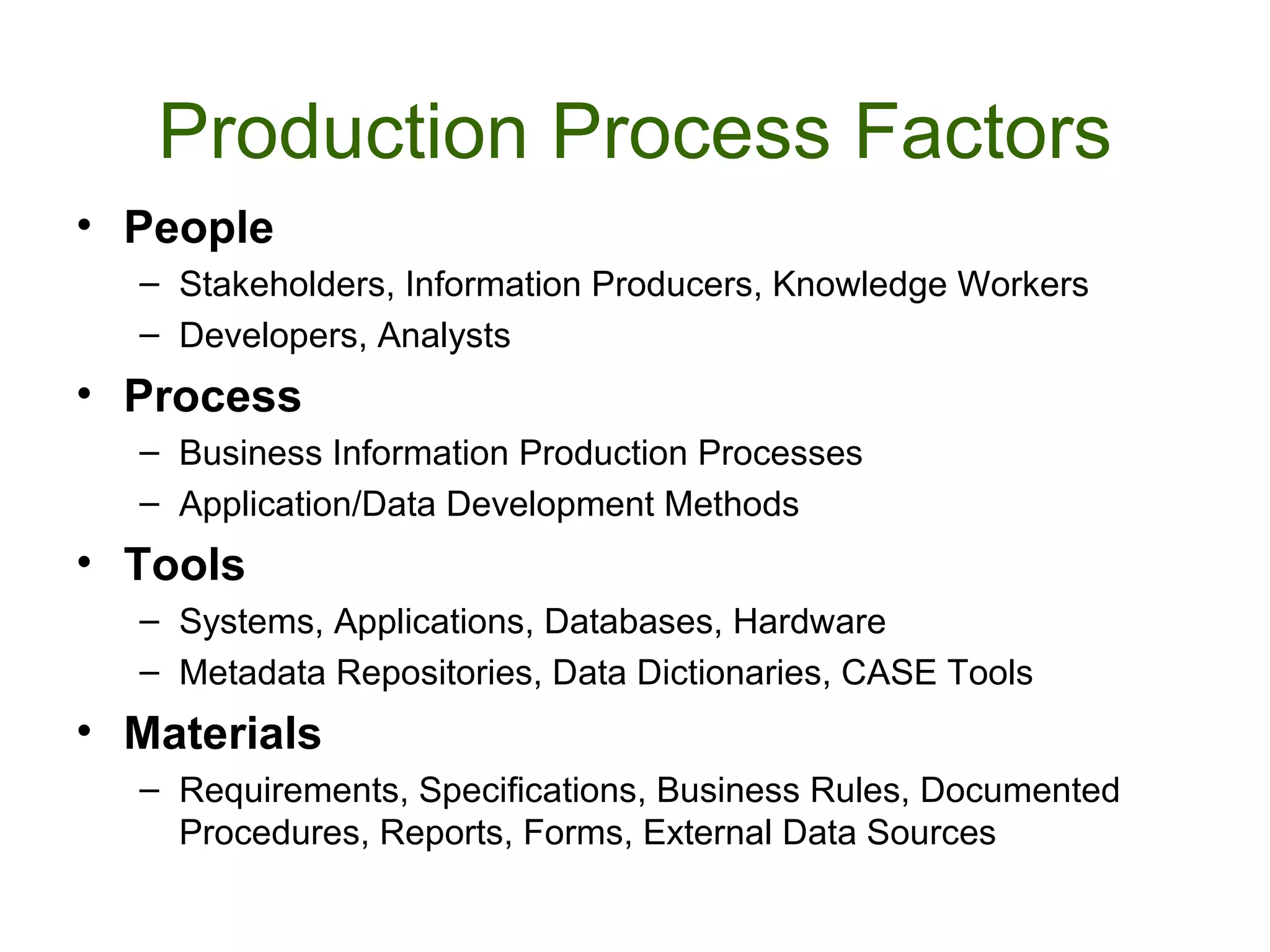
Production Process Factors
• People
  – Stakeholders, Information Producers, Knowledge Workers
  – Developers, Analysts
• Process
  – Business Information Production Processes
  – Application/Data Development Methods
• Tools
  – Systems, Applications, Databases, Hardware
  – Metadata Repositories, Data Dictionaries, CASE Tools
• Materials
  – Requirements, Specifications, Business Rules, Documented
    Procedures, Reports, Forms, External Data Sources
Simplified Picture
For each entity (Encounters, Members, Providers)
   – Who are its stakeholders?
   – What processes use it?
   – What are their requirements?

   – Then standards, measures, rules, definitions,
     specifications, etc.
Slightly More Detailed Picture
   •   Definition Standards
   •   Goals / Motivations
   •   Product Specifications
   •   Roles – Owners, Stakeholders
   •   Business Requirements
   •   Production Processes
   •   Improvement Processes
   •   Performance Measures
   •   Performance Rates
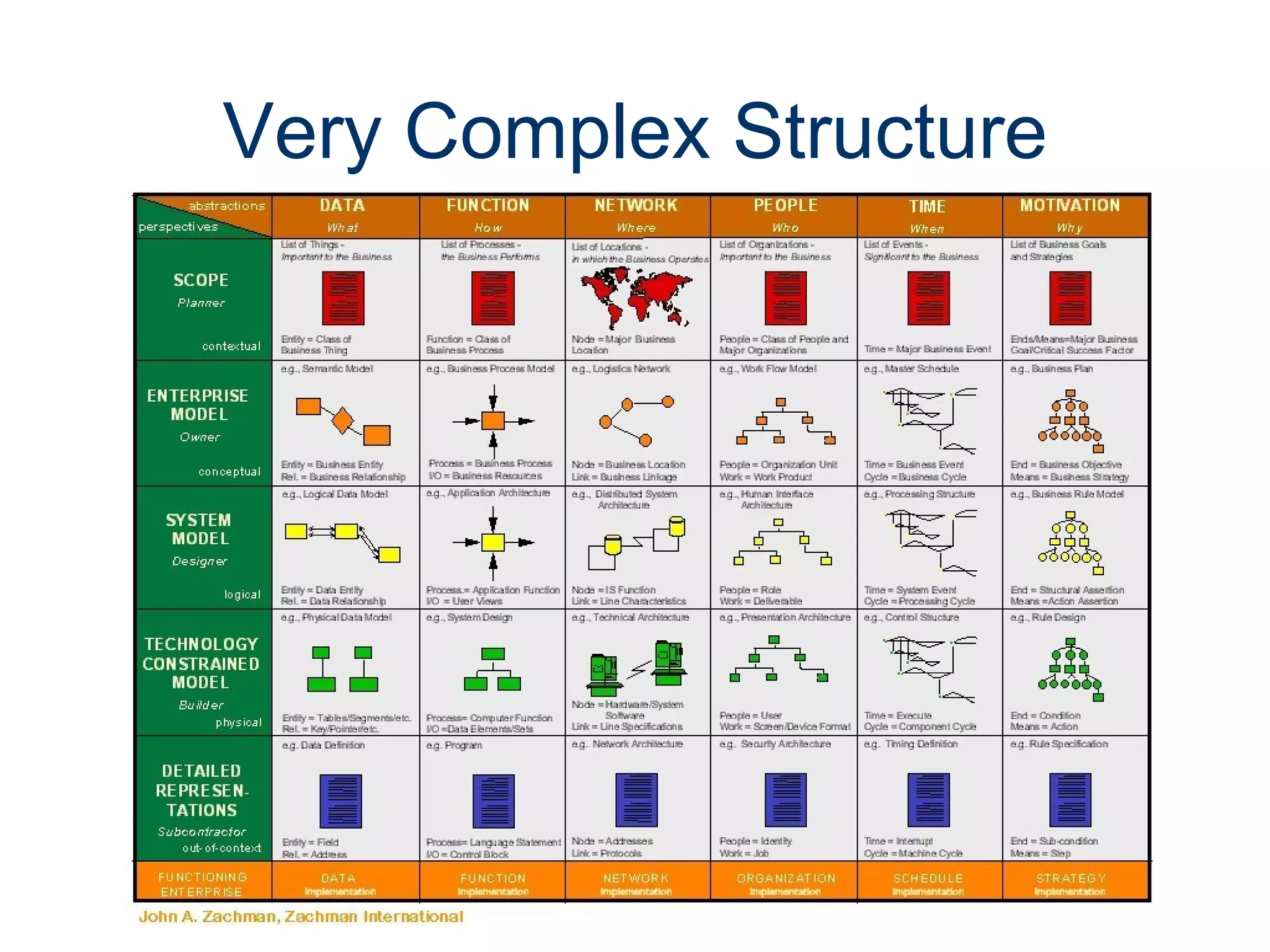
Very Complex Structure
Purposes of Metadata
• Foster process improvement for information
• Enable information producers to understand
  requirements from an enterprise standpoint, for both
  business and technical/development processes
• See all stakeholders, their processes that depend on the
  information, and their requirements
• Provide clear, accurate consensus definitions to enable
  problem resolution
• Enable developers to standardize and reuse
  specifications and business rules
• Manage information as a resource, including identifying
  needless cost, how much value you're deriving, how and
  where
Useful Steps to Take
• Work on information production processes by
  surveying stakeholders for their requirements
• Measure business and development processes
  according to requirements for the information as
  voiced by stakeholders
• Improve information production processes at the
  point of capture
• Devise rules for cleanup and transfer to decision
  support systems (CRMS) in collaboration with
  stakeholders
• Begin to store metadata: Document and share
  stakeholders, processes, requirements,
  performance measures, business rules, etc.
Foster Process Improvement through
     Common Understanding of
 Information Production Processes

Information Quality and Metadata in Healthcare Management

  • 1.
    The NCQA Baseline Assessment Tool . . . and How Sharing Information Production Process Metadata Fosters Process Improvement
  • 2.
    The BAT andInformation Production Process Metadata • What is the Baseline Assessment Tool? • What is this Metadata all about? How it relates to: – Quality Management and Process Improvement – Information Production Processes – HEDIS/QARR • Process Improvement Details Useful for the BAT
  • 3.
  • 4.
    The NCQA Baseline Assessment Tool • The BAT collects information that helps the NCQA assure that health plan information systems can generate reliable quality measures for HEDIS/QARR • Supports the NCQA's HEDIS Compliance Audit, an audit for compliance with HEDIS specifications for measures.
  • 5.
    Sections of theBAT • Data Processing Systems: – Encounters – Members – Providers • Completeness of Data • Integration of Data for Reporting • Controlling Integrity of Reporting • Medical Record Review • Other / General Information
  • 6.
    Quality Assurance Reporting Requirements (QARR) Childhood Immunization Status Annual Dental Visit Lead Testing Frequency of Ongoing Prenatal Care Use of Appropriate Medications for People with Asthma Children's Access to Primary Care Practitioners Antidepressant Medication Management Adults' Access to Preventive/Ambulatory Health Breast Cancer Screening Services Cervical Cancer Screening Ambulatory Care Comprehensive Diabetes Care Inpatient Utilization Controlling High Blood Pressure Births and Average Length of Stay, Newborns Follow-up After Hospitalization for Mental Illness Discharges and Average Length of Stay-Maternity Well Child and Preventive Care Visits in the 1st 15 Care Months of Life Mental Health Utilization-Inpatient Well Child and Preventive Care Visits - Children Chemical Dependency Utilization-Inpatient Ages 3-6 Years Frequency of Selected Procedures Adolescent Well-Care and Preventive Visits Timeliness of Prenatal Care Practitioner Turnover Postpartum Care Enrollment by County Board Certification/Residency Completion
  • 7.
    Generating QARR Measures •Extract random samples of member populations relevant to each measure • Calculate rates of those showing compliance with requirements for each measure • Includes visiting primary care sites, physically reviewing medical records, recording compliant instances
  • 8.
    What is thisMetadata all About? • Metadata Categories • Basic Metadata Purposes • What Quality Management Does • Overview of Relevant Processes • Quality Approach to Information
  • 9.
    Metadata Categories • ProductionProcess Factors – People – Process – Tools – Materials • Quality Measures – Timeliness – Completeness – Accuracy • Barriers to Quality (Root Causes) • Improvement Processes – Quality Assessment – Cleanup and Transfer – Process Improvement
  • 10.
    Basic Metadata Purposes: •Create common understanding • Foster process improvement • Enable information stewardship
  • 11.
    Metadata Creates Common Understanding Between: • Information Producers: – Business Process: data acquisition, entry and updating – Technical Process: developers and analysts • Information Stakeholders: – Anybody who uses the information for business
  • 12.
    Metadata Fosters Information ProcessImprovement • Establishes common understanding, from an enterprise standpoint, of all stakeholder requirements for information • Fosters collaboration, empowerment, teamwork, professionalism, pride of workmanship • Makes environment of information stewardship possible
  • 13.
    Information Stewardship Willingnessto be accountable for a set of business information for the well-being of the larger organization, by operating in service of (rather than under control of) those around us.
  • 14.
    What Quality ManagementDoes: • Brings producers and stakeholders together • Makes sure stakeholder requirements are fully represented • Assures completeness and objectivity of measures so they are reliable basis for understanding and managing functionality and performance • Establishes factual basis • Makes process improvement possible • Makes cross-functional teamwork possible • Makes performance management possible • Makes resource management possible
  • 15.
    The Definition ofQuality Meeting and exceeding stakeholder (customer) expectations and requirements
  • 16.
    Process Improvement: PDCA (Shewhart Cycle) • Plan an improvement based on factual basis • Do it for awhile • Check it for improvement • Act to standardize the improvement (Repeat)
  • 17.
    Process Improvement: RootCause Analysis People Process Defect Tools Materials
  • 18.
    Overview of ProductionProcesses Information Finance QM UM Etc. Stakeholders Information Operational Information Producers Data Mart Knowledge Workers Data Entry Members HEDIS/ Data QARR Claims/ Acquisition CRMS Encounters Providers Systems Performance Development Management
  • 19.
    Encounters Information Producers Data Entry Claims Data Acquisition CLAIMS/ ENCOUNTERS Care Providers Vendors Systems Development Developers/ Analysts
  • 20.
    Members Information Producers Data Entry Enrollment Data Acquisition MEMBERS Marketing Member Services Recertification Systems Development Developers/ Analysts
  • 21.
    Providers Information Producers Data Entry Network Information Data Acquisition PROVIDERS Network Development Provider Relations Systems Development Developers/ Analysts
  • 22.
    Encounters Stakeholders Information Stakeholders Finance QM UM Etc. HEDIS/ QARR Operational Decision Support Information System Quality Management Utilization Members Management Community Claims/ Health CRMS Encounters Institute Data Mining Providers P erformance Management
  • 23.
    HEDIS/QARR Quality Assessmentand Medical Record Review Data Mart • Build CRMS • Create population samples • Extract compliant instances CRMS based on administrative data, along with member and provider site information, to a Special QARR special QARR database Review Database • Load laptops from this database
  • 24.
    Lack of CompliantInstances by Administrative Data • Compliance with measure conditions requires the following data elements to be present and accurate: – Recipient information – Service and diagnosis codes – Service location information – Provider information • Missing or inaccurate information necessitates the conduct of onsite medical record review
  • 25.
    HEDIS/QARR Quality Assessmentand Medical Record Review • Review claims histories for all members in samples to identify most likely primary care provider • Sort samples and fax lists to each site, requesting charts for onsite review
  • 26.
    HEDIS/QARR Quality Assessmentand Medical Record Review • Visit sites and review charts
  • 27.
    HEDIS/QARR Quality Assessmentand Medical Record Review Track down charts not found at sites: • Verify Member name, CIN, SSN • Review claims history for other providers and spans of care • Check Healthy Beginnings / Mammogram Incentives databases • Check online Immunizations Registry • Check Phone logs • Check NY State Roster • Check http://www.whitepages.com • Call Providers • Call Members
  • 28.
    HEDIS/QARR Quality Assessmentand Medical Record Review • Visit new locations and review again
  • 29.
    HEDIS/QARR Quality Assessmentand Medical Record Review • Integrate and upload laptop data to CRMS • Use CRMS to generate rates Data Mart • Send results to NY State Department of CRMS Health
  • 30.
    HEDIS/QARR Quality Assessmentand Medical Record Review • Massive costs due to nonquality data • Nurses to sites throughout network, three times • Hunting down members, what provider they're getting care from, missing or miscoded services and diagnoses • 4300+ members in samples
  • 31.
    Quality Approach to Information • Foster common understanding between producers and stakeholders by use of shared metadata • Accuracy can’t be automated; only people can assess and correct for accuracy • Information is an enterprise resource • Measure information quality in voice of downstream customers/stakeholders • To improve a production process, measure its product • Improve information quality at the point of capture
  • 32.
    Foster Common Understanding Between Producers and Stakeholders
  • 33.
    Accuracy Can’t beAutomated • Only people can create, assess, or correct for accurate information • Automatic business rules can only prevent gross errors • Checking against a surrogate source: comparison to external Data Entry datasets, forms Information • Checking against (Encounters, authoritative source: Members, Providers) comparison to real Data Acquisition world entity
  • 34.
    Measure Information Quality in Voice of Stakeholders Information Finance QM UM Etc. Stakeholders Information Operational Information Producers Data Mart Knowledge Workers Data Entry Members HEDIS/ Data QARR Claims/ Acquisition CRMS Encounters Providers Systems Performance Development Management
  • 35.
    Information Quality Measures •Definitions/Specifications • Timeliness – Time from first capture to record of reference • Completeness – Represent each instance in the real world – Completeness of values in existing fields • Accuracy – To surrogate source – To authoritative source • Usability – Presence of fields to address functional requirements
  • 36.
    Measure the Product to Improve its Process • Purpose is not to improve a product by measuring it, but to improve its production process • Product is of concern only from a limited perspective • Quality measures show how well processes for producing information are functioning; i.e., how well they address all stakeholder requirements
  • 37.
    Applications are not the Product to Measure • Assessing applications addresses narrow requirements, not downstream requirements for the information • Address information as the product, understood as an enterprise resource • Measure the information that applications work on to assess development • Applications are machines on the assembly line, not the product
  • 38.
    Applications are Machines on the Assembly Line Applications Information
  • 39.
    Improving Information (theProduct) is not the Chief Concern • Right product to measure, but wrong purpose • Improving the product doesn't prevent errors or assure ongoing quality • Improve production processes • Information product improvement is all cost basis/scrap and rework • Correction of issues preventable by process
  • 40.
    Three Ways toCorrect Information Quality • As a one-time process • As a regular conversion process • At the point of capture
  • 41.
    As a One-timeProcess for a Special Table • Not preventative; same problems recur because information production process has not changed • Quality of data decays; not addressing changes in the information • Creates a redundant table for the entity (encounters, services, providers, members)
  • 42.
    As a RegularConversion for a Data Mart or Data Warehouse • Performed under constraint of a regular load for up-to-the-moment, daily analysis • Too late: requires automatic, estimated corrections • Corrections need to feed back to operational tables
  • 43.
    As a RegularConversion for a Data Mart or Data Warehouse Regular Estimated, Automated Corrections Operational Decision Support Systems System Cleanup & Transfer Members Claims/ CRMS Encounters Providers
  • 44.
    At the Pointof Capture • Actual process improvement • Actually preventative • Based on understanding of information as enterprise resource • Information producers assess and improve business and technical/development processes based on understanding of stakeholder requirements
  • 45.
    At the Pointof Capture Operational Measure: Information Data - Definitions - Timeliness Entry - Completeness Members - Accuracy - Usability Data Claims/ Acquisition Plan Encounters Do Check Providers Systems Act Development (Repeat)
  • 46.
    Do Both: • Improveat Point of Capture: Measure and improve information production process quality at the point of capture, from the standpoint of the requirements of all downstream stakeholders • Regular Cleanup and Transfer: Establish and document business rules for integration (cleanup and transfer), through stakeholder involvement (i.e., for CRMS load)
  • 47.
    Process Improvement forInformation • Plan: – Identify stakeholders/customers – Survey stakeholders for requirements – Measure quality of product against requirements – Determine root cause for identified issues • Do: – Implement improvement for awhile • Check: – Measure again to determine success of improvement • Act: – Act to standardize the improvement (Repeat)
  • 48.
    Root Cause Analysisfor Information Business Process Quality Business Processes Personnel Methods / Procedures Information Documented Producers Procedures Data Process Intermediaries Steps Specific Defect Application Source Forms Database Hardware External Data Application / Source Data System
  • 49.
    Root Cause Analysisfor Information Development Process Quality Development Personnel Methods Developers Application Development Analysts Data Analysis Specific Defect Metadata Definitions/ Repository Specifications, Business Rules Forms, Reports, Data Procedures, etc. Dictionary Development Source Materials Tools
  • 50.
    Process Improvement Details Usefulfor the NCQA Baseline Assessment Tool
  • 51.
    Process Improvement Steps •Plan: – Identify stakeholders/customers – Identify requirements – Measure quality of product against requirements – Determine root cause for identified issues • Do: – Implement improvement for awhile • Check: – Measure again to determine success of improvement • Act: – Act to standardize the improvement (Repeat)
  • 52.
    Metadata Categories • ProductionProcess Factors – People – Process – Tools – Materials • Quality Measures – Timeliness – Completeness – Accuracy • Barriers to Quality (Root Causes) • Improvement Processes – Quality Assessment – Cleanup and Transfer – Process Improvement
  • 53.
    Production Process Factors •People – Stakeholders, Information Producers, Knowledge Workers – Developers, Analysts • Process – Business Information Production Processes – Application/Data Development Methods • Tools – Systems, Applications, Databases, Hardware – Metadata Repositories, Data Dictionaries, CASE Tools • Materials – Requirements, Specifications, Business Rules, Documented Procedures, Reports, Forms, External Data Sources
  • 54.
    Simplified Picture For eachentity (Encounters, Members, Providers) – Who are its stakeholders? – What processes use it? – What are their requirements? – Then standards, measures, rules, definitions, specifications, etc.
  • 55.
    Slightly More DetailedPicture • Definition Standards • Goals / Motivations • Product Specifications • Roles – Owners, Stakeholders • Business Requirements • Production Processes • Improvement Processes • Performance Measures • Performance Rates
  • 56.
  • 57.
    Purposes of Metadata •Foster process improvement for information • Enable information producers to understand requirements from an enterprise standpoint, for both business and technical/development processes • See all stakeholders, their processes that depend on the information, and their requirements • Provide clear, accurate consensus definitions to enable problem resolution • Enable developers to standardize and reuse specifications and business rules • Manage information as a resource, including identifying needless cost, how much value you're deriving, how and where
  • 58.
    Useful Steps toTake • Work on information production processes by surveying stakeholders for their requirements • Measure business and development processes according to requirements for the information as voiced by stakeholders • Improve information production processes at the point of capture • Devise rules for cleanup and transfer to decision support systems (CRMS) in collaboration with stakeholders • Begin to store metadata: Document and share stakeholders, processes, requirements, performance measures, business rules, etc.
  • 59.
    Foster Process Improvementthrough Common Understanding of Information Production Processes