This paper investigates the influence of helicopter rotor wake modeling on blade airload predictions. A vortex element method is used to compute the free vortex wake geometry and rotor airloads. Various models for vortex core structure, vorticity diffusion, and vortex straining are tested to assess their impact on airload prediction. Empirical factors in vorticity diffusion models are evaluated. Comparisons with wind tunnel data show the benefit of using multiple trailing vortex lines behind the blade span rather than isolated lines or sheets, despite the higher computational cost. Accurately modeling viscous effects like vortex core formation and diffusion is important for reliable wake representation and induced velocity calculations, especially at large wake ages.







![C. K. Zioutis, A. I. Spyropoulos, A. P. Fragias, D. P. Margaris & D. G. Papanikas
Keywords: Helicopter aerodynamics, rotor wake, vortex core.
1. INTRODUCTION
Computational research on helicopter rotors focuses on blade airloads prediction, trying to
identify the effects of important operational, structural and flowfield parameters such as wake
formation, blade planform, flight conditions etc on blade vibrations and noise emissions. Improved
helicopter performance is a continuous research challenge as aeronautical industry is always
seeking for a more efficient, vibration free and "quiet" rotorcraft with increased public acceptance.
The main issue in helicopter aerodynamics examined by many computational and experimental
efforts is the interaction of rotor blades with wake vortices, a phenomenon which characterizes
helicopters and is the source of blade vibration and noise emission. As in other similar
aerodynamic flowfields, such as the trailing wake of aircrafts or wind turbines, the velocity field in
the vicinity of a helicopter rotor must be calculated from the vorticity field. A prerequisite for such
a calculation is that the physical structure and the free motion of wake vortices are adequately
simulated.
Vortex Element Methods (VEM) have been established during recent years computational
research as an efficient and reliable tool for calculating the velocity field of concentrated three-
dimensional, curved vortices [1,2]. Wake vortices are considered as vortex filaments which are
free to move in Lagrangian coordinates. The filaments are descritized into piecewise segments
and a vortex element is assigned to each one of them. Since the flow is considered inviscid
except for the vortices themselves, the Biot-Savart low is applied in closed-form integration over
each vortex element for the velocity field calculation. Marked points are traced on vortex filaments
as they move freely due to the mutual-induced velocity field, either by externally imposing
geometrical periodicity (relaxation methods) or not (time marching methods). Thus, VEM can
computationally reproduce an accurate geometry of the concentrated wake vortices spinning
close to rotor disk. As a result the non-uniform induced downwash of lifting helicopter rotors can
be computed, which is responsible for rotor blade vibratory airloads.
From the first simplified approaches [3,4], to recent advanced procedures [5-9], the vorticity
elements used are vortex lines and vortex sheets [5,10]. The sophistication level of rotor wake
analysis can vary from preliminary to advanced manufacture calculations. The basic formulation
of VEM is closely related to classical vortex methods for boundary layer and vortical flow analysis
extensively applied by Chorin [11], Leonard [12] and other researchers [13,33].
The extensive effort made by a number of researchers has resulted to several models proposed
for simulating viscous vortex core structure, vorticity diffusion, trailing vortex rollup process, rotor
blade dynamic stall and other phenomena [14]. These different physico-mathematical models
have a significant influence on computed blade airload distributions, while their reliability for the
majority of helicopter rotor flow conditions is always under evaluation.
The contribution of the work presented here is to investigate the influence of specific aerodynamic
models on computed blade airloads, evaluating their reliability by comparisons of computed
results with experimental data. In addition, the values of empirical factors included in these
models are computationally verified. The applied method consists of a free wake analysis, using a
wake-relaxation type VEM [15,16,29] and a coupled airload computation module which has the
flexibility to adopt either lifting line or lifting surface methods. Blade motion calculations include
provisions for articulated or hingeless blades and the main rigid and elastic flapping modules can
be regarded separately or coupled.
International Journal of Engineering (IJE), Volume (3): Issue (6) 522](https://image.slidesharecdn.com/ijev3i6-110103005953-phpapp01/75/Ije-v4-i2International-Journal-of-Engineering-IJE-Volume-3-Issue-6-10-2048.jpg)
![C. K. Zioutis, A. I. Spyropoulos, A. P. Fragias, D. P. Margaris & D. G. Papanikas
When helicopter rotor wakes are simulated, then the line segment discretization of wake vortices
is prevailed. Methods with straight [8,10] or curved [6,17] line segments have been proposed and
their accuracy was found to be of second order comparing to vortex ring analytical solution
[18,19]. Rarely, the distributed vorticity behind the inner part of blade span is modeled by surface
elements such as vortex sheets [10]. For the present investigation, a model of multiple trailing
lines is adopted and compared with models of simpler discretization.
Viscous effects on wake vorticity have also been the subject of computational and experimental
efforts because of their significant impact on induced velocity calculations especially for large
wake ages [20-22]. These effects are the vortex core formation in the center of vortex lines and
the diffusion of the concentrated vorticity as time progresses. Both of these phenomena are found
to be of crucial importance for a reliable wake representation. In the present paper several
models are compared, assuming both laminar and turbulent vortex core flow, in order to
demonstrate their effectiveness and a parametric investigation is performed concerning empirical
factors employed by these models.
The experimental data used for comparisons include test cases executed during cooperative
European research programs on rotorcraft aerodynamics and aeroacoustics performed in the
open test section of the German-Dutch Wind Tunnel (DNW) The Netherlands [23].
2. AERODYNAMIC FORMULATION
2.1 Rotor Wake Model
The vorticity generated in rotor wake is distinguished regarding its source in two main parts, the
trailing and the shed vorticity. Conservation of circulation dictates that the circulation gradients on
a rotor blade determine the vorticity shed at specific spanwise locations behind the blade. Thus
spanwise circulation variations generate trailing vorticity, gn, whose direction is parallel to the
local flow velocity (Figure 1). On the other hand, azimuthal variations produce shed vorticity
radially oriented, gs, due to the transient periodical nature of the rotor blade flowfield. In general,
bound circulation has a distribution as shown in Figure 1, where the pick is located outboard of
the semi-span and a steep gradient appears closely to blade tip. This gradient generates a high
strength trailing vortex sheet just behind the blade which quickly rolls up and forms a strong tip
vortex.
FIGURE 1: Rotor wake physicomathematical modeling.
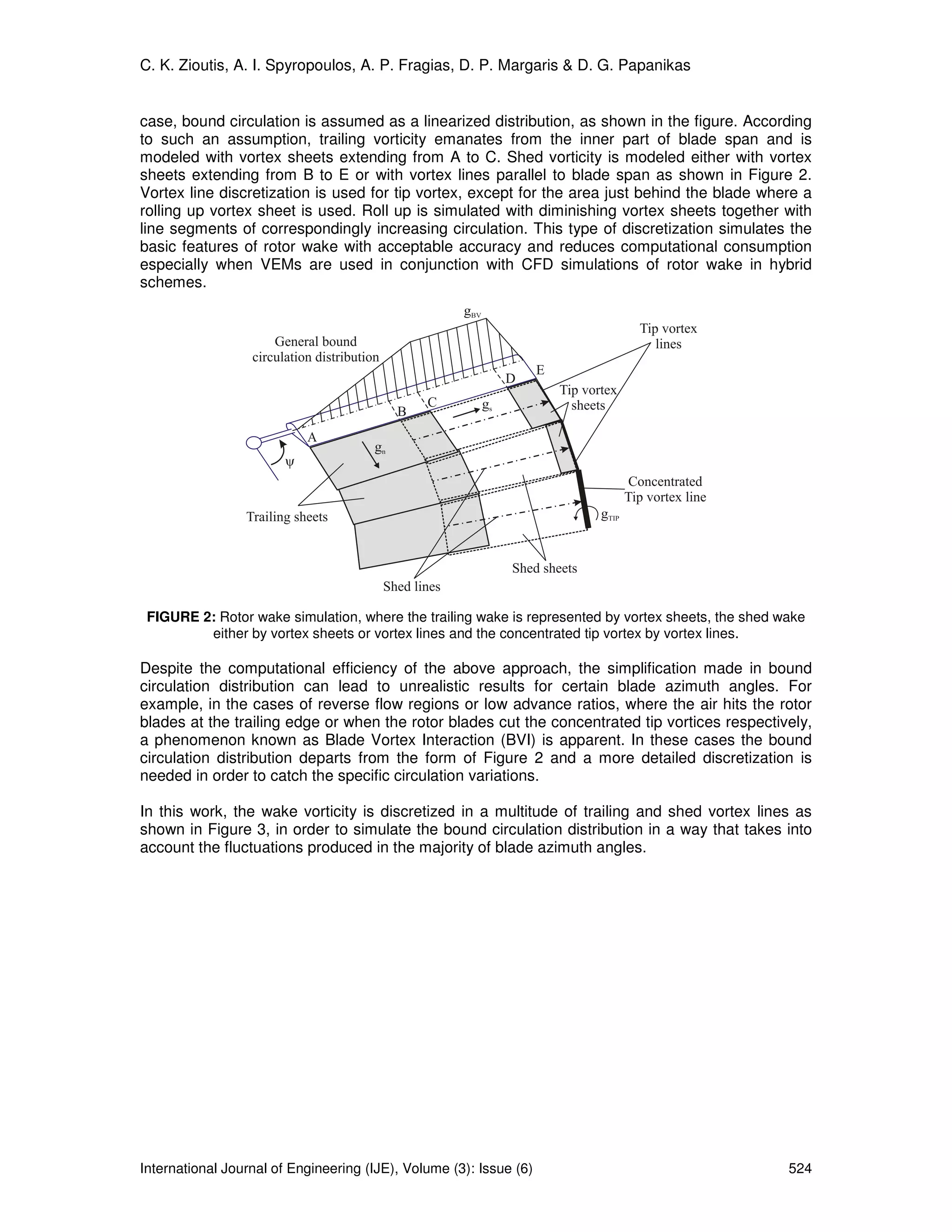
The continuous distribution of wake vorticity shown in Figure 1 is discretized into a series of
vortex elements. Depending on the degree of analysis of wake flowfield and on targeted
computational consumption, some VEMs use simple disretization as shown in Figure 2. In this
International Journal of Engineering (IJE), Volume (3): Issue (6) 523](https://image.slidesharecdn.com/ijev3i6-110103005953-phpapp01/75/Ije-v4-i2International-Journal-of-Engineering-IJE-Volume-3-Issue-6-11-2048.jpg)
![C. K. Zioutis, A. I. Spyropoulos, A. P. Fragias, D. P. Margaris & D. G. Papanikas
FIGURE 3: Modeling of rotor blade bound circulation distribution and wake
vorticity formations with multiple vortex lines.
Trailing vorticity is simulated by n-straight line vortex segments, labeled ℓℓ, which run from ℓ1 at the
root to ℓn at the tip. There are ηℓ=n-1 radial stations where bound circulation is computed, where ηℓ
runs from η1 between ℓ1 and ℓ2 to ηn-1 between ℓn-1 and ℓn. The strength of each segment is equal
to the gradient of the bound circulation gbv between two successive radial stations. This means
that for all intermediate segments at azimuthal angle ψ:
g n ( l l ,ψ ) = g bv ( ηl−1 ,ψ ) − g bv ( ηl ,ψ ) (1)
The first term is equal to zero at the root because there is no bound circulation inboard the root.
Analogically the second term is zero at the tip. The shed vorticity is simulated by n-1 straight line
vortex segments which are extended radially between two adjacent trailing vortices as shown in
Figure 3. The strength of each segment is equal to the azimuthal variation of bound circulation for
each radial station:
g s ( l l ,ψ ) = g bv ( ηl−1 ,ψ + ∆ψ ) − g bv ( ηl−1 ,ψ ) (2)
where ∆ψ is the azimuthal step. A number of 50 trailing and shed vortex line segments per
azimuthal step were found adequate to discretize the wake vorticity. More detailed discretization
will increase computational cost without any tangible improvement of accuracy.
2.2 Induced Velocity Calculation
The distortion of the initial helical geometry of the rotor wake vortices, makes the calculation of
the rotor downwash almost impossible with direct numerical integration of the Biot-Savart law,
over the actual wake geometry. This procedure is used only for simplified approaches such as the
rigid or semi-rigid wake assumptions [3,4]. The utilization of discrete computational elements
(vortex lines and sheets) by VEM, converts direct integration in a closed form integration of the
Biot-Savart law over the known spatial locations of these elements. The contribution of a vortex
r
line segment i to the induced velocity w ij at an arbitrary point in space j, is given by the relation
r r r
r (
1 g i rijm − k ⋅ ek × dk )
wij = −
4π ∫
r
r − k ⋅e
r 3 (3)
ijm k
International Journal of Engineering (IJE), Volume (3): Issue (6) 525](https://image.slidesharecdn.com/ijev3i6-110103005953-phpapp01/75/Ije-v4-i2International-Journal-of-Engineering-IJE-Volume-3-Issue-6-13-2048.jpg)
![C. K. Zioutis, A. I. Spyropoulos, A. P. Fragias, D. P. Margaris & D. G. Papanikas
r r
where rijm is the minimum distance from vortex line i to the point j, e k the unit vector in the
direction of the vortex segment, gi the circulation strength of the vortex segment and k the
coordinate measured along the vortex segment. With a reasonable step of discretization, the
simplification made to the actual wake geometry can be overcome. After computational
investigation the azimuthal step for realistic rotor wake simulations has been proposed by
different researchers to be from 2 to 5 degrees [5,32]. The calculation of velocity induced by
vortex sheet can be found in [15].
Free vortical wake computation is an iterative procedure, which initiates from rigid wake
geometry. Each iteration defines a new position of each vortex element, and takes into account
the contribution of all the wake elements to the local flow velocity. At the end of each iteration a
new distorted wake geometry is calculated, which is the starting point for the next cycle. This
scheme continues until distortion convergence is achieved.
Rotor blade dynamics influence the angle of attack distribution seen by the blade, and therefore
alter the bound circulation distribution. Due to out-of-plane motion, rotor blade balances the
asymmetry of rotor disk loading. For studying rotor aerodynamics, blade flapwise bending can be
represented by a simple mode shape, without significant loss of accuracy [10]. In general the out
of plane deflection z(r,t) can be written as a series of normal modes describing the spanwise
deformation
∑
∞
z( r ,t ) = n ( r )qκ ( t ) (4)
k =1 κ
where nκ is the mode shape and qκ(t) is the corresponding degree of freedom. For the developed
2
procedure rigid blade motion and the first flapwise bending mode shape, n=4r -3r, which is
appropriate for blade's basic bending deformation can be used alternatively [15].
By these means a detailed rotor induced downwash distribution is obtained by free wake
calculations. Sequentially, the blade section angle of attack distribution is computed by
α (r ,ψ ) = θ (r ) − tan −1 (u P uT ) (5)
where uP is the air velocity perpendicular to No Feathering Plane (NFP), which includes
nonuniform rotor downwash, uT is the tangential velocity to blade airfoil, both normalized by the
rotor tip speed R, and θ(r) is the collective pitch angle (since NFP is taken as reference). With
known angle of attack and local velocity, a blade-element type methodology is applied for blade
section lift calculations. The above computational procedure is extensively documented in [15].
2.3 Vortex Core Structure
As mentioned above, rotor induced velocity calculation is based on potential field solution such as
Biot-Savart law. Due to the absence of viscosity, the induced velocity calculated at a point lying
very close to a vortex segment, tends to be infinite which is unrealistic. In order to remove such
singularities and model the effects of viscosity in a convenient way the vortex core concept is
introduced. A great deal of the current knowledge about the role of viscosity in a vortex core has
been derived mainly from experimental measurements. As a result empirical relations are
commonly used for the vortex core radius, the velocity distribution at the core region and the
viscous core growth.
The core radius is defined as the distance from the core center where the maximum tangential
velocity is observed. A corresponding expression for the radial circulation distribution inside the
core region is introduced in the computations, which alters the velocity induced from a vortex
element. Outside the core region the induced velocity has an approximately potential distribution
which tends to coincide with the Biot-Savart distribution fairly away from the vortex line.
International Journal of Engineering (IJE), Volume (3): Issue (6) 526](https://image.slidesharecdn.com/ijev3i6-110103005953-phpapp01/75/Ije-v4-i2International-Journal-of-Engineering-IJE-Volume-3-Issue-6-14-2048.jpg)
![C. K. Zioutis, A. I. Spyropoulos, A. P. Fragias, D. P. Margaris & D. G. Papanikas
Several algebraic models for the vortex induced velocity have been introduced due to their
simplicity and computational efficiency in engineering applications [24-26]. According to Vatistas
[26] a series of tangential velocity profiles in the vortex core is given by the relation
gr
Vθ ( r ) = (6)
(
2π r c
2n
+ r 2n )
1/ n
where g is the circulation of the vortex line, n is an integer variable, r is the radial distance from
the vortex center and rc is the core radius. Using this relation for different values of n, the velocity
r profiles of some well-known core models can be derived using the nondimensional radius
r = r/rc For n=1 the core model suggested by Scully and Sullivan [27] is derived
g r
Vθ ( r ) = (7)
2πrc ( 1 + r 2 )
For n=2 the model proposed by Bagai-Leishman in [32] is derived
g r
Vθ ( r ) = (8)
2πrc 1+ r 4
Taking these models into account, the present investigation also applies the Rotary Wing vortex
model [10] and of the Lamb-Oseen model [28] for the representation of the vortex core structure.
2.4 Core Growth
Unlike airplanes, helicopter rotors remain in close proximity to their tip vortices, more so in
descent and maneuvers. This feature leads to close encounters of rotor blades with tip vortices,
which as already mentioned are known as blade vortex interactions or BVIs. As a consequence, it
is important to understand not only the initial core size after roll-up, but also the subsequent
growth of the vortex core [29].
The effect of diffusion on tip vortices is taken into account by increasing the vortex core radius
and decreasing its vorticity as time advances. The simplest viscous vortex is the Lamb-Oseen
vortex model. This is a two-dimensional flow with circular symmetry in which the streamlines are
circles around the vortex filament. The vorticity vector is parallel to the vortex filament and a
function of radial distance r and time t. Solving the Navier-Stokes equations for this case an exact
solution for the tangential or swirl velocity surrounding the vortex filament arises as
Vθ ( r ) =
gTIP
2πr
( 2
1 − e −r / 4 νt ) (9)
where gTIP is the tip vortex strength and ν is the kinematic viscosity. The core growth with time,
predicted by the Lamb-Oseen model is given by
rdiff ( t ) = 2.24181 νt (10)
International Journal of Engineering (IJE), Volume (3): Issue (6) 527](https://image.slidesharecdn.com/ijev3i6-110103005953-phpapp01/75/Ije-v4-i2International-Journal-of-Engineering-IJE-Volume-3-Issue-6-15-2048.jpg)
![C. K. Zioutis, A. I. Spyropoulos, A. P. Fragias, D. P. Margaris & D. G. Papanikas
This result came up by differentiating equation 9 with respect to r and setting the derivative to
zero. The Lamb-Oseen vortex can be regarded as the “desingularisation” of the rectilinear line
vortex, in which the vorticity has a delta-function singularity.
Squire [30] showed that the solution for a trailing vortex is identical to the Lamb-Oseen solution.
So the downstream distance z from the origin of the vortex can be related to time as t=z/V4. In
order to account for effects on turbulence generation, Squire introduced an eddy viscosity
coefficient δ. In the case of a helicopter rotor, time t is related to the wake age δℓ as δℓ = t, where
is the angular velocity of the rotor. Thus, including these parameters equation 10 can be written
as
δ +δ
rdiff ( δl ) = 2.24181 δν l 0 (11)
In the above equation δ0 is an effective origin offset, which gives a finite value of the vortex core
radius at the instant of its generation (δℓ=0) equals to
δ
rdiff ( δl = 0 ) ≡ r0 = 2.24181 δν 0 (12)
o o
At this work δ0 was selected to have an age between 15 and 30 . According to Squire, the eddy
viscosity coefficient is proportional to the vortex Reynolds number Rev and equals to
δ = 1 + aS Rev (13)
where as is the Squire’s parameter and its value is determined from experimental measurements.
A phenomenon often opposing vortex diffusion is the straining of vortex filaments due to their
freely distorted geometry. In fact the steep gradients of wake induced velocities cause them to
stretch or to squeeze and their core radius to decrease or to increase correspondingly. For
straining effects, the following fraction is defined
∆l
ε= (14)
l
as the strain imposed on the filament over the time interval ∆t, where ∆ℓ is the deformation from
its initial length ℓ. Now assume that the filament has a core radius rdiff(δℓ) at time δℓ. At time δℓ+∆ψ
the filament will have a core radius rdiff(δℓ+∆ψ)-∆rdiff(δℓ)=rstrain because of straining. Applying the
principle of conservation of mass leads to the following result
1
rstrain ( δl + ∆ψ ) = rdiff ( δl ) (15)
1+ ε
Combining equations (11) and (15) a vortex core radius including both diffusion and straining
effects can be defined as
International Journal of Engineering (IJE), Volume (3): Issue (6) 528](https://image.slidesharecdn.com/ijev3i6-110103005953-phpapp01/75/Ije-v4-i2International-Journal-of-Engineering-IJE-Volume-3-Issue-6-16-2048.jpg)
![C. K. Zioutis, A. I. Spyropoulos, A. P. Fragias, D. P. Margaris & D. G. Papanikas
1
rc ( δl ) = rdiff ( δl ) − rstrain ( δl ) = rdiff ( δl ) − rdiff ( δl − ∆ψ ) (16)
1+ ε
3. RESULTS AND DISCUSSION
Table 1 summarizes the basic parameters of the test cases used at the present work. For all of
the test cases the rotor blade radius and the chord length were equal to 2.1 m and 0.14 m
respectively.
TABLE 1: Basic parameters of the experimental flight test cases used at the present work.
Advance Tip Path Thrust Tip Mach
Test Type of
Ratio Plane Angle Coefficient Number
Case Flight
µ aTPP CT MTIP
o
1 0.168 6.0 0.0069 0.616 Ascent
o
2 0.264 3.0 0.0071 0.662 Ascent
o
3 0.166 -1.8 0.0069 0.617 Descent
o
4 0.166 -5.7 0.0070 0.617 Descent
Table 2 shows three different wake models which are compared for the present work. Each of
these wake models has been tested with the developed computational procedure and its
influence on the rotor aerodynamic forces has been studied.
TABLE 2: Different wake models used for rotor wake simulation.
SLV = Straight Line Vortex, VS = Vortex Sheet
Wake Shed Inboard Tip
Model Wake Wake Vortex
1 50 SLV 50 SLV 1 SLV
2 1 SLV VS 1 SLV
3 VS VS 1 SLV
1.2 1.2
Wake Model 1 Wake Model 1
Wake Model 2 Wake Model 2
1.0 Wake Model 3 1.0 Wake Model 3
Experimental Experimental
0.8 0.8
0.6 0.6
Cn
Cn
0.4 0.4
0.2 0.2
0.0 0.0
0 45 90 135 180 225 270 315 360 0 45 90 135 180 225 270 315 360
Azimuthal angle, [deg] Azimuthal angle, [deg]
(a) (b)
FIGURE 4: Influence of different wake models on the normal force coefficient at radial station 0.82 for two
climb cases with different advance ratio, (a) Test Case 1, µ=0.168, (b) Test Case 2, µ=0.268.
International Journal of Engineering (IJE), Volume (3): Issue (6) 529](https://image.slidesharecdn.com/ijev3i6-110103005953-phpapp01/75/Ije-v4-i2International-Journal-of-Engineering-IJE-Volume-3-Issue-6-17-2048.jpg)
![C. K. Zioutis, A. I. Spyropoulos, A. P. Fragias, D. P. Margaris & D. G. Papanikas
0.6 0.6
Wake Model 1 Wake Model 1
Wake Model 2 Wake Model 2
0.5 Wake Model 3 0.5 Wake Model 3
Experimental Experimental
0.4 0.4
0.3 0.3
Cn
Cn
0.2 0.2
0.1 0.1
0.0 0.0
0.4 0.5 0.6 0.7 0.8 0.9 1.0 0.4 0.5 0.6 0.7 0.8 0.9 1.0
Radial Station, r/R Radial Station, r/R
(a) (b)
ο
FIGURE 5: Influence of different wake models on the normal force coefficient at azimuth angle Ψ=45 for
two climb cases with different advance ratio, (a) Test Case 1, µ=0.168, (b) Test Case 2, µ=0.268.
In Figure 4 the resulting azimuthal distribution of normal force coefficient Cn is compared with
experimental data for the first two test cases of Table 1. For the same test cases the radial
distribution of normal force coefficient Cn is compared with experimental data as shown in Figure
5.
It is evident from these figures that representing the total rotor wake with n-straight line vortices is
preferable than using vortex sheets for trailing or shed wake. Especially at rotor disk areas where
o o
Blade Vortex Interaction phenomena are likely to occur, as for azimuth angles 90 to 180 and
o o
270 to 360 , wake model 1 gives substantially better results because the existing fluctuations of
bound circulation distribution are adequate simulated. For the test cases shown, radial airloads
o
distribution also differs at 45 where the results of wake model 1 follow closely the experimental
values. For this reason wake model 1 is used hereafter.
Another observation is that wake models 2 and 3 give better results by the increment of the
advance ratio, which demonstrates that helicopter rotor wake representation could be simpler for
high speed flights, saving extra computational time. On the other hand an elaborate rotor wake
model is crucial for low speed flights.
1.0 1.0
Wake Model 1 Wake Model 1
0.9 Wake Model 2 0.9 Wake Model 2
Wake Model 3 Wake Model 3
0.8 Experimental
0.8
Experimental
0.7 0.7
0.6 0.6
0.5 0.5
Cn
Cn
0.4 0.4
0.3 0.3
0.2 0.2
0.1 0.1
0.0 0.0
0 45 90 135 180 225 270 315 360 0 45 90 135 180 225 270 315 360
Azimuthal angle, [deg] Azimuthal angle, [deg]
(a) (b)
FIGURE 6: Influence of different wake models on the normal force coefficient at radial station 0.82 for two
o o
descent cases with different TPP angle, (a) Test Case 3, aTPP =-1.8 , (b) Test Case 4, aTPP =-5.7 .
International Journal of Engineering (IJE), Volume (3): Issue (6) 530](https://image.slidesharecdn.com/ijev3i6-110103005953-phpapp01/75/Ije-v4-i2International-Journal-of-Engineering-IJE-Volume-3-Issue-6-18-2048.jpg)
![C. K. Zioutis, A. I. Spyropoulos, A. P. Fragias, D. P. Margaris & D. G. Papanikas
0.8 0.8
Wake Model 1 Wake Model 1
0.7 Wake Model 2 0.7 Wake Model 2
Wake Model 3 Wake Model 3
Experimental Experimental
0.6 0.6
0.5 0.5
0.4 0.4
Cn
Cn
0.3 0.3
0.2 0.2
0.1 0.1
0.0 0.0
0.4 0.5 0.6 0.7 0.8 0.9 1.0 0.4 0.5 0.6 0.7 0.8 0.9 1.0
Radial Station, r/R Radial Station, r/R
(a) (b)
ο
FIGURE 7: Influence of different wake models on the normal force coefficient at azimuth angle Ψ=45 for
o o
two descent cases with different TPP angle, (a) Test Case 3, aTPP=-1.8 , (b) Test Case 4, aTPP =-5.7 .
In Figures 6 and 7 the azimuthal and radial distribution of normal force coefficient respectively is
compared with experimental data for test cases 3 and 4 of Table 1. The multiple vortex lines
model gave better results than the other two wake models although there is considerable
o
deviation from the experimental data especially for test case 4, where aTPP=-5.7 . This is due to
the intensive Blade Vortex Interactions (BVI) occurred at descent flight cases and especially at
the specific region of TPP angle, as demonstrated from wind tunnel results [16,23].
(a) 1.0 (b)
1.0
as=0.1 as=0.01
0.9 0.9
Experimental Experimental
0.8 0.8
0.7 0.7
0.6 0.6
0.5 0.5
Cn
Cn
0.4 0.4
0.3 0.3
0.2 0.2
0.1 0.1
0.0 0.0
0 45 90 135 180 225 270 315 360 0 45 90 135 180 225 270 315 360
Azimuthal angle, [deg] Azimuthal angle, [deg]
(c) 1.0 (d) 1.0
as=0.001 as=0.0001
0.9 0.9
Experimental Experimental
0.8 0.8
0.7 0.7
0.6 0.6
0.5 0.5
Cn
Cn
0.4 0.4
0.3 0.3
0.2 0.2
0.1 0.1
0.0 0.0
0 45 90 135 180 225 270 315 360 0 45 90 135 180 225 270 315 360
Azimuthal angle, [deg] Azimuthal angle, [deg]
International Journal of Engineering (IJE), Volume (3): Issue (6) 531](https://image.slidesharecdn.com/ijev3i6-110103005953-phpapp01/75/Ije-v4-i2International-Journal-of-Engineering-IJE-Volume-3-Issue-6-19-2048.jpg)
![C. K. Zioutis, A. I. Spyropoulos, A. P. Fragias, D. P. Margaris & D. G. Papanikas
(e) 1.0 (f)
1.0
as=0.00001 as=0.000065
0.9 0.9
Experimental Experimental
0.8 0.8
0.7 0.7
0.6 0.6
0.5 0.5
Cn
Cn
0.4 0.4
0.3 0.3
0.2 0.2
0.1 0.1
0.0 0.0
0 45 90 135 180 225 270 315 360 0 45 90 135 180 225 270 315 360
Azimuthal angle, [deg] Azimuthal angle, [deg]
FIGURE 8: Computational investigation for the definition of Squire’s parameter as. The diagrams correspond
to the test case 1 flight conditions.
As mentioned before in order to include diffusion effects in the vortex core, Squire’s parameter as
must be defined. For this purpose a computational investigation has been done for the derivation
of an acceptable value of as.
Figure 8 shows the azimuthal distribution of the normal force coefficient for several values of as
-1 -5
varying from 10 to 10 . Comparing the computed results with the corresponding experimental
-4 -5
ones for test case 1, a value of the order 10 to 10 , as indicated in diagrams (d) and (e) in
Figure 8, seems to achieve best results. This value for as has also been suggested by Leishman
[31]. At this work a value of 0.000065 was selected for as as shown in the diagram (f) in Figure 8.
1.2 1.2
Rotary Wing Rotary Wing
Scully-Kauffman Scully-Kauffman
1.0 Bagai-Leishman 1.0 Bagai-Leishman
Lamb-Oseen Lamb-Oseen
Experimental Experimental
0.8 0.8
0.6 0.6
Cn
Cn
0.4 0.4
0.2 0.2
0.0 0.0
0 45 90 135 180 225 270 315 360 0 45 90 135 180 225 270 315 360
Azimuthal angle, [deg] Azimuthal angle, [deg]
(a) (b)
FIGURE 9: Influence of different core models on the normal force coefficient at radial station 0.82 for two
climb cases with different advance ratio, (a) Test Case 1, µ=0.168, (b) Test Case 2, µ=0.268.
Having found an appropriate value for as, several core models are applied to simulate the tip
vortex core structure. In Figures 9 and 10 the azimuthal and radial distribution of normal force
coefficient respectively is compared with experimental data for test cases 1 and 2 as presented in
Table 1. Four different core models are tested. As expected, Scully-Kauffman, Bagai-Leishman
and Lamb-Oseen core models give about the same results. This is due to the fact that these core
models were obtained from the same series family proposed by Vatistas. The rotary wing gave
better results than the other three core models, demonstrating that this model is suitable for
helicopter climb test cases.
International Journal of Engineering (IJE), Volume (3): Issue (6) 532](https://image.slidesharecdn.com/ijev3i6-110103005953-phpapp01/75/Ije-v4-i2International-Journal-of-Engineering-IJE-Volume-3-Issue-6-20-2048.jpg)
![C. K. Zioutis, A. I. Spyropoulos, A. P. Fragias, D. P. Margaris & D. G. Papanikas
0.6 0.6
Rotary Wing Rotary Wing
Scully-Kauffman Scully-Kauffman
0.5 Bagai-Leishman 0.5 Bagai-Leishman
Lamb-Oseen Lamb-Oseen
Experimental Experimental
0.4 0.4
0.3 0.3
Cn
Cn
0.2 0.2
0.1 0.1
0.0 0.0
0.4 0.5 0.6 0.7 0.8 0.9 1.0 0.4 0.5 0.6 0.7 0.8 0.9 1.0
Radial Station, r/R Radial Station, r/R
(a) (b)
ο
FIGURE 10: Influence of different core models on the normal force coefficient at azimuth angle Ψ=45 for
two climb cases with different advance ratio, (a) Test Case 1, µ=0.168, (b) Test Case 2, µ=0.268.
The same core models were applied for the two descent test cases 3 and 4 (Table 1). As shown
in Figure 11 all core models give about the same overall results, underestimating the value of Cn
o o
at azimuthal angles between 90 and 135 . The three core models which belong to the same
series family fit better to the experimental data than the rotary wing, for azimuthal angles between
o o
315 and 360 . Also from Figure 12 seems that these models correspond better to the
experimental data and especially for the second descent test case, as shown in Figure 12b where
intense BVI phenomena occurred as mentioned previously. Due to its simplicity the Scully-
Kauffman core model is an option, but in order to include diffusion and straining effects the Lamb-
Oseen model is preferable.
1.0 1.0
Rotary Wing Rotary Wing
0.9 Scully-Kauffman
0.9
Scully-Kauffman
0.8 Bagai-Leishman 0.8 Bagai-Leishman
Lamb-Oseen Lamb-Oseen
0.7 Experimental 0.7 Experimental
0.6 0.6
0.5 0.5
Cn
Cn
0.4 0.4
0.3 0.3
0.2 0.2
0.1 0.1
0.0 0.0
0 45 90 135 180 225 270 315 360 0 45 90 135 180 225 270 315 360
Azimuthal angle, [deg] Azimuthal angle, [deg]
(a) (b)
FIGURE 11: Influence of different core models on the normal force coefficient at radial station 0.82 for two
o o
descent cases with different TPP angle, (a) Test Case 3, aTPP =-1.8 , (b) Test Case 4, aTPP =-5.7 .
International Journal of Engineering (IJE), Volume (3): Issue (6) 533](https://image.slidesharecdn.com/ijev3i6-110103005953-phpapp01/75/Ije-v4-i2International-Journal-of-Engineering-IJE-Volume-3-Issue-6-21-2048.jpg)
![C. K. Zioutis, A. I. Spyropoulos, A. P. Fragias, D. P. Margaris & D. G. Papanikas
0.8 0.8
Rotary Wing Rotary Wing
0.7 Scully-Kauffman 0.7 Scully-Kauffman
Bagai-Leishman Bagai-Leishman
0.6 Lamb-Oseen 0.6 Lamb-Oseen
Experimental Experimental
0.5 0.5
0.4 0.4
Cn
Cn
0.3 0.3
0.2 0.2
0.1 0.1
0.0 0.0
0.4 0.5 0.6 0.7 0.8 0.9 1.0 0.4 0.5 0.6 0.7 0.8 0.9 1.0
Radial Station, r/R Radial Station, r/R
(a) (b)
ο
FIGURE 12: Influence of different wake models on the normal force coefficient at azimuth angle Ψ=45 for
o o
two descent cases with different TPP angle, (a) Test Case 3, aTPP=-1.8 , (b) Test Case 4, aTPP =-5.7 .
1.0
0.9 Include diffusion
Without diffusion
0.8
0.7
0.6
CN
0.5
0.4
0.3
0.2
0.1
0.0
0 45 90 135 180 225 270 315 360
Azimuthal Angle, [deg]
FIGURE 13: Comparison of experimental and computed azimuthal distribution of normal force coefficient Cn
for the test case 1 flight conditions, when diffusion effects are included and neglected respectively.
The importance of diffusion effects was also studied. Using the Lamb-Oseen model for the
straight line tip vortex core structure, a comparison is made between experimental and computed
Cn for the cases where diffusion effects are included and neglected respectively. The diagram in
Figure 13 shows that better results can be obtained when diffusion effects are included, although
the differences are small.
An effort was also made in order to include straining effects at the tip vortex core growth. This
phenomenon is often opposing diffusion as already mentioned. Figure 14 shows the computed
azimuthal distribution of Cn for the cases where straining effects are included and neglected
respectively. The results are compared with experimental data. For the current test case it seems
that straining effects do not play an important role as diffusion.
International Journal of Engineering (IJE), Volume (3): Issue (6) 534](https://image.slidesharecdn.com/ijev3i6-110103005953-phpapp01/75/Ije-v4-i2International-Journal-of-Engineering-IJE-Volume-3-Issue-6-22-2048.jpg)
![C. K. Zioutis, A. I. Spyropoulos, A. P. Fragias, D. P. Margaris & D. G. Papanikas
1.0
0.9 Include diffusion
Include diffusion
0.8 and straining
0.7
0.6
CN
0.5
0.4
0.3
0.2
0.1
0.0
0 45 90 135 180 225 270 315 360
Azimuthal angle, [deg]
FIGURE 14: Comparison of experimental and computed azimuthal distribution of normal force coefficient Cn
for the test case 1 flight conditions, when straining effects are included and neglected respectively.
4. CONSLUSIONS
A computational model for the simulation of helicopter rotor wake has been developed using
multiple trailing vortex lines. Diffusion and straining effects of the tip vortex have been appropriate
incorporated in order to investigate their influences. To include viscous effects several core
models have been tested.
The conclusions from this study are summarized as follows:
1. Despite the extra computational cost, simulating the rotor wake by multiple trailing vortex
lines is preferable than using vortex sheets for the inboard or the shed wake. This is crucial
especially for low speed helicopter flight.
2. In order to include diffusion effects, Squire’s parameter as has been found to be of the order
-4 -5
of 10 to 10 . At this work a value equal to 0.000065 was selected.
3. The rotary wing core model seems to be more suitable for helicopter climb flight cases.
4. For descent flight cases, where intense BVI phenomena occurred, the Lamb-Oseen core
model is preferable due to its ability to include diffusion and straining effects. The Scully-
Kauffman core model is an option because of its simplicity.
5. Diffusion effects are important on the calculation of helicopter rotor aerodynamic forces, but
straining effects do not influence computational results as much as diffusion.
5. REFERENCES
1. W. Johnson. “Rotorcraft aerodynamics models for a comprehensive analysis”. Proceedings of
54th Annual Forum of American Helicopter Society, Washington, DC, May 20-22, 1998.
2. G. J. Leishman, M. J. Bhagwat and A. Bagai. “Free-vortex filament methods for the analysis
of helicopter rotor wakes”. Journal of Aircraft, 39(5):759-775, 2002.
3. T. A. Egolf and A. J. Landgrebe. “A prescribed wake rotor inflow and flow field prediction
analysis”. NASA CR 165894, June 1982.
4. T. S. Beddoes. “A wake model for high resolution airloads”. Proceedings of the 2nd
International Conference on Basic Rotorcraft Research, Univ. of Maryland, College Park, MD,
1985.
5. M. J. Bhagwat and G. J. Leishman. “Stability, consistency and convergence of time-marching
free-vortex rotor wake algorithms”. Journal of American Helicopter Society, 46(1):59-71,
2001.
6. T. R. Quackenbush, D. A. Wachspress and Boschitsch. “Rotor aerodynamic loads
computation using a constant vorticity contour free wake model”. Journal of Aircraft,
32(5):911-920, 1995.
7. K. Chua and T.R. Quackenbush. “Fast three-dimensional vortex method for unsteady wake
calculations”. AIAA Journal, 31(10):1957-1958, 1993.
International Journal of Engineering (IJE), Volume (3): Issue (6) 535](https://image.slidesharecdn.com/ijev3i6-110103005953-phpapp01/75/Ije-v4-i2International-Journal-of-Engineering-IJE-Volume-3-Issue-6-23-2048.jpg)


![Elias E. Panagiotopoulos & Spyridon D. Kyparissis
CFD Transonic Store Separation Trajectory Predictions with
Comparison to Wind Tunnel Investigations
Elias E. Panagiotopoulos hpanagio@mech.upatras.gr
Hellenic Military Academy
Vari, Attiki, 16673, Greece
Spyridon D. Kyparissis kypariss@mech.upatras.gr
Mechanical Engineering and
Aeronautics Department
University of Patras
Patras, Rio, 26500, Greece
Abstract
The prediction of the separation movements of the external store weapons
carried out on military aircraft wings under transonic Mach number and various
angles of attack is an important task in the aerodynamic design area in order to
define the safe operational-release envelopes. The development of
computational fluid dynamics techniques has successfully contributed to the
prediction of the flowfield through the aircraft/weapon separation problems. The
numerical solution of the discretized three-dimensional, inviscid and
compressible Navier-Stokes equations over a dynamic unstructured tetrahedral
mesh approach is accomplished with a commercial CFD finite-volume code. A
combination of spring-based smoothing and local remeshing are employed with
an implicit, second-order upwind accurate Euler solver. A six degree-of-freedom
routine using a fourth-order multi-point time integration scheme is coupled with
the flow solver to update the store trajectory information. This analysis is applied
for surface pressure distributions and various trajectory parameters during the
entire store-separation event at various angles of attack. The efficiency of the
applied computational analysis gives satisfactory results compared, when
possible, against the published data of verified experiments.
Keywords: CFD Modelling, Ejector Forces and Moments, Moving-body Trajectories, Rigid-body
Dynamics, Transonic Store Separation Events.
1. INTRODUCTION
With the advent and rapid development of high performance computing and numerical algorithms,
computational fluid dynamics (CFD) has emerged as an essential tool for engineering and
scientific analyses and design. Along with the growth of computational resources, the complexity
of problems that need to be modeled has also increased. The simulation of aerodynamically
driven, moving-body problems, such as store separation, maneuvering aircraft, and flapping-wing
flight are important goals for CFD practitioners [1].
The aerodynamic behavior of munitions or other objects as they are released from aircraft is
critical both to the accurate arrival of the munitions and the safety of the releasing aircraft [2]. In
International Journal of Engineering (IJE), Volume (3): Issue (6) 538](https://image.slidesharecdn.com/ijev3i6-110103005953-phpapp01/75/Ije-v4-i2International-Journal-of-Engineering-IJE-Volume-3-Issue-6-26-2048.jpg)
![Elias E. Panagiotopoulos & Spyridon D. Kyparissis
the distant past separation testing was accomplished solely using flying tests. This approach was
very time-consuming, often requiring years to certify a projectile. It was also expensive and
occasionally led to the loss of an aircraft due to unexpected behavior of the store being tested.
In the past, separation testing was accomplished solely via flight tests. In addition to being very
time consuming, often taking years to certify a weapon, this approach was very expensive and
often led to loss of aircraft. In the 1960s, experimental methods of predicting store separation in
wind tunnel tests were developed. These tests have proven so valuable that they are now the
primary design tool used. However, wind tunnel tests are still expensive, have long lead times,
and suffer from limited accuracy in certain situations, such as when investigating stores released
within weapons bays or the ripple release of multiple moving objects. In addition, because very
small-scale models must often be used, scaling problems can reduce accuracy.
In recent years, modelling and simulation have been used to reduce certification cost and
increase the margin of safety of flight tests for developmental weapons programs. Computational
fluid dynamics (CFD) approaches to simulating separation events began with steady-state
solutions combined with semi-empirical approaches [3] - [7]. CFD truly became an invaluable
asset with the introduction of Chimera overset grid approaches [8]. Using these methods,
unsteady full field simulations can be performed with or without viscous effects.
The challenge with using CFD is to provide accurate data in a timely manner. Computational cost
is often high because fine grids and small time steps may be required for accuracy and stability of
some codes. Often, the most costly aspect of CFD, both in terms of time and money, is grid
generation and assembly. This is especially true for complex store geometries and in the case of
stores released from weapons bays. These bays often contain intricate geometric features that
affect the flow field.
Aerodynamic and physical parameters affect store separation problems. Aerodynamic
parameters are the store shape and stability, the velocity, attitude, load factor, configuration of the
aircraft and flow field surrounding the store. Physical parameters include store geometric
characteristics, center of gravity position, ejector locations and impulses and bomb rack. The
above parameters are highly coupled and react with each other in a most complicated manner
[9] - 11]. An accurate prediction of the trajectory of store objects involves an accurate prediction
of the flow field around them, the resulting forces and moments, and an accurate integration of
the equations of motion. This necessitates a coupling of the CFD solver with a six degree of
freedom (6-DOF) rigid body dynamics simulator [12]. The simulation errors in the CFD solver and
in the 6-DOF simulator have an accumulative effect since any error in the calculated aerodynamic
forces can predict a wrong orientation and trajectory of the body and vice-versa. The forces and
moments on a store at carriage and various points in the flow field of the aircraft can be computed
using CFD applied to the aircraft and store geometry [13].
The purpose of this paper is to demonstrate the accuracy and technique of using an unstructured
dynamic mesh approach to store separation. The most significant advantage of utilizing
unstructured meshes [14] is the flexibility to handle complex geometries. Grid generation time is
greatly reduced because the user’s input is limited to mainly generation of a surface mesh.
Though not utilized in this study, unstructured meshes additionally lend themselves very well to
solution-adaptive mesh refinement/coarsening techniques, especially useful in capturing shocks.
Finally, because there are no overlapping grid regions, fewer grid points are required.
The computational validation of the coupled 6-DOF and overset grid system is carried out using a
simulation of a safe store separation event from underneath a delta wing under transonic
conditions (Mach number 1.2) at an altitude of 11,600 m [15] and various angles of attack (0° 3°
,
and 5° for a particular weapon configuration with appropriate ejection forces. An inviscid flow is
)
assumed to simplify the above simulations. The predicted computed trajectories are compared
with a 1/20 scale wind-tunnel experimental data conducted at he Arnold Engineering
Development Center (AEDC) [16] - [17].
International Journal of Engineering (IJE), Volume (3): Issue (6) 539](https://image.slidesharecdn.com/ijev3i6-110103005953-phpapp01/75/Ije-v4-i2International-Journal-of-Engineering-IJE-Volume-3-Issue-6-27-2048.jpg)
![Elias E. Panagiotopoulos & Spyridon D. Kyparissis
2. WEAPON / EJECTOR MODELLING
In the present work store-separation numerically simulation events were demonstrated on a
generic pylon/store geometric configuration attached to a clipped delta wing, as shown in
FIGURE 1. Benchmark wind-tunnel experiments for these cases were conducted at the Arnold
Engineering Development Center (AEDC) [16], and the details of the data can be found in
Lijewski and Suhs [18]. Results available from these studies include trajectory informations and
surface pressure distributions at multiple instants in time. The computational geometry matches
the experimental model with the exception of the physical model being 1/20 scale.
FIGURE 1: Global coordinate system OXYZ for store separation trajectory analysis.
It can be seen from FIGURE 1 the global coordinate system orientation OXYZ for the store
separation simulation analysis. The origin O is located at the store center of gravity while in
storage. X-axis runs from the tail to nose of the store, Y-axis points away from the aircraft and Z-
axis points downward along the direction of the gravity.
The aircraft’s wing is a 45-degree clipped delta with 7.62 m (full scale) root chord length, 6.6 m
semi-span, and NACA 64A010 airfoil section. The ogive-flat plate-ogive pylon is located spanwise
3.3 m from the root, and extends 61 cm below the wing leading edge. The store consists of a
tangent-ogive forebody, clipped tangent-ogive afterbody, and cylindrical centerbody almost 50 cm
in diameter. Overall, the store length is approximately 3.0 m. Four fins are attached, each
consisting of a 45-degree sweep clipped delta wing with NACA 008 airfoil section. To accurately
model the experimental setup, a small gap of 3.66 cm exists between the missile body and the
pylon while in carriage.
In the present analysis the projectile is forced away from its wing pylon by means of identical
piston ejectors located in the lateral plane of the store, -18 cm forward of the center of gravity
(C.G.), and 33 cm aft. While the focus of the current work is not to develop an ejector model for
the examined projectile configuration, simulating the store separation problem with an ejector
model which has known inaccuracies serves little purpose [9].
The ejector forces were present and operate for the duration of 0.054 s after releasing the store.
The ejectors extend during operation for 10 cm, and the force of each ejector is a constant
function of this stroke extension with values 10.7 kN and 42.7 kN, respectively. The basic
geometric properties of the store and ejector forces for this benchmark simulation problem are
tabulated in TABLE 1 and are depicted in a more detail drawing in FIGURE 2.
International Journal of Engineering (IJE), Volume (3): Issue (6) 540](https://image.slidesharecdn.com/ijev3i6-110103005953-phpapp01/75/Ije-v4-i2International-Journal-of-Engineering-IJE-Volume-3-Issue-6-28-2048.jpg)
![Elias E. Panagiotopoulos & Spyridon D. Kyparissis
As the store moves away from the pylon, it begins to pitch and yaw as a result of aerodynamic
forces and the stroke length of the individual ejectors responds asymmetrically.
FIGURE 2: Ejector force model for the store separation problem.
Characteristic Magnitudes Values
Mass m, kg 907
Reference Length L, mm 3017.5
Reference Diameter D, mm 500
No. of fins 4
Center of gravity xC.G., mm 1417 (aft of store nose)
2
Axial moment of inertia IXX, kg·m 27
Transverse moments of inertia 488
2
Iyy and Izz, kg·m
Forward ejector location LFE., mm 1237.5 (aft of store nose)
Forward ejector force FFE, kN 10.7
Aft ejector location LAE, mm 1746.5 (aft of store nose)
Aft ejector force FAE, kN 42.7
Ejector stroke length LES, mm 100
TABLE 1: Main geometrical data for the examined store separation projectile.
3. FLOWFIELD NUMERICAL SIMULATION
The computational approach applied in this study consists of three distinct components: a flow
solver, a six degree of freedom (6DOF) trajectory calculator and a dynamic mesh algorithm [12].
The flow solver is used to solve the governing fluid-dynamic equations at each time step. From
this solution, the aerodynamic forces and moments acting on the store are computed by
integrating the pressure over the surface. Knowing the aerodynamic and body forces, the
International Journal of Engineering (IJE), Volume (3): Issue (6) 541](https://image.slidesharecdn.com/ijev3i6-110103005953-phpapp01/75/Ije-v4-i2International-Journal-of-Engineering-IJE-Volume-3-Issue-6-29-2048.jpg)
![Elias E. Panagiotopoulos & Spyridon D. Kyparissis
movement of the store is computed by the 6DOF trajectory code. Finally, the unstructured mesh
is modified to account for the store movement via the dynamic mesh algorithm.
3.1 Flow Solver
The flow is compressible and is described by the standard continuity and momentum equations.
The energy equation incorporates the coupling between the flow velocity and the static pressure.
The flow solver is used to solve the governing fluid dynamic equations that include an implicit
algorithm for the solution of the Euler Equations [11] - [14]. The Euler equations are well known
and hence, for purposes of brevity, are not shown. The present analysis employs a cell-centered
finite volume method based on the linear reconstruction scheme, which allows the use of
computational elements with arbitrary polyhedral topology. A point implicit (block Gauss-Seidel)
linear equation solver is used in conjunction with an algebraic multigrid (AMG) method to solve
the resultant block system of equations for all dependent variables in each cell. Temporally, a first
order implicit Euler scheme is employed [14] - [23].
The conservation equation for a general scalar f on an arbitrary control volume whose boundary
is moving can be written in integral form as:
∂ r r r r
∫ ρ fdV + ∫ ρ f ( u − u g ) dA = ∫ Γ∇fdA + ∫ S f dV (1)
∂t V ∂V ∂V V
The time derivative in Eq.(1) is evaluated using a first-order backward difference formula:
k +1 k
d ( ρ fV ) − ( ρ fV )
∫ ρ fdV =
dt V ∆t
(2)
where the superscript denotes the time level and also
dV
V k +1 = V k + ∆t (3)
dt
The space conservation law [24] is used in formulating the volume time derivative in the above
expression Eq.(3) in order to ensure no volume surplus or deficit exists.
3.2 Trajectory Calculation
The 6DOF rigid-body motion of the store is calculated by numerically integrating the Newton-
Euler equations of motion within Fluent as a user-defined function (UDF). The aerodynamic
forces and moments on the body store are calculated based on the integration of pressure over
the surface. This information is provided to the 6DOF from the flow solver in inertial coordinates.
The governing equation for the translational motion of the center of gravity is solved for in the
inertial coordinate system, as shown below:
r r
&
vG = m ∑ fG (4)
r r
&
where vG is the translational motion of the center of gravity, m is the mass of the store and fG is
the force vector due to gravity.
r
The angular motion of the moving object ωΒ , on the other hand, is more readily computed in body
coordinates to avoid time-variant inertia properties:
r r r r
&
ωΒ = L−1 (∑ M B − ωΒ × LωΒ ) (5)
International Journal of Engineering (IJE), Volume (3): Issue (6) 542](https://image.slidesharecdn.com/ijev3i6-110103005953-phpapp01/75/Ije-v4-i2International-Journal-of-Engineering-IJE-Volume-3-Issue-6-30-2048.jpg)
![Elias E. Panagiotopoulos & Spyridon D. Kyparissis
r
where L is the inertia tensor and M B is the moment vector of the store.
The orientation of the store is tracked using a standard 3-2-1 Euler rotation sequence. The
moments are therefore transformed from inertial to body coordinates via
r r
M B = RM G (6)
where R is the transformation matrix
cθ cψ cθ sψ − sθ
R ≡ sφ sθ cψ − cφ sψ sφ sθ sψ + cφ cψ cθ sφ (7)
cφ sθ cψ + sφ sψ cφ sθ sψ − sφ cψ cθ cφ
with the shorthand notation cξ = cos(ξ) and sξ = sin(ξ) has been used.
Once the translational and angular accelerations are computed from Eqs (4) and (5), the angular
rates are determined by numerically integrating using a fourth-order multi-point Adams-Moulton
formulation:
∆t
ξ k +1 = ξ k +
24
( 9ξ
& k +1 & & &
+ 19ξ k − 5ξ k −1 + ξ k − 2 ) (8)
r r
where ξ represents either vG or ωΒ .
r r
The dynamic mesh algorithm takes as input vG and ωG . The angular velocity, then, is
transformed back to inertial coordinates via
r r
M G = RΤ M B (9)
where R is given in Eq.(7).
FIGURE 3: Refined mesh in the region near the store.
3.3 Dynamic Mesh
The geometry and the grid were generated with Fluent’s pre-processor, Gambit® using
tetrahedral volume mesh [25]. As shown in FIGURE 3, the mesh of the fluid domain is refined in
the region near the store to better resolves the flow details. In order to simulate the store
separation an unstructured dynamic mesh approach is developed. A local remeshing algorithm is
International Journal of Engineering (IJE), Volume (3): Issue (6) 543](https://image.slidesharecdn.com/ijev3i6-110103005953-phpapp01/75/Ije-v4-i2International-Journal-of-Engineering-IJE-Volume-3-Issue-6-31-2048.jpg)
![Elias E. Panagiotopoulos & Spyridon D. Kyparissis
used to accommodate the moving body in the discretized computational domain. The
unstructured mesh is modified to account for store movement via the dynamic mesh algorithm.
FIGURE 4: Surface mesh of the examined store.
When the motion of the moving body is large, poor quality cells, based on volume or skewness
criteria, are agglomerated and locally remeshed when necessary. On the other hand, when the
motion of the body is small, a localized smoothing method is used. That is, nodes are moved to
improve cell quality, but the connectivity remains unchanged. A so-called spring-based smoothing
method is employed to determine the new nodal locations. In this method, the cell edges are
modeled as a set of interconnected springs between nodes.
The movement of a boundary node is propagated into the volume mesh due to the spring force
generated by the elongation or contraction of the edges connected to the node. At equilibrium,
the sum of the spring forces at each node must be zero; resulting in an iterative equation:
ni
r
r
∑ kij ∆xim
j =1
∆xim +1 = ni
(10)
∑ kij
j =1
where the superscript denotes iteration number. After movement of the boundary nodes, as
defined by the 6DOF, Eq.(10) is solved using a Jacobi sweep on the interior nodes, and the nodal
locations updated as
r r r
xik +1 = xik + ∆ xi (11)
where here the superscript indicates the time step.
In FIGURE 4 the surface mesh of the store is illustrated. A pressure far field condition was used
at the upstream and downstream domain extents. The initial condition used for the store-
separation simulations was a fully converged steady-state solution [26] - [28]. This approach was
demonstrated on a generic wing-pylon-store geometry with the basic characteristics shown on the
previous section. The domain extends approximately 100 store diameters in all directions around
the wing and store.
3
The working fluid for this analysis is the air with density ρ = 0.33217 kg/m . The studied angles of
attack are 0° 3° and 5° respectively. The store separation is realized to an altitude of 11,600 m,
, ,
where the corresponding pressure is 20,657 Pa and the gravitational acceleration is g = 9.771
2
m/s . The Mach number is M = 1.2 and the ambient temperature is T = 216.65 K [15], [29], [30].
4. NUMERICAL ANALYSIS RESULTS
The full-scale separation events are simulated under transonic conditions (Mach number 1.2) at
an altitude of 11,600 m and various angles of attack (0° 3° and 5° using CFD-FLUENT package
, )
International Journal of Engineering (IJE), Volume (3): Issue (6) 544](https://image.slidesharecdn.com/ijev3i6-110103005953-phpapp01/75/Ije-v4-i2International-Journal-of-Engineering-IJE-Volume-3-Issue-6-32-2048.jpg)
![Elias E. Panagiotopoulos & Spyridon D. Kyparissis
[31] - [32]. The initial condition used for the separation analysis was a fully converged steady-
state solution. Because an implicit time stepping algorithm is used, the time step ∆t is not limited
by stability of the flow solver. Rather, ∆t is chosen based on accuracy and stability of the dynamic
meshing algorithm. Time step ∆t = 0.002 sec is chosen for the convergence of store-separation
trajectory simulations.
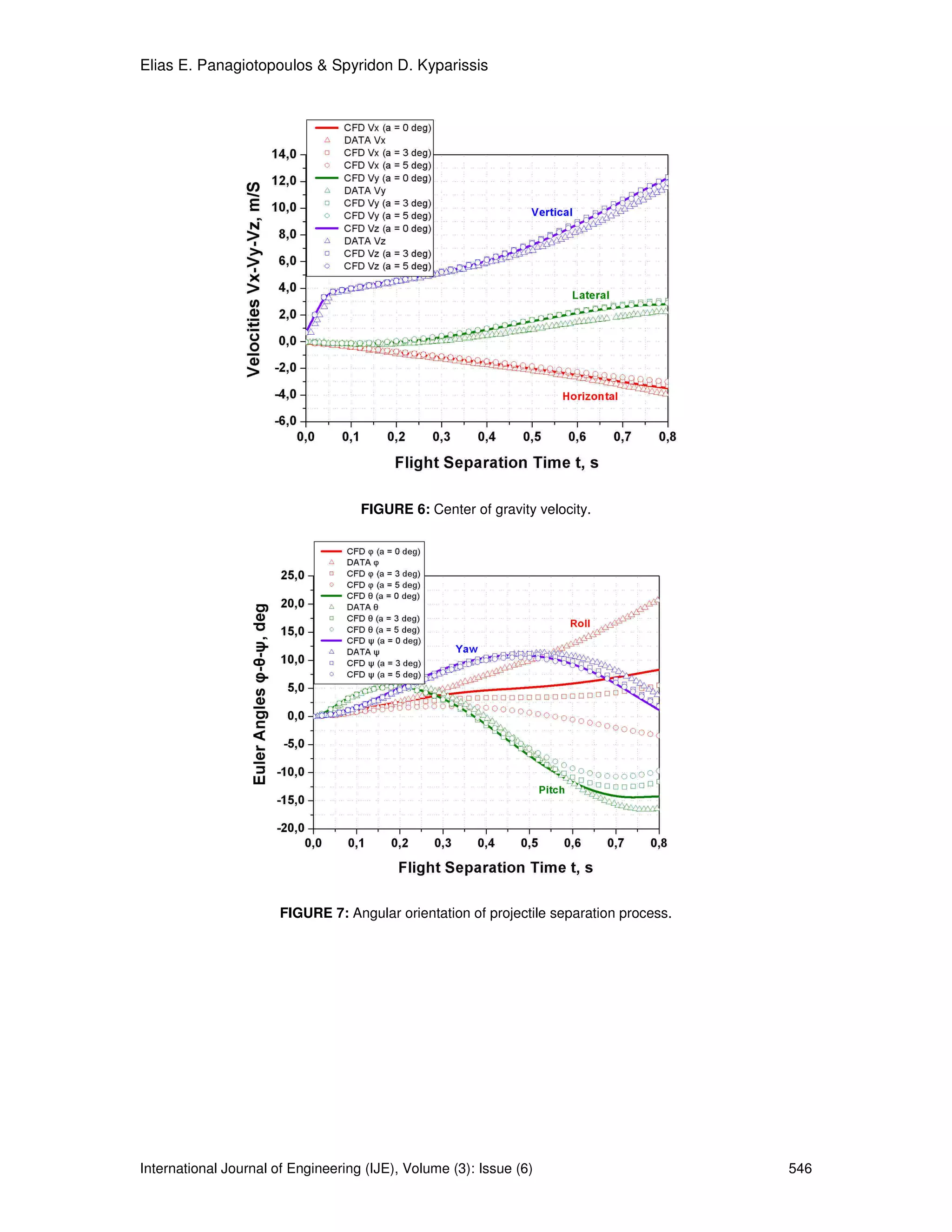
Four trajectory parameters are examined and compared with the experimental data: center of
gravity (CG) location, CG velocity, orientation, and angular rate. These parameters are plotted in
FIGURE 5 - 8 for total store separation process in 0.8 sec. In each plot are shown the
experimental data at α = 0 deg [30], [33], [34] and CFD data for the three examined angles of
attack.
FIGURE 5 shows the store CG location in the global coordinate system as a function of store-
separation time. It is apparent that the z (vertical) position matches very closely with the
experimental data for the three examined angles of attack. This is because the ejector and gravity
forces dominate the aerodynamic forces in this direction. In the x and y direction the agreement is
also very good. The store moves rearward and slightly inboard as it falls. The small discrepancy
in the x direction is expected because the drag is underestimated in the absence of viscous
effects. This is also seen in the CG velocities, shown in FIGURE 6. As expected, the store
continuously accelerates rearward, with the CFD results underpredicting the movement for the
three examined angles of attack. The store is initially pulled slightly inboard, but soon begins to
move slowly outboard with the wing outwash. As with position, the velocity in the z direction
matches very well with the experiments for zero angle of attack. In this plot the effect of the
ejectors is seen clearly at the beginning of the trajectory via a large z-velocity gradient. After
approximately t = 0.05 seconds, the store is clear of the ejectors.
FIGURE 5: Center of gravity location.
International Journal of Engineering (IJE), Volume (3): Issue (6) 545](https://image.slidesharecdn.com/ijev3i6-110103005953-phpapp01/75/Ije-v4-i2International-Journal-of-Engineering-IJE-Volume-3-Issue-6-33-2048.jpg)
![Elias E. Panagiotopoulos & Spyridon D. Kyparissis
FIGURE 8: Angular rate of the examined store movement.
The orientation of the store is more difficult to model than the CG position. This is evident in
FIGURE 7, which shows the Euler angles as a function of time. The pitch and yaw angles agree
well with the experiment for α = 0, 3 and 5 degrees, respectively. The store initially pitches nose-
up in response to the moment produced by the ejectors, as shown in FIGURE 2. Once free of the
ejectors after 0.05 seconds, though, the nose-down aerodynamic pitching moment reverses the
trend. The store yaws initially outboard until approximately 0.55 seconds, after which it begins
turning inboard. The store rolls continuously outboard throughout the first 0.8 seconds of the
separation. This trend is under-predicted by the CFD simulation analysis, and the curve tends to
diverge from the experiments after approximately 0.3 seconds for all the examined angles of
attack. The roll angle is especially difficult to model because the moment of inertia about the roll
axis is much smaller than that of the pitch and yaw axes, see TABLE 1. Consequently, roll is very
sensitive to errors in the aerodynamic force prediction. The body angular rates are plotted in
FIGURE 8. Here again it is shown that the pitch and yaw rates compare well with the experiments
at α = 0 deg, while the roll rate is more difficult to capture.
It is obvious, that the CFD performs very well in modelling the whole store separation events. This
is reiterated in FIGURE 9, in which views of the simulated store movements at α = 0 and α = 5
deg, respectively, are compared at discrete instants in time throughout the separation for the first
0.8 seconds. In the examined two cases the stores pitch down even though the applied ejector
forces causes a positive (nose up) ejector moment and roll inboard and yaw outboard. This
downward pitch of the store is a desirable trait for safe separation of a store from a fighter aircraft
[2].
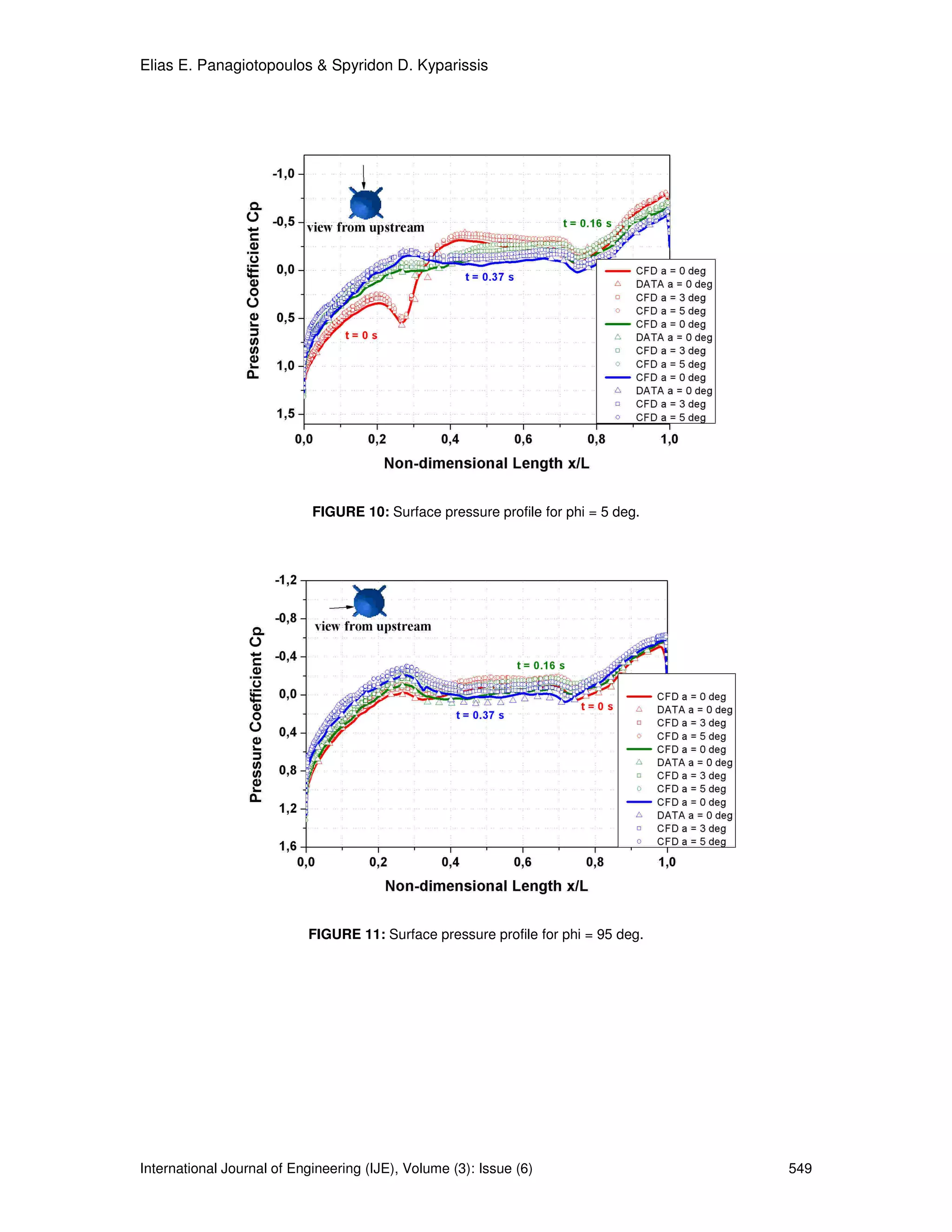
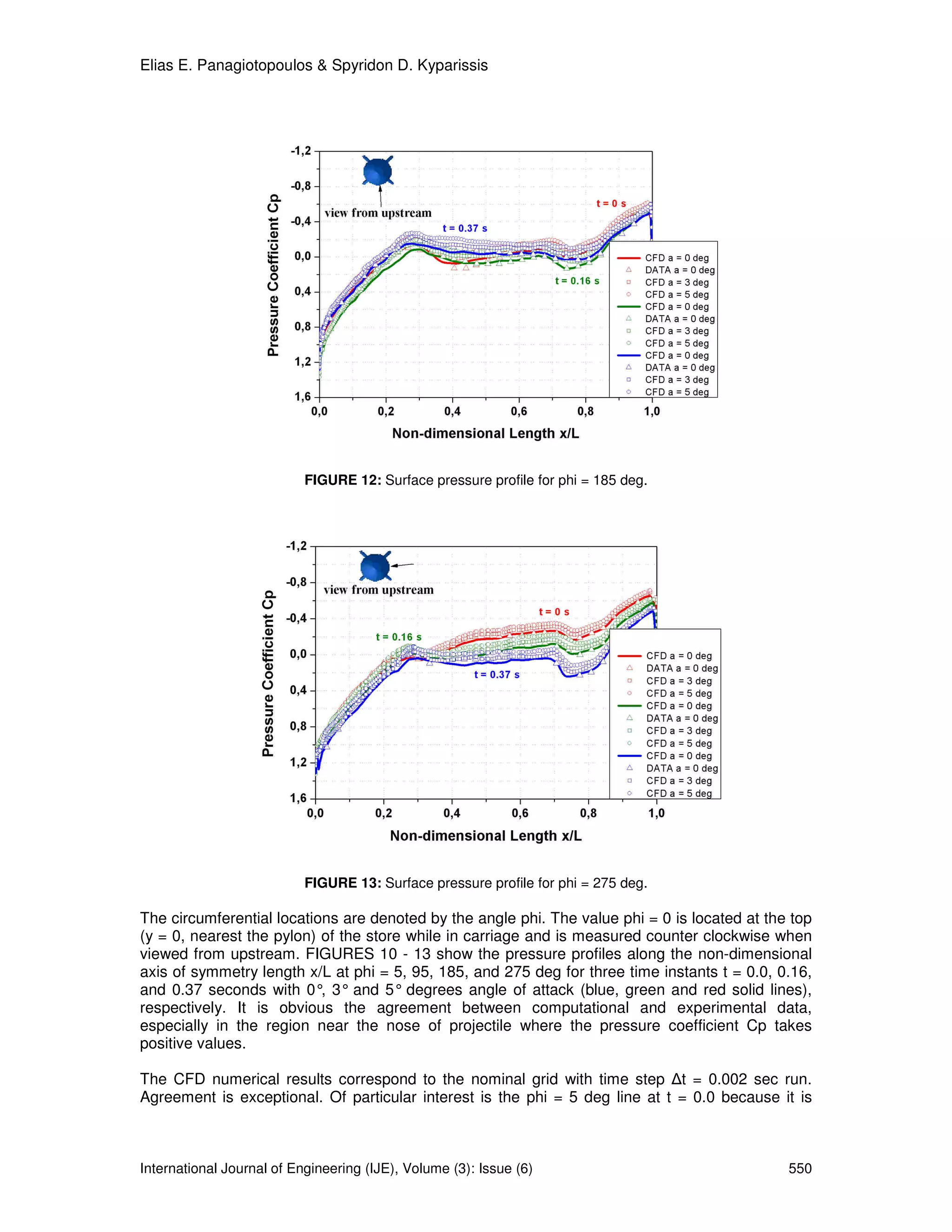
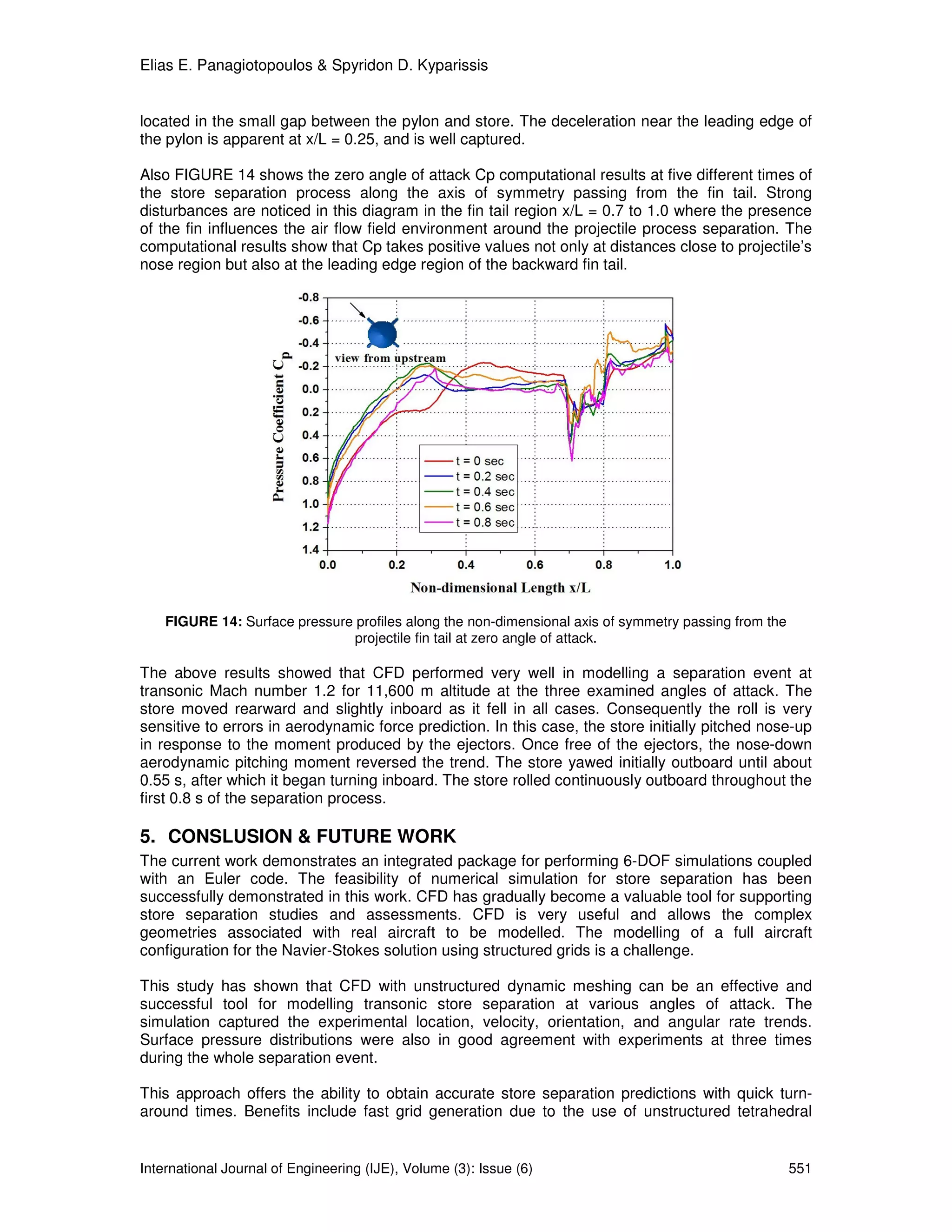
The fluid dynamics prediction analysis also gives pressure coefficient distributions for the total
separation history along axial lines on the store body at four circumferential locations and three
instants in time. The simulation data are compared with experimental surface pressure data from
the wind tunnel tests [31], [33], 34], as depicted in FIGURES 10 up to 13.
International Journal of Engineering (IJE), Volume (3): Issue (6) 547](https://image.slidesharecdn.com/ijev3i6-110103005953-phpapp01/75/Ije-v4-i2International-Journal-of-Engineering-IJE-Volume-3-Issue-6-35-2048.jpg)



![Fath Elrahman Ismael, Sharifah K. Syed Yusof & Norsheila Fisal
An efficient Bandwidth Demand Estimation for Delay Reduction
in IEEE 802.16j MMR WiMAX Networks
Fath Elrahman Ismael fathi_sml@yahoo.com
UTM MIMOS CoE Telecommunication Technology,
Faculty of Electrical Engineering (FKE)
Universiti Teknologi Malaysia (UTM)
Johor, 81300, Malaysia
Sharifah K. Syed Yusof kamilah@fke.utm.my
UTM MIMOS CoE Telecommunication Technology,
Faculty of Electrical Engineering (FKE)
Universiti Teknologi Malaysia (UTM)
Johor, 81300, Malaysia
Norsheila Fisal Sheila@fke.utm.my
UTM MIMOS CoE Telecommunication Technology,
Faculty of Electrical Engineering (FKE)
Universiti Teknologi Malaysia (UTM)
Johor, 81300, Malaysia
Abstract
IEEE 802.16j MMR WiMAX networks allow the number of hops between the user and
the MMR-BS to be more than two hops. The standard bandwidth request procedure in
WiMAX network introduces much delay to the user data and acknowledgement of the
TCP packet that affects the performance and throughput of the network. In this paper,
we propose a new scheduling scheme to reduce the bandwidth request delay in MMR
networks. In this scheme, the MMR-BS allocates bandwidth to its direct subordinate RSs
without bandwidth request using Grey prediction algorithm to estimate the required
bandwidth of each of its subordinate RS. Using this architecture, the access RS can
allocate its subordinate MSs the required bandwidth without notification to the MMR-BS.
Our scheduling architecture with efficient bandwidth demand estimation able to reduce
delay significantly.
Keywords – IEEE 802.16j, Grey prediction, Delay, throughput, wireless networks.
1. INTRODUCTION
The IEEE 802.16 WiMAX is a standard for the wireless broadband access networks and is
recognized as one of the strongest contenders of the wired networks to provide internet
connection to the end users. However, the existing WiMAX products have limited coverage and
provide poor signal strength for indoor users as well as users at cell boundaries [1].
Mobile Multi-hop Relay (MMR) WiMAX systems have the potential to offer improved coverage
and capacity over single-hop radio access systems. Standards development organizations are
considering how to incorporate such techniques into new standards. One such initiative is the
International Journal of Engineering (IJE), Volume (3): Issue (6) 554](https://image.slidesharecdn.com/ijev3i6-110103005953-phpapp01/75/Ije-v4-i2International-Journal-of-Engineering-IJE-Volume-3-Issue-6-42-2048.jpg)
![Fath Elrahman Ismael, Sharifah K. Syed Yusof & Norsheila Fisal
IEEE 802.16j standardization activity, adding relay capabilities to IEEE 802.16e systems [2]. The
Relay Station (RS) significantly reduces the installation and operation cost [3]. Moreover, the RS
increases the overall network capacity as a result of enhancing CINR in a poor coverage area.
Transmission Control Protocol (TCP) is the most commonly used transport protocol on the
Internet [16]. But conventional TCP requires acknowledgement from the receiver side to know
that the sent packet is received correctly or not.
The bandwidth request- grant mechanism in the standard WiMAX when applied to multi- hop
systems affects the performance of the TCP traffic. It introduces much delay to the transmitted
data in the uplink and also to the TCP acknowledgement, which increases the Round Trip Time
(RTT) and leads to unnecessary retransmission and reduces the throughput.
The paper is organized as follows. Section 2 introduces general overview on MMR network
architecture. In 3 scheduling algorithm of WiMAX networks are discussed. The Problem definition
is stated in 4. The literature and related work is given in 5. The proposed scheduling architecture
is explained in 6, the grey prediction algorithm is discussed in 7, the performance of the proposed
scheme is evaluated in 8, and the conclusion in 9.
2. Mmr networks architecture
The MMR networks consist of three types of station: the MMR-BS, a fixed (RS), and the (MS) as
shown in FIGURE 1. The MS can communicate with a MMR-BS either directly or over a two-hop
via the RS, and also more than two hops can be exploited via multiple RSs. The direct link
between the MS and the MMR-BS or RS is referred to as an access link, while the backhaul link
between the RS and the MMR-BS referred to as a relay link.
FIGURE 1: MMR network architecture
In WiMAX OFDMA the most common duplexing mode is frame structure TDD, in which the frame
is divided into downlink and uplink sub frame that are separated by a guard interval. At the
beginning of each Downlink (DL) frame there are several symbols that used for frame control as
shown in FIGURE 2. The Preamble enables MS to synchronize to the MMR-BS. DL MAP maps
each MS the location of its pertinent burst in the DL sub frame. UL MAP that define for the MS the
burst location and size in the coming UL sub frame. Frame Check Header (FCH) which is a
special management burst that is used for the MMR-BS to advertize the system configuration The
relay operation is classified in two different modes: transparent and non-transparent relay (NTR):
The transparent relay is an element that is located in the network between the MMR-BS and the
MS, without the MS being aware of its existence. It does not transmit any control data. The MS
International Journal of Engineering (IJE), Volume (3): Issue (6) 555](https://image.slidesharecdn.com/ijev3i6-110103005953-phpapp01/75/Ije-v4-i2International-Journal-of-Engineering-IJE-Volume-3-Issue-6-43-2048.jpg)
![Fath Elrahman Ismael, Sharifah K. Syed Yusof & Norsheila Fisal
receives directly all the control data such as preamble, FCH, DL MAP and UL MAP directly from
the MMR-BS. The transparent relay usually does not extend coverage; its main function is
channel quality improvement that as a result increases the link capacity [1] [2].
NTR is a network element that the MS is totally aware of it. The MS which is IEEE 802.16e
compatible is not aware of any relaying operation, from the MS point of view the NTR is its
conventional serving BS. So, the NTR should support most of the capabilities of a plain 802.16e
BS like sending frame control data that includes preamble, UL/DL MAP, FCH. Furthermore, the
NTR supports handover, network entry and MS ranging. The NTR serves MSs that are beyond
reach of the MMR-BS. As so the NTR is perfect tool for achieving extension of cell and coverage.
In addition it can also act as a capacity enhancer because of significant improvement in the
channel quality of both access and relay links [1] [2].
FIGURE 2: OFDMA frame structure
3. Scheduling algorithms of wimax
Scheduling is a sequence of allocating fixed-length time slots to users, where each possible
transmission is assigned a time slot. The scheduling challenges are how to develop scheduling
architecture that overcomes the problems of increased delay and signaling overhead, and design
scheduling algorithm that guarantees the QoS requirements of each service flow [13].
All transparent relays must (and NTRs may) operate in centralized scheduling mode. In this
option the MMR-BS is doing all scheduling tasks as it is defined in IEEE 802.16e. It supports
optimal centralized radio resource management (RRM), and enables network load balancing
among the subordinate relays. However, it requires heavy management traffic within the network,
and it is slow in granting bandwidth, which make it not feasible in heavy multi-hop network [4][5].
In distributed scheduling, some MAC intelligence can be given to the RSs. IEEE 802.16j allows
NTR relays to operate in distributed scheduling mode, where they make decisions about resource
allocation to their subordinate stations most always in coordination with the MMR-BS. In
distributed scheduling there is no heavy management traffic within the network and it allows fast
bandwidth request grants for high priority requests, which it a suitable technique in heavy multi-
hop architecture. But it does not give option for load balancing between relays, and there is no
option for centralized RRM [4] [5].
Five scheduling services are defines in the IEEE 802.16j, these are Unsolicited Grant Service
(UGS), Real Time Polling Service (rtps), Extended Real Time Polling Service (ertps), Non Real
International Journal of Engineering (IJE), Volume (3): Issue (6) 556](https://image.slidesharecdn.com/ijev3i6-110103005953-phpapp01/75/Ije-v4-i2International-Journal-of-Engineering-IJE-Volume-3-Issue-6-44-2048.jpg)
![Fath Elrahman Ismael, Sharifah K. Syed Yusof & Norsheila Fisal
Time polling Service (nrtps), and Best Effort (BE). The selected network service should allocate
sufficient amount of bandwidth in order to actually guarantee network QoS provisioning [17].
4. Problem definition
In WiMAX network when the MS wants to send data, it first sends a bandwidth request message
to the corresponding base station (BS), and then the BS grants the appropriate amount of
bandwidth to the MS based on the uplink scheduling algorithm. In MMR networks, the control
messages used for network entry or bandwidth request are doubled for every RS introduced
between MS and MMR-BS, as shown in FIGURE 3. The main reason of the increasing overhead
and latency is because all service flow management decisions should be made by MMR-BS in
spite of centralized or distributed scheduling. In the centralized scheduling all the functions of
network entry and bandwidth request are performed by the MMR-BS. The signaling messages
received by the RS from the MSs are forwarded to the MMR-BS, which decides and sends a
response messages to the MSs through the intermediate RSs, this process increases the
signaling messages exchanged and the delay. Although in the distributed scheduling the RS have
an ability to respond to the bandwidth request from their subordinate stations, the relay station
requires also a bandwidth request to relay received data to the MMR-BS, which also increase the
signaling overhead and delay. Considering that, a signaling message from one hop to another
cannot be transmitted in one frame’s duration, the delay of control messages transfer from
MMR-BS to the MS will increase significantly due to the multi-hop added.
The increased delay affects the performance of the services offered by the MMR WiMAX,
because in UGS, rtps, and ertps services the lower latency is required as a QoS metric.
Furthermore, even for the BE using TCP as transport protocol, the increased delay increases
Round Trip Time (RTT) which degrades the throughput.
FIGURE 3: Bandwidth request procedure
International Journal of Engineering (IJE), Volume (3): Issue (6) 557](https://image.slidesharecdn.com/ijev3i6-110103005953-phpapp01/75/Ije-v4-i2International-Journal-of-Engineering-IJE-Volume-3-Issue-6-45-2048.jpg)
![Fath Elrahman Ismael, Sharifah K. Syed Yusof & Norsheila Fisal
5. Related works
In the literature there is some works done to reduce the signaling overhead and delay in one hop
WiMAX networks such as IEEE 802.16e.
The authors of [8, 9] suggest bandwidth grant mechanism without bandwidth request to fully
utilize the available bandwidth for the BE traffic. The BE traffic has a lower priority among
services supported by WiMAX; this will result in small amount of bandwidth for this type of
service. In addition the BE uses contention based bandwidth request, in which BE connections
contend limited number of shared slots for sending their request, and if there is more than one SS
attempts to send their requests via a slot, the requested are corrupted.
In this scheme, the BS allocate bandwidth to the SSs without bandwidth request, the amount of
granted bandwidth is determined from the current sending rate, this scheme is suitable for large
scale network. On the other hand, it may waste the bandwidth when the sending rate is highly
fluctuated, and it’s hard to estimate the required bandwidth accurately.
In the downlink TCP flow, the standard bandwidth request- grant mechanism in single hop
networks introduces much delay to transmit uplink TCP acknowledgement, which increase the
Round Trip Time (RTT) and causes unnecessary retransmission that reduce the TCP traffic
performance. The authors of [11] introduce new bandwidth scheme that simultaneously allocate
bandwidth for both downlink TCP data and uplink TCP acknowledgement.
In the uplink TCP traffic, since the BS controls the uplink transmission and the MS needs to get
permission before transmission, these steps severely limit the performance of the TCP by
introducing much delay and degrade the throughput. The authors of [12] propose scheme
allocating uplink bandwidth in advance. When the BS receive acknowledgement to be sent to the
MS, it relays the TCP ACK and at the same time allocate bandwidth for the uplink TCP data
packet without bandwidth request from the SS. These schemes for bidirectional bandwidth
allocation require more information about the actual SS needs to not waste the bandwidth.
For MMR networks there are a little work done to reduce the signaling overhead and delay. In [6]
MSs send their bandwidth request to their super ordinate RS at their respective polling intervals.
The RS collects all bandwidth requests from MSs and generates an aggregated bandwidth
request to the MMR-BS. The MMR-BS, instead of allocating the bandwidth to the MSs directly, it
grants bandwidth to the intermediate RS, which then allocates bandwidth to individual MSs. This
scheme decreases the signaling overhead, but not decreases the delay.
The authors of [7], has defined an operation called concatenation, whereby multiple packet data
units (MPDUs) can be concatenated into a single transmission burst in either uplink or downlink
directions, regardless whether these MPDUs belong to the same connection or not. Also multiple
service data units (MSDUs) belong to the same connection can be aggregated to form one
MPDU. These schemes reduce the signaling overhead but there is still much delay.
In [10], the authors propose Extra Resource Reservation (ERR) scheme in which the MMR-BS
pre-allocate some resources to the RSs for purpose of transporting control messages or data
traffic. So the RS can admit its MSs without MMR-BS notification. This scheme can reduce the
delay but it wastes the channel resources if the ERR is used ineffectively in the RS.
Grey theory has been widely applied to many disciplines such as economics, sociology,
engineering, and so forth. The authors of [14] use the grey prediction to estimate the demand
value of the electricity on line. In [15] it is used for internet access forecasting.
International Journal of Engineering (IJE), Volume (3): Issue (6) 558](https://image.slidesharecdn.com/ijev3i6-110103005953-phpapp01/75/Ije-v4-i2International-Journal-of-Engineering-IJE-Volume-3-Issue-6-46-2048.jpg)
![Fath Elrahman Ismael, Sharifah K. Syed Yusof & Norsheila Fisal
6. The proposed scheduling algorithm
The IEEE 802.16j support tree architecture in which all the traffic go through the MMR-BS, so it
should be managed in a centralized manner. But to reduce the signaling overhead and delay its
better to distribute the management of the bandwidth request in the access RS. So, our scheme
manages the relay links centrally in the MMR-BS, and the bandwidth request for the end users
distributed in the RS to take the advantages of both scheduling architectures.
The aims of the proposed scheduling scheme are to fully utilize the available bandwidth, and
effectively respond to the demand changes of the subordinate Relay Stations.
In the proposed scheduling architecture in FIGURE 4, the MMR-BS manages its subordinate RSs
as one hop stations. The same procedure is applied in the intermediate RS in the case of more
than two hops, and in the access RS the conventional bandwidth request can be deployed.
FIGURE 4: Proposed Scheduling Architecture
In this scheme the bandwidth request is not needed, instead MMR-BS measures the existing
sending rate of its subordinate RSs, estimates the future demand of each RS using Grey
prediction algorithm and grants them a suitable bandwidth without request.
Grey prediction theory [14] aims to find the optimized system parameters of a Grey differential
equation such that the dynamic behavior of the traffic demand could be best fitted with the
differential equation.
One of the major advantages of Grey prediction theory is that only small amounts of data are
needed to describe the demand behavior and reveal the continuous changing in the required
bandwidth.
7. The grey prediction algorithm
The grey prediction algorithm is used in the proposed scheme to estimate the required bandwidth
of each RS from the previous values. In this paper, the GM (1, 1) model is adopted to perform the
prediction of the required bandwidth for each RS. The standard procedure is as follows:
Step 1: Collecting the original data sequence, those are at least four consequence values of the
measured traffic for the RS that is used in the estimation process.
{
x ( 0 ) = x ( 0 ) (1), x ( 0 ) ( 2 ),........ . x ( 0 ) ( m ) } m≥4 (1)
Step 2: Calculating an accumulated generation operation, AGO, on the original data sequence in
order to diminish the effect of data uncertainty.
International Journal of Engineering (IJE), Volume (3): Issue (6) 559](https://image.slidesharecdn.com/ijev3i6-110103005953-phpapp01/75/Ije-v4-i2International-Journal-of-Engineering-IJE-Volume-3-Issue-6-47-2048.jpg)
![Fath Elrahman Ismael, Sharifah K. Syed Yusof & Norsheila Fisal
k
x (1 ) ( k ) = ∑
i =1
x ( 0 ) (i ) k = 1, 2 ,......, m (2)
Step 3: Establishing Grey differential equation and then calculating its background values: First
we define z (1) as the sequence obtained by the MEAN operation to x (1) as:
[
z (1 ) ( k ) = α * x (1 ) ( k ) + (1 − α ) x (1 ) ( k − 1) ] (3)
for k = 2 , 3 ,... m
Secondly Grey differential equation can be obtained the as follow:
x ( 0 ) ( k ) + az (1 )
(k ) = b (4)
Where the parameters a, b are called the development coefficient and the grey input,
respectively. The equation (5) is called the whitening equation corresponding to the grey
differential equation.
dx ( 1 ) (1 )
+ ax = b (5 )
dt
Step 4: calculate the value of a, b by means of the least square method.
a T −1 T N
b = (B B ) B x (6 )
− z (1 )
(2 ) 1
(1 )
− z (3 ) 1
.
B = (7 )
.
.
− z
(1 )
(m ) 1
Where
And x N
[
= x ( 0 ) ( 2 ) x ( 0 ) ( 3 )... x ( 0 ) ( m ) ]T
(8 )
Step 5: Deriving the solution to the Grey difference equation:
b b
x (1 ) ( k + 1) = x ( 0 ) (1) − e − a ( k ) +
ˆ (9 )
a a
ˆ
Where the parameter (k) is the forecasting step size and the up script “^” means the value x is a
forecasting value of traffic demand.
ˆ ( 1 ) to obtain a
Step 6: conducting the inverse accumulated generation operation (IAGO) on x
prediction value as follow:
x ( 0 ) ( k ) = x (1 ) ( k ) − x (1 ) ( k − 1)
ˆ ˆ ˆ (10 )
K = 2 , 3 ,......, n
Combining the equations (9) and (10) gives the predicted value of the traffic demand as stated in
(11)
b
x ( 0 ) (k ) = (1 − e a ) x ( 0) (1) − e −a ( k −1)
ˆ (11)
a
Step 7: The parameters are changed and the accuracy of the estimated value is calculated using
the formula:
International Journal of Engineering (IJE), Volume (3): Issue (6) 560](https://image.slidesharecdn.com/ijev3i6-110103005953-phpapp01/75/Ije-v4-i2International-Journal-of-Engineering-IJE-Volume-3-Issue-6-48-2048.jpg)
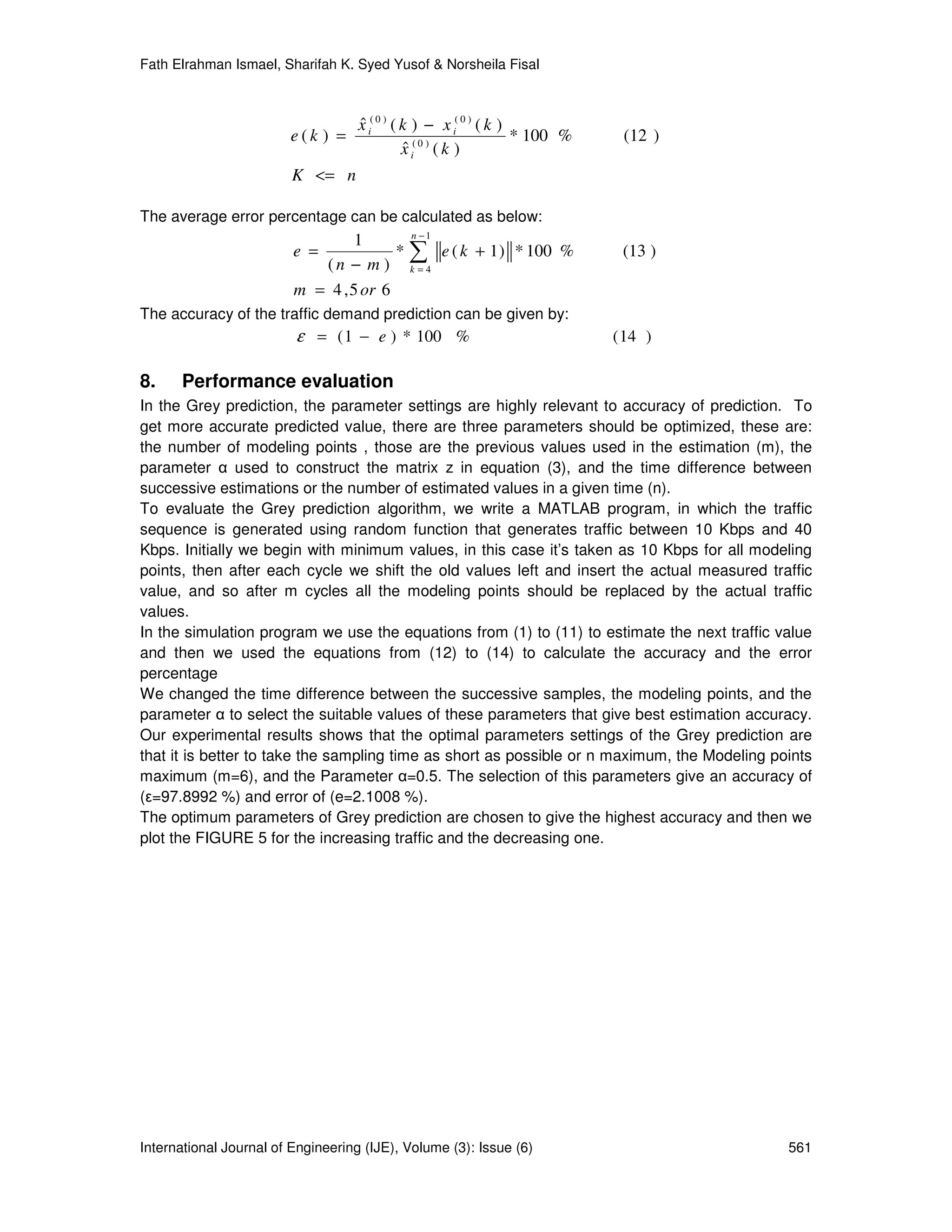
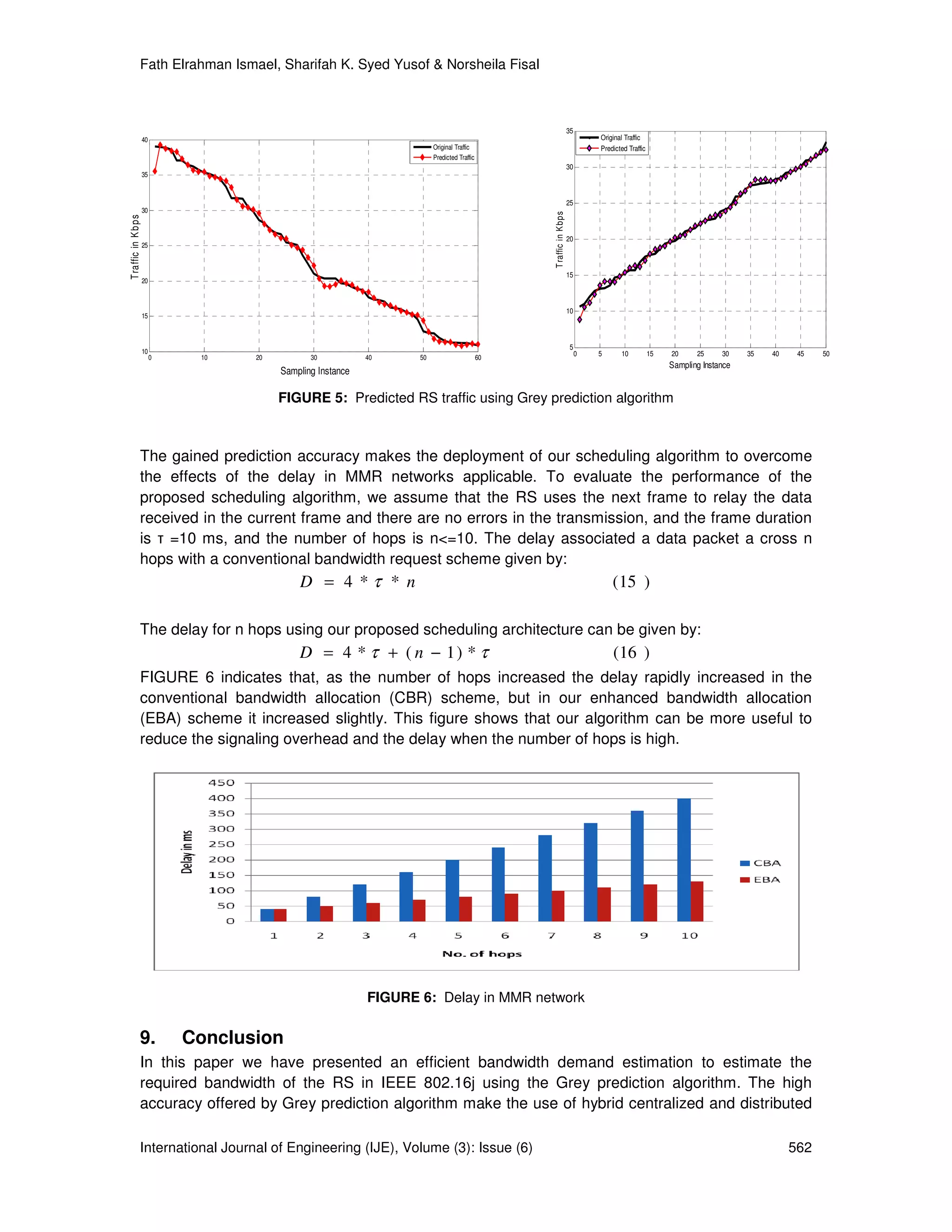



![Vahid. K. Alilou & Mohammad. Teshnehlab.
Concrete is the most widely used structural material in constructions in the world. Massive
concreting in huge civil projects like dams, power plants, bridges and etc… usually is not
practicable and it is necessary to be performed in several layers and the compressive strength of
each layer should not be less than the specified compressive strength. Therefore one should wait
28 days to achieve 28-day strength of each layer of concrete. Thereupon if we have n layers of
concrete we need 28×n days to complete the total project. [1]
2. CONCRETE
Concrete is the only major building material that can be delivered to the job site in a plastic state.
This unique quality makes concrete desirable as a building material because it can be molded to
virtually any form or shape. Concrete provides a wide latitude in surface textures and colors and
can be used to construct a wide variety of structures, such as highways and streets, bridges,
dams, large buildings, airport runways, irrigation structures, breakwaters, piers and docks,
sidewalks, silos and farm buildings, homes, and even barges and ships.
The two major components of concrete are a cement paste and inert materials. The cement paste
consists of Portland cement, water, and some air either in the form of naturally entrapped air
voids or minute, intentionally entrained air bubbles. The inert materials are usually composed of
fine aggregate, which is a material such as sand, and coarse aggregate, which is a material such
as gravel, crushed stone, or slag.
When Portland cement is mixed with water, the compounds of the cement react to form a
cementing medium. In properly mixed concrete, each particle of sand and coarse aggregate is
completely surrounded and coated by this paste, and all spaces between the particles are filled
with it. As the cement paste sets and hardens, it binds the aggregates into a solid mass.
Under normal conditions, concrete grows stronger as it grows older. The chemical reactions
between cement and water that cause the paste to harden and bind the aggregates together
require time. The reactions take place very rapidly at first and then more slowly over a long period
of time. [2]
3. CEMENT
Cement is a material that has adhesive and cohesive properties enabling it to bond mineral
fragments into a solid mass. Cement consists of silicates and aluminates of lime made from
limestone and clay (or shale) which is ground, blended, fused in a kiln and crushed to a powder.
Cement chemically combines with water (hydration) to form a hardened mass. The usual
hydraulic cement is known as Portland cement because of its resemblance when hardened to
Portland stone found near Dorset, England. The name was originated in a patent obtained by
Joseph Aspdin of Leeds, England in 1824.
Typical Portland cements are mixtures of tricalcium silicate (3CaO • SiO2), tricalcium aluminate
(3CaO • Al2O3), and dicalcium silicate (2CaO • SiO2), in varying proportions, together with small
amounts of magnesium and iron compounds. Gypsum is often added to slow the hardening
process. [2,3]
4. WATER
The water has two roles in concrete mixture: First is the chemical composition with cement and
perform cement hydration and second is to make the concrete composition fluent and workable.
The water which is used to make the concrete is drink water. The impurity of water can have
undesirable effect on concrete strength. [4]
5. AGGREGATES
Since aggregate usually occupies about 75% of the total volume of concrete, its properties have a
definite influence on behavior of hardened concrete. Not only does the strength of the aggregate
affect the strength of the concrete, its properties also greatly affect durability (resistance to
deterioration under freeze-thaw cycles). Since aggregate is less expensive than cement it is
International Journal of Engineering (IJE), Volume (3) : Issue (6) 566](https://image.slidesharecdn.com/ijev3i6-110103005953-phpapp01/75/Ije-v4-i2International-Journal-of-Engineering-IJE-Volume-3-Issue-6-54-2048.jpg)
![Vahid. K. Alilou & Mohammad. Teshnehlab.
logical to try to use the largest percentage feasible. Hence aggregates are usually graded by size
and a proper mix has specified percentages of both fine and coarse aggregates. Fine aggregate
(sand) is any material passing through a No. 4 sieve. Coarse aggregate (gravel) is any material of
larger size.
Fine aggregate provides the fineness and cohesion of concrete. It is important that fine aggregate
should not contain clay or any chemical pollution. Also, fine aggregate has the role of space filling
between coarse aggregates. Coarse aggregate includes: fine gravel, gravel and coarse gravel
In fact coarse aggregate comprises the strongest part of the concrete. It also has reverse effect
on the concrete fineness. The more coarse aggregate, the higher is the density and the lower is
the fineness. [3,5]
6. COMPRESSIVE STRENGTH OF CONCRETE
The strength of concrete is controlled by the proportioning of cement, coarse and fine aggregates,
water, and various admixtures. The ratio of the water to cement is the chief factor for determining
concrete strength as shown in figure1. The lower the water-cement ratio, the higher is the
compressive strength. A certain minimum amount of water is necessary for the proper chemical
action in the hardening of concrete; extra water increases the workability (how easily the concrete
will flow) but reduces strength. A measure of the workability is obtained by a slump test.
Actual strength of concrete in place in the structure is also greatly affected by quality control
procedures for placement and inspection. The strength of concrete is denoted in the United
'
States by f c which is the compressive strength of test cylinder 6 in. in diameter by 12 in. high
measured on the 28th day after they are made. [3]
56
49
42
Strength (N/mm2)
Co
35 m
pr
es
si v
eS
tr e
ng
28 th
21
14
7 Tensile Strength
0.3 0.4 0.5 0.6 0.7
Water/Cement Ratio
FIGURE 1: illustration of the effect of water/cement ratio in concrete strength [1]
International Journal of Engineering (IJE), Volume (3) : Issue (6) 567](https://image.slidesharecdn.com/ijev3i6-110103005953-phpapp01/75/Ije-v4-i2International-Journal-of-Engineering-IJE-Volume-3-Issue-6-55-2048.jpg)
![Vahid. K. Alilou & Mohammad. Teshnehlab.
7. CONCRETE SAMPLING
Acceptance of the concrete in the site is performed based on the results of the compressive tests
of concrete samples. The concrete samples must be taken from the final consumption place.
The purpose of the concrete sampling is to prepare two specimens of concrete which their
compressive tests will be performed after 28 days or in any predetermined day. To predict the 28-
day compressive strength of concrete we can also have another sample to be tested earlier than
28 days. [1]
8. CONCRETE MIX DESIGN
The concrete mix design is a process of selecting the suitable ingredients of concrete and
determining their most optimum proportion which would produce, as economically as possible,
concrete that satisfies a certain compressive strength and desired workability. [6]
The concrete mix design is based on the principles of
• Workability
• Desired strength and durability of hardened concrete
• Conditions in site, which helps in deciding workability, strength and durability
requirements
9. ADAPTIVE SYSTEMS
Adaptability, in essence, is the ability to react in sympathy with disturbances to the environment.
A system that exhibits adaptability is said to be adaptive. Biological systems are adaptive
systems; animals, for example, can adapt to changes in their environment through a learning
process [7]. A generic adaptive system employed in engineering is shown in Figure 2. It consists
of
• set of adjustable parameters (weights) within some filter structure;
• An error calculation block (the difference between the desired response and the output of
the filter structure);
• A control (learning) algorithm for the adaptation of the weights.
The type of learning represented in Figure 2 is so-called supervised learning, since the learning is
directed by the desired response of the system. Here, the goal is to adjust iteratively the free
parameters (weights) of the adaptive system so as to minimize a prescribed cost function in some
predetermined sense. [8]
ADAPTIVE SYSTEM - +
INPUT STRUCTURE
OUTPUT
Σ DESIRED
SIGNAL SIGNAL
CONTROL
ALGORITHM ERROR
FIGURE 2: Block diagram of an adaptive system
International Journal of Engineering (IJE), Volume (3) : Issue (6) 568](https://image.slidesharecdn.com/ijev3i6-110103005953-phpapp01/75/Ije-v4-i2International-Journal-of-Engineering-IJE-Volume-3-Issue-6-56-2048.jpg)
![Vahid. K. Alilou & Mohammad. Teshnehlab.
10. ARTIFICIAL NEURAL NETWORKS
Artificial Neural Network (ANN) models have been extensively studied with the aim of achieving
human-like performance, especially in the field of pattern recognition and system identification.
These networks are composed of a number of nonlinear computational elements which operate in
parallel and are arranged in a manner reminiscent of biological neural inter-connections.
The property that is of primary significance for a neural network is the ability of the network to
learn from its environment, and to improve its performance through learning. The improvement in
performance takes place over time in accordance with some prescribed measure. A neural
network learns about its environment through an interactive process of adjustments applied its
synaptic weights and bias levels. Ideally, the network becomes more knowledgeable about its
environment after each iteration of the learning process. [7]
11. CONCRETE STRENGTH PREDICTION
To predict 28-day strength of concrete, It should identify the effective parameters of the concrete
strength. The more accurately identified the parameters, the better is the result.
The studies in this paper were performed in two phases:
1. Phase one, includes the studies about the concrete and effective factors of the concrete
compressive strength and also performing the experiments in the real environment and
collecting data.
2. Phase two, include studies about how to use artificial neural networks to identify the
presented system and to achieve accurate prediction of concrete 28-day compressive
strength. [1]
12. PERFORMING EXPERIMENTS
In this study the ACI method is used to perform experiments. Experiments were performed in
Aghchay dam in west Azerbaijan in IRAN. The cement used in the experiments was provided
from Sofiyan cement plant and the aggregates were provided from the natural materials of the
Aghchay dam site. [1]
13. COLLECTING DATA
There are lots of Parameters affect on compressive strength of concrete. But the most important
parameters were collected in table 1. It is important that the range of each parameter is limited
due to regarding ACI standard.
TABLE 1: Effective parameters of the compressive strength of the concrete
Row Parameter Unit Range
1 Mix Design - A-L
2 Water/Cement Ratio % 35.0 - 75.0
3 Density ton/m3 2.30 - 2.60
4 Slump mm 70 - 150
5 Air % 1.0 - 7.0
6 Silica fumes gr 0 - 400
7 Super-Plasticizer kg 0.0 - 3.5
8 Age day 3, 7, 14, 28, 42
9 Compressive Strength kg/cm2 70.00 - 420.00
The concrete mix design is affected by these factors:
Cement, Fine aggregate, Fine gravel, gravel, coarse gravel, air
International Journal of Engineering (IJE), Volume (3) : Issue (6) 569](https://image.slidesharecdn.com/ijev3i6-110103005953-phpapp01/75/Ije-v4-i2International-Journal-of-Engineering-IJE-Volume-3-Issue-6-57-2048.jpg)
![Vahid. K. Alilou & Mohammad. Teshnehlab.
st th th
The 1 to 7 parameters are determined in the first day. There is a salient point about 8
parameter (age). As previously mentioned, the concrete age has a direct arithmetic relation with
the concrete strength. The more aged the concrete the higher is the compressive strength. [1]
Here is an interesting point so that the 3-day compressive strength of concrete has a
th th th
mathematical relation with the compressive strength of the same concrete in 7 , 14 , 28 and
th
42 day. Therefore it can be used as an important parameter for prediction of this system. In
other words, the 3-day compressive strength of concrete is a very good criterion to achieve the
28-day compressive strength.
It is conceived from figure.3 that the higher the 3-day compressive strength the higher is the 28-
day compressive strength of the concrete. Figure.4 shows the relationship between 3-day
compressive strength and 28-day compressive strength for 4 types of concrete with variable w/c
ratios, this relation is linear relatively.
60.00 60.00
52.50 w/c 52.50
0.40
Compressive Strength (N/mm2)
45.00 45.00
37.50
0.50 37.50
30.00 0.60 30.00
0.70
22.50 22.50
15.00 15.00
7.50 7.50
1 3 7 14 28
Concrete Age ( day )
FIGURE 3: illustration of relationship between age and compressive strength of concrete [1]
60
50
28-Day Compressive Strength
40
30
20
10
0 10 20 30 40
3-Day Compressive Strength
FIGURE 4: illustration of relationship between 3-day and 28-day strength of concrete [1]
International Journal of Engineering (IJE), Volume (3) : Issue (6) 570](https://image.slidesharecdn.com/ijev3i6-110103005953-phpapp01/75/Ije-v4-i2International-Journal-of-Engineering-IJE-Volume-3-Issue-6-58-2048.jpg)
![Vahid. K. Alilou & Mohammad. Teshnehlab.
14. METHODOLOGY OF CONCRETE STRENGTH NEURAL IDENTIFICATION
A methodology for concrete strength neural identification was developed. It is shown
schematically in Figure 5. Three blocks can be distinguished in the scheme. Experimental results,
forming a set of data on concrete, used for training and testing the neural network are an integral
part of block1.
The experimental results as a set of patterns were saved in a computer file which was then used
as the input data for the network in block 2. The data were divided into data for training and
testing the neural network. The training patterns were randomly input into the network as
following:
1. 70% of total data for training of the neural network
2. 15% of total data for validation of the neural network
3. 15% of total data for testing of the neural network,
Block1
Set of Data
Block2
Neural Network Training and testing Output data
Input Data of neural network processing
Block3
Analysis of
obtained results
FIGURE 5: Block diagram of concrete compressive strength identification by means of neural networks [9]
If the neural network correctly mapped the training data and correctly identified the testing data, it
was considered trained. The obtained results were analyzed in block 3 whose output was
'
identified concrete compressive strength f c. [9]
15. FEED-FORWARD NEURAL NETWORK
The Feed-forward neural network structure for prediction of concrete compressive strength is
shown in Figure 6. Feed-forward networks often have one or more hidden layers of sigmoid
neurons followed by an output layer of linear neurons. Multiple layers of neurons with nonlinear
transfer function allow the network to learn nonlinear and linear relationships between inputs and
outputs. [10]
The process of learning with teacher in this network is executed through a back-propagation
algorithm so that the network output converges to the desired output. The key distinguishing
characteristic of this feed-forward neural network with the back-propagation learning algorithm is
that it forms a nonlinear mapping from a set of input stimuli to a set of output using features
extracted from the input patterns. The network can be designed and trained to accomplish a wide
variety of nonlinear mappings, some of which are very complex. This is because the neural units
in the neural network learn to respond to features found in the input. [11]
International Journal of Engineering (IJE), Volume (3) : Issue (6) 571](https://image.slidesharecdn.com/ijev3i6-110103005953-phpapp01/75/Ije-v4-i2International-Journal-of-Engineering-IJE-Volume-3-Issue-6-59-2048.jpg)
![Vahid. K. Alilou & Mohammad. Teshnehlab.
The number of input and output units is determined by dimensions of the data set whereas the
number of hidden layer (M) is a free parameter which is adjusted to achieve the maximum
performance. Note that, M determines the degree of freedom of the system. Therefore we expect
that there was an optimum value for M. The criterion to achieve the optimum M is defined as:
"The smallest M which causes minimum mse while the maximum error is small"
Neuron 1
1
F
1
1
net 1 o1
1
w1
x0 = 1
Neuron 1
2
1
o0 =1 Neuron 2
1
Mix Design x1
F 1
Fineness x2 1
1
net 2 o2 F
w2
1 2 ne t 2 o2
1
Air x3 x o w1 1
28-Day Strength
...
Admixture x4
3-Day Strength x5
...
Neuron 1
n 1
F 1
1 net 1 1
n on
w n1
1
FIGURE 6: Diagram of the feed-forward neural network used for concrete compressive strength prediction
Figure.7 shows the mean squared error of the network output for validation and test data with 10
iterations for each number of hidden neurons. Figure.8 shows the maximum error between
desired outputs and the network outputs with 10 iterations for each number of hidden neurons.
The optimum value in this structure is to choose M=11 for the number of hidden neurons.
In order to backpropagage the error and update the network weights, Gradient-Descent, Quasi-
Newton, Conjugate-Gradient and Levenberg-Marquardt Algorithms were used.
• Gradient Descent W (k + 1) = W (k ) − α κ g k
• Quasi Newton W (k + 1) = W (k ) − H K1g K
−
• Conjugate Gradient W (k + 1) = W (k ) − g k +1 + α κ ∆Wκ
Where W is the weight matrix, α is the learning rate, g is the gradient of error and H is the hessian
matrix of the cost function. [12]
The levenberg-marquardt algorithm is like quasi-newton but it doesn't need to calculate hessian
matrix where it can be estimated as follows:
H = JT J , ∇E = J T e
W (k + 1) = W (k ) − [ H + µI ]−1.∇E
International Journal of Engineering (IJE), Volume (3) : Issue (6) 572](https://image.slidesharecdn.com/ijev3i6-110103005953-phpapp01/75/Ije-v4-i2International-Journal-of-Engineering-IJE-Volume-3-Issue-6-60-2048.jpg)
![Vahid. K. Alilou & Mohammad. Teshnehlab.
4.5
4
3.5
3
2.5
2
1.5
1
0.5
0
0 1 2 3 4 5 6 7 8 9 10 11 12 13 14 15 16 17 18 19 20
FIGURE 7: Diagram of mean squared error of the network output with 10 iterations for certain number of
neurons
10
9
8
7
6
5
4
3
2
1
0
0 1 2 3 4 5 6 7 8 9 10 11 12 13 14 15 16 17 18 19 20
FIGURE 8: Diagram of maximum error of the network output with 10 iterations for certain number of neurons
The results of above algorithms have been collected in Table 2. Each row of the table is the result
of average 40 iterations of each method. Evaluation criterion of adaptive systems was defined as
following formula:
1 N e
AveragePercentageError : APE = ∑ i * 100%
N i =1 Ti
Where Ti is the desired output and ei is the output error. [13]
International Journal of Engineering (IJE), Volume (3) : Issue (6) 573](https://image.slidesharecdn.com/ijev3i6-110103005953-phpapp01/75/Ije-v4-i2International-Journal-of-Engineering-IJE-Volume-3-Issue-6-61-2048.jpg)
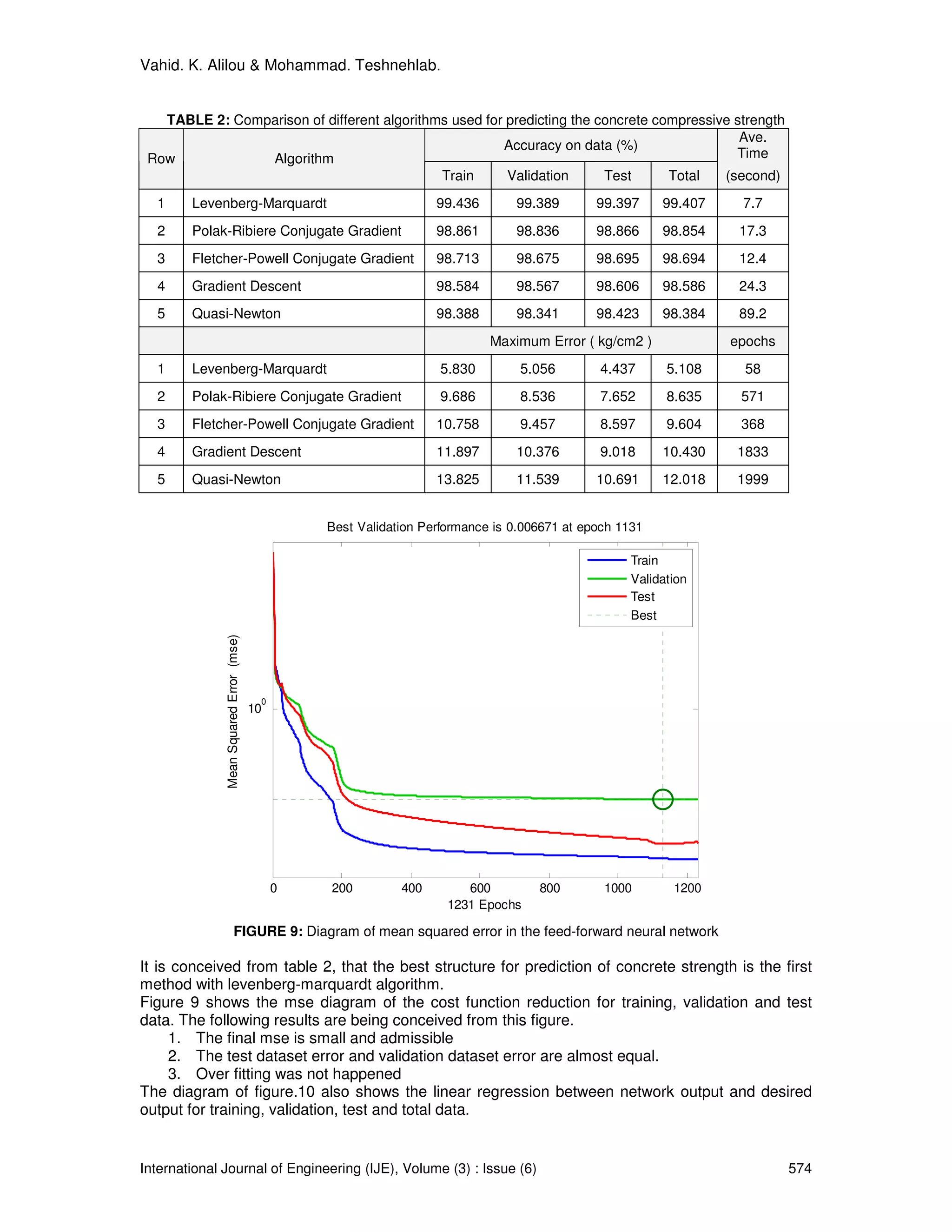
![Vahid. K. Alilou & Mohammad. Teshnehlab.
Training: R=1 Validation: R=1
340 340
Data Data
320 320
Fit Fit
Output~=1*Target+4.3e-005
Output~=1*Target+-0.0046
300 Y=T 300 Y=T
280 280
260 260
240 240
220 220
200 200
180 180
200 250 300 200 250 300
Target Target
Test: R=1 All: R=1
340 340
Data Data
320 320
Fit Fit
Output~=1*Target+0.00012
Output~=1*Target+0.002
300 Y=T 300 Y=T
280 280
260 260
240 240
220 220
200 200
180 180
200 250 300 200 250 300
Target Target
FIGURE 10: Diagram of the network output and desired output for train, validation, test and all data
16. CONCLUSION
In this paper, a practical approach has been presented for prediction of 28-day compressive
strength of concrete. Basically, in all of the methods have been resented previously, the 3-day
compressive strength of concrete was not considered as an important parameter.
From this point of view we can consider the proposed method as a new method in which the 3-
day compressive strength parameter has been introduced as a very important index. [Ref: 13, 14,
15, 16]
The proposed technique can be used as a very useful tool for reducing the duration of the project
execution in huge civil projects. For example, imagine if we have a massive concrete structure
which requires 10 stages of concreting then we need at least 28×10=280 days to complete the
total project regarding to standards. Therefore this project will be finished after about 1 year
considering the frigid winter days which concreting is impossible.
International Journal of Engineering (IJE), Volume (3) : Issue (6) 575](https://image.slidesharecdn.com/ijev3i6-110103005953-phpapp01/75/Ije-v4-i2International-Journal-of-Engineering-IJE-Volume-3-Issue-6-63-2048.jpg)

![G. Bassioni
The influence of cement composition on superplasticizers’
efficiency
Ghada Bassioni gbassioni@pi.ac.ae
Chemical Engineering Program
The Petroleum Institute
Abu Dhabi, P. O. Box 2533, United Arab Emirates
On leave from Chemistry Department, Faculty of Engineering
Ain Shams University
Cairo, Egypt
Abstract
Fundamental interactions between polymeric superplasticizers and cement are
studied. Cements with different alite-, belite-, C3A- and C4AF-contents are used.
The use of commercially available superplasticizers like melamine formaldehyde
sulfite- (MFS) and β-naphthalene sulfonic acid formaldehyde-(NSF) resins is
investigated. These superplasticizers (industrial products) are characterized by
means of their molecular weights and polymeric radii, as well as by estimating
the anionic charge density in water and in the cement filtrate of four CEM I
cements. Application data of the eight cement-superplasticizer-combinations
(heat flow calorimetry and mini-slump tests) are obtained and the surface
chemistry of the superplasticizers with cement (zeta potentials and
superplasticizer adsorption on cement) is studied.
Keywords: cement, superplasticizers, adsorption, zeta potential, charge density.
1. INTRODUCTION
The arising request for modern building materials that show better workability and durability can
only be fulfilled by the application of different construction-chemical admixtures. Although some
very good recipes have been developed e.g. for dry mix mortars, problems of compatibility
between cement and organic admixtures have arisen. For this reason, the interaction of some
superplasticizers on cement is studied. The results give some fundamental understanding in how
far the cement industry can reduce the cement production and consequently the CO2-emission
which is of high environmental interest.
The relation between the C3A content and naphthalene based-superplasticizers adsorption has
been investigated by many researchers. It is clear that a large amount is adsorbed on C3A of
ordinary Portland cement [1]. The adsorption is also determined by the cement fineness [2]. It has
been reported that hydration reactivity corresponds to high calcium aluminate contents [3, 4].
Generally, a certain amount of anionic superplasticizers are adsorbed on the surface of the
cement grain or its hydrated phases to obtain a dispersing effect. The impact of these
2-
superplasticizers can be understood considering that polycondensates possess many –SO3 -
groups and therefore a high negative charge. The grain surface will be also negatively charged,
once these superplasticizers adsorb. Due to the repulsion forces between equal charges, a good
dispersing effect is obtained and reagglomeration is avoided.
International Journal of Engineering (IJE), Volume (3) : Issue (6) 577](https://image.slidesharecdn.com/ijev3i6-110103005953-phpapp01/75/Ije-v4-i2International-Journal-of-Engineering-IJE-Volume-3-Issue-6-65-2048.jpg)

![G. Bassioni
interactions, because the scattered light intensity of a single molecule should be measured. The
second extrapolation occurs on the scattering angle zero to eliminate the intramolecular
influence. In the ZIMM-Plot all measured points are applied and connected to straight lines. From
nd
the slope of these straight lines the values of the 2 virial coefficient A2 and the z average radius
of gyration Rgz are obtained. With this information the weight-average molecular weight Mw of the
NSF-resin could be deduced (table 3). It is clear that the molecular weights of the
polycondensates are very high. The molecular weights and the polymeric radii lie within
expectations [5].
TABLE 2: GPC-Analysis of MFS-resin and “batch” - analysis of the NSF-resin.
Property MFS – resin NSF – resin
(“Batch”-
analysis)
Molecular weight [g/mol] Mn 77670
Molecular weight [g/mol] Mw 109800 193500 (4 %)
Poly-dispersity [Mw/Mn] 1.41
R.M.S. Radius (Rg) [nm] Rgn 12.0
R.M.S. Radius (Rg) [nm] Rgw 13.5
R.M.S. Radius (Rg) [nm] Rgz 16.9 38.7 (8 %)
QELS Hydro dynamic Radius moment [nm] Rhn 7.5
QELS Hydro dynamic Radius moment [nm] Rhw 8.4
QELS Hydro dynamic Radius moment [nm] Rhz 10.7
QELS Hydro dynamic Radius moment [nm] 5.8
Rh(avg)
According to the calculated Burchard-Parameter ([Rgz/ Rh(avg)] = 2.56) it is found that the MFS-
resin in solution lies in form of steady chains.
3.3 Estimation of the specific anionic charge density
The results of the specific anionic charge density measurements are found in figure 1.
International Journal of Engineering (IJE), Volume (3) : Issue (6) 580](https://image.slidesharecdn.com/ijev3i6-110103005953-phpapp01/75/Ije-v4-i2International-Journal-of-Engineering-IJE-Volume-3-Issue-6-68-2048.jpg)
![G. Bassioni
4500 in water
in PW of CEM I (A)
in PW of CEM I (B)
4000 in PW of CEM I (C)
in PW of CEM I (D)
3500
Charge density [10 eq/g]
3000
-6
2500
2000
1500
1000
500
0
MFS-resin NSF-resin
FIGURE 1: Anionic charge densities of the superplasticizers.
As expected, the polycondensates (MFS and NSF) show in salt free water as well as in the pore
water of the four cements very high anionic charge densities.
While in water, the anionic charge density of the superplasticizers appear higher than in the
different pore waters of the cements under investigation, due to the fact that pore water contains
2+
Ca ions which form complexes with the superplasticizers. The two superplasticizers behave
2+
differently depending on the amount of free Ca ions present in the pore solution and the affinity
to form complexes with them.
3.4 Liquefying effect of the superplasticizers
The dosage (w.r.t cement) for each superplasticizer is estimated according to that necessary to
produce a flow value of 26 ± 0.5 cm (mini-slump test). The blank value is a cement paste with a
w/c-value for which the flow value is 18 ± 0.5 cm. By adding each superplasticizer, the dosage is
adjusted so that a flow value of 26 ± 0.5 cm is obtained. The water content in the polymeric
solutions is considered.
The dosages necessary to obtain a flow value of 26 ± 0.5 cm are similar for both
polycondensates (table 6). Among all cements CEM I (B) is liquefied the best i.e. with the least
dosage of superplasticizer, the best result is obtained. This is attributed to its low C3A-content.
Comparable behaviour is given by CEM I (A).
The cements CEM I (C) and CEM I (D) need much higher dosages.
TABLE 3: Dosages of the superplasticizers necessary to obtain a flow value of 26 ± 0.5 cm.
International Journal of Engineering (IJE), Volume (3) : Issue (6) 581](https://image.slidesharecdn.com/ijev3i6-110103005953-phpapp01/75/Ije-v4-i2International-Journal-of-Engineering-IJE-Volume-3-Issue-6-69-2048.jpg)
![G. Bassioni
Cement; w/c MFS-resin NSF-resin
CEM I (A); w/c = 0.6 0.15 % 0.15 %
CEM I (B); w/c = 0.46 0.12 % 0.1 %
CEM I (C); w/c = 0.47 0.25 % 0.25 %
CEM I (D); w/c = 0.6 0.25 % 0.25 %
This can be explained by the high sulfate content - especially the rapidly soluble sulfates like
arcanite. The free sulfate adsorbs on the surface of cement hydration phases and prevents the
superplasticizers to adsorb and function as liquefiers [6]. Another reason for the bad compatibility
of the superplasticizer with cement is the free CaO content.
3.5 Estimation of the superplasticizers adsorption on cement
First, the TOC-content in the pore solution without superplasticizer is estimated as background.
Then the superplasticizer dosages listed in table 3 are examined by adsorption measurements
determining the TOC-content in the filtrate of non-adsorbed superplasticizer. Subtraction from
starting dosages leads to the amount adsorbed. The results are shown in figure 2.
Adsorbed amount of plasticizer [mg/g cement]
3,0
CEM I (A)
2,8 CEM I (B)
2,6 CEM I (C)
CEM I (D)
2,4
2,2
2,0
1,8
1,6
1,4
1,2
1,0
0,8
0,6
0,4
0,2
0,0
MFS-resin NSF-resin
International Journal of Engineering (IJE), Volume (3) : Issue (6) 582](https://image.slidesharecdn.com/ijev3i6-110103005953-phpapp01/75/Ije-v4-i2International-Journal-of-Engineering-IJE-Volume-3-Issue-6-70-2048.jpg)
![G. Bassioni
100
CEM I (A)
CEM I (B)
90 CEM I (C)
CEM I (D)
80
70
Adsorption [%]
60
50
40
30
20
10
0
MFS-resin NSF-resin
FIGURE 2: Adsorbed amount of superplasticizers in mg/g cement (above) and percent
adsorption of the superplasticizers (below).
As expected, the C3A-poor cement CEM I (B) adsorbed the least amount of superplasticizers,
while CEM I (C) and CEM I (D) adsorbed the most. These results are consistent with the finding
about dependence of adsorbed amount on the formation of ettringite [7]. In accordance with this,
the high contents of sulfate and free CaO of CEM I (C) resulted in a high consumption of
superplasticizers although it has a moderate C3A-content.
Regarding the adsorbed amount of superplasticizers, the adsorption behaviors of MFS-resin und
NSF-resin are very similar. The values of percental adsorption of these products indicated their
limited function as superplasticizers (bad slump loss – behavior). These superplasticizers are
good for precast concrete, because they show a high starting liquefaction of cement pastes with
low dosages.
3.6 Zeta potential measurements
The zeta potentials are determined first without then with superplasticizer (figure 3) according to
the dosages listed in table 3. The physical data needed to execute such experiments are given in
as follows:
3 3
CEM I (B) - (D) have a density of 3.14 g/ cm , while CEM I (A)’s density is 3.12 g/ cm . The
particle sizes D50 [µm] of the CEM I (A) – (D) are 7.5, 11.28, 17.49 and 8.81, respectively.
The zeta potential of the cement pastes are -2.6 mV for CEM I (A), -8.3 mV for CEM I (B), -1.9
mV for CEM I (C) and -2.8 mV for CEM I (D) without superplasticizers addition (figure 3). The
zeta potentials of the pure cements depend on their C3A-content. Cements with higher C3A- and
sulfate contents can form higher amounts of ettringite during the hydratation process which
International Journal of Engineering (IJE), Volume (3) : Issue (6) 583](https://image.slidesharecdn.com/ijev3i6-110103005953-phpapp01/75/Ije-v4-i2International-Journal-of-Engineering-IJE-Volume-3-Issue-6-71-2048.jpg)
![G. Bassioni
shows a stronger positive zeta potential [8]. CEM I (C) has the least negative zeta potential of -
1.9 mV. Apparently, this cement builds more ettringite due to its very high sulfate content than the
CEM I (A), which is richer in the C3A-content. This effect is even more intensified due to the fact,
that CEM I (C) possesses the biggest particle size. In the contrary to that, CEM I (B) shows a very
negative zeta potential, because it can form less ettringite. Besides it has a higher content of
silicates that produce a negative surface charge.
-6 CEM I (A)
CEM I (B)
-8 CEM I (C)
-10 CEM I (D)
-12
-14
Zeta potential [mV]
-16
-18
-20
-22
-24
-26
-28
-30
-32
-34
MFS-resin NSF-resin
FIGURE 3: Zeta potentials of the superplasticizers on the four cements CEM I (A-D).
3.7 Heat flow calorimetry
For the evaluation of a probable retarding effect of superplasticizers, the samples are prepared
according to the dosages listed in table 3 with the different types of cement. Regarding the data
obtained from the heat flow calorimetry (figures 4 and 5), all cements are not retarded by the
superplasticizers under investigation. Nevertheless, remarkable are the differences in the
maximum heat of hydration of the pure cements. The results showed the coherence to the C3A-
and sulfate contents. Astonishing is the low heat of hydration of CEM I (C). This can be attributed
to the relatively big particle size of 17.49 µm.
International Journal of Engineering (IJE), Volume (3) : Issue (6) 584](https://image.slidesharecdn.com/ijev3i6-110103005953-phpapp01/75/Ije-v4-i2International-Journal-of-Engineering-IJE-Volume-3-Issue-6-72-2048.jpg)
![G. Bassioni
5,0
CEM I (A) CEM I (A) with MFS-resin
4,5
CEM I (A) with NSF-resin
4,0
3,5
3,0
P [mW/g]
2,5
2,0
1,5
1,0
0,5
0,0
0 12 24
Hydratation time [h]
3,0
CEM I (B) CEM I (B) with MFS-resin
CEM I (B) with NSF-resin
2,5
2,0
P [mW/g]
1,5
1,0
0,5
0,0
0 12 24
Hydratation time [h]
FIGURE 4: Heat flow calorimetry of the superplasticizers with CEM I (A) (above) and CEM I (B)
(below).
International Journal of Engineering (IJE), Volume (3) : Issue (6) 585](https://image.slidesharecdn.com/ijev3i6-110103005953-phpapp01/75/Ije-v4-i2International-Journal-of-Engineering-IJE-Volume-3-Issue-6-73-2048.jpg)
![G. Bassioni
2,5
CEM I (C) CEM I (C) with MFS-resin
CEM I (C) with NSF-resin
2,0
1,5
P [mW/g]
1,0
0,5
0,0
0 12 24
Hydratation time [h]
4,0
CEM I (D) CEM I (D) with MFS-resin
3,5 CEM I (D) with NSF-resin
3,0
2,5
P [mW/g]
2,0
1,5
1,0
0,5
0,0
0 12 24
Hydratation time [h]
FIGURE 5: Heat flow calorimetry of the superplasticizers with CEM I (C) (above) and CEM I (D)
(below).
International Journal of Engineering (IJE), Volume (3) : Issue (6) 586](https://image.slidesharecdn.com/ijev3i6-110103005953-phpapp01/75/Ije-v4-i2International-Journal-of-Engineering-IJE-Volume-3-Issue-6-74-2048.jpg)
![G. Bassioni
4. CONSLUSION & FUTURE WORK
The interaction of two superplasticizers with four different types of cement is studied.
Characterization of the polycondensates, MFS- and NSF-resins, showed that they have very high
molecular weights. In solution, the MFS-resin lies as a steady chain according to the Burchard-
Parameter. The adsorption behavior is affected by the anionic charge of the polymers in water
and in the pore solutions of the four cements: The higher the anionic charge, the better the
adsorption [9]. On the basis of low C3A-content it is observed that CEM I (B) shows the best
liquefying effect. The two cements CEM I (C) and CEM I (D) need higher dosages of
superplasticizers to obtain the same result due to their high content of sulfate and free CaO. The
adsorbed amounts of the superplasticizers in mg / g cement correlated with the dosages to obtain
a flow value of 26 ± 0.5 cm. The C3A-poor cement CEM I (B) adsorbed in all cases the least
amount of superplasticizer. Regarding the heat flow values, no significant differences are
observed for the cement combinations with superplasticizers. The results give an insight in how
far the cement production (and consequently the CO2 -emission) can be minimized by using
admixtures which give good workability and compatibility which is of high environmental value.
5. REFERENCES
[1] a) S. Suzu, E. Okada and K. Hattori, “Adsorption of superplasticizers on cement” CAJ Review,
108-110, 1981. b) S. Goyal, M. Kumar, B. Bhattacharjee, “Effect of relative proportion of
pozzolana on compressive strength of concrete under different curing conditions”, Int. J. Eng.,
2(1): 20-34, 2008.
[2] E. Asakura, H. Yoshida and H. Nakae, “Influence of superplasticizers on fluidity of fresh
cement paste with different clinker phase composition”, In Proceedings of 9th Int. Cong.
Chemistry of Cement, New Delhi, India, 5: 570-576, 1992.
[3] K. Yamada, S. Ogawa and S. Hanehara, “Working Mechanism of Poly-Beta-Naphthalene
Sulfonate and Polycarboxylate Superplasticizer Types from Point of Cement Paste
Characteristics”, In Proceedings of. 6th CANMET/ACI Int. Conf. on Superplasticizers, Nice,
France, 195: 367-382, 2000.
[4] a) E. Sakai, J. K. Yamada and A. Ohta, “Molcular Structure and Dispersion-Adsorption
Mechansims of Coomb-Type Superplasticizers used in Japan”, J. Adv. Concr. Tech. 1(1): 16-25,
2003. b) P. P. Bansal, M. Kumar, S. K. Kaushik “Effect Of Wire Mesh Orientation On Strength Of
Beams Retrofitted Using Ferrocement Jackets”, Int. J. Eng. 2(1): 8-19, 2008.
[5] G. Bassioni, “Global warming and Construction Aspects”, In Proceeding of the 7th
International Scientific and Practical Conference on Environmental Technology Resources,
Rezekne, Latvia, 2: 78-86, 2009.
[6] G. Bassioni, J. Plank, “Untersuchungen zur kompetitiven Adsorption anorganischer Anionen
am Modellsystem Kalksteinmehl”, GDCh Monographie, 36: 225-232, 2006.
[7] J. Plank, G. Bassioni, Z. Dai, H. Keller, B. Sachsenhauser, N. Zouaoui, “Neues zur
Wechselwirkung zwischen Zementen und Polycarboxylat-Fließmitteln”, ibausil-Tagungsband, 16:
579-598, 2006.
[8] a) J. Plank, Ch. Hirsch, "Superplasticizer Adsorption on Synthetic Ettringite", In Proceedings of
7th CANMET/ACI Conference on Superplasticizers in Concrete, Berlin, Germany, 217: 283-298,
2003. b) A. Elazhary, Hassan Soliman, “Analytical Investigation of the Flow Hydrodynamics in
Micro-Channels at High Zeta Potentials”, Int. J. Eng., 3(3): 267-279, 2008.
[9] J. Plank, G. Bassioni, “Adsorption of Carboxylate on CaCO3 surface”, Z. Naturforsch. B, 62b:
1277-1284, 2007.
International Journal of Engineering (IJE), Volume (3) : Issue (6) 587](https://image.slidesharecdn.com/ijev3i6-110103005953-phpapp01/75/Ije-v4-i2International-Journal-of-Engineering-IJE-Volume-3-Issue-6-75-2048.jpg)
![Fatemeh Hassanipour & Jose L. Lage
The Effect of a Porous Medium on the Flow of a Liquid Vortex
Fatemeh Hassanipour fatemeh@utdallas.edu
Department of Mechanical Engineering
University of Texas at Dallas
Richardson, TX 75080, USA
Jose L. Lage
Department of Mechanical Engineering jll@lyle.smu.edu
Southern Methodist University
Dallas, TX 75205, USA
Abstract
This study investigates the predominant criteria in the persistence or decay of
vortex flows in porous media. A simple approach is used to build a pair of
vortices in a fluid. The vortices impinge on a permeable wall, thus allowing a
study of the interaction of vortices with the porous medium. New insights are
obtained, among them that permeability has a more important effect on this
interaction compared with either porosity or the vortex transport velocity.
Keywords: vortex flow, porosity, permeability
1. INTRODUCTION
Modeling and simulation of vortical flow through permeable (porous) media are essential for the
design of new devices and the prediction of a myriad of natural and man-made processes, such
as metal (alloy) processing, beach erosion, forest fires, snow avalanche, grain storage,
underground flow, and alveolar respiration. In forestry, accurate simulation of turbulent air flow
through the vegetative porous medium can predict the spread of forest fires as well as the
spreading of seeds that result in biodiversity. Dispersion of smog in heavily built cities can be
accurately modeled by turbulent flow in porous media. The aerial spreading of hazardous
substances in a city is similarly modeled, with applications in homeland security. Detection of
biological and biochemical compounds in permeable fabrics via turbulent air “puffs” is yet another
application. In energy exploration, the flow of oil and gas along a radial-inward path in an oil well
is accelerated by turbulence arising as the flow reaches a more permeable region (the well).
Our study involves vortex flows and porous media, two subject matters that can individually be
complex and interesting on their own. The issue of vortex flow in porous media begins with
transition from laminar flow behavior to turbulence flow. Transition to turbulence in porous media
is among the interesting topics reviewed by Getachew et al [1] who discussed several
experimental studies related to transition to turbulence in porous media, and by Inoue et al [2].
Vortex rings are also used by other investigators to unveil the basic structure of a turbulent round
jet by Lau and Fisher [3] and the dynamics of coherent structures in turbulent boundary layers by
International Journal of Engineering (IJE), Volume (3) : Issue(6) 587](https://image.slidesharecdn.com/ijev3i6-110103005953-phpapp01/75/Ije-v4-i2International-Journal-of-Engineering-IJE-Volume-3-Issue-6-76-2048.jpg)
![Fatemeh Hassanipour & Jose L. Lage
Lim [4]. Moreover, Chu and Falco [5] used laminar vortex rings interacting with an inclined,
moving wall to reproduce some of the features observed in turbulent boundary layers. In addition
to laminar vortex rings, other investigations have studied the entrainment, growth, and turbulence
production in turbulent vortex rings to better understand the role of coherent structures in
turbulence by Maxworthy [6], Glezer et al. [7] and Olcay et al.[8]. However, the behavior of vortex
flow in porous media has not been directly studied.
The interaction of vortex flows and porous media is on the cutting edge of knowledge in fluid
mechanics. Vortex flows are inherently nonlinear and are known to display intriguing behavior
while interacting with boundary conditions and various flow conditions. Porous media also with
their various morphologies are a challenging area of ongoing study. When these two subject
areas come together, an even richer set of conditions emerge and, as shown by the analysis in
the sequel, display interesting behaviors.
The current study investigates the transport of large vortical structures through permeable
obstructions. The focus on large-scale vortical structures is motivated by their intricate local
transport behavior depending on the characteristics of the permeable obstruction. This study aims
at building a protocol for predicting the behavior of vortical flow based on permeable media and
flow characteristics. Numerical simulations demonstrate the effect of permeable media properties
and vortex strength on the transport of vortex flow in porous medium.
2. MODEL CONFIGURATION
A simplified two-dimensional model is used, shown in Figure 1. The vortex ring generator is a
piston–cylinder mechanism located in a 160 x 60 x 60 cm water tank. The cylinder is 50 cm long
with a diameter of 5cm, which is used to produce a finite-duration jet pulse. The jet velocity
program is trapezoidal to create a vortex flow, Fig 2.
The vortex ring impinges to a 40 x 20 x 20 cm porous medium located within 40 cm in front of it.
Porous media with various morphologies are characterized by the porosity and
permeability .
L=160cm
Water Tank
40cm
P=50cm
h=40cm H=60cm
D=5cm
Porous Media
Vortex Ring
Generator w=20cm
FIGURE 1: Schematic model configuration
International Journal of Engineering (IJE), Volume (3) : Issue(6) 588](https://image.slidesharecdn.com/ijev3i6-110103005953-phpapp01/75/Ije-v4-i2International-Journal-of-Engineering-IJE-Volume-3-Issue-6-77-2048.jpg)

![Fatemeh Hassanipour & Jose L. Lage
FIGURE 2: Typical Trapezoidal piston velocity for Re=3000 and Re=9000
3. THEORETICAL FORMULATION
The general equation for fluid flow through an isotropic, rigid, homogenous porous medium is
Brinkman-Hazen-Dupuit-Darcy equation: [1]
Observe that Equation 4 has six physical properties: fluid density ρ, fluid dynamic viscosity µ,
effective viscosity , permeability , form coefficient , and porosity The latter is defined
as:
is the area occupied by the fluid and is the total volume of the mateiral. Parameter ρ, µ,
can be measure independently but the other three namely , and depends on the
geometry of the permeable medium. They cannot be measured directly, nor calculated
analytically, because there is no model relating them to more basic (measurable) quantities valid
for all porous media. In principle, these quantities should be obtained simultaneously by matching
the solution of Equation 4 to experimental data.
The Brinkman-Hazen-Dupuit-Darcy equation also has an alternative form where is replaced by
. The constant is often takes the value 0.55.
International Journal of Engineering (IJE), Volume (3) : Issue(6) 590](https://image.slidesharecdn.com/ijev3i6-110103005953-phpapp01/75/Ije-v4-i2International-Journal-of-Engineering-IJE-Volume-3-Issue-6-79-2048.jpg)
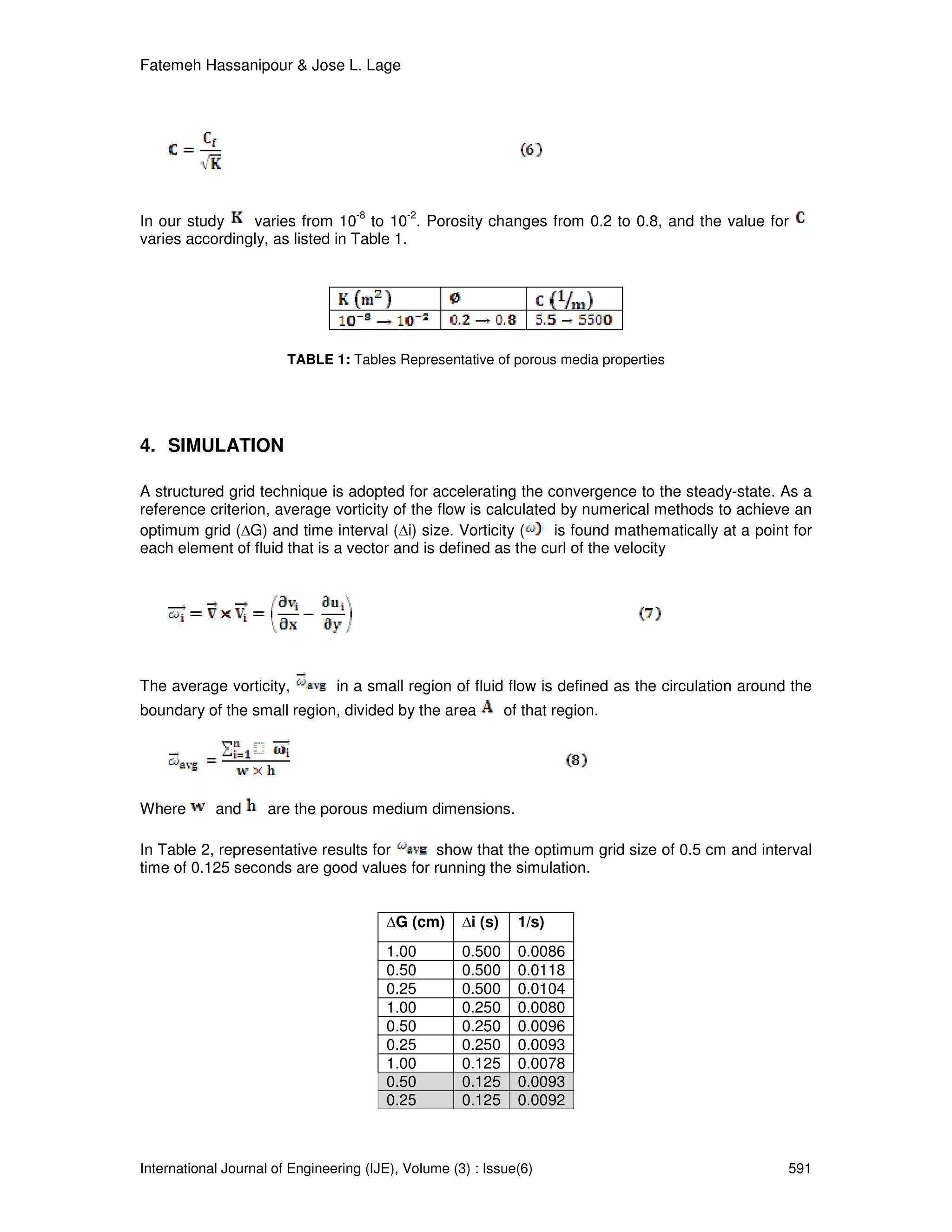
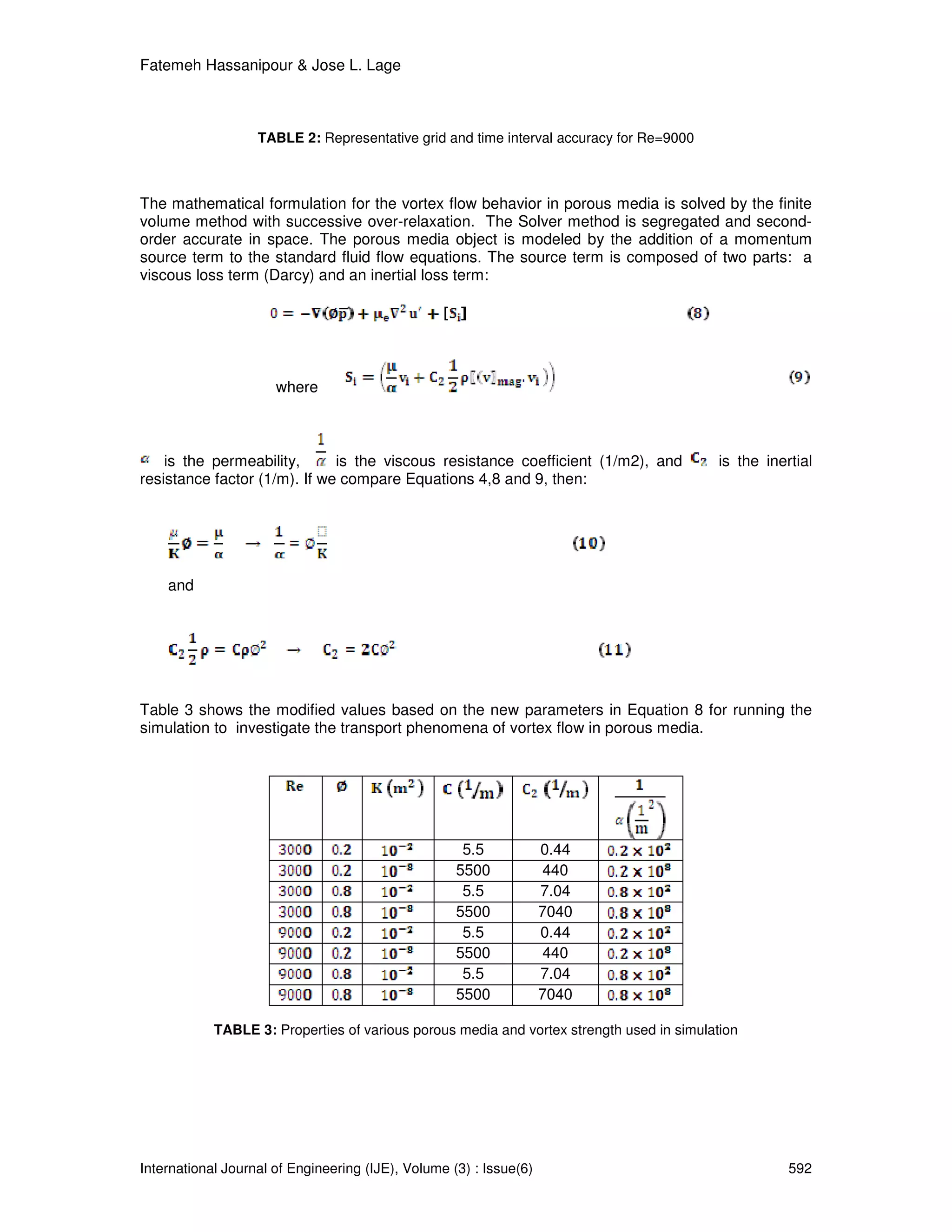
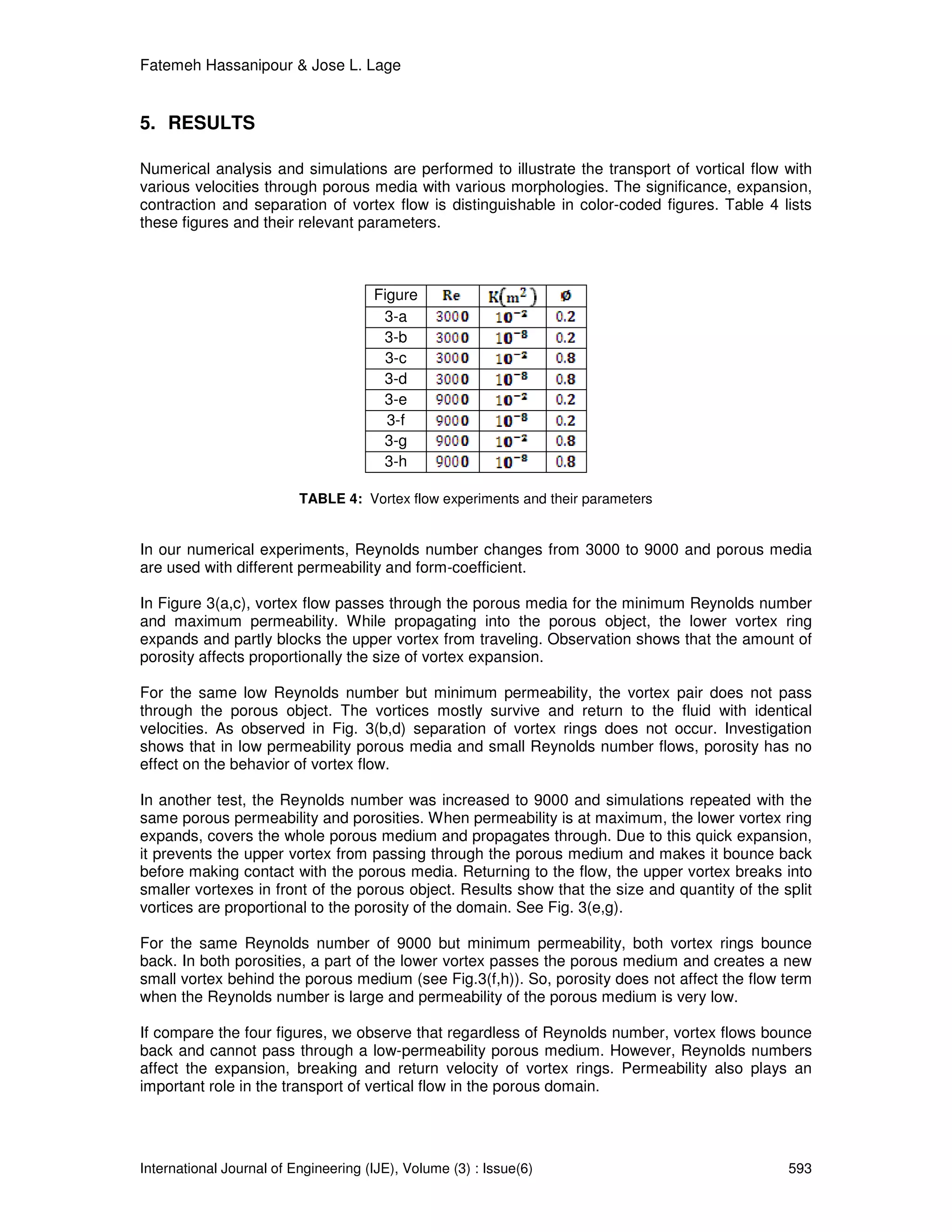
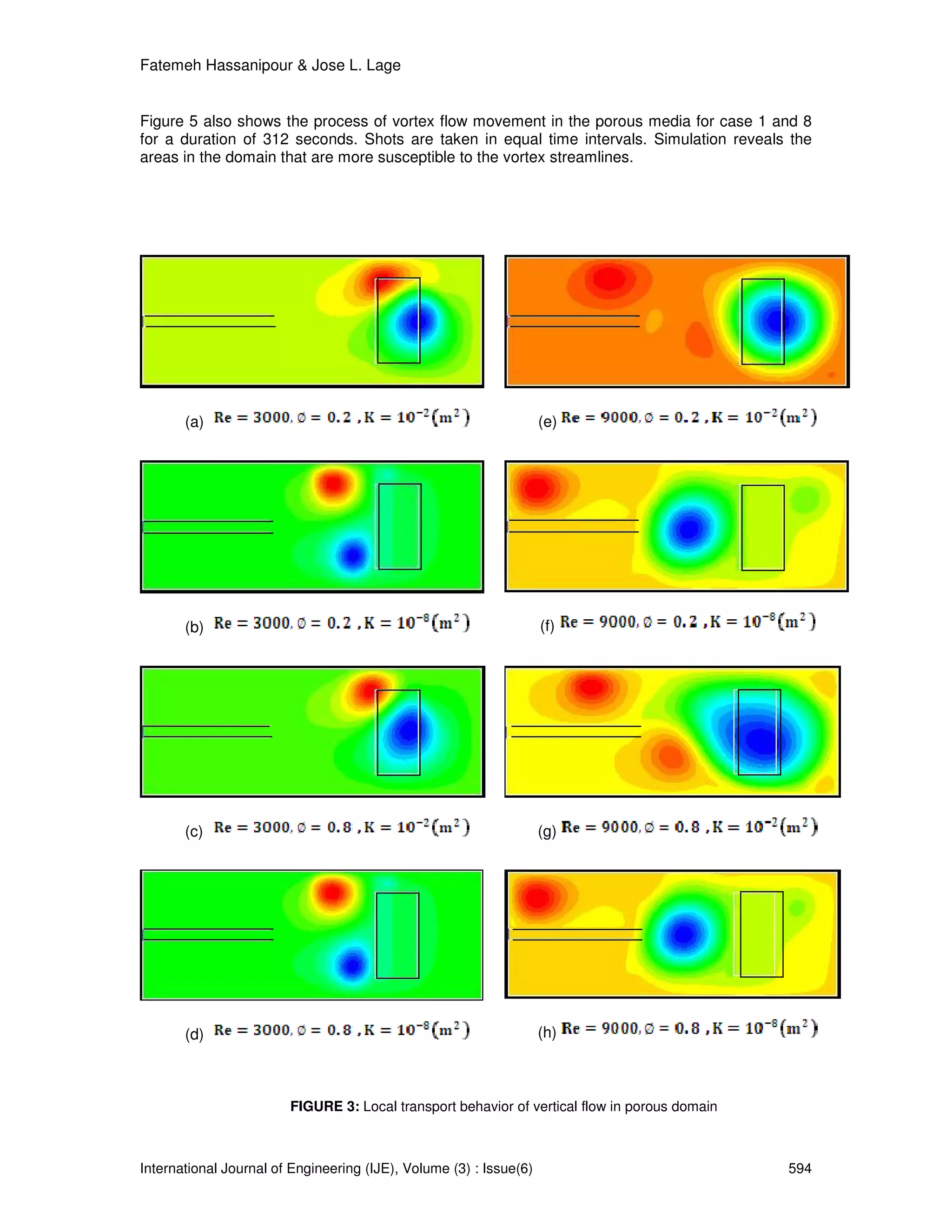
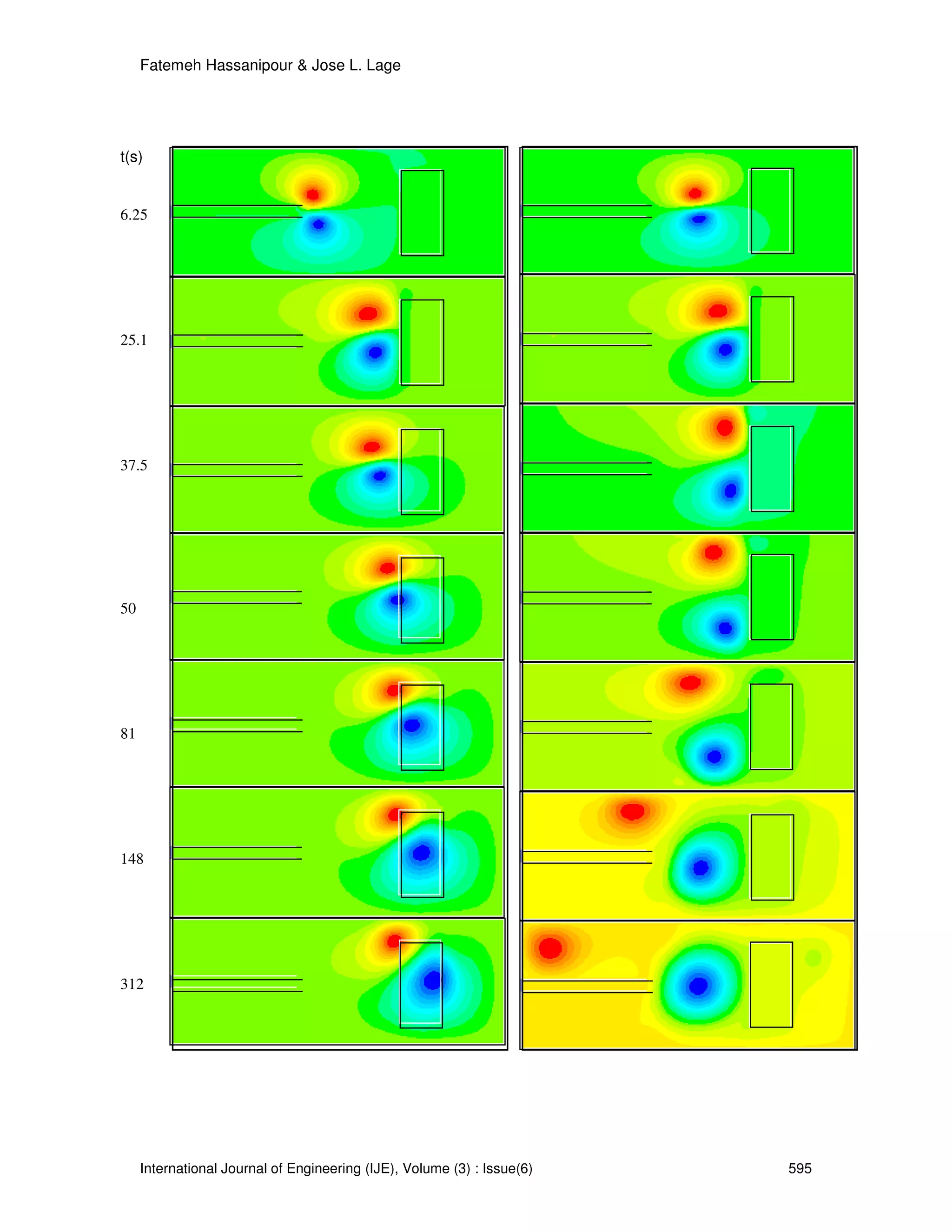

![Ala Eldin Awouda & Rosbi Bin Mamat
New PID Tuning Rule Using ITAE Criteria
Ala Eldin Abdallah Awouda Ala_awouda@yahoo.com
Department of Mechatronics and Robotics,
Faculty of Electrical Engineering,
Universiti Teknologi Malaysia,
Johor, 83100, Malaysia
rosbi@fke.utm.my
Rosbi Bin Mamat
Department of Mechatronics and Robotics, rosbi@fke.utm.my
Faculty of Electrical Engineering,
Universiti Teknologi Malaysia,
Johor, 83100, Malaysia
Abstract
This paper demonstrates an efficient method of tuning the PID controller parameters
using the optimization rule for ITAE performance criteria. The method implies an
analytical calculating the gain of the controller (Kc), integral time (Ti) and the
derivative time (Td) for PID controlled systems whose process is modeled in first
order lag plus time delay (FOLPD) form. Firstly A mat lab program with objective
function is written to find the optimum value for the PID controller parameters which
can achieve most of the systems requirements such as reducing the overshoot,
maintaining a high system response, achieving a good load disturbances rejection
and maintaining robustness. The objective function is selected so as to minimize the
integral of Time Absolute Error (ITAE) performance index. Using crave fitting
technique, equations that define the controller parameters is driven. A comparison
between the proposed tuning rules and the traditional tuning rules is done through
the Matlab software to show the efficiency of the new tuning rule.
Keywords: ITAE criteria; AMIGO; Z-N tuning rule; PID;
1. INTRODUCTION
Controlling the process is the main issue that rises in the process industry. It is very important to keep
the process working probably and safely in the industry, for environmental issues and for the quality of
the product being processed. In order for the controllers to work satisfactorily, they must be tuned
probably. Tuning of controllers can be done in several ways, depending on the dynamics desired
strengths of the system, and many methods have been developed and refined in recent years. The
proportional-integral-derivative (PID) controller is widely used in the process industries. The main
reason is their simple structure, which can be easily understood and implemented in practice. Finding
design methods that lead to the optimal operation of PID controllers is therefore of significant interest.
It has been stated, for example, that 98% of control loops in the pulp and paper industries are
controlled by PI controllers (Bialkowski, 1996) and that, in more general process control applications,
more than 95% of the controllers are of PID type (Åström and Hägglund, 1995). In order for the PID
controller to work probably it has to be tuned which mean a selection of the PID controller parameters
has to be made [8]. The requirement to choose either two or three controller parameters has meant
that the use of tuning rules to determine these parameters is popular. There are many tuning rules for
the PID controller as it has been noted that 219 such tuning rules in the literature to specify the PI
controller terms, with 381 tuning rules defined to specify the PID controller parameters (O’Dwyer,
International Journal of Engineering (IJE), Volume (3 ), Issue (6 ) 597](https://image.slidesharecdn.com/ijev3i6-110103005953-phpapp01/75/Ije-v4-i2International-Journal-of-Engineering-IJE-Volume-3-Issue-6-86-2048.jpg)
![Ala Eldin Awouda & Rosbi Bin Mamat
2003), Though the use of tuning rules is practically important [3, 11]. Even though, recent surveys
indicate, 30 % of installed controllers operate in manual, 30 % of loops increase variability, 25 % of
loops use default settings and 30 % of loops have equipment problems [1, 10]. Most PID tuning rules
are based on first-order plus time delay assumption of the plant hence cannot ensure the best control
performance. Using modern optimization techniques, it is possible to tune a PID controller based on
the actual transfer function of the plant to optimize the closed-loop performance. In this paper
optimization method is being used to obtain PID controller parameters. A search of one parameter to
be optimized lead to select the Integral of Time multiply by Absolute Error (ITAE) index performance
criterion, since it can provide controllers with a high load disturbance rejection and minimize the
system overshoot while maintain the robustness of the system.
The Integral of Time multiply by Absolute Error (ITAE) index is a popular performance criterion
used for control system design. The index was proposed by Graham and Lathrop (1953), who derived
a set of normalized transfer function coefficients from 2nd to 8th-order to minimize the ITAE criterion
for a step input [10].
This paper is organized as follows: - an overview of the traditional and a best performance tuning
rule is covered in section 2. The proposed tuning rule which derived from optimization method is
outlined in section 3. Section 4 outlines the optimized PID parameters values that obtained from using
the ITAE criteria performance index. In section 5 graphical results showing the performance and
robustness of FOLPD processes, compensated with the proposed PID tuning rule. The process is
modeled as a first order lag plus time delay (FOLPD) model, and compensated by PID controllers
whose parameters are specified using the proposed tuning rule. The results of the proposed tuning
rule are plotted and are used to be compared in the face of the performance, robustness and load
disturbance rejection against the traditional tuning rule and more over against a well performance
tuning rule. Conclusions of the work are drawn in Section 6.
2. CONTROLLER TUNING
Controller tuning methods provide the controller parameters in the form of formulae or algorithms.
They ensure that the obtained control system would be stable and would meet given objectives. Also,
great advances on optimal methods based on stabilizing PID solutions have been achieved. These
methods require certain knowledge about the controlled process. This knowledge, which depends on
the applied method, usually translates into a transfer function [9]. In fact, since Ziegler–Nichols
proposed their first tuning rules [5], an intensive research has been done from modifications of the
original tuning rules to a variety of new techniques: analytical tuning; optimization methods; gain and
phase margin optimization, just to mention a few. Recently, tuning methods based on optimization
approaches with the aim of ensuring good stability and robustness has received attention in the
literature [2, 6]. In this section some of PID tuning algorithms is considered.
2.1 Ziegler-Nichols tuning rule
Ziegler-Nichols tuning rule was the first such effort to provide a practical approach to tune a PID
controller. According to the rule, a PID controller is tuned by firstly setting it to the P-only mode but
adjusting the gain to make the control system in continuous oscillation. The corresponding gain is
referred to as the ultimate gain (Ku) and the oscillation period is termed as the ultimate period (P u).
Then, the PID controller parameters are determined from Ku and Pu using the Ziegler-Nichols tuning
table.
Table 1:- Ziegler-Nichols tuning rule
controller Kc Ti Td
P Ku/2
PI Ku/2.2 Pu/1.2
PID Ku/1.7 Pu/2 Pu/8
The key step of the Ziegler-Nichols tuning approach is to determine the ultimate gain and period [5].
However, to determine the ultimate gain and period experimentally is time consuming.
International Journal of Engineering (IJE), Volume (3 ), Issue (6 ) 598](https://image.slidesharecdn.com/ijev3i6-110103005953-phpapp01/75/Ije-v4-i2International-Journal-of-Engineering-IJE-Volume-3-Issue-6-87-2048.jpg)
![Ala Eldin Awouda & Rosbi Bin Mamat
2.2. AMIGO tuning rules
AMIGO tuning rule consider a controller described by:-
)
d
Where u is the control variable, ysp the set point, y the process output, and yf is the filtered process
variable, i.e. Yf(s) = Gf(s)Y(s) The transfer function Gf(s) is a first order filter with time constant Tf , or
a second order filter if high frequency roll-off is desired [7].
Parameters b and c are called set-point weights. They have no influence on the response to
disturbances but they have a significant influence on the response to set point changes. Neglecting
the filter of the process output the feedback part of the controller has the transfer function
The advantage by feeding the filtered process variable into the controller is that the filter dynamics
can be combined with in the process dynamics and the controller can be designed designing an ideal
controller for the process P(s) Gf(s). The objective of AMIGO was to develop tuning rules for the PID
controller in varying time-delay systems by analyzing different properties (performance, robustness
etc.) of a process test batch. The AMIGO tuning rules are based on the KLT-process model obtained
with a step response experiment. The AMIGO tuning rules are
In order to use the PID controller with filtering, the rules are extended as follows:
Where: - is the gain crossover frequency and is the relative dead-time of the
process, which has turned out to be an important process parameter for controller tuning [4, 7].
3. THE PROPOSED TUNING RULE
The proposed tuning rule is driven using several steps
Step 1:- Find relations between the controller tuning parameters and process parameters as
stated below:-
Kc = ƒ1 (KP; L; T) ; Ti = ƒ2 (KP; L; T) ; Td = ƒ3 (KP; L; T)
International Journal of Engineering (IJE), Volume (3 ), Issue (6 ) 599](https://image.slidesharecdn.com/ijev3i6-110103005953-phpapp01/75/Ije-v4-i2International-Journal-of-Engineering-IJE-Volume-3-Issue-6-88-2048.jpg)
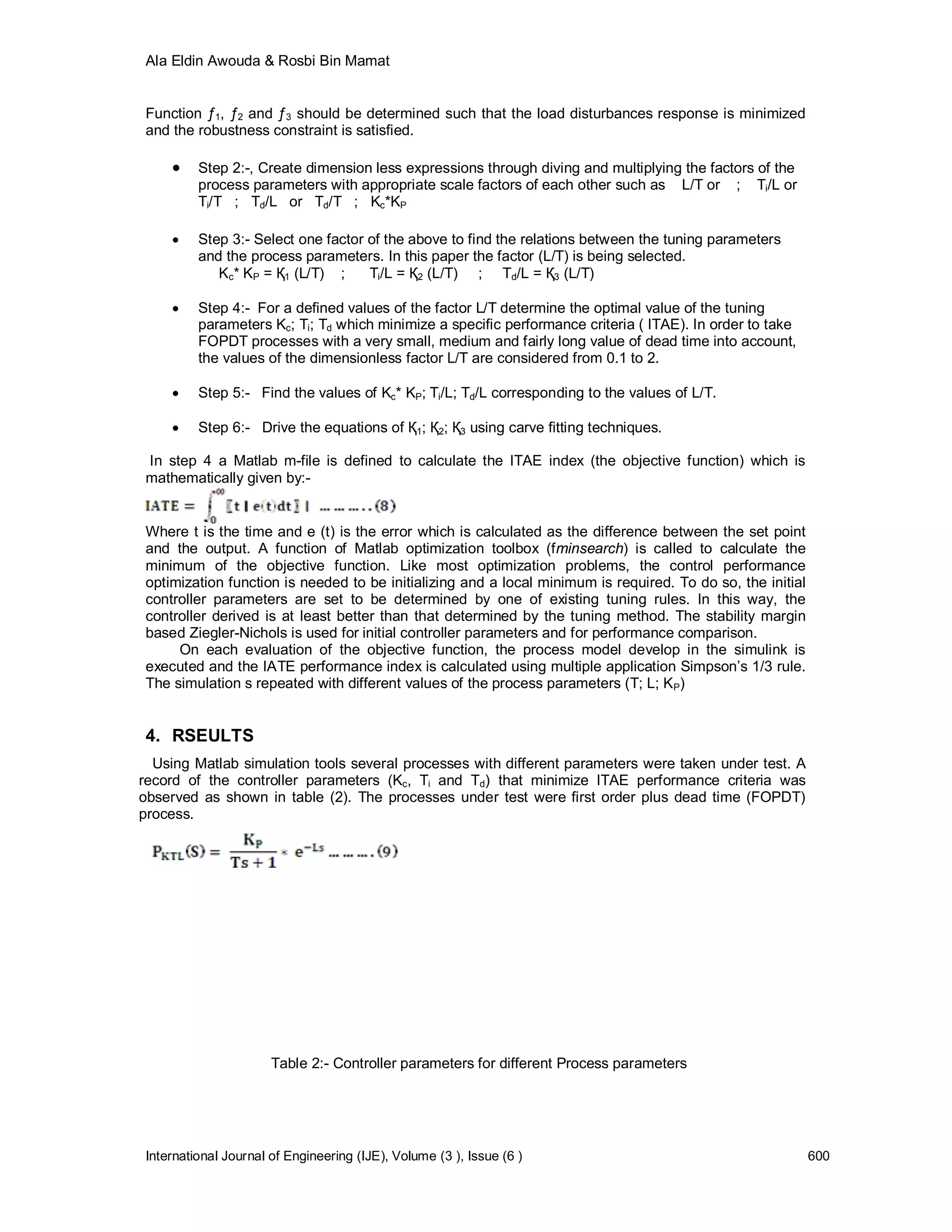
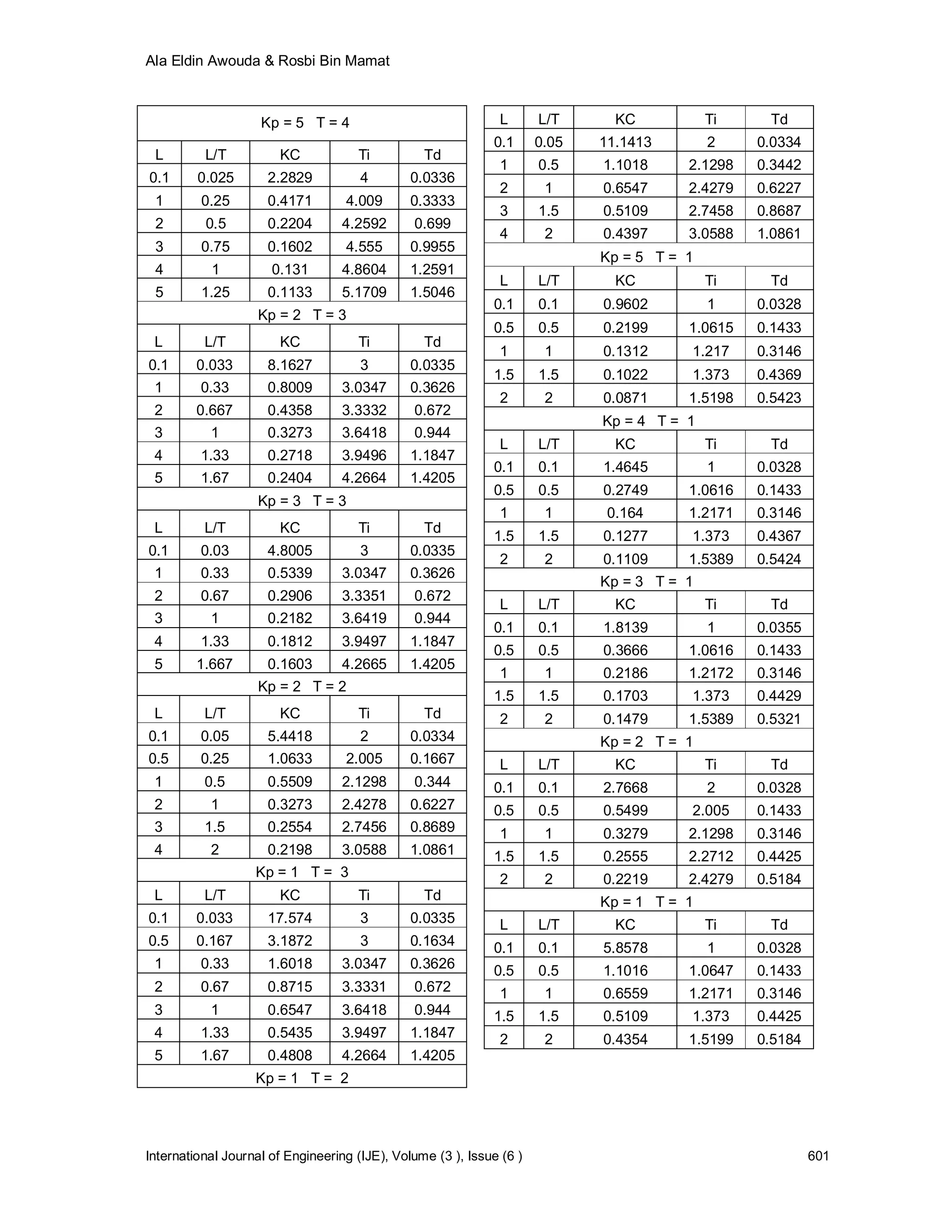

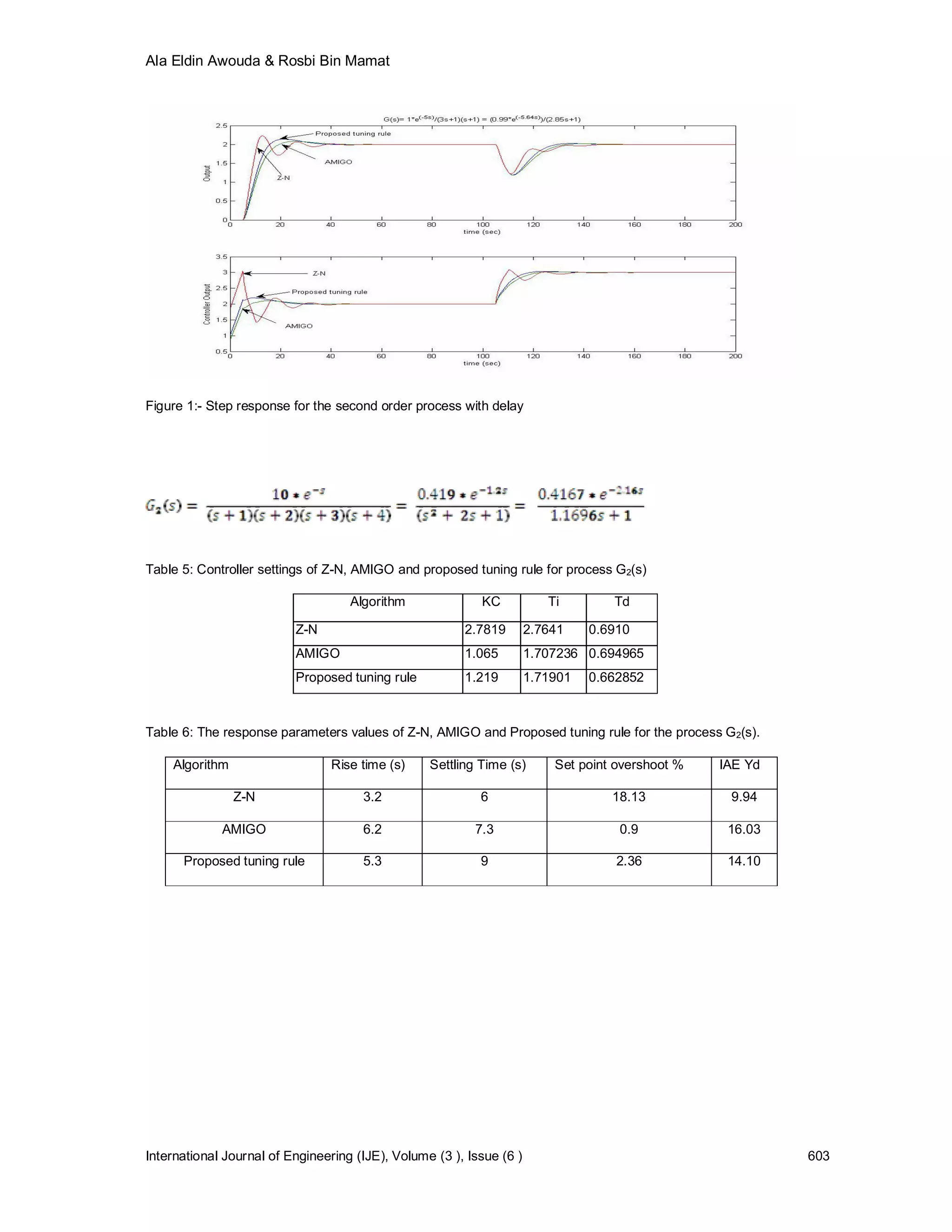
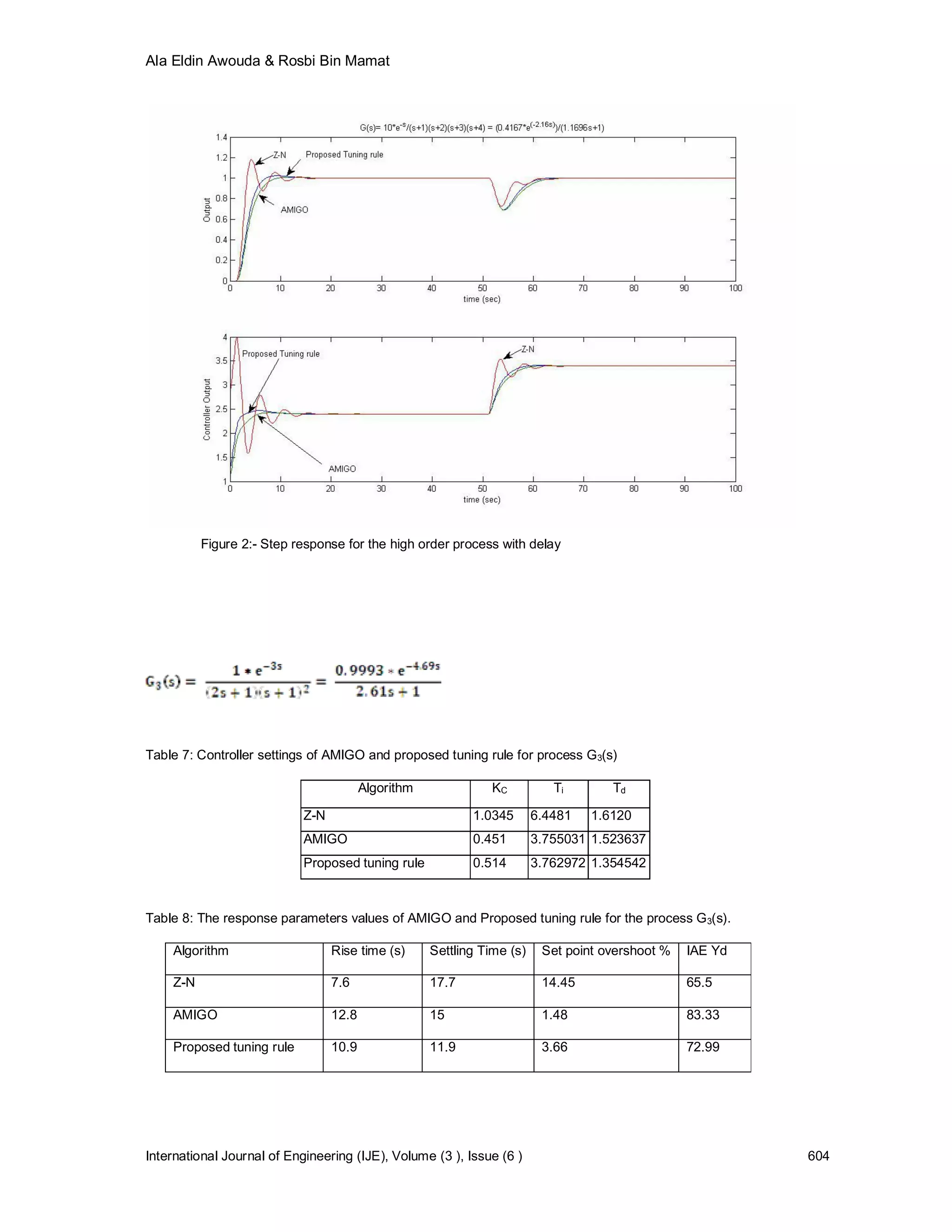
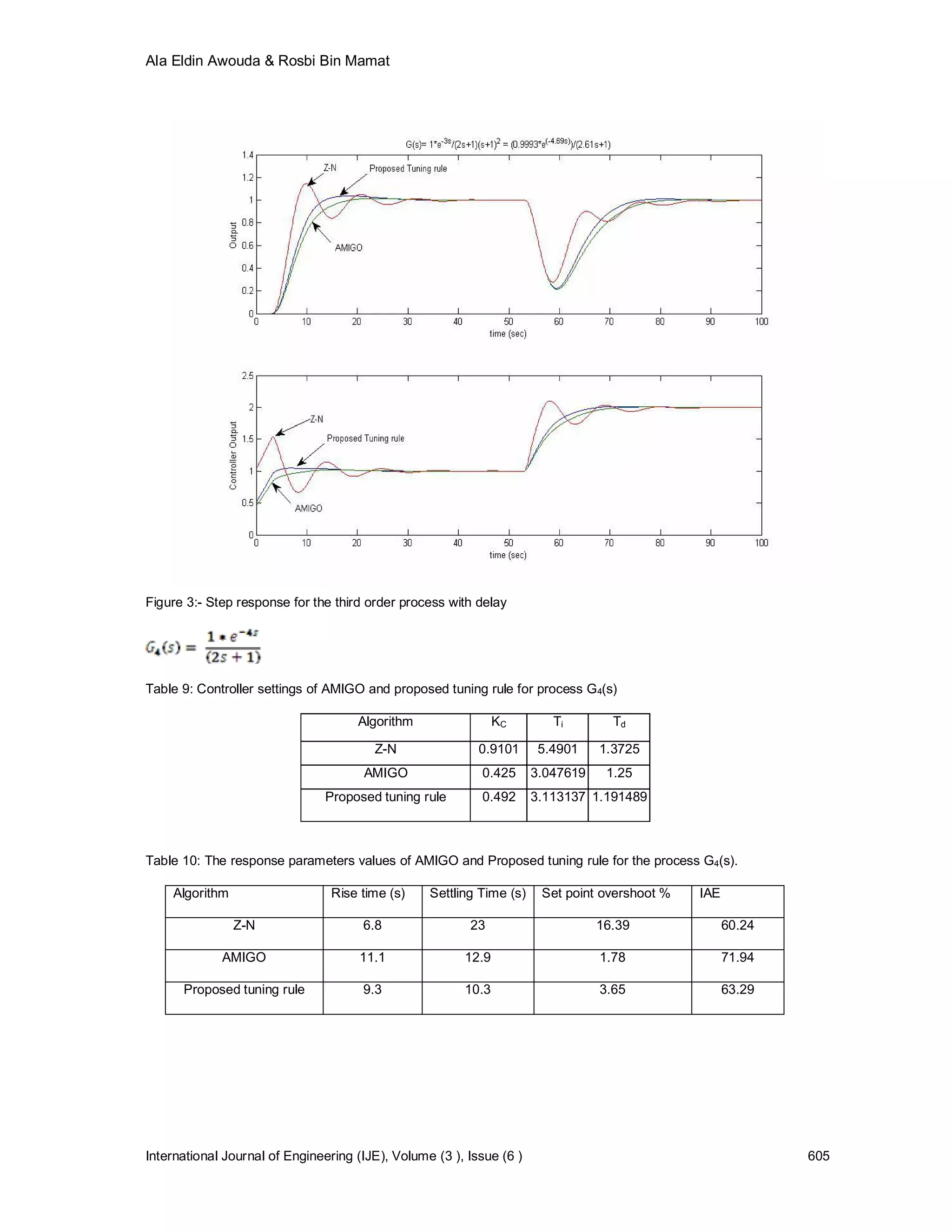
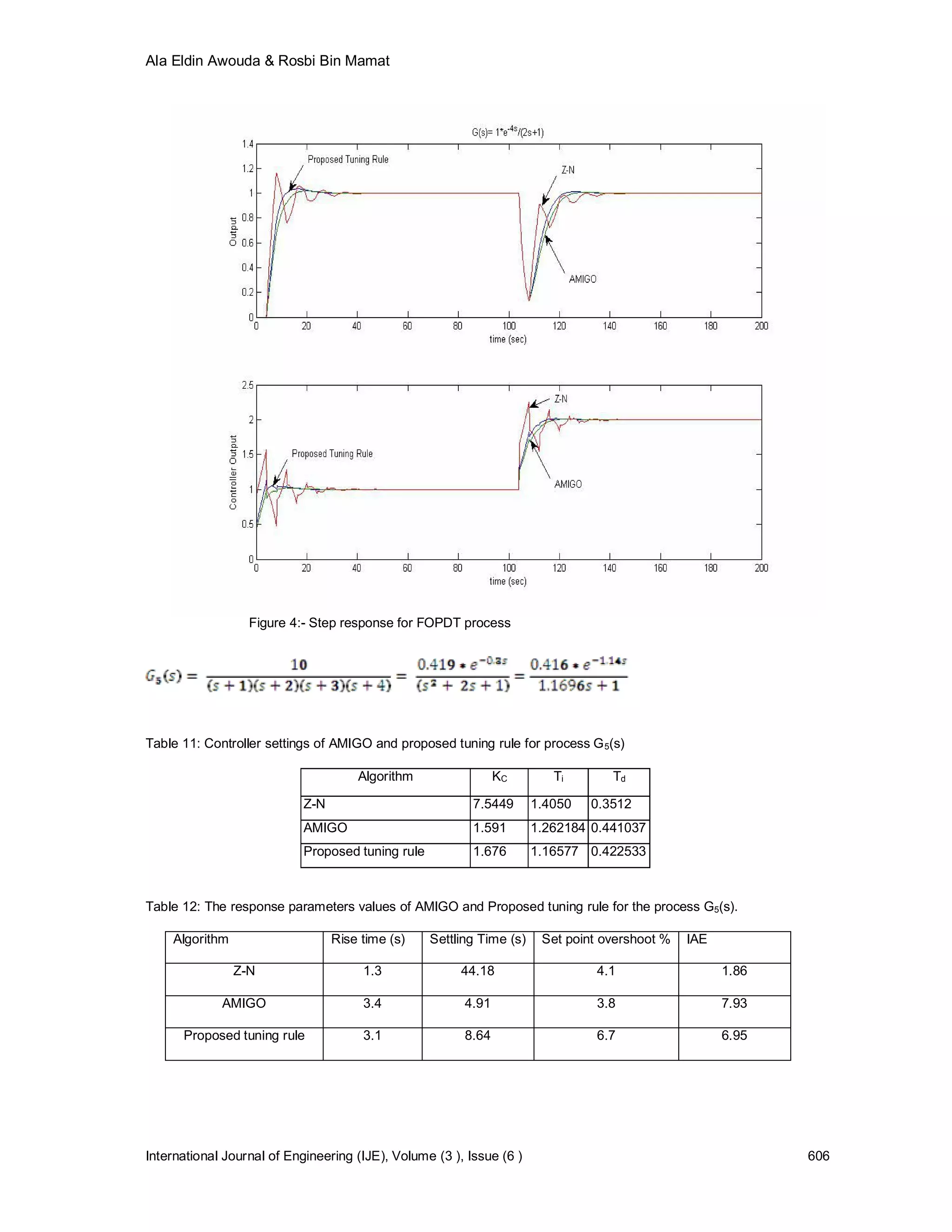
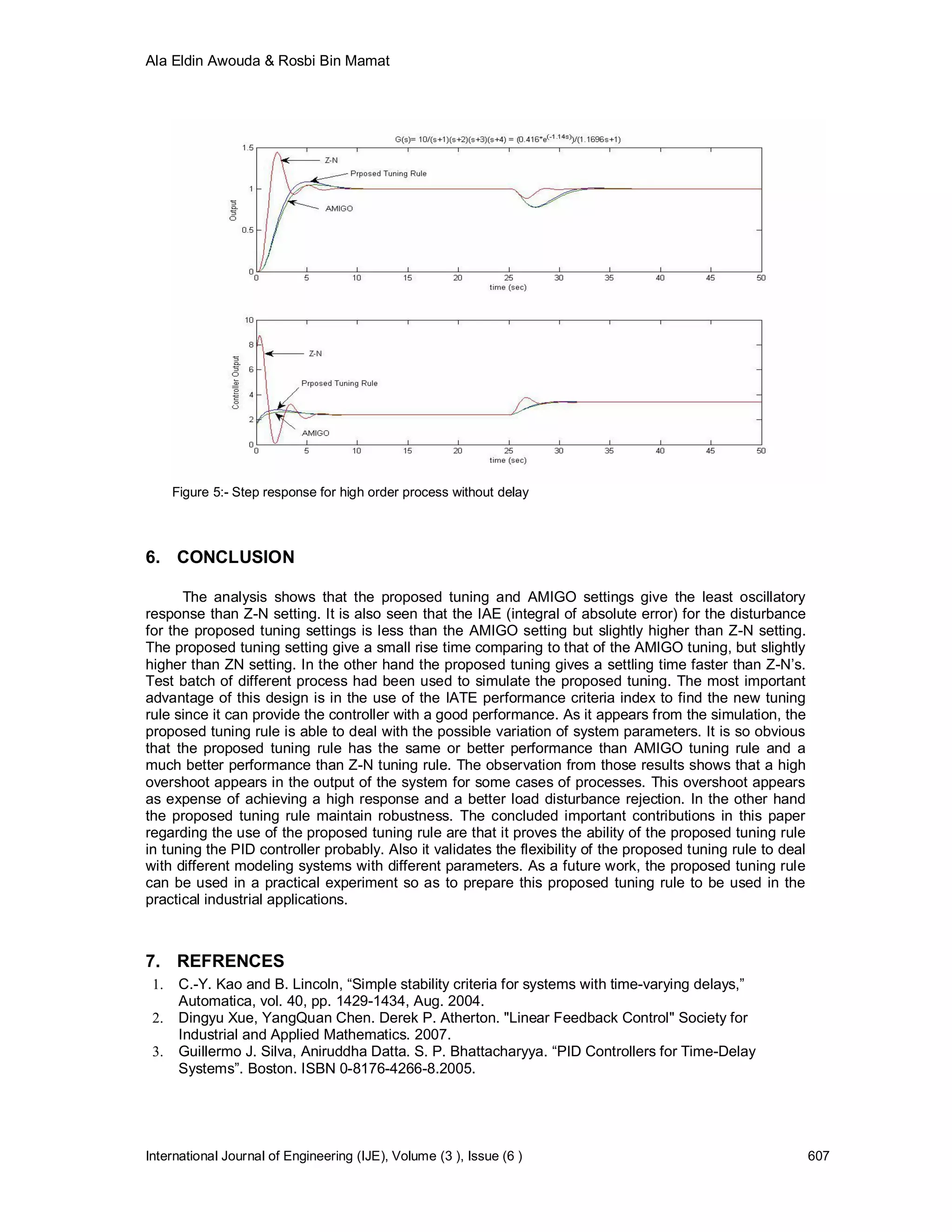


![ADITYA GOEL, VITTHAL J GOND, R K SETHI and A K SINGH
Keywords: BSWA: Balanced Static Wavelength Assignment, OBS: Optical Burst Switching, OADM:
Optical Add/Drop Multiplexers, OXC: Optical Cross-Connect, TBS: Terabit Burst Switching, PWA: Priority
Wavelength Assignment.
1. INTRODUCTION
Due to the introduction of various wide band applications, such as video conferencing, broadband
wireless communication [1] etc the demand of transmission capacity is growing exponentially.
This has motivated the researcher to device & employ different techniques [2,3] to enhance the
existing transmission capacity of optical terrestrial and wireless networks. In order to
accommodate this wide capacity requirement, efficient and cost-effective wavelength division
multiplexing (WDM) can be used between network nodes [4]. Today up to several Tbit/s traffic
can be carried by the optical link over long distances. e.g. in an ultra-dense WDM transmission
total capacity of 50 Tbit/s have already been experimentally demonstrated [5]. However, with the
introduction of very high capacity WDM optical transmission techniques, the discrepancy between
optical transmission capacity and electronic switching capability increases. Moreover, due to cost
and complexity aspects, it is advantageous to keep data in the optical domain and to avoid bit-
level signal processing. Burst switched WDM optical networks are coming up as suitable network
architectures for future Optical Internet backbones [6]. Optical Burst Switching (OBS) has
emerged as a new paradigm for an optical Internet [7]. During the past years, there are large
efforts to realize OBS. Although the concept of burst switching had already been known since the
1980s, it has never been a big success in electrical networks. The main reason is that its
complexity and realization requirements are comparable to that of more flexible electronic packet
switching techniques. Optical circuit switching (OCS) does not support fine switching granularity
on the packet-level. Only poor bandwidth utilization is obtained due to the absence of statistical
multiplexing. On the other hand, Optical Packet Switching (OPS) are still too complex to be
realized in the near future. Therefore, a hybrid approach like burst switching seems promising for
the WDM-based optical networks. Optical burst switching (OBS) was proposed in the late 1990
[7,8] and it tries to exploit the advantages of both OCS and OPS approaches and avoid a part of
their limitations. OBS is considered as one of the most promising approaches to implement IP
over WDM [9]. At the moment, due to the fast development of this new approach and the large
number of new proposals, OBS is still at its definition phase and no common definition of OBS
can be found. However, among several different definitions two main definitions can be found.
One is more oriented towards fast wavelength switching. Synonyms like optical flow switching
(OFS) [10] and wavelength routed OBS (WR-OBS) [11,12,13] can be found in the literature. Here,
an acknowledged two-way reservation is generally used. A burst will be only transmitted after
having received a positive acknowledgement of its reservation request. Another most widely used
definition for OBS is more packets oriented and was proposed by Qiao and Turner [14,7,8].
To realize an OBS network, a new optical layer is mandatory. Furthermore, an OBS network will
be only possible if fast and efficient switching nodes can be built. To constitute the OBS network
nodes several key components are needed e.g. optical space switches, tunable filters/lasers,
wavelength converters etc. Most of the studies on OBS networks assume that full wavelength
conversion is available throughout the network. However, such capability is not at present a
realistic assumption. Although use of wavelength converters give better performance with respect
to blocking probability but it is quite expensive. So, the absence of (full) wavelength conversion
capabilities calls for good and efficient wavelength assignment policies. The Wavelength
Assignment Algorithm is a method to improve the performance in respect of blocking probability
and to provide cost effective communication system. To solve the above problems there have
been developed number of wavelength assignment techniques e.g. Random, FF-TE, BSWA etc.
Traditional first-fit or random wavelength assignment algorithm in OCS network is not appropriate
for wavelength-continuous OBS networks, since the burst is transmitted without knowledge of the
wavelength occupation status of the following links.
Out of the number of wavelength assignment techniques we have selected Balanced Static
wavelength assignment (BSWA) algorithm. The BSWA algorithm is new and improved
wavelength assignment policy [15] In BSWA wavelength order lists are carefully designed during
International Journal of Engineering, Volume (3): Issue (6) 610](https://image.slidesharecdn.com/ijev3i6-110103005953-phpapp01/75/Ije-v4-i2International-Journal-of-Engineering-IJE-Volume-3-Issue-6-99-2048.jpg)
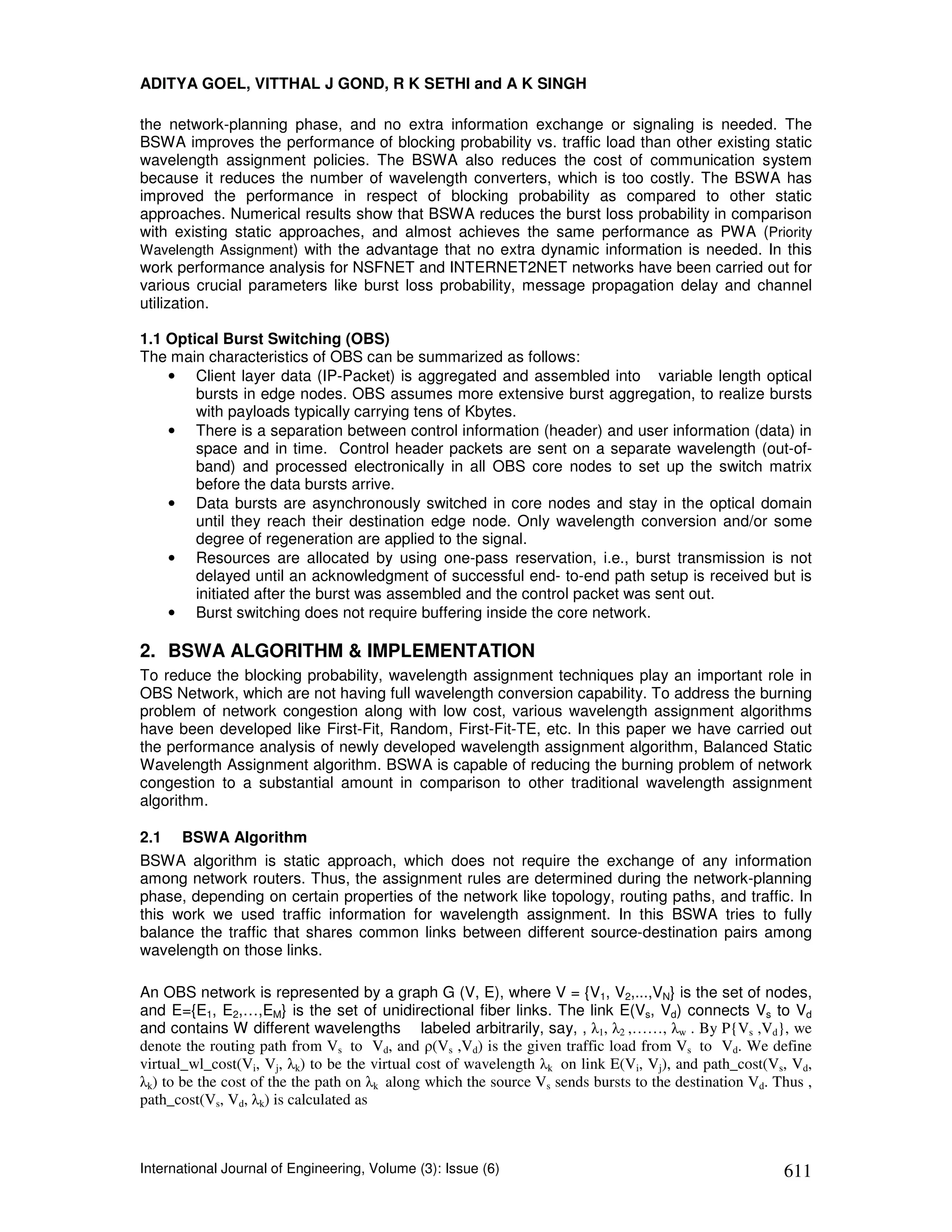
![ADITYA GOEL, VITTHAL J GOND, R K SETHI and A K SINGH
path_cost(Vs, Vd, λk) = ∑ virtual _ wl _ cost ( Vi , Vj , λk ) (1)
( )
E Vi , Vj ∈P( Vs ,Vd )
Balanced static wavelength assignment (BSWA) algorithm:
Input: G(V,E), P(Vs ,Vd), ρ(Vs ,Vd) for all s,d є {1,2,……..,n}
Output: WA(Vs, Vd, t) for all s,d є {1,2,……..,n}, t є {1,2,……..,w}
Initialization: virtual_wl_cost (Vi, Vj, λk) = 0 for all i, j є {1,2, ... ,N},
t є {1,2, ... ,W}
FOR t← from 1 to W
FOR s← from 1 to N
FOR d← from 1 to N
Step 1: Compute the path_cost for each wavelength that has not been assigned before for this
s-d pair.
Step 2: Choose the λk that has the least path_cost, and make it the wavelength assigned in this
loop.That is, WA(Vs, Vd, t)= λk.
Step 3: Update virtual_wl_cost(Vi, Vj, λk) for all E(Vi, Vj) є P{Vs, Vd} by virtual_wl_cost(Vi, Vj, λk) =
virtual_wl_cost(Vi, Vj, λk) + ρ(Vs, Vd) (2)
The process of BSWA is stated as follows. First the cost of each wavelength on all links,
virtual_wl_cost(Vi, Vj, λk) is initialized to 0. Then we begin to assign wavelengths for s-d pairs one by one.
The value of path_cost(Vs, Vd, λk), k є {1, 2, ….,w}, is calculated for each (Vs, Vd) pair, and λk that has the
least path_cost is chosen as the wavelength assigned for the (Vs, Vd) pair.Every time we assign a
wavelength (e.g. λk) for an s-d pair, we increase virtual_wl_cost(Vi, Vj, λk) on all the passing links of P{Vs
,Vd} by ρ(Vs ,Vd) so that the wavelength is less likely to be chosen by other s-d pairs if it is already heavily
loaded. We continue to do this for all s-d pairs, so that each pair is assigned a wavelength. The
process described is called searching loop W times, we can get a list of the wavelength
assignment order for each s-d pair.
2.2 Implementation of BSWA Algorithm
To reduce the data congestion with low cost, we have used balanced static wavelength
assignment algorithm to assign the wavelength for each source-destination pair (s-d pair). The
programming of the BSWA algorithm has been coded in Matlab. We have used a very powerful
tool named as Matplan-wdm to implement the coded algorithm. This works on the platform of
Matlab7.0 or above version. The optimization in this tool will be done with the help of Tomlab,
which is also a powerful tool for optimization. The algorithm has been implemented in two
network topology namely NSFNET & INTERNET2NET as shown in Figure 1 & Figure 2
respectively. The NSFNET consist of 14 nodes and 21 bi-directional fiber links, where as
INTERNET2NET consist of 9 nodes and 13 bi-directional fiber links. The traffic loads have been
taken in erlangs per wavelength. The NSFNET have 40 maximum wavelengths per fiber where
as INTERNET2NET have 32 maximum wavelengths per fiber. It is assumed that there are not
available wavelengths converters and optical buffers in both networks. We have used the
Dijkastra’s shortest-path algorithm to calculate the route for each s-d pair [15]. In this algorithm
each s-d pair will select shortest path in network to transfer the data. This algorithm has been
also coded in Matlab. We have analyzed the burst loss probability by varying the traffic load in
erlangs per wavelength. Similarly we have done performance analysis of channel utilization,
traffic transferred in single hop, message propagation delay by varying the number of
wavelengths per fiber. The channel utilization has been calculated as how many wavelengths
channels are being used to transfer the data out of total wavelengths channels available in the
network. The traffic transferred in single hop has been calculated as ratio of traffic transferred in
single hop to total traffic offered in percentage. The message propagation delay has been
calculated as the difference between the time that message being transmitted at transmitter and
that is being received at receiver. It is assumed that burst dropped at transmitter have negligible
propagation delay. The number of wavelengths per fiber varied as percentage of maximum
wavelengths used per fiber in the particular network. For example in NSFNET maximum
wavelengths per fiber is 40 and in INTERNET2NET that is 32.
International Journal of Engineering, Volume (3): Issue (6) 612](https://image.slidesharecdn.com/ijev3i6-110103005953-phpapp01/75/Ije-v4-i2International-Journal-of-Engineering-IJE-Volume-3-Issue-6-101-2048.jpg)
![ADITYA GOEL, VITTHAL J GOND, R K SETHI and A K SINGH
11 12
3
10 13
6 8 9
1 7
14
2
4
5
FIGURE 1: NSFNET (14 Nodes, 21 Bi-directional Link)
1
3
6 7
4
2
8
9
5
FIGURE 2:INTERNET2NET (9 Nodes, 13 Bi-directional Link)
2.3 Validation of BSWA
We have validated our simulated results generated through our code with the previously
published results [15] as reported by Chunlei Zhu, Wenda Ni at all in their paper titled “New and
Improved Approaches for Wavelength Assignment in Wavelength-Continuous Optical Burst
Switching Network,” By The tabular comparison of the two shows that the simulated result is in
reasonably good agreement with the reported result [15]. The comparison of result is for NSFNET
with 14 nodes and 21 bidirectional fiber links. The load is taken in erlangs per wavelength.
Table: 2.1 Result Validations
LOAD Published Simulated
(Erlang) Result (1)
0.1 0.0015 0.002
0.2 0.009 0.009
0.3 0.026 0.03
0.4 0.05 0.06
0.5 0.08 0.08
0.6 0.12 0.12
0.7 0.15 0.15
0.8 0.2 0.19
0.9 0.25 0.26
1.0 0.30 0.30
International Journal of Engineering, Volume (3): Issue (6) 613](https://image.slidesharecdn.com/ijev3i6-110103005953-phpapp01/75/Ije-v4-i2International-Journal-of-Engineering-IJE-Volume-3-Issue-6-102-2048.jpg)
![ADITYA GOEL, VITTHAL J GOND, R K SETHI and A K SINGH
FIGURE 3: Result validation
The Figure 3 shows that there is small variation of simulated result from that with published result
[15] up to 0.5 erlangs of traffic load and after 0.5 erlangs of traffic load the simulated result and
published result [15] are almost coincident. Hence this shows that simulated results are in good
agreement reasonably with that of published reported results [15]. Once the validation has been
done, it is ensured that the simulated code is free from logical & other errors. Hence we can apply
our code to other networks and applications.
2.4 Comparison of Various Wavelength Assignments
The comparision of various wavelength assignment policies with respect to burst loss probability
have been shown in the Figure. 4. In this we can see at low load, burst loss probability is
minimum for BSWA.This comparision is demonstrated for NSFNET network with 14 nodes, 21
bidirectional link.The load is in erlangs per wavelength. At high load burst loss probability is
almost same as PWA which is dynamic wavelength assignment algorithm. Thus BSWA is giving
optimum performance because it is giving almost the same result as PWA with the advantage
that no extra dynamic information is needed.
The Figure 4 shows that up to 0.2 erlangs, the BSWA is giving optimum performance. After 0.2
erlangs load BSWA shows the same performance as PWA with small variation in burst loss
probability and after 0.9 erlang it shows almost same performance as PWA. The advantage of
BSWA is that it shows almost same performance as PWA without incorporating any extra
dynamic information exchange.
FIGURE 4: Traffic Load vs. Burst Loss Probability for Various Wavelengths
Assignments Policies (NSFNET, 14 Nodes, 21 Bi-directional Link)
International Journal of Engineering, Volume (3): Issue (6) 614](https://image.slidesharecdn.com/ijev3i6-110103005953-phpapp01/75/Ije-v4-i2International-Journal-of-Engineering-IJE-Volume-3-Issue-6-103-2048.jpg)
![ADITYA GOEL, VITTHAL J GOND, R K SETHI and A K SINGH
2.5 Performance Analysis
The performance analysis of wavelength-continuous optical burst switching network [17 has been
carried out, by evaluating the performance of following parameters: -
2.5.1 Burst loss probability
Burst loss probability [17 is given by,
Pb =
( Numer of burst dropped ) (3)
( Total number of arrivals )
Here we have assumed that if any route is blocked then coming burst through this rote will be dropped.
Hence the burst loss probability has been calculated as the average blocking probability Pb for the network
and is defined as average of the blocking probabilities on all the routes and is given by,
R
∑ Br
r =1
Pb = (4)
R
Where R is the total number of routes in the network.
Br is the blocking probability of a route r, which involves multiple links (say n links), is given by,
n
Br = 1- ∏ (1 − Pi)
i =1
(5)
Where Pi is the blocking probability of a link i with capacity C (number of wavelengths on link) and is given
by
−1
L (i ) C L (i )
C n
Pi = R (L (i), C) = ∑ (6)
C ! n =0 n
Where L (i) is carried traffic on link i which has frequency of usage, Fi and is given by,
Fi
L × Fi
L (i) = ∑L
j =1
r =
R
(7)
Where Lr is the load on any route r and is given by,
L
Lr = (8)
R
Where L is the total load (erlangs) on the network and is given by,
L=l×N (9)
and R is the total number of bi-directional routes and is given by,
N × ( N − 1)
R= (10)
2
2.5.2 Channel Utilization
Channel Utilization [17] s given by,
Average value of occupied channels in the network
U= (11)
Total available channels in the network
∑ ∑
J C −1
i =1 m=0
(C − m) Pi (C − m)
= (12)
C∗J
Total Available Channels = C × J
(13)
J C −1 C
Here Occupied channels = ∑ ∑ (C − m) P (C − m) ; where ∑ P (m) = 1
i =1 m = 0
i
m =0
i (14)
Where Pi(C-m) = qi(m) (15)
≅ Probability of finding C-m wavelengths occupied in link i
≅ Probability of finding m wavelengths free on link i
International Journal of Engineering, Volume (3): Issue (6) 615](https://image.slidesharecdn.com/ijev3i6-110103005953-phpapp01/75/Ije-v4-i2International-Journal-of-Engineering-IJE-Volume-3-Issue-6-104-2048.jpg)
![ADITYA GOEL, VITTHAL J GOND, R K SETHI and A K SINGH
Where qi(m) is the probability of finding m idle or free wavelengths on link i and from the
Birth-death model, qi(m) is given as,
C (C − 1)......(C − m + 1)
qi(m) = qi(0); m = 1,2,…..C (16)
Leff (i ) m
Where
C
C (C − 1)......(C − m + 1)
qi(0) = 1+ ∑ (17)
m =1
Leff (i ) m
and Leff(i) is the effective carried traffic on link I and is given by,
Fi
Fi
Leff(i) = ∑ Lr (1 + P − Br ) = Lr Fi + Fi × P − ∑ Br
i i (18)
r =1 r =1
Since in the formula of channel utilization given, channel utilization mainly depends on value of
occupied channels so we have simulated the result for average Occupied Channel used against
total channel available.
2.5.3 Message propagation delay
This is the difference between the times of Message being transmitted from source and message
being received at receiver. The assumption has been taken that dropped burst have no
transmission delay.
2.5.4 Ratio of single hop traffic to total traffic offered
It is the ratio of traffic being transmitted in single hop to total traffic offered to network. In our
simulation traffic is being transmitted through Dijkastra’s shortest path [15].
2.6 Burst loss calculation for OBS Network using full wavelength converter capability
The objective of calculation of burst loss probability for full wavelength conversion capability
network is to show that wavelength converters have very important roll to reduce the burst loss
probability. The disadvantage of wavelength converter is, it is too costly. So to reduce the cost
wavelength assignment policies is being used. Let in the OBS Network, there are (M+1)
wavelengths per fiber link. In (M+1) wavelengths one wavelength is used as reservation channel
for signaling and other M wavelengths channel carry data bursts. The bursts loss probability B on
each fiber link is the same and is given by using the well known Erlang loss formula [16,17] with
M
M i
B(A,M) = (A / M!) / ( Σ A / i!) , (19)
i=0
Where A is the offered traffic load and M the number of wavelengths (which will carry data
bursts) per out put fiber. Therefore A/M is the normalized offered traffic, which corresponds to
utilization of output fiber of the node.
3. Results and Discussion
The typical network topologies we have used in this simulation are NSFNET (14 nodes, 21 bi-
directional fiber links) and INTERNET2NET (9 nodes, 13 bi-directional fiber links) as shown in
Figure 1 and Figure 2 respectively. We initially assume wavelength converters are not available.
Dijkstra’s shortest-path algorithm is used to calculate the route for each s-d pair. The
performance of BSWA has been investigated by evaluating the performance of following
parameters:
1. Burst loss probability vs. traffic load in Erlangs with BSWA.
2. Number of used wavelength channels v/s. % of wavelengths used per fiber.
3. Message propagation Delay v/s % of wavelengths used per fiber.
Further we have also calculated the blocking probability of OBS Network with full wavelength
conversion capability using Erlangs Loss formula for NSFNET.
3.1 Burst Loss Probability with BSWA Algorithm
3.1.1 NSFNET Topology
International Journal of Engineering, Volume (3): Issue (6) 616](https://image.slidesharecdn.com/ijev3i6-110103005953-phpapp01/75/Ije-v4-i2International-Journal-of-Engineering-IJE-Volume-3-Issue-6-105-2048.jpg)
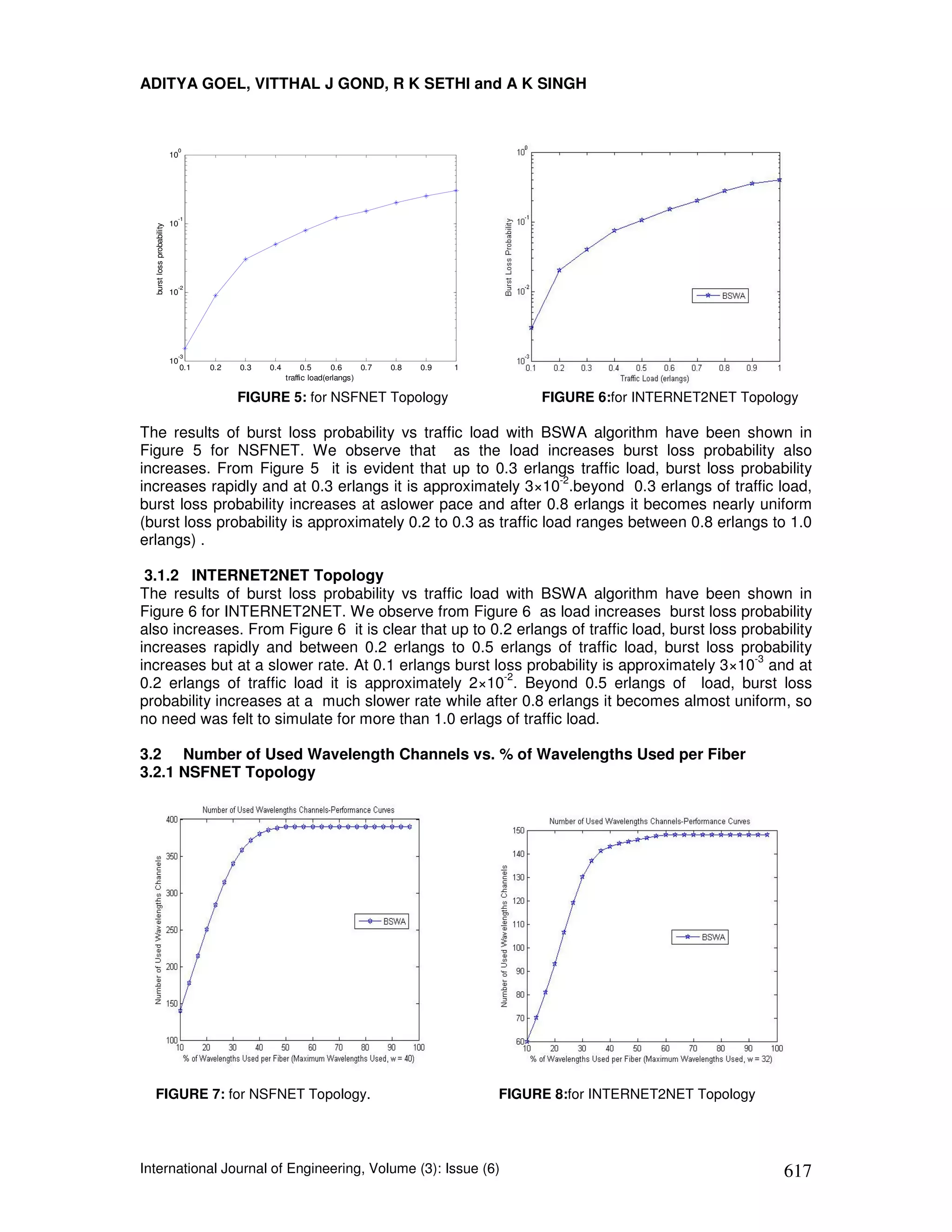
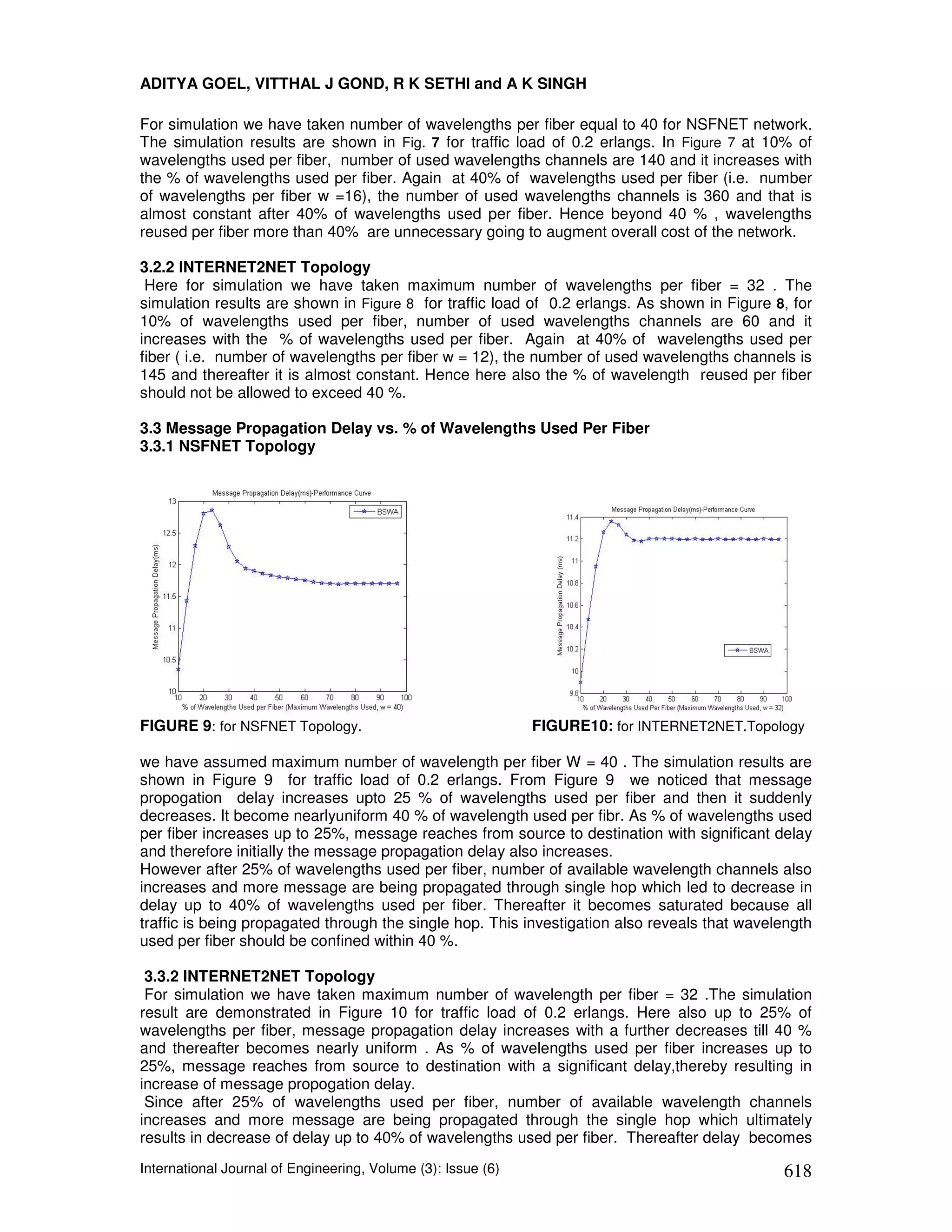
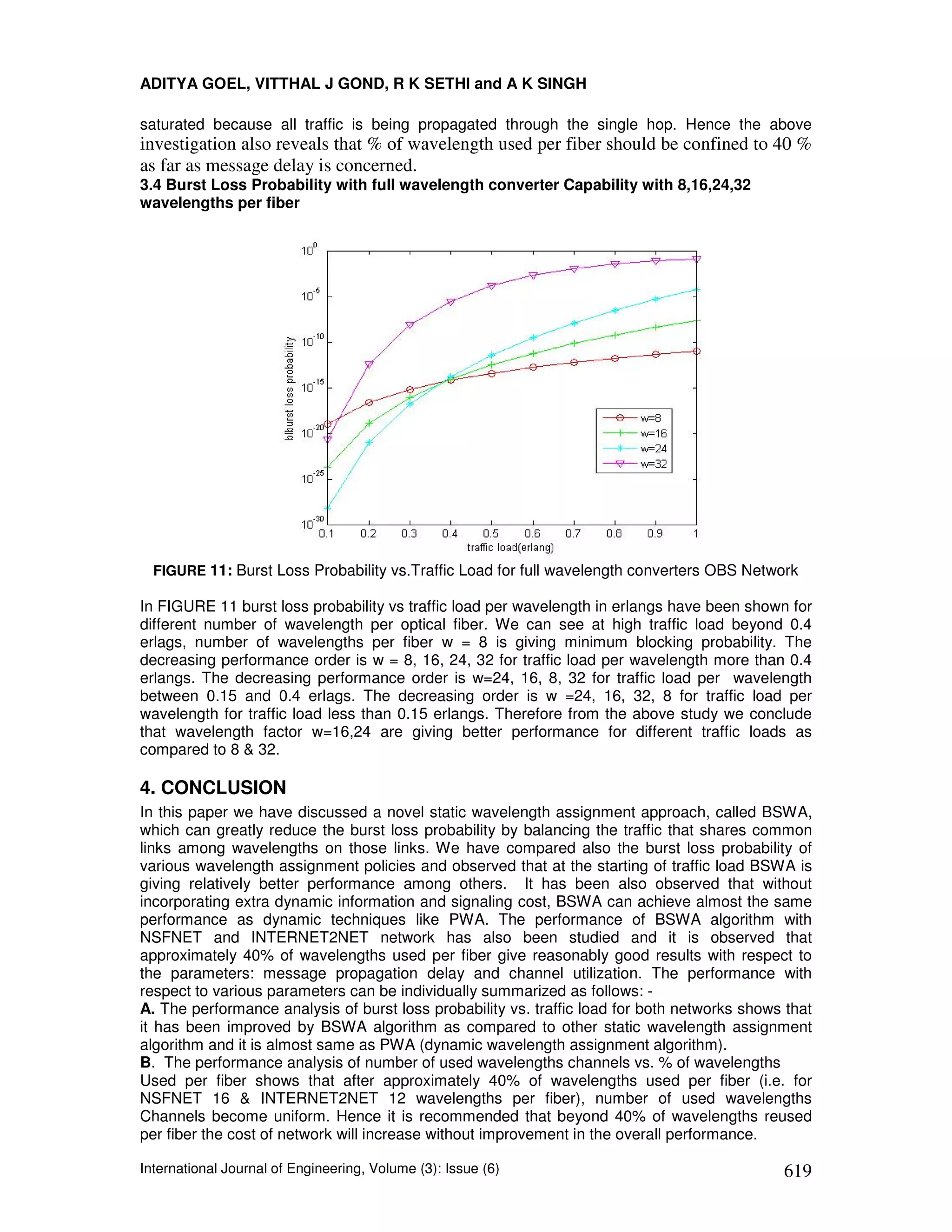


![M. Enamul Hossain and M. Rafiqul Islam
Knowledge – Based Reservoir Simulation – A Novel Approach
M. Enamul Hossain menamul@kfupm.edu.sa
Department of Petroleum Engineering
King Fahd University of Petroleum & Minerals
Dhahran 31261, Saudi Arabia
M. Rafiqul Islam rafiq.islam@dal.ca
Department of Civil and Resource Engineering
Dalhousie University
Sexton Campus, 1360 Barrington Street, Halifax, NS B3J 2X4, Canada
Abstract
It is well known that reservoir simulation studies are very subjective and vary from
simulator to simulator. While SPE benchmarking has helped accept differences in
predicting petroleum reservoir performance, there has been no scientific explanation
behind the variability that has frustrated many policy makers and operations managers and
puzzled scientists and engineers. In a recent book by the research group of R. Islam, a
new approach is taken to add the Knowledge dimension to the problem. For the first time,
reservoir simulation equations are shown to have embedded variability and multiple
solutions that are in line with physics rather than spurious mathematical solutions. With
this clear description, a fresh perspective in reservoir simulation is presented. Unlike the
majority of reservoir simulation approaches available today, the 'knowledge-based'
approach does not stop at questioning the fundamentals of reservoir simulation but offers
solutions and demonstrates that proper reservoir simulation should be transparent and
empower decision makers rather than creating a black box. Mathematical developments of
new governing equations based on in-depth understanding of the factors that influence
fluid flow in porous media under different flow conditions are introduced. Behavior of flow
through matrix and fractured systems in the same reservoir, heterogeneity and fluid/rock
properties interactions, Darcy and non-Darcy flow are among the issues that are thoroughly
addressed. For the first time, the fluid memory factor is introduced with a functional
form. The resulting governing equations are solved without linearization at any stage. A
series of clearly superior mathematical and numerical techniques are also presented that
allow one to achieve this objective. Mathematical solutions that provide a basis for
systematic tracking of multiple solutions that are inherent to non-linear governing
equations. This was possible because the new technique is capable of solving non-linear
equations without linearization. To promote the new models, a presentation of the common
criterion and procedure of reservoir simulators currently in use is provided. The models are
applied to difficult scenarios, such as in the presence of viscous fingering, fractures, and
others. It is demonstrated that the currently available simulators only address very limited
range of solutions for a particular reservoir engineering problem. Examples are provided to
show how the Knowledge-based approach extends the currently known solutions and
provide one with an extremely useful predictive tool for risk assessment.
Keywords: Emulation, Newtonian Mechanics, New Energy Balance Formulation, Energy Pricing, Non-Linear
Mathematics
1. INTRODUCTION
In reservoir simulation, the principle of GIGO (Garbage in and garbage out) is well known [1]. This principle
implies that the input data have to be accurate for the simulation results to be acceptable. Petroleum industry
International Journal of Engineering (IJE), Volume (3): Issue (6) 622](https://image.slidesharecdn.com/ijev3i6-110103005953-phpapp01/75/Ije-v4-i2International-Journal-of-Engineering-IJE-Volume-3-Issue-6-111-2048.jpg)
![M. Enamul Hossain and M. Rafiqul Islam
has established itself as the pioneer of subsurface data collection [2]. Historically, no other discipline has
taken so much care in making sure input data are as accurate as the latest technology would allow. The
recent superflux of technologies dealing with subsurface mapping, real time monitoring, and high speed data
transfer is an evidence of the fact that input data in reservoir simulation are not the weak link of reservoir
modelling.
However, for a modelling process to be knowledge-based, it must fulfill two criteria, namely, the source has to
be true (or real) and the subsequent processing has to be true [3]. As indicated earlier, the source is not a
problem in the petroleum industry. The potential problem lies within the processing of data. For the process to
be knowledge-based, the following logical steps have to be taken:
• Collection of data with constant improvement of the data acquisition technique. The data set to be
collected is dictated by the objective function, which is an integral part of the decision making process.
Decision making, however, should not take place without the abstraction process. The connection
between objective function and data needs constant refinement. This area of research is one of the
biggest strength of the petroleum industry, particularly in the information age.
• The gathered data should be transformed into Information so that they become useful. With today’s
technology, the amount of raw data is so huge, the need for a filter is more important than ever before.
However, it is important to select a filter that doesn’t skew data set toward a certain decision.
Mathematically, these filters have to be non-linearized [4]. While the concept of non-linear filtering is not
new, the existence of non-linearized models is only beginning to be recognized [2].
• Information should be further processed into ‘knowledge’ that is free from preconceived ideas or a
‘preferred decision’. Scientifically, this process must be free from information lobbying, environmental
activism, and other forms of bias. Most current models include these factors as an integral part of the
decision making process [5], whereas a scientific knowledge model must be free from those interferences
as they distort the abstraction process and inherently prejudice the decision making. Knowledge gathering
essentially puts information into the big picture. For this picture to be distortion-free, it must be free from
non-scientific maneuvering.
• Final decision making is knowledge-based, only if the abstraction from 1) through 4) has been followed
without interference. Final decision is a matter of Yes or No (or True or False or 1 or 0) and this decision
will be either knowledge-based or prejudice-based. Figure 1 shows the essence of the knowledge based
decision making.
The process of aphenomenal or prejudice-based decision-making is illustrated by the inverted triangle,
proceeding from the top down (Figure 2). The inverted representation stresses the inherent instability and
unsustainability of the model. The source data from which a decision eventually emerges already
incorporates their own justifications, which are then massaged by layers of opacity and disinformation.
The disinformation referred to here is what results when information is presented or recapitulated in the
service of unstated or unacknowledged ulterior intentions [6]. The methods of this disinformation achieve their
effect by presenting evidence or raw data selectively, without disclosing either the fact of such selection or the
criteria guiding the selection. This process of selection obscures any distinctions between the data coming
from nature or from any all-natural pathway, on the one hand, and data from unverified or untested
observations on the other. In social science, such manoeuvering has been well known, but the recognition of
this aphenomenal model is new in science and engineering [7].
FIGURE1: The knowledge model and the direction of abstraction FIGURE 2: Aphenomenal decision-making
International Journal of Engineering (IJE), Volume (3): Issue (6) 623](https://image.slidesharecdn.com/ijev3i6-110103005953-phpapp01/75/Ije-v4-i2International-Journal-of-Engineering-IJE-Volume-3-Issue-6-112-2048.jpg)
![M. Enamul Hossain and M. Rafiqul Islam
2. SHORTCOMINGS OF THE CONVENTIONAL APPROACH
Recently, Mustafiz and Islam [8] published a comprehensive review of currently available reservoir simulation
approaches. In this paper, the discussion is limited to finite difference approach because that is the most
commonly used technique in the petroleum reservoir modelling community.
The history of differential calculus dates back to the time of Leibnitz and Newton. In this concept, the
derivative of a continuous function to the function itself is related. In the core of differential calculus is the
Newton’s formula that has the following approximation attached to it: the magnitude and direction change
independently of one another. There is no problem in having separate derivatives for each component of the
vector or in superimposing their effects separately and regardless of order. That is what mathematicians
mean when they describe or discuss Newton’s derivative being used as a “linear operator”. Following this,
comes Newton’s difference-quotient formula. When the value of a function is inadequate to solve a problem,
the rate at which the function changes, sometimes, becomes useful. Therefore, the derivatives are also
important in reservoir simulation. In Newton’s difference-quotient formula, the derivative of a continuous
function is obtained. This method relies implicitly on the notion of approximating instantaneous moments of
curvature, or infinitely small segments, by means of straight lines. This alone should have tipped everyone off
that his derivative is a linear operator precisely because, and to the extent that, it examines change over time
(or distance) within an already established function. This function is applicable to an infinitely small domain,
making it non-existent. When, integration is performed, however, this non-existent domain is assumed to be
extended to finite and realistic domain, making the entire process questionable.
Zatzman and Islam [9] identified the most significant contribution of Newton in mathematics as the famous
definition of the derivative as the limit of a difference quotient involving changes in space or in time as small
as anyone might like, but not zero, viz.
(1)
Without regards to further conditions being defined as to when and where differentiation would produce a
meaningful result, it was entirely possible to arrive at “derivatives” that would generate values in the range of
a function at points of the domain where the function was not defined or did not exist. Indeed: it took another
century following Newton’s death before mathematicians would work out the conditions – especially the
requirements for continuity of the function to be differentiated within the domain of values – in which its
derivative (the name given to the ratio-quotient generated by the limit formula) could be applied and yield
reliable results. Kline [10] detailed the problems involving this breakthrough formulation of Newton. However,
no one in the past did propose an alternative to this differential formulation, at least not explicitly. The
following figure (Figure 3) illustrates this difficulty.
FIGURE 3: Economic wellbeing is known to fluctuate with time
In this figure, economic index (it may be one of many indicators) is plotted as a function of time. In nature, all
functions are very similar. They do have local trends as well as global trend (in time). One can imagine how
the slope of this graph on a very small time frame would quite arbitrary and how devastating it would be to
International Journal of Engineering (IJE), Volume (3): Issue (6) 624](https://image.slidesharecdn.com/ijev3i6-110103005953-phpapp01/75/Ije-v4-i2International-Journal-of-Engineering-IJE-Volume-3-Issue-6-113-2048.jpg)
![M. Enamul Hossain and M. Rafiqul Islam
take that slope to a long-term. One can easily show the trend, emerging from Newton’s differential quotient
would be diametrically opposite to the real trend. Zatzman and Islam [9] provided a basis for determining real
gradient, rather than local gradient that emerges from Newtonian’s differential quotient. In that formulation, it
is shown that the actual value of t, over which a reliable gradient has to be observed, needs to be several
time greater than the characteristic time of a system. The notion of Representative Elemental Volume (REV),
as first promoted by Bear [11] is useful in determining a reasonable value for this characteristic time. The
second principle is that at no time t be allowed to approach 0 (Newton’s approximation), even when the
characteristic value is very small (e.g. phenomena at nano scale). With the engineering approach, it turns out
such approximation is not necessary [12] because this approach bypasses the recasting of governing
equations into Taylor series expansion, instead relying on directly transforming governing equations into a set
of algebraic equations. In fact, by setting up the algebraic equations directly, one can make the process
simple and yet maintain accuracy [4]. Finally, initial analysis should involve the extension t to ∞ in order to
determine the direction, which is related to sustainability of a process [13].
Figure 4 shows how formulation with the engineering approach ends up with the same linear algebraic
equations if the inside steps are avoided. Even though the engineering approach was known for decades
(known as the control volume approach), no one identified in the past the advantage of removing in-between
steps. In analyzing further the role of mathematical manipulation in solving a natural problem, the following
extremely simple example can be cited. Consider the function, y = 5. Following steps show how this function
simple function can take route of knowledge or prejudice, based on the information that is exposed or hidden,
respectively.
FIGURE 4: Major steps used to develop reservoir simulators (redrawn from Abou-Kassem et al., 2006, Hossain et al.,
2009)
Step 1: y = 5. This is an algebraic equation that means, y is a constant with a value of 5. This statement is
an expression of tangibles, which becomes clear if the assumptions are pointed out. The assumptions are: a)
y has the same dimension as 5 (meaning dimensionless); b) nothing else matters (this one actually is a
clarification of the condition a). Therefore, the above function implies that y cannot be a function of anything
(including space and time). The mere fact that there is nothing in nature that is constant makes the function
aphenomenal. However, subsequent manipulations (as in Step 2) make the process even more convoluted.
Step 2: = 0. This simple derivation is legitimate in calculus that originates from Newton’s ratio of
quotient theory. In this, even partial derivative would be allowed with equal legitimacy as nothing states in
conventional calculus that such operation is illegitimate. By adding this derivative in x (as in x direction in
Cartesian coordinate), a spurious operation is performed. In fact, if Step 1 is true, one can add any dimension
to this the differential would still be 0 – statement that is ‘technically’ true but hides background information
that becomes evident in Step 3.
Step 3: If one integrates , one obtains, y = C, where C is a constant that can have infinite number of
values, depending on which special case it is being solved for. All of a sudden, it is clear that the original
function. All of a sudden, it is clear that the original function (y = 5) has disappeared.
Step 4: One special case of y = C is, y = 5. To get back the original and unique function (as in Step 1), one
now is required to have boundary conditions that are no longer attached to the mathematical formulation. If a
special case of C = 5 is created, similarly one can have y=1, 2, 3, 4, 5, 6,... How does one know which
solution will give the ‘true’ solution. In this particular case, all but one solution are called ‘spurious' solutions,
because they failed to match the solution of interest, i.e., y = 5.
This simple example shows how imposing Newton's differential and integrating procedure convolutes the
entire process, while losing information that would allow anyone to trace back the original algebraic function.
International Journal of Engineering (IJE), Volume (3): Issue (6) 625](https://image.slidesharecdn.com/ijev3i6-110103005953-phpapp01/75/Ije-v4-i2International-Journal-of-Engineering-IJE-Volume-3-Issue-6-114-2048.jpg)
![M. Enamul Hossain and M. Rafiqul Islam
On the other hand, if one is looking at an actual phenomenon, then = 0 could mean that we are at the
very start of something, or at the very end of something. If we look at ∂y/∂x, on the other hand, then we have
to look also at ∆y/∆t, and then we also have to consider the situation where ∆y/∆x=0 but ∆y/∆t is non-0. This
might very well be a branch-point, a point of bifurcation or, generally speaking, something marking a change
from an old state to a new state. Branch-points in physical natural reality clearly imply infinite solutions, since
the process could go, literally, anywhere from that branch-point. This approach of locating bifurcation
phenomena has eluded previous researchers engaged in modelling chaos [14]. With the engineering
approach, the following steps can be taken. Note the similarity of these steps with the one shown above
regarding a simpler function.
Step 1) Mass balance + Darcy's law It is an algebraic equation.
Step 2a) Time variable is added to it through Newton's differential quotient time increment is allowed to
approach to 0.
Step 2b) Space variable is added through Newton's differential quotient space increment is allowed to
approach 0.
Step 2c) Differential equations emerge, burying assumptions added in 2a and 2b.
Step 3) Differential equation integrated analytically, original solutions will not be recovered. The integrated
values will have the possibility of having infinite solutions, depending on the boundary conditions,
initial conditions, etc.
Step 4) Three special cases (out of infinite number of solutions possible) are identified as part of the
integrated solution of the Differential equation in Step 3. They are:
Step 4a) Steady state, compressible. This is Mass balance and Darcy's law as in Step 1.
Step 4b) Unsteady state, slightly compressible fluid. This is the typical equation that gives rise to the
Diffusivity equation. This one would have liquid density as the only equation of state (density as a
function of pressure).
Step 4c) Unsteady state, compressible fluid case. This is the typical gas flow equation. This would have gas
compressibility (z factor that is a function of pressure and temperature). Here the term 'unsteady'
means there is a time derivative. As time extends to infinity, this term drops off, making the model
steady state. This alone shows that these 'unsteady state' models are not dynamic models and do
not emulate nature that is dynamic at all time.
Step 5) Because analytical methods are very limited in solving a PDE and require their additional
assumptions regarding boundary conditions, numerical techniques were introduced. This one
essentially involves discretisation through Taylor series approximation and subsequent elimination
2
of higher order terms, arguing that at higher order they are too small (e.g. if ∆x is less than 1, ∆x is
<< 1; ∆x3 <<< 1).
Step 6) The removal of higher order terms, as in Step 5, is equivalent to eliminating the additions of space
and time variables as in Steps 2a and 2b. We, therefore, recover original mass balance and
Darcy's law (Momentum balance equation) as in Step 1. The Engineering approach works with
these algebraic equations (Step 1) rather than working with PDE and subsequent discretized
forms. This explains why Engineering approach coefficients are the same as the 'mathematical
approach' coefficients.
When we go from y = 5 to = 0, we add the possibility of adding an infinite series. When we then go
from to y = constant, we are left with infinite solutions, all because of the previous addition. On the
other hand, if we do this integration numerically (by invoking Taylor series approximation), we end up having
the original solution only if we ignore the left over terms of the infinite series that may or may not be
convergent. It is important to see the actual derivation of Taylor series expansion.
3. NUMERICAL CHALLENGES
3.1. Theory of Onset and Propagation of Fractures due to Thermal Stress
Fundamental work needs to be performed in order to develop relevant equations for thermal stresses.
Similar work has been initiated by Wilkinson et al. [15], who used finite element modelling to solve the
problem. There has been some progress in the design of material manufacturing for which in situ fractures
and cracks are considered to be fatal flaws. Therefore, formulation complete equations are required in order
to model thermal stress and its effect in petroleum reservoirs. It is to be noted that this theory deals with only
transient state of the reservoir rock.
International Journal of Engineering (IJE), Volume (3): Issue (6) 626](https://image.slidesharecdn.com/ijev3i6-110103005953-phpapp01/75/Ije-v4-i2International-Journal-of-Engineering-IJE-Volume-3-Issue-6-115-2048.jpg)
![M. Enamul Hossain and M. Rafiqul Islam
3.2. 2-D and 3-D solutions of the governing equations
In order to determine fracture width, orientation, and length under thermal stresses as a function of time, it is
imperative to solve the governing equations first in 2-D. The finite difference is the most accepted technique
to develop the simulator. An extension of the developed simulator to the cylindrical system is useful in
designing hydraulic fractures in thermally active reservoirs. The 3-D solutions are required to determine 3-D
stresses and the effects of permeability tensor. Such simulation will provide one with the flexibility of
determining fracture orientation in the 3-D mode and guide as a design tool for hydraulic fracturing. Although
the 3-D version of the hydraulic fracturing model can be in the framework put forward earlier [15], differences
of opinion exist as to how thermal stress can be added to the in situ stress equations.
3.3 Viscous fingering during miscible displacement
Viscous fingering is believed to be dominant in both miscible and immiscible flooding and of much importance
in a number of practical areas including secondary and tertiary oil recovery. However, modelling viscous
fingering remains a formidable task. Only recently, researchers from Shell have attempted to model viscous
fingering with the chaos theory. Islam (1993) has reported in a series of publications that periodic and even
chaotic flow can be captured properly by solving the governing partial differential equations with improved
accuracy ( x4, t2). This needs to be demonstrated for viscous fingering. The tracking of chaos (and hence
viscous fingering) in a miscible displacement system can be further enhanced by studying phenomena that
onset fingering in a reservoir. It eventually will lead to developing operating conditions that would avoid or
minimize viscous fingering. Naami et al. [[16] conducted both experimental and numerical modelling of
viscous fingering in a 2-D system. They modelled both the onset and propagation of fingers by solving
governing partial differential equations. Recent advances in numerical schemes [17 – 18] can be suitably
applied in modelling of viscous fingering. The scheme proposed by Bokhari and Islam [18] is accurate in the
4 2
order of x in space and t in time. This approach has been used to model viscous fingering with
reasonable agreement with experimental results [19]. Similar approach can be extended for tests in a 3-D
system in future. Modelling viscous fingering using finite element approach has been attempted as well [20].
4. CHALLENGES OF MODELLING SUSTAINABLE PETROLEUM OPERATIONS
Recently, Khan and Islam [21 – 22] outlined the requirements for rending fossil fuel production sustainable.
This scientific study shows step by step how various operations ranging from exploration to fuel processing
can be performed in such a manner that resulting products will not be toxic to the environment. However,
modelling such a process is a challenge as the conventional characterization of matter does not make any
provision for separating sustainable operations from unsustainable ones. In order to avoid some of the
difficulties associated with conventional approach, Khan et al. [23] recently introduced simultaneous
characterization of matter and energy. This renders time a characteristic of matter itself within the overall
context of mass-energy-momentum conservation. In other words, time ceases to be mainly or only a
derivative of some spatial displacement of matter. In this way, it becomes possible at last to treat time,
consistently, as a true fourth dimension — and no longer as merely the independent variable. This description
is consistent with Einstein’s revolutionary relativity theory, but does not rely on Maxwell’s equations as the
starting point. The resulting equation is shown to be continuous in time, thereby allowing transition from mass
to energy. As a result a single governing equation emerges. This equation is solved for a number of cases
and is shown to be successful in discerning between various natural and artificial sources of mass and
energy. With this equation, the difference between chemical and organic fertilizers, microwave and wood
stove heating, and sunlight and fluorescent light can be made with unprecedented clarity. This analysis would
not be possible with conventional techniques. Finally, analysis results are shown for a number of energy- and
material-related prospects. The key to the sustainability of a system lies within its energy balance. Khan et al.
recast the combined energy-mass balance equation in the following form:
(2)
Dynamic balances of mass, energy and momentum imply conditions that will give rise to multiple solutions, at
least with the currently available mathematical tools. When it comes to the Nature, a portion of the space-time
continuum in which real physical boundary conditions are largely absent, a mathematics that requires ∆t 0
is clearly inappropriate. What is needed are non-linear algebraic equations that incorporate all relevant
components (unknowns and other variables) involved in any of these critical balances that must be preserved
by any natural system. In this context, Eq. 2 is of utmost importance. This equation can be used to define any
process, for which the following equation applies:
Qin = Qacc. + Qout (3)
International Journal of Engineering (IJE), Volume (3): Issue (6) 627](https://image.slidesharecdn.com/ijev3i6-110103005953-phpapp01/75/Ije-v4-i2International-Journal-of-Engineering-IJE-Volume-3-Issue-6-116-2048.jpg)
![M. Enamul Hossain and M. Rafiqul Islam
In the above equation classical mass balance equation, Qin in expresses Eq. 2 for inflow matter, Qacc
represents the same for accumulating matter, and Qout represents the same for outflowing matter. Qacc will
have all terms related to dispersion/diffusion, adsorption/desorption, and chemical reactions. This equation
must include all available information regarding inflow matters, e.g., their sources and pathways, the vessel
materials, catalysts, and others. In this equation, there must be a distinction made among various matter,
based on their source and pathway. Three categories are proposed: 1) biomass (BM); 2) convertible non-
biomass (CNB); and 3) non-convertible non-biomass (NCNB). Biomass is any living object. Even though,
conventionally dead matters are also called biomass, we avoid that denomination as it is difficult to
scientifically discern when a matter becomes non-biomass after death. The convertible non-biomass (CNB) is
the one that due to natural processes will be converted to biomass. For example, a dead tree is converted
into methane after microbial actions, the methane is naturally broken down into carbon dioxide, and plants
utilize this carbon dioxide in presence of sunlight to produce biomass. Finally, non-convertible non-biomass
(NCNB) is a matter that emerges from human intervention. These matters do not exist in nature and their
existence can be only considered artificial. For instance, synthetic plastic matters (e.g. polyurethane) may
have similar composition as natural polymers (e.g. human hair, leather), but they are brought into existence
through a very different process than that of natural matters. Similar examples can be cited for all synthetic
chemicals, ranging from pharmaceutical products to household cookwares. This denomination makes it
possible to keep track of the source and pathway of a matter. The principal hypothesis of this denomination
is: all matters naturally present on Earth are either BM or CNB, with the following balance:
Matter from natural source + CNB1 = BM + CNB2 (4)
The quality of CNB2 is different from or superior to that of CNB1 in the sense that CNB2 has undergone one
extra step of natural processing. If nature is continuously moving to better environment (as represented by
the transition from a barren Earth to a green Earth), CNB2 quality has to be superior to CNB1 quality.
Similarly, when matter from natural energy sources come in contact with BMs, the following equation can be
written.
Matter from natural source + B1M = B2M + CNB (5)
Applications of this equation can be cited from biological sciences. When sunlight comes in contact with
retinal cells, vital chemical reactions take place that results in the nourishment of the nervous system, among
others [24]. In these mass transfers, chemical reactions take place entirely differently depending on the light
source, the evidence of which has been reported in numerous publications [25]. Similarly, sunlight is also
essential for the formation of vitamin D, which is in itself essential for numerous physiological activities. In the
above equation, vitamin D would fall under B2M. This vitamin D is not to be confused with the synthetic
vitamin D, the latter one being the product of artificial process. It is important to note that all products on the
right hand side are of greater value than the ones on the left hand side. This is the inherent nature of natural
processing – a scheme that continuously improves the quality of the environment and is the essence of
sustainable technology development.
Following equation shows how energy from NCNB will react with various types of matter.
Matter from unnatural source + B1M = NCNB2 (6)
An example of the above equation can be cited from biochemical applications. For instance, if artificially
generated UV is in contact with bacteria, the resulting bacteria mass would fall under the category of NCNB,
stopping further value addition by nature. Similarly, if bacteria are destroyed with synthetic antibiotic
(pharmaceutical product, pesticide, etc.), the resulting product will not be conducive to value addition through
natural processes, instead becoming trigger for further deterioration and insult to the environment.
Matter from unnatural source + CNB1 = NCNB3 (7)
An example of the above equation can be cited from biochemical applications. The NCNB1 which is created
artificially reacts with CNB1 (such as N2, O2) and forms NCNB3. The transformation will be in negative
direction, meaning the product is more harmful than it was earlier. Similarly, the following equation can be
written:
Matter from unnatural source + NCNB21 = NCNB2 (8)
International Journal of Engineering (IJE), Volume (3): Issue (6) 628](https://image.slidesharecdn.com/ijev3i6-110103005953-phpapp01/75/Ije-v4-i2International-Journal-of-Engineering-IJE-Volume-3-Issue-6-117-2048.jpg)
![M. Enamul Hossain and M. Rafiqul Islam
An example of this equation is that the sunlight leads to photosynthesis in plants, converting NCBM to MB,
whereas fluorescent lighting would freeze that process can never convert natural non-biomass into biomass.
4.1 Implications of the Simultaneous Characterization
The principles of the knowledge-based model proposed here are restricted to those of mass (or material)
balance, energy balance and momentum balance. For instance, in a non-isothermal model, the first step is to
resolve the energy balance based on temperature as the driver for some given time-period, the duration of
which has to do with characteristic time of a process or phenomenon. Following the example of the
engineering approach employed by Abou-Kassem, [12] and Abou-Kassem et al. [2], the available
temperature data are distributed block-wise over the designated time-period of interest. Temperature being
the driver, as the bulk process of interest, i.e., changes with time, a momentum balance may be derived.
Velocity would be supplied by local speeds, for all known particles. This is a system that manifests
phenomena of thermal diffusion, thermal convection and thermal conduction, without spatial boundaries but
giving rise nonetheless to the “mass” component.
The key to the system’s sustainability lies with its energy balance. Here is where natural sources of biomass
and non-biomass must be distinguished from non-natural, non-characteristic industrially synthesised sources
of non-biomass.
Figure 5 envisions the environment of a natural process as a bioreactor that does not and will not enable
conversion of synthetic non-biomass into biomass. The key problem of mass balance in this process, as in
the entire natural environment of the earth as a whole, is set out in Figure 6: the accumulation rate of
synthetic non-biomass continually threatens to overwhelm the natural capacities of the environment to use or
absorb such material.
In evaluating Eq. 3, it is desirable to know all the contents of the inflow matter. However, it is highly unlikely to
know the all the contents, even at macroscopic level. In absence of a technology that would find the detailed
content, it is important to know the pathway of the process to have an idea of the source of impurities. For
instance, if de-ionised water is used in a system, one would know that its composition would be affected by
the process of de-ionisation. Similar rules apply to products of organic sources, etc. If we consider
combustion reaction (coal, for instance) in a burner, the bulk output will likely to be CO2. However, this CO2
will be associated with a number of trace chemicals (impurities) depending upon the process it passes
through. Because, Eq. 3 includes all known chemicals (e.g. from source, adsorption/desorption products,
catalytic reaction products), it would be able to track matters in terms of CNB and NCNB products.
Automatically, this analysis will lead to differentiation of CO2 in terms of pathway and the composition of the
environment, the basic requirement of Eq. 2. According to Eq. 4, charcoal combustion in a burner made up of
clay will release CO2 and natural impurities of charcoal and the materials from burner itself. Similar
phenomenon can be expected from a burner made up of nickel plated with an exhaust pipe made up of
copper.
FIGURE 5: Sustainable pathway for material substance in the environment
International Journal of Engineering (IJE), Volume (3): Issue (6) 629](https://image.slidesharecdn.com/ijev3i6-110103005953-phpapp01/75/Ije-v4-i2International-Journal-of-Engineering-IJE-Volume-3-Issue-6-118-2048.jpg)
![M. Enamul Hossain and M. Rafiqul Islam
FIGURE 6: Transitions of natural and synthetic materials
Anytime, CO2 is accompanied with CNB matter, it will be characterised as beneficial to the environment. This
is shown in the positive slope of Figure 7. On the other hand, when CO2 is accompanied with NCNB matter, it
will be considered to be harmful to the environment, as this is not readily acceptable by the eco-system. For
instance, the exhaust of the Cu or Ni-plated burner (with catalysts) will include chemicals, e.g. nickel, copper
from pipe, trace chemicals from catalysts, beside bulk CO2 because of adsorption/desorption, catalyst
chemistry, etc. These trace chemicals fall under the category of NCNB and cannot be utilised by plants
(negative slope from Figure 7). This figure clearly shows that on the upward slope case is sustainable as it
makes an integral component of the eco-system. With conventional mass balance approach, the bifurcation
graph of Figure 7 would be incorrectly represented by a single graph that is incapable of discerning between
different qualities of CO2 because the information regarding the quality (trace chemicals) are lost in the
balance equation. Only recently, the work of Sorokhtin et al. [26] has demonstrated that without such
distinction, there cannot be any scientific link between global warming and fossil fuel production and
utilisation. In solving Eq. 3, one is likely encounter a set of non-linear equations. These equations cannot be
linearised. Recently, Moussavizadegan et al. [27] proposed a method of solving non-linear equations. The
principle is to cast Eq. 3 in engineering formulation, as outlined by Abou-Kassem et al. [2], whose principles
were further elaborated in Abou-Kassem [12].
FIGURE 7: Divergent results from natural and artificial
International Journal of Engineering (IJE), Volume (3): Issue (6) 630](https://image.slidesharecdn.com/ijev3i6-110103005953-phpapp01/75/Ije-v4-i2International-Journal-of-Engineering-IJE-Volume-3-Issue-6-119-2048.jpg)
![M. Enamul Hossain and M. Rafiqul Islam
The non-linear algebraic equations then can be solved in multiple solution mode. Mousavizadegan [27]
recently solved such an equation to contemporary professionally acceptable standards of computational
efficiency. The result looked like what is pictured in Figure 8.
4 3 4
FIGURE 8: The solution behaviour manifested by just two non-linear bivariate equations, x + x y + 0.5y - 15x - 3 = 0 and
4 4
2x - y - 10y + 3 = 0, suggests that a “cloud” of solutions would emerge.
5. EXAMPLES OF KNOWLEDGE-BASED SIMULATION
A series of computer simulation runs were performed, using the knowledge-based approach. The first series
involved the solution of the 1-D multiphase flow problem. The Buckley-Leverett approach involves neglecting
the capillary pressure term, leading to spurious multiple solutions. In order to remedy this problem, the well
known ‘shock’ is introduced. While this approach is a practical solution to the problem, it is scientifically
inaccurate. The knowledge-based approach requires that à priori simplification and/or linearisation be
avoided. The governing 1-D multiphase equation, including the capillary pressure term, was solved using
Adomian domain decomposition technique. This technique is capable of solving non-linear equations. The
details of the approach are available elsewhere [28]. Figure 9 shows the results obtained for this case. This
figure shows how the spurious multiple solutions disappear in favour of a set of monotonous functions.
However, one would easily recall that such solutions also appear with conventional finite difference approach,
even though this method does use linearisation, albeit at a later stage (during matrix inversion).
In order to determine the role of this linearisation, a series of numerical runs was performed using a non-
linear solver. No linearisation was performed during the solution of these multiphase flow problems.
International Journal of Engineering (IJE), Volume (3): Issue (6) 631](https://image.slidesharecdn.com/ijev3i6-110103005953-phpapp01/75/Ije-v4-i2International-Journal-of-Engineering-IJE-Volume-3-Issue-6-120-2048.jpg)
![M. Enamul Hossain and M. Rafiqul Islam
FIGURE 9: 1D multiphase problem solved without linearisation (classical Buckley Leverett equation)
The flow depends on two types of parameters. The first types are those that is changed with the variation of
pressure, such as the fluid formation volume factor, the viscosity of the oil and the porosity of the formation.
The second type depends on the variation of water saturation. These are the relative permeability of oil and
water and the capillary pressure. The parameters are categorised based on their dependency on the
pressure or water saturation and the effect of each group are studied separately. A complete description of
these runs is available elsewhere [29]. In the first series of runs, the value of the fluid formation volume factor
in the process of oil production was varied between 1.2063 to 1.22 from the reservoir pressure to the bubble
point pressure. We neglect the compressibility of the fluid and take that Bo = 1.22 during the production
process. The pressure and water saturation distribution are computed for a year with t = 1(day) and n = 256.
The result for t = 3, 6, 9 and 12 (months) are given in Figure 10. The obtained results are then compared with
the solutions when the fluid formation volume factor is changed with change in pressure. There are no
significant differences at early months of production. But, the differences are increased with time and with the
increase in production time. However, it shows that the variation of Bo has a minor effect on the distribution of
po and Sw.
The variation of the viscosity with the pressure is neglected and it is assumed that o = 1.1340 cp during the
production process. This corresponds to the viscosity at the initial reservoir pressure, PR = 4000 psia. The
computations are carried out for a year with t = 1(day) and m = 256. The pressure and water saturation
distributions are shown in Figure 11 for t = 3, 6, 9 and 12 (months). The results are compared with the the
case when µo = f(po) as given in (4). There are not significant differences between the results when
µo = Const. and µo = f(po) for various depicted times. It indicates that the variation of viscosity has not a major
effect on the pressure and water saturation distributions.
International Journal of Engineering (IJE), Volume (3): Issue (6) 632](https://image.slidesharecdn.com/ijev3i6-110103005953-phpapp01/75/Ije-v4-i2International-Journal-of-Engineering-IJE-Volume-3-Issue-6-121-2048.jpg)
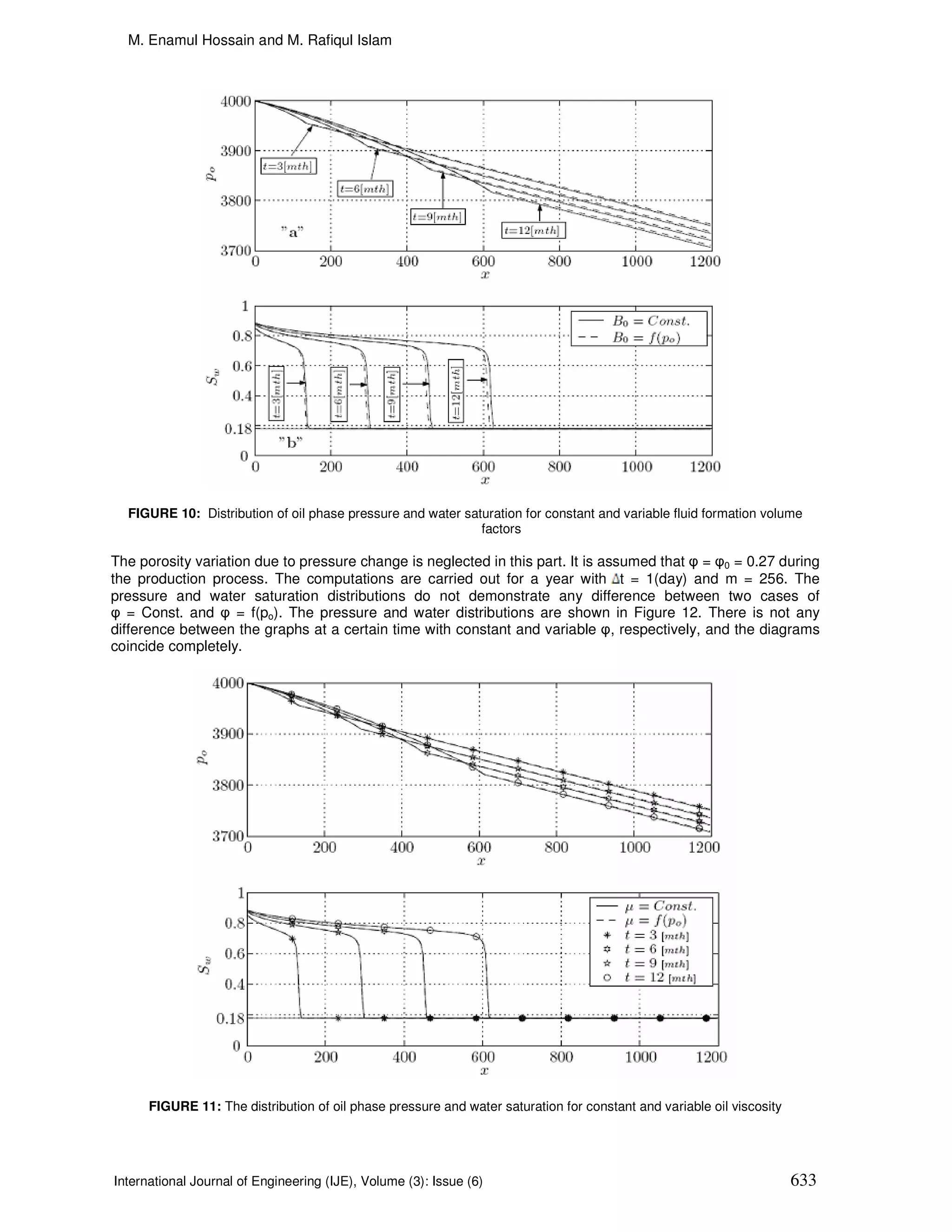
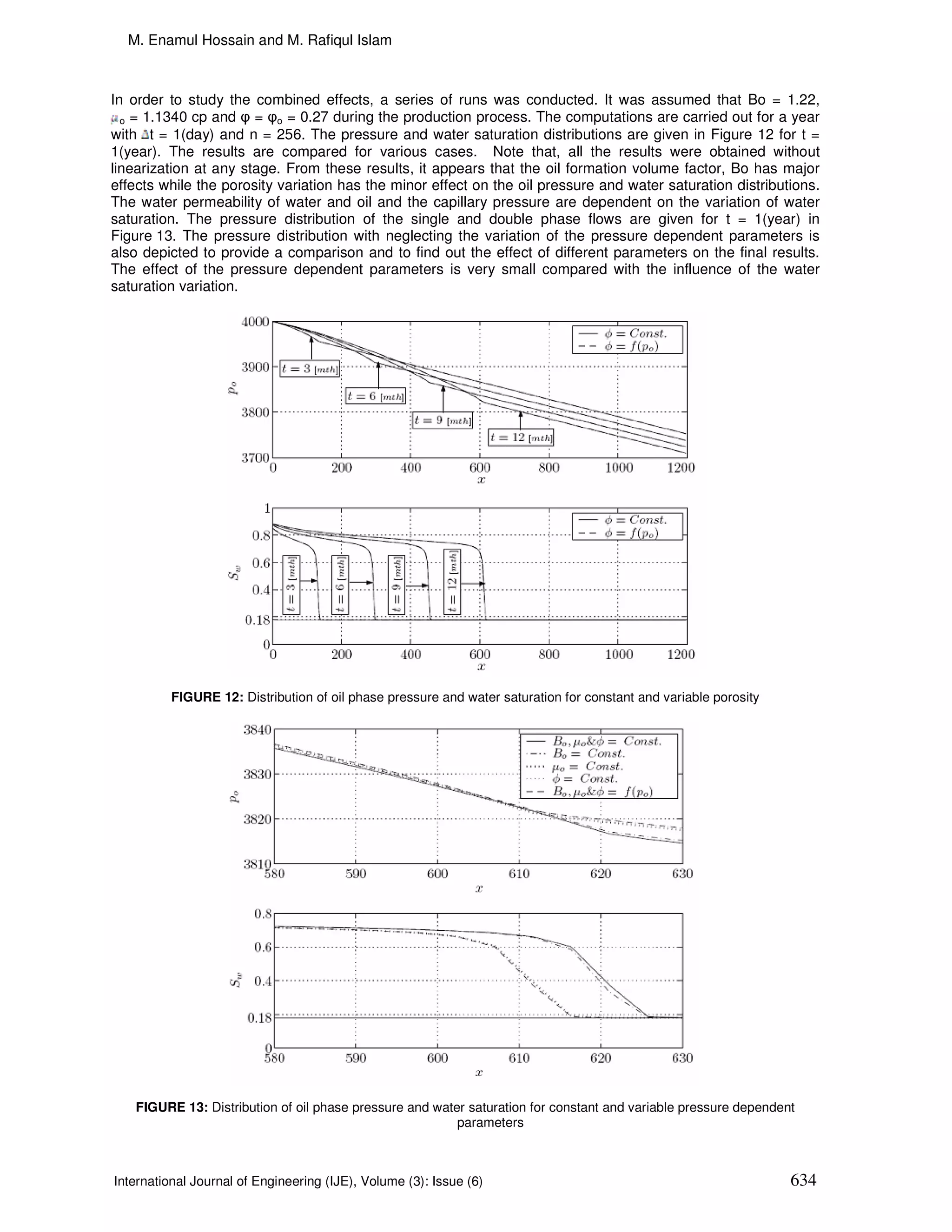
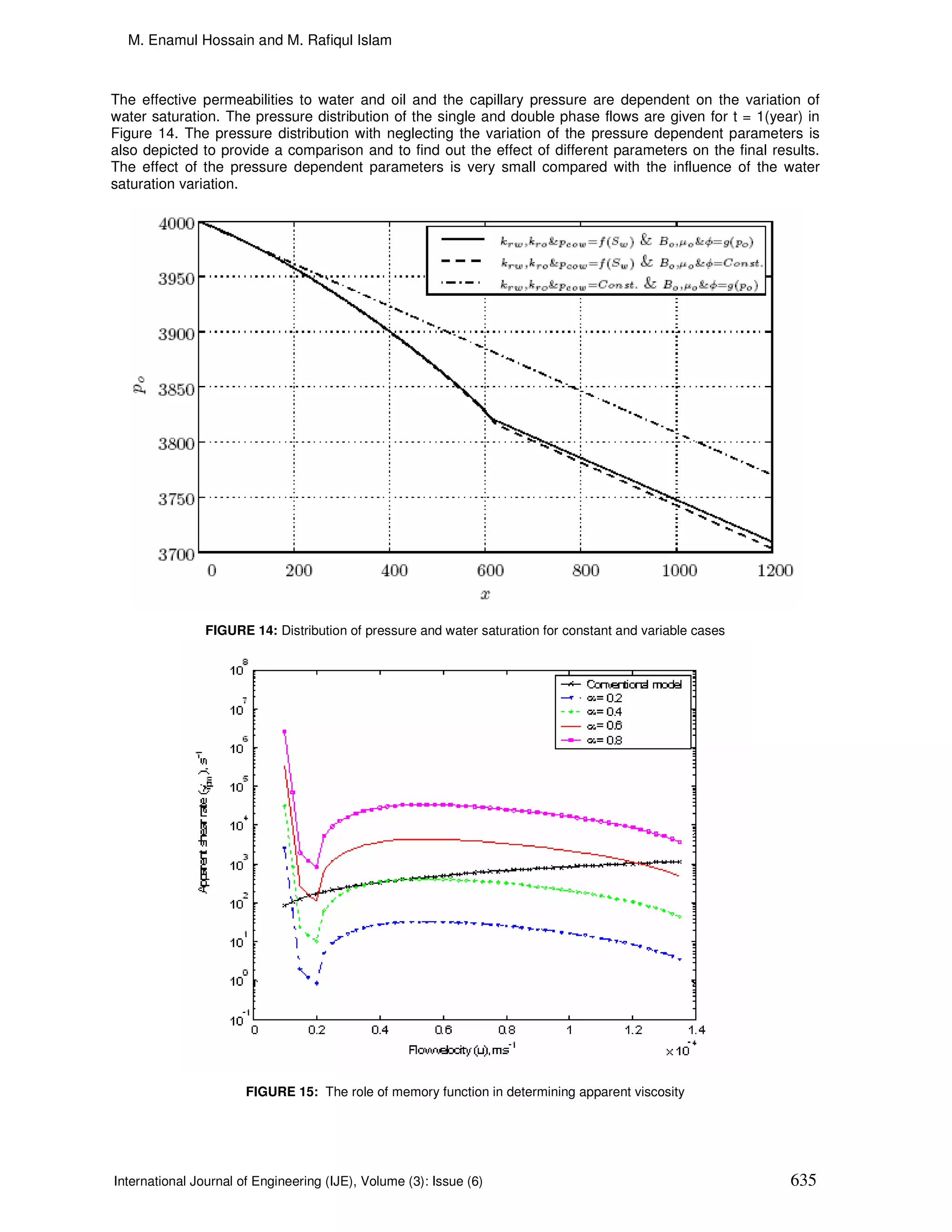
![M. Enamul Hossain and M. Rafiqul Islam
Finally, results using a recently developed fluid rheology model that includes fluid memory are presented in
Figure 15. Once again, fluid memory is considered to be the continuous time function. With the inclusion of
the memory, results deviate significantly from the conventional approaches. When, this rheology is coupled
with the momentum balance equation, classical cases of multiple solutions arise. Because the exact form of
the memory is never known, this depiction would give one an opportunity to refine the prediction envelop,
rather than putting too much emphasis on a single solution. Further details of this technique are available in
recent work of Hossain and Islam [30].
6. FUTURE RESEACH
Recent research has shown, the source of this uncertainty is the linearization of all governing equations – a
standard practice in reservoir simulation. If this linearization is eliminated, the accuracy of the results can
improve as much as 30%. A more accurate scenario of the reservoir would add science to the risk analysis,
which is often left to arbitrary assignment of the risk factor. A more accurate range of predicted values will
reduce the uncertainty to a great extent. The most important aspect of the knowledge-based approach is that
it leaves the open the option of multiple solutions, generating a set of cloud points rather than single point
solution. The same model is applicable to other fields of engineering, including aviation engineering and
biomedical engineering.
Concrete justifications on their results in order to prove that with their knowledge-
based approach, results are significantly different for most of the solution regime.
The results and successes reported by recent works of Mousavizadegan et al. (2007), Mustafiz et al. (2008a,
2008b), and Mousavizadegan et al. (2008) in solving equations without linearization promise the success of
the knowledge-based approach The benefits of the knowledge-based approach are two-fold. For a specific
study, if the results show significant differences between the solutions of the linearized and non-linearized
models, the stage will be set to seriously consider the new approach in reservoir simulation. If however the
results show insignificant differences for a given range of parametric values, then the proposed research
reaffirms that current method of linearization of model equations is appropriate for the given range and,
therefore, delineates the range for which fine tuning of the current techniques is necessary.
7. CONCLUSION
In the paper, the concept of knowledge-based modelling is presented. Proposals are made to overcome a
number of challenges encountered during modelling of petroleum reservoirs. It is shown that with the
knowledge-based approach, results are significantly different for most of the solution regime. This finding
would help determine more accurate range of risk factors in petroleum reservoir management. With the
proposed technique, sustainable petroleum operations can be modelled to yield different results from
unsustainable practices. This also allows one to distinguish between materials that cause global warming and
the ones that don’t. Such distinction was not possible with conventional modelling techniques.
8. ACKNOWLEDGMENTS
This paper summarizes recent work of a number of current and former PhD students, such as, Dr Shabbir
Mustafiz, Dr Enamul Hossain, Dr Hadi Belhaj, and Mr M. Moniruzzaman Khan. They were funded by various
funding agencies and industries. That funding is gratefully acknowledged. The first author gratefully
acknowledges the support of King Fahd University of Petroleum & Minerals during the preparation of the
manuscript.
9. NOMENCLATURE
All symbols and notations are explained in the text.
International Journal of Engineering (IJE), Volume (3): Issue (6) 636](https://image.slidesharecdn.com/ijev3i6-110103005953-phpapp01/75/Ije-v4-i2International-Journal-of-Engineering-IJE-Volume-3-Issue-6-125-2048.jpg)



![N.Yub Harun, M.T. Afzal and M.T. Azizan
Of all alternative energy resources, biomass has a great potential today and in the future, since it
is renewable, in contrast to the nature of the fossil fuels [3]. Biomass is seen as one of the best
options that can provide a renewable fuel which can be utilized in a range of energy conversion
technologies and also has the added advantage of being CO2 neutral [7]. It is biodegradable and
non-toxic. It has low emission profiles and thus is environmentally beneficial. There are many
biomass resources available in the world and one of those is rubber seed kernel which is not
edible. Rubber seed kernel can be converted into source of energy via biomass processes which
are torrefaction and fast pyrolysis.
Peninsular Malaysia, comprising 12 of the 14 states in the Malaysian federation is among the
world’s most important rubber growing area. Rubber is also grown in Sabah (formerly North
Borneo) and Sarawak, which, known together as East Malaysia.
Altogether Malaysia produces almost 20% of the world’s natural rubber. More than half
Malaysia’s rubber comes from thousands of privately owned small landholdings, which are
usually about 2 hectares. The rest is grown on big estates owned by various companies; each
can cover over a thousand hectares. Altogether, Malaysia has 1.7 million hectares of rubber
plantation [19]
Torrefaction produces solid product of carbon sources material like biomass, retaining
approximately 70% of the initial weight and 80%-90% of the original energy content [4]. As the
temperature increases, biomass begins to be brown and gives off moisture, carbon dioxide, and
large amount of acetic acid with some phenols [5].
This project studies the possibility of using rubber seed kernel to produce biofuel via torrefaction.
As the annual rubber seed production in Malaysia is high, this makes the source unlimited and
renewable throughout the years.
2. METHODOLOGY
The biomass waste of rubber seed kernel was obtained from a local supplier. It was dried at
110 °C for 2 hours, then grinded into smaller particles and finally sieved into two mesh sizes i.e.
250 and 500 µm, respectively. Each sample weighing 10 grams underwent torrefaction process
where it was heated for 1.5 and 3 hours respectively in a special furnace called Fixed Bed
Activation Unit at two different temperatures i.e. 240 ° and 280 °C, in the presence of inert
C
nitrogen. The torrefied material was then cooled to room temperature and reweighed to determine
the weight loss from the material due to the torrefaction process.
2.1 Sample Analysis
2.1(a) Moisture Content Analysis
The moisture content of material was analyzed by using Halogen Moisture Analyzer (HMA). It is
an important indication and method to determine the moisture content loss of the biomass sample
after undergoing torrefaction or pyrolysis process. The measurement was conducted two times,
which are before and after the torrefaction or pyrolysis process.
2.1(b) Ultimate Analysis
The ultimate analysis was conducted by using Carbon Hydrogen Nitrogen Sulphur (CHNS)
Analyzer. The samples were weighed around 1.5 milligrams to 2.0 milligrams in aluminium
container prior entering the analyzer. The analyzer will then display the composition of that
carbon, hydrogen, nitrogen, and sulphur contained within the material in percentage value. The
oxygen composition is calculated by difference method.
2.1(c) Calorific Value Analyses
International Journal of Engineering Volume (3): Issue (6) 640](https://image.slidesharecdn.com/ijev3i6-110103005953-phpapp01/75/Ije-v4-i2International-Journal-of-Engineering-IJE-Volume-3-Issue-6-129-2048.jpg)

![N.Yub Harun, M.T. Afzal and M.T. Azizan
Weight of sample vs heating time
Weight of sample (g)
650
630
610
590
570
Time (min)
15 30 45 60 75 90 105 120 135 150 165
Figure 1: Weight of rubber seed kernel versus heating time
Referring to Alves and Figueiredo [19], when heat is applied into wood particles, it will begin to
dry more intensely at the outer boundary with the increasing temperature. The bound and free
water tend to move outwards by convection and diffusion, while some may migrate towards the
inner, which is the colder part of the solid where condensation occurs. However, as the drying
process proceeds, the penetration of heat into the deeper part of the wood particle and moisture
movement to the surface becomes harder due to material resistance. This results in the rate
decrease of drying.
This concept can also be applied to the pre-treatment process of rubber seed kernel via drying in
the oven. This is because, the concept applied is similar in both cases where heat is applied to
the wet raw material in order to remove the bound and free water; in this case; rubber seed
kernel. The drying is considered finished when the weight of sample remains constant. During
this time, it is assumed that all bound and free water have been released. The rate of weight loss
gradually decreases because as time goes by, the moisture content in the raw material becomes
lower and lower. Therefore, less water is removed from the sample from time to time throughout
the drying period until the weight remains constant.
3.2 Sample Analysis
Sample analysis before heating is carried out using CHNS Analyzer. The equipment only
evaluates the carbon, hydrogen, nitrogen, and sulphur composition of the material. The remaining
composition of the material is oxygen which is determined by difference method. In this case,
oxygen value is 50.25%. This is done to compare the composition of the sample before and after
heating. From this analysis, the major components of rubber seed kernel initially are carbon and
oxygen. This result will be compared with the composition obtained from the samples undergoing
the heating process.
From CHNS analysis also, it is found out that hydrogen, nitrogen, and sulphur are minor
components of rubber seed kernel. The percentages of those components are acceptable after
comparison made with other torrefied biomass wastes used as solid biofuel production such as
beech, willow, larch, and straw [9] as shown in the Table 1.
Apart from the CHNS analysis, the initial calorific value of the raw sample is also determined
using bomb calorimeter before the heating process takes place which is 17218 J/g. From the first
look also, rubber seed kernel is seen as a good viable source of alternative solid fuel as by
nature.
International Journal of Engineering Volume (3): Issue (6) 642](https://image.slidesharecdn.com/ijev3i6-110103005953-phpapp01/75/Ije-v4-i2International-Journal-of-Engineering-IJE-Volume-3-Issue-6-131-2048.jpg)
![N.Yub Harun, M.T. Afzal and M.T. Azizan
Composition of Raw Sample
Raw Sample
0 10 20 30 40 50 60
Raw Sample
sulphur 0,019
nitrogen 0,547
hydrogen 5,973
carbon 43,21
Composition (%)
carbon hydrogen nitrogen sulphur
Figure 2: Composition of fresh rubber seed kernel
Biomass Type % Carbon % Hydrogen % Nitrogen
Beech 47.2 6.0 0.40
Willow 47.2 6.1 0.34
Larch 48.8 6.1 0.10
Straw 44.3 5.8 0.40
Rubber Seed Kernel 43.2 6.0 0.55
Table 1: Compositions of hydrogen and nitrogen of torrefied biomass wastes
3.3 Experimental Results
3.3(a) Color Changes
A B C
Figure 3: Colour change of samples
A is the sample taken before heating process takes place. B and C are samples observed when
heated in the fix bed activation unit at temperature 240° and 280° respectively. From Figure 3,
C C
the colour of samples becomes darker as the temperature of heating increases. According to J.
Bourgeois [5], he has proven from his research that as temperature increases, biomass begins to
be browned off and gives off moisture, carbon dioxide and large amounts of acetic acid with some
phenols. The colour turns into darker due to the increasing carbon content of the heating sample.
3.3(b) Effect of Duration, Temperature and Particle Size to Weight Loss
During torrefaction process where sample is heated at temperature range between 225° to C
300°C, two main reactions occur which are dehydration and carbonization. In general, higher
process temperature and longer time period result in lower production of solid product as more
biomass is converted to gas and liquid. This is proven by research done by Farah Dila [7] where
longer reaction time from 1.5 hours to 4 hours produce higher liquid yield for pyrolysis process
and lower product yield. This can also be applied to torrefaction. However, the portion of liquid
International Journal of Engineering Volume (3): Issue (6) 643](https://image.slidesharecdn.com/ijev3i6-110103005953-phpapp01/75/Ije-v4-i2International-Journal-of-Engineering-IJE-Volume-3-Issue-6-132-2048.jpg)
![N.Yub Harun, M.T. Afzal and M.T. Azizan
and gas produced during torrefaction is lower compared to pyrolysis due to the difference in
temperature ranges.
Weight Loss (%) vs Temperature
Weight Loss (%) vs Duration
16
16 Weight loss (%) size = 500
Weight Loss (%) T = 240
size = 250
T = 280
14
14
12 12
10 10
8 8
6 6
4 4
2 2
Duration (hour) Temperature (C
1.5 3 240 280
Figure 4: Effect of duration Figure 5: Effect of Temperature
Weight Loss (%) vs Sample Size
Weight loss (%) T = 280
T = 240
4.5
4
3.5
3
2.5
2
size (micrometer)
250 500
Figure 6: Effect of Size
By referring to Figure 4, heating time gives a massive impact to the weight loss. As the reaction
time is increased, more weight loss is observed. This is expected because, as time goes by, more
water in the sample, which constitutes as the major contribution to the mass, is evaporated
leaving behind the solid. This is true since the greater the size is, the longer time is needed to
convert to the torrefied material.
From Figure 5, it is observed that, as the heating temperature is increased, the weight loss is also
increased. When the biomass is heated, drying process takes place first. Further heating
removes new amount of water from chemical reactions through thermo-condensation process,
which occurs at temperature above 160° as well as the formation of carbon dioxide gas begins.
C,
This results to the weight loss of the sample as the heating process takes place. As the heating
temperature is increased, the rate of evaporation of water in the material becomes higher, thus
the weight loss increases. That is why it is observed that, at temperature 240° the weight loss is
C
8.0% while at temperature 280°C, 14.9% weight loss is exhibited which is nearly two times of the
previous value.
Referring to Herlina [6] and Farah Dila [7], both concluded that higher temperature promotes
higher evaporation and changes the solid to gaseous form. This is because, more cracking
occurs at higher temperature resulting in higher gas yield and lower solid yield. From this study,
the highest weight loss occured at temperature 280°C and reaction time of 3 hours with the
smaller particle size of rubber seed kernel.
As the size increases, weight loss is decreased. This is because, as the size of particles increase,
the surface area exposed to the heating process decreases. Therefore, less water can be
International Journal of Engineering Volume (3): Issue (6) 644](https://image.slidesharecdn.com/ijev3i6-110103005953-phpapp01/75/Ije-v4-i2International-Journal-of-Engineering-IJE-Volume-3-Issue-6-133-2048.jpg)
![N.Yub Harun, M.T. Afzal and M.T. Azizan
evaporated as the process takes place. This is within expectation because as time goes by within
1.5 hours, there are still more water evaporated, leaving behind the solid. The greater the size is,
the longer time is needed to convert to torrefied material. This is also proven by the moisture loss
analysis which exhibits higher value in smaller sample size compared to the bigger one which will
be discussed further in the next part.
Apart from that, with less surface area exposed, less contact area is established for the reaction
to take place, either for dehydration or degradation of biomass sample. As a result, less
degradation of solid to convert to gas exhibits lesser weight loss for bigger sample size and vice
versa.
3.3 (c) Effect of Duration, Temperature and Particle Size Composition
Figure 7 shows the comparison of the rubber seed kernel composition before and after heating at
different duration of time. The torrefied materials still exhibit carbon and oxygen content as the
major composition while others remain as minor ones. However, as the raw material undergoes
heating process and the heating duration increases, the carbon content also increases. Thus, the
torrefied material contains higher percentage of carbon compared to the raw material. In addition,
the increase is more significant at longer time period and higher temperature. In contrast, the
oxygen content become lesser as the duration is longer and carbon content is higher.
D uration vs C ompos ition T emperatu re v s C omp os ition
3 hr 280
S am ple
S am ple
c arbon c arbon
1,5 hr hy drogen 240 hydrogen
nitrogen nitrogen
s ulphur s ulphur
R aw R aw
0 10 20 30 40 50 60 0 10 20 30 40 50 60
R aw 1,5 hr 3 hr R aw 240 280
s ulphur 0,019 0,037 0,043 s ulphur 0,019 0,043 0,043
nitrogen 0,547 0,709 0,416 nitrogen 0,547 0,454 0,416
hy drogen 5,973 6,071 5,852 hydrogen 5,973 6,523 5,852
c arbon 43,21 44,97 48,19 c arbon 43,21 44,93 48,19
C om position (%) C om position (%)
Figure 7: Effect of Duration Figure 8: Effect of Temperature
S iz e vs C ompos ition
250
S am ple
c arbon
500 hy drogen
nitrogen
s ulphur
R aw
0 10 20 30 40 50 60
R aw 500 250
s ulphur 0,019 0,063 0,043
nitrogen 0,547 0,249 0,416
hy drogen 5,973 6,475 5,852
c arbon 43,21 44,7 48,19
C om position (%)
Figure 9: Effect of Size
According to Patrick et. al [20], in torrefaction process biomass loses relatively more oxygen and
hydrogen compared to carbon. Water from dehydration is the best example, but also all organic
reaction products (acetic acid, furans, methanol) and gases (mostly CO2 and CO) contain a
considerable amount of oxygen. Therefore, torrefied material has higher carbon content and
International Journal of Engineering Volume (3): Issue (6) 645](https://image.slidesharecdn.com/ijev3i6-110103005953-phpapp01/75/Ije-v4-i2International-Journal-of-Engineering-IJE-Volume-3-Issue-6-134-2048.jpg)
![N.Yub Harun, M.T. Afzal and M.T. Azizan
lower oxygen content compared to the raw sample. Due to removal of water and CO2, the
composition of torrefied material has a lower Oxygen/Carbon and Hydrogen/Carbon ratio.
As longer duration takes place, more water and gases are removed from the biomass sample,
therefore lower oxygen content exhibits lower Oxygen/Carbon ratio which is 0.9 and thus the
torrefied product becomes a better biofuel. However, the common Oxygen/Carbon ratio according
to Prins [8] is 0.69 to 0.72 which is quite low compared to the result obtained. It can be concluded
that, the oxygen content in the torrefied product is still high to be accepted as a good biofuel.
Figure 8 shows nitrogen and hydrogen decrease while the carbon content exhibits higher
composition at higher temperature. In conjunction with that, the oxygen content decreases as the
temperature increases. In this study, the highest percentage of carbon content is at 280° which
C,
is the maximum temperature of the experiment.
Rapid breakdown of the biomass structure increases tremendously at higher temperature, leaving
the decreased amount of torrefied product as discussed in the weight loss section previously. The
reason is, at high temperature, the reaction achieves complete conversion to form more stable
form of solid. Besides, at higher temperature, greater amount of raw material is oxidised with
other component exist in it. With high burn-off rate, most of the original sample has undergone
complete reaction with oxygen. Therefore, more water and gas are released from the biomass
sample as the temperature increases. That is why hydrogen and nitrogen components decrease
while the carbon content increases.
The decrease in Oxygen/Carbon ratio from 1.2 to 0.9 as the heating temperature increases
exhibit better biofuel. However, as discussed earlier, the ratio does not meet the torrefied wood
ratio which is from 0.69 to 0.72. In addition, the changes in composition is significant only at
higher temperature and longer time period as the increase of carbon content is higher compared
to at lower temperature and shorter time period.
Figure 9 shows the relationship between the particle size and composition of torrefied material.
Theoretically, the lower the particle size, the higher the surface and contact area exposed to the
heating process as well as the reaction to take place. High surface area can induce more
evaporation of water and other volatile products such as CO and CO2 to leave the sample quickly
and thus, resulting in lower volatile matter in the product and higher fixed carbon content. The
removal of those water and volatile matter reduces the hydrogen and nitrogen content as well as
Oxygen/Carbon ratio which results to better biofuel product. Furthermore, the result is more
significant at longer heating time as the change in composition is more compared to at shorter
heating time.
From the analysis done to the torrefied products composition with the effect of reaction time,
temperature, and sample size, the best biofuel product exhibited is at 280° for 3 hours reaction
C
time of 250 µm sample which has 48.19% carbon with 0.9 Oxygen/Carbon ratios.
3.3 (d) Effect of Duration, Temperature and Particle Size to Moisture Loss
Basically, all the effects studied for moisture content loss are similar to weight loss behaviour.
Figure 10 shows the effect of reaction time to the moisture loss of the torrefied material. It is
observed that as the reaction time increases, the moisture loss also increases. This is because,
as the heating process takes place, water is removed from the biomass sample. Thus, as more
time left for the biomass to be heated, more and more water can be removed as time goes by.
Apart from that, the moisture content loss is also affected by temperature where the higher the
temperature, the higher the moisture loss is. This is proven by Figure 11. Referring to Zanzi et. al
[9], at temperatures between 180° and 270° an exothermically reaction takes place, as well as
C C
the degradation of hemicelluloses goes on. Biomass begins to be brown and gives off moisture,
carbon dioxide and large amounts of acetic acid with some phenols. As the temperature
International Journal of Engineering Volume (3): Issue (6) 646](https://image.slidesharecdn.com/ijev3i6-110103005953-phpapp01/75/Ije-v4-i2International-Journal-of-Engineering-IJE-Volume-3-Issue-6-135-2048.jpg)
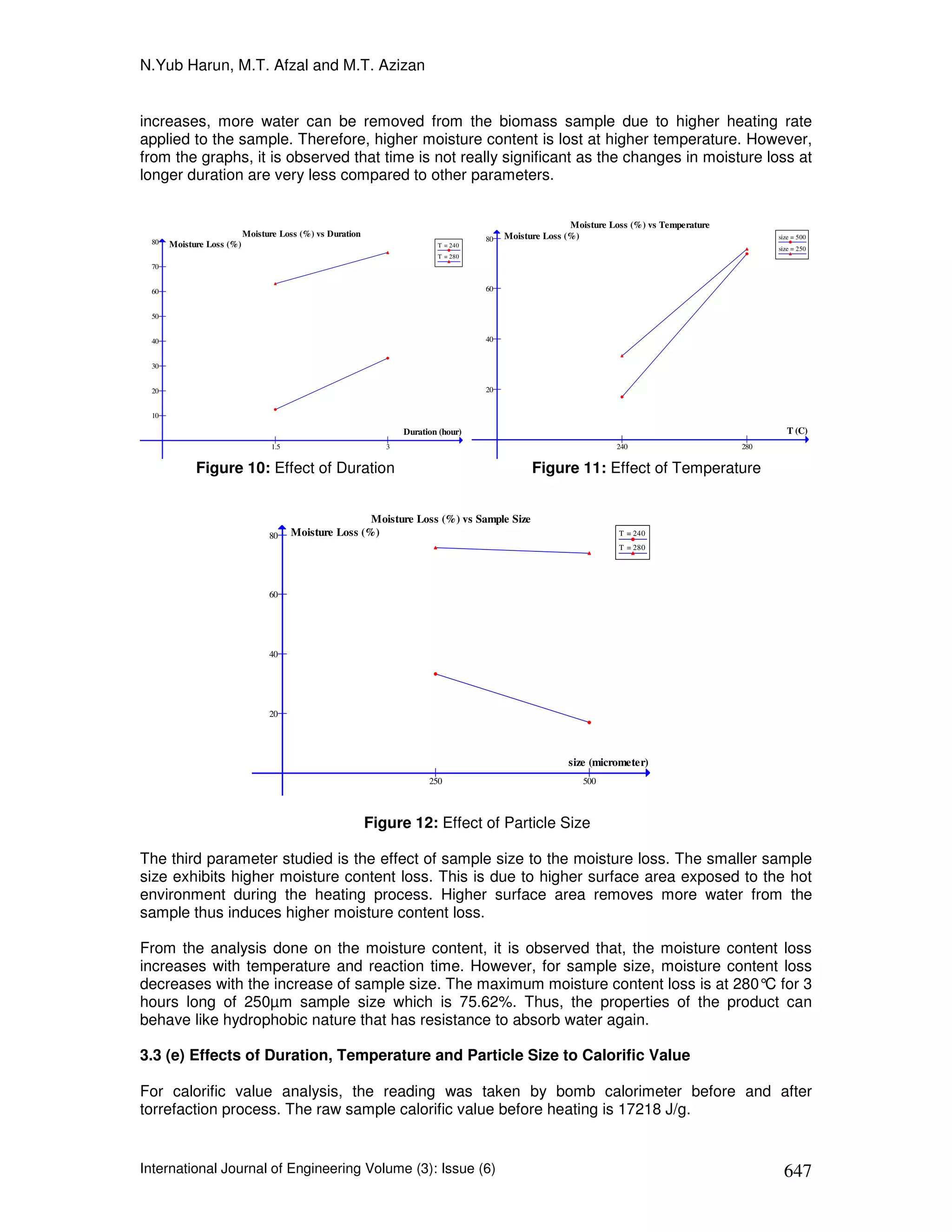
![N.Yub Harun, M.T. Afzal and M.T. Azizan
Calorific Value for different duration Calorific Value for different temperature
Calorific Calorific
Value (J/g) Value (J/g)
17700 19000
17600
18500
17500
Raw 18000 Raw
17400
17300 1.5 hours 17500 T = 240 C
17200 3 hours 17000 T = 280 C
17100 16500
17000 16000
Sample Sample
Figure 13: Effect of Duration Figure 14: Effect of Temperature
Calorific Value for different sample size
Calorific
Value (J/g)
18400
18200
18000
17800 Raw
17600
17400 500 micrometer
17200
17000 250 micrometer
16800
16600
Sample
Figure 15: Effect of Particle Size
Referring to Figure 13, 14 and 15, it is clearly seen that, the torrefied materials can retain the
calorific value almost 100% of the initial value. The research done by Itebe et. al [23] that
torrefaction process can retain up to 90% of the original energy is proven. In fact, the values
increase with the increasing heating temperature and reaction time. However, the calorific value
decreases with the increasing sample size. The higher the calorific value, the better the torrefied
material will be as it provides enough energy to be an alternative fossil fuel.
According to Patrick et. al [20], an increase of the calorific is the main result from the increasing
carbon content and decreasing O/C ratio with the removal of water and gas during torrefaction.
Depending on the torrefaction conditions, the low heating value dry of biomass, specifically wood
can be increased from 17-19 MJ/kg to 19 to 23 MJ/kg. Also referring to R. Zanzi et. Al [9], at
higher temperature, the carbon content in the product increases while the contents of H and O
decrease. H/C and O/C atomic ratios decrease with the temperature. As a result, the calorific
value (CV) of the solid product increases with the temperature and at longer residence time.
International Journal of Engineering Volume (3): Issue (6) 648](https://image.slidesharecdn.com/ijev3i6-110103005953-phpapp01/75/Ije-v4-i2International-Journal-of-Engineering-IJE-Volume-3-Issue-6-137-2048.jpg)
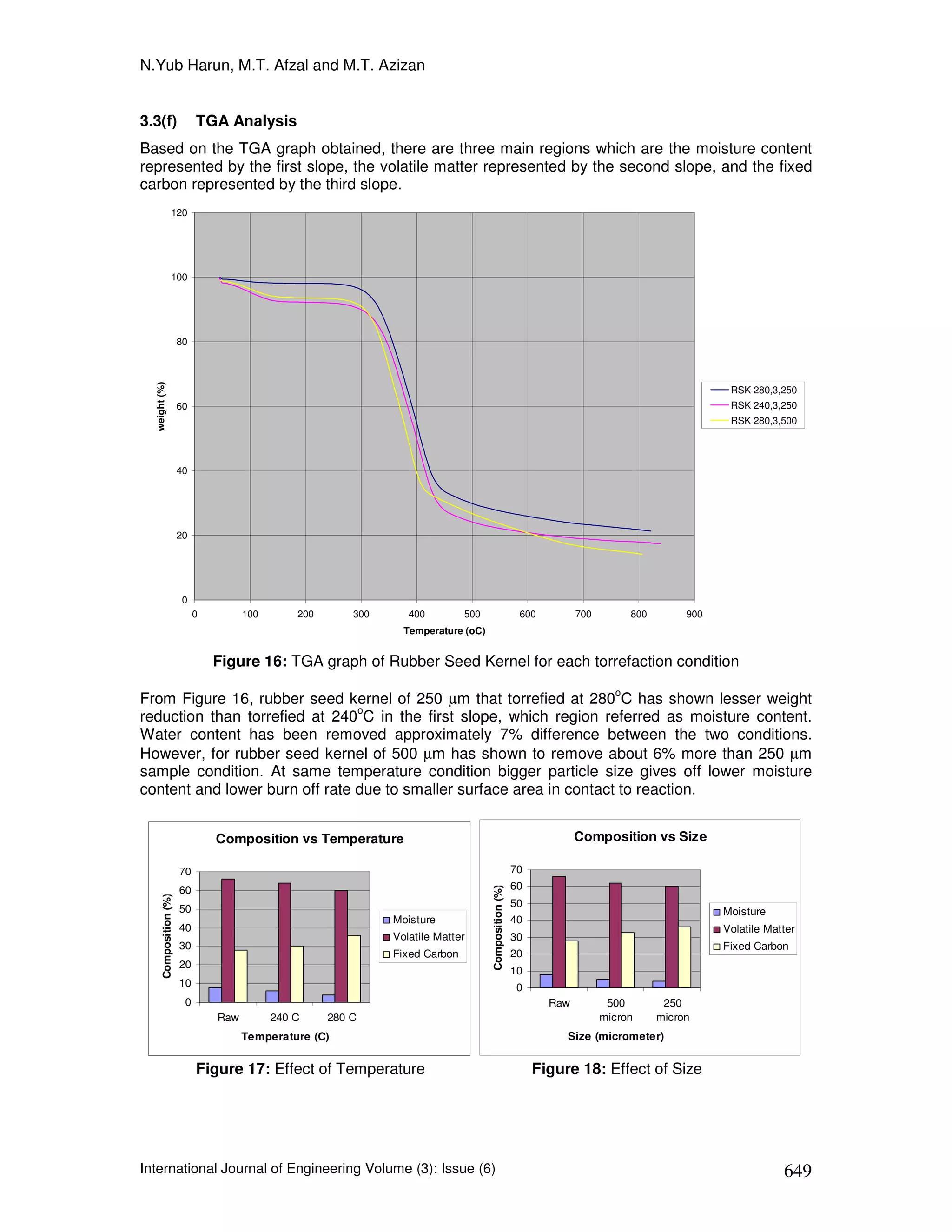
![N.Yub Harun, M.T. Afzal and M.T. Azizan
From Figure 17, it is observed that, the moisture content and volatile matter compositions are
reduced slightly as temperature increases. As discussed previously, the reduction is due to the
increase in drying rate of the sample at higher temperature. Therefore, more water and volatile
matter is removed at 280°C compared to at 240° The moisture content is the first element
C.
which is decomposed normally at temperature 100 °C to 150 ° where at this temperature the
C
recondensation and depolymerisation occur to remove the moisture. It is important to analyze the
behaviour of torrefied material as hydrophobic nature which has the resistance to absorb water.
Thus, it is expected that the moisture content within the material has lower value for this purpose.
As the temperature increases, more moisture can be removed from the torrefied material.
According to Herlina [6], the volatile matter indicates the by-product of torrefaction which includes
non-condensable and condensable gases. High values of volatile matter are a result of high
number of functional groups and low number of aromatic structures in organic materials. High
volatile charcoal may be easy to ignite but it burns with heavy smoke. In addition, with high
volatility, the material commonly will be less friable than ordinary material with low volatile matter.
Devolutilisation occurs at temperature of 150 ° to 220 ° The volatile matter should exhibit low
C C.
value for it to be more friable. In addition, rate of volatile matter removal increases as temperature
increases.
Apart from that, the fixed carbon content increases as heating process takes place and the value
also increases at higher temperature. High fixed carbon content illustrates high heating capacity
as discussed before. As the temperature increases, more volatile matter is being discharged to
the environment which leads to a higher amount of carbon left in the torrefied product. However,
the increase is very slight. As referred to Herlina [6], the fixed carbon should illustrate high
content for torrefied materials. The fixed carbon content induces high calorific value and hence
contributes to become potential fossil fuels for its high energy content. Normally, the
carbonization for torrefaction occurs at temperature between 250 ° to 300 °C.
C
From the composition analysis done using CHNS Analyzer, the percentage of carbon content
determined for torrefied material at 280 ° is 48.19%, while the fixed carbon analyzed by TGA
C
Analyzer is 36%. Therefore, we can conclude that about 25% of carbon is burnt as volatile
hydrocarbon and 75% of total carbon content remains. On the other hand, the percentage of
carbon content of torrefied material at 240 ° analyzed by CHNS Analyzer is 44.88% while the
C,
fixed carbon analyzed by TGA Analyzer is 30%. In total, the remaining carbon content left in the
torrefied material is about 67% which is much lower compared to at 280 °C.
Figure 18 shows the relationship between size and the composition of the torrefied products. The
results obtained shows that the moisture and volatile matter content decrease as the sample size
decreases while the fixed carbon increases. High surface area of smaller sample size causes the
evaporation of water and volatile matter to leave the charcoal quickly and thus, resulting in lower
volatile matter in the product and higher fixed carbon content. This is due to the decrease in
Oxygen/Carbon and Hydrogen/Carbon ratio. However, the changes are not so much that the
amounts of those three components are almost equal for different sizes of material.
For the torrefied material with size of 500 µm, the CHNS Analyzer gives carbon content of 44.2%
while the TGA Analyzer gives fixed carbon value of 33%. This shows that the remaining carbon
left is about 75% while the rest is burnt as volatile hydrocarbon. In comparison, the torrefied
material with size of 250 µm also has carbon content left of 75%. This proves that the particle
size of the sample does not give much effect to the torrefied material.
4. CONCLUSION
It is observed that temperature, particle size, and residence time do affect the physical and
chemical characteristics of the torrefied products. Almost 100% of the calorific value in all the
samples can be retained or increased by up to 10% from the original waste calorific value. From
the Thermo Gravimetric Analysis (TGA), rubber seed kernels exhibited high fixed carbon region
International Journal of Engineering Volume (3): Issue (6) 650](https://image.slidesharecdn.com/ijev3i6-110103005953-phpapp01/75/Ije-v4-i2International-Journal-of-Engineering-IJE-Volume-3-Issue-6-139-2048.jpg)

![N.Yub Harun, M.T. Afzal and M.T. Azizan
16. F. Fonseca Felfli, C. Luengo, G. Bezzon and P. Beaton. “Bench unit for biomass residues
torrefaction”. In Proceedings of Conference on Biomass for Energy and Industry. Würzburg,
Germany. 1998
17. Joe¨l Blin, Ghislaine Volle, Philippe Girard, Tony Bridgwater, Dietrich Meier, Biodegradability
of biomass pyrolysis oils: Comparison to conventional petroleum fuels and alternatives fuels
in current use. Fuel. 86(17-18): 2679-2686. 2007
18. Mohamad K.M. Sabil. “Study on the Production of Charcoal by Carbonization Using
Mangrove Wood in Malaysia”. In Proceedings of Second Engineering Congression
Engineering Innovation and Sustainability: Global Challenges and Issues. Sarawak,
Malaysia. 2002
19. S.S. Alves, Figuereido. “A model for pyrolysis for wet wood”. Chemical Engineering Science,
44(12): 2861-2869, 1989
20. Patrick C.A. Bergman, Jacob H.A. Kiel. “Torrefaction for Biomass Upgrading“. In
th.
Proceedings of 14 European Biomass Conference & Exhibition. Paris, France. 2005
21. Malaysian Rubber Review Third Quarterly Industrial Report 2006
22. International Energy Outlook 2007
th
23. http://library.thinkquest.org/11226/why.htm [retrieved on 11 March 2008]
th
24. http://en.wikipedia.org/wiki/Carbon_cycle [retrieved on 12 March 2008]
th
25. http://en.wikipedia.org/wiki/Kyoto_Protocol [retrieved on 12 March 2008]
th
26. http://unfccc.int/kyoto_protocol/items/2830.php [retrieved on 12 March 2008]
th
27. http://en.wikipedia.org/wiki/Biofuel [retrieved on 9 March 2008]
th
28. http://en.wikipedia.org/wiki/Second_generation_biofuels [retrieved on 9 March 2008]
th
29. http://www.cpeo.org/techtree/ttdescript/pyrols.htm [retrieved on 9 March 2008]
th
30. http://www.bioenergywiki.net/index.php/Pyrolysis [retrieved on 11 March 2008]
th
31. http://www.btgworld.com/technologies/pyrolysis.html [retrieved on 9 March 2008]
International Journal of Engineering Volume (3): Issue (6) 652](https://image.slidesharecdn.com/ijev3i6-110103005953-phpapp01/75/Ije-v4-i2International-Journal-of-Engineering-IJE-Volume-3-Issue-6-141-2048.jpg)
![Imad Khatib, Moh’d Awad, Kathem Osaily
An improved mathematical model for assessing the performance
of the SDHW systems
Imad A. Khatib imadk@ppu.edu
Renewable Energy and Environment Research Unit
Palestine Polytechnic University
Hebron, 19000, Palestinian Authority
Moh’d Awad mohdawad@ppu.edu
Renewable Energy and Environment Research Unit
Palestine Polytechnic University
Hebron, 19000, Palestinian Authority
Kathem Osaily kazema@ppu.edu
Renewable Energy and Environment Research Unit
Palestine Polytechnic University
Hebron, 19000, Palestinian Authority
Abstract
Short term testing of the SDHW system components is an essential prerequisite
for assessing the system’s long-term thermal performance. Relevant
performance parameters are therefore, crucial in recommending systems outputs
and feasibility. Short term testing methods based on ANSI/ASHRAE and ISO
standards testing methods and the mathematical system energy input/output
models used showed sensitivity to variation of the day length used in testing and
to different levels of irradiance. On the bases of the thermal performance testing
carried out for a SDHW system and the outcomes of the day-by-day long-term
performance prediction, a new mathematical system energy model is proposed
which may reduce the number of tests required, minimizes the dependency on
the day length and the sensitivity of the levels of irradiance.
Keywords: SDHW Systems, Performance Testing, Long-Term Performance Prediction, Energy
Input/output System Equation model.
1. INTRODUCTION
The potential of utilizing solar energy in Palestinian areas is so promising. Since the 1970s
people began to use solar energy for heating water for domestic uses and after 36 years; i.e. in
2006, survey studies done by the Palestinian Central Bureau of Statistics [1] indicated that more
than 70% of Palestinian dwellings are equipped with solar domestic hot water (SDHW) systems.
The SDHW systems are manufactured locally using traditional manufacturing processes that
make these products very competitive and feasible when compared to other similar imported
products. Until very recently, evaluating the performance of the locally manufactured SDHW
systems could not be realized as there exists no official standards institute to regulate the
process, and even after the establishment of the Palestinian Standards Institution (PSI) until
recently the relevant standards for testing the performance of the SDHW systems are inactive.
International Journal of Engineering (IJE), Volume(3):Issue(6) 653](https://image.slidesharecdn.com/ijev3i6-110103005953-phpapp01/75/Ije-v4-i2International-Journal-of-Engineering-IJE-Volume-3-Issue-6-142-2048.jpg)
![Imad Khatib, Moh’d Awad, Kathem Osaily
The establishment of the Renewable Energy and Environment Research Unit (REERU) at the
Palestine Polytechnic University and its involvement in a multilateral project funded by the US-
Citizen Exchange Program of the Department of State entails its cooperation with the Florida
Solar Energy Center (FSEC) of the University of Central Florida and a consortium of universities
in the Middle East. The outcome of the cooperation is the establishment of the solar energy
testing facility at REERU and strengthening the required human capacity. Through cooperation
among REERU, the Palestinian Standards Institute and the Ministry of Higher Education, REERU
was assigned to evaluate the performance of the locally produced SDHW systems and to validate
a standard performance testing procedure that enables understanding, predicting and comparing
the performance of the different SDHW systems.
2. TESTING SDHW SYSTEM’S COMPONENTS
The SDHW system used is a thermo-siphon integrated two flat-plate collectors tested with a
thermal storage tank in an open cycle. The thermal storage tank capacity is 126-Liters. Each
2
collector is having an aperture area of 1.42m . The collector housing is made of galvanized steel
with 30mm polyurethane insulation separating the housing from the flow risers and headers tubes
that are made of iron. The absorber plate is made of black steel and above it are transparent
glass plates. This configuration is usually used in all locally manufactured flat plate solar
collectors. The storage tank core is non-enameled made of 4mm steel sheets insulated from the
housing with 50mm polyurethane and it withstands a maximum attainable pressure of 12bar. The
collector housing is made of a 0.4mm galvanized steel sheet.
Both the flat plate collectors and the storage tank were tested under transient conditions in
accordance with ANSI/ASHRAE 93-2003 [2] and ISO 1995 [3] standards testing procedures and
methods.
2.1. TESTING FLAT-PLATE SOLAR COLLECTORS
The method used to test the collectors operating with constant flow rate is the steady-state
method. The method was first proposed by Hill and Kausuda [4], and later published in ASHRAE
standard [5] and ISO 1995 [3]. The steady state testing method depends on measuring the
instantaneous collector efficiency over a range of operating temperature. The data collected
should correspond to stationary conditions over a period of 15 to 20 minutes. A straight line
presentation is then plotted using the relationship:
*
η = ηo – UT (1)
*
Where the reduced temperature difference T is computed using Eq. 2:
*
T = (Tm – Ta) / GT (2)
And Tm is the mean plate operating temperature, i.e.
Tm = (Ti + Te) / 2 (3)
The slope in Eq. 1 represents the collector heat loss coefficient; U and the intercept with the Y-
axis (ηo) is the collector zero loss efficiency or the optical efficiency. For each testing point, the
energy output of the collectors is calculated as:
Qout = mc cP (Te – Ti) (4)
and the energy input as
Qin = GT AC (5)
International Journal of Engineering (IJE), Volume(3):Issue(6) 654](https://image.slidesharecdn.com/ijev3i6-110103005953-phpapp01/75/Ije-v4-i2International-Journal-of-Engineering-IJE-Volume-3-Issue-6-143-2048.jpg)
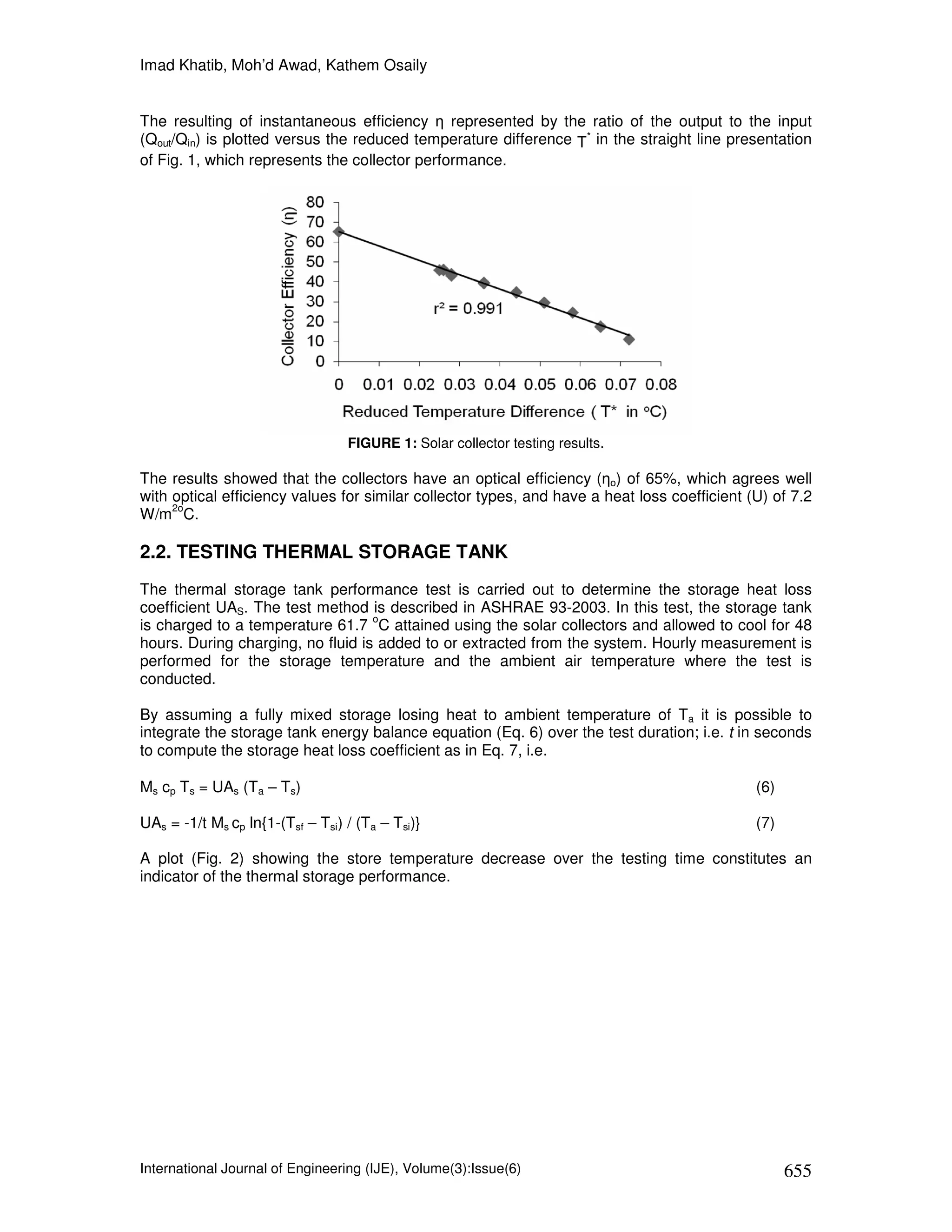
![Imad Khatib, Moh’d Awad, Kathem Osaily
FIGURE 2: Storage tank temperature trend over the 48 hours.
o -1
The storage tank heat loss coefficient UAS was computed at 1.42 W C , a value considered
relatively good for such thermal storage. However, in order to improve the thermal storage
performance better insulation may be used including enameling the core of the storage tank.
2.3. TESTING IN SITU THE SDHW SYSTEM
It is clear that the ISO 9459-2 standard testing method is based on the European CSTG method
[6]. The method assumes that for a fixed system and a fixed load, where there is little or no carry-
over of energy from one day to the next, the climatic parameters which significantly affect daily
system performance are:
• the daily solar irradiance on the plane of the collector H,
• the average ambient air temperature Ta during day time, and
• main cold water temperature supplied to the system TC.
A correlation between these parameter is assumed which represents an approximate linear
relationship between the solar irradiance and the system output which takes the form in Eq. 8:
Qout = a1H + a2(Ta – Tc) + a3 (8)
The correlation expressed in Eq. (8) forms the basis of the test method where, from results of
several tests employing different values of H, Ta and Tc, the values a1, a2 and a3 can be
determined using a multi-regression fit method. It is worth mentioning that a1 represent the
irradiance part of the model equation, a2 is the part of the energy lost or gained from the
temperature difference and a3 is the balance coefficient.
The test procedure carried out consists of one day tests which are independent of each other. For
each test the system is first preconditioned bringing the store temperature to the cold water
temperature. During that time collectors are covered to ensure no heat gained by solar radiation.
The circulation of water through the store is stopped after ensuring that the temperature in the
store is uniformly distributed. The system then charges by taking off the collectors' cover and
exposing them to sun rays. Immediately after the charge phase a single draw-off of three times
the store volume is performed in order to ensure that there was no carryover of energy to the next
day.
The test is repeated over several days constituting different values of irradiance levels, ambient
air temperatures, and mains water temperatures. During the course of each test the irradiance is
measured over the plans of the collectors. And during the charging phase, hourly measurements
are performed for the ambient air temperature, and the store temperature. The temperature
difference between the outlet and the inlet to the store is also recorded over a time increment of
60 seconds.
International Journal of Engineering (IJE), Volume(3):Issue(6) 656](https://image.slidesharecdn.com/ijev3i6-110103005953-phpapp01/75/Ije-v4-i2International-Journal-of-Engineering-IJE-Volume-3-Issue-6-145-2048.jpg)
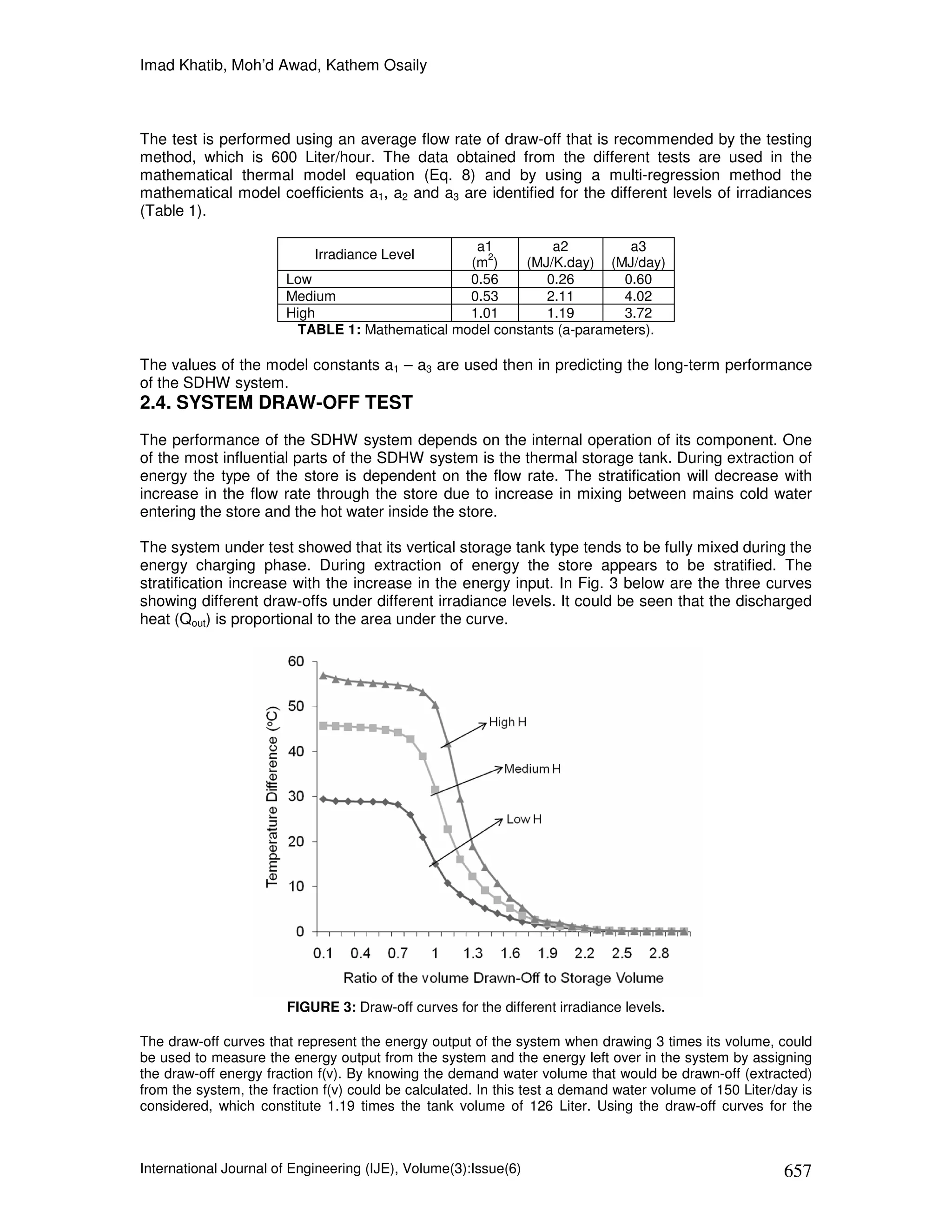
![Imad Khatib, Moh’d Awad, Kathem Osaily
different levels of irradiance, the different values of f(v) could be calculated as shown in Table 2. The same
table shows the fraction of energy when extracting the same tank volume of 126 Liter.
Irradiance Level f(v) for 150 Liter f(v) for 126 Liter
Low 0.78 0.66
Medium 0.79 0.68
High 0.84 0.72
TABLE 1: Values of the fraction f(v) calculated for different levels of Irradiance.
2.4. SYSTEM MIXING TEST
While the draw-off profile represents the effect of temperature stratification in the storage tank,
and mixing during discharging the system, there is a need to determine the effect of mixing during
draw-off independent of the temperature stratification inside the store. This is achieved by
discharging the system after establishing a uniform temperature distribution inside the store, and
by using the same flow rate utilized in draw-off profiles.
The resulting mixing profile can be seen in Fig. 4. It is seen that after consuming a volume equals
to store volume (i.e. 126 Liter), the fraction of energy extracted g(v) is approximately 0.86 of the
total energy withdrawn, and 0.90 of the total energy is for a demand load of 150 Liter.
FIGURE 4: Mixing profile.
3. LONG-TERM SYSTEM PERFORMANCE PREDICTION
Long term performance prediction of the SDHW system is computed using a Day-by-Day method
described in the European CSTG documents and later adopted by the ASHRAE 93-2003. The
method requires several parameters to be pre-identified, i.e. those identified in the short-tem
tests, as well as the dominant meteorological settings (or any other setting) for the location where
the system is going to be installed. In addition daily mains cold water temperature recorded or
calculated is considered essential for consistent calculations. In this respect, the British
Standards (BS 5918) of 1982 [7] referenced a correlation for computing mains cold water
temperature. This correlation was later modified to suit the Palestine climate and is written in the
form:
Tc =18 - 5.5 x cos((2 x pi/365.5) x (D + 11.25)) (9)
For the long-term calculation, the annual climate data used is taken from the Meteorological
Station of the Renewable Energy and Environment Research Unit (REERU).The weather station
records values on time increment of 15 minutes and store them for each year.
International Journal of Engineering (IJE), Volume(3):Issue(6) 658](https://image.slidesharecdn.com/ijev3i6-110103005953-phpapp01/75/Ije-v4-i2International-Journal-of-Engineering-IJE-Volume-3-Issue-6-147-2048.jpg)

![Imad Khatib, Moh’d Awad, Kathem Osaily
It should be mentioned here that the mathematical input/output model (Eq. 8) showed high
sensitivity for the day length and the variation in the level of irradiance.
3.2. RECOMMEDNED MODIFIED MATHEMATICAL MODLE
The sub-task E of the International Energy Agency (IEA) has suggested a stationary model for
the short-term testing of the SDHW systems [8]. The model was called the c-model that identifies
5 parameters, reduce the testing time and provide more variability of test data. The correlation
model expressed in the form:
Qout (1+c3c4δt / (ML cp)) = c1 Σ (GT Kατ – c2 {Tc - Ta+
+
c4 Qout / (ML cp)}) ∆t – c3 δt (Tc – Ta) –
c5 δt (TD – Ta) (10)
The coefficient c1 – c5 are system parameters that can be identified by a best fit to test data. It is
worth mentioning that the last term of Eq. 10 accounts for thermal auxiliary source during testing
and hence for real testing the term could be excluded; i.e. c5 accounts to zero. Marshall et al. [9]
have added a term to Eq. 10 that accounts for carryover of energy, changing the model from
stationary to non-stationary model as in Eq. 11:
Qout (1+c3c4δt / (ML cp)) = c1 Σ (GT Kατ – c2 {Tc - Ta +
+
c4 Qout / (ML cp)}) ∆t – c3 δt (Tc – Ta) –
n+1 n
Ms cp δt (Ts – Ts ) (11)
n+1 n
Where, Ts and Ts are the store temperature at end of the test day and at the beginning of the
test day respectively.
Eq. 11 could be written in terms of energy output (Qout) as:
+
Qout = c1Σ(GT - c2 {Tc – Ta + c4 Qout / (ML cp)}) ∆t –
c3 δt (Tc - Ta) – c3 c4 δt Qout / ML cp) –
n+1 n
Ms cp (Ts – Ts ) (12)
By assuming that all energy is utilizable (the + sign) then the equation should be reduced to:
Qout (1+(c1c2c4 /ML cp)Σ∆t + c3c4 δt / ML cp) =
c1 ΣGT ∆t – c1c2 (Tc – Ta)Σ∆t – c3 δt (Tc - Ta) –
n+1 n
Ms cp (Ts – Tn ) (13)
Or
Qout = [c1 / (1+d+e)]H +
[c1c2 Σ∆t + c3δt / (1+d+e)] (Ta – Tc) +
[-1 / (1+d+e)] ∆Qstore (14)
Assuming that the values:
d = (c1c2c4 / ML cp) Σ ∆t
e = c3c4 δt / ML cp
n+1 n
∆Qstore = Ms cp (Ts – Ts )
Comparing the model Eq. 14 with the model Eq. 8 showed that the coefficients a1 – a3 are given
by:
a1 = c1 / (1+d+e)
a2 = c1c2 Σ δt + c3 t / 1+d+e
a3 = -1 / 1+d+e
International Journal of Engineering (IJE), Volume(3):Issue(6) 660](https://image.slidesharecdn.com/ijev3i6-110103005953-phpapp01/75/Ije-v4-i2International-Journal-of-Engineering-IJE-Volume-3-Issue-6-149-2048.jpg)
![K.Meena alias Jeyanthi & A.P.Kabilan
Modeling and simulation of Microstrip patch array for smart
antennas
K.Meena alias Jeyanthi, meena.jeyanthi@gmail.com
Assistant Professor,
PSNA College of Engineering & Technology,
Dindigul, Tamil Nadu, India.
A.P.Kabilan, apkabilan@yahoo.co.in
Principal,
Chetinad College of Engineering & Technology,
Karur, Tamil Nadu, India.
Abstract
The aim of the paper is two fold. One is to design and simulate an antenna array
suitable for wireless applications and the other is the design of beamforming
algorithm. In this paper, the first module presents the design of multiple
microstrip rectangular patch elements suitable for beamforming technique in
wireless applications in the range of 1.8 - 2.4 GHz. By designing 1x8 patch array,
it is possible to achieve 15 dB gain and 58% more directivity compared to the
conventional patches. The second module suggests a NLVFF-RLS algorithm for
beamforming technique to concentrate the power in the desired direction and
nullify the power in the interferer direction with HPBW of 13° .The results are
analyzed for the scanning sector of -60° to 60° The modeling and simulation of
.
antenna array is computed using Agilent’s ADS. The beamforming algorithm is
designed in Matlab.
Key words: Adaptive antennas, antenna arrays, microstrip patch, beamforming.
1. INTRODUCTION
The rising importance of wireless communication and multimedia services increasing the efforts
to the design and implementation of novel microstrip patch structures from miniaturized electronic
circuits to the antenna arrays[2]. The main advantages of microstrip patches are light weight, low
cost, planar or conformal and ability of integration with electronic or signal processing circuitry.
Microstrip antenna elements radiates efficiently as devices on microstip printed circuit boards.
Microstrip antenna array consists of microstrip antenna elements, feed and phasing
networks.Designing microstrip structure requires understanding of both mathematical relatives
and applications[2].The microstrip array is very reliable since the entire array is one continous
piece of copper.
Microstrip patch antenna consists of a radiating patch on one side of a dielectric substrate with a
continuous metal layer bonded to the opposite side of the substrate which forms a ground plane.
The patch is generally made of conducting material such as copper or gold and can take any
possible shape. A patch antenna is a narrowband, wide-beam antenna fabricated by photo
etching the antenna element pattern in metal trace on the dielectric substrate shown in figure 1.
1.1 Design of microstrip patch array
International Journal of Engineering,IJE volume(3),Issue(6) 662](https://image.slidesharecdn.com/ijev3i6-110103005953-phpapp01/75/Ije-v4-i2International-Journal-of-Engineering-IJE-Volume-3-Issue-6-151-2048.jpg)
![K.Meena alias Jeyanthi & A.P.Kabilan
The following are the design equations of the single patch[2],
The actual Length of the Patch is, λ (1)
L=
2 εr
Effective relative dielectric permittivity,
(2)
the effective Length of the Patch is, (3)
FIGURE 1: Rectanular microstrip antenna element
The Extension Length due to fringing field,
(4)
The coaxial feed is a very common technique used for feeding microstrip patch antennas as
shown in figure 2.
FIGURE 2: side view of element with coaxial feed
1.2 Simulation of single and multiple array
A single patch antenna provides a maximum directive gain of around 6-9 dB. It is relatively easy
to print an array of patches on a single (large) substrate using lithographic techniques[2]. Patch
arrays can provide much higher gain than a single patch at little additional cost; matching and
phase adjustment can be performed with printed microstrip feed structures. The ability to create
high gain arrays in a low-profile antenna is one reason that patch arrays are common in all
wireless applications[2]. The antenna model is simulated by Agilent’s ADS which is a powerful
tool in the design of multilayer micostrip antennas. In early days, most of the designers uses
graphical tool for the design of antennas[10,11]. Figure 3 shows the return loss of -13 dB for
single patch and figure 4 shows the return loss of -18dB for 1x8 patch array for the center
International Journal of Engineering,IJE volume(3),Issue(6) 663](https://image.slidesharecdn.com/ijev3i6-110103005953-phpapp01/75/Ije-v4-i2International-Journal-of-Engineering-IJE-Volume-3-Issue-6-152-2048.jpg)
![K.Meena alias Jeyanthi & A.P.Kabilan
frequency of 1.85GHz. Even the fractal antennas have the S11 of -27dB which is comparable with
this.[9].Figure 3 & 4 shows the return loss is obtained for the same resonant frequency of
1.85GHz accurately.
S11
0
-5
M a g . [d B ]
-10
-15
1.80 1.85 1.90 1.95 2.00 2.05 2.10 2.15 2.20
Frequency
FIGURE 3: Return loss of single patch
0
d B (S _ Z 0 (8 ,8 ))
-5
-10
-15
-20
1.80 1.85 1.90 1.95 2.00 2.05 2.10 2.15 2.20
freq, GHz
FIGURE 4: return loss of 1x8 elements
2. DESIGN OF ARRAY OF PATCHES
2.1 Substrate selection
It is important to choose a suitable dielectric substrate of appropriate thickness’ h’ and loss
tangent ’δ’. A thicker substrate are mechanically strong, will increase the radiated power, reduce
conductor loss and improve the impedance bandwidth[2]. A high loss tangent increases the
dielectric loss and therefore reduces antenna efficiency. Here the substrate selected as
1/32in(1.58mm)and loss tangent of 0.024 for the operating frequency ranges from 1.8-2.4GHz.
2.2 Element width and Length
Patch width has a minor effect on the resonant frequency and radiation pattern of the antenna.
With the proper excitation, a patch width ‘W’ greater than the patch length ‘L’ without exciting
undesired modes. The patch width affects the cross polarization characteristics.
International Journal of Engineering,IJE volume(3),Issue(6) 664](https://image.slidesharecdn.com/ijev3i6-110103005953-phpapp01/75/Ije-v4-i2International-Journal-of-Engineering-IJE-Volume-3-Issue-6-153-2048.jpg)
![K.Meena alias Jeyanthi & A.P.Kabilan
FIGURE 5: Array of 8 patches
In this paper, a broadband rectangular microstrip patch antenna using the permittivity of εr of
4.28, log tan δ of 0.024. The length and breadth of the patch is 51.25mm and 40.01mm
respectively. The uniform linear array of patches with spacing of 0.5λ are arranged as shown in
figure 5.
2.3 Radiation pattern
The radiation pattern of an antenna is prime important in determining most of the characteristics
which include beamdwidth,beam shape, sidelobe level, directivity and radiated power. Radiation
pattern is computed using method of moments in ADS.
2.4 Beamwidth
The half power beamwidth(HPBW) of an antenna is equal to the angular width between the
directions where radiated fields reduced to 1/√2 times the maximum value.
2.5 Directivity and gain
The directivity is a measure of the directional properties of an antenna compared to the isotropic
antenna. Directivity is generally high for array antennas. The gain of the antenna directly depends
on the radiation efficiency and the directivity of the antenna[2]. It is observed that directivity
increases with increase of substrate thickness and patch width. Conversely, the beamwidth is
expected to decrease for higher values of ‘h ‘and ‘W’.
Figure 6 shows the E plane beamwidth of the array. The dimensions and the antenna parameters
are tabulated in table 1.
FIGURE 6: Radiation pattern of 1x8 patches
International Journal of Engineering,IJE volume(3),Issue(6) 665](https://image.slidesharecdn.com/ijev3i6-110103005953-phpapp01/75/Ije-v4-i2International-Journal-of-Engineering-IJE-Volume-3-Issue-6-154-2048.jpg)
![K.Meena alias Jeyanthi & A.P.Kabilan
The conventional single patch has the directivity of 7-8dB.But it is observed that the directivity of
1x8 array is improved by 6 dB compared to the single patch. The gain of the array is found to be
15 dB.
Operating frequency(fo) 1.85 GHz Power radiated(Watts) 0.046
Width of single patch(W) 51.25mm Effective angle(deg) 0.41 steradian
Length of single patch(L) 40.01mm Directivity(dB) 14.832
Height 1.5 mm Gain(dB) 14.8287
No.of elements 8 Intensity(Watts) 0.112
Distance between elements 0.5 λ E(theta) 81.68
Feed line length 9.5 mm E(phi) 82.68
Radius of the field 0.5 mm
Table 1: Antenna parameters
3. SMART ANTENNAS
Smart antennas gain more space in modern wireless communication systems using the important
property of spatial filtering[8]. The increasing demand for mobile communication services in a
limited RF spectrum motivates the need for better techniques to improve spectrum utilization as
well as the development of new high bit rate applications[1]. A smart antenna is an antenna array
system aided by some smart algorithm designed to adapt to different signal environments[2]. In
this paper our approach is presented by designing an adaptive algorithm using a linear
arrangement of rectangular antenna array, with 8 elements, a high degree-of-freedom exists to
synthesize very sophisticated radiation patterns[7].
FIGURE 7: Structure of the adaptive array
International Journal of Engineering,IJE volume(3),Issue(6) 666](https://image.slidesharecdn.com/ijev3i6-110103005953-phpapp01/75/Ije-v4-i2International-Journal-of-Engineering-IJE-Volume-3-Issue-6-155-2048.jpg)
![K.Meena alias Jeyanthi & A.P.Kabilan
A linearly arranged and equally spaced array of antenna forms the structure of a beam former. In
order to form a beam, each user input signal is multiplied by a set of complex weights and then
transmitted from the array to the distant point, the signal emitted from the antennas in the array
differ in phase as well as amplitude. If the weights are computed and updated in real time, the
process is known as adaptive beam forming [3]. The structure of the adaptive antenna array is
shown in figure 7.
Adaptive process permits narrower beam and improving the signal to noise ratio only in the
direction of that particular user. This technique drastically reduces the interference in the system.
In digital beamforming, the received RF signals are down converted to intermediate frequency
(IF) and then digitized by Analog-to-digital converters (ADC). The availability of digital signals
enables the use of a considerable number of processing algorithms, because the adaptation can
be performed by the controlling software at a lower frequency.
3.1. Non linear variable forgetting factor recursive least squares algorithm (NLVFF-RLS)
The Recursive Least Squares (RLS) algorithm offers an alternative to the LMS algorithm as a tool
for the solution of adaptive filtering problems. This algorithm uses the least squares estimate of
the tap weight vector of the filter at iteration n-1, to compute the updated estimate of the vector at
iteration ‘n’ upon the arrival of new data. Hence this algorithm is referred as the Recursive Least
Squares (RLS) algorithm.
The recursive equation for updating the tap- weight vector is,
− −
W (n) = W (n − 1) + k (n)ξ * (n) (5)
− *
ξ (n) = d (n) − u T (n) W (n − 1) , (6)
is the a priori estimation error.
k(n) is the gain vector. k(n) is expressed as
π ( n)
k ( n) = (7)
λ + u H (n)π (n)
The intermediate quantity π (n) is computed as
π (n) = P (n − 1)u (n) (8)
The inverse correlation matrix is computed as
P(n) = λ−1 P(n − 1) − λ−1 k (n)u H (n) P (n − 1) (9)
3.2 Forgetting factor
In the case of non stationary environment, the algorithm[3] uses the forgetting factor λ €(0,1).
Here the constant forgetting factor used is λ =0.95.The constant forgetting factor will not produce
the optimal performance. Hence the nonlinear variable forgetting factor is preferred. RLS
approach leads to higher complexity, but provides a higher speed of convergence and performs
better in flat fading channels. The nonlinear forgetting factor can be obtained by error
measurements and updating the constant forgetting factor λ non linearly .The optimal filtering
gain k should be chosen in such a way that the equalization error is an uncorrelated noise
sequence.
λi −1 (1 + u H (n) P(i − 1)u (i − 1))
λi = (10)
Si
where λ−1 P(n − 1)u i − k i S i = 0,
This algorithm produces feed back control by updating the gain and forgetting factor λ based on
the nonstationary environment.
International Journal of Engineering,IJE volume(3),Issue(6) 667](https://image.slidesharecdn.com/ijev3i6-110103005953-phpapp01/75/Ije-v4-i2International-Journal-of-Engineering-IJE-Volume-3-Issue-6-156-2048.jpg)
![K.Meena alias Jeyanthi & A.P.Kabilan
4. RESULTS AND DISCUSSION
The simulated system consists of an eight element uniform linear array spaced at half
wavelength. The operating frequency selected as 1.8GHz. The channel is modeled as additive
white Gaussian channel. The received signals are modeled in the base band processing and
modulated by MSK (Minimum Shift Keying) signals. The modulated signals are multiplied by
steering vectors to simulate array processing technology. Inverse correlation matrix was
computed, and the weights are updated.
Linear Polarization Absolute Fields
E_co E_cross Axial Ratio Etheta Ephi Htheta Hphi
0 50 9E0 3E-2
-10 40 1E-2
-20 1
30
Mag. [dB ]
Mag. [dB ]
Mag. [V ]
Mag. [A ]
-30
1E-3
20
-40
1E-1
-50 10
1E-4
-60 0
-100
-80
-60
-40
-20
0
20
40
60
80
100
-100
-80
-60
-40
-20
0
20
40
60
80
100
-100
-80
-60
-40
-20
0
20
40
60
80
100
-100
-80
-60
-40
-20
0
20
40
60
80
100
THETA THETA THETA THETA
180 180 180 180
135 135 135 135
90 90 90 90
45 45 45 45
P hase [deg]
P hase [deg]
P hase [deg]
P hase [deg]
0 0 0 0
-45 -45 -45 -45
-90 -90 -90 -90
-135 -135 -135 -135
-180 -180 -180 -180
-100
-80
-60
-40
-20
0
20
40
60
80
100
-100
-80
-60
-40
-20
0
20
40
60
80
100
-100
-80
-60
-40
-20
0
20
40
60
80
100
-100
-80
-60
-40
-20
0
20
40
60
80
100
THETA THETA THETA THETA
Circular Polarization Power
E_left E_right Axial Ratio Gain Directivity Effective Area
0 50 20 4E-2
1E-2
-10 10
40
-20 0 1E-3
30
Mag. [dB ]
Mag. [dB ]
Mag. [dB ]
Mag. [m2]
-30 -10 1E-4
20
-40 -20
1E-5
-50 10 -30
1E-6
-60 0 -40
-100
-80
-60
-40
-20
0
20
40
60
80
100
-100
-80
-60
-40
-20
0
20
40
60
80
100
-100
-80
-60
-40
-20
0
20
40
60
80
100
-100
-80
-60
-40
-20
0
20
40
60
80
100
THETA THETA THETA THETA
Efficiency Radiated Power
180 180 100 1E-1
135 135 90
80 1E-2
90 90
70
Mag. [W /sterad]
45 45
P hase [deg]
P hase [deg]
P ercentage
60 1E-3
0 0 50
-45 -45 40 1E-4
30
-90 -90
20 1E-5
-135 -135 10
-180 -180 0 1E-6
-100
-80
-60
-40
-20
0
20
40
60
80
100
-100
-80
-60
-40
-20
0
20
40
60
80
100
-100
-80
-60
-40
-20
0
20
40
60
80
100
-100
-80
-60
-40
-20
0
20
40
60
80
100
THETA THETA THETA THETA
FIGURE 8: Amplitude response of the array
International Journal of Engineering,IJE volume(3),Issue(6) 668](https://image.slidesharecdn.com/ijev3i6-110103005953-phpapp01/75/Ije-v4-i2International-Journal-of-Engineering-IJE-Volume-3-Issue-6-157-2048.jpg)
![K.Meena alias Jeyanthi & A.P.Kabilan
Figure 8 shows the Amplitude response the 1x8 antenna array. Figure 9 shows the power pattern
comparison of NLVFF-RLS and RLS algorithm which is scanning efficiently with half power beam
width of 13 º for the scanning sector of -60º to 60º . The side lobe level is varying between -14 dB
to -18dB which is appreciable valueBeam pattern of VFF-RLS & RLS
compared to the conventional methods [12].
5
RLS
0 NLVFF-RLS
-5 HPBW-13
-10
-14
-15
-20
(dB)
-25
-30
-35
-40
-45
-50
-60 -40 -20 -12 0 8 15 20 25 30
10
angle(degrees)
Figure 9: Beam pattern comparison of NLVFF-RLS and RLS
The various parameters are computed for the scanning sector of -60° to 60° are half power beam
width(HPBW), null point suppression and compared with the conventional LMS and RLS
algorithms are shown in table 2.
Null point
Algorithm HPBW SLL No.of
Supp
(deg) (db) Iter
(db)
LMS 14 12 25 30
RLS 18 14 15 40
NLVFF-RLS 13 14 10 50
Table 2: Comparision of algorithms
4. CONCLUSION
Due to the high cost and complexity of the design for planar and high resolution array, the design
focused on the development of uniform linear array antenna. The array designed using method of
moments in ADS to obtain the directivity of 14 dB (58% increase compared to the normal
patch).The proposed structure uses the spacing 0.5 λ, provides the return loss of 18 dB
referenced to the center frequency 1.85 GHz. The second goal is achieved by concentrating the
power in the specified direction with a HPBW of 13° in the scan sector of -60° to 60°. Simulation
results showed that NLVFF-RLS provides remarkable improvement in null point suppression of
50dB, convergence rate of 10 iterations and minimum mean square error over that of RLS. The
International Journal of Engineering,IJE volume(3),Issue(6) 669](https://image.slidesharecdn.com/ijev3i6-110103005953-phpapp01/75/Ije-v4-i2International-Journal-of-Engineering-IJE-Volume-3-Issue-6-158-2048.jpg)