Community-based HIV testing: reflections
from the field
Dr Jeanne Ellard
Acknowledgments
The Participants, AFAO, ACON, QUAC, VAC,
WAAC.
The Approach
Aims:
 To identify the design strengths
 To identify ongoing training and support needs of
peer workers
Approach:
 Draw on the expertise and experience of the
organisations and peer workers
 Collect data using ethnographic techniques including
field observations and interviews
The sites
 a[TEST] Surry Hills, Sydney, NSW (ACON)
 a[TEST] Newtown, Sydney, NSW(ACON/AFAO)
 M Clinic West Perth, Perth, WA (WAAC)
 PRONTO, Collingwood, Melbourne, Vic (VAC)
 Testing Point, Teneriffe, Brisbane, Qld (QuAC)
The Participants
 8 Managers
 8 Peer workers
 3 Peer ethnographers
Increasing testing frequency
 Locating services in inner city areas where many gay
men live
 Making the appointment process easy, for example
offering on-line bookings
 Offering rapid HIV tests
 Providing HIV and STI testing free of charge
 Staffing services with skilled peer educators
 Delivering a non-judgmental service
 Working in partnership with clinicians/clinical services
Community-based testing: what makes the
experience different?
 The environment
 Peer-led
 Non-judgment
The Spaces
In approaching the concept of trying to be less clinical and more
user friendly and inviting we just made sure that when they first
walked through the door they did not feel like they were in a
white room where if you touch anything it is going to have to be
sterilised
(manager, interview)
[name] is trialling a new digital radio station today to have
playing in the waiting room (SBS “Chill” or something like that)
which is filling the place with slightly echoing calm music with
occasional bird calls. I think it works.
(Peer worker, fieldnotes)
The community and the clinical
The clinical component of the process is very important and so
there has to be part of the training and all that kind of thing and
ensuring that our processes are robust and ... it’s a funny balance
between an environment that is relaxed, people who can
empathise and aren’t judgemental and belong to the communities
who use the service who are doing the testing but also a kind of
robust and rigorous clinical core to the service.
(Peer worker, interview).
Peer-led
... be of the community, so they have to be peers, literally,
ideally if it is gay men who are going to come through the door,
they are going to have to be gay men,...explain the process, and
make it seem like a gay community organisation...that’s running
this programme...
(Manager, interview)
Non-judgemental
I do the 2015 Gay Community Periodic Survey, which was being offered to
clients at [...] while they wait for their appointments. In answering the
sexual behaviour section I was reminded of how different my own sex life is
compared with what clients often disclose. This makes me think about
whether or not I do a good job of being a ‘peer’ if I can’t directly relate to
many experiences that clients recount – something I think about often.
However, today it doesn’t weigh on me too much. I ran into a gay friend
before arriving at work who described a horrible and judgemental
experience with a nurse at a recent HIV test he had, and this reminded me
that the approach someone takes when providing a test and their skills in
making the client feel comfortable are perhaps more important than how
much they have in common.
(Peer worker, fieldnotes)
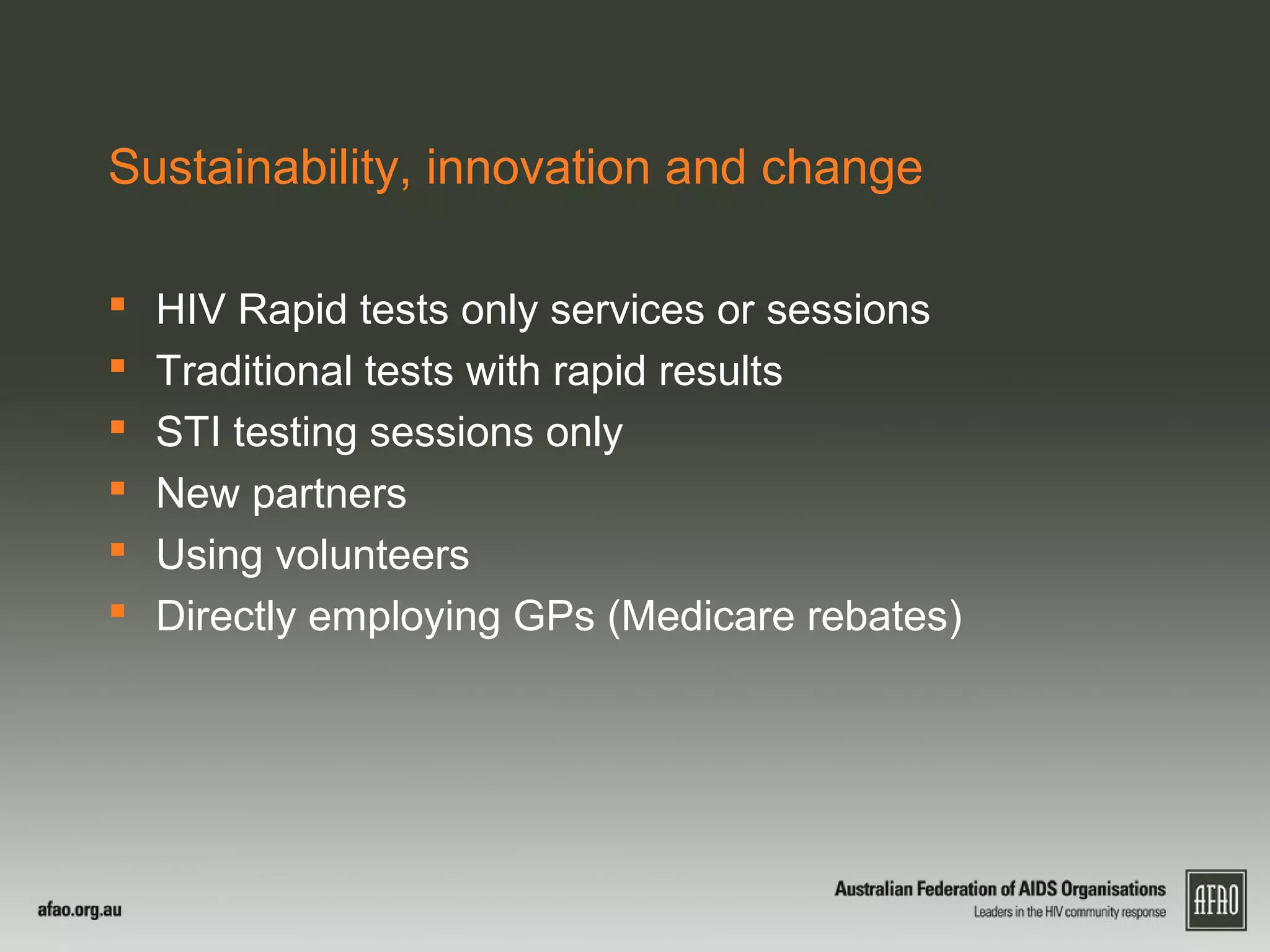
Sustainability, innovation and change
 HIV Rapid tests only services or sessions
 Traditional tests with rapid results
 STI testing sessions only
 New partners
 Using volunteers
 Directly employing GPs (Medicare rebates)

Community-based HIV testing: reflections from the field

  • 1.
    Community-based HIV testing:reflections from the field Dr Jeanne Ellard
  • 2.
  • 3.
    The Approach Aims:  Toidentify the design strengths  To identify ongoing training and support needs of peer workers Approach:  Draw on the expertise and experience of the organisations and peer workers  Collect data using ethnographic techniques including field observations and interviews
  • 4.
    The sites  a[TEST]Surry Hills, Sydney, NSW (ACON)  a[TEST] Newtown, Sydney, NSW(ACON/AFAO)  M Clinic West Perth, Perth, WA (WAAC)  PRONTO, Collingwood, Melbourne, Vic (VAC)  Testing Point, Teneriffe, Brisbane, Qld (QuAC)
  • 5.
    The Participants  8Managers  8 Peer workers  3 Peer ethnographers
  • 6.
    Increasing testing frequency Locating services in inner city areas where many gay men live  Making the appointment process easy, for example offering on-line bookings  Offering rapid HIV tests  Providing HIV and STI testing free of charge  Staffing services with skilled peer educators  Delivering a non-judgmental service  Working in partnership with clinicians/clinical services
  • 7.
    Community-based testing: whatmakes the experience different?  The environment  Peer-led  Non-judgment
  • 8.
    The Spaces In approachingthe concept of trying to be less clinical and more user friendly and inviting we just made sure that when they first walked through the door they did not feel like they were in a white room where if you touch anything it is going to have to be sterilised (manager, interview) [name] is trialling a new digital radio station today to have playing in the waiting room (SBS “Chill” or something like that) which is filling the place with slightly echoing calm music with occasional bird calls. I think it works. (Peer worker, fieldnotes)
  • 9.
    The community andthe clinical The clinical component of the process is very important and so there has to be part of the training and all that kind of thing and ensuring that our processes are robust and ... it’s a funny balance between an environment that is relaxed, people who can empathise and aren’t judgemental and belong to the communities who use the service who are doing the testing but also a kind of robust and rigorous clinical core to the service. (Peer worker, interview).
  • 10.
    Peer-led ... be ofthe community, so they have to be peers, literally, ideally if it is gay men who are going to come through the door, they are going to have to be gay men,...explain the process, and make it seem like a gay community organisation...that’s running this programme... (Manager, interview)
  • 11.
    Non-judgemental I do the2015 Gay Community Periodic Survey, which was being offered to clients at [...] while they wait for their appointments. In answering the sexual behaviour section I was reminded of how different my own sex life is compared with what clients often disclose. This makes me think about whether or not I do a good job of being a ‘peer’ if I can’t directly relate to many experiences that clients recount – something I think about often. However, today it doesn’t weigh on me too much. I ran into a gay friend before arriving at work who described a horrible and judgemental experience with a nurse at a recent HIV test he had, and this reminded me that the approach someone takes when providing a test and their skills in making the client feel comfortable are perhaps more important than how much they have in common. (Peer worker, fieldnotes)
  • 12.
    Sustainability, innovation andchange  HIV Rapid tests only services or sessions  Traditional tests with rapid results  STI testing sessions only  New partners  Using volunteers  Directly employing GPs (Medicare rebates)

Editor's Notes

  • #13 Community based testing in Australia is relative new and with the trails coming to an end there will be challenges and opportunities. Some are already happening and some need further investigation and debate.