Billennium
J.gBallard
Victoria Patiño
J.GBallard James Graham "J. G." Ballard was an
English novelist, short story writer, and
essayist. Ballard came to be associated
with the New Wave of science fiction
early in his career. In the late 1960s
and early 1970s Ballard focused on an
eclectic variety of short stories. In 1973
the highly controversial novel Crash
was published but he is perhaps best
known for his relatively conventional
war novel, Empire of the Sun
(1984)."The best British novel about the
Second World War" by The Guardian.
The literary distinctiveness of Ballard's
work has given rise to the adjective
"Ballardian"
Descriptionofthecharacters
John Ward
He was unmarried, he worked
as a librarian, used to live
with seven people in a house
in 75th street, he broke the
wall and then they find the
secret room, and in the end
he became the ambitious
landlords that in the
beginning of the story he
hated.
Henry Rossiter
He was Ward’s friend, and the
girl’s friend too, he invited
them to move into their house
Judith and Helen
Rossiter’s friends and when they
were living in Ward and
Rossiter’s house(with the secret
room) they invited their family
into the house
Relevanceofthetitle
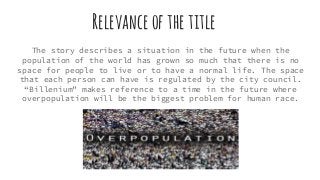
The story describes a situation in the future when the
population of the world has grown so much that there is no
space for people to live or to have a normal life. The space
that each person can have is regulated by the city council.
“Billenium” makes reference to a time in the future where
overpopulation will be the biggest problem for human race.
tone
Quotation
“Thirty million people are
packed into this city now,
a million increase in just
one year.”
Because we can see when we
read the story that the
characters don’t have any
type of hope for the future
because they know that the
situation is not going to
change the characters as
well maintain a passive role
all along the story
Themes
Overpopulation and lack of
responsibility
Hard and Rossiter lived in a crowded
city, and the cause of this is the lack
of responsibility from the authorities
and the people in the city. Because the
authorities didn’t control the local
people and the local people neither
realise of what was happening, so they
continue having more and more babies
without any control.
Power and loss of
responsibility
Because when they discover the secret
room and became landlords thay win
power. They also loss privacy because
of the people that were there, wich
give tham money that give them power.
Destruction of beauty
On one hand because the important and big buildings such as cathedrals
were used by people because of the lack of space so this in a way
damaged the buildings, on the other hand because Ward and Rossiter had
a wardrope from the victorian times(the past that their never knew)
that in the end of the story they threw out because as in their cubicle
with thesecret room were many people and they needed more space
quotations
Overpopulation and lack of responsibility
“Over a hundred people lived in the top three floors of the
old rooming house”
Power and loss of privacy
“The small rental he charged the others paid for the little
food he needed”
Destruction of beauty
“It was a beautiful wardrobe, without doubt, but when it was
gone it would make the room seem even larger”
Wardrobe
The wardrobe symbolise, one hand
freedom because as now they have a
bigger room they can decided what
to put there. It also represents
beauty, because as It was a
victorian wardrobe It belongs to
the past that Ward and Rossiter
didn’t know about.
Quotation:
“It has been a beautiful piece of
furniture, in a way symbolising
this whole private world, and the
salesman at the store told him
there were few like it left”
Cubicle
The cubicle symbolise a lack of space,
because they didn’t have space even to
strech their arms, lack of privacy and
also lack of freedom that lead to lack
of power because they didn’t have the
power of decide were to live.
Quotation:
“their double cubicle was on the
third floor, at the end of a corridor
that ringed the building. Its
architecture was impossible to follow,
rooms letting off at all angles, and
luckily the corridor was a cul-de-sac”
S
Y
M
B
O
L
I
S
M

Billenium, J.G Ballard

  • 1.
  • 2.
    J.GBallard James Graham"J. G." Ballard was an English novelist, short story writer, and essayist. Ballard came to be associated with the New Wave of science fiction early in his career. In the late 1960s and early 1970s Ballard focused on an eclectic variety of short stories. In 1973 the highly controversial novel Crash was published but he is perhaps best known for his relatively conventional war novel, Empire of the Sun (1984)."The best British novel about the Second World War" by The Guardian. The literary distinctiveness of Ballard's work has given rise to the adjective "Ballardian"
  • 3.
    Descriptionofthecharacters John Ward He wasunmarried, he worked as a librarian, used to live with seven people in a house in 75th street, he broke the wall and then they find the secret room, and in the end he became the ambitious landlords that in the beginning of the story he hated. Henry Rossiter He was Ward’s friend, and the girl’s friend too, he invited them to move into their house Judith and Helen Rossiter’s friends and when they were living in Ward and Rossiter’s house(with the secret room) they invited their family into the house
  • 4.
    Relevanceofthetitle The story describesa situation in the future when the population of the world has grown so much that there is no space for people to live or to have a normal life. The space that each person can have is regulated by the city council. “Billenium” makes reference to a time in the future where overpopulation will be the biggest problem for human race.
  • 5.
    tone Quotation “Thirty million peopleare packed into this city now, a million increase in just one year.” Because we can see when we read the story that the characters don’t have any type of hope for the future because they know that the situation is not going to change the characters as well maintain a passive role all along the story
  • 6.
  • 7.
    Overpopulation and lackof responsibility Hard and Rossiter lived in a crowded city, and the cause of this is the lack of responsibility from the authorities and the people in the city. Because the authorities didn’t control the local people and the local people neither realise of what was happening, so they continue having more and more babies without any control. Power and loss of responsibility Because when they discover the secret room and became landlords thay win power. They also loss privacy because of the people that were there, wich give tham money that give them power. Destruction of beauty On one hand because the important and big buildings such as cathedrals were used by people because of the lack of space so this in a way damaged the buildings, on the other hand because Ward and Rossiter had a wardrope from the victorian times(the past that their never knew) that in the end of the story they threw out because as in their cubicle with thesecret room were many people and they needed more space
  • 8.
    quotations Overpopulation and lackof responsibility “Over a hundred people lived in the top three floors of the old rooming house” Power and loss of privacy “The small rental he charged the others paid for the little food he needed” Destruction of beauty “It was a beautiful wardrobe, without doubt, but when it was gone it would make the room seem even larger”
  • 9.
    Wardrobe The wardrobe symbolise,one hand freedom because as now they have a bigger room they can decided what to put there. It also represents beauty, because as It was a victorian wardrobe It belongs to the past that Ward and Rossiter didn’t know about. Quotation: “It has been a beautiful piece of furniture, in a way symbolising this whole private world, and the salesman at the store told him there were few like it left” Cubicle The cubicle symbolise a lack of space, because they didn’t have space even to strech their arms, lack of privacy and also lack of freedom that lead to lack of power because they didn’t have the power of decide were to live. Quotation: “their double cubicle was on the third floor, at the end of a corridor that ringed the building. Its architecture was impossible to follow, rooms letting off at all angles, and luckily the corridor was a cul-de-sac” S Y M B O L I S M