The impact of takeovers and
mergers on the performance
 of the businesses involved
Key points
• Impact of a takeover or merger not just
  measured in financial terms
• Consider the strategic motives and the
  effect on achievement of broader
  corporate objectives
• Performance impact best measured in
  the long-term, but may be difficult to
  identify data if there is close integration
  between the businesses
Key Definitions

• Shareholder value: the return on
  investment achieved by shareholders of
  the buying/acquiring firm. The return
  needs to be at least equal to the
  required rate of return of shareholders
• Value destruction: where shareholder
  value falls as a result of the transaction
Key theories & concepts
• Profitability: the overall level of profits
  (a key return) in the enlarged business
• Market capitalisation: the monetary
  value (usually represented by the share
  price x shares in issue) of a business
• Porter’s Five Forces: a model of
  competitive rivalry which analyses the
  attractiveness of a market from the
  point of view of existing competitors
Measuring the impact of M&A
• For the target business:
  – Measure actual performance post-takeover with the
    assumptions in the takeover plan & due diligence.
  – Track achievement against planned synergies.
• For the buying business:
  – Measure effect on profitability, cash generation and
    other key financial ratios.
• For both businesses (combined)
  – Assess effect on customer service levels & brand
    reputation; efficiency (e.g. unit costs, productivity); key
    labour ratios (e.g. staff retention)
  – Has the transaction changed the competitive position of
    the enlarged firm and the competitive structure of its
    markets?
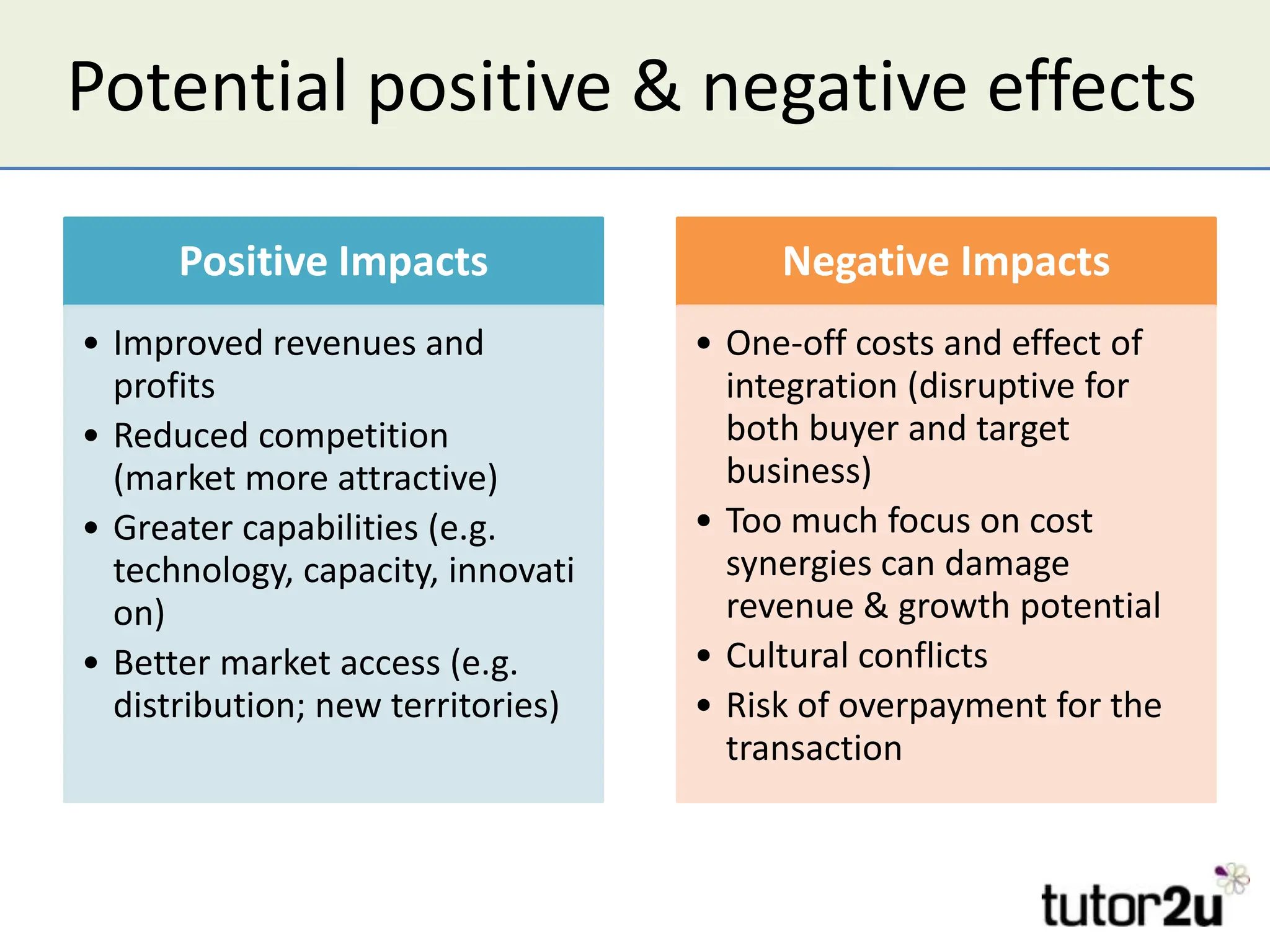
Potential positive & negative effects

      Positive Impacts                  Negative Impacts
• Improved revenues and            • One-off costs and effect of
  profits                            integration (disruptive for
• Reduced competition                both buyer and target
  (market more attractive)           business)
• Greater capabilities (e.g.       • Too much focus on cost
  technology, capacity,              synergies can damage
  innovation)                        revenue & growth potential
• Better market access (e.g.       • Cultural conflicts
  distribution; new territories)   • Risk of overpayment for the
                                     transaction
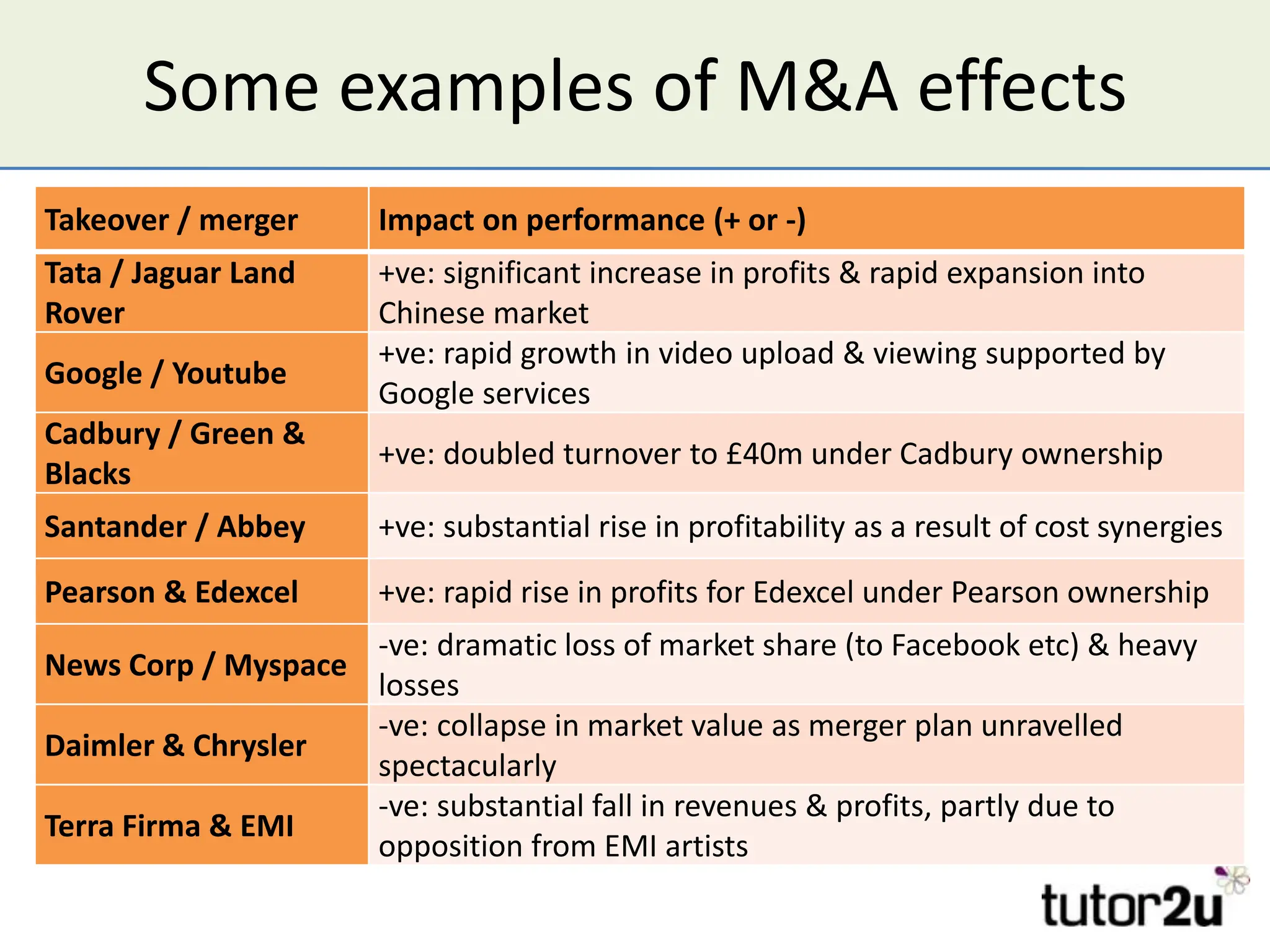
Some examples of M&A effects
Takeover / merger     Impact on performance (+ or -)
Tata / Jaguar Land    +ve: significant increase in profits & rapid expansion into
Rover                 Chinese market
                      +ve: rapid growth in video upload & viewing supported by
Google / Youtube
                      Google services
Cadbury / Green &
                      +ve: doubled turnover to £40m under Cadbury ownership
Blacks
Santander / Abbey     +ve: substantial rise in profitability as a result of cost synergies
Pearson & Edexcel     +ve: rapid rise in profits for Edexcel under Pearson ownership
                      -ve: dramatic loss of market share (to Facebook etc) & heavy
News Corp / Myspace
                      losses
                      -ve: collapse in market value as merger plan unravelled
Daimler & Chrysler
                      spectacularly
                      -ve: substantial fall in revenues & profits, partly due to
Terra Firma & EMI
                      opposition from EMI artists
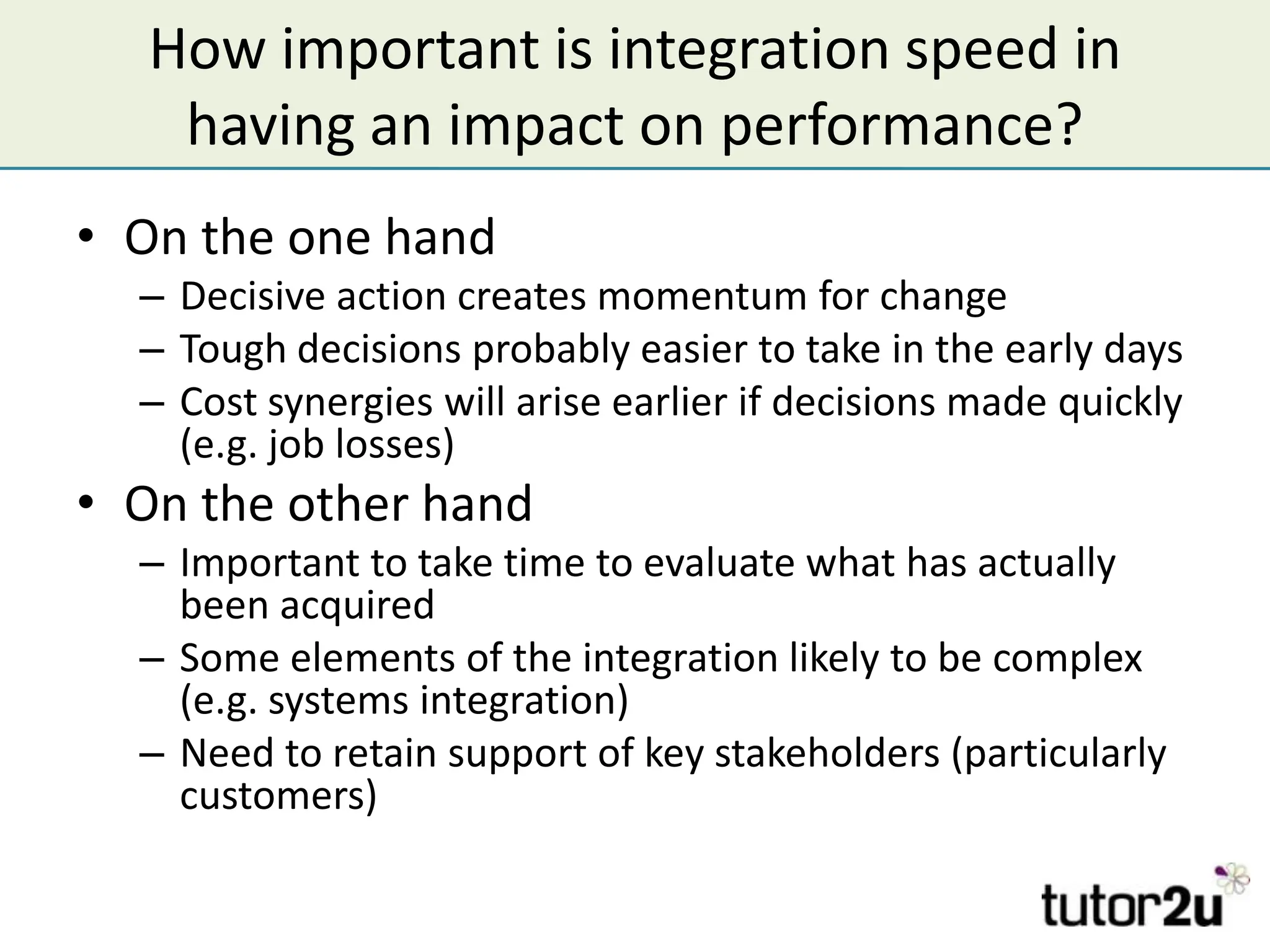
How important is integration speed in
    having an impact on performance?
• On the one hand
  – Decisive action creates momentum for change
  – Tough decisions probably easier to take in the early days
  – Cost synergies will arise earlier if decisions made quickly
    (e.g. job losses)
• On the other hand
  – Important to take time to evaluate what has actually
    been acquired
  – Some elements of the integration likely to be complex
    (e.g. systems integration)
  – Need to retain support of key stakeholders (particularly
    customers)
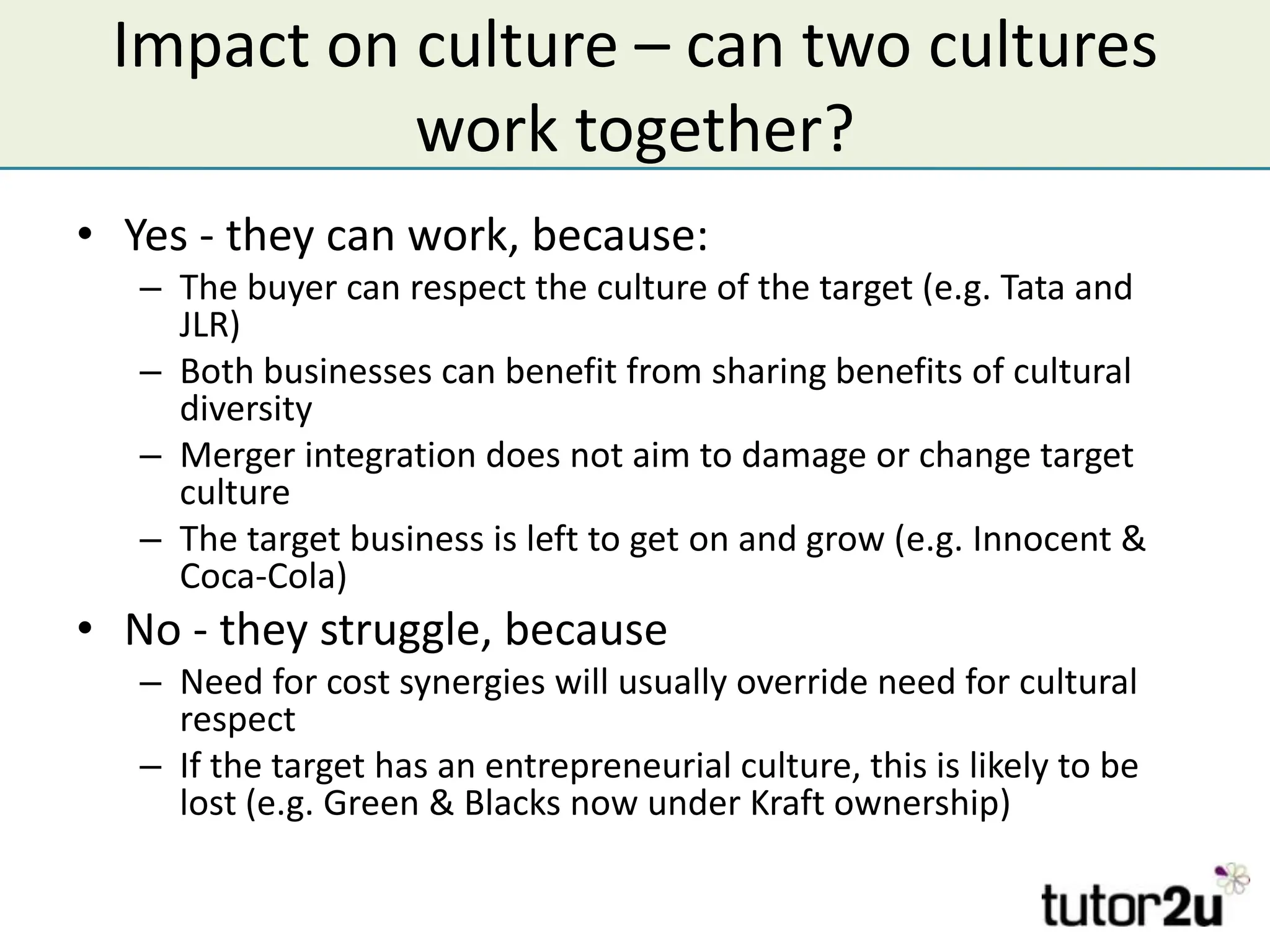
Impact on culture – can two cultures
           work together?
• Yes - they can work, because:
   – The buyer can respect the culture of the target (e.g. Tata and
     JLR)
   – Both businesses can benefit from sharing benefits of cultural
     diversity
   – Merger integration does not aim to damage or change target
     culture
   – The target business is left to get on and grow (e.g. Innocent &
     Coca-Cola)
• No - they struggle, because
   – Need for cost synergies will usually override need for cultural
     respect
   – If the target has an entrepreneurial culture, this is likely to be
     lost (e.g. Green & Blacks now under Kraft ownership)
Depends on factors
• How are we measuring “performance”? Traditional
  to look at financial measures where data most likely
  to be available.
• Impact on performance closely linked with the
  motives for the takeover or merger. Transactions
  with a mainly financial motive will need to impact
  mainly on financial measures / targets.
• Transactions with more strategic motives might be
  harder to measure financially (certainly in the short-
  run). How do you measure the impact on
  performance on intangible factors like innovation,
  capability, motivation?
Evaluation opportunities
• Distinction needs to be made between tangible
  measures (e.g. revenues, profits, market share etc)
  and more intangible measures such as brand &
  customer service reputation.
• Are we looking at the impact on the businesses
  involved over the short-term or longer-term? The
  full impact (positive or negative) might take some
  years to fully assess.
• Hard to measure impact for many takeovers, since
  the businesses concerned “disappear” into the result
  of the acquiring firm. Impact not so transparent in
  many cases.
Visit the tutor2u BUSS4 Takeovers and
   Mergers Blog for more resources

Impact of Takeovers and Mergers on Performance of Businesses Involved

  • 1.
    The impact oftakeovers and mergers on the performance of the businesses involved
  • 2.
    Key points • Impactof a takeover or merger not just measured in financial terms • Consider the strategic motives and the effect on achievement of broader corporate objectives • Performance impact best measured in the long-term, but may be difficult to identify data if there is close integration between the businesses
  • 3.
    Key Definitions • Shareholdervalue: the return on investment achieved by shareholders of the buying/acquiring firm. The return needs to be at least equal to the required rate of return of shareholders • Value destruction: where shareholder value falls as a result of the transaction
  • 4.
    Key theories &concepts • Profitability: the overall level of profits (a key return) in the enlarged business • Market capitalisation: the monetary value (usually represented by the share price x shares in issue) of a business • Porter’s Five Forces: a model of competitive rivalry which analyses the attractiveness of a market from the point of view of existing competitors
  • 5.
    Measuring the impactof M&A • For the target business: – Measure actual performance post-takeover with the assumptions in the takeover plan & due diligence. – Track achievement against planned synergies. • For the buying business: – Measure effect on profitability, cash generation and other key financial ratios. • For both businesses (combined) – Assess effect on customer service levels & brand reputation; efficiency (e.g. unit costs, productivity); key labour ratios (e.g. staff retention) – Has the transaction changed the competitive position of the enlarged firm and the competitive structure of its markets?
  • 6.
    Potential positive &negative effects Positive Impacts Negative Impacts • Improved revenues and • One-off costs and effect of profits integration (disruptive for • Reduced competition both buyer and target (market more attractive) business) • Greater capabilities (e.g. • Too much focus on cost technology, capacity, synergies can damage innovation) revenue & growth potential • Better market access (e.g. • Cultural conflicts distribution; new territories) • Risk of overpayment for the transaction
  • 7.
    Some examples ofM&A effects Takeover / merger Impact on performance (+ or -) Tata / Jaguar Land +ve: significant increase in profits & rapid expansion into Rover Chinese market +ve: rapid growth in video upload & viewing supported by Google / Youtube Google services Cadbury / Green & +ve: doubled turnover to £40m under Cadbury ownership Blacks Santander / Abbey +ve: substantial rise in profitability as a result of cost synergies Pearson & Edexcel +ve: rapid rise in profits for Edexcel under Pearson ownership -ve: dramatic loss of market share (to Facebook etc) & heavy News Corp / Myspace losses -ve: collapse in market value as merger plan unravelled Daimler & Chrysler spectacularly -ve: substantial fall in revenues & profits, partly due to Terra Firma & EMI opposition from EMI artists
  • 8.
    How important isintegration speed in having an impact on performance? • On the one hand – Decisive action creates momentum for change – Tough decisions probably easier to take in the early days – Cost synergies will arise earlier if decisions made quickly (e.g. job losses) • On the other hand – Important to take time to evaluate what has actually been acquired – Some elements of the integration likely to be complex (e.g. systems integration) – Need to retain support of key stakeholders (particularly customers)
  • 9.
    Impact on culture– can two cultures work together? • Yes - they can work, because: – The buyer can respect the culture of the target (e.g. Tata and JLR) – Both businesses can benefit from sharing benefits of cultural diversity – Merger integration does not aim to damage or change target culture – The target business is left to get on and grow (e.g. Innocent & Coca-Cola) • No - they struggle, because – Need for cost synergies will usually override need for cultural respect – If the target has an entrepreneurial culture, this is likely to be lost (e.g. Green & Blacks now under Kraft ownership)
  • 10.
    Depends on factors •How are we measuring “performance”? Traditional to look at financial measures where data most likely to be available. • Impact on performance closely linked with the motives for the takeover or merger. Transactions with a mainly financial motive will need to impact mainly on financial measures / targets. • Transactions with more strategic motives might be harder to measure financially (certainly in the short- run). How do you measure the impact on performance on intangible factors like innovation, capability, motivation?
  • 11.
    Evaluation opportunities • Distinctionneeds to be made between tangible measures (e.g. revenues, profits, market share etc) and more intangible measures such as brand & customer service reputation. • Are we looking at the impact on the businesses involved over the short-term or longer-term? The full impact (positive or negative) might take some years to fully assess. • Hard to measure impact for many takeovers, since the businesses concerned “disappear” into the result of the acquiring firm. Impact not so transparent in many cases.
  • 12.
    Visit the tutor2uBUSS4 Takeovers and Mergers Blog for more resources