1
Addressing for Census
2021
Welcome
Please turn off your camera and mute your microphone
Questions?
Visit www.sli.do and enter code 14856 to ask your questions
Technology problems?
Email sdr.stakeholder.engagement@ons.gov.uk
Starting at 2:15pm
#Census2021
2
Speakers
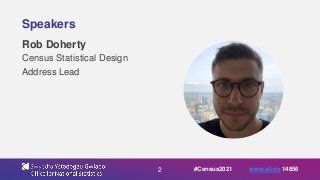
Rob Doherty
Census Statistical Design
Address Lead
#Census2021 www.sli.do 14856
3
Speakers
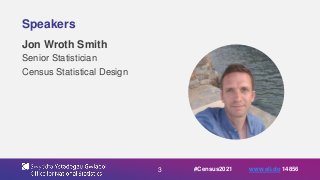
Jon Wroth Smith
Senior Statistician
Census Statistical Design
#Census2021 www.sli.do 14856
4
Why are we running these webinars?
• To explain how the census works in collecting information
and producing great statistics
• To sign-post where more information is available
• To follow on from the material we published in October
• COVID response
• Statistical Design
• Findings from 2019 rehearsal
#Census2021 www.sli.do 14856
5
Aims for this session:
- Explain how ONS has created a high-quality address frame for
Census 2021.
- Indicate what considerations, checks and quality measures were
used in the frame creation.
- Highlight how the frame will continue to be updated and improved
throughout the Census 2021 data collection phase
#Census2021 www.sli.do 14856
6
Overview
• Why addressing is integral to a successful census
• What different addresses we’ve factored into the census
design
• How these have been collected, managed and assured
• What planned continuous activity for addresses ONS has
planned through operations and beyond
#Census2021 www.sli.do 14856
7 #Census2021 www.sli.do 14856
8
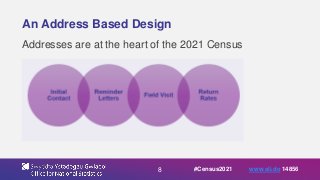
An Address Based Design
Addresses are at the heart of the 2021 Census
#Census2021 www.sli.do 14856
9
Addressing Overview – a few statistics
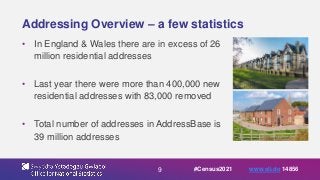
• In England & Wales there are in excess of 26
million residential addresses
• Last year there were more than 400,000 new
residential addresses with 83,000 removed
• Total number of addresses in AddressBase is
39 million addresses
#Census2021 www.sli.do 14856
10
A few key definitions
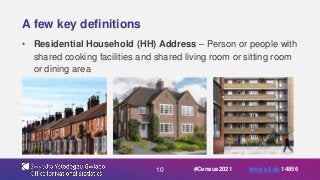
• Residential Household (HH) Address – Person or people with
shared cooking facilities and shared living room or sitting room
or dining area
#Census2021 www.sli.do 14856
11
A few key definitions
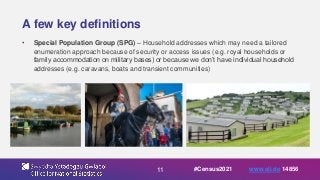
• Special Population Group (SPG) – Household addresses which may need a tailored
enumeration approach because of security or access issues (e.g. royal households or
family accommodation on military bases) or because we don’t have individual household
addresses (e.g. caravans, boats and transient communities)
#Census2021 www.sli.do 14856
12
A few key definitions
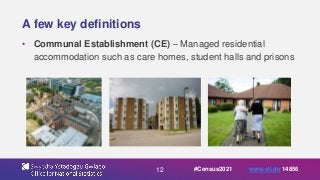
• Communal Establishment (CE) – Managed residential
accommodation such as care homes, student halls and prisons
#Census2021 www.sli.do 14856
13
Address Frame
#Census2021 www.sli.do 14856
14
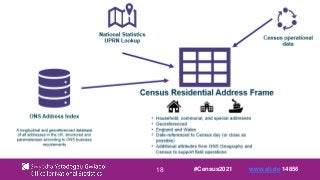
Overview of the address frame
• Address frame is the list of HH, SPG and CE which ONS use to
make initial contact in 2021 Census
• AddressBase is the basis for the frame supplemented by
administrative sources
• Quality measures for the frame have been defined as no more
than 0.75% under coverage and no more than 1% over
coverage
#Census2021 www.sli.do 14856
15
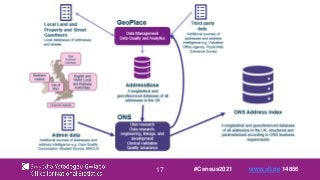
Address Frame
AddressBase Maintenance
#Census2021 www.sli.do 14856
16
Address Frame
AddressBase Extracts Used
• Initial extract based on July 2020 snapshot (epoch) of AddressBase for
main print run of contact letters
• Second extract later, based on November 2020 snapshot of AddressBase
for a second print run of contact letters
• New addresses; invalid addresses & changes in address type from later
updates of AddressBase will be used to update the Address Frame and
field operation, before and during census
#Census2021 www.sli.do 14856
17 #Census2021 www.sli.do 14856
18 #Census2021 www.sli.do 14856
19
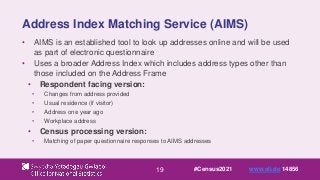
Address Index Matching Service (AIMS)
• AIMS is an established tool to look up addresses online and will be used
as part of electronic questionnaire
• Uses a broader Address Index which includes address types other than
those included on the Address Frame
• Respondent facing version:
• Changes from address provided
• Usual residence (if visitor)
• Address one year ago
• Workplace address
• Census processing version:
• Matching of paper questionnaire responses to AIMS addresses
#Census2021 www.sli.do 14856
20
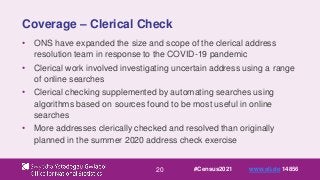
Coverage – Clerical Check
• ONS have expanded the size and scope of the clerical address
resolution team in response to the COVID-19 pandemic
• Clerical work involved investigating uncertain address using a range
of online searches
• Clerical checking supplemented by automating searches using
algorithms based on sources found to be most useful in online
searches
• More addresses clerically checked and resolved than originally
planned in the summer 2020 address check exercise
#Census2021 www.sli.do 14856
21
Coverage – Clerical Check
• Desk-Based clerical resolution steps
1. Data ‘buckets’ of uncertain address to clerical team
2. Put address into the AIMS tool (ONS Address Index Matching
Service)
3. Check for Council Tax
4. Check Business Rates
5. Check Google Earth/ Maps
6. Google the address
#Census2021 www.sli.do 14856
22
Coverage – Data Linkage
• Data Linkage automated resolution steps
1. Clean and standardise ‘uncertain addresses’ extract (500k) from
Epoch & the admin data
2. Use matching algorithm to link extract to Council Tax, VOA and Land
Registry Prices Paid data
3. Flag linked records as real residential addresses
4. Reduces number of uncertain records to be checked manually
5. Include flagged records in the frame with confidence
#Census2021 www.sli.do 14856
23
Supplementing AddressBase
• ONS use a range of administrative and commercial data
sources to supplement AddressBase for CEs and SPGs
• Prisons (Ministry of Justice)
• Armed Forces (Ministry of Defence / US Armed Forces)
• Student Halls (Cushman & Wakefield)
• Care Homes (Care Quality Commission and Care Inspectorate
Wales)
• Boarding Schools (Edubase)
• Traveller Sites (Ministry of Communities and Local Government)
#Census2021 www.sli.do 14856
24
Supplementing AddressBase
• Clerical resource has most recently been used to supplement
student halls with room level address information (where this is not
provided on LLPG) – approximately 2,200 addresses
• c.400,000 unit level addresses obtained.
• Clerical checking has also been carried out to validate other CE
types on AddressBase such as religious establishments and staff
accommodation - approximately 2,800 addresses
#Census2021 www.sli.do 14856
Continual improvement
25 #Census2021 www.sli.do 14856
26
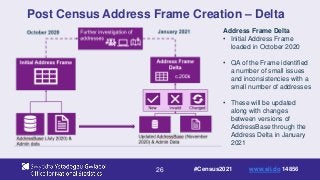
Post Census Address Frame Creation – Delta
Address Frame Delta
• Initial Address Frame
loaded in October 2020
• QA of the Frame identified
a number of small issues
and inconsistencies with a
small number of addresses
• These will be updated
along with changes
between versions of
AddressBase through the
Address Delta in January
2021
#Census2021 www.sli.do 14856
27
Address Frame
Undercount on frame
• HH / SPG / CE can request an access code/questionnaire during census
• Census Coverage Survey (CCS), sampled independently from Census.
designed to identify any missed addresses to be accounted for in
coverage estimation
#Census2021 www.sli.do 14856
28
Address Frame
Overcount on frame
• Addresses which no longer exist will be undeliverable
• ONS will use admin data (such as Council Tax) in the process of
evaluating where addresses have not returned, including those
which are flagged as potentially vacant
• Field officers will identify addresses as vacant or derelict during
visits to non-responding households
#Census2021 www.sli.do 14856
29
Post Census Address Frame Creation – Collection
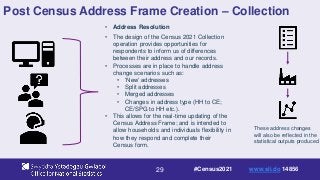
• Address Resolution
• The design of the Census 2021 Collection
operation provides opportunities for
respondents to inform us of differences
between their address and our records.
• Processes are in place to handle address
change scenarios such as:
• ‘New’ addresses
• Split addresses
• Merged addresses
• Changes in address type (HH to CE;
CE/SPG to HH etc.).
• This allows for the real-time updating of the
Census Address Frame; and is intended to
allow households and individuals flexibility in
how they respond and complete their
Census form.
These address changes
will also be reflected in the
statistical outputs produced
#Census2021 www.sli.do 14856
30
Summary
• A high quality census needs a high quality address frame
• The Address Frame for Census 2021 has been created using high quality
and timely data sources
• The Address Frame and Field Operation for Census 2021 has been
designed to reflect the complexities and challenges of addressing varied
accommodation types
• Census collection has been designed to flexibly respond to these
complexities
• Improvement of the Address Frame will continue throughout preparations
and collection for the Census, and beyond including through CCS.
#Census2021 www.sli.do 14856
31
Addressing for Census
2021
Any questions?
Visit www.sli.do and enter code 14856
Please complete our evaluation survey (we’ll email you a link) and let us know how we did.
If you have any questions email us on SDR.stakeholder.engagement@ons.gov.uk.
Want to learn more about the Census 2021 Statistical Design? Visit our website to find out
more about our other webinars.
#Census2021

Addressing for Census 2021

  • 1.
    1 Addressing for Census 2021 Welcome Pleaseturn off your camera and mute your microphone Questions? Visit www.sli.do and enter code 14856 to ask your questions Technology problems? Email sdr.stakeholder.engagement@ons.gov.uk Starting at 2:15pm #Census2021
  • 2.
    2 Speakers Rob Doherty Census StatisticalDesign Address Lead #Census2021 www.sli.do 14856
  • 3.
    3 Speakers Jon Wroth Smith SeniorStatistician Census Statistical Design #Census2021 www.sli.do 14856
  • 4.
    4 Why are werunning these webinars? • To explain how the census works in collecting information and producing great statistics • To sign-post where more information is available • To follow on from the material we published in October • COVID response • Statistical Design • Findings from 2019 rehearsal #Census2021 www.sli.do 14856
  • 5.
    5 Aims for thissession: - Explain how ONS has created a high-quality address frame for Census 2021. - Indicate what considerations, checks and quality measures were used in the frame creation. - Highlight how the frame will continue to be updated and improved throughout the Census 2021 data collection phase #Census2021 www.sli.do 14856
  • 6.
    6 Overview • Why addressingis integral to a successful census • What different addresses we’ve factored into the census design • How these have been collected, managed and assured • What planned continuous activity for addresses ONS has planned through operations and beyond #Census2021 www.sli.do 14856
  • 7.
  • 8.
    8 An Address BasedDesign Addresses are at the heart of the 2021 Census #Census2021 www.sli.do 14856
  • 9.
    9 Addressing Overview –a few statistics • In England & Wales there are in excess of 26 million residential addresses • Last year there were more than 400,000 new residential addresses with 83,000 removed • Total number of addresses in AddressBase is 39 million addresses #Census2021 www.sli.do 14856
  • 10.
    10 A few keydefinitions • Residential Household (HH) Address – Person or people with shared cooking facilities and shared living room or sitting room or dining area #Census2021 www.sli.do 14856
  • 11.
    11 A few keydefinitions • Special Population Group (SPG) – Household addresses which may need a tailored enumeration approach because of security or access issues (e.g. royal households or family accommodation on military bases) or because we don’t have individual household addresses (e.g. caravans, boats and transient communities) #Census2021 www.sli.do 14856
  • 12.
    12 A few keydefinitions • Communal Establishment (CE) – Managed residential accommodation such as care homes, student halls and prisons #Census2021 www.sli.do 14856
  • 13.
  • 14.
    14 Overview of theaddress frame • Address frame is the list of HH, SPG and CE which ONS use to make initial contact in 2021 Census • AddressBase is the basis for the frame supplemented by administrative sources • Quality measures for the frame have been defined as no more than 0.75% under coverage and no more than 1% over coverage #Census2021 www.sli.do 14856
  • 15.
  • 16.
    16 Address Frame AddressBase ExtractsUsed • Initial extract based on July 2020 snapshot (epoch) of AddressBase for main print run of contact letters • Second extract later, based on November 2020 snapshot of AddressBase for a second print run of contact letters • New addresses; invalid addresses & changes in address type from later updates of AddressBase will be used to update the Address Frame and field operation, before and during census #Census2021 www.sli.do 14856
  • 17.
  • 18.
  • 19.
    19 Address Index MatchingService (AIMS) • AIMS is an established tool to look up addresses online and will be used as part of electronic questionnaire • Uses a broader Address Index which includes address types other than those included on the Address Frame • Respondent facing version: • Changes from address provided • Usual residence (if visitor) • Address one year ago • Workplace address • Census processing version: • Matching of paper questionnaire responses to AIMS addresses #Census2021 www.sli.do 14856
  • 20.
    20 Coverage – ClericalCheck • ONS have expanded the size and scope of the clerical address resolution team in response to the COVID-19 pandemic • Clerical work involved investigating uncertain address using a range of online searches • Clerical checking supplemented by automating searches using algorithms based on sources found to be most useful in online searches • More addresses clerically checked and resolved than originally planned in the summer 2020 address check exercise #Census2021 www.sli.do 14856
  • 21.
    21 Coverage – ClericalCheck • Desk-Based clerical resolution steps 1. Data ‘buckets’ of uncertain address to clerical team 2. Put address into the AIMS tool (ONS Address Index Matching Service) 3. Check for Council Tax 4. Check Business Rates 5. Check Google Earth/ Maps 6. Google the address #Census2021 www.sli.do 14856
  • 22.
    22 Coverage – DataLinkage • Data Linkage automated resolution steps 1. Clean and standardise ‘uncertain addresses’ extract (500k) from Epoch & the admin data 2. Use matching algorithm to link extract to Council Tax, VOA and Land Registry Prices Paid data 3. Flag linked records as real residential addresses 4. Reduces number of uncertain records to be checked manually 5. Include flagged records in the frame with confidence #Census2021 www.sli.do 14856
  • 23.
    23 Supplementing AddressBase • ONSuse a range of administrative and commercial data sources to supplement AddressBase for CEs and SPGs • Prisons (Ministry of Justice) • Armed Forces (Ministry of Defence / US Armed Forces) • Student Halls (Cushman & Wakefield) • Care Homes (Care Quality Commission and Care Inspectorate Wales) • Boarding Schools (Edubase) • Traveller Sites (Ministry of Communities and Local Government) #Census2021 www.sli.do 14856
  • 24.
    24 Supplementing AddressBase • Clericalresource has most recently been used to supplement student halls with room level address information (where this is not provided on LLPG) – approximately 2,200 addresses • c.400,000 unit level addresses obtained. • Clerical checking has also been carried out to validate other CE types on AddressBase such as religious establishments and staff accommodation - approximately 2,800 addresses #Census2021 www.sli.do 14856
  • 25.
  • 26.
    26 Post Census AddressFrame Creation – Delta Address Frame Delta • Initial Address Frame loaded in October 2020 • QA of the Frame identified a number of small issues and inconsistencies with a small number of addresses • These will be updated along with changes between versions of AddressBase through the Address Delta in January 2021 #Census2021 www.sli.do 14856
  • 27.
    27 Address Frame Undercount onframe • HH / SPG / CE can request an access code/questionnaire during census • Census Coverage Survey (CCS), sampled independently from Census. designed to identify any missed addresses to be accounted for in coverage estimation #Census2021 www.sli.do 14856
  • 28.
    28 Address Frame Overcount onframe • Addresses which no longer exist will be undeliverable • ONS will use admin data (such as Council Tax) in the process of evaluating where addresses have not returned, including those which are flagged as potentially vacant • Field officers will identify addresses as vacant or derelict during visits to non-responding households #Census2021 www.sli.do 14856
  • 29.
    29 Post Census AddressFrame Creation – Collection • Address Resolution • The design of the Census 2021 Collection operation provides opportunities for respondents to inform us of differences between their address and our records. • Processes are in place to handle address change scenarios such as: • ‘New’ addresses • Split addresses • Merged addresses • Changes in address type (HH to CE; CE/SPG to HH etc.). • This allows for the real-time updating of the Census Address Frame; and is intended to allow households and individuals flexibility in how they respond and complete their Census form. These address changes will also be reflected in the statistical outputs produced #Census2021 www.sli.do 14856
  • 30.
    30 Summary • A highquality census needs a high quality address frame • The Address Frame for Census 2021 has been created using high quality and timely data sources • The Address Frame and Field Operation for Census 2021 has been designed to reflect the complexities and challenges of addressing varied accommodation types • Census collection has been designed to flexibly respond to these complexities • Improvement of the Address Frame will continue throughout preparations and collection for the Census, and beyond including through CCS. #Census2021 www.sli.do 14856
  • 31.
    31 Addressing for Census 2021 Anyquestions? Visit www.sli.do and enter code 14856 Please complete our evaluation survey (we’ll email you a link) and let us know how we did. If you have any questions email us on SDR.stakeholder.engagement@ons.gov.uk. Want to learn more about the Census 2021 Statistical Design? Visit our website to find out more about our other webinars. #Census2021