1
Elements, Atoms & Ions
Chapter 4
2
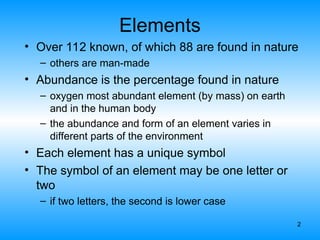
Elements
• Over 112 known, of which 88 are found in nature
– others are man-made
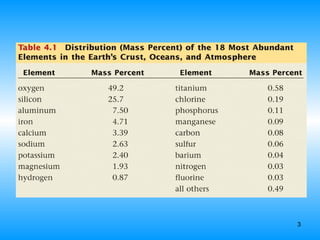
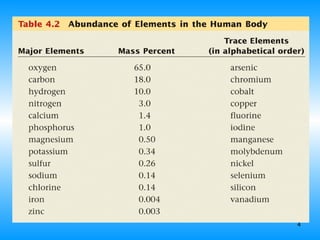
• Abundance is the percentage found in nature
– oxygen most abundant element (by mass) on earth
and in the human body
– the abundance and form of an element varies in
different parts of the environment
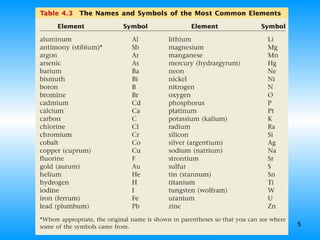
• Each element has a unique symbol
• The symbol of an element may be one letter or
two
– if two letters, the second is lower case
3
4
5
6
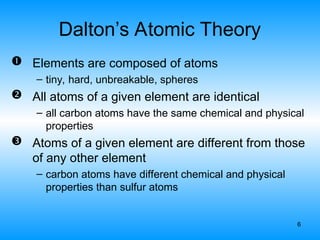
Dalton’s Atomic Theory
 Elements are composed of atoms
– tiny, hard, unbreakable, spheres
 All atoms of a given element are identical
– all carbon atoms have the same chemical and physical
properties
 Atoms of a given element are different from those
of any other element
– carbon atoms have different chemical and physical
properties than sulfur atoms
7
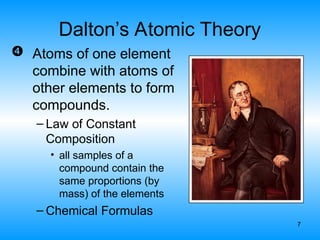
Dalton’s Atomic Theory
 Atoms of one element
combine with atoms of
other elements to form
compounds.
– Law of Constant
Composition
• all samples of a
compound contain the
same proportions (by
mass) of the elements
– Chemical Formulas
8
Dalton’s Atomic Theory
 Atoms are indivisible in a chemical process.
– all atoms present at beginning are present at
the end
– atoms are not created or destroyed, just
rearranged
– atoms of one element cannot change into
atoms of another element
• cannot turn Lead into Gold by a chemical reaction
9
Formulas Describe Compounds
• a compound is a distinct substance that is
composed of atoms of two or more elements
• describe the compound by describing the number
and type of each atom in the simplest unit of the
compound
– molecules or ions
• each element represented by its letter symbol
• the number of atoms of each element is written to
the right of the element as a subscript
– if there is only one atom, the 1 subscript is not written
• polyatomic groups are placed in parentheses
– if more than one
10
Are Atoms Really Unbreakable?
• J.J. Thomson investigated a beam called a
cathode ray
• he determined that the ray was made of tiny
negatively charged particles we call electrons
• his measurements led him to conclude that these
electrons were smaller than a hydrogen atom
• if electrons are smaller than atoms, they must be
pieces of atoms
• if atoms have pieces, they must be breakable
• Thomson also found that atoms of different
elements all produced these same electrons
11
The Electron
• Tiny, negatively charged particle
• Very light compared to mass of atom
– 1/1836th
the mass of a H atom
• Move very rapidly within the atom
12
Thomson’s Plum Pudding Model
 Atom breakable!!
 Atom has structure
 Electrons suspended in a positively charged electric
field
– must have positive charge to balance negative
charge of electrons and make the atom neutral
 mass of atom due to electrons
 atom mostly “empty” space
– compared size of electron to size of atom
13
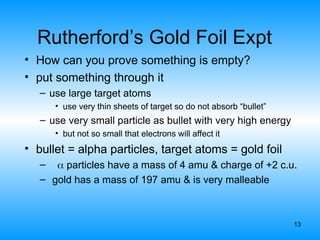
Rutherford’s Gold Foil Expt
• How can you prove something is empty?
• put something through it
– use large target atoms
• use very thin sheets of target so do not absorb “bullet”
– use very small particle as bullet with very high energy
• but not so small that electrons will affect it
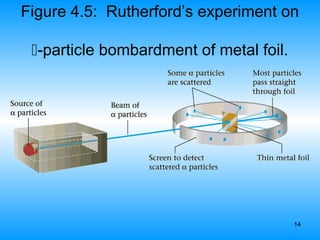
• bullet = alpha particles, target atoms = gold foil
–  particles have a mass of 4 amu & charge of +2 c.u.
– gold has a mass of 197 amu & is very malleable
14
Figure 4.5: Rutherford’s experiment on
-particle bombardment of metal foil.
15
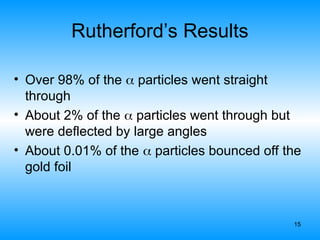
Rutherford’s Results
• Over 98% of the  particles went straight
through
• About 2% of the  particles went through but
were deflected by large angles
• About 0.01% of the  particles bounced off the
gold foil
16
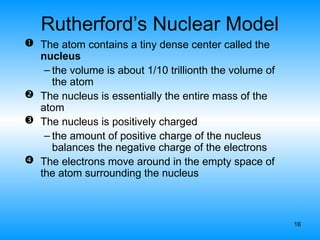
Rutherford’s Nuclear Model
 The atom contains a tiny dense center called the
nucleus
– the volume is about 1/10 trillionth the volume of
the atom
 The nucleus is essentially the entire mass of the
atom
 The nucleus is positively charged
– the amount of positive charge of the nucleus
balances the negative charge of the electrons
 The electrons move around in the empty space of
the atom surrounding the nucleus
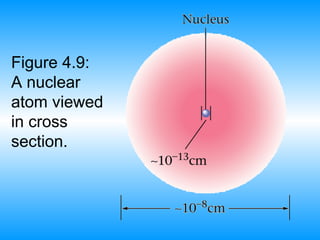
Figure 4.9:
A nuclear
atom viewed
in cross
section.
18
Structure of the Nucleus
• The nucleus was found to be composed of two
kinds of particles
• Some of these particles are called protons
– charge = +1
– mass is about the same as a hydrogen atom
• Since protons and electrons have the same
amount of charge, for the atom to be neutral there
must be equal numbers of protons and electrons
• The other particle is called a neutron
– has no charge
– has a mass slightly more than a proton
19
The Modern Atom
• We know atoms are composed of three main
pieces - protons, neutrons and electrons
• The nucleus contains protons and neutrons
• The nucleus is only about 10-13
cm in diameter
• The electrons move outside the nucleus with
an average distance of about 10-8
cm
– therefore the radius of the atom is about 105
times
larger than the radius of the nucleus
20
Isotopes
• All atoms of an element have the same number of protons
• The number of protons in an atom of a given element is
the same as the atomic number
– found on the Periodic Table
• Atoms of an element with different numbers of neutrons
are called isotopes
• All isotopes of an element are chemically identical
– undergo the exact same chemical reactions
• Isotopes of an element have different masses
• Isotopes are identified by their mass numbers
– mass number = protons + neutrons
21
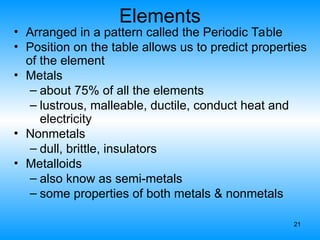
Elements
• Arranged in a pattern called the Periodic Table
• Position on the table allows us to predict properties
of the element
• Metals
– about 75% of all the elements
– lustrous, malleable, ductile, conduct heat and
electricity
• Nonmetals
– dull, brittle, insulators
• Metalloids
– also know as semi-metals
– some properties of both metals & nonmetals
22
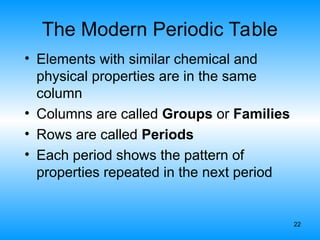
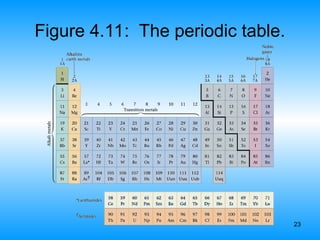
The Modern Periodic Table
• Elements with similar chemical and
physical properties are in the same
column
• Columns are called Groups or Families
• Rows are called Periods
• Each period shows the pattern of
properties repeated in the next period
23
Figure 4.11: The periodic table.
24
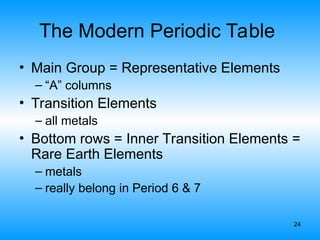
The Modern Periodic Table
• Main Group = Representative Elements
– “A” columns
• Transition Elements
– all metals
• Bottom rows = Inner Transition Elements =
Rare Earth Elements
– metals
– really belong in Period 6 & 7
25
Important Groups
• Group 8 = Noble Gases
• He, Ne, Ar, Kr, Xe, Rn
• all colorless gases at
room temperature
• very non-reactive,
practically inert
• found in nature as a
collection of separate
atoms uncombined with
other atoms
• Noble Metals
• Ag, Au, Pt
• all solids at room
temperature
• least reactive metals
• found in nature
uncombined with
other atoms
26
Important Groups - Halogens
• Group 7A =
Halogens
• very reactive
nonmetals
• react with metals to
form ionic
compounds
• HX all acids
• Fluorine = F2
– pale yellow gas
• Chlorine = Cl2
– pale green gas
• Bromine = Br2
– brown liquid that has lots
of brown vapor over it
– Only other liquid element
at room conditions is the
metal Hg
• Iodine = I2
– lustrous, purple solid
27
Allotropes
• Many solid nonmetallic elements can
exist in different forms with different
physical properties, these are called
allotropes
• the different physical properties arise from
the different arrangements of the atoms in
the solid
• Allotropes of Carbon include
– diamond
– graphite
– buckminsterfullerene
28
Electrical Nature of Matter
• Most common pure substances are very poor
conductors of electricity
– with the exception of metals and graphite
– Water is a very poor electrical conductor
• Some substances dissolve in water to form a solution
that conducts well - these are called electrolytes
• When dissolved in water, electrolyte compounds
break up into component ions
– ions are atoms or groups of atoms that have an electrical
charge
29
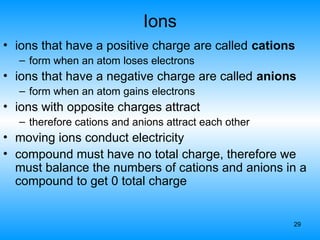
Ions
• ions that have a positive charge are called cations
– form when an atom loses electrons
• ions that have a negative charge are called anions
– form when an atom gains electrons
• ions with opposite charges attract
– therefore cations and anions attract each other
• moving ions conduct electricity
• compound must have no total charge, therefore we
must balance the numbers of cations and anions in a
compound to get 0 total charge
30
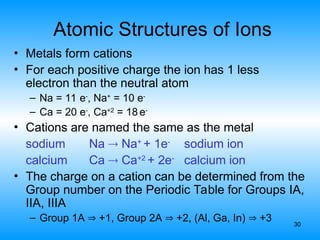
Atomic Structures of Ions
• Metals form cations
• For each positive charge the ion has 1 less
electron than the neutral atom
– Na = 11 e-
, Na+
= 10 e-
– Ca = 20 e-
, Ca+2
= 18 e-
• Cations are named the same as the metal
sodium Na  Na+
+ 1e-
sodium ion
calcium Ca  Ca+2
+ 2e-
calcium ion
• The charge on a cation can be determined from the
Group number on the Periodic Table for Groups IA,
IIA, IIIA
– Group 1A  +1, Group 2A  +2, (Al, Ga, In)  +3
31
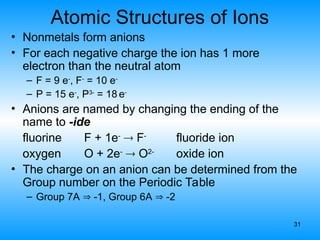
Atomic Structures of Ions
• Nonmetals form anions
• For each negative charge the ion has 1 more
electron than the neutral atom
– F = 9 e-
, F-
= 10 e-
– P = 15 e-
, P3-
= 18 e-
• Anions are named by changing the ending of the
name to -ide
fluorine F + 1e-
 F-
fluoride ion
oxygen O + 2e-
 O2-
oxide ion
• The charge on an anion can be determined from the
Group number on the Periodic Table
– Group 7A  -1, Group 6A  -2

Zumdahl Chapter 4.ppmsmsmsmsmsmsmsmsmsmsms.ppt

  • 1.
    1 Elements, Atoms &Ions Chapter 4
  • 2.
    2 Elements • Over 112known, of which 88 are found in nature – others are man-made • Abundance is the percentage found in nature – oxygen most abundant element (by mass) on earth and in the human body – the abundance and form of an element varies in different parts of the environment • Each element has a unique symbol • The symbol of an element may be one letter or two – if two letters, the second is lower case
  • 3.
  • 4.
  • 5.
  • 6.
    6 Dalton’s Atomic Theory Elements are composed of atoms – tiny, hard, unbreakable, spheres  All atoms of a given element are identical – all carbon atoms have the same chemical and physical properties  Atoms of a given element are different from those of any other element – carbon atoms have different chemical and physical properties than sulfur atoms
  • 7.
    7 Dalton’s Atomic Theory Atoms of one element combine with atoms of other elements to form compounds. – Law of Constant Composition • all samples of a compound contain the same proportions (by mass) of the elements – Chemical Formulas
  • 8.
    8 Dalton’s Atomic Theory Atoms are indivisible in a chemical process. – all atoms present at beginning are present at the end – atoms are not created or destroyed, just rearranged – atoms of one element cannot change into atoms of another element • cannot turn Lead into Gold by a chemical reaction
  • 9.
    9 Formulas Describe Compounds •a compound is a distinct substance that is composed of atoms of two or more elements • describe the compound by describing the number and type of each atom in the simplest unit of the compound – molecules or ions • each element represented by its letter symbol • the number of atoms of each element is written to the right of the element as a subscript – if there is only one atom, the 1 subscript is not written • polyatomic groups are placed in parentheses – if more than one
  • 10.
    10 Are Atoms ReallyUnbreakable? • J.J. Thomson investigated a beam called a cathode ray • he determined that the ray was made of tiny negatively charged particles we call electrons • his measurements led him to conclude that these electrons were smaller than a hydrogen atom • if electrons are smaller than atoms, they must be pieces of atoms • if atoms have pieces, they must be breakable • Thomson also found that atoms of different elements all produced these same electrons
  • 11.
    11 The Electron • Tiny,negatively charged particle • Very light compared to mass of atom – 1/1836th the mass of a H atom • Move very rapidly within the atom
  • 12.
    12 Thomson’s Plum PuddingModel  Atom breakable!!  Atom has structure  Electrons suspended in a positively charged electric field – must have positive charge to balance negative charge of electrons and make the atom neutral  mass of atom due to electrons  atom mostly “empty” space – compared size of electron to size of atom
  • 13.
    13 Rutherford’s Gold FoilExpt • How can you prove something is empty? • put something through it – use large target atoms • use very thin sheets of target so do not absorb “bullet” – use very small particle as bullet with very high energy • but not so small that electrons will affect it • bullet = alpha particles, target atoms = gold foil –  particles have a mass of 4 amu & charge of +2 c.u. – gold has a mass of 197 amu & is very malleable
  • 14.
    14 Figure 4.5: Rutherford’sexperiment on -particle bombardment of metal foil.
  • 15.
    15 Rutherford’s Results • Over98% of the  particles went straight through • About 2% of the  particles went through but were deflected by large angles • About 0.01% of the  particles bounced off the gold foil
  • 16.
    16 Rutherford’s Nuclear Model The atom contains a tiny dense center called the nucleus – the volume is about 1/10 trillionth the volume of the atom  The nucleus is essentially the entire mass of the atom  The nucleus is positively charged – the amount of positive charge of the nucleus balances the negative charge of the electrons  The electrons move around in the empty space of the atom surrounding the nucleus
  • 17.
    Figure 4.9: A nuclear atomviewed in cross section.
  • 18.
    18 Structure of theNucleus • The nucleus was found to be composed of two kinds of particles • Some of these particles are called protons – charge = +1 – mass is about the same as a hydrogen atom • Since protons and electrons have the same amount of charge, for the atom to be neutral there must be equal numbers of protons and electrons • The other particle is called a neutron – has no charge – has a mass slightly more than a proton
  • 19.
    19 The Modern Atom •We know atoms are composed of three main pieces - protons, neutrons and electrons • The nucleus contains protons and neutrons • The nucleus is only about 10-13 cm in diameter • The electrons move outside the nucleus with an average distance of about 10-8 cm – therefore the radius of the atom is about 105 times larger than the radius of the nucleus
  • 20.
    20 Isotopes • All atomsof an element have the same number of protons • The number of protons in an atom of a given element is the same as the atomic number – found on the Periodic Table • Atoms of an element with different numbers of neutrons are called isotopes • All isotopes of an element are chemically identical – undergo the exact same chemical reactions • Isotopes of an element have different masses • Isotopes are identified by their mass numbers – mass number = protons + neutrons
  • 21.
    21 Elements • Arranged ina pattern called the Periodic Table • Position on the table allows us to predict properties of the element • Metals – about 75% of all the elements – lustrous, malleable, ductile, conduct heat and electricity • Nonmetals – dull, brittle, insulators • Metalloids – also know as semi-metals – some properties of both metals & nonmetals
  • 22.
    22 The Modern PeriodicTable • Elements with similar chemical and physical properties are in the same column • Columns are called Groups or Families • Rows are called Periods • Each period shows the pattern of properties repeated in the next period
  • 23.
    23 Figure 4.11: Theperiodic table.
  • 24.
    24 The Modern PeriodicTable • Main Group = Representative Elements – “A” columns • Transition Elements – all metals • Bottom rows = Inner Transition Elements = Rare Earth Elements – metals – really belong in Period 6 & 7
  • 25.
    25 Important Groups • Group8 = Noble Gases • He, Ne, Ar, Kr, Xe, Rn • all colorless gases at room temperature • very non-reactive, practically inert • found in nature as a collection of separate atoms uncombined with other atoms • Noble Metals • Ag, Au, Pt • all solids at room temperature • least reactive metals • found in nature uncombined with other atoms
  • 26.
    26 Important Groups -Halogens • Group 7A = Halogens • very reactive nonmetals • react with metals to form ionic compounds • HX all acids • Fluorine = F2 – pale yellow gas • Chlorine = Cl2 – pale green gas • Bromine = Br2 – brown liquid that has lots of brown vapor over it – Only other liquid element at room conditions is the metal Hg • Iodine = I2 – lustrous, purple solid
  • 27.
    27 Allotropes • Many solidnonmetallic elements can exist in different forms with different physical properties, these are called allotropes • the different physical properties arise from the different arrangements of the atoms in the solid • Allotropes of Carbon include – diamond – graphite – buckminsterfullerene
  • 28.
    28 Electrical Nature ofMatter • Most common pure substances are very poor conductors of electricity – with the exception of metals and graphite – Water is a very poor electrical conductor • Some substances dissolve in water to form a solution that conducts well - these are called electrolytes • When dissolved in water, electrolyte compounds break up into component ions – ions are atoms or groups of atoms that have an electrical charge
  • 29.
    29 Ions • ions thathave a positive charge are called cations – form when an atom loses electrons • ions that have a negative charge are called anions – form when an atom gains electrons • ions with opposite charges attract – therefore cations and anions attract each other • moving ions conduct electricity • compound must have no total charge, therefore we must balance the numbers of cations and anions in a compound to get 0 total charge
  • 30.
    30 Atomic Structures ofIons • Metals form cations • For each positive charge the ion has 1 less electron than the neutral atom – Na = 11 e- , Na+ = 10 e- – Ca = 20 e- , Ca+2 = 18 e- • Cations are named the same as the metal sodium Na  Na+ + 1e- sodium ion calcium Ca  Ca+2 + 2e- calcium ion • The charge on a cation can be determined from the Group number on the Periodic Table for Groups IA, IIA, IIIA – Group 1A  +1, Group 2A  +2, (Al, Ga, In)  +3
  • 31.
    31 Atomic Structures ofIons • Nonmetals form anions • For each negative charge the ion has 1 more electron than the neutral atom – F = 9 e- , F- = 10 e- – P = 15 e- , P3- = 18 e- • Anions are named by changing the ending of the name to -ide fluorine F + 1e-  F- fluoride ion oxygen O + 2e-  O2- oxide ion • The charge on an anion can be determined from the Group number on the Periodic Table – Group 7A  -1, Group 6A  -2