Your Journey into the Serverless World
Introduction to Serverless
bit.ly/faas-tutorial
https://learn.openshift.com/serverless
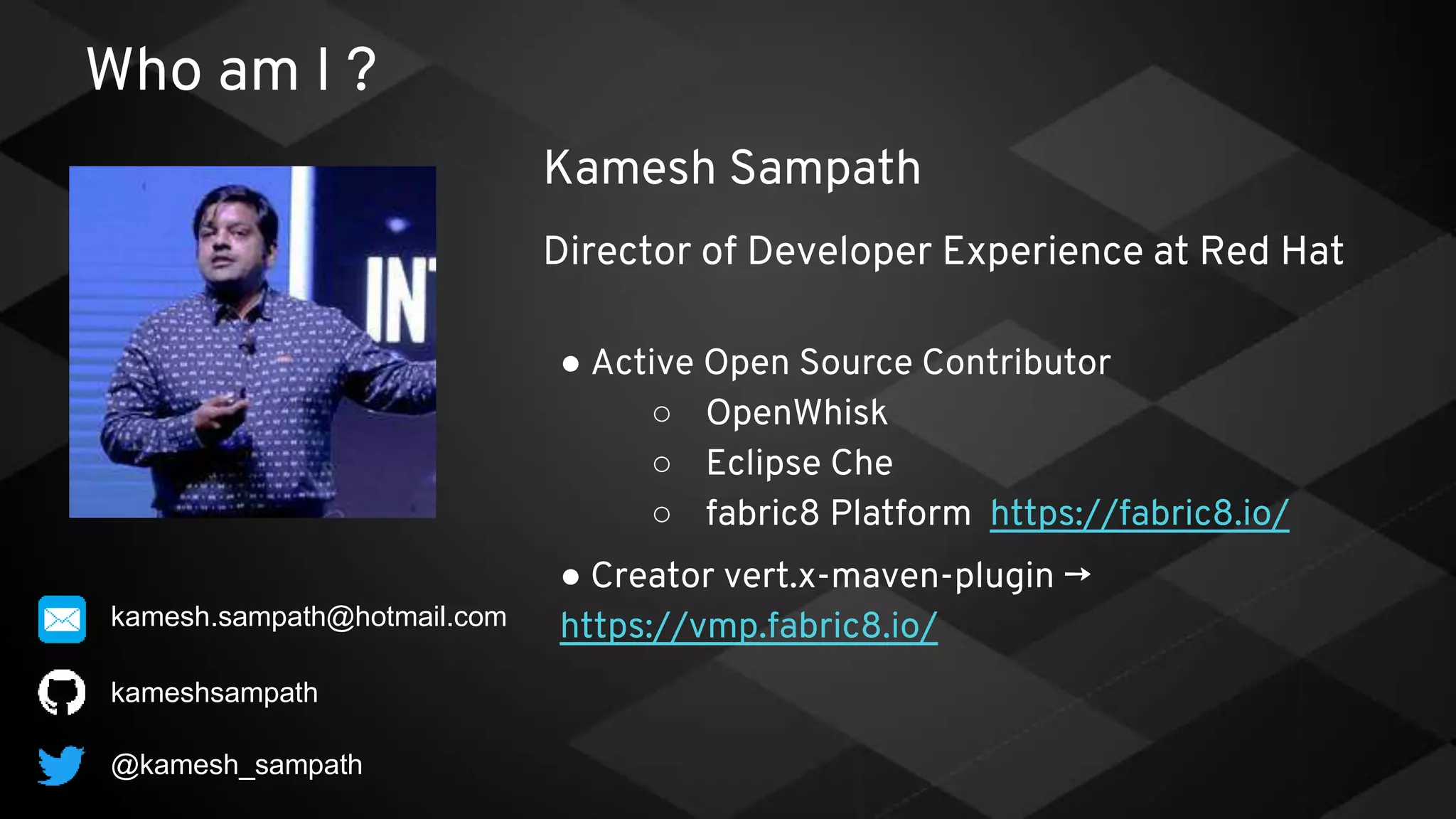
Who am I ?
● Active Open Source Contributor
○ OpenWhisk
○ Eclipse Che
○ fabric8 Platform https://fabric8.io/
● Creator vert.x-maven-plugin →
https://vmp.fabric8.io/
kameshsampath
Kamesh Sampath
Director of Developer Experience at Red Hat
@kamesh_sampath
kamesh.sampath@hotmail.com
What is Serverless ?
Serverless computing refers to the concept of
building and running applications that do not require
server management. It describes a finer-grained
deployment model where applications, bundled as
one or more functions, are uploaded to a platform and
then executed, scaled, and billed in response to the
exact demand needed at the moment.
https://www.cncf.io/blog/2018/02/14/cncf-takes-first-step-towards-serverless-computing
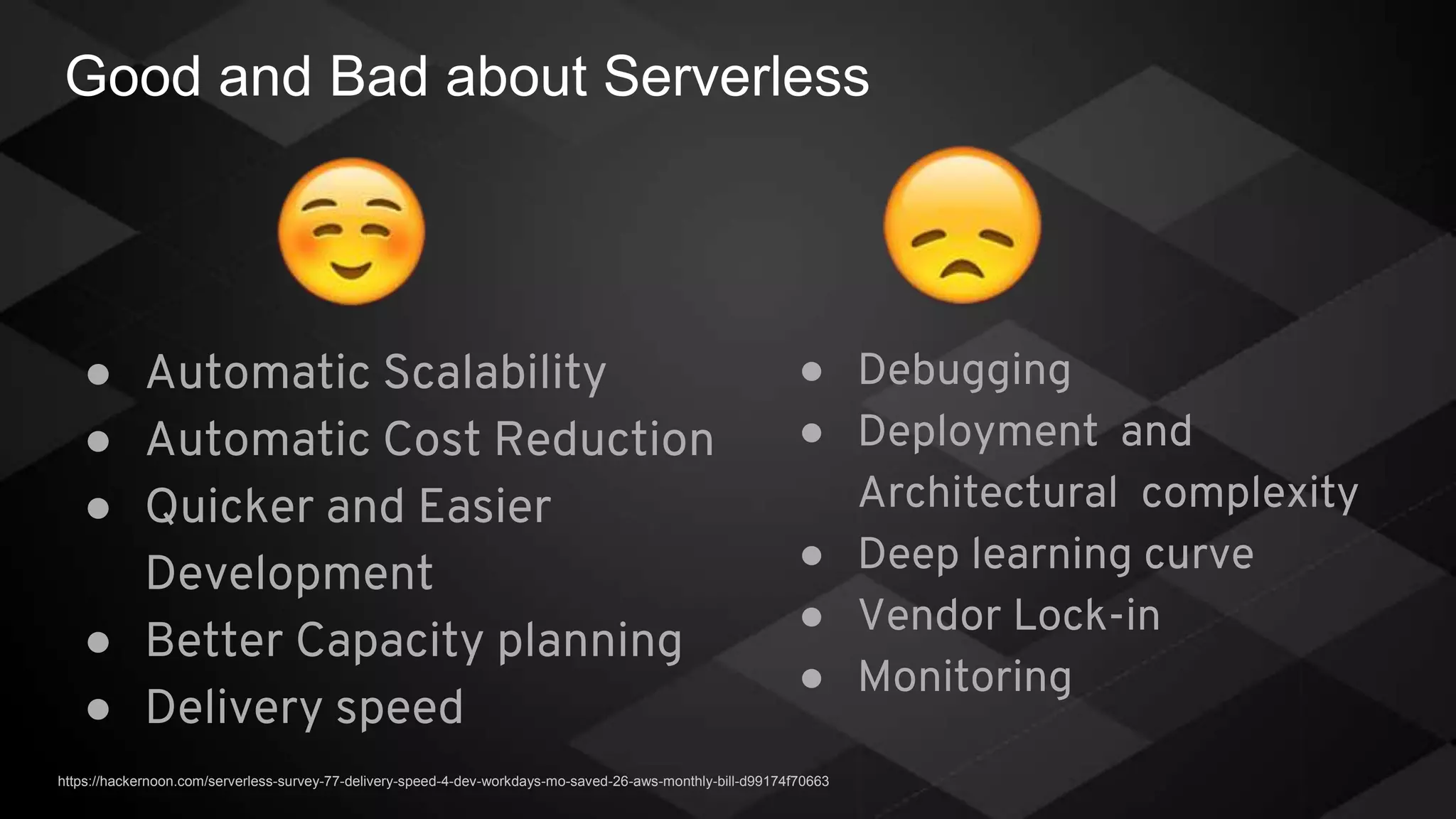
Good and Bad about Serverless
● Automatic Scalability
● Automatic Cost Reduction
● Quicker and Easier
Development
● Better Capacity planning
● Delivery speed
● Debugging
● Deployment and
Architectural complexity
● Deep learning curve
● Vendor Lock-in
● Monitoring
https://hackernoon.com/serverless-survey-77-delivery-speed-4-dev-workdays-mo-saved-26-aws-monthly-bill-d99174f70663
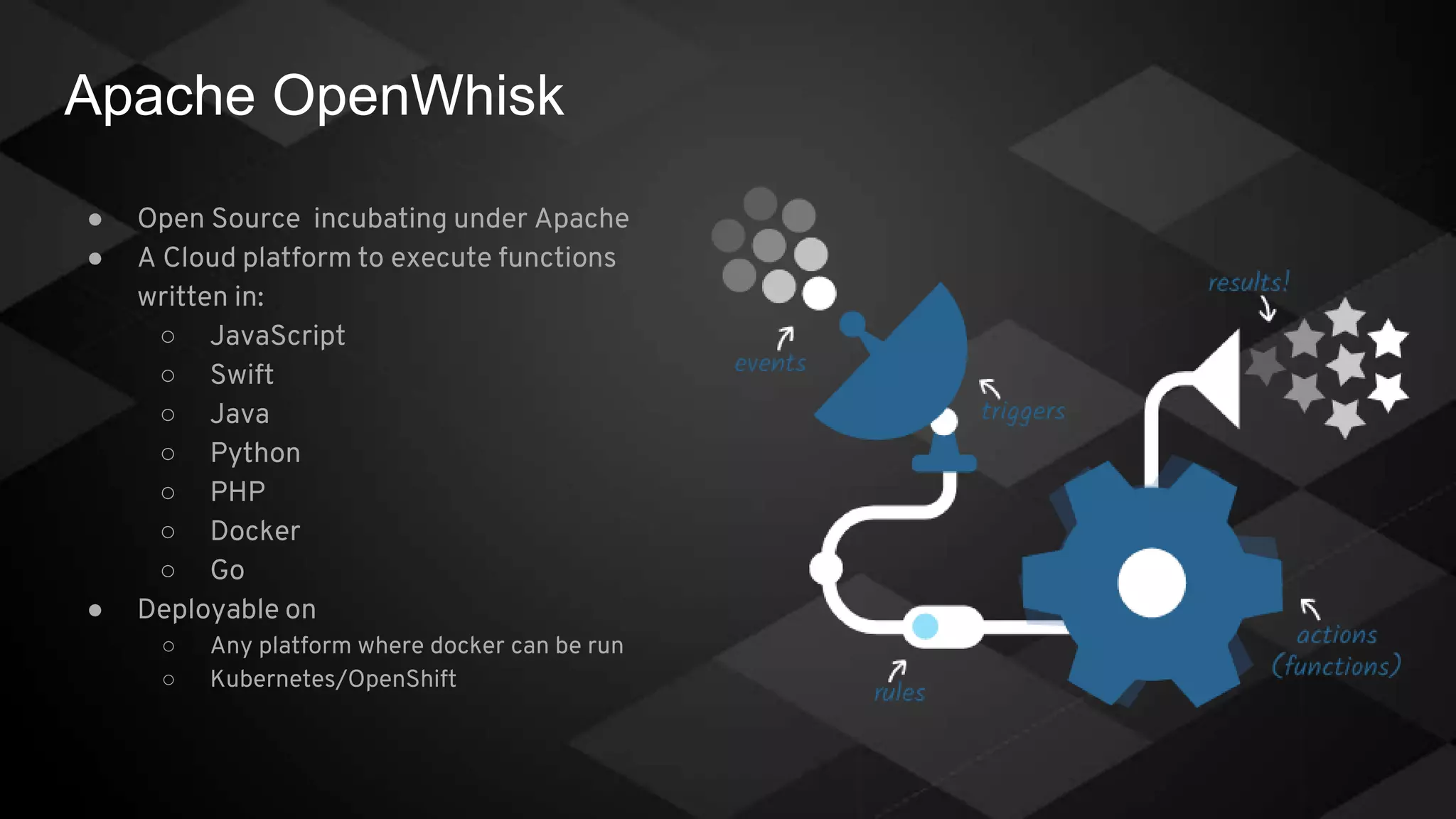
Apache OpenWhisk
● Open Source incubating under Apache
● A Cloud platform to execute functions
written in:
○ JavaScript
○ Swift
○ Java
○ Python
○ PHP
○ Docker
○ Go
● Deployable on
○ Any platform where docker can be run
○ Kubernetes/OpenShift
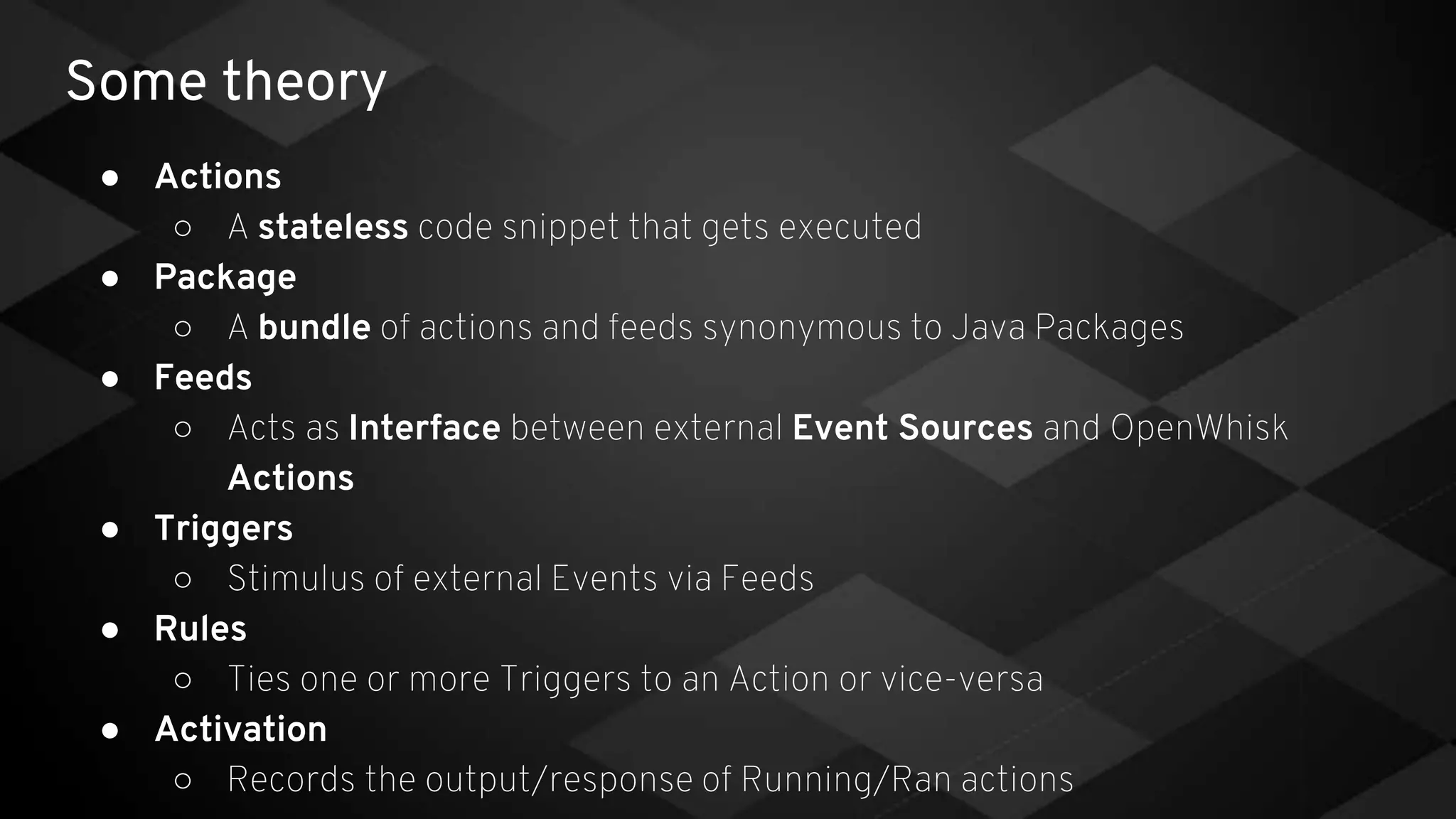
Some theory
● Actions
○ A stateless code snippet that gets executed
● Package
○ A bundle of actions and feeds synonymous to Java Packages
● Feeds
○ Acts as Interface between external Event Sources and OpenWhisk
Actions
● Triggers
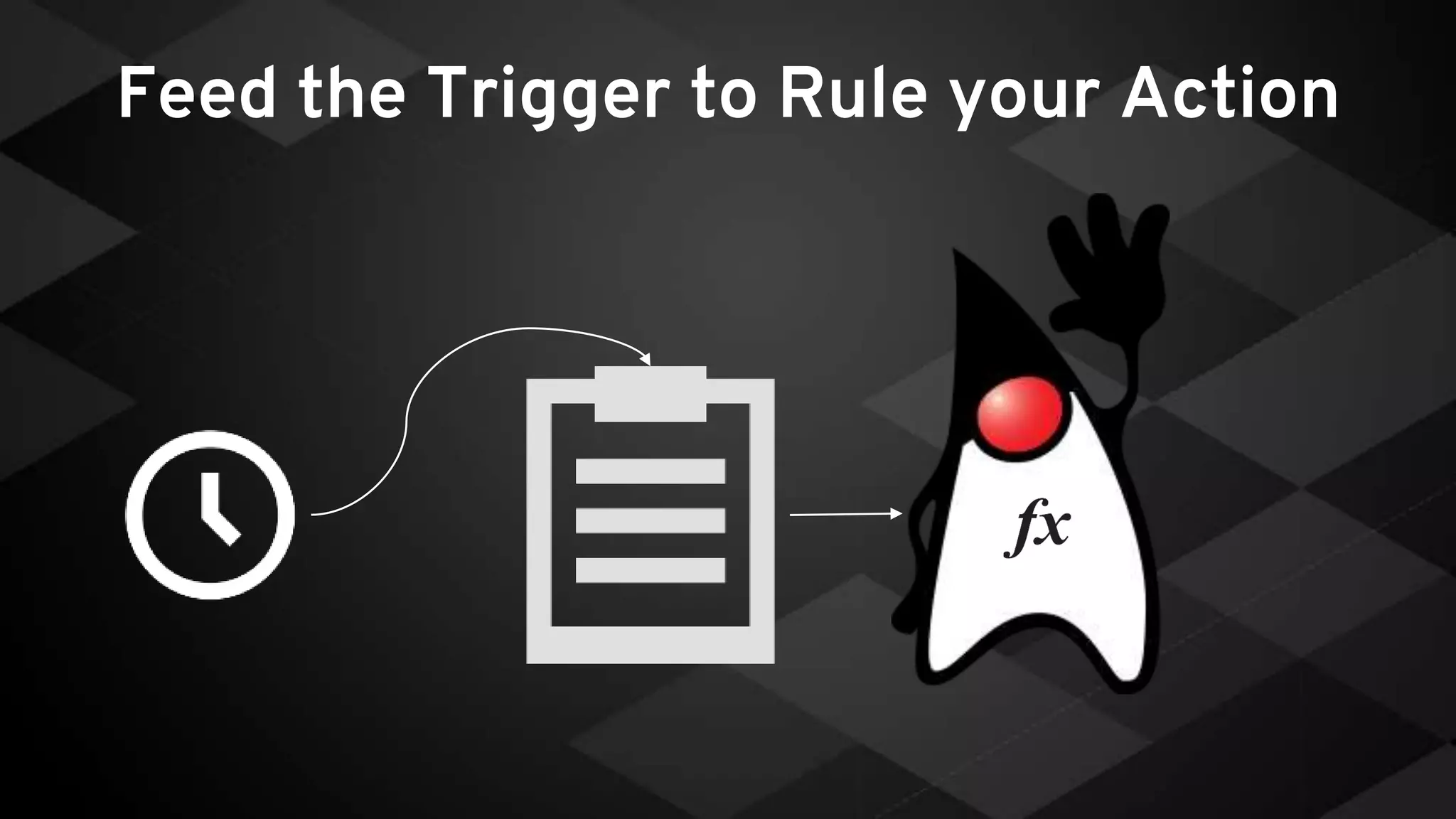
○ Stimulus of external Events via Feeds
● Rules
○ Ties one or more Triggers to an Action or vice-versa
● Activation
○ Records the output/response of Running/Ran actions
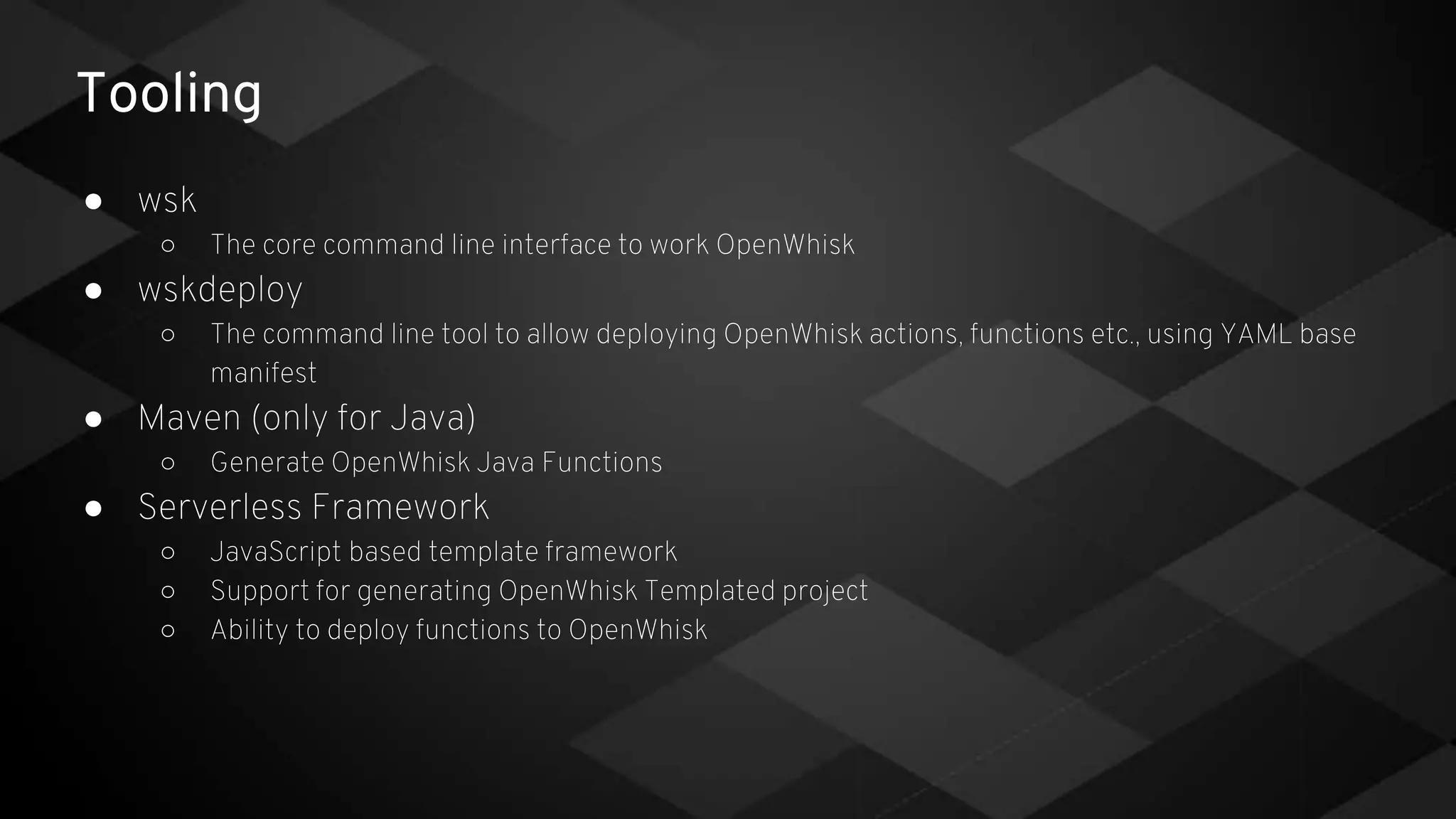
Tooling
● wsk
○ The core command line interface to work OpenWhisk
● wskdeploy
○ The command line tool to allow deploying OpenWhisk actions, functions etc., using YAML base
manifest
● Maven (only for Java)
○ Generate OpenWhisk Java Functions
● Serverless Framework
○ JavaScript based template framework
○ Support for generating OpenWhisk Templated project
○ Ability to deploy functions to OpenWhisk
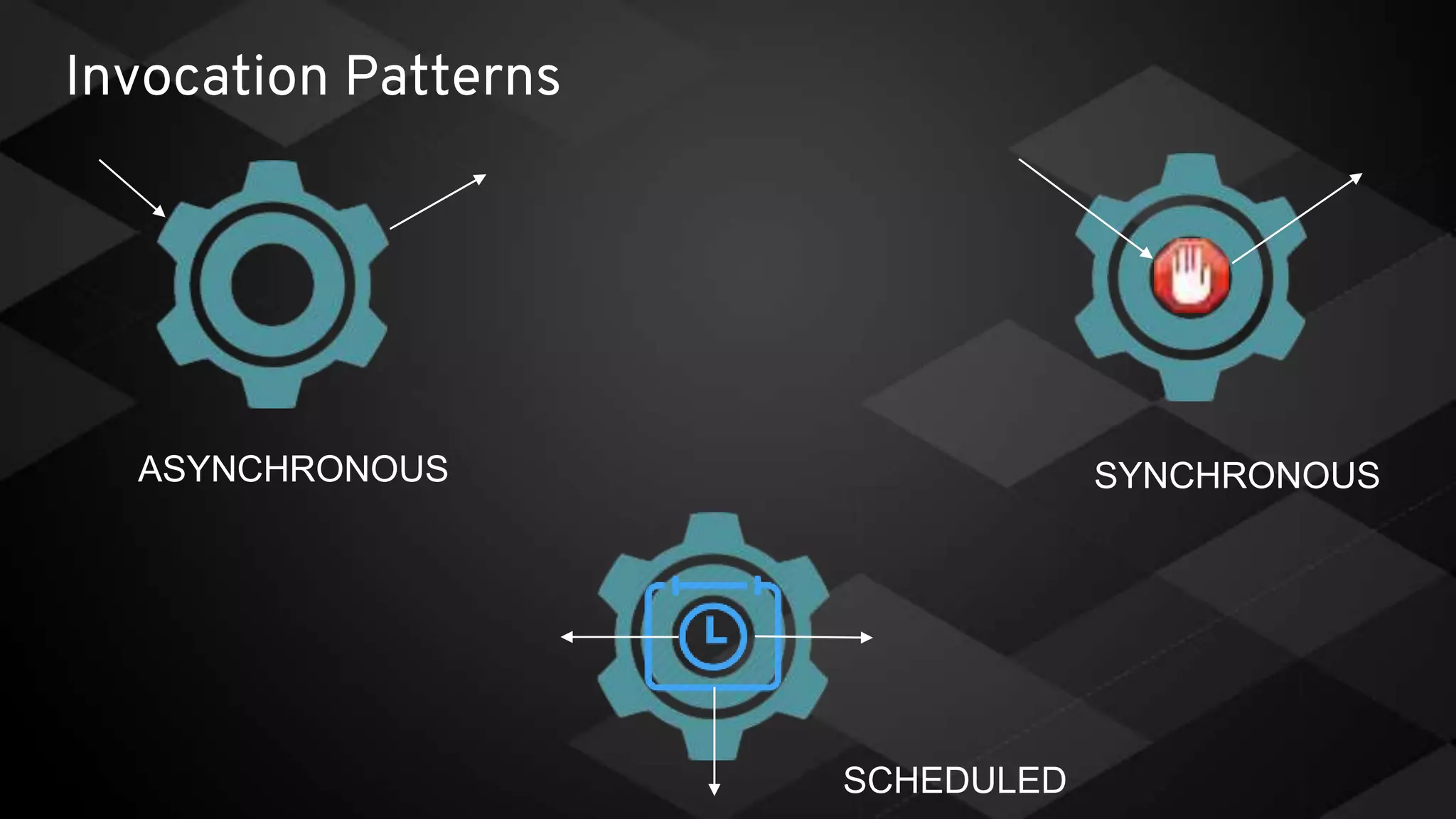
Invocation Patterns
ASYNCHRONOUS SYNCHRONOUS
SCHEDULED
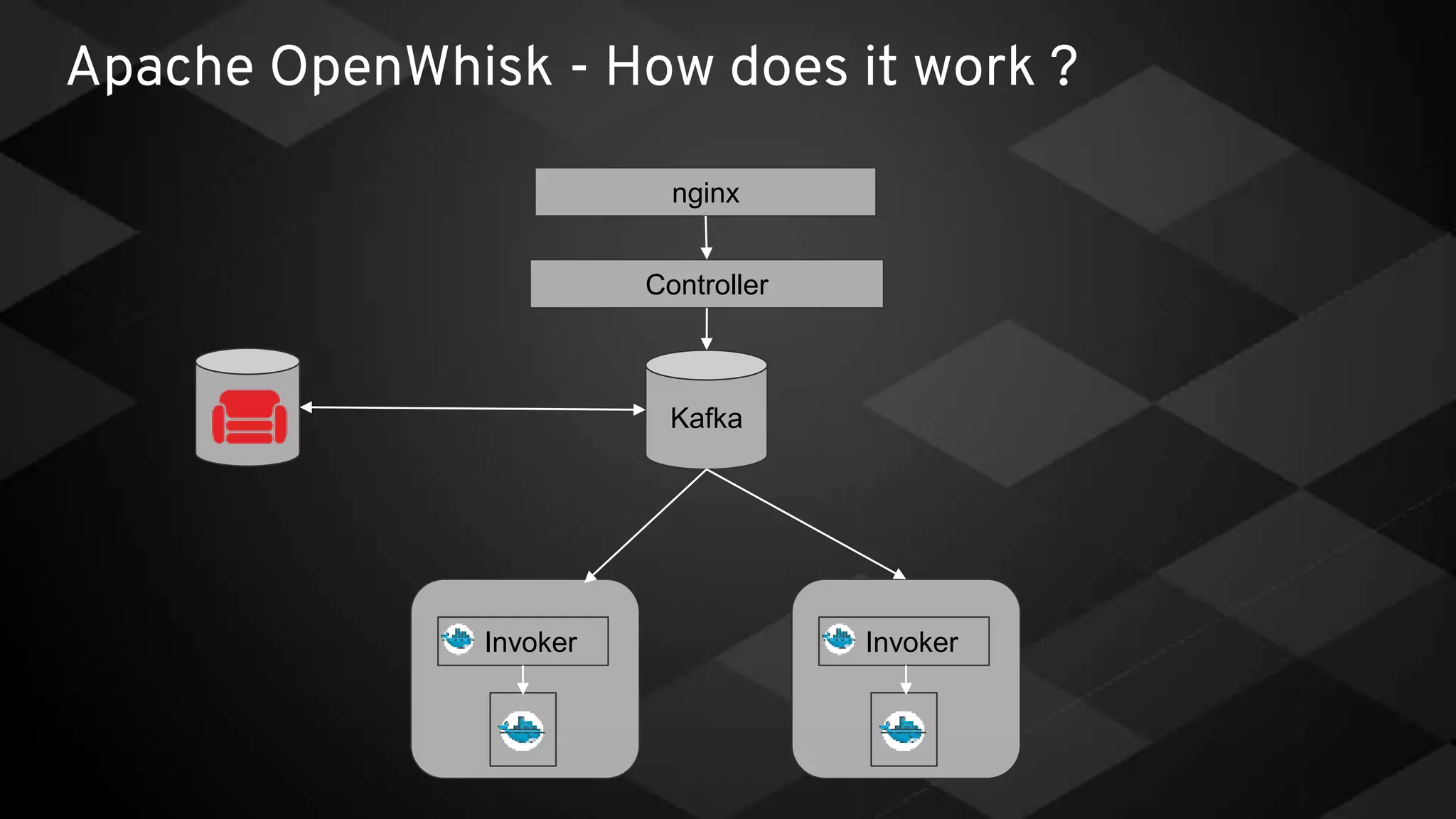
Apache OpenWhisk - How does it work ?
Controller
Kafka
nginx
Invoker Invoker
Get the feel
Java Actions
Plain Old Function (POF)
● Pros
○ Java POJO
○ Simple and straightforward to understand
● Cons
○ Not portable across serverless providers
○ Dependencies need to bundled as an uberjar
○ Uses third-party libs e.g Google Gson for OpenWhisk
Java Actions
Spring Cloud Functions (SCF)
● Pros
○ Uses standard and popular Spring Programming model
○ Standard Spring Boot Application Signature
■ No extension of specific provider e.g. AWS Lambda
○ Uses Java Function Model
■ Functions (Event Sinks)
● Suppliers
● Consumer
○ Adapters for major serverless providers OpenWhisk, AWS, Azure
■ Increases portability
● Cons
○ Heavy and Fat for serverless functional app
○ Startup time is longer owing to start the standard Spring Boot Application
○ Uses thin-jar for basic application and dependency resolution happens at runtime
○ Customization is not possible as some serverless providers might not allow custom docker
images
WebAction
● Any action could be made web action
○ via annotation
● Web Action has URLS wsk -i action get myaction --url
● Any HTTP Verb could be used
● Automatic Content type detection via prefixing the url
○ E.g. https://some-url.json
● Can be invoked via URL
○ Query Parameters will be Action Parameter JSON
○ Request Body will be Action Parameter JSON
● If Content-Type header is ignored then the request body will be base64
encoded string
● It's NOT SYNCHRONOUS
● Some resources require authentication
Demo - Web Action
Action Chaining
● Actions can be chained
● Pre-defined chain of actions
○ Sequences
● Action Chaining could also be determined at runtime
○ Conductors
● Only first function in Sequence can accept parameter
○ The output of previous step(Action) is input to next
Demo - Action Chaining
Event Driven Capabilities
● OpenWhisk functions can respond to Events
● Events could be
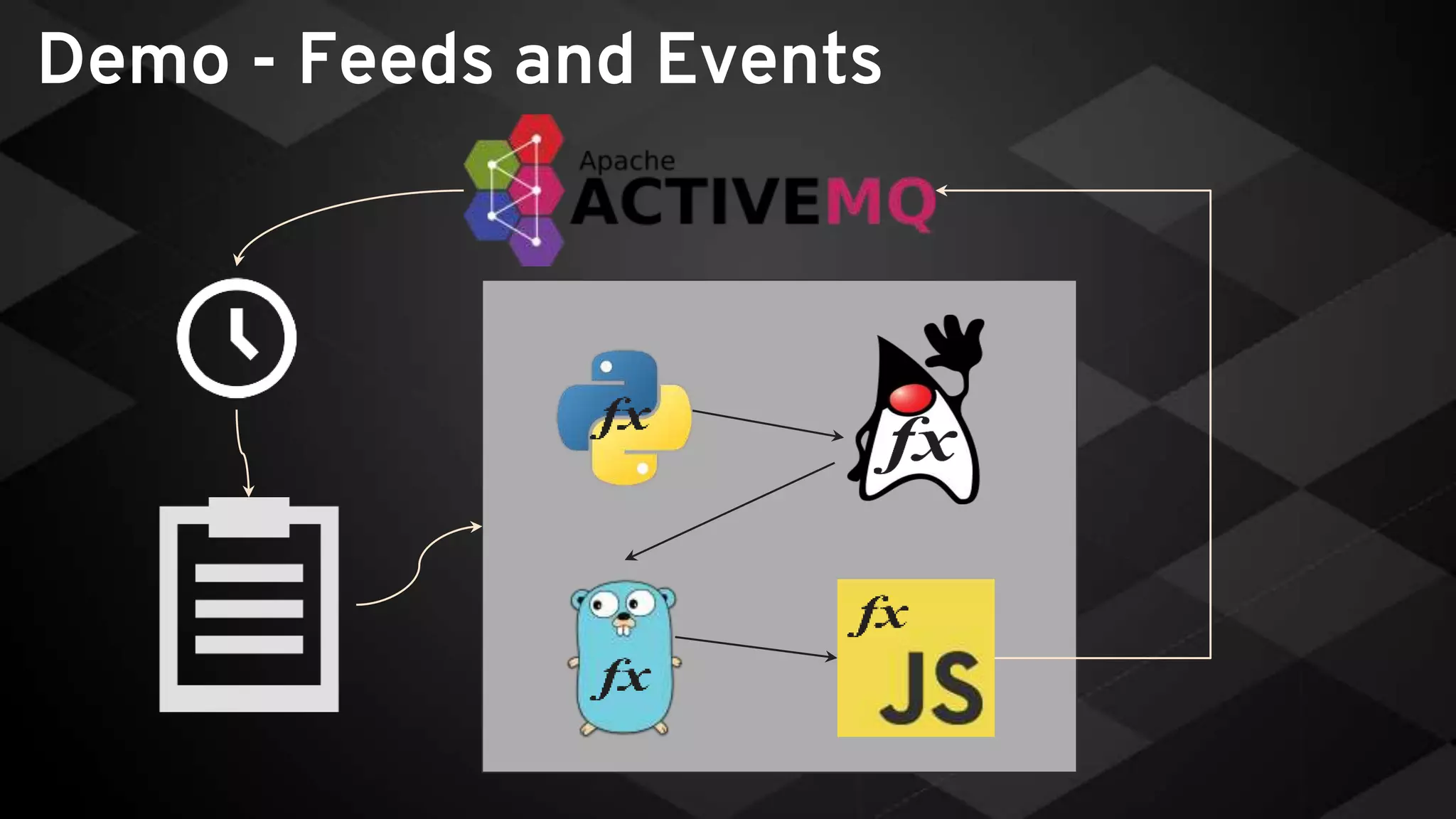
○ Another function
○ External event source called as Feed Provider
● Event Action is OpenWhisk Function that’s invoked for a Trigger
● Event Actions are invoked via Triggers
○ Rules tie Actions to Triggers
● Trigger can be registered to Event Provider via Feeds (Stream of Events)
○ Feed can be:
■ Polling
■ Webhook
■ Persistent Connection
Cloud Events
● Define specification for Cloud Events
○ Effort via CNCF’s Serverless Working
Group
● Major Cloud Providers, SaaS providers are
part of working committee
● https://cloudevents.io/
Feed the Trigger to Rule your Action
Demo - Feeds and Events
Thank you
bit.ly/faas-tutorial
https://learn.openshift.com/serverless
@kamesh_sampathkamesh.sampath@hotmail.com

Your journey into the serverless world

  • 2.
    Your Journey intothe Serverless World Introduction to Serverless bit.ly/faas-tutorial https://learn.openshift.com/serverless
  • 3.
    Who am I? ● Active Open Source Contributor ○ OpenWhisk ○ Eclipse Che ○ fabric8 Platform https://fabric8.io/ ● Creator vert.x-maven-plugin → https://vmp.fabric8.io/ kameshsampath Kamesh Sampath Director of Developer Experience at Red Hat @kamesh_sampath kamesh.sampath@hotmail.com
  • 4.
    What is Serverless? Serverless computing refers to the concept of building and running applications that do not require server management. It describes a finer-grained deployment model where applications, bundled as one or more functions, are uploaded to a platform and then executed, scaled, and billed in response to the exact demand needed at the moment. https://www.cncf.io/blog/2018/02/14/cncf-takes-first-step-towards-serverless-computing
  • 6.
    Good and Badabout Serverless ● Automatic Scalability ● Automatic Cost Reduction ● Quicker and Easier Development ● Better Capacity planning ● Delivery speed ● Debugging ● Deployment and Architectural complexity ● Deep learning curve ● Vendor Lock-in ● Monitoring https://hackernoon.com/serverless-survey-77-delivery-speed-4-dev-workdays-mo-saved-26-aws-monthly-bill-d99174f70663
  • 7.
    Apache OpenWhisk ● OpenSource incubating under Apache ● A Cloud platform to execute functions written in: ○ JavaScript ○ Swift ○ Java ○ Python ○ PHP ○ Docker ○ Go ● Deployable on ○ Any platform where docker can be run ○ Kubernetes/OpenShift
  • 8.
    Some theory ● Actions ○A stateless code snippet that gets executed ● Package ○ A bundle of actions and feeds synonymous to Java Packages ● Feeds ○ Acts as Interface between external Event Sources and OpenWhisk Actions ● Triggers ○ Stimulus of external Events via Feeds ● Rules ○ Ties one or more Triggers to an Action or vice-versa ● Activation ○ Records the output/response of Running/Ran actions
  • 9.
    Tooling ● wsk ○ Thecore command line interface to work OpenWhisk ● wskdeploy ○ The command line tool to allow deploying OpenWhisk actions, functions etc., using YAML base manifest ● Maven (only for Java) ○ Generate OpenWhisk Java Functions ● Serverless Framework ○ JavaScript based template framework ○ Support for generating OpenWhisk Templated project ○ Ability to deploy functions to OpenWhisk
  • 10.
  • 11.
    Apache OpenWhisk -How does it work ? Controller Kafka nginx Invoker Invoker
  • 12.
  • 13.
  • 14.
    Plain Old Function(POF) ● Pros ○ Java POJO ○ Simple and straightforward to understand ● Cons ○ Not portable across serverless providers ○ Dependencies need to bundled as an uberjar ○ Uses third-party libs e.g Google Gson for OpenWhisk Java Actions
  • 15.
    Spring Cloud Functions(SCF) ● Pros ○ Uses standard and popular Spring Programming model ○ Standard Spring Boot Application Signature ■ No extension of specific provider e.g. AWS Lambda ○ Uses Java Function Model ■ Functions (Event Sinks) ● Suppliers ● Consumer ○ Adapters for major serverless providers OpenWhisk, AWS, Azure ■ Increases portability ● Cons ○ Heavy and Fat for serverless functional app ○ Startup time is longer owing to start the standard Spring Boot Application ○ Uses thin-jar for basic application and dependency resolution happens at runtime ○ Customization is not possible as some serverless providers might not allow custom docker images
  • 16.
    WebAction ● Any actioncould be made web action ○ via annotation ● Web Action has URLS wsk -i action get myaction --url ● Any HTTP Verb could be used ● Automatic Content type detection via prefixing the url ○ E.g. https://some-url.json ● Can be invoked via URL ○ Query Parameters will be Action Parameter JSON ○ Request Body will be Action Parameter JSON ● If Content-Type header is ignored then the request body will be base64 encoded string ● It's NOT SYNCHRONOUS ● Some resources require authentication
  • 17.
    Demo - WebAction
  • 18.
    Action Chaining ● Actionscan be chained ● Pre-defined chain of actions ○ Sequences ● Action Chaining could also be determined at runtime ○ Conductors ● Only first function in Sequence can accept parameter ○ The output of previous step(Action) is input to next
  • 19.
    Demo - ActionChaining
  • 20.
    Event Driven Capabilities ●OpenWhisk functions can respond to Events ● Events could be ○ Another function ○ External event source called as Feed Provider ● Event Action is OpenWhisk Function that’s invoked for a Trigger ● Event Actions are invoked via Triggers ○ Rules tie Actions to Triggers ● Trigger can be registered to Event Provider via Feeds (Stream of Events) ○ Feed can be: ■ Polling ■ Webhook ■ Persistent Connection
  • 21.
    Cloud Events ● Definespecification for Cloud Events ○ Effort via CNCF’s Serverless Working Group ● Major Cloud Providers, SaaS providers are part of working committee ● https://cloudevents.io/
  • 22.
    Feed the Triggerto Rule your Action
  • 23.
    Demo - Feedsand Events
  • 24.