Recommendation
System
김정환, 이진우, 최수아
1. Wide&deep model
2. restaurant recommend
a. (contents-based, collaborative filtering, neural network)
3. Web application
4. casual inference
Contents
Wide & deep Model
Memorization & Generalization
Memorization
케이스 학습
● 우수한 기억력
● 낮은 serendipity (즉, 너무 fit한 결과)
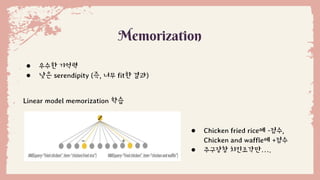
Memorization
Linear model memorization 학습
● Chicken fried rice에 -점수,
Chicken and waffle에 +점수
● 주구장창 치킨조각만….
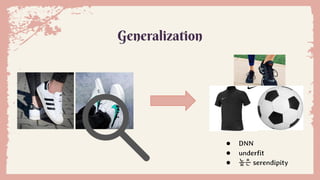
Generalization
● DNN
● underfit
● 높은 serendipity
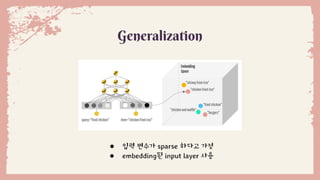
● 입력 변수가 sparse 하다고 가정
● embedding된 input layer 사용
Generalization
● polynomial하게 cross-product로 재구성
● 어떤 조합을 사용할 지 분석가가 결정
(차원 수 기하급수적 증가 시 불가능)
Feature 연관성 반영
● MF기반의 CF 혹은 FM, Deep Learning
● cross-product의 기능을 하는 무언가를 학습
‘날개 달린 동물은 난다’
Wide & Deep
‘펭귄은 날지 못한다’ ‘날개 달린 동물은 날지만
펭귄은 날지 못한다’
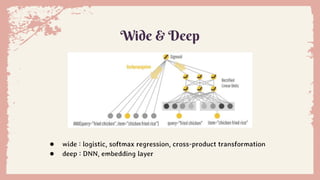
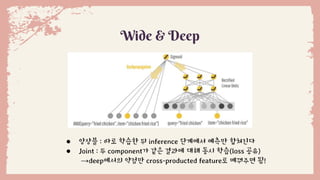
● wide : logistic, softmax regression, cross-product transformation
● deep : DNN, embedding layer
Wide & Deep
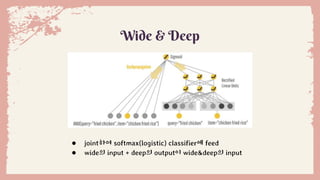
● joint하여 softmax(logistic) classifier에 feed
● wide의 input + deep의 output이 wide&deep의 input
Wide & Deep
● 앙상블 : 따로 학습한 뒤 inference 단계에서 예측만 합쳐진다
● Joint : 두 component가 같은 결과에 대해 동시 학습(loss 공유)
→deep에서의 약점만 cross-producted feature로 메꿔주면 됨!
Wide & Deep
Web application
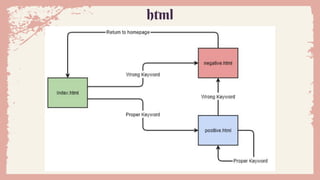
Using flask & html
Deploying Recommendation system on web
+ +
html
Deconfounded
Recommender
Via Modeling Selection Bias
Recommender Policy?
추천시스템은 일반적으로 유저가 높은 평가를 준 아이템과 비슷한 아이템들을 추천해준다.
● 높은 평가를 받는 아이템은 그 아이템만의 고유 특성이 유저의 고유 취향과 잘 부합하기
때문
● 따라서 유저 취향에 잘 부합하는 아이템 위주로 추천해주는 정책이 회사의 수익성을 보장할
것이다.
Recommender Policy?
얼핏 보면 당연히 옳은 추천 정책이지만 - 역설적으로 유저의 취향에 따라서만 추천해주는데에
문제가 있을 수 있다.
● 유저 자신이 좋아하는 분야는 굳이 추천을 안받아도 자신이 알아서 잘 찾아볼 것이다. 그러면
추천의 효율성이 떨어진다.
마케터 입장에서는 - 수익성을 높이기 위해서는 유저의 취향을 ‘넓혀야’ 한다.
● 즉, 선택의 폭을 넓히려면 유저의 취향과 좀 다른 아이템들도 추천해줘야함.
○ 평소에 잘 모르는 분야이기에 유저 입장에서 직접 찾아보기 힘든 아이템을 회사가
추천해주는것.
‘만약 평소에 잘 안찾거나 잘 모르던 아이템을
억지로 추천해준다면
유저의 평가는 어떨까?’
마케터의 관심사는
Problem transition : Causal Inference
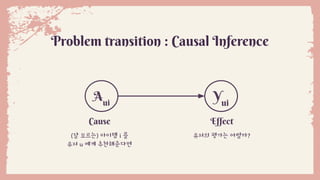
Cause
(잘 모르는) 아이템 i 를
유저 u 에게 추천해준다면
Effect
유저의 평가는 어떨까?
Yui
Aui
Inference problem : Selection Bias
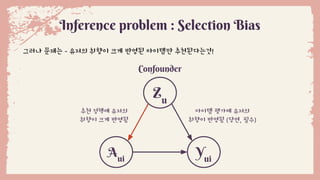
그러나 문제는 - 유저의 취향이 크게 반영된 아이템만 추천된다는것!
Yui
Aui
Zu
Confounder
아이템 평가에 유저의
취향이 반영됨 (당연, 필수)
추천 정책에 유저의
취향이 크게 반영됨
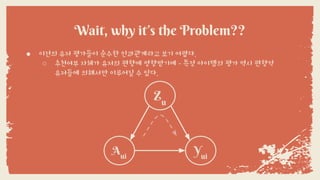
Wait, why it’s the Problem??
● 이전의 유저 평가들이 순수한 인과관계라고 보기 어렵다.
○ 추천여부 자체가 유저의 편향에 영향받기에 - 특정 아이템의 평가 역시 편향적
유저들에 의해서만 이루어질 수 있다.
Yui
Aui
Zu
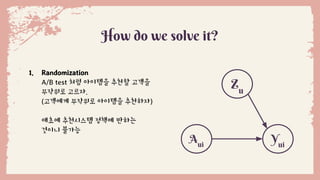
How do we solve it?
1. Randomization
A/B test 처럼 아이템을 추천할 고객을
무작위로 고르자.
(고객에게 무작위로 아이템을 추천하자)
애초에 추천시스템 정책에 반하는
것이니 불가능
Yui
Aui
Zu
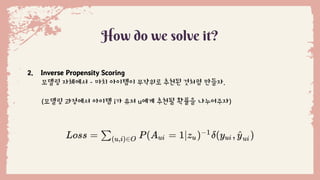
How do we solve it?
2. Inverse Propensity Scoring
모델링 자체에서 - 마치 아이템이 무작위로 추천된 것처럼 만들자.
(모델링 과정에서 아이템 i가 유저 u에게 추천될 확률을 나누어주자)
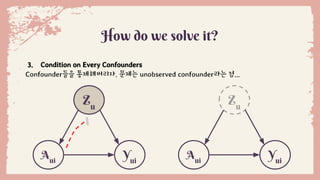
How do we solve it?
3. Condition on Every Confounders
Confounder들을 통제해버리자. 문제는 unobserved confounder라는 점...
Yui
Aui
Zu
Yui
Aui
Zu
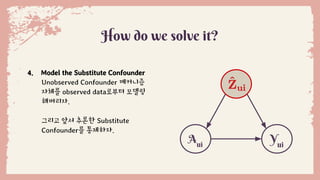
How do we solve it?
4. Model the Substitute Confounder
Unobserved Confounder 메커니즘
자체를 observed data로부터 모델링
해버리자.
그리고 앞서 추론한 Substitute
Confounder를 통제하자.
Yui
Aui
2-Stage Modeling
1-step. Construct a substitute confounder
2-step. Model the rating data
conditioning on substitute confounder
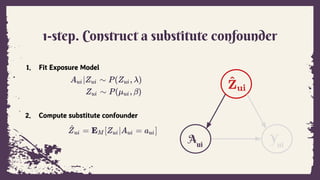
1-step. Construct a substitute confounder
1. Fit Exposure Model
2. Compute substitute confounder
Yui
Aui
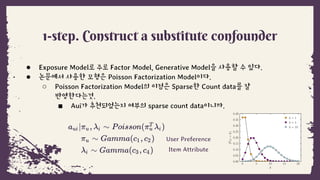
1-step. Construct a substitute confounder
● Exposure Model로 주로 Factor Model, Generative Model을 사용할 수 있다.
● 논문에서 사용한 모형은 Poisson Factorization Model이다.
○ Poisson Factorization Model의 이점은 Sparse한 Count data를 잘
반영한다는것.
■ Aui가 추천되었는지 여부의 sparse count data이니까.
User Preference
Item Attribute
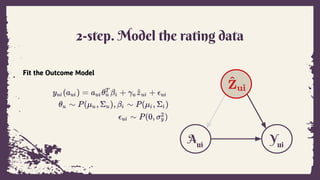
2-step. Model the rating data
Fit the Outcome Model
Yui
Aui
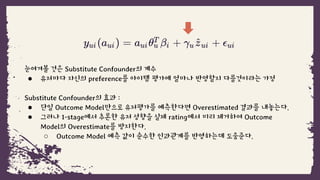
눈여겨볼 것은 Substitute Confounder의 계수
● 유저마다 자신의 preference를 아이템 평가에 얼마나 반영할지 다를것이라는 가정
Substitute Confounder의 효과 :
● 단일 Outcome Model만으로 유저평가를 예측한다면 Overestimated 결과를 내놓는다.
● 그러나 1-stage에서 추론한 유저 성향을 실제 rating에서 미리 제거하여 Outcome
Model의 Overestimate를 방지한다.
○ Outcome Model 예측 값이 순수한 인과관계를 반영하는데 도움준다.
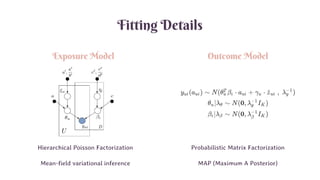
Fitting Details
Exposure Model Outcome Model
Hierarchical Poisson Factorization
Mean-field variational inference
Probabilistic Matrix Factorization
MAP (Maximum A Posterior)
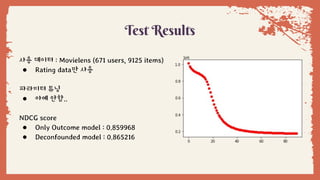
Test Results
사용 데이터 : Movielens (671 users, 9125 items)
● Rating data만 사용
파라미터 튜닝
● 아예 안함..
NDCG score
● Only Outcome model : 0.859968
● Deconfounded model : 0.865216
Discussions
● Deconfounded recommender은 특정 모형이 아닌 - 프레임워크다.
○ Exposure model에 다른 Generative model과 Outcome model에 다른
Embedding model을 적용하여 개선 가능
● 주의할 점은 1-stage model부터 성능이 안좋다면 Outcome model만 쓴 것보다도
못한 결과가 초래할수도…!
○ 조정할 파라미터 수가 너무 많다..
● 꼭 이러한 프레임워크를 따를 필요 없이 - 모델러 자신이 옳다고 생각한 인과구조를
바탕으로 프레임워크를 임의로 설계할 수 있다.
○ 대신 타당한 이론과 test score로 자신의 가설을 입증해야할 것이다.
References
1. Yixin, W., Liang, D., Charlin, L., and Blei, D.M. (2020). Causal Inference for
Recommender Systems.
2. Yixin, W. and Blei, D.M. (2019). The Blessings of Multiple Causes.
3. Bonner, S. and Vasile, F. (2018). Causal Embeddings for Recommendation.
4. Schnabel, T., Swaminathan, A., Singh, A., Chandak, N., and Joachims, T.
(2016). Recommendations as Treatments: Debiasing Learning and Evaluation.
5. Liang, D., Charlin, L., and Blei, D.M. (2016). Causal Inference for
Recommendation.
6. Gopalan, P., Hofman J.M., and Blei, D.M. (2015). Scalable Recommendation
with Hierarchical Poisson Factorization

Yonsei Data Science Lab - Recommender System Implementation 1

  • 1.
  • 2.
    1. Wide&deep model 2.restaurant recommend a. (contents-based, collaborative filtering, neural network) 3. Web application 4. casual inference Contents
  • 3.
    Wide & deepModel Memorization & Generalization
  • 4.
  • 5.
    ● 우수한 기억력 ●낮은 serendipity (즉, 너무 fit한 결과) Memorization Linear model memorization 학습 ● Chicken fried rice에 -점수, Chicken and waffle에 +점수 ● 주구장창 치킨조각만….
  • 6.
  • 7.
    ● 입력 변수가sparse 하다고 가정 ● embedding된 input layer 사용 Generalization
  • 8.
    ● polynomial하게 cross-product로재구성 ● 어떤 조합을 사용할 지 분석가가 결정 (차원 수 기하급수적 증가 시 불가능) Feature 연관성 반영 ● MF기반의 CF 혹은 FM, Deep Learning ● cross-product의 기능을 하는 무언가를 학습
  • 9.
    ‘날개 달린 동물은난다’ Wide & Deep ‘펭귄은 날지 못한다’ ‘날개 달린 동물은 날지만 펭귄은 날지 못한다’
  • 10.
    ● wide :logistic, softmax regression, cross-product transformation ● deep : DNN, embedding layer Wide & Deep
  • 11.
    ● joint하여 softmax(logistic)classifier에 feed ● wide의 input + deep의 output이 wide&deep의 input Wide & Deep
  • 12.
    ● 앙상블 :따로 학습한 뒤 inference 단계에서 예측만 합쳐진다 ● Joint : 두 component가 같은 결과에 대해 동시 학습(loss 공유) →deep에서의 약점만 cross-producted feature로 메꿔주면 됨! Wide & Deep
  • 13.
  • 14.
  • 15.
  • 16.
  • 17.
    Recommender Policy? 추천시스템은 일반적으로유저가 높은 평가를 준 아이템과 비슷한 아이템들을 추천해준다. ● 높은 평가를 받는 아이템은 그 아이템만의 고유 특성이 유저의 고유 취향과 잘 부합하기 때문 ● 따라서 유저 취향에 잘 부합하는 아이템 위주로 추천해주는 정책이 회사의 수익성을 보장할 것이다.
  • 18.
    Recommender Policy? 얼핏 보면당연히 옳은 추천 정책이지만 - 역설적으로 유저의 취향에 따라서만 추천해주는데에 문제가 있을 수 있다. ● 유저 자신이 좋아하는 분야는 굳이 추천을 안받아도 자신이 알아서 잘 찾아볼 것이다. 그러면 추천의 효율성이 떨어진다. 마케터 입장에서는 - 수익성을 높이기 위해서는 유저의 취향을 ‘넓혀야’ 한다. ● 즉, 선택의 폭을 넓히려면 유저의 취향과 좀 다른 아이템들도 추천해줘야함. ○ 평소에 잘 모르는 분야이기에 유저 입장에서 직접 찾아보기 힘든 아이템을 회사가 추천해주는것.
  • 19.
    ‘만약 평소에 잘안찾거나 잘 모르던 아이템을 억지로 추천해준다면 유저의 평가는 어떨까?’ 마케터의 관심사는
  • 20.
    Problem transition :Causal Inference Cause (잘 모르는) 아이템 i 를 유저 u 에게 추천해준다면 Effect 유저의 평가는 어떨까? Yui Aui
  • 21.
    Inference problem :Selection Bias 그러나 문제는 - 유저의 취향이 크게 반영된 아이템만 추천된다는것! Yui Aui Zu Confounder 아이템 평가에 유저의 취향이 반영됨 (당연, 필수) 추천 정책에 유저의 취향이 크게 반영됨
  • 22.
    Wait, why it’sthe Problem?? ● 이전의 유저 평가들이 순수한 인과관계라고 보기 어렵다. ○ 추천여부 자체가 유저의 편향에 영향받기에 - 특정 아이템의 평가 역시 편향적 유저들에 의해서만 이루어질 수 있다. Yui Aui Zu
  • 23.
    How do wesolve it? 1. Randomization A/B test 처럼 아이템을 추천할 고객을 무작위로 고르자. (고객에게 무작위로 아이템을 추천하자) 애초에 추천시스템 정책에 반하는 것이니 불가능 Yui Aui Zu
  • 24.
    How do wesolve it? 2. Inverse Propensity Scoring 모델링 자체에서 - 마치 아이템이 무작위로 추천된 것처럼 만들자. (모델링 과정에서 아이템 i가 유저 u에게 추천될 확률을 나누어주자)
  • 25.
    How do wesolve it? 3. Condition on Every Confounders Confounder들을 통제해버리자. 문제는 unobserved confounder라는 점... Yui Aui Zu Yui Aui Zu
  • 26.
    How do wesolve it? 4. Model the Substitute Confounder Unobserved Confounder 메커니즘 자체를 observed data로부터 모델링 해버리자. 그리고 앞서 추론한 Substitute Confounder를 통제하자. Yui Aui
  • 27.
    2-Stage Modeling 1-step. Constructa substitute confounder 2-step. Model the rating data conditioning on substitute confounder
  • 28.
    1-step. Construct asubstitute confounder 1. Fit Exposure Model 2. Compute substitute confounder Yui Aui
  • 29.
    1-step. Construct asubstitute confounder ● Exposure Model로 주로 Factor Model, Generative Model을 사용할 수 있다. ● 논문에서 사용한 모형은 Poisson Factorization Model이다. ○ Poisson Factorization Model의 이점은 Sparse한 Count data를 잘 반영한다는것. ■ Aui가 추천되었는지 여부의 sparse count data이니까. User Preference Item Attribute
  • 30.
    2-step. Model therating data Fit the Outcome Model Yui Aui
  • 31.
    눈여겨볼 것은 SubstituteConfounder의 계수 ● 유저마다 자신의 preference를 아이템 평가에 얼마나 반영할지 다를것이라는 가정 Substitute Confounder의 효과 : ● 단일 Outcome Model만으로 유저평가를 예측한다면 Overestimated 결과를 내놓는다. ● 그러나 1-stage에서 추론한 유저 성향을 실제 rating에서 미리 제거하여 Outcome Model의 Overestimate를 방지한다. ○ Outcome Model 예측 값이 순수한 인과관계를 반영하는데 도움준다.
  • 32.
    Fitting Details Exposure ModelOutcome Model Hierarchical Poisson Factorization Mean-field variational inference Probabilistic Matrix Factorization MAP (Maximum A Posterior)
  • 33.
    Test Results 사용 데이터: Movielens (671 users, 9125 items) ● Rating data만 사용 파라미터 튜닝 ● 아예 안함.. NDCG score ● Only Outcome model : 0.859968 ● Deconfounded model : 0.865216
  • 34.
    Discussions ● Deconfounded recommender은특정 모형이 아닌 - 프레임워크다. ○ Exposure model에 다른 Generative model과 Outcome model에 다른 Embedding model을 적용하여 개선 가능 ● 주의할 점은 1-stage model부터 성능이 안좋다면 Outcome model만 쓴 것보다도 못한 결과가 초래할수도…! ○ 조정할 파라미터 수가 너무 많다.. ● 꼭 이러한 프레임워크를 따를 필요 없이 - 모델러 자신이 옳다고 생각한 인과구조를 바탕으로 프레임워크를 임의로 설계할 수 있다. ○ 대신 타당한 이론과 test score로 자신의 가설을 입증해야할 것이다.
  • 35.
    References 1. Yixin, W.,Liang, D., Charlin, L., and Blei, D.M. (2020). Causal Inference for Recommender Systems. 2. Yixin, W. and Blei, D.M. (2019). The Blessings of Multiple Causes. 3. Bonner, S. and Vasile, F. (2018). Causal Embeddings for Recommendation. 4. Schnabel, T., Swaminathan, A., Singh, A., Chandak, N., and Joachims, T. (2016). Recommendations as Treatments: Debiasing Learning and Evaluation. 5. Liang, D., Charlin, L., and Blei, D.M. (2016). Causal Inference for Recommendation. 6. Gopalan, P., Hofman J.M., and Blei, D.M. (2015). Scalable Recommendation with Hierarchical Poisson Factorization