Yeast
bread
Preparation
CONTENTS
What is Yeast Bread? Types of Yeast
Bread 01 Bread 02
Basic Ingridients of
Yeast Bread
Procedures on making
Yeast bread/Dinner Rolls
Bread 03 Bread 04
what is yeast bread?
It is the bread that uses yeasts as a
leavener which causes the bread to rise,
making it light and airy. It is formed into
countless shaped.
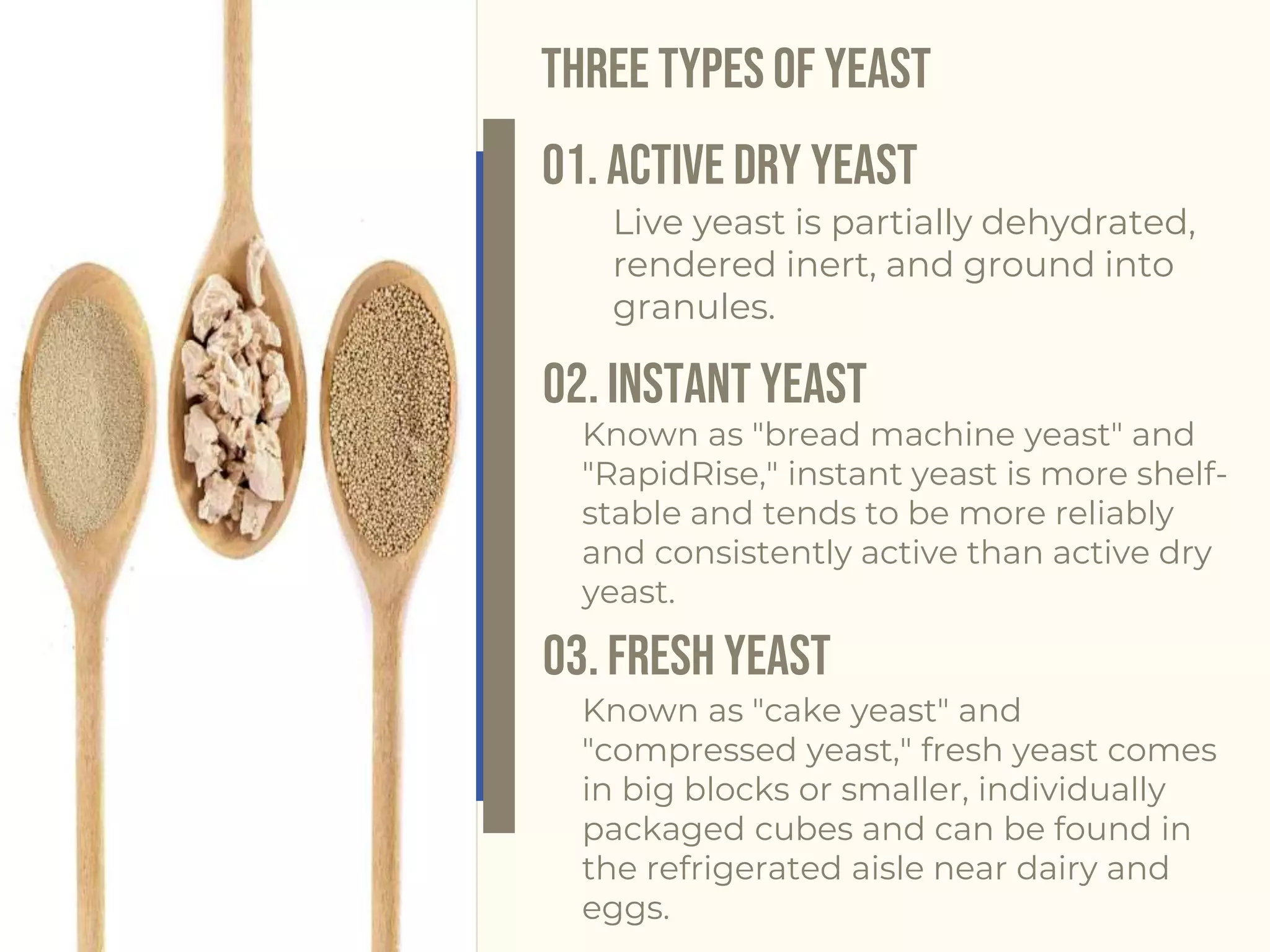
Three types of yeast
Known as "bread machine yeast" and
"RapidRise," instant yeast is more shelf-
stable and tends to be more reliably
and consistently active than active dry
yeast.
Known as "cake yeast" and
"compressed yeast," fresh yeast comes
in big blocks or smaller, individually
packaged cubes and can be found in
the refrigerated aisle near dairy and
eggs.
Live yeast is partially dehydrated,
rendered inert, and ground into
granules.
02. Instant yeast
03. Fresh Yeast
01. Active dry yeast
It makes the dough rise,
and develop the gluten
network of the bread.
Flour holds ingredients
together and provides the
structure of the dough
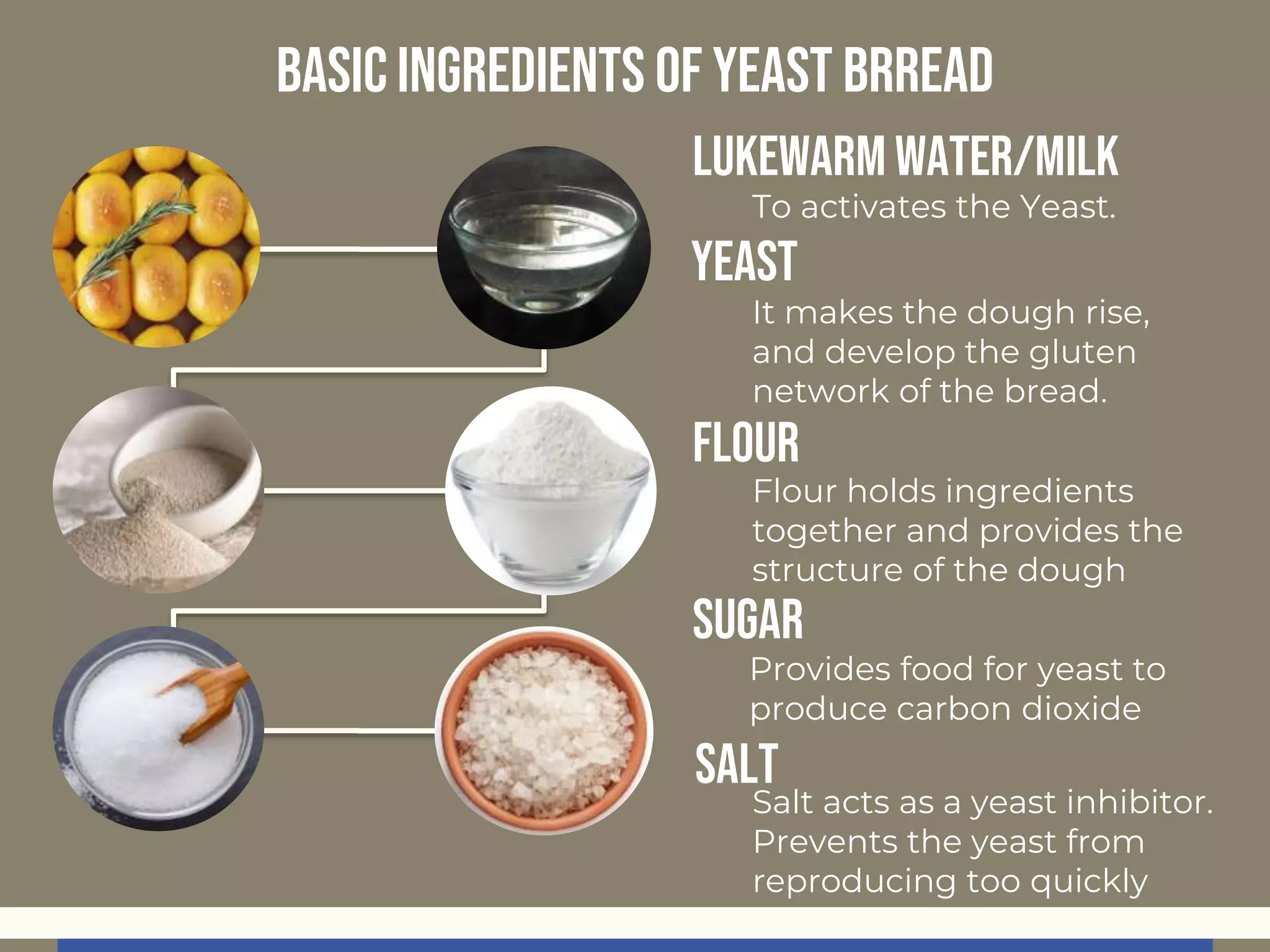
To activates the Yeast.
Provides food for yeast to
produce carbon dioxide
Basic ingredients of Yeast brread
Lukewarm water/milk
Yeast
Flour
SUGAR
Salt acts as a yeast inhibitor.
Prevents the yeast from
reproducing too quickly
Salt
Procedures
in making
Yeast
bread
Gather all of
your ingredients (mise
en place) and
measure them
accurately. Measuring
ingredients by
weight is a much
more accurate way to
measure and is the
preferred method for
bread making.
Step 1. MISE EN
PLACE (SCALING)
STEP 2. MIXING
Mix the dry
ingredients first before
adding the wet
ingredients (such as
water, butter, milk).
Mixing assures all
ingredients are spread
out over the bread evenly.
It assures yeast is spread
out through the entire
dough and thus makes it
evenly fluffy.
After the
ingredients for the bread
dough are combined the
dough is kneaded.
Dough can be kneaded
in a stand mixer using a
dough hook, or by hand.
Knead the dough until it
is smooth and elastic.
Kneading helps the
formation of a light and
airy bread. Its main role
here is gluten
development, gluten are
proteins in flour.
Step 3. KNEADING
Step 4. BULK
FERMENT (1ST RISE)
After the dough is
mixed and kneaded, it is
allowed to rest and
ferment. Put it in a bowl
and cover it with plastic
wrap or towel and let it
rise for 30 minutes to 2
hours in a warm place.
Fermentation occurs
when the yeast begins to
feed on the starches and
sugar present in the
dough.
 Once the dough has
doubled in size, you’re
going to literally punch out
all the excess air that has
built up inside the dough.
 Once punched down, the
dough is then portioned out
into desired size.
 The portions are then
rounded into smooth, round
balls. This helps stretch the
gluten to help hold in the
gasses and give a smooth
surface. Dough can be
shaped in different shapes.
Step 5. Punch down
and shape the dough
Step 6. PROOFING OR PROVING
(2ND RISE) second fermentation
After shaping
the dough, put it on
the the baking pan
that you’ll be using to
bake it on and let it
rise once more.
Baking is where
your bread becomes a
bread. During baking a
lot of things happen.
Bread is cooked
through when its
internal temperature
reaches 190-200 F (99-
94 C).
STEP 7: BAKING
References:
● https://bakerbettie.com/intro-bread-making-basic-process/
● https://theculinarycook.com/how-to-make-fresh-bread/
● https://foodcrumbles.com/bread-making-process-a-
concise-overview/
● https://redstaryeast.com/yeast-baking-lessons/common-
baking-ingredients/sweeteners/

Yeast bread preparation- capistrano_valencia

  • 1.
  • 2.
    CONTENTS What is YeastBread? Types of Yeast Bread 01 Bread 02 Basic Ingridients of Yeast Bread Procedures on making Yeast bread/Dinner Rolls Bread 03 Bread 04
  • 3.
    what is yeastbread? It is the bread that uses yeasts as a leavener which causes the bread to rise, making it light and airy. It is formed into countless shaped.
  • 4.
    Three types ofyeast Known as "bread machine yeast" and "RapidRise," instant yeast is more shelf- stable and tends to be more reliably and consistently active than active dry yeast. Known as "cake yeast" and "compressed yeast," fresh yeast comes in big blocks or smaller, individually packaged cubes and can be found in the refrigerated aisle near dairy and eggs. Live yeast is partially dehydrated, rendered inert, and ground into granules. 02. Instant yeast 03. Fresh Yeast 01. Active dry yeast
  • 5.
    It makes thedough rise, and develop the gluten network of the bread. Flour holds ingredients together and provides the structure of the dough To activates the Yeast. Provides food for yeast to produce carbon dioxide Basic ingredients of Yeast brread Lukewarm water/milk Yeast Flour SUGAR Salt acts as a yeast inhibitor. Prevents the yeast from reproducing too quickly Salt
  • 6.
  • 7.
    Gather all of youringredients (mise en place) and measure them accurately. Measuring ingredients by weight is a much more accurate way to measure and is the preferred method for bread making. Step 1. MISE EN PLACE (SCALING)
  • 8.
    STEP 2. MIXING Mixthe dry ingredients first before adding the wet ingredients (such as water, butter, milk). Mixing assures all ingredients are spread out over the bread evenly. It assures yeast is spread out through the entire dough and thus makes it evenly fluffy.
  • 9.
    After the ingredients forthe bread dough are combined the dough is kneaded. Dough can be kneaded in a stand mixer using a dough hook, or by hand. Knead the dough until it is smooth and elastic. Kneading helps the formation of a light and airy bread. Its main role here is gluten development, gluten are proteins in flour. Step 3. KNEADING
  • 10.
    Step 4. BULK FERMENT(1ST RISE) After the dough is mixed and kneaded, it is allowed to rest and ferment. Put it in a bowl and cover it with plastic wrap or towel and let it rise for 30 minutes to 2 hours in a warm place. Fermentation occurs when the yeast begins to feed on the starches and sugar present in the dough.
  • 11.
     Once thedough has doubled in size, you’re going to literally punch out all the excess air that has built up inside the dough.  Once punched down, the dough is then portioned out into desired size.  The portions are then rounded into smooth, round balls. This helps stretch the gluten to help hold in the gasses and give a smooth surface. Dough can be shaped in different shapes. Step 5. Punch down and shape the dough
  • 12.
    Step 6. PROOFINGOR PROVING (2ND RISE) second fermentation After shaping the dough, put it on the the baking pan that you’ll be using to bake it on and let it rise once more.
  • 13.
    Baking is where yourbread becomes a bread. During baking a lot of things happen. Bread is cooked through when its internal temperature reaches 190-200 F (99- 94 C). STEP 7: BAKING
  • 14.
    References: ● https://bakerbettie.com/intro-bread-making-basic-process/ ● https://theculinarycook.com/how-to-make-fresh-bread/ ●https://foodcrumbles.com/bread-making-process-a- concise-overview/ ● https://redstaryeast.com/yeast-baking-lessons/common- baking-ingredients/sweeteners/