1
A. Choose and write.
1. 2. 3. 4.
……………………………… ………………………………. ………………………………. ……………………………….
5. 6. 7. 8.
………………………………… …………………………………… ………………………………… …………………………………..
9 . 10.
……………………………………… ………………………………..
(10 marks)
drink cycle
paint water
sing skip
painting read
throw eat
2
B. Choose and write the correct answer.
toy enjoy oyster annoy
destroy soy joy loyal
1.
5.
6.
2.
3. 7.
4. 8.
(16 marks)
3
C. Read. Then, match the sentence parts.
(12 marks)
Pupils must use
zebra crossing to
We must look left
and right before
Pupils must always
line up and walk
Never talk to
strangers
You must queue
up at the canteen
Pupils must stand
in a single file
cross the road.
in the playground.
crossing the road.
when buying food.
when board on a
bus.
to classroom.
4
D. Change the simple present tense verbs into simple past tense verbs.
(16 marks)
Simple Present Tense
1. live
2. wash
3. move
4. dance
5. start
6. play
7. climb
8. help
Simple Past Tense
1.
2.
3.
4.
5.
6.
7.
8.
5
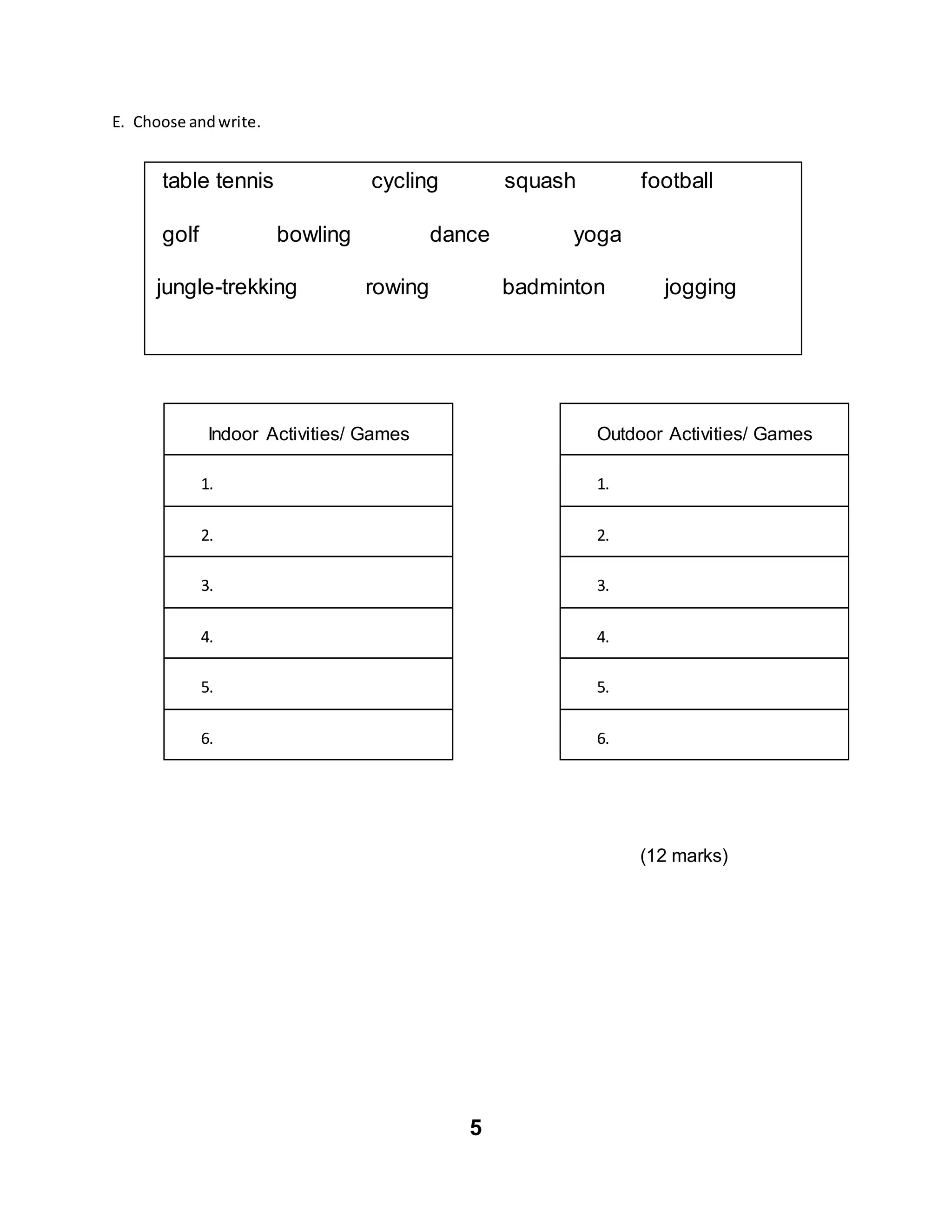
E. Choose andwrite.
(12 marks)
Indoor Activities/ Games
1.
2.
3.
4.
5.
6.
Outdoor Activities/ Games
1.
2.
3.
4.
5.
6.
table tennis cycling squash football
golf bowling dance yoga
jungle-trekking rowing badminton jogging
6
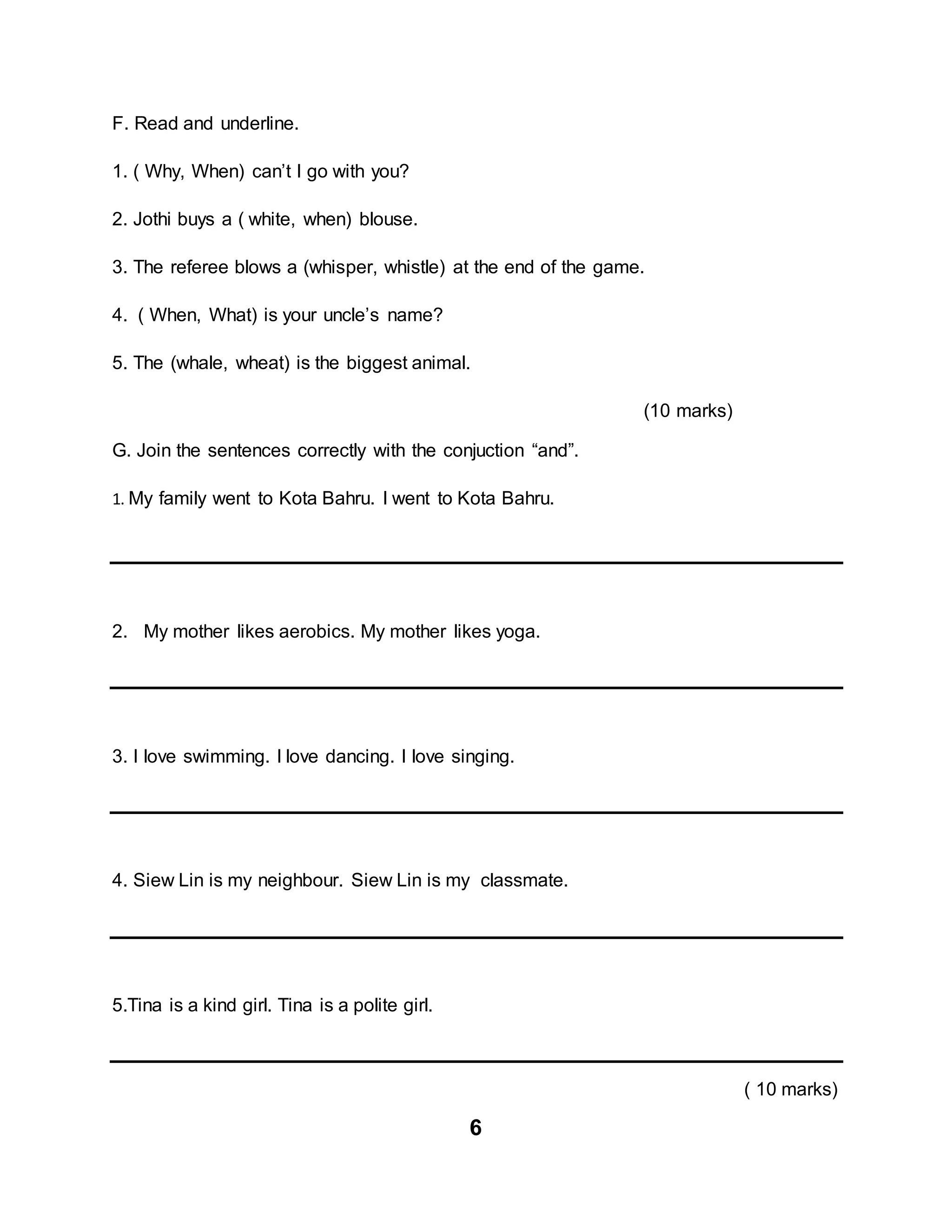
F. Read and underline.
1. ( Why, When) can’t I go with you?
2. Jothi buys a ( white, when) blouse.
3. The referee blows a (whisper, whistle) at the end of the game.
4. ( When, What) is your uncle’s name?
5. The (whale, wheat) is the biggest animal.
(10 marks)
G. Join the sentences correctly with the conjuction “and”.
1. My family went to Kota Bahru. I went to Kota Bahru.
2. My mother likes aerobics. My mother likes yoga.
3. I love swimming. I love dancing. I love singing.
4. Siew Lin is my neighbour. Siew Lin is my classmate.
5.Tina is a kind girl. Tina is a polite girl.
( 10 marks)
7
H. Underline the correct answer.
One day, the giant decided to visit his friend in a neighbouring village. The giant
came home after seven years. He saw some children playing in his garden. He shouted
angrily and chased them away.
When the children stopped coming to the garden, the trees and flowers were very
sad. Spring was everywhere but it was still winter in the giant’s garden.
One morning, the giant saw the children playing in the garden and the spring arrived
into garden to express its happiness on seeing the children again.
The giant realised that he had been selfish. He was very sorry for what he had done.
He let the children play in the garden every day.
1. The giant decided to visit his family in a neighbouring village. ( True , False)
2. The giant came home after seven years. ( True , False)
3. The giant chased the children away from the garden when he saw them playing
in his garden. (True, False)
4. The trees and flowers were happy when the children stopped coming to the
garden. ( True, False)
5. The Spring arrived into the garden after the children played again in the garden.
(True, False)
6. The giant is selfish ( True, False)
7. In the end, the giant only let the children to play in the garden twice a week.
(True, False)
(14 marks)
-End-

Year 3 BI SJKT monthly exam paper (unit 6-unit 8)

  • 1.
    1 A. Choose andwrite. 1. 2. 3. 4. ……………………………… ………………………………. ………………………………. ………………………………. 5. 6. 7. 8. ………………………………… …………………………………… ………………………………… ………………………………….. 9 . 10. ……………………………………… ……………………………….. (10 marks) drink cycle paint water sing skip painting read throw eat
  • 2.
    2 B. Choose andwrite the correct answer. toy enjoy oyster annoy destroy soy joy loyal 1. 5. 6. 2. 3. 7. 4. 8. (16 marks)
  • 3.
    3 C. Read. Then,match the sentence parts. (12 marks) Pupils must use zebra crossing to We must look left and right before Pupils must always line up and walk Never talk to strangers You must queue up at the canteen Pupils must stand in a single file cross the road. in the playground. crossing the road. when buying food. when board on a bus. to classroom.
  • 4.
    4 D. Change thesimple present tense verbs into simple past tense verbs. (16 marks) Simple Present Tense 1. live 2. wash 3. move 4. dance 5. start 6. play 7. climb 8. help Simple Past Tense 1. 2. 3. 4. 5. 6. 7. 8.
  • 5.
    5 E. Choose andwrite. (12marks) Indoor Activities/ Games 1. 2. 3. 4. 5. 6. Outdoor Activities/ Games 1. 2. 3. 4. 5. 6. table tennis cycling squash football golf bowling dance yoga jungle-trekking rowing badminton jogging
  • 6.
    6 F. Read andunderline. 1. ( Why, When) can’t I go with you? 2. Jothi buys a ( white, when) blouse. 3. The referee blows a (whisper, whistle) at the end of the game. 4. ( When, What) is your uncle’s name? 5. The (whale, wheat) is the biggest animal. (10 marks) G. Join the sentences correctly with the conjuction “and”. 1. My family went to Kota Bahru. I went to Kota Bahru. 2. My mother likes aerobics. My mother likes yoga. 3. I love swimming. I love dancing. I love singing. 4. Siew Lin is my neighbour. Siew Lin is my classmate. 5.Tina is a kind girl. Tina is a polite girl. ( 10 marks)
  • 7.
    7 H. Underline thecorrect answer. One day, the giant decided to visit his friend in a neighbouring village. The giant came home after seven years. He saw some children playing in his garden. He shouted angrily and chased them away. When the children stopped coming to the garden, the trees and flowers were very sad. Spring was everywhere but it was still winter in the giant’s garden. One morning, the giant saw the children playing in the garden and the spring arrived into garden to express its happiness on seeing the children again. The giant realised that he had been selfish. He was very sorry for what he had done. He let the children play in the garden every day. 1. The giant decided to visit his family in a neighbouring village. ( True , False) 2. The giant came home after seven years. ( True , False) 3. The giant chased the children away from the garden when he saw them playing in his garden. (True, False) 4. The trees and flowers were happy when the children stopped coming to the garden. ( True, False) 5. The Spring arrived into the garden after the children played again in the garden. (True, False) 6. The giant is selfish ( True, False) 7. In the end, the giant only let the children to play in the garden twice a week. (True, False) (14 marks) -End-