G R E AT OX Y M O R O N
KNOWLEDGE MANAGEMENT
PRESENTED BY:
SANDEEP MENGHANI
SANDEEP MENGHANI
Industry Psychologist
Yeshaswi Bhav Training & Management Solutions
 An articulate communicator possessing the ability to
effectively interact with diverse populations of
individuals at a variety of corporate/ academic levels.
 Dedicated experience in formulating and implementing
operational strategies and control systems to achieve
business objectives.
 Keen strategist, adept at creating innovative strategies
and formulating administrative policies for accelerated
growth of the organization and cost optimization with
expertise in entire operations involving General
Management and Administration.
KNOWLEDGE MANAGEMENT
Multi- disciplined approach to achieve organizational objectives by
making the best use of knowledge.
Focuses on processes such as acquiring, creating and sharing
knowledge and the cultural and technical foundations that support
them.
Provides the right information to the right people at the right time to
enable informed decision making.
Enables service providers to be more efficient and improve the
quality of service delivered.
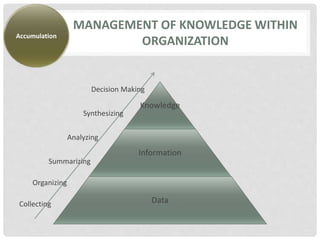
MANAGEMENT OF KNOWLEDGE WITHIN
ORGANIZATION
Accumulation
Knowledge
Information
Data
Collecting
Synthesizing
Analyzing
Summarizing
Organizing
Decision Making
KNOWLEDGE MANAGEMENT
Process to help organization identify, select, organize, disseminate,
transfer information
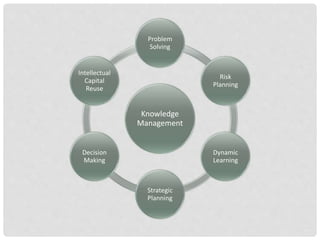
Knowledge
Management
Problem
Solving
Risk
Planning
Dynamic
Learning
Strategic
Planning
Decision
Making
Intellectual
Capital
Reuse
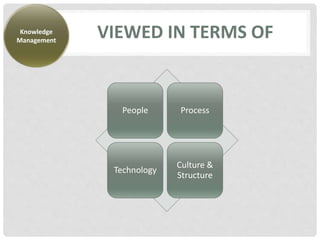
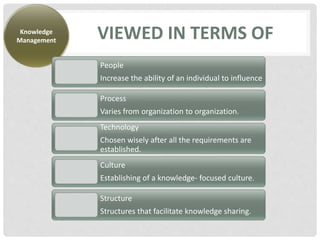
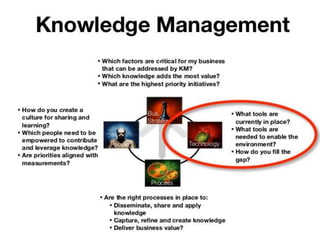
VIEWED IN TERMS OF
Knowledge
Management
People Process
Technology
Culture &
Structure
VIEWED IN TERMS OF
Knowledge
Management
People
Increase the ability of an individual to influence
Process
Varies from organization to organization.
Technology
Chosen wisely after all the requirements are
established.
Culture
Establishing of a knowledge- focused culture.
Structure
Structures that facilitate knowledge sharing.
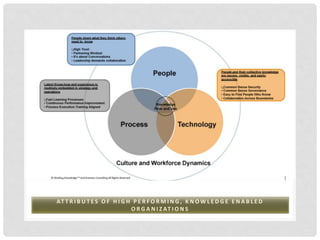
AT T R I B U T E S O F H I G H P E R F O R M I N G , K N O W L E D G E E N A B L E D
O R G A N I Z AT I O N S
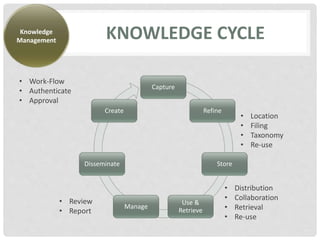
KNOWLEDGE CYCLE
Knowledge
Management
Capture
Refine
Store
Use &
Retrieve
Manage
Disseminate
Create
• Review
• Report
• Distribution
• Collaboration
• Retrieval
• Re-use
• Location
• Filing
• Taxonomy
• Re-use
• Work-Flow
• Authenticate
• Approval
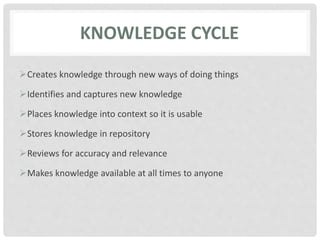
KNOWLEDGE CYCLE
Creates knowledge through new ways of doing things
Identifies and captures new knowledge
Places knowledge into context so it is usable
Stores knowledge in repository
Reviews for accuracy and relevance
Makes knowledge available at all times to anyone
BENEFITS OF KNOWLEDGE
MANAGEMENT
Improves quality of service to users
improves user satisfaction
Increases adoption of self service
Higher first call resolution rates
Reduces time to diagnose incidents and problems
Reduction in training time and costs
Speeds up adoption of new or changed services
Increases responsiveness to changing business demands
TWO TYPES OF KNOWLEDGE
EXPLICIT
Documented information that
can facilitate action.
Formal or codified
Documents: reports, policy
manuals, white papers,
standard procedures
Databases
 Books, magazines, journals
IMPLICIT (TACIT)
Learned only by experience, and
communicated only indirectly,
through metaphor and analogy.
Informal and un-codified
Values, perspectives & culture
Knowledge in heads
Memories of staff, suppliers and
vendors
Knowledge informs decisions and actions
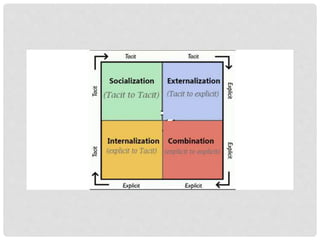
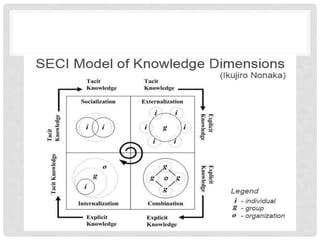
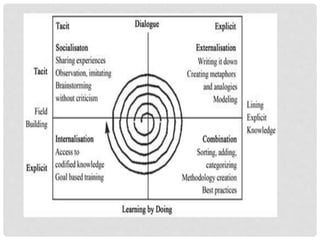
S E C I MODEL
FOUR MODES OF KNOWLEDGE
CONVERSION
Socialization (tacit to tacit)
Externalization (tacit to explicit)
Combination (explicit to explicit),
Internalization (explicit to tacit).
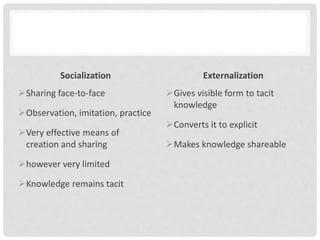
Socialization
Sharing face-to-face
Observation, imitation, practice
Very effective means of
creation and sharing
however very limited
Knowledge remains tacit
Externalization
Gives visible form to tacit
knowledge
Converts it to explicit
Makes knowledge shareable
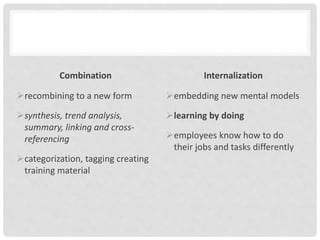
Combination
embedding new mental models
learning by doing
employees know how to do
their jobs and tasks differently
Internalization
recombining to a new form
synthesis, trend analysis,
summary, linking and cross-
referencing
categorization, tagging creating
training material
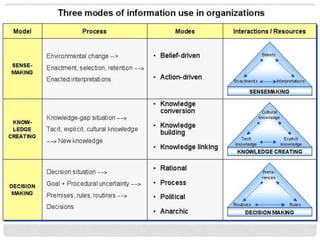
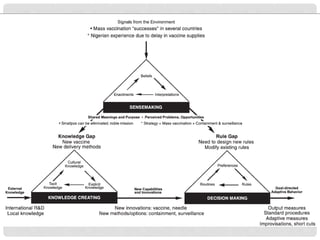
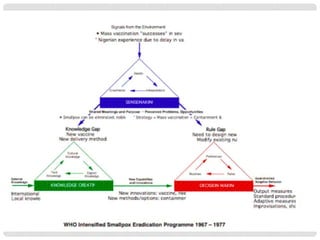
SENSE MAKING MODEL
CHOO
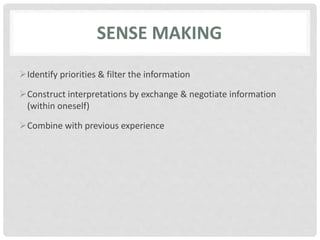
SENSE MAKING
Identify priorities & filter the information
Construct interpretations by exchange & negotiate information
(within oneself)
Combine with previous experience
INTEGRATED PROCESS OF SENSE
MAKING
Ecological change (external trigger of internal change
Enactment (construct, rearrange, clarify, single out)
Selection and Retention (interpret &observe rationale changes)
Retention ( provide organization with new experiences)
KNOWLEDGE CREATING
Viewed as the transformation of personal knowledge between
individuals through dialogue, discourse, sharing, & storytelling.
Directed by a knowledge vision of ―as is‖ (current situation) & ―to
be‖ (future, desired state).
Widens the spectrum of potential choices in decision making by
providing new knowledge & new competencies.
Feeds the decision-making process with innovative strategies that
extend the organization‘s capability to make informed, rational
decisions.
DECISION MAKING
Situated in rational decision-making models that are used to identify
and evaluate alternatives by processing the information and
knowledge collected to date.
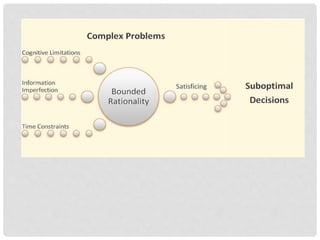
Bounded rationality characterized by individual use of limited
information analysis, evaluation and processing, shortcuts and rules
of thumb (sometimes called heuristics), and ―satisficing‖ behavior,
which means it may not be fully optimized but it is good enough.
Yb knowledge management

Yb knowledge management

  • 1.
    G R EAT OX Y M O R O N KNOWLEDGE MANAGEMENT PRESENTED BY: SANDEEP MENGHANI
  • 2.
    SANDEEP MENGHANI Industry Psychologist YeshaswiBhav Training & Management Solutions  An articulate communicator possessing the ability to effectively interact with diverse populations of individuals at a variety of corporate/ academic levels.  Dedicated experience in formulating and implementing operational strategies and control systems to achieve business objectives.  Keen strategist, adept at creating innovative strategies and formulating administrative policies for accelerated growth of the organization and cost optimization with expertise in entire operations involving General Management and Administration.
  • 3.
    KNOWLEDGE MANAGEMENT Multi- disciplinedapproach to achieve organizational objectives by making the best use of knowledge. Focuses on processes such as acquiring, creating and sharing knowledge and the cultural and technical foundations that support them. Provides the right information to the right people at the right time to enable informed decision making. Enables service providers to be more efficient and improve the quality of service delivered.
  • 4.
    MANAGEMENT OF KNOWLEDGEWITHIN ORGANIZATION Accumulation Knowledge Information Data Collecting Synthesizing Analyzing Summarizing Organizing Decision Making
  • 5.
    KNOWLEDGE MANAGEMENT Process tohelp organization identify, select, organize, disseminate, transfer information
  • 7.
  • 8.
    VIEWED IN TERMSOF Knowledge Management People Process Technology Culture & Structure
  • 9.
    VIEWED IN TERMSOF Knowledge Management People Increase the ability of an individual to influence Process Varies from organization to organization. Technology Chosen wisely after all the requirements are established. Culture Establishing of a knowledge- focused culture. Structure Structures that facilitate knowledge sharing.
  • 10.
    AT T RI B U T E S O F H I G H P E R F O R M I N G , K N O W L E D G E E N A B L E D O R G A N I Z AT I O N S
  • 11.
    KNOWLEDGE CYCLE Knowledge Management Capture Refine Store Use & Retrieve Manage Disseminate Create •Review • Report • Distribution • Collaboration • Retrieval • Re-use • Location • Filing • Taxonomy • Re-use • Work-Flow • Authenticate • Approval
  • 12.
    KNOWLEDGE CYCLE Creates knowledgethrough new ways of doing things Identifies and captures new knowledge Places knowledge into context so it is usable Stores knowledge in repository Reviews for accuracy and relevance Makes knowledge available at all times to anyone
  • 13.
    BENEFITS OF KNOWLEDGE MANAGEMENT Improvesquality of service to users improves user satisfaction Increases adoption of self service Higher first call resolution rates Reduces time to diagnose incidents and problems Reduction in training time and costs Speeds up adoption of new or changed services Increases responsiveness to changing business demands
  • 15.
    TWO TYPES OFKNOWLEDGE EXPLICIT Documented information that can facilitate action. Formal or codified Documents: reports, policy manuals, white papers, standard procedures Databases  Books, magazines, journals IMPLICIT (TACIT) Learned only by experience, and communicated only indirectly, through metaphor and analogy. Informal and un-codified Values, perspectives & culture Knowledge in heads Memories of staff, suppliers and vendors Knowledge informs decisions and actions
  • 16.
    S E CI MODEL
  • 17.
    FOUR MODES OFKNOWLEDGE CONVERSION Socialization (tacit to tacit) Externalization (tacit to explicit) Combination (explicit to explicit), Internalization (explicit to tacit).
  • 20.
    Socialization Sharing face-to-face Observation, imitation,practice Very effective means of creation and sharing however very limited Knowledge remains tacit Externalization Gives visible form to tacit knowledge Converts it to explicit Makes knowledge shareable
  • 21.
    Combination embedding new mentalmodels learning by doing employees know how to do their jobs and tasks differently Internalization recombining to a new form synthesis, trend analysis, summary, linking and cross- referencing categorization, tagging creating training material
  • 23.
  • 24.
    SENSE MAKING Identify priorities& filter the information Construct interpretations by exchange & negotiate information (within oneself) Combine with previous experience
  • 25.
    INTEGRATED PROCESS OFSENSE MAKING Ecological change (external trigger of internal change Enactment (construct, rearrange, clarify, single out) Selection and Retention (interpret &observe rationale changes) Retention ( provide organization with new experiences)
  • 26.
    KNOWLEDGE CREATING Viewed asthe transformation of personal knowledge between individuals through dialogue, discourse, sharing, & storytelling. Directed by a knowledge vision of ―as is‖ (current situation) & ―to be‖ (future, desired state). Widens the spectrum of potential choices in decision making by providing new knowledge & new competencies. Feeds the decision-making process with innovative strategies that extend the organization‘s capability to make informed, rational decisions.
  • 27.
    DECISION MAKING Situated inrational decision-making models that are used to identify and evaluate alternatives by processing the information and knowledge collected to date. Bounded rationality characterized by individual use of limited information analysis, evaluation and processing, shortcuts and rules of thumb (sometimes called heuristics), and ―satisficing‖ behavior, which means it may not be fully optimized but it is good enough.

Editor's Notes

  • #2 I think that every presentation regarding finance or investments has to be grounded in some type of metaphor. The right metaphor allows the audience to feel immediately comfortable with the presentation even though they may not have much prior knowledge on the subject matter. To me, sailing has always seemed to provide just the right terms to describe both the planning and patience required of a successful investor. Whether it be “charting the course” of an investment plan or having the patience required to navigate choppy markets, sailing and investing can make for a compelling presentation. Disclaimer: You understand that Microsoft does not endorse or control the content provided in the following presentation. Microsoft provides this content to you for informational purposes only; it is not intended to be relied upon as business or financial advice. Microsoft does not guarantee or otherwise warrant the accuracy or validity of this information and encourages you to consult with a business or financial professional as appropriate.
  • #3 As one of the largest fee-only investment managers in the state of Georgia, our job is to help you chart out your own course to retirement. Here, presenters should place their credibility statement, education, title, and/or years of experience.
  • #4 This slide lets the audience know that everyone is at “some stage” of retirement planning.
  • #5 As you’re accumulating, this is a logical order in which to contribute to your commonly-used retirement savings vehicles. Financial professionals should feel free to customize their own hierarchy so that the audience has a clear, visual understanding of how investment “blocks” should build on each other.
  • #6 This slide lets the audience know that everyone is at “some stage” of retirement planning.
  • #8 This slide lays out the overall objective of the presentation; which is how to achieve or start working towards a “successful retirement”. It starts with a “written financial plan”, and moves clock-wise – all centered around the main goal. On this continuum, buttons can be added or removed, depending upon the financial professional giving the presentation. A successful retirement plan has many moving parts and each of them must serve a unique function in carrying you to retirement. Regardless of your situation, the journey to retirement is likely dotted with some storms and choppy seas along the way. Here, I have laid out what I believe to be the very basic principles necessary for any successful retirement plan.
  • #9 This slide begins with “written financial plan”, which is a critical step in being able to navigate any path towards retirement. In any financial presentation, it is important to help the audience establish and understand their goals. Understanding this process is to “chart the course” for each individual in the room. Every financial professional should have a different take on this, but typically there will be between two and three planning phases for a given audience/client. If three goals are needed, you can simply add to the graphic. Financial professionals should feel free to customize the language labeled in bullet points for each phase. Note: To add another goal to the SmartArt graphic on this slide, click in the graphic to activate the SmartArt text pane. Click at the end of the last bullet in the pane, press Enter, and the press Shift+Tab to start another first-level bullet. A new section will be added to the graphic automatically and existing elements automatically resized. To add the items under the new goal, press Enter in the text pane to create a new paragraph and then press Tab to demote the new paragraph to the second level.
  • #10 This slide begins with “written financial plan”, which is a critical step in being able to navigate any path towards retirement. In any financial presentation, it is important to help the audience establish and understand their goals. Understanding this process is to “chart the course” for each individual in the room. Every financial professional should have a different take on this, but typically there will be between two and three planning phases for a given audience/client. If three goals are needed, you can simply add to the graphic. Financial professionals should feel free to customize the language labeled in bullet points for each phase. Note: To add another goal to the SmartArt graphic on this slide, click in the graphic to activate the SmartArt text pane. Click at the end of the last bullet in the pane, press Enter, and the press Shift+Tab to start another first-level bullet. A new section will be added to the graphic automatically and existing elements automatically resized. To add the items under the new goal, press Enter in the text pane to create a new paragraph and then press Tab to demote the new paragraph to the second level.
  • #12 This slide begins with “written financial plan”, which is a critical step in being able to navigate any path towards retirement. In any financial presentation, it is important to help the audience establish and understand their goals. Understanding this process is to “chart the course” for each individual in the room. Every financial professional should have a different take on this, but typically there will be between two and three planning phases for a given audience/client. If three goals are needed, you can simply add to the graphic. Financial professionals should feel free to customize the language labeled in bullet points for each phase. Note: To add another goal to the SmartArt graphic on this slide, click in the graphic to activate the SmartArt text pane. Click at the end of the last bullet in the pane, press Enter, and the press Shift+Tab to start another first-level bullet. A new section will be added to the graphic automatically and existing elements automatically resized. To add the items under the new goal, press Enter in the text pane to create a new paragraph and then press Tab to demote the new paragraph to the second level.