Company Profile
Corporate Name
YAKULT HONSHA CO., LTD.
Founder
DR. MINORU SHIROTA
Founded in
1935 IN FUKUOKA CITY, KYUSHU
Date incorporated
APRIL 9, 1955
Head office
1-19 HIGASHI SHIMBASHI 1-
CHOME, MINATO- KU, TOKYO,
JAPAN
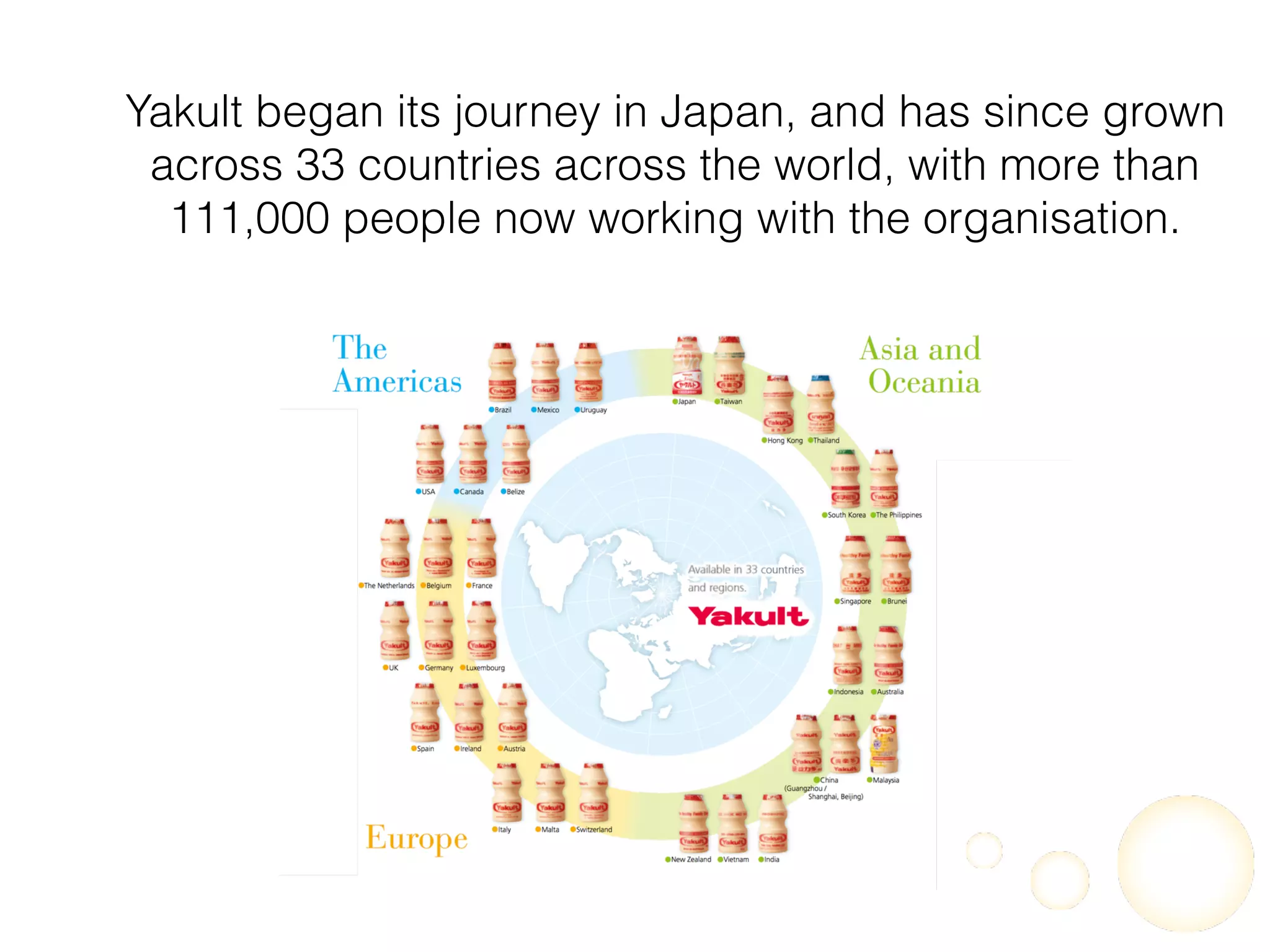
Yakult began its journey in Japan, and has since grown
across 33 countries across the world, with more than
111,000 people now working with the organisation.
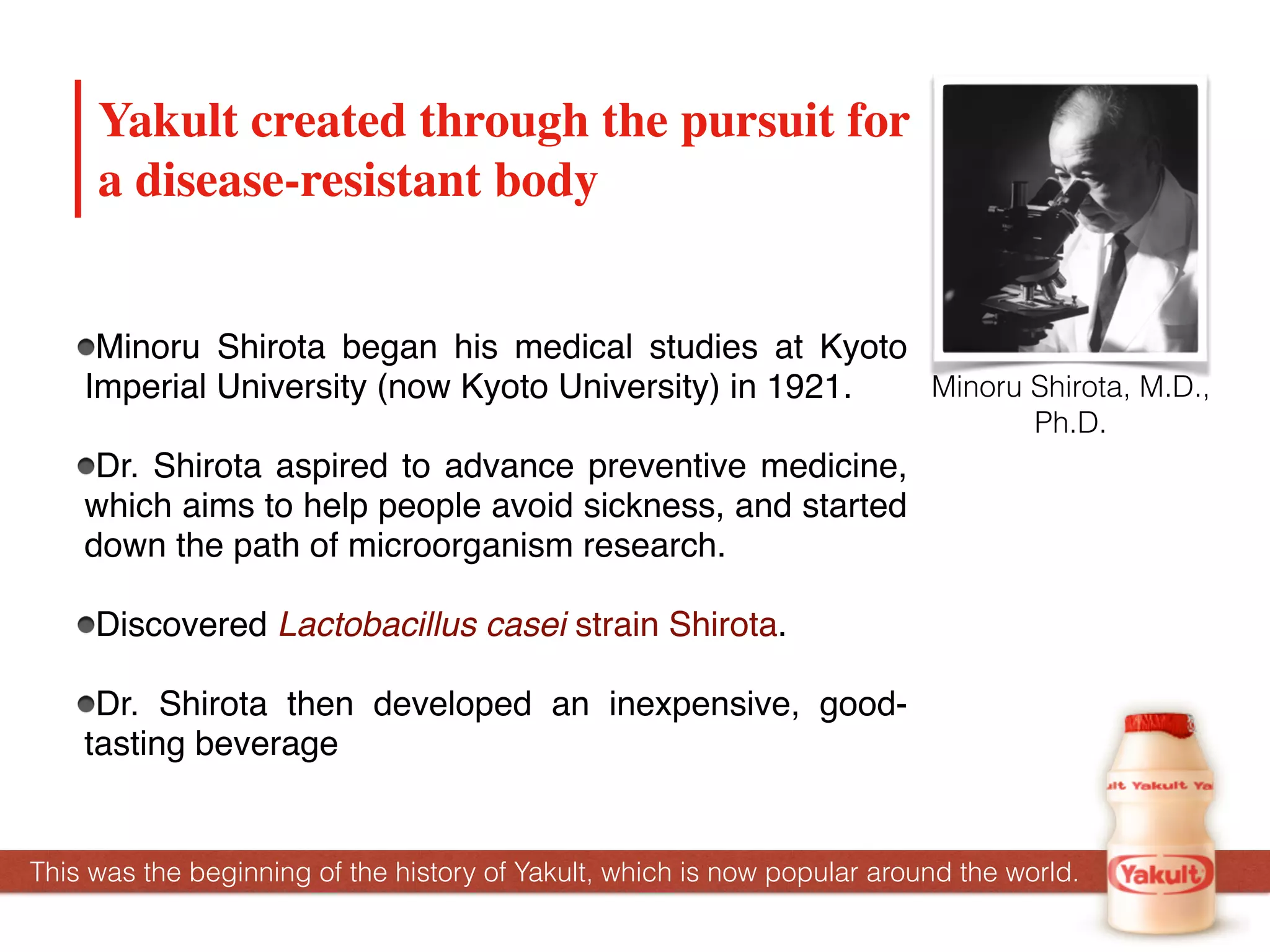
Minoru Shirota began his medical studies at Kyoto
Imperial University (now Kyoto University) in 1921.
Dr. Shirota aspired to advance preventive medicine,
which aims to help people avoid sickness, and started
down the path of microorganism research.
Discovered Lactobacillus casei strain Shirota.
Dr. Shirota then developed an inexpensive, good-
tasting beverage
Yakult created through the pursuit for
a disease-resistant body
Minoru Shirota, M.D.,
Ph.D.
This was the beginning of the history of Yakult, which is now popular around the world.
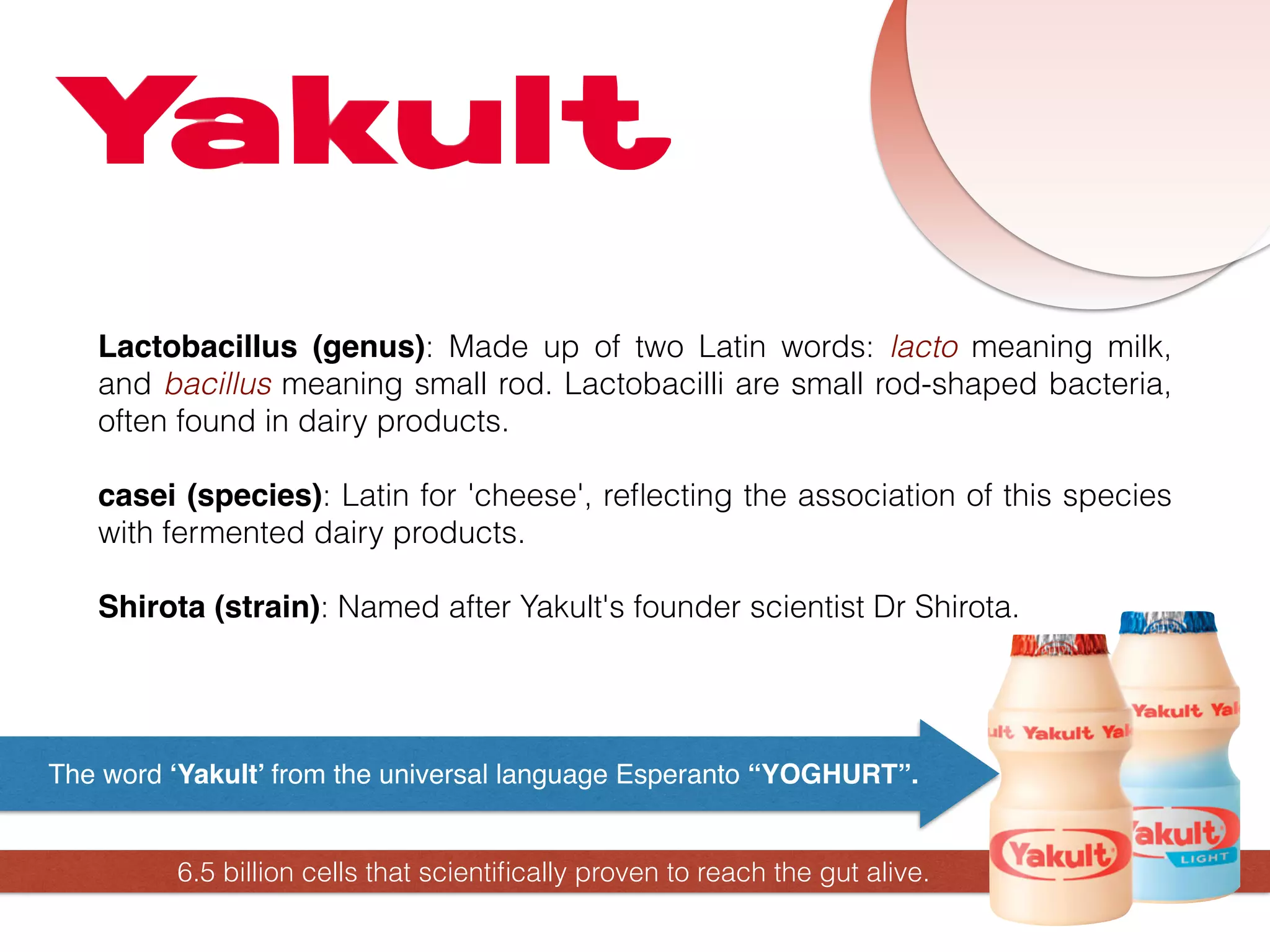
The word ‘Yakult’ from the universal language Esperanto “YOGHURT”.
Lactobacillus (genus): Made up of two Latin words: lacto meaning milk,
and bacillus meaning small rod. Lactobacilli are small rod-shaped bacteria,
often found in dairy products.
casei (species): Latin for 'cheese', reflecting the association of this species
with fermented dairy products.
Shirota (strain): Named after Yakult's founder scientist Dr Shirota.
6.5 billion cells that scientifically proven to reach the gut alive.
The global corporate philosophy of the Yakult Group is:
"We contribute to the health and happiness of people
around the world through the pursuit of excellence in
life sciences in general and our research and
experience in microorganisms in particular."
Mission and Goal
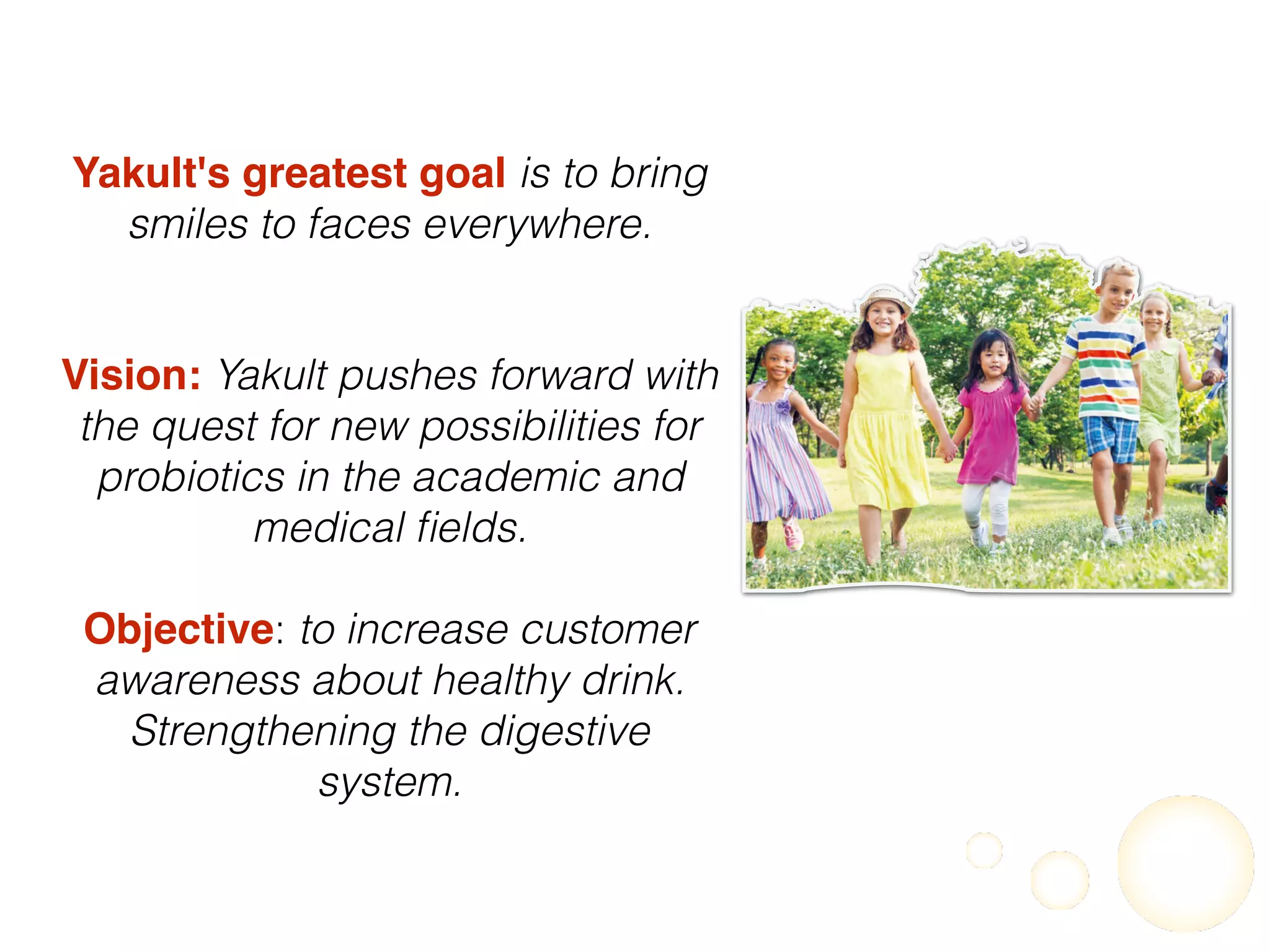
Yakult's greatest goal is to bring
smiles to faces everywhere.
Vision: Yakult pushes forward with
the quest for new possibilities for
probiotics in the academic and
medical fields.
Objective: to increase customer
awareness about healthy drink.
Strengthening the digestive
system.
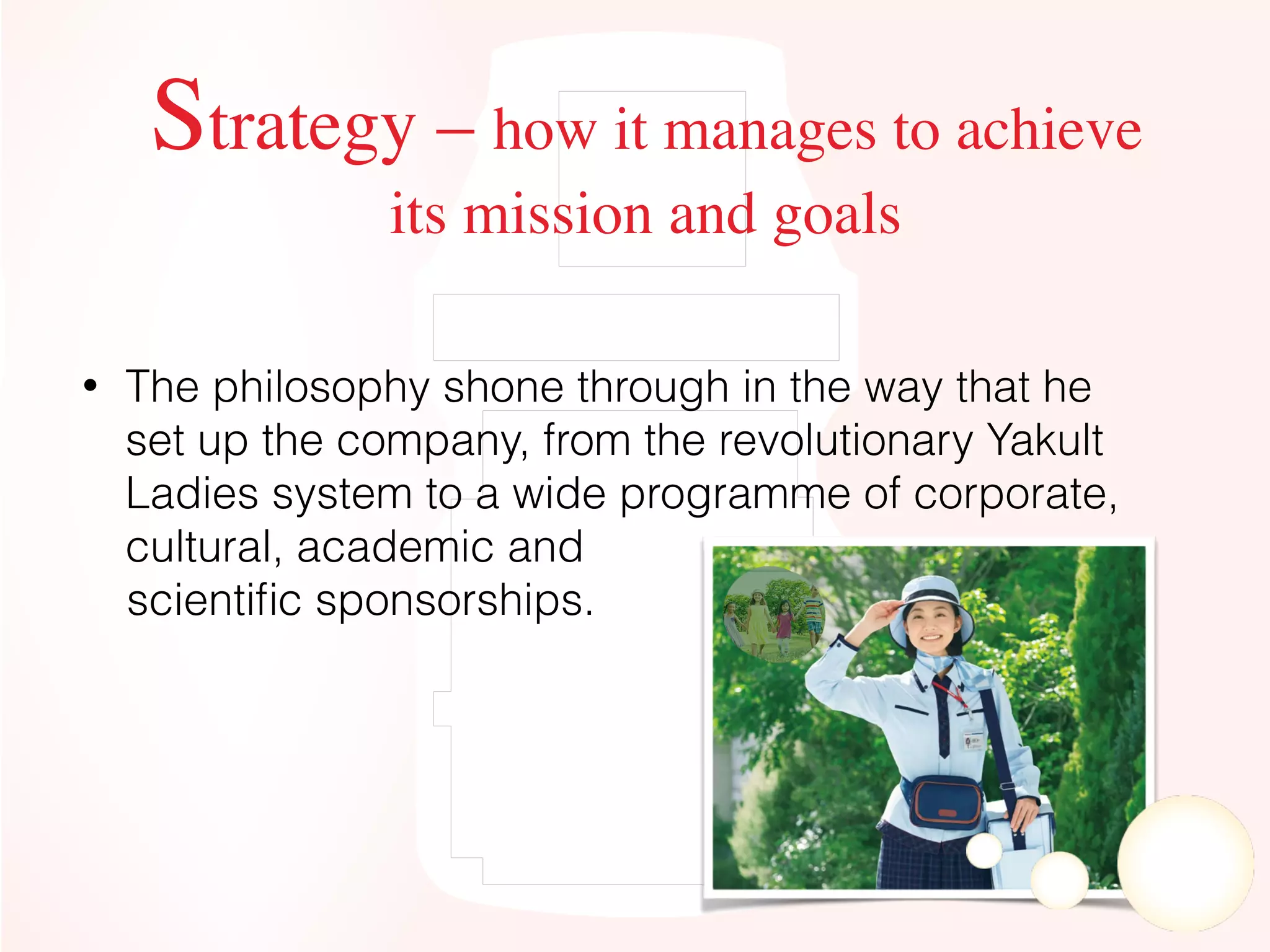
• The philosophy shone through in the way that he
set up the company, from the revolutionary Yakult
Ladies system to a wide programme of corporate,
cultural, academic and
scientific sponsorships.
Strategy – how it manages to achieve
its mission and goals
• Yakult gives affordable selling
price to most of the people in the
community so people can get
better health with an affordable
cost
A healthy life for as
many people as
possible.
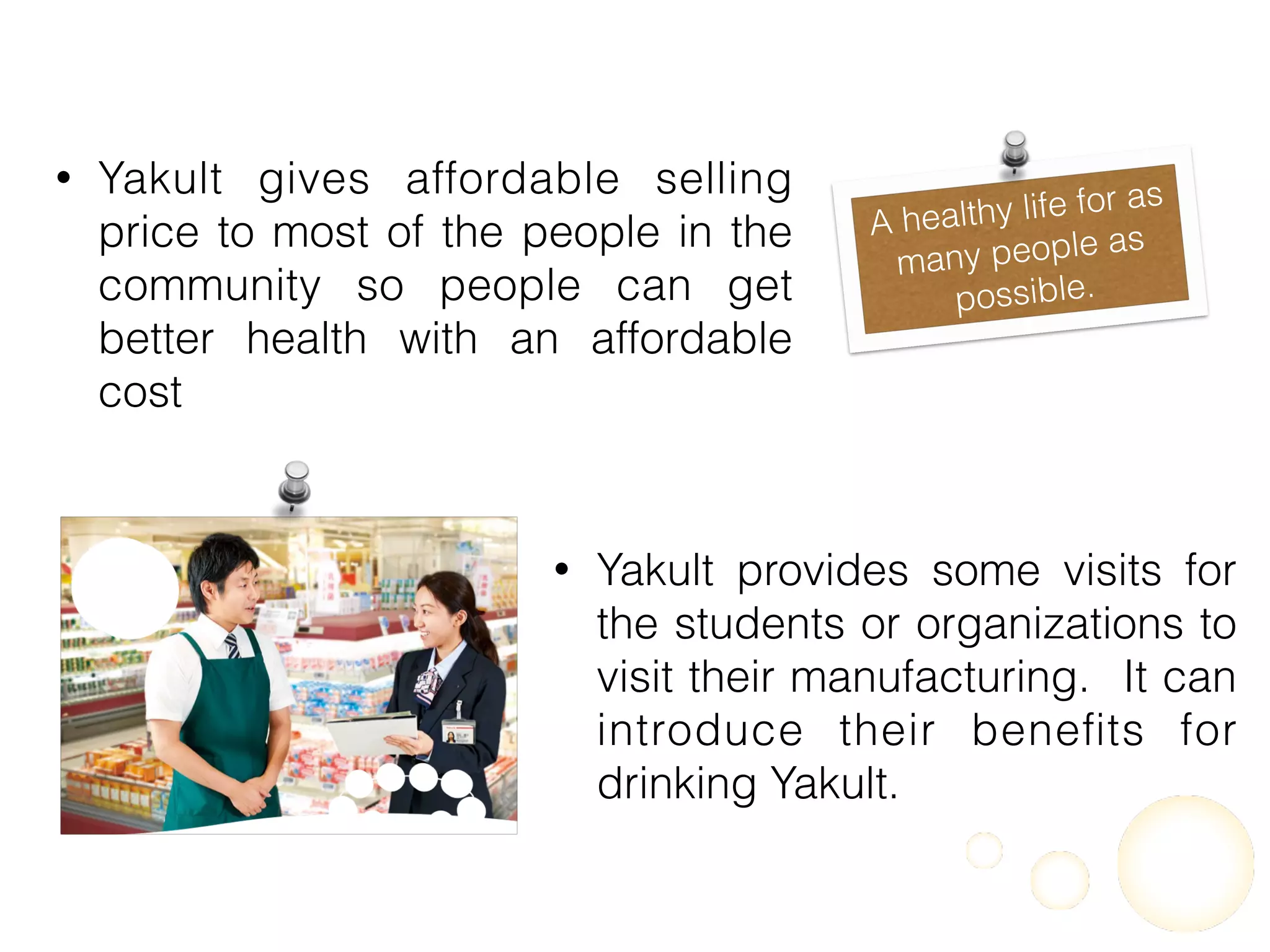
• Yakult provides some visits for
the students or organizations to
visit their manufacturing. It can
introduce their benefits for
drinking Yakult.
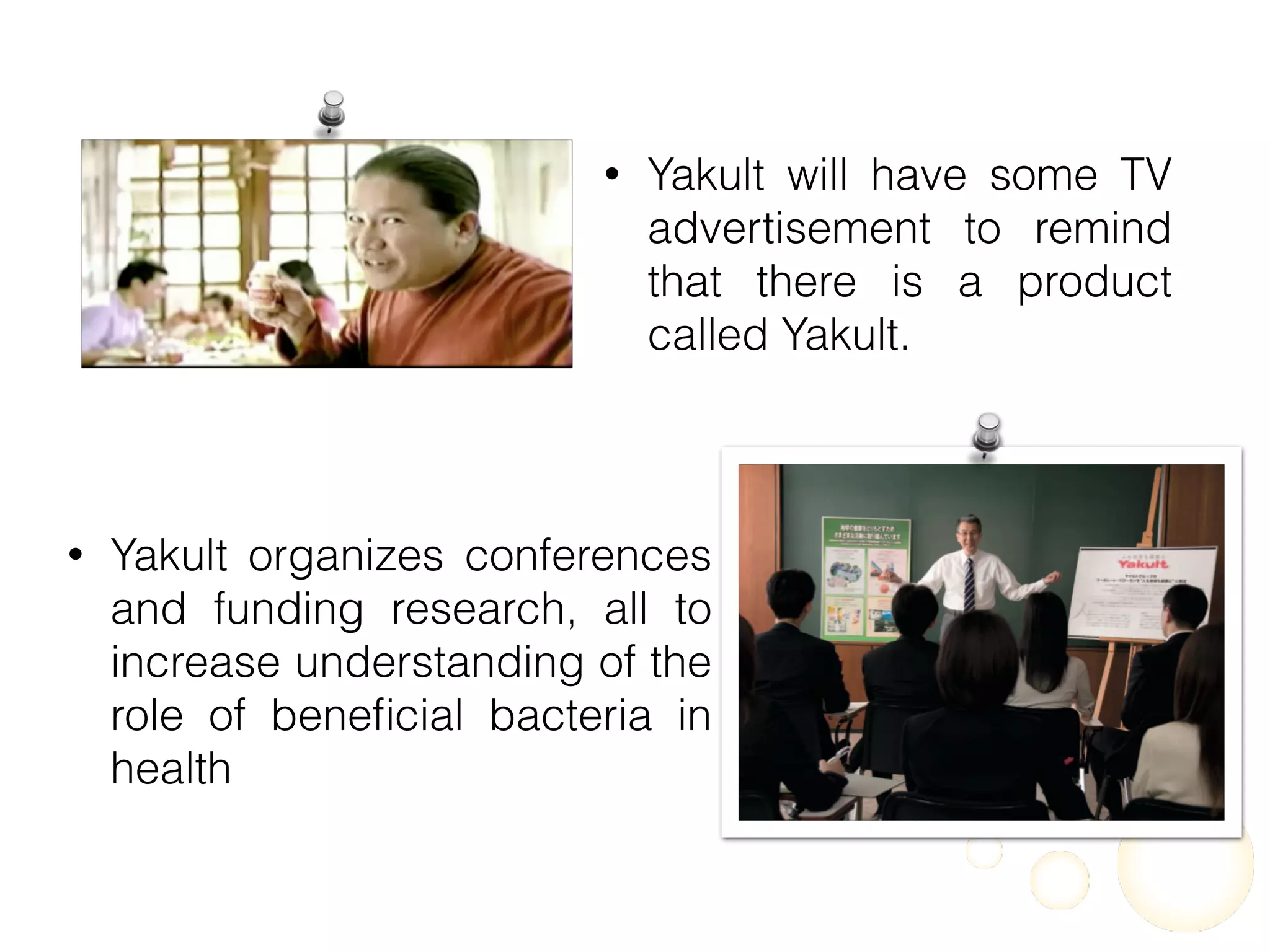
• Yakult will have some TV
advertisement to remind
that there is a product
called Yakult.
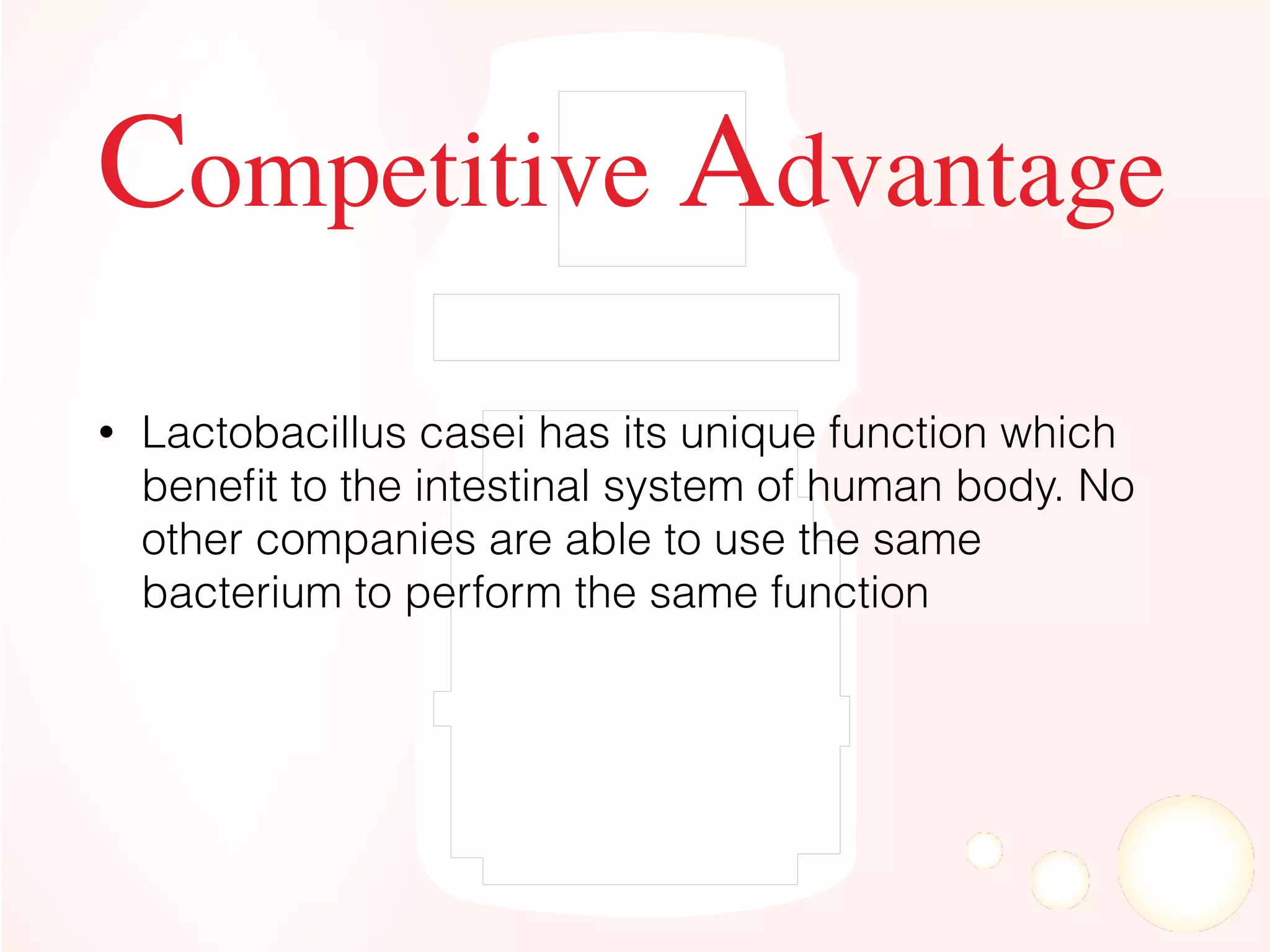
• Yakult organizes conferences
and funding research, all to
increase understanding of the
role of beneficial bacteria in
health
Yakult is actively working to
convey the value of probiotics
to people around the world and
advance the globalization of its
operations.
Competitive Advantage
• Lactobacillus casei has its unique function which
benefit to the intestinal system of human body. No
other companies are able to use the same
bacterium to perform the same function
• Function of the bacteria, Yakult discovered, brings a
unique effect in human body which is different from
the result bought by other healthy drinks.
• Unique Packaging
• The history of the company
is also a promise of product quality.
SWOT Analysis
Internal Analysis: Strengths and Seaknesses
External Analysis: Opportunity and Threats
Customer-based assets
• Brand reputation
• Originality
(in consumers’ mind)
• Superior taste
(ref. survey)
• Direct relationship with
customers
Supply chain
assets
• Distribution
uniqueness
Internal support assets
• Setting up dept. for
specific operations
• Patents of
Lactobasillus
• Economy of scale –
market leader
• Production expertise
(but with limited
capacity)
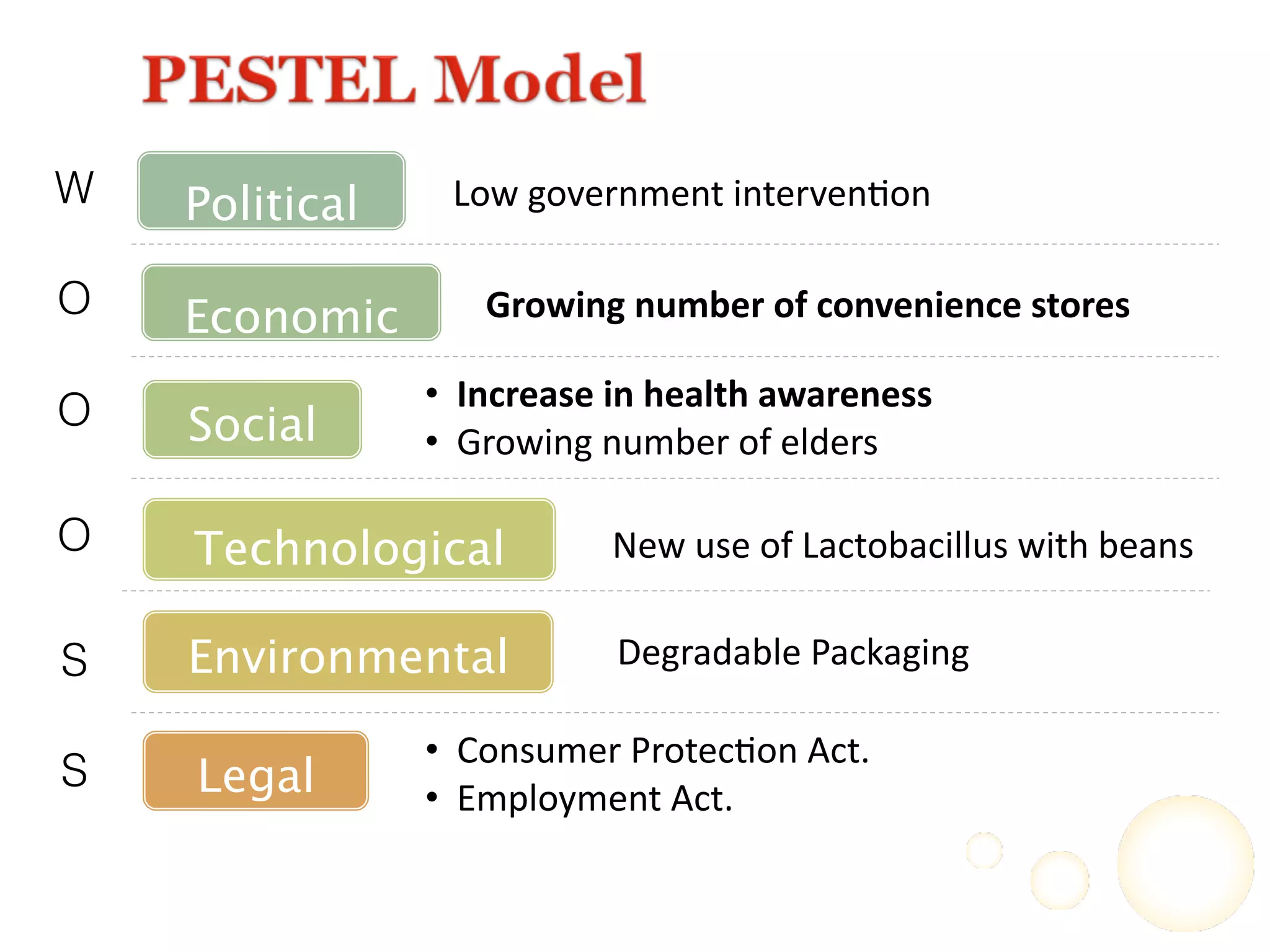
Political
Economic
Social
Technological
Environmental
Legal
Low$government$interven-on$
Growing(number(of(convenience(stores(
• $$Increase(in(health(awareness((
• $$Growing$number$of$elders$
New$use$of$Lactobacillus$with$beans$
Degradable$Packaging$
• $$Consumer$Protec-on$Act.$
• $$Employment$Act.$
S
O
O
W
O
S
Strengths Vs. Weaknesses
High Brand Awareness
Limited flavor
Strong brand reputation with
health benefits
Storage Difficulty (Temperature)
Limited Distribution Channel
Opportunities Vs. Threats
Trend in health concerns
Competitors provide many flavors,
packaging, and promotions
Increase in number of
convenience stores and
hypermarkets
Expiration of lactobacillus patent
gives rise to new competitors
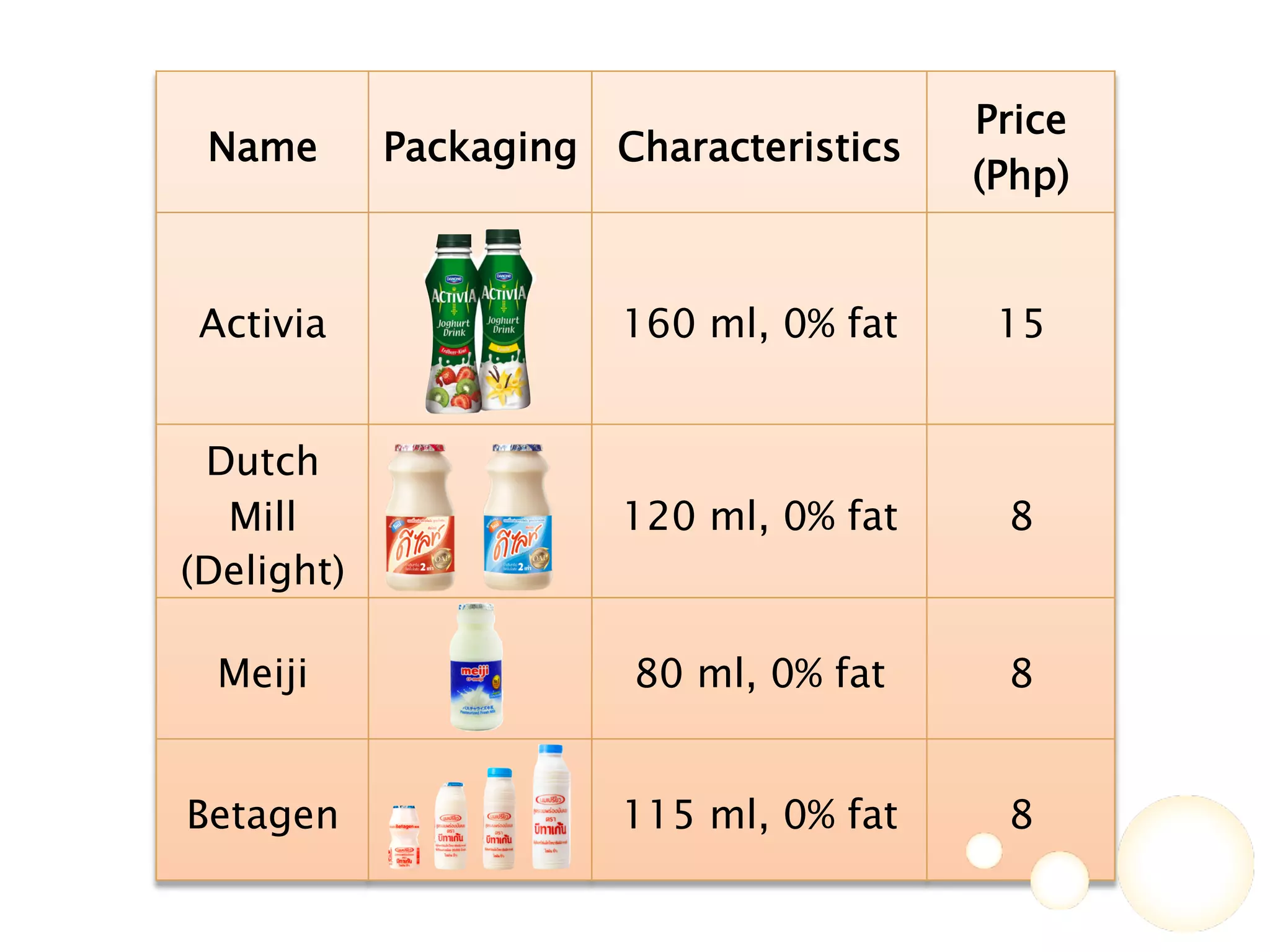
Name! Packaging! Characteristics!
Price
(Php)!
Activia! 160 ml, 0% fat! 15!
Dutch
Mill
(Delight)!
120 ml, 0% fat! 8!
Meiji! 80 ml, 0% fat! 8!
Betagen! 115 ml, 0% fat! 8!
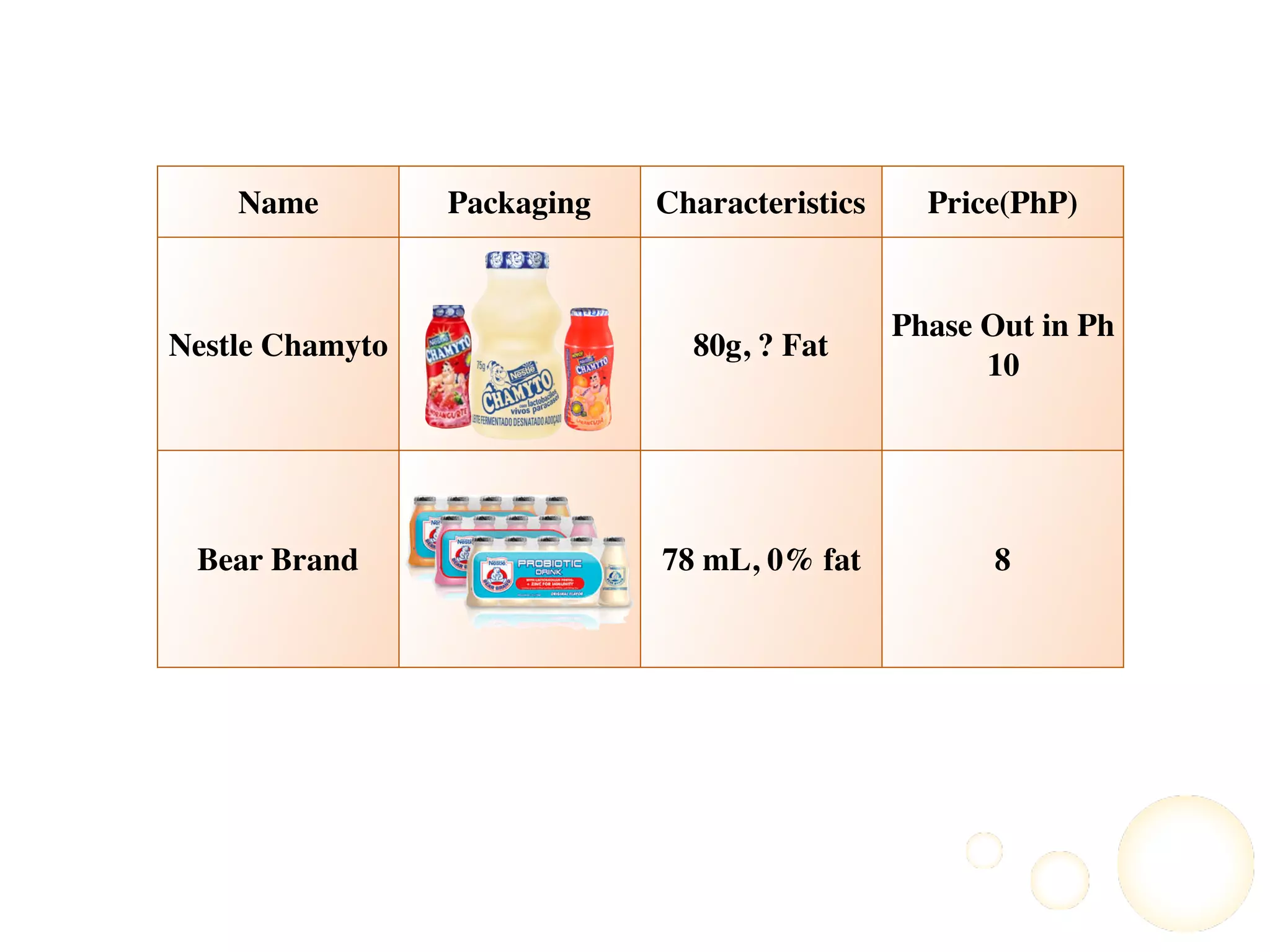
Name Packaging Characteristics Price(PhP)
Nestle Chamyto 80g, ? Fat
Phase Out in Ph
10
Bear Brand 78 mL, 0% fat 8
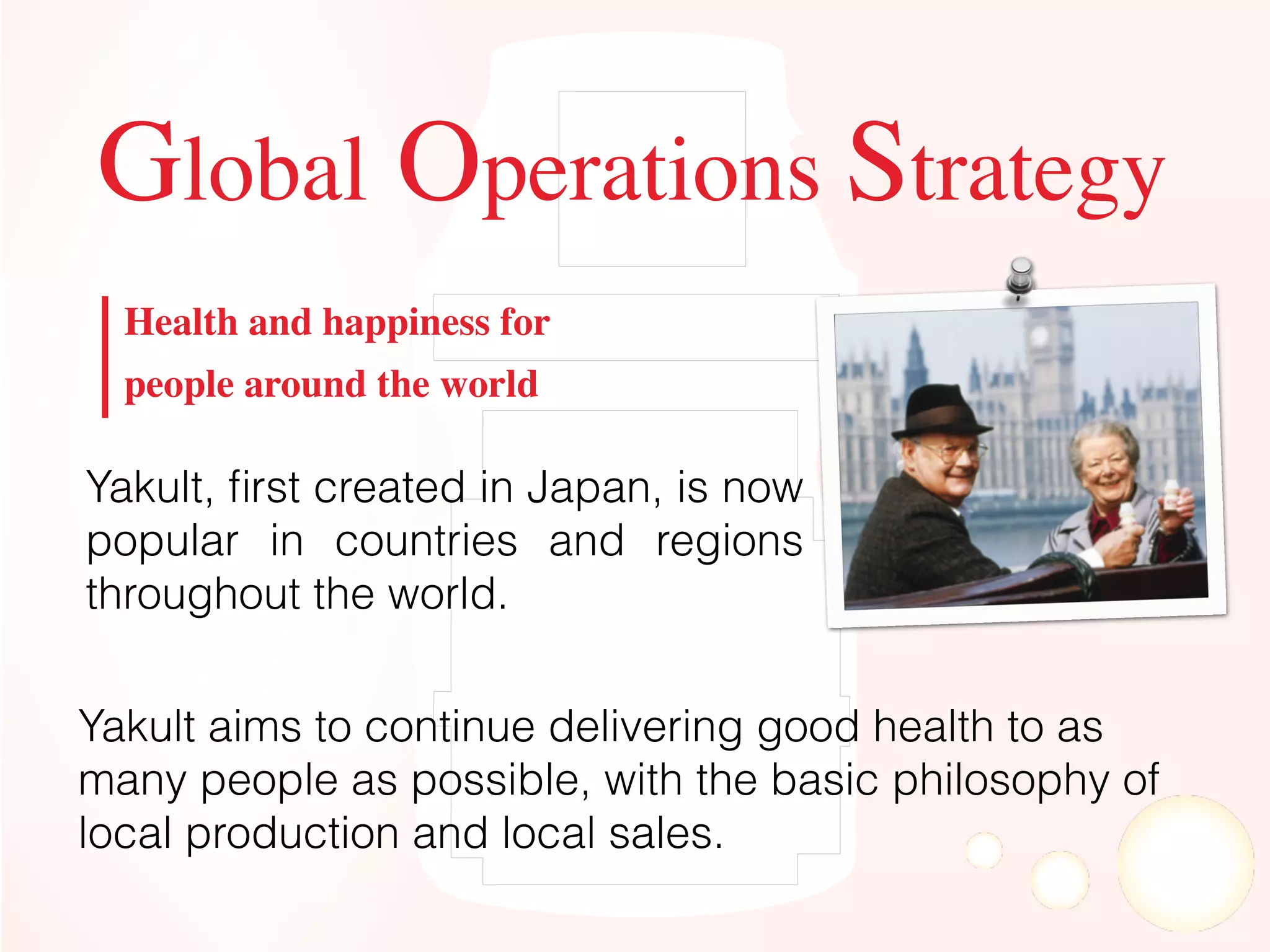
Global Operations Strategy
Health and happiness for
people around the world
Yakult, first created in Japan, is now
popular in countries and regions
throughout the world.
Yakult aims to continue delivering good health to as
many people as possible, with the basic philosophy of
local production and local sales.
• Yakult began its overseas expansion in 1964, guided
by founder Minoru Shirota’s vision of “protecting the
health of people around the world.”
• This 2015, Yakult conducts sales in 33 countries and
regions including Japan, and operates 27 overseas
business locations.
*As of December 2014. Number of Yakult dairy products consumed per day: Average for 2014
• Over 43,400 Yakult Ladies ,
505,600 stores handle our
products,approximately
25.2 million Yakult dairy
products are consumed per
day.
Going forward, Yakult will continue to work to
convey the value of Yakult probiotic drinks to people
around the world. Yakult steadily widening the ring
of Yakult consumers, continually pursuing the
achievement of its mission to contribute to the
health and happiness of people around the world
Yakult, a Global
Brand That is Loved
Worldwide
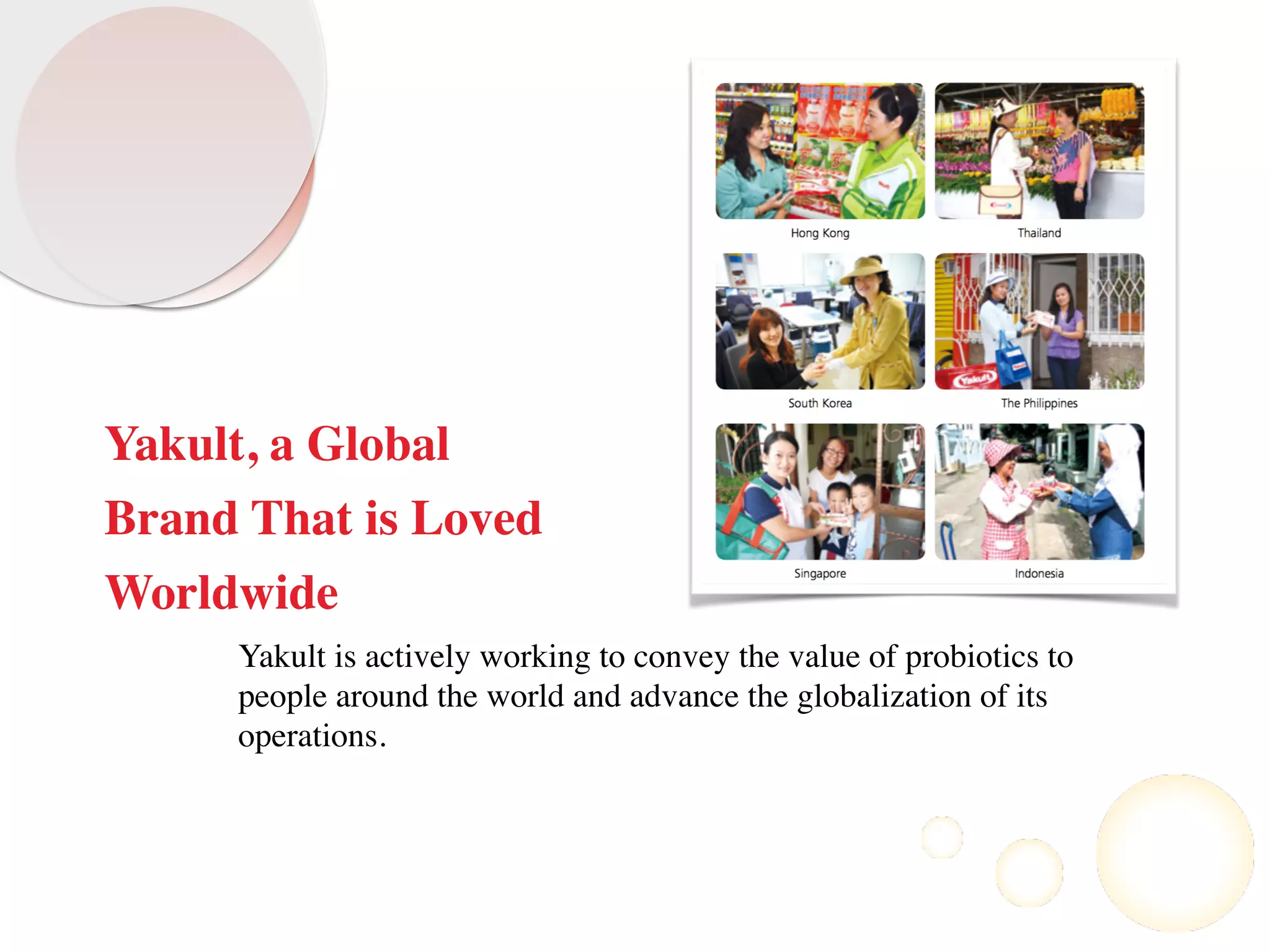
Yakult is actively working to convey the value of probiotics to
people around the world and advance the globalization of its
operations.
Issues in Operations Strategy
• Yakult does not try to expand its product line with
more flavor or different drinks in other countries.
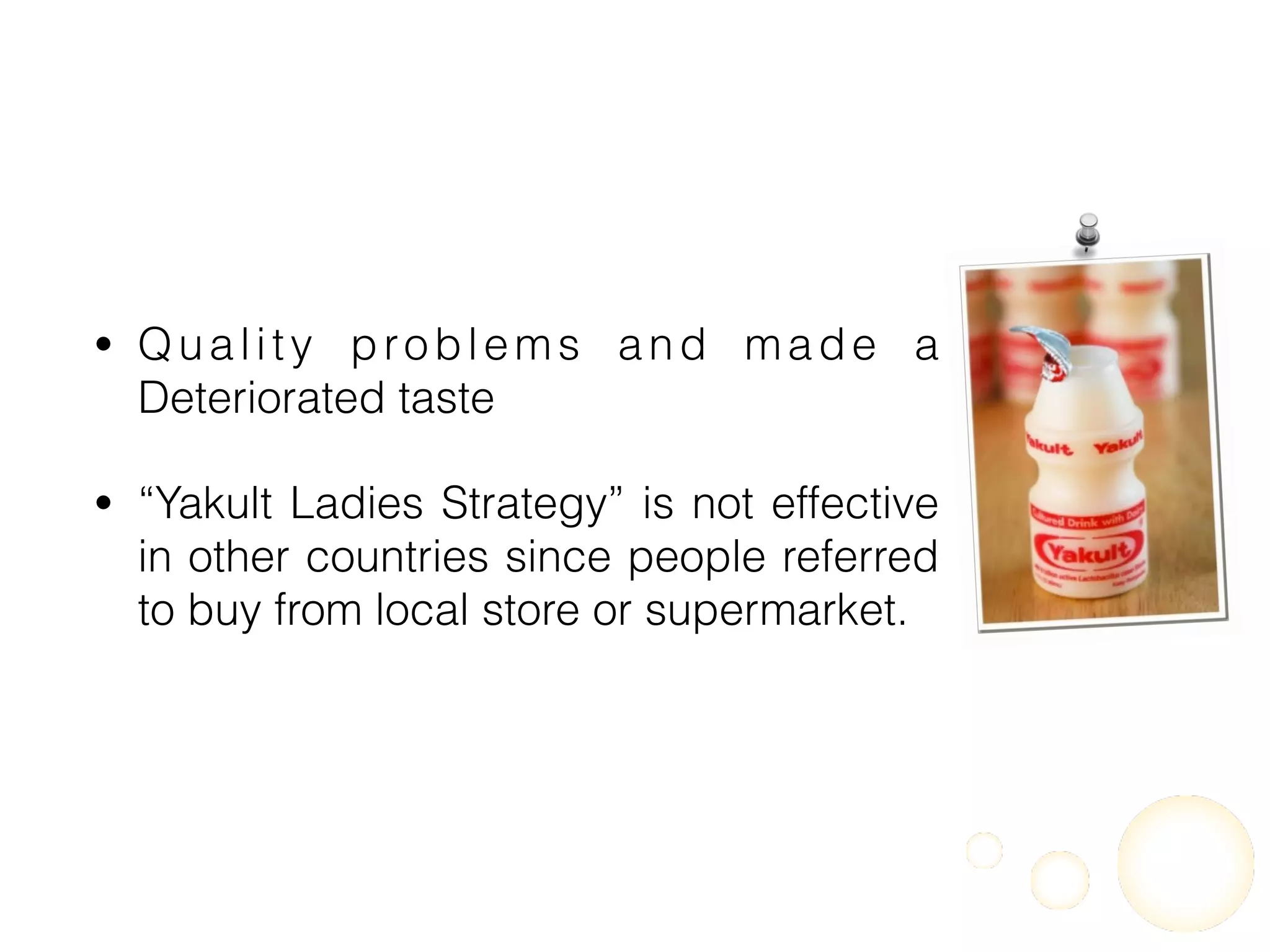
• Quality problems and made a
Deteriorated taste
• “Yakult Ladies Strategy” is not effective
in other countries since people referred
to buy from local store or supermarket.
Conclusions and Recommendations/
Suggested Solutions to Issues
• Follow up to ensure the execution is taking place as planned. Seek
input from staff at all levels and throughout various divisions of the
company. Without frequent communication with -- and feedback from
-- staff, the business can't adjust course when necessary. Continuous
assessment and follow-up is essential to maintain a competitive
advantage. Frequently adjust the operational strategy in response to
significant internal and external opportunities and threats.
• To prevent deteriorated taste, Yakult can preserve for a month after
the production, the expired Yakult will be collected from the store and
dispose afterwards.
• Other ways it could use to improve itself, is by getting more
innovative in launching new product of the same type, which may
include the packaging design, or information details.
Presented by:
Ray Anthony Bulan
May Ann Ballera
Rholin Grace Bulan

Yakult Operation Management simple presentation

  • 2.
    Company Profile Corporate Name YAKULTHONSHA CO., LTD. Founder DR. MINORU SHIROTA Founded in 1935 IN FUKUOKA CITY, KYUSHU Date incorporated APRIL 9, 1955 Head office 1-19 HIGASHI SHIMBASHI 1- CHOME, MINATO- KU, TOKYO, JAPAN
  • 3.
    Yakult began itsjourney in Japan, and has since grown across 33 countries across the world, with more than 111,000 people now working with the organisation.
  • 4.
    Minoru Shirota beganhis medical studies at Kyoto Imperial University (now Kyoto University) in 1921. Dr. Shirota aspired to advance preventive medicine, which aims to help people avoid sickness, and started down the path of microorganism research. Discovered Lactobacillus casei strain Shirota. Dr. Shirota then developed an inexpensive, good- tasting beverage Yakult created through the pursuit for a disease-resistant body Minoru Shirota, M.D., Ph.D. This was the beginning of the history of Yakult, which is now popular around the world.
  • 5.
    The word ‘Yakult’from the universal language Esperanto “YOGHURT”. Lactobacillus (genus): Made up of two Latin words: lacto meaning milk, and bacillus meaning small rod. Lactobacilli are small rod-shaped bacteria, often found in dairy products. casei (species): Latin for 'cheese', reflecting the association of this species with fermented dairy products. Shirota (strain): Named after Yakult's founder scientist Dr Shirota. 6.5 billion cells that scientifically proven to reach the gut alive.
  • 7.
    The global corporatephilosophy of the Yakult Group is: "We contribute to the health and happiness of people around the world through the pursuit of excellence in life sciences in general and our research and experience in microorganisms in particular." Mission and Goal
  • 8.
    Yakult's greatest goalis to bring smiles to faces everywhere. Vision: Yakult pushes forward with the quest for new possibilities for probiotics in the academic and medical fields. Objective: to increase customer awareness about healthy drink. Strengthening the digestive system.
  • 9.
    • The philosophyshone through in the way that he set up the company, from the revolutionary Yakult Ladies system to a wide programme of corporate, cultural, academic and scientific sponsorships. Strategy – how it manages to achieve its mission and goals
  • 10.
    • Yakult givesaffordable selling price to most of the people in the community so people can get better health with an affordable cost A healthy life for as many people as possible. • Yakult provides some visits for the students or organizations to visit their manufacturing. It can introduce their benefits for drinking Yakult.
  • 11.
    • Yakult willhave some TV advertisement to remind that there is a product called Yakult. • Yakult organizes conferences and funding research, all to increase understanding of the role of beneficial bacteria in health
  • 12.
    Yakult is activelyworking to convey the value of probiotics to people around the world and advance the globalization of its operations.
  • 13.
    Competitive Advantage • Lactobacilluscasei has its unique function which benefit to the intestinal system of human body. No other companies are able to use the same bacterium to perform the same function
  • 14.
    • Function ofthe bacteria, Yakult discovered, brings a unique effect in human body which is different from the result bought by other healthy drinks. • Unique Packaging • The history of the company is also a promise of product quality.
  • 15.
    SWOT Analysis Internal Analysis:Strengths and Seaknesses External Analysis: Opportunity and Threats
  • 16.
    Customer-based assets • Brand reputation • Originality (inconsumers’ mind) • Superior taste (ref. survey) • Direct relationship with customers Supply chain assets • Distribution uniqueness Internal support assets • Setting up dept. for specific operations • Patents of Lactobasillus • Economy of scale – market leader • Production expertise (but with limited capacity)
  • 17.
  • 18.
    Strengths Vs. Weaknesses HighBrand Awareness Limited flavor Strong brand reputation with health benefits Storage Difficulty (Temperature) Limited Distribution Channel
  • 19.
    Opportunities Vs. Threats Trendin health concerns Competitors provide many flavors, packaging, and promotions Increase in number of convenience stores and hypermarkets Expiration of lactobacillus patent gives rise to new competitors
  • 20.
    Name! Packaging! Characteristics! Price (Php)! Activia!160 ml, 0% fat! 15! Dutch Mill (Delight)! 120 ml, 0% fat! 8! Meiji! 80 ml, 0% fat! 8! Betagen! 115 ml, 0% fat! 8!
  • 21.
    Name Packaging CharacteristicsPrice(PhP) Nestle Chamyto 80g, ? Fat Phase Out in Ph 10 Bear Brand 78 mL, 0% fat 8
  • 22.
    Global Operations Strategy Healthand happiness for people around the world Yakult, first created in Japan, is now popular in countries and regions throughout the world. Yakult aims to continue delivering good health to as many people as possible, with the basic philosophy of local production and local sales.
  • 23.
    • Yakult beganits overseas expansion in 1964, guided by founder Minoru Shirota’s vision of “protecting the health of people around the world.” • This 2015, Yakult conducts sales in 33 countries and regions including Japan, and operates 27 overseas business locations. *As of December 2014. Number of Yakult dairy products consumed per day: Average for 2014 • Over 43,400 Yakult Ladies , 505,600 stores handle our products,approximately 25.2 million Yakult dairy products are consumed per day.
  • 24.
    Going forward, Yakultwill continue to work to convey the value of Yakult probiotic drinks to people around the world. Yakult steadily widening the ring of Yakult consumers, continually pursuing the achievement of its mission to contribute to the health and happiness of people around the world
  • 25.
    Yakult, a Global BrandThat is Loved Worldwide Yakult is actively working to convey the value of probiotics to people around the world and advance the globalization of its operations.
  • 26.
    Issues in OperationsStrategy • Yakult does not try to expand its product line with more flavor or different drinks in other countries.
  • 27.
    • Quality problemsand made a Deteriorated taste • “Yakult Ladies Strategy” is not effective in other countries since people referred to buy from local store or supermarket.
  • 28.
    Conclusions and Recommendations/ SuggestedSolutions to Issues • Follow up to ensure the execution is taking place as planned. Seek input from staff at all levels and throughout various divisions of the company. Without frequent communication with -- and feedback from -- staff, the business can't adjust course when necessary. Continuous assessment and follow-up is essential to maintain a competitive advantage. Frequently adjust the operational strategy in response to significant internal and external opportunities and threats. • To prevent deteriorated taste, Yakult can preserve for a month after the production, the expired Yakult will be collected from the store and dispose afterwards. • Other ways it could use to improve itself, is by getting more innovative in launching new product of the same type, which may include the packaging design, or information details.
  • 29.
    Presented by: Ray AnthonyBulan May Ann Ballera Rholin Grace Bulan