The Newsletter of Spring 2008 
Workshops on the Farm 
$30 Each Workshop - 9 a.m. to 3 p.m 
Organic Gardening - School & Farm 
Thursday, June 26 
Holly Hill Farm, Cohasset 
Horticultural Therapy Adaptations 
Thursday, July 10 
Perkins School for Blind, Watertown 
Renewable Energy & Sustainable Ag. 
Wednesday, July 16 
Hancock Shaker Village, Pittsfield 
Chickens, Embryology & Heritage 
Breeds 
Wednesday, July 23 
Diemand Egg Farm, Miller’s Falls 
Heritage Breeds, Heirloom Seeds, 
Local Foods & Sustainable Agri. 
Wednesday, August 6 
Moon in the Pond Farm, Sheffield 
Dairy Goats, Ruminants & Cheese 
Tuesday, August 12 
Bob Cote’s Family Farm, Pascoag, RI 
Feature 
Topic: 
Plants that 
Resist 
Drought 
Mission: Massachusetts Agriculture 
in the Classroom is a non-profit 501 
(c)(3) educational organization with 
the mission to foster an awareness 
and learning in all areas related to 
the food and agriculture industries 
and the economic and social 
importance of agriculture to the 
state, nation and the world. 
Making the Link from 
Farm to Classroom 
Massachusetts Agriculture 
in the Classroom (MAC) 
is a very small non-profit 
organization, but with a big 
impact. Since 1982, this 
dedicated group of voluteers 
has been committed to the 
promotion of agricultural 
education and literacy across 
the Commonwealth, joining 
in a national effort that was 
initiated through a directive 
from the Secretary of the 
U.S. Department of Agriculture. 
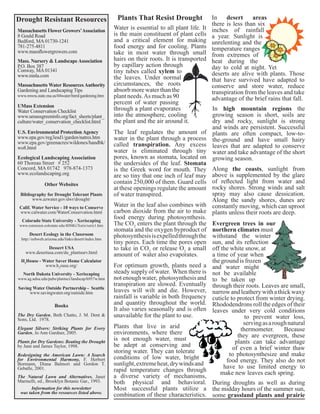
Teachers board wagons to tour Verrill Farm in 
Concord during a summer workshop on the farm. 
As Massachusetts educators attend 
our educational programs and use the 
information and resources that we 
provide, we all become an integral 
part of assuring a stronger future for 
agriculture and the many products 
upon which we all depend. One of our 
most popular programs is our seasonal 
newsletter. Each issue focuses on 
a unique agricultural topic with 
background information and activities 
that can be used in the classroom. 
MAC also has an active website 
which provides more information 
on all of our educational materials. 
Teachers can download information 
from all past newsletters, check out 
workshops and conferences, review 
mini-grant winners and guidelines 
or connect to other agricultural 
education sites. Visit MAC’s website 
at www.aginclassroom.org. 
MAC has grown over the past 
twenty-six years to reach more than 
11,000 educators in every school in 
the state. Our programs and services 
help teachers to make the connection 
between the foods that they, and their 
students, eat and the agricultural 
roots that make these foods and other 
products available. Resources offer a 
link between production agriculture 
and retail products and emphasize the 
impact that each has on our everyday 
lives - past and present. 
The teachers who participate in our 
workshops on the farm, annual 
conference and summer graduate 
course appreciate the chance to meet 
farmers and learn about the work that 
they do. They also share ideas and 
resources with other educators who 
are dedicated to bringing agriculture 
alive for their students. 
Our popular mini-grant program 
reviews proposals three times a year 
and rewards educators who foster 
agricultural learning. Other resources 
include educational manuals, an 
award for Teacher of the Year, 
collaboration on the Massachusetts 
Agriculture Calendar and more.
Educational Resources 
Available from MAC 
School Gardens & Their 
Community Partnership Manual 
$10 
Farm Field Trip Manual $12 
8 Lessons about Agriculture & 
the Environment Manual $5 
The graduate course will meet on 
Wednesdays, June 25 and August 
13 at the Brigham Hill Community 
Farm in North Grafton from 9 
a.m. to 3 p.m. Each participant 
must attend both these sessions and 
also participate in six additional 
workshops during the summer, 
selected from twelve workshops on 
a variety of topics at locations across 
the state. Participants will also keep 
a journal of their agricultural journey 
and spend ten hours developing a 
classroom project, which they will 
present to their peers on August 13. 
Mini Grants 
Last April, Massachusetts Agricul-ture 
in the Classroom awarded a 
mini-grant in the amount of $400 to 
the Winship Elementary School in 
Brighton. Teachers Nicole Maniez 
and Teresa Strong developed 
the program to raise awareness 
throughout the school about 
how food is grown, highlighting 
topics including nutrition, the 
environment, growing practices 
and improved observation. The 
program culminated in the fall with 
a harvest festival featuring locally 
grown foods. 
Any Massachusetts teacher or 
school can apply for a mini-grant to 
support their agricultural education 
efforts. Each year MAC awards 
grants of up to $1,500 to teachers 
for agricultural education projects. 
Mini-grants are due the first of 
April, September and November. 
To receive a copy of our mini-grant 
guidelines, send a letter to MAC 
or visit www.aginclassroom.org. 
Heirloom Tomato Benefit 
Once again this year, MAC board 
member, James Munger will 
raise heirloom tomatoes seedlings 
to support MAC. Jim will sow 
the seeds of these popular plants, 
transplant them, and have them 
ready in May or June for those 
who wish to sell them at their farm, 
school or business as a benefit to 
MAC. Visit the 
MAC website 
for information 
on how to order 
your heirloom 
tomatoes. 
Learn about farming, best management pest prac-tices 
and more during our summer workshops. 
Graduate Level Course 
Massachusetts Agriculture in the 
Classroom is collaborating, again 
this summer, with Fitchburg State 
College to offer a three-credit graduate 
course. Using Massachusetts farms 
as their classrooms teachers will 
participate in agricultural-literacy 
training through fun, hands-on study 
and investigation. The course also 
offers agriculture education resources 
to help enhance curricula and meet 
many MCAS requirements. 
This course will assist new educators 
and those who want to expand their 
offerings to integrate agriculture into 
the classroom. The fee for this eight-day 
course is $450 and includes all 
materials; farm workshops; some 
meals and three graduate credits 
or 67 professional development 
points from Fitchburg State College. 
Participants will be paired with a 
MAC board member for access to 
agricultural resources and support. 
For more information and workshop 
descriptions and locations visit our 
website at www.aginclassroom.org. 
President’s Message 
In March, I traveled to Harrisburg 
in Pennsylvania, where I had the 
pleasure of meeting with leaders from 
Agriculture in the Classroom programs 
throughout the Northeast at the 2008 
Regional Conference of the Northeast 
AITC Coordinators. We were hosted 
by the Pennsylvania Farm Bureau. 
Everyone had the opportunity to share 
their current triumphs, concerns and 
trends. It was good to see people who 
are usually only e-mail companions 
and to welcome to the group three 
new, young educators from New York, 
Vermont and Pennsylvania. 
Louise Lamm, Director of the North 
Carolina Agriculture in the Classroom 
program and Ellen Gould, Curriculum 
Specialist for North Carolina AITC 
offered a terrific presentation and 
preview of a new curriculum that 
is available to educators across 
the country. It was developed with 
assistance from local educators, North 
Carolina Farm Bureau and Agriculture 
in the Classroom and USDA leaders, 
and offers lessons that are lively and 
timely. 
This new curriculum is titled The 
Farmer Grows A Rainbow. The goal 
is “to enhance the MyPyramid nutrition 
and health lessons, integrate them 
with traditional academic subjects and 
emphasize the vital role played by the 
farmer in food production.” 
Louise and Ellen emphasized that 
“many educators define learning as an 
acquisition of knowledge that results 
in permanently changed behavior. 
These new lessons strive to meet that 
goal by providing many new facts, 
concepts and skills to young learners 
that will enable them to: become 
more successful student citizens; 
make healthy dietary choices; keep 
physically fit; live healthy lives, and 
show appreciation for the American 
farmer for all that she/he provides.” 
The bounty produced by all farmers is 
celebrated. Take a moment to review 
these new and innovative lessons at 
www.agclassroom.org/rainbow/index. 
htm. Adopt one or more to compliment 
your conversation with children, 
teachers, customers and family. 
Marjorie Cooper 
Co-President
Plants That Resist Drought 
Water is essential to all plant life. It 
is the main constituent of plant cells 
and a critical element for making 
food energy and for cooling. Plants 
take in most water through small 
hairs on their roots. It is transported 
by capillary action through 
tiny tubes called xylem to 
the leaves. Under normal 
circumstances, the roots 
absorb more water than the 
plant needs. As much as 90 
percent of water passing 
through a plant evaporates 
into the atmosphere, cooling 
the plant and the air around it. 
The leaf regulates the amount of 
water in the plant through a process 
called transpiration. Any excess 
water is eliminated through tiny 
pores, known as stomata, located on 
the undersides of the leaf. Stomata 
is the Greek word for mouth. They 
are so tiny that one inch of leaf may 
contain 250,000 of them. Guard cells 
at these openings regulate the amount 
of water transpired. 
Plants that live in arid 
environments, where there 
is not enough water, must 
be adept at conserving and 
storing water. They can tolerate 
conditions of low water, bright 
sunlight, extreme heat, dry winds and 
rapid temperature changes through 
a diverse variety of mechanisms, 
both physical and behavioral. 
Most successful plants utilize a 
combination of these characteristics. 
In desert areas 
there is less than six 
inches of rainfall 
a year. Sunlight is 
unrelenting and the 
temperature ranges 
from extremes of 
heat during the 
day to cold at night. Yet 
deserts are alive with plants. Those 
that have survived have adapted to 
conserve and store water, reduce 
transpiration from the leaves and take 
advantage of the brief rains that fall. 
In high mountain regions the 
growing season is short, soils are 
dry and rocky, sunlight is strong 
and winds are persistent. Successful 
plants are often compact, low-to-the- 
ground and have small hairy 
leaves that are adapted to conserve 
water and take advantage of the short 
growing season. 
Along the coasts, sunlight from 
above is supplemented by the glare 
of reflected light from water and 
rocky shores. Strong winds and salt 
spray may also cause dessication. 
Along the sandy shores, dunes are 
constantly moving, which can uproot 
plants unless their roots are deep. 
During droughts as well as during 
the midday hours of the summer sun, 
some grassland plants and prairie 
Drought Resistant Resources 
Massachusetts Flower Growers’ Association 
8 Gould Road 
Bedford, MA 01730-1241 
781-275-4811 
www.massflowergrowers.com 
Mass. Nursery & Landscape Association 
P.O. Box 387 
Conway, MA 01341 
www.mnla.com 
Massachusetts Water Resources Authority 
Gardening and Landscaping Tips 
www.mwra.state.ma.us/04water/html/gardening.htm 
UMass Extension 
Water Conservation Checklist 
www.umassgreeninfo.org/fact_sheets/plant_ 
culture/water_conservation_checklist.html 
U.S. Environmental Protection Agency 
www.epa.gov/reg3esd1/garden/natres.htm 
www.epa.gov/greenacres/wildones/handbk/ 
wo8.html 
Ecological Landscaping Association 
60 Thoreau Street # 252 
Concord, MA 01742 978-874-1373 
www.ecolandscaping.org 
Other Websites 
Bibliography for Drought Tolerant Plants 
www.azwater.gov/dwr/drought/ 
Calif. Water Service - 10 ways to Conserve 
www.calwater.com/WaterConservation.html 
Colorado State University - Xeriscaping 
www.extension.colostate.edu/4DMG/Xeris/xeris1.htm 
Desert Ecology in the Classroom 
http://eebweb.arizona.edu/links/desert/index.htm 
Dessert USA 
www.desertusa.com/du_plantsurv.html 
H2House - Water Saver Home Calculator 
www.h2ouse.org/ 
North Dakota University - Xeriscaping 
www.ag.ndsu.edu/pubs/plantsci/landscap/h957w.htm 
Saving Water Outside Partnership - Seattle 
www.savingwater.org/outside.htm 
Books 
The Dry Garden, Beth Chatto, J. M. Dent & 
Sons, Ltd. 1978. 
Elegant Silvers: Striking Plants for Every 
Garden, Jo Ann Gardner, 2005. 
Plants for Dry Gardens: Beating the Drought 
by Jane and James Taylor, 1998. 
Redesigning the American Lawn: A Search 
for Environmental Harmony, F. Herbert 
Bormann, Diana Balmori and Gordon T. 
Geballe, 2001. 
The Natural Lawn and Alternatives, Janet 
Marinelli, ed., Brooklyn Botanic Gar., 1993. 
Information for this newsletter 
was taken from the resources listed above. 
Evergreen trees in our 
northern climates must 
withstand the winter 
sun, and its reflection 
off the white snow, at 
a time of year when 
the ground is frozen 
and water might 
not be available 
to be taken up 
through their roots. Leaves are small, 
narrow and leathery with a thick waxy 
cuticle to protect from winter drying. 
Rhododendrons roll the edges of their 
leaves under very cold conditions 
to prevent water loss, 
serving as a rough natural 
thermometer. Because 
they are evergreen, these 
plants can take advantage 
of even a brief winter thaw 
to photosynthesize and make 
food energy. They also do not 
have to use limited energy to 
make new leaves each spring. 
Water in the leaf also combines with 
carbon dioxide from the air to make 
food energy during photosynthesis. 
The CO2 enters the plant through the 
stomata and the oxygen byproduct of 
photosynthesis is expelled through the 
tiny pores. Each time the pores open 
to take in CO2 or release O2 a small 
amount of water also evaporates. 
For optimum growth, plants need a 
steady supply of water. When there is 
not enough water, photosynthesis and 
transpiration are slowed. Eventually 
leaves will wilt and die. However, 
rainfall is variable in both frequency 
and quantity throughout the world. 
It also varies seasonally and is often 
unavailable for the plant to use.
The school yard garden can also 
be a challenging environment. 
Disturbed soils offer low water 
holding potential and poor nutrient 
value. Then during the summer 
vacation, plants must survive with 
little or no supplemental watering. 
Although New England is not known 
for its long periods of unrelenting 
drought, the past decade has brought 
several long summer and autumn 
growing seasons with little or no rain 
for a month or more. The summer and 
fall of 2007, was just one example 
of a prolonged drought that affected 
crops and gardens. 
4. Plant annuals at least 12 inches 
apart and perennials 18 to 24 inches 
apart to reduce competition for 
water. 
plants, such as little 
blue stem grass, prevent 
excess water loss by 
rolling their long, 
narrow leaves inward. 
An extensive root systems 
permits many meadow plants to tap 
moisture from dry, shallow soils. 
Tips for Conserving Water 
As we experience more and more 
droughts, like the one in 2007, and 
water is perceived as a critical and 
valuable resource, we can look to the 
western United States for new ideas 
on gardening in dry climates. 
Xeriscaping refers to concepts 
and practices that reduce 
water needs by altering the 
landscape. Pronounced with 
a z, Xero, is the Greek word 
for dry. Xeriscape originated 
with the Denver Water 
Department in 1981 and is 
trademarked by them. 
Principals include appropriate planning 
and design, soil improvement, more 
efficient irrigation, practical turf 
areas, appropriate plant selection, use 
of mulches and maintenance. Gardens 
can still be beautiful while reducing 
consumption of water, landscape 
maintenance, use of fertilizers and 
pesticides. Here are some principals: 
Start now by conserving water in 
your landscape. You can create a 
beautiful site that requires less water 
and maintenance by looking to plants 
from these arid regions for your 
inspiration. Reduce the amount of turf 
and permit your lawn to go dormant 
during times when we get less than an 
inch of rainfall a week. Plant drought 
tolerant varieties whenever possible 
and choose plants that are best 
adapted to our own climate and your 
particular conditions. Amend the 
soil to add water holding capacity, 
use mulch and drip irrigation to 
reduce evaporation and conserve 
water and try collecting rainwater. 
7. Mulch garden beds to reduce water 
demand by as much as 40 percent, 
keep the soil cooler, eliminate weed 
competition, and reduces evaporation 
from the soil surface. However, keep 
mulch away from the crowns of native 
plants and from against the trunks of 
trees. You can add a thin layer of sand 
or fine gravel around plants from arid 
climates to keep the crowns dry and 
avoid winter heaving in heavy soils. 
Even in the tropical rainforests, 
where rainfall is plentiful there are 
plants that are not able to get enough 
moisture. Water quickly runs through 
deep well-drained soils and other 
plants are epiphytes that live high 
in the trees with their roots out of 
the soil. These roots are covered in 
a waxy protection and are primarily 
used to attach the plant to the tree, not 
to take in water. Many ephiphytes 
have adapted to collect water in other 
ways. Some bromeliads have leaves 
that overlap in the center to form a 
vase-like watertank that holds water. 
The classroom can often resemble 
and arid, dessert-like environment. 
When the only window with suitable 
light is located over the radiator, 
plants are baked with heat and low 
humidity. Then on the weekend, the 
heat is turned off at school and plants 
struggle and even die. 
Fortunately most 
communities in the 
northeastern United 
States have access to 
adequate water to meet needs. 
However, increasing demands for 
water from growing municipalities, 
suburban development, irrigation 
of lawns, agriculture and industrial 
usage has made water consumption 
an important issue across the region. 
to see the results. With the threat of 
changing water patterns and hotter 
and drier growing seasons that are 
predicted with global warming, we 
must all make wiser choices about 
how we use available water. 
We need only look at the lower 
water tables in our reservoirs and the 
outdoor watering bans in local towns 
Remember that plants, that get less 
than the needed amount of water, will 
be stunted and suffer stress. Stressed 
plants are more susceptible to 
infection by diseases. Evidence also 
indicates that stressed plants attract 
insects more readily than unstressed 
plants. A garden of drought free 
plants, will be a happier garden. 
1. Group plants with similar water 
needs together, allowing them to be 
watered as needed with little waste of 
water. 
2. Use drip irrigation systems to apply 
water directly to plants, reducing water 
consumption as much as 60 percent 
from the use of sprinkler. 
3. Choose plants that either 
avoid or tolerate dry conditions, 
including native plants. While 
these plants are tolerant to 
drought once established, they 
need watering for the first year 
or two after planting. 
5. Amend soil, whether clay or 
sand, with organic material, such as 
compost, aged manure and shredded 
leaves to promote water percolation 
and retention. 
6. Grade beds to allow water to soak 
into the soil and avoid runoff. Raised 
beds are discouraged as they dry out 
more quickly. 
8. The lawn is the most demanding 
user of water in the home landscape. 
Whereever possible, reduce lawn size 
by adding walkways, ground covers, 
and shrub borders. Consider the use 
of turfgrasses other than Kentucky 
Bluegrass. Water lawns only when 
there has been less than one inch of 
rainfall in a week. Consider allowing 
the lawn to go dormant when there is 
no rainfall.
Thickened leaves are insulated, 
to some extent, from extreme heat, 
which also slows transpiration. 
Many also store water. Plants that 
store water in their leaves, stems 
or roots can survive a long time on 
water collected from a single rainfall. 
A few arid plants dehydrate under 
extreme conditions, rehydrating 
again when water is available, with 
little or no damage to the cells. 
Physical Characteristics 
Water is lost through the stomata, 
during transpiration and also when 
these tiny pores open to obtain CO2 
and release O2. The stomata are 
located on the underside of the leaf 
away from the drying effects of direct 
sunlight. Some plants that are tolerant 
to drought have fewer stomata; others 
open only at night when it is cooler. 
Some arid acclimatized 
plants have a waxy coating 
over their leaves and stems 
that serves as a waterproof barrier 
that seals in moisture. Others have 
a powdery bloom that protects 
from glaring sunlight, temperature 
extremes, wind and salt spray. It 
can easily be rubbed off and will no 
longer be there if the plant is grown 
in conditions where it is not required. 
Scales can also cover the entire leaf, 
as in epiphytic bromeliads. 
Downy hairs of silver, gray-green 
or white on leaves form a protective 
layer to help reduce the evaporation 
of moisture from the leaf surface by 
reflecting sunlight and inhibiting the 
drying effects of air currents. Silky 
hairs also trap water vapor, raising the 
humidity near the leaf and protecting 
from extremes of heat and cold. 
In areas where sunlight is reflected 
from stone, water or snow, leaves may 
have pale undersides, often covered 
with downy hairs. These hairs deflect 
the reflected light protecting the 
stomata from water loss. 
Plants with small or narrow, needle-like 
leaves have less surface 
area from which water can 
be lost. Some desert plants, 
such as cacti, have no leaves, 
replacing them with thorns 
and using chlorophyll in the 
outer tissue of the stem for 
the manufacture of food. 
Plants with evergreen foliage are 
physiologically ready to take advan-tage 
of a winter thaw in the north or a 
rare shower in the dessert, absorbing 
moisture through their roots to 
quickly begin to photosynthesize. 
Vertical leaf orientation decreases 
the exposure and absorption of 
sunlight by leaves, 
keeping them cool. 
Some tropical bromeli-ads, 
from the pineapple 
family, have plastic-like 
leaves that form a central 
water reservoir. 
Spines and thorns protect plants 
from animal predators, shade it from 
the sun and also collect moisture. 
Alpines and some desert plants grow 
low-to-the-ground with a whorled, 
compact shape that reduces their 
exposure to high winds and extreme 
temperatures. 
Prairie and dune grasses and many 
desert plants have a shallow but 
expansive root system that is able 
to collect large amounts of surface 
water when it rains. Other drought-resistant 
plants have long tap roots 
that can reach underground water 
sources. These long roots also protect 
the plant from being blown about in 
high winds or shifting soil. 
Plants known as living stone, ex-pose 
only a few of their leaves to the 
sun. The rest plant remains under-ground, 
safe from the sun and heat. 
Drought tolerance is 
another beneficial 
survival mechanism. 
To avoid dessication, 
some plants will 
drop their leaves 
and become dormant. Leaf drop 
not only prevents the loss of moisture 
from evaporation during tough times, 
but also slows the growth of the plant 
so it uses less water, food and energy. 
These plants often have an extensive 
root system that can quickly absorb 
available water. When the short 
rain season arrives, they are able to 
rapidly sprout leaves and flowers. 
Perennials in arid climates may 
slow growth for part of the year 
to conserve moisture and energy and 
maximize growth during seasons of 
optimum moisture and temperatures. 
Some, like the saguaro cactus, grow 
slowly their whole lifetime, taking as 
long as 200 years to reach a mature 
height. With slow growth, it expends 
less energy, food and water. 
Many desert plants are located some 
distance away from one another, 
reducing competition for limited 
moisture. Others release toxins from 
their roots to assure distance. 
Behavioral Mechanisms 
Plants must conserve water and 
protect it and themselves from 
animals in search of water. Some 
desert plants have spines or a taste 
that is bitter and toxic. Other plants 
may grow only in inaccessible places 
or be camouflaged. 
Many prairie, alpine and desert wild-flowers 
are annuals or ephemerals; 
and begin their lives as seeds. While 
annuals germinate and bloom yearly, 
plants in arid regions germinate 
only when there is rain. They are 
more accurately called ephemerals. 
Both mature quickly, release their 
seeds and then die. These seeds can 
survive dormant for an indefinite 
period of time. After the rains, seeds 
will sprout when temperatures are 
moderate. Many complete their life 
cycle in months or even weeks. 
Bulbs are another example of a type 
of perennial that utilizes dormancy as 
a means of evading drought. These 
members of the lily family have tops 
that dry out completely and leave no 
trace of their existence above ground 
when dormant. They 
are able to store 
enough nourishment 
to survive for long 
periods in rocky or 
alluvial soils. 
Many plants have a 
symbiotic relationship 
with fauna. Animals aid in both 
fertilization and dispersion of seeds, 
assuring the continued profusion and 
diversity of plant life in arid areas.
Sometimes, existing conditions can 
be modified to accommodate plant 
preferences. Soil can be amended 
with organic matter to improve 
water holding capacity or with grit to 
speed drainage or nearby trees can be 
limbed up to provide more sunlight. 
However, for optimum success, it is 
better to understand your site and then 
select plants that are compatible. 
Perennials: achillea; amsonia; 
antennaria; anthemis; arabis; armeria; 
aster; baptisia; centaurea; cimicifuga; 
coreopsis; crambe; dictamnus; 
echinacea; echinops; epimedium; 
eryngium; euphorbia; geranium; 
helleborus; hemerocallis; heuchera; 
hosta; Iris sibirica; lamium; liatris; 
limonium; lychnis; oenothera; Patrinia 
scabiosifolia; papaver; penstemon; 
Perovskia atriplicifolia; Potentilla 
tridentata; rudbeckia; salvia; sedum; 
sempervivum; solidago (Goldenrod); 
verbascum; veronica; Viola 
labradorica; waldsteinia and yucca. 
2. Ask students to analyze 
the environment of their 
own school room, garden 
or school yard to determine the 
moisture, drainage, soil, pH, light and 
temperature conditions. Remember to 
consider conditions unique to your 
setting, such as school heat turned off 
at night and on weekends or school 
vacations and summer breaks without 
supplemental watering. 
Right Plant - Right Place 
Successful gardening, whether in-doors 
or out, depends on using the 
best gardening techniques. It is also 
important to consider the climate and 
growing conditions of your particular 
area. These includes soil conditions, 
water, temperature, humidity and 
fertility. 
In addition to 
cultural factors, there 
are microclimates 
within the garden, 
home or school 
with cold and hot 
spots and differing amounts of wind, 
sun and snow. Access to water and 
nutrients vary with soil conditions as 
well as the gardener, and provide the 
best opportunity for control. 
Selecting plants that will flourish in 
your environment is a practical first 
step to success. Most plants that we 
grow in the school, home or garden 
are horticultural cultivars of plants 
that once grew in the wild. Learn as 
much as you can about the original 
habitat and growing conditions of the 
parent species. These include how 
much light they receive, moisture, 
drainage and pH. You may not be 
able to match their environment 
exactly, but may find an area that will 
be suitable for growth. 
Use drought tolerant plants in 
dry, sandy, exposed areas, while 
plants adapted to wet soils should 
be planted in low spots or areas of 
low drainage. Light, humidity and 
salt requirements also need to be 
considered and plants found that will 
thrive under your conditions. Then 
group plant according to their water, 
fertilizer and maintenance needs for 
ease of care. 
Massachusetts Agriculture in the Classroom 
P.O. Box 345 Seekonk, MA 02771 
www.aginclassroom.org 
Plants to Defy Drought 
At Tranquil Lake Nursery in Rehoboth, 
Massachusetts the soils are sandy and 
water quickly drains. The display 
gardens are planted with tough plants 
that thrive in these light sandy soils 
and perennial bouts of drought, with 
supplemental watering. Here are a few 
recommendations: 
Annuals: California poppy; cleome; 
dahlberg daisy; gazania; globe 
amaranth; dusty miller; helichrysum; 
lantana; lavatera; nasturtium; nicotiana; 
perilla, portulaca, sanvitalia, senecio, 
sweet alyssum, verbena and viola 
Activity Ideas 
1. Take a walk in a park or natural area 
near the school and try to find as many 
examples as possible of plants with 
physical characteristics that protect 
them from drought, such as: needle-like 
leaves; small leaves; succulent 
leaves; hairy leaves; white, silver or 
gray foliage; pale leaf undersides; leaf 
scales; thorns or spines; low 
compact foliage, etc. 
3. Ask students to research and make 
a list of plants that are suited to these 
conditions. 
Herbs: artemesia, basil; catmint; 
chamomile; chives, coriander; dill; 
fennel; germander; lady’s mantle; 
lamb’s ear, lavender, mint; oregano, 
rosemary; rue; sage; santolina; sweet 
woodruff, tansy & thyme. 
Grasses: Calamagrostis; 
Carex glauca & pensyl-vanica; 
Miscanthus sin-ensis 
‘Morning Light’ & 
‘Strictus’; Molinia caeru-lea 
‘Variegata’; Panicum 
virgatum, Pennisetum, 
and Schizachrium sco-parium. 
Woody Trees & Shrubs: Acanthopa-nax 
sieboldianus; Acer negundo; 
Amorpha canescens; Aronia arbutifo-lia; 
Caryopteris; Ceanthus americanus; 
Comptonia peregrina; Cornus sericea 
‘Silver & Gold’; Cotinus coggygria; 
Cytissus; Fothergilla ‘Blue Shadow’; 
Hydrangea arborescens ‘Annabelle’; 
Indigofera; Heptacodium miconoides; 
Juniperus; Lespedeza; Myrica pensyl-vanica; 
Physocarpus opulifolius; Pi-nus 
banksiana; Pinus virginiana; Rhus 
typhina; Rosa glauca; Rosa rugosa; 
Salix elaeagnos; Sorbaria sorbifolia; 
Spiraea japonica; Spiraea thunbergii’; 
Thuja occidentalis ‘Rheingold’; and 
Weigela. 
In the Classroom 
1. Examine the undersides of leaves 
of a variety of plants with a hand lens 
and a microscope to see the stomata. 
2. Ask students to generate a list of 
“things we know about leaves” and 
a list of “questions we have about 
leaves.” Identify the questions that can 
be answered by experimentation 
and those through research. 
3. Conduct an experiment to 
see what happens when a plant 
is over-watered and is under-watered. 
Use two similar 
plants with thin leaves such 
as a coleus. Allow one plant 
to sit in waterlogged soil. Water the 
second plant well and then refrain from 
watering it. Observe daily and make 
records. What happened? Why? 
4. Make a garden in the classroom for 
cactus and succulents. Research their 
native habitat and decide where they 
are best located and when to water.
On Tuesday, August 12th travel 
across the border to Pascoag, RI and 
the small family farm of Mansfield 
teacher Bob Cote. Spend the morning 
learning about raising and caring 
for dairy goats, the digestive system 
and diets of small ruminants and try 
your hand at making goat cheese. 
Following a farm lunch, we’ll tour this 
small but busy farm to meet llamas, 
chickens, honeybees and an organic 
farm garden. 
Massachusetts Ag Tags 
Now is the time to order your new 
Mass. Agriculture Specialty License 
Plate. Proceeds will go to the Mass. 
Agricultural Trust, which will fund 
marketing and education programs 
and services to help farmers 
succeed. 
Once 1,500 
plates are 
o r d e r e d , 
they will 
be produced and sent to the regional 
RMV offices for distribution. The 
cost to transfer your registration to 
an “Ag Tag” is $60, including a $40 
donation to Agricultural Trust, and 
a $20 fee to swap the plate when 
it arrives. Renewals, every second 
year, cost $81, including a $41 RMV 
registration fee, and $40 contribution 
to the Trust. To apply for your Mass. 
Ag Tag License, send a $40 check 
made payable to the RMV. For more 
information on the Ag Tag, visit 
www.mass.gov/agr/agtag. 
Workshops on the Farm 
Join us for one of more of our summer 
workshops and try some activities 
for the classroom while you explore 
local farms. Workshops runs from 9 
a.m. to 3 p.m., offer classroom-ready 
activities and focus on a unique area 
of agriculture with exploration of the 
work that takes place at that farm. The 
fee of $30 includes pdp’s, lunch and 
all materials. 
Thursday, June 26, takes us to Holly 
Hill Farm in Cohasset. Spend the 
morning observing the summer youth 
educational programs. Learn organic 
farming and gardening practices as 
we tour the fields with farm educator 
Jon Belber and owners Frank 
and Jean White. In the afternoon, 
take an in-depth look at the organic 
gardening curriculum developed by 
the farm in cooperation with teachers 
and students at South Shore Charter 
Public School in Norwell and try out 
some recommended activities. 
Spend Thursday July 10 at the 
Perkins School for the Blind in 
Watertown learning about the field of 
Horticultural Therapy and remarkable 
work that takes place in the gardens and 
greenhouses at this school for the blind 
and visually impaired. Horticultural 
Therapist Deborah Krause will lead 
a tour of the gardens and greenhouse 
and explain adaptations in horticultural 
techniques and devices that make 
gardening accessible to this special 
population. She’ll also offer techniques 
for teaching science MCAS. 
On Wednesday, July 16 explore 
Hancock Shaker Village in Pittsfield. 
The Shakers have long been renowned 
for their innovations, progressive prac-tices 
and technologies, and quest for 
and creation of an overall sustainable 
community lifestyle. Look closely 
at the historic renewable energy and 
sustainable agriculture resources pre-served 
and interpreted at the Village 
with Education Director Todd Burdick 
and staff, and discuss suggestions and 
examples of modern 
applications. 
Travel to Diemand 
Egg Farm in Miller's 
Falls on Wednesday, 
July 23, to learn about 
incubating and raising 
chicks and the value of 
Heritage Breeds with 5th grade teacher 
Lenore Paul. Following a farm lunch, 
we'll tour this growing family farm 
with Anne Diemand. Founded in 
1936 as a chicken farm, it convereted 
to egg production in the 1960s, added 
turkeys in the 1980 and now offers 
value added products and catering. 
Join us on Wednesday, August 6 at 
Moon in the Pond Farm in Sheffield. 
Farm owner Dominic Palumbo will 
introduce heritage breeds, heirloom 
seeds, local foods and sustainable 
agriculture practices. You’ll have the 
chance to harvest and prepare your 
own lunch. Then tour the farm and 
learn about the educational programs, 
apprenticeships and farm stewardships 
that takes place here. 
REGISTRATION ... DONATION.... MATERIAL ORDER FORM 
Please fill out this form and return it to: MAC, Inc. P. O. Box 345 Seekonk, MA 02771 
Name ____________________________________________________________________________________ 
School or Organization ____________________________ Address _____________________________________ 
City __________________________________ State ____________________ Zip _________________________ 
Phone Number (day) _____________________ (evening) __________________ e-mail ________________________________ 
I am registering for the following workshop (s): ❑ $30 enclosed for each workshop registration, ❑ please send directions 
❑ June 26, Holly Hill Farm, Cohasset ❑ July 10, Perkins School for Blind, Watertown 
❑ July 17, Hancock Shake Village, Pittsfield ❑ July 23, Diemand Egg Farm, Miller’s Falls 
❑ August 6, Moon in Pond Farm, Sheffield ❑ August 12, Bob Cote’s Farm, Pascoag, RI 
❑ I am registering for the Summer Graduate Course ❑ $450 is enclosed (Make Check payable TO MAC) 
Please send information on: ❑ The Summer Graduate Course; ❑ MAC Annual Report; ❑ Mini-Grant Guidelines 
❑ Farm Field Trip Manual $12; ❑ 8 Lessons about Agriculture & Environment $5; ❑ School Gardening Manual $10 
I’d like to make a tax-deductible donation in the amount of: ❑ $50; ❑ $25; ❑ $10 Other donation ______
2009 Massachusetts Agriculture 
Calendar Photo Contest. Photos 
must be at least 4” by 6” and no 
larger than 8” by 10” and must 
have been taken in Massachusetts 
in the past three years. Send photos 
of local rural scenes, farm animals 
or produce by June 1 to Photo 
Contest, Mass. DAR, 251 
Causeway Street, Suite 500, 
Boston, MA 02114. For more 
information, call Rick LeBlanc at 
617-626-1759 or send an e-mail to 
Richard.LeBlanc@state.ma.us. 
The twelve winners will be featured 
in the 2009 Massachusetts 
Agriculture calendar. and will be 
honoreed at the Big E this Sept. 
To receive more information, add a 
name to our mailing list or give us 
your comments: 
Mass. Agriculture 
in the Classroom 
P.O. Box 345 
Seekonk, MA 02771 
call Debi Hogan 
at 508-336-4426 
fax: 508-336-0682 
e-mail to debi.hogan@earthlink.net 
Website: www.aginclassroom.org 
Calendar Resources 
The Massachusetts Department of Agricultural Resources sponsored this newsletter by funding the printing costs. 
PERMIT NO. 2226 
01613 
NONPROFIT ORG. 
U. S. POSTAGE PAID 
WORCESTER, MA 
Return Service Requested 
Massachusetts Agriculture 
in the Classroom 
P.O. Box 345 
Seekonk, MA 02771 
“Fresh from the Farms: The Mass. 
Farm to School Cookbook" 
with 45 recipes (50-100 servings), 
nutritional analysis, vegetable 
preparation tips and more can be 
ordered from Nutrition Resources 
on the MA Dept. of Education site 
or at www.mass.doe.edu/cnp. 
MyPyramid Lesson Plans & 
Poster at www.mypyramid.gov/ 
can be combined with the Farmer 
Grows a Rainbow nutrition lessons 
at www.agclassroom.org/rainbow. 
June is Dairy Month. Find 
educational tips from the National 
Dairy Council and more resources 
at www.nationaldairycouncil.org. 
“The Science & Scientists Behind 
the Food” multimedia resource kit 
at http://school.discoveryeducation. 
com:80/foodscience/science_ 
resources.html. 
Join the Great Sunflower Project 
to order and plant free sunflower 
seeds, count and record honeybee 
pollinators, and check where the 
bees are across the country. Visit 
www.greatsunflower.org. 
Cotton Lesson Plans & contest for 
teachers for lesson plan due June 
10 at www.cottonsjourney.com. 
May 24-25, 34th Sheep & Woolcraft 
Fair, Cummington, $6 per car. Visit 
www.masheepwool.org/aboutus.htm. 
May 31, Plant Sale at Tower Hill 
Botanic Garden, Boylston. Heirloom 
tomato sales support MAC. For 
information, www.towerhillbg.org. 
July 19, Summer Festival, Tranquil 
Lake Nursery in Rehoboth. Food 
Sales support MAC. Call 508-252- 
4002 or visit www.tranquil-lake.com. 
June 25-28, National Agriculture in 
the Classroom Conference in Costa 
Mesa, CA. For more information visit 
www.agclassroom.org. 
August 8-10, 34th Annual NOFA 
Summer Conference (NE Organic 
Farming Assn.) at UMass, Amherst, 
visit www.nofa.org. A series of grazing 
workshops will also be held throughout 
the summer. For information, visit 
www.massgrass.org. 
September 12-28 at Eastern States 
Exposition in West Springfield. For 
information visit www.thebige.com. 
Sept. 20-21, North Quabbin Garlic 
& Arts Festival, Orange, $5 adults, 
visit www.garlicandarts.org.

Spring 2008 School Gardening News ~ Massachusetts

  • 1.
    The Newsletter ofSpring 2008 Workshops on the Farm $30 Each Workshop - 9 a.m. to 3 p.m Organic Gardening - School & Farm Thursday, June 26 Holly Hill Farm, Cohasset Horticultural Therapy Adaptations Thursday, July 10 Perkins School for Blind, Watertown Renewable Energy & Sustainable Ag. Wednesday, July 16 Hancock Shaker Village, Pittsfield Chickens, Embryology & Heritage Breeds Wednesday, July 23 Diemand Egg Farm, Miller’s Falls Heritage Breeds, Heirloom Seeds, Local Foods & Sustainable Agri. Wednesday, August 6 Moon in the Pond Farm, Sheffield Dairy Goats, Ruminants & Cheese Tuesday, August 12 Bob Cote’s Family Farm, Pascoag, RI Feature Topic: Plants that Resist Drought Mission: Massachusetts Agriculture in the Classroom is a non-profit 501 (c)(3) educational organization with the mission to foster an awareness and learning in all areas related to the food and agriculture industries and the economic and social importance of agriculture to the state, nation and the world. Making the Link from Farm to Classroom Massachusetts Agriculture in the Classroom (MAC) is a very small non-profit organization, but with a big impact. Since 1982, this dedicated group of voluteers has been committed to the promotion of agricultural education and literacy across the Commonwealth, joining in a national effort that was initiated through a directive from the Secretary of the U.S. Department of Agriculture. Teachers board wagons to tour Verrill Farm in Concord during a summer workshop on the farm. As Massachusetts educators attend our educational programs and use the information and resources that we provide, we all become an integral part of assuring a stronger future for agriculture and the many products upon which we all depend. One of our most popular programs is our seasonal newsletter. Each issue focuses on a unique agricultural topic with background information and activities that can be used in the classroom. MAC also has an active website which provides more information on all of our educational materials. Teachers can download information from all past newsletters, check out workshops and conferences, review mini-grant winners and guidelines or connect to other agricultural education sites. Visit MAC’s website at www.aginclassroom.org. MAC has grown over the past twenty-six years to reach more than 11,000 educators in every school in the state. Our programs and services help teachers to make the connection between the foods that they, and their students, eat and the agricultural roots that make these foods and other products available. Resources offer a link between production agriculture and retail products and emphasize the impact that each has on our everyday lives - past and present. The teachers who participate in our workshops on the farm, annual conference and summer graduate course appreciate the chance to meet farmers and learn about the work that they do. They also share ideas and resources with other educators who are dedicated to bringing agriculture alive for their students. Our popular mini-grant program reviews proposals three times a year and rewards educators who foster agricultural learning. Other resources include educational manuals, an award for Teacher of the Year, collaboration on the Massachusetts Agriculture Calendar and more.
  • 2.
    Educational Resources Availablefrom MAC School Gardens & Their Community Partnership Manual $10 Farm Field Trip Manual $12 8 Lessons about Agriculture & the Environment Manual $5 The graduate course will meet on Wednesdays, June 25 and August 13 at the Brigham Hill Community Farm in North Grafton from 9 a.m. to 3 p.m. Each participant must attend both these sessions and also participate in six additional workshops during the summer, selected from twelve workshops on a variety of topics at locations across the state. Participants will also keep a journal of their agricultural journey and spend ten hours developing a classroom project, which they will present to their peers on August 13. Mini Grants Last April, Massachusetts Agricul-ture in the Classroom awarded a mini-grant in the amount of $400 to the Winship Elementary School in Brighton. Teachers Nicole Maniez and Teresa Strong developed the program to raise awareness throughout the school about how food is grown, highlighting topics including nutrition, the environment, growing practices and improved observation. The program culminated in the fall with a harvest festival featuring locally grown foods. Any Massachusetts teacher or school can apply for a mini-grant to support their agricultural education efforts. Each year MAC awards grants of up to $1,500 to teachers for agricultural education projects. Mini-grants are due the first of April, September and November. To receive a copy of our mini-grant guidelines, send a letter to MAC or visit www.aginclassroom.org. Heirloom Tomato Benefit Once again this year, MAC board member, James Munger will raise heirloom tomatoes seedlings to support MAC. Jim will sow the seeds of these popular plants, transplant them, and have them ready in May or June for those who wish to sell them at their farm, school or business as a benefit to MAC. Visit the MAC website for information on how to order your heirloom tomatoes. Learn about farming, best management pest prac-tices and more during our summer workshops. Graduate Level Course Massachusetts Agriculture in the Classroom is collaborating, again this summer, with Fitchburg State College to offer a three-credit graduate course. Using Massachusetts farms as their classrooms teachers will participate in agricultural-literacy training through fun, hands-on study and investigation. The course also offers agriculture education resources to help enhance curricula and meet many MCAS requirements. This course will assist new educators and those who want to expand their offerings to integrate agriculture into the classroom. The fee for this eight-day course is $450 and includes all materials; farm workshops; some meals and three graduate credits or 67 professional development points from Fitchburg State College. Participants will be paired with a MAC board member for access to agricultural resources and support. For more information and workshop descriptions and locations visit our website at www.aginclassroom.org. President’s Message In March, I traveled to Harrisburg in Pennsylvania, where I had the pleasure of meeting with leaders from Agriculture in the Classroom programs throughout the Northeast at the 2008 Regional Conference of the Northeast AITC Coordinators. We were hosted by the Pennsylvania Farm Bureau. Everyone had the opportunity to share their current triumphs, concerns and trends. It was good to see people who are usually only e-mail companions and to welcome to the group three new, young educators from New York, Vermont and Pennsylvania. Louise Lamm, Director of the North Carolina Agriculture in the Classroom program and Ellen Gould, Curriculum Specialist for North Carolina AITC offered a terrific presentation and preview of a new curriculum that is available to educators across the country. It was developed with assistance from local educators, North Carolina Farm Bureau and Agriculture in the Classroom and USDA leaders, and offers lessons that are lively and timely. This new curriculum is titled The Farmer Grows A Rainbow. The goal is “to enhance the MyPyramid nutrition and health lessons, integrate them with traditional academic subjects and emphasize the vital role played by the farmer in food production.” Louise and Ellen emphasized that “many educators define learning as an acquisition of knowledge that results in permanently changed behavior. These new lessons strive to meet that goal by providing many new facts, concepts and skills to young learners that will enable them to: become more successful student citizens; make healthy dietary choices; keep physically fit; live healthy lives, and show appreciation for the American farmer for all that she/he provides.” The bounty produced by all farmers is celebrated. Take a moment to review these new and innovative lessons at www.agclassroom.org/rainbow/index. htm. Adopt one or more to compliment your conversation with children, teachers, customers and family. Marjorie Cooper Co-President
  • 3.
    Plants That ResistDrought Water is essential to all plant life. It is the main constituent of plant cells and a critical element for making food energy and for cooling. Plants take in most water through small hairs on their roots. It is transported by capillary action through tiny tubes called xylem to the leaves. Under normal circumstances, the roots absorb more water than the plant needs. As much as 90 percent of water passing through a plant evaporates into the atmosphere, cooling the plant and the air around it. The leaf regulates the amount of water in the plant through a process called transpiration. Any excess water is eliminated through tiny pores, known as stomata, located on the undersides of the leaf. Stomata is the Greek word for mouth. They are so tiny that one inch of leaf may contain 250,000 of them. Guard cells at these openings regulate the amount of water transpired. Plants that live in arid environments, where there is not enough water, must be adept at conserving and storing water. They can tolerate conditions of low water, bright sunlight, extreme heat, dry winds and rapid temperature changes through a diverse variety of mechanisms, both physical and behavioral. Most successful plants utilize a combination of these characteristics. In desert areas there is less than six inches of rainfall a year. Sunlight is unrelenting and the temperature ranges from extremes of heat during the day to cold at night. Yet deserts are alive with plants. Those that have survived have adapted to conserve and store water, reduce transpiration from the leaves and take advantage of the brief rains that fall. In high mountain regions the growing season is short, soils are dry and rocky, sunlight is strong and winds are persistent. Successful plants are often compact, low-to-the- ground and have small hairy leaves that are adapted to conserve water and take advantage of the short growing season. Along the coasts, sunlight from above is supplemented by the glare of reflected light from water and rocky shores. Strong winds and salt spray may also cause dessication. Along the sandy shores, dunes are constantly moving, which can uproot plants unless their roots are deep. During droughts as well as during the midday hours of the summer sun, some grassland plants and prairie Drought Resistant Resources Massachusetts Flower Growers’ Association 8 Gould Road Bedford, MA 01730-1241 781-275-4811 www.massflowergrowers.com Mass. Nursery & Landscape Association P.O. Box 387 Conway, MA 01341 www.mnla.com Massachusetts Water Resources Authority Gardening and Landscaping Tips www.mwra.state.ma.us/04water/html/gardening.htm UMass Extension Water Conservation Checklist www.umassgreeninfo.org/fact_sheets/plant_ culture/water_conservation_checklist.html U.S. Environmental Protection Agency www.epa.gov/reg3esd1/garden/natres.htm www.epa.gov/greenacres/wildones/handbk/ wo8.html Ecological Landscaping Association 60 Thoreau Street # 252 Concord, MA 01742 978-874-1373 www.ecolandscaping.org Other Websites Bibliography for Drought Tolerant Plants www.azwater.gov/dwr/drought/ Calif. Water Service - 10 ways to Conserve www.calwater.com/WaterConservation.html Colorado State University - Xeriscaping www.extension.colostate.edu/4DMG/Xeris/xeris1.htm Desert Ecology in the Classroom http://eebweb.arizona.edu/links/desert/index.htm Dessert USA www.desertusa.com/du_plantsurv.html H2House - Water Saver Home Calculator www.h2ouse.org/ North Dakota University - Xeriscaping www.ag.ndsu.edu/pubs/plantsci/landscap/h957w.htm Saving Water Outside Partnership - Seattle www.savingwater.org/outside.htm Books The Dry Garden, Beth Chatto, J. M. Dent & Sons, Ltd. 1978. Elegant Silvers: Striking Plants for Every Garden, Jo Ann Gardner, 2005. Plants for Dry Gardens: Beating the Drought by Jane and James Taylor, 1998. Redesigning the American Lawn: A Search for Environmental Harmony, F. Herbert Bormann, Diana Balmori and Gordon T. Geballe, 2001. The Natural Lawn and Alternatives, Janet Marinelli, ed., Brooklyn Botanic Gar., 1993. Information for this newsletter was taken from the resources listed above. Evergreen trees in our northern climates must withstand the winter sun, and its reflection off the white snow, at a time of year when the ground is frozen and water might not be available to be taken up through their roots. Leaves are small, narrow and leathery with a thick waxy cuticle to protect from winter drying. Rhododendrons roll the edges of their leaves under very cold conditions to prevent water loss, serving as a rough natural thermometer. Because they are evergreen, these plants can take advantage of even a brief winter thaw to photosynthesize and make food energy. They also do not have to use limited energy to make new leaves each spring. Water in the leaf also combines with carbon dioxide from the air to make food energy during photosynthesis. The CO2 enters the plant through the stomata and the oxygen byproduct of photosynthesis is expelled through the tiny pores. Each time the pores open to take in CO2 or release O2 a small amount of water also evaporates. For optimum growth, plants need a steady supply of water. When there is not enough water, photosynthesis and transpiration are slowed. Eventually leaves will wilt and die. However, rainfall is variable in both frequency and quantity throughout the world. It also varies seasonally and is often unavailable for the plant to use.
  • 4.
    The school yardgarden can also be a challenging environment. Disturbed soils offer low water holding potential and poor nutrient value. Then during the summer vacation, plants must survive with little or no supplemental watering. Although New England is not known for its long periods of unrelenting drought, the past decade has brought several long summer and autumn growing seasons with little or no rain for a month or more. The summer and fall of 2007, was just one example of a prolonged drought that affected crops and gardens. 4. Plant annuals at least 12 inches apart and perennials 18 to 24 inches apart to reduce competition for water. plants, such as little blue stem grass, prevent excess water loss by rolling their long, narrow leaves inward. An extensive root systems permits many meadow plants to tap moisture from dry, shallow soils. Tips for Conserving Water As we experience more and more droughts, like the one in 2007, and water is perceived as a critical and valuable resource, we can look to the western United States for new ideas on gardening in dry climates. Xeriscaping refers to concepts and practices that reduce water needs by altering the landscape. Pronounced with a z, Xero, is the Greek word for dry. Xeriscape originated with the Denver Water Department in 1981 and is trademarked by them. Principals include appropriate planning and design, soil improvement, more efficient irrigation, practical turf areas, appropriate plant selection, use of mulches and maintenance. Gardens can still be beautiful while reducing consumption of water, landscape maintenance, use of fertilizers and pesticides. Here are some principals: Start now by conserving water in your landscape. You can create a beautiful site that requires less water and maintenance by looking to plants from these arid regions for your inspiration. Reduce the amount of turf and permit your lawn to go dormant during times when we get less than an inch of rainfall a week. Plant drought tolerant varieties whenever possible and choose plants that are best adapted to our own climate and your particular conditions. Amend the soil to add water holding capacity, use mulch and drip irrigation to reduce evaporation and conserve water and try collecting rainwater. 7. Mulch garden beds to reduce water demand by as much as 40 percent, keep the soil cooler, eliminate weed competition, and reduces evaporation from the soil surface. However, keep mulch away from the crowns of native plants and from against the trunks of trees. You can add a thin layer of sand or fine gravel around plants from arid climates to keep the crowns dry and avoid winter heaving in heavy soils. Even in the tropical rainforests, where rainfall is plentiful there are plants that are not able to get enough moisture. Water quickly runs through deep well-drained soils and other plants are epiphytes that live high in the trees with their roots out of the soil. These roots are covered in a waxy protection and are primarily used to attach the plant to the tree, not to take in water. Many ephiphytes have adapted to collect water in other ways. Some bromeliads have leaves that overlap in the center to form a vase-like watertank that holds water. The classroom can often resemble and arid, dessert-like environment. When the only window with suitable light is located over the radiator, plants are baked with heat and low humidity. Then on the weekend, the heat is turned off at school and plants struggle and even die. Fortunately most communities in the northeastern United States have access to adequate water to meet needs. However, increasing demands for water from growing municipalities, suburban development, irrigation of lawns, agriculture and industrial usage has made water consumption an important issue across the region. to see the results. With the threat of changing water patterns and hotter and drier growing seasons that are predicted with global warming, we must all make wiser choices about how we use available water. We need only look at the lower water tables in our reservoirs and the outdoor watering bans in local towns Remember that plants, that get less than the needed amount of water, will be stunted and suffer stress. Stressed plants are more susceptible to infection by diseases. Evidence also indicates that stressed plants attract insects more readily than unstressed plants. A garden of drought free plants, will be a happier garden. 1. Group plants with similar water needs together, allowing them to be watered as needed with little waste of water. 2. Use drip irrigation systems to apply water directly to plants, reducing water consumption as much as 60 percent from the use of sprinkler. 3. Choose plants that either avoid or tolerate dry conditions, including native plants. While these plants are tolerant to drought once established, they need watering for the first year or two after planting. 5. Amend soil, whether clay or sand, with organic material, such as compost, aged manure and shredded leaves to promote water percolation and retention. 6. Grade beds to allow water to soak into the soil and avoid runoff. Raised beds are discouraged as they dry out more quickly. 8. The lawn is the most demanding user of water in the home landscape. Whereever possible, reduce lawn size by adding walkways, ground covers, and shrub borders. Consider the use of turfgrasses other than Kentucky Bluegrass. Water lawns only when there has been less than one inch of rainfall in a week. Consider allowing the lawn to go dormant when there is no rainfall.
  • 5.
    Thickened leaves areinsulated, to some extent, from extreme heat, which also slows transpiration. Many also store water. Plants that store water in their leaves, stems or roots can survive a long time on water collected from a single rainfall. A few arid plants dehydrate under extreme conditions, rehydrating again when water is available, with little or no damage to the cells. Physical Characteristics Water is lost through the stomata, during transpiration and also when these tiny pores open to obtain CO2 and release O2. The stomata are located on the underside of the leaf away from the drying effects of direct sunlight. Some plants that are tolerant to drought have fewer stomata; others open only at night when it is cooler. Some arid acclimatized plants have a waxy coating over their leaves and stems that serves as a waterproof barrier that seals in moisture. Others have a powdery bloom that protects from glaring sunlight, temperature extremes, wind and salt spray. It can easily be rubbed off and will no longer be there if the plant is grown in conditions where it is not required. Scales can also cover the entire leaf, as in epiphytic bromeliads. Downy hairs of silver, gray-green or white on leaves form a protective layer to help reduce the evaporation of moisture from the leaf surface by reflecting sunlight and inhibiting the drying effects of air currents. Silky hairs also trap water vapor, raising the humidity near the leaf and protecting from extremes of heat and cold. In areas where sunlight is reflected from stone, water or snow, leaves may have pale undersides, often covered with downy hairs. These hairs deflect the reflected light protecting the stomata from water loss. Plants with small or narrow, needle-like leaves have less surface area from which water can be lost. Some desert plants, such as cacti, have no leaves, replacing them with thorns and using chlorophyll in the outer tissue of the stem for the manufacture of food. Plants with evergreen foliage are physiologically ready to take advan-tage of a winter thaw in the north or a rare shower in the dessert, absorbing moisture through their roots to quickly begin to photosynthesize. Vertical leaf orientation decreases the exposure and absorption of sunlight by leaves, keeping them cool. Some tropical bromeli-ads, from the pineapple family, have plastic-like leaves that form a central water reservoir. Spines and thorns protect plants from animal predators, shade it from the sun and also collect moisture. Alpines and some desert plants grow low-to-the-ground with a whorled, compact shape that reduces their exposure to high winds and extreme temperatures. Prairie and dune grasses and many desert plants have a shallow but expansive root system that is able to collect large amounts of surface water when it rains. Other drought-resistant plants have long tap roots that can reach underground water sources. These long roots also protect the plant from being blown about in high winds or shifting soil. Plants known as living stone, ex-pose only a few of their leaves to the sun. The rest plant remains under-ground, safe from the sun and heat. Drought tolerance is another beneficial survival mechanism. To avoid dessication, some plants will drop their leaves and become dormant. Leaf drop not only prevents the loss of moisture from evaporation during tough times, but also slows the growth of the plant so it uses less water, food and energy. These plants often have an extensive root system that can quickly absorb available water. When the short rain season arrives, they are able to rapidly sprout leaves and flowers. Perennials in arid climates may slow growth for part of the year to conserve moisture and energy and maximize growth during seasons of optimum moisture and temperatures. Some, like the saguaro cactus, grow slowly their whole lifetime, taking as long as 200 years to reach a mature height. With slow growth, it expends less energy, food and water. Many desert plants are located some distance away from one another, reducing competition for limited moisture. Others release toxins from their roots to assure distance. Behavioral Mechanisms Plants must conserve water and protect it and themselves from animals in search of water. Some desert plants have spines or a taste that is bitter and toxic. Other plants may grow only in inaccessible places or be camouflaged. Many prairie, alpine and desert wild-flowers are annuals or ephemerals; and begin their lives as seeds. While annuals germinate and bloom yearly, plants in arid regions germinate only when there is rain. They are more accurately called ephemerals. Both mature quickly, release their seeds and then die. These seeds can survive dormant for an indefinite period of time. After the rains, seeds will sprout when temperatures are moderate. Many complete their life cycle in months or even weeks. Bulbs are another example of a type of perennial that utilizes dormancy as a means of evading drought. These members of the lily family have tops that dry out completely and leave no trace of their existence above ground when dormant. They are able to store enough nourishment to survive for long periods in rocky or alluvial soils. Many plants have a symbiotic relationship with fauna. Animals aid in both fertilization and dispersion of seeds, assuring the continued profusion and diversity of plant life in arid areas.
  • 6.
    Sometimes, existing conditionscan be modified to accommodate plant preferences. Soil can be amended with organic matter to improve water holding capacity or with grit to speed drainage or nearby trees can be limbed up to provide more sunlight. However, for optimum success, it is better to understand your site and then select plants that are compatible. Perennials: achillea; amsonia; antennaria; anthemis; arabis; armeria; aster; baptisia; centaurea; cimicifuga; coreopsis; crambe; dictamnus; echinacea; echinops; epimedium; eryngium; euphorbia; geranium; helleborus; hemerocallis; heuchera; hosta; Iris sibirica; lamium; liatris; limonium; lychnis; oenothera; Patrinia scabiosifolia; papaver; penstemon; Perovskia atriplicifolia; Potentilla tridentata; rudbeckia; salvia; sedum; sempervivum; solidago (Goldenrod); verbascum; veronica; Viola labradorica; waldsteinia and yucca. 2. Ask students to analyze the environment of their own school room, garden or school yard to determine the moisture, drainage, soil, pH, light and temperature conditions. Remember to consider conditions unique to your setting, such as school heat turned off at night and on weekends or school vacations and summer breaks without supplemental watering. Right Plant - Right Place Successful gardening, whether in-doors or out, depends on using the best gardening techniques. It is also important to consider the climate and growing conditions of your particular area. These includes soil conditions, water, temperature, humidity and fertility. In addition to cultural factors, there are microclimates within the garden, home or school with cold and hot spots and differing amounts of wind, sun and snow. Access to water and nutrients vary with soil conditions as well as the gardener, and provide the best opportunity for control. Selecting plants that will flourish in your environment is a practical first step to success. Most plants that we grow in the school, home or garden are horticultural cultivars of plants that once grew in the wild. Learn as much as you can about the original habitat and growing conditions of the parent species. These include how much light they receive, moisture, drainage and pH. You may not be able to match their environment exactly, but may find an area that will be suitable for growth. Use drought tolerant plants in dry, sandy, exposed areas, while plants adapted to wet soils should be planted in low spots or areas of low drainage. Light, humidity and salt requirements also need to be considered and plants found that will thrive under your conditions. Then group plant according to their water, fertilizer and maintenance needs for ease of care. Massachusetts Agriculture in the Classroom P.O. Box 345 Seekonk, MA 02771 www.aginclassroom.org Plants to Defy Drought At Tranquil Lake Nursery in Rehoboth, Massachusetts the soils are sandy and water quickly drains. The display gardens are planted with tough plants that thrive in these light sandy soils and perennial bouts of drought, with supplemental watering. Here are a few recommendations: Annuals: California poppy; cleome; dahlberg daisy; gazania; globe amaranth; dusty miller; helichrysum; lantana; lavatera; nasturtium; nicotiana; perilla, portulaca, sanvitalia, senecio, sweet alyssum, verbena and viola Activity Ideas 1. Take a walk in a park or natural area near the school and try to find as many examples as possible of plants with physical characteristics that protect them from drought, such as: needle-like leaves; small leaves; succulent leaves; hairy leaves; white, silver or gray foliage; pale leaf undersides; leaf scales; thorns or spines; low compact foliage, etc. 3. Ask students to research and make a list of plants that are suited to these conditions. Herbs: artemesia, basil; catmint; chamomile; chives, coriander; dill; fennel; germander; lady’s mantle; lamb’s ear, lavender, mint; oregano, rosemary; rue; sage; santolina; sweet woodruff, tansy & thyme. Grasses: Calamagrostis; Carex glauca & pensyl-vanica; Miscanthus sin-ensis ‘Morning Light’ & ‘Strictus’; Molinia caeru-lea ‘Variegata’; Panicum virgatum, Pennisetum, and Schizachrium sco-parium. Woody Trees & Shrubs: Acanthopa-nax sieboldianus; Acer negundo; Amorpha canescens; Aronia arbutifo-lia; Caryopteris; Ceanthus americanus; Comptonia peregrina; Cornus sericea ‘Silver & Gold’; Cotinus coggygria; Cytissus; Fothergilla ‘Blue Shadow’; Hydrangea arborescens ‘Annabelle’; Indigofera; Heptacodium miconoides; Juniperus; Lespedeza; Myrica pensyl-vanica; Physocarpus opulifolius; Pi-nus banksiana; Pinus virginiana; Rhus typhina; Rosa glauca; Rosa rugosa; Salix elaeagnos; Sorbaria sorbifolia; Spiraea japonica; Spiraea thunbergii’; Thuja occidentalis ‘Rheingold’; and Weigela. In the Classroom 1. Examine the undersides of leaves of a variety of plants with a hand lens and a microscope to see the stomata. 2. Ask students to generate a list of “things we know about leaves” and a list of “questions we have about leaves.” Identify the questions that can be answered by experimentation and those through research. 3. Conduct an experiment to see what happens when a plant is over-watered and is under-watered. Use two similar plants with thin leaves such as a coleus. Allow one plant to sit in waterlogged soil. Water the second plant well and then refrain from watering it. Observe daily and make records. What happened? Why? 4. Make a garden in the classroom for cactus and succulents. Research their native habitat and decide where they are best located and when to water.
  • 7.
    On Tuesday, August12th travel across the border to Pascoag, RI and the small family farm of Mansfield teacher Bob Cote. Spend the morning learning about raising and caring for dairy goats, the digestive system and diets of small ruminants and try your hand at making goat cheese. Following a farm lunch, we’ll tour this small but busy farm to meet llamas, chickens, honeybees and an organic farm garden. Massachusetts Ag Tags Now is the time to order your new Mass. Agriculture Specialty License Plate. Proceeds will go to the Mass. Agricultural Trust, which will fund marketing and education programs and services to help farmers succeed. Once 1,500 plates are o r d e r e d , they will be produced and sent to the regional RMV offices for distribution. The cost to transfer your registration to an “Ag Tag” is $60, including a $40 donation to Agricultural Trust, and a $20 fee to swap the plate when it arrives. Renewals, every second year, cost $81, including a $41 RMV registration fee, and $40 contribution to the Trust. To apply for your Mass. Ag Tag License, send a $40 check made payable to the RMV. For more information on the Ag Tag, visit www.mass.gov/agr/agtag. Workshops on the Farm Join us for one of more of our summer workshops and try some activities for the classroom while you explore local farms. Workshops runs from 9 a.m. to 3 p.m., offer classroom-ready activities and focus on a unique area of agriculture with exploration of the work that takes place at that farm. The fee of $30 includes pdp’s, lunch and all materials. Thursday, June 26, takes us to Holly Hill Farm in Cohasset. Spend the morning observing the summer youth educational programs. Learn organic farming and gardening practices as we tour the fields with farm educator Jon Belber and owners Frank and Jean White. In the afternoon, take an in-depth look at the organic gardening curriculum developed by the farm in cooperation with teachers and students at South Shore Charter Public School in Norwell and try out some recommended activities. Spend Thursday July 10 at the Perkins School for the Blind in Watertown learning about the field of Horticultural Therapy and remarkable work that takes place in the gardens and greenhouses at this school for the blind and visually impaired. Horticultural Therapist Deborah Krause will lead a tour of the gardens and greenhouse and explain adaptations in horticultural techniques and devices that make gardening accessible to this special population. She’ll also offer techniques for teaching science MCAS. On Wednesday, July 16 explore Hancock Shaker Village in Pittsfield. The Shakers have long been renowned for their innovations, progressive prac-tices and technologies, and quest for and creation of an overall sustainable community lifestyle. Look closely at the historic renewable energy and sustainable agriculture resources pre-served and interpreted at the Village with Education Director Todd Burdick and staff, and discuss suggestions and examples of modern applications. Travel to Diemand Egg Farm in Miller's Falls on Wednesday, July 23, to learn about incubating and raising chicks and the value of Heritage Breeds with 5th grade teacher Lenore Paul. Following a farm lunch, we'll tour this growing family farm with Anne Diemand. Founded in 1936 as a chicken farm, it convereted to egg production in the 1960s, added turkeys in the 1980 and now offers value added products and catering. Join us on Wednesday, August 6 at Moon in the Pond Farm in Sheffield. Farm owner Dominic Palumbo will introduce heritage breeds, heirloom seeds, local foods and sustainable agriculture practices. You’ll have the chance to harvest and prepare your own lunch. Then tour the farm and learn about the educational programs, apprenticeships and farm stewardships that takes place here. REGISTRATION ... DONATION.... MATERIAL ORDER FORM Please fill out this form and return it to: MAC, Inc. P. O. Box 345 Seekonk, MA 02771 Name ____________________________________________________________________________________ School or Organization ____________________________ Address _____________________________________ City __________________________________ State ____________________ Zip _________________________ Phone Number (day) _____________________ (evening) __________________ e-mail ________________________________ I am registering for the following workshop (s): ❑ $30 enclosed for each workshop registration, ❑ please send directions ❑ June 26, Holly Hill Farm, Cohasset ❑ July 10, Perkins School for Blind, Watertown ❑ July 17, Hancock Shake Village, Pittsfield ❑ July 23, Diemand Egg Farm, Miller’s Falls ❑ August 6, Moon in Pond Farm, Sheffield ❑ August 12, Bob Cote’s Farm, Pascoag, RI ❑ I am registering for the Summer Graduate Course ❑ $450 is enclosed (Make Check payable TO MAC) Please send information on: ❑ The Summer Graduate Course; ❑ MAC Annual Report; ❑ Mini-Grant Guidelines ❑ Farm Field Trip Manual $12; ❑ 8 Lessons about Agriculture & Environment $5; ❑ School Gardening Manual $10 I’d like to make a tax-deductible donation in the amount of: ❑ $50; ❑ $25; ❑ $10 Other donation ______
  • 8.
    2009 Massachusetts Agriculture Calendar Photo Contest. Photos must be at least 4” by 6” and no larger than 8” by 10” and must have been taken in Massachusetts in the past three years. Send photos of local rural scenes, farm animals or produce by June 1 to Photo Contest, Mass. DAR, 251 Causeway Street, Suite 500, Boston, MA 02114. For more information, call Rick LeBlanc at 617-626-1759 or send an e-mail to Richard.LeBlanc@state.ma.us. The twelve winners will be featured in the 2009 Massachusetts Agriculture calendar. and will be honoreed at the Big E this Sept. To receive more information, add a name to our mailing list or give us your comments: Mass. Agriculture in the Classroom P.O. Box 345 Seekonk, MA 02771 call Debi Hogan at 508-336-4426 fax: 508-336-0682 e-mail to debi.hogan@earthlink.net Website: www.aginclassroom.org Calendar Resources The Massachusetts Department of Agricultural Resources sponsored this newsletter by funding the printing costs. PERMIT NO. 2226 01613 NONPROFIT ORG. U. S. POSTAGE PAID WORCESTER, MA Return Service Requested Massachusetts Agriculture in the Classroom P.O. Box 345 Seekonk, MA 02771 “Fresh from the Farms: The Mass. Farm to School Cookbook" with 45 recipes (50-100 servings), nutritional analysis, vegetable preparation tips and more can be ordered from Nutrition Resources on the MA Dept. of Education site or at www.mass.doe.edu/cnp. MyPyramid Lesson Plans & Poster at www.mypyramid.gov/ can be combined with the Farmer Grows a Rainbow nutrition lessons at www.agclassroom.org/rainbow. June is Dairy Month. Find educational tips from the National Dairy Council and more resources at www.nationaldairycouncil.org. “The Science & Scientists Behind the Food” multimedia resource kit at http://school.discoveryeducation. com:80/foodscience/science_ resources.html. Join the Great Sunflower Project to order and plant free sunflower seeds, count and record honeybee pollinators, and check where the bees are across the country. Visit www.greatsunflower.org. Cotton Lesson Plans & contest for teachers for lesson plan due June 10 at www.cottonsjourney.com. May 24-25, 34th Sheep & Woolcraft Fair, Cummington, $6 per car. Visit www.masheepwool.org/aboutus.htm. May 31, Plant Sale at Tower Hill Botanic Garden, Boylston. Heirloom tomato sales support MAC. For information, www.towerhillbg.org. July 19, Summer Festival, Tranquil Lake Nursery in Rehoboth. Food Sales support MAC. Call 508-252- 4002 or visit www.tranquil-lake.com. June 25-28, National Agriculture in the Classroom Conference in Costa Mesa, CA. For more information visit www.agclassroom.org. August 8-10, 34th Annual NOFA Summer Conference (NE Organic Farming Assn.) at UMass, Amherst, visit www.nofa.org. A series of grazing workshops will also be held throughout the summer. For information, visit www.massgrass.org. September 12-28 at Eastern States Exposition in West Springfield. For information visit www.thebige.com. Sept. 20-21, North Quabbin Garlic & Arts Festival, Orange, $5 adults, visit www.garlicandarts.org.