Presented By :- Kunal Roy Subranjoy Debnath
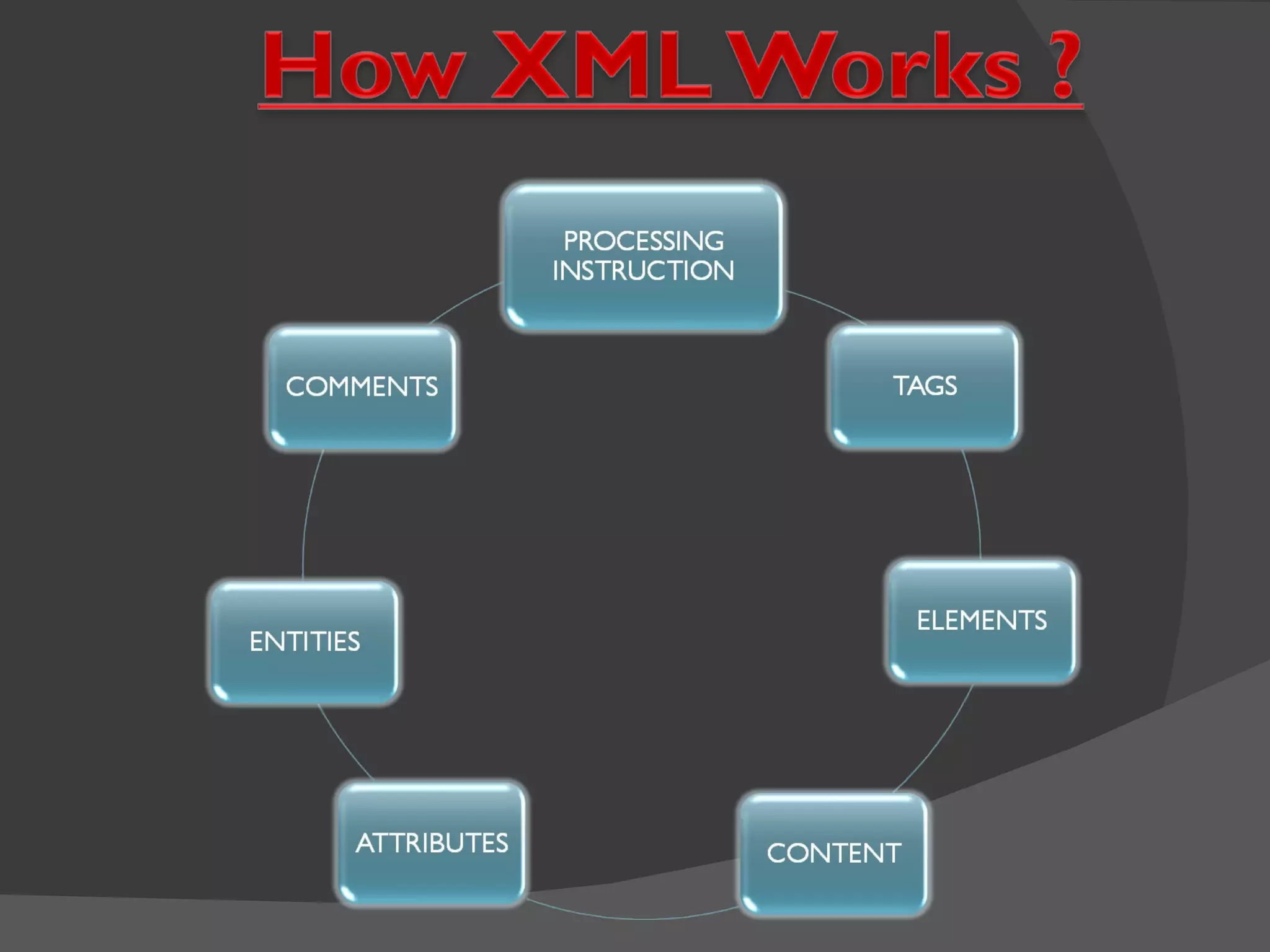
XML  TECHNOLOGY Contents :- Introduction to XML How XML Works Infrastructure of XML Where XML is Used Advantages & Disadvantages of XML
e X tensible  M arkup  L anguage File extension :  .xml MIME type :  application/xml , text/xml (deprecated) Uniform Type :  public.xml Identifier Type of format :  Markup Language Extended form :  SGML
What Is XML ? e X tensible  M arkup  L anguage (XML)  Markup Language for documents containing structured information Defined by four specifications:  XML , the eXtensible Markup Language  XLL , the eXtensible Linking Language  XSL , the eXtensible Style Language  XUA , the XML User Agent
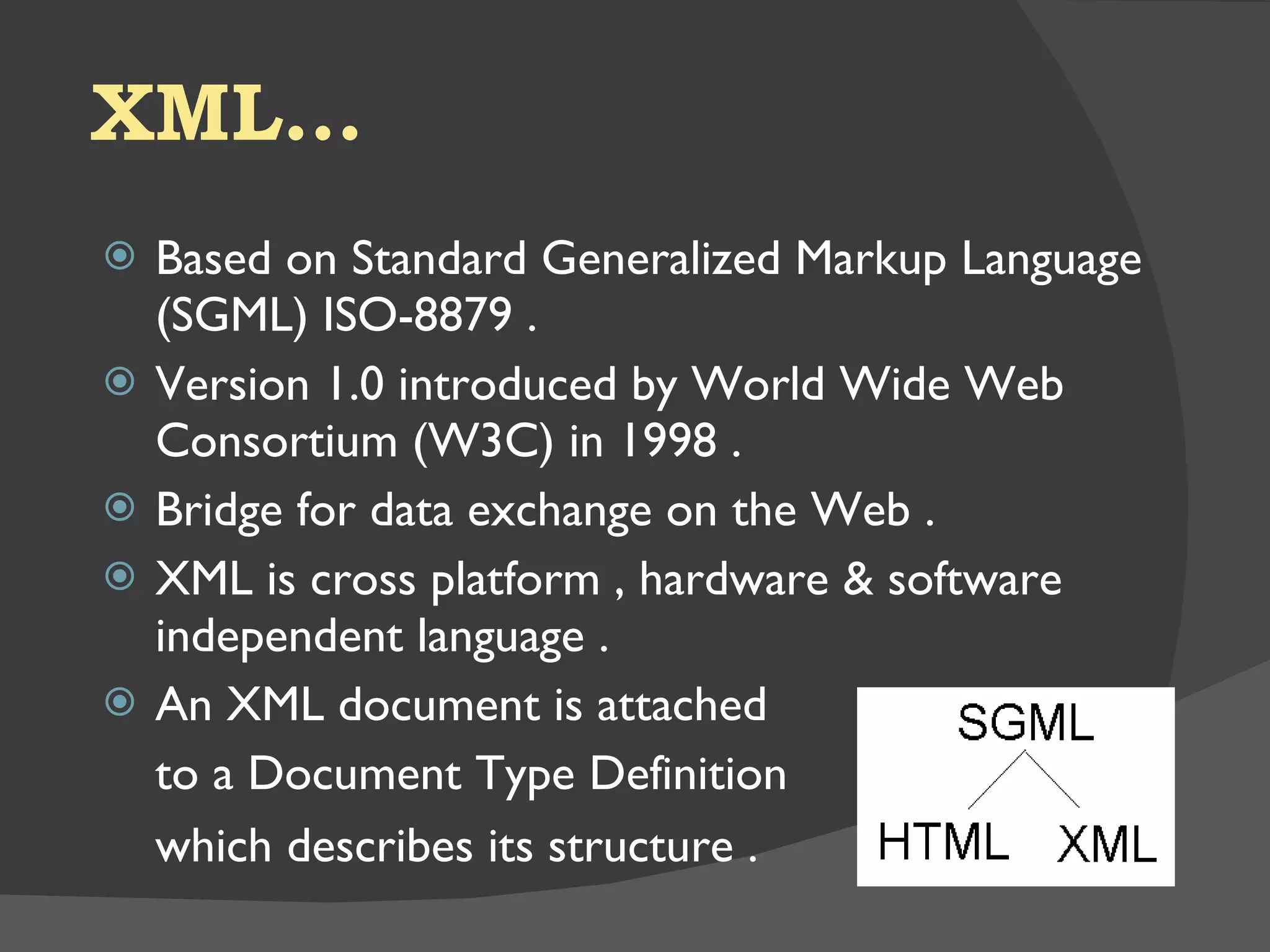
XML… Based on Standard Generalized Markup Language (SGML) ISO-8879 . Version 1.0 introduced by World Wide Web Consortium (W3C) in 1998 . Bridge for data exchange on the Web . XML is cross platform , hardware & software independent language . An XML document is attached to a Document Type Definition which describes its structure .
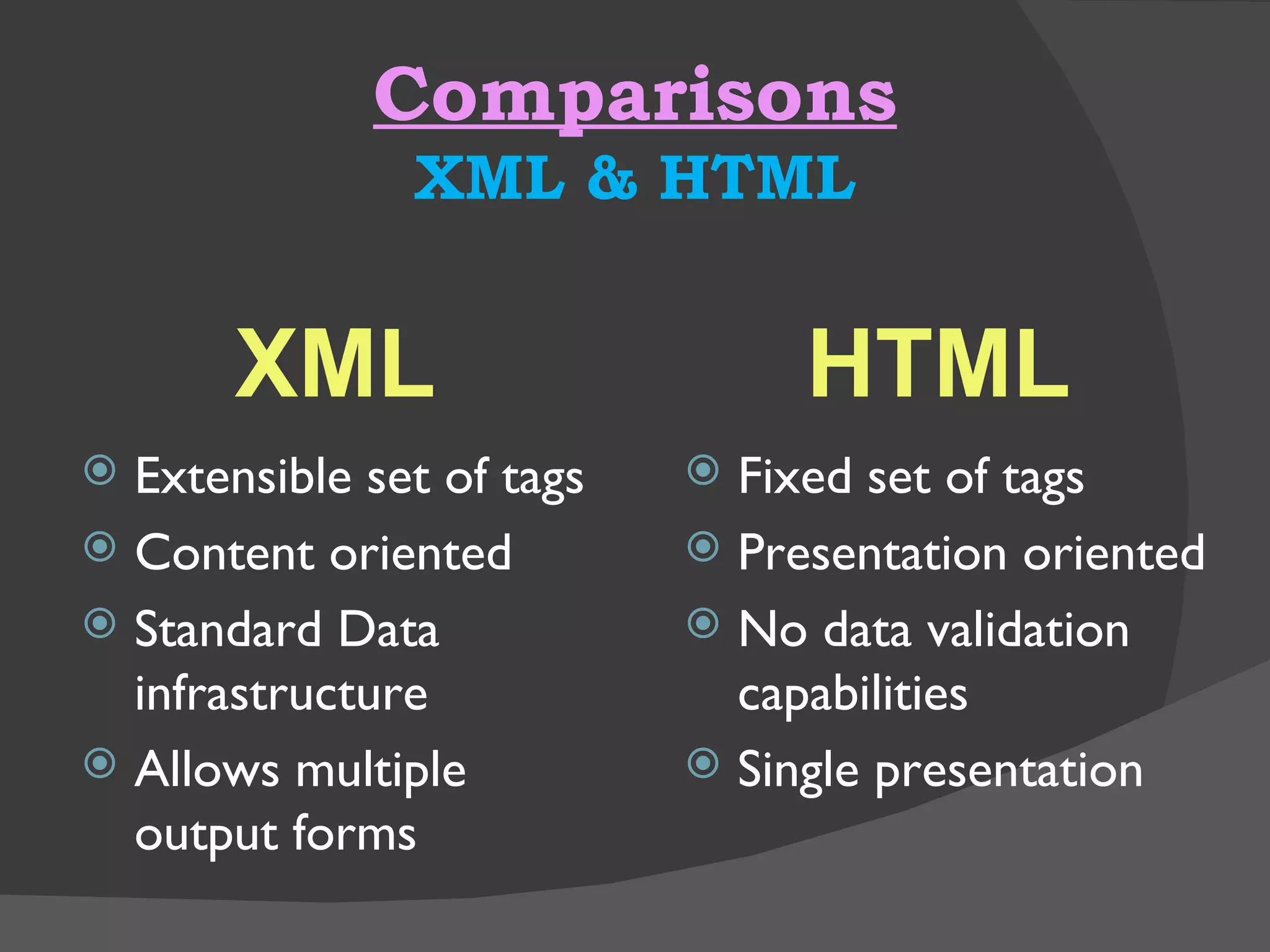
Comparisons XML & HTML XML HTML Extensible set of tags Content oriented Standard Data infrastructure  Allows multiple output forms Fixed set of tags Presentation oriented No data validation capabilities Single presentation
 
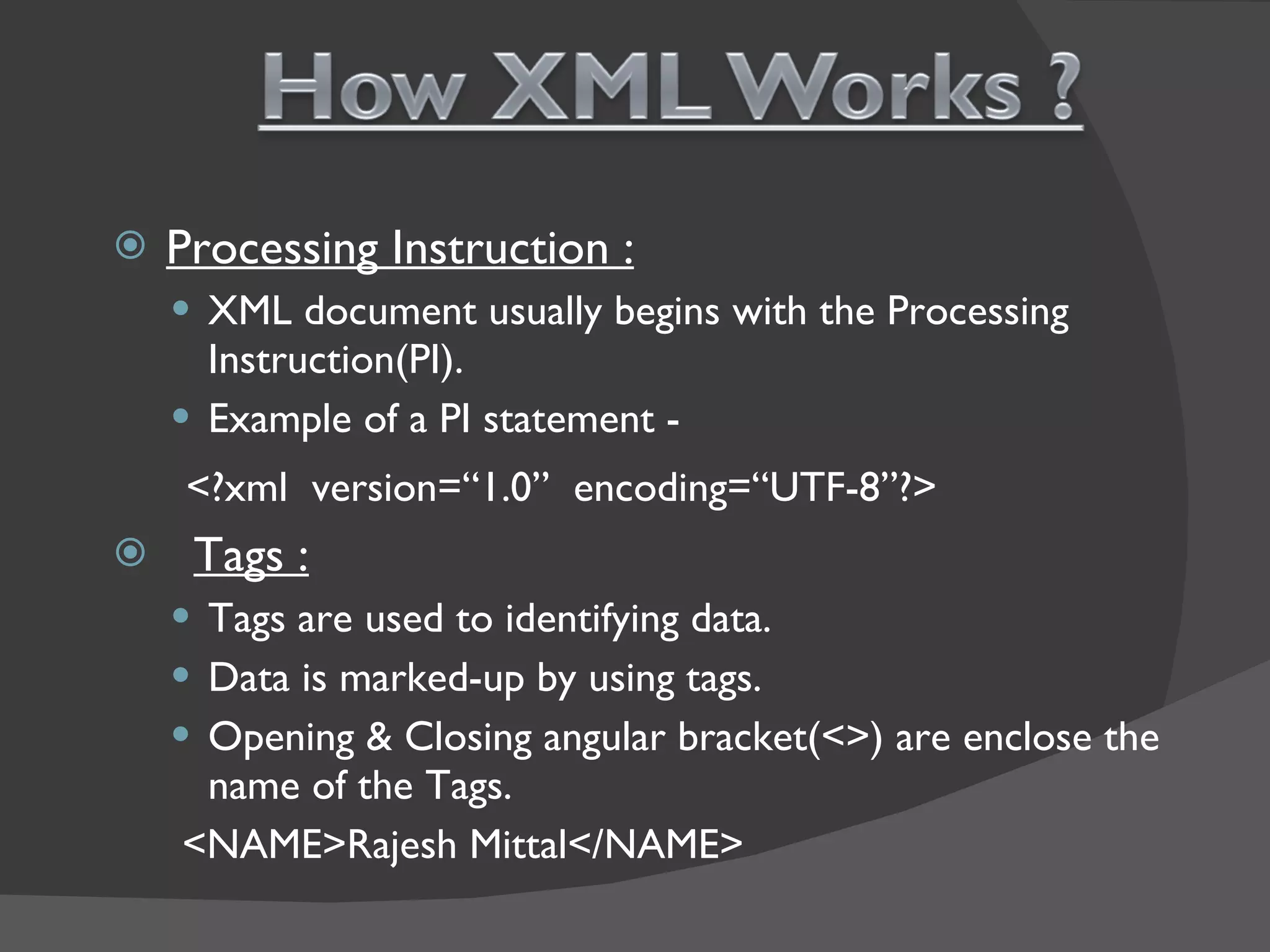
Processing Instruction : XML document usually begins with the Processing  Instruction(PI). Example of a PI statement - <?xml  version=“1.0”  encoding=“UTF-8”?> Tags : Tags are used to identifying data. Data is marked-up by using tags. Opening & Closing angular bracket(<>) are enclose the name of the Tags. <NAME>Rajesh Mittal</NAME>
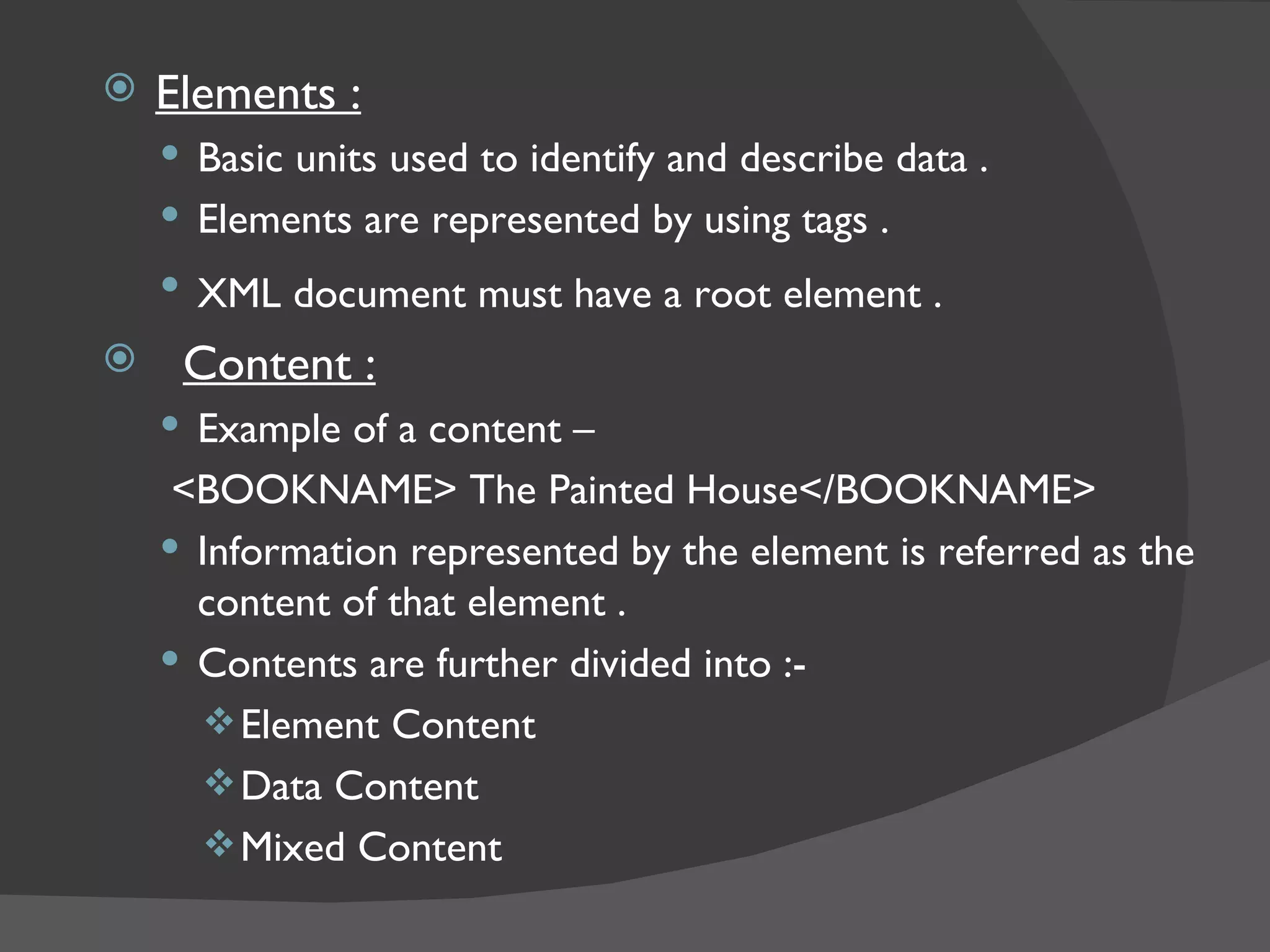
Elements : Basic units used to identify and describe data . Elements are represented by using tags . XML document must have a root element .   Content : Example of a content – <BOOKNAME> The Painted House</BOOKNAME> Information represented by the element is referred as the content of that element . Contents are further divided into :- Element Content  Data Content Mixed Content
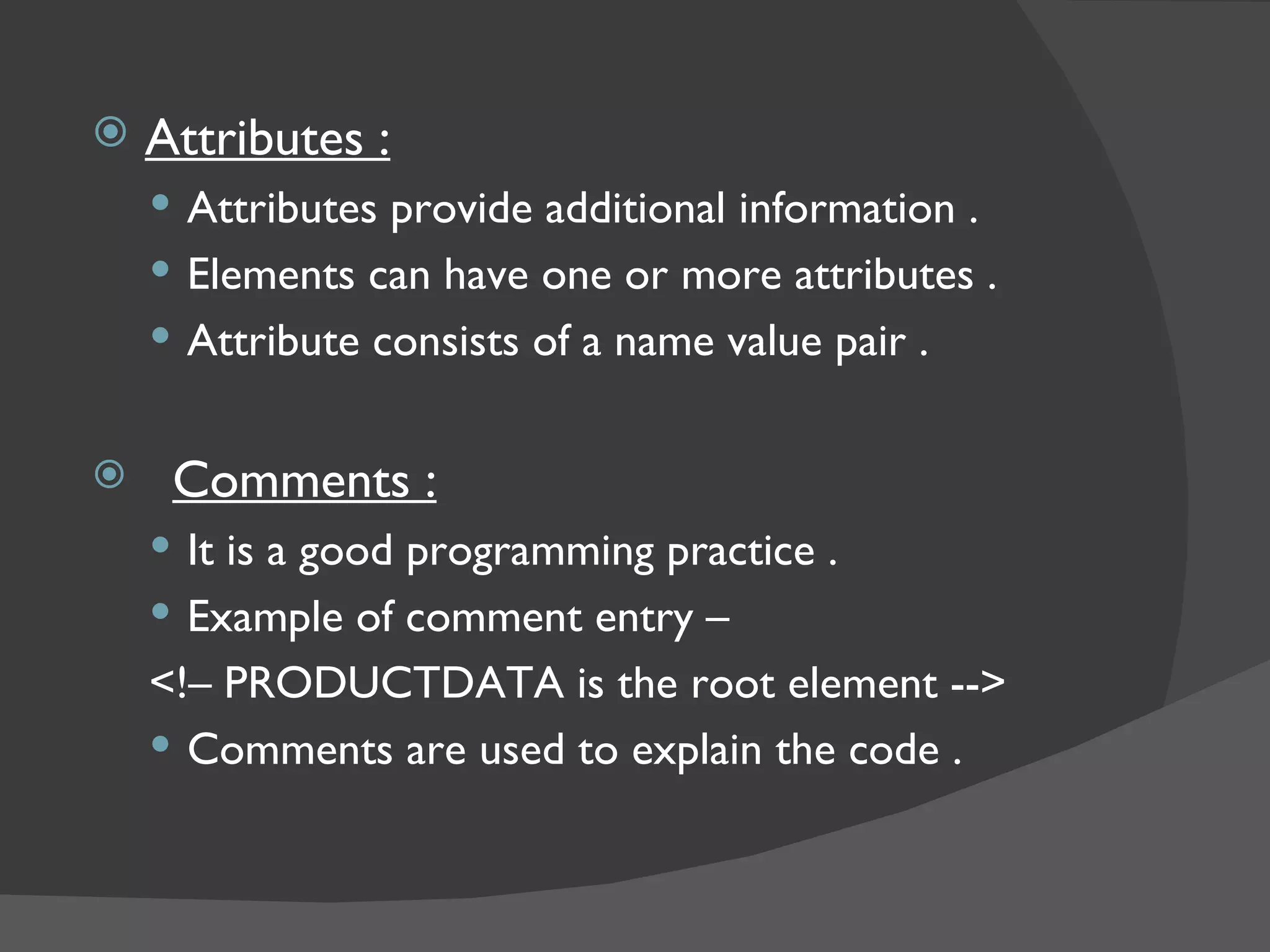
Attributes : Attributes provide additional information . Elements can have one or more attributes . Attribute consists of a name value pair . Comments : It is a good programming practice . Example of comment entry – <!– PRODUCTDATA is the root element --> Comments are used to explain the code .
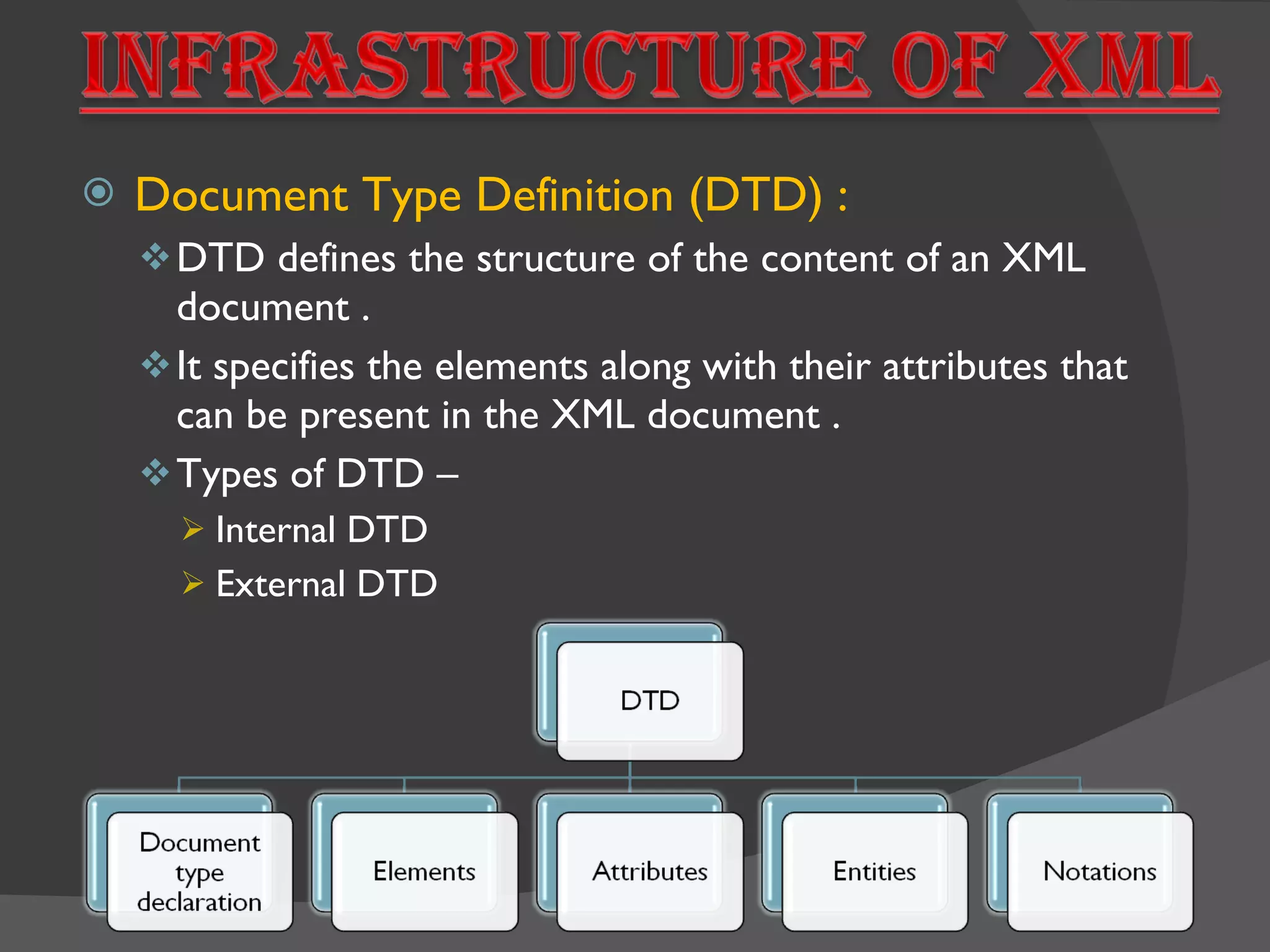
Document Type Definition (DTD) : DTD defines the structure of the content of an XML document . It specifies the elements along with their attributes that can be present in the XML document . Types of DTD – Internal DTD External DTD
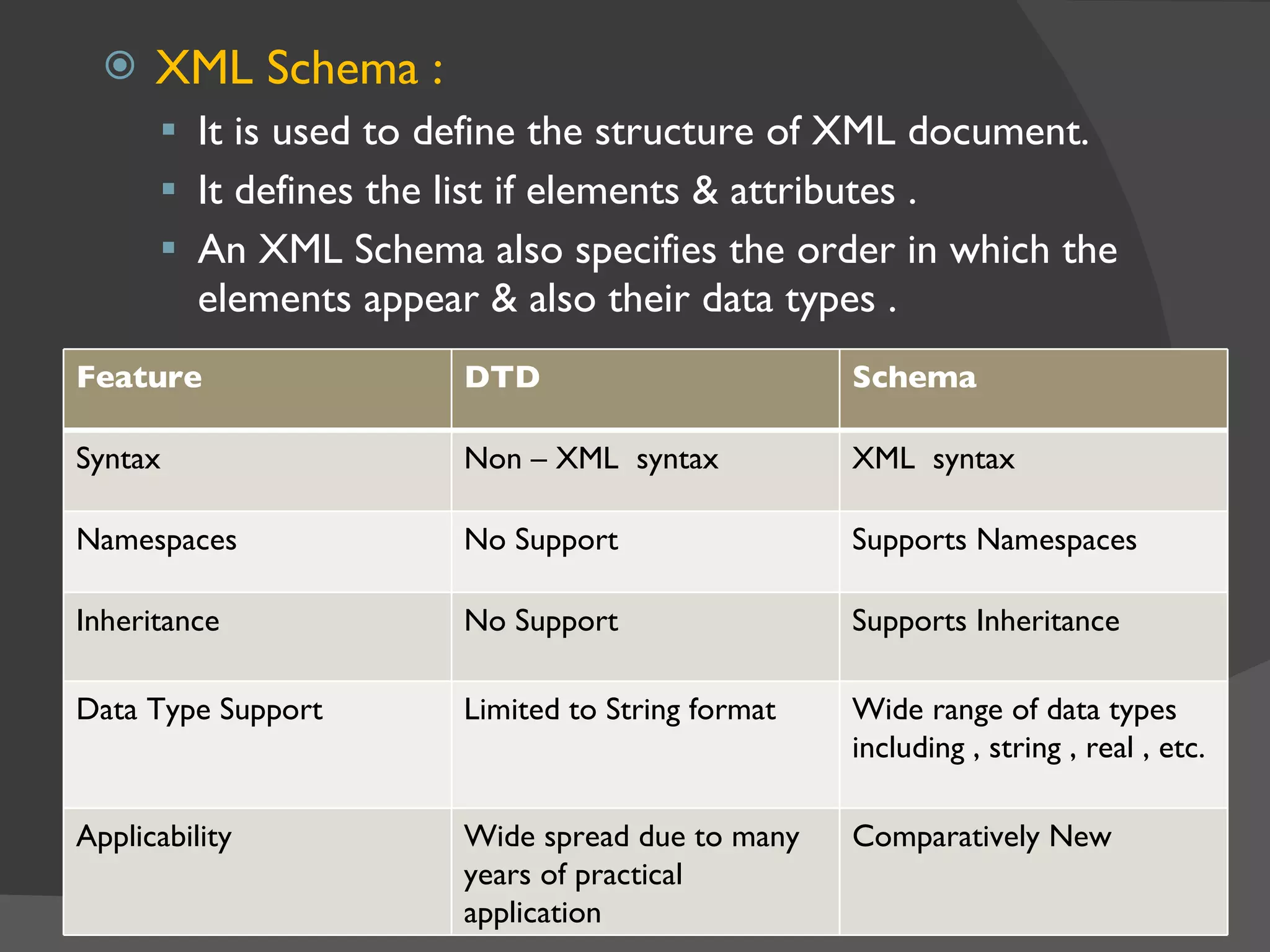
XML Schema : It is used to define the structure of XML document. It defines the list if elements & attributes . An XML Schema also specifies the order in which the elements appear & also their data types . Feature DTD Schema Syntax Non – XML  syntax XML  syntax Namespaces No Support Supports Namespaces Inheritance No Support Supports Inheritance Data Type Support Limited to String format Wide range of data types including , string , real , etc. Applicability Wide spread due to many years of practical application Comparatively New
XML is used to exchange structured documents over internet . XML can be used as a format to transfer structured data between heterogeneous systems as it is platform independent . XML can be used effectively with applications like Java . XML can be used to create new languages e.g. WML , VRML .
Advantages :- It is based on International Standards . It has User Specific Vocabulary , i.e. user defined tags can be created . The Hierarchical Structure is suitable for almost all types of documents . It is platform independent , thus relatively immune to changes in technology .
XML provides the feature of conditional formatting of a document which HTML does not provide . Forward & backward compatibility are easy to maintain despite the changes in DTD or Schema . Disadvantages :- Repetition  : In XML every element and attribute name for every element and attribute instance has to be repeated . External References  : The biggest performance risk for XML comes from the fact that it can include external files .
Thank You

XML

  • 1.
    Presented By :-Kunal Roy Subranjoy Debnath
  • 2.
    XML TECHNOLOGYContents :- Introduction to XML How XML Works Infrastructure of XML Where XML is Used Advantages & Disadvantages of XML
  • 3.
    e X tensible M arkup L anguage File extension : .xml MIME type : application/xml , text/xml (deprecated) Uniform Type : public.xml Identifier Type of format : Markup Language Extended form : SGML
  • 4.
    What Is XML? e X tensible M arkup L anguage (XML) Markup Language for documents containing structured information Defined by four specifications: XML , the eXtensible Markup Language XLL , the eXtensible Linking Language XSL , the eXtensible Style Language XUA , the XML User Agent
  • 5.
    XML… Based onStandard Generalized Markup Language (SGML) ISO-8879 . Version 1.0 introduced by World Wide Web Consortium (W3C) in 1998 . Bridge for data exchange on the Web . XML is cross platform , hardware & software independent language . An XML document is attached to a Document Type Definition which describes its structure .
  • 6.
    Comparisons XML &HTML XML HTML Extensible set of tags Content oriented Standard Data infrastructure Allows multiple output forms Fixed set of tags Presentation oriented No data validation capabilities Single presentation
  • 7.
  • 8.
    Processing Instruction :XML document usually begins with the Processing Instruction(PI). Example of a PI statement - <?xml version=“1.0” encoding=“UTF-8”?> Tags : Tags are used to identifying data. Data is marked-up by using tags. Opening & Closing angular bracket(<>) are enclose the name of the Tags. <NAME>Rajesh Mittal</NAME>
  • 9.
    Elements : Basicunits used to identify and describe data . Elements are represented by using tags . XML document must have a root element . Content : Example of a content – <BOOKNAME> The Painted House</BOOKNAME> Information represented by the element is referred as the content of that element . Contents are further divided into :- Element Content Data Content Mixed Content
  • 10.
    Attributes : Attributesprovide additional information . Elements can have one or more attributes . Attribute consists of a name value pair . Comments : It is a good programming practice . Example of comment entry – <!– PRODUCTDATA is the root element --> Comments are used to explain the code .
  • 11.
    Document Type Definition(DTD) : DTD defines the structure of the content of an XML document . It specifies the elements along with their attributes that can be present in the XML document . Types of DTD – Internal DTD External DTD
  • 12.
    XML Schema :It is used to define the structure of XML document. It defines the list if elements & attributes . An XML Schema also specifies the order in which the elements appear & also their data types . Feature DTD Schema Syntax Non – XML syntax XML syntax Namespaces No Support Supports Namespaces Inheritance No Support Supports Inheritance Data Type Support Limited to String format Wide range of data types including , string , real , etc. Applicability Wide spread due to many years of practical application Comparatively New
  • 13.
    XML is usedto exchange structured documents over internet . XML can be used as a format to transfer structured data between heterogeneous systems as it is platform independent . XML can be used effectively with applications like Java . XML can be used to create new languages e.g. WML , VRML .
  • 14.
    Advantages :- Itis based on International Standards . It has User Specific Vocabulary , i.e. user defined tags can be created . The Hierarchical Structure is suitable for almost all types of documents . It is platform independent , thus relatively immune to changes in technology .
  • 15.
    XML provides thefeature of conditional formatting of a document which HTML does not provide . Forward & backward compatibility are easy to maintain despite the changes in DTD or Schema . Disadvantages :- Repetition : In XML every element and attribute name for every element and attribute instance has to be repeated . External References : The biggest performance risk for XML comes from the fact that it can include external files .
  • 16.