[ X ] C H A N G I N G P E R S P E C T I V E S :
E N R I C H I N G M U LT I - S TA K E H O L D E R D E L I B E R AT I O N W I T H E M B O D I M E N T I N
PA R T I C I PAT O RY S O C I E T Y.
[ X ] C P @ C E ’ D E M ’ 1 7 K R E M S , A U S T R I A | 1 7 - 0 5 - 2 0 1 7
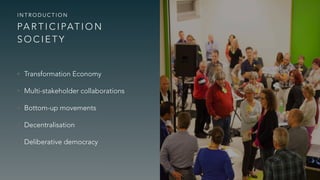
I N T R O D U C T I O N
• Transformation Economy
• Multi-stakeholder collaborations
• Bottom-up movements
• Decentralisation
• Deliberative democracy
PA R T I C I PAT I O N
S O C I E T Y
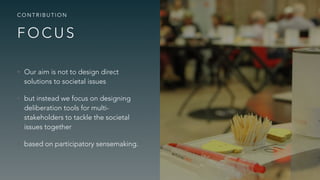
F O C U S
C O N T R I B U T I O N
• Our aim is not to design direct
solutions to societal issues
• but instead we focus on designing
deliberation tools for multi-
stakeholders to tackle the societal
issues together
• based on participatory sensemaking.
• Systemic mechanisms are
‘colonising’ the Lifeworld
• ”…reaching understanding in the
sense of a cooperative process of
interpretation” [Habermas 1981, p.
40]
• Stakeholders should engage in
discussions that cross over the
System and Lifeworld dichotomy
and reach a common
understanding
• System-Lifeworld 

(HABERMAS, 1981)
• Plurality

(ARENDT, 1945)
• Phenemenology of Perception

(MERLEAU-PONTY, 1985)
• Participatory Sensemaking

(DE JAEGHER & DI PAOLO, 2009)
• Deliberative Democracy

(FISHKIN & LUSKIN, 2005)
• Embodiment

(HUMMELS & VAN DIJK, 2015)
F R A M E
T H E O RY
• System-Lifeworld 

(HABERMAS, 1981)
• Plurality

(ARENDT, 1945)
• Phenemenology of Perception

(MERLEAU-PONTY, 1985)
• Participatory Sensemaking

(DE JAEGHER & DI PAOLO, 2009)
• Deliberative Democracy

(FISHKIN & LUSKIN, 2005)
• Embodiment

(HUMMELS & VAN DIJK, 2015)
F R A M E
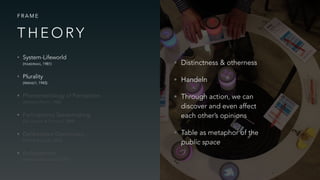
• Distinctness & otherness
• Handeln
• Through action, we can
discover and even affect
each other’s opinions
• Table as metaphor of the
public space
T H E O RY
• System-Lifeworld 

(HABERMAS, 1981)
• Plurality

(ARENDT, 1945)
• Phenemenology of Perception

(MERLEAU-PONTY, 1985)
• Participatory Sensemaking

(DE JAEGHER & DI PAOLO, 2009)
• Deliberative Democracy

(FISHKIN & LUSKIN, 2005)
• Embodiment

(HUMMELS & VAN DIJK, 2015)
F R A M E
T H E O RY
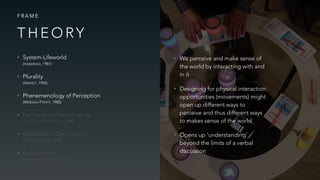
• We perceive and make sense of
the world by interacting with and
in it
• Designing for physical interaction
opportunities (movements) might
open up different ways to
perceive and thus different ways
to makes sense of the world
• Opens up ‘understanding’
beyond the limits of a verbal
discussion
• System-Lifeworld 

(HABERMAS, 1981)
• Plurality

(ARENDT, 1945)
• Phenemenology of Perception

(MERLEAU-PONTY, 1985)
• Participatory Sensemaking

(DE JAEGHER & DI PAOLO, 2009)
• Deliberative Democracy

(FISHKIN & LUSKIN, 2005)
• Embodiment

(HUMMELS & VAN DIJK, 2015)
F R A M E
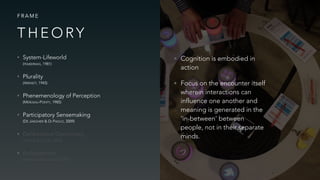
• Cognition is embodied in
action
• Focus on the encounter itself
wherein interactions can
influence one another and
meaning is generated in the
‘in-between’ between
people, not in their separate
minds.
T H E O RY
• System-Lifeworld 

(HABERMAS, 1981)
• Plurality

(ARENDT, 1945)
• Phenemenology of Perception

(MERLEAU-PONTY, 1985)
• Participatory Sensemaking

(DE JAEGHER & DI PAOLO, 2009)
• Deliberative Democracy

(FISHKIN & LUSKIN, 2005)
• Embodiment

(HUMMELS & VAN DIJK, 2015)
F R A M E
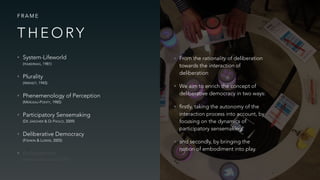
• From the rationality of deliberation
towards the interaction of
deliberation
• We aim to enrich the concept of
deliberative democracy in two ways:
• firstly, taking the autonomy of the
interaction process into account, by
focusing on the dynamics of
participatory sensemaking,
• and secondly, by bringing the
notion of embodiment into play.
T H E O RY
• System-Lifeworld 

(HABERMAS, 1981)
• Plurality

(ARENDT, 1945)
• Phenemenology of Perception

(MERLEAU-PONTY, 1985)
• Participatory Sensemaking

(DE JAEGHER & DI PAOLO, 2009)
• Deliberative Democracy

(FISHKIN & LUSKIN, 2005)
• Embodiment

(HUMMELS & VAN DIJK, 2015)
F R A M E
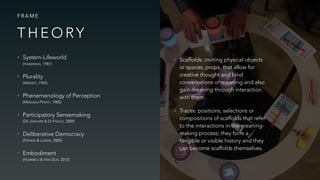
• Scaffolds: inviting physical objects
or spaces, props, that allow for
creative thought and bind
conversations or meaning and also
gain meaning through interaction
with them.
• Traces: positions, selections or
compositions of scaffolds that refer
to the interactions in the meaning-
making process; they form a
tangible or visible history and they
can become scaffolds themselves.
T H E O RY
D E S I G N : [ X ] C H A N G I N G P E R S P E C T I V E S
C O N T R I B U T I O N
• PRODUCT

(2) 15 tracking tables each with 15 tokens
with icons and 1 real-time visualisation of
token movements
• SERVICE

(1) Expectation management, Invitation, 

(3) Analysis, report, video-impression, 

(4) Collective evaluation session.
• SYSTEM

Token movements are tracked and
visualised in a real-time visualisation.
3 C A S E S
C A S E S T U D I E S
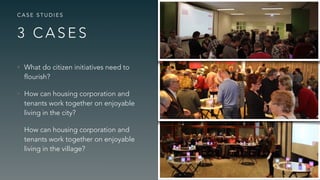
• What do citizen initiatives need to
flourish?
• How can housing corporation and
tenants work together on enjoyable
living in the city?
• How can housing corporation and
tenants work together on enjoyable
living in the village?
vimeo.com/philemonne/aop080915
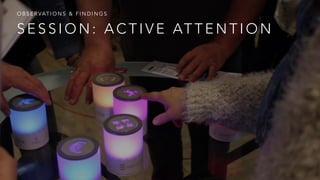
S E S S I O N : A C T I V E AT T E N T I O N
O B S E R VAT I O N S & F I N D I N G S
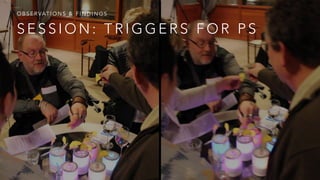
S E S S I O N : T R I G G E R S F O R P S
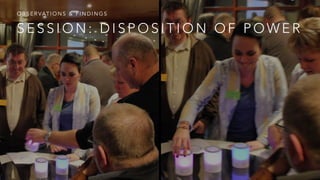
S E S S I O N : D I S P O S I T I O N O F P O W E R
O B S E R VAT I O N S & F I N D I N G S
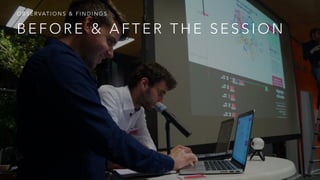
B E F O R E & A F T E R T H E S E S S I O N
O B S E R VAT I O N S & F I N D I N G S
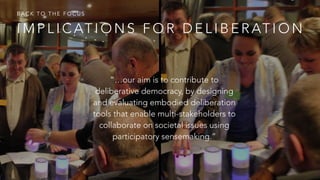
B A C K T O T H E F O C U S
• “…our aim is to contribute to
deliberative democracy, by designing
and evaluating embodied deliberation
tools that enable multi-stakeholders to
collaborate on societal issues using
participatory sensemaking.”
I M P L I C AT I O N S F O R D E L I B E R AT I O N
• Introducing physical and visual
elements to enrich deliberation
• Scaffolds: icons, tokens

(HUMMELS & VAN DIJK, 2015)
• Traces: visual representation

(HUMMELS & VAN DIJK, 2015)
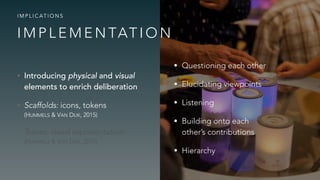
I M P L I C AT I O N S
• Questioning each other
• Elucidating viewpoints
• Listening
• Building onto each
other’s contributions
• Hierarchy
I M P L E M E N TAT I O N
• Introducing physical and visual
elements to enrich deliberation
• Scaffolds: icons, tokens

(HUMMELS & VAN DIJK, 2015)
• Traces: visual representation

(HUMMELS & VAN DIJK, 2015)
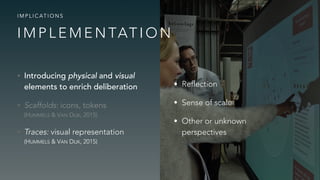
I M P L I C AT I O N S
• Reflection
• Sense of scale
• Other or unknown
perspectives
I M P L E M E N TAT I O N
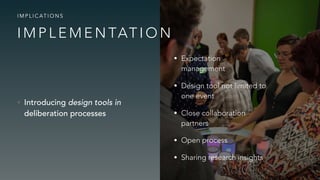
• Introducing design tools in
deliberation processes
I M P L I C AT I O N S
• Expectation
management
• Design tool not limited to
one event
• Close collaboration
partners
• Open process
• Sharing research insights
I M P L E M E N TAT I O N
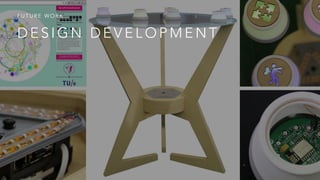
F U T U R E W O R K
D E S I G N D E V E L O P M E N T
[ X ] C H A N G I N G P E R S P E C T I V E S :
E N R I C H I N G M U LT I - S TA K E H O L D E R D E L I B E R AT I O N W I T H E M B O D I M E N T I N
PA R T I C I PAT O RY S O C I E T Y.
[ X ] C P @ C E ’ D E M ’ 1 7 K R E M S , A U S T R I A | 1 7 - 0 5 - 2 0 1 7
P H I L É M O N N E J A A S M A
P. G . J A A S M A @ T U E . N L

[X]CHANGING PERSPECTIVES

  • 1.
    [ X ]C H A N G I N G P E R S P E C T I V E S : E N R I C H I N G M U LT I - S TA K E H O L D E R D E L I B E R AT I O N W I T H E M B O D I M E N T I N PA R T I C I PAT O RY S O C I E T Y. [ X ] C P @ C E ’ D E M ’ 1 7 K R E M S , A U S T R I A | 1 7 - 0 5 - 2 0 1 7
  • 2.
    I N TR O D U C T I O N • Transformation Economy • Multi-stakeholder collaborations • Bottom-up movements • Decentralisation • Deliberative democracy PA R T I C I PAT I O N S O C I E T Y
  • 3.
    F O CU S C O N T R I B U T I O N • Our aim is not to design direct solutions to societal issues • but instead we focus on designing deliberation tools for multi- stakeholders to tackle the societal issues together • based on participatory sensemaking.
  • 4.
    • Systemic mechanismsare ‘colonising’ the Lifeworld • ”…reaching understanding in the sense of a cooperative process of interpretation” [Habermas 1981, p. 40] • Stakeholders should engage in discussions that cross over the System and Lifeworld dichotomy and reach a common understanding • System-Lifeworld 
 (HABERMAS, 1981) • Plurality
 (ARENDT, 1945) • Phenemenology of Perception
 (MERLEAU-PONTY, 1985) • Participatory Sensemaking
 (DE JAEGHER & DI PAOLO, 2009) • Deliberative Democracy
 (FISHKIN & LUSKIN, 2005) • Embodiment
 (HUMMELS & VAN DIJK, 2015) F R A M E T H E O RY
  • 5.
    • System-Lifeworld 
 (HABERMAS,1981) • Plurality
 (ARENDT, 1945) • Phenemenology of Perception
 (MERLEAU-PONTY, 1985) • Participatory Sensemaking
 (DE JAEGHER & DI PAOLO, 2009) • Deliberative Democracy
 (FISHKIN & LUSKIN, 2005) • Embodiment
 (HUMMELS & VAN DIJK, 2015) F R A M E • Distinctness & otherness • Handeln • Through action, we can discover and even affect each other’s opinions • Table as metaphor of the public space T H E O RY
  • 6.
    • System-Lifeworld 
 (HABERMAS,1981) • Plurality
 (ARENDT, 1945) • Phenemenology of Perception
 (MERLEAU-PONTY, 1985) • Participatory Sensemaking
 (DE JAEGHER & DI PAOLO, 2009) • Deliberative Democracy
 (FISHKIN & LUSKIN, 2005) • Embodiment
 (HUMMELS & VAN DIJK, 2015) F R A M E T H E O RY • We perceive and make sense of the world by interacting with and in it • Designing for physical interaction opportunities (movements) might open up different ways to perceive and thus different ways to makes sense of the world • Opens up ‘understanding’ beyond the limits of a verbal discussion
  • 7.
    • System-Lifeworld 
 (HABERMAS,1981) • Plurality
 (ARENDT, 1945) • Phenemenology of Perception
 (MERLEAU-PONTY, 1985) • Participatory Sensemaking
 (DE JAEGHER & DI PAOLO, 2009) • Deliberative Democracy
 (FISHKIN & LUSKIN, 2005) • Embodiment
 (HUMMELS & VAN DIJK, 2015) F R A M E • Cognition is embodied in action • Focus on the encounter itself wherein interactions can influence one another and meaning is generated in the ‘in-between’ between people, not in their separate minds. T H E O RY
  • 8.
    • System-Lifeworld 
 (HABERMAS,1981) • Plurality
 (ARENDT, 1945) • Phenemenology of Perception
 (MERLEAU-PONTY, 1985) • Participatory Sensemaking
 (DE JAEGHER & DI PAOLO, 2009) • Deliberative Democracy
 (FISHKIN & LUSKIN, 2005) • Embodiment
 (HUMMELS & VAN DIJK, 2015) F R A M E • From the rationality of deliberation towards the interaction of deliberation • We aim to enrich the concept of deliberative democracy in two ways: • firstly, taking the autonomy of the interaction process into account, by focusing on the dynamics of participatory sensemaking, • and secondly, by bringing the notion of embodiment into play. T H E O RY
  • 9.
    • System-Lifeworld 
 (HABERMAS,1981) • Plurality
 (ARENDT, 1945) • Phenemenology of Perception
 (MERLEAU-PONTY, 1985) • Participatory Sensemaking
 (DE JAEGHER & DI PAOLO, 2009) • Deliberative Democracy
 (FISHKIN & LUSKIN, 2005) • Embodiment
 (HUMMELS & VAN DIJK, 2015) F R A M E • Scaffolds: inviting physical objects or spaces, props, that allow for creative thought and bind conversations or meaning and also gain meaning through interaction with them. • Traces: positions, selections or compositions of scaffolds that refer to the interactions in the meaning- making process; they form a tangible or visible history and they can become scaffolds themselves. T H E O RY
  • 10.
    D E SI G N : [ X ] C H A N G I N G P E R S P E C T I V E S C O N T R I B U T I O N • PRODUCT
 (2) 15 tracking tables each with 15 tokens with icons and 1 real-time visualisation of token movements • SERVICE
 (1) Expectation management, Invitation, 
 (3) Analysis, report, video-impression, 
 (4) Collective evaluation session. • SYSTEM
 Token movements are tracked and visualised in a real-time visualisation.
  • 11.
    3 C AS E S C A S E S T U D I E S • What do citizen initiatives need to flourish? • How can housing corporation and tenants work together on enjoyable living in the city? • How can housing corporation and tenants work together on enjoyable living in the village?
  • 12.
  • 13.
    S E SS I O N : A C T I V E AT T E N T I O N O B S E R VAT I O N S & F I N D I N G S
  • 14.
    O B SE R VAT I O N S & F I N D I N G S S E S S I O N : T R I G G E R S F O R P S
  • 15.
    S E SS I O N : D I S P O S I T I O N O F P O W E R O B S E R VAT I O N S & F I N D I N G S
  • 16.
    B E FO R E & A F T E R T H E S E S S I O N O B S E R VAT I O N S & F I N D I N G S
  • 17.
    B A CK T O T H E F O C U S • “…our aim is to contribute to deliberative democracy, by designing and evaluating embodied deliberation tools that enable multi-stakeholders to collaborate on societal issues using participatory sensemaking.” I M P L I C AT I O N S F O R D E L I B E R AT I O N
  • 18.
    • Introducing physicaland visual elements to enrich deliberation • Scaffolds: icons, tokens
 (HUMMELS & VAN DIJK, 2015) • Traces: visual representation
 (HUMMELS & VAN DIJK, 2015) I M P L I C AT I O N S • Questioning each other • Elucidating viewpoints • Listening • Building onto each other’s contributions • Hierarchy I M P L E M E N TAT I O N
  • 19.
    • Introducing physicaland visual elements to enrich deliberation • Scaffolds: icons, tokens
 (HUMMELS & VAN DIJK, 2015) • Traces: visual representation
 (HUMMELS & VAN DIJK, 2015) I M P L I C AT I O N S • Reflection • Sense of scale • Other or unknown perspectives I M P L E M E N TAT I O N
  • 20.
    • Introducing designtools in deliberation processes I M P L I C AT I O N S • Expectation management • Design tool not limited to one event • Close collaboration partners • Open process • Sharing research insights I M P L E M E N TAT I O N
  • 21.
    F U TU R E W O R K D E S I G N D E V E L O P M E N T
  • 22.
    [ X ]C H A N G I N G P E R S P E C T I V E S : E N R I C H I N G M U LT I - S TA K E H O L D E R D E L I B E R AT I O N W I T H E M B O D I M E N T I N PA R T I C I PAT O RY S O C I E T Y. [ X ] C P @ C E ’ D E M ’ 1 7 K R E M S , A U S T R I A | 1 7 - 0 5 - 2 0 1 7 P H I L É M O N N E J A A S M A P. G . J A A S M A @ T U E . N L