X ray crystallography
analysis
Submitted to :
Dr. Kiran Kumar
Division of Bioinformatics &
Biotechnology.
JSSAHE&R Mysore.
Submitted by,
Prabhakarareddy A V
19L10913
MSc Bioinformatics
JSSAHE&R MYSORE
Introduction
 X-ray crystallography is a powerful technique for visualizing the structure of
protein.
 It is a tool used for identifying the atomic and molecular structure of a
crystal.
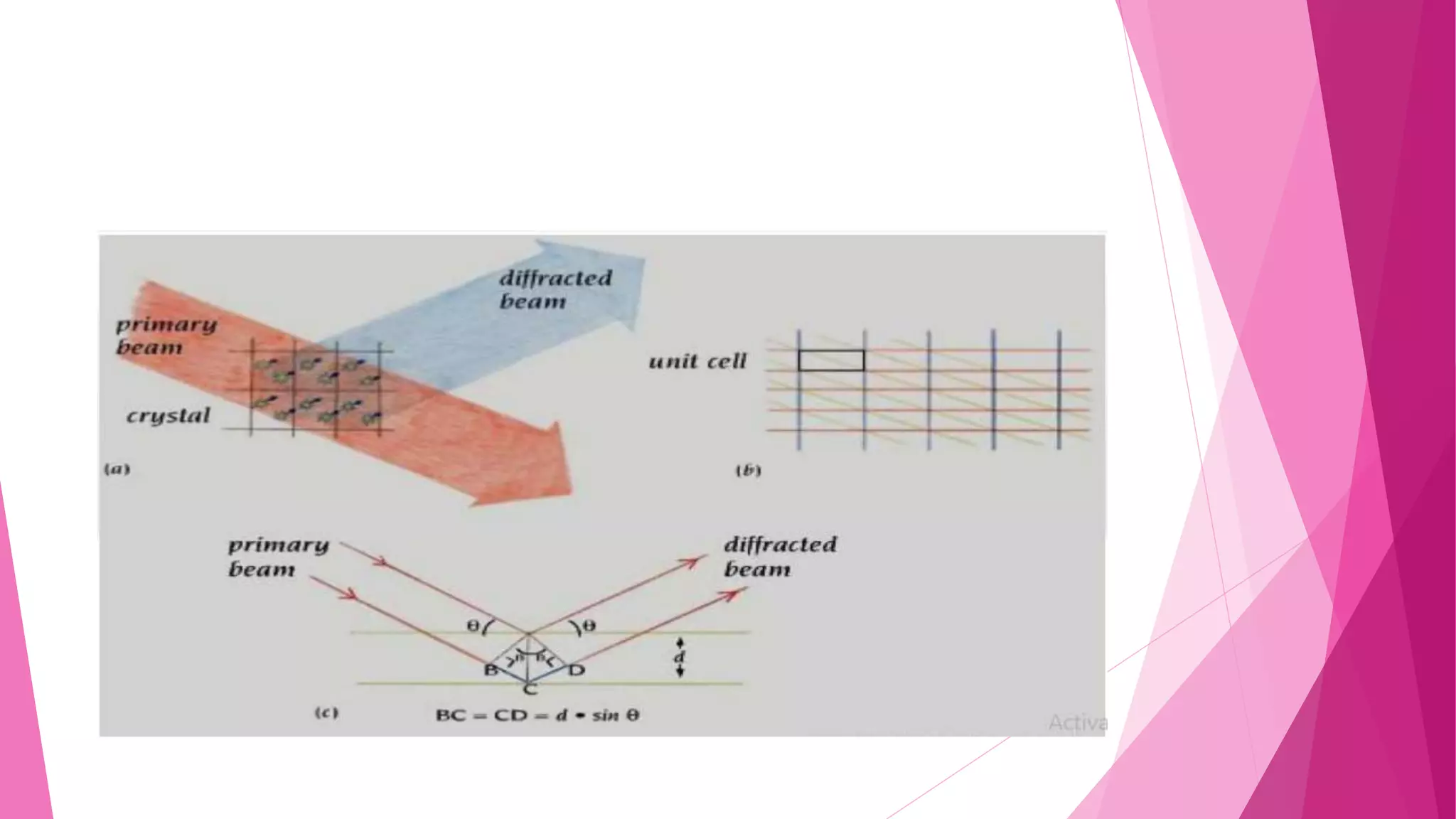
 In crystallography the crystalline atoms cause a beam of incident X-rays to
diffract into many specific directions.
 Then crystallographer can produce a three-dimensional picture of the density
of electrons within the crystal.
 From this electron density, the mean positions of the atoms in the crystal can
be determined.
 X-ray crystallography can locate every atom in a zeolite, an aluminosilicate.
X-Ray Crystallography
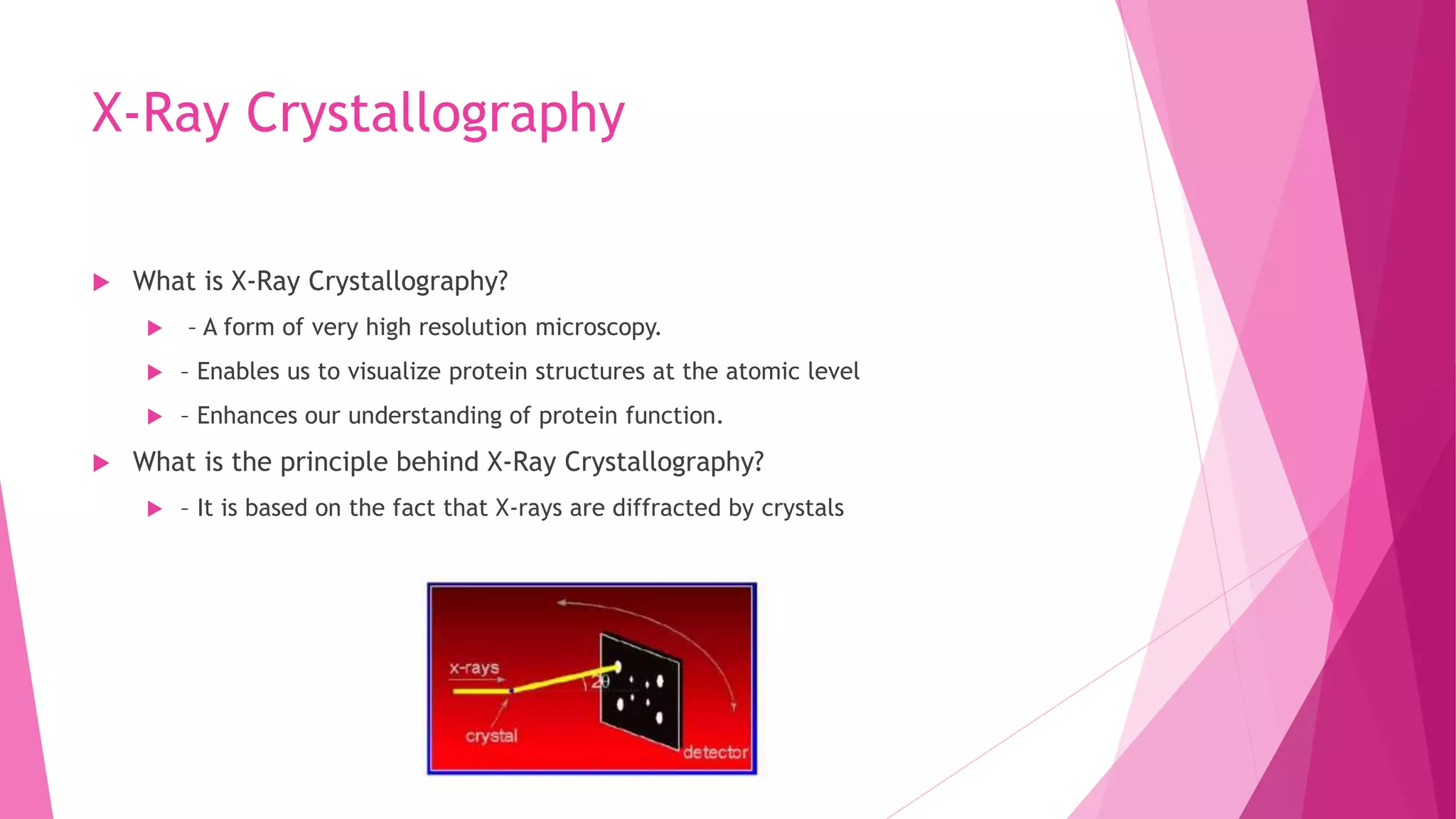
 What is X-Ray Crystallography?
 – A form of very high resolution microscopy.
 – Enables us to visualize protein structures at the atomic level
 – Enhances our understanding of protein function.
 What is the principle behind X-Ray Crystallography?
 – It is based on the fact that X-rays are diffracted by crystals
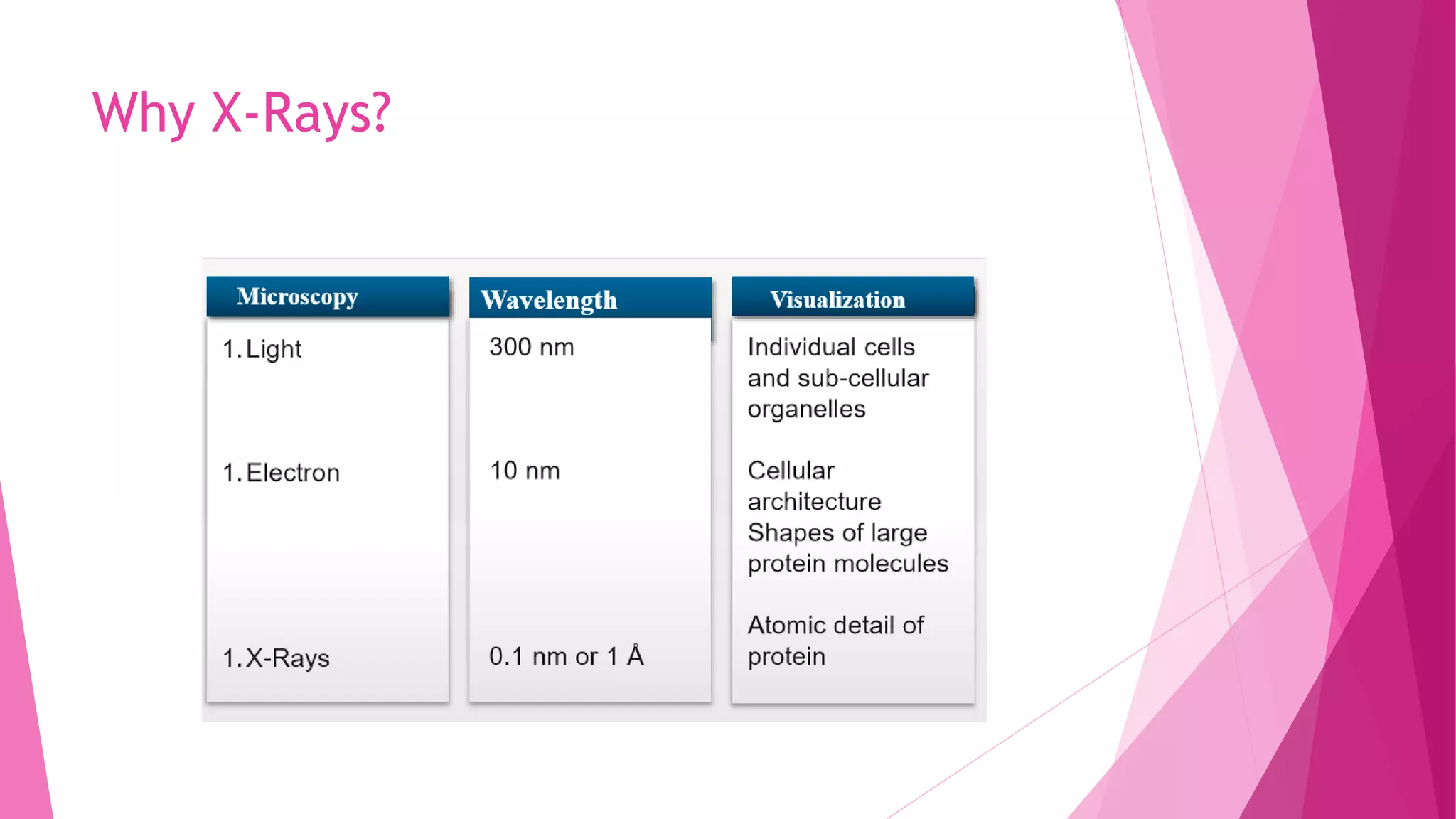
Why X-Rays?
Steps in Structure Determination
 1. Protein purification.
 2. Protein crystallization.
 3. Data collection.
 4. Structure Solution (Phasing)
 5. Structure determination (Model building and refinement)
Step1:Protein Purification
 What is Protein Purification?
 is a series of processes intended to isolate one or a few proteins from a complex
mixture, usually cells, tissues or whole organisms.
 Why Protein Purification?
 Characterization of the function.
 Structure
 Interactions of the protein.
 Requirements
 minimum of 5 to 10 milligrams pure soluble
 protein are required with better than 95% purity
Step2:Protein crystallization
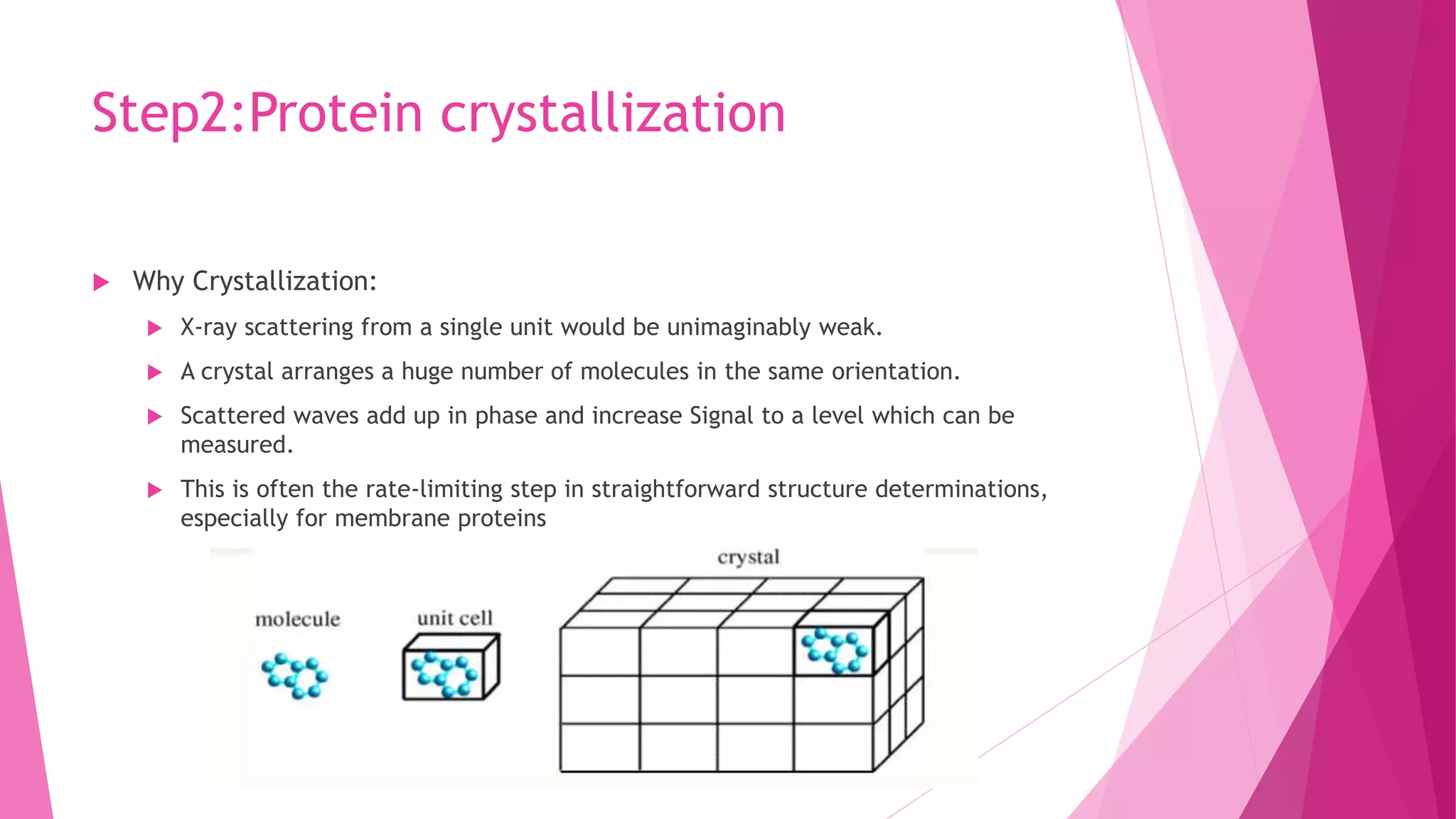
 Why Crystallization:
 X-ray scattering from a single unit would be unimaginably weak.
 A crystal arranges a huge number of molecules in the same orientation.
 Scattered waves add up in phase and increase Signal to a level which can be
measured.
 This is often the rate-limiting step in straightforward structure determinations,
especially for membrane proteins
Step3:Data collection:
Continue…..
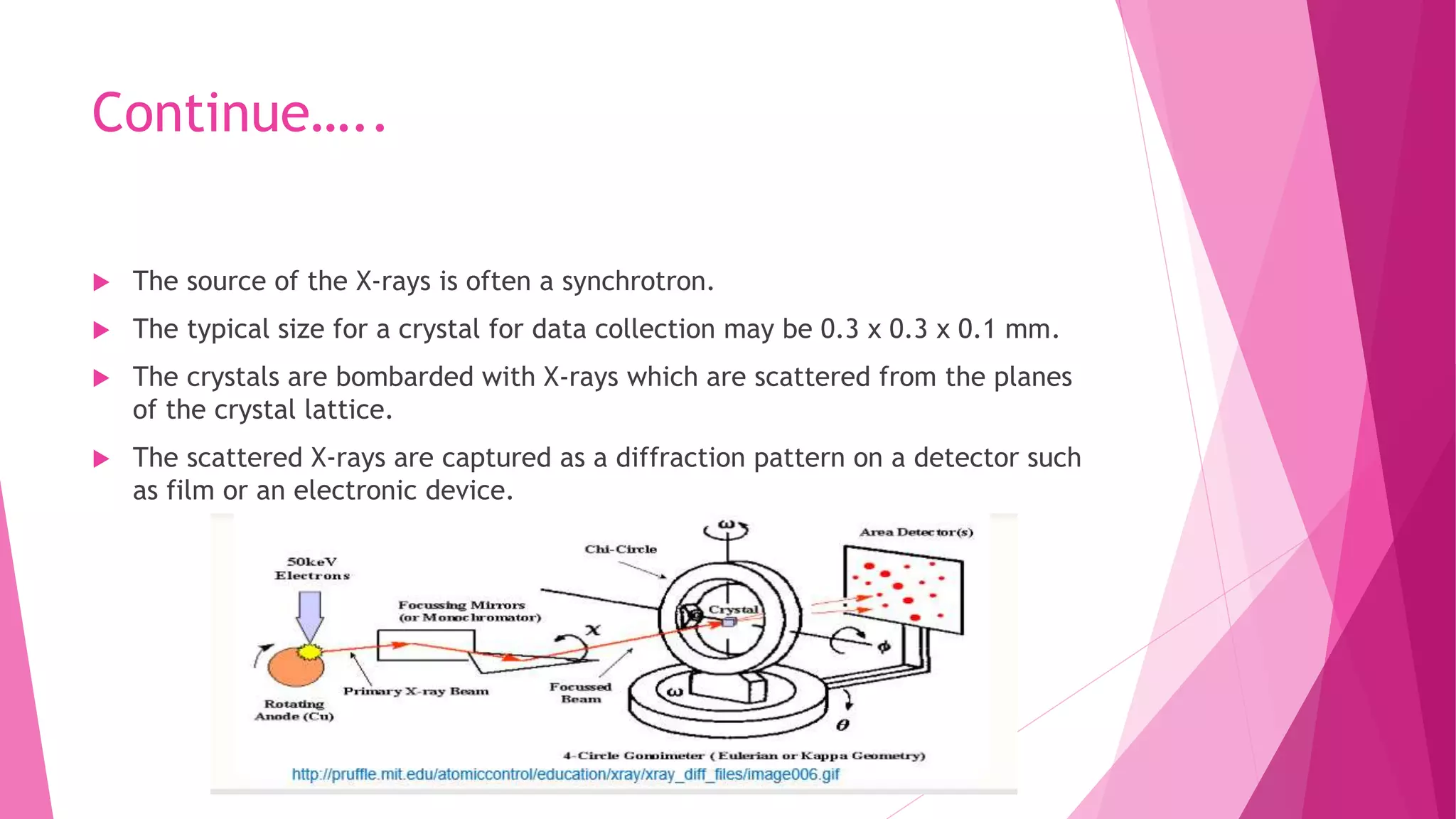
 The source of the X-rays is often a synchrotron.
 The typical size for a crystal for data collection may be 0.3 x 0.3 x 0.1 mm.
 The crystals are bombarded with X-rays which are scattered from the planes
of the crystal lattice.
 The scattered X-rays are captured as a diffraction pattern on a detector such
as film or an electronic device.
Continue….
 Rotate crystal through 1 degree and Record XRD pattern
 If XRD pattern is very crowded, reduce the degree of rotation
 Repeat until 30 degrees were obtained
 Sometimes 180 degrees depending on crystal symmetry
 Lower the symmetry= More data are required
 For high resolution, use Synchrotron
Step4:Structure Solution (Phasing)
 GOAL= From Diffraction Data to Electron Density
Phasing
Step4:Structure Solution (Phasing)
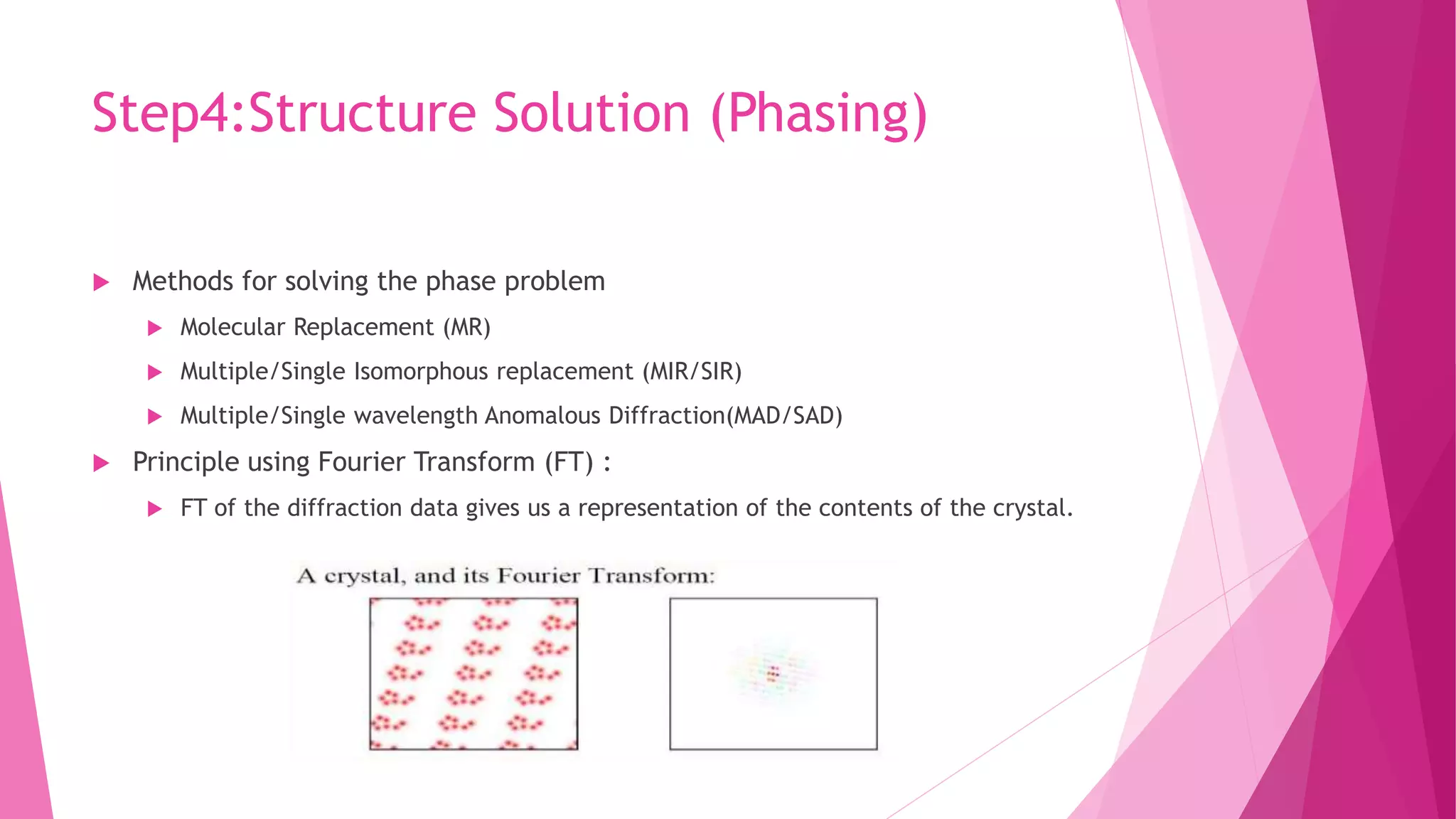
 Methods for solving the phase problem
 Molecular Replacement (MR)
 Multiple/Single Isomorphous replacement (MIR/SIR)
 Multiple/Single wavelength Anomalous Diffraction(MAD/SAD)
 Principle using Fourier Transform (FT) :
 FT of the diffraction data gives us a representation of the contents of the crystal.
Step5: Structure determination (Fitting):
 Fitting of protein sequence in the electron density.
 Electron density – Not self explanatory
 Can be automated, if resolution is close to 2Å or better.
 What can be interpreted is largely defined by resolution.
Step5: Structure determination
(Refinement):
 Automated improvement of the model, so it explains the observed data
better.
 The phases get improved as well, so the electron density maps get better.
Process of resolution of molecular and
crystal structures by X-ray diffraction
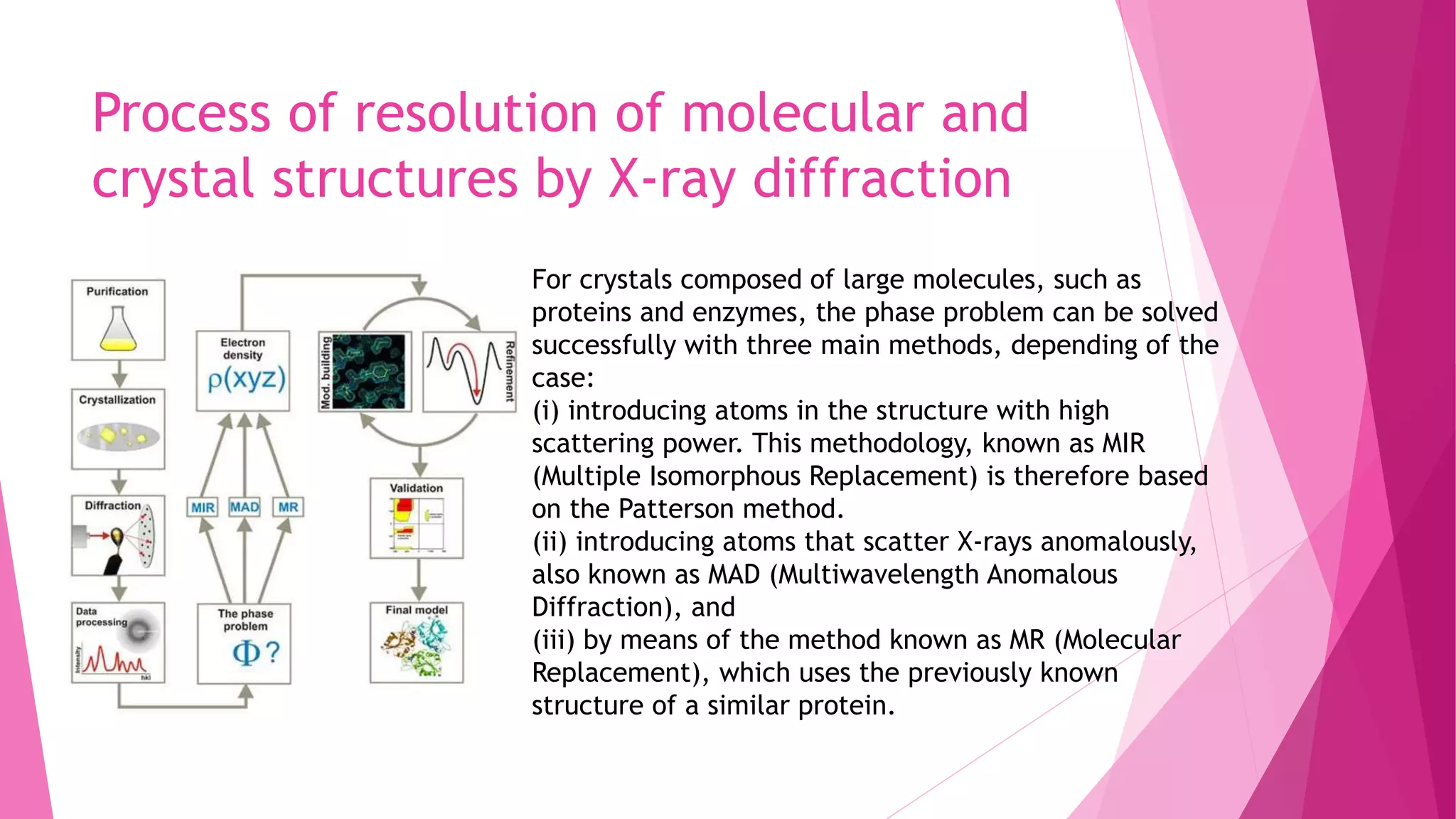
For crystals composed of large molecules, such as
proteins and enzymes, the phase problem can be solved
successfully with three main methods, depending of the
case:
(i) introducing atoms in the structure with high
scattering power. This methodology, known as MIR
(Multiple Isomorphous Replacement) is therefore based
on the Patterson method.
(ii) introducing atoms that scatter X-rays anomalously,
also known as MAD (Multiwavelength Anomalous
Diffraction), and
(iii) by means of the method known as MR (Molecular
Replacement), which uses the previously known
structure of a similar protein.
Applications of X-ray Crystallography
 HIV
 Scientists also determined the X-ray crystallographic structure of HIV protease, a viral
enzyme critical in HIV’s life cycle, in 1989.
 Pharmaceutical scientists hoped that by blocking this enzyme, they could prevent the
virus from spreading in the body.
 By feeding the structural information into a computer modeling program, they could use
the model structure as a reference to determine the types of molecules that might block
the enzyme.
 Arthritis
 To create an effective painkiller in case of arthritis that doesn’t cause ulcers, scientists
realized they needed to develop new medicines that shut down COX-2 but not COX-1.
 Through structural biology, they could see exactly why Celebrex plugs up COX-2 but not
COX-1
Continue….
 Get whole 3D structure by analysis of good crystallized material.
 Produces a single model that is easy to visualize and interpret.
 More mathematically direct image construction
 Quality indicators available (resolution, Rfactor)
 Large molecules can be determined.
X ray crystallography analysis

X ray crystallography analysis

  • 1.
    X ray crystallography analysis Submittedto : Dr. Kiran Kumar Division of Bioinformatics & Biotechnology. JSSAHE&R Mysore. Submitted by, Prabhakarareddy A V 19L10913 MSc Bioinformatics JSSAHE&R MYSORE
  • 2.
    Introduction  X-ray crystallographyis a powerful technique for visualizing the structure of protein.  It is a tool used for identifying the atomic and molecular structure of a crystal.  In crystallography the crystalline atoms cause a beam of incident X-rays to diffract into many specific directions.  Then crystallographer can produce a three-dimensional picture of the density of electrons within the crystal.  From this electron density, the mean positions of the atoms in the crystal can be determined.  X-ray crystallography can locate every atom in a zeolite, an aluminosilicate.
  • 3.
    X-Ray Crystallography  Whatis X-Ray Crystallography?  – A form of very high resolution microscopy.  – Enables us to visualize protein structures at the atomic level  – Enhances our understanding of protein function.  What is the principle behind X-Ray Crystallography?  – It is based on the fact that X-rays are diffracted by crystals
  • 4.
  • 5.
    Steps in StructureDetermination  1. Protein purification.  2. Protein crystallization.  3. Data collection.  4. Structure Solution (Phasing)  5. Structure determination (Model building and refinement)
  • 6.
    Step1:Protein Purification  Whatis Protein Purification?  is a series of processes intended to isolate one or a few proteins from a complex mixture, usually cells, tissues or whole organisms.  Why Protein Purification?  Characterization of the function.  Structure  Interactions of the protein.  Requirements  minimum of 5 to 10 milligrams pure soluble  protein are required with better than 95% purity
  • 7.
    Step2:Protein crystallization  WhyCrystallization:  X-ray scattering from a single unit would be unimaginably weak.  A crystal arranges a huge number of molecules in the same orientation.  Scattered waves add up in phase and increase Signal to a level which can be measured.  This is often the rate-limiting step in straightforward structure determinations, especially for membrane proteins
  • 9.
  • 10.
    Continue…..  The sourceof the X-rays is often a synchrotron.  The typical size for a crystal for data collection may be 0.3 x 0.3 x 0.1 mm.  The crystals are bombarded with X-rays which are scattered from the planes of the crystal lattice.  The scattered X-rays are captured as a diffraction pattern on a detector such as film or an electronic device.
  • 11.
    Continue….  Rotate crystalthrough 1 degree and Record XRD pattern  If XRD pattern is very crowded, reduce the degree of rotation  Repeat until 30 degrees were obtained  Sometimes 180 degrees depending on crystal symmetry  Lower the symmetry= More data are required  For high resolution, use Synchrotron
  • 12.
    Step4:Structure Solution (Phasing) GOAL= From Diffraction Data to Electron Density
  • 13.
  • 14.
    Step4:Structure Solution (Phasing) Methods for solving the phase problem  Molecular Replacement (MR)  Multiple/Single Isomorphous replacement (MIR/SIR)  Multiple/Single wavelength Anomalous Diffraction(MAD/SAD)  Principle using Fourier Transform (FT) :  FT of the diffraction data gives us a representation of the contents of the crystal.
  • 15.
    Step5: Structure determination(Fitting):  Fitting of protein sequence in the electron density.  Electron density – Not self explanatory  Can be automated, if resolution is close to 2Å or better.  What can be interpreted is largely defined by resolution.
  • 16.
    Step5: Structure determination (Refinement): Automated improvement of the model, so it explains the observed data better.  The phases get improved as well, so the electron density maps get better.
  • 18.
    Process of resolutionof molecular and crystal structures by X-ray diffraction For crystals composed of large molecules, such as proteins and enzymes, the phase problem can be solved successfully with three main methods, depending of the case: (i) introducing atoms in the structure with high scattering power. This methodology, known as MIR (Multiple Isomorphous Replacement) is therefore based on the Patterson method. (ii) introducing atoms that scatter X-rays anomalously, also known as MAD (Multiwavelength Anomalous Diffraction), and (iii) by means of the method known as MR (Molecular Replacement), which uses the previously known structure of a similar protein.
  • 19.
    Applications of X-rayCrystallography  HIV  Scientists also determined the X-ray crystallographic structure of HIV protease, a viral enzyme critical in HIV’s life cycle, in 1989.  Pharmaceutical scientists hoped that by blocking this enzyme, they could prevent the virus from spreading in the body.  By feeding the structural information into a computer modeling program, they could use the model structure as a reference to determine the types of molecules that might block the enzyme.  Arthritis  To create an effective painkiller in case of arthritis that doesn’t cause ulcers, scientists realized they needed to develop new medicines that shut down COX-2 but not COX-1.  Through structural biology, they could see exactly why Celebrex plugs up COX-2 but not COX-1
  • 20.
    Continue….  Get whole3D structure by analysis of good crystallized material.  Produces a single model that is easy to visualize and interpret.  More mathematically direct image construction  Quality indicators available (resolution, Rfactor)  Large molecules can be determined.