Writing Workshop
for parents
Monday 5th February 2018
“The writer is an explorer.
Every step is an advance into new land.”
Ralph Waldo Emerson
Aims of session
 To gain an understanding of how
children’s writing develops.
 To understand how we teach writing at
Marlow CE Infant school.
 To gain a better understanding of some
of the vocabulary behind the SPaG.
 To give you some practical ideas about
how you can support your children at
home with their writing.
Discuss:
Why is writing important?
What is it’s purpose in day-to-
day life?
What do you use it for?
Writing = Transcription &
Composition
 Transcription = Spelling and Handwriting
 Composition =
- Planning
- Drafting
- Evaluating
- Sharing
- Re-reading and editing
- Sentence combining
- Summarising
- Writing for a purpose and an audience
- Grammar and punctuation
The writing journey
 As soon as your child starts to make
marks, they are writers.
 Writing is a developmental process; a
journey.
The different stages of this journey are
described briefly in the following
slides...
How children’s writing develops
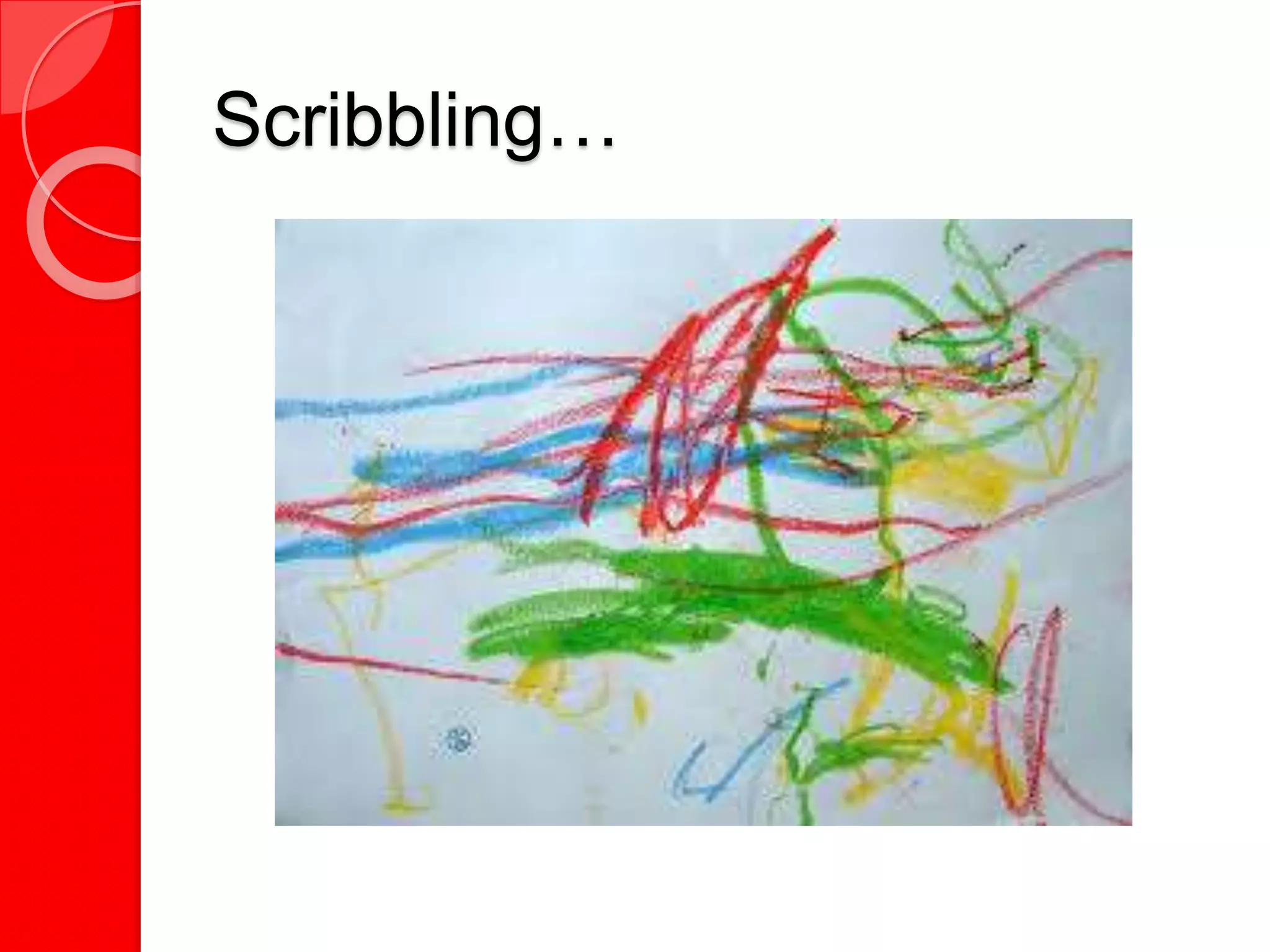
Scribbling
 Looks like a random assortment of
marks on paper.
 Sometimes the marks are large,
circular and random. Sometimes they
resemble drawing.
 Although the marks do not resemble
print, they are significant because the
young writer uses them to show ideas
and can talk about them.
Scribbling…
Letter-like symbols
 Letter-like forms emerge, sometimes
randomly placed and often
interspersed with numbers.
 The children can talk about their own
‘writing’. In this stage, spacing is rarely
present.
Letter-like-symbols
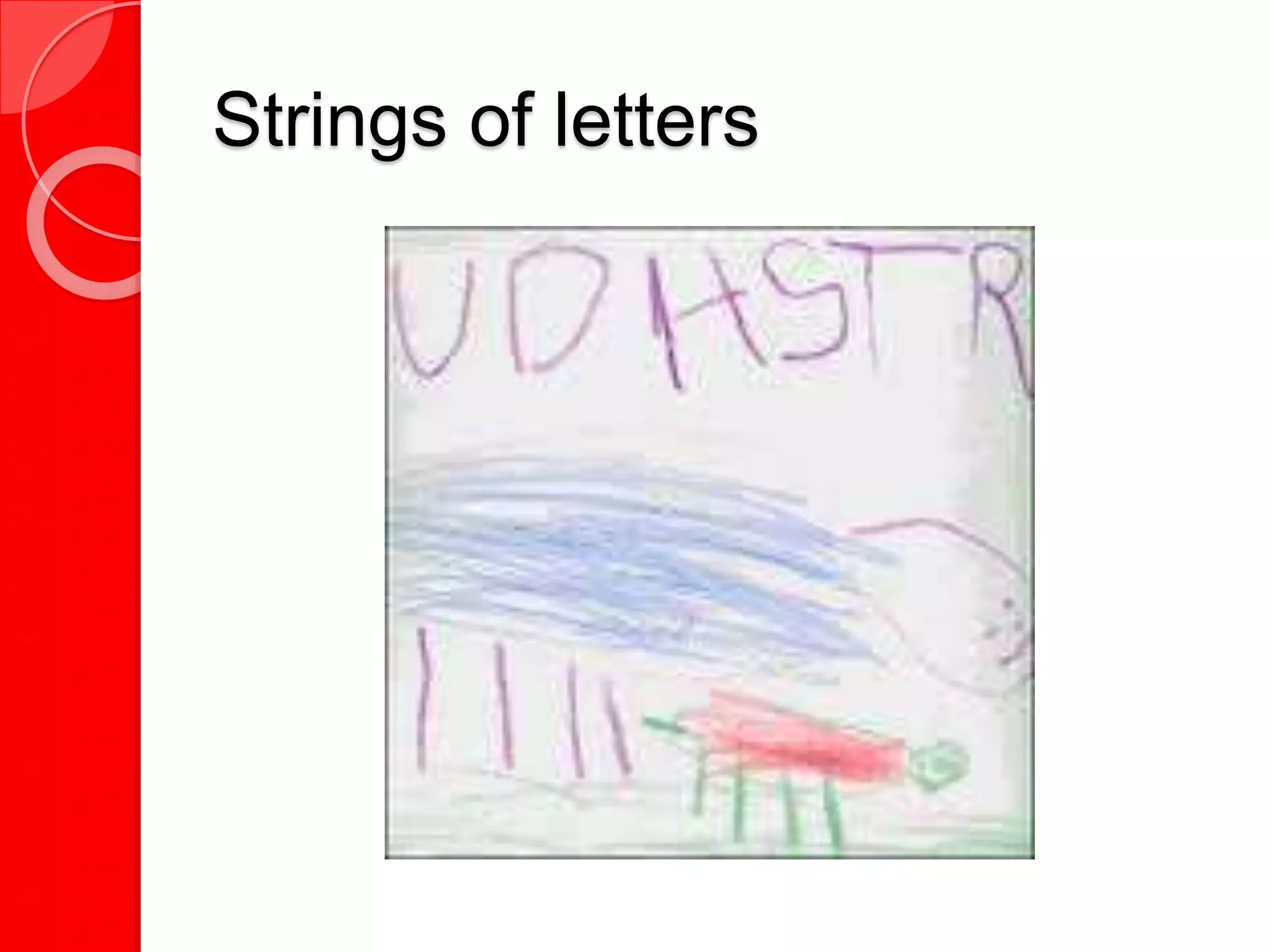
Strings of letters
 In the ‘strings of letters’ phase, children
write some legible letters that tell us they
know more about writing.
 They will often use letters from their
names.
 Children are developing awareness of
the sound-to-symbol relationship,
although they are not matching most
sounds.
 Children will often write in capital letters
and have not yet begun spacing.
Strings of letters
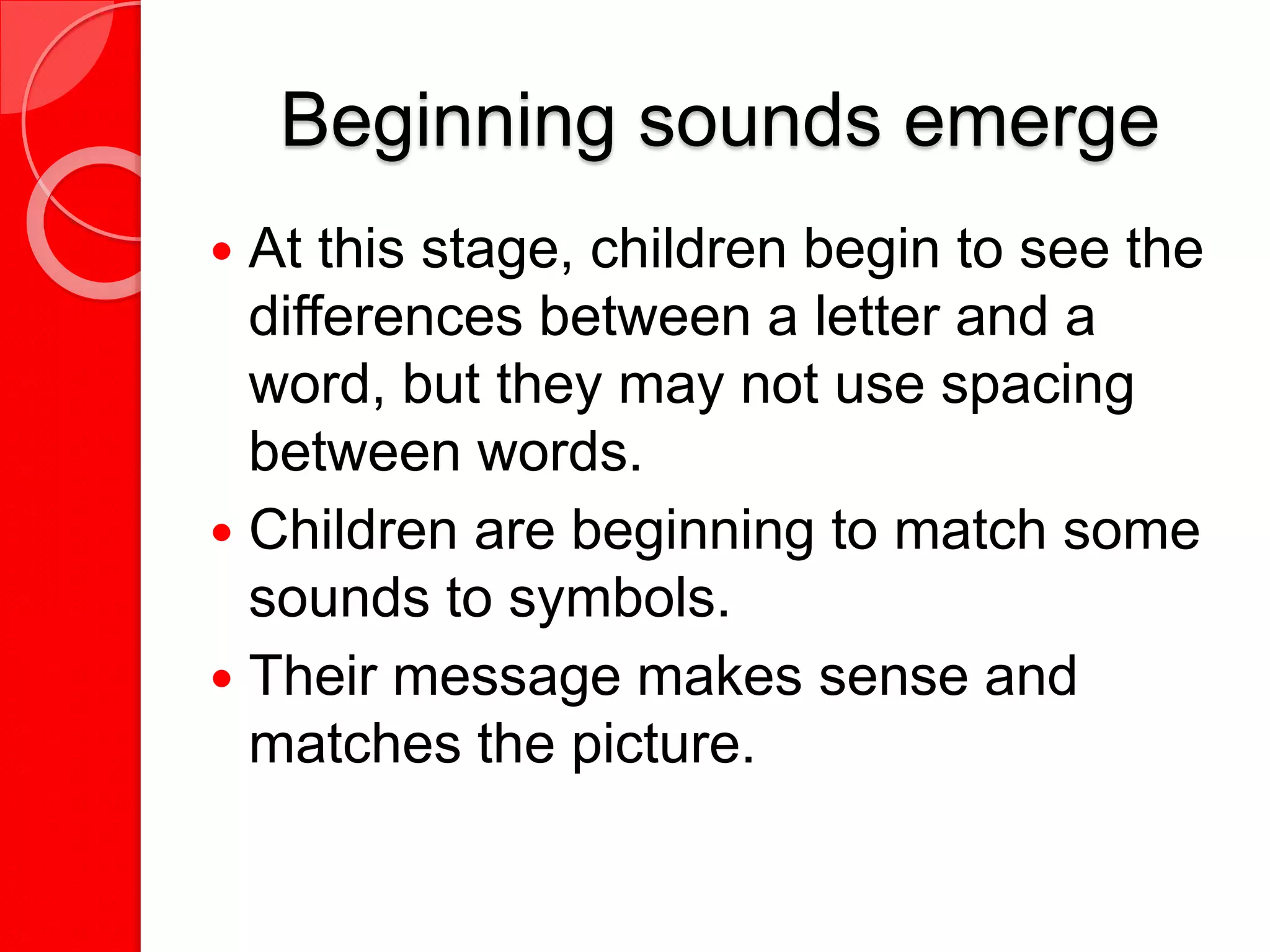
Beginning sounds emerge
 At this stage, children begin to see the
differences between a letter and a
word, but they may not use spacing
between words.
 Children are beginning to match some
sounds to symbols.
 Their message makes sense and
matches the picture.
Beginning sounds emerge…
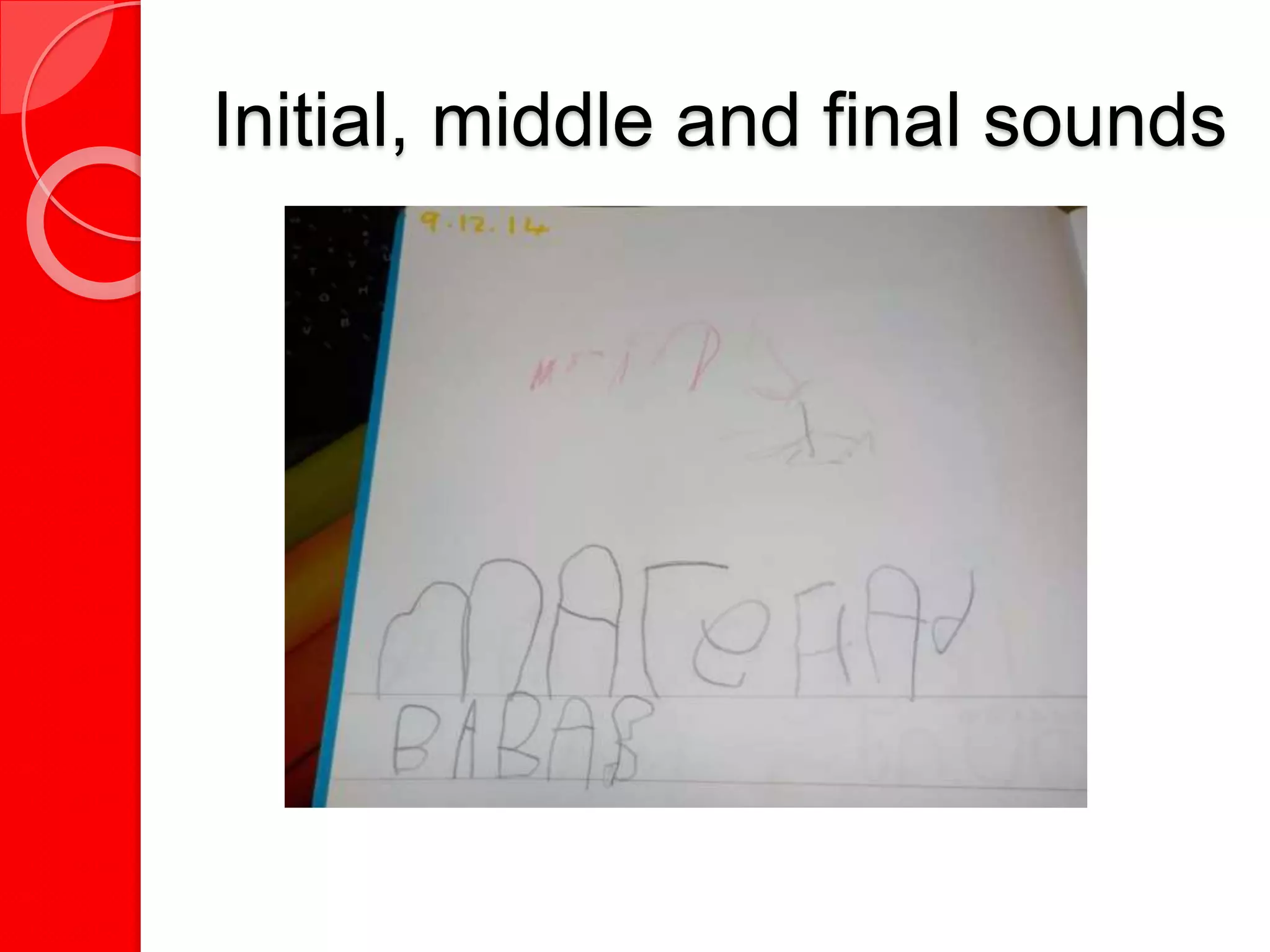
Initial, middle and final sounds
 Children in this phase may correctly
spell some sight words, familiar words
and names, and environmental print.
 Other words are spelt the way they
sound.
 Their writing is readable.
Initial, middle and final sounds
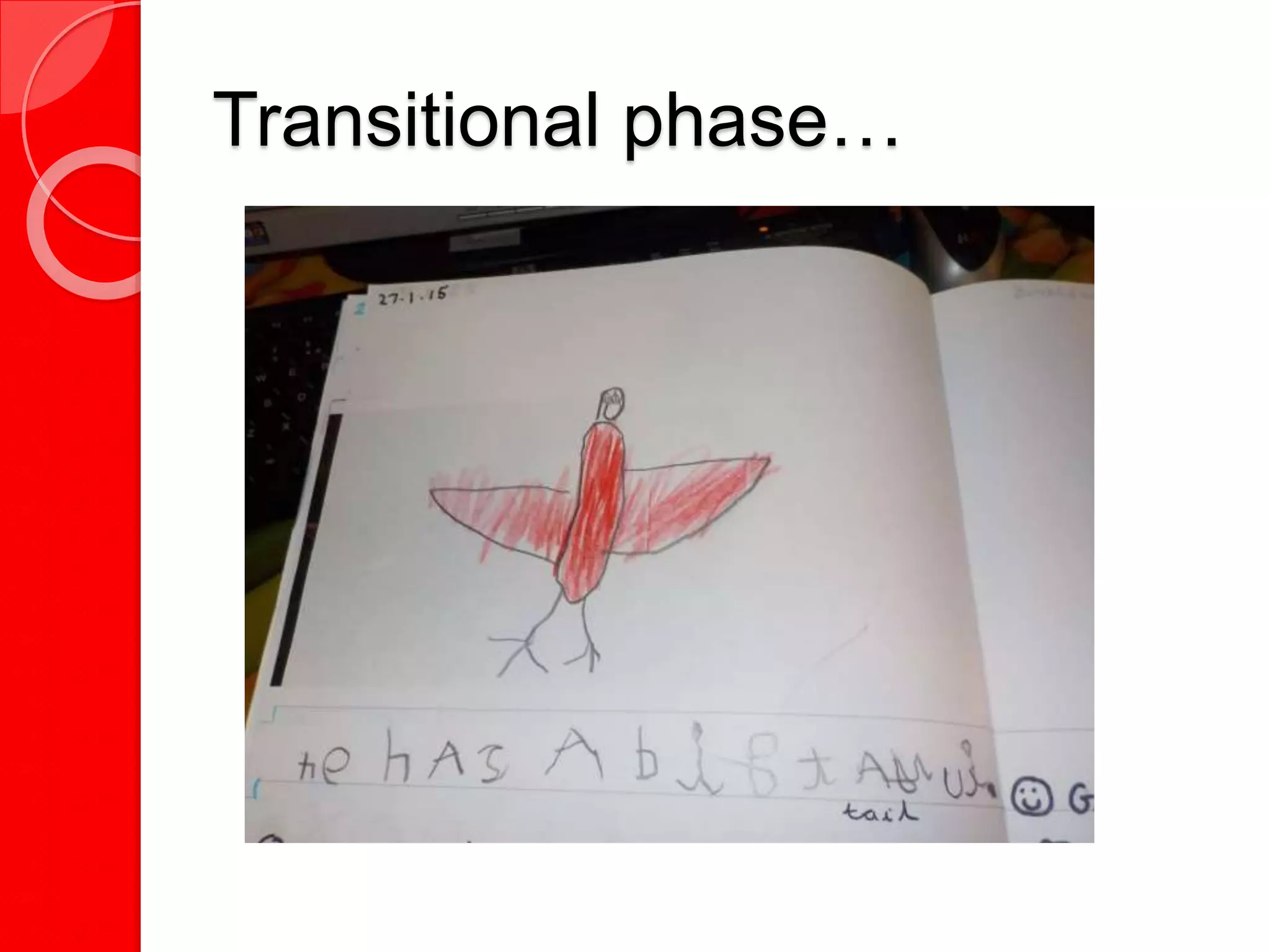
Transitional phase
 This writing is readable and
approaches conventional spelling.
 The writing is interspaced with words
that are in standard form and have
standard letter patterns.
Transitional phase…
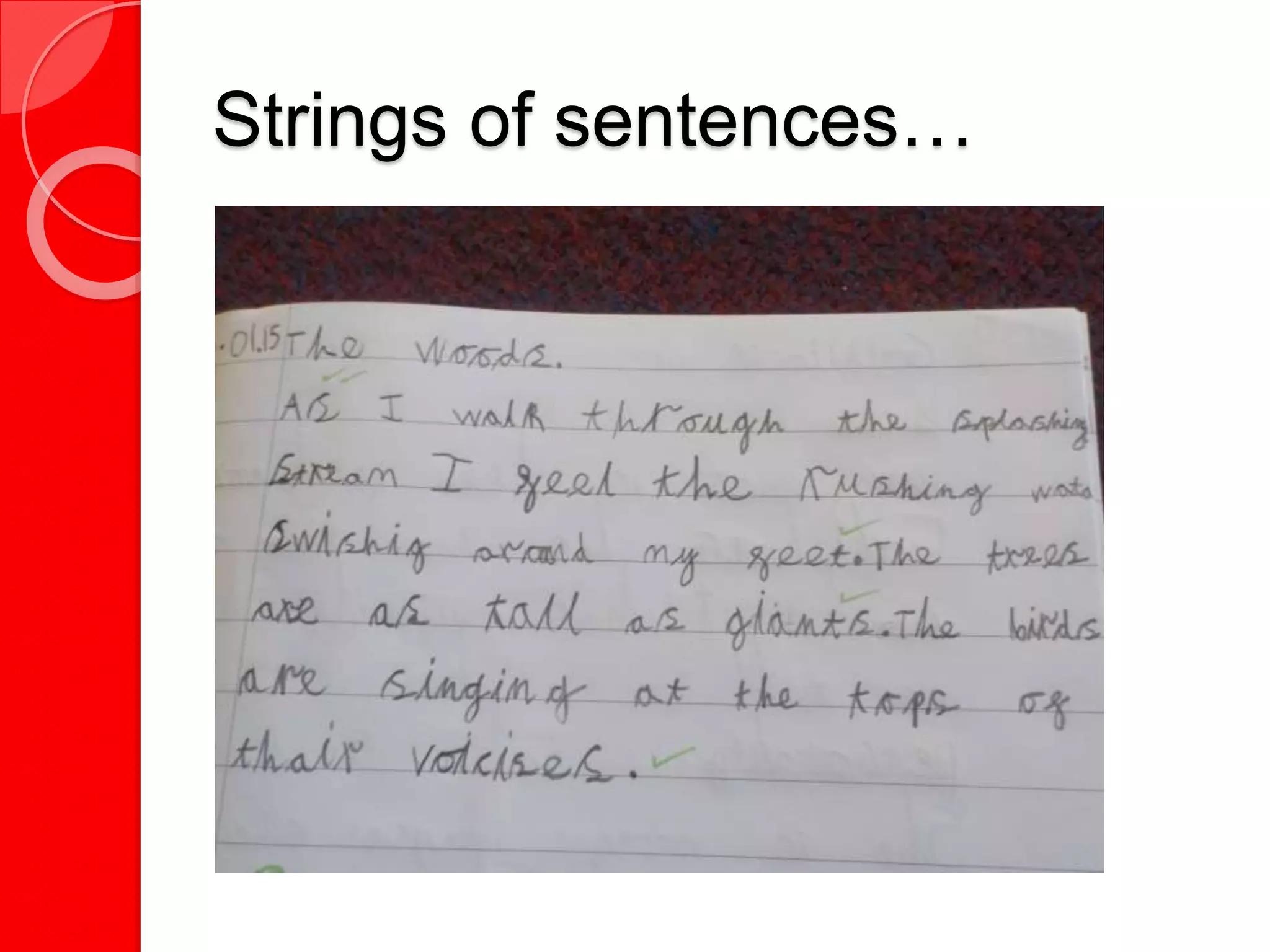
Strings of sentences
 Children in this phase can spell most
words correctly and are developing an
understanding of more complex
grammar.
 This understanding helps them to spell
similar words.
Strings of sentences…
The success of children’s ability
to write is based on:
 A rich talking environment
 Experience of many stories that have
been read to them.
 Being able to join in with stories and
adding their own ideas.
 Practising and developing their own
story language – ‘talking like a book’.
 A range of engaging speaking and
listening activities.
Writing at Marlow CE Infant
School
What we do
 Daily reading and writing opportunities
- Embedded within indoor/outdoor provision EYFS
 Weekly creative writing sessions in KS1
 Frequent, structured and discrete handwriting
sessions
 Daily phonic sessions
 Discrete SPaG lessons
 Lots of stories
 Speaking and listening
 Drama
 Feedback
 We celebrate it, lots of praise!
What we teach
 Using adventurous and wide-ranging vocabulary
 Using clear structure to organise writing
 Using texts read as models for writing
 Sequencing events and recount them in
appropriate detail
 Varying writing to suit purpose and reader
 Putting ideas into sentences – grammar and
punctuation
 Having a positive, confident attitude to writing.
I can and I will!
How we do it
 Shared discussion/talk partners – children
are encouraged to discuss their ideas
 Drama – acting out ideas creates stimulation
 Demonstration – I’ll show you how to do
something
 Joint composition – now we’ll have a go
together
 Guided writing – I’ll support you in a small,
focussed group
 Independent writing – you have a go on your
own
Storytelling Schools
 Each term we tell the children a story
that is linked to our topic.
 We all learn the story by hearing it,
mapping it, stepping it and then
speaking it.
 From this we invent our own stories,
change the original one and create
pieces of non-narrative text using it as
a stimuli.
Forms of writing your child will
experience at school
 Narratives
 Poems
 Notes
 Lists
 Captions
 Messages
 Instructions
 Letters
 Labels
 Diary entries
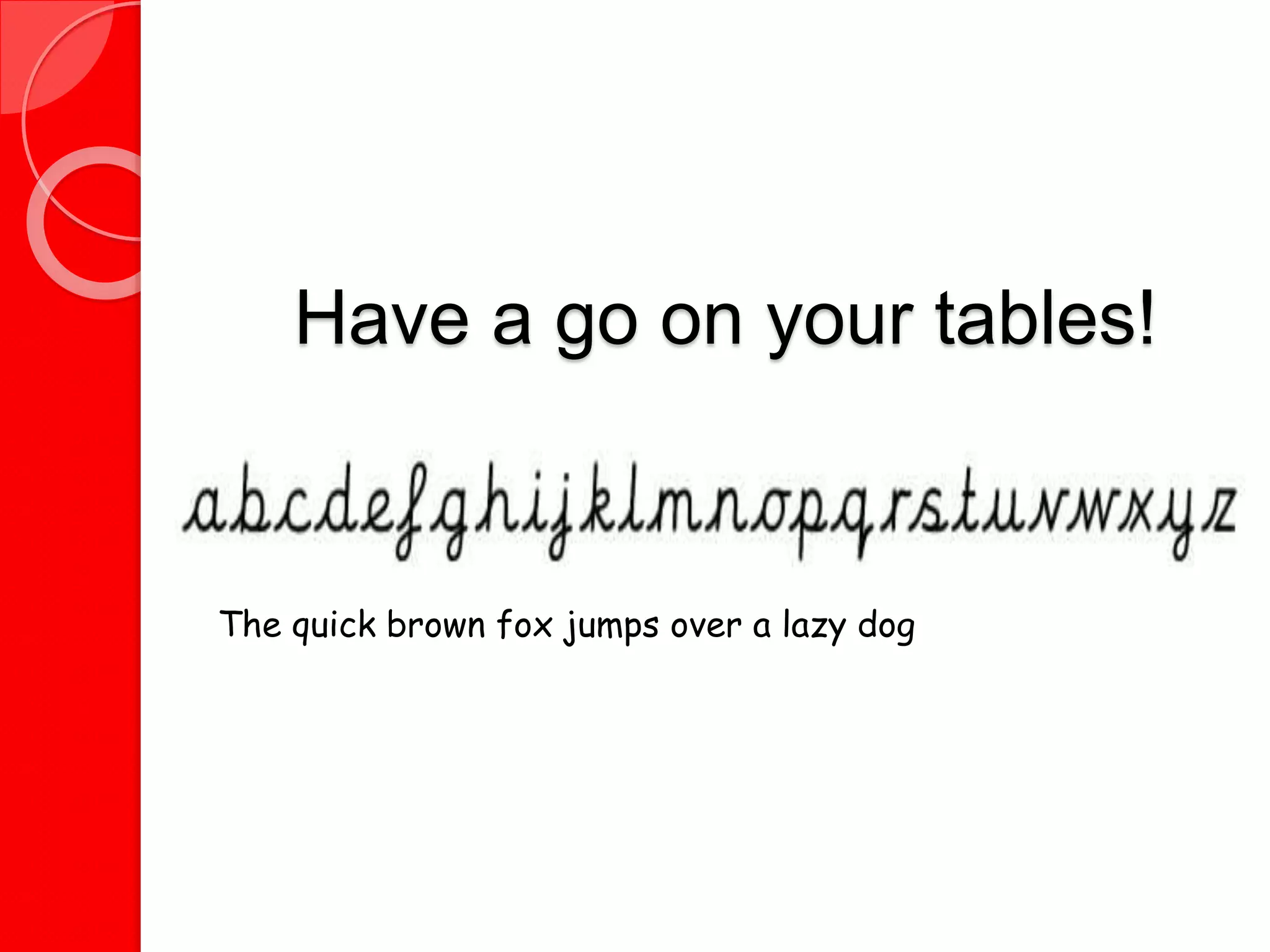
Cursive handwriting
‘The ability to write quickly and legibly affects the quality of a
child’s written output, for difficulty with handwriting can hamper
his thoughts and limit his fluency.’
‘A language for Life’ Department for Education and Science
The handwriting style we use at Sandygate is called continuous cursive. Its most
important feature is that each letter is formed without taking the pencil off the
paper – and consequently, each word is formed in one, flowing movement.
The key advantages to this system are:
 By making each letter in one movement, children’s hands develop a ‘physical
memory’ of it, making it easier to produce the correct shape;
 Because letters and words flow from left to right, children are less likely to
reverse letters which are typically difficult (like b/d or p/q);
 There is a clearer distinction between capital letters and lower case;
 The continuous flow of writing ultimately improves speed and spelling.
Have a go on your tables!
The quick brown fox jumps over a lazy dog
An Introduction to the Spelling,
Punctuation and Grammar
curriculum
(SPaG)
Spelling Punctuation and
Grammar
 The grammar of our first language is learnt
naturally and implicitly through interactions with
other speakers and from reading.
 Explicit knowledge of grammar is, however, very
important, as it gives us more conscious control
and choice in our language. Building this
knowledge is best achieved through a focus on
grammar within the teaching of reading, writing
and speaking.
 Once pupils are familiar with a grammatical
concept they should be encouraged to apply
and explore this concept in the grammar of their
own speech and writing and to note where it is
used by others.
What is a Sentence?
 A sentence is a group of words which
expresses a complete thought.
 A sentence must contain a subject and a
verb (although this may be implied)
 A sentence has 3 main characteristics:
◦ It starts with a capital letter
◦ It ends with a full stop, exclamation mark or a
question mark
◦ It MUST contain at least one main clause
with a subject and a verb that expresses a
complete thought
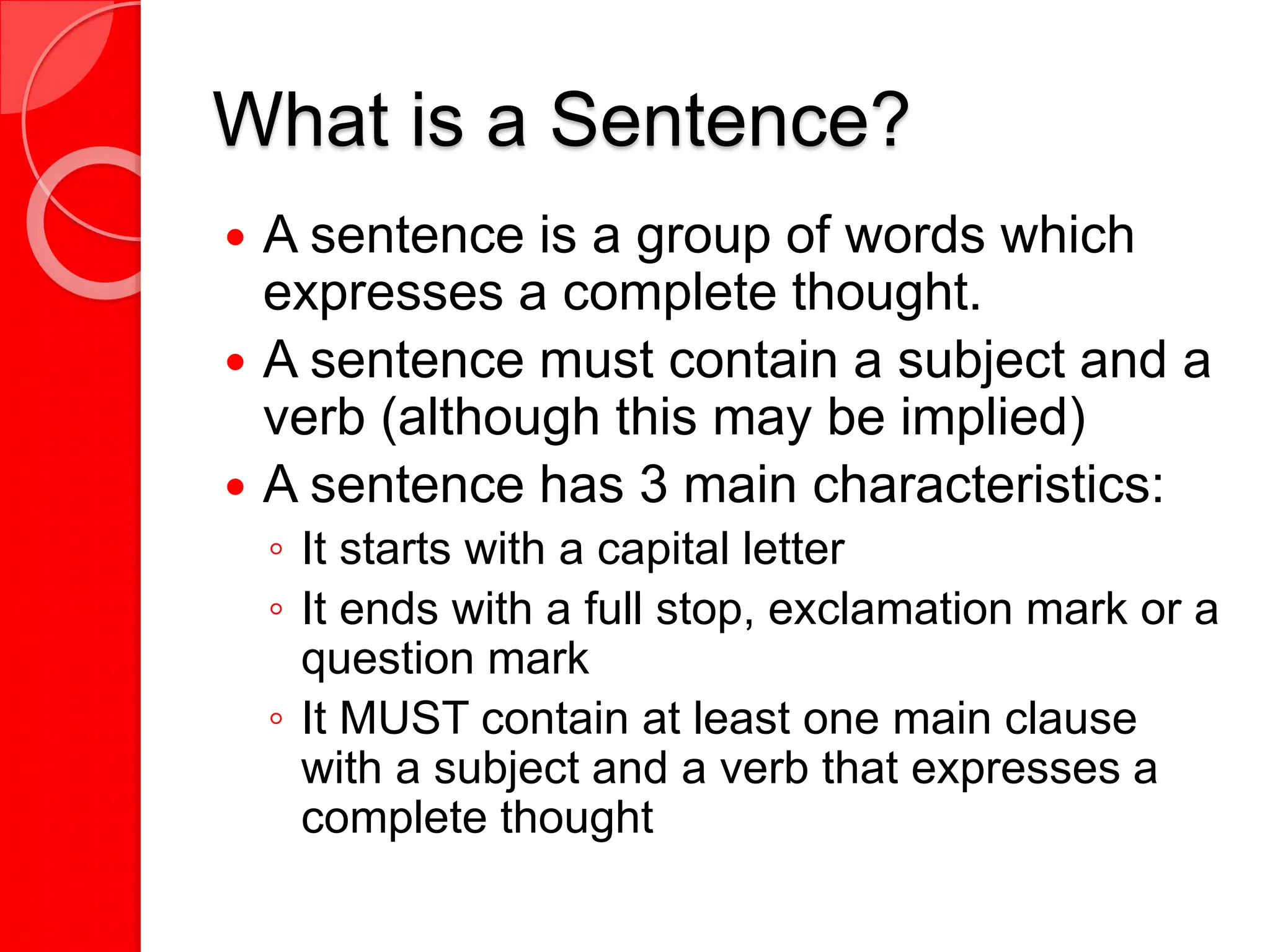
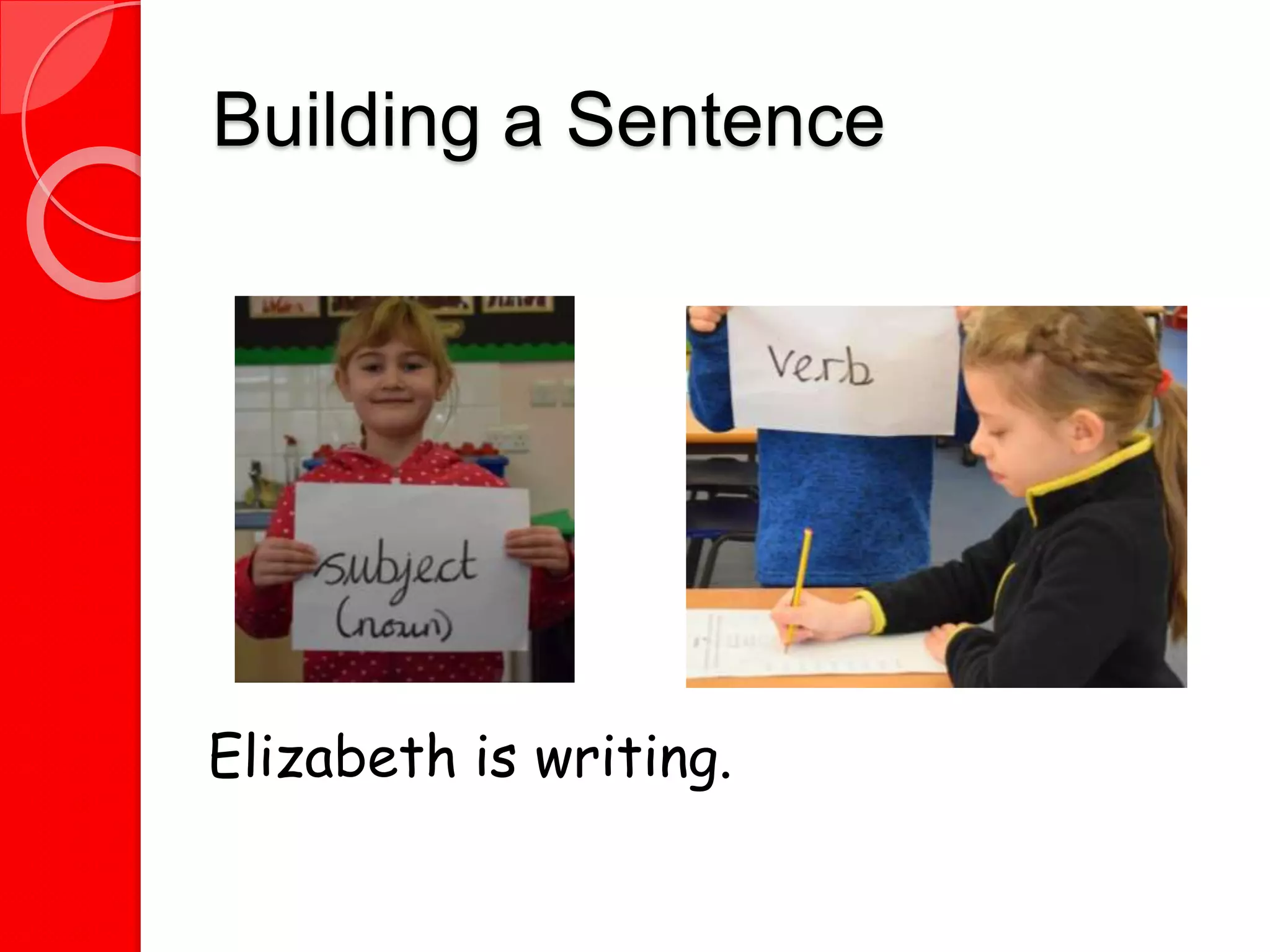
Building a Sentence
Elizabeth is writing.
Conjunctions
A conjunction (or connective as they’ve
been called in the past) is a word that is
used to join clauses in a sentence.
E.g.
and, but, because
Co-ordinate Clauses
This is where two main clauses are
joined together by a conjunction. These
conjunctions are usually and, but or so.
If you take away the conjunction, both
parts of the sentence will still make
sense on their own.
Building a Sentence
William is looking and Eleanor is listening.
Building a Sentence
Dawid was excited but Darcey was grumpy!
Sub-ordinate Clauses
 This is where we add a sub-ordinate
clause onto a main clause. There are
lots of conjunctions that can do this!
We look at because, when, if and that.
 If we took away the main clause and
the conjunction, the sub-ordinate
clause wouldn’t make sense on its
own.
Building a Sentence
subject
verb
While William phones his mum, Dawid sleeps.
We look at the clauses in the sentence. The sub-ordinate clause is
lower because it is dependant on the main clause.
Sub-ordinate Clauses
A sub-ordinate clause can come at the
beginning, middle or the end of a
sentence. Some are punctuated with
commas.
When you’ve finished your work, put it in
the box.
My friend Andy, who was 6 feet tall, was a
lovely man.
Katy blew out her candles before we cut
into the cake.
Your Turn!
Human Sentences
There are some word family cards on
your tables. Work as a table (or a
bigger group) to make a human
sentence. Add in conjunctions (word
mats are on the tables) and show
whether they are co-ordinating or sub-
ordinate.
4 Types of Sentences
 Statement
 Question
 Command
 Exclamatory
Statements
A statement is a sentence which tells
you something.
It ends with a full stop or an exclamation
mark.
For example:
A rainbow has 7 colours. They are
beautiful to look at.
I can’t believe how late it is!
Questions
A question is a sentence which asks
you something.
They usually end with a question mark.
For example:
Would you like a cup of tea?
Have you got a pen I could borrow?
Commands
A command is a sentence that tells you
to do something. They are often urgent
or angry and can be quite short. They
could end with a full stop or an
exclamation mark.
For example:
Put your shoes away.
Tidy up your bedroom!
Exclamatory sentences
An exclamatory sentence is used when
someone is surprised. It always starts
with a ‘How’ or ‘What’ and contains a
noun and a verb. They end with an
exclamation mark.
For example:
How exciting PE was today!
What a beautiful bunch of flowers that
is!
Nouns
 A noun is a naming word. It can name
a person, a place or a thing.
◦ Some nouns are common nouns – they
name objects and things:
- cow, pencil, carrots, school etc.
◦ Some nouns are proper nouns – they
name individual people, places or
organisations:
- London, Mrs Smith, Sandygate School
etc.
Plural Noun Suffixes
We can add ‘s’ or ‘es’ to a noun to show
the plural.
For example:
dog – dogs
wish – wishes
Generally, when a word ends with a sh,
ch, ss, s, x or z, we add the ‘es’ ending.
Expanding the noun phrase
We can expand the noun phrase using
words either before or after the noun.
Before:
The small, black cat was purring.
After:
The cat was small and black and it was
purring.
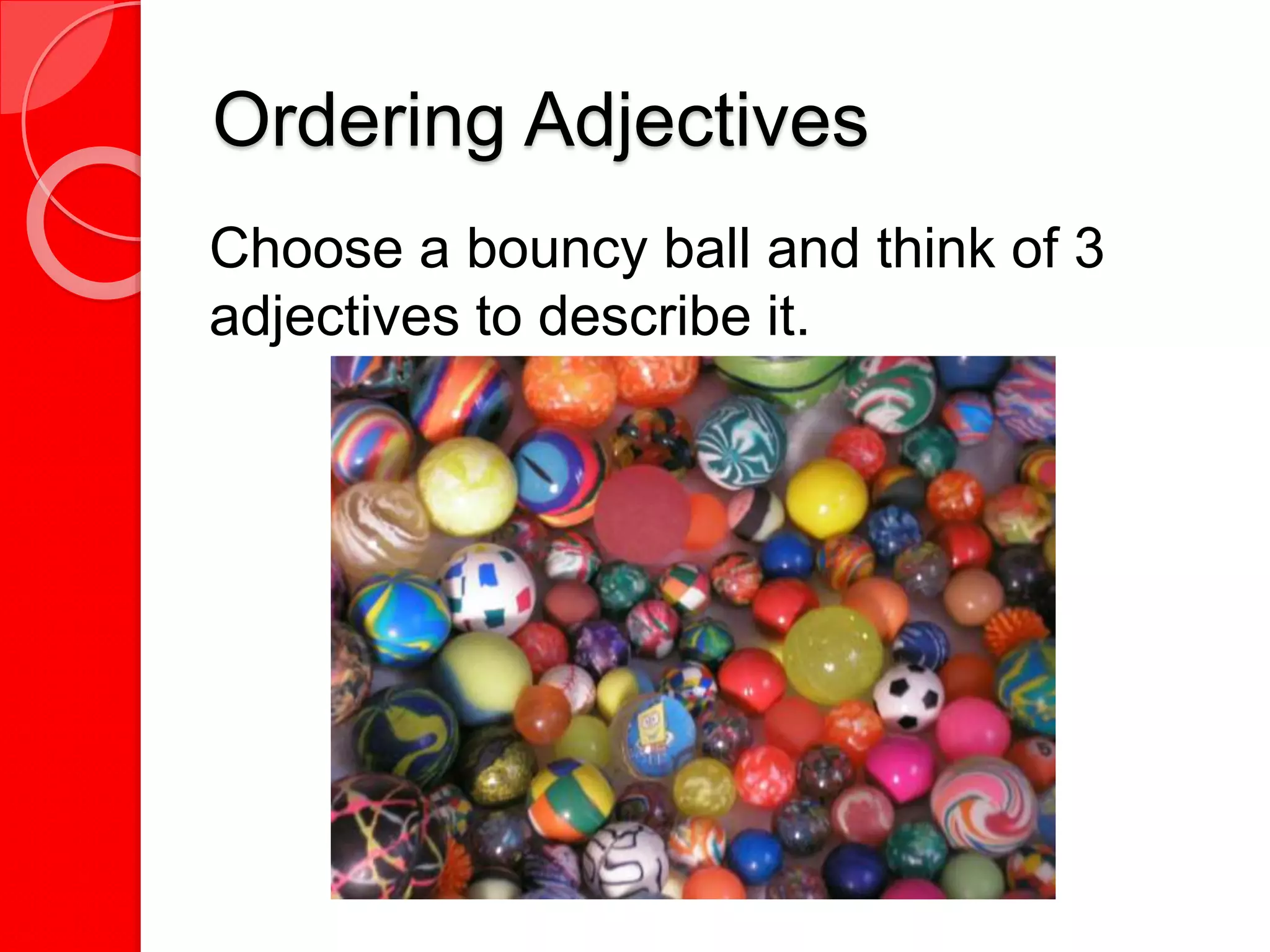
Ordering Adjectives
Choose a bouncy ball and think of 3
adjectives to describe it.
Ordering Adjectives
The big, bouncy and multi-coloured
ball
The bouncy, multi-coloured and big
ball
We have to consider the order in
which we use adjectives. Which
one do you think sounds the
best?
Verbs
A verb is an action word.
It describes what someone or
something is doing.
For example:
The man kicked the ball.
The pencil lay on the table.
Adverbs
Adverbs are used to modify the verbs
within a sentence.
They usually end with ‘ly’. (very, lonely)
For example:
The man quickly kicked the ball.
The pencil lay silently on the table.
Suffixes
In Year 1, we add suffixes to verbs
where no change to the root word is
needed.
For example:
help – helped – helping – helper
Suffixes
In Year 2, we add suffixes where we
need to change the root word.
For example:
swim – swimming – adding the extra
consonant
cry – cried – removing the y and adding
ied
We also look at how the root word has
been changed into another word type.
Prefixes
In Year 1, we look at how the prefix ‘un’
changes the meaning of verbs and
adjectives.
Using ‘un’ before a root word negates
the verb or adjective:
 unkind
 untie
Past and Present Tense
We can identify whether a piece of writing
is in past or present tense by looking at
the verbs.
Adding ‘ed’ to verbs:
 jump – jumped
 hop – hopped
Irregular verbs:
 run – ran
 swim - swam
Progressive Tense Verbs
We can use progressive verbs in the
past or present tense. They mark
actions that are or were in progress.
We use the auxiliary verb to be and a
verb with an ‘ing’ suffix.
 I am walking.
 He/she/it is walking.
 They/we/you are walking.
Using commas in a list
A comma is used to separate items in a list.
The fruit bowl has oranges, apples, bananas
and kiwi fruit.
Watch out!
 We don’t use a comma before the first item.
 We don’t put a comma in between two
items in a list.
Compound Words
A compound word is made when two
words are formed to make one word.
Both words must make sense on their
own.
For example:
 hair and brush – hairbrush
 ham and burger – hamburger
 foot and ball – football
Homophones
Homophones are words that sound the
same but have different meanings and
are spelled differently.
 pair/pear
 great/grate
 to/too/two
 their/there/they’re
Apostrophes
There are two uses for an apostrophe:
contraction or possession.
Contraction
Do not – don’t
I will – I’ll
Possession
We only look at using the singular
possessive apostrophe in Year 2:
The girl’s book was ripped.
Your Turn!
Have a look at the sentences on your
tables.
They are a bit boring.
Can you make them more interesting
using the words we’ve covered
tonight?
How to help your child at home
Stories can give your child
writing ideas and inspiration...
 Story openings
 Plot patterns
 Settings
 Character types
 Sentence openings/structure
 Connectives
 Effective words and phrases – ‘WOW’
Hints for writing
 Give your child a purpose for the writing
 Don’t expect perfection
 Practise reading out your writing aloud –
does it make sense?
 Writers concentrate on their work –talk
about the authors of their favourite books
and how hard they will have worked
 Lots of praise!
 Go for it, let your imagination go wild!
 Enjoy writing and have fun
Create a literate-rich, word-loving
home
 Visit the library
 Read aloud and listen to audio books
together
 Encourage independent audio book-listening
if your child can’t yet read independently or
doesn’t enjoy reading
 Have deep discussions about books, stories
and films, including your own wonderings...
 Tell stories
 Read and recite poetry
 Engage in word play: rhyming games, puns
and riddles, on the spot poetry etc...
Talk about what interests your
child
 Let them talk and talk about dogs, science,
history or Dr Who if that’s what excites them!
 Ask them questions and get them to ask
questions.
 Have discussions.
 Ask for their opinion on important and real-
world issues.
All of the above will develop their skills of
explanation and argument, which will
eventually factor into their writing.
Make the distinction between getting-words-
on-the-paper skills and written expression
 In other words...
- Learning to form letters and spell words are not
the same skills as developing a voice as a writer-
the more important skill in the long run
- Help make the mechanics of writing as easy as
possible for your child
- Let those getting-words-on-the-paper skills
develop slowly, regardless of statuary testing
- Explore dictation as a means of developing your
child's written expression
- Encourage keyboarding as an alternative to
writing by hand
Make writing exciting!
 Let your child write about what interests
them – if they are mad about Moshi
Monsters or One Direction – respect
their interest:
◦ this is what they know and will excite them!
◦ It will make their writing vivid and detailed.
 We have to make the act of writing
engaging – to draw children in and to
make them want to continue. This will
lead to self-sponsored writing projects.
Help your child find meaningful,
authentic reasons to write
We write to communicate. We write to
connect.
 Find real writing opportunities that
engage your child and invite
responses e.g. Letters and e-mails,
invitations, shopping lists etc.
Remember...
In order to write, children need
something to say, the means
to say it, and a reason to say
it.
Any questions?

Writing workshop for parents 2018

  • 1.
    Writing Workshop for parents Monday5th February 2018 “The writer is an explorer. Every step is an advance into new land.” Ralph Waldo Emerson
  • 2.
    Aims of session To gain an understanding of how children’s writing develops.  To understand how we teach writing at Marlow CE Infant school.  To gain a better understanding of some of the vocabulary behind the SPaG.  To give you some practical ideas about how you can support your children at home with their writing.
  • 3.
    Discuss: Why is writingimportant? What is it’s purpose in day-to- day life? What do you use it for?
  • 4.
    Writing = Transcription& Composition  Transcription = Spelling and Handwriting  Composition = - Planning - Drafting - Evaluating - Sharing - Re-reading and editing - Sentence combining - Summarising - Writing for a purpose and an audience - Grammar and punctuation
  • 5.
    The writing journey As soon as your child starts to make marks, they are writers.  Writing is a developmental process; a journey. The different stages of this journey are described briefly in the following slides...
  • 6.
  • 7.
    Scribbling  Looks likea random assortment of marks on paper.  Sometimes the marks are large, circular and random. Sometimes they resemble drawing.  Although the marks do not resemble print, they are significant because the young writer uses them to show ideas and can talk about them.
  • 8.
  • 9.
    Letter-like symbols  Letter-likeforms emerge, sometimes randomly placed and often interspersed with numbers.  The children can talk about their own ‘writing’. In this stage, spacing is rarely present.
  • 10.
  • 11.
    Strings of letters In the ‘strings of letters’ phase, children write some legible letters that tell us they know more about writing.  They will often use letters from their names.  Children are developing awareness of the sound-to-symbol relationship, although they are not matching most sounds.  Children will often write in capital letters and have not yet begun spacing.
  • 12.
  • 13.
    Beginning sounds emerge At this stage, children begin to see the differences between a letter and a word, but they may not use spacing between words.  Children are beginning to match some sounds to symbols.  Their message makes sense and matches the picture.
  • 14.
  • 15.
    Initial, middle andfinal sounds  Children in this phase may correctly spell some sight words, familiar words and names, and environmental print.  Other words are spelt the way they sound.  Their writing is readable.
  • 16.
    Initial, middle andfinal sounds
  • 17.
    Transitional phase  Thiswriting is readable and approaches conventional spelling.  The writing is interspaced with words that are in standard form and have standard letter patterns.
  • 18.
  • 19.
    Strings of sentences Children in this phase can spell most words correctly and are developing an understanding of more complex grammar.  This understanding helps them to spell similar words.
  • 20.
  • 21.
    The success ofchildren’s ability to write is based on:  A rich talking environment  Experience of many stories that have been read to them.  Being able to join in with stories and adding their own ideas.  Practising and developing their own story language – ‘talking like a book’.  A range of engaging speaking and listening activities.
  • 22.
    Writing at MarlowCE Infant School
  • 23.
    What we do Daily reading and writing opportunities - Embedded within indoor/outdoor provision EYFS  Weekly creative writing sessions in KS1  Frequent, structured and discrete handwriting sessions  Daily phonic sessions  Discrete SPaG lessons  Lots of stories  Speaking and listening  Drama  Feedback  We celebrate it, lots of praise!
  • 24.
    What we teach Using adventurous and wide-ranging vocabulary  Using clear structure to organise writing  Using texts read as models for writing  Sequencing events and recount them in appropriate detail  Varying writing to suit purpose and reader  Putting ideas into sentences – grammar and punctuation  Having a positive, confident attitude to writing. I can and I will!
  • 25.
    How we doit  Shared discussion/talk partners – children are encouraged to discuss their ideas  Drama – acting out ideas creates stimulation  Demonstration – I’ll show you how to do something  Joint composition – now we’ll have a go together  Guided writing – I’ll support you in a small, focussed group  Independent writing – you have a go on your own
  • 26.
    Storytelling Schools  Eachterm we tell the children a story that is linked to our topic.  We all learn the story by hearing it, mapping it, stepping it and then speaking it.  From this we invent our own stories, change the original one and create pieces of non-narrative text using it as a stimuli.
  • 27.
    Forms of writingyour child will experience at school  Narratives  Poems  Notes  Lists  Captions  Messages  Instructions  Letters  Labels  Diary entries
  • 28.
    Cursive handwriting ‘The abilityto write quickly and legibly affects the quality of a child’s written output, for difficulty with handwriting can hamper his thoughts and limit his fluency.’ ‘A language for Life’ Department for Education and Science The handwriting style we use at Sandygate is called continuous cursive. Its most important feature is that each letter is formed without taking the pencil off the paper – and consequently, each word is formed in one, flowing movement. The key advantages to this system are:  By making each letter in one movement, children’s hands develop a ‘physical memory’ of it, making it easier to produce the correct shape;  Because letters and words flow from left to right, children are less likely to reverse letters which are typically difficult (like b/d or p/q);  There is a clearer distinction between capital letters and lower case;  The continuous flow of writing ultimately improves speed and spelling.
  • 29.
    Have a goon your tables! The quick brown fox jumps over a lazy dog
  • 30.
    An Introduction tothe Spelling, Punctuation and Grammar curriculum (SPaG)
  • 31.
    Spelling Punctuation and Grammar The grammar of our first language is learnt naturally and implicitly through interactions with other speakers and from reading.  Explicit knowledge of grammar is, however, very important, as it gives us more conscious control and choice in our language. Building this knowledge is best achieved through a focus on grammar within the teaching of reading, writing and speaking.  Once pupils are familiar with a grammatical concept they should be encouraged to apply and explore this concept in the grammar of their own speech and writing and to note where it is used by others.
  • 32.
    What is aSentence?  A sentence is a group of words which expresses a complete thought.  A sentence must contain a subject and a verb (although this may be implied)  A sentence has 3 main characteristics: ◦ It starts with a capital letter ◦ It ends with a full stop, exclamation mark or a question mark ◦ It MUST contain at least one main clause with a subject and a verb that expresses a complete thought
  • 33.
  • 34.
    Conjunctions A conjunction (orconnective as they’ve been called in the past) is a word that is used to join clauses in a sentence. E.g. and, but, because
  • 35.
    Co-ordinate Clauses This iswhere two main clauses are joined together by a conjunction. These conjunctions are usually and, but or so. If you take away the conjunction, both parts of the sentence will still make sense on their own.
  • 36.
    Building a Sentence Williamis looking and Eleanor is listening.
  • 37.
    Building a Sentence Dawidwas excited but Darcey was grumpy!
  • 38.
    Sub-ordinate Clauses  Thisis where we add a sub-ordinate clause onto a main clause. There are lots of conjunctions that can do this! We look at because, when, if and that.  If we took away the main clause and the conjunction, the sub-ordinate clause wouldn’t make sense on its own.
  • 39.
    Building a Sentence subject verb WhileWilliam phones his mum, Dawid sleeps. We look at the clauses in the sentence. The sub-ordinate clause is lower because it is dependant on the main clause.
  • 40.
    Sub-ordinate Clauses A sub-ordinateclause can come at the beginning, middle or the end of a sentence. Some are punctuated with commas. When you’ve finished your work, put it in the box. My friend Andy, who was 6 feet tall, was a lovely man. Katy blew out her candles before we cut into the cake.
  • 41.
    Your Turn! Human Sentences Thereare some word family cards on your tables. Work as a table (or a bigger group) to make a human sentence. Add in conjunctions (word mats are on the tables) and show whether they are co-ordinating or sub- ordinate.
  • 42.
    4 Types ofSentences  Statement  Question  Command  Exclamatory
  • 43.
    Statements A statement isa sentence which tells you something. It ends with a full stop or an exclamation mark. For example: A rainbow has 7 colours. They are beautiful to look at. I can’t believe how late it is!
  • 44.
    Questions A question isa sentence which asks you something. They usually end with a question mark. For example: Would you like a cup of tea? Have you got a pen I could borrow?
  • 45.
    Commands A command isa sentence that tells you to do something. They are often urgent or angry and can be quite short. They could end with a full stop or an exclamation mark. For example: Put your shoes away. Tidy up your bedroom!
  • 46.
    Exclamatory sentences An exclamatorysentence is used when someone is surprised. It always starts with a ‘How’ or ‘What’ and contains a noun and a verb. They end with an exclamation mark. For example: How exciting PE was today! What a beautiful bunch of flowers that is!
  • 47.
    Nouns  A nounis a naming word. It can name a person, a place or a thing. ◦ Some nouns are common nouns – they name objects and things: - cow, pencil, carrots, school etc. ◦ Some nouns are proper nouns – they name individual people, places or organisations: - London, Mrs Smith, Sandygate School etc.
  • 48.
    Plural Noun Suffixes Wecan add ‘s’ or ‘es’ to a noun to show the plural. For example: dog – dogs wish – wishes Generally, when a word ends with a sh, ch, ss, s, x or z, we add the ‘es’ ending.
  • 49.
    Expanding the nounphrase We can expand the noun phrase using words either before or after the noun. Before: The small, black cat was purring. After: The cat was small and black and it was purring.
  • 50.
    Ordering Adjectives Choose abouncy ball and think of 3 adjectives to describe it.
  • 51.
    Ordering Adjectives The big,bouncy and multi-coloured ball The bouncy, multi-coloured and big ball We have to consider the order in which we use adjectives. Which one do you think sounds the best?
  • 52.
    Verbs A verb isan action word. It describes what someone or something is doing. For example: The man kicked the ball. The pencil lay on the table.
  • 53.
    Adverbs Adverbs are usedto modify the verbs within a sentence. They usually end with ‘ly’. (very, lonely) For example: The man quickly kicked the ball. The pencil lay silently on the table.
  • 54.
    Suffixes In Year 1,we add suffixes to verbs where no change to the root word is needed. For example: help – helped – helping – helper
  • 55.
    Suffixes In Year 2,we add suffixes where we need to change the root word. For example: swim – swimming – adding the extra consonant cry – cried – removing the y and adding ied We also look at how the root word has been changed into another word type.
  • 56.
    Prefixes In Year 1,we look at how the prefix ‘un’ changes the meaning of verbs and adjectives. Using ‘un’ before a root word negates the verb or adjective:  unkind  untie
  • 57.
    Past and PresentTense We can identify whether a piece of writing is in past or present tense by looking at the verbs. Adding ‘ed’ to verbs:  jump – jumped  hop – hopped Irregular verbs:  run – ran  swim - swam
  • 58.
    Progressive Tense Verbs Wecan use progressive verbs in the past or present tense. They mark actions that are or were in progress. We use the auxiliary verb to be and a verb with an ‘ing’ suffix.  I am walking.  He/she/it is walking.  They/we/you are walking.
  • 59.
    Using commas ina list A comma is used to separate items in a list. The fruit bowl has oranges, apples, bananas and kiwi fruit. Watch out!  We don’t use a comma before the first item.  We don’t put a comma in between two items in a list.
  • 60.
    Compound Words A compoundword is made when two words are formed to make one word. Both words must make sense on their own. For example:  hair and brush – hairbrush  ham and burger – hamburger  foot and ball – football
  • 61.
    Homophones Homophones are wordsthat sound the same but have different meanings and are spelled differently.  pair/pear  great/grate  to/too/two  their/there/they’re
  • 62.
    Apostrophes There are twouses for an apostrophe: contraction or possession. Contraction Do not – don’t I will – I’ll Possession We only look at using the singular possessive apostrophe in Year 2: The girl’s book was ripped.
  • 63.
    Your Turn! Have alook at the sentences on your tables. They are a bit boring. Can you make them more interesting using the words we’ve covered tonight?
  • 64.
    How to helpyour child at home
  • 65.
    Stories can giveyour child writing ideas and inspiration...  Story openings  Plot patterns  Settings  Character types  Sentence openings/structure  Connectives  Effective words and phrases – ‘WOW’
  • 66.
    Hints for writing Give your child a purpose for the writing  Don’t expect perfection  Practise reading out your writing aloud – does it make sense?  Writers concentrate on their work –talk about the authors of their favourite books and how hard they will have worked  Lots of praise!  Go for it, let your imagination go wild!  Enjoy writing and have fun
  • 67.
    Create a literate-rich,word-loving home  Visit the library  Read aloud and listen to audio books together  Encourage independent audio book-listening if your child can’t yet read independently or doesn’t enjoy reading  Have deep discussions about books, stories and films, including your own wonderings...  Tell stories  Read and recite poetry  Engage in word play: rhyming games, puns and riddles, on the spot poetry etc...
  • 68.
    Talk about whatinterests your child  Let them talk and talk about dogs, science, history or Dr Who if that’s what excites them!  Ask them questions and get them to ask questions.  Have discussions.  Ask for their opinion on important and real- world issues. All of the above will develop their skills of explanation and argument, which will eventually factor into their writing.
  • 69.
    Make the distinctionbetween getting-words- on-the-paper skills and written expression  In other words... - Learning to form letters and spell words are not the same skills as developing a voice as a writer- the more important skill in the long run - Help make the mechanics of writing as easy as possible for your child - Let those getting-words-on-the-paper skills develop slowly, regardless of statuary testing - Explore dictation as a means of developing your child's written expression - Encourage keyboarding as an alternative to writing by hand
  • 70.
    Make writing exciting! Let your child write about what interests them – if they are mad about Moshi Monsters or One Direction – respect their interest: ◦ this is what they know and will excite them! ◦ It will make their writing vivid and detailed.  We have to make the act of writing engaging – to draw children in and to make them want to continue. This will lead to self-sponsored writing projects.
  • 71.
    Help your childfind meaningful, authentic reasons to write We write to communicate. We write to connect.  Find real writing opportunities that engage your child and invite responses e.g. Letters and e-mails, invitations, shopping lists etc.
  • 72.
    Remember... In order towrite, children need something to say, the means to say it, and a reason to say it. Any questions?

Editor's Notes

  • #29  Agreed with HT and Little Marlow Recommended by British Dyslexic association By end of KS1 it is expected that all chidlren will have fully joined cursive hand and will use with confidence in their writing