WRITING PROCESS
By Mehwish Ali Khan
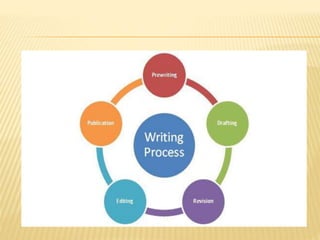
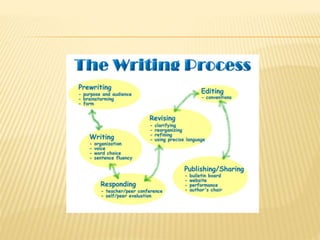
 "Writing is a fluid process created by writers
as they work. Accomplished writers move
back and forth between the stages of the
process, both consciously and
unconsciously. Young writers, however,
benefit from the structure and security of
following the writing process in their writing.
 Prewriting. Students generate ideas for
writing: brainstorming; reading literature; creating life
maps, webs, and story charts; developing word
banks; deciding on form, audience, voice, and
purpose as well as through teacher motivation.
 Find Your Idea
 Build On Your Idea
 Plan and Structure
 Rough Draft. Students get their ideas on
paper. They write without concern for conventions.
Written work does not have to be neat; it is a
'sloppy copy.‘
Reread. Students proof their own work by reading aloud and reading for sensibility.
 Your story can change a great deal during this stage. When
revising their work, many writers naturally adopt the A.R.R.R.
approach:
 Add
 Rearrange
 Remove
 Replace
 Add: The average novel has between 60,000 and 100,000 words.
Does your book have enough words to be considered a novel? Have
you given your readers all the information they need to make sense
of your story? If not, go back to your notebook that you kept for
additional scenes and any additional details.
 Rearrange: Consider the flow, pacing and sequencing of your story.
Would the work look better if some of the events occur in a different
order?
 Remove: Are your readers experiencing
information overload? You may need to eliminate
passages that don’t quite fit.
 Replace: The most effective way to revise your
work is to ask for a second opinion. Do you need
more vivid details to help clarify your work? Is
one paragraph contradicting another? Ask
friends or fellow writers to take a look and give
you feedback, and if something isn’t working
rewrite it and replace it.
 Share with a Peer Revisor. Students share and
make suggestions for improvement: asking who,
what, when, where, why, and how questions
about parts of the story the peer does not
understand; looking for better words; and talking
about how to make the work better.
 Revise. Improve what the narrative says and
how it says it: write additions, imagery, and
details. Take out unnecessary work. Use peer
suggestions to improve. Clarify.
Editing
 The enemy of good proofreading is speed. Many
people rush through their documents, but this is how
you miss mistakes. Follow these guidelines to check
what you've written:
 Proof your headers and subheaders – People
often skip these and focus on the text alone. Just
because headers are big and bold doesn't mean
they're error free!
 Read the document out loud – This forces you to
go more slowly, so that you're more likely to catch
mistakes.
 Use your finger to follow text as you
read – This is another trick that helps you
slow down.
 Start at the end of your document –
Proofread one sentence at a time, working
your way from the end to the beginning. This
helps you focus on errors, not on content.
 Final Draft. Students produce their final copy to
discuss with the teacher and write a final draft.
 Publishing. Students publish their written
pieces: sending their work to publishers;
reading their finished story aloud, making
books. This is a time to celebrate!
PICTURE DESCRIPTION
BOOK REVIEW
 A book review is both a description and an
evaluation of a book
 A critical book review is not a book
report. Reports discuss content, while
reviews evaluate the book's strengths,
weaknesses and validity through
explanation, interpretation and analysis
 Nobody expects you to be the intellectual
equal of the work’s creator, but your careful
observations can provide you with the raw
material to make reasoned judgments.
Tactfully voicing agreement and
disagreement, praise and criticism, is a
valuable, challenging skill, and like many
forms of writing, reviews require you to
provide concrete evidence for your
assertions.
 Consult Additional Sources

 Try to find further information about the author -
his/her reputation, qualifications, influences, etc.
- any information that is relevant to the book
being reviewed and that would help to establish
the author's authority. Knowledge of
the literary period and of critical theoriescan
also be helpful to your review. Your professor
and/or reference librarian will be able to suggest
sources to use.

 Full bibliographic information (author, title,
edition, publisher, place of publication, year of
publication)
 Example:
 Rory Maclean
Under the Dragon
Travels in a betrayed land
London: Harper Collins, 1998
224pp. $37.50
0 00 257013 0
 Rule number one: do not give away the story!
 Theme
 What is/are the major theme(s)?
 How are they revealed and developed?
 Is the theme traditional and familiar, or new
and original?
 Is the theme didactic, psychological, social,
entertaining, escapist, etc. in purpose or
intent
 Summarise some of your thoughts on the
book by suggesting the type of reader you'd
recommend the book to.
 Try using a few short quotes from the book to
illustrate your points. This is not absolutely
necessary, but it's a good way to give your
reader a sense of the author's writing style
 Avoid excessive quotation and give a specific
page reference in parentheses when you do
quote.
REVISE THE DRAFT
 Allow some time to elapse before going over
your review, to gain perspective.
 Carefully read through the text, looking for
clarity and coherence.
 Correct grammar and spelling.
 Conclusion - If your thesis has been well
argued, the conclusion should follow
naturally. It can include a final assessment or
simply restate your thesis. Do not introduce
new material at this point.
 Finally
 What is your final assessment? Would you
buy this book or recommend it to others?


Writing process (1)

  • 1.
  • 2.
     "Writing isa fluid process created by writers as they work. Accomplished writers move back and forth between the stages of the process, both consciously and unconsciously. Young writers, however, benefit from the structure and security of following the writing process in their writing.
  • 4.
     Prewriting. Studentsgenerate ideas for writing: brainstorming; reading literature; creating life maps, webs, and story charts; developing word banks; deciding on form, audience, voice, and purpose as well as through teacher motivation.  Find Your Idea  Build On Your Idea  Plan and Structure
  • 5.
     Rough Draft.Students get their ideas on paper. They write without concern for conventions. Written work does not have to be neat; it is a 'sloppy copy.‘
  • 6.
    Reread. Students prooftheir own work by reading aloud and reading for sensibility.  Your story can change a great deal during this stage. When revising their work, many writers naturally adopt the A.R.R.R. approach:  Add  Rearrange  Remove  Replace  Add: The average novel has between 60,000 and 100,000 words. Does your book have enough words to be considered a novel? Have you given your readers all the information they need to make sense of your story? If not, go back to your notebook that you kept for additional scenes and any additional details.  Rearrange: Consider the flow, pacing and sequencing of your story. Would the work look better if some of the events occur in a different order?
  • 7.
     Remove: Areyour readers experiencing information overload? You may need to eliminate passages that don’t quite fit.  Replace: The most effective way to revise your work is to ask for a second opinion. Do you need more vivid details to help clarify your work? Is one paragraph contradicting another? Ask friends or fellow writers to take a look and give you feedback, and if something isn’t working rewrite it and replace it.
  • 8.
     Share witha Peer Revisor. Students share and make suggestions for improvement: asking who, what, when, where, why, and how questions about parts of the story the peer does not understand; looking for better words; and talking about how to make the work better.
  • 9.
     Revise. Improvewhat the narrative says and how it says it: write additions, imagery, and details. Take out unnecessary work. Use peer suggestions to improve. Clarify.
  • 10.
    Editing  The enemyof good proofreading is speed. Many people rush through their documents, but this is how you miss mistakes. Follow these guidelines to check what you've written:  Proof your headers and subheaders – People often skip these and focus on the text alone. Just because headers are big and bold doesn't mean they're error free!  Read the document out loud – This forces you to go more slowly, so that you're more likely to catch mistakes.
  • 11.
     Use yourfinger to follow text as you read – This is another trick that helps you slow down.  Start at the end of your document – Proofread one sentence at a time, working your way from the end to the beginning. This helps you focus on errors, not on content.
  • 12.
     Final Draft.Students produce their final copy to discuss with the teacher and write a final draft.  Publishing. Students publish their written pieces: sending their work to publishers; reading their finished story aloud, making books. This is a time to celebrate!
  • 14.
  • 15.
    BOOK REVIEW  Abook review is both a description and an evaluation of a book  A critical book review is not a book report. Reports discuss content, while reviews evaluate the book's strengths, weaknesses and validity through explanation, interpretation and analysis
  • 16.
     Nobody expectsyou to be the intellectual equal of the work’s creator, but your careful observations can provide you with the raw material to make reasoned judgments. Tactfully voicing agreement and disagreement, praise and criticism, is a valuable, challenging skill, and like many forms of writing, reviews require you to provide concrete evidence for your assertions.
  • 17.
     Consult AdditionalSources   Try to find further information about the author - his/her reputation, qualifications, influences, etc. - any information that is relevant to the book being reviewed and that would help to establish the author's authority. Knowledge of the literary period and of critical theoriescan also be helpful to your review. Your professor and/or reference librarian will be able to suggest sources to use. 
  • 18.
     Full bibliographicinformation (author, title, edition, publisher, place of publication, year of publication)  Example:  Rory Maclean Under the Dragon Travels in a betrayed land London: Harper Collins, 1998 224pp. $37.50 0 00 257013 0  Rule number one: do not give away the story!
  • 19.
     Theme  Whatis/are the major theme(s)?  How are they revealed and developed?  Is the theme traditional and familiar, or new and original?  Is the theme didactic, psychological, social, entertaining, escapist, etc. in purpose or intent
  • 20.
     Summarise someof your thoughts on the book by suggesting the type of reader you'd recommend the book to.  Try using a few short quotes from the book to illustrate your points. This is not absolutely necessary, but it's a good way to give your reader a sense of the author's writing style
  • 21.
     Avoid excessivequotation and give a specific page reference in parentheses when you do quote.
  • 22.
    REVISE THE DRAFT Allow some time to elapse before going over your review, to gain perspective.  Carefully read through the text, looking for clarity and coherence.  Correct grammar and spelling.
  • 23.
     Conclusion -If your thesis has been well argued, the conclusion should follow naturally. It can include a final assessment or simply restate your thesis. Do not introduce new material at this point.
  • 24.
     Finally  Whatis your final assessment? Would you buy this book or recommend it to others? 