Hurair Ali 11111
Imran Khan 11431
Shafiq Khan 11111
Israr Ahmad 11111
Murad Khan 11111
 Basic Web Architecture
 HTML
 URI
 HTTP
 Web Architecture Extension
 Cookie
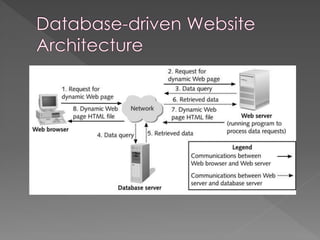
 Database-driven Website Architecture
 AJAX
 Web Services
 XML
 JSON
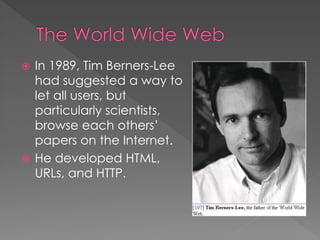
 In 1989, Tim Berners-Lee
had suggested a way to
let all users, but
particularly scientists,
browse each others’
papers on the Internet.
 He developed HTML,
URLs, and HTTP.
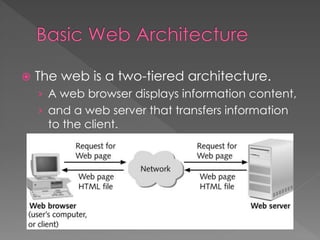
 The web is a two-tiered architecture.
› A web browser displays information content,
› and a web server that transfers information
to the client.
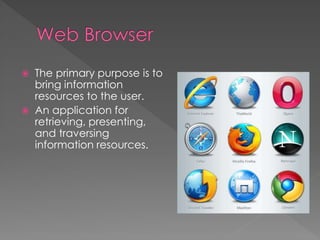
 The primary purpose is to
bring information
resources to the user.
 An application for
retrieving, presenting,
and traversing
information resources.
 The term web server or webserver can
mean one of two things:
› A computer program that accepts HTTP
requests and return HTTP responses with
optional data content.
› A computer that runs a computer program
as described above.
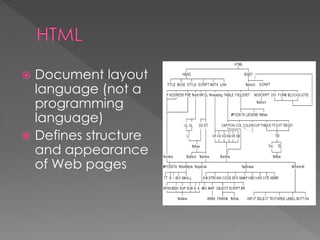
 Document layout
language (not a
programming
language)
 Defines structure
and appearance
of Web pages
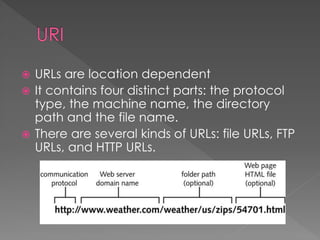
 URLs are location dependent
 It contains four distinct parts: the protocol
type, the machine name, the directory
path and the file name.
 There are several kinds of URLs: file URLs, FTP
URLs, and HTTP URLs.
 HTTP is a request/response standard of a
client and a server.
 Typically, an HTTP client initiates a request.
 Resources to be accessed by HTTP are
identified using Uniform Resource Identifiers
(URIs).
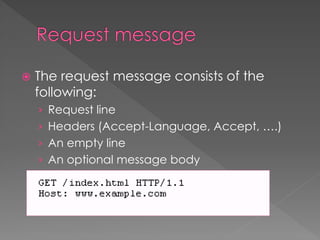
 The request message consists of the
following:
› Request line
› Headers (Accept-Language, Accept, ….)
› An empty line
› An optional message body
 HTTP defines eight methods (sometimes

referred to as "verbs") indicating the desired
action to be performed on the identified
resource.
› HEAD
› GET
› POST
› PUT
› DELETE
› TRACE
› OPTIONS
› CONNECT
 HEAD, GET, OPTIONS and TRACE are
defined as safe (no side effects).
 POST, PUT and DELETE are intended for
actions which may cause side effects
either on the server.
 The first line of the HTTP response is called
the status line.
 The way the user agent handles the
response primarily depends on the code
and secondarily on the response
headers.
 Success: 2xx
 Redirection: 3xx
 Client-Side Error: 4xx
 Server-Side Error: 5xx
 HTTP is a stateless protocol.
 Hosts do not need to retain information
about users between requests.
 Statelessness is a scalability property.
 For example, when a host needs to
customize the content of a website for a
user. Solution:
› Cookies
› Sessions
› Hidden variables (when the current page is a
form)
› URL encoded parameters (such as
/index.php?session_id=some_unique_session_code)
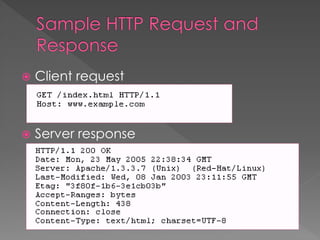
 Client request
 Server response
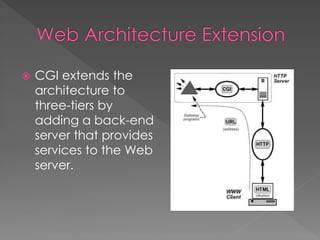
 CGI extends the
architecture to
three-tiers by
adding a back-end
server that provides
services to the Web
server.
 JavaScript is a scripting language designed
for creating dynamic, interactive Web
applications that link together objects and
resources on both clients and servers.
› Getting your Web page to respond or react
directly to user interaction with form elements
and hypertext links
› Preprocessing data on the client before
submission to a server
› Changing content and styles
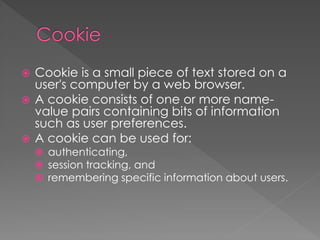
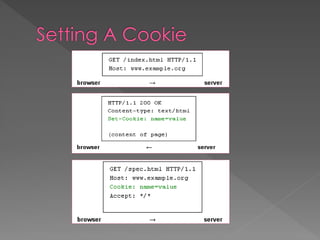
 Cookie is a small piece of text stored on a
user's computer by a web browser.
 A cookie consists of one or more name-
value pairs containing bits of information
such as user preferences.
 A cookie can be used for:
 authenticating,
 session tracking, and
 remembering specific information about users.
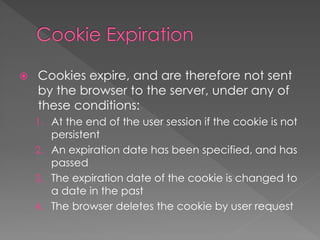
 Cookies expire, and are therefore not sent
by the browser to the server, under any of
these conditions:
1. At the end of the user session if the cookie is not
persistent
2. An expiration date has been specified, and has
passed
3. The expiration date of the cookie is changed to
a date in the past
4. The browser deletes the cookie by user request
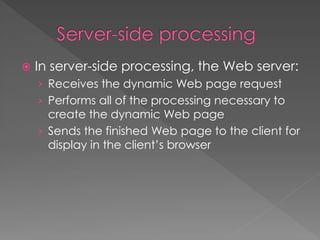
 In server-side processing, the Web server:
› Receives the dynamic Web page request
› Performs all of the processing necessary to
create the dynamic Web page
› Sends the finished Web page to the client for
display in the client’s browser
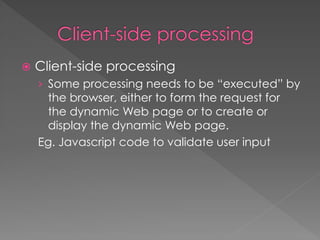
 Client-side processing
› Some processing needs to be “executed” by
the browser, either to form the request for
the dynamic Web page or to create or
display the dynamic Web page.
Eg. Javascript code to validate user input
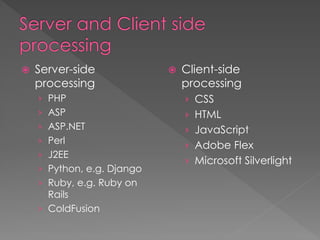
 Server-side
processing
› PHP
› ASP
› ASP.NET
› Perl
› J2EE
› Python, e.g. Django
› Ruby, e.g. Ruby on
Rails
› ColdFusion
 Client-side
processing
› CSS
› HTML
› JavaScript
› Adobe Flex
› Microsoft Silverlight
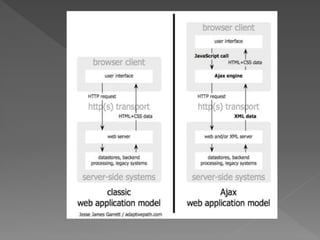
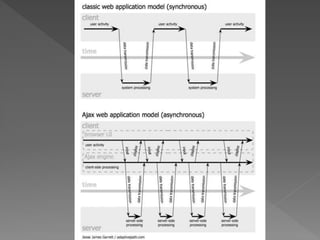
 Ajax isn’t a technology. It’s
really several technologies,
each flourishing in its own
right, coming together in
powerful new ways. Ajax
incorporates:
› XHTML and CSS;
› Document Object Model;
› XML and XSLT;
› XMLHttpRequest;
› JavaScript Jesse James Garrett, essay in
february 18, 2005
Ajax: A New Approach to Web
Applications
 It breaks browser history engine (Back
button).
 No bookmark.
 The same origin policy.
 Ajax opens up another attack vector for
malicious code that web developers
might not fully test for.
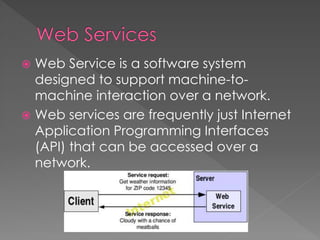
 Web Service is a software system
designed to support machine-to-
machine interaction over a network.
 Web services are frequently just Internet
Application Programming Interfaces
(API) that can be accessed over a
network.
 Web Services are platform-independent
and language-independent, since they use
standard XML languages.
 Most Web Services use HTTP for transmitting
messages (such as the service request and
response).
 Style of Use
› RPC
› SOAP
› REST
 XML is a universally agreed markup meta-
language primarily used for information
exchange.
 The two primary building blocks of XML are
elements and attributes.
› Elements are tags and have values.
› Elements are structured as a tree.
› Alternatively, elements may have both attributes
as well as data
› Attributes help you to give more meaning and
describe your element more efficiently and
clearly.
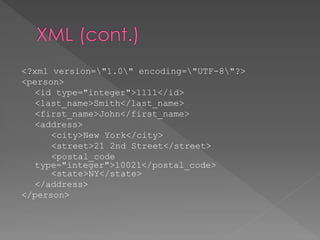
<?xml version="1.0" encoding="UTF-8"?>
<person>
<id type="integer">1111</id>
<last_name>Smith</last_name>
<first_name>John</first_name>
<address>
<city>New York</city>
<street>21 2nd Street</street>
<postal_code
type="integer">10021</postal_code>
<state>NY</state>
</address>
</person>
 JSON is a lightweight
computer data interchange
format.
 JSON is based on a subset of
the JavaScript programming
language.
 It is considered to be a
language-independent data
format.
 It serves as an alternative to
the use of the XML format.
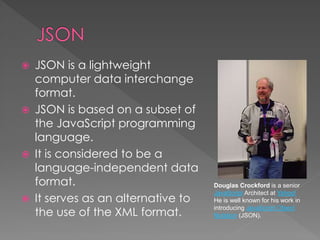
Douglas Crockford is a senior
JavaScript Architect at Yahoo!
He is well known for his work in
introducing JavaScript Object
Notation (JSON).
{
"firstName": "John",
"lastName": "Smith",
"address": {
"street": "21 2nd Street",
"city": "New York",
"state": "NY",
"postalCode": 10021
},
"phoneNumbers": [
"212 555-1234",
"646 555-4567"
]
}
 http://gdp.globus.org/gt4-tutorial/multiplehtml/ch01s02.html
 http://www.objs.com/survey/WebArch.htm
 http://en.wikipedia.org/wiki/World_Wide_Web
 http://en.wikipedia.org/wiki/Web_browser
 http://en.wikipedia.org/wiki/Web_services
 http://en.wikipedia.org/wiki/Web_server
 http://www.slideshare.net/warlock/intro-to-web-development
 http://www.slideshare.net/rstein/advanced-web-development
 http://www.slideshare.net/hblowers/intro-to-web-20-277488
 http://www.slideshare.net/cheilmann/the-road-to-professional-web-
development
 http://en.wikipedia.org/wiki/Common_Gateway_Interface
 http://www.edwardsamuels.com/ILLUSTRATEDSTORY/isc5.htm
 http://en.wikipedia.org/wiki/Hypertext_Transfer_Protocol
 http://en.wikipedia.org/wiki/HTTP_cookie
 http://www.adaptivepath.com/ideas/newsletter/archives/111405/index.
php
World wide web architecture presentation

World wide web architecture presentation

  • 2.
    Hurair Ali 11111 ImranKhan 11431 Shafiq Khan 11111 Israr Ahmad 11111 Murad Khan 11111
  • 3.
     Basic WebArchitecture  HTML  URI  HTTP  Web Architecture Extension  Cookie  Database-driven Website Architecture  AJAX  Web Services  XML  JSON
  • 5.
     In 1989,Tim Berners-Lee had suggested a way to let all users, but particularly scientists, browse each others’ papers on the Internet.  He developed HTML, URLs, and HTTP.
  • 7.
     The webis a two-tiered architecture. › A web browser displays information content, › and a web server that transfers information to the client.
  • 8.
     The primarypurpose is to bring information resources to the user.  An application for retrieving, presenting, and traversing information resources.
  • 9.
     The termweb server or webserver can mean one of two things: › A computer program that accepts HTTP requests and return HTTP responses with optional data content. › A computer that runs a computer program as described above.
  • 11.
     Document layout language(not a programming language)  Defines structure and appearance of Web pages
  • 13.
     URLs arelocation dependent  It contains four distinct parts: the protocol type, the machine name, the directory path and the file name.  There are several kinds of URLs: file URLs, FTP URLs, and HTTP URLs.
  • 15.
     HTTP isa request/response standard of a client and a server.  Typically, an HTTP client initiates a request.  Resources to be accessed by HTTP are identified using Uniform Resource Identifiers (URIs).
  • 16.
     The requestmessage consists of the following: › Request line › Headers (Accept-Language, Accept, ….) › An empty line › An optional message body
  • 17.
     HTTP defineseight methods (sometimes referred to as "verbs") indicating the desired action to be performed on the identified resource. › HEAD › GET › POST › PUT › DELETE › TRACE › OPTIONS › CONNECT

  • 18.
     HEAD, GET,OPTIONS and TRACE are defined as safe (no side effects).  POST, PUT and DELETE are intended for actions which may cause side effects either on the server.
  • 19.
     The firstline of the HTTP response is called the status line.  The way the user agent handles the response primarily depends on the code and secondarily on the response headers.  Success: 2xx  Redirection: 3xx  Client-Side Error: 4xx  Server-Side Error: 5xx
  • 20.
     HTTP isa stateless protocol.  Hosts do not need to retain information about users between requests.  Statelessness is a scalability property.  For example, when a host needs to customize the content of a website for a user. Solution: › Cookies › Sessions › Hidden variables (when the current page is a form) › URL encoded parameters (such as /index.php?session_id=some_unique_session_code)
  • 21.
     Client request Server response
  • 23.
     CGI extendsthe architecture to three-tiers by adding a back-end server that provides services to the Web server.
  • 24.
     JavaScript isa scripting language designed for creating dynamic, interactive Web applications that link together objects and resources on both clients and servers. › Getting your Web page to respond or react directly to user interaction with form elements and hypertext links › Preprocessing data on the client before submission to a server › Changing content and styles
  • 26.
     Cookie isa small piece of text stored on a user's computer by a web browser.  A cookie consists of one or more name- value pairs containing bits of information such as user preferences.  A cookie can be used for:  authenticating,  session tracking, and  remembering specific information about users.
  • 28.
     Cookies expire,and are therefore not sent by the browser to the server, under any of these conditions: 1. At the end of the user session if the cookie is not persistent 2. An expiration date has been specified, and has passed 3. The expiration date of the cookie is changed to a date in the past 4. The browser deletes the cookie by user request
  • 31.
     In server-sideprocessing, the Web server: › Receives the dynamic Web page request › Performs all of the processing necessary to create the dynamic Web page › Sends the finished Web page to the client for display in the client’s browser
  • 32.
     Client-side processing ›Some processing needs to be “executed” by the browser, either to form the request for the dynamic Web page or to create or display the dynamic Web page. Eg. Javascript code to validate user input
  • 33.
     Server-side processing › PHP ›ASP › ASP.NET › Perl › J2EE › Python, e.g. Django › Ruby, e.g. Ruby on Rails › ColdFusion  Client-side processing › CSS › HTML › JavaScript › Adobe Flex › Microsoft Silverlight
  • 35.
     Ajax isn’ta technology. It’s really several technologies, each flourishing in its own right, coming together in powerful new ways. Ajax incorporates: › XHTML and CSS; › Document Object Model; › XML and XSLT; › XMLHttpRequest; › JavaScript Jesse James Garrett, essay in february 18, 2005 Ajax: A New Approach to Web Applications
  • 38.
     It breaksbrowser history engine (Back button).  No bookmark.  The same origin policy.  Ajax opens up another attack vector for malicious code that web developers might not fully test for.
  • 40.
     Web Serviceis a software system designed to support machine-to- machine interaction over a network.  Web services are frequently just Internet Application Programming Interfaces (API) that can be accessed over a network.
  • 41.
     Web Servicesare platform-independent and language-independent, since they use standard XML languages.  Most Web Services use HTTP for transmitting messages (such as the service request and response).  Style of Use › RPC › SOAP › REST
  • 43.
     XML isa universally agreed markup meta- language primarily used for information exchange.  The two primary building blocks of XML are elements and attributes. › Elements are tags and have values. › Elements are structured as a tree. › Alternatively, elements may have both attributes as well as data › Attributes help you to give more meaning and describe your element more efficiently and clearly.
  • 44.
    <?xml version="1.0" encoding="UTF-8"?> <person> <idtype="integer">1111</id> <last_name>Smith</last_name> <first_name>John</first_name> <address> <city>New York</city> <street>21 2nd Street</street> <postal_code type="integer">10021</postal_code> <state>NY</state> </address> </person>
  • 46.
     JSON isa lightweight computer data interchange format.  JSON is based on a subset of the JavaScript programming language.  It is considered to be a language-independent data format.  It serves as an alternative to the use of the XML format. Douglas Crockford is a senior JavaScript Architect at Yahoo! He is well known for his work in introducing JavaScript Object Notation (JSON).
  • 47.
    { "firstName": "John", "lastName": "Smith", "address":{ "street": "21 2nd Street", "city": "New York", "state": "NY", "postalCode": 10021 }, "phoneNumbers": [ "212 555-1234", "646 555-4567" ] }
  • 48.
     http://gdp.globus.org/gt4-tutorial/multiplehtml/ch01s02.html  http://www.objs.com/survey/WebArch.htm http://en.wikipedia.org/wiki/World_Wide_Web  http://en.wikipedia.org/wiki/Web_browser  http://en.wikipedia.org/wiki/Web_services  http://en.wikipedia.org/wiki/Web_server  http://www.slideshare.net/warlock/intro-to-web-development  http://www.slideshare.net/rstein/advanced-web-development  http://www.slideshare.net/hblowers/intro-to-web-20-277488  http://www.slideshare.net/cheilmann/the-road-to-professional-web- development  http://en.wikipedia.org/wiki/Common_Gateway_Interface  http://www.edwardsamuels.com/ILLUSTRATEDSTORY/isc5.htm  http://en.wikipedia.org/wiki/Hypertext_Transfer_Protocol  http://en.wikipedia.org/wiki/HTTP_cookie  http://www.adaptivepath.com/ideas/newsletter/archives/111405/index. php