Working model on solar car
Solar Car the Future……..
By Prince Kumar
Introduction
 In today's climate of growing energy needs and increasing environmental
concern, alternatives to the use of non-renewable and polluting fossil fuels
have to be investigated. One such alternative is solar energy.
 Solar energy is quite simply the energy produced directly by the sun and
collected elsewhere, normally the Earth. Only a very small fraction of the total
radiation produced reaches the Earth. Much of the world's required energy
can be supplied directly by solar power.
 Methods of collecting and storing solar energy vary depending on the uses
planned for the solar generator. In general, there are three types of collectors
and many forms of storage units.
The three types of collectors are flat-plate collectors, focusing collectors, and
passive collectors.
 We are using hear flat-plate collector which are commonly known as solar
array.
History of Solar Car
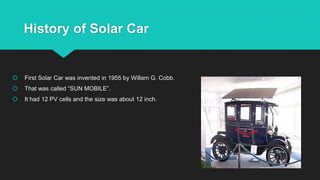
 First Solar Car was invented in 1955 by Willam G. Cobb.
 That was called “SUN MOBILE”.
 It had 12 PV cells and the size was about 12 inch.
Summary
 Solar cars depend on photovoltaic cells to convert sunlight into electricity.
 Unlike solar thermal energy which converts solar energy to heat for either household purposes,
industrial purposes or to be converted to electricity.
Background of solar energy
 The history of photovoltaic energy (solar cells) started way back in 1876. William Grylls Adams
along with a student of his, Richard Day, discovered that when selenium was exposed to light, it
produced electricity.
 An electricity expert, Werner von Siemens, stated that the discovery was "scientifically of the most
far-reaching importance". The selenium cells were not efficient, but it was proved that light, could
be converted into electricity.
 In 1953, Calvin Fuller, Gerald Pearson, and Daryl Chapin, discovered the silicon solar cell. This cell
actually produced enough electricity and was efficient enough to run small electrical devices.
 The New York Times stated that this discovery was "the beginning of a new era, leading eventually
to the realization of harnessing the almost limitless energy of the sun for the uses of civilization."
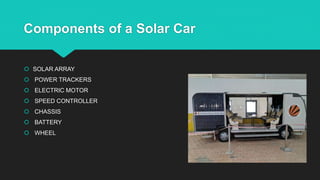
Components of a Solar Car
 SOLAR ARRAY
 POWER TRACKERS
 ELECTRIC MOTOR
 SPEED CONTROLLER
 CHASSIS
 BATTERY
 WHEEL
Solar Array
 The array is made up of many (often several hundred) photovoltaic solar cells.
 It collects the direct sun radiation and converts to electricity. It is the main source of power to the
Solar Car.
 The power produced by the solar array varies depending on the weather, the sun's position in the
sky, and the solar array itself.
Power Trackers
 Power trackers condition the electricity coming from
the solar array to maximize the power and deliver it
either to the batteries for storage or to the motor
controller for propulsion.
 When the solar array is charging the batteries, the
power trackers help to protect the batteries from
being damaged by overcharging.
Electric Motor
 An electric motor is a device using electrical energy to produce mechanical energy.
 An electric motor is the basic and the most important part of a solar car.
 It should work with optimal power and the efficiency should be high.
 It is used to drives the wheels.
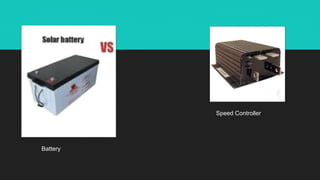
Battery
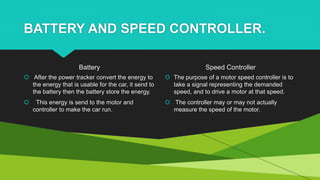
Speed Controller
BATTERY AND SPEED CONTROLLER.
Battery
 After the power tracker convert the energy to
the energy that is usable for the car, it send to
the battery then the battery store the energy.
 This energy is send to the motor and
controller to make the car run.
Speed Controller
 The purpose of a motor speed controller is to
take a signal representing the demanded
speed, and to drive a motor at that speed.
 The controller may or may not actually
measure the speed of the motor.
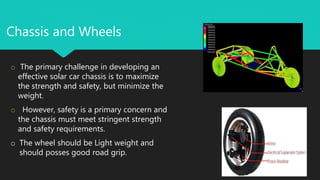
Chassis and Wheels
o The primary challenge in developing an
effective solar car chassis is to maximize
the strength and safety, but minimize the
weight.
o However, safety is a primary concern and
the chassis must meet stringent strength
and safety requirements.
o The wheel should be Light weight and
should posses good road grip.
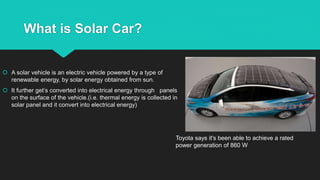
What is Solar Car?
 A solar vehicle is an electric vehicle powered by a type of
renewable energy, by solar energy obtained from sun.
 It further get’s converted into electrical energy through panels
on the surface of the vehicle.(i.e. thermal energy is collected in
solar panel and it convert into electrical energy)
Toyota says it's been able to achieve a rated
power generation of 860 W
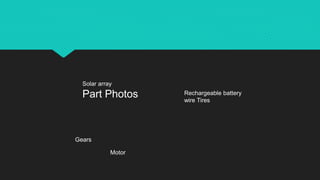
Motor
Solar array
Part Photos
Gears
Rechargeable battery
wire Tires
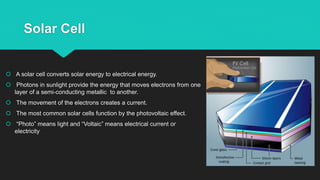
Solar Cell
 A solar cell converts solar energy to electrical energy.
 Photons in sunlight provide the energy that moves electrons from one
layer of a semi-conducting metallic to another.
 The movement of the electrons creates a current.
 The most common solar cells function by the photovoltaic effect.
 “Photo” means light and “Voltaic” means electrical current or
electricity
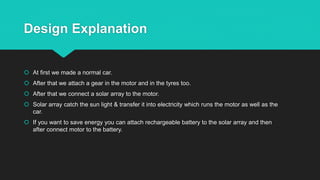
Design Explanation
 At first we made a normal car.
 After that we attach a gear in the motor and in the tyres too.
 After that we connect a solar array to the motor.
 Solar array catch the sun light & transfer it into electricity which runs the motor as well as the
car.
 If you want to save energy you can attach rechargeable battery to the solar array and then
after connect motor to the battery.
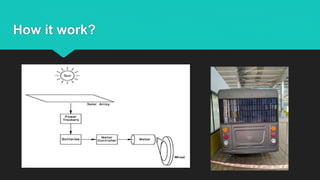
How it work?
How it Works.
 Solar cars are powered by the sun's energy.
 The main component of a solar car is its solar array, which collect the energy from the sun and
converts it into usable electrical energy.
 The solar cells collect a portion of the sun's energy and stores it into the batteries of the solar car.
 Before that happens, power trackers converts the energy collected from the solar array to the
proper system voltage, so that the batteries and the motor can use it.
 After the energy is stored in the batteries, it is available for use by the motor & motor controller to
drive the car.
 The motor controller adjusts the amount of energy that flows to the motor to correspond to the
throttle. The motor uses that energy to drive the wheels.
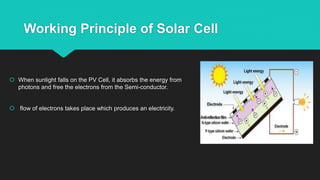
Working Principle of Solar Cell
 When sunlight falls on the PV Cell, it absorbs the energy from
photons and free the electrons from the Semi-conductor.
 flow of electrons takes place which produces an electricity.
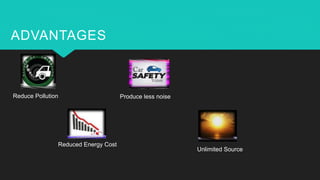
ADVANTAGES
Reduce Pollution Produce less noise
Reduced Energy Cost
Unlimited Source
Applications
 This concept can be utilized to build a single sitter four wheel vehicles in practice.
 It can be extended to more commercial form of four wheeler vehicle.
 In industry where small vehicles are used to perform light weight conveys work from one place
to other place.
 It can be used places where, fuel based vehicles are banned due to production of pollution and
noise
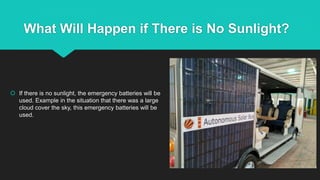
What Will Happen if There is No Sunlight?
 If there is no sunlight, the emergency batteries will be
used. Example in the situation that there was a large
cloud cover the sky, this emergency batteries will be
used.
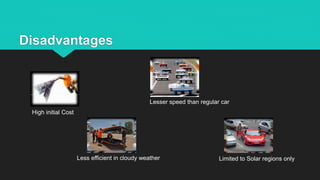
Disadvantages
Lesser speed than regular car
Less efficient in cloudy weather Limited to Solar regions only
High initial Cost
Consider an example.
Conclusion
 Solar Car would be an amazing advancement in future car technology.
 They would allow free and pollution less travel with unlimited accessibility.
 If some minor drawbacks associated with Solar Car can be rectified, then for sure Solar Car will
play a vital role in future transportation.
 Solar energy and more specifically solar cars would be an amazing advancement in future car
technology. They would allow for free travel and nearly unlimited .but solar cars are not successful
at all places like Antarctica which see sun’s rarely .
 If the hurdles can be passed then for sure solar cars will be wave of future
.
Reference
 www.wikipedia.com
 www.solarcar.Stanford.edu
 www.technologystudent.com
 www.auto.howstuffsworks.com
 www.solarcar.engine.umich.edu

Working model-of-solar-car

  • 1.
    Working model onsolar car Solar Car the Future…….. By Prince Kumar
  • 2.
    Introduction  In today'sclimate of growing energy needs and increasing environmental concern, alternatives to the use of non-renewable and polluting fossil fuels have to be investigated. One such alternative is solar energy.  Solar energy is quite simply the energy produced directly by the sun and collected elsewhere, normally the Earth. Only a very small fraction of the total radiation produced reaches the Earth. Much of the world's required energy can be supplied directly by solar power.  Methods of collecting and storing solar energy vary depending on the uses planned for the solar generator. In general, there are three types of collectors and many forms of storage units. The three types of collectors are flat-plate collectors, focusing collectors, and passive collectors.  We are using hear flat-plate collector which are commonly known as solar array.
  • 3.
    History of SolarCar  First Solar Car was invented in 1955 by Willam G. Cobb.  That was called “SUN MOBILE”.  It had 12 PV cells and the size was about 12 inch.
  • 4.
    Summary  Solar carsdepend on photovoltaic cells to convert sunlight into electricity.  Unlike solar thermal energy which converts solar energy to heat for either household purposes, industrial purposes or to be converted to electricity.
  • 5.
    Background of solarenergy  The history of photovoltaic energy (solar cells) started way back in 1876. William Grylls Adams along with a student of his, Richard Day, discovered that when selenium was exposed to light, it produced electricity.  An electricity expert, Werner von Siemens, stated that the discovery was "scientifically of the most far-reaching importance". The selenium cells were not efficient, but it was proved that light, could be converted into electricity.  In 1953, Calvin Fuller, Gerald Pearson, and Daryl Chapin, discovered the silicon solar cell. This cell actually produced enough electricity and was efficient enough to run small electrical devices.  The New York Times stated that this discovery was "the beginning of a new era, leading eventually to the realization of harnessing the almost limitless energy of the sun for the uses of civilization."
  • 6.
    Components of aSolar Car  SOLAR ARRAY  POWER TRACKERS  ELECTRIC MOTOR  SPEED CONTROLLER  CHASSIS  BATTERY  WHEEL
  • 7.
    Solar Array  Thearray is made up of many (often several hundred) photovoltaic solar cells.  It collects the direct sun radiation and converts to electricity. It is the main source of power to the Solar Car.  The power produced by the solar array varies depending on the weather, the sun's position in the sky, and the solar array itself.
  • 8.
    Power Trackers  Powertrackers condition the electricity coming from the solar array to maximize the power and deliver it either to the batteries for storage or to the motor controller for propulsion.  When the solar array is charging the batteries, the power trackers help to protect the batteries from being damaged by overcharging.
  • 9.
    Electric Motor  Anelectric motor is a device using electrical energy to produce mechanical energy.  An electric motor is the basic and the most important part of a solar car.  It should work with optimal power and the efficiency should be high.  It is used to drives the wheels.
  • 10.
  • 11.
    BATTERY AND SPEEDCONTROLLER. Battery  After the power tracker convert the energy to the energy that is usable for the car, it send to the battery then the battery store the energy.  This energy is send to the motor and controller to make the car run. Speed Controller  The purpose of a motor speed controller is to take a signal representing the demanded speed, and to drive a motor at that speed.  The controller may or may not actually measure the speed of the motor.
  • 12.
    Chassis and Wheels oThe primary challenge in developing an effective solar car chassis is to maximize the strength and safety, but minimize the weight. o However, safety is a primary concern and the chassis must meet stringent strength and safety requirements. o The wheel should be Light weight and should posses good road grip.
  • 13.
    What is SolarCar?  A solar vehicle is an electric vehicle powered by a type of renewable energy, by solar energy obtained from sun.  It further get’s converted into electrical energy through panels on the surface of the vehicle.(i.e. thermal energy is collected in solar panel and it convert into electrical energy) Toyota says it's been able to achieve a rated power generation of 860 W
  • 14.
  • 15.
    Solar Cell  Asolar cell converts solar energy to electrical energy.  Photons in sunlight provide the energy that moves electrons from one layer of a semi-conducting metallic to another.  The movement of the electrons creates a current.  The most common solar cells function by the photovoltaic effect.  “Photo” means light and “Voltaic” means electrical current or electricity
  • 16.
    Design Explanation  Atfirst we made a normal car.  After that we attach a gear in the motor and in the tyres too.  After that we connect a solar array to the motor.  Solar array catch the sun light & transfer it into electricity which runs the motor as well as the car.  If you want to save energy you can attach rechargeable battery to the solar array and then after connect motor to the battery.
  • 17.
  • 18.
    How it Works. Solar cars are powered by the sun's energy.  The main component of a solar car is its solar array, which collect the energy from the sun and converts it into usable electrical energy.  The solar cells collect a portion of the sun's energy and stores it into the batteries of the solar car.  Before that happens, power trackers converts the energy collected from the solar array to the proper system voltage, so that the batteries and the motor can use it.  After the energy is stored in the batteries, it is available for use by the motor & motor controller to drive the car.  The motor controller adjusts the amount of energy that flows to the motor to correspond to the throttle. The motor uses that energy to drive the wheels.
  • 19.
    Working Principle ofSolar Cell  When sunlight falls on the PV Cell, it absorbs the energy from photons and free the electrons from the Semi-conductor.  flow of electrons takes place which produces an electricity.
  • 20.
    ADVANTAGES Reduce Pollution Produceless noise Reduced Energy Cost Unlimited Source
  • 21.
    Applications  This conceptcan be utilized to build a single sitter four wheel vehicles in practice.  It can be extended to more commercial form of four wheeler vehicle.  In industry where small vehicles are used to perform light weight conveys work from one place to other place.  It can be used places where, fuel based vehicles are banned due to production of pollution and noise
  • 22.
    What Will Happenif There is No Sunlight?  If there is no sunlight, the emergency batteries will be used. Example in the situation that there was a large cloud cover the sky, this emergency batteries will be used.
  • 23.
    Disadvantages Lesser speed thanregular car Less efficient in cloudy weather Limited to Solar regions only High initial Cost
  • 24.
  • 25.
    Conclusion  Solar Carwould be an amazing advancement in future car technology.  They would allow free and pollution less travel with unlimited accessibility.  If some minor drawbacks associated with Solar Car can be rectified, then for sure Solar Car will play a vital role in future transportation.  Solar energy and more specifically solar cars would be an amazing advancement in future car technology. They would allow for free travel and nearly unlimited .but solar cars are not successful at all places like Antarctica which see sun’s rarely .  If the hurdles can be passed then for sure solar cars will be wave of future .
  • 26.
    Reference  www.wikipedia.com  www.solarcar.Stanford.edu www.technologystudent.com  www.auto.howstuffsworks.com  www.solarcar.engine.umich.edu