CHAPTER - I


                               1-BACKGROUND OF THE STUDY
                               2-STATEMENT OF PROBLEM
                               3-OBJECTIVES OF THE STUDY
                               4-HYPOTHESIS
                               5-METHODOLOGY
                               6-LIMITATIONS OF THE STUDY
                               7-STRUCTURE    OF THE WORKS.


1.1 BACKGROUND OF THE STUDY.
                                                              1
“THE MAJOR OBJECTIVE OF THIS STUDY IS FOR THE PROPER UNDERSTANDING OF THE WORKING CAPITAL OF ARABIAN
INDUSTRIES LLC AND TO SUGGEST NECESSARY MEASURES TO OVERCOME THE SHORTFALLS IF ANY IN THE INDUSTRY.”


The project undertaken is on “Working Capital Management of Arabian Industries LLC.”. It describes
about how the company manages its working capital and the various steps that are required in the
management of working capital. Cash is the lifeline of a company. If this lifeline deteriorates, so does
the company's ability to fund operations, reinvest and meet capital requirements and payments.
Understanding a company's cash flow health is essential to making investment decisions. A good way
to judge a company's cash flow prospects is to look at its Working Capital Management (WCM).


Working capital refers to the cash of a business requires for day-to-day operations or, more
specifically, for financing the conversion of raw materials into finished goods, which the company
sells for payment. Among the most important items of working capital are levels of inventory,
accounts receivable, and accounts payable. Analysts look at these items for signs of a company's
efficiency and financial strength.


The working capital is an important yardstick to measure the company’s operational and financial
efficiency. Any company should have a right amount of cash and lines of credit for its business needs
at all times. This project describes how the management of working capital takes place at Arabian
Industries LLC..


There are numerous instances in the history of business world where inadequacy of working capital
has led to business failures when a firm finds it difficult to meetings day to day affairs. Operating
expenses essential out lays may have to be postponed for want of funds, operating plans will go out of
gear & enterprise objectives on investment slumps the suppliers & creditors of the firm may have to
wait longer to raise their dues & will hesitate to extend further credit to the firm.


Thus efficient management of working capital in an important prerequisite for successful working of a
business concern it reduces the chances of business failure generates a felling of security and
confidence in the minds of personnel in the organization it assurance solvency of steady of the
organization.


1.2 STATEMENT OF PROBLEM


                                                                                                      2
In the management of working capital, the firm is faced with two key problems:

1. First, given the level of sales and the relevant cost considerations, what are the optimal amounts of
cash, accounts receivable and inventories that a firm should choose to maintain?

2. Second, given these optimal amounts, what is the most economical way to finance these working
capital investments? To produce the best possible results, firms should keep no unproductive assets
and should finance with the cheapest available sources of funds. Why? In general, it is quite
advantageous for the firm to invest in short term assets and to finance short-term liabilities.


Besides this followings are some other problem , a firm is facing. Through this study we try to find
answer for these problems.


    1. What are root causes of working capital on business?
    2. What are the major effects on accounts receivable?
    3. What is the nature of relationship between working capital and capital employed
    4. What steps should be taken to ensure that it effect on the profit of the firm will not be
        negative?
    5. How can working capital be managed?
    6. What make up the working capital cycle?
    7. How can debtors be controlled?


1.3 NEED AND IMPORTANCE OF THE STUDY.


1.This projects is helpful in knowing the companies position of funds maintenance and setting the
standards for working capital inventory levels, current ratio level, quick ratio, current asset turnover
level & size of current liability etc.


2. This project is helpful to the managements for expanding the dualism & the project viability &
present availability of funds.


3. This project is also useful as it combines the present year data with the previous year data and there
by it show the trend analysis, i.e. increasing fund or decreasing fund.


4. The project is done as a whole entirely. It will give overall view of the organization and it is useful
in further expansion decision to be taken by management.
1.4 OBJECTIVES OF THE STUDY


                                                                                                             3
The main objective of the study is to determine the effect of working capital on business profitability
which has to do with:-


    1. Maintenance of working capital at appropriate level, and
    2. Availability of ample funds as and when they are needed


To accomplishment of these two objectives, the management has consider the composition of current
assets pool. The working capital position sets the various policies in the business with respect to
general operations like purchasing, financing, expansion and dividend etc,


The subsidiary Objective of Working Capital Management is to provide adequate support for the
smooth functioning of the normal business operations of a company. This Objective can be sub-
divided into 2 parts:-
1. Liquidity
2. Profitability
1) Liquidity


The quantum of Investment in Current Assets has to be made in a manner that it not only meets the
needs of the forecasted sales but also provides a built in cushion in the form of safety stocks to meet
unforeseen contingencies arising out of factors such as delays in arrival of Raw Material, sudden
spurts in demand etc. Consequently, the investment in current assets for a given level of forecasted
sales will be higher if the management follows a conservative attitude than when it follows an
aggressive attitude. Thus, a company following a conservative approach is subject to a lower degree of
risk than the one following an aggressive approach. Further, in the former situation the high amount of
Investment in Current Assets imparts greater liquidity to the company than under the latter situation
wherein the quantum of investment in Current Asset is less. This aspect exclusively covers the
liquidity dimension of Working Capital.
2) Profitability
Once we recognize the fact that the total amount of financial resources at the disposal of a company is
limited and these can be put to alternative uses, the larger the amount of investment in current assets,
the smaller will be the amount available for investment in other profitable avenues at hand with the
company. A conservative approach in respect of Investment in Current Assets leaves fewer amounts
for other Investments than an aggressive approach does.
1.5 HYPOTHESIS


                                                                                                      4
Hypothesis is a conjectural statement of the relationships between two or more variables. It is testable,
tentative problem explanation of the relationship between two or more variables that create a state of
affairs or phenomenon.E,C, Osuola said hypothesis should always be in declarative sentence form, and
they should relate to them generally or specially variable to variables.


Hypothesis thus:-


1. Explain observed events in a systematic manner
2. Predict the outcome of events and relationships
3. Systematically summarized existing knowledge.


In essence, there exist null hypothesis set up only to nullify the research hypothesis and the alternative
hypothesis, for the purpose of the study. For the efficiency of the study, the hypothesis is as follows:


H0


     1. Working capital does not help the business concern in maintaining the goodwill
     2. Working capital does not create an environment of security, confidence, and overall efficiency
         in a business


H1


1. Working capital helps the business concern in maintaining the goodwill.
2. Working capital creates an environment of security, confidence, and overall efficiency in business.
1.6 METHODOLOGY


Methodology may be a description of process, or may be expanded to include a philosophically
coherent collection of theories, concepts or ideas as they relate to a particular discipline or field of
inquiry. This project requires a detailed understanding of the concept – “Working Capital
Management”. Therefore, firstly we need to have a clear idea of, what is working capital, how it is
managed in Arabian Industries LLC, what are the different ways in which the financing of working
capital is done in the organization etc.
To recognize the various type of information which are necessary for the study of working capital
management.

                                                                                                           5
   The management of working capital involves managing inventories, accounts receivable and
        payable and cash. Therefore one also needs to have a sound knowledge about cash
        management, inventory management and receivables management.


       Then comes the financing of working capital requirement, i.e. how the working capital is
        financed, what are the various sources through which it is done.


       And, in the end, suggestions and recommendations on ways for better management and
        control of working capital are provided.


Collection of data from various department of AILLC to analyze the working capital management of
the firm.


1.6.1   COLLECTION OF DATA


There are several ways of collecting both data-Primary and Secondary datas,               which differ
considerably in context of money, cost, time and other sources at the disposable of the researcher.


There are two types of data:
· Primary data
· Secondary data


1-Primary Data


Definition:-
The first handed information/Fresh data collected through various methods is known as primary data.
        In respect of primary data which the researchers are directly collects data that have not been
previously collected.
The primary data was gathered through personal interaction with various functional heads and other
technical personnel. Some information was also collected by observation.


2-Secondary Data :
Definition:-

                                                                                                      6
The data which have been already collected & comprised for another purpose. Secondary data
was collected various reports, annual reports, documents charts, management information systems, etc
in AI LLC, And also collected various magazines, books, newspapers etc.


The analysis of the information gathered has been made on the basis of the clarifications sought during
the personal discussions with the concerned people and perception during the personal visits to the
important areas of services.


In marking observations identifying problems and suggesting certain remedies such emphasis was
given on the basis of opinions gathered during the personal discussions and with the personal
experience gained during the academic study of M.B.A course.


1.6.2    TOOLS EMPLOYED


The data presentation tools are mainly Mathematical tools, Tables and Charts are used for this study.
The most important parts of tools include;
    a) Table numbers
    b) Title of the table
    c) Caption
    d) Stub or the designation of the rows and columns
    e) The body of the table
    f) The head note or prefatory note or explanatory just before the title.
    g) Source note, which refers to the literally or scientific source of the table has observed that a
         table has the following merits over a prose information that;
    h) A table ensures an easy location of the required figure;
    i)   Comparisons are easily made utilizing a table than prose information;
    j)   Patterns or trends within the figures which cannot be visualized in the prose information can
         be revealed and better depicted by a table; and a table is more concise and takes up a less
         space than a prose formation:
1.6.3    TIME SPAN


A period of six year i.e. 2004-2009 has been taken for the study.
1.7 LIMITATIONS OF THE STUDY.


                                                                                                        7
The following are the various limitations involved in the study.
.
1. The study in limited 4 years (2004-2005) to (2005-2006) performance of the company.
2. The data used in this study have been taken from published annual report only.
3. This study in conducted within a short period. During the limited period the study may not be
    retailed, full fledged and utilization in all aspects.
4. Financial accounting does not take into account the price level changes.
5. We cannot do comparisons with other companies unless and until we have the data of other
    companies on the same subject.
6. Only the printed data about the company will be available and not the back–end details.
7. Future plans of the company will not be disclosed to us.
8. Lastly, due to shortage of time it is not possible to cover all the factors and details regarding the
    subject of study.


1.8 CHAPTERIZATION


This research work is to be organized in nine chapters as follows:


       Chapter – 1           - Introduction

       Chapter-II            - Manufacturing Industry in Oman – A profile

       Chapter-III           - Arabian Industries LLC-A Profile

       Chapter-IV            - A Theoretical Perspective of Working Capital Management

       Chapter – V           - Research methodology

       Chapter VI            - Analysis of Working Capital Level

       Chapter VII           - Analysis of Financial Statement

       Chapter – VIII        - Management of working capital and it’s Financing and Estimation

       Chapter – IX          - Findings, Conclusion and Recommendations


                                                                                                      8
CHAPTER – II


                                   1-Introduction
                                   2-Present Scenario
                                   3-Foreign Investment
                                   4-Oman Economy
                                   5-Major Diversification
                                   6-Oman Industry- An over view
                                   7-ManufacturingIndustry in Oman
                                   8-The Scope of Oil and Gas Industry.


2.1 OMAN PETROLEUM INDUSTRY - INTRODUCTION


                                                                          9
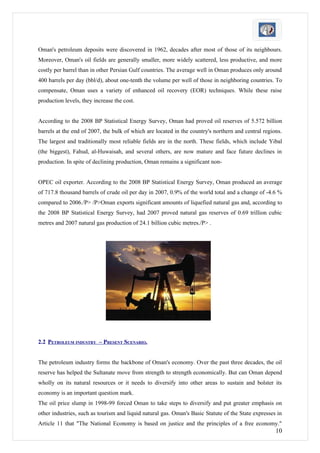
Oman's petroleum deposits were discovered in 1962, decades after most of those of its neighbours.
Moreover, Oman's oil fields are generally smaller, more widely scattered, less productive, and more
costly per barrel than in other Persian Gulf countries. The average well in Oman produces only around
400 barrels per day (bbl/d), about one-tenth the volume per well of those in neighboring countries. To
compensate, Oman uses a variety of enhanced oil recovery (EOR) techniques. While these raise
production levels, they increase the cost.


According to the 2008 BP Statistical Energy Survey, Oman had proved oil reserves of 5.572 billion
barrels at the end of 2007, the bulk of which are located in the country's northern and central regions.
The largest and traditionally most reliable fields are in the north. These fields, which include Yibal
(the biggest), Fahud, al-Huwaisah, and several others, are now mature and face future declines in
production. In spite of declining production, Oman remains a significant non-


OPEC oil exporter. According to the 2008 BP Statistical Energy Survey, Oman produced an average
of 717.8 thousand barrels of crude oil per day in 2007, 0.9% of the world total and a change of -4.6 %
compared to 2006./P> /P>Oman exports significant amounts of liquefied natural gas and, according to
the 2008 BP Statistical Energy Survey, had 2007 proved natural gas reserves of 0.69 trillion cubic
metres and 2007 natural gas production of 24.1 billion cubic metres./P> .


2.2 PETROLEUM INDUSTRY – PRESENT SCENARIO.


The petroleum industry forms the backbone of Oman's economy. Over the past three decades, the oil
reserve has helped the Sultanate move from strength to strength economically. But can Oman depend
wholly on its natural resources or it needs to diversify into other areas to sustain and bolster its
economy is an important question mark.
The oil price slump in 1998-99 forced Oman to take steps to diversify and put greater emphasis on
other industries, such as tourism and liquid natural gas. Oman's Basic Statute of the State expresses in
Article 11 that "The National Economy is based on justice and the principles of a free economy."
                                                                                                     10
Recent official statistics reveal that the oil sector's share in the GDP has risen to 49 per cent in 2005
from 42.2 per cent in 2004. According to the 2006 annual report of the Central Bank of Oman (CBO),
"The fiscal position remained strong in 2005, with the fiscal recording a surplus of about 2.6 per cent
of GDP. As against a budgeted deficit of RO540 million in 2005, there was a net surplus of RO303
million."


Revenues from the petroleum sector rose 44.3 per cent in 2005. Non-oil revenues rose 9.2 per cent,
driven by a strong 17.8 per cent growth in non-oil industrial activities. The average price of Omani
crude was about US $50.26 per barrel in 2005, representing a 46 per cent rise over the average price of
US $34.42 in 2004. As a result, the share of oil and gas sector in the GDP, exports and net government
revenue rose to 49 per cent, 84.2 per cent and 79 per cent, respectively, in 2005. After a period of
subdued inflation, 2004 saw signs of minor rise in prices, which persisted in 2005. Consumer price
inflation rose from 0.7 per cent in 2004 to 1.9 per cent in 2005. But the Sultanate's inflation at 2.3 per
cent was still lower than the average inflation in advanced countries in 2005.


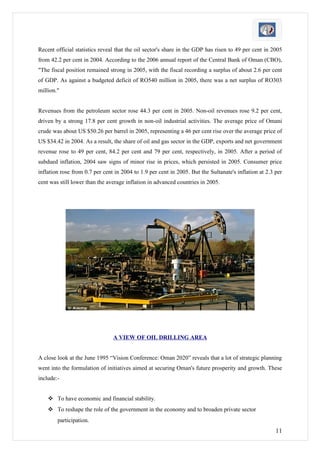
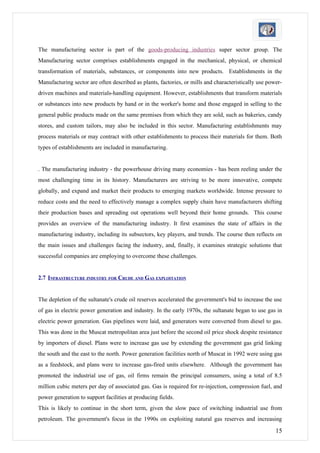
                                A VIEW OF OIL DRILLING AREA


A close look at the June 1995 “Vision Conference: Oman 2020” reveals that a lot of strategic planning
went into the formulation of initiatives aimed at securing Oman's future prosperity and growth. These
include:-


     To have economic and financial stability.
     To reshape the role of the government in the economy and to broaden private sector
        participation.
                                                                                                       11
 To diversify the economic base and sources of national income.
     To globalise the Omani economy.
     To upgrade the skills of the Omani workforce and develop human resources.


It is expected that by 2020 the economy will not be reliant on oil, but rather diversified into non oil
sectors, raising higher levels of savings and investments. Studies reveal that the crude oil sector's share
of GDP is estimated to drop to 9 per cent in 2020, compared with 41 per cent in 1996. Also, the gas
sector is expected to contribute around 10 per cent to GDP, compared with less than 1 per cent in
1996, while the non-oil industrial sector's contribution is expected to increase from 7.5 per cent to 29
per cent.


2.3 INCENTIVES FOR FOREIGN INVESTMENT


In a bid to reinforce the existing set-up as well as make room for further development in the petroleum
sector, the government has undertaken a string of measures to provide incentives to foreign investors.
These include:
    1. Tax exemption for five years (sometimes renewable for a further five years) for industrial
        enterprises which contribute to Oman's economy.
    2. Foreign investors allowed to hold 49 per cent of equity, which could be increased in
        mitigating circumstances.
    3. Concessional financing may be arranged through the Ministry of Commerce and Industry and
        Oman Development Bank.
    4. A clear and efficient legal network which offers advice on company law, copyright law,
        arbitration and agency law.
    5. A diverse economy which encourages privatisation of infrastructure and services.
    6. Price stability, with an inflation rate of not more than 1 per cent since 1992.
    7. Stable currency with full convertibility.
    8. No personal income tax and no foreign exchange controls.
    9. Tax and import duty exemptions.
    10. Interest-free long-term loans to partly foreign-owned industrial and tourism projects.


Foreign business participation in Oman is encouaged provided the company is established in
accordance with the Foreign Business and Investment Law of 1974. Foreign companies are formed as
an incorporation of a local company or other commercial entity. They may also exist as a branch


                                                                                                        12
office, a consultancy or by appointing a commercial agent, ensuring that the company only supplies
services and/or goods to be imported into the Sultanate.
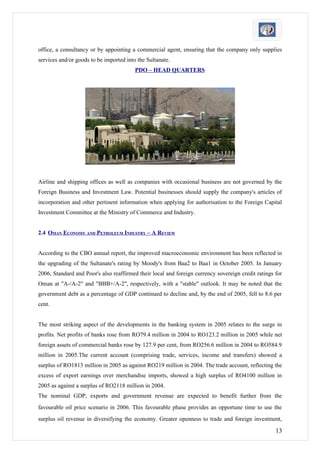
                                         PDO – HEAD QUARTERS


Airline and shipping offices as well as companies with occasional business are not governed by the
Foreign Business and Investment Law. Potential businesses should supply the company's articles of
incorporation and other pertinent information when applying for authorisation to the Foreign Capital
Investment Committee at the Ministry of Commerce and Industry.


2.4 OMAN ECONOMY AND PETROLEUM INDUSTRY – A REVIEW


According to the CBO annual report, the improved macroeconomic environment has been reflected in
the upgrading of the Sultanate's rating by Moody's from Baa2 to Baa1 in October 2005. In January
2006, Standard and Poor's also reaffirmed their local and foreign currency sovereign credit ratings for
Oman at "A-/A-2" and "BBB+/A-2", respectively, with a "stable" outlook. It may be noted that the
government debt as a percentage of GDP continued to decline and, by the end of 2005, fell to 8.6 per
cent.


The most striking aspect of the developments in the banking system in 2005 relates to the surge in
profits. Net profits of banks rose from RO79.4 million in 2004 to RO123.2 million in 2005 while net
foreign assets of commercial banks rose by 127.9 per cent, from RO256.6 million in 2004 to RO584.9
million in 2005.The current account (comprising trade, services, income and transfers) showed a
surplus of RO1813 million in 2005 as against RO219 million in 2004. The trade account, reflecting the
excess of export earnings over merchandise imports, showed a high surplus of RO4100 million in
2005 as against a surplus of RO2118 million in 2004.
The nominal GDP, exports and government revenue are expected to benefit further from the
favourable oil price scenario in 2006. This favourable phase provides an opportune time to use the
surplus oil revenue in diversifying the economy. Greater openness to trade and foreign investment,

                                                                                                    13
phased implementation of the privatisation programme of the government, and reversing the declining
trend in oil production will help strengthen the growth impulses in the economy.


In 2002, the petroleum ministry took big steps to encourage international companies to invest in
abandoned concession onshore and offshore areas. Oil and Gas Minister Dr. Mohammed Bin Hamad
al-Rumhi had then called on Petroleum Development Oman (PDO) and international companies
operating in oil and gas exploration and production to continue their efforts to discover new fields and
improve extracting methods and techniques.


The minister upheld his ministry's resolve to provide necessary infrastructure and the government
constructed three pipelines to transport gas from the central region to Sur, Sohar and Salalah for
existing industrial estates and power plants.


The transported gas was to be used to operate power plants in Salalah and Barka, and petrochemical,
aluminum, cement factories, oil refinery and other industries in Sohar and Raysut industrial estates.
With the new infrastructure in place, the scene has improved significantly. Foreign investors are now
keen on joint ventures in these regions.


2.5 ECONOMY ON THRESHOLD OF MAJOR DIVERSIFICATION


When His Majesty Sultan Qaboos Bin Said assumed power in 1970, he embarked on his vision of
putting the Sultanate on a progressive path of making the country economically stable. He left the
doors open for other countries to join hands with the local government in constructing Oman into a
nation that would stride comfortably into the 21st century.


In his zeal for economic development and modernization, he launched a programme to built and
expand the country's almost non-existent infrastructure. As the 70s rolled on, the country achieved
substantial progress in developing physical and social infrastructure. New roads, a new deepwater
port, an international airport, electricity-generating plants, schools, hospitals and low-cost housing
were built from money that came exclusively from oil receipts.

2.6 THE MANUFACTURING INDUSTRY - AN OVERVIEW


                                                                                                     14
The manufacturing sector is part of the goods-producing industries super sector group. The
Manufacturing sector comprises establishments engaged in the mechanical, physical, or chemical
transformation of materials, substances, or components into new products. Establishments in the
Manufacturing sector are often described as plants, factories, or mills and characteristically use power-
driven machines and materials-handling equipment. However, establishments that transform materials
or substances into new products by hand or in the worker's home and those engaged in selling to the
general public products made on the same premises from which they are sold, such as bakeries, candy
stores, and custom tailors, may also be included in this sector. Manufacturing establishments may
process materials or may contract with other establishments to process their materials for them. Both
types of establishments are included in manufacturing.


. The manufacturing industry - the powerhouse driving many economies - has been reeling under the
most challenging time in its history. Manufacturers are striving to be more innovative, compete
globally, and expand and market their products to emerging markets worldwide. Intense pressure to
reduce costs and the need to effectively manage a complex supply chain have manufacturers shifting
their production bases and spreading out operations well beyond their home grounds. This course
provides an overview of the manufacturing industry. It first examines the state of affairs in the
manufacturing industry, including its subsectors, key players, and trends. The course then reflects on
the main issues and challenges facing the industry, and, finally, it examines strategic solutions that
successful companies are employing to overcome these challenges.


2.7 INFRASTRUCTURE INDUSTRY FOR CRUDE AND GAS EXPLOITATION


The depletion of the sultanate's crude oil reserves accelerated the government's bid to increase the use
of gas in electric power generation and industry. In the early 1970s, the sultanate began to use gas in
electric power generation. Gas pipelines were laid, and generators were converted from diesel to gas.
This was done in the Muscat metropolitan area just before the second oil price shock despite resistance
by importers of diesel. Plans were to increase gas use by extending the government gas grid linking
the south and the east to the north. Power generation facilities north of Muscat in 1992 were using gas
as a feedstock, and plans were to increase gas-fired units elsewhere. Although the government has
promoted the industrial use of gas, oil firms remain the principal consumers, using a total of 8.5
million cubic meters per day of associated gas. Gas is required for re-injection, compression fuel, and
power generation to support facilities at producing fields.
This is likely to continue in the short term, given the slow pace of switching industrial use from
petroleum. The government's focus in the 1990s on exploiting natural gas reserves and increasing

                                                                                                      15
output to meet rising demand complements its priority in maintaining current oil output levels. It seeks
to do this without depleting crude reserves by using gas produced in association with oil output for
reinjection at mature fields to increase production and, by substituting gas for oil, to release greater
volumes of crude oil for export.


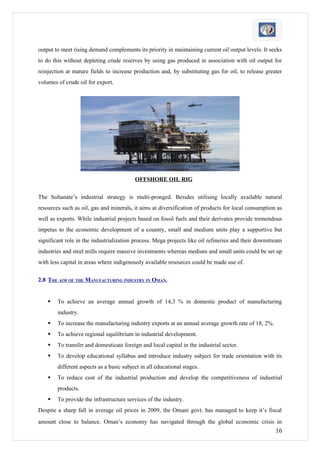
                                          OFFSHORE OIL RIG

The Sultanate’s industrial strategy is multi-pronged. Besides utilising locally available natural
resources such as oil, gas and minerals, it aims at diversification of products for local consumption as
well as exports. While industrial projects based on fossil fuels and their derivates provide tremendous
impetus to the economic development of a country, small and medium units play a supportive but
significant role in the industrialization process. Mega projects like oil refineries and their downstream
industries and steel mills require massive investments whereas medium and small units could be set up
with less capital in areas where indigenously available resources could be made use of.

2.8 THE AIM OF THE MANUFACTURING INDUSTRY IN OMAN.


       To achieve an average annual growth of 14,3 % in domestic product of manufacturing
        industry.
       To increase the manufacturing industry exports at an annual average growth rate of 18, 2%.
       To achieve regional equilibrium in industrial development.
       To transfer and domesticate foreign and local capital in the industrial sector.
       To develop educational syllabus and introduce industry subject for trade orientation with its
        different aspects as a basic subject in all educational stages.
       To reduce cost of the industrial production and develop the competitiveness of industrial
        products.
       To provide the infrastructure services of the industry.
Despite a sharp fall in average oil prices in 2009, the Omani govt. has managed to keep it’s fiscal
amount close to balance. Oman’s economy has navigated through the global economic crisis in
                                                                                                      16
relatively good shape. Although country’s real non oil growth fell sharply in 2009, it remained in
positive territory. Oman’s financial sector was less affected by the global economic crisis and the
countries modest level of indebtedness has limited it’s external vulnerability.


2.9 THE SCOPE OF OIL AND GAS INDUSTRY IN OMAN – AN OVERVIEW

The continued growth in demand and an industry struggling to meet this voracious demand have
pushed oil prices to an all-time high. Big oil companies, even while investing heavily in exploration,
technology, operational improvement, and research and development, are still left with huge surpluses
in an industry so far known only as a modest return. In reality, there has never been a more
challenging time for the oil and gas industry. While oil companies face tough challenges in finding
new sources of oil and gas to replace the old ones, the emerging oil demand and supply equation
renders some of the world's most powerful nations increasingly dependent on some of the world's most
unstable regions.

As a result, companies are applying advanced technologies and improved processes to meet growing
demand, as well as working to keep abreast of the constantly shifting geopolitical landscape so critical
to success in this sector. This course provides a high-level view of the industry environment, including
its scope and structure, and navigates learners through relevant business and regulatory issues. Also
examined are the forces shaping this industry, its key players, business drivers and challenges, and the
strategic solutions for these challenges? A report on the state of affairs in the oil and gas industry and
analysis based insights are also presented. The overall purpose of this course is not to make learners
industry experts, but to help them get a feel of the industry and learn some of the winning strategies
the key players are successfully applying.


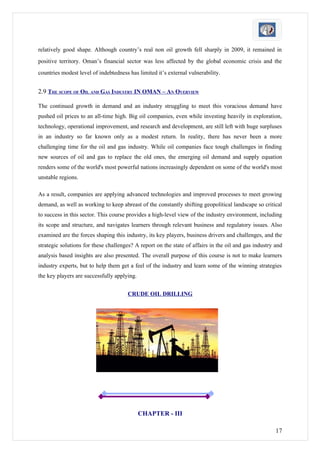
                                      CRUDE OIL DRILLING


                                             CHAPTER - III

                                                                                                       17
1-Introduction
                                          2-Industry Profile
                                          3-Subsidiary and Joint Venture
                                          4-Mission and Vision
                                          5-Objectives and Goals
                                          6-Product and Project Profiles
                                          7-Financial Highlights
                                          8-Literature Review


3.1 INTRODUCTION TO ARABIAN INDUSTRIES LLC

Arabian Industries LLC is a leading engineering company catering to the needs of the energy sector
for the MENA region. It has facilities and expertise to meet the varied client needs of the Oil/Gas and

                                                                                                    18
other energy sectors in the production, Processing and delivery phases. Started in 1991 in The
Sultanate of Oman, they have grown steadily and won many accolades and appreciations. The most
prestigious achievement is the Year 2008 “His Majesty Cup award for best five factories”. Their
commitment to the job, quality of work, earnestness to provide Total Solutions and desire to surpass
client expectations has consistently earned repeat business from their esteemed clients. These qualities
enable them to compete in international markets and succeed.


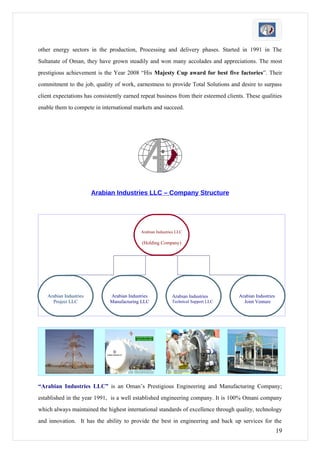
                         Arabian Industries LLC – Company Structure


                                            Arabian Industries LLC

                                            (Holding Company)


    Arabian Industries        Arabian Industries            Arabian Industries       Arabian Industries
      Project LLC             Manufacturing LLC             Technical Support LLC      Joint Venture


“Arabian Industries LLC” is an Oman’s Prestigious Engineering and Manufacturing Company;
established in the year 1991, is a well established engineering company. It is 100% Omani company
which always maintained the highest international standards of excellence through quality, technology
and innovation. It has the ability to provide the best in engineering and back up services for the
                                                                                                          19
petroleum and allied industries. The company has ISO 9001-2000 certification and has executed
projects in various Middle East countries. It captured the various facets of the Oman economy in
sectors ranging from maintenance, manufacturing, fabrication and infrastructure, etc.


“Arabian Industries LLC and its subsidiaries are committed to become one of the leading companies
providing complete solutions to the energy sector by enhancing customer satisfaction, strengthening
employee & supplier relations and continually improving its product & services through the Quality
Continuous Improvement, Enhancing Employees Safety, Providing proper resources & suitable
working environment, achieving national development and improving profitability and budget”.


3.2 PROFILES OF ARABIAN INDUSTRIES LLC.

Arabian Industries LLC is a leading engineering company catering to the needs of the energy sector
for the MENA region with active participation in Oman’s Hydrocarbon, Petrochemical and Energy
Sector industries. .. Started in 1991 in The Sultanate of Oman, they have grown steadily and won
many accolades and appreciations. Arabian Industries LLC clientele include all major operating
companies in Oman including Petroleum Development Oman /Shell, Oman Gas Company, Occidental
of Oman, Occidental Mukhaizna, Oman Refinery and other Omani Oil, Gas, Water and Process Sector
clients.


The Company posted a growth of approximately 200% during the period from 1991 to 2009 and is
currently rated one of the leading EPC Contractors in the Region. Their commitment to the job, quality
of work, earnestness to provide Total Solutions and desire to surpass client expectations has
consistently earned repeat business from their esteemed clients. These qualities enable them to
compete in international markets and succeed.


           Arabian Industries LLC, is currently executing a number of major contracts in Oman for
activities, which include Greenfield and Brownfield EPC & CME&I Construction Contracts for
Facilities, Pipelines and Process Plant, Long Term Maintenance Contracts for Oil & Gas facilities,
Pipeline Integrity Management Services including rehabilitation and routine / planned maintenance of
cross country pipelines and Environmental Services.
Arabian Industries LLC, owns one of the biggest fleet of plant and equipment amongst the oil and gas
sector contractors in Oman and directly employs approximately 2500 multi-disciplined experienced
staff personnel. Apart from the Head Office located at Al Khuwair House, various site, Arabian
Industries LLC, currently have a Project Coordination office, Staff Camp, Fabrication Shop, Vehicle

                                                                                                   20
Maintenance Workshop and other related facilities in Rusayl, Sultanate of Oman. These are in addition
to on-site offices, accommodation, workshops and warehouses throughout its operating areas in the
Country.


Arabian Industries LLC, is one of the first companies in the Sultanate of Oman to have ISO 9002
Quality System Certification of Compliance for its entire scope of activities. This System was updated
to ISO 9001 in the year of 2000. The The Company’s Health, Safety, Environmental & Waste
Management standards are one of the most effective amongst the Omani contracting community with
a number of major milestone achievements to its credit.


3.3 SUBSIDIARY COMPANIES & JOINT VENTURES


   SUBSIDIARY COMPANIES


1. ◙ARABIAN INDUSTRIES MANUFACTURING LLC


Arabian Industries Manufacturing Co. LLC (AIM) (a subsidiary of Arabian Industries LLC), is the
manufacturing division providing complete solutions for engineering, procurement and fabrication of
equipments to cater to clients in the Oil & Gas, Petrochemicals, Power , Fertilizer, Chemicals, and
Refinery industries..
2. ◙ ARABIAN INDUSTRIES PROJECTS LLC

Arabian Industries Projects LLC (AIP), a subsidiary of Arabian Industries LLC, is the Projects
Division providing Engineering, Procurement, Construction and commissioning services, to cater to
clients in the Oil & Gas, Petrochemicals, Power, Fertilizer, Chemicals and Refinery Industries.
                                                                                                   21
3. ◙ ARABIAN INDUSTRIES TECHNICAL SUPPORT LLC


Arabian Industries Technical Support LLC (AITS), a subsidiary of Arabian Industries LLC, is a
provider of total maintenance solutions under one roof to cater to clients in the Oil & Gas,
Petrochemicals, Power, Fertilizer, Chemicals and Refinery Industries.


   JOINT VENTURES


Arabian Industries LLC has entered into a JV with two foreign companies. They are listed below.


1. WORLEY PARSONS –ARABIAN INDUSTRIES J.V. (WPAI J.V.)


The WPAI - J.V. was formed between Arabian Industries LLC. and Worley Parsons (Oman) during
the middle of 2005 as a framework to cater to the Engineering, Maintenance and Construction contract
for Petroleum Development of South Oman, awarded by PDO. This is a five year contract which can
be extended to 7 years.


2. NORM PROJECT J.V.


This is another J.V. formed between Arabian Industries LLC. and an International institution
(specializing in the treatment of radioactive contamination). NORM stands for “Naturally
Occurring Radioactive Materials” which are found in the PDO sites during production of Oil from
oil-wells.. This entails suitable investments in setting up decontaminating facilities and developing the
required infrastructure in PDO sites for the said purpose.
    •   CREDENTIALS OF ARABIAN INDUSTRIES LLC.


    •   ASME ‘U’, 'U2' ‘S’ & ‘R’ Stamps: For the manufacture and repair of Pressure Vessels at their
        state-of-art facilities at Rusayl & Sohar work centre.


                                                                                                      22
•      Society is their cradle so they need to preserve and enrich it; Customers are their Patrons so
           they need to honor their commitments with them;
    •      The employees are their biggest assets, so they need to nourish and help them grow.


3.4 CORPORATE PHILOSOPHY


A corporate philosophy is — Creating Jobs, Adding Value to the Individual, and Contributing to
Society inspires Temp Holdings to become a company that helps people fulfill their dreams and find
happiness through work. Based on this philosophy, Arabian Industries LLC, will enter the future as a
trusted and reliable company throughout Oman and the rest of the world. We will also pursue business
activities that emphasize corporate social responsibility (CSR) in order to contribute to a better
society.


1   Creating Jobs
Arabian Industries LLC, creates various types of employment by examining working arrangements,
working environment, job content, and conditions of employment


2   Contributing to society
Arabian Industries LLC, contributes to society’s betterment by creating jobs and developing effective
human resources


3   Adding Value to the individual
Arabian Industries LLC, supports people who want to improve themselves through their work,
regardless of age, sex, or nationality.


3.4.1      CORPORATE MISSION AND VISION


        Overview

                                                                                                      23
Arabian industry is a leading EPC Contracting Company, specialized in design, engineering,
    project construction, fabrication, and testing activities in Oil and Gas, Refineries,
    Petrochemicals and Power sectors.


1 Mission


To achieve market leadership through excellence in the quality of product and services by adopting
state of the art technologies and innovative management approaches aim towards customer
satisfaction.


2 Vision


Arabian Industries LLC is committed to providing their clients with the best possible service and
results at a competitive price, without compromising on quality, health, safety, environment,


                                                                                               24
business ethics or welfare of their staff. “As a recommended supplier, and a preferred employer, AI
LLC is meeting the objectives and needs of their clients & employees.”


3 Policy


Arabian Industries LLC and its subsidiaries are committed to become one of the leading company
providing complete solutions to the energy sector by enhancing customer satisfaction, strengthening
employee & supplier relations and continually improving its product & services.


4 Strength


Integrity in diversity. Though their business expands to diverse sectors they still abide by their
vision & policy and maintain integration of their Quality management system and consistency of
operations through empowerment, motivated & dedicated peers and strong leadership
                                                                                                25
5 Approach


 AILLC is a customer-focused organization nurturing the culture of internal-customers & external-
 customers through out the organization. They achieve this through team-building, supply chain
 management and continual training & development of their employees.


 6-Credentials


 AI LLC’s quality management system established since 1996 has been certified to ISO 9001 – 2000.
 Their pressure equipments manufacturing facilities are accredited by ASME for U, U2, S and R


                                                                                              26
stamps. Oil & Gas field equipments manufacturing facilities are certified by API for conformance to
 6A, 6D and 16A requirements.


3.5 CORPORATE OBJECTIVE


   1   A To be of service to the nation and to contribute effectively to its economic well being and
       growth through the production, supply and marketing of infrastructure facilities to Petroleum
       Production and it’s allied industries in Sultanate of Oman.
   2   To sustain and improve its pioneering role in the development of engineering and technology
       in manufacturing industry through continuous research and development.
   3   To improve productivity and maintain high standards of quality and adopt effective measures
       for controlling cost in all aspects.

   4. To ensure for its customers the availability of its products and services on reasonable terms,
       for its shareholders a fair return on capital invested and, for itself, development of adequate
       internal resources for continual growth and expansion.


                                                                                                       27
CORPORATE OBJECTIVE


3.5.1    CORPORATE GOALS


1    To achieve a net profit of OMR: One Million per year with a turnover of OMR: 100 Million by the
     year of 2010
2. To focus on cost reduction and technology up gradation in order to become competitive in each
     line of business.
3. To constantly innovate and develop new technology and services to satisfy customer requirements.
4. To invest in new business lines, where profit can be made on sustainable basis over the long te rm.
5. To compete through speed, agility and flexibility in recognizing and capturing opportunities in
     existing markets.
6.


                                          CORPORATE GOALS


3.5.2    QUALITY PERFECTIVE


A dedicated team of Quality Assurance and Quality Control Engineers (lead by the Company’s
QA/QC Manager and Quality Systems Engineer) supports the implementation and monitoring of
Quality Management of the Company. All departments in the Company are certified to ISO 9001 and
regular internal and external audits are conducted to check the compliance and renewal of certificate.

                                                                                                     28
ISO 9001:2000 requires that an organization’s quality policy provide a framework for reviewing the
company’s quality objectives. The policy should give an overall direction for the organization, and its
objectives should flow in that direction. But because of outside forces such as customer requirements
and market environments, business conditions can change. If this happens, the alignment between
quality policy and objectives can become off-centered. So, the standard requires that management
periodically review changes to both the policy and objectives. An organization’s objectives must be
measurable and its quality management system processes designed to meet those objectives.


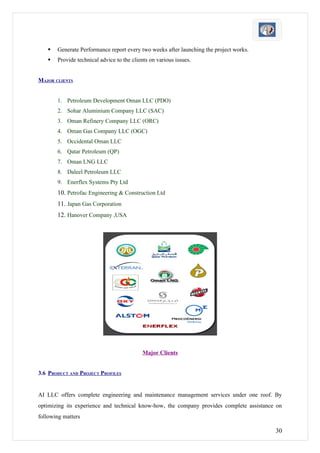
3.5.3   MAJOR CLIENTS OF ARABIAN INDUSTRIES LLC


Since the company began operations in 1991, it has successfully executed numerous projects for
clients within the Gulf region. It includes some of the most reputed industrial entities like:-


In achieving the objectives of Centre, they promise to:


       Attending clients promptly and courteously
       Respond to complaints/suggestions from the clients within a reasonable time
       Continuously evaluate the effectiveness of company’s programmes
       Provide timely support to staff and workers of the firm.

                                                                                                    29
   Generate Performance report every two weeks after launching the project works.
      Provide technical advice to the clients on various issues.


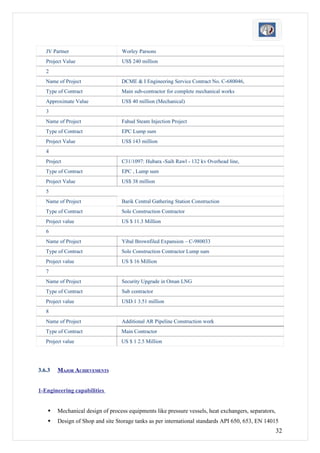
MAJOR CLIENTS


       1. Petroleum Development Oman LLC (PDO)
       2. Sohar Aluminium Company LLC (SAC)
       3. Oman Refinery Company LLC (ORC)
       4. Oman Gas Company LLC (OGC)
       5. Occidental Oman LLC
       6. Qatar Petroleum (QP)
       7. Oman LNG LLC
       8. Daleel Petroleum LLC
       9. Enerflex Systems Pty Ltd
       10. Petrofac Engineering & Construction Ltd
       11. Japan Gas Corporation
       12. Hanover Company ,USA


                                           Major Clients


3.6 PRODUCT AND PROJECT PROFILES


AI LLC offers complete engineering and maintenance management services under one roof. By
optimizing its experience and technical know-how, the company provides complete assistance on
following matters

                                                                                          30
A project is a series of activities aimed at bringing about clearly specified goals within a defined time-
period and with a defined budget.


A project has:     a primary target group and final beneficiaries, clearly defined coordination,
management and financing arrangements, a monitoring and evaluation system financial and economic
analysis, showing that benefits will exceed costs.


3.6.1   MAJOR PROJECTS OFFERED BY ARABIAN INDUSTRIES LLC


        1. Projects and Construction (Including EPC)
        2. Service Contracts
        3. Civil & Building Works
        4. Workshop Fabrication
        5. Tank Fabrication, Construction & EPC Services
        6. High Density Polyethylene Pipe Lining
        7. Maintenance & Process Plant Turnaround Services
        8. Aluminum Component Fabrication & Installation Services


3.6.2   Major Projects & Products details


   1
   Project                          C31/0606: Engineering and Maintenance Contract (EMC

                                                                                                       31
JV Partner                     Worley Parsons
   Project Value                  US$ 240 million
   2
   Name of Project                DCME & I Engineering Service Contract No. C-680046,
   Type of Contract               Main sub-contractor for complete mechanical works
   Approximate Value              US$ 40 million (Mechanical)
   3
   Name of Project                Fahud Steam Injection Project
   Type of Contract               EPC Lump sum
   Project Value                  US$ 143 million
   4
   Project                        C31/1097: Hubara -Saih Rawl - 132 kv Overhead line,
   Type of Contract               EPC , Lump sum
   Project Value                  US$ 38 million
   5
   Name of Project                Barik Central Gathering Station Construction
   Type of Contract               Sole Construction Contractor
   Project value                  US $ 11.3 Million
   6
   Name of Project                Yibal Brownfiled Expansion – C-980033
   Type of Contract               Sole Construction Contractor Lump sum
   Project value                  US $ 16 Million
   7
   Name of Project                Security Upgrade in Oman LNG
   Type of Contract               Sub contractor
   Project value                  USD.1 3.51 million
   8
   Name of Project                Additional AR Pipeline Construction work
   Type of Contract               Main Contractor
   Project value                  US $ 1 2.5 Million


3.6.3   MAJOR ACHIEVEMENTS


1-Engineering capabilities


       Mechanical design of process equipments like pressure vessels, heat exchangers, separators,
       Design of Shop and site Storage tanks as per international standards API 650, 653, EN 14015
                                                                                                      32
   Design of direct and indirect heaters, fuel gas treatment plants
      Packages: PV Elite, Stadd Pro, AUTOCAD and piping software’s
      Regular association with reputed international process owners and licensors in the Oil & Gas,
       Refinery and Petrochemical industry for the design of equipment internals.


2-Welding and joining technology


      Core competency and expertise in welding and joining technology of all construction metals,
       especially in DSS,CRA and special alloy steels
      Qualified for a wide range of welding procedures up to 200 mm thickness
      SMAW /SAW/GTAW/FCAW/MIG facilities
      Strip cladding and special weld metal overlays
      GRP piping fabrication and bonding facilities


3-Testing


      Hydro/pneumatic testing bays and facilities
      RT/MT/UT/PT/PWHT/PMI and other NDT facilities
      PWHT facilities by Internal and external firing methods
      Local stress relieving facilities by electrical methods
      Gas fired PWHT furnaces adjustable to equipment sizes.


4-Major Services Offered


      Maintenance of Static Equipments
      Maintenance of Heat Exchangers including Tube Cleaning, Re-tubing and Plugging
      Maintenance, Overhauling and Monitoring of Compressors, Pumps, and Turbines ..
      Maintenance and Overhauling of Oilfield Equipments;
      Design, fabrication, erection and commissioning of oil and petroleum storage tanks,


                                       MAJOR ACHIEVEMENTS


                                                                                                  33
34
3.7 FINANCIAL HIGHLIGHTS FOR 2009
        [SOURCE: COMPANY REPORT]


    •    FINANCIAL PERFORMANCE REVIEW 2009
        BUSINESS PLAN – 2010


   New project inflows (excluding EMU) at RO 41.58 million for the year 2008 vis-à-vis RO 20.977
    million in the year 2008 – 103.4% growth year on year.


   Backlog of works at RO 40.216 million as at December 2008 (of which RO 37.352 million is
    expected to be executed in 2009) against RO 9.98 million as at December 200 – 347.2% growth
    year on year.


   Projected Gross Sales at RO 42.70 million in 2008 vis-à-vis RO 38.14 million in the previous year
    – 113.44% growth year on year


   Forecasted Net Profit Before Tax at RO 5.33 million in 2008 as against RO 3.58 million in the
    previous year – 59.8% growth over 2008.

                                                                                                  35
BUSINESS UNITS


        1. FABRICATION BUSINESS UNIT


        2. TECHNICAL SUPPORT UNIT


        3. PROJECT DEVELOPMENT UNIT


        4. ENGINEERING MAINTENANCE UNIT
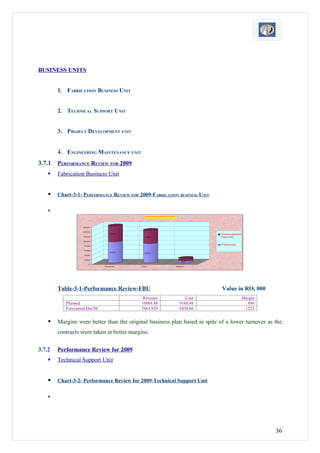
3.7.1   PERFORMANCE REVIEW FOR 2009
       Fabrication Business Unit


       Chart-3-1- PERFORMANCE REVIEW FOR 2009-FABRICATION BUSINESS UNIT


    
                                               P e rfo rm ance R e vie w -M B U


                    1 00 0
                     6


                    1 00 0
                     4
                                  684 1                                                        Forecasted
                    1 00 0
                     2                         574 9                                           Dec'08
                    1 00 0
                     0


                    800 0
                                                                                               Planned

                    600 0
                                  900 4
                                              82 04
                    400 0


                    200 0                                                             1 92
                                                                                       0
                                                                                       80 0
                        0
                               Revenue      Co st                                 M arg in


        Table-3-1-Performance Review-FBU                                                       Value in RO, 000
                                            Revenue                                     Cost                Margin
           Planned                         10084.48                                  9188.48                  896
           Forecasted Dec'08               7661.920                                  6438.88                 1223


       Margins were better than the original business plan based in spite of a lower turnover as the
        contracts were taken at better margins.

3.7.2   Performance Review for 2009
       Technical Support Unit


       Chart-3-2- Performance Review for 2009-Technical Support Unit


    


                                                                                                                     36
P RFORMA NCE RE IE
                                                        E             V W-MBU-ITS


                    1600          1502

                    1400

                    1200                   1098         1066                                                               Planned
                    1000

                     800                                           704
                                                                                                                           Forecasted
                     600
                                                                                                                           Dec'08
                                                                                             435
                                                                                                          394
                     400

                     200

                       0
                                  Revenue               Cos t                               Margin


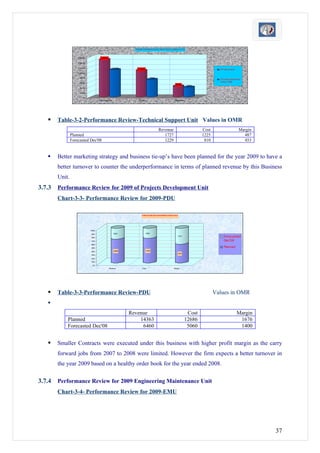
       Table-3-2-Performance Review-Technical Support Unit Values in OMR
                                                                           Revenue                                Cost                Margin
                Planned                                                       1727                                1225                  487
                Forecasted Dec'08                                             1229                                 810                  453


       Better marketing strategy and business tie-up’s have been planned for the year 2009 to have a
        better turnover to counter the underperformance in terms of planned revenue by this Business
        Unit.
3.7.3   Performance Review for 2009 of Projects Development Unit
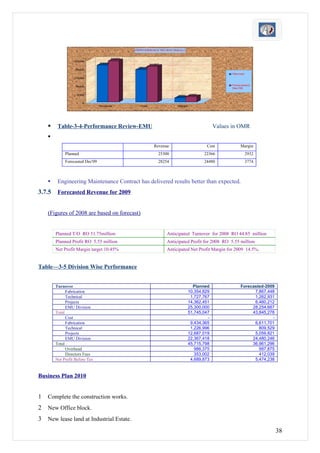
        Chart-3-3- Performance Review for 2009-PDU

                                                          P ER FO R M AN C E R EVIEW-2 008-P B U


                           100%

                           90%               5618               4400

                           80%
                                                                                                   1218                     Forecasted
                           70%                                                                                              Dec'08
                           60%

                           50%                                                                                              Planned
                                             12489             11032
                           40%
                                                                                                   1457
                           30%

                           20%

                           10%

                            0%
                                         Revenue          Cost                              Margin


       Table-3-3-Performance Review-PDU                                                                                 Values in OMR
   
                                                     Revenue                                               Cost                       Margin
            Planned                                      14363                                            12686                        1676
            Forecasted Dec'08                             6460                                             5060                        1400


       Smaller Contracts were executed under this business with higher profit margin as the carry
        forward jobs from 2007 to 2008 were limited. However the firm expects a better turnover in
        the year 2009 based on a healthy order book for the year ended 2008.

3.7.4   Performance Review for 2009 Engineering Maintenance Unit
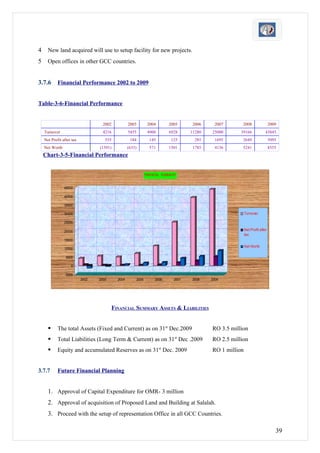
        Chart-3-4- Performance Review for 2009-EMU


                                                                                                                                               37
PERFORMA NCE REVIEW-EMC(jv)


                                         24569
                  25000
                                 22000
                                                          21287
                                                  19449
                  20000
                                                                                                    Planned
                  15000


                                                                                                    Forecasted
                  10000
                                                                                                    Dec'08

                   5000                                                 2550     3282


                       0
                                 Revenue           Cost                 Margin


        Table-3-4-Performance Review-EMU                                                     Values in OMR
    
                                                            Revenue                      Cost           Margin
             Planned                                          25300                     22366                 2932
             Forecasted Dec'09                                28254                     24480                 3774


        Engineering Maintenance Contract has delivered results better than expected.
3.7.5    Forecasted Revenue for 2009


    (Figures of 2008 are based on forecast)


        Planned T/O RO 51.75million                               Anticipated Turnover for 2008 RO 44.85 million
        Planned Profit RO 5.55 million                            Anticipated Profit for 2008 RO 5.55 million
        Net Profit Margin target 10.45%                           Anticipated Net Profit Margin for 2009 14.5%.


Table—3-5 Division Wise Performance


        Turnover                                                                   Planned              Forecasted-2009
              Fabrication                                                        10,354,829                   7,867,448
              Technical                                                           1,727,767                   1,262,931
              Projects                                                           14,362,451                   6,460,212
              EMU Division                                                       25,300,000                  28,254,687
        Total                                                                    51,745,047                  43,845,278
              Cost                                                                        -                           -
              Fabrication                                                         9,434,365                   6,611,701
              Technical                                                           1,226,996                     809,529
              Projects                                                           12,687,019                   5,059,821
              EMU Division                                                       22,367,418                  24,480,246
        Total                                                                    45,715,798                  36,961,296
              Overhead                                                              986,375                     997,875
              Directors Fees                                                        353,002                     412,039
        Net Profit Before Tax                                                     4,689,873                   5,474,238


Business Plan 2010


1   Complete the construction works.
2   New Office block.
3   New lease land at Industrial Estate.

                                                                                                                          38
4     New land acquired will use to setup facility for new projects.
5     Open offices in other GCC countries.


3.7.6       Financial Performance 2002 to 2009


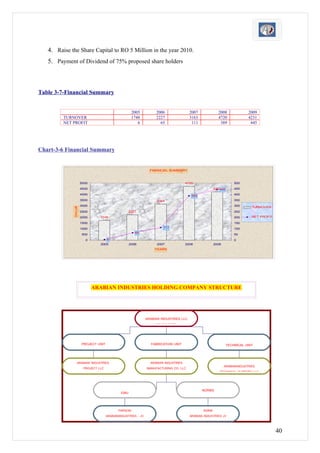
Table-3-6-Financial Performance


                                    2002            2003            2004        2005      2006     2007      2008                  2009
    Turnover                        4216            5455            4900        6928     11280   25000      39166              43845
    Net Profit after tax             555             184             145         125       285     1695      2649                  5095
    Net Worth                     (1591)            (633)            571        1501      1785     4136      5241                  8555
    Chart-3-5-Financial Performance


                                                                   FINANCIAL SUMMARY


                45000

                40000

                35000

                30000                                                                                           Turnover

                25000

                20000                                                                                           Net Profit after
                                                                                                                tax
                15000
                                                                                                                Net Worth
                10000

                 5000

                    0

                -5000
                           2002   2003       2004           2005        2006      2007   2008    2009


                                           FINANCIAL SUMMARY ASSETS & LIABILITIES


           The total Assets (Fixed and Current) as on 31st Dec.2009                             RO 3.5 million
           Total Liabilities (Long Term & Current) as on 31st Dec .2009                         RO 2.5 million
           Equity and accumulated Reserves as on 31st Dec. 2009                                 RO 1 million


3.7.7       Future Financial Planning


      1. Approval of Capital Expenditure for OMR- 3 million
      2. Approval of acquisition of Proposed Land and Building at Salalah.
      3. Proceed with the setup of representation Office in all GCC Countries.

                                                                                                                                      39
4. Raise the Share Capital to RO 5 Million in the year 2010.
   5. Payment of Dividend of 75% proposed share holders


Table 3-7-Financial Summary


                                                    2005           2006                2007            2008              2009
         TURNOVER                                   1748           2227                3163            4720              4231
         NET PROFIT                                    6             65                 111             389               445


Chart-3-6 Financial Summary


                                                                FINANCIAL SUMMARY


                      5000                                                           4720                         500
                      4500                                                                           4231
                                                                                                        445       450
                      4000                                                              389                       400

                      3500                                          3163                                          350
             VALUES


                      3000                                                                                        300      TURNOVER
                      2500                         2227                                                           250
                      2000      1748                                                                              200      NET PROFIT

                      1500                                                                                        150

                      1000                                             111                                        100
                                                      65
                      500                                                                                         50

                        0            6                                                                            0
                                2005               2006             2007             2008            2009
                                                                  YEARS


                             ARABIAN INDUSTRIES HOLDING COMPANY STRUCTURE


                                                              ARABIAN INDUSTRIES LLC
                                                                   HOLDING CO.


                      PROJECT UNIT                               FABRICATION UNIT                             TECHNICAL UNIT


                 ARABIAN INDUSTRIES                             ARABIAN INDUSTRIES
                                                                                                            ARABIANINDUSTRIES
                       PROJECT LLC                            MANUFACTURING CO. LLC
                                                                                                        TECHNICAL SUPPORT LLC


                                                                                              NORMS
                                             EMU


                                            PARSON-                                           NORM
                                     ARABIANINDUSTRIES - JV                            ARABIAN INDUSTRIES JV


                                                                                                                                        40
OBJECTIVES FOR 2010

                •    Executing jobs in hand in line with schedule & budgets

                •    Secure at least 5 projects in the range of 30 Million USD under EMU.

                •    Achieve a net profit of RO 6.5 Million (before tax and after adjustment of Management fees)

                •    Expand client base especially for the Fabrication Shop.

                •    Buildup strong management at various levels to meet the Company long term objectives.

3.7.8                FIVE YEAR PLANNED TURNOVER


Table-3-8-Future Plan


                                                                                                                  Value in RO Million
                BUSINESS UNIT                                   2010               2011            2012          2013           2014
                Engineering Maintenance Contract           20.000               25.000        25.000        25.000            25.000
                Arabian Industries Manufacturing               10.000           13.000        15.000        18.000            20.000
                Arabian Industries Technical Support           2.500              3.000            3.500     4.000             5.000
                Arabian Industries Projects                    30.000             35.000          40.000    45.000            50.000
                Total                                     62.500                  75.000          83.500    92.000           100.000


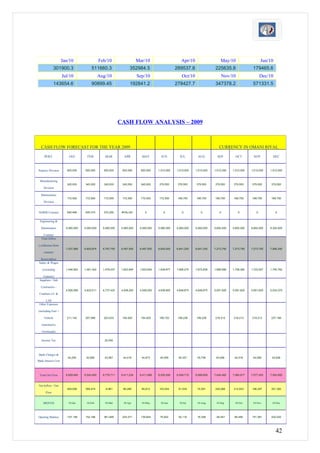
Chart-3-7 - Cash Flow Analysis


                                                               CASH FLOW 2009

                600000


                500000
  CASH INFLOW


                400000


                300000                                                                                                       Series2


                200000


                100000


                        0
                            JAN   FEB     MAR      APR   MAY      JUN       JUL       AUG   SEP      OCT   NOV      DEC
                                                                       MONTHS


Table – 3-9 Cash Flow Analysis

                                                                                                                                   41
Jan/10                    Feb/10                     Mar/10                      Apr/10                    May/10                     Jun/10
             301900.3                   511660.3                    352984.5                       289537.8                 225635.8                 179465.6
                     Jul/10                    Aug/10                     Sep/10                       Oct/10                      Nov/10                  Dec/10
             143654.6                   90899.45                    192841.2                       278427.7                 347378.2                 571331.5


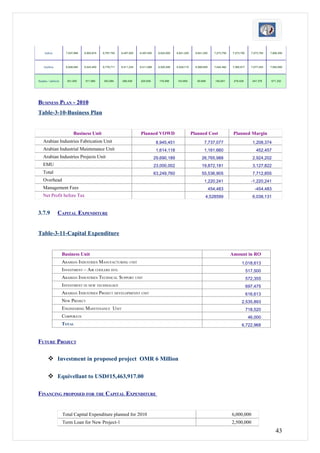
                                                             CASH FLOW ANALYSIS – 2009


  CASH FLOW FORECAST FOR THE YEAR 2009                                                                                         CURRENCY IN OMANI RIYAL

     PERT.               JAN         FEB          MAR           APR         MAY          JUN         JUL         AUG          SEP         OCT        NOV          DEC


Projects Division      920,000     920,000       920,000      920,000       920,000    1,012,000   1,012,000    1,012,000   1,012,000   1,012,000   1,012,000   1,012,000


 Manufacturing
                       345,000     345,000       345,000      345,000       345,000    379,500      379,500     379,500     379,500     379,500     379,500     379,500
    Division

  Maintenance
                       172,500     172,500       172,500      172,500       172,500    172,500      189,750     189,750     189,750     189,750     189,750     189,750
    Division


NORM Contract          540,499     405,374       270,250      #VALUE!         0           0            0           0           0            0          0            0


 Engineering &

  Maintenance          5,060,000   5,060,000     5,060,000    5,060,000    5,060,000   5,060,000   5,060,000    5,060,000   5,692,500   5,692,500   5,692,500   6,325,000

   Contract
  Total Inflow

( collection from
                       7,037,999   6,902,874     6,767,750    6,497,500    6,497,500   6,624,000   6,641,250    6,641,250   7,273,750   7,273,750   7,273,750   7,906,250
     contract

  Receivables)
 Salary & Wages

   (excluding          1,446,953   1,461,422     1,476,037    1,623,640    1,623,640   1,639,877   1,656,275    1,672,838   1,689,566   1,706,462   1,723,527   1,740,762

   Gratuity)
 Suppliers / Sub

  Contractors -
                       4,926,599   4,832,011     4,737,425    4,548,250    4,548,250   4,636,800   4,648,875    4,648,875   5,091,625   5,091,625   5,091,625   5,534,375
 Creditors LC &

      LTR
 Other Expenses

(including Fuel +

     Vehicle           211,140     207,086       203,033      194,925       194,925    198,720      199,238     199,238     218,213     218,213     218,213     237,188

   ministrative

   Overheads)

   Income Tax                                     25,000


Bank Charges &
                        44,249      42,880        43,967       44,419       44,873      45,059      45,327       45,708      45,058      44,518      44,089      42,626
Bank Interest Cost


 Total Out Flow        6,628,940   6,543,400     6,776,711    6,411,234    6,411,688   6,520,456   6,549,715    6,566,659   7,044,462   7,060,817   7,077,453   7,554,950


Net Inflow / Out
                       409,058     359,474        -8,961       86,266       85,812     103,544      91,535       74,591     229,288     212,933     196,297     351,300
      Flow


    MONTH               10-Jan      10-Feb        10-Mar       10-Apr       10-May      10-Jun       10-Jul      10-Aug      10-Sep      10-Oct      10-Nov      10-Dec


Opening Balance        -107,158    152,186       361,946      203,271       139,824     75,922      52,119       16,308      -36,447     65,495     151,081     220,032


                                                                                                                                                                    42
Inflow             7,037,999   6,902,874   6,767,750   6,497,500   6,497,500     6,624,000   6,641,250     6,641,250     7,273,750   7,273,750     7,273,750   7,906,250


     Outflow            6,628,940   6,543,400   6,776,711   6,411,234   6,411,688     6,520,456   6,549,715     6,566,659     7,044,462   7,060,817     7,077,453   7,554,950


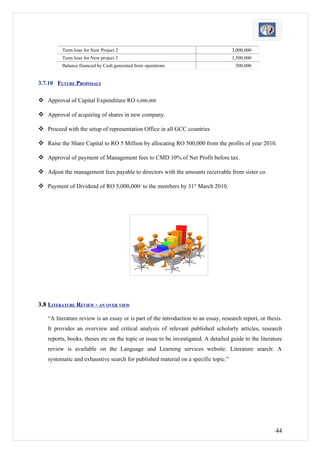
Surplus / (deficit)     301,900     511,660     352,984     289,538     225,636       179,466     143,655        90,899        192,841     278,428       347,378    571,332


BUSINESS PLAN - 2010
Table-3-10-Business Plan


                             Business Unit                              Planned VOWD                          Planned Cost                 Planned Margin
    Arabian Industries Fabrication Unit                                              8,945,451                        7,737,077                          1,208,374
    Arabian Industrial Maintenance Unit                                              1,614,118                        1,161,660                            452,457
    Arabian Industries Projects Unit                                                29,690,189                      26,765,988                           2,924,202
    EMU                                                                             23,000,002                      19,872,181                           3,127,822
    Total                                                                           63,249,760                      55,536,905                           7,712,855
    Overhead                                                                                                          1,220,241                         -1,220,241
    Management Fees                                                                                                         454,483                       -454,483
    Net Profit before Tax                                                                                              4,528599                          6,038,131


3.7.9            CAPITAL EXPENDITURE


Table-3-11-Capital Expenditure


                      Business Unit                                                                                                       Amount in RO
                      ARABIAN INDUSTRIES MANUFACTURING UNIT                                                                                     1,018,613
                      INVESTMENT – AIR COOLERS INTL                                                                                                   517,500
                      ARABIAN INDUSTRIES TECHNICAL SUPPORT UNIT                                                                                       572,355
                      INVESTMENT IN NEW TECHNOLOGY                                                                                                    697,475
                      ARABIAN INDUSTRIES PROJECT DEVELOPMENNT UNIT                                                                                    616,613
                      NEW PROJECT                                                                                                               2,535,893
                      ENGINEERING MAINTENANCE UNIT                                                                                                    718,520
                      CORPORATE                                                                                                                        46,000
                      TOTAL                                                                                                                     6,722,968


FUTURE PROJECT

         Investment in proposed project OMR 6 Million

         Equivellant to USD#15,463,917.00

FINANCING PROPOSED FOR THE CAPITAL EXPENDITURE


                      Total Capital Expenditure planned for 2010                                                                          6,000,000
                      Term Loan for New Project-1                                                                                         2,500,000
                                                                                                                                                                        43
Term loan for New Project 2                                                3,000,000
         Term loan for New project 3                                                1,500,000
         Balance financed by Cash generated from operations                           500,000


3.7.10 FUTURE PROPOSALS

 Approval of Capital Expenditure RO 6,000,000

 Approval of acquiring of shares in new company.

 Proceed with the setup of representation Office in all GCC countries

 Raise the Share Capital to RO 5 Million by allocating RO 500,000 from the profits of year 2010.

 Approval of payment of Management fees to CMD 10% of Net Profit before tax.

 Adjust the management fees payable to directors with the amounts receivable from sister co.

 Payment of Dividend of RO 5,000,000/ to the members by 31st March 2010.


3.8 LITERATURE REVIEW - AN OVER VIEW

   “A literature review is an essay or is part of the introduction to an essay, research report, or thesis.
   It provides an overview and critical analysis of relevant published scholarly articles, research
   reports, books, theses etc on the topic or issue to be investigated. A detailed guide to the literature
   review is available on the Language and Learning services website. Literature search: A
   systematic and exhaustive search for published material on a specific topic.”


                                                                                                        44
   It discusses published information in a particular subject area, and sometimes information in a
    particular subject area within a certain time period. It is a summary of research that has been
    published about a particular subject. It provides the reader with an idea about the current situation
    in terms of what has been done, and what we know. Sometimes it includes suggestions about what
    needs to be done to increase the knowledge and understanding of a particular problem.


   It gives an overview of what has been said, who the key writers are, what are the prevailing
    theories and hypotheses, what questions are being asked, and what methods and methodologies are
    appropriate and useful. As such, it is not in itself primary research, but rather it reports on other
    findings. Literature reviews can give you an overview or act as a stepping stone. It also provide a
    solid background for a research paper's investigation.


A LITERATURE REVIEW MUST DO THESE THINGS:


   be organized around and related directly to the thesis or research question you are developing
   synthesize results into a summary of what is and is not known
   identify areas of controversy in the literature
   formulate questions that need further research


Structuring a literature review


   It is often difficult to decide how to organize the huge amount of information you have collected.
   The structure of each dissertation will be different but there are some general principles and these
    are really the guidelines you should use for any piece of academic writing.


Structuring a literature review


       Introduction to the literature review
       Main part
       Conclusions

                                                                                                      45
   A literature review is a piece of discursive prose, not a list describing or summarizing one piece of
    literature after another.

   It's usually a bad sign to see every paragraph beginning with the name of a researcher. Instead,
    organize the literature review into sections that present themes or identify trends, including
    relevant theory.
3.9 ABSTRACT OF LITERATURE      REVIEW


The current study contributes to the literature by examining impact of working capital management on
the operating performance and growth of new public companies. The study also sheds light on the
relationship of working capital with debt level, firm risk, and industry. Using a sample of a
manufacturing, the study finds a significant positive association between higher levels of accounts
receivable and operating performance. The study further finds that maintaining control (i.e. lower
amounts) over levels of cash and securities, inventory, fixed assets, and accounts payables appears to
be associated with higher operating performance, as well. We find that the firms which are
experiencing unusually high growth tend not to perform as well as those with low to moderate growth.
Further firms which are experiencing high growth tend to hold higher levels of cash and securities,
inventory, fixed assets, and accounts payables. These findings tend to suggest that firms are willing to
sacrifice performance (accept low or negative operating returns) to increase their growth levels. The
higher level of growth is also associated with higher operating and financial risk. The findings of this
study suggest that perhaps the firms should stay more focused on their operating performance than on
maintaining high growth levels.

3.10INTRODUCTION AND LITERATURE REVIEW

Working capital policy refers to the firm's policies regarding 1) target levels for each category of
current operating assets and liabilities, and 2) how current assets will be financed. Generally good
working capital policy (i.e. under conditions of certainty) is considered to be one in which holdings of
cash, securities, inventories, fixed assets, and accounts payables are minimized.


        The level of accounts receivables should be used as a means of stimulating sales and other
income. Previous literature on working capital management has found a negative association, overall,
between level of working capital and operating performance as measured by operating returns and
operating margins (Peterson and Rajan, 1997). Under conditions of certainty (i.e. sales, costs, lead
times, payment periods, and so on, are known), firms have little reason to hold more working capital
than a minimum level.


                                                                                                      46
3.11AN ANALYSIS OF WORKING CAPITAL MANAGEMENT RESULTS ACROSS INDUSTRIES :-

INTRODUCTION


The importance of efficient working capital management (WCM) is indisputable. Working capital is
the difference between resources in cash or readily convertible into cash (Current Assets) and
organizational commitments for which cash will soon be required (Current Liabilities). The objective
of working capital management is to maintain the optimum balance of each of the working capital
components.
Business viability relies on the ability to effectively manage receivables, inventory, and payables.
Firms are able to reduce financing costs and/or increase the funds available for expansion by
minimizing the amount of funds tied up in current assets. Much managerial effort is expended in
bringing non-optimal levels of current assets and liabilities back toward optimal levels. An optimal
level would be one in which a balance is achieved between risk and efficiency.


        A recent example of business attempting to maximize working capital management is the
recurrent attention being given to the application of Six Sigma® methodology. When used to identify
and rectify discrepancies, inefficiencies and erroneous transactions in the financial supply chain, Six
Sigma® reduces Days Sales Outstanding (DSO), accelerates the payment cycle, improves customer
satisfaction and reduces the necessary amount and cost of working capital needs. There appear to be
many success stories, including Jennifer Towne’s (2002) report of a 15 percent decrease in days that
sales are outstanding, resulting in an increased cash flow of approximately 2 million dollars at
Thibodaux Regional Medical Center. Furthermore, bad debts declined from 3.4 million dollar to o
600,000 dollar.


Even in a business using Six Sigma® methodology, an “optimal” level of working capital
management needs to be identified. Industry factors may impact firm credit policy, inventory
management, and bill-paying activities. Some firms may be better suited to minimize receivables and
inventory, while others maximize payables. Another aspect of “optimal” is the extent to which poor
financial results can be tied to sub-optimal performance. Fortunately, these issues are testable with
data published by CFO magazine (Mintz and Lazere 1997; Corman 1998; Mintz 1999; Myers 2000;


                                                                                                    47
Fink 2001), which claims to be the source of “tools and information for the financial executive,” and
are the subject of this research.


The following section presents a brief literature review. Next, the research method is described,
including some information about the annual Working Capital Management Survey published by CFO
magazine. Findings are then presented and conclusions are drawn.
   Many researchers have studied working capital from different views and in different
    environments. The following are some useful research:
3.12RELATED LITERATURE


The importance of working capital management is not new to the finance literature. Over twenty years
ago, Largay and Stickney (1980) reported that the then-recent bankruptcy of W.T. Grant, a nationwide
chain of department stores, should have been anticipated because the corporation had been running a
deficit cash flow from operations for eight of the last ten years of its corporate life. As part of a study
of the Fortune 500’s financial management practices. Following are the important views of scholars
about working capital management.


1   GILBERT AND REICHERT (1995) :


Find that accounts receivable management models are used in 59 percent of these firms to improve
working capital projects, while inventory management models were used in 60 percent of the
companies. More recently, Farragher, Kleiman and Sahu (1999) find that 55 percent of firms in the
S&P Industrial index complete some form of a cash flow assessment, but did not present insights
regarding accounts receivable and inventory management, or the variations of any current asset
accounts or liability accounts across industries. Thus, mixed evidence exists concerning the use of
working capital management techniques. Theoretical determination of optimal trade credit limits are
the subject of many articles over the years (e.g., Schwartz 1974; Scherr 1996), with scant attention
paid to actual accounts receivable management. Across a limited sample,


2   WEINRAUB AND VISSCHER (1998) :


Observe a tendency of firms with low levels of current ratios to also have low levels of current
liabilities. Simultaneously investigating accounts receivable and payable issues, Hill, Sartoris, and
Ferguson (1984) find differences in the way payment dates are defined. Payees define the date of

                                                                                                        48
payment as the date payment is received, while payers view payment as the postmark date. Additional
WCM insight across firms, industries, and time can add to this body of research. Maness and Zietlow
(2002, 51, 496) presents two models of value creation that incorporate effective short-term financial
management activities. However, these models are generic models and do not consider unique firm or
industry influences. Maness and Zietlow discuss industry influences in a short paragraph that includes
the observation that, “An industry a company is located in may have more influence on that
company’s fortunes than overall GNP” (2002, 507).
3   ELJELLY, 2004 :

Elucidated that efficient liquidity management involves planning and controlling current assets and
current liabilities in such a manner that eliminates the risk of inability to meet due short-term
obligations and avoids excessive investment in these assets. The relation between profitability and
liquidity was examined, as measured by current ratio and cash gap (cash conversion cycle) on a
sample of joint stock companies in Saudi Arabia using correlation and regression analysis.

The study found that the cash conversion cycle was of more importance as a measure of liquidity than
the current ratio that affects profitability. The size variable was found to have significant effect on
profitability at the industry level. The results were stable and had important implications for liquidity
management in various Saudi companies. First, it was clear that there was a negative relationship
between profitability and liquidity indicators such as current ratio and cash gap in the Saudi sample
examined. Second, the study also revealed that there was great variation among industries with respect
to the significant measure of liquidity.

4   BERGAMI ROBERT (2007) :

Analysis that that international trade transactions carry inherently more risk than domestic trade
transactions, because of differences in culture, business processes, laws and regulations. It is therefore
important for traders to ensure that payment is received for goods dispatched and that the goods
received and paid for comply with the contract of sale. One effective way of managing these risks has
been for traders to rely on the letter of credit as a payment method. However for exporters in
particular, the letter of credit has presented difficulties in meeting the compliance requirements
necessary for the payment to be triggered.

The current rules that govern letter of credit transactions(UCP 500) have been under review for the
past three years and an updated set of rules (UCP 600) is expected to be introduced on 1July 2007.
This paper focuses on the changes mooted for 2007and compares these main issues with the existing
rules and other associated guidelines and regulations governing this method of payment. This paper
considers the implication to changes of letter of credit transactions and the sharing of risk. Firstly the

                                                                                                       49
paper provides some background to letters of credit, then comments on existing literature and models,
and subsequently an analysis of the most important changes to the existing rules, before reaching a
conclusion. The conclusion is that the UCP 600 have not paid enough consideration to traders and
service providers and are likely to engender an environment of uncertainty for exporters in particular.


                                              CHAPTER 4


                                     1-INTRODUCTION
                                     2-NEED OF WORKING CAPITAL
                                     3-CONCEPT OF WORKING CAPITAL                                    50
                                     4-CLASSIFICATION OF WORKING CAPITAL
                                     5-DETERMINANTS OF WORKING CAPITAL
4.1 INTRODUCTION- WORKING CAPITAL MANAGEMENT


“Working capital occupies a peculiar position in the capital structure of a company. The decision as
to the adequacy of working capital is a complicated and yet a very important decision”.


Working capital is the life-blood of all types of enterprises, manufacturing and trading both. It is
constantly required to buy raw materials for payment of wages and other day-to-day expenses.
Without adequate working capital, manufacturing operations will be crippled. For trading enterprises,
the capacity to stock a variety of goods for sale depends upon its working capital. It is a base on which
all the activities of business enterprise depend.


Many companies still under estimate the importance of working capital management as a lever for
freeing up cash from inventory, accounts receivable, and accounts payable. By effectively managing
these components, companies can sharply reduce their dependence on outside funding and can use the
released cash for further investments or acquisitions. This will not only lead to more financial
flexibility, but also create value and have a strong impact on a company’s enterprise value by reducing
capital employed and thus increasing asset productivity.


High working capital ratios often mean that too much money is tied up in receivables and inventories.
Typically, the knee-jerk reaction to this problem is to apply the “big squeeze” by aggressively
collecting receivables, ruthlessly delaying payments to suppliers and cutting inventories across the
board. But that only attacks the symptoms of working capital issues, not the root causes. A more
effective approach is to fundamentally rethink and streamline key processes across the value chain.
This will not only free up cash but lead to significant cost reductions at the same time.


Only those enterprises which have adequate working capital can survive in times of depression. The
investment in raw materials becomes long- term investments during depression and cash flow declines
due to fall in sale. In such circumstances only enterprises with adequate working capital can survive.


                                                                                                      51
Excessive working capital is equally unprofitable. The extra working capital is not utilized in business
operations and earns no profit for the firm. It results in unnecessary accumulation of inventories,
leading to inventory mishandling, waste, theft etc. The abundance of working capital would lead to
waste and inefficiency
Shortage of working capital funds renders the firm unable to avail attractive credit opportunities etc.
The firm loses its reputation when it is not in a position to honor its short term obligations. As a result,
the firm faces tight credit terms. It stagnates growth.
Definition:-


1. According to Guttmann & Dougall:-


“Working capital is defined as current assets minus current liabilities”.
     A positive position means that a company is able to support its day-to-day operations. i.e. to serve
     both maturing short-term debt and upcoming operational expenses.


2.     According to Park & Gladson:-


     “The excess of current assets of a business (i.e. cash, accounts receivables, inventories) over current
     items owned to employees and others (such as salaries & wages payable, accounts payable, taxes
     owned to government)”


“Working capital like many other accounting terms and financial terms has been used by different
people in different senses.”


One school of thought believes that, as all capital resources available to a business organization –
From shareholders, bondholders, and creditors (secured and unsecured) works up in the business
activities to generate revenues and facilitate future expansion and growth; they are to be considered as
‘working capital’.
           Another school of thought links working capital with current assets and current liabilities.
According to them, the excess of current assets over current liabilities is to be rightly considered as the
working capital of a business organization.
           According to “Shubin” working capital is “the amount of funds necessary to cover the cost of
operating the enterprise. Working capital in a going concern is a revolving (circulating fund), it
consists of cash receipts from sales which are used to cover the cost of current operations.


“Circulating capital means current assets of the company that are changed in the ordinary course of
business from one form to another, as for example from cash to inventories, inventories to receivables
and receivables to cash.”
                                                                                                         52
“Working capital is descriptive of that capital which is not fixed. But, the more common use of
working capital is to consider it as the difference between the current assets and the current liabilities”.
Current assets and current liabilities are assets and liabilities which arise in the course of business. The
WC demonstrates the amount of liquid assets that are available to sustain and build the business by
measuring company’s efficiency and short-term financial health. As such, it carries great value to
those who might be interested in investing in business or even purchasing it.
           Working capital, also known as net working capital, is a measurement of a business’s current
assets, after subtracting its short-term liabilities, typically short term. Sometimes referred to as
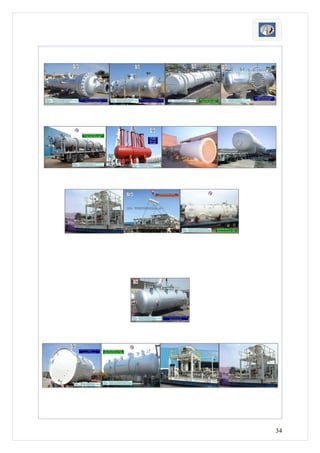
operating capital, it is a valuation of the assets that a business or organization has available to manage
and build the business. Generally speaking, companies with higher amounts of working capital are
better positioned for success because they have the liquid assets that are essential to expand their
business operations when required.


Characteristics of Working Capital


Working capital is the life blood and nerve centre of a business. Just as circulation of blood is essential
in the human body for maintaining life, working capital is very essential to maintain the smooth
running of a business. No business can run successfully with out an adequate amount of working
capital.


The features of working capital distinguishing it from the fixed capital are as follows:


1   Short term Needs:


Working capital is used to acquire current assets which get converted into cash in a short period. In
this respect it differs from fixed capital which represents funds locked in long term assets. The
duration of the working capital depends on the length of production process, the time that elapses in
the sale and the waiting period of the cash receipt.


2   Circular Movement:


Working capital is constantly converted into cash which again turns into working capital. This process
of conversion goes on continuously. The cash is used to purchase current assets and when the goods
are produced and sold out; those current assets are transformed into cash. Thus it moves in a circular
away. That is why working capital is also described as circulating capital.


                                                                                                         53
3   An Element of Permanency:


Though working capital is a short term capital, it is required always and forever. As stated before,
working capital is necessary to continue the productive activity of the enterprise. Hence so long as
production continues, the enterprise will constantly remain in need of working capital. The working
capital that is required permanently is called “permanent or regular working capital”.
4   An Element of Fluctuation:


Though the requirement of working capital is felt permanently, its requirement fluctuates more widely
than that of fixed capital. The requirement of working capital varies directly with the level of
production. It varies with the variation of the purchase and sale policy; price level and the level of
demand also. The portion of working capital that changes with production, sale, price etc. is called
“variable working capital”.


5   Liquidity:


Working capital is more liquid than fixed capital. If need arises, working capital can be converted into
cash within a short period and without much loss. A company in need of cash can get it through the
conversion of its working capital by insisting on quick recovery of its bills receivable and by
expediting sales of its product. It is due to this trait of working capital that the companies with a larger
amount of working capital feel more secure.’


6   Less Risky:


Funds invested in fixed assets get locked up for a long period of time and can not be recovered easily.
There is also a danger of fixed assets like machinery getting obsolete due to technological innovations.
Hence investment in fixed capital is comparatively more risky. As against this, investment in current
assets is less risky as it is a short term investment. Working capital involves more of physical risk
only, and that too is limited. Moreover, working capital gets converted into cash again and again;
therefore, it is free from the risk arising out of technological changes.


7   Special Accounting System not needed:


Since fixed capital is invested in long term assets, it becomes necessary to adopt various systems of
estimating depreciation. On the other hand working capital is invested in short term assets which last
for one year only. Hence it is not necessary to adopt special accounting system for them.


                                                                                                         54
Among the most important items of working capital are levels of inventory, accounts receivable, and
accounts payable. Working capital can be expressed as a positive or a negative number.


“When a company has more debts than current assets, it has negative working capital; When
current assets outweigh debts, a company has positive working capital”.


A company will try to manage cash by:


       Identifying the cash balance that allows it to meet day-to-day expenses but minimizes the cost
        of holding cash;


       Finding the level of inventory that allows for continuous production but lessens the investment
        in raw materials and reduces reordering costs;


       Identifying the appropriate source of financing, given the cash-conversion cycle.


It may be necessary to use a bank loan or overdraft. However, inventory is preferably financed by
credit arranged with the supplier. If a company is not operating efficiently, this will show up as an
increase in the working capital. This can be judged by comparing the amounts of working capital from
one period to another. Slow collection and inventory turnover may signal an underlying problem in the
company’s operations.
Advantages


Proper management of working capital gives a firm the assurance that it is able to continue its
operations and that it has sufficient cash flow to satisfy both maturing short term debt and upcoming
operational expenses.

Disadvantages


If a company’s current assets do not exceed its current liabilities, then it may run into trouble paying
back creditors in the short term.


A declining working-capital ratio over a longer time period could also be a red flag that merits further
analysis. For example, it could be that the company’s sales volumes are decreasing and, as a result, its
accounts receivable are diminishing.


                                                                                                     55
FACTORS INFLUENCING WORKING CAPITAL


4.2 NEED OF WORKING CAPITAL


Working capital is among the many important things that contribute to the success of a business.
Without it, a business may cease to function properly or at all. Not only does a lack of working capital
render a company unable to build and grow, but it may also leave a company with too little cash to pay
its short-term obligations. Simply put, a company with a very low amount of working capital may be
at risk of running out of money.


When a company has too little working capital, it can face financial difficulties and may even be
forced toward bankruptcy. This is true of both very small companies and billion-dollar organizations.
A company with this problem may pay creditors late or even skip payments. It may borrow money in
an attempt to remain afloat. If late payments have affected the company’s credit rating, it may have
difficulty obtaining a loan at an affordable interest rate.


         The need for working capital gross or current assets cannot be over emphasized. As already
observed, the objective of financial decision making is to maximize the shareholders wealth. To
achieve this, it is necessary to generate sufficient profits can be earned will naturally depend upon the
magnitude of the sales among other things but sales can not convert into cash. There is a need for
working capital in the form of current assets to deal with the problem arising out of lack of immediate
realization of cash against goods sold. Therefore sufficient working capital is necessary to sustain
sales activity. Technically this is refers to operating or cash cycle.


4.3 CONCEPT OF WORKING CAPITAL


    There are two concepts of working capital:
    1.   Gross working capital
                                                                                                      56
2.     Net working capital


   Grossw Working Capital


    “The gross working capital is the capital invested in the total current assets of the
    enterprises. Current assets are those Assets which can convert in to cash within a short
    period normally one accounting year.”
Constituents of Current Assets.


Current assets are assets which are expected to be sold or otherwise used within one fiscal year.
Typically, current assets include cash, cash equivalents, accounts receivable, inventory, prepaid
accounts which will be used within a year, and short-term investments.


1   Cash in hand and cash at bank
2   Bills receivables/Sundry debtors
3   Short term loans and advances.
4   Inventories of stock as:
         4.1   Raw material
         4.2   Work in process
         4.3   Stores and spares
         4.4   Finished goods
5   Temporary investment of surplus funds.
6   Prepaid expenses
7   Accrued incomes.
8   Marketable securities.


   Net Working Capital
         “In a narrow sense, the term working capital refers to the net working capital. Net
         working capital is the excess of current assets over current liability”


         “NET WORKING CAPITAL = CURRENT ASSETS – CURRENT LIABILITIES.”


Net working capital refers to the difference between current assets and current liabilities. Current
liabilities are those claims of outsiders which are expected to mature for payment within an accounting
year and include creditors, bills payable and outstanding expenses. Net working capital can be positive
or negative
                                                                                                    57
Constituents of Current liabilities


Current liabilities are considered as liabilities of the business that are to be settled in cash within the
fiscal year. Current liabilities include accounts payable for goods, services or supplies, short-term
loans, long-term loans with maturity within one year, dividends and interest payable, or accrued
liabilities such as accrued taxes.
     1.      Accrued or outstanding expenses.
     2.      Short term loans, advances and deposits.
     3.      Dividends payable.
     4.      Bank overdraft.
     5.      Provision for taxation, if it does not amount to appropriation of profit.
     6.      Bills payable.
     7.      Sundry creditors.


The gross working capital concept is financial or going concern concept whereas net working capital
is an accounting concept of working capital. Both the concepts have their own merits.
The gross concept is sometimes preferred to the concept of working capital for the following reasons:
1.   It enables the enterprise to provide correct amount of working capital at correct time.
2.    Every management is more interested in total current assets with which it has to operate then the
          source from where it is made available.
3.    It take into consideration of the fact every increase in the funds of the enterprise would increase
          its working capital.
4.    This concept is also useful in determining the rate of return on investments in working capital.
          The net working capital concept, however, is also important for following reasons:
     1. It is qualitative concept, which indicates the firm’s ability to meet to its operating expenses
            and short-term liabilities.
     2. IT indicates the margin of protection available to the short term creditors.
     3. It is an indicator of the financial soundness of enterprises.
     4. It suggests the need of financing a part of working capital requirement out of the permanent
            sources of funds.


Working capital, on the one hand, can be seen as a metric for evaluating a company’s operating
liquidity. A positive working capital position indicates that a company can meet its short-term
obligations. On the other hand, a company’s working capital position signals its operating efficiency.
Comparably high working capital levels may indicate that too much money is tied up in the business.

                                                                                                          58
The most important positions for effective working capital management are inventory, accounts
receivable, and accounts payable. Depending on the industry and business, prepayments received from
customers and prepayments paid to suppliers may also play an important role in the company’s cash
flow. Excess cash and no operational items may be excluded from the calculation for better
comparison.


4.4 CLASSIFICATION OF WORKING CAPITAL

      Working capital may be classified in to ways:
      •      On the basis of concept.
      •      On the basis of time.


      On the basis of concept working capital can be classified as gross working capital and net
      working capital. On the basis of time, working capital may be classified as:


      •      Permanent or fixed working capital.
      •      Temporary or variable working capital


A-Permanent OR Fixed Working Capital.

The operating cycle is a continuous feature in almost all the going concerns and therefore creates the
need for working capital and their efficient management. However the magnitude of working capital
required will not be constant, but will fluctuate. At any time, there is always a minimum level of
current assets which is constantly and continuously required by a business unit to carry on its
operations. This minimum amount of current assets, which is required on a continuous and
uninterrupted basis, is after referred to as fixed or permanent working capital. This type of working
capital should be financed (along with other fixed assets) out of long term funds of the unit. However
in practice, a portion of these requirements also is met through short term borrowings from banks and
suppliers credit.

Chart 4-1 Permanent Working Capital


                                     The amount of Current Assets require to meet
                                          a firms long term minimum needs
                     Y


                                                                                                   59
Value
                                                                     Permanent Current Asset


                            O                                                      X
                                         Time

                            Permanent Working Capital
The amount of current assets required to meet a firm’s long-term minimum needs are called
Permanent current assets.


For e.g., In a manufacturing unit, basic raw materials required for production has to be available at all
times and this has to be financed without any disturbance.
B-Temporary OR Variable Working Capital.


Any amount over and above the permanent level of working capital is variable, temporary or
fluctuating working capital. This type of working capital is generally financed from short term sources
of finance such as bank credit because this amount is not permanently required and is usually paid
back during off season or after the contingency. As the name implies, the level of fluctuating working
capital keeps on fluctuating depending on the needs of the unit unlike the permanent working capital
which remains constant over a period of time.


The Temporary or Variable working capital is the amount of working capital which is required to meet
the seasonal demands and some special exigencies. Variable working capital can further be classified
as Seasonal Working Capital and Special Working Capital. The capital required to meet the seasonal
need of the enterprise is called seasonal working capital. Special working capital is that part of
working capital which is required to meet special exigencies such as launching of extensive marketing
for conducting research, etc.


Temporary working capital differs from Permanent working capital in the sense that is required for
short periods and cannot be permanently employed gainfully in the business.

Chart 1-2 Temporary Working Capital

                                        The amount of Current Asset required
                     Y
                                        to meet short term minimum needs


                                         Temporary current assets

                                                                                                      60
Value


                                           Permanent Working Capital


                                                  Time
                                      Temporary Working Capital
4.5 DETERMINANTS OF WORKING CAPITAL


Working capital management is an indispensable functional area of management. However the total
working capital requirements of the firm are influenced by the large number of factors. It may
however be added that these factors affect differently to the different units and these keep varying
from time to time. In general, the determinants of working capital which are common to all
organizations can be summarized as under:
   Nature of Business


This is one of the main factors. Usually in trading businesses the working capital needs are higher as
most of their investment is concentrated in stock or inventory. Manufacturing businesses also need a
good amount of working capital to meet their production requirements. Whereas, those companies that
sell services and not goods, on a cash basis require least working capital because there is no
requirement on their part to maintain heavy inventories.
   Size of Business


In very small company the working capital requirement is quit high due to high overhead, higher
buying and selling cost etc. as such medium size business positively has edge over the small
companies. But if the business start growing after certain limit, the working capital requirements may
adversely affect by the increasing size.
   Credit Terms / Credit Policy


Some time due to competition or custom, it may be necessary for the company to extend more and
more credit to customers, as result which more and more amount is locked up in debtors or bills
receivables which increase the working capital requirement. On the other hand, in the case of
purchase, if the credit is offered by suppliers of goods and services, a part of working capital
requirement may be financed by them, but it is necessary to purchase on cash basis, the working
capital requirement will be higher.


       Credit terms greatly influence working capital needs. If terms are:
       buy on credit and sell by cash, working capital is lower
       buy on credit and sell on credit, working capital is medium

                                                                                                   61
   buy on cash and sell on cash, working capital is medium
       buy on cash and sell on credit, working capital is higher.


    Prevailing trade practices and changing economic condition do generally exert greater influence
on the credit policy of concern. A liberal credit policy if adopted more trade debtors would result and
when the same is tightened, size of debtors gets slim.
Credit periods also influence the size and composition of working capital. When longer credit period is
allowed to debtors as against the one extended to the firm by its creditors, more working capital is
needed and vice versa.

Collection policy is another influencing factor. A stringent collection policy might not only deter away
some credit customers, but also force the existing customers to be prompt in settling dues resulting in
lower level of working capital. The opposite holds well with a liberal collection policy.

Collection procedure also influences the working capital needs. A decentralized collection of dues
from customers and centralized payments to suppliers shall reduce the size of working capital.
Centralized collections and centralized payments would lead to moderate level of working capital. But
with centralized collections and decentralized payments, the working capital need would be the
highest.

   Seasonality

Seasonality of Production

Agriculture and food processing and preservation industries have a seasonal production. During
seasons, when production activities are in their peak, working capital need is high.

Seasonality in supply of raw materials

This also affects the size of working capital. Industries that use raw materials which are available
during seasons only, have to buy and stock those raw materials. They cannot afford to buy these items
in a phased way, since either supplies would get reduced or prices would be higher. Also, from the
point of view of quality of raw materials, it pays to buy in bulk during the seasons. Hence the high
level of working capital needed when season exists for raw materials.

Seasonality of demand for finished goods

In case of products like umbrella, rain-coats and other seasonal items, the demand is high during peak
seasons. But the production of these items has to be continuous throughout the year to meet the high
demand during peak seasons. Thus, working capital requirement would be higher.


•   “Since Arabian Industries LLC is a contracting company, the above mentioned seasonal factors do
    not affect its operation or its business cycle. “


                                                                                                     62
   Business Trade Cycle

Trade cycle refers to the periodic turns in business opportunities from extremely peak levels, via a
slackening to extremely tough levels and from there, via a recovery phase to peak levels, thus
completing a business cycle. There are 4 phases of trade cycle.


       Boom Period – more business, more production, more working capital.
       Depression period – less business, less production, less working capital.
       Recession period – slackening business, stock pile-up, more working capital.
       Recovery period – recouping business, stock speedily converts to sales, less working capital.


   Inflation


Under inflationary conditions generally working capital increases, since with rising prices demand
reduces resulting in stock pile-up and consequent increase in working capital.


   Length of Production cycle


The time lapse between feeding of raw material into the machine and obtaining the finished goods out
from the machine is what is described as the length of manufacturing process. It is otherwise known as
conversion time. Longer this time period, higher is the volume and value of work-in-progress and
hence higher the requirement of working capital and vice versa.


   System of Production process


If capital intensive, high-technology automated system is adopted for production, more investment in
fixed assets and less investment in current assets are involved. Also, the conversion time is likely to be
lower, resulting in further drop in the level of working capital. On the other hand, if labor intensive
technology is adopted, less investment in fixed assets and more investment in current assets which
would lead to higher requirement of working capital.


   Growth and expansion plans


Growth and expansion industries need more working capital than those that are static.


                                                                                                       63
   Profitability


The profitability of the business may be vary in each and every individual case, which is in turn its
depend on numerous factors, but high profitability will positively reduce the strain on working capital
requirement of the company, because the profits to the extend that they earned in cash may be used to
meet the working capital requirement of the company.
   Operating efficiency

If the business is carried on more efficiently, it can operate in profits which may reduce the strain on
working capital; it may ensure proper utilization of existing resources by eliminating the waste and
improved coordination etc.


Apart from the above factors, dividend policy, depreciation policy, price level changes, operating
efficiency and government regulations also influence the level and the size of working capital.


                                                             Inflation
                                               Length of                   Business
                                               Production
                                                 cycle                      Trade
                                                                            cycle

                                  System of
                                  Production
                                   process                                                Seasonality

                                                            WORKING
                                                            CAPITAL
                                 Nature of
                                   the
                                                                                          Profitability
                                 Business


                                                                          Credit term
                                               Operating                       or
                                               efficiency                 Credit policy
                                                            Size of the
                                                             Business


                                                                                                          64
CHAPTER – V


1) INTRODUCTION
2) SCOPE OF THE STUDY
3) TYPES OF DATA COLLECTION
4) OBJECTIVE OF STUDY
5) LIMITATIONS OF STUDY

                              65
5.1 RESEARCH METHODOLOGY - INTRODUCTION

Research Methodology is a purposeful, precise and systematic search for new knowledge, skills,
attitudes and values, or for the re-interpretation of existing knowledge, skills, attitudes and values.
Research methodology is a way to systematically solve the research problem. It may be understood as
a science of studying now research is done systematically. In that various steps, those are generally
adopted by a researcher in studying his problem along with the logic behind them.


Data collection is important step in any project and success of any project will be largely depend upon
now much accurate you will be able to collect and how much time, money and effort will be required
to collect that necessary data, this is also important step.


                               Various Steps for Research Methodology


This project requires a detailed understanding of the concept – “Working Capital Management”.
Therefore, firstly we need to have a clear idea of what is working capital, how it is managed in AI
LLC, what are the different ways in which the financing of working capital is done in the company.

The management of working capital involves managing inventories, accounts receivable and payable
and cash. Therefore one also needs to have a sound knowledge about cash management, inventory
management and receivables management.
                                                                                                          66
Then comes the financing of working capital requirement, i.e. how the working capital is financed,
what are the various sources through which it is done.

And, in the end, suggestions and recommendations on ways for better management and control of
working capital are provided.

5.2 SCOPE OF THE STUDY


This project is vital to us in a significant way. It does have some importance for the company too.
These are as follows:–


         This project will be a learning device for the finance student.


         Through this project we would study the various methods of the working capital management.


         The project will be a learning of planning and financing working capital.


         The project would also be an effective tool for credit policies of the companies.


         This will show different methods of holding inventory and dealing with cash and receivables.


         This will show the liquidity position of the company and also how do they maintain a
          particular liquidity position.

5.3 TYPES OF DATA COLLECTION


          There are two types of data collection methods available.


          1.        Primary data collection


          2.        Secondary data collection


  5.3.1        Primary data collection method

          Primary data is the data which the researcher collects through various methods like
          interviews, surveys, questionnaires etc, to support the secondary data. Some advantages and
          disadvantages of primary data are as follows:

                                                                                                    67
5.3.2     Secondary data collection method

          Secondary data is data collected by someone other than the user. Common sources of
          secondary data for social science include censuses, surveys, organizational records and data
          collected through qualitative methodologies or qualitative research. Primary data, by contrast,
          are collected by the investigator conducting the research.
This project is based on primary data collected through personal interview of head of Finance
Department, head of Statistical Quality Control department and other concerned staff member of
finance department. But primary data collection had limitations such as matter confidential
information thus project is based on secondary information collected through four years annual report
of the company, supported by various books and internet sides. The data collection was aimed at study
of working capital management of the company.

Project is based on:

    Financial Report of Arabian Industries LLC – 2004-2005-2006-2007-2008-2009


5.4 OBJECTIVES OF THE STUDY.


This research is focusing on working capital management and its effects on profitability for a sample
of Omani firm. Study of the working capital management is important because unless the working
capital is managed effectively, monitored efficiently planed properly and reviewed periodically at
regular intervals to remove bottlenecks if any the company can not earn profits and increase its
turnover. With this primary objective of the study, the following further objectives are framed for a
depth analysis.


5.4.1     The Main objectives of the studies are:


  1. To study the way and means of working capital finance of the company.
  2. To estimate the operating cash cycle and working capital requirement of the company.
  3. To establish a relationship between Working Capital Management and Profitability over a
        period of five years of the company..
  4. To find out the effects of different components of working capital management on Profitability
  5. To establish a relationship between the two objectives of liquidity and profitability of the Omani
        firm.
  6. To find out the relationship between debt used by Arabian Industry LLC and its Profitability
  7. To draw conclusion about relationship of working capital management and profitability of the
        company.

                                                                                                      68
8. To study the optimum level of current assets and current liabilities of the company.
 9. To study the liquidity position through various working capital related ratios.
 10. To study the working capital components such as receivables accounts, cash management,
     Inventory position


   5.4.2       Analysis Used in Study : Descriptive analysis.

   Descriptive Statistics are used to describe the basic features of the data in a study. They provide
   simple summaries about the sample and the measures. Together with simple graphics analysis,
   they form the basis of virtually every quantitative analysis of data. With descriptive statistics you
   are simply describing what is, what the data shows

   5.4.3       Research Design


           STEP 1 - To study the Financial Statement of Arabian Industries LLC
           STEP 2 – Data Analysis of working capital through Estimation of Working Capital.
           STEP 3 – Analysis of Inventory Management of Arabian Industries LLC.
           STEP 4 – Comparison of base year data’s with previous years datas.


   5.4.4       Data Collection


   5.4.4.1 The information is collected through the Primary Source like:-

               Interviewing the employees of the department.
               Getting information from MIS department.
               Discussion with the head of the Finance department and Procurement department.


   5.4.4.2 The Data was collected from following Secondary Sources like:-


               Corporate department
               Procurement department
               Finance department
               Logistic Department


5.5 SCOPE AND LIMITATIONS OF THE STUDY


   5.5.1       Scope of the study


                                                                                                     69
The scope of the study is identified after and during the study is conducted. The study of working
capital is based on tools like trend Analysis, Ratio Analysis, working capital leverage, operating
cycle etc. Further the study is based on last 5 years Annual Reports of Arabian Industries LLC,
and even factors like competitor’s analysis, industry analysis were not considered while preparing
this project.
5.5.2    Limitations of the study

Following limitations were encountered while preparing this project:

1) Limited data:-

This project has completed with annual reports; it just constitutes one part of data collection i.e.
secondary. There were limitations for primary data collection because of confidentiality.

2) Limited period:-

This project is based on five year annual reports. Conclusions and recommendations are based on
such limited data. The trend of last five year may or may not reflect the real working capital
position of the company

3) Limited area:-

Also it was difficult to collect the data regarding the competitors and their financial information.
Industry figures were also difficult to get.


                       RESEARCH METHODOLOGY – DATA TO ACTION


                                                                                                 70
Chapter VI


1) Working capital level.
2) Working capital trend analysis.
3) Current assets analysis.
4) Current liability analysis.
5) Changes of working capital
6) Operating cycle
7) Working capital leverage
                                     71
1.1 Working Capital level

The guiding principle for working capital is called the hedging principle or principle of self-liquidating
debt or matching principle (different from the matching principle used in measuring accounting
profit).
It is an accepted belief in business that the term of a funding arrangement must match the term of the
investment itself. This means that any funds used for short-term assets or purposes should be financed
from short-term sources. Likewise investments in long term-assets should be funded from long-term
sources.

Therefore a key criterion for acquiring additional finance is matching up the life of the assets acquired
with the term of the loan or other method of funding. For example, the buying of an unusually large
quantity of inventory should be financed by a loan, or credit, with a repayment period of less than one
year.

The level of any long-term assets funded by short-term debt shows the firm's level of 'aggression' in its
financing policy. Although this type of action may increase profits (due to the lower cost of short-term
debt) it greatly increases the risk of cash shortages if short-term financing can't be renewed.

Table 6.1- Size of Working Capital
                                                                             SOURCE: COMPANY REPORT
                      EXTRACTED FROM AUDITED BALANCE SHEET OF ARABIAN INDUSTRIES LLC

                                  2004        2005       2006         2007          2008          2009

  CURRENT ASSET
                                                     1                        5            1         1,892,3
 Bank Balances                      45,595     96,786      67,900       62,828       43,351              72
                                       2,18       2,92        7,70        12,54        20,19        13,437,9
 Trade Debtors                       8,348      1,799       2,727        3,178        4,201              81
                                          1          4           1            3            5           724,1
 Inventory                          12,639     59,404      60,412       73,118       63,989              45
                                       1,75       2,14        2,77         1,27         1,42         2,274,6
 Work in Progress                    8,719      2,770       3,635        5,523        2,625              90
                                                                 2            1            3         4,632,7
 Dues from Related Parties               -           -     14,325       91,658       16,956              89
                                          3                      7            5            3            99,2
 Other Receivables                  49,388     52,319      25,857       12,228       36,700              43
                                       4,45       5,77       11,64        15,45        22,97        23,061,2
 TOTAL CURRENT ASSETS                4,689      3,078       4,857        8,533        7,822              19

                                         -           -          -            -             -              -

 CURRENT LIABILITIES                     -           -          -            -            -               -
                                          3          9        2,04                      2,01            553,8
 Short-term Borrowings              40,867     00,676       9,745            -        5,753               12
 Current Portion of Long Term             1          1            4        1,43         1,50          2,188,4
 loan                               47,493     84,717      98,801        6,567        3,569               46
                                       1,17       3,01        5,15         6,84        10,29          6,186,8
 Trade Creditors                     1,301      3,726       4,023        0,688        3,795               54
 Dues to Related Parties                  4                                             1,49            420,9

                                                                                                           72
49,842       2,043       23,504       31,073     9,973          00
                                                                     1            1         4       922,4
    Provisions - Tax                       -      27,422       82,064       75,183    02,530          51
                                         1,21        1,53         3,48         6,65      6,94     5,588,5
    Other Payables                     7,574       3,552        9,970        2,454     8,035          69
                                         3,32        5,66        11,39        15,13     22,66    15,861,0
    TOTAL CURRENT LIABILITIES          7,077       2,135        8,106        5,965     3,655          31
    NET WORKING CAPITAL - (A-B)     1,127,612     110,943      246,751      322,568   314,167   7,200,188


1.2 WORKING CAPITAL TREND ANALYSIS


Trend analysis is an improvement over the year to year analysis. When a comparison of Financial
Statements covering more than 3 years is undertaken, the year to year analysis becomes cumbersome.
In trend analysis, the changes are calculated for several successive years instead of two or three years.
Therefore the trend analysis is a company's financial position over a long period of time. Trend
analysis is important as it may point to basic changes in the nature of business and also helps in
drawing meaningful conclusions regarding the operating performance over several years and the
financial position of the enterprise. It is based on the idea that what has happened in the past gives an
idea of what will happen in the future.


In working capital analysis the direction at changes over a period of time is of crucial importance.
Working capital is one of the important fields of management. It is therefore very essential for an
annalist to make a study about the trend and direction of working capital over a period of time. Such
analysis enables as to study the upward and downward trend in current assets and current liabilities
and it’s effect on the working capital position.


       In the words of S.P. Gupta “The term trend is very commonly used in day-today conversion trend,
        also called secular or long term need is the basic tendency of population, sales, income, current
        assets, and current liabilities to grow or decline over a period of time”.


       According to R.C.Galeziem “The trend is defined as smooth irreversible movement in the series. It
        can be increasing or decreasing.”


Emphasizing the importance of working capital trends, Man Mohan and Goyal have pointed out that
“analysis of working capital trends provide as base to judge whether the practice and privilege policy
of the management with regard to working capital is good enough or an important is to be made in
managing the working capital funds.


Further, any one trend by it self is not very informative and therefore comparison with Illustrated their
ideas in these words, “An upwards trends coupled with downward trend or sells, accompanied by


                                                                                                       73
marked increase in plant investment especially if the increase in planning investment by fixed interest
obligation”


One of the main goals of trend analysis is to forecast future values of the series. It allows a researcher
to look at a pattern of change over a long period of time rather than at a single discrete point in time or
over a short time so that better conclusions can be drawn.
Table 6.2 – Working Capital Variance Analysis.

             ANALYSIS OF VARIANCE OF WORKING CAPITAL

  YEARS                                         2004            2005             2006               2007            2008                2009

  TOTAL CURRENT ASSETS                     4,454,689      5,773,078         11,644,857             15,458,533      22,977,822        23,061,219

  TOTAL CURRENT LIABILITIES                3,327,077      5,662,135         11,398,106             15,135,965      22,663,655        15,861,031

  NET WORKING CAPITAL - (A-B)              1,127,612           110,943           246,751             322,568         314,167           7,200,188

  W-C VARIATION –in %                            100%            9.84%             21.88%             28.61%          27.86%             638.53%


                          (“Index   =           100 X Index Year Amount / Base Year Amount”)


Chart-6.1- Working capital index

                                                         WORKING CAPITAL INDEX


             25,000,000


             20,000,000
                                                                                                                           TOTAL CURRENT
                                                                                                                           ASSETS

             15,000,000                                                                                                    TOTAL CURRENT
     VALUE


                                                                                                                           LIABILITIES

             10,000,000                                                                                                    NET WORKING
                                                                                                                           CAPITAL - (A-B)

              5,000,000                                                                                                    W-C VARIATION –in
                                                                                                                           %


                     0
                             2004       2005            2006             2007               2008            2009

                                                                YEARS


Table 6.3-Working capital size

             ANALYSIS OF VARIANCE OF WORKING CAPITAL

  YEARS                                         2004            2005             2006               2007            2008                2009

  TOTAL CURRENT ASSETS                     4,454,689      5,773,078         11,644,857             15,458,533      22,977,822        23,061,219

  TOTAL CURRENT LIABILITIES                3,327,077      5,662,135         11,398,106             15,135,965      22,663,655        15,861,031

  NET WORKING CAPITAL - (A-B)              1,127,612           110,943           246,751             322,568         314,167           7,200,188

  W-C VARIATION –in %                          100%            9.84%            21.88%             28.61%          27.86%             638.53%


             The computation of a series of Index Numbers requires the choice of a base year that will for
all times have an index number of 100. The base period should be a normal year with regard to

                                                                                                                                                74
business conditions, since the base year used as a reference should be representative. Generally, the
earliest year is selected as a base year. However, where the earliest year is selected as the normal year
then another year is chosen. All Index numbers are computed with reference to the base year using this
formula


1.2.1     OBSERVATIONS


It was observed that major source of liquidity problem is the mismatch between current payments and
current receipts from the Comparison of funds flow statements of AI LLC for six years. It was
observed that in the year 2005 current assets increased by around 29.6% compared to 2004 and current
liabilities increased by 70.18% which affect as working capital reduced by 9.84% in the year 2005
compared to 2004.because the net working capital was OMR 1,127,612/- in 2004 but in 2005 it was
reduced to OMR 110,943/- in the year 2005 due to the increase in current liability of 70% compared to
2004. In 2004 current liability was OMR 3,327,077, where as in 2005 it was increased by OMR
2,335,058/-; a total liability of OMR 5,662,135/- in 2005.


In the year 2006, 2007, 2008 a tremendous increase we can see in current liability by 172.4%,
112.35%, and 226.26% res. and current asset also increased accordingly compared to 2004 like
131.8%, 85.61% and 168.79% during the year 2006, 2007, 2008. In the year 2009 we can see the
growth of current asset is very less compared to 2004 with a percentage of only 1.87% where as in the
current liability we can see there is a slop of -2004.46% compared to 2004, where as an increase in
current asset for 73.478% compared to 2004 and a good nest asset (WC reserve) is with the firm for an
increased percentage of 638.53% in the year 2009.


The position of working capital is very good in 2009 because the bank balance in 2008 was only
143,351/- OMR where as in 2009 it is increased to OMR 1,892,372/-; ie. 1220% compared to 2008,
which is quite good and also we can see that there is receivable from related parties is 4,632,789/- in
the year 2009, where as in 2008 it was only OMR 316,956/-; that means an increase is for 1361% in
the year 2009 compared to 2008. That means the fund position is quite good for 2009.


While compared to 2004 current assets have been increased by 417.68% and current liabilities have
been increased by 376.73%. But compared to 2008 and 2009 there is a short fall of -30.02% in current
liabilities, where as an increase in current asset is only an increase of .36%. The bank balance is

                                                                                                      75
increased to OMR 1,892,372/- in 2009 from OMR 143,351/- in the year 2008.It shows that
management is using only it’s own fund for the short term requirements and WC has been increased to
OMR 7,200,186/- in the year 2009-A growth of 638.53%. This two together pushed down the net
working capital to the present level. The increase in working capital is a clear indication that the
company is utilizing its own funds and resources with efficiency.
Table 6.4 –Variance Analysis of Current Asset and Current Liability.

 OBSERVATION OF WORKING CAPITAL

 YEARS                              2004          2005            2006              2007              2008               2009
 TOTAL CURRENT ASSETS                529853        686666         1385071            1838680           2733045            2742964
 YEARLY VARIATION                          100     156813          698405             453609            894365               9920
 GROWT COMPARED TO 2004                    100       29.60          131.81              85.61            168.79                 1.87

 YEARLY GROWTH IN %                        100       29.60          101.71              32.75             48.64                 0.36


 TOTAL CURRENT LIABILITIES           395732        673470         1355722            1800313           2695677            1886554
 YEARLY VARIATION                    395732        673470         1355722            1800313           2695677            1886554
 GROWTH COMPARED TO 2004                   100       70.18          172.40             112.35            226.26            (204.46)

 YEARLY GROWTH IN %                        100       70.18          101.30              32.79             49.73             (30.02)

 NET WORKING CAPITAL - (A-B)         134121         13196           29349              38367             37368             856410
 WORKING CAPITAL SIZE                      100        9.84           21.88              28.61             27.86             638.53

 TOTAL CURRENT ASSETS                      100   156812.76       855218.25        1308827.295       2203192.035        2213111.565

 VARIATION COMPARED TO 2004                100           29.6       161.41             247.02            415.81             417.68

 TOTAL CURRENT LIABILITIES                 100    277738.2      959990.265        1404581.445       2299945.455         1490822.82

 VARIATION COMPARED TO 2004                100       70.18          242.59             354.93            581.19             376.73


1.3 CURRENT ASSETS

A balance sheet item which equals the sum of cash and cash equivalents, accounts receivable,
inventory, marketable securities, prepaid expenses, and other assets that could be converted to cash in
less than one year. A company's creditors will often be interested in how much that company has in
current assets, since these assets can be easily liquidated in case the company goes bankrupt. In
addition, current assets are important to most companies as a source of funds for day-to-day
operations.


Table 6.5-Current Asset Size

CURRENT ASSET

                                       2004              2005             2006              2007               2008                    2009

CURRENT ASSET - A
                                                         19                  68                57                  1                1,91
Bank Balances / Deposits
                                    46,198           9,387                ,798             0,267             45,245               7,381
                                        2,2            2,96              7,804             12,70                20,4               13,61
Trade Debtors (Net of Provisions)
                                    17,269           0,413                ,526             8,947             61,085               5,576
                                          1              46                 162                37                  5                  73
Inventory
                                    14,127           5,475                ,532             8,049             71,443               3,715
Work in Progress                        1,7            2,17              2,810               1,29                1,4                2,30

                                                                                                                                  76
81,962                 1,088              ,291     2,380    41,426         4,752
                                                                                217       19          3          4,69
Dues from Related Parties
                                          -                   -               ,158     4,191    21,144         4,015
                                          3                     5               735       51          3            10
Other Receivables
                                    54,006                 3,010              ,450     8,997    41,150         0,555
                                        4,5                  5,84           11,798     15,66       23,2         23,36
TOTAL CURRENT ASSETS
                                    13,561                 9,374              ,754     2,831    81,494         5,993
CURRENT ASSET INDEX                       100              129.60           261.41     347.02    515.81        517.68


Chart 6.2- Current Asset Index.


                                                    CURRENT ASSET INDEX


                    600

                    500

                    400
                                                                                                    CURRENT
        VALUE                                                                                       ASSET
                    300                                                                             INDEX
                                                                             515.81   517.68

                    200                                            347.02
                                                    261.41
                    100
                             100   129.60

                       0
                            2004   2005             2006          2007       2008     2009

                                                        YEAR


1.3.1       Composition of current assets

Analysis of current assets components enable one to examine in which components the working
capital fund has locked. A large tie up of funds in inventories affects the profitability of the business or
the major portion of current assets is made up cash alone, the profitability will be decreased because
cash is non earning asset


Table 6.6-Composition of Current Assets


CURRENT ASSET COMPOSITION
                                           2004               2005           2006       2007     2008          2009

CURRENT ASSET - A
Bank Balances                              1.02               3.41           0.58       3.64     0.62          8.21
Trade Debtors                             49.12              50.61          66.15      81.14    87.89         58.27
Inventory                                  2.53               7.96           1.38       2.41     2.45          3.14
Work in Progress                          39.48              37.12          23.82       8.25     6.19          9.86
Dues from Related Parties                       -                 -          1.84       1.24     1.38         20.09
Other Receivables                          7.84               0.91           6.23       3.31     1.47          0.43


                                                                                                               77
CURRENT ASSET INDEX                                   100             100          100      100    100                 100


Chart 6.3- Current Asset Components


                                                            CURRENT ASSET COMPOSITION

                                                                                                  Other Receivables

                              100%
                                                                                                  Dues f rom Related
                                                                                                  Parties
                               80%
        VARIATION IN %


                                                                                                  Work in Progress

                               60%
                                                                                                  Inventory

                               40%
                                                                                                  Trade Debtors (Net
                                                                                                  of Provisions)
                               20%
                                                                                                  Bank Balances /
                                                                                                  Deposits
                                0%
                                        2004   2005         2006       2007       2008   2009

                                                                   YEARS


1.3.2                    Observations

It was observed that the size of current assets is increasing with increases in the sales. The excess of
current assets is showing positive liquidity position of the firm but it is not always good because
excess current assets then required, it may adversely affects on profitability.. We can see in each year
there is tremendous growth in current asset. Compared to 2007 the growth in current asset in 2008,
there is a growth of 48.64%, where as in 2009 the growth rate is only .36%. The reason is that the
debtors receivable in 2008 is 20,461,085 but in 2009 it has been reduced to 13,615,576/-, a drop of
OMR 6,845,509/- ie. 33.46%. These shows that the a good cash collection from receivables in 2009
which shows a good working capital reserve of OMR 6,845,509/- which used to pay back the current
liabilities of sundry creditors, other payables and due to related parties.


Compared to 2008 in 2009 the bank balance also increased to OMR 1,917,381/-from OMR 145,245/-
in the year 2008. Cash balance of the company increased in the year 2009 because company had done
good in it’s collection process, which provides a good financial position in 2009. Current assets
components show sundry debtors are the major part in current assets it indicates that the efficiency in
collection management. Over investment in the debtors may affects liquidity of firm for that company
has raised funds from other sources like short term loan which incurred the interest. Other main
achievement is that, if we compare the purchase level with inventory, we can see that inventory level
is not increased as compared to the volume of purchase. But same time we can see that the receivable
from related parties and work in progress has been increased substantially. These show the proper
utilization of materials and resources.

                                                                                                                       78
1.4 Current liabilities


Current liabilities are debts, accounts payable, interest due, trade credit, loans, and other obligations
that are due and payable within one year. Current liabilities are calculated and identified on a business'
balance sheet. Current liabilities as a total are information that is used as one measure of the financial
condition of a company, especially in association with current assets to calculate the level of working
capital.


Table 6.7-Current liabilities size


                                                     2004              2005           2006         2007         2008             2009

                CURRENT LIABILITIES - B

    Short-term Borrowings                         345,371         912,579       2,076,834             0    2,042,393         561,131

    Current Portion of Long Term Debt             149,443         187,158        505,393      1,455,553    1,523,440        2,217,368

    Trade Creditors                              1,186,780      3,053,555       5,222,137     6,931,094   10,429,836        6,268,619

    Dues to Related Parties                       455,788             2,070       23,814        31,484     1,519,796         426,463

    Provisions - Tax                                    0          27,784        184,470       177,498      407,850          934,642

    Other Payables                               1,233,665      1,553,819       3,536,092     6,740,372    7,039,860        5,662,426

    TOTAL CURRENT LIABILITIES                    3,371,047      5,736,965      11,548,742    15,336,000   22,963,175       16,070,649
    VARIATION              IN    CURRENT
                                                  100.000         170.183         342.586       454.933      681.188          476.726
    LIABILITIES IN %


Chart 6.4- Current Liability Index


                                                     VARIATION IN CURRENT LIABILITIES


                800

                700                                                                     681.188
                600                                                                                                    VARIATION
                                                                                                                       IN
                500
    VARIATION


                                                                            454.933                  476.7258          CURRENT
                400                                                                                                    LIABILITIES
                                                             342.586
                300

                200
                                             170.183
                100             100

                   0
                          2004            2005       2006             2007        2008          2009
                                                              YEARS


                                                                                                                                     79
Observations


Current liabilities show a tremendous growth till 2008, because company creates the credit in the
market by good transaction. To get maximum credit from supplier which is profitable to the company
it reduces the need of working capital of firm. As the current liability increase in the year 2007, 2008
by 455% and 682 % res. it increases the working capital size in the same year. But subsequently it the
liability has been reduced to 477%. But due to the good collection process the change in working
capital is not affected much and the company enjoyed good credit terms over creditors which may
include indirect cost of credit terms. From the graph we can see that the requirementof working
capital has been increased drastically during the year 2006-2007-2008and it has been paid and cleared
n 2009, and still the firm is having a good reserve in it’s working capital. This shows the efficiency in
it’s collection policy.


1.5 Changes in working capital


The excess of current assets over current liabilities is referred to as the company’s working capital.
The difference between the working capital for two given reporting periods is called the change in
working capital.


1.5.1   Benefit


Changes in working capital is included in cash flow from operations because companies typically
increase and decrease their current assets and current liabilities to fund their ongoing operations. When
a company increases its current assets, it’s a cash outflow: The company had to shell out money to buy
the extra assets. Likewise, when a company increases its current liabilities, it’s a cash inflow: The
added liabilities, such as short-term debt, provide money. Changes in working capital simply shows
the net affect on cash flows of this adding and subtracting from current assets and current liabilities.
When changes in working capital is negative, the company is investing heavily in its current assets, or
else drastically reducing its current liabilities. When a change in working capital is positive, the
company is either selling off current assets or else raising its current liabilities.
                                                                                                      80
1.5.2   Origin


This information is found in the Statement of Cash Flow of the company’s financial statement.


1.5.3   For the Processing:


For many growing companies, changes in working capital is a little like capital spending: It’s money
the company is investing—in things like inventory—in order to grow. To get a true picture of the cash
a company is generating before investment, one can add back changes in working capital to cash flow
from operations. Another point: A negative value for changes in working capital could mean the
company is investing heavily in growth, or that something’s gone wrong. If a company is having
trouble selling its goods, inventories will balloon, and changes in working capital will turn sharply
negative.
There are so many reasons to changes in working capital as follows:-


1. CHANGES IN SALES AND OPERATING EXPANSES:-


The changes in sales and operating expanses may be due to three reasons


A) There may be long run trend of change e.g. The price of row material say steel may constantly raise
necessity the holding of large inventory.


B) Cyclical changes in economy dealing to ups and downs in business activity will influence the level
of working capital both permanent and temporary.


C) Changes in seasonality in sales activities


2. Policy changes:-


The second major case of changes in the level of working capital is because of policy changes initiated
by management. The term current assets policy may be refined as the relationship between current
assets and sales volume.


3. Technology changes:-


The third major point if changes in working capital are changes in technology because change sin
technology to install that technology in our business more working capital is required


A change in operating expanses rise or full will have similar effects on the levels of working following
working capital statement is prepared on the base of balance sheet of last two year.
                                                                                                     81
“Net change in working capital is the difference in working capital levels from one year
to the next. When more cash is tied up in working capital than the previous year, the increase in
working capital is treated as a cost against free cash flow”
.
Table 6-8-Changes in Working Capital

                                                       CHANGES IN WORKING CAPITAL                         CHANGES IN W C

                                                     2008              2009    changes in %   INCREASE        DECREASE

                           CURRENT ASSET - A
                                                     145,2            1,917,            1,4     1,772,1
Bank Balances / Deposits                            45.00            381.20          03.12       36.20                -
                                                  20,461,0           13,615,              (                       6,845,5
Trade Debtors (Net of Provisions)                   85.20            575.65          38.47)         -              09.55
                                                     571,4              733,                      162,2
Inventory                                           43.05            714.95          32.66       71.90                -
                                                   1,441,4            2,304,                      863,3
Work in Progress                                    26.10            751.80          68.88       25.70                -
                                                     321,1            4,694,            1,5     4,372,8
Dues from Related Parties                           44.40            014.80          65.90       70.40                -
                                                     341,1              100,              (                        240,5
Other Receivables                                   49.80            554.85          81.10)    #VALUE!             94.95
                                                  23,281,4           23,365,
TOTAL CURRENT ASSETS-A                              93.55            993.25             -           -                 -

                                                       -                 -              -           -                 -

CURRENT LIABILITIES - B                                -                 -              -           -                 -
                                                   2,042,3              561,              (     1,481,2
Short-term Borrowings                               93.10            131.00          83.40)      62.10                -
                                                   1,523,4            2,217,                                       693,9
Current Portion of Long Term Debt                   39.50            367.90          52.38          -              28.40
                                                  10,429,8            6,268,              (     4,161,2
Trade Creditors                                     36.45            618.95          45.88)      17.50                -
                                                   1,519,7              426,              (     1,093,3
Dues to Related Parties                             96.30            462.55          82.73)      33.75                -
                                                     407,8              934,              1                        526,7
Provisions - Tax                                    49.80            641.80          48.54          -              92.00
                                                   7,039,8            5,662,              (     1,377,4
Other Payables                                      59.55            426.35          22.50)      33.20                -
                                                  22,963,1           16,070,
TOTAL CURRENT LIABILITIES-B                         74.70            648.55             -           -                 -
                                                     318,3            7,295,
NET WORKING CAPITAL - (A-B)                         18.85            344.70             -           -                 -
                                                   6,977,0                                                        6,977,0
NET INCREASE IN WC                                  25.85                -              -           -              25.85
                                                    7,295            7,29                       15,283,          15,283,
                         TOTAL                   ,344.70        5,344.70                -       850.75           850.75


Chart 6.5- Changes in Working Capital

                                               CHANGES IN WORKING CAPITAL

                         7,000,000                                                                              1.5.4Ob
                         6,000,000
                                                                                                                servatio
                                                                                                                ns
             VARIATION


                         5,000,000
                         4,000,000                                                              DECREASE
                                                                                                INCREASE
                         3,000,000
                         2,000,000
                         1,000,000
                                 -
                                       8
                                      0
                                      0


                                                             YEARS
                                     2


Working capital has been increased in the year 2008 to 2009 because:
                                                                                                                          82
   Trade Receivables in the year 2008, for OMR 20,461085/- has been reduced to OMR
      13,615,575/-, ie. 33.45% less, compared to 2008. That means there was a good cash collection
      effected in 2009, and therefore the bank balance also has been increased from OMR 145,245/- to
      OMR 1,917,381/-, an increase of 1220%, where cost of raw material purchased increased by
      28.4%.

     When the trade receivable has reduced in 2009, simultaneously there was a decrease in trade
      creditors also. In 2008 trade creditors was 10,429,836/-, but in 2009 it has been reduced to OMR
      6,268,618/-, a reduction of 39.9%. That means an increase in Working Capital is OMR
      4,161,217/-. Same way, Due to related parties; it was OMR 1,519,796/- in the year of 2008, but
      it has been reduced to OMR 426,462/. A reduction of 71.9%. That means the there is an increase
      in Working Capital for OMR.1, 093,333/-.

     In the case of short-term borrowing; in the year 2008 the short-term borrowing was OMR
      2,042,393/-. But in 2009 it has been reduced to 561,131/-. There is a decrease of 72.5%. That
      means there is an in crease in working capital for 1,481,262/-.

     Even though the trade receivables and other receivables are reduced the fund received from
      receivables has been utilized to clear the liabilities. This leads to show a good performance and
      result in it’s working capital.

1.6 OPERATING CYCLE OR WORKING CAPITAL CYCLE
Working capital is also known as revolving capital and a circular path of conversion/recon version
takes place. This revolution of cycle is called as the Operating Cycle Available cash tends to be tied up
in what is known as the Working Capital Cycle (WCC). Every business, regardless of what they do
operates this cycle. To start any business cash is required; this cash is then used to purchase stock in
order to generate a sale. When the stock is sold it is either by way of a cash sale or is charged to an
account, creating a debtor.

When the debt is collected the WCC continues on. In a service industry the stock is client base or the
service provided. The need of working capital arrived because of time gap between production of
goods and their actual realization after sale. This time gap is called “Operating Cycle” or “Working
Capital Cycle”. The operating cycle of a company consist of time period between procurement of
inventory and the collection of cash from receivables. The operating cycle is the length of time
between the company’s outlay on raw materials, wages and other expanses and inflow of cash from
sales of goods.


Thus a revolution or cycle from cash to raw materials to Work-in-Progress, to finished goods, to
debtors, and back to cash takes place. This revolution is called as operating cycle.
                                                                                                      83
While waiting for cash to to return, more stock has to be purchased to keep the business operating and
to do so, many businesses use their overdraft facility which is costing them money. If there is no
overdraft they are using credit funds that could be better utilised elsewhere. The faster you can turn the
WCC the faster the dollar returns and the less overdraft or credit funds you have to use. This is where
efficiency in debt collection and stock turnover is the key.


Managing cash in any business is important. Many profitable businesses end up closing down simply
because they could not get the cash to carry them in the short term. Beyond Survival Workshops
emphasize the difference between cash flow and profits, constructs a cash flow budget for a business
and analyses where does all the cash go. It will demonstrate the importance on the efficient operation
of the working capital cycle, how to improve debtor collection and stock turnover to help increase
cash holdings and reduce the overdraft limit.


                                                OPERATING CYCLE.


Thus, the term operating cycle, otherwise called as cash cycle refers to the length of time necessary to
complete the following cycle of events:


    1   Conversion of cash into inventory
    2   Conversion of inventory into debtors
    3   Conversion of debtors into cash


                                                                                                       84
Stage 1: Cash to Inventory – In this stage, cash first gets converted into raw materials, then work-in
progress and then finished goods in a typical manufacturing concern. As regards non-manufacturing
concerns, when the goods are purchased, cash gets converted into inventory
.
Stage 2: Inventory to Debtors – The inventory thus produced or purchased, gets converted into debtors
or receivables upon credit sales.


Stage 3: Debtors to Cash -The debtors or accounts receivables get in turn converted back into cash
when they make payment
.

1.6.1   LENGTH OF OPERATING CYCLE:

When raw materials remain in store pending issue for production for a less duration, when raw
materials gets converted into WIP in a short duration, when finished goods remain in warehouse
pending for sales for a short duration only, and when cash realizations out of sales are made quickly
and finally when payment to creditors is made slowly, the operating cycle would be smaller and
consequently the working capital will also be reasonable. Thus shorter duration of operating cycle
indicates an efficient working capital management.


Operating cycle is an important concept in management of cash and management of cash working
capital. The operating cycle reveals the time that elapses between outlays of cash and inflow of cash.
Quicker the operating cycle less amount of investment in working capital is needed and it improves
profitability. The duration of the operating cycle depends on nature of industries and efficiency in
working capital management.


1.6.2   OPERATING CYCLE APPROACH OR WORKING CAPITAL CYCLE APPROACH


According to this approach, the requirements of working capital depend upon the operating cycle of
the business.

The operating cycle begins with the acquisition of raw materials and ends with the collection of
receivables


It may be broadly classified into the following four stages viz.
1. Raw materials and stores storage stage.
2. Work-in-progress stage.
3. Finished goods inventory stage.
4. Receivables collection stage.

                                                                                                     85
1.6.3      CALCULATION OF OPERATING CYCLE OR WORKING CAPITAL CYCLE


To calculate the operating cycle of AI LLC, used last five year data. Operating cycle of the AI LLC
vary year to year as changes in policy of management about credit policy and operating control.


The duration of the operating cycle for the purpose of estimating Working capital requirements is
equivalent to the sum of the durations of each of these stages less the credit period allowed by the
suppliers of the firm.


Symbolically the duration of the working capital cycle can be put as follows: -


                                          O=R+W+F+R-C


The gross operating cycle of a firm is equal to the length of the inventories and receivables conversion
periods.


               Therefore Gross Operating Cycle = RMCP + WIPCP + FGCP + RCP - CPP


                     RMCP       =       Raw Material Conversion Period
                     WIPCP      =       Work–In-Process Conversion Period
                     FGCP       =       Finished Goods Conversion Period
                     RCP        =       Receivables Conversion Period
                     CPP        =       Creditors Payment Period


However, a firm may acquire some resources on credit and thus defer payments for certain period. In
that case, Net Operating Cycle Period can be calculated as below:

        Net Operating Cycle Period = Gross Operating Cycle Period – Payable Deferral period


                                                                                                     86
Further, following formula can be used to determine the conversion periods. Each of the components
of the Operating Cycle can be calculated as follows:-

o Raw Material Conversion Period = Average Stock of Raw Material / Raw Material Consumption
per day
p Work in process Conversion Period = Average Stock of Work-in-Progress / Total Cost of
Production per day
P Finished Goods Conversion Period = Average Stock of Finished Goods / Total Cost of Goods sold
per day
p Receivables Conversion Period = Average Accounts Receivables / Net Credit Sales per day

  Payable Deferral Period = Average trade Creditors / Average Credit Purchase per day


After computing the period of one operating cycle, the total number of operating cycles that can be
computed during a year can be computed by dividing 365 days with number of operating days in a
cycle. The total expenditure in the year when year when divided by the number of operating cycles in
a year will give the average amount of the working capital requirement.


                       OPERATING CYCLE/WORKING CAPITALCYCLE


     IF THE FIRM-                                                THEN THE FIRM WILL-
     T Collect receivables (debtors) faster                      Release cash from the cycle
     R Collect receivables (debtors) slower                      Receivables soak up cash
     R Get better credit (in terms of duration or amount)
                                                                 Increase THE cash resources
         from suppliers
     I Shift inventory (stocks) faster                           Free up cash
     F Move inventory (stocks) slower                            Consume more cash
1.6.4 CASH CONVERSION CYCLE OR NET OPERATING CYCLE


Operating cycle and cash cycle are two important components of working capital management.
                                                                                                 87
Together they determine the efficiency of a firm regarding working capital management. While the
operating cycle is the time period from inventory purchase until the receipt of cash, the cash cycle is
the time period from when cash is paid out, to when cash is received.


Refers to the delay between the buying of raw materials and the receipt of cash from sales proceeds. In
other words, operating cycle refers to the number of days taken for the conversion of cash to inventory
through the conversion of accounts receivable to cash. It indicates towards the time period for which
cash is engaged in inventory and accounts receivable. If an operating cycle is long, then there is lower
accessibility to cash for satisfying liabilities for the short term.


Operating cycle takes into consideration the following elements: accounts payable, cash, accounts
receivable, and inventory replacement. The following formula is used for calculating operating cycle:


(1) Disregarding the capacity to defer payables, the cash conversion cycle is the length of time
between the payment of cash for inventory and receipt of cash from accounts receivable.


(a) If a firm holds its inventory 50 days and collects its accounts receivable in 30 days, then it would
take 80 days for the original investment to be converted back into cash.


(b) However, if the firm has the option of creating an accounts payable for 20 days, the cash
conversion cycle can be reduced from 80 days to 60 days.


(2) The cash conversion cycle is equal to the inventory conversion period, plus the receivables
collection period, minus the payables deferral period.


(a) The inventory conversion period is the average time between buying inventory and selling the
goods. We have: inventory conversion period = inventory/(cost of sales/365) = 365/(inventory
turnover).


(b) The receivables collection period, or days' sales outstanding (DSO), is the average number of days
that it takes to collect on accounts receivable. We have: receivables collection period = receivables/
(sales/365) = 365/receivables turnover.


(c) The payables deferral period is (the accounts payable + wages, benefits, and payroll taxes
payable) / ([the cost of sales + selling, general, and administrative expenses]/365).


Table 6.9- Operating cycle (No. of Days)


                                                                                                     88
YEARS                      2006             2007           2008         2009
         Days Debtors                 83               78            136           96
         Days Inventory               80               45             18           17
         Days Payable                 75               66             84           55

Chart 6.6- Net Operating Cycle


                                           NET OPERATING CYCLE


                100%

                90%
                          75          66               84          55
                80%

                70%
                                                       18          17
                60%
                          80          45                                     Days Payable
         DAYS   50%                                                          Days Inventory
                40%                                                          Days Debtors

                30%                                   136          96
                                      78
                20%       83

                10%

                 0%
                        2006        2007            2008         2009

                                           YEARS


         THE FIRMS GROSS OPERATING PROFIT (GOC) CAN BE DETERMINED AS:-
    INVENTORY CONVERSIONPERIOD (ICP) + DEBTORS CONVERSION PERIOD (DCP).


                                             GOC=ICP+DCP


                                       ICP+RMCP+WIPCP


Observations


Operating cycle of AI LLC shows the numbers of day are decreasing in recent year it is reflect the
efficiency of management. Days of operating cycle shows period of lack of funds in current assets, if
no of day are more than it increases the cost of funds as taken from outside of the business. In 2008/09
shows the high no. of days because of reduced of creditors holding period.
1.7 WORKING CAPITAL LEVERAGE OR GEARING OF WORKING CAPITAL

In finance, leverage (also known as gearing or levering) refers to the use of debt capital to supplement
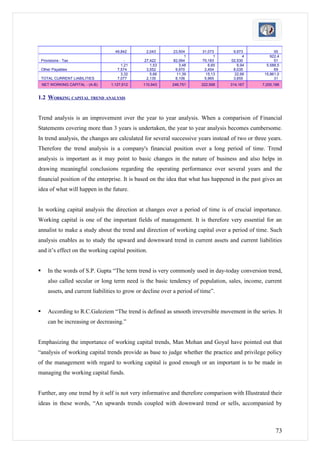
equity capital. Companies usually leverage to attempt to increase returns on equity capital, as it can
increase the scope for gains or losses. The temporary increases in stock prices due to leverage at some
                                                                                                     89
banks have been blamed for the unusually high overall remuneration for top executives during the
financial crisis of 2007–2010, since gains in stock prices were often rewarded regardless of how they
were achieved. Deleveraging is the action of reducing borrowings. In macroeconomics, a key measure
of leverage is the debt to GDP ratio.


One of the important objectives of working capital management is by maintaining the optimum level
of investment in current assets and by reducing the level of investment in current assets and by
reducing the level of current liabilities the company can minimize the investment in the working
capital thereby improvement in return on capital employed is achieved. The term working capital
leverage refers to the impact of level of working capital on company’s profitability. The working
capital management should improve the productivity of investment in current assets and ultimately it
will increase the return on capital employed. Higher level of investment in current assets than is
actually required means increase in the cost of Interest charges on short term loans and working capital
finance raised from banks etc. and will result in lower return on capital employed and vice versa.
Working capital leverage measures the responsiveness of ROCE (Return on Capital Employed) for
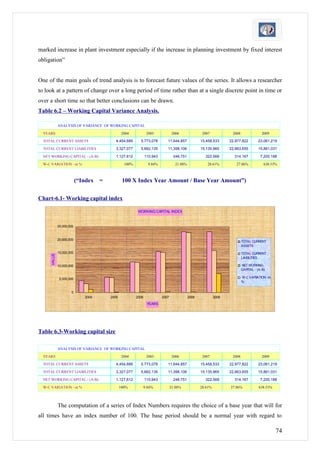
changes in current assets. It is measures by applying the following formula,


The working capital leverage reflects the sensitivity of return on capital employed to changes in level
of current assets. Working capital leverage would be less in the case of capital intensive capital
employed is same working capital leverage expresses the relation of efficiency of working capital
management with the profitability of the company.


           WORKING CAPITAL LEVERAGE = % CHANGES IN ROCE / % CHANGES IN CURRENT ASSETS
                                                                                                     90
RETURN ON CAPITAL EMPLOYED – (ROCE) = EBIT / TOTAL ASSETS


Table 6.10- Calculation of working capital leverages.

        YEARS                                             2006             2007                2008           2009
        ROCE                                              630%            1650%            1960%             2460%
        WC LEVERAGE                                       3.37             3.23                3.14            1.8


Chart 6.7- Working Capital Leverage


                                          WORKING CAPITAL LEVERAGE


                                                                                  24.60%
                25.00%


                                                                 19.60%
                20.00%
                                          16.50%
                                                                                                      ROCE
                15.00%
   % CHANGES
                                                                                                      WC LEVERAGE

                10.00%

                             6.30%

                5.00%            3.37%            3.23%               3.14%
                                                                                       1.80%

                0.00%
                              2006         2007                   2008             2009
                                                     YEARS


Working capital leverage of the company has decreased in the year 2009 as compare to the year 2006,
and increase in working capital shows the efficient current assets management. In the year 2006 and
2007 the current assets has increased by high rate of 261% and 347% respectively. It tends to increase
ROCE, which increased at the rate of 6.3% and 16.5% respectively, that resulted in push down the
working capital leverage to 3.37% and 2.32% respectively. When investment in current assets and
fixed asset will help the firm to run with sufficient fund without any overdraft or interrupt in it’s fund
flow.


                                            CHAPTER V1I
                                                                                                               91
1) Introduction
                                         2) Role of ratio analysis
                                         3) Limitations of ratio analysis
                                         4) Classifications of ratios
                                         5) Efficiency ratio
                                         6) Liquidity ratio


7.1 INTRODUCTION TO FINANCIAL RATIO ANALYSIS – ARABIAN INDUSTRIES LLC


Financial ratios are one of the most common tools of managerial decision making. Financial ratios
involve the comparison of various figures from the financial statements in order to gain information
about a company's performance. It is the interpretation, rather than the calculation, that makes

                                                                                                 92
financial ratios a useful tool for business managers. Ratios may serve as indicators, clues, or red flags
regarding noteworthy relationships between variables used to measure the firm's performance in terms
of profitability, asset utilization, liquidity, leverage, or market valuation.


Financial statement analysis is a judgmental process. One of the primary objectives is identification of
major changes in trends, and relationships and the investigation of the reasons underlying those
changes. The judgment process can be improved by experience and the use of analytical tools.
Probably the most widely used financial analysis technique is ratio analysis, the analysis of
relationships between two or more line items on the financial statement. Financial ratios are usually
expressed in percentage or times. Generally, financial ratios are calculated for the purpose of
evaluating aspects of a company's operations and fall into the following categories:


Ratio analysis is the powerful tool of financial statements analysis. A ratio is define as “the indicated
quotient of two mathematical expressions” and as “the relationship between two or more things”. The
absolute figures reported in the financial statement do not provide meaningful understanding of the
performance and financial position of the firm. Ratio helps to summaries large quantities of financial
data and to make qualitative judgment of the firm’s financial performance


7.2 ROLE OF RATIO ANALYSIS


Ratio analysis helps to appraise the firms in the term of there profitability and efficiency of
performance, either individually or in relation to other firms in same industry. Ratio analysis is one of
the best possible techniques available to management to impart the basic functions like planning and
control. As future is closely related to the immediately past, ratio calculated on the basis historical
financial data may be of good assistance to predict the future, the ratio analysis may be able to locate
the point out the various arias which need the management attention in order to improve the situation.
E.g. Current ratio which shows a constant decline trend may be indicate the need for further
introduction of long term finance in order to increase the liquidity position. As the ratio analysis is
concerned with all the aspect of the firm’s financial analysis liquidity, solvency, activity, profitability
and overall performance, it enables the interested persons to know the financial and operational
characteristics of an organization and take suitable decisions.
7.3 LIMITATIONS OF RATIO ANALYSIS


1   The basic limitation of ratio analysis is that it may be difficult to find a basis for making the
    comparison


                                                                                                        93
2   Normally, the ratios are calculated on the basis of historical financial statements. An organization
    for the purpose of decision making may need the hint regarding the future happiness rather than
    those in the past. The external analyst has to depend upon the past which may not necessary to
    reflect financial position and performance in future.


3   The technique of ratio analysis may prove inadequate in some situations if there is differs in
    opinion regarding the interpretation of certain ratio.


4   As the ratio calculates on the basis of financial statements, the basic limitation which is applicable
    to the financial statement is equally applicable In case of technique of ratio analysis also i.e. only
    facts which can be expressed in financial terms are considered by the ratio analysis.


5   The technique of ratio analysis has certain limitations of use in the sense that it only highlights the
    strong or problem arias, it dose not provide any solution to rectify the problem arias.


Ratio analysis is very important for the franchisor to establish norms and seek patterns of financial
operations over a period of time. Unfortunately, few franchisors (or any kind of business) use ratio
analysis -- it is estimated that just two percent compute financial ratios and use them in managing their
businesses. The franchisor can use ratio analysis also to obtain a bank loan.


There are different financial ratios which may


    1   liquidity ratios,
    2   leverage ratios,
    3   operating ratios, and
    4   profitability ratios


7.4 CLASSIFICATION OF WORKING CAPITAL RATIO


Working capital ratio means ratios which are related with the working capital management e.g. current
assets, current liabilities, liquidity, profitability and risk turnoff etc. these ratio are classified as follows
7.4.1   EFFICIENCY RATIO

The ratios compounded under this group indicate the efficiency of the organization to use the various
kinds of assets by converting them the form of sale. This ratio also called as activity ratio or assets
management ratio. As the assets basically categorized as fixed assets and current assets and the current
assets further classified according to individual components of current assets viz. investment and
receivables or debtors or as net current assets, the important of efficiency ratio as follow
                                                                                                              94
1) Working capital turnover ratio
        2) Inventory turnover ratio
        3) Receivable turnover ratio
        4) Current assets turnover ratio

7.4.2     LIQUIDITY RATIO

The ratios compounded under this group indicate the short term position of the organization and also
indicate the efficiency with which the working capital is being used. The most important ratio under
this group is follows

        1. Current ratio
        2. Quick ratio
        3. Absolute liquid ratio

7.5 EFFICIENCY RATIO

7.5.1     WORKING CAPITAL TURNOVER RATIO

It signifies that for an amount of sales, a relative amount of working capital is needed. If any increase
in sales contemplated working capital should be adequate and thus this ratio helps management to
maintain the adequate level of working capital. The ratio measures the efficiency with which the
working capital is being used by a firm. It may thus compute net working capital turnover by dividing
sales by working capital.


                      Working Capital Turnover Ratio = Sales / Net Working Capital

This ratio maker a comparison between net sales and net working capital in order to find the working
capital turnover ratio the working capital turnover ratio for the year 2004-2009. We can see an
increase in working capital turnover ratio for the next 5 year has increased in a gradual way in the last
year the net sales has been increased and the working capital in being similarly that of previous year
hence the working that of previous year hence the working that capital turnover ratio is 27.63 in 200
but 1.59 in 2009 after clearing all bills payables.


Table 7-1 Working Capital Turnover Ratio


            YEAR                       2004         2005          2006          2007          2008          2009

 GROSS SALES                       6,927,072   11,279,759   24,739,046    39,165,363    43,850,144    63,664,311

 Cost of Goods sold             -5,939,978     -9,866,566   -21,708,552   -33,554,054   -35,055,556   -52,042,769


                                                                                                             95
NET SALES                                987,094          1,413,192       3,030,494   5,611,309   8,794,588    11,621,541

 NET WORKING CAPITAL                  1,142,515              112,409        250,012     326,831     318,319      7,295,345

 WC TURN OVER RATIO                          0.86              12.57          12.12       17.17       27.63            1.59


Chart 7-1 Working Capital Turnover


                                                           WORKING CAPITAL TURNOVER


               18000000

               16000000

               14000000                                                                                  WC TURN OVER
                                                                                                         RATIO
               12000000
 WC TURNOVER


                                                                                                         NET WORKING
               10000000                                                                                  CAPITAL
                8000000
                                                                                                         NET SALES
                6000000

                4000000                                                                                  YEAR

                2000000

                     0
                          2004     2005             2006            2007        2008     2009
                                                            YEARS


Observations


High working capital ratio indicates the capability of the organization to achieve maximum sales with
the minimum investment in working capital. Company’s working capital ratio shows mostly more than
two, except for the year 2005-06 because of excess of cash balance in current assets which occurred
due to encashment of deposits. In the year 2004 and 2008 The ratio was above 3, it indicates that the
capability of the company to achieve maximum sales with the minimum investment in working
capital. But in the year 2009 the WC graph has gone down to 1.59% from 27.63 % in 2008. In 2009
wecan see that the payables are also gone down. That means after clearing all bills payables, still AI
LLC is having a good working capital reserve.


7.5.2              INVENTORY TURNOVER RATIO:


Inventory turnover ratio, defined as how many times the entire inventory of a company has been sold
during an accounting period, is a major factor to success in any business that holds inventory. It shows
how well a company manages its inventory levels and how frequently a company replenishes its
inventory. In general, a higher inventory turnover is better because inventories are the least liquid form
                                                                                                                        96
of asset. Inventory turnover ratio explanations occur very simply through an illustration of high and
low turnover ratios. Despite this, many businesses do not survive due to issues with inventory.


Average inventory and cost of goods sold are the two elements of this ratio. Average inventory is
calculated by adding the stock in the beginning and at the and of the period and dividing it by two. In
case of monthly balances of stock, all the monthly balances are added and the total is divided by the
number of months for which the average is calculated.


A low inventory turnover ratio shows that a company may be overstocking or deficiencies in the
product line or marketing effort. It is a sign of ineffective inventory management because inventory
usually has a zero rate of return and high storage cost.


Higher inventory turnover ratios are considered a positive indicator of effective inventory
management. However, a higher inventory turnover ratio does not always mean better performance. It
sometimes may indicate inadequate inventory level, which may result in decrease in sales.


Although the first calculation is more frequently used, COGS (cost of goods sold) may be substituted
because sales are recorded at market value, while inventories are usually recorded at cost. Also,
average inventory may be used instead of the ending inventory level to minimize seasonal factors.


This ratio should be compared against industry averages. A low turnover implies poor sales and,
therefore, excess inventory. A high ratio implies either strong sales or ineffective buying.


High inventory levels are unhealthy because they represent an investment with a rate of return of zero.
It also opens the company up to trouble should prices begin to fall.


    (a) [Inventory Turnover Ratio = Cost of goods sold / Average inventory at cost]

    (b) [Inventory Turnover Ratio = Net Sales / Average Inventory at Cost]

    (c) [Inventory Turnover Ratio = Net Sales / Average inventory at Selling Price]

    (d) [Inventory Turnover Ratio = Net Sales / Inventory]
Table 7-2- Inventory Turnover


           YEAR                     2004         2005           2006         2007        2008      2009
                                       5,           9,            21,         33,          35,    52,04
 COST OF GOODS SOLD              939,978      866,566        708,552     554,054      055,556     2,769
                                       1,           2,             2,          1,           2,      3,03
 AVERAGE INVENTORY               896,089      636,564        972,822     670,429      012,869     8,467
 INVENTORY TURNOVER                  3.1           3.7           7.3         20.1        17.4      17.1


                                                                                                       97
Chart 7-2 Inventory Turnover Ratio


                                             INVENTORY TURNOVER RATIO


              50,000,000

              45,000,000
                                                                                             COST OF
              40,000,000                                                                     GOODS
                                                                                             SOLD
              35,000,000
  INVENTORY


                                                                                             AVERAGE
              30,000,000                                                                     INVENTORY

              25,000,000
                                                                                             INVENTORY
                                                                                             TURNOVER
              20,000,000

              15,000,000

              10,000,000

               5,000,000

                      0
                           2004      2005      2006           2007      2008   2009
                                                      YEARS


Observations

It was observed that Inventory turnover ratio indicates maximum sales achieved with the minimum
investment in the inventory. As such, the general rule high inventory turnover is desirable but high
inventory turnover ratio may not necessary indicates the profitable situation. An organization, in order
to achieve a large sales volume may sometime sacrifice on profit, inventory ratio may not result into
high amount of profit.


The result represents the turnover or inventory or how many times inventory was used and then again
replaced. This number is representative for a one year time period. If the value of the inventory-
turnover ratio is low, then it indicates that the management team doesn't do its job properly in
managing inventories.
Importance of Inventory Turnover:

If the company can quickly sell its inventory, then the Inventory Turnover will be higher. Conversely,
if the company cannot sell its inventory very well, then the Inventory Turnover will be low. We have
to watch this figure closely - if the Inventory Ratio climbs too high, then the company may be keeping
too little inventory. This could cause lost profits due to customer orders that had to wait until
inventory arrived.
7.5.3            RECEIVABLE TURNOVER RATIO

Debtors turnover ratio or accounts receivable turnover ratio indicates the velocity of debt collection of
a firm. In simple words it indicates the number of times average debtors (receivable) are turned over
during a year.


Formula of Debtors Turnover Ratio:
                                                                                                       98
[Debtors Turnover Ratio = Net Credit Sales / Average Trade Debtors]


The two basic components of accounts receivable turnover ratio are net credit annual sales and
average trade debtors. The trade debtors for the purpose of this ratio include the amount of Trade
Debtors & Bills Receivables. The average receivables are found by adding the opening receivables
and closing balance of receivables and dividing the total by two. It should be noted that provision for
bad and doubtful debts should not be deducted since this may give an impression that some amount of
receivables has been collected. But when the information about opening and closing balances of trade
debtors and credit sales is not available, then the debtors turnover ratio can be calculated by dividing
the total sales by the balance of debtors (inclusive of bills receivables) given. and formula can be
written as follows.

                           [Debtors Turnover Ratio = Total Sales / Debtors]

The derivation of this ratio is made in following way


                Receivable turnover ratio = Gross sales/Average account receivables


Average receivable calculate by opening plus closing balance divide by 2. Increasing volume of
receivables without a matching increase in sales is reflected by a low receivable turnover ratio. It is
indication of slowing down of the collection system or an extend line of credit being allowed by the
customer organization. The latter may be due to the fact that the firm is loosing out to competition. A
credit manager engage in the task of granting credit or monitoring receivable should take the hint from
a falling receivable turnover ratio use his market intelligence to find out the reason behind such failing
trend.


Debtor turnover indicates the number of times debtors turnover each year. Generally the higher the
value of debtor’s turnover, the more is the management of credit.


                      Debtor’s turnover ratio = 365 days/Receivable turnover ratio
Table 7-3- Debtor’s Turnover Ratio


  YEAR                           2004        2005          2006          2007          2008         2009

  GROSS SALES                       6,         11,           24,       39,16            43,8         63,
                              927,072     279,759       739,046        5,363         50,144     664,311
  AVERAGE ACCOUNT                   2,          3,            6,       14,15            22,9         27,
  RECEIVABLE                  217,269     697,475       862,676        8,999         39,489     268,874


                                                                                                       99
RECEIVABLE
                                     3.12          3.05               3.60          2.77      1.91          2.33
  TURNOVER RATIO


Table 7-3- Receivable Turnover Ratio


                                            RECEIVABLE TURNOVER RATIO


             90,000,000

             80,000,000

             70,000,000
                                                                                                     RECEIVABLE
                                                                                                     TURNOVER
             60,000,000
  TURNOVER


                                                                                                     RATIO

             50,000,000
                                                                                                     AVERAGE
             40,000,000                                                                              ACCOUNT
                                                                                                     RECEIVABLE
             30,000,000
                                                                                                     GROSS SALES
             20,000,000

             10,000,000

                    -
                          2004     2005         2006           2007          2008      2009
                                                       YEARS


Observations

It was observed from receivable turnover ratio that receivables turned around the sales were less than 4
times. The actual collection period was more than normal collection period allowed to customer. It
concludes that over investment in the debtors which adversely affect on requirement of the working
capital finance and cost of such finance.

Significance of the Ratio:

Accounts receivable turnover ratio or debtors turnover ratio indicates the number of times the debtors
are turned over a year. The higher the value of debtors turnover the more efficient is the management
of debtors or more liquid the debtors are. Similarly, low debtors turnover ratio implies inefficient
management of debtors or less liquid debtors. It is the reliable measure of the time of cash flow from
credit sales. There is no rule of thumb which may be used as a norm to interpret the ratio as it may be
different from firm to firm.


7.5.4           CURRENT ASSETS TURNOVER RATIO

Current assets are a major component of the balance sheet and represent assets that are expected to be
sold or used, typically within the next 12 months. They are also an important measure of a companies
liquidity position. Current assets have become a very important factor in evaluating the financial
strength of a company, in the event of a weak economic environment or one of lower demand. Many

                                                                                                              100
of the popular financial ratios will utilize the current assets when performing analysis to gauge
financial performance and stability.

Current Assets Turnover ratio, shows the productivity of the company's current assets. The formula is
the following:

            = turnover / average (current assets, other + stocks + debtors + cash & equivalents)

Current assets turnover ratio is calculate to know the firms efficiency of utilizing the current assets.
Current assets includes the assets like inventories, sundry debtors, bills receivable, cash in hand or
bank, marketable securities, prepaid expenses and short term loans and advances. This ratio includes
the efficiency with which current assets turn into sales. A higher ratio implies a more efficient use of
funds thus high turnover ratio indicate to reduced the lock up of funds in current assets. An analysis of
this ratio over a period of time reflects working capital management of a firm.
                                        Current assets TOR= Sales / Current assets

Table 7.-4-Calculation of Current Assets Turnover Ratio


 YEAR                                       2004       2005            2006       2007       2008        2009
                                              6,        11,          24,73         39,        43,      63,66
 SALES                                  927,072    279,759           9,046    165,363    850,144       4,311
                                              8,        11,          22,64         30,        45,      41,93
 TOTAL CURRENT ASSETS                   673,117    645,737           4,900    612,473    900,693       7,417
 CURRENT ASSET TOR                         0.80       0.97            1.09       1.28       0.96        1.52


Chart No.7-4-Current assets Turnover Ratio


                                            CURRENT ASSET TURNOVER RATIO


                    60,000,000

                    50,000,000                                                             SALES
         TURNOVER


                    40,000,000
                                                                                           TOTAL
                    30,000,000                                                             CURRENT
                                                                                           ASSETS
                    20,000,000
                                                                                           CURRENT
                    10,000,000                                                             ASSET TOR

                           -
                                 2004       2005   2006       2007     2008   2009

                                                       YEARS


Observations

It was observed that current assets turnover ratio does not indicate any trend over the period of time.
Turnover ratio was 0.80 in the year 2004 and increase to 1.09 and 1.28 in the year 2006 and 2007
respectively, but it decreased in the year 2008, because of high cash balance. Cash did not help to
increase in sales volume, as cash is non earning asset. In the year 2006-07 company increased its sales
                                                                                                          101
with increased investment in current assets, thus current assets turnover ratio increased to 1.28 from
1.09 in the year 2006.
7.6 LIQUIDITY RATIO

7.6.1    CURRENT RATIO

Current ratio may be defined as the relationship between current assets and current liabilities. This
ratio is also known as "working capital ratio". It is a measure of general liquidity and is most widely
used to make the analysis for short term financial position or liquidity of a firm. It is calculated by
dividing the total of the current assets by total of the current liabilities.


The ratio is mainly used to give an idea of the company's ability to pay back its short-term liabilities
(debt and payables) with its short-term assets (cash, inventory, receivables). The higher the current
ratio, the more capable the company is of paying its obligations. A ratio under 1 suggests that the
company would be unable to pay off its obligations if they came due at that point. While this shows
the company is not in good financial health, it does not necessarily mean that it will go bankrupt - as
there are many ways to access financing - but it is definitely not a good sign.


The current ratio can give a sense of the efficiency of a company's operating cycle or its ability to
turn its Product into cash. Companies that have trouble getting paid on their receivables or have long
inventory turnover can run into liquidity problems because they are unable to alleviate their
obligations. Because business operations differ in each industry, it is always more useful to compare
companies within the same industry.


This ratio is similar to the acid-test ratio except that the acid-test ratio does not include inventory and
pre paid as assets that can be liquidated. The components of current ratio (current assets and current
liabilities) can be used to derive working capital (difference between current assets and current
liabilities). Working capital is frequently used to derive the working capital ratio, which is working
capital as a ratio of sales.
                         [Current Ratio = Current Assets / Current Liabilities]
                                                      Or
                                  [Current Assets: Current Liabilities]
Components:

The two basic components of this ratio are current assets and current liabilities. Current assets include
cash and those assets which can be easily converted into cash within a short period of time, generally,
one year, such as marketable securities or readily realizable investments, bills receivables, sundry
debtors, (excluding bad debts or provisions), inventories, work in progress, etc. Prepaid expenses

                                                                                                      102
should also be included in current assets because they represent payments made in advance which will
not have to be paid in near future.


Current liabilities are those obligations which are payable within a short period of tie generally one
year and include outstanding expenses, bills payable, sundry creditors, bank overdraft, accrued
expenses, short term advances, income tax payable, dividend payable, etc. However, some times a
controversy arises that whether overdraft should be regarded as current liability or not. Often an
arrangement with a bank may be regarded as permanent and therefore, it may be treated as long term
liability. At the same time the fact remains that the overdraft facility may be cancelled at any time.
Accordingly, because of this reason and the need for conversion in interpreting a situation, it seems
advisable to include overdrafts in current liabilities.


Limitations of Current Ratio:


This ratio is measure of liquidity and should be used very carefully because it suffers from many
limitations. It is, therefore, suggested that it should not be used as the sole index of short term
solvency.


1   It is crude ratio because it measures only the quantity and not the quality of the current assets.


2   Even if the ratio is favorable, the firm may be in financial trouble, because of more stock and work
    in process which is not easily convertible into cash, and, therefore firm may have less cash to pay
    off current liabilities.

3   Valuation of current assets and window dressing is another problem. This ratio can be very easily
    manipulated by overvaluing the current assets. An equal increase in both current assets and current
    liabilities would decrease the ratio and similarly equal decrease in current assets and current
    liabilities would increase current ratio.


Table 7-5-Current                                                                            Ratio

    YEAR                              2004        2005            2006            2007            2008            2009

    TOTAL CURRENT ASSETS                               5,             11,             15,             23,             23,
                                 4,513,561   849,374        798,754         662,831         281,494         365,993
    TOTAL CURRENT                                      6,             13,             15,             22,             16,
    LIABILITIES                  3,903,540   264,607        384,679         336,000         963,175         070,649

    CURRENT RATIO                     1.16         0.93           0.88            1.02            1.01            1.45

                                                                                                                      103
Chart No. 7.5 Current Ratio


                                           CURRENT ASSET RATIO
         25,000,000                                                               1.60

                                                                                  1.40
         20,000,000                                                                          TOTAL
                                                                                  1.20       CURRENT
                                                                                             ASSETS
         15,000,000                                                               1.00
                                                                                             TOTAL
 RATIO


                                                                                  0.80       CURRENT
         10,000,000                                                                          LIABILITIES
                                                                                  0.60
                                                                                             CURRENT
                                                                                  0.40
          5,000,000                                                                          RATIO
                                                                                  0.20

                -                                                                 0.00
                      2004   2005        2006           2007    2008     2009
                                                YEARS


Observations


The current ratio indicates the availability of funds to payment of current liabilities in the form of
current assets. A higher ratio indicates that there were sufficient assets available with the organization
which can be converted in cash, without any reduction in the value.: Generally, the higher the ratio,
the more liquid the company is. This means the company would have a better short-term financial
standing to meet its debt obligations.


A low current ratio is can often be supported by a strong operating cash flow. On the other hand, if a
company is able to operate with a low current ratio, it means that the company is more efficient about
using its capital. Therefore, a low current ratio can lead to higher return of assets. Generally speaking,
the more liquid the current assets, the smaller the current ratio can be without cause for concern. For
most industrial companies, 1.5 is an acceptable current ratio


7.6.2         QUICK RATIO


The quick ratio, defined also as the acid test ratio, reveals a company's ability to meet short-term
operating needs by using its liquid assets. It is similar to the current ratio, but is considered a more
reliable indicator of a company’s short-term financial strength. The difference between these two is
that the quick ratio subtracts inventory from current assets and compares the quick asset to the current
liabilities. Similar to the current ratio, value for the quick ratio analysis varies widely by company and
                                                                                                      104
industry. In theory, the higher the ratio is, the better the position of the company is. However, a better
benchmark is to compare the ratio with the industry average.


Quick ratios are often explained as measures of a company’s ability to pay their current debt liabilities
without relying on the sale of inventory. Compared with the current ratio, the quick ratio is more
conservative because it does not include inventories which can sometimes be difficult to liquidate. For
lenders, the quick ratio is very helpful because it reveals a company’s ability to pay off under the
worst possible condition.


Although the quick ratio gives investors a better picture of a company’s ability to meet current
obligations the current ratio, investors should be aware that the quick ratio does not apply to the
handful of companies where inventory is almost immediately convertible into cash.


Quick Ratio Formula


                   Quick Ratio = (Current assets – Inventories) / Current liabilities
                                                    Or
                                    Quick assets / Current liabilities
                                                    Or
               (Cash + Accounts Receivable + Cash equivalents) / Current liabilities


Quick Ratio Calculation


Quick ratio calculation is a useful skill for any business that may face cash flow issues. Quick assets
include those current assets that presumably can be quickly converted to cash at close to their book
values. It normally includes cash, marketable securities, and some accounts receivables. The quick
ratio, sometimes called the acid-test, is a more stringent test of liquidity than the current ratio. This is
because it removes inventory from the equation. Inventory is the least liquid of all the current assets. A
business has to find a buyer if it wants to liquidate inventory, or turn it into cash. Finding a buyer is
not always easy.
Quick ratios establish the relationship between quick or liquid assets and liabilities. An asset is liquid
if it can be converting in to cash immediately or reasonably soon without a loss of value. Cash is the
most liquid asset .other assets which are consider to be relatively liquid and include in quick assets are
debtors and bills receivable and marketable securities. Inventories are considered as less liquid.
Inventory normally required some time for realizing into cash. Their value also be tendency to
fluctuate. The quick ratio is found out by dividing quick assets by current liabilities


                                                                                                       105
Table 7-.6- Quick Ratio

 YEAR                                    2004           2005            2006        2007         2008            2009
                                       4,513,          5,849         11,798,     15,662,      23,281,         23,365,
 TOTAL CURRENT ASSETS                    561           ,374             754         831          494             993
                                         114,            465            162,        378,         571,            733,
 INVENTORY                               127           ,475             532         049          443             715
                                       4,399,          5,383         11,636,     15,284,      22,710,         22,632,
  LIQUID CURRENT ASSET                   434           ,899             222         782          051             278
                                       3,903,          6,264         13,384,     15,336,      22,963,         16,070,
 TOTAL CURRENT LIABILITIES               540           ,607             679         000          175             649
  QUICK RATIO                           1.13            0.86           0.87           1.00      0.99             1.41


Chart No.7-.6 Quick ratio


                                                       QUICK RATIO


          45,000,000

          40,000,000

          35,000,000
                                                                                                        QUICK RATIO
          30,000,000
 VALUES


          25,000,000
                                                                                                        TOTAL
          20,000,000                                                                                    CURRENT
                                                                                                        LIABILITIES
          15,000,000                                                                                    LIQUID
                                                                                                        CURRENT
          10,000,000                                                                                    ASSET

           5,000,000

                 -
                       2004     2005            2006           2007            2008          2009
                                                       YEARS


Observations

Quick ratio indicates that the company has sufficient liquid balance for the payment of current
liabilities. In some ways, the quick ratio is a more conservative standard. If the quick ratio is greater
than one, there would seem to be no danger that the firm would not be able to meet its current
obligations. If the quick ratio is less than one, but the current ratio is considerably above one, the
status of the firm is more complex.
In this case, the valuation of inventories and the inventory turnover are obviously in a better stage. The
liquid ratio of 1:1 is suppose to be standard or ideal. In the year 2007 and 2009 company had Rs.1.40
cash for every 1 rupee of expenses; such a policy is called conservative policy of finance for working
capital, Rs.0.90 is the ideal investment which affects on the cost of the fund and returns on the funds.


7.6.3        ABSOLUTE LIQUID RATIO


                                                                                                               106
Absolute liquid ratio is the ratio, which expresses the relationship between Absolute Liquid Assets and
Quick Liabilities.
Components of Absolute Liquid Assets


Absolute Liquid assets
    1. Cash in Hand and at Bank
    2. Readily Marketable Securities


Quick Liabilities
    1. Outstanding Expenses
    2. Bills Payable
    3. Sundry Creditors
    4. Short- term Advances
    5. Income Tax payable
    6. Dividends Payable


Expression of Absolute liquid ratio


                     Absolute Liquid Ratio = Absolute Liquid assets / Quick Liabilities


Significance of Absolute liquid ratio


The ratio shows very clearly whether a concern is liquid or not. In other words, it is the real measure
of the liquidity or short-term solvency of a concern Even though debtors and bills receivables are
considered as more liquid then inventories; it can not be converted in to cash immediately or in time.
Therefore the while calculation of absolute liquid ratio only the absolute liquid assets as like cash in
hand cash at bank, short term marketable securities are taken in to consideration to measure the ability
of the company in meeting short term financial obligation. It calculates by absolute assets dividing by
current liabilities.
Table 7.7- Absolute Liquid Ratio

 YEAR                              2004         2005       2006          2007          2008        2009
 Current Assets
                                   46,19       199,3         68,       570,26        145,24       1,917
 BANK/CASH                            8          87         798            7             5        ,381
                                  354,00        53,0        735,       518,99        341,15         100
 OTHER RECEIVABLES                    6          10         450            7             0        ,555
                                  400,20       252,3        804,     1,089,26        486,39       2,017
 TOTAL LIQUID ASSET                   3          97         248            4             5        ,936
                                3,371,04     5,736,9     11,548,    15,336,00     22,963,17      16,070
 CURRENT LIABILITIES                  7          65         742            0             5        ,649
  ABSOLUTE LIQUID
 RATIO                            0.119        0.044      0.070         0.071         0.021       0.126

                                                                                                    107
Chart No.7.7- Cash and bank to current liabilities

                                           ABSOLUTE LIQUID RATIO

          25,000,000


          20,000,000                                                   2008

                                                                                              ABSOLUTE
                                                                                              LIQUID
                                                                                  2009        RATIO
          15,000,000
 VALUES


                                                             2007
                                                                                              CURRENT
                                                                                              LIABILITIES
                                              2006
          10,000,000
                                                                                              TOTAL
                                                                                              LIQUID
                                                                                              ASSET
           5,000,000                2005
                          2004
                                                                                  2009
                                              2006           2007
                 -        2004      2005                               2008
                       2004      2005      2006           2007      2008       2009
                                                  YEARS


Observations

Absolute liquid ratio indicates the availability of cash with company is sufficient because company
also has other current assets to support current liabilities of the company. In the year 2007 and
2008,absolute liquid ratio increased because of company carry more cash balance, as a cash balance is
ideal assets company has to take control on such availability of funds which is affect on cost of the
funds. The absolute liquid ratio is the best for three years like 2007/2008/2009, and the cash balances
as to the current liability has improved for the firm. Firm has large resources in cash and bank
balances. While large resources in cash and bank balances may seem to affect the revenue the firm
could have earned by investing it elsewhere as maintenance of current assets as cash and in near cash
assets may increase the liquidity position but not the revenue or profit earning capacity of the firm.


                                           CHAPTER VIII


                                                                                                         108
1) Introduction
                                    2) Receivables Management
                                    3) Inventory Management
                                    4) Cash Management
                                    5) Working Capital Finance and Estimation
                                    6) Source of Working Capital
                                    7) Estimation of working capital


8.1   INTRODUCTION TO WORKING CAPITAL MANAGEMENT

Decisions relating to working capital and short term financing are referred to as working capital
management. These involve managing the relationship between a firm's short-term assets and its short-
term liabilities. The goal of working capital management is to ensure that the firm is able to continue
its operations and that it has sufficient cash flow to satisfy both maturing short-term debt and
upcoming operational expenses.


                                                                                                   109
Guided by the above criteria, management will use a combination of policies and techniques for the
management of working capital. These policies aim at managing the current assets (generally cash and
cash equivalents, inventories and debtors) and the short term financing, such that cash flows and
returns are acceptable.


     Debtors management. Identify the appropriate credit policy, i.e. credit terms which will attract
      customers, such that any impact on cash flows and the cash conversion cycle will be offset by
      increased revenue and hence Return on Capital (or vice versa); see Discounts and allowances.


     Cash management. Identify the cash balance which allows for the business to meet day to day
      expenses, but reduces cash holding costs.


     Inventory management. Identify the level of inventory which allows for uninterrupted
      production but reduces the investment in raw materials - and minimizes reordering costs - and
      hence increases cash flow; see Supply chain management; Just In Time (JIT); Economic order
      quantity (EOQ); Economic production quantity


     Short term financing. Identify the appropriate source of financing, given the cash conversion
      cycle: the inventory is ideally financed by credit granted by the supplier; however, it may be
      necessary to utilize a bank loan (or overdraft), or to "convert debtors to cash" through "factoring".


8.2     RECEIVABLES MANAGEMENT


Receivables or debtors are the one of the most important parts of the current assets which is created if
the company sells the finished goods to the customer but not receive the cash for the same
immediately. Trade credit arises when firm sells its products and services on credit and dose not
receive cash immediately. It is essential marketing tool, acting as bridge for the movement of goods
through production and distribution stages to customers. Trade credit creates receivables or book debts
which the firm is expected to collect in the near future. The receivables include three characteristics
1) It involve element of risk which should be carefully analysis.

2) It is based on economic value. To the buyer, the economic value in goods or services
passes immediately at the time of sale, while seller expects an equivalent value to be received
later on.

3) It implies futurity. The cash payment for goods or serves received by the buyer will be
made by him in a future period.

                                                                                                       110
1. OBJECTIVE OF RECEIVABLE MANAGEMENT

The sales of goods on credit basis are an essential part of the modern competitive economic system.
The credit sales are generally made up on account in the sense that there are formal acknowledgements
of debt obligation through a financial instrument. As a marketing tool, they are intended to promote
sales and there by profit. However extension of credit involves risk and cost, management should
weigh the benefit as well as cost to determine the goal of receivable management. Thus the objective
of receivable management is to promote sales and profit until that point is reached where the return on
investment in further funding of receivables is less .than the cost of funds raised to finance that
additional credit

Table 8.1-Size of receivables

 YEAR                             2004       2005               2006          2007             2008       2009
                                2,217,    2,960,4            7,804,5       12,708,                    13,615,5
 TRADE RECEIVABLES                269         13                 26           947        20,461,085        76
 RECEIVABLE INDEX                 100        134                   352          573            923        614


Chart 8.1-Receivable Index

                                             SIZE OF RECEIVABLES


            20,000,000                                                                        1000
                                                                         2008
                                                                            5
            18,000,000                                                                        900

            16,000,000                                                                        800

            14,000,000                                                                        700
                                                                                      2009                 Trade
            12,000,000                                      2007                         6    600
   VALUES


                                                               4                                           Debtors
            10,000,000                                                                        500
                                                                                                           INDEX
             8,000,000                     2006                                               400
                                              3
             6,000,000                                                                        300

             4,000,000                                                                        200
                                   2005
                         2004         2
             2,000,000      1                                                                 100

                   -                                                                          0
                         2004      2005    2006             2007         2008         2009
                                                    YEARS


2. AVERAGE COLLECTION PERIOD


The average collection period measures the quality of debtors since it indicate the speed of there
collection. The shorter the average collection period, the better the quality of the debtors since a short
collection period implies the prompt payment by debtors. The average collection period should be
compared against the firm’s credit terms and policy judges its credit and collection efficiency. The
collection period ratio thus helps an analyst in two respects.


                                                                                                           111
    In determining the collect ability of debtors and thus, the efficiency of collection efforts.
           In ascertaining the firm’s comparative strength and advantages related to its credit policy and
            performance. The debtor’s turnover ratio can be transformed in to the number of days of
            holding of debtors.


Table 8.2- Average Collection Period


 YEAR                                    2004              2005               2006              2007             2008          2009
 GROSS SALES                   6,927,072         11,279,759         24,739,046           39,165,363       43,850,144    63,664,311
 TRADE RECEIVABLES                 2,217,269     2,960,413          7,804,526            12,708,947       20,461,085    13,615,576
  RECEIVABLE
 TURNOVER                               3.12                3.81                 3.17           3.08             2.14          4.68
 AVERAGE
 COLLECTION PERIOD                    116.83               95.80               115.15         118.44          170.31         78.06


Chart No.8.2 Average Collection Period


                                                       AVERAGE COLLECTION PERIOD


               180.00                                                                170.31

               160.00

               140.00                                                                                                    RECEIVABLE
                                                                      118.44
                                                                                                                         TURNOVER
                           116.83                      115.15
               120.00
   VALUES


               100.00                    95.80
                                                                                                                         AVERAGE
                                                                                                  78.06                  COLLECTION
                80.00
                                                                                                                         PERIOD
                60.00

                40.00

                20.00
                        3.12          3.81          3.17           3.08           2.14         4.68
                 0.00
                        2004          2005          2006           2007           2008         2009

                                                           YEARS

3. Observations

The size of receivables are staidly increasing it indicates that the company was allowing more credit
year to year, but it was not bad signal because as receivables were supporting to the increase in the
sales. Average collection period are reducing to present situation, but as compare with the normal
collection period allowed to customer by JISL of 90 day’s, it was clear that the company required to
increase our efficiency of collection of receivables. All the above factors directly or indirectly affects
in the debtors turnover ratio, current ratio and working capital ratio. For effective management of
credit, the firm should lay down clear cut guidelines and procedure for granting credit to individual


                                                                                                                                112
customers and collecting individual accounts should involve following steps: (1) Credit information
(2) Credit investigation (3) Credit limits (4) Collection procedure.

8.3     INVENTORY MANAGEMENT

Inventory management is primarily about specifying the size and placement of stocked goods.
Inventory management is required at different locations within a facility or within multiple locations
of a supply network to protect the regular and planned course of production against the random
disturbance of running out of materials or goods. The scope of inventory management also concerns
the fine lines between replenishment lead time, carrying costs of inventory, asset management,
inventory forecasting, inventory valuation, inventory visibility, future inventory price forecasting,
physical inventory, available physical space for inventory, quality management, replenishment, returns
and defective goods and demand forecasting. Balancing these competing requirements leads to
optimal inventory levels, which is an on-going process as the business needs shift and react to the
wider environment.


     Inventory management involves a retailer seeking to acquire and maintain a proper merchandise
      assortment while ordering, shipping, handling, and related costs are kept in check.


     Systems and processes that identify inventory requirements, set targets, provide replenishment
      techniques and report actual and projected inventory status.


     Handles all functions related to the tracking and management of material. This would include the
      monitoring of material moved into and out of stockroom locations and the reconciling of the
      inventory balances. Also may include ABC analysis, lot tracking, cycle counting support etc.


     Management of the inventories, with the primary objective of determining/controlling stock levels
      within the physical distribution function to balance the need for product availability against the
      need for minimizing stock holding and handling costs
The term ‘inventory’ is used to designate the aggregate of those items of tangible assets which are:-


1) Finished goods (‘saleable’)
2) Work-in-progress (‘convertible’)
3) Material and supplies (‘consumable’)


In financial view, inventory defined as the sum of the value of raw material and supplies, including
spares, semi-processed material or work in progress and finished goods. The nature of inventory is


                                                                                                     113
largely depending upon the type of operation carried on. For instance, in the case of a manufacturing
concern, the
inventory will generally comprise all three groups mentioned above while in the case of a trading
concern, it will simply be by stock- in- trade or finished goods.


1. OBJECTIVE OF INVENTORY MANAGEMENT


In company there should be an optimum level of investment for any asset, whether it is plant, cash or
inventories. Again inadequate disrupts production and causes losses in sales. Efficient management of
inventory should ultimately result in wealth maximization of owner’s wealth. It implies that while the
management should try to pursue financial objective of turning inventory as quickly as possible, it
should at the same time ensure sufficient inventories to satisfy production and sales demand. The
objectives of inventory management consist of two counterbalancing parts:


     To minimize the firms investment in inventory
     To meet a demand for the product by efficiently organizing the firms production and sales
      operation.


This two conflicting objective of inventory management can also be expressed in term of cost and
benefits associated with inventory. That the firm should minimize the investment in inventory implies
that maintaining an inventory cost, such that smaller the inventory, the better the view point
.obviously, the financial manager should aim at a level of inventory which will reconcile these
conflicting elements. Some objectives are as follows:-


     To have stock available as and when they are required.
     To utilize available storage space but prevents stock levels from exceeding space available.
     To maintain adequate accountability of inventories assets.
     To provide, on item – by- item basis, for re-order point and order such quantity as would ensure
      that the aggregate result confirm with the constraint and objective of inventory control.
Table 8.3-Size of inventory


         YEAR                   2004           2005           2006          2007         2008          2009
                               114,1         465,47         162,53        378,04         571,          733,
 INVENTORY                       27               5              2             9         443           715
                             1,781,9       2,171,08       2,810,29      1,292,38       1,441,        2,304,
 WORK IN PROGRESS                62               8              1             0         426           752
                             1,896,0       2,636,56       2,972,82      1,670,42       2,012,        3,038,
    TOTAL INVENTORY              89               4              2             9         869           467
    INVENTORY INDEX             100            139           157             88         106           160


Chart No. 8.3 - Inventories index
                                                                                                        114
INVENTORY INDEX


             180

             160

             140

             120

             100
   VALUES
                                             157                                           160              INVENTORY INDEX
              80
                                 139
              60                                                            106
                       100
                                                             88
              40

              20

             -
                      2004      2005        2006           2007            2008          2009
                                                   YEARS


2. INVENTORY COMPONENTS

The manufacturing firm’s inventory consists following components:-
    I)           Inventory
    II)          Work- in-progress

To analyze the level of raw material inventory and work in progress inventory held by the firm on an
average it is necessary to examine the efficiency with which the firm converts raw material inventory
and work in progress into finished goods.


Table No. 8.4-Components of inventories


          YEAR                       2004          2005            2006            2007             2008              2009
                                                   465,            162,            378,           571,44             733,71
 INVENTORY                     114,127           475                532             049                 3                 5
                                               2,171,             2,810,          1,292,         1,441,42          2,304,75
 WORK IN PROGRESS             1,781,962            088             291             380                 6                 2


Chart No. 8.4-Components of inventories


                                                                                                                        115
INVENTORY COMPONENTS


          3,000,000


          2,500,000


          2,000,000
  VALUE


                                                                                            INVENTORY
          1,500,000
                                                                                            WORK IN PROGRESS


          1,000,000


           500,000


                -
                       2004      2005          2006          2007     2008      2009
                                                      YEAR


3. INVENTORY HOLDING PERIOD

The reciprocal of inventory turnover gives average inventory holding in percentage term. When the
numbers of days in year are divided by inventory turnover, we obtain Days of Inventory Holding
(DIH).

Inventory management involves a retailer seeking to acquire and maintain a proper merchandise
assortment while ordering, shipping, handling, and related costs are kept in check. Systems and
processes that identify inventory requirements, set targets, provide replenishment techniques and
report actual and projected inventory status.


Formula to calculate number of days inventory:

                      Number of Days Inventory = 365 days / inventory turnover ratio.

Number of day’s inventory ratio definition and explanation:


The number of day’s inventory is also known as average inventory period and inventory holding
period. A high number of days inventory indicates that, their is a lack of demand for the product being
sold. A low days inventory ratio (inventory holding period) may indicate that the company is not
keeping enough stock on hand to meet demands.                   The number of days inventory and inventory
turnover ratios are included in the financial statement ratio analysis spreadsheets highlighted in the left
column, which provide formulas, definitions, calculation, charts and explanations of each ratio.
Table - 8. 5- Inventory Turnover Ratio


 YEAR                                   2004            2005        2006       2007       2008          2009

                                                                                                         116
INVENTORY TURNOVER
 RATIO                                   3.1              3.7             7.3        20.1         17.4              17.1
 DAYS OF INVENTORY
 HOLDING                             117.74             98.65         50.00         18.16        20.98             21.35
                                      5,939,          9,866,5      21,708,5      33,554,0     35,055,5          52,042,7
 Cost of Goods sold                     978               66            52            54           56                69
                                        114,            465,4         162,5         378,0        571,4             733,7
 Inventory                              127               75            32            49           43                15
 RAW MAT. TURN OVER                    52.05            21.20        133.56         88.76        61.35             70.93
 RAW MAT. HOLDING PERIOD                7.01            17.22            2.73        4.11         5.95              5.15


Chart No. 8.5 – Inventory Turnover Ratio


                                               INVENTORY TURNOVER RATIO


           100


                                                                     20.1
                                                                                      17.4             17.1
  VALUES


            10
                                                  7.3

                               3.7
                      3.1


             1
                 2004       2005               2006               2007             2008           2009
                                                          YEARS


                                               INVENTORY TURNOVER RATIO


Table - 8.6-Inventory holding Period


         YEAR                        2004             2005          2006          2007         2008                2009
 INVENTORY TURNOVER
 RATIO                                3.1               3.7           7.3         20.1         17.4                 17.1
 DAYS OF INVENTORY
 HOLDING                           117.74          98.65            50.00         18.16        20.98               21.35
                                    5,939,        9,866,          21,708,       33,554,      35,055,
 COST OF GOODS SOLD                   978           566              552           054          556           52,042,769
                                      114,          465,             162,          378,         571,
 INVENTORY                            127           475              532           049          443             733,715
                                    1,781,        2,171,           2,810,        1,292,       1,441,
 WORK IN PROGRESS                     962           088              291           380          426            2,304,752
                                    1,896,        2,636,           2,972,        1,670,       2,012,
 TOTAL INVENTORY                      089           564              822           429          869            3,038,467
 RAW MAT. TURN OVER                  3.13             3.74          7.30         20.09        17.42                17.13
 RAW MAT. HOLDING
 PERIOD                            116.51          97.54           49.98         18.17        20.96                21.31


Chart- 8.6-Inventory holding Period


                                                                                                                     117
RAW MAT. HOLDING PERIOD

                         116.51

            120.00
                                     97.54

            100.00


             80.00
                                                49.98                                           RAW MAT.
 VALUES      60.00                                                                              HOLDING
                                                                                                PERIOD
             40.00                                                     20.96      21.31
                                                           18.17

             20.00


              0.00
                      2004        2005       2006       2007       2008        2009


                                                        YEARS


4. Observations
Size of inventory of AI LLC, was increasing gradually with the increase the sales. The inventory size
was increasing because of increment in the finished goods stock; it indicates that the company reduced
the liquidity of finished goods. High inventory turnover ratio is showing that the maximum sales
turnover is achieved with the minimum investment in the inventories. Raw material turnover has
increased in the year 2007 it indicates that company are investing more in raw material purchasing;
thus raw material holding period has reduced in the same year to 18 days from 49 days in the previous
year 2006. Overall inventory holding period has reduced because of increases in the inventory
turnover and sales volume.

8.4   MANAGEMENT OF CASH

Cash is money that is easily accessible either in the bank or in the business. It is not inventory, it is not
accounts receivable, and it is not property. These might be converted to cash at some point in time, but
it takes cash on hand or in the bank to pay suppliers, to pay the rent, and to meet the payroll. Profit
growth does not always mean more cash.


Profit is the amount of money you expect to make if all customers paid on time and if your expenses
were spread out evenly over the time period being measured. However, it is not your day-to-day
                                                                                                        118
reality. Cash is what you must have to keep the doors of your business open. Over time, a company's
profits are of little value if they are not accompanied by positive net cash flow. You can't spend profit;
you can only spend cash.


Cash Flow refers to the flow of cash into and out of a business over a period of time. The outflow of
cash is measured by the money you pay every month to salaries, suppliers, and creditors. The inflows
are the cash you receive from customers, lenders, and investors.


1. POSITIVE CASH FLOW

If the cash coming into the business is more than the cash going out of the business, the company has a
positive cash flow. A positive cash flow is very good and the only concern here is managing the
excess cash prudently.


2. NEGATIVE CASH FLOW

If the cash going out of the business is more than the cash coming into the business, the company has a
negative cash flow. A negative cash flow can be caused by a number of problems that result in a
shortage of cash, such as too much or obsolete inventory, or poor collections on accounts receivable. If
the company doesn't have money in the bank or can't borrow additional cash at this point, it may be in
serious trouble.


A Cash Flow Statement is typically divided into three components so that you can see and understand
both the internal and external sources and uses of cash.


3. OPERATING CASH FLOW (INTERNAL)

Operating cash flow, often referred to as working capital, is the cash flow generated from internal
operations. It is the cash generated from sales of the product or service of your business. Because it is
generated internally, it is under your control.


4. INVESTING CASH FLOW (INTERNAL)


Investing cash flow is generated internally from non-operating activities. This component would
include investments in plant and equipment or other fixed assets, nonrecurring gains or losses, or other
sources and uses of cash outside of normal operations.
5. FINANCING CASH FLOW (EXTERNAL)


                                                                                                     119
Financing cash flow is the cash to and from external sources, such as lenders, investors and
shareholders. A new loan, the repayment of a loan, the issuance of stock and the payment of dividend
are some of the activities that would be included in this section of the cash flow statement.


6. GOOD CASH MANAGEMENT MEANS:


Knowing when, where, and how your cash needs will occur, Knowing what the best sources are for
meeting additional cash needs; and, Being prepared to meet these needs when they occur, by keeping
good relationships with bankers and other creditors. Daily cash, and Long-term (annual, 3-5 year) cash
flow projections to help firms to develop the necessary capital strategy to meet their business needs.
They also prepare and use historical cash flow statements to gain an understanding about where all the
money went.
7. PRECAUTIONARY MOTIVE


Cash flows are somewhat unpredictable, with the degree of predictability varying among firms and
industries. Unexpected cash needs at short notice may also be the result of following:


1) Uncontrollable circumstances such as strike and natural calamities.
2) Unexpected delay in collection of trade dues.
3) Cancellation of some order for goods due unsatisfactory quality.
4) Increase in cost of raw material, rise in wages, etc.


The higher the predictability of firm’s cash flows, the lower will be the necessity of holding this
balance and vice versa. The need for holding the precautionary cash balance is also influenced by the
firm’s capacity to have short term borrowed funds and also to convert short term marketable securities
into cash.


8. SPECULATIVE MOTIVE


Speculative cash balances may be defined as cash balances that are held to enable the firm to take
advantages of any bargain purchases that might arise. While the precautionary motive is defensive in
nature, the speculative motive is aggressive in approach.


9. ADVANTAGES OF CASH MANAGEMENT


                                                                                                  120
Cash does not enter in to the profit and loss account of an enterprise, hence cash is neither profit nor
losses but without cash, profit remains meaningless for an enterprise owner.
    A sufficient of cash can keep an unsuccessful firm going despite losses

    An efficient cash management through a relevant and timely cash budget may enable a firm to
     obtain optimum working capital and ease the strains of cash shortage, fascinating temporary
     investment of cash and providing funds normal growth.

    Cash management involves balance sheet changes and other cash flow that do not appear in the
     profit and loss account such as capital expenditure.

Table 8.7-Size and index of cash

     YEAR                          2004          2005                2006          2007          2008        2009
     BANK/CASH                   46,198       199,387            68,798       570,267      145,245      1,917,381
     CASHINDEX                     100           432                 149           1234          314        4150

Chart No. 8.7-Cash Index

                                                 CASH INDEX


            10,000,000


             1,000,000


              100,000

                                                                                                        BANK/CASH
                 10,000
    INDEX
                  1,000
                                                                                                        CASHINDEX

                   100


                    10


                     1
                          2004    2005         2006           2007          2008          2009
                                                      YEARS


10. CASH CONVERSION CYCLE:-

The cash conversion cycle is simply the duration of time it takes a firm to convert its activities
requiring cash back into cash returns. The cycle is composed of the three main working capital
components: Accounts Receivable outstanding in days (ARO), Accounts Payable outstanding in days
(APO) and Inventory in days (IOD). The Cash Conversion Cycle (CCC) is equal to the time is takes to
sell inventory and collect receivables less the time it takes to pay your payables,


                                                        OR
                                          CCC = IOD + ARO – APO
Cash Cycle is very important, because it represents the number of days a firm's cash remains tied up
within the operations of the business. It is also a powerful tool for assessing how well a company is

                                                                                                               121
managing its working capital. The lower the cash conversion cycle, the more healthy a company
generally is. If you compare the results of the cycle over time and see a rising trend it is often a
warning sign that the business may be facing a cash flow crunch.


                                        CASH CONVERSION CYCLE


Understanding the components of the cycle


When evaluating cash flow, those factors directly affecting profit, revenue and expenses, are easy to
understand and their affect on cash is straight forward; decreases in costs or increases in profit margin
results in less cash going out or more cash coming in, and increased profits. However, the working
capital components of the CCC are a little more complex. In simple terms, an increase in the amount
of time accounts receivables are outstanding uses up cash, a decrease provides cash; an increase in the
amount of inventory uses cash, a decrease provides cash; an increase in the amount of time it takes
you to pay your payables provides cash, a decrease uses cash.


The Operating Cycle consists of 3 phases:-


Phase 1


In Phase 1, Cash gets converted into Inventory. This includes purchase of Raw Material, Conversion
of Raw Material into Work-in-Progress, Finished Goods and finally the transfer of goods to stock at
the end of the manufacturing process. In the case of Trading Companies, this phase is shorter as there
would be no manufacturing activity and cash is directly converted into Inventory. This Phase is of
course totally absent in the case of Service Organizations.


Phase 2


                                                                                                    122
In Phase 2 of the cycle, the Inventory is converted into Receivables as Credit Sales are made to
customers. Firms which do not sell on Credit obviously don't have the Phase 2 of the operating Cycle.


Phase 3


The Last Phase i.e. Phase 3 of the Operating Cycle, represents the stage when Receivables are
collected. This phase completes the operating cycle. Thus, the firm has moved from cash to inventory,
to receivables and to cash again.


Table 8.8-Operating Cycle


        YEAR                         2004            2005         2006       2007       2008          2009
 DAYS OF INVENTORY
 HOLDING                             117                98         50         18         21            21
 AVERAGE COLLECTION
 PERIOD                              117                96        115        118        170            78
 CREDITORS PAYMENT
 PERIOD                               70                75         65         70         85            55

 CASH CONVERTION CYCLE               163                118       100         67        106            44


Chart No. 8.8-Cash Conversion Cycle


                                                CASH CONVERSION CYCLE

         250


         200                                                                              AVERAGE
                                                                                          COLLECTION PERIOD
                117
                  163
                                                                                           DAYS OF
         150                                                                              INVENTORY
                              96
                                                                                          HOLDING
  DAYS


                               118
                                                                       106                CASH CONVERTION
                                         100
                                       115                           170                  CYCLE
         100
                                                                   85
                         75
               70                                       7011867                           CREDITORS
                                      65
                                                                              55 78       PAYMENT PERIOD
                117
         50                                                                        44
                              98

                                           50

                                                          18            21      21
          0
                2004      2005         2006              2007       2008       2009
                                                YEARS


Observations


                                                                                                       123
The size of the cash in the current assets of the company indicates the good cash management of the
company. After 2004, the cash balance in the year 2006 and 2008 was extremely increased; because of
the good collection from Debtors. Company failed to proper investment of available cash. After the
study of cash management it mentioned above it can be conclude that management of cash involve
three things: a) Managing cash flow into and out of the firm. b) Managing cash inflow within the firm,
c) Financial deficit or investing surpluses cash and thus controlling cash balance at a point of a time.
The firm should hold an optimum balance of cash and invest any temporary excess amount in short
term bank deposits and inter corporate deposit. The high portion of cash balance in the current assets it
adversely affected on profitability of the company as cash is ideal asset; it reduced the working capital
leverage.

8.5   WORKING CAPITAL FINANCE AND ESTIMATION

Introduction

Corporate finance is an area of finance dealing with financial decisions business enterprises make and
the tools and analysis used to make these decisions. The primary goal of corporate finance is to
maximize corporate value while managing the firm's financial risks. Although it is in principle
different from managerial finance which studies the financial decisions of all firms, rather than
corporations alone, the main concepts in the study of corporate finance are applicable to the financial
problems of all kinds of firms.


The discipline can be divided into long-term and short-term decisions and techniques. Capital
investment decisions are long-term choices about which projects receive investment, whether to
finance that investment with equity or debt, and when or whether to pay dividends to shareholders. On
the other hand, the short term decisions can be grouped under the heading "Working capital
management". This subject deals with the short-term balance of current assets and current liabilities;
the focus here is on managing cash, inventories, and short-term borrowing and lending (such as the
terms on credit extended to customers).


The terms corporate finance and corporate financier are also associated with investment banking. The
typical role of an investment bank is to evaluate the company's financial needs and raise the
appropriate type of capital that best fits those needs.


After determine the level of working capital, a firm has to consider how it will finance. Following are
sources of working capital finance.
8.6   SOURCES OF WORKING CAPITAL FINANCE


                                                                                                    124
1) Trade credit
2) Bank Finance
3) Letter of credit


1. Trade credit

Trade credit is an arrangement between businesses to buy goods or services on account, that is,
without making immediate cash payment. The supplier typically provides the customer with an
agreement to bill them later, stipulating a fixed number of days or other date by which the customer
should pay. It can be viewed as an essential element of capitalization in an operating business because
it can reduce the required capital investment required to operate the business if it is managed properly.
Trade credit is the largest use of capital for a majority of business to business (B2B) sellers in most of
the countries, and is a critical source of capital for a majority of all businesses.


2. BANK FINANCE FOR WORKING CAPITAL

Banks are main institutional source of working capital finance in India. After trade credit, bank credit
is the most important source of financing working capital in India. A banks considers a firms sales and
production plane and desirable levels of current assets in determining its working capital requirements.
The amount approved by bank for the firm’s working capital is called credit limit. Credit limit is the
maximum funds which a firm can obtain from the banking system. In practice banks do not lend 100%
credit limit; they deduct margin money.


Forms of bank finance:-

1) Over Draft
2) Term Loan
3) Cash credit
4) Purchase or discounting of bills

1) Overdraft

An overdraft occurs when withdrawals from a bank account exceed the available balance. In this
situation a person is said to be "overdrawn". If there is a prior agreement with the account provider for
an overdraft protection plan, and the amount overdrawn is within this authorized overdraft limit, then
interest is normally charged at the agreed rate. If the balance exceeds the agreed terms, then fees may
be charged and higher interest rate might apply.
2) Term Loan


                                                                                                     125
While the four prior debt instruments address cyclical working capital needs, term loans can finance
medium-term no cyclical working capital. A term loan is a form of medium-term debt in which
principal is repaid over several years, typically in 3 to 7 years. Since lenders prefer not to bear interest
rate risk, term loans usually have a floating interest rate set between the prime rate and prime plus 300
basis points, depending on the borrower’s credit risk. Sometimes, a bank will agree to an interest rate
cap or fixed rate loan, but it usually charges a fee or higher interest rate for these features. Term loans
have a fixed repayment schedule that can take several forms. Level principal payments over the loan
term are most common. In this case, the company pays the same principal amount each month plus
interest on the outstanding loan balance.


3) Cash credit


In practice, the operations in cash credit facility are similar to those of those of overdraft facility
except the fact that the company need not have a formal current account. Here also a fixed limit is
stipulated beyond which the company is not able to withdraw the amount.


4) Bills purchased / discounted


This form of assistance is comparatively of recent origin. This facility enables the company to get the
immediate payment against the credit bills / invoice raised by the company. The banks hold the bills as
a security till the payment is made by the customer. The entire amount of bill is not paid to the
company. The company gets only the present worth of amount of bill from of discount charges. On
maturity, bank collects the full amount of bill from the customer.


3. LETTER OF CREDIT


A standard, commercial letter of credit is a document issued mostly by a financial institution, used
primarily in trade finance, which usually provides an irrevocable payment undertaking. The letter of
credit can also be source of payment for a transaction, meaning that redeeming the letter of credit will
pay an exporter. Letters of credit are used primarily in international trade transactions of significant
value, for deals between a supplier in one country and a customer in another. They are also used in the
land development process to ensure that approved public facilities (streets, sidewalks, storm water
ponds, etc.) will be built. The parties to a letter of credit are usually a beneficiary who is to receive the
money, the issuing bank of whom the applicant is a client, and the advising bank of whom the
beneficiary is a client.
Almost all letters of credit are irrevocable, i.e., cannot be amended or canceled without prior
agreement of the beneficiary, the issuing bank and the confirming bank, if any. In executing a

                                                                                                        126
transaction, letters of credit incorporate functions common to General Inter bank Recurring Order and
Traveler's cheques. Typically, the documents a beneficiary has to present in order to receive payment
include a commercial invoice, bill of lading, and documents proving the shipment were insured against
loss or damage in transit. However, the list and form of documents is open to imagination and
negotiation and might contain requirements to present documents issued by a neutral third party
evidencing the quality of the goods shipped, or their place of origin.

Chart No. 8.-9-Cash Conversion Cycle


 YEAR                                      2004         2005                  2006     2007       2008     2009
                                             34            9                2,076,                2,04     561,
 SHORTTERM BORROWINGS                    5,371       12,579                   834               2,393      131
                                              2                               155,                  15      42,
 INTEREST @8.5%                          5,903       68,443                   763        -      3,180      085


Chart No. 8.9-Cash Conversion Cycle

                                                  WORKING CAPITAL LOAN AND INTEREST


                      2,000,000

                      1,800,000

                      1,600,000

                      1,400,000                                                               SHORTTERM
                                                                                              BORROWINGS
         BORROWINGS


                      1,200,000
                                                                                              INTEREST
                      1,000,000                                                               @8.5%


                       800,000

                       600,000

                       400,000

                       200,000

                            -
                                  2004     2005       2006           2007       2008   2009
                                                             YEARS


Observations

Arabian Industries LLC, takes only very low working capital loan to fulfill the requirement of working
capital, thus company saved a lot from paying interest, on working capital loan. Company raised the
funds for working capital through term loan from bank.. We can see that in 2007 firm doesn’t have
any kind of loan. The supplier extending trade credit incurs cost in the form of opportunity cost of
funds invested in accounts receivable. The annual opportunity cost of forgoing cash discount can be
very high. Therefore AI LLC, should compare the opportunity cost of trade credit with the cost of
other sources of credit while making its financial decisions.
8.7   Estimation of working capital


                                                                                                            127
After considering the various factors affecting the working capital needs, it is necessary to forecast the
working capital requirements. For this purpose, first of all estimate of all current assets should be
made, these should be followed by the estimation of all current liabilities. Difference between the
estimated current assets and estimated current liabilities will represent the working capital
requirements. The estimation of working capital requirement of Arabian Industries LLC is based on
few assumptions such as follows.

· Gross sales will increase by 40%
· Receivables collection period will be 90 day as per standards fixed by company.
· Unnecessary balance of Cash may reduce by finance management.
· For working capital finance company can use maximum trade credit.
· Inventory holding period can be 60 days instead of present 95


            ESTIMATED BALANCE SHEET OF ARABIAN INDUSTRIES LLC FOR THE YEAR 2010

                         2005        2006       2007        2008        2009       20%           2010
    CURRENT ASSET -
A
                             199         68,       570,        145,      1,917,        383
BANK BALANCE               ,387         798        267         245         381       ,476        2,300,857
                          2,960       7,804,    12,708,     20,461,     13,615,     2,723
TRADE DEBTORS              ,413         526        947         085         576       ,115       16,338,691
                             465        162,       378,        571,        733,        146
INVENTORY                  ,475         532        049         443         715       ,743          880,458
                          2,171       2,810,     1,292,      1,441,      2,304,        460
WORK IN PROGRESS           ,088         291        380         426         752       ,950        2,765,702
DUE FROM RELATED                        217,       194,        321,      4,694,        938
PARTIES                      -          158        191         144         015       ,803        5,632,818
                              53        735,       518,        341,        100,         20
OTHER RECEIVABLE           ,010         450        997         150         555       ,111          120,666
TOTAL CURRENT             5,849      11,798,    15,662,     23,281,     23,365,
ASSETS                     ,374         754        831         494         993           -      28,039,192

                                -           -          -           -           -         -               -
CURRENT
LIABILITIES - B               -          -             -        -           -           -                -
                             912      2,076,                 2,042,        561,        112
SHORT TERM LOAN            ,579         834         -          393         131       ,226          673,357
CURRENT PORTION              187        505,     1,455,      1,523,      2,217,        443
OF TERM LOAN               ,158         393        553         440         368       ,474        2,660,841
                          3,053       5,222,     6,931,     10,429,      6,268,     1,253
TRADE CREDITORS            ,555         137        094         836         619       ,724        7,522,343
DUE TO RELATED                  2        23,        31,      1,519,        426,         85
PARTIES                    ,070         814        484         796         463       ,293          511,755
                              27        184,       177,        407,        934,        186
PROVISION FOR TAX          ,784         470        498         850         642       ,928        1,121,570
                          1,553       3,536,     6,740,      7,039,      5,662,     1,132
OTHER PAYABLES             ,819         092        372         860         426       ,485        6,794,912
TOTAL CURRENT             5,736      11,548,    15,336,     22,963,     16,070,
LIABILITIES                ,965         742        000         175         649           -      19,284,778
NET WORKING                  112        250,       326,        318,      7,295,
CAPITAL - (A-B)            ,409         012        831         319         345           -       8,754,414
Table 8-10-Estimation of the Working Capital For the year 2010 For AI LLC.


Chart 8-10-Estimation of the Working Capital For the year 2010 For AI LLC.
                                                                                                        128
ESTIMATION OF WORKING CAPITAL FOR 2010

           30,000,000


           25,000,000

                                                                                         TOTAL
                                                                                         CURRENT
           20,000,000                                                                    ASSETS
  VALUES


                                                                                         TOTAL
           15,000,000                                                                    CURRENT
                                                                                         LIABILITIES


                                                                                         NET WORKING
           10,000,000
                                                                                         CAPITAL - (A-B)


            5,000,000


                  -
                        2005   2006     2007       2008       2009      2010   2010
                                                  YEARS


Observations

Arabian Industries LLC has good credit in the market because it is No. 1 Engineering and
Manufacturing Contracting Company in Sultanate of Oman, and 3rd position in entire GCC countries.
Company took benefit of such position to raise the funds for working capital finance. In the year 2006
and 2008, term loan from bank was the major source of finance, but it reduced by 250% in the
subsequent year, which shows the paying capacity due to the efficient financial management and also
it ndicate that company changed the finance policy to get benefit sources like term credit (export
package credit) which is not directly affect on cost of finance. In the year 2006 and 08 company used
latter of credit but after that company not used such facility from third person.. Company mainly used
term loan and letter of credit for the working capital requirement and clearing the debt for import
within the year itself. For working capital finance company use cash credit facility provided by
scheduled banks and national banks. Company required such huge amount for working capital finance
because liquidity of the company locked in debtors. Company had around 50 % receivables account of
total current assets. Company fixed normal collection period of 90 days, but collection system of the
company was not able to collection from debtors within credit term. Company has receivable but not
liquidity to payment of creditors thus company took cash credit and credit term, which increased the
interest on working capital finance by around 126% from year 2006 compared to 2005, but in 2007 it
become 126% and it reduced to 38.5 % in the year 2009. Cash management of the company is more
efficient and conservative thus company carry huge amount in terms of liquid assets.


                                                                                                       129
CHAPTER IX


                                         1-Findings
                                         3-Conclusions
                                         4-Recommendations


9.1 FINDINGS

Working capital management is important aspect of financial management. The study of working

capital management of Arabian Industries LLC, has revealed that the current ratio was as per the
                                                                                            130
standard industrial practice but the liquidity position of the company showed an increasing trend. The

study has been conducted on working capital ratio analysis, working capital leverage, working capital

components which helped the company to manage its working capital efficiency and affectively.


    1. Working capital of the company was increasing and showing positive working capital each
        year. It shows good liquidity position.

    2. Positive working capital indicates that company has the ability of payments of short terms

        liabilities.

    3. Working capital increased because of increment in the current assets is more than increase in

        the current liabilities.

    4. Company’s current assets were always more than requirement and it affected on profitability
        of the company.

    5. Current assets are more than current liabilities indicate that company used long term funds for

        short term requirement, where long term funds are most costly then short term funds.

    6. Current assets components shows sundry debtors were the major part in current assets it shows

        that the efficient receivables collection management.

    7. In the year 2009 working capital decreased because of increased the expenses as

        manufacturing expenses and increase the price of raw material as increased in the inflation

        rate.

    8. Inventory was supporting to sales, thus inventory turnover ratio was increasing, but company

        increased the raw material holding period.

    9. Study of the cash management of the company shows that company have a good control on

        cash management in the year 2009, where cash came from receivables and short term funds.

    10. When comparing Working capital is compared with net sales it is in increasing trend

        indicating the effective utilization of the net working capital.

    11. The decrease in figures of sources and applications from the year 20004- to the year 20009

        makes at clear that the company is doing activity increasing or standardizing of its operations.


9.2 CONCLUSION


                                                                                                    131
Working Capital is the lifeline of every industry, irrespective of whether it’s a manufacturing industry,

services industry. Working Capital is the prime and most important requirement for carrying out the

day to day operations of the business. Working Capital gives the much-needed liquidity to the

business. Working Capital Finance reduces the overall fund requirement, required to build up the

Current Assets, which in turn help you improve your Turn Over Ratio.


The company is performing exceptionally well due to the up wising in the global market followed by

the domestic market. It is an up coming one with good and innovative ideas and believed in improving

all the areas of its operations. The company has a good liquidity position and does not delay its

commitment in case of both its creditors and debtors. The company being mostly dependent on the

working capital facilities, it is maintaining very good relationship with their banks and their working

capital management is well balanced.


1. The working capital position of the company is sound and the various sources through which it is
    funded are optimal.


2. The company has used its dividend policy, purchasing, financing and investment decisions to good
    effect can be seen from the inferences made earlier in the project.


3. The returns have been affected by a marked growth in working capital and 2009 return on
    investment is good, but it got reduced as compared to 2008.


4. The various ratios calculated are an indicator as to the fact that the profitability of the firm and
    sales are on a rise and also the deletion of the inefficiencies in the working capital management.


5. The firm has not compromised on profitability despite the high liquidity is commendable.


6. Arabian Industries has reached a position where the default costs are as low as negligible and
    where they can readily factor their accounts receivables for availing finance is noteworthy.

9.3 SUGGESTIONS


                                                                                                     132
Suggestions can be use by the firm for the betterment increased of the firm after study and
analysis of project report on study and analysis of working capital. The suggestions are:-


    1. Company should raise funds through short term sources for short term requirement of funds,
          which comparatively economical as compare to long term funds.

    2. Company should take control on debtor’s collection period which is major part of current
          assets.

    3. Company has to take control on cash balance because cash is non earning assets and
          increasing cost of funds.

    4. Company should reduce the inventory holding period with use of zero inventory concepts.


    5. The current assets should be managed more effectively so as to avoid unnecessary blocking of
          capital that could be used for other purposes.

    6. There are various global challenges that are faced by every company n the present competitive
          environment and AI LLC is not any exemption. To face the present global challenges the
          human resources department should be develop to improve various skills among the
          employees specially the motivational skills and having the regular training for the employees
          about various developments in the market.

Over all company has good liquidity position and sufficient funds to repayment of liabilities.
Company has accepted conservative financial policy and thus maintaining more current assets balance.
Company is increasing sales volume per year which supported to company for sustain 2nd position in
Sultanate of Oman and 3rd position in GCC Countries.


          Summarizing the overall project work done during these 2 months, it can be said that the
project was a good learning experience. The entire staff of finance department was very cooperative
and they helped in all the phases of this project. It was an opportunity to learn about inventory
management at the same time problems faced by the Company. These two months has given an
opportunity to conceptualize and implement a new initiative. There we could learn how to interpret
working capital and ratio analysis with the help of guidance given by the Finance Manager. There
were lot of difficulties in the beginning of the project but slowly it got the grip on the road towards
future.


                                                                                                   133

Working capital final project-ii

  • 1.
    CHAPTER - I 1-BACKGROUND OF THE STUDY 2-STATEMENT OF PROBLEM 3-OBJECTIVES OF THE STUDY 4-HYPOTHESIS 5-METHODOLOGY 6-LIMITATIONS OF THE STUDY 7-STRUCTURE OF THE WORKS. 1.1 BACKGROUND OF THE STUDY. 1
  • 2.
    “THE MAJOR OBJECTIVEOF THIS STUDY IS FOR THE PROPER UNDERSTANDING OF THE WORKING CAPITAL OF ARABIAN INDUSTRIES LLC AND TO SUGGEST NECESSARY MEASURES TO OVERCOME THE SHORTFALLS IF ANY IN THE INDUSTRY.” The project undertaken is on “Working Capital Management of Arabian Industries LLC.”. It describes about how the company manages its working capital and the various steps that are required in the management of working capital. Cash is the lifeline of a company. If this lifeline deteriorates, so does the company's ability to fund operations, reinvest and meet capital requirements and payments. Understanding a company's cash flow health is essential to making investment decisions. A good way to judge a company's cash flow prospects is to look at its Working Capital Management (WCM). Working capital refers to the cash of a business requires for day-to-day operations or, more specifically, for financing the conversion of raw materials into finished goods, which the company sells for payment. Among the most important items of working capital are levels of inventory, accounts receivable, and accounts payable. Analysts look at these items for signs of a company's efficiency and financial strength. The working capital is an important yardstick to measure the company’s operational and financial efficiency. Any company should have a right amount of cash and lines of credit for its business needs at all times. This project describes how the management of working capital takes place at Arabian Industries LLC.. There are numerous instances in the history of business world where inadequacy of working capital has led to business failures when a firm finds it difficult to meetings day to day affairs. Operating expenses essential out lays may have to be postponed for want of funds, operating plans will go out of gear & enterprise objectives on investment slumps the suppliers & creditors of the firm may have to wait longer to raise their dues & will hesitate to extend further credit to the firm. Thus efficient management of working capital in an important prerequisite for successful working of a business concern it reduces the chances of business failure generates a felling of security and confidence in the minds of personnel in the organization it assurance solvency of steady of the organization. 1.2 STATEMENT OF PROBLEM 2
  • 3.
    In the managementof working capital, the firm is faced with two key problems: 1. First, given the level of sales and the relevant cost considerations, what are the optimal amounts of cash, accounts receivable and inventories that a firm should choose to maintain? 2. Second, given these optimal amounts, what is the most economical way to finance these working capital investments? To produce the best possible results, firms should keep no unproductive assets and should finance with the cheapest available sources of funds. Why? In general, it is quite advantageous for the firm to invest in short term assets and to finance short-term liabilities. Besides this followings are some other problem , a firm is facing. Through this study we try to find answer for these problems. 1. What are root causes of working capital on business? 2. What are the major effects on accounts receivable? 3. What is the nature of relationship between working capital and capital employed 4. What steps should be taken to ensure that it effect on the profit of the firm will not be negative? 5. How can working capital be managed? 6. What make up the working capital cycle? 7. How can debtors be controlled? 1.3 NEED AND IMPORTANCE OF THE STUDY. 1.This projects is helpful in knowing the companies position of funds maintenance and setting the standards for working capital inventory levels, current ratio level, quick ratio, current asset turnover level & size of current liability etc. 2. This project is helpful to the managements for expanding the dualism & the project viability & present availability of funds. 3. This project is also useful as it combines the present year data with the previous year data and there by it show the trend analysis, i.e. increasing fund or decreasing fund. 4. The project is done as a whole entirely. It will give overall view of the organization and it is useful in further expansion decision to be taken by management. 1.4 OBJECTIVES OF THE STUDY 3
  • 4.
    The main objectiveof the study is to determine the effect of working capital on business profitability which has to do with:- 1. Maintenance of working capital at appropriate level, and 2. Availability of ample funds as and when they are needed To accomplishment of these two objectives, the management has consider the composition of current assets pool. The working capital position sets the various policies in the business with respect to general operations like purchasing, financing, expansion and dividend etc, The subsidiary Objective of Working Capital Management is to provide adequate support for the smooth functioning of the normal business operations of a company. This Objective can be sub- divided into 2 parts:- 1. Liquidity 2. Profitability 1) Liquidity The quantum of Investment in Current Assets has to be made in a manner that it not only meets the needs of the forecasted sales but also provides a built in cushion in the form of safety stocks to meet unforeseen contingencies arising out of factors such as delays in arrival of Raw Material, sudden spurts in demand etc. Consequently, the investment in current assets for a given level of forecasted sales will be higher if the management follows a conservative attitude than when it follows an aggressive attitude. Thus, a company following a conservative approach is subject to a lower degree of risk than the one following an aggressive approach. Further, in the former situation the high amount of Investment in Current Assets imparts greater liquidity to the company than under the latter situation wherein the quantum of investment in Current Asset is less. This aspect exclusively covers the liquidity dimension of Working Capital. 2) Profitability Once we recognize the fact that the total amount of financial resources at the disposal of a company is limited and these can be put to alternative uses, the larger the amount of investment in current assets, the smaller will be the amount available for investment in other profitable avenues at hand with the company. A conservative approach in respect of Investment in Current Assets leaves fewer amounts for other Investments than an aggressive approach does. 1.5 HYPOTHESIS 4
  • 5.
    Hypothesis is aconjectural statement of the relationships between two or more variables. It is testable, tentative problem explanation of the relationship between two or more variables that create a state of affairs or phenomenon.E,C, Osuola said hypothesis should always be in declarative sentence form, and they should relate to them generally or specially variable to variables. Hypothesis thus:- 1. Explain observed events in a systematic manner 2. Predict the outcome of events and relationships 3. Systematically summarized existing knowledge. In essence, there exist null hypothesis set up only to nullify the research hypothesis and the alternative hypothesis, for the purpose of the study. For the efficiency of the study, the hypothesis is as follows: H0 1. Working capital does not help the business concern in maintaining the goodwill 2. Working capital does not create an environment of security, confidence, and overall efficiency in a business H1 1. Working capital helps the business concern in maintaining the goodwill. 2. Working capital creates an environment of security, confidence, and overall efficiency in business. 1.6 METHODOLOGY Methodology may be a description of process, or may be expanded to include a philosophically coherent collection of theories, concepts or ideas as they relate to a particular discipline or field of inquiry. This project requires a detailed understanding of the concept – “Working Capital Management”. Therefore, firstly we need to have a clear idea of, what is working capital, how it is managed in Arabian Industries LLC, what are the different ways in which the financing of working capital is done in the organization etc. To recognize the various type of information which are necessary for the study of working capital management. 5
  • 6.
    The management of working capital involves managing inventories, accounts receivable and payable and cash. Therefore one also needs to have a sound knowledge about cash management, inventory management and receivables management.  Then comes the financing of working capital requirement, i.e. how the working capital is financed, what are the various sources through which it is done.  And, in the end, suggestions and recommendations on ways for better management and control of working capital are provided. Collection of data from various department of AILLC to analyze the working capital management of the firm. 1.6.1 COLLECTION OF DATA There are several ways of collecting both data-Primary and Secondary datas, which differ considerably in context of money, cost, time and other sources at the disposable of the researcher. There are two types of data: · Primary data · Secondary data 1-Primary Data Definition:- The first handed information/Fresh data collected through various methods is known as primary data. In respect of primary data which the researchers are directly collects data that have not been previously collected. The primary data was gathered through personal interaction with various functional heads and other technical personnel. Some information was also collected by observation. 2-Secondary Data : Definition:- 6
  • 7.
    The data whichhave been already collected & comprised for another purpose. Secondary data was collected various reports, annual reports, documents charts, management information systems, etc in AI LLC, And also collected various magazines, books, newspapers etc. The analysis of the information gathered has been made on the basis of the clarifications sought during the personal discussions with the concerned people and perception during the personal visits to the important areas of services. In marking observations identifying problems and suggesting certain remedies such emphasis was given on the basis of opinions gathered during the personal discussions and with the personal experience gained during the academic study of M.B.A course. 1.6.2 TOOLS EMPLOYED The data presentation tools are mainly Mathematical tools, Tables and Charts are used for this study. The most important parts of tools include; a) Table numbers b) Title of the table c) Caption d) Stub or the designation of the rows and columns e) The body of the table f) The head note or prefatory note or explanatory just before the title. g) Source note, which refers to the literally or scientific source of the table has observed that a table has the following merits over a prose information that; h) A table ensures an easy location of the required figure; i) Comparisons are easily made utilizing a table than prose information; j) Patterns or trends within the figures which cannot be visualized in the prose information can be revealed and better depicted by a table; and a table is more concise and takes up a less space than a prose formation: 1.6.3 TIME SPAN A period of six year i.e. 2004-2009 has been taken for the study. 1.7 LIMITATIONS OF THE STUDY. 7
  • 8.
    The following arethe various limitations involved in the study. . 1. The study in limited 4 years (2004-2005) to (2005-2006) performance of the company. 2. The data used in this study have been taken from published annual report only. 3. This study in conducted within a short period. During the limited period the study may not be retailed, full fledged and utilization in all aspects. 4. Financial accounting does not take into account the price level changes. 5. We cannot do comparisons with other companies unless and until we have the data of other companies on the same subject. 6. Only the printed data about the company will be available and not the back–end details. 7. Future plans of the company will not be disclosed to us. 8. Lastly, due to shortage of time it is not possible to cover all the factors and details regarding the subject of study. 1.8 CHAPTERIZATION This research work is to be organized in nine chapters as follows:  Chapter – 1 - Introduction  Chapter-II - Manufacturing Industry in Oman – A profile  Chapter-III - Arabian Industries LLC-A Profile  Chapter-IV - A Theoretical Perspective of Working Capital Management  Chapter – V - Research methodology  Chapter VI - Analysis of Working Capital Level  Chapter VII - Analysis of Financial Statement  Chapter – VIII - Management of working capital and it’s Financing and Estimation  Chapter – IX - Findings, Conclusion and Recommendations 8
  • 9.
    CHAPTER – II 1-Introduction 2-Present Scenario 3-Foreign Investment 4-Oman Economy 5-Major Diversification 6-Oman Industry- An over view 7-ManufacturingIndustry in Oman 8-The Scope of Oil and Gas Industry. 2.1 OMAN PETROLEUM INDUSTRY - INTRODUCTION 9
  • 10.
    Oman's petroleum depositswere discovered in 1962, decades after most of those of its neighbours. Moreover, Oman's oil fields are generally smaller, more widely scattered, less productive, and more costly per barrel than in other Persian Gulf countries. The average well in Oman produces only around 400 barrels per day (bbl/d), about one-tenth the volume per well of those in neighboring countries. To compensate, Oman uses a variety of enhanced oil recovery (EOR) techniques. While these raise production levels, they increase the cost. According to the 2008 BP Statistical Energy Survey, Oman had proved oil reserves of 5.572 billion barrels at the end of 2007, the bulk of which are located in the country's northern and central regions. The largest and traditionally most reliable fields are in the north. These fields, which include Yibal (the biggest), Fahud, al-Huwaisah, and several others, are now mature and face future declines in production. In spite of declining production, Oman remains a significant non- OPEC oil exporter. According to the 2008 BP Statistical Energy Survey, Oman produced an average of 717.8 thousand barrels of crude oil per day in 2007, 0.9% of the world total and a change of -4.6 % compared to 2006./P> /P>Oman exports significant amounts of liquefied natural gas and, according to the 2008 BP Statistical Energy Survey, had 2007 proved natural gas reserves of 0.69 trillion cubic metres and 2007 natural gas production of 24.1 billion cubic metres./P> . 2.2 PETROLEUM INDUSTRY – PRESENT SCENARIO. The petroleum industry forms the backbone of Oman's economy. Over the past three decades, the oil reserve has helped the Sultanate move from strength to strength economically. But can Oman depend wholly on its natural resources or it needs to diversify into other areas to sustain and bolster its economy is an important question mark. The oil price slump in 1998-99 forced Oman to take steps to diversify and put greater emphasis on other industries, such as tourism and liquid natural gas. Oman's Basic Statute of the State expresses in Article 11 that "The National Economy is based on justice and the principles of a free economy." 10
  • 11.
    Recent official statisticsreveal that the oil sector's share in the GDP has risen to 49 per cent in 2005 from 42.2 per cent in 2004. According to the 2006 annual report of the Central Bank of Oman (CBO), "The fiscal position remained strong in 2005, with the fiscal recording a surplus of about 2.6 per cent of GDP. As against a budgeted deficit of RO540 million in 2005, there was a net surplus of RO303 million." Revenues from the petroleum sector rose 44.3 per cent in 2005. Non-oil revenues rose 9.2 per cent, driven by a strong 17.8 per cent growth in non-oil industrial activities. The average price of Omani crude was about US $50.26 per barrel in 2005, representing a 46 per cent rise over the average price of US $34.42 in 2004. As a result, the share of oil and gas sector in the GDP, exports and net government revenue rose to 49 per cent, 84.2 per cent and 79 per cent, respectively, in 2005. After a period of subdued inflation, 2004 saw signs of minor rise in prices, which persisted in 2005. Consumer price inflation rose from 0.7 per cent in 2004 to 1.9 per cent in 2005. But the Sultanate's inflation at 2.3 per cent was still lower than the average inflation in advanced countries in 2005. A VIEW OF OIL DRILLING AREA A close look at the June 1995 “Vision Conference: Oman 2020” reveals that a lot of strategic planning went into the formulation of initiatives aimed at securing Oman's future prosperity and growth. These include:-  To have economic and financial stability.  To reshape the role of the government in the economy and to broaden private sector participation. 11
  • 12.
     To diversifythe economic base and sources of national income.  To globalise the Omani economy.  To upgrade the skills of the Omani workforce and develop human resources. It is expected that by 2020 the economy will not be reliant on oil, but rather diversified into non oil sectors, raising higher levels of savings and investments. Studies reveal that the crude oil sector's share of GDP is estimated to drop to 9 per cent in 2020, compared with 41 per cent in 1996. Also, the gas sector is expected to contribute around 10 per cent to GDP, compared with less than 1 per cent in 1996, while the non-oil industrial sector's contribution is expected to increase from 7.5 per cent to 29 per cent. 2.3 INCENTIVES FOR FOREIGN INVESTMENT In a bid to reinforce the existing set-up as well as make room for further development in the petroleum sector, the government has undertaken a string of measures to provide incentives to foreign investors. These include: 1. Tax exemption for five years (sometimes renewable for a further five years) for industrial enterprises which contribute to Oman's economy. 2. Foreign investors allowed to hold 49 per cent of equity, which could be increased in mitigating circumstances. 3. Concessional financing may be arranged through the Ministry of Commerce and Industry and Oman Development Bank. 4. A clear and efficient legal network which offers advice on company law, copyright law, arbitration and agency law. 5. A diverse economy which encourages privatisation of infrastructure and services. 6. Price stability, with an inflation rate of not more than 1 per cent since 1992. 7. Stable currency with full convertibility. 8. No personal income tax and no foreign exchange controls. 9. Tax and import duty exemptions. 10. Interest-free long-term loans to partly foreign-owned industrial and tourism projects. Foreign business participation in Oman is encouaged provided the company is established in accordance with the Foreign Business and Investment Law of 1974. Foreign companies are formed as an incorporation of a local company or other commercial entity. They may also exist as a branch 12
  • 13.
    office, a consultancyor by appointing a commercial agent, ensuring that the company only supplies services and/or goods to be imported into the Sultanate. PDO – HEAD QUARTERS Airline and shipping offices as well as companies with occasional business are not governed by the Foreign Business and Investment Law. Potential businesses should supply the company's articles of incorporation and other pertinent information when applying for authorisation to the Foreign Capital Investment Committee at the Ministry of Commerce and Industry. 2.4 OMAN ECONOMY AND PETROLEUM INDUSTRY – A REVIEW According to the CBO annual report, the improved macroeconomic environment has been reflected in the upgrading of the Sultanate's rating by Moody's from Baa2 to Baa1 in October 2005. In January 2006, Standard and Poor's also reaffirmed their local and foreign currency sovereign credit ratings for Oman at "A-/A-2" and "BBB+/A-2", respectively, with a "stable" outlook. It may be noted that the government debt as a percentage of GDP continued to decline and, by the end of 2005, fell to 8.6 per cent. The most striking aspect of the developments in the banking system in 2005 relates to the surge in profits. Net profits of banks rose from RO79.4 million in 2004 to RO123.2 million in 2005 while net foreign assets of commercial banks rose by 127.9 per cent, from RO256.6 million in 2004 to RO584.9 million in 2005.The current account (comprising trade, services, income and transfers) showed a surplus of RO1813 million in 2005 as against RO219 million in 2004. The trade account, reflecting the excess of export earnings over merchandise imports, showed a high surplus of RO4100 million in 2005 as against a surplus of RO2118 million in 2004. The nominal GDP, exports and government revenue are expected to benefit further from the favourable oil price scenario in 2006. This favourable phase provides an opportune time to use the surplus oil revenue in diversifying the economy. Greater openness to trade and foreign investment, 13
  • 14.
    phased implementation ofthe privatisation programme of the government, and reversing the declining trend in oil production will help strengthen the growth impulses in the economy. In 2002, the petroleum ministry took big steps to encourage international companies to invest in abandoned concession onshore and offshore areas. Oil and Gas Minister Dr. Mohammed Bin Hamad al-Rumhi had then called on Petroleum Development Oman (PDO) and international companies operating in oil and gas exploration and production to continue their efforts to discover new fields and improve extracting methods and techniques. The minister upheld his ministry's resolve to provide necessary infrastructure and the government constructed three pipelines to transport gas from the central region to Sur, Sohar and Salalah for existing industrial estates and power plants. The transported gas was to be used to operate power plants in Salalah and Barka, and petrochemical, aluminum, cement factories, oil refinery and other industries in Sohar and Raysut industrial estates. With the new infrastructure in place, the scene has improved significantly. Foreign investors are now keen on joint ventures in these regions. 2.5 ECONOMY ON THRESHOLD OF MAJOR DIVERSIFICATION When His Majesty Sultan Qaboos Bin Said assumed power in 1970, he embarked on his vision of putting the Sultanate on a progressive path of making the country economically stable. He left the doors open for other countries to join hands with the local government in constructing Oman into a nation that would stride comfortably into the 21st century. In his zeal for economic development and modernization, he launched a programme to built and expand the country's almost non-existent infrastructure. As the 70s rolled on, the country achieved substantial progress in developing physical and social infrastructure. New roads, a new deepwater port, an international airport, electricity-generating plants, schools, hospitals and low-cost housing were built from money that came exclusively from oil receipts. 2.6 THE MANUFACTURING INDUSTRY - AN OVERVIEW 14
  • 15.
    The manufacturing sectoris part of the goods-producing industries super sector group. The Manufacturing sector comprises establishments engaged in the mechanical, physical, or chemical transformation of materials, substances, or components into new products. Establishments in the Manufacturing sector are often described as plants, factories, or mills and characteristically use power- driven machines and materials-handling equipment. However, establishments that transform materials or substances into new products by hand or in the worker's home and those engaged in selling to the general public products made on the same premises from which they are sold, such as bakeries, candy stores, and custom tailors, may also be included in this sector. Manufacturing establishments may process materials or may contract with other establishments to process their materials for them. Both types of establishments are included in manufacturing. . The manufacturing industry - the powerhouse driving many economies - has been reeling under the most challenging time in its history. Manufacturers are striving to be more innovative, compete globally, and expand and market their products to emerging markets worldwide. Intense pressure to reduce costs and the need to effectively manage a complex supply chain have manufacturers shifting their production bases and spreading out operations well beyond their home grounds. This course provides an overview of the manufacturing industry. It first examines the state of affairs in the manufacturing industry, including its subsectors, key players, and trends. The course then reflects on the main issues and challenges facing the industry, and, finally, it examines strategic solutions that successful companies are employing to overcome these challenges. 2.7 INFRASTRUCTURE INDUSTRY FOR CRUDE AND GAS EXPLOITATION The depletion of the sultanate's crude oil reserves accelerated the government's bid to increase the use of gas in electric power generation and industry. In the early 1970s, the sultanate began to use gas in electric power generation. Gas pipelines were laid, and generators were converted from diesel to gas. This was done in the Muscat metropolitan area just before the second oil price shock despite resistance by importers of diesel. Plans were to increase gas use by extending the government gas grid linking the south and the east to the north. Power generation facilities north of Muscat in 1992 were using gas as a feedstock, and plans were to increase gas-fired units elsewhere. Although the government has promoted the industrial use of gas, oil firms remain the principal consumers, using a total of 8.5 million cubic meters per day of associated gas. Gas is required for re-injection, compression fuel, and power generation to support facilities at producing fields. This is likely to continue in the short term, given the slow pace of switching industrial use from petroleum. The government's focus in the 1990s on exploiting natural gas reserves and increasing 15
  • 16.
    output to meetrising demand complements its priority in maintaining current oil output levels. It seeks to do this without depleting crude reserves by using gas produced in association with oil output for reinjection at mature fields to increase production and, by substituting gas for oil, to release greater volumes of crude oil for export. OFFSHORE OIL RIG The Sultanate’s industrial strategy is multi-pronged. Besides utilising locally available natural resources such as oil, gas and minerals, it aims at diversification of products for local consumption as well as exports. While industrial projects based on fossil fuels and their derivates provide tremendous impetus to the economic development of a country, small and medium units play a supportive but significant role in the industrialization process. Mega projects like oil refineries and their downstream industries and steel mills require massive investments whereas medium and small units could be set up with less capital in areas where indigenously available resources could be made use of. 2.8 THE AIM OF THE MANUFACTURING INDUSTRY IN OMAN.  To achieve an average annual growth of 14,3 % in domestic product of manufacturing industry.  To increase the manufacturing industry exports at an annual average growth rate of 18, 2%.  To achieve regional equilibrium in industrial development.  To transfer and domesticate foreign and local capital in the industrial sector.  To develop educational syllabus and introduce industry subject for trade orientation with its different aspects as a basic subject in all educational stages.  To reduce cost of the industrial production and develop the competitiveness of industrial products.  To provide the infrastructure services of the industry. Despite a sharp fall in average oil prices in 2009, the Omani govt. has managed to keep it’s fiscal amount close to balance. Oman’s economy has navigated through the global economic crisis in 16
  • 17.
    relatively good shape.Although country’s real non oil growth fell sharply in 2009, it remained in positive territory. Oman’s financial sector was less affected by the global economic crisis and the countries modest level of indebtedness has limited it’s external vulnerability. 2.9 THE SCOPE OF OIL AND GAS INDUSTRY IN OMAN – AN OVERVIEW The continued growth in demand and an industry struggling to meet this voracious demand have pushed oil prices to an all-time high. Big oil companies, even while investing heavily in exploration, technology, operational improvement, and research and development, are still left with huge surpluses in an industry so far known only as a modest return. In reality, there has never been a more challenging time for the oil and gas industry. While oil companies face tough challenges in finding new sources of oil and gas to replace the old ones, the emerging oil demand and supply equation renders some of the world's most powerful nations increasingly dependent on some of the world's most unstable regions. As a result, companies are applying advanced technologies and improved processes to meet growing demand, as well as working to keep abreast of the constantly shifting geopolitical landscape so critical to success in this sector. This course provides a high-level view of the industry environment, including its scope and structure, and navigates learners through relevant business and regulatory issues. Also examined are the forces shaping this industry, its key players, business drivers and challenges, and the strategic solutions for these challenges? A report on the state of affairs in the oil and gas industry and analysis based insights are also presented. The overall purpose of this course is not to make learners industry experts, but to help them get a feel of the industry and learn some of the winning strategies the key players are successfully applying. CRUDE OIL DRILLING CHAPTER - III 17
  • 18.
    1-Introduction 2-Industry Profile 3-Subsidiary and Joint Venture 4-Mission and Vision 5-Objectives and Goals 6-Product and Project Profiles 7-Financial Highlights 8-Literature Review 3.1 INTRODUCTION TO ARABIAN INDUSTRIES LLC Arabian Industries LLC is a leading engineering company catering to the needs of the energy sector for the MENA region. It has facilities and expertise to meet the varied client needs of the Oil/Gas and 18
  • 19.
    other energy sectorsin the production, Processing and delivery phases. Started in 1991 in The Sultanate of Oman, they have grown steadily and won many accolades and appreciations. The most prestigious achievement is the Year 2008 “His Majesty Cup award for best five factories”. Their commitment to the job, quality of work, earnestness to provide Total Solutions and desire to surpass client expectations has consistently earned repeat business from their esteemed clients. These qualities enable them to compete in international markets and succeed. Arabian Industries LLC – Company Structure Arabian Industries LLC (Holding Company) Arabian Industries Arabian Industries Arabian Industries Arabian Industries Project LLC Manufacturing LLC Technical Support LLC Joint Venture “Arabian Industries LLC” is an Oman’s Prestigious Engineering and Manufacturing Company; established in the year 1991, is a well established engineering company. It is 100% Omani company which always maintained the highest international standards of excellence through quality, technology and innovation. It has the ability to provide the best in engineering and back up services for the 19
  • 20.
    petroleum and alliedindustries. The company has ISO 9001-2000 certification and has executed projects in various Middle East countries. It captured the various facets of the Oman economy in sectors ranging from maintenance, manufacturing, fabrication and infrastructure, etc. “Arabian Industries LLC and its subsidiaries are committed to become one of the leading companies providing complete solutions to the energy sector by enhancing customer satisfaction, strengthening employee & supplier relations and continually improving its product & services through the Quality Continuous Improvement, Enhancing Employees Safety, Providing proper resources & suitable working environment, achieving national development and improving profitability and budget”. 3.2 PROFILES OF ARABIAN INDUSTRIES LLC. Arabian Industries LLC is a leading engineering company catering to the needs of the energy sector for the MENA region with active participation in Oman’s Hydrocarbon, Petrochemical and Energy Sector industries. .. Started in 1991 in The Sultanate of Oman, they have grown steadily and won many accolades and appreciations. Arabian Industries LLC clientele include all major operating companies in Oman including Petroleum Development Oman /Shell, Oman Gas Company, Occidental of Oman, Occidental Mukhaizna, Oman Refinery and other Omani Oil, Gas, Water and Process Sector clients. The Company posted a growth of approximately 200% during the period from 1991 to 2009 and is currently rated one of the leading EPC Contractors in the Region. Their commitment to the job, quality of work, earnestness to provide Total Solutions and desire to surpass client expectations has consistently earned repeat business from their esteemed clients. These qualities enable them to compete in international markets and succeed. Arabian Industries LLC, is currently executing a number of major contracts in Oman for activities, which include Greenfield and Brownfield EPC & CME&I Construction Contracts for Facilities, Pipelines and Process Plant, Long Term Maintenance Contracts for Oil & Gas facilities, Pipeline Integrity Management Services including rehabilitation and routine / planned maintenance of cross country pipelines and Environmental Services. Arabian Industries LLC, owns one of the biggest fleet of plant and equipment amongst the oil and gas sector contractors in Oman and directly employs approximately 2500 multi-disciplined experienced staff personnel. Apart from the Head Office located at Al Khuwair House, various site, Arabian Industries LLC, currently have a Project Coordination office, Staff Camp, Fabrication Shop, Vehicle 20
  • 21.
    Maintenance Workshop andother related facilities in Rusayl, Sultanate of Oman. These are in addition to on-site offices, accommodation, workshops and warehouses throughout its operating areas in the Country. Arabian Industries LLC, is one of the first companies in the Sultanate of Oman to have ISO 9002 Quality System Certification of Compliance for its entire scope of activities. This System was updated to ISO 9001 in the year of 2000. The The Company’s Health, Safety, Environmental & Waste Management standards are one of the most effective amongst the Omani contracting community with a number of major milestone achievements to its credit. 3.3 SUBSIDIARY COMPANIES & JOINT VENTURES  SUBSIDIARY COMPANIES 1. ◙ARABIAN INDUSTRIES MANUFACTURING LLC Arabian Industries Manufacturing Co. LLC (AIM) (a subsidiary of Arabian Industries LLC), is the manufacturing division providing complete solutions for engineering, procurement and fabrication of equipments to cater to clients in the Oil & Gas, Petrochemicals, Power , Fertilizer, Chemicals, and Refinery industries.. 2. ◙ ARABIAN INDUSTRIES PROJECTS LLC Arabian Industries Projects LLC (AIP), a subsidiary of Arabian Industries LLC, is the Projects Division providing Engineering, Procurement, Construction and commissioning services, to cater to clients in the Oil & Gas, Petrochemicals, Power, Fertilizer, Chemicals and Refinery Industries. 21
  • 22.
    3. ◙ ARABIANINDUSTRIES TECHNICAL SUPPORT LLC Arabian Industries Technical Support LLC (AITS), a subsidiary of Arabian Industries LLC, is a provider of total maintenance solutions under one roof to cater to clients in the Oil & Gas, Petrochemicals, Power, Fertilizer, Chemicals and Refinery Industries.  JOINT VENTURES Arabian Industries LLC has entered into a JV with two foreign companies. They are listed below. 1. WORLEY PARSONS –ARABIAN INDUSTRIES J.V. (WPAI J.V.) The WPAI - J.V. was formed between Arabian Industries LLC. and Worley Parsons (Oman) during the middle of 2005 as a framework to cater to the Engineering, Maintenance and Construction contract for Petroleum Development of South Oman, awarded by PDO. This is a five year contract which can be extended to 7 years. 2. NORM PROJECT J.V. This is another J.V. formed between Arabian Industries LLC. and an International institution (specializing in the treatment of radioactive contamination). NORM stands for “Naturally Occurring Radioactive Materials” which are found in the PDO sites during production of Oil from oil-wells.. This entails suitable investments in setting up decontaminating facilities and developing the required infrastructure in PDO sites for the said purpose. • CREDENTIALS OF ARABIAN INDUSTRIES LLC. • ASME ‘U’, 'U2' ‘S’ & ‘R’ Stamps: For the manufacture and repair of Pressure Vessels at their state-of-art facilities at Rusayl & Sohar work centre. 22
  • 23.
    Society is their cradle so they need to preserve and enrich it; Customers are their Patrons so they need to honor their commitments with them; • The employees are their biggest assets, so they need to nourish and help them grow. 3.4 CORPORATE PHILOSOPHY A corporate philosophy is — Creating Jobs, Adding Value to the Individual, and Contributing to Society inspires Temp Holdings to become a company that helps people fulfill their dreams and find happiness through work. Based on this philosophy, Arabian Industries LLC, will enter the future as a trusted and reliable company throughout Oman and the rest of the world. We will also pursue business activities that emphasize corporate social responsibility (CSR) in order to contribute to a better society. 1 Creating Jobs Arabian Industries LLC, creates various types of employment by examining working arrangements, working environment, job content, and conditions of employment 2 Contributing to society Arabian Industries LLC, contributes to society’s betterment by creating jobs and developing effective human resources 3 Adding Value to the individual Arabian Industries LLC, supports people who want to improve themselves through their work, regardless of age, sex, or nationality. 3.4.1 CORPORATE MISSION AND VISION Overview 23
  • 24.
    Arabian industry isa leading EPC Contracting Company, specialized in design, engineering, project construction, fabrication, and testing activities in Oil and Gas, Refineries, Petrochemicals and Power sectors. 1 Mission To achieve market leadership through excellence in the quality of product and services by adopting state of the art technologies and innovative management approaches aim towards customer satisfaction. 2 Vision Arabian Industries LLC is committed to providing their clients with the best possible service and results at a competitive price, without compromising on quality, health, safety, environment, 24
  • 25.
    business ethics orwelfare of their staff. “As a recommended supplier, and a preferred employer, AI LLC is meeting the objectives and needs of their clients & employees.” 3 Policy Arabian Industries LLC and its subsidiaries are committed to become one of the leading company providing complete solutions to the energy sector by enhancing customer satisfaction, strengthening employee & supplier relations and continually improving its product & services. 4 Strength Integrity in diversity. Though their business expands to diverse sectors they still abide by their vision & policy and maintain integration of their Quality management system and consistency of operations through empowerment, motivated & dedicated peers and strong leadership 25
  • 26.
    5 Approach AILLCis a customer-focused organization nurturing the culture of internal-customers & external- customers through out the organization. They achieve this through team-building, supply chain management and continual training & development of their employees. 6-Credentials AI LLC’s quality management system established since 1996 has been certified to ISO 9001 – 2000. Their pressure equipments manufacturing facilities are accredited by ASME for U, U2, S and R 26
  • 27.
    stamps. Oil &Gas field equipments manufacturing facilities are certified by API for conformance to 6A, 6D and 16A requirements. 3.5 CORPORATE OBJECTIVE 1 A To be of service to the nation and to contribute effectively to its economic well being and growth through the production, supply and marketing of infrastructure facilities to Petroleum Production and it’s allied industries in Sultanate of Oman. 2 To sustain and improve its pioneering role in the development of engineering and technology in manufacturing industry through continuous research and development. 3 To improve productivity and maintain high standards of quality and adopt effective measures for controlling cost in all aspects. 4. To ensure for its customers the availability of its products and services on reasonable terms, for its shareholders a fair return on capital invested and, for itself, development of adequate internal resources for continual growth and expansion. 27
  • 28.
    CORPORATE OBJECTIVE 3.5.1 CORPORATE GOALS 1 To achieve a net profit of OMR: One Million per year with a turnover of OMR: 100 Million by the year of 2010 2. To focus on cost reduction and technology up gradation in order to become competitive in each line of business. 3. To constantly innovate and develop new technology and services to satisfy customer requirements. 4. To invest in new business lines, where profit can be made on sustainable basis over the long te rm. 5. To compete through speed, agility and flexibility in recognizing and capturing opportunities in existing markets. 6. CORPORATE GOALS 3.5.2 QUALITY PERFECTIVE A dedicated team of Quality Assurance and Quality Control Engineers (lead by the Company’s QA/QC Manager and Quality Systems Engineer) supports the implementation and monitoring of Quality Management of the Company. All departments in the Company are certified to ISO 9001 and regular internal and external audits are conducted to check the compliance and renewal of certificate. 28
  • 29.
    ISO 9001:2000 requiresthat an organization’s quality policy provide a framework for reviewing the company’s quality objectives. The policy should give an overall direction for the organization, and its objectives should flow in that direction. But because of outside forces such as customer requirements and market environments, business conditions can change. If this happens, the alignment between quality policy and objectives can become off-centered. So, the standard requires that management periodically review changes to both the policy and objectives. An organization’s objectives must be measurable and its quality management system processes designed to meet those objectives. 3.5.3 MAJOR CLIENTS OF ARABIAN INDUSTRIES LLC Since the company began operations in 1991, it has successfully executed numerous projects for clients within the Gulf region. It includes some of the most reputed industrial entities like:- In achieving the objectives of Centre, they promise to:  Attending clients promptly and courteously  Respond to complaints/suggestions from the clients within a reasonable time  Continuously evaluate the effectiveness of company’s programmes  Provide timely support to staff and workers of the firm. 29
  • 30.
    Generate Performance report every two weeks after launching the project works.  Provide technical advice to the clients on various issues. MAJOR CLIENTS 1. Petroleum Development Oman LLC (PDO) 2. Sohar Aluminium Company LLC (SAC) 3. Oman Refinery Company LLC (ORC) 4. Oman Gas Company LLC (OGC) 5. Occidental Oman LLC 6. Qatar Petroleum (QP) 7. Oman LNG LLC 8. Daleel Petroleum LLC 9. Enerflex Systems Pty Ltd 10. Petrofac Engineering & Construction Ltd 11. Japan Gas Corporation 12. Hanover Company ,USA Major Clients 3.6 PRODUCT AND PROJECT PROFILES AI LLC offers complete engineering and maintenance management services under one roof. By optimizing its experience and technical know-how, the company provides complete assistance on following matters 30
  • 31.
    A project isa series of activities aimed at bringing about clearly specified goals within a defined time- period and with a defined budget. A project has: a primary target group and final beneficiaries, clearly defined coordination, management and financing arrangements, a monitoring and evaluation system financial and economic analysis, showing that benefits will exceed costs. 3.6.1 MAJOR PROJECTS OFFERED BY ARABIAN INDUSTRIES LLC 1. Projects and Construction (Including EPC) 2. Service Contracts 3. Civil & Building Works 4. Workshop Fabrication 5. Tank Fabrication, Construction & EPC Services 6. High Density Polyethylene Pipe Lining 7. Maintenance & Process Plant Turnaround Services 8. Aluminum Component Fabrication & Installation Services 3.6.2 Major Projects & Products details 1 Project C31/0606: Engineering and Maintenance Contract (EMC 31
  • 32.
    JV Partner Worley Parsons Project Value US$ 240 million 2 Name of Project DCME & I Engineering Service Contract No. C-680046, Type of Contract Main sub-contractor for complete mechanical works Approximate Value US$ 40 million (Mechanical) 3 Name of Project Fahud Steam Injection Project Type of Contract EPC Lump sum Project Value US$ 143 million 4 Project C31/1097: Hubara -Saih Rawl - 132 kv Overhead line, Type of Contract EPC , Lump sum Project Value US$ 38 million 5 Name of Project Barik Central Gathering Station Construction Type of Contract Sole Construction Contractor Project value US $ 11.3 Million 6 Name of Project Yibal Brownfiled Expansion – C-980033 Type of Contract Sole Construction Contractor Lump sum Project value US $ 16 Million 7 Name of Project Security Upgrade in Oman LNG Type of Contract Sub contractor Project value USD.1 3.51 million 8 Name of Project Additional AR Pipeline Construction work Type of Contract Main Contractor Project value US $ 1 2.5 Million 3.6.3 MAJOR ACHIEVEMENTS 1-Engineering capabilities  Mechanical design of process equipments like pressure vessels, heat exchangers, separators,  Design of Shop and site Storage tanks as per international standards API 650, 653, EN 14015 32
  • 33.
    Design of direct and indirect heaters, fuel gas treatment plants  Packages: PV Elite, Stadd Pro, AUTOCAD and piping software’s  Regular association with reputed international process owners and licensors in the Oil & Gas, Refinery and Petrochemical industry for the design of equipment internals. 2-Welding and joining technology  Core competency and expertise in welding and joining technology of all construction metals, especially in DSS,CRA and special alloy steels  Qualified for a wide range of welding procedures up to 200 mm thickness  SMAW /SAW/GTAW/FCAW/MIG facilities  Strip cladding and special weld metal overlays  GRP piping fabrication and bonding facilities 3-Testing  Hydro/pneumatic testing bays and facilities  RT/MT/UT/PT/PWHT/PMI and other NDT facilities  PWHT facilities by Internal and external firing methods  Local stress relieving facilities by electrical methods  Gas fired PWHT furnaces adjustable to equipment sizes. 4-Major Services Offered  Maintenance of Static Equipments  Maintenance of Heat Exchangers including Tube Cleaning, Re-tubing and Plugging  Maintenance, Overhauling and Monitoring of Compressors, Pumps, and Turbines ..  Maintenance and Overhauling of Oilfield Equipments;  Design, fabrication, erection and commissioning of oil and petroleum storage tanks, MAJOR ACHIEVEMENTS 33
  • 34.
  • 35.
    3.7 FINANCIAL HIGHLIGHTSFOR 2009 [SOURCE: COMPANY REPORT] • FINANCIAL PERFORMANCE REVIEW 2009  BUSINESS PLAN – 2010  New project inflows (excluding EMU) at RO 41.58 million for the year 2008 vis-à-vis RO 20.977 million in the year 2008 – 103.4% growth year on year.  Backlog of works at RO 40.216 million as at December 2008 (of which RO 37.352 million is expected to be executed in 2009) against RO 9.98 million as at December 200 – 347.2% growth year on year.  Projected Gross Sales at RO 42.70 million in 2008 vis-à-vis RO 38.14 million in the previous year – 113.44% growth year on year  Forecasted Net Profit Before Tax at RO 5.33 million in 2008 as against RO 3.58 million in the previous year – 59.8% growth over 2008. 35
  • 36.
    BUSINESS UNITS 1. FABRICATION BUSINESS UNIT 2. TECHNICAL SUPPORT UNIT 3. PROJECT DEVELOPMENT UNIT 4. ENGINEERING MAINTENANCE UNIT 3.7.1 PERFORMANCE REVIEW FOR 2009  Fabrication Business Unit  Chart-3-1- PERFORMANCE REVIEW FOR 2009-FABRICATION BUSINESS UNIT  P e rfo rm ance R e vie w -M B U 1 00 0 6 1 00 0 4 684 1 Forecasted 1 00 0 2 574 9 Dec'08 1 00 0 0 800 0 Planned 600 0 900 4 82 04 400 0 200 0 1 92 0 80 0 0 Revenue Co st M arg in Table-3-1-Performance Review-FBU Value in RO, 000 Revenue Cost Margin Planned 10084.48 9188.48 896 Forecasted Dec'08 7661.920 6438.88 1223  Margins were better than the original business plan based in spite of a lower turnover as the contracts were taken at better margins. 3.7.2 Performance Review for 2009  Technical Support Unit  Chart-3-2- Performance Review for 2009-Technical Support Unit  36
  • 37.
    P RFORMA NCERE IE E V W-MBU-ITS 1600 1502 1400 1200 1098 1066 Planned 1000 800 704 Forecasted 600 Dec'08 435 394 400 200 0 Revenue Cos t Margin  Table-3-2-Performance Review-Technical Support Unit Values in OMR Revenue Cost Margin Planned 1727 1225 487 Forecasted Dec'08 1229 810 453  Better marketing strategy and business tie-up’s have been planned for the year 2009 to have a better turnover to counter the underperformance in terms of planned revenue by this Business Unit. 3.7.3 Performance Review for 2009 of Projects Development Unit Chart-3-3- Performance Review for 2009-PDU P ER FO R M AN C E R EVIEW-2 008-P B U 100% 90% 5618 4400 80% 1218 Forecasted 70% Dec'08 60% 50% Planned 12489 11032 40% 1457 30% 20% 10% 0% Revenue Cost Margin  Table-3-3-Performance Review-PDU Values in OMR  Revenue Cost Margin Planned 14363 12686 1676 Forecasted Dec'08 6460 5060 1400  Smaller Contracts were executed under this business with higher profit margin as the carry forward jobs from 2007 to 2008 were limited. However the firm expects a better turnover in the year 2009 based on a healthy order book for the year ended 2008. 3.7.4 Performance Review for 2009 Engineering Maintenance Unit Chart-3-4- Performance Review for 2009-EMU 37
  • 38.
    PERFORMA NCE REVIEW-EMC(jv) 24569 25000 22000 21287 19449 20000 Planned 15000 Forecasted 10000 Dec'08 5000 2550 3282 0 Revenue Cost Margin  Table-3-4-Performance Review-EMU Values in OMR  Revenue Cost Margin Planned 25300 22366 2932 Forecasted Dec'09 28254 24480 3774  Engineering Maintenance Contract has delivered results better than expected. 3.7.5 Forecasted Revenue for 2009 (Figures of 2008 are based on forecast) Planned T/O RO 51.75million Anticipated Turnover for 2008 RO 44.85 million Planned Profit RO 5.55 million Anticipated Profit for 2008 RO 5.55 million Net Profit Margin target 10.45% Anticipated Net Profit Margin for 2009 14.5%. Table—3-5 Division Wise Performance Turnover Planned Forecasted-2009 Fabrication 10,354,829 7,867,448 Technical 1,727,767 1,262,931 Projects 14,362,451 6,460,212 EMU Division 25,300,000 28,254,687 Total 51,745,047 43,845,278 Cost - - Fabrication 9,434,365 6,611,701 Technical 1,226,996 809,529 Projects 12,687,019 5,059,821 EMU Division 22,367,418 24,480,246 Total 45,715,798 36,961,296 Overhead 986,375 997,875 Directors Fees 353,002 412,039 Net Profit Before Tax 4,689,873 5,474,238 Business Plan 2010 1 Complete the construction works. 2 New Office block. 3 New lease land at Industrial Estate. 38
  • 39.
    4 New land acquired will use to setup facility for new projects. 5 Open offices in other GCC countries. 3.7.6 Financial Performance 2002 to 2009 Table-3-6-Financial Performance 2002 2003 2004 2005 2006 2007 2008 2009 Turnover 4216 5455 4900 6928 11280 25000 39166 43845 Net Profit after tax 555 184 145 125 285 1695 2649 5095 Net Worth (1591) (633) 571 1501 1785 4136 5241 8555 Chart-3-5-Financial Performance FINANCIAL SUMMARY 45000 40000 35000 30000 Turnover 25000 20000 Net Profit after tax 15000 Net Worth 10000 5000 0 -5000 2002 2003 2004 2005 2006 2007 2008 2009 FINANCIAL SUMMARY ASSETS & LIABILITIES  The total Assets (Fixed and Current) as on 31st Dec.2009 RO 3.5 million  Total Liabilities (Long Term & Current) as on 31st Dec .2009 RO 2.5 million  Equity and accumulated Reserves as on 31st Dec. 2009 RO 1 million 3.7.7 Future Financial Planning 1. Approval of Capital Expenditure for OMR- 3 million 2. Approval of acquisition of Proposed Land and Building at Salalah. 3. Proceed with the setup of representation Office in all GCC Countries. 39
  • 40.
    4. Raise theShare Capital to RO 5 Million in the year 2010. 5. Payment of Dividend of 75% proposed share holders Table 3-7-Financial Summary 2005 2006 2007 2008 2009 TURNOVER 1748 2227 3163 4720 4231 NET PROFIT 6 65 111 389 445 Chart-3-6 Financial Summary FINANCIAL SUMMARY 5000 4720 500 4500 4231 445 450 4000 389 400 3500 3163 350 VALUES 3000 300 TURNOVER 2500 2227 250 2000 1748 200 NET PROFIT 1500 150 1000 111 100 65 500 50 0 6 0 2005 2006 2007 2008 2009 YEARS ARABIAN INDUSTRIES HOLDING COMPANY STRUCTURE ARABIAN INDUSTRIES LLC HOLDING CO. PROJECT UNIT FABRICATION UNIT TECHNICAL UNIT ARABIAN INDUSTRIES ARABIAN INDUSTRIES ARABIANINDUSTRIES PROJECT LLC MANUFACTURING CO. LLC TECHNICAL SUPPORT LLC NORMS EMU PARSON- NORM ARABIANINDUSTRIES - JV ARABIAN INDUSTRIES JV 40
  • 41.
    OBJECTIVES FOR 2010 • Executing jobs in hand in line with schedule & budgets • Secure at least 5 projects in the range of 30 Million USD under EMU. • Achieve a net profit of RO 6.5 Million (before tax and after adjustment of Management fees) • Expand client base especially for the Fabrication Shop. • Buildup strong management at various levels to meet the Company long term objectives. 3.7.8 FIVE YEAR PLANNED TURNOVER Table-3-8-Future Plan Value in RO Million BUSINESS UNIT 2010 2011 2012 2013 2014 Engineering Maintenance Contract 20.000 25.000 25.000 25.000 25.000 Arabian Industries Manufacturing 10.000 13.000 15.000 18.000 20.000 Arabian Industries Technical Support 2.500 3.000 3.500 4.000 5.000 Arabian Industries Projects 30.000 35.000 40.000 45.000 50.000 Total 62.500 75.000 83.500 92.000 100.000 Chart-3-7 - Cash Flow Analysis CASH FLOW 2009 600000 500000 CASH INFLOW 400000 300000 Series2 200000 100000 0 JAN FEB MAR APR MAY JUN JUL AUG SEP OCT NOV DEC MONTHS Table – 3-9 Cash Flow Analysis 41
  • 42.
    Jan/10 Feb/10 Mar/10 Apr/10 May/10 Jun/10 301900.3 511660.3 352984.5 289537.8 225635.8 179465.6 Jul/10 Aug/10 Sep/10 Oct/10 Nov/10 Dec/10 143654.6 90899.45 192841.2 278427.7 347378.2 571331.5 CASH FLOW ANALYSIS – 2009 CASH FLOW FORECAST FOR THE YEAR 2009 CURRENCY IN OMANI RIYAL PERT. JAN FEB MAR APR MAY JUN JUL AUG SEP OCT NOV DEC Projects Division 920,000 920,000 920,000 920,000 920,000 1,012,000 1,012,000 1,012,000 1,012,000 1,012,000 1,012,000 1,012,000 Manufacturing 345,000 345,000 345,000 345,000 345,000 379,500 379,500 379,500 379,500 379,500 379,500 379,500 Division Maintenance 172,500 172,500 172,500 172,500 172,500 172,500 189,750 189,750 189,750 189,750 189,750 189,750 Division NORM Contract 540,499 405,374 270,250 #VALUE! 0 0 0 0 0 0 0 0 Engineering & Maintenance 5,060,000 5,060,000 5,060,000 5,060,000 5,060,000 5,060,000 5,060,000 5,060,000 5,692,500 5,692,500 5,692,500 6,325,000 Contract Total Inflow ( collection from 7,037,999 6,902,874 6,767,750 6,497,500 6,497,500 6,624,000 6,641,250 6,641,250 7,273,750 7,273,750 7,273,750 7,906,250 contract Receivables) Salary & Wages (excluding 1,446,953 1,461,422 1,476,037 1,623,640 1,623,640 1,639,877 1,656,275 1,672,838 1,689,566 1,706,462 1,723,527 1,740,762 Gratuity) Suppliers / Sub Contractors - 4,926,599 4,832,011 4,737,425 4,548,250 4,548,250 4,636,800 4,648,875 4,648,875 5,091,625 5,091,625 5,091,625 5,534,375 Creditors LC & LTR Other Expenses (including Fuel + Vehicle 211,140 207,086 203,033 194,925 194,925 198,720 199,238 199,238 218,213 218,213 218,213 237,188 ministrative Overheads) Income Tax 25,000 Bank Charges & 44,249 42,880 43,967 44,419 44,873 45,059 45,327 45,708 45,058 44,518 44,089 42,626 Bank Interest Cost Total Out Flow 6,628,940 6,543,400 6,776,711 6,411,234 6,411,688 6,520,456 6,549,715 6,566,659 7,044,462 7,060,817 7,077,453 7,554,950 Net Inflow / Out 409,058 359,474 -8,961 86,266 85,812 103,544 91,535 74,591 229,288 212,933 196,297 351,300 Flow MONTH 10-Jan 10-Feb 10-Mar 10-Apr 10-May 10-Jun 10-Jul 10-Aug 10-Sep 10-Oct 10-Nov 10-Dec Opening Balance -107,158 152,186 361,946 203,271 139,824 75,922 52,119 16,308 -36,447 65,495 151,081 220,032 42
  • 43.
    Inflow 7,037,999 6,902,874 6,767,750 6,497,500 6,497,500 6,624,000 6,641,250 6,641,250 7,273,750 7,273,750 7,273,750 7,906,250 Outflow 6,628,940 6,543,400 6,776,711 6,411,234 6,411,688 6,520,456 6,549,715 6,566,659 7,044,462 7,060,817 7,077,453 7,554,950 Surplus / (deficit) 301,900 511,660 352,984 289,538 225,636 179,466 143,655 90,899 192,841 278,428 347,378 571,332 BUSINESS PLAN - 2010 Table-3-10-Business Plan Business Unit Planned VOWD Planned Cost Planned Margin Arabian Industries Fabrication Unit 8,945,451 7,737,077 1,208,374 Arabian Industrial Maintenance Unit 1,614,118 1,161,660 452,457 Arabian Industries Projects Unit 29,690,189 26,765,988 2,924,202 EMU 23,000,002 19,872,181 3,127,822 Total 63,249,760 55,536,905 7,712,855 Overhead 1,220,241 -1,220,241 Management Fees 454,483 -454,483 Net Profit before Tax 4,528599 6,038,131 3.7.9 CAPITAL EXPENDITURE Table-3-11-Capital Expenditure Business Unit Amount in RO ARABIAN INDUSTRIES MANUFACTURING UNIT 1,018,613 INVESTMENT – AIR COOLERS INTL 517,500 ARABIAN INDUSTRIES TECHNICAL SUPPORT UNIT 572,355 INVESTMENT IN NEW TECHNOLOGY 697,475 ARABIAN INDUSTRIES PROJECT DEVELOPMENNT UNIT 616,613 NEW PROJECT 2,535,893 ENGINEERING MAINTENANCE UNIT 718,520 CORPORATE 46,000 TOTAL 6,722,968 FUTURE PROJECT  Investment in proposed project OMR 6 Million  Equivellant to USD#15,463,917.00 FINANCING PROPOSED FOR THE CAPITAL EXPENDITURE Total Capital Expenditure planned for 2010 6,000,000 Term Loan for New Project-1 2,500,000 43
  • 44.
    Term loan forNew Project 2 3,000,000 Term loan for New project 3 1,500,000 Balance financed by Cash generated from operations 500,000 3.7.10 FUTURE PROPOSALS  Approval of Capital Expenditure RO 6,000,000  Approval of acquiring of shares in new company.  Proceed with the setup of representation Office in all GCC countries  Raise the Share Capital to RO 5 Million by allocating RO 500,000 from the profits of year 2010.  Approval of payment of Management fees to CMD 10% of Net Profit before tax.  Adjust the management fees payable to directors with the amounts receivable from sister co.  Payment of Dividend of RO 5,000,000/ to the members by 31st March 2010. 3.8 LITERATURE REVIEW - AN OVER VIEW “A literature review is an essay or is part of the introduction to an essay, research report, or thesis. It provides an overview and critical analysis of relevant published scholarly articles, research reports, books, theses etc on the topic or issue to be investigated. A detailed guide to the literature review is available on the Language and Learning services website. Literature search: A systematic and exhaustive search for published material on a specific topic.” 44
  • 45.
    It discusses published information in a particular subject area, and sometimes information in a particular subject area within a certain time period. It is a summary of research that has been published about a particular subject. It provides the reader with an idea about the current situation in terms of what has been done, and what we know. Sometimes it includes suggestions about what needs to be done to increase the knowledge and understanding of a particular problem.  It gives an overview of what has been said, who the key writers are, what are the prevailing theories and hypotheses, what questions are being asked, and what methods and methodologies are appropriate and useful. As such, it is not in itself primary research, but rather it reports on other findings. Literature reviews can give you an overview or act as a stepping stone. It also provide a solid background for a research paper's investigation. A LITERATURE REVIEW MUST DO THESE THINGS:  be organized around and related directly to the thesis or research question you are developing  synthesize results into a summary of what is and is not known  identify areas of controversy in the literature  formulate questions that need further research Structuring a literature review  It is often difficult to decide how to organize the huge amount of information you have collected.  The structure of each dissertation will be different but there are some general principles and these are really the guidelines you should use for any piece of academic writing. Structuring a literature review  Introduction to the literature review  Main part  Conclusions 45
  • 46.
    A literature review is a piece of discursive prose, not a list describing or summarizing one piece of literature after another.  It's usually a bad sign to see every paragraph beginning with the name of a researcher. Instead, organize the literature review into sections that present themes or identify trends, including relevant theory. 3.9 ABSTRACT OF LITERATURE REVIEW The current study contributes to the literature by examining impact of working capital management on the operating performance and growth of new public companies. The study also sheds light on the relationship of working capital with debt level, firm risk, and industry. Using a sample of a manufacturing, the study finds a significant positive association between higher levels of accounts receivable and operating performance. The study further finds that maintaining control (i.e. lower amounts) over levels of cash and securities, inventory, fixed assets, and accounts payables appears to be associated with higher operating performance, as well. We find that the firms which are experiencing unusually high growth tend not to perform as well as those with low to moderate growth. Further firms which are experiencing high growth tend to hold higher levels of cash and securities, inventory, fixed assets, and accounts payables. These findings tend to suggest that firms are willing to sacrifice performance (accept low or negative operating returns) to increase their growth levels. The higher level of growth is also associated with higher operating and financial risk. The findings of this study suggest that perhaps the firms should stay more focused on their operating performance than on maintaining high growth levels. 3.10INTRODUCTION AND LITERATURE REVIEW Working capital policy refers to the firm's policies regarding 1) target levels for each category of current operating assets and liabilities, and 2) how current assets will be financed. Generally good working capital policy (i.e. under conditions of certainty) is considered to be one in which holdings of cash, securities, inventories, fixed assets, and accounts payables are minimized. The level of accounts receivables should be used as a means of stimulating sales and other income. Previous literature on working capital management has found a negative association, overall, between level of working capital and operating performance as measured by operating returns and operating margins (Peterson and Rajan, 1997). Under conditions of certainty (i.e. sales, costs, lead times, payment periods, and so on, are known), firms have little reason to hold more working capital than a minimum level. 46
  • 47.
    3.11AN ANALYSIS OFWORKING CAPITAL MANAGEMENT RESULTS ACROSS INDUSTRIES :- INTRODUCTION The importance of efficient working capital management (WCM) is indisputable. Working capital is the difference between resources in cash or readily convertible into cash (Current Assets) and organizational commitments for which cash will soon be required (Current Liabilities). The objective of working capital management is to maintain the optimum balance of each of the working capital components. Business viability relies on the ability to effectively manage receivables, inventory, and payables. Firms are able to reduce financing costs and/or increase the funds available for expansion by minimizing the amount of funds tied up in current assets. Much managerial effort is expended in bringing non-optimal levels of current assets and liabilities back toward optimal levels. An optimal level would be one in which a balance is achieved between risk and efficiency. A recent example of business attempting to maximize working capital management is the recurrent attention being given to the application of Six Sigma® methodology. When used to identify and rectify discrepancies, inefficiencies and erroneous transactions in the financial supply chain, Six Sigma® reduces Days Sales Outstanding (DSO), accelerates the payment cycle, improves customer satisfaction and reduces the necessary amount and cost of working capital needs. There appear to be many success stories, including Jennifer Towne’s (2002) report of a 15 percent decrease in days that sales are outstanding, resulting in an increased cash flow of approximately 2 million dollars at Thibodaux Regional Medical Center. Furthermore, bad debts declined from 3.4 million dollar to o 600,000 dollar. Even in a business using Six Sigma® methodology, an “optimal” level of working capital management needs to be identified. Industry factors may impact firm credit policy, inventory management, and bill-paying activities. Some firms may be better suited to minimize receivables and inventory, while others maximize payables. Another aspect of “optimal” is the extent to which poor financial results can be tied to sub-optimal performance. Fortunately, these issues are testable with data published by CFO magazine (Mintz and Lazere 1997; Corman 1998; Mintz 1999; Myers 2000; 47
  • 48.
    Fink 2001), whichclaims to be the source of “tools and information for the financial executive,” and are the subject of this research. The following section presents a brief literature review. Next, the research method is described, including some information about the annual Working Capital Management Survey published by CFO magazine. Findings are then presented and conclusions are drawn.  Many researchers have studied working capital from different views and in different environments. The following are some useful research: 3.12RELATED LITERATURE The importance of working capital management is not new to the finance literature. Over twenty years ago, Largay and Stickney (1980) reported that the then-recent bankruptcy of W.T. Grant, a nationwide chain of department stores, should have been anticipated because the corporation had been running a deficit cash flow from operations for eight of the last ten years of its corporate life. As part of a study of the Fortune 500’s financial management practices. Following are the important views of scholars about working capital management. 1 GILBERT AND REICHERT (1995) : Find that accounts receivable management models are used in 59 percent of these firms to improve working capital projects, while inventory management models were used in 60 percent of the companies. More recently, Farragher, Kleiman and Sahu (1999) find that 55 percent of firms in the S&P Industrial index complete some form of a cash flow assessment, but did not present insights regarding accounts receivable and inventory management, or the variations of any current asset accounts or liability accounts across industries. Thus, mixed evidence exists concerning the use of working capital management techniques. Theoretical determination of optimal trade credit limits are the subject of many articles over the years (e.g., Schwartz 1974; Scherr 1996), with scant attention paid to actual accounts receivable management. Across a limited sample, 2 WEINRAUB AND VISSCHER (1998) : Observe a tendency of firms with low levels of current ratios to also have low levels of current liabilities. Simultaneously investigating accounts receivable and payable issues, Hill, Sartoris, and Ferguson (1984) find differences in the way payment dates are defined. Payees define the date of 48
  • 49.
    payment as thedate payment is received, while payers view payment as the postmark date. Additional WCM insight across firms, industries, and time can add to this body of research. Maness and Zietlow (2002, 51, 496) presents two models of value creation that incorporate effective short-term financial management activities. However, these models are generic models and do not consider unique firm or industry influences. Maness and Zietlow discuss industry influences in a short paragraph that includes the observation that, “An industry a company is located in may have more influence on that company’s fortunes than overall GNP” (2002, 507). 3 ELJELLY, 2004 : Elucidated that efficient liquidity management involves planning and controlling current assets and current liabilities in such a manner that eliminates the risk of inability to meet due short-term obligations and avoids excessive investment in these assets. The relation between profitability and liquidity was examined, as measured by current ratio and cash gap (cash conversion cycle) on a sample of joint stock companies in Saudi Arabia using correlation and regression analysis. The study found that the cash conversion cycle was of more importance as a measure of liquidity than the current ratio that affects profitability. The size variable was found to have significant effect on profitability at the industry level. The results were stable and had important implications for liquidity management in various Saudi companies. First, it was clear that there was a negative relationship between profitability and liquidity indicators such as current ratio and cash gap in the Saudi sample examined. Second, the study also revealed that there was great variation among industries with respect to the significant measure of liquidity. 4 BERGAMI ROBERT (2007) : Analysis that that international trade transactions carry inherently more risk than domestic trade transactions, because of differences in culture, business processes, laws and regulations. It is therefore important for traders to ensure that payment is received for goods dispatched and that the goods received and paid for comply with the contract of sale. One effective way of managing these risks has been for traders to rely on the letter of credit as a payment method. However for exporters in particular, the letter of credit has presented difficulties in meeting the compliance requirements necessary for the payment to be triggered. The current rules that govern letter of credit transactions(UCP 500) have been under review for the past three years and an updated set of rules (UCP 600) is expected to be introduced on 1July 2007. This paper focuses on the changes mooted for 2007and compares these main issues with the existing rules and other associated guidelines and regulations governing this method of payment. This paper considers the implication to changes of letter of credit transactions and the sharing of risk. Firstly the 49
  • 50.
    paper provides somebackground to letters of credit, then comments on existing literature and models, and subsequently an analysis of the most important changes to the existing rules, before reaching a conclusion. The conclusion is that the UCP 600 have not paid enough consideration to traders and service providers and are likely to engender an environment of uncertainty for exporters in particular. CHAPTER 4 1-INTRODUCTION 2-NEED OF WORKING CAPITAL 3-CONCEPT OF WORKING CAPITAL 50 4-CLASSIFICATION OF WORKING CAPITAL 5-DETERMINANTS OF WORKING CAPITAL
  • 51.
    4.1 INTRODUCTION- WORKINGCAPITAL MANAGEMENT “Working capital occupies a peculiar position in the capital structure of a company. The decision as to the adequacy of working capital is a complicated and yet a very important decision”. Working capital is the life-blood of all types of enterprises, manufacturing and trading both. It is constantly required to buy raw materials for payment of wages and other day-to-day expenses. Without adequate working capital, manufacturing operations will be crippled. For trading enterprises, the capacity to stock a variety of goods for sale depends upon its working capital. It is a base on which all the activities of business enterprise depend. Many companies still under estimate the importance of working capital management as a lever for freeing up cash from inventory, accounts receivable, and accounts payable. By effectively managing these components, companies can sharply reduce their dependence on outside funding and can use the released cash for further investments or acquisitions. This will not only lead to more financial flexibility, but also create value and have a strong impact on a company’s enterprise value by reducing capital employed and thus increasing asset productivity. High working capital ratios often mean that too much money is tied up in receivables and inventories. Typically, the knee-jerk reaction to this problem is to apply the “big squeeze” by aggressively collecting receivables, ruthlessly delaying payments to suppliers and cutting inventories across the board. But that only attacks the symptoms of working capital issues, not the root causes. A more effective approach is to fundamentally rethink and streamline key processes across the value chain. This will not only free up cash but lead to significant cost reductions at the same time. Only those enterprises which have adequate working capital can survive in times of depression. The investment in raw materials becomes long- term investments during depression and cash flow declines due to fall in sale. In such circumstances only enterprises with adequate working capital can survive. 51
  • 52.
    Excessive working capitalis equally unprofitable. The extra working capital is not utilized in business operations and earns no profit for the firm. It results in unnecessary accumulation of inventories, leading to inventory mishandling, waste, theft etc. The abundance of working capital would lead to waste and inefficiency Shortage of working capital funds renders the firm unable to avail attractive credit opportunities etc. The firm loses its reputation when it is not in a position to honor its short term obligations. As a result, the firm faces tight credit terms. It stagnates growth. Definition:- 1. According to Guttmann & Dougall:- “Working capital is defined as current assets minus current liabilities”. A positive position means that a company is able to support its day-to-day operations. i.e. to serve both maturing short-term debt and upcoming operational expenses. 2. According to Park & Gladson:- “The excess of current assets of a business (i.e. cash, accounts receivables, inventories) over current items owned to employees and others (such as salaries & wages payable, accounts payable, taxes owned to government)” “Working capital like many other accounting terms and financial terms has been used by different people in different senses.” One school of thought believes that, as all capital resources available to a business organization – From shareholders, bondholders, and creditors (secured and unsecured) works up in the business activities to generate revenues and facilitate future expansion and growth; they are to be considered as ‘working capital’. Another school of thought links working capital with current assets and current liabilities. According to them, the excess of current assets over current liabilities is to be rightly considered as the working capital of a business organization. According to “Shubin” working capital is “the amount of funds necessary to cover the cost of operating the enterprise. Working capital in a going concern is a revolving (circulating fund), it consists of cash receipts from sales which are used to cover the cost of current operations. “Circulating capital means current assets of the company that are changed in the ordinary course of business from one form to another, as for example from cash to inventories, inventories to receivables and receivables to cash.” 52
  • 53.
    “Working capital isdescriptive of that capital which is not fixed. But, the more common use of working capital is to consider it as the difference between the current assets and the current liabilities”. Current assets and current liabilities are assets and liabilities which arise in the course of business. The WC demonstrates the amount of liquid assets that are available to sustain and build the business by measuring company’s efficiency and short-term financial health. As such, it carries great value to those who might be interested in investing in business or even purchasing it. Working capital, also known as net working capital, is a measurement of a business’s current assets, after subtracting its short-term liabilities, typically short term. Sometimes referred to as operating capital, it is a valuation of the assets that a business or organization has available to manage and build the business. Generally speaking, companies with higher amounts of working capital are better positioned for success because they have the liquid assets that are essential to expand their business operations when required. Characteristics of Working Capital Working capital is the life blood and nerve centre of a business. Just as circulation of blood is essential in the human body for maintaining life, working capital is very essential to maintain the smooth running of a business. No business can run successfully with out an adequate amount of working capital. The features of working capital distinguishing it from the fixed capital are as follows: 1 Short term Needs: Working capital is used to acquire current assets which get converted into cash in a short period. In this respect it differs from fixed capital which represents funds locked in long term assets. The duration of the working capital depends on the length of production process, the time that elapses in the sale and the waiting period of the cash receipt. 2 Circular Movement: Working capital is constantly converted into cash which again turns into working capital. This process of conversion goes on continuously. The cash is used to purchase current assets and when the goods are produced and sold out; those current assets are transformed into cash. Thus it moves in a circular away. That is why working capital is also described as circulating capital. 53
  • 54.
    3 An Element of Permanency: Though working capital is a short term capital, it is required always and forever. As stated before, working capital is necessary to continue the productive activity of the enterprise. Hence so long as production continues, the enterprise will constantly remain in need of working capital. The working capital that is required permanently is called “permanent or regular working capital”. 4 An Element of Fluctuation: Though the requirement of working capital is felt permanently, its requirement fluctuates more widely than that of fixed capital. The requirement of working capital varies directly with the level of production. It varies with the variation of the purchase and sale policy; price level and the level of demand also. The portion of working capital that changes with production, sale, price etc. is called “variable working capital”. 5 Liquidity: Working capital is more liquid than fixed capital. If need arises, working capital can be converted into cash within a short period and without much loss. A company in need of cash can get it through the conversion of its working capital by insisting on quick recovery of its bills receivable and by expediting sales of its product. It is due to this trait of working capital that the companies with a larger amount of working capital feel more secure.’ 6 Less Risky: Funds invested in fixed assets get locked up for a long period of time and can not be recovered easily. There is also a danger of fixed assets like machinery getting obsolete due to technological innovations. Hence investment in fixed capital is comparatively more risky. As against this, investment in current assets is less risky as it is a short term investment. Working capital involves more of physical risk only, and that too is limited. Moreover, working capital gets converted into cash again and again; therefore, it is free from the risk arising out of technological changes. 7 Special Accounting System not needed: Since fixed capital is invested in long term assets, it becomes necessary to adopt various systems of estimating depreciation. On the other hand working capital is invested in short term assets which last for one year only. Hence it is not necessary to adopt special accounting system for them. 54
  • 55.
    Among the mostimportant items of working capital are levels of inventory, accounts receivable, and accounts payable. Working capital can be expressed as a positive or a negative number. “When a company has more debts than current assets, it has negative working capital; When current assets outweigh debts, a company has positive working capital”. A company will try to manage cash by:  Identifying the cash balance that allows it to meet day-to-day expenses but minimizes the cost of holding cash;  Finding the level of inventory that allows for continuous production but lessens the investment in raw materials and reduces reordering costs;  Identifying the appropriate source of financing, given the cash-conversion cycle. It may be necessary to use a bank loan or overdraft. However, inventory is preferably financed by credit arranged with the supplier. If a company is not operating efficiently, this will show up as an increase in the working capital. This can be judged by comparing the amounts of working capital from one period to another. Slow collection and inventory turnover may signal an underlying problem in the company’s operations. Advantages Proper management of working capital gives a firm the assurance that it is able to continue its operations and that it has sufficient cash flow to satisfy both maturing short term debt and upcoming operational expenses. Disadvantages If a company’s current assets do not exceed its current liabilities, then it may run into trouble paying back creditors in the short term. A declining working-capital ratio over a longer time period could also be a red flag that merits further analysis. For example, it could be that the company’s sales volumes are decreasing and, as a result, its accounts receivable are diminishing. 55
  • 56.
    FACTORS INFLUENCING WORKINGCAPITAL 4.2 NEED OF WORKING CAPITAL Working capital is among the many important things that contribute to the success of a business. Without it, a business may cease to function properly or at all. Not only does a lack of working capital render a company unable to build and grow, but it may also leave a company with too little cash to pay its short-term obligations. Simply put, a company with a very low amount of working capital may be at risk of running out of money. When a company has too little working capital, it can face financial difficulties and may even be forced toward bankruptcy. This is true of both very small companies and billion-dollar organizations. A company with this problem may pay creditors late or even skip payments. It may borrow money in an attempt to remain afloat. If late payments have affected the company’s credit rating, it may have difficulty obtaining a loan at an affordable interest rate. The need for working capital gross or current assets cannot be over emphasized. As already observed, the objective of financial decision making is to maximize the shareholders wealth. To achieve this, it is necessary to generate sufficient profits can be earned will naturally depend upon the magnitude of the sales among other things but sales can not convert into cash. There is a need for working capital in the form of current assets to deal with the problem arising out of lack of immediate realization of cash against goods sold. Therefore sufficient working capital is necessary to sustain sales activity. Technically this is refers to operating or cash cycle. 4.3 CONCEPT OF WORKING CAPITAL There are two concepts of working capital: 1. Gross working capital 56
  • 57.
    2. Net working capital  Grossw Working Capital “The gross working capital is the capital invested in the total current assets of the enterprises. Current assets are those Assets which can convert in to cash within a short period normally one accounting year.” Constituents of Current Assets. Current assets are assets which are expected to be sold or otherwise used within one fiscal year. Typically, current assets include cash, cash equivalents, accounts receivable, inventory, prepaid accounts which will be used within a year, and short-term investments. 1 Cash in hand and cash at bank 2 Bills receivables/Sundry debtors 3 Short term loans and advances. 4 Inventories of stock as: 4.1 Raw material 4.2 Work in process 4.3 Stores and spares 4.4 Finished goods 5 Temporary investment of surplus funds. 6 Prepaid expenses 7 Accrued incomes. 8 Marketable securities.  Net Working Capital “In a narrow sense, the term working capital refers to the net working capital. Net working capital is the excess of current assets over current liability” “NET WORKING CAPITAL = CURRENT ASSETS – CURRENT LIABILITIES.” Net working capital refers to the difference between current assets and current liabilities. Current liabilities are those claims of outsiders which are expected to mature for payment within an accounting year and include creditors, bills payable and outstanding expenses. Net working capital can be positive or negative 57
  • 58.
    Constituents of Currentliabilities Current liabilities are considered as liabilities of the business that are to be settled in cash within the fiscal year. Current liabilities include accounts payable for goods, services or supplies, short-term loans, long-term loans with maturity within one year, dividends and interest payable, or accrued liabilities such as accrued taxes. 1. Accrued or outstanding expenses. 2. Short term loans, advances and deposits. 3. Dividends payable. 4. Bank overdraft. 5. Provision for taxation, if it does not amount to appropriation of profit. 6. Bills payable. 7. Sundry creditors. The gross working capital concept is financial or going concern concept whereas net working capital is an accounting concept of working capital. Both the concepts have their own merits. The gross concept is sometimes preferred to the concept of working capital for the following reasons: 1. It enables the enterprise to provide correct amount of working capital at correct time. 2. Every management is more interested in total current assets with which it has to operate then the source from where it is made available. 3. It take into consideration of the fact every increase in the funds of the enterprise would increase its working capital. 4. This concept is also useful in determining the rate of return on investments in working capital. The net working capital concept, however, is also important for following reasons: 1. It is qualitative concept, which indicates the firm’s ability to meet to its operating expenses and short-term liabilities. 2. IT indicates the margin of protection available to the short term creditors. 3. It is an indicator of the financial soundness of enterprises. 4. It suggests the need of financing a part of working capital requirement out of the permanent sources of funds. Working capital, on the one hand, can be seen as a metric for evaluating a company’s operating liquidity. A positive working capital position indicates that a company can meet its short-term obligations. On the other hand, a company’s working capital position signals its operating efficiency. Comparably high working capital levels may indicate that too much money is tied up in the business. 58
  • 59.
    The most importantpositions for effective working capital management are inventory, accounts receivable, and accounts payable. Depending on the industry and business, prepayments received from customers and prepayments paid to suppliers may also play an important role in the company’s cash flow. Excess cash and no operational items may be excluded from the calculation for better comparison. 4.4 CLASSIFICATION OF WORKING CAPITAL Working capital may be classified in to ways: • On the basis of concept. • On the basis of time. On the basis of concept working capital can be classified as gross working capital and net working capital. On the basis of time, working capital may be classified as: • Permanent or fixed working capital. • Temporary or variable working capital A-Permanent OR Fixed Working Capital. The operating cycle is a continuous feature in almost all the going concerns and therefore creates the need for working capital and their efficient management. However the magnitude of working capital required will not be constant, but will fluctuate. At any time, there is always a minimum level of current assets which is constantly and continuously required by a business unit to carry on its operations. This minimum amount of current assets, which is required on a continuous and uninterrupted basis, is after referred to as fixed or permanent working capital. This type of working capital should be financed (along with other fixed assets) out of long term funds of the unit. However in practice, a portion of these requirements also is met through short term borrowings from banks and suppliers credit. Chart 4-1 Permanent Working Capital The amount of Current Assets require to meet a firms long term minimum needs Y 59
  • 60.
    Value Permanent Current Asset O X Time Permanent Working Capital The amount of current assets required to meet a firm’s long-term minimum needs are called Permanent current assets. For e.g., In a manufacturing unit, basic raw materials required for production has to be available at all times and this has to be financed without any disturbance. B-Temporary OR Variable Working Capital. Any amount over and above the permanent level of working capital is variable, temporary or fluctuating working capital. This type of working capital is generally financed from short term sources of finance such as bank credit because this amount is not permanently required and is usually paid back during off season or after the contingency. As the name implies, the level of fluctuating working capital keeps on fluctuating depending on the needs of the unit unlike the permanent working capital which remains constant over a period of time. The Temporary or Variable working capital is the amount of working capital which is required to meet the seasonal demands and some special exigencies. Variable working capital can further be classified as Seasonal Working Capital and Special Working Capital. The capital required to meet the seasonal need of the enterprise is called seasonal working capital. Special working capital is that part of working capital which is required to meet special exigencies such as launching of extensive marketing for conducting research, etc. Temporary working capital differs from Permanent working capital in the sense that is required for short periods and cannot be permanently employed gainfully in the business. Chart 1-2 Temporary Working Capital The amount of Current Asset required Y to meet short term minimum needs Temporary current assets 60
  • 61.
    Value Permanent Working Capital Time Temporary Working Capital 4.5 DETERMINANTS OF WORKING CAPITAL Working capital management is an indispensable functional area of management. However the total working capital requirements of the firm are influenced by the large number of factors. It may however be added that these factors affect differently to the different units and these keep varying from time to time. In general, the determinants of working capital which are common to all organizations can be summarized as under:  Nature of Business This is one of the main factors. Usually in trading businesses the working capital needs are higher as most of their investment is concentrated in stock or inventory. Manufacturing businesses also need a good amount of working capital to meet their production requirements. Whereas, those companies that sell services and not goods, on a cash basis require least working capital because there is no requirement on their part to maintain heavy inventories.  Size of Business In very small company the working capital requirement is quit high due to high overhead, higher buying and selling cost etc. as such medium size business positively has edge over the small companies. But if the business start growing after certain limit, the working capital requirements may adversely affect by the increasing size.  Credit Terms / Credit Policy Some time due to competition or custom, it may be necessary for the company to extend more and more credit to customers, as result which more and more amount is locked up in debtors or bills receivables which increase the working capital requirement. On the other hand, in the case of purchase, if the credit is offered by suppliers of goods and services, a part of working capital requirement may be financed by them, but it is necessary to purchase on cash basis, the working capital requirement will be higher.  Credit terms greatly influence working capital needs. If terms are:  buy on credit and sell by cash, working capital is lower  buy on credit and sell on credit, working capital is medium 61
  • 62.
    buy on cash and sell on cash, working capital is medium  buy on cash and sell on credit, working capital is higher. Prevailing trade practices and changing economic condition do generally exert greater influence on the credit policy of concern. A liberal credit policy if adopted more trade debtors would result and when the same is tightened, size of debtors gets slim. Credit periods also influence the size and composition of working capital. When longer credit period is allowed to debtors as against the one extended to the firm by its creditors, more working capital is needed and vice versa. Collection policy is another influencing factor. A stringent collection policy might not only deter away some credit customers, but also force the existing customers to be prompt in settling dues resulting in lower level of working capital. The opposite holds well with a liberal collection policy. Collection procedure also influences the working capital needs. A decentralized collection of dues from customers and centralized payments to suppliers shall reduce the size of working capital. Centralized collections and centralized payments would lead to moderate level of working capital. But with centralized collections and decentralized payments, the working capital need would be the highest.  Seasonality Seasonality of Production Agriculture and food processing and preservation industries have a seasonal production. During seasons, when production activities are in their peak, working capital need is high. Seasonality in supply of raw materials This also affects the size of working capital. Industries that use raw materials which are available during seasons only, have to buy and stock those raw materials. They cannot afford to buy these items in a phased way, since either supplies would get reduced or prices would be higher. Also, from the point of view of quality of raw materials, it pays to buy in bulk during the seasons. Hence the high level of working capital needed when season exists for raw materials. Seasonality of demand for finished goods In case of products like umbrella, rain-coats and other seasonal items, the demand is high during peak seasons. But the production of these items has to be continuous throughout the year to meet the high demand during peak seasons. Thus, working capital requirement would be higher. • “Since Arabian Industries LLC is a contracting company, the above mentioned seasonal factors do not affect its operation or its business cycle. “ 62
  • 63.
    Business Trade Cycle Trade cycle refers to the periodic turns in business opportunities from extremely peak levels, via a slackening to extremely tough levels and from there, via a recovery phase to peak levels, thus completing a business cycle. There are 4 phases of trade cycle.  Boom Period – more business, more production, more working capital.  Depression period – less business, less production, less working capital.  Recession period – slackening business, stock pile-up, more working capital.  Recovery period – recouping business, stock speedily converts to sales, less working capital.  Inflation Under inflationary conditions generally working capital increases, since with rising prices demand reduces resulting in stock pile-up and consequent increase in working capital.  Length of Production cycle The time lapse between feeding of raw material into the machine and obtaining the finished goods out from the machine is what is described as the length of manufacturing process. It is otherwise known as conversion time. Longer this time period, higher is the volume and value of work-in-progress and hence higher the requirement of working capital and vice versa.  System of Production process If capital intensive, high-technology automated system is adopted for production, more investment in fixed assets and less investment in current assets are involved. Also, the conversion time is likely to be lower, resulting in further drop in the level of working capital. On the other hand, if labor intensive technology is adopted, less investment in fixed assets and more investment in current assets which would lead to higher requirement of working capital.  Growth and expansion plans Growth and expansion industries need more working capital than those that are static. 63
  • 64.
    Profitability The profitability of the business may be vary in each and every individual case, which is in turn its depend on numerous factors, but high profitability will positively reduce the strain on working capital requirement of the company, because the profits to the extend that they earned in cash may be used to meet the working capital requirement of the company.  Operating efficiency If the business is carried on more efficiently, it can operate in profits which may reduce the strain on working capital; it may ensure proper utilization of existing resources by eliminating the waste and improved coordination etc. Apart from the above factors, dividend policy, depreciation policy, price level changes, operating efficiency and government regulations also influence the level and the size of working capital. Inflation Length of Business Production cycle Trade cycle System of Production process Seasonality WORKING CAPITAL Nature of the Profitability Business Credit term Operating or efficiency Credit policy Size of the Business 64
  • 65.
    CHAPTER – V 1)INTRODUCTION 2) SCOPE OF THE STUDY 3) TYPES OF DATA COLLECTION 4) OBJECTIVE OF STUDY 5) LIMITATIONS OF STUDY 65
  • 66.
    5.1 RESEARCH METHODOLOGY- INTRODUCTION Research Methodology is a purposeful, precise and systematic search for new knowledge, skills, attitudes and values, or for the re-interpretation of existing knowledge, skills, attitudes and values. Research methodology is a way to systematically solve the research problem. It may be understood as a science of studying now research is done systematically. In that various steps, those are generally adopted by a researcher in studying his problem along with the logic behind them. Data collection is important step in any project and success of any project will be largely depend upon now much accurate you will be able to collect and how much time, money and effort will be required to collect that necessary data, this is also important step. Various Steps for Research Methodology This project requires a detailed understanding of the concept – “Working Capital Management”. Therefore, firstly we need to have a clear idea of what is working capital, how it is managed in AI LLC, what are the different ways in which the financing of working capital is done in the company. The management of working capital involves managing inventories, accounts receivable and payable and cash. Therefore one also needs to have a sound knowledge about cash management, inventory management and receivables management. 66
  • 67.
    Then comes thefinancing of working capital requirement, i.e. how the working capital is financed, what are the various sources through which it is done. And, in the end, suggestions and recommendations on ways for better management and control of working capital are provided. 5.2 SCOPE OF THE STUDY This project is vital to us in a significant way. It does have some importance for the company too. These are as follows:–  This project will be a learning device for the finance student.  Through this project we would study the various methods of the working capital management.  The project will be a learning of planning and financing working capital.  The project would also be an effective tool for credit policies of the companies.  This will show different methods of holding inventory and dealing with cash and receivables.  This will show the liquidity position of the company and also how do they maintain a particular liquidity position. 5.3 TYPES OF DATA COLLECTION There are two types of data collection methods available. 1. Primary data collection 2. Secondary data collection 5.3.1 Primary data collection method Primary data is the data which the researcher collects through various methods like interviews, surveys, questionnaires etc, to support the secondary data. Some advantages and disadvantages of primary data are as follows: 67
  • 68.
    5.3.2 Secondary data collection method Secondary data is data collected by someone other than the user. Common sources of secondary data for social science include censuses, surveys, organizational records and data collected through qualitative methodologies or qualitative research. Primary data, by contrast, are collected by the investigator conducting the research. This project is based on primary data collected through personal interview of head of Finance Department, head of Statistical Quality Control department and other concerned staff member of finance department. But primary data collection had limitations such as matter confidential information thus project is based on secondary information collected through four years annual report of the company, supported by various books and internet sides. The data collection was aimed at study of working capital management of the company. Project is based on: Financial Report of Arabian Industries LLC – 2004-2005-2006-2007-2008-2009 5.4 OBJECTIVES OF THE STUDY. This research is focusing on working capital management and its effects on profitability for a sample of Omani firm. Study of the working capital management is important because unless the working capital is managed effectively, monitored efficiently planed properly and reviewed periodically at regular intervals to remove bottlenecks if any the company can not earn profits and increase its turnover. With this primary objective of the study, the following further objectives are framed for a depth analysis. 5.4.1 The Main objectives of the studies are: 1. To study the way and means of working capital finance of the company. 2. To estimate the operating cash cycle and working capital requirement of the company. 3. To establish a relationship between Working Capital Management and Profitability over a period of five years of the company.. 4. To find out the effects of different components of working capital management on Profitability 5. To establish a relationship between the two objectives of liquidity and profitability of the Omani firm. 6. To find out the relationship between debt used by Arabian Industry LLC and its Profitability 7. To draw conclusion about relationship of working capital management and profitability of the company. 68
  • 69.
    8. To studythe optimum level of current assets and current liabilities of the company. 9. To study the liquidity position through various working capital related ratios. 10. To study the working capital components such as receivables accounts, cash management, Inventory position 5.4.2 Analysis Used in Study : Descriptive analysis. Descriptive Statistics are used to describe the basic features of the data in a study. They provide simple summaries about the sample and the measures. Together with simple graphics analysis, they form the basis of virtually every quantitative analysis of data. With descriptive statistics you are simply describing what is, what the data shows 5.4.3 Research Design STEP 1 - To study the Financial Statement of Arabian Industries LLC STEP 2 – Data Analysis of working capital through Estimation of Working Capital. STEP 3 – Analysis of Inventory Management of Arabian Industries LLC. STEP 4 – Comparison of base year data’s with previous years datas. 5.4.4 Data Collection 5.4.4.1 The information is collected through the Primary Source like:-  Interviewing the employees of the department.  Getting information from MIS department.  Discussion with the head of the Finance department and Procurement department. 5.4.4.2 The Data was collected from following Secondary Sources like:-  Corporate department  Procurement department  Finance department  Logistic Department 5.5 SCOPE AND LIMITATIONS OF THE STUDY 5.5.1 Scope of the study 69
  • 70.
    The scope ofthe study is identified after and during the study is conducted. The study of working capital is based on tools like trend Analysis, Ratio Analysis, working capital leverage, operating cycle etc. Further the study is based on last 5 years Annual Reports of Arabian Industries LLC, and even factors like competitor’s analysis, industry analysis were not considered while preparing this project. 5.5.2 Limitations of the study Following limitations were encountered while preparing this project: 1) Limited data:- This project has completed with annual reports; it just constitutes one part of data collection i.e. secondary. There were limitations for primary data collection because of confidentiality. 2) Limited period:- This project is based on five year annual reports. Conclusions and recommendations are based on such limited data. The trend of last five year may or may not reflect the real working capital position of the company 3) Limited area:- Also it was difficult to collect the data regarding the competitors and their financial information. Industry figures were also difficult to get. RESEARCH METHODOLOGY – DATA TO ACTION 70
  • 71.
    Chapter VI 1) Workingcapital level. 2) Working capital trend analysis. 3) Current assets analysis. 4) Current liability analysis. 5) Changes of working capital 6) Operating cycle 7) Working capital leverage 71
  • 72.
    1.1 Working Capitallevel The guiding principle for working capital is called the hedging principle or principle of self-liquidating debt or matching principle (different from the matching principle used in measuring accounting profit). It is an accepted belief in business that the term of a funding arrangement must match the term of the investment itself. This means that any funds used for short-term assets or purposes should be financed from short-term sources. Likewise investments in long term-assets should be funded from long-term sources. Therefore a key criterion for acquiring additional finance is matching up the life of the assets acquired with the term of the loan or other method of funding. For example, the buying of an unusually large quantity of inventory should be financed by a loan, or credit, with a repayment period of less than one year. The level of any long-term assets funded by short-term debt shows the firm's level of 'aggression' in its financing policy. Although this type of action may increase profits (due to the lower cost of short-term debt) it greatly increases the risk of cash shortages if short-term financing can't be renewed. Table 6.1- Size of Working Capital SOURCE: COMPANY REPORT EXTRACTED FROM AUDITED BALANCE SHEET OF ARABIAN INDUSTRIES LLC 2004 2005 2006 2007 2008 2009 CURRENT ASSET 1 5 1 1,892,3 Bank Balances 45,595 96,786 67,900 62,828 43,351 72 2,18 2,92 7,70 12,54 20,19 13,437,9 Trade Debtors 8,348 1,799 2,727 3,178 4,201 81 1 4 1 3 5 724,1 Inventory 12,639 59,404 60,412 73,118 63,989 45 1,75 2,14 2,77 1,27 1,42 2,274,6 Work in Progress 8,719 2,770 3,635 5,523 2,625 90 2 1 3 4,632,7 Dues from Related Parties - - 14,325 91,658 16,956 89 3 7 5 3 99,2 Other Receivables 49,388 52,319 25,857 12,228 36,700 43 4,45 5,77 11,64 15,45 22,97 23,061,2 TOTAL CURRENT ASSETS 4,689 3,078 4,857 8,533 7,822 19 - - - - - - CURRENT LIABILITIES - - - - - - 3 9 2,04 2,01 553,8 Short-term Borrowings 40,867 00,676 9,745 - 5,753 12 Current Portion of Long Term 1 1 4 1,43 1,50 2,188,4 loan 47,493 84,717 98,801 6,567 3,569 46 1,17 3,01 5,15 6,84 10,29 6,186,8 Trade Creditors 1,301 3,726 4,023 0,688 3,795 54 Dues to Related Parties 4 1,49 420,9 72
  • 73.
    49,842 2,043 23,504 31,073 9,973 00 1 1 4 922,4 Provisions - Tax - 27,422 82,064 75,183 02,530 51 1,21 1,53 3,48 6,65 6,94 5,588,5 Other Payables 7,574 3,552 9,970 2,454 8,035 69 3,32 5,66 11,39 15,13 22,66 15,861,0 TOTAL CURRENT LIABILITIES 7,077 2,135 8,106 5,965 3,655 31 NET WORKING CAPITAL - (A-B) 1,127,612 110,943 246,751 322,568 314,167 7,200,188 1.2 WORKING CAPITAL TREND ANALYSIS Trend analysis is an improvement over the year to year analysis. When a comparison of Financial Statements covering more than 3 years is undertaken, the year to year analysis becomes cumbersome. In trend analysis, the changes are calculated for several successive years instead of two or three years. Therefore the trend analysis is a company's financial position over a long period of time. Trend analysis is important as it may point to basic changes in the nature of business and also helps in drawing meaningful conclusions regarding the operating performance over several years and the financial position of the enterprise. It is based on the idea that what has happened in the past gives an idea of what will happen in the future. In working capital analysis the direction at changes over a period of time is of crucial importance. Working capital is one of the important fields of management. It is therefore very essential for an annalist to make a study about the trend and direction of working capital over a period of time. Such analysis enables as to study the upward and downward trend in current assets and current liabilities and it’s effect on the working capital position.  In the words of S.P. Gupta “The term trend is very commonly used in day-today conversion trend, also called secular or long term need is the basic tendency of population, sales, income, current assets, and current liabilities to grow or decline over a period of time”.  According to R.C.Galeziem “The trend is defined as smooth irreversible movement in the series. It can be increasing or decreasing.” Emphasizing the importance of working capital trends, Man Mohan and Goyal have pointed out that “analysis of working capital trends provide as base to judge whether the practice and privilege policy of the management with regard to working capital is good enough or an important is to be made in managing the working capital funds. Further, any one trend by it self is not very informative and therefore comparison with Illustrated their ideas in these words, “An upwards trends coupled with downward trend or sells, accompanied by 73
  • 74.
    marked increase inplant investment especially if the increase in planning investment by fixed interest obligation” One of the main goals of trend analysis is to forecast future values of the series. It allows a researcher to look at a pattern of change over a long period of time rather than at a single discrete point in time or over a short time so that better conclusions can be drawn. Table 6.2 – Working Capital Variance Analysis. ANALYSIS OF VARIANCE OF WORKING CAPITAL YEARS 2004 2005 2006 2007 2008 2009 TOTAL CURRENT ASSETS 4,454,689 5,773,078 11,644,857 15,458,533 22,977,822 23,061,219 TOTAL CURRENT LIABILITIES 3,327,077 5,662,135 11,398,106 15,135,965 22,663,655 15,861,031 NET WORKING CAPITAL - (A-B) 1,127,612 110,943 246,751 322,568 314,167 7,200,188 W-C VARIATION –in % 100% 9.84% 21.88% 28.61% 27.86% 638.53% (“Index = 100 X Index Year Amount / Base Year Amount”) Chart-6.1- Working capital index WORKING CAPITAL INDEX 25,000,000 20,000,000 TOTAL CURRENT ASSETS 15,000,000 TOTAL CURRENT VALUE LIABILITIES 10,000,000 NET WORKING CAPITAL - (A-B) 5,000,000 W-C VARIATION –in % 0 2004 2005 2006 2007 2008 2009 YEARS Table 6.3-Working capital size ANALYSIS OF VARIANCE OF WORKING CAPITAL YEARS 2004 2005 2006 2007 2008 2009 TOTAL CURRENT ASSETS 4,454,689 5,773,078 11,644,857 15,458,533 22,977,822 23,061,219 TOTAL CURRENT LIABILITIES 3,327,077 5,662,135 11,398,106 15,135,965 22,663,655 15,861,031 NET WORKING CAPITAL - (A-B) 1,127,612 110,943 246,751 322,568 314,167 7,200,188 W-C VARIATION –in % 100% 9.84% 21.88% 28.61% 27.86% 638.53% The computation of a series of Index Numbers requires the choice of a base year that will for all times have an index number of 100. The base period should be a normal year with regard to 74
  • 75.
    business conditions, sincethe base year used as a reference should be representative. Generally, the earliest year is selected as a base year. However, where the earliest year is selected as the normal year then another year is chosen. All Index numbers are computed with reference to the base year using this formula 1.2.1 OBSERVATIONS It was observed that major source of liquidity problem is the mismatch between current payments and current receipts from the Comparison of funds flow statements of AI LLC for six years. It was observed that in the year 2005 current assets increased by around 29.6% compared to 2004 and current liabilities increased by 70.18% which affect as working capital reduced by 9.84% in the year 2005 compared to 2004.because the net working capital was OMR 1,127,612/- in 2004 but in 2005 it was reduced to OMR 110,943/- in the year 2005 due to the increase in current liability of 70% compared to 2004. In 2004 current liability was OMR 3,327,077, where as in 2005 it was increased by OMR 2,335,058/-; a total liability of OMR 5,662,135/- in 2005. In the year 2006, 2007, 2008 a tremendous increase we can see in current liability by 172.4%, 112.35%, and 226.26% res. and current asset also increased accordingly compared to 2004 like 131.8%, 85.61% and 168.79% during the year 2006, 2007, 2008. In the year 2009 we can see the growth of current asset is very less compared to 2004 with a percentage of only 1.87% where as in the current liability we can see there is a slop of -2004.46% compared to 2004, where as an increase in current asset for 73.478% compared to 2004 and a good nest asset (WC reserve) is with the firm for an increased percentage of 638.53% in the year 2009. The position of working capital is very good in 2009 because the bank balance in 2008 was only 143,351/- OMR where as in 2009 it is increased to OMR 1,892,372/-; ie. 1220% compared to 2008, which is quite good and also we can see that there is receivable from related parties is 4,632,789/- in the year 2009, where as in 2008 it was only OMR 316,956/-; that means an increase is for 1361% in the year 2009 compared to 2008. That means the fund position is quite good for 2009. While compared to 2004 current assets have been increased by 417.68% and current liabilities have been increased by 376.73%. But compared to 2008 and 2009 there is a short fall of -30.02% in current liabilities, where as an increase in current asset is only an increase of .36%. The bank balance is 75
  • 76.
    increased to OMR1,892,372/- in 2009 from OMR 143,351/- in the year 2008.It shows that management is using only it’s own fund for the short term requirements and WC has been increased to OMR 7,200,186/- in the year 2009-A growth of 638.53%. This two together pushed down the net working capital to the present level. The increase in working capital is a clear indication that the company is utilizing its own funds and resources with efficiency. Table 6.4 –Variance Analysis of Current Asset and Current Liability. OBSERVATION OF WORKING CAPITAL YEARS 2004 2005 2006 2007 2008 2009 TOTAL CURRENT ASSETS 529853 686666 1385071 1838680 2733045 2742964 YEARLY VARIATION 100 156813 698405 453609 894365 9920 GROWT COMPARED TO 2004 100 29.60 131.81 85.61 168.79 1.87 YEARLY GROWTH IN % 100 29.60 101.71 32.75 48.64 0.36 TOTAL CURRENT LIABILITIES 395732 673470 1355722 1800313 2695677 1886554 YEARLY VARIATION 395732 673470 1355722 1800313 2695677 1886554 GROWTH COMPARED TO 2004 100 70.18 172.40 112.35 226.26 (204.46) YEARLY GROWTH IN % 100 70.18 101.30 32.79 49.73 (30.02) NET WORKING CAPITAL - (A-B) 134121 13196 29349 38367 37368 856410 WORKING CAPITAL SIZE 100 9.84 21.88 28.61 27.86 638.53 TOTAL CURRENT ASSETS 100 156812.76 855218.25 1308827.295 2203192.035 2213111.565 VARIATION COMPARED TO 2004 100 29.6 161.41 247.02 415.81 417.68 TOTAL CURRENT LIABILITIES 100 277738.2 959990.265 1404581.445 2299945.455 1490822.82 VARIATION COMPARED TO 2004 100 70.18 242.59 354.93 581.19 376.73 1.3 CURRENT ASSETS A balance sheet item which equals the sum of cash and cash equivalents, accounts receivable, inventory, marketable securities, prepaid expenses, and other assets that could be converted to cash in less than one year. A company's creditors will often be interested in how much that company has in current assets, since these assets can be easily liquidated in case the company goes bankrupt. In addition, current assets are important to most companies as a source of funds for day-to-day operations. Table 6.5-Current Asset Size CURRENT ASSET 2004 2005 2006 2007 2008 2009 CURRENT ASSET - A 19 68 57 1 1,91 Bank Balances / Deposits 46,198 9,387 ,798 0,267 45,245 7,381 2,2 2,96 7,804 12,70 20,4 13,61 Trade Debtors (Net of Provisions) 17,269 0,413 ,526 8,947 61,085 5,576 1 46 162 37 5 73 Inventory 14,127 5,475 ,532 8,049 71,443 3,715 Work in Progress 1,7 2,17 2,810 1,29 1,4 2,30 76
  • 77.
    81,962 1,088 ,291 2,380 41,426 4,752 217 19 3 4,69 Dues from Related Parties - - ,158 4,191 21,144 4,015 3 5 735 51 3 10 Other Receivables 54,006 3,010 ,450 8,997 41,150 0,555 4,5 5,84 11,798 15,66 23,2 23,36 TOTAL CURRENT ASSETS 13,561 9,374 ,754 2,831 81,494 5,993 CURRENT ASSET INDEX 100 129.60 261.41 347.02 515.81 517.68 Chart 6.2- Current Asset Index. CURRENT ASSET INDEX 600 500 400 CURRENT VALUE ASSET 300 INDEX 515.81 517.68 200 347.02 261.41 100 100 129.60 0 2004 2005 2006 2007 2008 2009 YEAR 1.3.1 Composition of current assets Analysis of current assets components enable one to examine in which components the working capital fund has locked. A large tie up of funds in inventories affects the profitability of the business or the major portion of current assets is made up cash alone, the profitability will be decreased because cash is non earning asset Table 6.6-Composition of Current Assets CURRENT ASSET COMPOSITION 2004 2005 2006 2007 2008 2009 CURRENT ASSET - A Bank Balances 1.02 3.41 0.58 3.64 0.62 8.21 Trade Debtors 49.12 50.61 66.15 81.14 87.89 58.27 Inventory 2.53 7.96 1.38 2.41 2.45 3.14 Work in Progress 39.48 37.12 23.82 8.25 6.19 9.86 Dues from Related Parties - - 1.84 1.24 1.38 20.09 Other Receivables 7.84 0.91 6.23 3.31 1.47 0.43 77
  • 78.
    CURRENT ASSET INDEX 100 100 100 100 100 100 Chart 6.3- Current Asset Components CURRENT ASSET COMPOSITION Other Receivables 100% Dues f rom Related Parties 80% VARIATION IN % Work in Progress 60% Inventory 40% Trade Debtors (Net of Provisions) 20% Bank Balances / Deposits 0% 2004 2005 2006 2007 2008 2009 YEARS 1.3.2 Observations It was observed that the size of current assets is increasing with increases in the sales. The excess of current assets is showing positive liquidity position of the firm but it is not always good because excess current assets then required, it may adversely affects on profitability.. We can see in each year there is tremendous growth in current asset. Compared to 2007 the growth in current asset in 2008, there is a growth of 48.64%, where as in 2009 the growth rate is only .36%. The reason is that the debtors receivable in 2008 is 20,461,085 but in 2009 it has been reduced to 13,615,576/-, a drop of OMR 6,845,509/- ie. 33.46%. These shows that the a good cash collection from receivables in 2009 which shows a good working capital reserve of OMR 6,845,509/- which used to pay back the current liabilities of sundry creditors, other payables and due to related parties. Compared to 2008 in 2009 the bank balance also increased to OMR 1,917,381/-from OMR 145,245/- in the year 2008. Cash balance of the company increased in the year 2009 because company had done good in it’s collection process, which provides a good financial position in 2009. Current assets components show sundry debtors are the major part in current assets it indicates that the efficiency in collection management. Over investment in the debtors may affects liquidity of firm for that company has raised funds from other sources like short term loan which incurred the interest. Other main achievement is that, if we compare the purchase level with inventory, we can see that inventory level is not increased as compared to the volume of purchase. But same time we can see that the receivable from related parties and work in progress has been increased substantially. These show the proper utilization of materials and resources. 78
  • 79.
    1.4 Current liabilities Currentliabilities are debts, accounts payable, interest due, trade credit, loans, and other obligations that are due and payable within one year. Current liabilities are calculated and identified on a business' balance sheet. Current liabilities as a total are information that is used as one measure of the financial condition of a company, especially in association with current assets to calculate the level of working capital. Table 6.7-Current liabilities size 2004 2005 2006 2007 2008 2009 CURRENT LIABILITIES - B Short-term Borrowings 345,371 912,579 2,076,834 0 2,042,393 561,131 Current Portion of Long Term Debt 149,443 187,158 505,393 1,455,553 1,523,440 2,217,368 Trade Creditors 1,186,780 3,053,555 5,222,137 6,931,094 10,429,836 6,268,619 Dues to Related Parties 455,788 2,070 23,814 31,484 1,519,796 426,463 Provisions - Tax 0 27,784 184,470 177,498 407,850 934,642 Other Payables 1,233,665 1,553,819 3,536,092 6,740,372 7,039,860 5,662,426 TOTAL CURRENT LIABILITIES 3,371,047 5,736,965 11,548,742 15,336,000 22,963,175 16,070,649 VARIATION IN CURRENT 100.000 170.183 342.586 454.933 681.188 476.726 LIABILITIES IN % Chart 6.4- Current Liability Index VARIATION IN CURRENT LIABILITIES 800 700 681.188 600 VARIATION IN 500 VARIATION 454.933 476.7258 CURRENT 400 LIABILITIES 342.586 300 200 170.183 100 100 0 2004 2005 2006 2007 2008 2009 YEARS 79
  • 80.
    Observations Current liabilities showa tremendous growth till 2008, because company creates the credit in the market by good transaction. To get maximum credit from supplier which is profitable to the company it reduces the need of working capital of firm. As the current liability increase in the year 2007, 2008 by 455% and 682 % res. it increases the working capital size in the same year. But subsequently it the liability has been reduced to 477%. But due to the good collection process the change in working capital is not affected much and the company enjoyed good credit terms over creditors which may include indirect cost of credit terms. From the graph we can see that the requirementof working capital has been increased drastically during the year 2006-2007-2008and it has been paid and cleared n 2009, and still the firm is having a good reserve in it’s working capital. This shows the efficiency in it’s collection policy. 1.5 Changes in working capital The excess of current assets over current liabilities is referred to as the company’s working capital. The difference between the working capital for two given reporting periods is called the change in working capital. 1.5.1 Benefit Changes in working capital is included in cash flow from operations because companies typically increase and decrease their current assets and current liabilities to fund their ongoing operations. When a company increases its current assets, it’s a cash outflow: The company had to shell out money to buy the extra assets. Likewise, when a company increases its current liabilities, it’s a cash inflow: The added liabilities, such as short-term debt, provide money. Changes in working capital simply shows the net affect on cash flows of this adding and subtracting from current assets and current liabilities. When changes in working capital is negative, the company is investing heavily in its current assets, or else drastically reducing its current liabilities. When a change in working capital is positive, the company is either selling off current assets or else raising its current liabilities. 80
  • 81.
    1.5.2 Origin This information is found in the Statement of Cash Flow of the company’s financial statement. 1.5.3 For the Processing: For many growing companies, changes in working capital is a little like capital spending: It’s money the company is investing—in things like inventory—in order to grow. To get a true picture of the cash a company is generating before investment, one can add back changes in working capital to cash flow from operations. Another point: A negative value for changes in working capital could mean the company is investing heavily in growth, or that something’s gone wrong. If a company is having trouble selling its goods, inventories will balloon, and changes in working capital will turn sharply negative. There are so many reasons to changes in working capital as follows:- 1. CHANGES IN SALES AND OPERATING EXPANSES:- The changes in sales and operating expanses may be due to three reasons A) There may be long run trend of change e.g. The price of row material say steel may constantly raise necessity the holding of large inventory. B) Cyclical changes in economy dealing to ups and downs in business activity will influence the level of working capital both permanent and temporary. C) Changes in seasonality in sales activities 2. Policy changes:- The second major case of changes in the level of working capital is because of policy changes initiated by management. The term current assets policy may be refined as the relationship between current assets and sales volume. 3. Technology changes:- The third major point if changes in working capital are changes in technology because change sin technology to install that technology in our business more working capital is required A change in operating expanses rise or full will have similar effects on the levels of working following working capital statement is prepared on the base of balance sheet of last two year. 81
  • 82.
    “Net change inworking capital is the difference in working capital levels from one year to the next. When more cash is tied up in working capital than the previous year, the increase in working capital is treated as a cost against free cash flow” . Table 6-8-Changes in Working Capital CHANGES IN WORKING CAPITAL CHANGES IN W C 2008 2009 changes in % INCREASE DECREASE CURRENT ASSET - A 145,2 1,917, 1,4 1,772,1 Bank Balances / Deposits 45.00 381.20 03.12 36.20 - 20,461,0 13,615, ( 6,845,5 Trade Debtors (Net of Provisions) 85.20 575.65 38.47) - 09.55 571,4 733, 162,2 Inventory 43.05 714.95 32.66 71.90 - 1,441,4 2,304, 863,3 Work in Progress 26.10 751.80 68.88 25.70 - 321,1 4,694, 1,5 4,372,8 Dues from Related Parties 44.40 014.80 65.90 70.40 - 341,1 100, ( 240,5 Other Receivables 49.80 554.85 81.10) #VALUE! 94.95 23,281,4 23,365, TOTAL CURRENT ASSETS-A 93.55 993.25 - - - - - - - - CURRENT LIABILITIES - B - - - - - 2,042,3 561, ( 1,481,2 Short-term Borrowings 93.10 131.00 83.40) 62.10 - 1,523,4 2,217, 693,9 Current Portion of Long Term Debt 39.50 367.90 52.38 - 28.40 10,429,8 6,268, ( 4,161,2 Trade Creditors 36.45 618.95 45.88) 17.50 - 1,519,7 426, ( 1,093,3 Dues to Related Parties 96.30 462.55 82.73) 33.75 - 407,8 934, 1 526,7 Provisions - Tax 49.80 641.80 48.54 - 92.00 7,039,8 5,662, ( 1,377,4 Other Payables 59.55 426.35 22.50) 33.20 - 22,963,1 16,070, TOTAL CURRENT LIABILITIES-B 74.70 648.55 - - - 318,3 7,295, NET WORKING CAPITAL - (A-B) 18.85 344.70 - - - 6,977,0 6,977,0 NET INCREASE IN WC 25.85 - - - 25.85 7,295 7,29 15,283, 15,283, TOTAL ,344.70 5,344.70 - 850.75 850.75 Chart 6.5- Changes in Working Capital CHANGES IN WORKING CAPITAL 7,000,000 1.5.4Ob 6,000,000 servatio ns VARIATION 5,000,000 4,000,000 DECREASE INCREASE 3,000,000 2,000,000 1,000,000 - 8 0 0 YEARS 2 Working capital has been increased in the year 2008 to 2009 because: 82
  • 83.
    Trade Receivables in the year 2008, for OMR 20,461085/- has been reduced to OMR 13,615,575/-, ie. 33.45% less, compared to 2008. That means there was a good cash collection effected in 2009, and therefore the bank balance also has been increased from OMR 145,245/- to OMR 1,917,381/-, an increase of 1220%, where cost of raw material purchased increased by 28.4%.  When the trade receivable has reduced in 2009, simultaneously there was a decrease in trade creditors also. In 2008 trade creditors was 10,429,836/-, but in 2009 it has been reduced to OMR 6,268,618/-, a reduction of 39.9%. That means an increase in Working Capital is OMR 4,161,217/-. Same way, Due to related parties; it was OMR 1,519,796/- in the year of 2008, but it has been reduced to OMR 426,462/. A reduction of 71.9%. That means the there is an increase in Working Capital for OMR.1, 093,333/-.  In the case of short-term borrowing; in the year 2008 the short-term borrowing was OMR 2,042,393/-. But in 2009 it has been reduced to 561,131/-. There is a decrease of 72.5%. That means there is an in crease in working capital for 1,481,262/-.  Even though the trade receivables and other receivables are reduced the fund received from receivables has been utilized to clear the liabilities. This leads to show a good performance and result in it’s working capital. 1.6 OPERATING CYCLE OR WORKING CAPITAL CYCLE Working capital is also known as revolving capital and a circular path of conversion/recon version takes place. This revolution of cycle is called as the Operating Cycle Available cash tends to be tied up in what is known as the Working Capital Cycle (WCC). Every business, regardless of what they do operates this cycle. To start any business cash is required; this cash is then used to purchase stock in order to generate a sale. When the stock is sold it is either by way of a cash sale or is charged to an account, creating a debtor. When the debt is collected the WCC continues on. In a service industry the stock is client base or the service provided. The need of working capital arrived because of time gap between production of goods and their actual realization after sale. This time gap is called “Operating Cycle” or “Working Capital Cycle”. The operating cycle of a company consist of time period between procurement of inventory and the collection of cash from receivables. The operating cycle is the length of time between the company’s outlay on raw materials, wages and other expanses and inflow of cash from sales of goods. Thus a revolution or cycle from cash to raw materials to Work-in-Progress, to finished goods, to debtors, and back to cash takes place. This revolution is called as operating cycle. 83
  • 84.
    While waiting forcash to to return, more stock has to be purchased to keep the business operating and to do so, many businesses use their overdraft facility which is costing them money. If there is no overdraft they are using credit funds that could be better utilised elsewhere. The faster you can turn the WCC the faster the dollar returns and the less overdraft or credit funds you have to use. This is where efficiency in debt collection and stock turnover is the key. Managing cash in any business is important. Many profitable businesses end up closing down simply because they could not get the cash to carry them in the short term. Beyond Survival Workshops emphasize the difference between cash flow and profits, constructs a cash flow budget for a business and analyses where does all the cash go. It will demonstrate the importance on the efficient operation of the working capital cycle, how to improve debtor collection and stock turnover to help increase cash holdings and reduce the overdraft limit. OPERATING CYCLE. Thus, the term operating cycle, otherwise called as cash cycle refers to the length of time necessary to complete the following cycle of events: 1 Conversion of cash into inventory 2 Conversion of inventory into debtors 3 Conversion of debtors into cash 84
  • 85.
    Stage 1: Cashto Inventory – In this stage, cash first gets converted into raw materials, then work-in progress and then finished goods in a typical manufacturing concern. As regards non-manufacturing concerns, when the goods are purchased, cash gets converted into inventory . Stage 2: Inventory to Debtors – The inventory thus produced or purchased, gets converted into debtors or receivables upon credit sales. Stage 3: Debtors to Cash -The debtors or accounts receivables get in turn converted back into cash when they make payment . 1.6.1 LENGTH OF OPERATING CYCLE: When raw materials remain in store pending issue for production for a less duration, when raw materials gets converted into WIP in a short duration, when finished goods remain in warehouse pending for sales for a short duration only, and when cash realizations out of sales are made quickly and finally when payment to creditors is made slowly, the operating cycle would be smaller and consequently the working capital will also be reasonable. Thus shorter duration of operating cycle indicates an efficient working capital management. Operating cycle is an important concept in management of cash and management of cash working capital. The operating cycle reveals the time that elapses between outlays of cash and inflow of cash. Quicker the operating cycle less amount of investment in working capital is needed and it improves profitability. The duration of the operating cycle depends on nature of industries and efficiency in working capital management. 1.6.2 OPERATING CYCLE APPROACH OR WORKING CAPITAL CYCLE APPROACH According to this approach, the requirements of working capital depend upon the operating cycle of the business. The operating cycle begins with the acquisition of raw materials and ends with the collection of receivables It may be broadly classified into the following four stages viz. 1. Raw materials and stores storage stage. 2. Work-in-progress stage. 3. Finished goods inventory stage. 4. Receivables collection stage. 85
  • 86.
    1.6.3 CALCULATION OF OPERATING CYCLE OR WORKING CAPITAL CYCLE To calculate the operating cycle of AI LLC, used last five year data. Operating cycle of the AI LLC vary year to year as changes in policy of management about credit policy and operating control. The duration of the operating cycle for the purpose of estimating Working capital requirements is equivalent to the sum of the durations of each of these stages less the credit period allowed by the suppliers of the firm. Symbolically the duration of the working capital cycle can be put as follows: - O=R+W+F+R-C The gross operating cycle of a firm is equal to the length of the inventories and receivables conversion periods. Therefore Gross Operating Cycle = RMCP + WIPCP + FGCP + RCP - CPP  RMCP = Raw Material Conversion Period  WIPCP = Work–In-Process Conversion Period  FGCP = Finished Goods Conversion Period  RCP = Receivables Conversion Period  CPP = Creditors Payment Period However, a firm may acquire some resources on credit and thus defer payments for certain period. In that case, Net Operating Cycle Period can be calculated as below: Net Operating Cycle Period = Gross Operating Cycle Period – Payable Deferral period 86
  • 87.
    Further, following formulacan be used to determine the conversion periods. Each of the components of the Operating Cycle can be calculated as follows:- o Raw Material Conversion Period = Average Stock of Raw Material / Raw Material Consumption per day p Work in process Conversion Period = Average Stock of Work-in-Progress / Total Cost of Production per day P Finished Goods Conversion Period = Average Stock of Finished Goods / Total Cost of Goods sold per day p Receivables Conversion Period = Average Accounts Receivables / Net Credit Sales per day Payable Deferral Period = Average trade Creditors / Average Credit Purchase per day After computing the period of one operating cycle, the total number of operating cycles that can be computed during a year can be computed by dividing 365 days with number of operating days in a cycle. The total expenditure in the year when year when divided by the number of operating cycles in a year will give the average amount of the working capital requirement. OPERATING CYCLE/WORKING CAPITALCYCLE IF THE FIRM- THEN THE FIRM WILL- T Collect receivables (debtors) faster Release cash from the cycle R Collect receivables (debtors) slower Receivables soak up cash R Get better credit (in terms of duration or amount) Increase THE cash resources from suppliers I Shift inventory (stocks) faster Free up cash F Move inventory (stocks) slower Consume more cash 1.6.4 CASH CONVERSION CYCLE OR NET OPERATING CYCLE Operating cycle and cash cycle are two important components of working capital management. 87
  • 88.
    Together they determinethe efficiency of a firm regarding working capital management. While the operating cycle is the time period from inventory purchase until the receipt of cash, the cash cycle is the time period from when cash is paid out, to when cash is received. Refers to the delay between the buying of raw materials and the receipt of cash from sales proceeds. In other words, operating cycle refers to the number of days taken for the conversion of cash to inventory through the conversion of accounts receivable to cash. It indicates towards the time period for which cash is engaged in inventory and accounts receivable. If an operating cycle is long, then there is lower accessibility to cash for satisfying liabilities for the short term. Operating cycle takes into consideration the following elements: accounts payable, cash, accounts receivable, and inventory replacement. The following formula is used for calculating operating cycle: (1) Disregarding the capacity to defer payables, the cash conversion cycle is the length of time between the payment of cash for inventory and receipt of cash from accounts receivable. (a) If a firm holds its inventory 50 days and collects its accounts receivable in 30 days, then it would take 80 days for the original investment to be converted back into cash. (b) However, if the firm has the option of creating an accounts payable for 20 days, the cash conversion cycle can be reduced from 80 days to 60 days. (2) The cash conversion cycle is equal to the inventory conversion period, plus the receivables collection period, minus the payables deferral period. (a) The inventory conversion period is the average time between buying inventory and selling the goods. We have: inventory conversion period = inventory/(cost of sales/365) = 365/(inventory turnover). (b) The receivables collection period, or days' sales outstanding (DSO), is the average number of days that it takes to collect on accounts receivable. We have: receivables collection period = receivables/ (sales/365) = 365/receivables turnover. (c) The payables deferral period is (the accounts payable + wages, benefits, and payroll taxes payable) / ([the cost of sales + selling, general, and administrative expenses]/365). Table 6.9- Operating cycle (No. of Days) 88
  • 89.
    YEARS 2006 2007 2008 2009 Days Debtors 83 78 136 96 Days Inventory 80 45 18 17 Days Payable 75 66 84 55 Chart 6.6- Net Operating Cycle NET OPERATING CYCLE 100% 90% 75 66 84 55 80% 70% 18 17 60% 80 45 Days Payable DAYS 50% Days Inventory 40% Days Debtors 30% 136 96 78 20% 83 10% 0% 2006 2007 2008 2009 YEARS THE FIRMS GROSS OPERATING PROFIT (GOC) CAN BE DETERMINED AS:- INVENTORY CONVERSIONPERIOD (ICP) + DEBTORS CONVERSION PERIOD (DCP). GOC=ICP+DCP ICP+RMCP+WIPCP Observations Operating cycle of AI LLC shows the numbers of day are decreasing in recent year it is reflect the efficiency of management. Days of operating cycle shows period of lack of funds in current assets, if no of day are more than it increases the cost of funds as taken from outside of the business. In 2008/09 shows the high no. of days because of reduced of creditors holding period. 1.7 WORKING CAPITAL LEVERAGE OR GEARING OF WORKING CAPITAL In finance, leverage (also known as gearing or levering) refers to the use of debt capital to supplement equity capital. Companies usually leverage to attempt to increase returns on equity capital, as it can increase the scope for gains or losses. The temporary increases in stock prices due to leverage at some 89
  • 90.
    banks have beenblamed for the unusually high overall remuneration for top executives during the financial crisis of 2007–2010, since gains in stock prices were often rewarded regardless of how they were achieved. Deleveraging is the action of reducing borrowings. In macroeconomics, a key measure of leverage is the debt to GDP ratio. One of the important objectives of working capital management is by maintaining the optimum level of investment in current assets and by reducing the level of investment in current assets and by reducing the level of current liabilities the company can minimize the investment in the working capital thereby improvement in return on capital employed is achieved. The term working capital leverage refers to the impact of level of working capital on company’s profitability. The working capital management should improve the productivity of investment in current assets and ultimately it will increase the return on capital employed. Higher level of investment in current assets than is actually required means increase in the cost of Interest charges on short term loans and working capital finance raised from banks etc. and will result in lower return on capital employed and vice versa. Working capital leverage measures the responsiveness of ROCE (Return on Capital Employed) for changes in current assets. It is measures by applying the following formula, The working capital leverage reflects the sensitivity of return on capital employed to changes in level of current assets. Working capital leverage would be less in the case of capital intensive capital employed is same working capital leverage expresses the relation of efficiency of working capital management with the profitability of the company. WORKING CAPITAL LEVERAGE = % CHANGES IN ROCE / % CHANGES IN CURRENT ASSETS 90
  • 91.
    RETURN ON CAPITALEMPLOYED – (ROCE) = EBIT / TOTAL ASSETS Table 6.10- Calculation of working capital leverages. YEARS 2006 2007 2008 2009 ROCE 630% 1650% 1960% 2460% WC LEVERAGE 3.37 3.23 3.14 1.8 Chart 6.7- Working Capital Leverage WORKING CAPITAL LEVERAGE 24.60% 25.00% 19.60% 20.00% 16.50% ROCE 15.00% % CHANGES WC LEVERAGE 10.00% 6.30% 5.00% 3.37% 3.23% 3.14% 1.80% 0.00% 2006 2007 2008 2009 YEARS Working capital leverage of the company has decreased in the year 2009 as compare to the year 2006, and increase in working capital shows the efficient current assets management. In the year 2006 and 2007 the current assets has increased by high rate of 261% and 347% respectively. It tends to increase ROCE, which increased at the rate of 6.3% and 16.5% respectively, that resulted in push down the working capital leverage to 3.37% and 2.32% respectively. When investment in current assets and fixed asset will help the firm to run with sufficient fund without any overdraft or interrupt in it’s fund flow. CHAPTER V1I 91
  • 92.
    1) Introduction 2) Role of ratio analysis 3) Limitations of ratio analysis 4) Classifications of ratios 5) Efficiency ratio 6) Liquidity ratio 7.1 INTRODUCTION TO FINANCIAL RATIO ANALYSIS – ARABIAN INDUSTRIES LLC Financial ratios are one of the most common tools of managerial decision making. Financial ratios involve the comparison of various figures from the financial statements in order to gain information about a company's performance. It is the interpretation, rather than the calculation, that makes 92
  • 93.
    financial ratios auseful tool for business managers. Ratios may serve as indicators, clues, or red flags regarding noteworthy relationships between variables used to measure the firm's performance in terms of profitability, asset utilization, liquidity, leverage, or market valuation. Financial statement analysis is a judgmental process. One of the primary objectives is identification of major changes in trends, and relationships and the investigation of the reasons underlying those changes. The judgment process can be improved by experience and the use of analytical tools. Probably the most widely used financial analysis technique is ratio analysis, the analysis of relationships between two or more line items on the financial statement. Financial ratios are usually expressed in percentage or times. Generally, financial ratios are calculated for the purpose of evaluating aspects of a company's operations and fall into the following categories: Ratio analysis is the powerful tool of financial statements analysis. A ratio is define as “the indicated quotient of two mathematical expressions” and as “the relationship between two or more things”. The absolute figures reported in the financial statement do not provide meaningful understanding of the performance and financial position of the firm. Ratio helps to summaries large quantities of financial data and to make qualitative judgment of the firm’s financial performance 7.2 ROLE OF RATIO ANALYSIS Ratio analysis helps to appraise the firms in the term of there profitability and efficiency of performance, either individually or in relation to other firms in same industry. Ratio analysis is one of the best possible techniques available to management to impart the basic functions like planning and control. As future is closely related to the immediately past, ratio calculated on the basis historical financial data may be of good assistance to predict the future, the ratio analysis may be able to locate the point out the various arias which need the management attention in order to improve the situation. E.g. Current ratio which shows a constant decline trend may be indicate the need for further introduction of long term finance in order to increase the liquidity position. As the ratio analysis is concerned with all the aspect of the firm’s financial analysis liquidity, solvency, activity, profitability and overall performance, it enables the interested persons to know the financial and operational characteristics of an organization and take suitable decisions. 7.3 LIMITATIONS OF RATIO ANALYSIS 1 The basic limitation of ratio analysis is that it may be difficult to find a basis for making the comparison 93
  • 94.
    2 Normally, the ratios are calculated on the basis of historical financial statements. An organization for the purpose of decision making may need the hint regarding the future happiness rather than those in the past. The external analyst has to depend upon the past which may not necessary to reflect financial position and performance in future. 3 The technique of ratio analysis may prove inadequate in some situations if there is differs in opinion regarding the interpretation of certain ratio. 4 As the ratio calculates on the basis of financial statements, the basic limitation which is applicable to the financial statement is equally applicable In case of technique of ratio analysis also i.e. only facts which can be expressed in financial terms are considered by the ratio analysis. 5 The technique of ratio analysis has certain limitations of use in the sense that it only highlights the strong or problem arias, it dose not provide any solution to rectify the problem arias. Ratio analysis is very important for the franchisor to establish norms and seek patterns of financial operations over a period of time. Unfortunately, few franchisors (or any kind of business) use ratio analysis -- it is estimated that just two percent compute financial ratios and use them in managing their businesses. The franchisor can use ratio analysis also to obtain a bank loan. There are different financial ratios which may 1 liquidity ratios, 2 leverage ratios, 3 operating ratios, and 4 profitability ratios 7.4 CLASSIFICATION OF WORKING CAPITAL RATIO Working capital ratio means ratios which are related with the working capital management e.g. current assets, current liabilities, liquidity, profitability and risk turnoff etc. these ratio are classified as follows 7.4.1 EFFICIENCY RATIO The ratios compounded under this group indicate the efficiency of the organization to use the various kinds of assets by converting them the form of sale. This ratio also called as activity ratio or assets management ratio. As the assets basically categorized as fixed assets and current assets and the current assets further classified according to individual components of current assets viz. investment and receivables or debtors or as net current assets, the important of efficiency ratio as follow 94
  • 95.
    1) Working capitalturnover ratio 2) Inventory turnover ratio 3) Receivable turnover ratio 4) Current assets turnover ratio 7.4.2 LIQUIDITY RATIO The ratios compounded under this group indicate the short term position of the organization and also indicate the efficiency with which the working capital is being used. The most important ratio under this group is follows 1. Current ratio 2. Quick ratio 3. Absolute liquid ratio 7.5 EFFICIENCY RATIO 7.5.1 WORKING CAPITAL TURNOVER RATIO It signifies that for an amount of sales, a relative amount of working capital is needed. If any increase in sales contemplated working capital should be adequate and thus this ratio helps management to maintain the adequate level of working capital. The ratio measures the efficiency with which the working capital is being used by a firm. It may thus compute net working capital turnover by dividing sales by working capital. Working Capital Turnover Ratio = Sales / Net Working Capital This ratio maker a comparison between net sales and net working capital in order to find the working capital turnover ratio the working capital turnover ratio for the year 2004-2009. We can see an increase in working capital turnover ratio for the next 5 year has increased in a gradual way in the last year the net sales has been increased and the working capital in being similarly that of previous year hence the working that of previous year hence the working that capital turnover ratio is 27.63 in 200 but 1.59 in 2009 after clearing all bills payables. Table 7-1 Working Capital Turnover Ratio YEAR 2004 2005 2006 2007 2008 2009 GROSS SALES 6,927,072 11,279,759 24,739,046 39,165,363 43,850,144 63,664,311 Cost of Goods sold -5,939,978 -9,866,566 -21,708,552 -33,554,054 -35,055,556 -52,042,769 95
  • 96.
    NET SALES 987,094 1,413,192 3,030,494 5,611,309 8,794,588 11,621,541 NET WORKING CAPITAL 1,142,515 112,409 250,012 326,831 318,319 7,295,345 WC TURN OVER RATIO 0.86 12.57 12.12 17.17 27.63 1.59 Chart 7-1 Working Capital Turnover WORKING CAPITAL TURNOVER 18000000 16000000 14000000 WC TURN OVER RATIO 12000000 WC TURNOVER NET WORKING 10000000 CAPITAL 8000000 NET SALES 6000000 4000000 YEAR 2000000 0 2004 2005 2006 2007 2008 2009 YEARS Observations High working capital ratio indicates the capability of the organization to achieve maximum sales with the minimum investment in working capital. Company’s working capital ratio shows mostly more than two, except for the year 2005-06 because of excess of cash balance in current assets which occurred due to encashment of deposits. In the year 2004 and 2008 The ratio was above 3, it indicates that the capability of the company to achieve maximum sales with the minimum investment in working capital. But in the year 2009 the WC graph has gone down to 1.59% from 27.63 % in 2008. In 2009 wecan see that the payables are also gone down. That means after clearing all bills payables, still AI LLC is having a good working capital reserve. 7.5.2 INVENTORY TURNOVER RATIO: Inventory turnover ratio, defined as how many times the entire inventory of a company has been sold during an accounting period, is a major factor to success in any business that holds inventory. It shows how well a company manages its inventory levels and how frequently a company replenishes its inventory. In general, a higher inventory turnover is better because inventories are the least liquid form 96
  • 97.
    of asset. Inventoryturnover ratio explanations occur very simply through an illustration of high and low turnover ratios. Despite this, many businesses do not survive due to issues with inventory. Average inventory and cost of goods sold are the two elements of this ratio. Average inventory is calculated by adding the stock in the beginning and at the and of the period and dividing it by two. In case of monthly balances of stock, all the monthly balances are added and the total is divided by the number of months for which the average is calculated. A low inventory turnover ratio shows that a company may be overstocking or deficiencies in the product line or marketing effort. It is a sign of ineffective inventory management because inventory usually has a zero rate of return and high storage cost. Higher inventory turnover ratios are considered a positive indicator of effective inventory management. However, a higher inventory turnover ratio does not always mean better performance. It sometimes may indicate inadequate inventory level, which may result in decrease in sales. Although the first calculation is more frequently used, COGS (cost of goods sold) may be substituted because sales are recorded at market value, while inventories are usually recorded at cost. Also, average inventory may be used instead of the ending inventory level to minimize seasonal factors. This ratio should be compared against industry averages. A low turnover implies poor sales and, therefore, excess inventory. A high ratio implies either strong sales or ineffective buying. High inventory levels are unhealthy because they represent an investment with a rate of return of zero. It also opens the company up to trouble should prices begin to fall. (a) [Inventory Turnover Ratio = Cost of goods sold / Average inventory at cost] (b) [Inventory Turnover Ratio = Net Sales / Average Inventory at Cost] (c) [Inventory Turnover Ratio = Net Sales / Average inventory at Selling Price] (d) [Inventory Turnover Ratio = Net Sales / Inventory] Table 7-2- Inventory Turnover YEAR 2004 2005 2006 2007 2008 2009 5, 9, 21, 33, 35, 52,04 COST OF GOODS SOLD 939,978 866,566 708,552 554,054 055,556 2,769 1, 2, 2, 1, 2, 3,03 AVERAGE INVENTORY 896,089 636,564 972,822 670,429 012,869 8,467 INVENTORY TURNOVER 3.1 3.7 7.3 20.1 17.4 17.1 97
  • 98.
    Chart 7-2 InventoryTurnover Ratio INVENTORY TURNOVER RATIO 50,000,000 45,000,000 COST OF 40,000,000 GOODS SOLD 35,000,000 INVENTORY AVERAGE 30,000,000 INVENTORY 25,000,000 INVENTORY TURNOVER 20,000,000 15,000,000 10,000,000 5,000,000 0 2004 2005 2006 2007 2008 2009 YEARS Observations It was observed that Inventory turnover ratio indicates maximum sales achieved with the minimum investment in the inventory. As such, the general rule high inventory turnover is desirable but high inventory turnover ratio may not necessary indicates the profitable situation. An organization, in order to achieve a large sales volume may sometime sacrifice on profit, inventory ratio may not result into high amount of profit. The result represents the turnover or inventory or how many times inventory was used and then again replaced. This number is representative for a one year time period. If the value of the inventory- turnover ratio is low, then it indicates that the management team doesn't do its job properly in managing inventories. Importance of Inventory Turnover: If the company can quickly sell its inventory, then the Inventory Turnover will be higher. Conversely, if the company cannot sell its inventory very well, then the Inventory Turnover will be low. We have to watch this figure closely - if the Inventory Ratio climbs too high, then the company may be keeping too little inventory. This could cause lost profits due to customer orders that had to wait until inventory arrived. 7.5.3 RECEIVABLE TURNOVER RATIO Debtors turnover ratio or accounts receivable turnover ratio indicates the velocity of debt collection of a firm. In simple words it indicates the number of times average debtors (receivable) are turned over during a year. Formula of Debtors Turnover Ratio: 98
  • 99.
    [Debtors Turnover Ratio= Net Credit Sales / Average Trade Debtors] The two basic components of accounts receivable turnover ratio are net credit annual sales and average trade debtors. The trade debtors for the purpose of this ratio include the amount of Trade Debtors & Bills Receivables. The average receivables are found by adding the opening receivables and closing balance of receivables and dividing the total by two. It should be noted that provision for bad and doubtful debts should not be deducted since this may give an impression that some amount of receivables has been collected. But when the information about opening and closing balances of trade debtors and credit sales is not available, then the debtors turnover ratio can be calculated by dividing the total sales by the balance of debtors (inclusive of bills receivables) given. and formula can be written as follows. [Debtors Turnover Ratio = Total Sales / Debtors] The derivation of this ratio is made in following way Receivable turnover ratio = Gross sales/Average account receivables Average receivable calculate by opening plus closing balance divide by 2. Increasing volume of receivables without a matching increase in sales is reflected by a low receivable turnover ratio. It is indication of slowing down of the collection system or an extend line of credit being allowed by the customer organization. The latter may be due to the fact that the firm is loosing out to competition. A credit manager engage in the task of granting credit or monitoring receivable should take the hint from a falling receivable turnover ratio use his market intelligence to find out the reason behind such failing trend. Debtor turnover indicates the number of times debtors turnover each year. Generally the higher the value of debtor’s turnover, the more is the management of credit. Debtor’s turnover ratio = 365 days/Receivable turnover ratio Table 7-3- Debtor’s Turnover Ratio YEAR 2004 2005 2006 2007 2008 2009 GROSS SALES 6, 11, 24, 39,16 43,8 63, 927,072 279,759 739,046 5,363 50,144 664,311 AVERAGE ACCOUNT 2, 3, 6, 14,15 22,9 27, RECEIVABLE 217,269 697,475 862,676 8,999 39,489 268,874 99
  • 100.
    RECEIVABLE 3.12 3.05 3.60 2.77 1.91 2.33 TURNOVER RATIO Table 7-3- Receivable Turnover Ratio RECEIVABLE TURNOVER RATIO 90,000,000 80,000,000 70,000,000 RECEIVABLE TURNOVER 60,000,000 TURNOVER RATIO 50,000,000 AVERAGE 40,000,000 ACCOUNT RECEIVABLE 30,000,000 GROSS SALES 20,000,000 10,000,000 - 2004 2005 2006 2007 2008 2009 YEARS Observations It was observed from receivable turnover ratio that receivables turned around the sales were less than 4 times. The actual collection period was more than normal collection period allowed to customer. It concludes that over investment in the debtors which adversely affect on requirement of the working capital finance and cost of such finance. Significance of the Ratio: Accounts receivable turnover ratio or debtors turnover ratio indicates the number of times the debtors are turned over a year. The higher the value of debtors turnover the more efficient is the management of debtors or more liquid the debtors are. Similarly, low debtors turnover ratio implies inefficient management of debtors or less liquid debtors. It is the reliable measure of the time of cash flow from credit sales. There is no rule of thumb which may be used as a norm to interpret the ratio as it may be different from firm to firm. 7.5.4 CURRENT ASSETS TURNOVER RATIO Current assets are a major component of the balance sheet and represent assets that are expected to be sold or used, typically within the next 12 months. They are also an important measure of a companies liquidity position. Current assets have become a very important factor in evaluating the financial strength of a company, in the event of a weak economic environment or one of lower demand. Many 100
  • 101.
    of the popularfinancial ratios will utilize the current assets when performing analysis to gauge financial performance and stability. Current Assets Turnover ratio, shows the productivity of the company's current assets. The formula is the following: = turnover / average (current assets, other + stocks + debtors + cash & equivalents) Current assets turnover ratio is calculate to know the firms efficiency of utilizing the current assets. Current assets includes the assets like inventories, sundry debtors, bills receivable, cash in hand or bank, marketable securities, prepaid expenses and short term loans and advances. This ratio includes the efficiency with which current assets turn into sales. A higher ratio implies a more efficient use of funds thus high turnover ratio indicate to reduced the lock up of funds in current assets. An analysis of this ratio over a period of time reflects working capital management of a firm. Current assets TOR= Sales / Current assets Table 7.-4-Calculation of Current Assets Turnover Ratio YEAR 2004 2005 2006 2007 2008 2009 6, 11, 24,73 39, 43, 63,66 SALES 927,072 279,759 9,046 165,363 850,144 4,311 8, 11, 22,64 30, 45, 41,93 TOTAL CURRENT ASSETS 673,117 645,737 4,900 612,473 900,693 7,417 CURRENT ASSET TOR 0.80 0.97 1.09 1.28 0.96 1.52 Chart No.7-4-Current assets Turnover Ratio CURRENT ASSET TURNOVER RATIO 60,000,000 50,000,000 SALES TURNOVER 40,000,000 TOTAL 30,000,000 CURRENT ASSETS 20,000,000 CURRENT 10,000,000 ASSET TOR - 2004 2005 2006 2007 2008 2009 YEARS Observations It was observed that current assets turnover ratio does not indicate any trend over the period of time. Turnover ratio was 0.80 in the year 2004 and increase to 1.09 and 1.28 in the year 2006 and 2007 respectively, but it decreased in the year 2008, because of high cash balance. Cash did not help to increase in sales volume, as cash is non earning asset. In the year 2006-07 company increased its sales 101
  • 102.
    with increased investmentin current assets, thus current assets turnover ratio increased to 1.28 from 1.09 in the year 2006. 7.6 LIQUIDITY RATIO 7.6.1 CURRENT RATIO Current ratio may be defined as the relationship between current assets and current liabilities. This ratio is also known as "working capital ratio". It is a measure of general liquidity and is most widely used to make the analysis for short term financial position or liquidity of a firm. It is calculated by dividing the total of the current assets by total of the current liabilities. The ratio is mainly used to give an idea of the company's ability to pay back its short-term liabilities (debt and payables) with its short-term assets (cash, inventory, receivables). The higher the current ratio, the more capable the company is of paying its obligations. A ratio under 1 suggests that the company would be unable to pay off its obligations if they came due at that point. While this shows the company is not in good financial health, it does not necessarily mean that it will go bankrupt - as there are many ways to access financing - but it is definitely not a good sign. The current ratio can give a sense of the efficiency of a company's operating cycle or its ability to turn its Product into cash. Companies that have trouble getting paid on their receivables or have long inventory turnover can run into liquidity problems because they are unable to alleviate their obligations. Because business operations differ in each industry, it is always more useful to compare companies within the same industry. This ratio is similar to the acid-test ratio except that the acid-test ratio does not include inventory and pre paid as assets that can be liquidated. The components of current ratio (current assets and current liabilities) can be used to derive working capital (difference between current assets and current liabilities). Working capital is frequently used to derive the working capital ratio, which is working capital as a ratio of sales. [Current Ratio = Current Assets / Current Liabilities] Or [Current Assets: Current Liabilities] Components: The two basic components of this ratio are current assets and current liabilities. Current assets include cash and those assets which can be easily converted into cash within a short period of time, generally, one year, such as marketable securities or readily realizable investments, bills receivables, sundry debtors, (excluding bad debts or provisions), inventories, work in progress, etc. Prepaid expenses 102
  • 103.
    should also beincluded in current assets because they represent payments made in advance which will not have to be paid in near future. Current liabilities are those obligations which are payable within a short period of tie generally one year and include outstanding expenses, bills payable, sundry creditors, bank overdraft, accrued expenses, short term advances, income tax payable, dividend payable, etc. However, some times a controversy arises that whether overdraft should be regarded as current liability or not. Often an arrangement with a bank may be regarded as permanent and therefore, it may be treated as long term liability. At the same time the fact remains that the overdraft facility may be cancelled at any time. Accordingly, because of this reason and the need for conversion in interpreting a situation, it seems advisable to include overdrafts in current liabilities. Limitations of Current Ratio: This ratio is measure of liquidity and should be used very carefully because it suffers from many limitations. It is, therefore, suggested that it should not be used as the sole index of short term solvency. 1 It is crude ratio because it measures only the quantity and not the quality of the current assets. 2 Even if the ratio is favorable, the firm may be in financial trouble, because of more stock and work in process which is not easily convertible into cash, and, therefore firm may have less cash to pay off current liabilities. 3 Valuation of current assets and window dressing is another problem. This ratio can be very easily manipulated by overvaluing the current assets. An equal increase in both current assets and current liabilities would decrease the ratio and similarly equal decrease in current assets and current liabilities would increase current ratio. Table 7-5-Current Ratio YEAR 2004 2005 2006 2007 2008 2009 TOTAL CURRENT ASSETS 5, 11, 15, 23, 23, 4,513,561 849,374 798,754 662,831 281,494 365,993 TOTAL CURRENT 6, 13, 15, 22, 16, LIABILITIES 3,903,540 264,607 384,679 336,000 963,175 070,649 CURRENT RATIO 1.16 0.93 0.88 1.02 1.01 1.45 103
  • 104.
    Chart No. 7.5Current Ratio CURRENT ASSET RATIO 25,000,000 1.60 1.40 20,000,000 TOTAL 1.20 CURRENT ASSETS 15,000,000 1.00 TOTAL RATIO 0.80 CURRENT 10,000,000 LIABILITIES 0.60 CURRENT 0.40 5,000,000 RATIO 0.20 - 0.00 2004 2005 2006 2007 2008 2009 YEARS Observations The current ratio indicates the availability of funds to payment of current liabilities in the form of current assets. A higher ratio indicates that there were sufficient assets available with the organization which can be converted in cash, without any reduction in the value.: Generally, the higher the ratio, the more liquid the company is. This means the company would have a better short-term financial standing to meet its debt obligations. A low current ratio is can often be supported by a strong operating cash flow. On the other hand, if a company is able to operate with a low current ratio, it means that the company is more efficient about using its capital. Therefore, a low current ratio can lead to higher return of assets. Generally speaking, the more liquid the current assets, the smaller the current ratio can be without cause for concern. For most industrial companies, 1.5 is an acceptable current ratio 7.6.2 QUICK RATIO The quick ratio, defined also as the acid test ratio, reveals a company's ability to meet short-term operating needs by using its liquid assets. It is similar to the current ratio, but is considered a more reliable indicator of a company’s short-term financial strength. The difference between these two is that the quick ratio subtracts inventory from current assets and compares the quick asset to the current liabilities. Similar to the current ratio, value for the quick ratio analysis varies widely by company and 104
  • 105.
    industry. In theory,the higher the ratio is, the better the position of the company is. However, a better benchmark is to compare the ratio with the industry average. Quick ratios are often explained as measures of a company’s ability to pay their current debt liabilities without relying on the sale of inventory. Compared with the current ratio, the quick ratio is more conservative because it does not include inventories which can sometimes be difficult to liquidate. For lenders, the quick ratio is very helpful because it reveals a company’s ability to pay off under the worst possible condition. Although the quick ratio gives investors a better picture of a company’s ability to meet current obligations the current ratio, investors should be aware that the quick ratio does not apply to the handful of companies where inventory is almost immediately convertible into cash. Quick Ratio Formula Quick Ratio = (Current assets – Inventories) / Current liabilities Or Quick assets / Current liabilities Or (Cash + Accounts Receivable + Cash equivalents) / Current liabilities Quick Ratio Calculation Quick ratio calculation is a useful skill for any business that may face cash flow issues. Quick assets include those current assets that presumably can be quickly converted to cash at close to their book values. It normally includes cash, marketable securities, and some accounts receivables. The quick ratio, sometimes called the acid-test, is a more stringent test of liquidity than the current ratio. This is because it removes inventory from the equation. Inventory is the least liquid of all the current assets. A business has to find a buyer if it wants to liquidate inventory, or turn it into cash. Finding a buyer is not always easy. Quick ratios establish the relationship between quick or liquid assets and liabilities. An asset is liquid if it can be converting in to cash immediately or reasonably soon without a loss of value. Cash is the most liquid asset .other assets which are consider to be relatively liquid and include in quick assets are debtors and bills receivable and marketable securities. Inventories are considered as less liquid. Inventory normally required some time for realizing into cash. Their value also be tendency to fluctuate. The quick ratio is found out by dividing quick assets by current liabilities 105
  • 106.
    Table 7-.6- QuickRatio YEAR 2004 2005 2006 2007 2008 2009 4,513, 5,849 11,798, 15,662, 23,281, 23,365, TOTAL CURRENT ASSETS 561 ,374 754 831 494 993 114, 465 162, 378, 571, 733, INVENTORY 127 ,475 532 049 443 715 4,399, 5,383 11,636, 15,284, 22,710, 22,632, LIQUID CURRENT ASSET 434 ,899 222 782 051 278 3,903, 6,264 13,384, 15,336, 22,963, 16,070, TOTAL CURRENT LIABILITIES 540 ,607 679 000 175 649 QUICK RATIO 1.13 0.86 0.87 1.00 0.99 1.41 Chart No.7-.6 Quick ratio QUICK RATIO 45,000,000 40,000,000 35,000,000 QUICK RATIO 30,000,000 VALUES 25,000,000 TOTAL 20,000,000 CURRENT LIABILITIES 15,000,000 LIQUID CURRENT 10,000,000 ASSET 5,000,000 - 2004 2005 2006 2007 2008 2009 YEARS Observations Quick ratio indicates that the company has sufficient liquid balance for the payment of current liabilities. In some ways, the quick ratio is a more conservative standard. If the quick ratio is greater than one, there would seem to be no danger that the firm would not be able to meet its current obligations. If the quick ratio is less than one, but the current ratio is considerably above one, the status of the firm is more complex. In this case, the valuation of inventories and the inventory turnover are obviously in a better stage. The liquid ratio of 1:1 is suppose to be standard or ideal. In the year 2007 and 2009 company had Rs.1.40 cash for every 1 rupee of expenses; such a policy is called conservative policy of finance for working capital, Rs.0.90 is the ideal investment which affects on the cost of the fund and returns on the funds. 7.6.3 ABSOLUTE LIQUID RATIO 106
  • 107.
    Absolute liquid ratiois the ratio, which expresses the relationship between Absolute Liquid Assets and Quick Liabilities. Components of Absolute Liquid Assets Absolute Liquid assets 1. Cash in Hand and at Bank 2. Readily Marketable Securities Quick Liabilities 1. Outstanding Expenses 2. Bills Payable 3. Sundry Creditors 4. Short- term Advances 5. Income Tax payable 6. Dividends Payable Expression of Absolute liquid ratio Absolute Liquid Ratio = Absolute Liquid assets / Quick Liabilities Significance of Absolute liquid ratio The ratio shows very clearly whether a concern is liquid or not. In other words, it is the real measure of the liquidity or short-term solvency of a concern Even though debtors and bills receivables are considered as more liquid then inventories; it can not be converted in to cash immediately or in time. Therefore the while calculation of absolute liquid ratio only the absolute liquid assets as like cash in hand cash at bank, short term marketable securities are taken in to consideration to measure the ability of the company in meeting short term financial obligation. It calculates by absolute assets dividing by current liabilities. Table 7.7- Absolute Liquid Ratio YEAR 2004 2005 2006 2007 2008 2009 Current Assets 46,19 199,3 68, 570,26 145,24 1,917 BANK/CASH 8 87 798 7 5 ,381 354,00 53,0 735, 518,99 341,15 100 OTHER RECEIVABLES 6 10 450 7 0 ,555 400,20 252,3 804, 1,089,26 486,39 2,017 TOTAL LIQUID ASSET 3 97 248 4 5 ,936 3,371,04 5,736,9 11,548, 15,336,00 22,963,17 16,070 CURRENT LIABILITIES 7 65 742 0 5 ,649 ABSOLUTE LIQUID RATIO 0.119 0.044 0.070 0.071 0.021 0.126 107
  • 108.
    Chart No.7.7- Cashand bank to current liabilities ABSOLUTE LIQUID RATIO 25,000,000 20,000,000 2008 ABSOLUTE LIQUID 2009 RATIO 15,000,000 VALUES 2007 CURRENT LIABILITIES 2006 10,000,000 TOTAL LIQUID ASSET 5,000,000 2005 2004 2009 2006 2007 - 2004 2005 2008 2004 2005 2006 2007 2008 2009 YEARS Observations Absolute liquid ratio indicates the availability of cash with company is sufficient because company also has other current assets to support current liabilities of the company. In the year 2007 and 2008,absolute liquid ratio increased because of company carry more cash balance, as a cash balance is ideal assets company has to take control on such availability of funds which is affect on cost of the funds. The absolute liquid ratio is the best for three years like 2007/2008/2009, and the cash balances as to the current liability has improved for the firm. Firm has large resources in cash and bank balances. While large resources in cash and bank balances may seem to affect the revenue the firm could have earned by investing it elsewhere as maintenance of current assets as cash and in near cash assets may increase the liquidity position but not the revenue or profit earning capacity of the firm. CHAPTER VIII 108
  • 109.
    1) Introduction 2) Receivables Management 3) Inventory Management 4) Cash Management 5) Working Capital Finance and Estimation 6) Source of Working Capital 7) Estimation of working capital 8.1 INTRODUCTION TO WORKING CAPITAL MANAGEMENT Decisions relating to working capital and short term financing are referred to as working capital management. These involve managing the relationship between a firm's short-term assets and its short- term liabilities. The goal of working capital management is to ensure that the firm is able to continue its operations and that it has sufficient cash flow to satisfy both maturing short-term debt and upcoming operational expenses. 109
  • 110.
    Guided by theabove criteria, management will use a combination of policies and techniques for the management of working capital. These policies aim at managing the current assets (generally cash and cash equivalents, inventories and debtors) and the short term financing, such that cash flows and returns are acceptable.  Debtors management. Identify the appropriate credit policy, i.e. credit terms which will attract customers, such that any impact on cash flows and the cash conversion cycle will be offset by increased revenue and hence Return on Capital (or vice versa); see Discounts and allowances.  Cash management. Identify the cash balance which allows for the business to meet day to day expenses, but reduces cash holding costs.  Inventory management. Identify the level of inventory which allows for uninterrupted production but reduces the investment in raw materials - and minimizes reordering costs - and hence increases cash flow; see Supply chain management; Just In Time (JIT); Economic order quantity (EOQ); Economic production quantity  Short term financing. Identify the appropriate source of financing, given the cash conversion cycle: the inventory is ideally financed by credit granted by the supplier; however, it may be necessary to utilize a bank loan (or overdraft), or to "convert debtors to cash" through "factoring". 8.2 RECEIVABLES MANAGEMENT Receivables or debtors are the one of the most important parts of the current assets which is created if the company sells the finished goods to the customer but not receive the cash for the same immediately. Trade credit arises when firm sells its products and services on credit and dose not receive cash immediately. It is essential marketing tool, acting as bridge for the movement of goods through production and distribution stages to customers. Trade credit creates receivables or book debts which the firm is expected to collect in the near future. The receivables include three characteristics 1) It involve element of risk which should be carefully analysis. 2) It is based on economic value. To the buyer, the economic value in goods or services passes immediately at the time of sale, while seller expects an equivalent value to be received later on. 3) It implies futurity. The cash payment for goods or serves received by the buyer will be made by him in a future period. 110
  • 111.
    1. OBJECTIVE OFRECEIVABLE MANAGEMENT The sales of goods on credit basis are an essential part of the modern competitive economic system. The credit sales are generally made up on account in the sense that there are formal acknowledgements of debt obligation through a financial instrument. As a marketing tool, they are intended to promote sales and there by profit. However extension of credit involves risk and cost, management should weigh the benefit as well as cost to determine the goal of receivable management. Thus the objective of receivable management is to promote sales and profit until that point is reached where the return on investment in further funding of receivables is less .than the cost of funds raised to finance that additional credit Table 8.1-Size of receivables YEAR 2004 2005 2006 2007 2008 2009 2,217, 2,960,4 7,804,5 12,708, 13,615,5 TRADE RECEIVABLES 269 13 26 947 20,461,085 76 RECEIVABLE INDEX 100 134 352 573 923 614 Chart 8.1-Receivable Index SIZE OF RECEIVABLES 20,000,000 1000 2008 5 18,000,000 900 16,000,000 800 14,000,000 700 2009 Trade 12,000,000 2007 6 600 VALUES 4 Debtors 10,000,000 500 INDEX 8,000,000 2006 400 3 6,000,000 300 4,000,000 200 2005 2004 2 2,000,000 1 100 - 0 2004 2005 2006 2007 2008 2009 YEARS 2. AVERAGE COLLECTION PERIOD The average collection period measures the quality of debtors since it indicate the speed of there collection. The shorter the average collection period, the better the quality of the debtors since a short collection period implies the prompt payment by debtors. The average collection period should be compared against the firm’s credit terms and policy judges its credit and collection efficiency. The collection period ratio thus helps an analyst in two respects. 111
  • 112.
    In determining the collect ability of debtors and thus, the efficiency of collection efforts.  In ascertaining the firm’s comparative strength and advantages related to its credit policy and performance. The debtor’s turnover ratio can be transformed in to the number of days of holding of debtors. Table 8.2- Average Collection Period YEAR 2004 2005 2006 2007 2008 2009 GROSS SALES 6,927,072 11,279,759 24,739,046 39,165,363 43,850,144 63,664,311 TRADE RECEIVABLES 2,217,269 2,960,413 7,804,526 12,708,947 20,461,085 13,615,576 RECEIVABLE TURNOVER 3.12 3.81 3.17 3.08 2.14 4.68 AVERAGE COLLECTION PERIOD 116.83 95.80 115.15 118.44 170.31 78.06 Chart No.8.2 Average Collection Period AVERAGE COLLECTION PERIOD 180.00 170.31 160.00 140.00 RECEIVABLE 118.44 TURNOVER 116.83 115.15 120.00 VALUES 100.00 95.80 AVERAGE 78.06 COLLECTION 80.00 PERIOD 60.00 40.00 20.00 3.12 3.81 3.17 3.08 2.14 4.68 0.00 2004 2005 2006 2007 2008 2009 YEARS 3. Observations The size of receivables are staidly increasing it indicates that the company was allowing more credit year to year, but it was not bad signal because as receivables were supporting to the increase in the sales. Average collection period are reducing to present situation, but as compare with the normal collection period allowed to customer by JISL of 90 day’s, it was clear that the company required to increase our efficiency of collection of receivables. All the above factors directly or indirectly affects in the debtors turnover ratio, current ratio and working capital ratio. For effective management of credit, the firm should lay down clear cut guidelines and procedure for granting credit to individual 112
  • 113.
    customers and collectingindividual accounts should involve following steps: (1) Credit information (2) Credit investigation (3) Credit limits (4) Collection procedure. 8.3 INVENTORY MANAGEMENT Inventory management is primarily about specifying the size and placement of stocked goods. Inventory management is required at different locations within a facility or within multiple locations of a supply network to protect the regular and planned course of production against the random disturbance of running out of materials or goods. The scope of inventory management also concerns the fine lines between replenishment lead time, carrying costs of inventory, asset management, inventory forecasting, inventory valuation, inventory visibility, future inventory price forecasting, physical inventory, available physical space for inventory, quality management, replenishment, returns and defective goods and demand forecasting. Balancing these competing requirements leads to optimal inventory levels, which is an on-going process as the business needs shift and react to the wider environment.  Inventory management involves a retailer seeking to acquire and maintain a proper merchandise assortment while ordering, shipping, handling, and related costs are kept in check.  Systems and processes that identify inventory requirements, set targets, provide replenishment techniques and report actual and projected inventory status.  Handles all functions related to the tracking and management of material. This would include the monitoring of material moved into and out of stockroom locations and the reconciling of the inventory balances. Also may include ABC analysis, lot tracking, cycle counting support etc.  Management of the inventories, with the primary objective of determining/controlling stock levels within the physical distribution function to balance the need for product availability against the need for minimizing stock holding and handling costs The term ‘inventory’ is used to designate the aggregate of those items of tangible assets which are:- 1) Finished goods (‘saleable’) 2) Work-in-progress (‘convertible’) 3) Material and supplies (‘consumable’) In financial view, inventory defined as the sum of the value of raw material and supplies, including spares, semi-processed material or work in progress and finished goods. The nature of inventory is 113
  • 114.
    largely depending uponthe type of operation carried on. For instance, in the case of a manufacturing concern, the inventory will generally comprise all three groups mentioned above while in the case of a trading concern, it will simply be by stock- in- trade or finished goods. 1. OBJECTIVE OF INVENTORY MANAGEMENT In company there should be an optimum level of investment for any asset, whether it is plant, cash or inventories. Again inadequate disrupts production and causes losses in sales. Efficient management of inventory should ultimately result in wealth maximization of owner’s wealth. It implies that while the management should try to pursue financial objective of turning inventory as quickly as possible, it should at the same time ensure sufficient inventories to satisfy production and sales demand. The objectives of inventory management consist of two counterbalancing parts:  To minimize the firms investment in inventory  To meet a demand for the product by efficiently organizing the firms production and sales operation. This two conflicting objective of inventory management can also be expressed in term of cost and benefits associated with inventory. That the firm should minimize the investment in inventory implies that maintaining an inventory cost, such that smaller the inventory, the better the view point .obviously, the financial manager should aim at a level of inventory which will reconcile these conflicting elements. Some objectives are as follows:-  To have stock available as and when they are required.  To utilize available storage space but prevents stock levels from exceeding space available.  To maintain adequate accountability of inventories assets.  To provide, on item – by- item basis, for re-order point and order such quantity as would ensure that the aggregate result confirm with the constraint and objective of inventory control. Table 8.3-Size of inventory YEAR 2004 2005 2006 2007 2008 2009 114,1 465,47 162,53 378,04 571, 733, INVENTORY 27 5 2 9 443 715 1,781,9 2,171,08 2,810,29 1,292,38 1,441, 2,304, WORK IN PROGRESS 62 8 1 0 426 752 1,896,0 2,636,56 2,972,82 1,670,42 2,012, 3,038, TOTAL INVENTORY 89 4 2 9 869 467 INVENTORY INDEX 100 139 157 88 106 160 Chart No. 8.3 - Inventories index 114
  • 115.
    INVENTORY INDEX 180 160 140 120 100 VALUES 157 160 INVENTORY INDEX 80 139 60 106 100 88 40 20 - 2004 2005 2006 2007 2008 2009 YEARS 2. INVENTORY COMPONENTS The manufacturing firm’s inventory consists following components:- I) Inventory II) Work- in-progress To analyze the level of raw material inventory and work in progress inventory held by the firm on an average it is necessary to examine the efficiency with which the firm converts raw material inventory and work in progress into finished goods. Table No. 8.4-Components of inventories YEAR 2004 2005 2006 2007 2008 2009 465, 162, 378, 571,44 733,71 INVENTORY 114,127 475 532 049 3 5 2,171, 2,810, 1,292, 1,441,42 2,304,75 WORK IN PROGRESS 1,781,962 088 291 380 6 2 Chart No. 8.4-Components of inventories 115
  • 116.
    INVENTORY COMPONENTS 3,000,000 2,500,000 2,000,000 VALUE INVENTORY 1,500,000 WORK IN PROGRESS 1,000,000 500,000 - 2004 2005 2006 2007 2008 2009 YEAR 3. INVENTORY HOLDING PERIOD The reciprocal of inventory turnover gives average inventory holding in percentage term. When the numbers of days in year are divided by inventory turnover, we obtain Days of Inventory Holding (DIH). Inventory management involves a retailer seeking to acquire and maintain a proper merchandise assortment while ordering, shipping, handling, and related costs are kept in check. Systems and processes that identify inventory requirements, set targets, provide replenishment techniques and report actual and projected inventory status. Formula to calculate number of days inventory: Number of Days Inventory = 365 days / inventory turnover ratio. Number of day’s inventory ratio definition and explanation: The number of day’s inventory is also known as average inventory period and inventory holding period. A high number of days inventory indicates that, their is a lack of demand for the product being sold. A low days inventory ratio (inventory holding period) may indicate that the company is not keeping enough stock on hand to meet demands. The number of days inventory and inventory turnover ratios are included in the financial statement ratio analysis spreadsheets highlighted in the left column, which provide formulas, definitions, calculation, charts and explanations of each ratio. Table - 8. 5- Inventory Turnover Ratio YEAR 2004 2005 2006 2007 2008 2009 116
  • 117.
    INVENTORY TURNOVER RATIO 3.1 3.7 7.3 20.1 17.4 17.1 DAYS OF INVENTORY HOLDING 117.74 98.65 50.00 18.16 20.98 21.35 5,939, 9,866,5 21,708,5 33,554,0 35,055,5 52,042,7 Cost of Goods sold 978 66 52 54 56 69 114, 465,4 162,5 378,0 571,4 733,7 Inventory 127 75 32 49 43 15 RAW MAT. TURN OVER 52.05 21.20 133.56 88.76 61.35 70.93 RAW MAT. HOLDING PERIOD 7.01 17.22 2.73 4.11 5.95 5.15 Chart No. 8.5 – Inventory Turnover Ratio INVENTORY TURNOVER RATIO 100 20.1 17.4 17.1 VALUES 10 7.3 3.7 3.1 1 2004 2005 2006 2007 2008 2009 YEARS INVENTORY TURNOVER RATIO Table - 8.6-Inventory holding Period YEAR 2004 2005 2006 2007 2008 2009 INVENTORY TURNOVER RATIO 3.1 3.7 7.3 20.1 17.4 17.1 DAYS OF INVENTORY HOLDING 117.74 98.65 50.00 18.16 20.98 21.35 5,939, 9,866, 21,708, 33,554, 35,055, COST OF GOODS SOLD 978 566 552 054 556 52,042,769 114, 465, 162, 378, 571, INVENTORY 127 475 532 049 443 733,715 1,781, 2,171, 2,810, 1,292, 1,441, WORK IN PROGRESS 962 088 291 380 426 2,304,752 1,896, 2,636, 2,972, 1,670, 2,012, TOTAL INVENTORY 089 564 822 429 869 3,038,467 RAW MAT. TURN OVER 3.13 3.74 7.30 20.09 17.42 17.13 RAW MAT. HOLDING PERIOD 116.51 97.54 49.98 18.17 20.96 21.31 Chart- 8.6-Inventory holding Period 117
  • 118.
    RAW MAT. HOLDINGPERIOD 116.51 120.00 97.54 100.00 80.00 49.98 RAW MAT. VALUES 60.00 HOLDING PERIOD 40.00 20.96 21.31 18.17 20.00 0.00 2004 2005 2006 2007 2008 2009 YEARS 4. Observations Size of inventory of AI LLC, was increasing gradually with the increase the sales. The inventory size was increasing because of increment in the finished goods stock; it indicates that the company reduced the liquidity of finished goods. High inventory turnover ratio is showing that the maximum sales turnover is achieved with the minimum investment in the inventories. Raw material turnover has increased in the year 2007 it indicates that company are investing more in raw material purchasing; thus raw material holding period has reduced in the same year to 18 days from 49 days in the previous year 2006. Overall inventory holding period has reduced because of increases in the inventory turnover and sales volume. 8.4 MANAGEMENT OF CASH Cash is money that is easily accessible either in the bank or in the business. It is not inventory, it is not accounts receivable, and it is not property. These might be converted to cash at some point in time, but it takes cash on hand or in the bank to pay suppliers, to pay the rent, and to meet the payroll. Profit growth does not always mean more cash. Profit is the amount of money you expect to make if all customers paid on time and if your expenses were spread out evenly over the time period being measured. However, it is not your day-to-day 118
  • 119.
    reality. Cash iswhat you must have to keep the doors of your business open. Over time, a company's profits are of little value if they are not accompanied by positive net cash flow. You can't spend profit; you can only spend cash. Cash Flow refers to the flow of cash into and out of a business over a period of time. The outflow of cash is measured by the money you pay every month to salaries, suppliers, and creditors. The inflows are the cash you receive from customers, lenders, and investors. 1. POSITIVE CASH FLOW If the cash coming into the business is more than the cash going out of the business, the company has a positive cash flow. A positive cash flow is very good and the only concern here is managing the excess cash prudently. 2. NEGATIVE CASH FLOW If the cash going out of the business is more than the cash coming into the business, the company has a negative cash flow. A negative cash flow can be caused by a number of problems that result in a shortage of cash, such as too much or obsolete inventory, or poor collections on accounts receivable. If the company doesn't have money in the bank or can't borrow additional cash at this point, it may be in serious trouble. A Cash Flow Statement is typically divided into three components so that you can see and understand both the internal and external sources and uses of cash. 3. OPERATING CASH FLOW (INTERNAL) Operating cash flow, often referred to as working capital, is the cash flow generated from internal operations. It is the cash generated from sales of the product or service of your business. Because it is generated internally, it is under your control. 4. INVESTING CASH FLOW (INTERNAL) Investing cash flow is generated internally from non-operating activities. This component would include investments in plant and equipment or other fixed assets, nonrecurring gains or losses, or other sources and uses of cash outside of normal operations. 5. FINANCING CASH FLOW (EXTERNAL) 119
  • 120.
    Financing cash flowis the cash to and from external sources, such as lenders, investors and shareholders. A new loan, the repayment of a loan, the issuance of stock and the payment of dividend are some of the activities that would be included in this section of the cash flow statement. 6. GOOD CASH MANAGEMENT MEANS: Knowing when, where, and how your cash needs will occur, Knowing what the best sources are for meeting additional cash needs; and, Being prepared to meet these needs when they occur, by keeping good relationships with bankers and other creditors. Daily cash, and Long-term (annual, 3-5 year) cash flow projections to help firms to develop the necessary capital strategy to meet their business needs. They also prepare and use historical cash flow statements to gain an understanding about where all the money went. 7. PRECAUTIONARY MOTIVE Cash flows are somewhat unpredictable, with the degree of predictability varying among firms and industries. Unexpected cash needs at short notice may also be the result of following: 1) Uncontrollable circumstances such as strike and natural calamities. 2) Unexpected delay in collection of trade dues. 3) Cancellation of some order for goods due unsatisfactory quality. 4) Increase in cost of raw material, rise in wages, etc. The higher the predictability of firm’s cash flows, the lower will be the necessity of holding this balance and vice versa. The need for holding the precautionary cash balance is also influenced by the firm’s capacity to have short term borrowed funds and also to convert short term marketable securities into cash. 8. SPECULATIVE MOTIVE Speculative cash balances may be defined as cash balances that are held to enable the firm to take advantages of any bargain purchases that might arise. While the precautionary motive is defensive in nature, the speculative motive is aggressive in approach. 9. ADVANTAGES OF CASH MANAGEMENT 120
  • 121.
    Cash does notenter in to the profit and loss account of an enterprise, hence cash is neither profit nor losses but without cash, profit remains meaningless for an enterprise owner.  A sufficient of cash can keep an unsuccessful firm going despite losses  An efficient cash management through a relevant and timely cash budget may enable a firm to obtain optimum working capital and ease the strains of cash shortage, fascinating temporary investment of cash and providing funds normal growth.  Cash management involves balance sheet changes and other cash flow that do not appear in the profit and loss account such as capital expenditure. Table 8.7-Size and index of cash YEAR 2004 2005 2006 2007 2008 2009 BANK/CASH 46,198 199,387 68,798 570,267 145,245 1,917,381 CASHINDEX 100 432 149 1234 314 4150 Chart No. 8.7-Cash Index CASH INDEX 10,000,000 1,000,000 100,000 BANK/CASH 10,000 INDEX 1,000 CASHINDEX 100 10 1 2004 2005 2006 2007 2008 2009 YEARS 10. CASH CONVERSION CYCLE:- The cash conversion cycle is simply the duration of time it takes a firm to convert its activities requiring cash back into cash returns. The cycle is composed of the three main working capital components: Accounts Receivable outstanding in days (ARO), Accounts Payable outstanding in days (APO) and Inventory in days (IOD). The Cash Conversion Cycle (CCC) is equal to the time is takes to sell inventory and collect receivables less the time it takes to pay your payables, OR CCC = IOD + ARO – APO Cash Cycle is very important, because it represents the number of days a firm's cash remains tied up within the operations of the business. It is also a powerful tool for assessing how well a company is 121
  • 122.
    managing its workingcapital. The lower the cash conversion cycle, the more healthy a company generally is. If you compare the results of the cycle over time and see a rising trend it is often a warning sign that the business may be facing a cash flow crunch. CASH CONVERSION CYCLE Understanding the components of the cycle When evaluating cash flow, those factors directly affecting profit, revenue and expenses, are easy to understand and their affect on cash is straight forward; decreases in costs or increases in profit margin results in less cash going out or more cash coming in, and increased profits. However, the working capital components of the CCC are a little more complex. In simple terms, an increase in the amount of time accounts receivables are outstanding uses up cash, a decrease provides cash; an increase in the amount of inventory uses cash, a decrease provides cash; an increase in the amount of time it takes you to pay your payables provides cash, a decrease uses cash. The Operating Cycle consists of 3 phases:- Phase 1 In Phase 1, Cash gets converted into Inventory. This includes purchase of Raw Material, Conversion of Raw Material into Work-in-Progress, Finished Goods and finally the transfer of goods to stock at the end of the manufacturing process. In the case of Trading Companies, this phase is shorter as there would be no manufacturing activity and cash is directly converted into Inventory. This Phase is of course totally absent in the case of Service Organizations. Phase 2 122
  • 123.
    In Phase 2of the cycle, the Inventory is converted into Receivables as Credit Sales are made to customers. Firms which do not sell on Credit obviously don't have the Phase 2 of the operating Cycle. Phase 3 The Last Phase i.e. Phase 3 of the Operating Cycle, represents the stage when Receivables are collected. This phase completes the operating cycle. Thus, the firm has moved from cash to inventory, to receivables and to cash again. Table 8.8-Operating Cycle YEAR 2004 2005 2006 2007 2008 2009 DAYS OF INVENTORY HOLDING 117 98 50 18 21 21 AVERAGE COLLECTION PERIOD 117 96 115 118 170 78 CREDITORS PAYMENT PERIOD 70 75 65 70 85 55 CASH CONVERTION CYCLE 163 118 100 67 106 44 Chart No. 8.8-Cash Conversion Cycle CASH CONVERSION CYCLE 250 200 AVERAGE COLLECTION PERIOD 117 163 DAYS OF 150 INVENTORY 96 HOLDING DAYS 118 106 CASH CONVERTION 100 115 170 CYCLE 100 85 75 70 7011867 CREDITORS 65 55 78 PAYMENT PERIOD 117 50 44 98 50 18 21 21 0 2004 2005 2006 2007 2008 2009 YEARS Observations 123
  • 124.
    The size ofthe cash in the current assets of the company indicates the good cash management of the company. After 2004, the cash balance in the year 2006 and 2008 was extremely increased; because of the good collection from Debtors. Company failed to proper investment of available cash. After the study of cash management it mentioned above it can be conclude that management of cash involve three things: a) Managing cash flow into and out of the firm. b) Managing cash inflow within the firm, c) Financial deficit or investing surpluses cash and thus controlling cash balance at a point of a time. The firm should hold an optimum balance of cash and invest any temporary excess amount in short term bank deposits and inter corporate deposit. The high portion of cash balance in the current assets it adversely affected on profitability of the company as cash is ideal asset; it reduced the working capital leverage. 8.5 WORKING CAPITAL FINANCE AND ESTIMATION Introduction Corporate finance is an area of finance dealing with financial decisions business enterprises make and the tools and analysis used to make these decisions. The primary goal of corporate finance is to maximize corporate value while managing the firm's financial risks. Although it is in principle different from managerial finance which studies the financial decisions of all firms, rather than corporations alone, the main concepts in the study of corporate finance are applicable to the financial problems of all kinds of firms. The discipline can be divided into long-term and short-term decisions and techniques. Capital investment decisions are long-term choices about which projects receive investment, whether to finance that investment with equity or debt, and when or whether to pay dividends to shareholders. On the other hand, the short term decisions can be grouped under the heading "Working capital management". This subject deals with the short-term balance of current assets and current liabilities; the focus here is on managing cash, inventories, and short-term borrowing and lending (such as the terms on credit extended to customers). The terms corporate finance and corporate financier are also associated with investment banking. The typical role of an investment bank is to evaluate the company's financial needs and raise the appropriate type of capital that best fits those needs. After determine the level of working capital, a firm has to consider how it will finance. Following are sources of working capital finance. 8.6 SOURCES OF WORKING CAPITAL FINANCE 124
  • 125.
    1) Trade credit 2)Bank Finance 3) Letter of credit 1. Trade credit Trade credit is an arrangement between businesses to buy goods or services on account, that is, without making immediate cash payment. The supplier typically provides the customer with an agreement to bill them later, stipulating a fixed number of days or other date by which the customer should pay. It can be viewed as an essential element of capitalization in an operating business because it can reduce the required capital investment required to operate the business if it is managed properly. Trade credit is the largest use of capital for a majority of business to business (B2B) sellers in most of the countries, and is a critical source of capital for a majority of all businesses. 2. BANK FINANCE FOR WORKING CAPITAL Banks are main institutional source of working capital finance in India. After trade credit, bank credit is the most important source of financing working capital in India. A banks considers a firms sales and production plane and desirable levels of current assets in determining its working capital requirements. The amount approved by bank for the firm’s working capital is called credit limit. Credit limit is the maximum funds which a firm can obtain from the banking system. In practice banks do not lend 100% credit limit; they deduct margin money. Forms of bank finance:- 1) Over Draft 2) Term Loan 3) Cash credit 4) Purchase or discounting of bills 1) Overdraft An overdraft occurs when withdrawals from a bank account exceed the available balance. In this situation a person is said to be "overdrawn". If there is a prior agreement with the account provider for an overdraft protection plan, and the amount overdrawn is within this authorized overdraft limit, then interest is normally charged at the agreed rate. If the balance exceeds the agreed terms, then fees may be charged and higher interest rate might apply. 2) Term Loan 125
  • 126.
    While the fourprior debt instruments address cyclical working capital needs, term loans can finance medium-term no cyclical working capital. A term loan is a form of medium-term debt in which principal is repaid over several years, typically in 3 to 7 years. Since lenders prefer not to bear interest rate risk, term loans usually have a floating interest rate set between the prime rate and prime plus 300 basis points, depending on the borrower’s credit risk. Sometimes, a bank will agree to an interest rate cap or fixed rate loan, but it usually charges a fee or higher interest rate for these features. Term loans have a fixed repayment schedule that can take several forms. Level principal payments over the loan term are most common. In this case, the company pays the same principal amount each month plus interest on the outstanding loan balance. 3) Cash credit In practice, the operations in cash credit facility are similar to those of those of overdraft facility except the fact that the company need not have a formal current account. Here also a fixed limit is stipulated beyond which the company is not able to withdraw the amount. 4) Bills purchased / discounted This form of assistance is comparatively of recent origin. This facility enables the company to get the immediate payment against the credit bills / invoice raised by the company. The banks hold the bills as a security till the payment is made by the customer. The entire amount of bill is not paid to the company. The company gets only the present worth of amount of bill from of discount charges. On maturity, bank collects the full amount of bill from the customer. 3. LETTER OF CREDIT A standard, commercial letter of credit is a document issued mostly by a financial institution, used primarily in trade finance, which usually provides an irrevocable payment undertaking. The letter of credit can also be source of payment for a transaction, meaning that redeeming the letter of credit will pay an exporter. Letters of credit are used primarily in international trade transactions of significant value, for deals between a supplier in one country and a customer in another. They are also used in the land development process to ensure that approved public facilities (streets, sidewalks, storm water ponds, etc.) will be built. The parties to a letter of credit are usually a beneficiary who is to receive the money, the issuing bank of whom the applicant is a client, and the advising bank of whom the beneficiary is a client. Almost all letters of credit are irrevocable, i.e., cannot be amended or canceled without prior agreement of the beneficiary, the issuing bank and the confirming bank, if any. In executing a 126
  • 127.
    transaction, letters ofcredit incorporate functions common to General Inter bank Recurring Order and Traveler's cheques. Typically, the documents a beneficiary has to present in order to receive payment include a commercial invoice, bill of lading, and documents proving the shipment were insured against loss or damage in transit. However, the list and form of documents is open to imagination and negotiation and might contain requirements to present documents issued by a neutral third party evidencing the quality of the goods shipped, or their place of origin. Chart No. 8.-9-Cash Conversion Cycle YEAR 2004 2005 2006 2007 2008 2009 34 9 2,076, 2,04 561, SHORTTERM BORROWINGS 5,371 12,579 834 2,393 131 2 155, 15 42, INTEREST @8.5% 5,903 68,443 763 - 3,180 085 Chart No. 8.9-Cash Conversion Cycle WORKING CAPITAL LOAN AND INTEREST 2,000,000 1,800,000 1,600,000 1,400,000 SHORTTERM BORROWINGS BORROWINGS 1,200,000 INTEREST 1,000,000 @8.5% 800,000 600,000 400,000 200,000 - 2004 2005 2006 2007 2008 2009 YEARS Observations Arabian Industries LLC, takes only very low working capital loan to fulfill the requirement of working capital, thus company saved a lot from paying interest, on working capital loan. Company raised the funds for working capital through term loan from bank.. We can see that in 2007 firm doesn’t have any kind of loan. The supplier extending trade credit incurs cost in the form of opportunity cost of funds invested in accounts receivable. The annual opportunity cost of forgoing cash discount can be very high. Therefore AI LLC, should compare the opportunity cost of trade credit with the cost of other sources of credit while making its financial decisions. 8.7 Estimation of working capital 127
  • 128.
    After considering thevarious factors affecting the working capital needs, it is necessary to forecast the working capital requirements. For this purpose, first of all estimate of all current assets should be made, these should be followed by the estimation of all current liabilities. Difference between the estimated current assets and estimated current liabilities will represent the working capital requirements. The estimation of working capital requirement of Arabian Industries LLC is based on few assumptions such as follows. · Gross sales will increase by 40% · Receivables collection period will be 90 day as per standards fixed by company. · Unnecessary balance of Cash may reduce by finance management. · For working capital finance company can use maximum trade credit. · Inventory holding period can be 60 days instead of present 95 ESTIMATED BALANCE SHEET OF ARABIAN INDUSTRIES LLC FOR THE YEAR 2010 2005 2006 2007 2008 2009 20% 2010 CURRENT ASSET - A 199 68, 570, 145, 1,917, 383 BANK BALANCE ,387 798 267 245 381 ,476 2,300,857 2,960 7,804, 12,708, 20,461, 13,615, 2,723 TRADE DEBTORS ,413 526 947 085 576 ,115 16,338,691 465 162, 378, 571, 733, 146 INVENTORY ,475 532 049 443 715 ,743 880,458 2,171 2,810, 1,292, 1,441, 2,304, 460 WORK IN PROGRESS ,088 291 380 426 752 ,950 2,765,702 DUE FROM RELATED 217, 194, 321, 4,694, 938 PARTIES - 158 191 144 015 ,803 5,632,818 53 735, 518, 341, 100, 20 OTHER RECEIVABLE ,010 450 997 150 555 ,111 120,666 TOTAL CURRENT 5,849 11,798, 15,662, 23,281, 23,365, ASSETS ,374 754 831 494 993 - 28,039,192 - - - - - - - CURRENT LIABILITIES - B - - - - - - - 912 2,076, 2,042, 561, 112 SHORT TERM LOAN ,579 834 - 393 131 ,226 673,357 CURRENT PORTION 187 505, 1,455, 1,523, 2,217, 443 OF TERM LOAN ,158 393 553 440 368 ,474 2,660,841 3,053 5,222, 6,931, 10,429, 6,268, 1,253 TRADE CREDITORS ,555 137 094 836 619 ,724 7,522,343 DUE TO RELATED 2 23, 31, 1,519, 426, 85 PARTIES ,070 814 484 796 463 ,293 511,755 27 184, 177, 407, 934, 186 PROVISION FOR TAX ,784 470 498 850 642 ,928 1,121,570 1,553 3,536, 6,740, 7,039, 5,662, 1,132 OTHER PAYABLES ,819 092 372 860 426 ,485 6,794,912 TOTAL CURRENT 5,736 11,548, 15,336, 22,963, 16,070, LIABILITIES ,965 742 000 175 649 - 19,284,778 NET WORKING 112 250, 326, 318, 7,295, CAPITAL - (A-B) ,409 012 831 319 345 - 8,754,414 Table 8-10-Estimation of the Working Capital For the year 2010 For AI LLC. Chart 8-10-Estimation of the Working Capital For the year 2010 For AI LLC. 128
  • 129.
    ESTIMATION OF WORKINGCAPITAL FOR 2010 30,000,000 25,000,000 TOTAL CURRENT 20,000,000 ASSETS VALUES TOTAL 15,000,000 CURRENT LIABILITIES NET WORKING 10,000,000 CAPITAL - (A-B) 5,000,000 - 2005 2006 2007 2008 2009 2010 2010 YEARS Observations Arabian Industries LLC has good credit in the market because it is No. 1 Engineering and Manufacturing Contracting Company in Sultanate of Oman, and 3rd position in entire GCC countries. Company took benefit of such position to raise the funds for working capital finance. In the year 2006 and 2008, term loan from bank was the major source of finance, but it reduced by 250% in the subsequent year, which shows the paying capacity due to the efficient financial management and also it ndicate that company changed the finance policy to get benefit sources like term credit (export package credit) which is not directly affect on cost of finance. In the year 2006 and 08 company used latter of credit but after that company not used such facility from third person.. Company mainly used term loan and letter of credit for the working capital requirement and clearing the debt for import within the year itself. For working capital finance company use cash credit facility provided by scheduled banks and national banks. Company required such huge amount for working capital finance because liquidity of the company locked in debtors. Company had around 50 % receivables account of total current assets. Company fixed normal collection period of 90 days, but collection system of the company was not able to collection from debtors within credit term. Company has receivable but not liquidity to payment of creditors thus company took cash credit and credit term, which increased the interest on working capital finance by around 126% from year 2006 compared to 2005, but in 2007 it become 126% and it reduced to 38.5 % in the year 2009. Cash management of the company is more efficient and conservative thus company carry huge amount in terms of liquid assets. 129
  • 130.
    CHAPTER IX 1-Findings 3-Conclusions 4-Recommendations 9.1 FINDINGS Working capital management is important aspect of financial management. The study of working capital management of Arabian Industries LLC, has revealed that the current ratio was as per the 130
  • 131.
    standard industrial practicebut the liquidity position of the company showed an increasing trend. The study has been conducted on working capital ratio analysis, working capital leverage, working capital components which helped the company to manage its working capital efficiency and affectively. 1. Working capital of the company was increasing and showing positive working capital each year. It shows good liquidity position. 2. Positive working capital indicates that company has the ability of payments of short terms liabilities. 3. Working capital increased because of increment in the current assets is more than increase in the current liabilities. 4. Company’s current assets were always more than requirement and it affected on profitability of the company. 5. Current assets are more than current liabilities indicate that company used long term funds for short term requirement, where long term funds are most costly then short term funds. 6. Current assets components shows sundry debtors were the major part in current assets it shows that the efficient receivables collection management. 7. In the year 2009 working capital decreased because of increased the expenses as manufacturing expenses and increase the price of raw material as increased in the inflation rate. 8. Inventory was supporting to sales, thus inventory turnover ratio was increasing, but company increased the raw material holding period. 9. Study of the cash management of the company shows that company have a good control on cash management in the year 2009, where cash came from receivables and short term funds. 10. When comparing Working capital is compared with net sales it is in increasing trend indicating the effective utilization of the net working capital. 11. The decrease in figures of sources and applications from the year 20004- to the year 20009 makes at clear that the company is doing activity increasing or standardizing of its operations. 9.2 CONCLUSION 131
  • 132.
    Working Capital isthe lifeline of every industry, irrespective of whether it’s a manufacturing industry, services industry. Working Capital is the prime and most important requirement for carrying out the day to day operations of the business. Working Capital gives the much-needed liquidity to the business. Working Capital Finance reduces the overall fund requirement, required to build up the Current Assets, which in turn help you improve your Turn Over Ratio. The company is performing exceptionally well due to the up wising in the global market followed by the domestic market. It is an up coming one with good and innovative ideas and believed in improving all the areas of its operations. The company has a good liquidity position and does not delay its commitment in case of both its creditors and debtors. The company being mostly dependent on the working capital facilities, it is maintaining very good relationship with their banks and their working capital management is well balanced. 1. The working capital position of the company is sound and the various sources through which it is funded are optimal. 2. The company has used its dividend policy, purchasing, financing and investment decisions to good effect can be seen from the inferences made earlier in the project. 3. The returns have been affected by a marked growth in working capital and 2009 return on investment is good, but it got reduced as compared to 2008. 4. The various ratios calculated are an indicator as to the fact that the profitability of the firm and sales are on a rise and also the deletion of the inefficiencies in the working capital management. 5. The firm has not compromised on profitability despite the high liquidity is commendable. 6. Arabian Industries has reached a position where the default costs are as low as negligible and where they can readily factor their accounts receivables for availing finance is noteworthy. 9.3 SUGGESTIONS 132
  • 133.
    Suggestions can beuse by the firm for the betterment increased of the firm after study and analysis of project report on study and analysis of working capital. The suggestions are:- 1. Company should raise funds through short term sources for short term requirement of funds, which comparatively economical as compare to long term funds. 2. Company should take control on debtor’s collection period which is major part of current assets. 3. Company has to take control on cash balance because cash is non earning assets and increasing cost of funds. 4. Company should reduce the inventory holding period with use of zero inventory concepts. 5. The current assets should be managed more effectively so as to avoid unnecessary blocking of capital that could be used for other purposes. 6. There are various global challenges that are faced by every company n the present competitive environment and AI LLC is not any exemption. To face the present global challenges the human resources department should be develop to improve various skills among the employees specially the motivational skills and having the regular training for the employees about various developments in the market. Over all company has good liquidity position and sufficient funds to repayment of liabilities. Company has accepted conservative financial policy and thus maintaining more current assets balance. Company is increasing sales volume per year which supported to company for sustain 2nd position in Sultanate of Oman and 3rd position in GCC Countries. Summarizing the overall project work done during these 2 months, it can be said that the project was a good learning experience. The entire staff of finance department was very cooperative and they helped in all the phases of this project. It was an opportunity to learn about inventory management at the same time problems faced by the Company. These two months has given an opportunity to conceptualize and implement a new initiative. There we could learn how to interpret working capital and ratio analysis with the help of guidance given by the Finance Manager. There were lot of difficulties in the beginning of the project but slowly it got the grip on the road towards future. 133