Wireless LANs
Dr R Jegadeesan Prof-CSE
Jyothishmathi Institute of technology
and Science, karimnagar
◼ Wireless communication is one of the fastest-
growing technologies.
◼ The demand for connecting devices without the use
of cables is increasing everywhere.
◼ Wireless LANs can be found on college campuses,
in office buildings, and in many public areas.
◼ There are two promising wireless
technologies for LANs:
◼ IEEE 802.11 wireless LANs, sometimes called
wireless Ethernet
◼ Bluetooth, a technology for small wireless
LANs.
IEEE 802.11
IEEE has defined the specifications for a wireless
LAN, called IEEE 802.11
Architecture
MAC Sublayer
Topics discussed in this section:
Architecture
◼ The IEEE 802.11 standard defines two kinds of
architecture services:
➢ Basic service set (BSS)
➢ Extended service set (ESS).
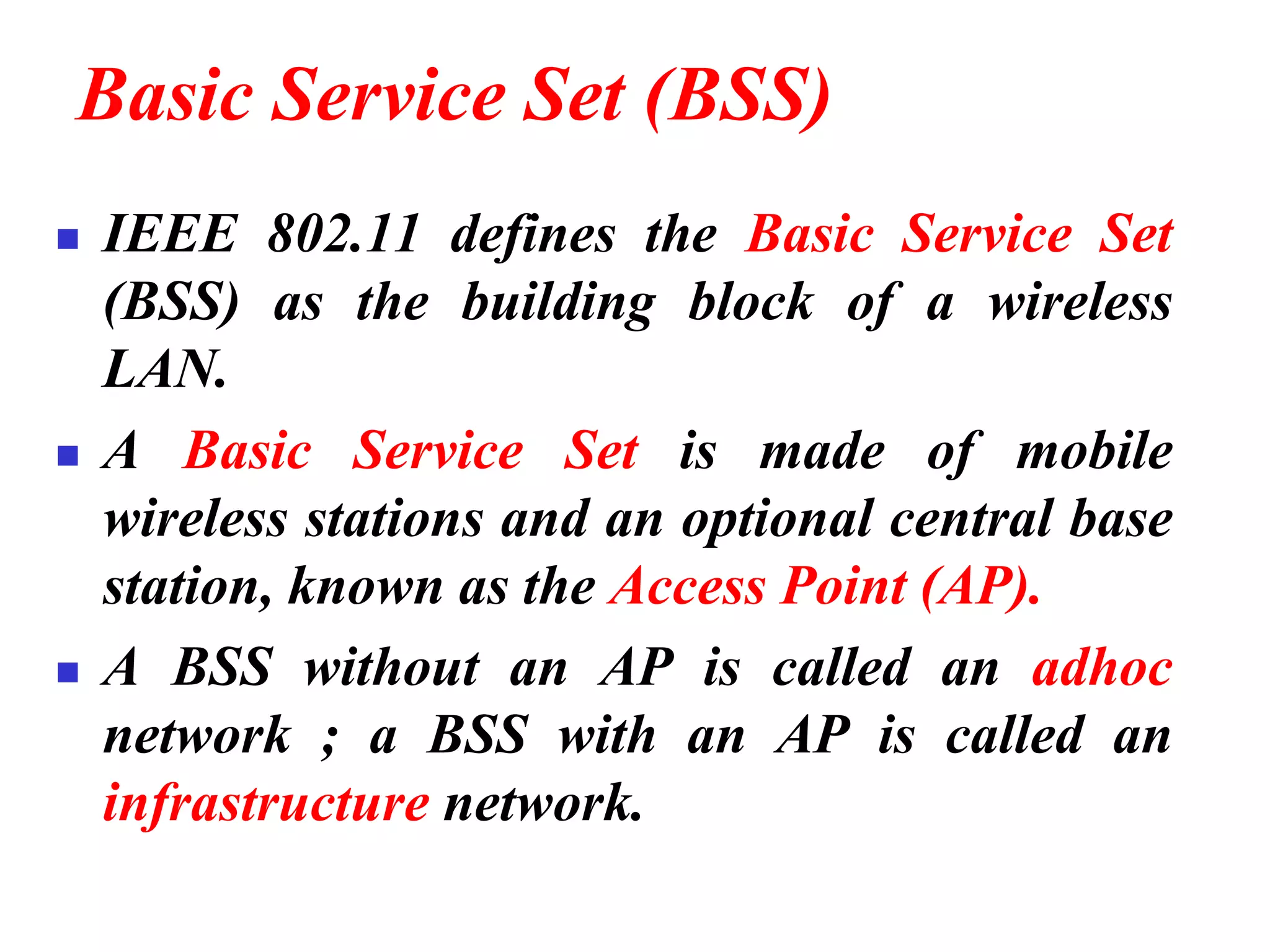
Basic Service Set (BSS)
◼ IEEE 802.11 defines the Basic Service Set
(BSS) as the building block of a wireless
LAN.
◼ A Basic Service Set is made of mobile
wireless stations and an optional central base
station, known as the Access Point (AP).
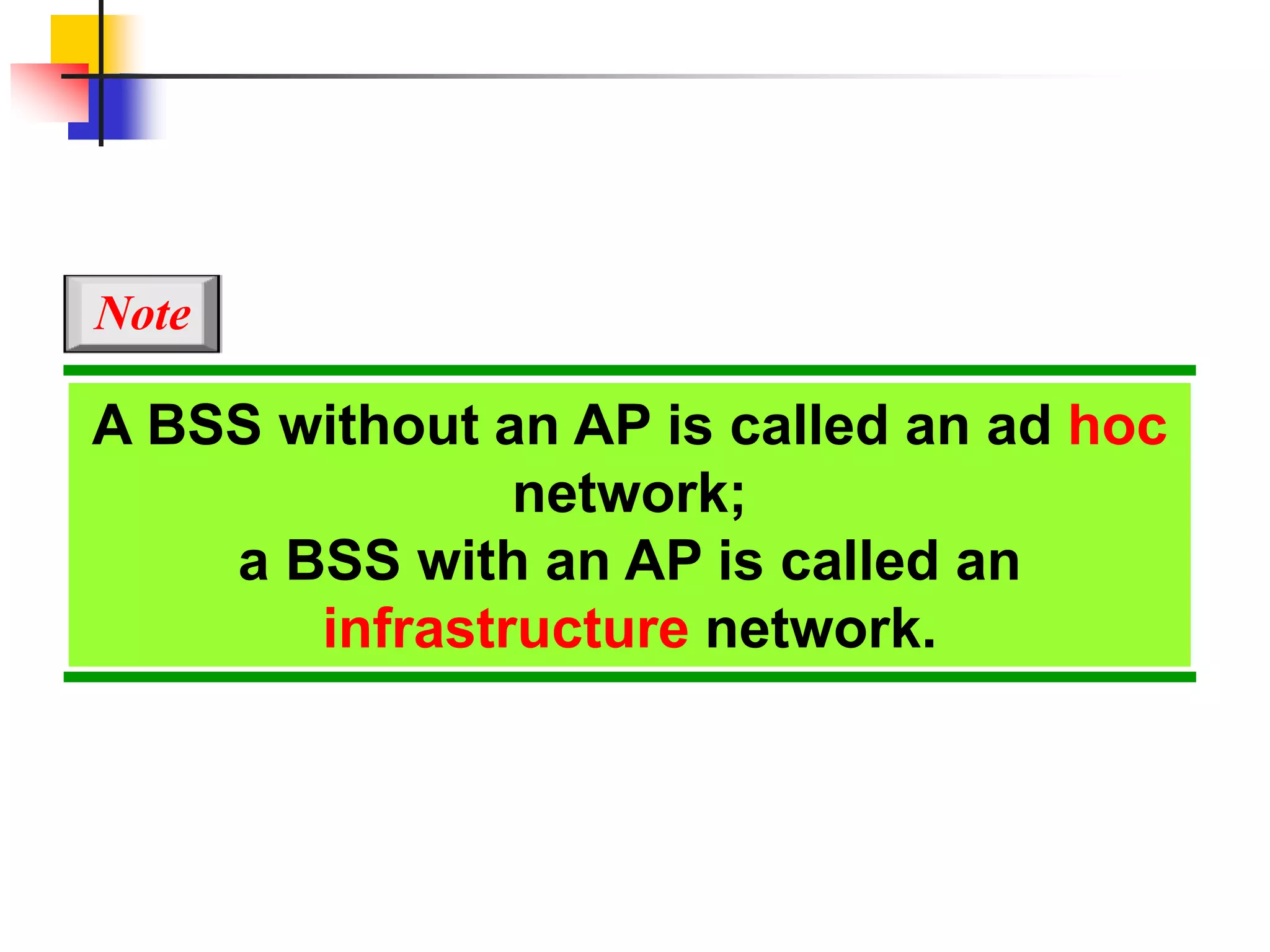
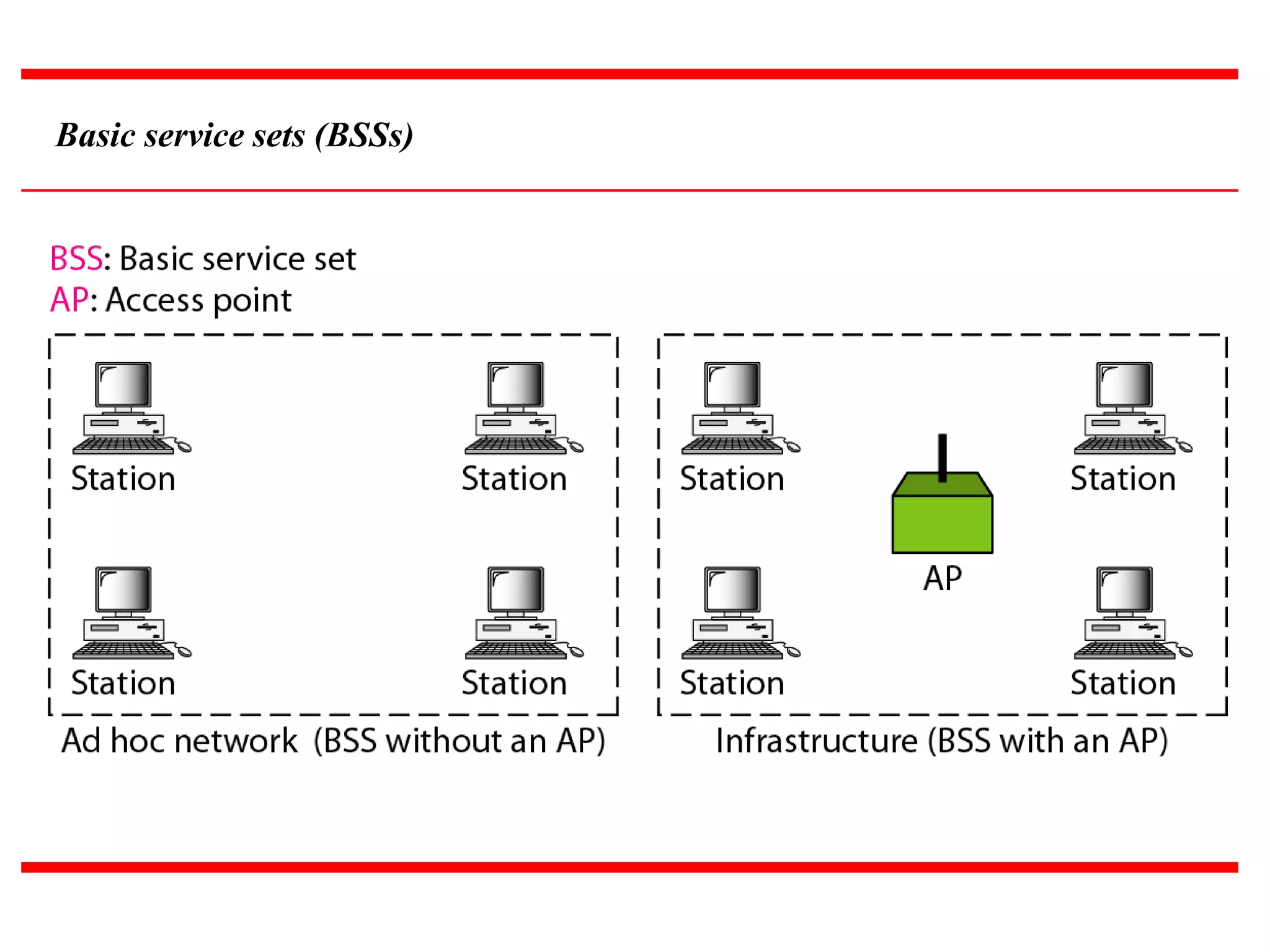
◼ A BSS without an AP is called an adhoc
network ; a BSS with an AP is called an
infrastructure network.
A BSS without an AP is called an ad hoc
network;
a BSS with an AP is called an
infrastructure network.
Note
Basic service sets (BSSs)
Extended Service Set
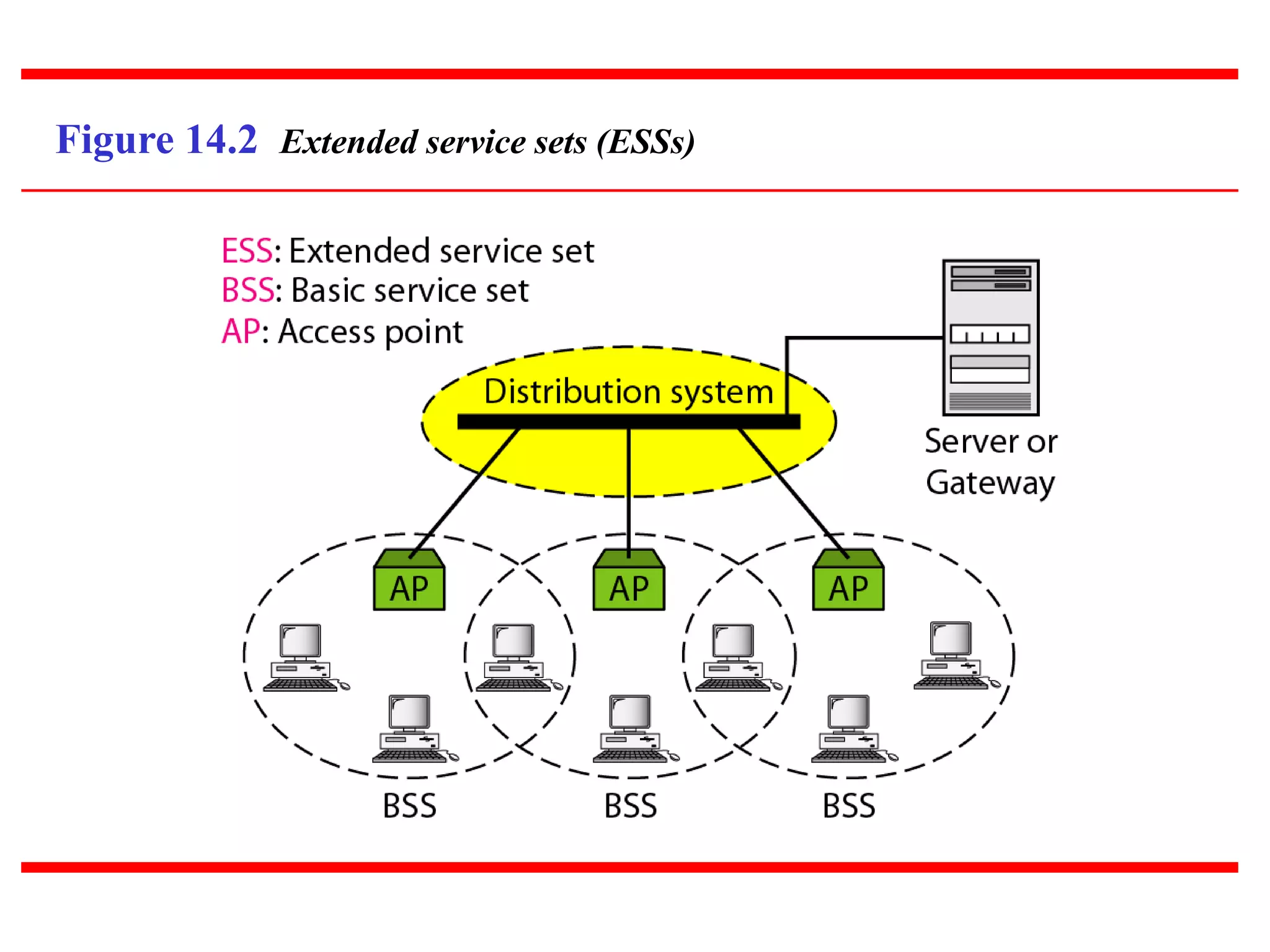
◼ An extended service set (ESS) is made up of two or
more BSSs with APs.
◼ In this case, the BSSs are connected through a
distribution system, which is usually a wired LAN.
◼ The distribution system connects the APs in the
BSSs.
◼ Note that the extended service set uses two types of
stations: mobile stations and stationary stations.
◼ The mobile stations are normal stations inside a
BSS.
◼ The stationary stations are AP stations that are part
of a wired LAN.
Figure 14.2 Extended service sets (ESSs)
◼ When BSSs are connected, the stations within
reach of one another can communicate
without the use of an AP.
◼ However, communication between two
stations in two different BSSs usually occurs
via two APs.
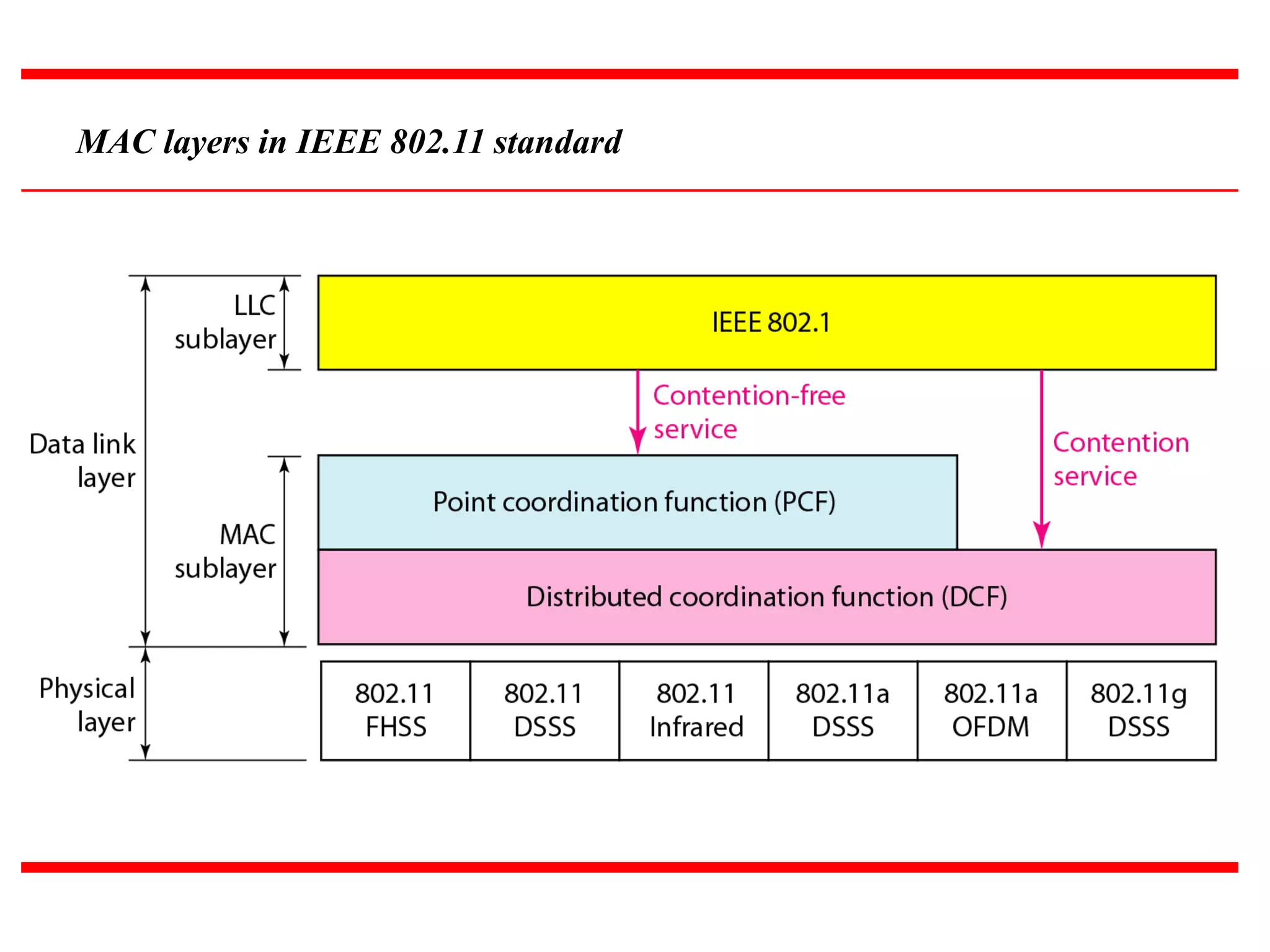
MAC Sub layer
◼ IEEE 802.11 defines two MAC sub layers:
Distributed Coordination Function (DCF)
Point Coordination Function (PCF).
◼ Figure below shows the relationship between
the two MAC sub layers, the LLC sub layer,
and the physical layer
MAC layers in IEEE 802.11 standard
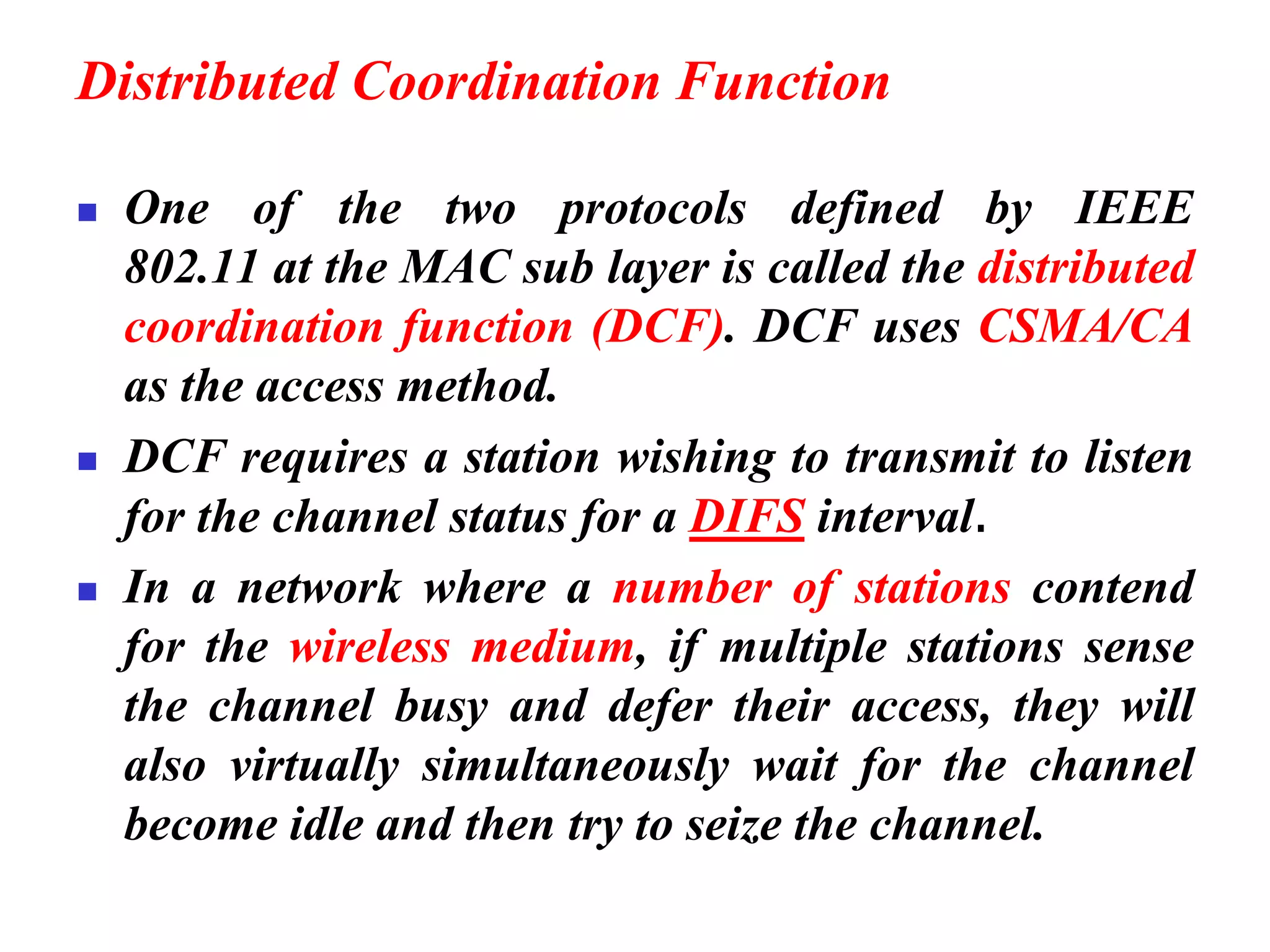
Distributed Coordination Function
◼ One of the two protocols defined by IEEE
802.11 at the MAC sub layer is called the distributed
coordination function (DCF). DCF uses CSMA/CA
as the access method.
◼ DCF requires a station wishing to transmit to listen
for the channel status for a DIFS interval.
◼ In a network where a number of stations contend
for the wireless medium, if multiple stations sense
the channel busy and defer their access, they will
also virtually simultaneously wait for the channel
become idle and then try to seize the channel.
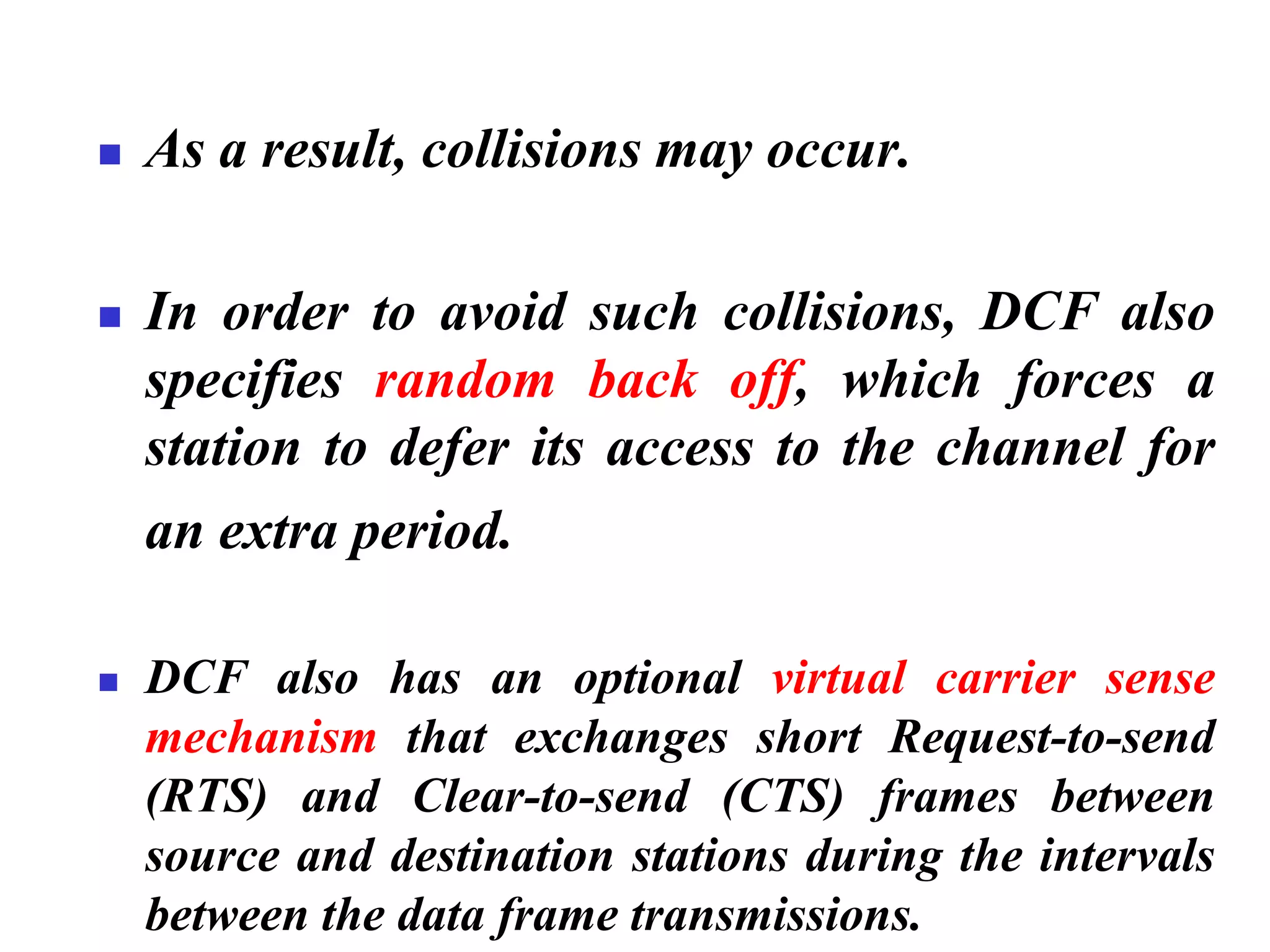
◼ As a result, collisions may occur.
◼ In order to avoid such collisions, DCF also
specifies random back off, which forces a
station to defer its access to the channel for
an extra period.
◼ DCF also has an optional virtual carrier sense
mechanism that exchanges short Request-to-send
(RTS) and Clear-to-send (CTS) frames between
source and destination stations during the intervals
between the data frame transmissions.
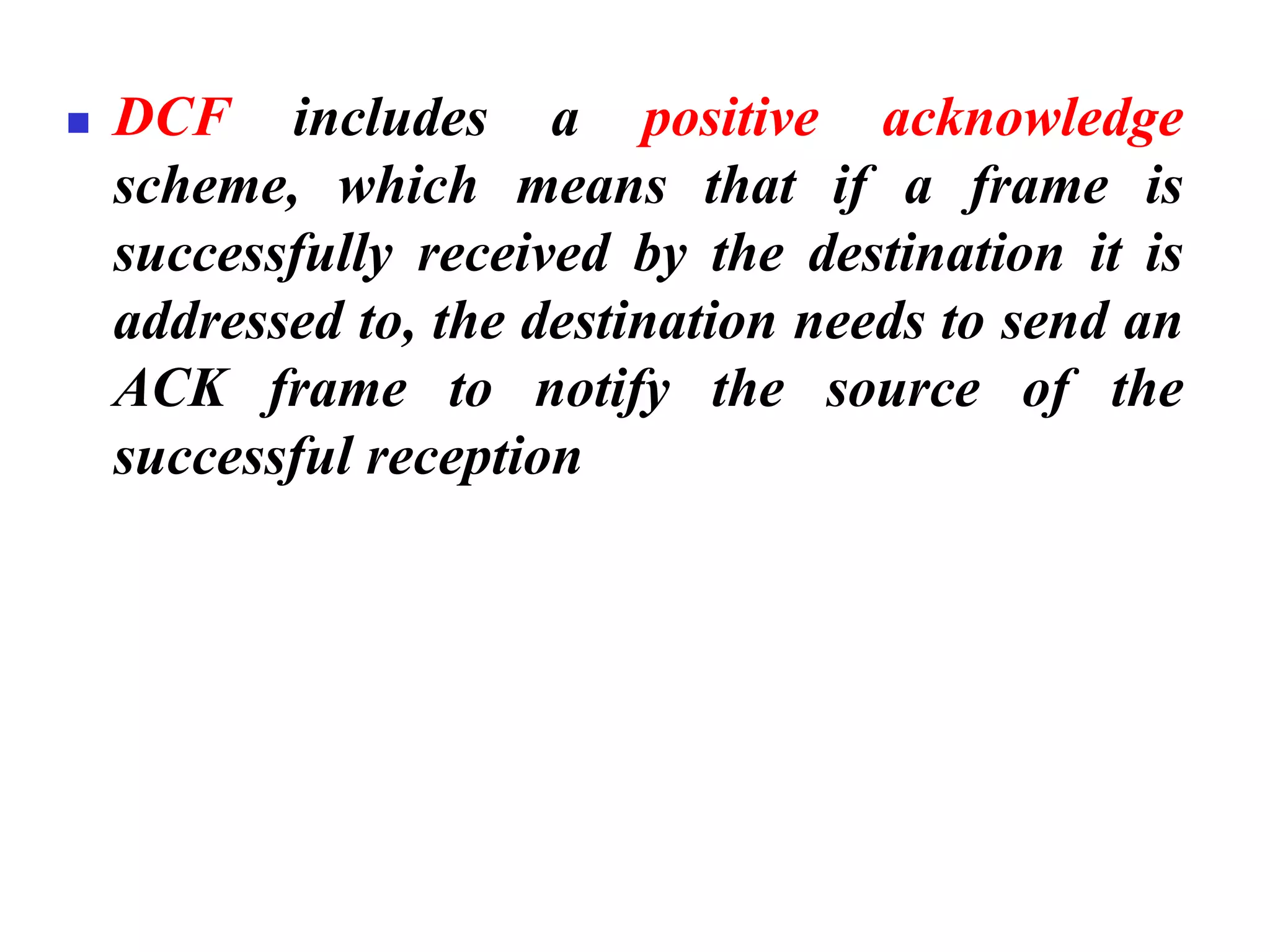
◼ DCF includes a positive acknowledge
scheme, which means that if a frame is
successfully received by the destination it is
addressed to, the destination needs to send an
ACK frame to notify the source of the
successful reception
Point Coordination Function (PCF).
◼ The point coordination function (PCF) is an
optional access method that can be implemented in
an infrastructure network.
◼ It is implemented on top of the DCF and is use
mostly for time-sensitive transmission.
◼ PCF has a centralized, contention-free polling
access method. The AP performs polling for stations
that are capable of being polled. The stations are
polled one after another, sending any data they have
to the AP.
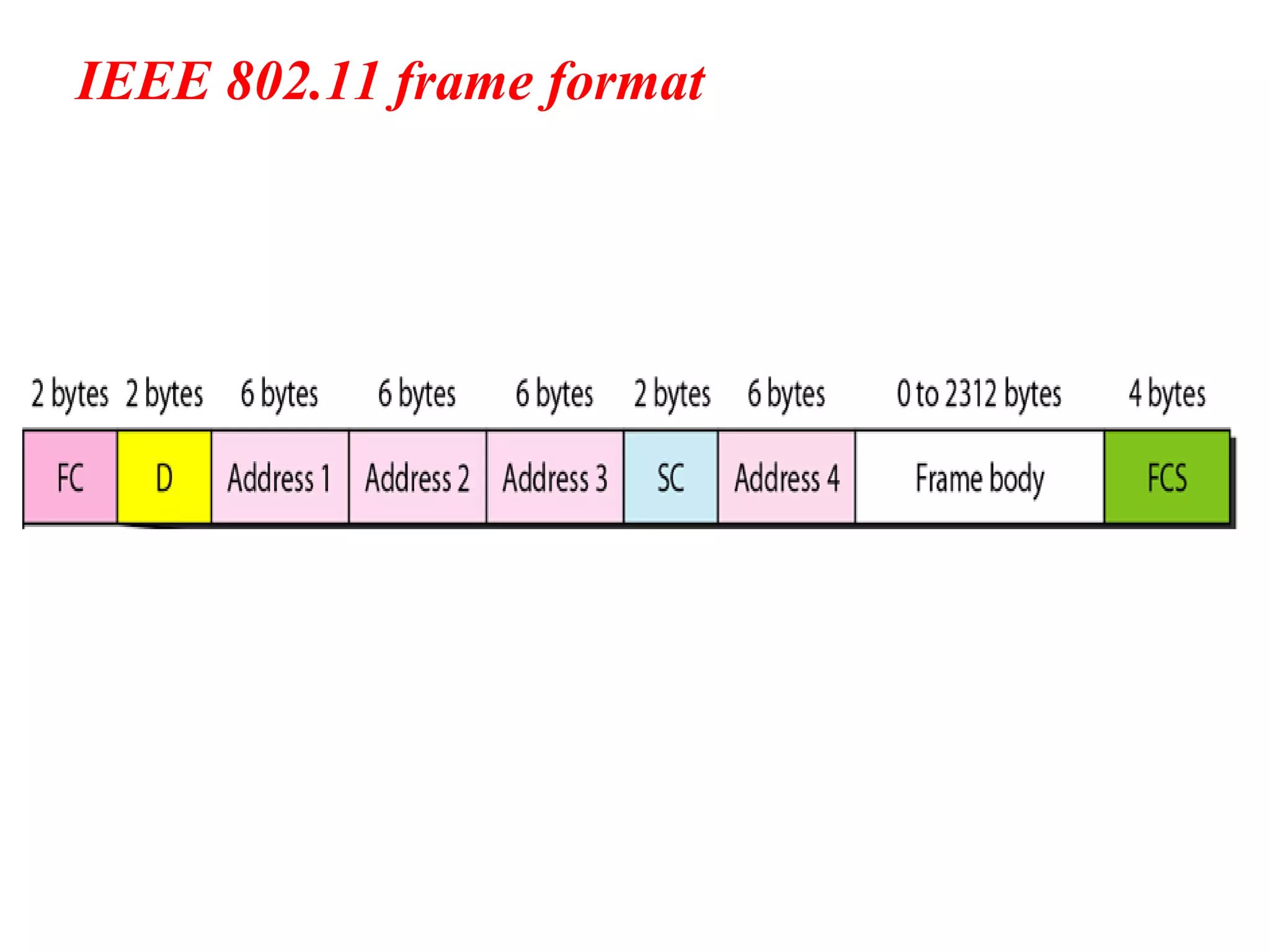
IEEE 802.11 frame format
◼ Frame control field: The FC field is 2 bytes
long and defines the type of frame and some
control information.
◼ Duration field. This field is usually of 2 bytes
and defines the duration of the transmission
time of frame in micro seconds.
Addresses
◼ There are four address fields, each 6 bytes
long. The meaning of each address field are
◼ Address 1 always refers to the address of next
device .
◼ Address 2 always refers to the address of
previous device
◼ Address 3 always refers to the address of final
destination
◼ Address 4 always refers to the address of
source
◼ Sequence control. This field defines the
sequence number of the frame to be used in
flow control.
◼ Frame body(data). This field, which can be
between 0 and 2312 bytes, contains
information based on the FC field.
◼ FCS. The FCS field is 4 bytes long and
contains a CRC-32 error detection sequence.
Types of frames
◼ A wireless LAN defined by IEEE 802.11 has
three categories of frames:
◼ Management frames
◼ Control frames
◼ Data frames.
Management Frames
◼ Management frames are used for the initial
communication between stations and access
points.
◼ Functions of this of frames are
➢ Request
➢ Response
➢ Authentication
➢ Re association
Control Frames
◼ Control frames are used for sending and
acknowledging frames.
➢ Request To Send
➢ Clear To Send
➢ Ack
Data Frames
Data frames are used for carrying actual data
BLUETOOTH
➢Bluetooth is a wireless LAN technology designed to
connect devices of different functions such as telephones,
notebooks, computers, cameras, printers, coffee makers,
and so on.
➢A Bluetooth LAN is an adhoc network, which means
that the network is formed spontaneously.
Architecture
Bluetooth Layers
Topics discussed in this section:
Architecture
◼ Bluetooth defines two types of networks:
➢ Piconet
➢ Scatternet
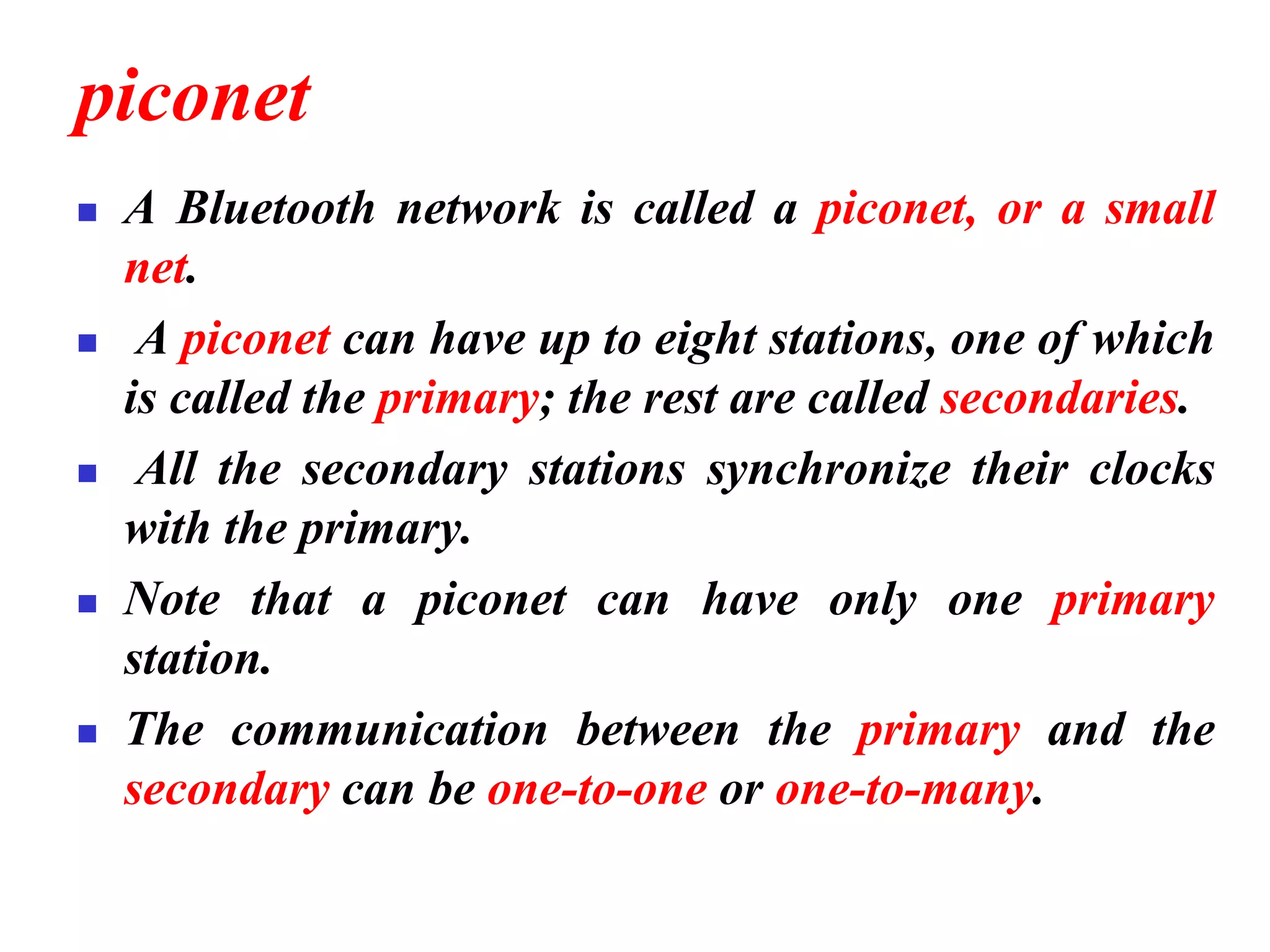
piconet
◼ A Bluetooth network is called a piconet, or a small
net.
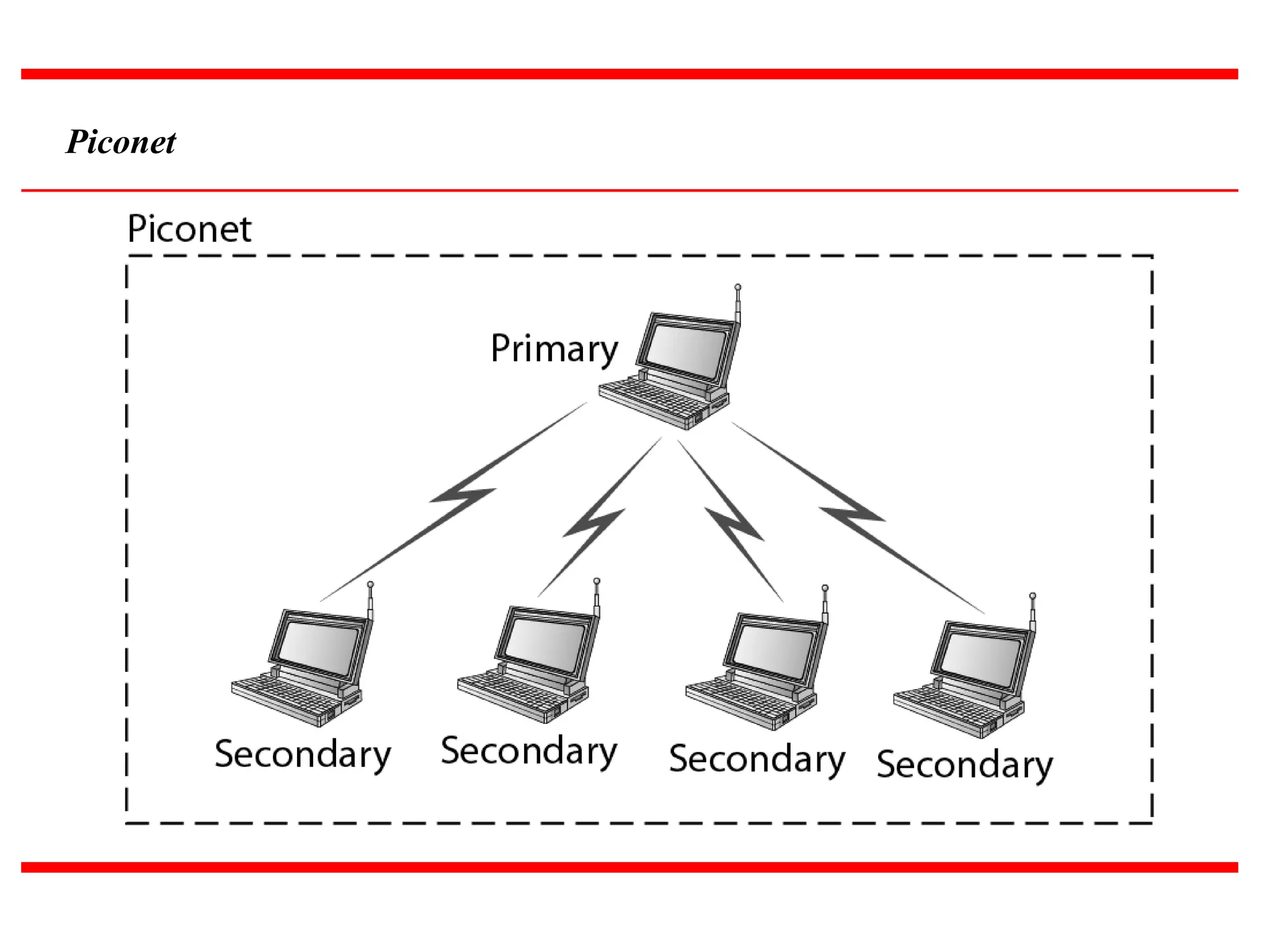
◼ A piconet can have up to eight stations, one of which
is called the primary; the rest are called secondaries.
◼ All the secondary stations synchronize their clocks
with the primary.
◼ Note that a piconet can have only one primary
station.
◼ The communication between the primary and the
secondary can be one-to-one or one-to-many.
Piconet
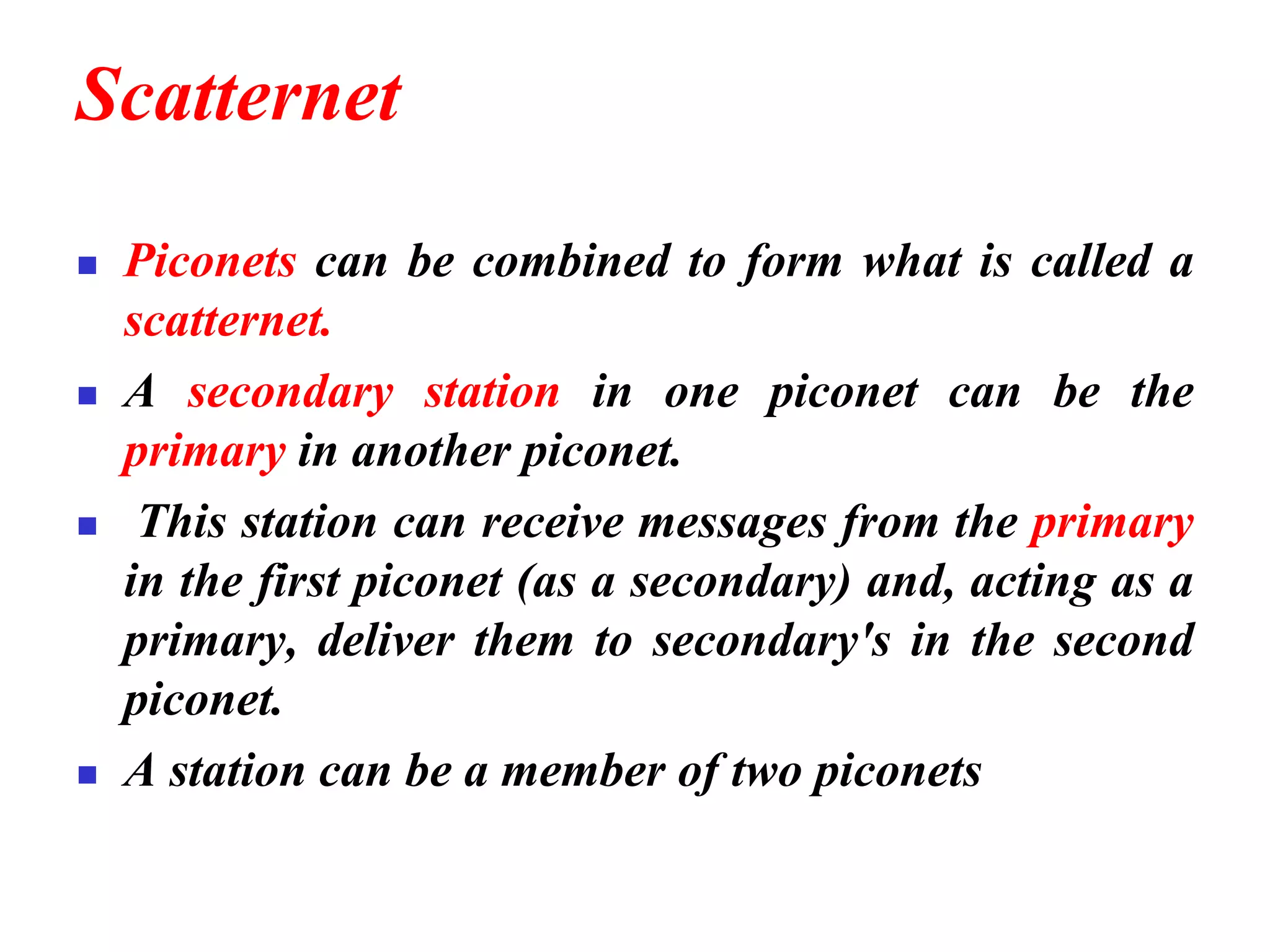
Scatternet
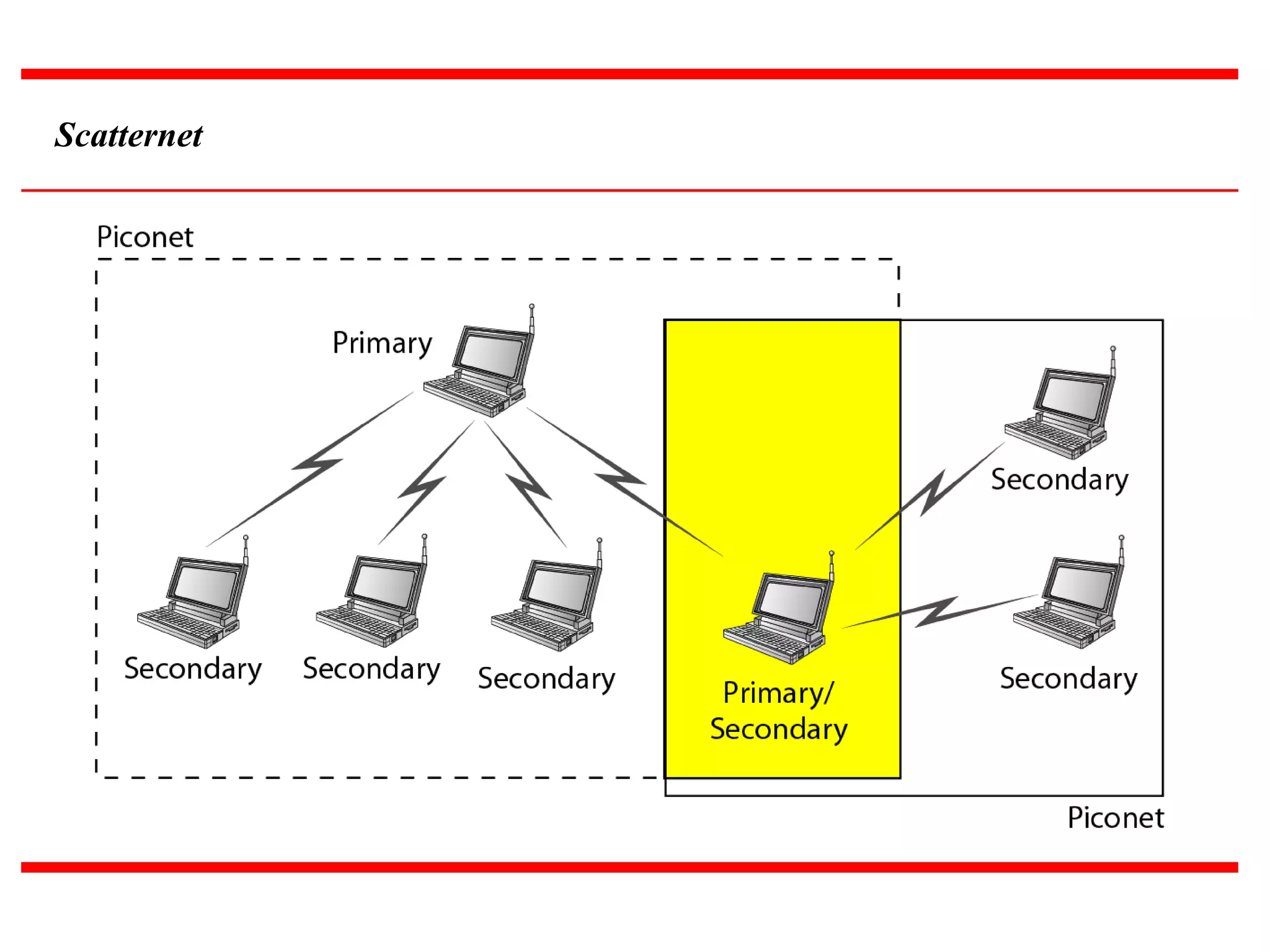
◼ Piconets can be combined to form what is called a
scatternet.
◼ A secondary station in one piconet can be the
primary in another piconet.
◼ This station can receive messages from the primary
in the first piconet (as a secondary) and, acting as a
primary, deliver them to secondary's in the second
piconet.
◼ A station can be a member of two piconets
Scatternet
Bluetooth Layers
◼ Bluetooth uses several layers those are
➢ Radio layer (physical layer)
➢ Base Band layer(data link layer)
➢ Middleware layer
➢ Application layer
Radio layer
◼ The radio layer is roughly equivalent to the
physical layer of the Internet model.
◼ Bluetooth devices are low-power and have a
range of 10m with a frequency band of 2.4
GHz.
◼ This frequency band is divided into 79
channels of 1 MHz each.
◼ The main function of radio layer is modulation
that is done using GFSK
(Gaussian frequency shift keying)
Gaussian frequency-shift keying (GFSK) is a type of frequency
shift keying modulation that uses a Gaussian filter to smooth
positive/negative frequency deviations, which represent a
binary 1 or 0.
◼ Bluetooth also uses the frequency-hopping
spread spectrum (FHSS) method in the radio
layer to avoid interference from other devices
or other networks.
Baseband Layer
◼ The baseband layer is roughly equivalent to the MAC sub
layer in LANs.
◼ The access method used is TDMA
◼ The primary and secondary communicate with each other
using time slots. The length of a time slot is 625
microsecond.
◼ This means that during this time a sender sends a frame to a
secondary, or a secondary sends a frame to the primary.
Note that the communication is only between the primary and
a secondary; secondary's cannot communicate directly with
one another.
Physical Links
◼ In base band layer the transmission of frames
is done using a logical channel called link
◼ Two types of links can be created between a
primary and a secondary:
➢ SCO (synchronous connection-oriented link)
➢ ACL(asynchronous connectionless link)
SCO (synchronous connection-oriented link)
◼ This type of radio link used for voice data.
◼ It is a point to point link i.e. link between
master and slave by reserving specific slots at
regular intervals
◼ SCQ is used forward error correction
mechanism to provide reliable transmission.
ACL(asynchronous connectionless link)
◼ It is a point to multi point link i.e a link
between a single master and all the slave in
the piconet.
◼ This link is used to transfer the data to and
from the above layer i.e L2CAP layer
◼ Since there is no connection between the
nodes there is a possibility of lost of frames
and might require retransmission.
L2CAP (Logical Link Control and Adaptation Protocol)
◼ It is used for data exchange on an ACL link.
◼ The L2CAP has specific duties:
➢ Multiplexing
➢ Segmentation And Reassembly,
➢ Quality Of Service (Qos)
➢ Group Management.
Multiplexing
◼ The L2CAP can do multiplexing.
◼ At the sender site, it accepts data from one of the
upper-layer protocols, frames them, and delivers
them to the baseband layer.
◼ At the receiver site, it accepts a frame from the
baseband layer, extracts the data, and delivers them
to the appropriate upper layer.
Segmentation and Reassembly
◼ The L2CAP divides these large frames into
segments and adds extra information to
define the location of the segments in the
original frame.
◼ The L2CAP segments the frame at the source
and reassembles them at the destination.
Quality Of Service (Qos)
◼ Bluetooth allows the stations to define a
quality-of-service level
◼ Qos is the idea that transmission rates, error
rates, can be measured, improved, and, to
some extent, guaranteed in advance.
Group Management
◼ Another functionality of L2CAP is to allow
devices to create a type of logical addressing
between themselves.
◼ This is similar to multicasting. For example,
two or three secondary devices can be part of
a multicast group to receive data from the
primary.
Link Manager Protocol
◼ This protocol is responsible for carrying out
link setup between the Bluetooth devices.
◼ It is also capable of controlling and
negotiating every aspect of the link between
master and slave.
◼ Functions of LMP are
➢ Authentication
➢ Pairing
➢ Encryption
➢ Synchronization
Middleware layer
◼ The layer above the data link layer is middle
ware layer
◼ This layer consists of the following protocols
➢ RFCOMM(Radio Frequency Communication)
➢ Service discovery protocol
➢ Telephony control service protocol
RFCOMM
◼ The Bluetooth protocol RFCOMM is a simple
set of transport protocol, made on top of the
L2CAP protocol, providing serial ports (up to
sixty simultaneous connections to a Bluetooth
device at a time).
◼ RFCOMM is sometimes called serial port
emulation.
Service discovery protocol
◼ The Bluetooth devices are supposed to work together
creating an adhoc network.
◼ There may be certain Bluetooth devices which wants to
provide service to other Bluetooth devices in its range.
◼ For this purpose Service Discovery Protocol (SDP) is used.
◼ The devices which provides services should have installed
SDP server on them.
◼ The devices which wants to take those services becomes SDP
client
◼ The SDP defines only discovery of services.
◼ The services discovered by clients are cached by them.
Telephony control service protocol
◼ It is a bit oriented protocol, defines the call
control signalling for the establishment of
voice calls between Bluetooth devices.
Application layer
◼ The top most layer protocol stack is the
application layer that consists of applications
(management applications) and profiles
(Management Application is the process of managing the
operation, maintenance, versioning and upgrading of
an application throughout its lifecycle)
◼ Profiles are associated with usage model used
by users for connection purpose.
Some of the profiles are
◼ Advanced Audio Distribution Profile (A2DP)
◼ Audio/Video Remote Control Profile
◼ Basic Printing Profile (BPP)
◼ Cordless Telephony Profile
◼ Fax Profile (FAX)
◼ File Transfer Profile
◼ Headset Profile (HSP)
◼ SIM Access Profile
◼ Thank you
14.51

Wireless Local Area Network

  • 1.
    Wireless LANs Dr RJegadeesan Prof-CSE Jyothishmathi Institute of technology and Science, karimnagar
  • 2.
    ◼ Wireless communicationis one of the fastest- growing technologies. ◼ The demand for connecting devices without the use of cables is increasing everywhere. ◼ Wireless LANs can be found on college campuses, in office buildings, and in many public areas.
  • 3.
    ◼ There aretwo promising wireless technologies for LANs: ◼ IEEE 802.11 wireless LANs, sometimes called wireless Ethernet ◼ Bluetooth, a technology for small wireless LANs.
  • 4.
    IEEE 802.11 IEEE hasdefined the specifications for a wireless LAN, called IEEE 802.11 Architecture MAC Sublayer Topics discussed in this section:
  • 5.
    Architecture ◼ The IEEE802.11 standard defines two kinds of architecture services: ➢ Basic service set (BSS) ➢ Extended service set (ESS).
  • 6.
    Basic Service Set(BSS) ◼ IEEE 802.11 defines the Basic Service Set (BSS) as the building block of a wireless LAN. ◼ A Basic Service Set is made of mobile wireless stations and an optional central base station, known as the Access Point (AP). ◼ A BSS without an AP is called an adhoc network ; a BSS with an AP is called an infrastructure network.
  • 7.
    A BSS withoutan AP is called an ad hoc network; a BSS with an AP is called an infrastructure network. Note
  • 8.
  • 9.
    Extended Service Set ◼An extended service set (ESS) is made up of two or more BSSs with APs. ◼ In this case, the BSSs are connected through a distribution system, which is usually a wired LAN. ◼ The distribution system connects the APs in the BSSs. ◼ Note that the extended service set uses two types of stations: mobile stations and stationary stations. ◼ The mobile stations are normal stations inside a BSS. ◼ The stationary stations are AP stations that are part of a wired LAN.
  • 10.
    Figure 14.2 Extendedservice sets (ESSs)
  • 11.
    ◼ When BSSsare connected, the stations within reach of one another can communicate without the use of an AP. ◼ However, communication between two stations in two different BSSs usually occurs via two APs.
  • 12.
    MAC Sub layer ◼IEEE 802.11 defines two MAC sub layers: Distributed Coordination Function (DCF) Point Coordination Function (PCF). ◼ Figure below shows the relationship between the two MAC sub layers, the LLC sub layer, and the physical layer
  • 13.
    MAC layers inIEEE 802.11 standard
  • 14.
    Distributed Coordination Function ◼One of the two protocols defined by IEEE 802.11 at the MAC sub layer is called the distributed coordination function (DCF). DCF uses CSMA/CA as the access method. ◼ DCF requires a station wishing to transmit to listen for the channel status for a DIFS interval. ◼ In a network where a number of stations contend for the wireless medium, if multiple stations sense the channel busy and defer their access, they will also virtually simultaneously wait for the channel become idle and then try to seize the channel.
  • 15.
    ◼ As aresult, collisions may occur. ◼ In order to avoid such collisions, DCF also specifies random back off, which forces a station to defer its access to the channel for an extra period. ◼ DCF also has an optional virtual carrier sense mechanism that exchanges short Request-to-send (RTS) and Clear-to-send (CTS) frames between source and destination stations during the intervals between the data frame transmissions.
  • 16.
    ◼ DCF includesa positive acknowledge scheme, which means that if a frame is successfully received by the destination it is addressed to, the destination needs to send an ACK frame to notify the source of the successful reception
  • 17.
    Point Coordination Function(PCF). ◼ The point coordination function (PCF) is an optional access method that can be implemented in an infrastructure network. ◼ It is implemented on top of the DCF and is use mostly for time-sensitive transmission. ◼ PCF has a centralized, contention-free polling access method. The AP performs polling for stations that are capable of being polled. The stations are polled one after another, sending any data they have to the AP.
  • 18.
  • 19.
    ◼ Frame controlfield: The FC field is 2 bytes long and defines the type of frame and some control information. ◼ Duration field. This field is usually of 2 bytes and defines the duration of the transmission time of frame in micro seconds.
  • 20.
    Addresses ◼ There arefour address fields, each 6 bytes long. The meaning of each address field are ◼ Address 1 always refers to the address of next device . ◼ Address 2 always refers to the address of previous device ◼ Address 3 always refers to the address of final destination ◼ Address 4 always refers to the address of source
  • 21.
    ◼ Sequence control.This field defines the sequence number of the frame to be used in flow control. ◼ Frame body(data). This field, which can be between 0 and 2312 bytes, contains information based on the FC field. ◼ FCS. The FCS field is 4 bytes long and contains a CRC-32 error detection sequence.
  • 22.
    Types of frames ◼A wireless LAN defined by IEEE 802.11 has three categories of frames: ◼ Management frames ◼ Control frames ◼ Data frames.
  • 23.
    Management Frames ◼ Managementframes are used for the initial communication between stations and access points. ◼ Functions of this of frames are ➢ Request ➢ Response ➢ Authentication ➢ Re association
  • 24.
    Control Frames ◼ Controlframes are used for sending and acknowledging frames. ➢ Request To Send ➢ Clear To Send ➢ Ack Data Frames Data frames are used for carrying actual data
  • 25.
    BLUETOOTH ➢Bluetooth is awireless LAN technology designed to connect devices of different functions such as telephones, notebooks, computers, cameras, printers, coffee makers, and so on. ➢A Bluetooth LAN is an adhoc network, which means that the network is formed spontaneously. Architecture Bluetooth Layers Topics discussed in this section:
  • 26.
    Architecture ◼ Bluetooth definestwo types of networks: ➢ Piconet ➢ Scatternet
  • 27.
    piconet ◼ A Bluetoothnetwork is called a piconet, or a small net. ◼ A piconet can have up to eight stations, one of which is called the primary; the rest are called secondaries. ◼ All the secondary stations synchronize their clocks with the primary. ◼ Note that a piconet can have only one primary station. ◼ The communication between the primary and the secondary can be one-to-one or one-to-many.
  • 28.
  • 29.
    Scatternet ◼ Piconets canbe combined to form what is called a scatternet. ◼ A secondary station in one piconet can be the primary in another piconet. ◼ This station can receive messages from the primary in the first piconet (as a secondary) and, acting as a primary, deliver them to secondary's in the second piconet. ◼ A station can be a member of two piconets
  • 30.
  • 31.
    Bluetooth Layers ◼ Bluetoothuses several layers those are ➢ Radio layer (physical layer) ➢ Base Band layer(data link layer) ➢ Middleware layer ➢ Application layer
  • 33.
    Radio layer ◼ Theradio layer is roughly equivalent to the physical layer of the Internet model. ◼ Bluetooth devices are low-power and have a range of 10m with a frequency band of 2.4 GHz. ◼ This frequency band is divided into 79 channels of 1 MHz each.
  • 34.
    ◼ The mainfunction of radio layer is modulation that is done using GFSK (Gaussian frequency shift keying) Gaussian frequency-shift keying (GFSK) is a type of frequency shift keying modulation that uses a Gaussian filter to smooth positive/negative frequency deviations, which represent a binary 1 or 0. ◼ Bluetooth also uses the frequency-hopping spread spectrum (FHSS) method in the radio layer to avoid interference from other devices or other networks.
  • 35.
    Baseband Layer ◼ Thebaseband layer is roughly equivalent to the MAC sub layer in LANs. ◼ The access method used is TDMA ◼ The primary and secondary communicate with each other using time slots. The length of a time slot is 625 microsecond. ◼ This means that during this time a sender sends a frame to a secondary, or a secondary sends a frame to the primary. Note that the communication is only between the primary and a secondary; secondary's cannot communicate directly with one another.
  • 36.
    Physical Links ◼ Inbase band layer the transmission of frames is done using a logical channel called link ◼ Two types of links can be created between a primary and a secondary: ➢ SCO (synchronous connection-oriented link) ➢ ACL(asynchronous connectionless link)
  • 37.
    SCO (synchronous connection-orientedlink) ◼ This type of radio link used for voice data. ◼ It is a point to point link i.e. link between master and slave by reserving specific slots at regular intervals ◼ SCQ is used forward error correction mechanism to provide reliable transmission.
  • 38.
    ACL(asynchronous connectionless link) ◼It is a point to multi point link i.e a link between a single master and all the slave in the piconet. ◼ This link is used to transfer the data to and from the above layer i.e L2CAP layer ◼ Since there is no connection between the nodes there is a possibility of lost of frames and might require retransmission.
  • 39.
    L2CAP (Logical LinkControl and Adaptation Protocol) ◼ It is used for data exchange on an ACL link. ◼ The L2CAP has specific duties: ➢ Multiplexing ➢ Segmentation And Reassembly, ➢ Quality Of Service (Qos) ➢ Group Management.
  • 40.
    Multiplexing ◼ The L2CAPcan do multiplexing. ◼ At the sender site, it accepts data from one of the upper-layer protocols, frames them, and delivers them to the baseband layer. ◼ At the receiver site, it accepts a frame from the baseband layer, extracts the data, and delivers them to the appropriate upper layer.
  • 41.
    Segmentation and Reassembly ◼The L2CAP divides these large frames into segments and adds extra information to define the location of the segments in the original frame. ◼ The L2CAP segments the frame at the source and reassembles them at the destination.
  • 42.
    Quality Of Service(Qos) ◼ Bluetooth allows the stations to define a quality-of-service level ◼ Qos is the idea that transmission rates, error rates, can be measured, improved, and, to some extent, guaranteed in advance.
  • 43.
    Group Management ◼ Anotherfunctionality of L2CAP is to allow devices to create a type of logical addressing between themselves. ◼ This is similar to multicasting. For example, two or three secondary devices can be part of a multicast group to receive data from the primary.
  • 44.
    Link Manager Protocol ◼This protocol is responsible for carrying out link setup between the Bluetooth devices. ◼ It is also capable of controlling and negotiating every aspect of the link between master and slave. ◼ Functions of LMP are ➢ Authentication ➢ Pairing ➢ Encryption ➢ Synchronization
  • 45.
    Middleware layer ◼ Thelayer above the data link layer is middle ware layer ◼ This layer consists of the following protocols ➢ RFCOMM(Radio Frequency Communication) ➢ Service discovery protocol ➢ Telephony control service protocol
  • 46.
    RFCOMM ◼ The Bluetoothprotocol RFCOMM is a simple set of transport protocol, made on top of the L2CAP protocol, providing serial ports (up to sixty simultaneous connections to a Bluetooth device at a time). ◼ RFCOMM is sometimes called serial port emulation.
  • 47.
    Service discovery protocol ◼The Bluetooth devices are supposed to work together creating an adhoc network. ◼ There may be certain Bluetooth devices which wants to provide service to other Bluetooth devices in its range. ◼ For this purpose Service Discovery Protocol (SDP) is used. ◼ The devices which provides services should have installed SDP server on them. ◼ The devices which wants to take those services becomes SDP client ◼ The SDP defines only discovery of services. ◼ The services discovered by clients are cached by them.
  • 48.
    Telephony control serviceprotocol ◼ It is a bit oriented protocol, defines the call control signalling for the establishment of voice calls between Bluetooth devices.
  • 49.
    Application layer ◼ Thetop most layer protocol stack is the application layer that consists of applications (management applications) and profiles (Management Application is the process of managing the operation, maintenance, versioning and upgrading of an application throughout its lifecycle) ◼ Profiles are associated with usage model used by users for connection purpose.
  • 50.
    Some of theprofiles are ◼ Advanced Audio Distribution Profile (A2DP) ◼ Audio/Video Remote Control Profile ◼ Basic Printing Profile (BPP) ◼ Cordless Telephony Profile ◼ Fax Profile (FAX) ◼ File Transfer Profile ◼ Headset Profile (HSP) ◼ SIM Access Profile
  • 51.