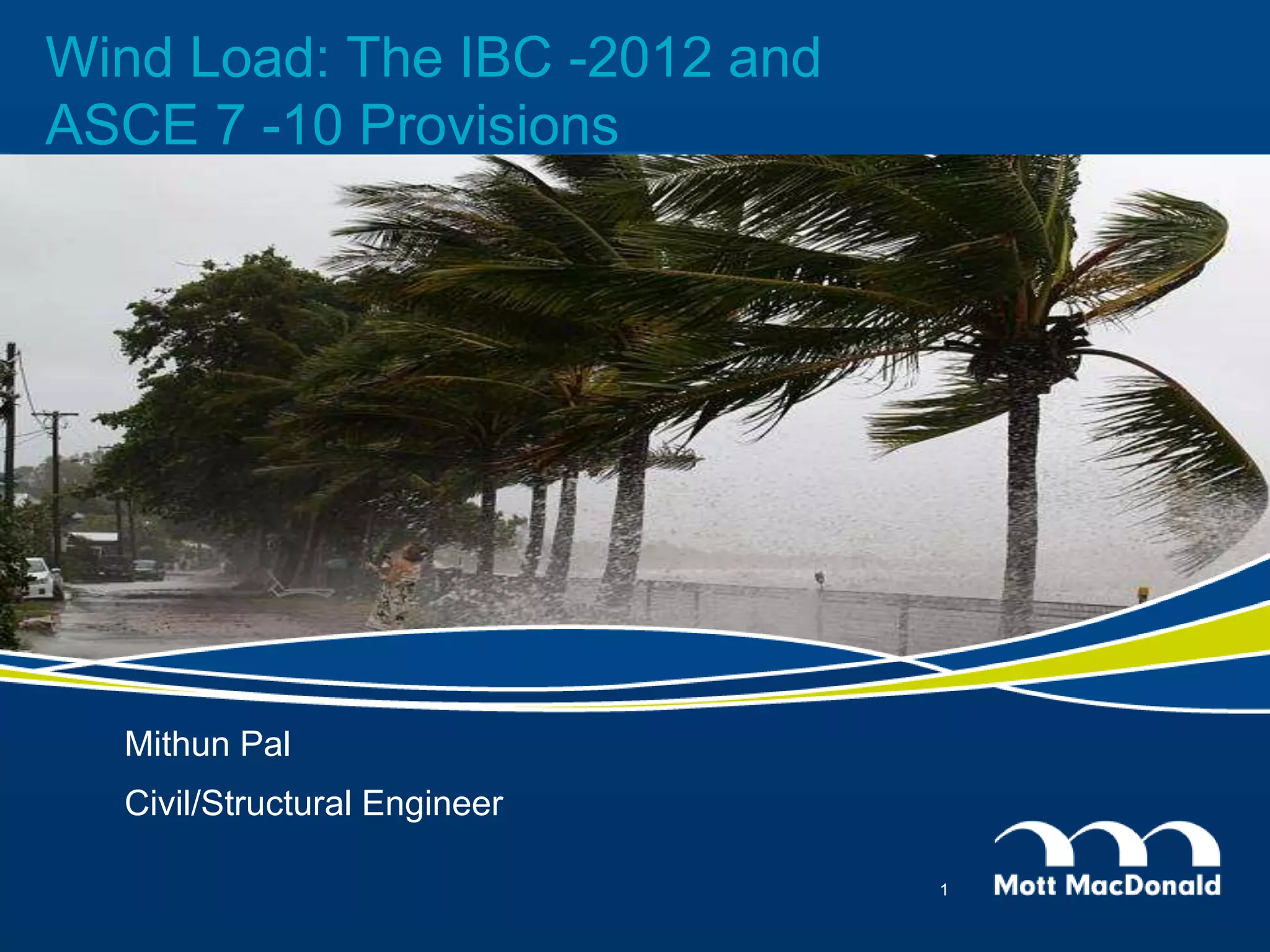
Wind Load: The IBC -2012 and
ASCE 7 -10 Provisions
Mithun Pal
Civil/Structural Engineer
1
Contents
 Objectives
 Important Definitions
 Major Changes in ASCE 7-10 from ASCE 7-05
 Wind Load Calculation Procedure
 Wind Load Calculation as per IBC-2012 and ASCE 7-
10 and Load Combinations
 Conclusion
 Wind Loads for Petrochemical Facilities
 Q&A
2
Objectives
 Explain the design steps for Wind Load calculation as
per IBC-2012 and ASCE 7-10
 To demonstrate the changes made in ASCE 7-10 from
ASCE 7-05
 To explain ASCE guidelines for Wind Load calculation
on Petrochemical Facilities.
3
Important Definitions
 Basic Wind Speed – 3 sec gust speed at 10m above
the ground in Exposure C.
 Gust - A wind gust is a sudden, brief increase in the
speed of the wind followed by a break.
 Gust Factor – Factor to account the dynamics of wind
fluctuation and load amplification by building dynamics.
4
Important Definitions (Cont.)
 Type of buildings
Enclosure Classification
– Open Building – Building having each wall at least 80% open.
Ao > 0.8Ag
– Partially Enclosed Building – Ratio of total area of openings in a
wall receiving positive external pressure and sum of total
openings (roof and wall) is more than 10% and total area of
openings receiving positive pressure is more than 4 sq.ft.
• Ao > 1.10 Aoi, and
• Ao > min[4 sqft , 0.01Ag], and
• Aoi/Agi < 0.20
– Enclosed Building – A building that does not comply with the
requirements for open or partially enclosed building.
5
 Type of buildings (Cont.)
– Low Rise Building – Enclosed or partially enclosed building
having mean roof height (h) less than or equal to 60 ft (18m) and
mean roof height does not exceed the least horizontal
dimension.
– Simple Diaphragm – A building in which both windward and
leeward wind loads are transmitted by roof and vertical spanning
wall assemblies, through continuous floor and roof diaphragms
to the MWFRS.
 Flexible Structure – Structure having fundamental
natural frequency less than 1 Hz
Important Definitions (Cont.)
6
 Exposure Category – Adequately reflects the
characteristics of ground surface irregularities.
– Exposure A – Deleted in ASCE 7-02 and later.
– Exposure B - Urban and suburban areas, wooded areas, areas with
many closely spaced obstructions.
This category includes terrains with numerous closely spaced
obstruction that extends upto 1500 ft with building of height upto
30 ft and 2600 ft or 20 times the height, whichever is greater, for
building of height more than 30 ft.
– Exposure C - Open terrain with scatter obstructions. Airports, areas
that are generally flat open country.
– Exposure D - Flat, unobstructed areas and water surfaces. This
category includes smooth mud flats, salt flats, and unbroken ice
that extend 5,000 ft or 20 times the building height, whichever is
greater, in the upwind direction.
Important Definitions (Cont.)
7
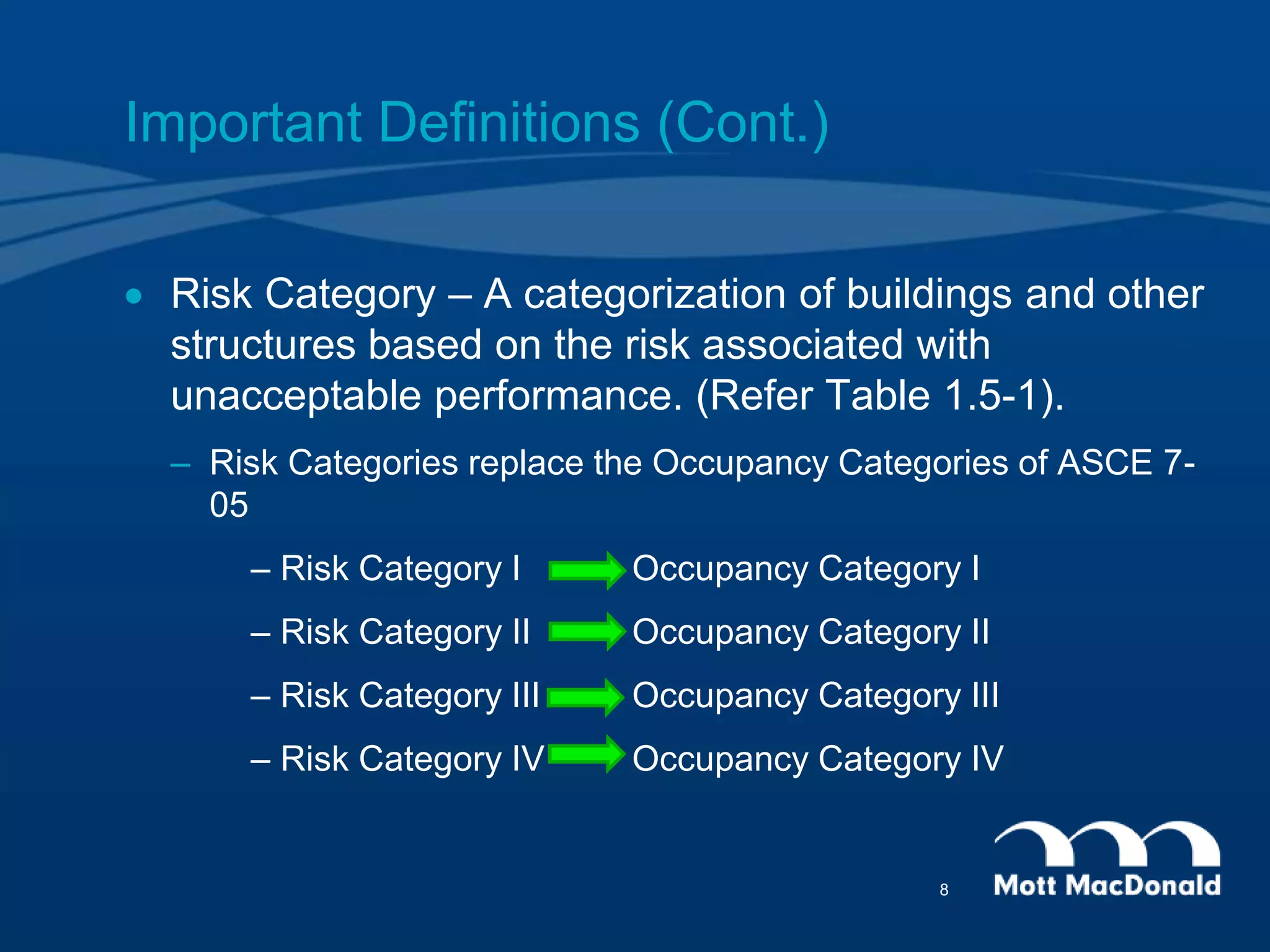
 Risk Category – A categorization of buildings and other
structures based on the risk associated with
unacceptable performance. (Refer Table 1.5-1).
– Risk Categories replace the Occupancy Categories of ASCE 7-
05
– Risk Category I Occupancy Category I
– Risk Category II Occupancy Category II
– Risk Category III Occupancy Category III
– Risk Category IV Occupancy Category IV
Important Definitions (Cont.)
8
Changes in ASCE 7 - 10
 In ASCE 7-05 Wind Load is in Chapter-6, but in ASCE 7-10 Wind
Load is in Chapter -26 to Chapter – 31.
 Removal of the Occupancy Factor (Importance Factor) and
introduction of Risk Category.
 Revised Load Factor for wind in ASD and LRFD load
combinations.
 Revised pressure values for minimum design loads.
 Reinstating applicability of Exposure D in hurricane prone regions.
 Revised wind speed triggers for definition of hurricane prone region
and wind-borne debris region.
 Allowable building height for simplified procedure is increased from
60 ft to 160 ft.
9
Wind Load Calculation Procedures
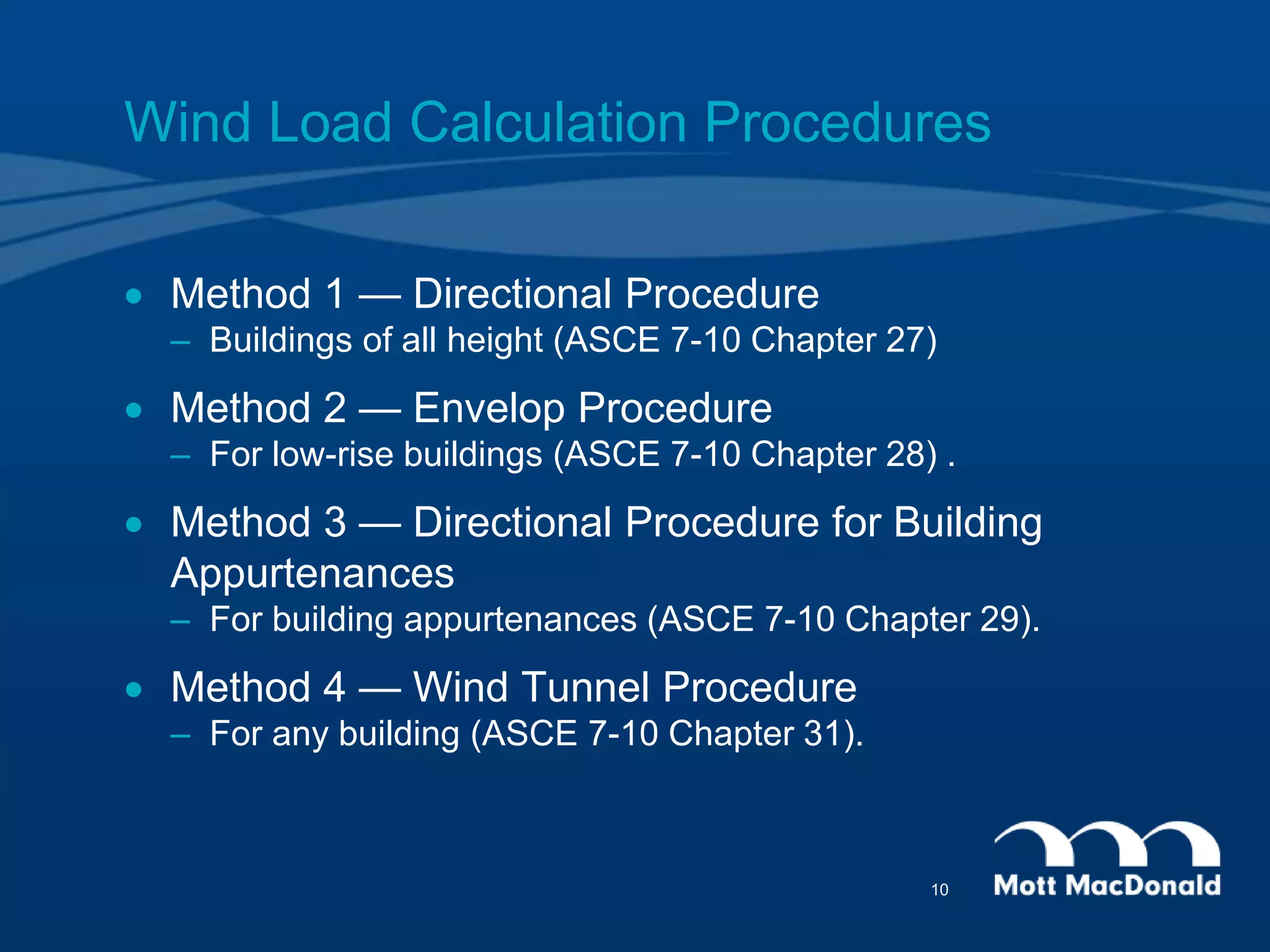
 Method 1 — Directional Procedure
– Buildings of all height (ASCE 7-10 Chapter 27)
 Method 2 — Envelop Procedure
– For low-rise buildings (ASCE 7-10 Chapter 28) .
 Method 3 — Directional Procedure for Building
Appurtenances
– For building appurtenances (ASCE 7-10 Chapter 29).
 Method 4 — Wind Tunnel Procedure
– For any building (ASCE 7-10 Chapter 31).
10
Wind Load Calculation Procedures (Cont.)
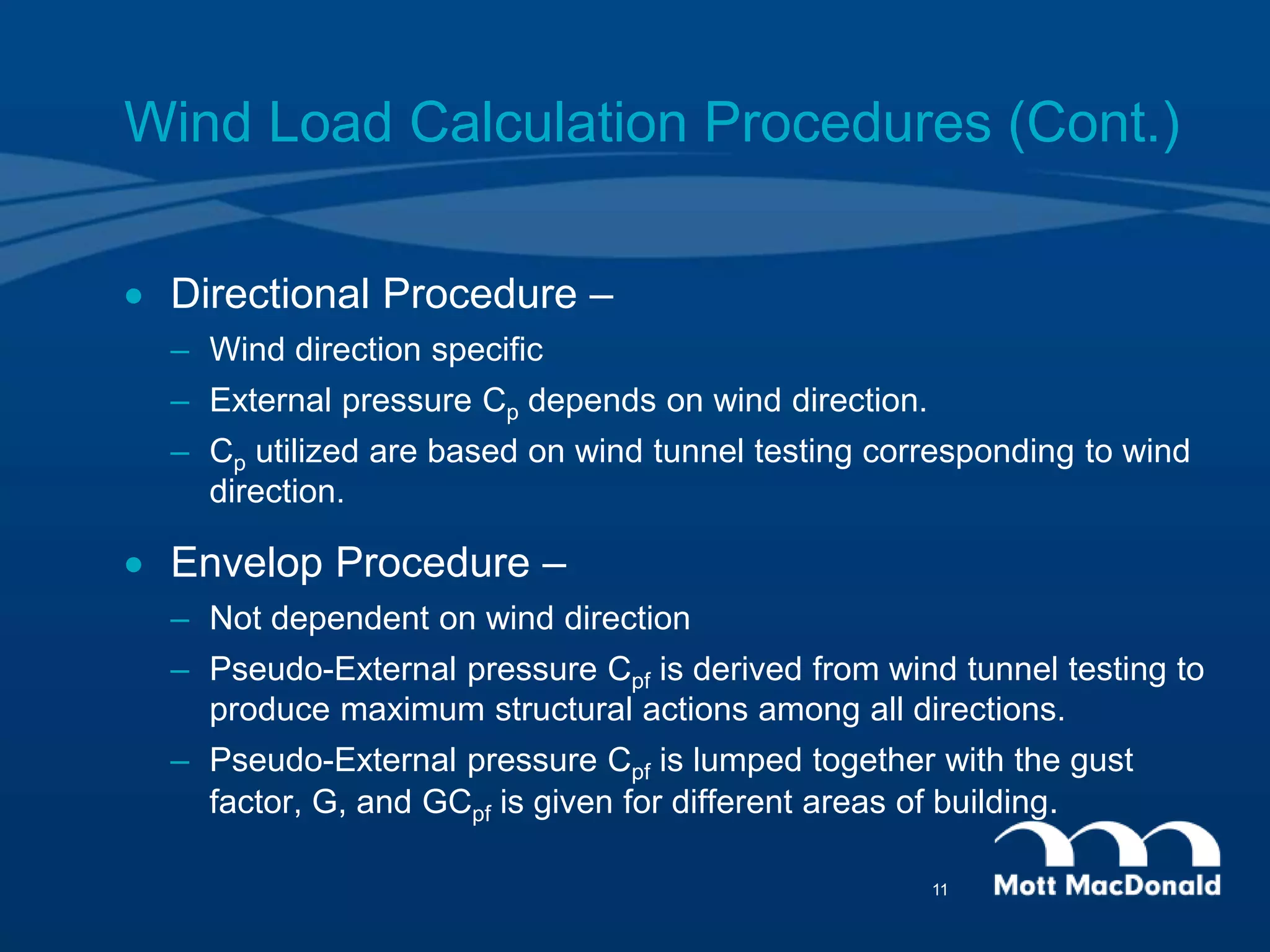
 Directional Procedure –
– Wind direction specific
– External pressure Cp depends on wind direction.
– Cp utilized are based on wind tunnel testing corresponding to wind
direction.
 Envelop Procedure –
– Not dependent on wind direction
– Pseudo-External pressure Cpf is derived from wind tunnel testing to
produce maximum structural actions among all directions.
– Pseudo-External pressure Cpf is lumped together with the gust
factor, G, and GCpf is given for different areas of building.
11
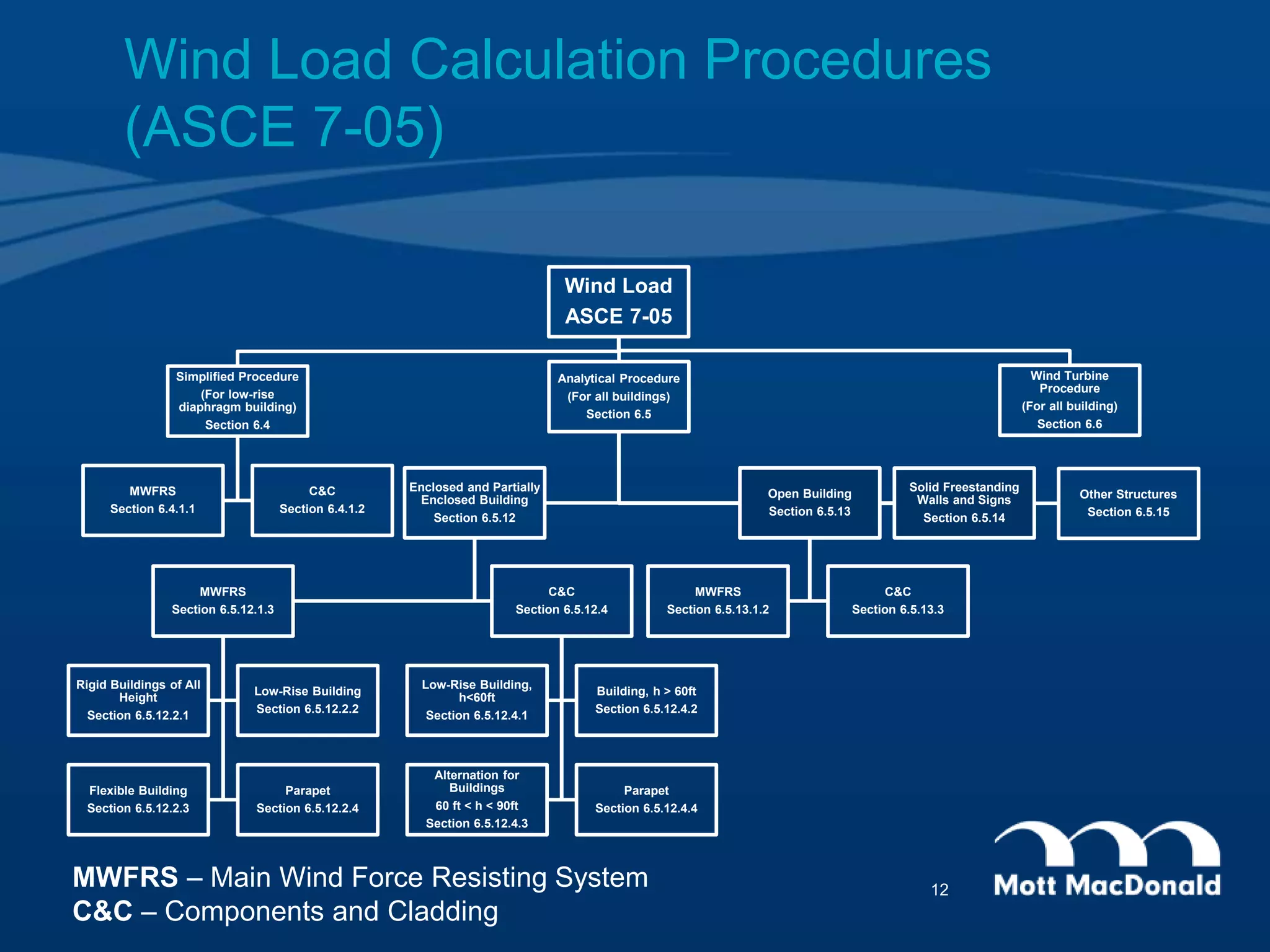
Wind Load Calculation Procedures
(ASCE 7-05)
Wind Load
ASCE 7-05
Simplified Procedure
(For low-rise
diaphragm building)
Section 6.4
MWFRS
Section 6.4.1.1
C&C
Section 6.4.1.2
Analytical Procedure
(For all buildings)
Section 6.5
Enclosed and Partially
Enclosed Building
Section 6.5.12
MWFRS
Section 6.5.12.1.3
Rigid Buildings of All
Height
Section 6.5.12.2.1
Low-Rise Building
Section 6.5.12.2.2
Flexible Building
Section 6.5.12.2.3
Parapet
Section 6.5.12.2.4
C&C
Section 6.5.12.4
Low-Rise Building,
h<60ft
Section 6.5.12.4.1
Building, h > 60ft
Section 6.5.12.4.2
Alternation for
Buildings
60 ft < h < 90ft
Section 6.5.12.4.3
Parapet
Section 6.5.12.4.4
Open Building
Section 6.5.13
MWFRS
Section 6.5.13.1.2
C&C
Section 6.5.13.3
Solid Freestanding
Walls and Signs
Section 6.5.14
Other Structures
Section 6.5.15
Wind Turbine
Procedure
(For all building)
Section 6.6
MWFRS – Main Wind Force Resisting System
C&C – Components and Cladding
12
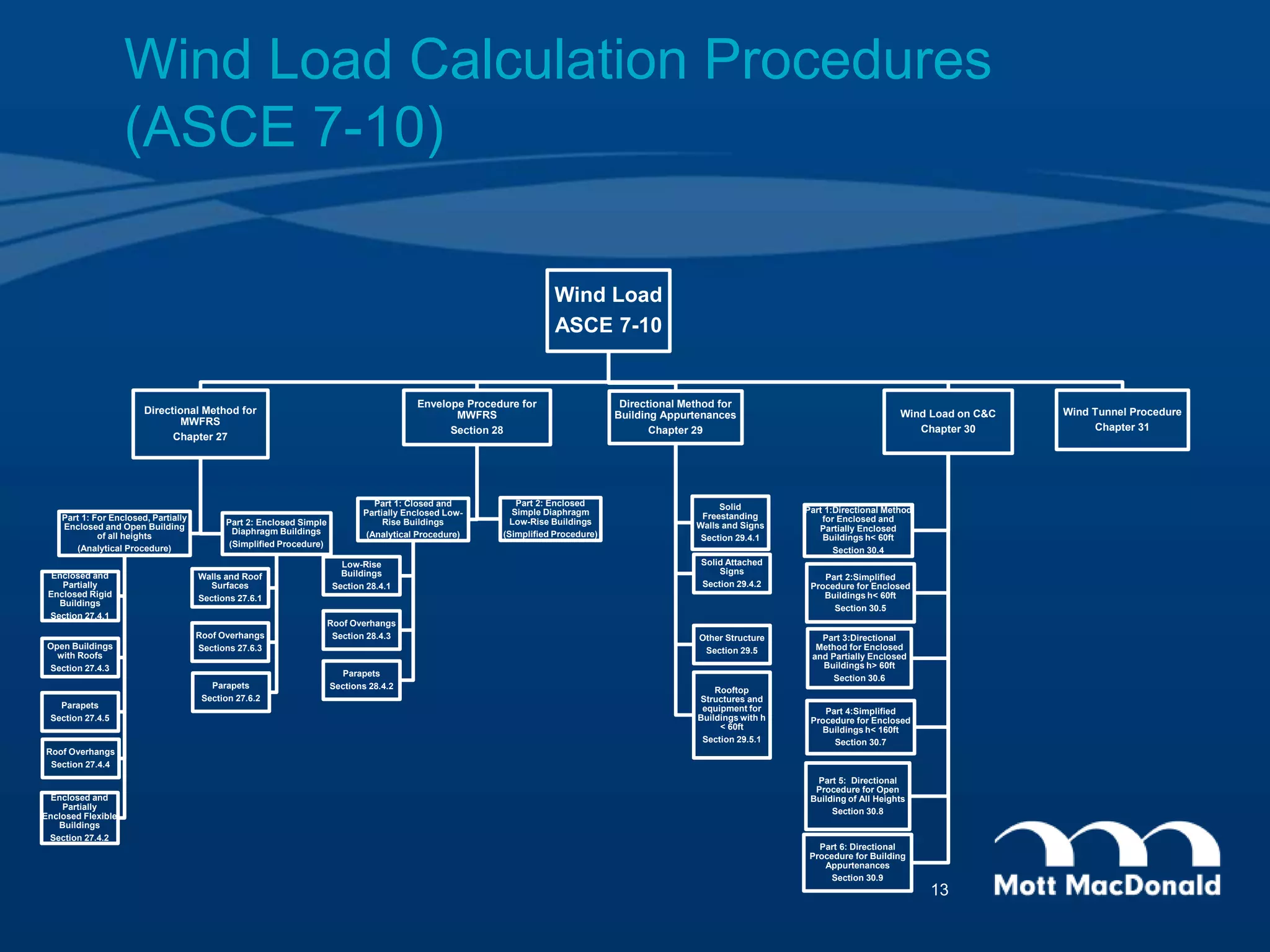
Wind Load
ASCE 7-10
Directional Method for
MWFRS
Chapter 27
Part 1: For Enclosed, Partially
Enclosed and Open Building
of all heights
(Analytical Procedure)
Enclosed and
Partially
Enclosed Rigid
Buildings
Section 27.4.1
Enclosed and
Partially
Enclosed Flexible
Buildings
Section 27.4.2
Open Buildings
with Roofs
Section 27.4.3
Roof Overhangs
Section 27.4.4
Parapets
Section 27.4.5
Part 2: Enclosed Simple
Diaphragm Buildings
(Simplified Procedure)
Walls and Roof
Surfaces
Sections 27.6.1
Parapets
Section 27.6.2
Roof Overhangs
Sections 27.6.3
Envelope Procedure for
MWFRS
Section 28
Part 1: Closed and
Partially Enclosed Low-
Rise Buildings
(Analytical Procedure)
Low-Rise
Buildings
Section 28.4.1
Parapets
Sections 28.4.2
Roof Overhangs
Section 28.4.3
Part 2: Enclosed
Simple Diaphragm
Low-Rise Buildings
(Simplified Procedure)
Directional Method for
Building Appurtenances
Chapter 29
Solid
Freestanding
Walls and Signs
Section 29.4.1
Solid Attached
Signs
Section 29.4.2
Other Structure
Section 29.5
Rooftop
Structures and
equipment for
Buildings with h
< 60ft
Section 29.5.1
Wind Load on C&C
Chapter 30
Part 1:Directional Method
for Enclosed and
Partially Enclosed
Buildings h< 60ft
Section 30.4
Part 2:Simplified
Procedure for Enclosed
Buildings h< 60ft
Section 30.5
Part 3:Directional
Method for Enclosed
and Partially Enclosed
Buildings h> 60ft
Section 30.6
Part 4:Simplified
Procedure for Enclosed
Buildings h< 160ft
Section 30.7
Part 5: Directional
Procedure for Open
Building of All Heights
Section 30.8
Part 6: Directional
Procedure for Building
Appurtenances
Section 30.9
Wind Tunnel Procedure
Chapter 31
Wind Load Calculation Procedures
(ASCE 7-10)
13
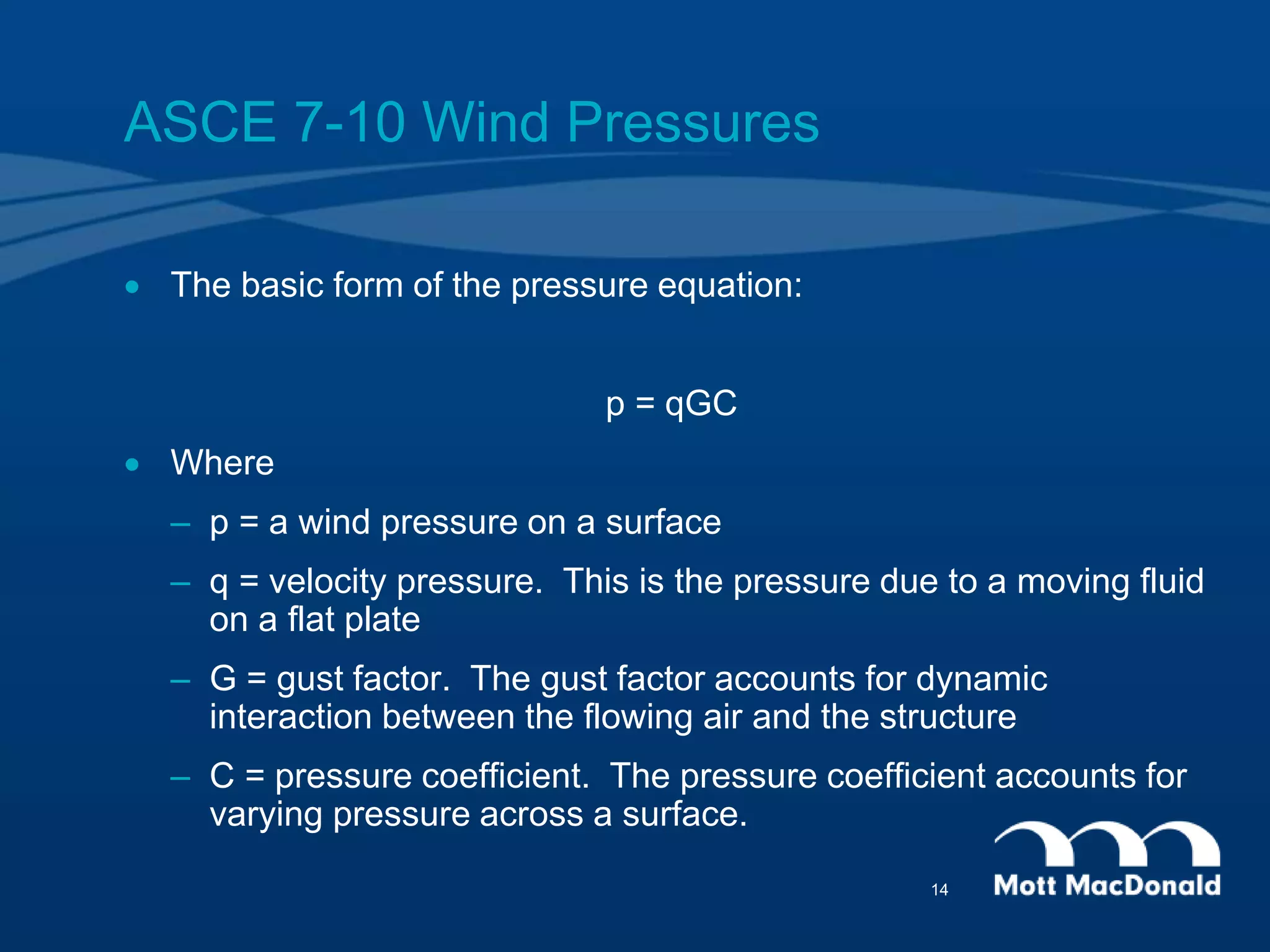
ASCE 7-10 Wind Pressures
 The basic form of the pressure equation:
p = qGC
 Where
– p = a wind pressure on a surface
– q = velocity pressure. This is the pressure due to a moving fluid
on a flat plate
– G = gust factor. The gust factor accounts for dynamic
interaction between the flowing air and the structure
– C = pressure coefficient. The pressure coefficient accounts for
varying pressure across a surface.
14
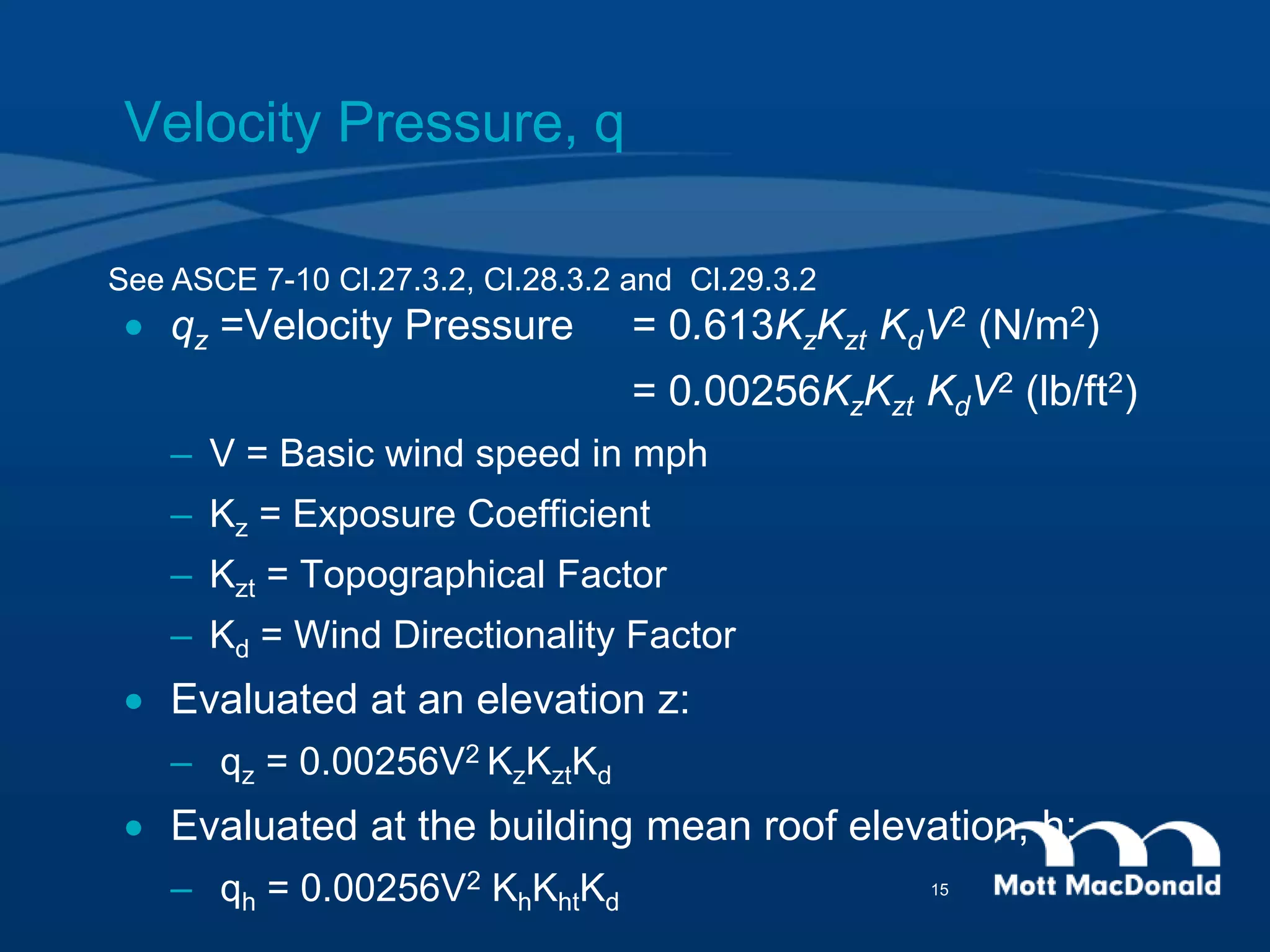
Velocity Pressure, q
 qz =Velocity Pressure = 0.613KzKzt KdV2 (N/m2)
= 0.00256KzKzt KdV2 (lb/ft2)
– V = Basic wind speed in mph
– Kz = Exposure Coefficient
– Kzt = Topographical Factor
– Kd = Wind Directionality Factor
 Evaluated at an elevation z:
– qz = 0.00256V2 KzKztKd
 Evaluated at the building mean roof elevation, h:
– qh = 0.00256V2 KhKhtKd
See ASCE 7-10 Cl.27.3.2, Cl.28.3.2 and Cl.29.3.2
15
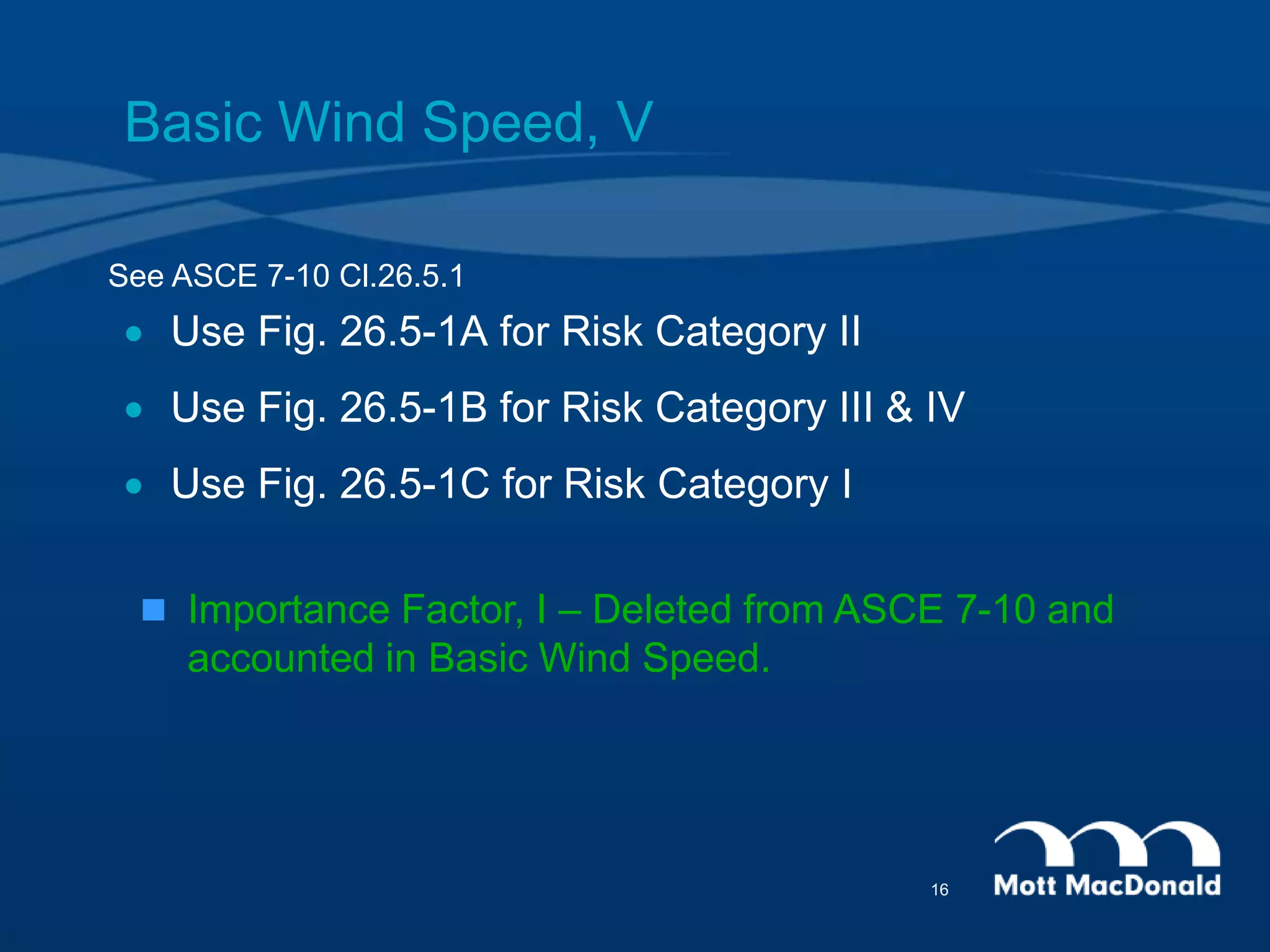
Basic Wind Speed, V
 Use Fig. 26.5-1A for Risk Category II
 Use Fig. 26.5-1B for Risk Category III & IV
 Use Fig. 26.5-1C for Risk Category I
See ASCE 7-10 Cl.26.5.1
 Importance Factor, I – Deleted from ASCE 7-10 and
accounted in Basic Wind Speed.
16
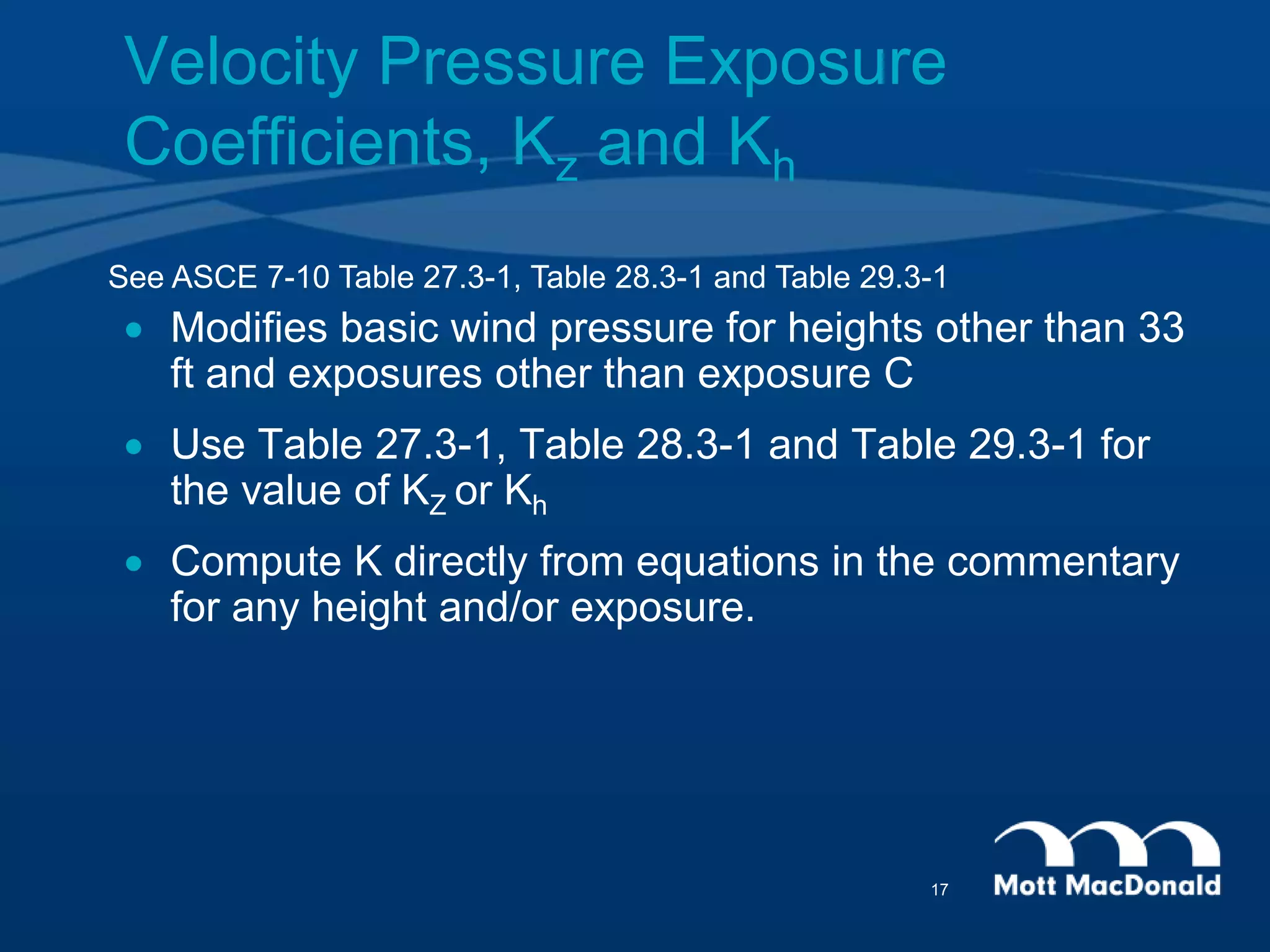
Velocity Pressure Exposure
Coefficients, Kz and Kh
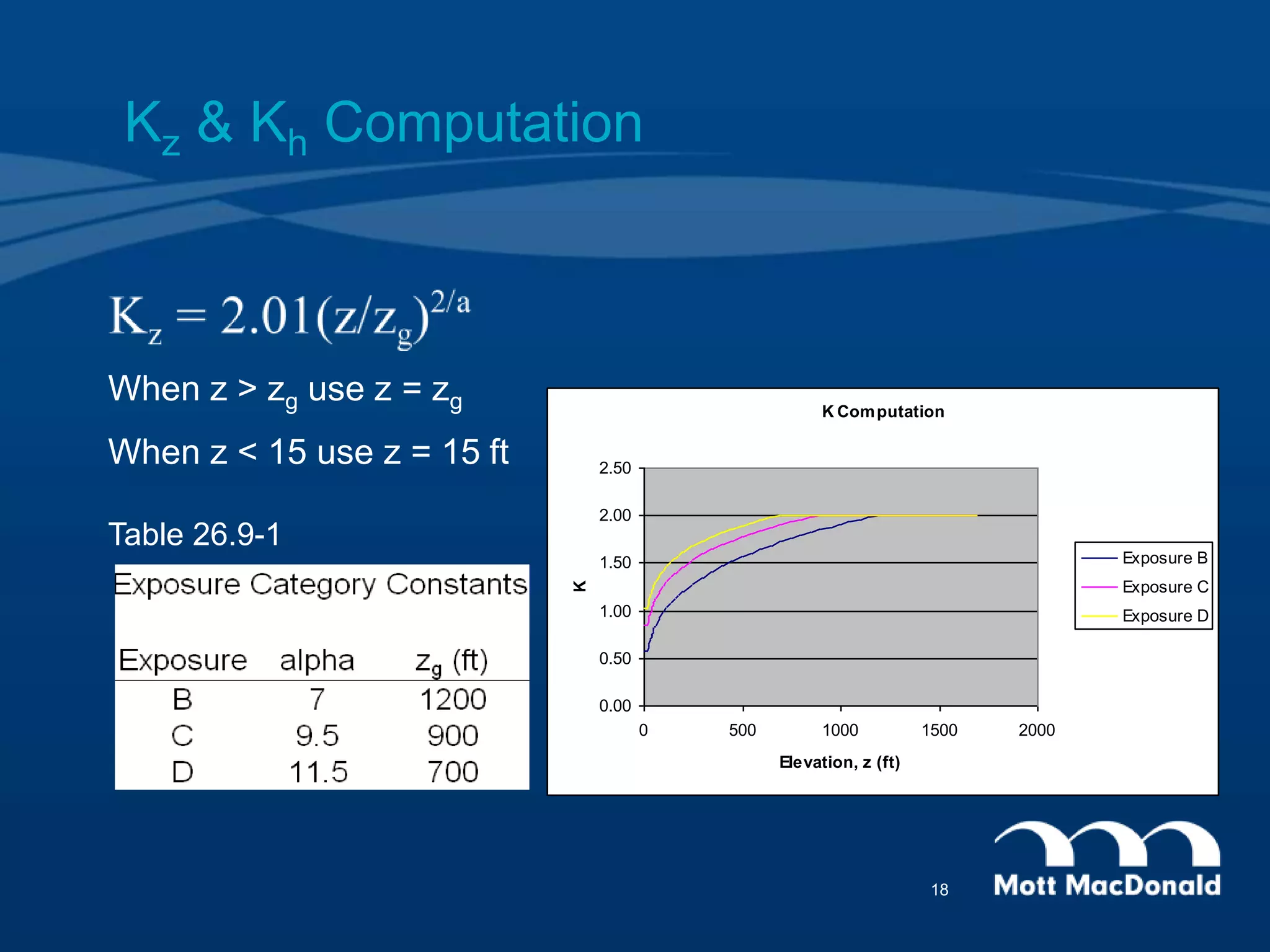
 Modifies basic wind pressure for heights other than 33
ft and exposures other than exposure C
 Use Table 27.3-1, Table 28.3-1 and Table 29.3-1 for
the value of KZ or Kh
 Compute K directly from equations in the commentary
for any height and/or exposure.
See ASCE 7-10 Table 27.3-1, Table 28.3-1 and Table 29.3-1
17
Kz & Kh Computation
K Computation
0.00
0.50
1.00
1.50
2.00
2.50
0 500 1000 1500 2000
Elevation, z (ft)
K
Exposure B
Exposure C
Exposure D
When z > zg use z = zg
When z < 15 use z = 15 ft
Table 26.9-1
18
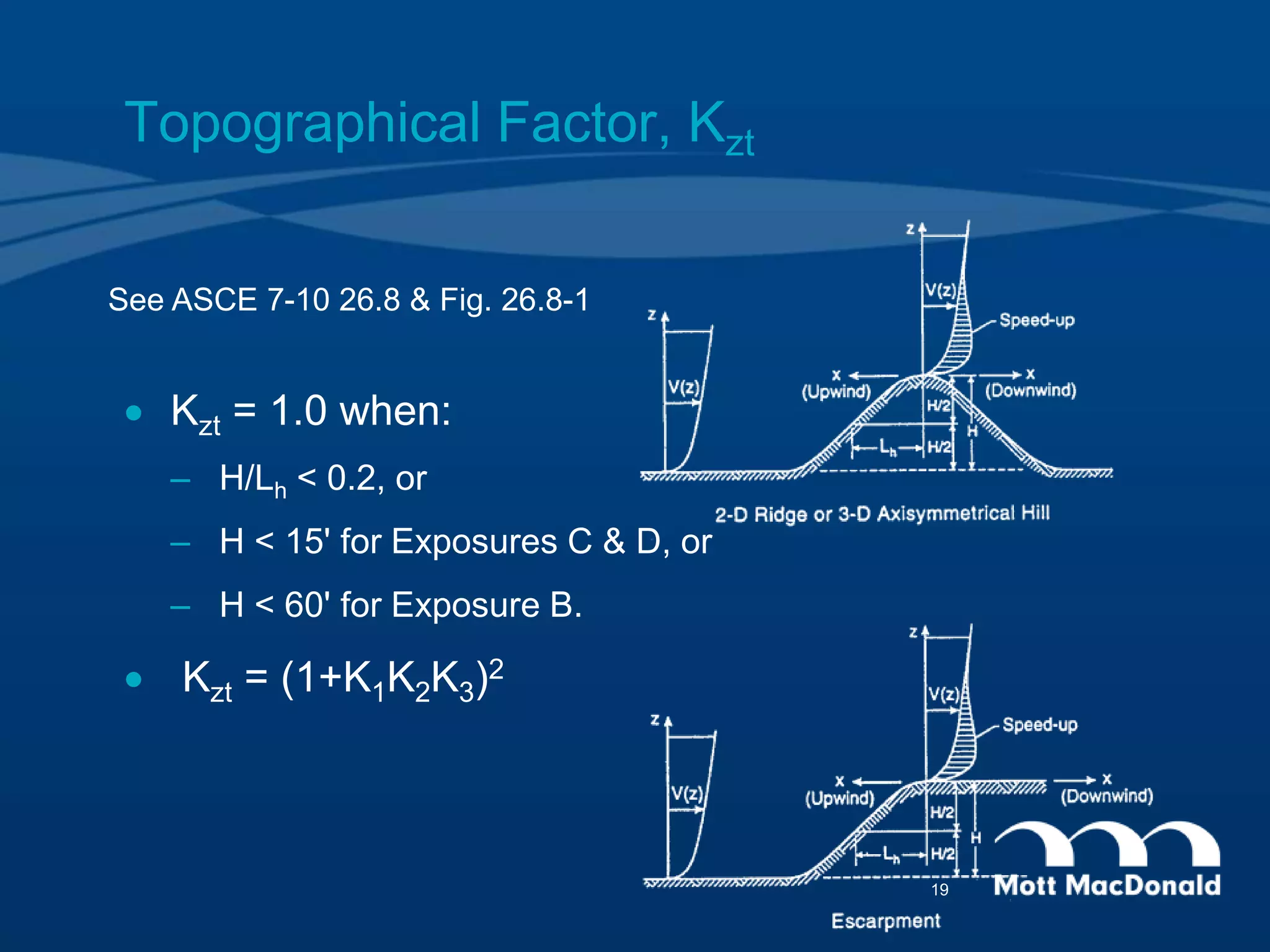
Topographical Factor, Kzt
 Kzt = 1.0 when:
– H/Lh < 0.2, or
– H < 15' for Exposures C & D, or
– H < 60' for Exposure B.
 Kzt = (1+K1K2K3)2
See ASCE 7-10 26.8 & Fig. 26.8-1
19
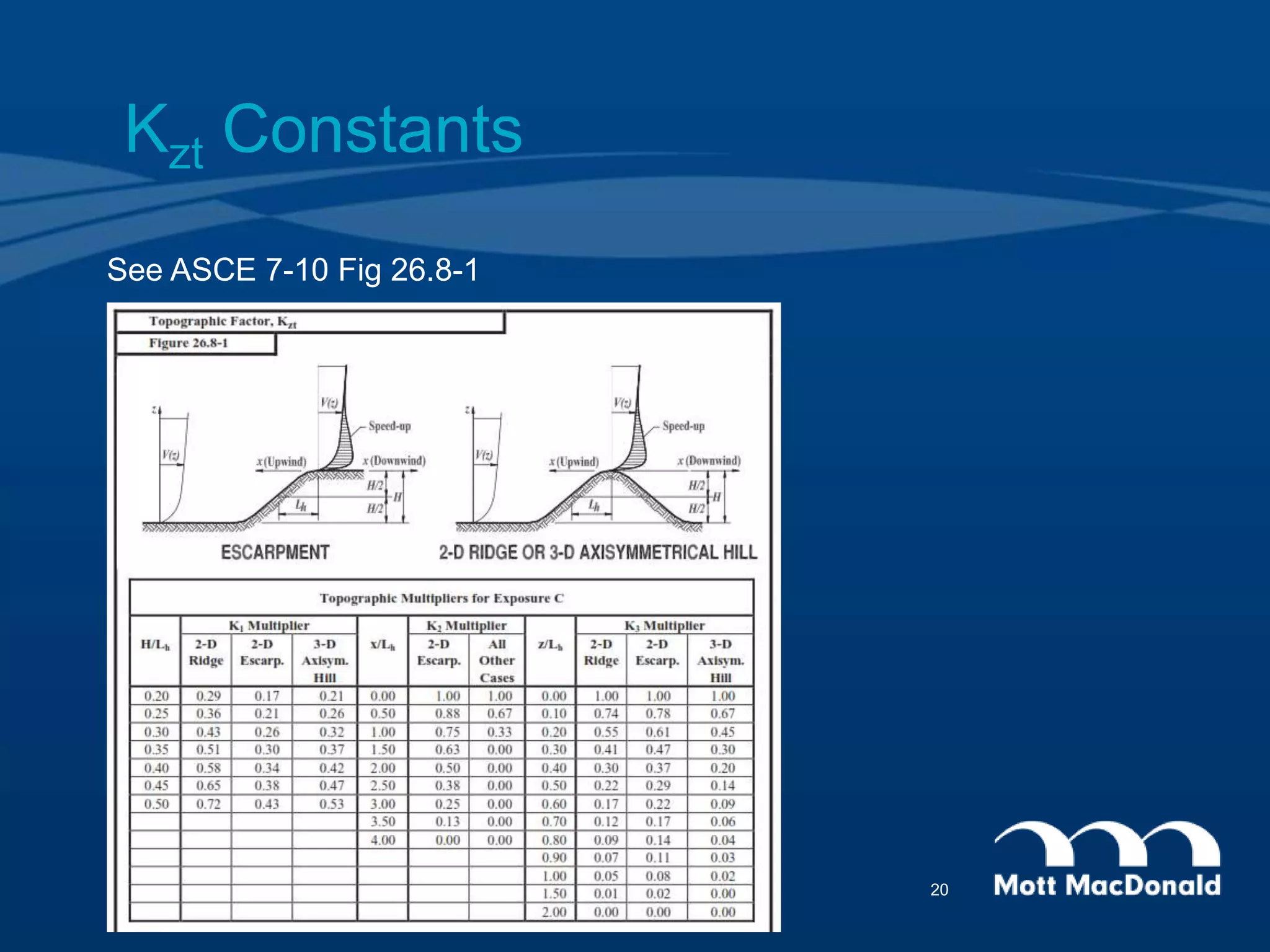
Kzt Constants
See ASCE 7-10 Fig 26.8-1
20
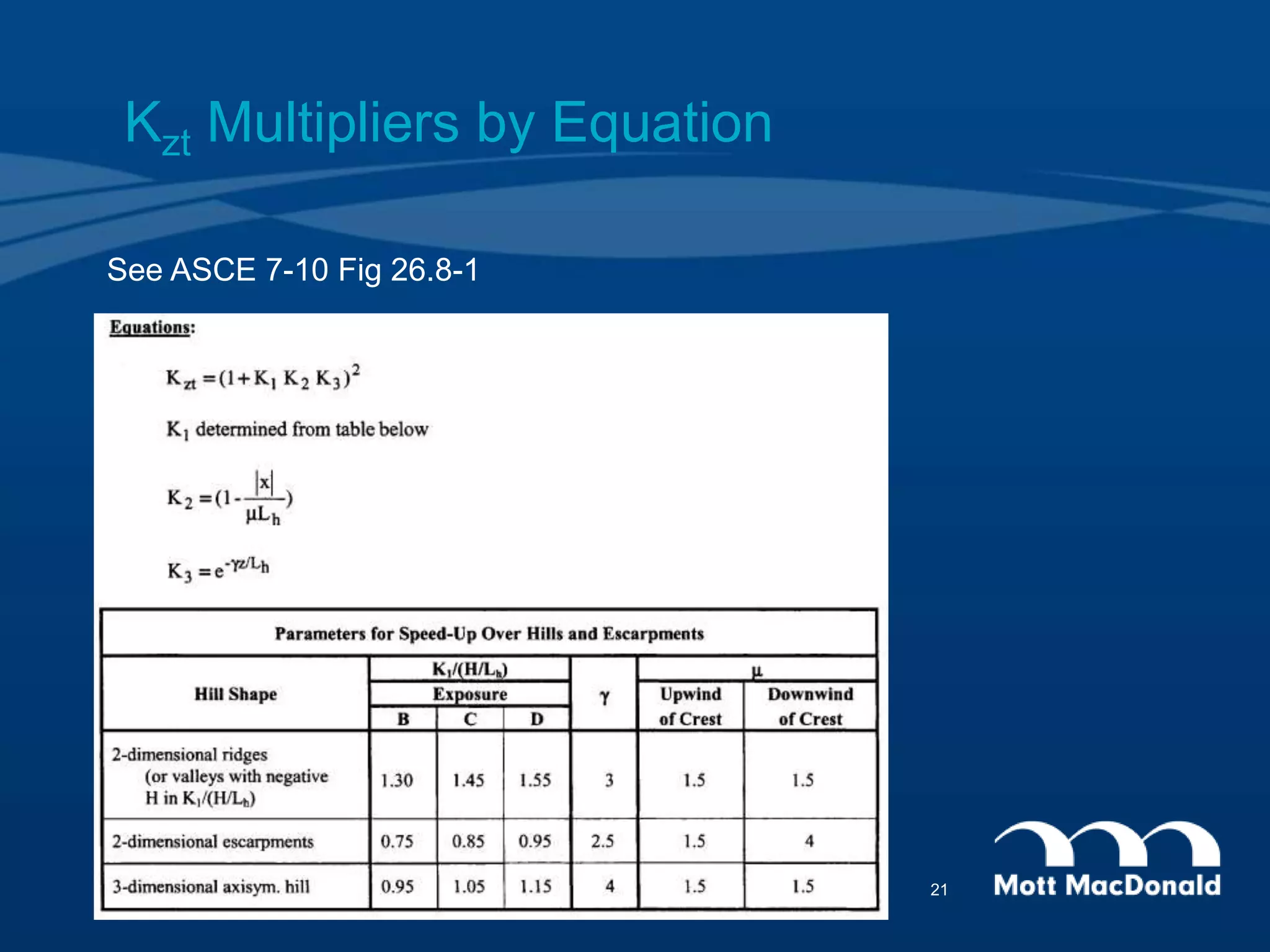
Kzt Multipliers by Equation
See ASCE 7-10 Fig 26.8-1
21
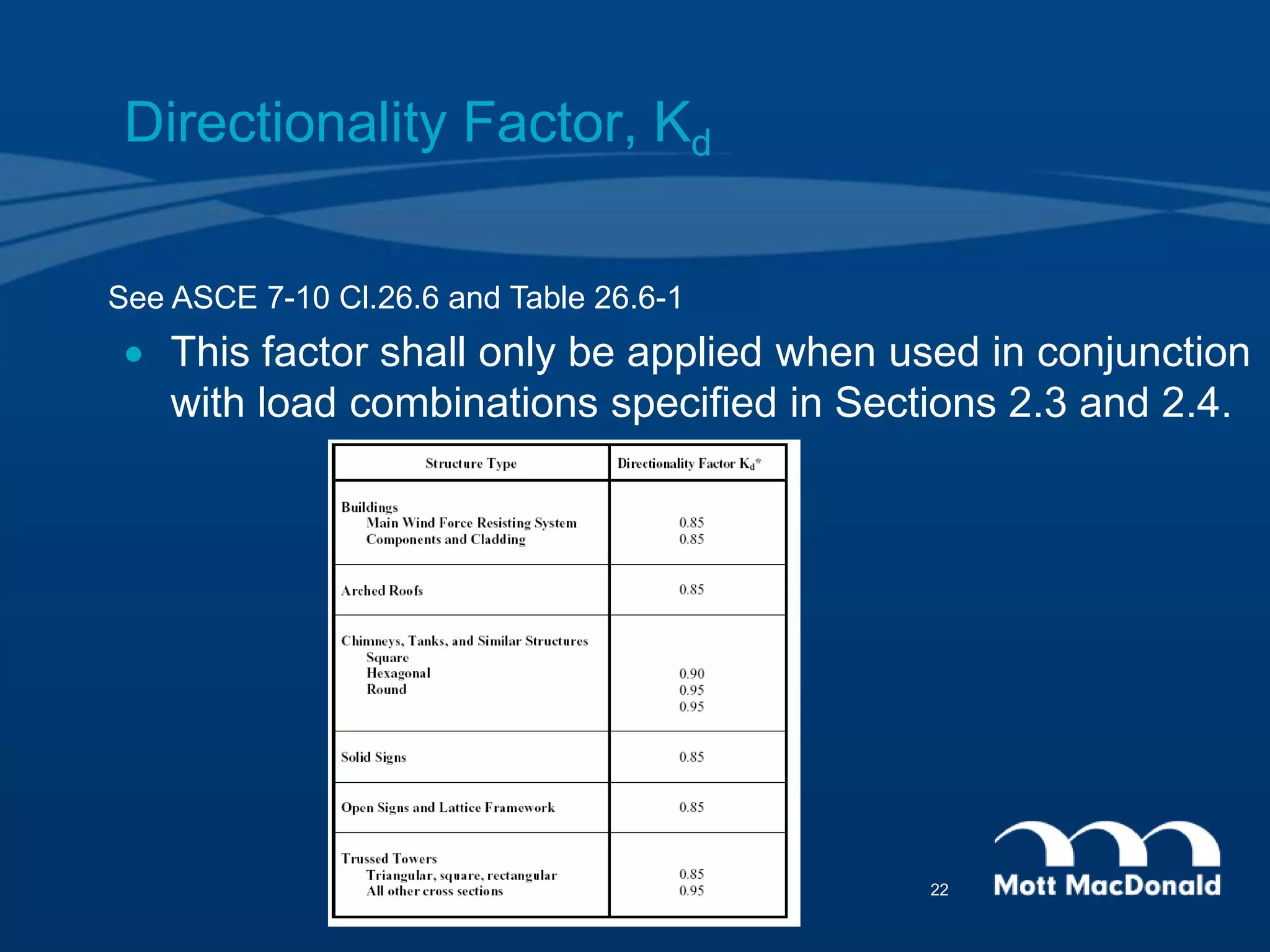
Directionality Factor, Kd
 This factor shall only be applied when used in conjunction
with load combinations specified in Sections 2.3 and 2.4.
See ASCE 7-10 Cl.26.6 and Table 26.6-1
22
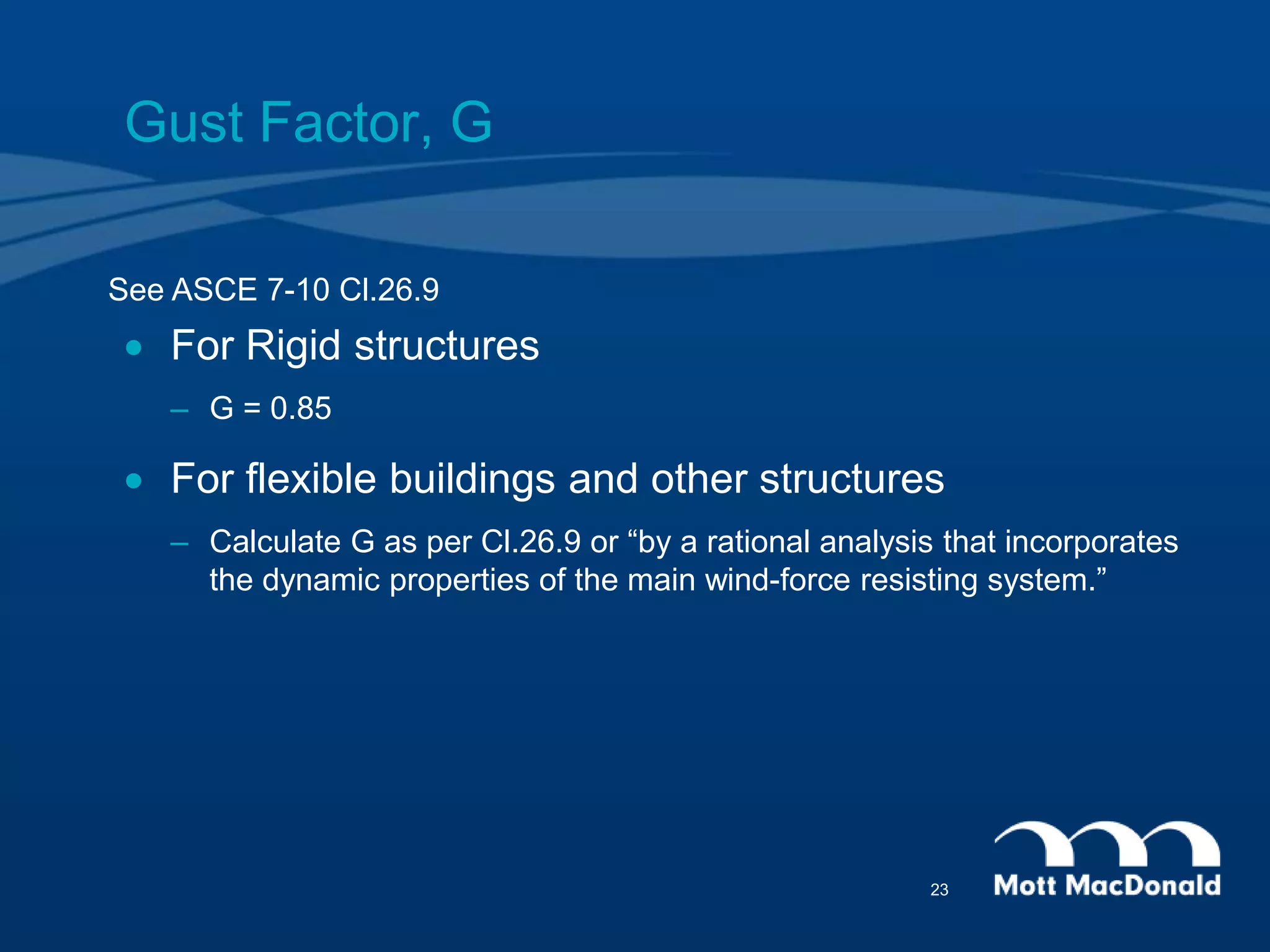
Gust Factor, G
 For Rigid structures
– G = 0.85
 For flexible buildings and other structures
– Calculate G as per Cl.26.9 or “by a rational analysis that incorporates
the dynamic properties of the main wind-force resisting system.”
See ASCE 7-10 Cl.26.9
23
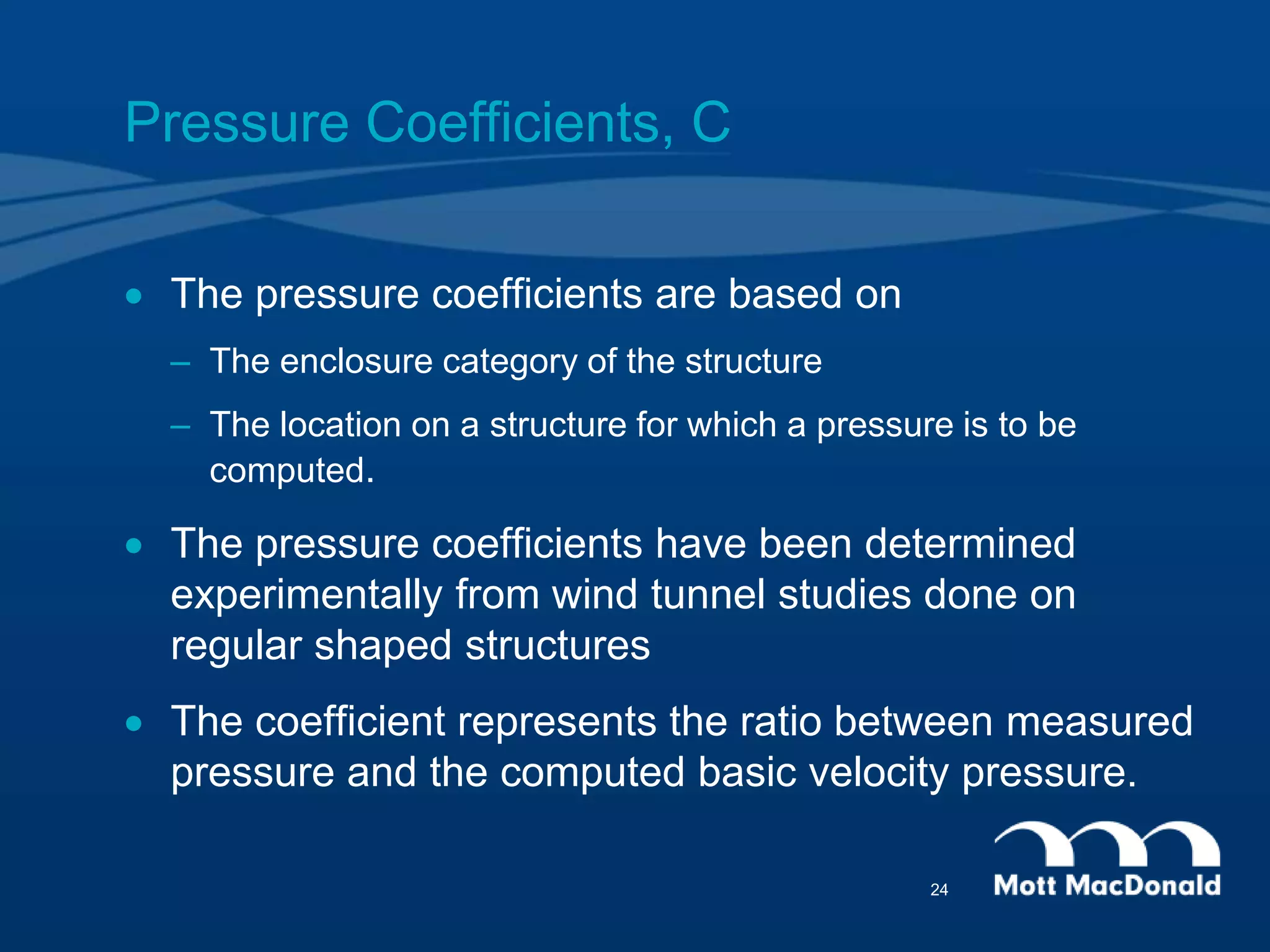
Pressure Coefficients, C
 The pressure coefficients are based on
– The enclosure category of the structure
– The location on a structure for which a pressure is to be
computed.
 The pressure coefficients have been determined
experimentally from wind tunnel studies done on
regular shaped structures
 The coefficient represents the ratio between measured
pressure and the computed basic velocity pressure.
24
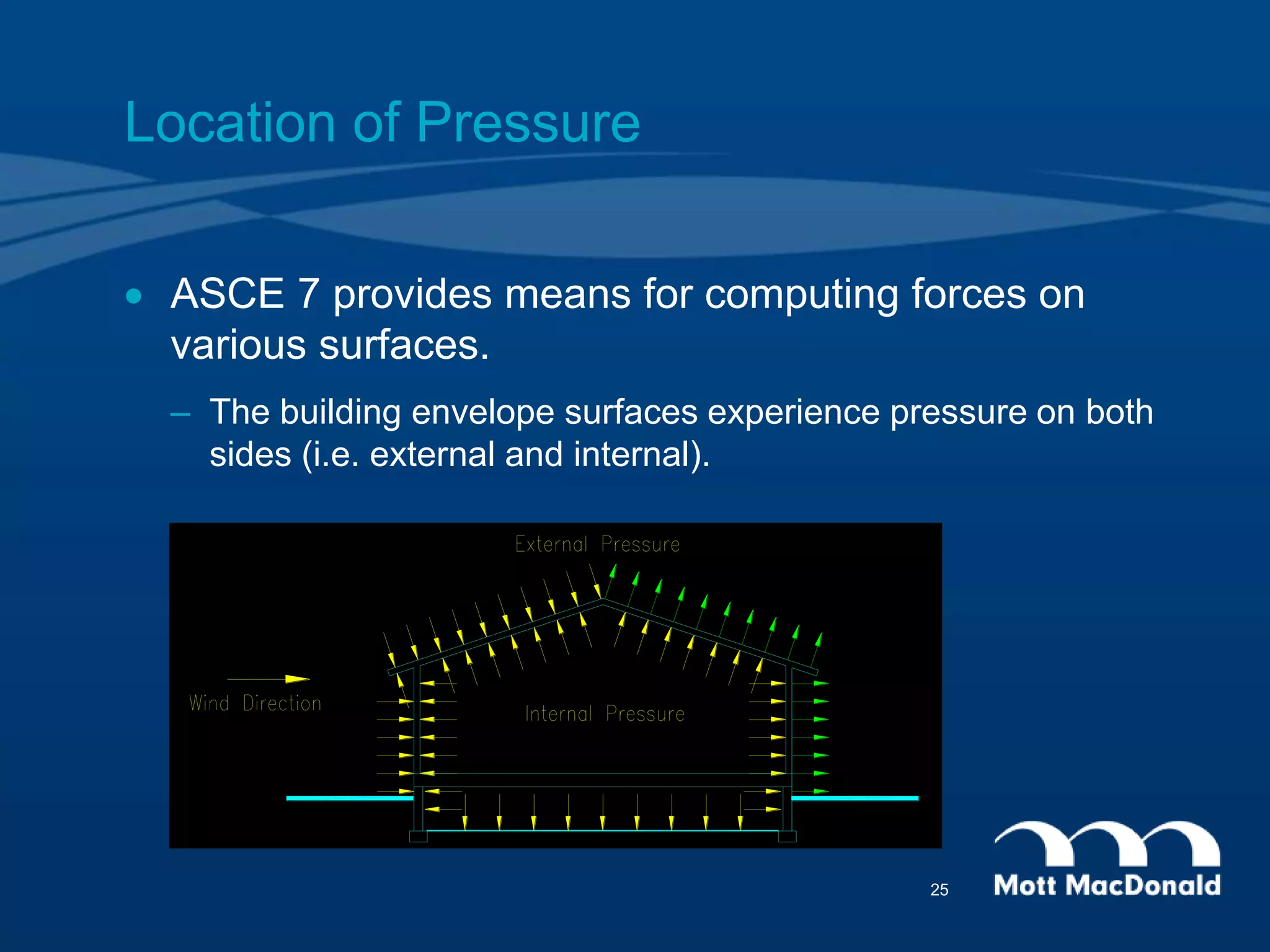
Location of Pressure
 ASCE 7 provides means for computing forces on
various surfaces.
– The building envelope surfaces experience pressure on both
sides (i.e. external and internal).
25
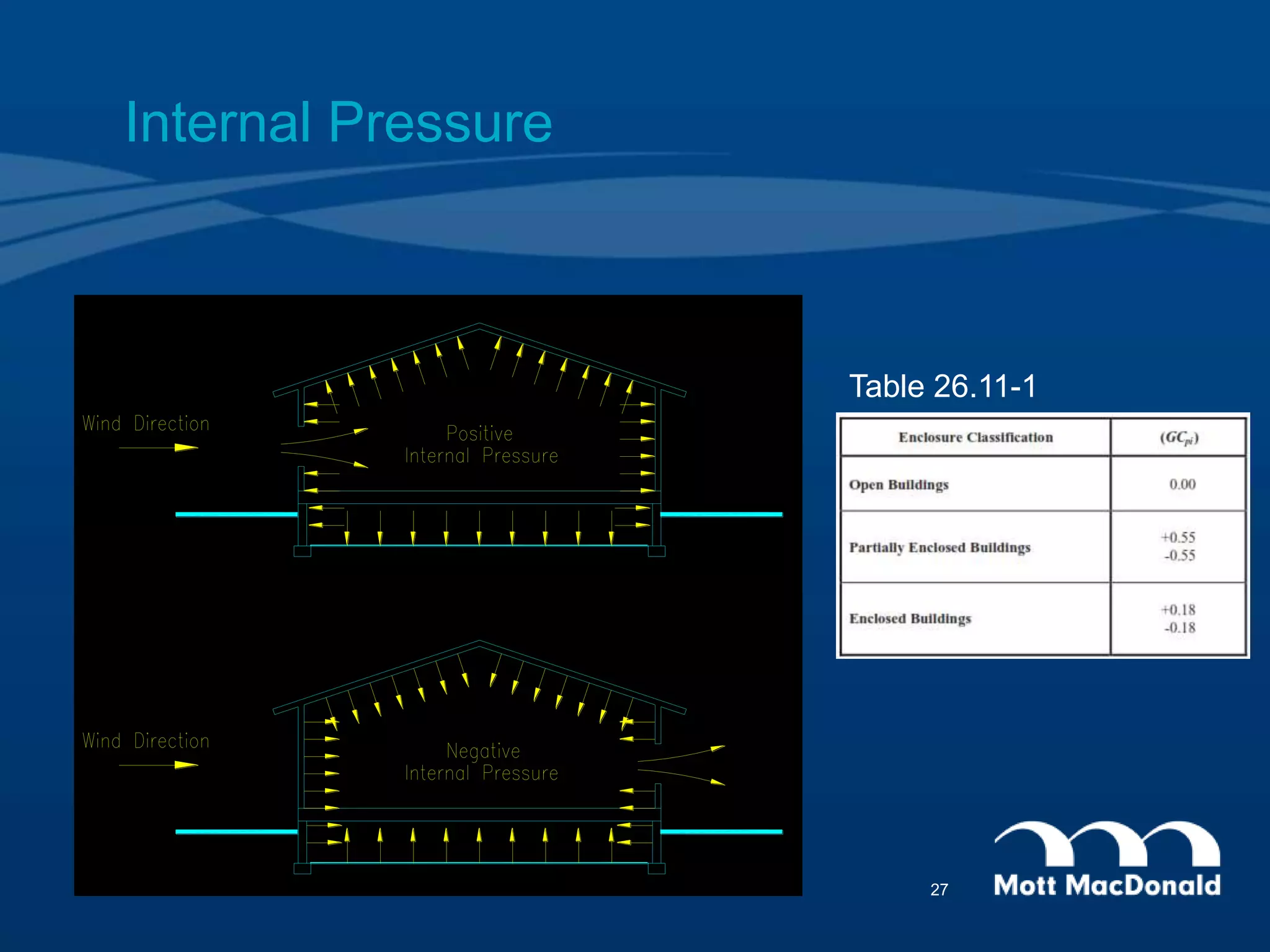
Internal Pressure Coefficients, GCpi
 Internal pressure is fairly easy because the air is
relatively stagnant and the shape of the structure does
not affect it’s magnitude.
 As gusting is not a concern internally, the gust factor
and the pressure coefficient are combined.
– GCpi
 The magnitude of the internal pressure coefficient is
strictly dependent on the enclosure classification.
 The pressure can be both positive or negative (i.e.
suction) depending on the direction of the wind relative
to opening for partially enclosed or enclosed buildings.
– Both internal pressures must be considered.
See ASCE 7-10 Cl.26.11 & Table 26.11-1
26
Internal Pressure
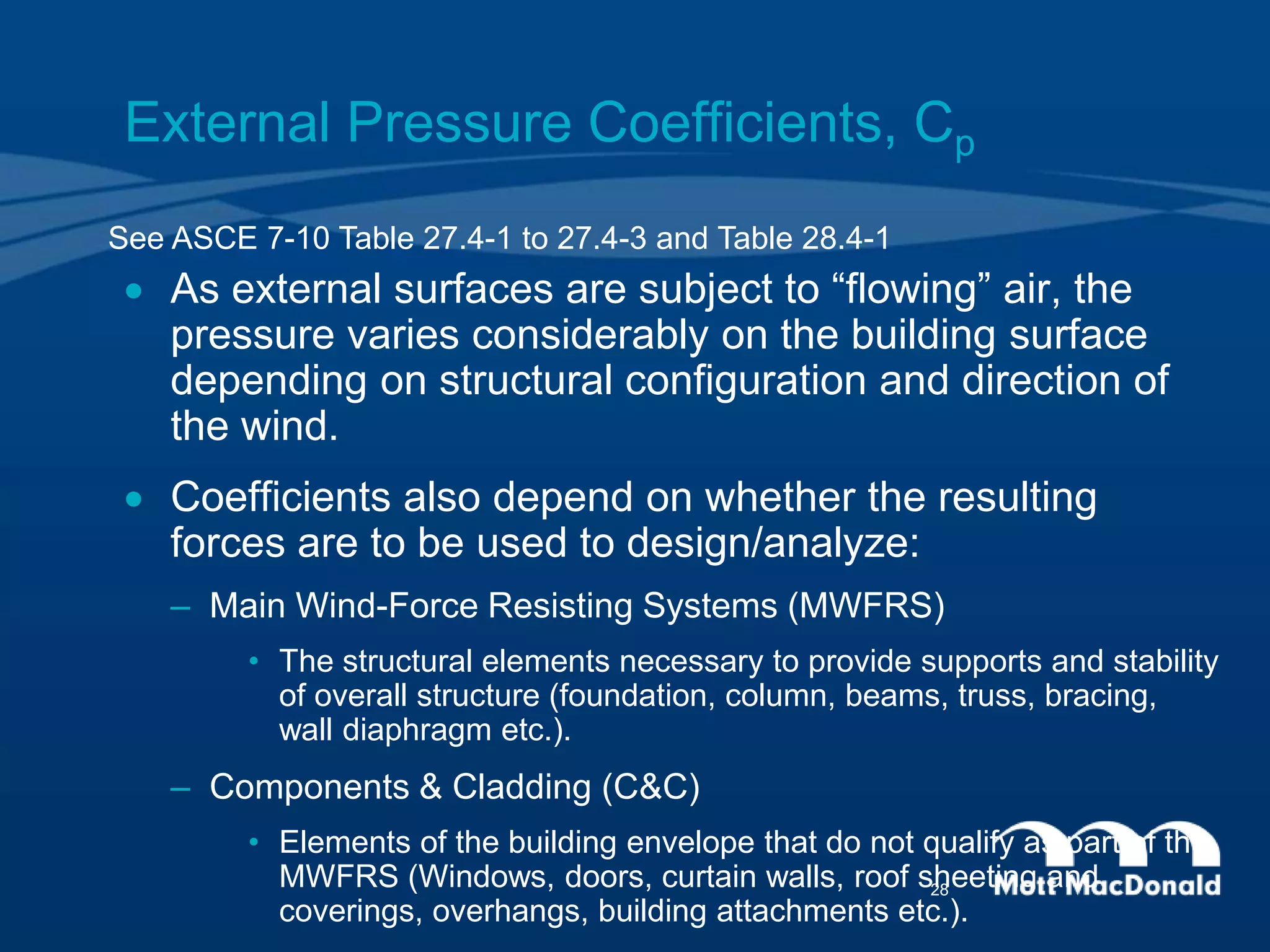
Table 26.11-1
27
External Pressure Coefficients, Cp
 As external surfaces are subject to “flowing” air, the
pressure varies considerably on the building surface
depending on structural configuration and direction of
the wind.
 Coefficients also depend on whether the resulting
forces are to be used to design/analyze:
– Main Wind-Force Resisting Systems (MWFRS)
• The structural elements necessary to provide supports and stability
of overall structure (foundation, column, beams, truss, bracing,
wall diaphragm etc.).
– Components & Cladding (C&C)
• Elements of the building envelope that do not qualify as part of the
MWFRS (Windows, doors, curtain walls, roof sheeting and
coverings, overhangs, building attachments etc.).
See ASCE 7-10 Table 27.4-1 to 27.4-3 and Table 28.4-1
28
Directional Procedure
 For Wind Load calculation for enclosed, partially
enclosed and open buildings of all height.
 Conditions
– Building shall be of regular shape
– Building does not have response characteristics making it subject
to cross-wind loading, vortex, shedding, instability due to
galloping or flutter or it does not have a location that creates
channelling effect.
 Limitations – Building having unusual shapes or
response.
See ASCE 7-10 Chapter 27
29
Directional Procedure (Cont.)
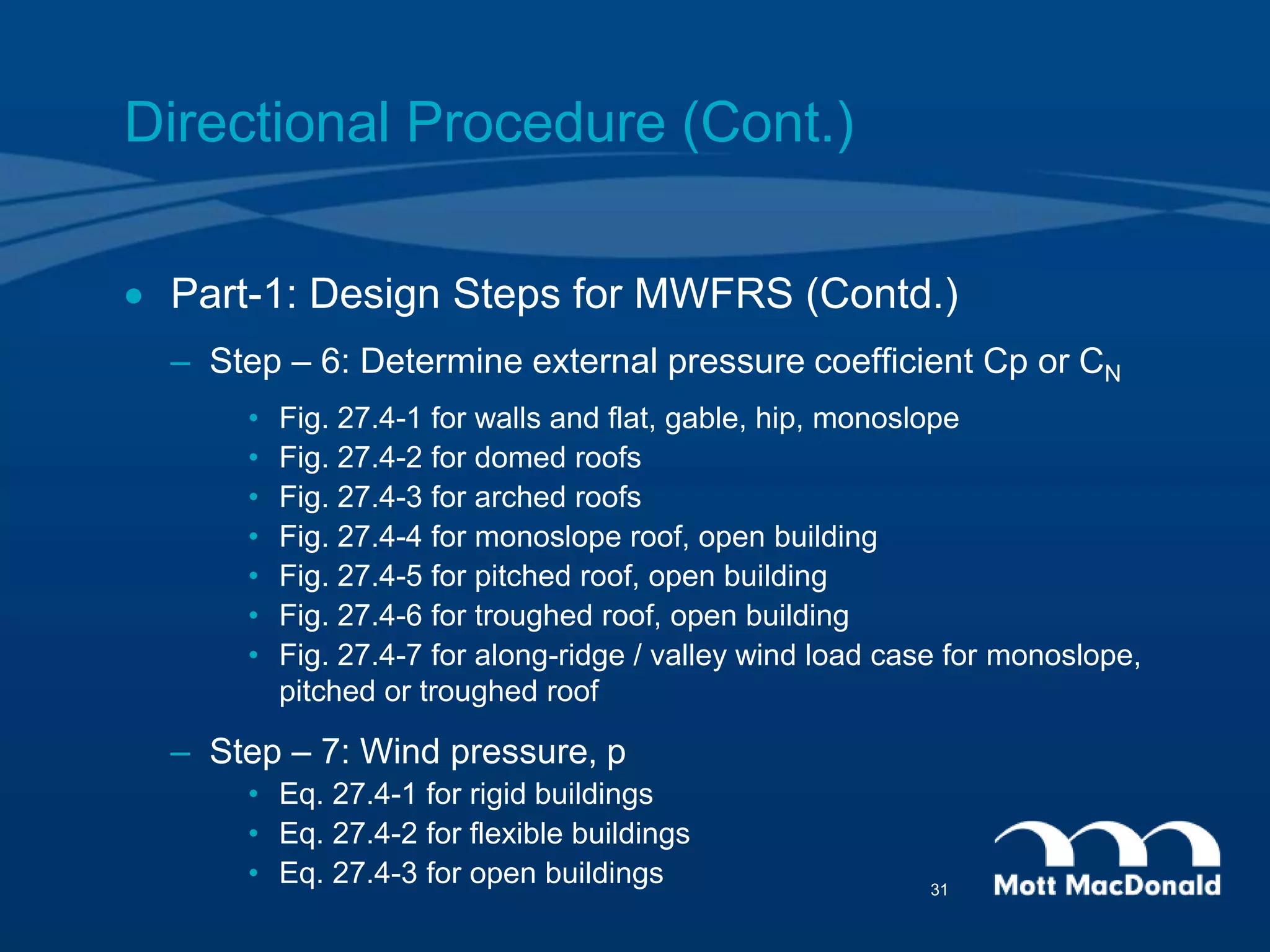
 Part-1: Design Steps for MWFRS (Analytical Procedure)
– Step – 1: Determine risk category (Table 1.5-1)
– Step – 2: Determine Basic Wind Speed
– Step – 3: Determine Wind Parameters (Kd, Exposure Category,
Kzt, G, Enclosure Classification, GCpi)
– Step – 4: Determine velocity pressure exposure coefficient Kz or
Kh (Table 27.3-1)
– Step – 5: Determine velocity pressure qz or qh (Eq. 27.3-1)
See ASCE 7-10 Table 27.2-1
30
Directional Procedure (Cont.)
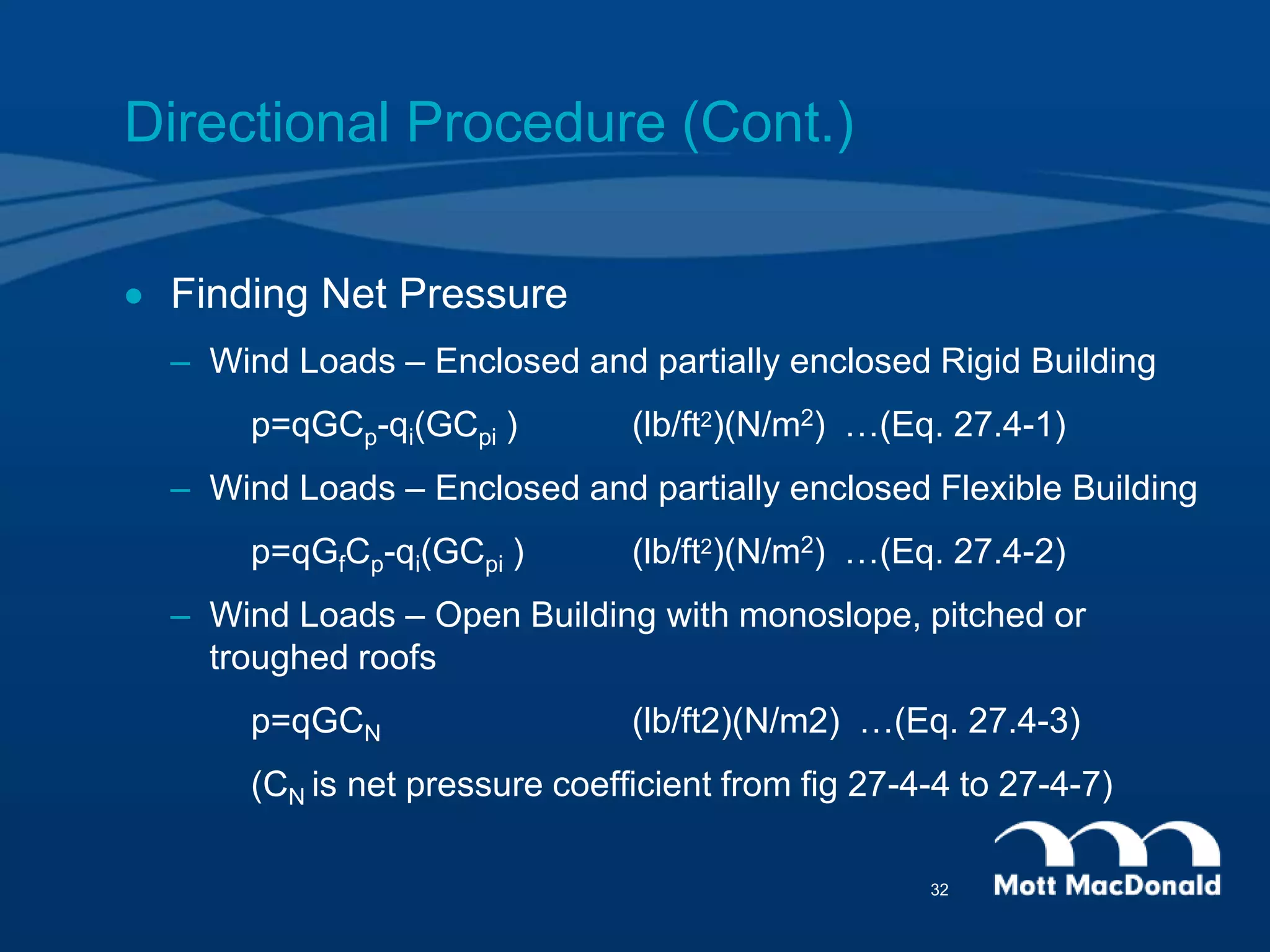
 Part-1: Design Steps for MWFRS (Contd.)
– Step – 6: Determine external pressure coefficient Cp or CN
• Fig. 27.4-1 for walls and flat, gable, hip, monoslope
• Fig. 27.4-2 for domed roofs
• Fig. 27.4-3 for arched roofs
• Fig. 27.4-4 for monoslope roof, open building
• Fig. 27.4-5 for pitched roof, open building
• Fig. 27.4-6 for troughed roof, open building
• Fig. 27.4-7 for along-ridge / valley wind load case for monoslope,
pitched or troughed roof
– Step – 7: Wind pressure, p
• Eq. 27.4-1 for rigid buildings
• Eq. 27.4-2 for flexible buildings
• Eq. 27.4-3 for open buildings 31
Directional Procedure (Cont.)
 Finding Net Pressure
– Wind Loads – Enclosed and partially enclosed Rigid Building
p=qGCp-qi(GCpi ) (lb/ft2)(N/m2) …(Eq. 27.4-1)
– Wind Loads – Enclosed and partially enclosed Flexible Building
p=qGfCp-qi(GCpi ) (lb/ft2)(N/m2) …(Eq. 27.4-2)
– Wind Loads – Open Building with monoslope, pitched or
troughed roofs
p=qGCN (lb/ft2)(N/m2) …(Eq. 27.4-3)
(CN is net pressure coefficient from fig 27-4-4 to 27-4-7)
32
Directional Procedure (Cont.)
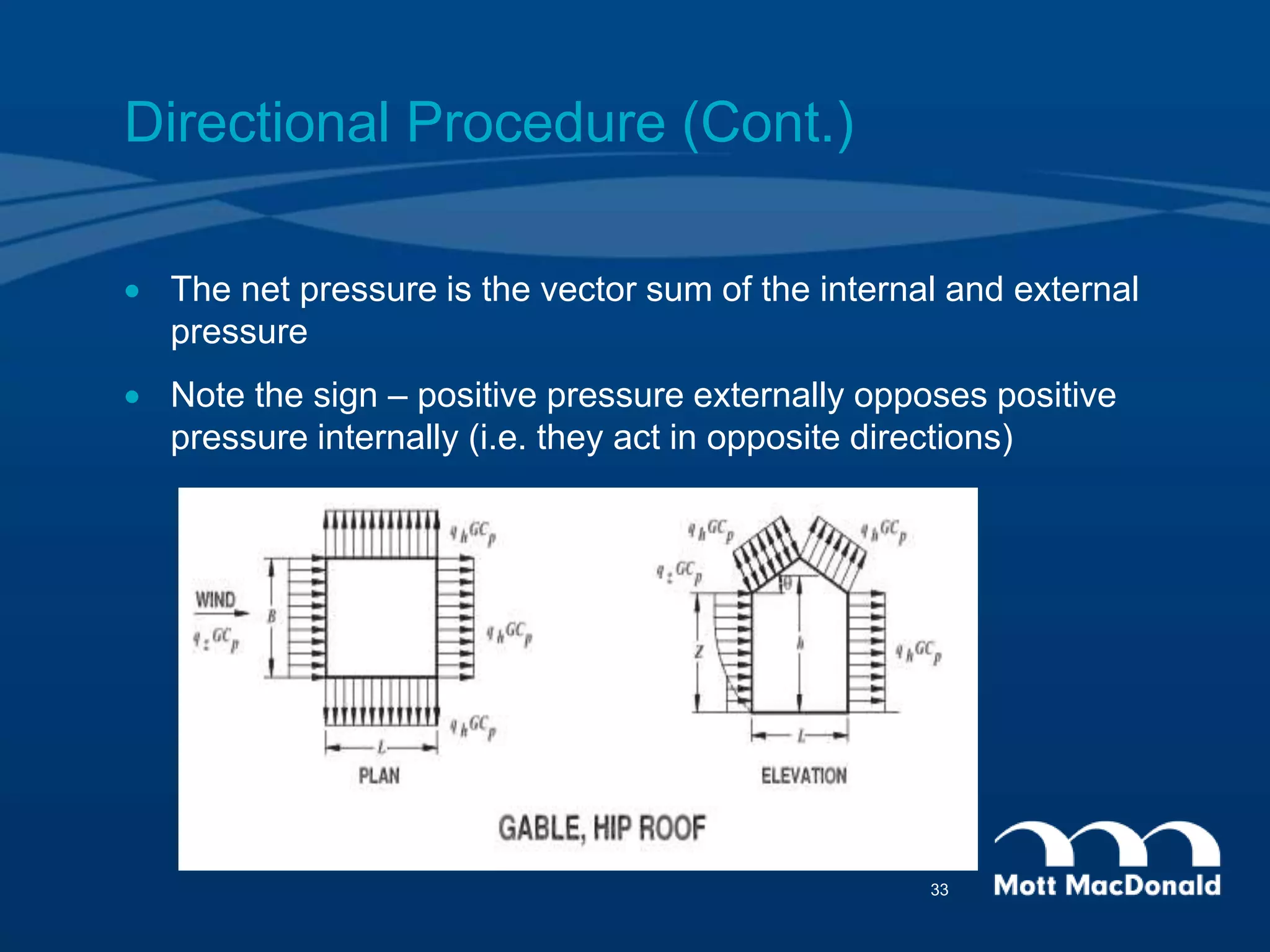
 The net pressure is the vector sum of the internal and external
pressure
 Note the sign – positive pressure externally opposes positive
pressure internally (i.e. they act in opposite directions)
33
Directional Procedure (Cont.)
 Part-2: Design Steps for Diaphragm Building
(h<160ft) (Simplified Procedure)
– Step – 1: Determine risk category (Table 1.5-1).
– Step – 2: Determine Basic Wind Speed.
– Step – 3: Determine Wind Parameters (Kd, Exposure
Category, Kzt, Enclosure Classification).
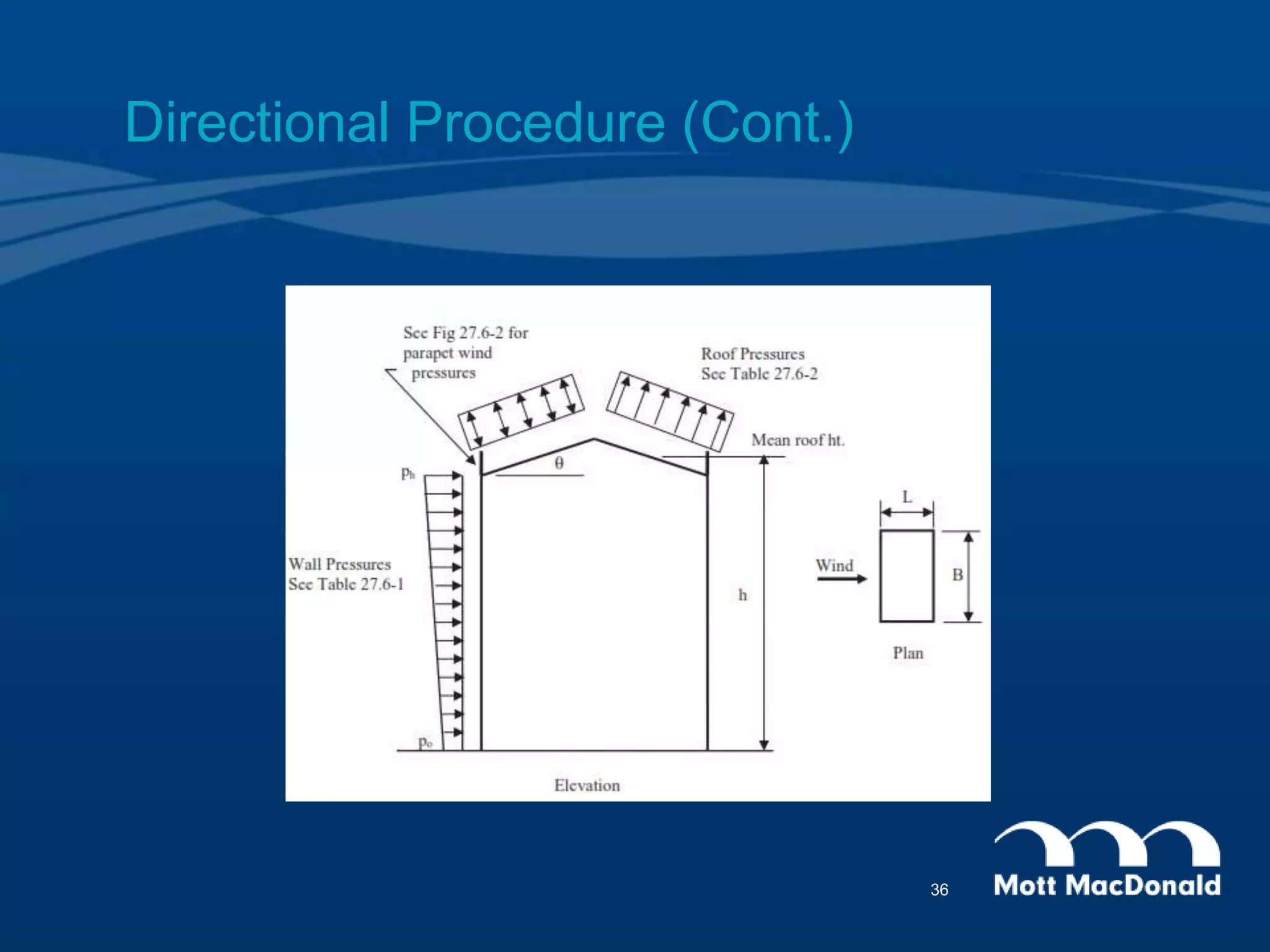
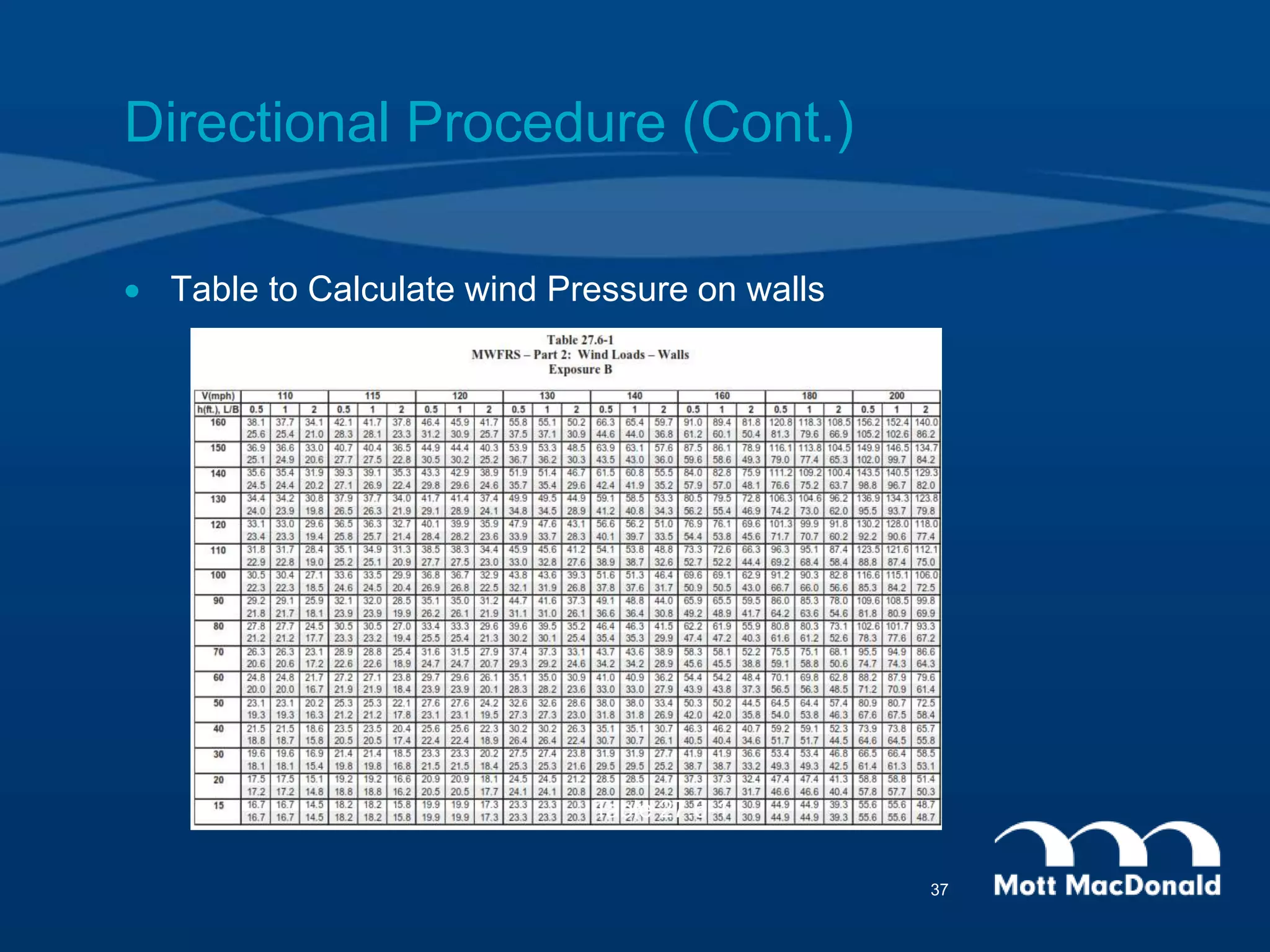
– Step – 4: Enter Table to determine net pressure on walls at
top and base of building ph and p0 (Table 27.6-1).
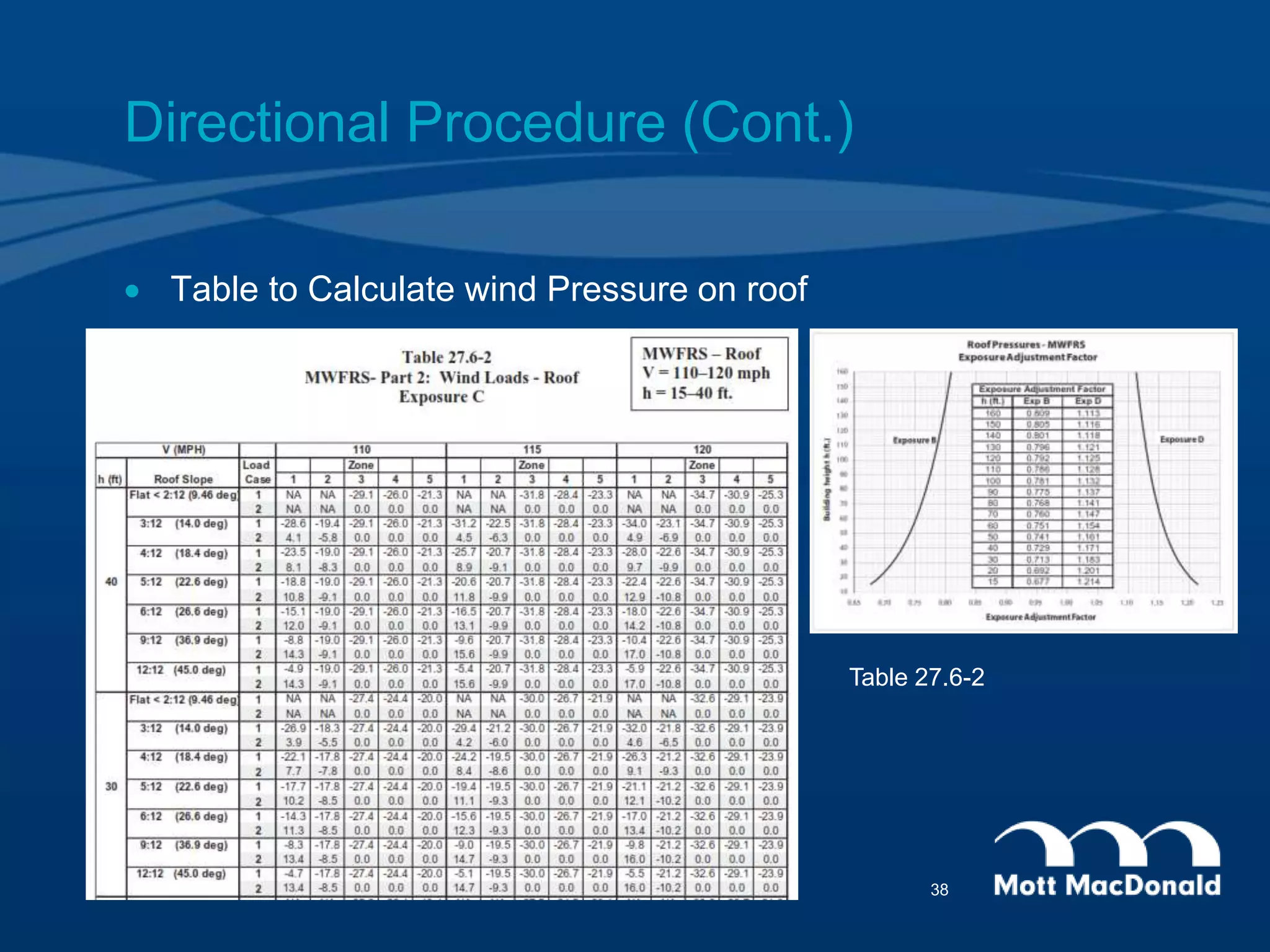
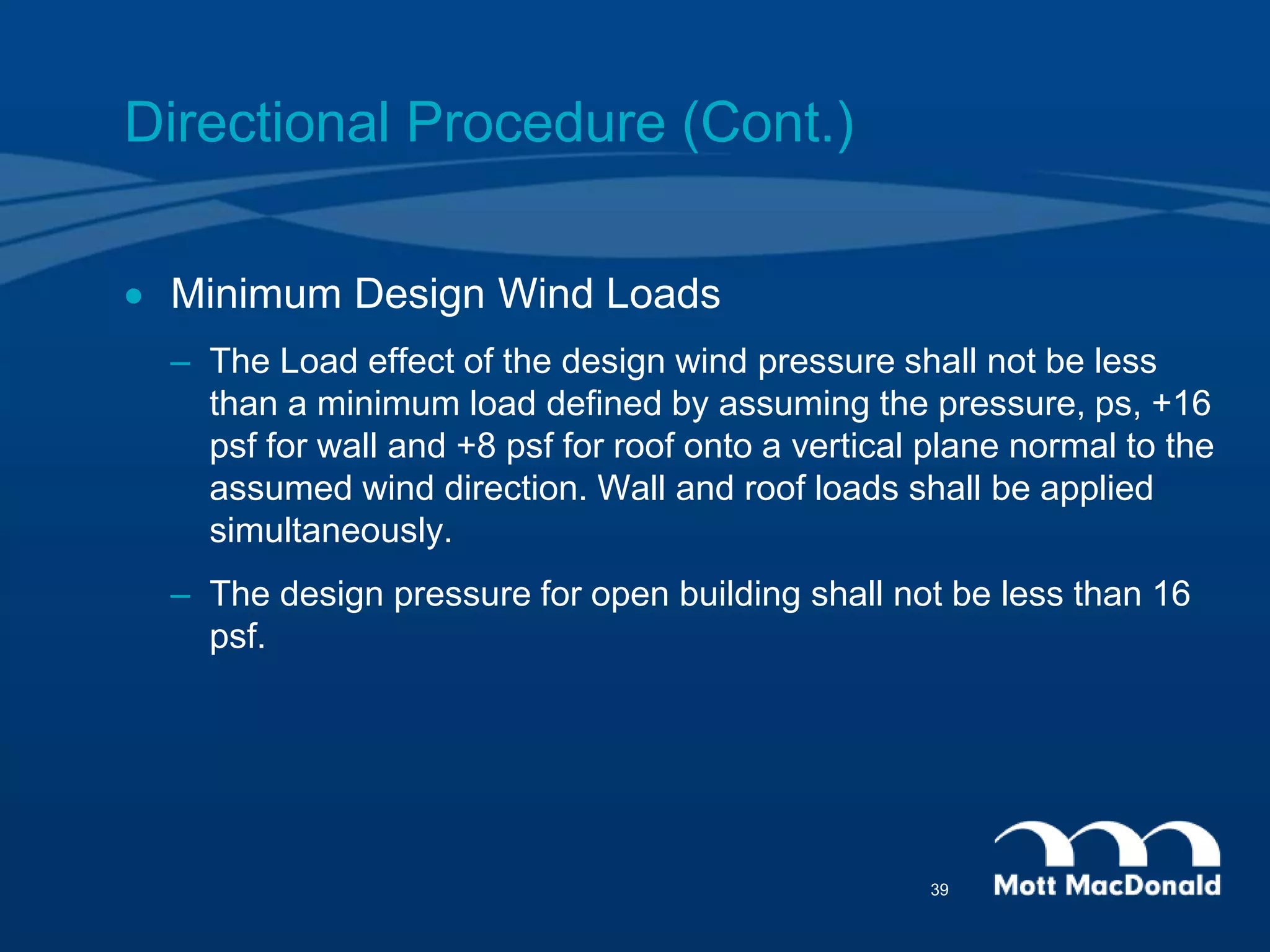
– Step – 5: Enter Table to determine net roof pressure pz
(Table 27.6-2).
See ASCE 7-10 Table 27.5-1
34
Directional Procedure (Cont.)
 Part-2: Design Steps for Diaphragm Building (h<160ft)
(Simplified Procedure) (Cont.)
– Step – 6: Determine topographical factor, Kzt and apply to wall
and roof pressure.
– Step – 7: Apply loads to walls and roofs simultaneously.
 Diaphragm Flexibility – The design procedure applies to
buildings having either rigid or flexible diaphragms.
35
Directional Procedure (Cont.)
36
Directional Procedure (Cont.)
 Table to Calculate wind Pressure on walls
Table 27.6-1
37
Directional Procedure (Cont.)
 Table to Calculate wind Pressure on roof
Table 27.6-2
38
Directional Procedure (Cont.)
 Minimum Design Wind Loads
– The Load effect of the design wind pressure shall not be less
than a minimum load defined by assuming the pressure, ps, +16
psf for wall and +8 psf for roof onto a vertical plane normal to the
assumed wind direction. Wall and roof loads shall be applied
simultaneously.
– The design pressure for open building shall not be less than 16
psf.
39
Envelope Procedure
 For Wind Load calculation for enclosed and partially
enclosed low-rise buildings.
 Condition
– For building of height less than 60 ft
– Building shall be of regular shape
– Building does not have response characteristics making it
subject to cross-wind loading, vortex, shedding, instability due to
galloping or flutter or it does not have a location that creates
channelling effect.
 Limitations – Building having unusual shapes or
response.
See ASCE 7-10 Chapter 28
40
Envelope Procedure (Cont.)
 Part-1: Design Steps for MWFRS
– Step – 1: Determine risk category (Table 1.5-1).
– Step – 2: Determine Basic Wind Speed.
– Step – 3: Determine Wind Parameters (Kd, Exposure
Category, Kzt, Enclosure Classification, GCpi).
– Step – 4: Determine velocity pressure exposure coefficint Kz
or Kh using Table 28.3-1.
– Step – 5: Determine velocity pressure qz or qh.
– Step – 6: Determine external pressure coefficient (GCp)
using Fig 28.4-1.
– Step – 7: Calculate wind pressure, p, from Eq. 28.4-1
See ASCE 7-10 Table 28.2-1
41
Envelope Procedure (Cont.)
 Design Wind Pressure
– Wind Loads – Enclosed and partially enclosed Rigid Building
p=qh[(GCpf ) - (GCpi )] (lb/ft2)(N/m2) …(Eq. 28.4-1)
 External Pressure Coefficient (GCpf )
– The combined gust effect factor and external pressure
coefficients for low-rise buildings, (GCpf ), are not permitted to be
separated.
42
Envelope Procedure (Cont.)
 Part-2: Design Steps for Low-Rise Diaphragm Building
(Simplified Procedure)
– Step – 1: Determine risk category (Table 1.5-1).
– Step – 2: Determine Basic Wind Speed.
– Step – 3: Determine Wind Parameters (Exposure Category,
Kzt).
– Step – 4: Enter Table to determine net pressure on walls at top
and base of building ph and p0, Table 27.6-1.
– Step – 5: Enter Table to determine net roof pressure pz, Table
27.6-2
See ASCE 7-10 Table 28.5-1
43
Envelope Procedure (Cont.)
 Design Wind Pressure
– Wind Loads – Enclosed and partially enclosed Rigid Building
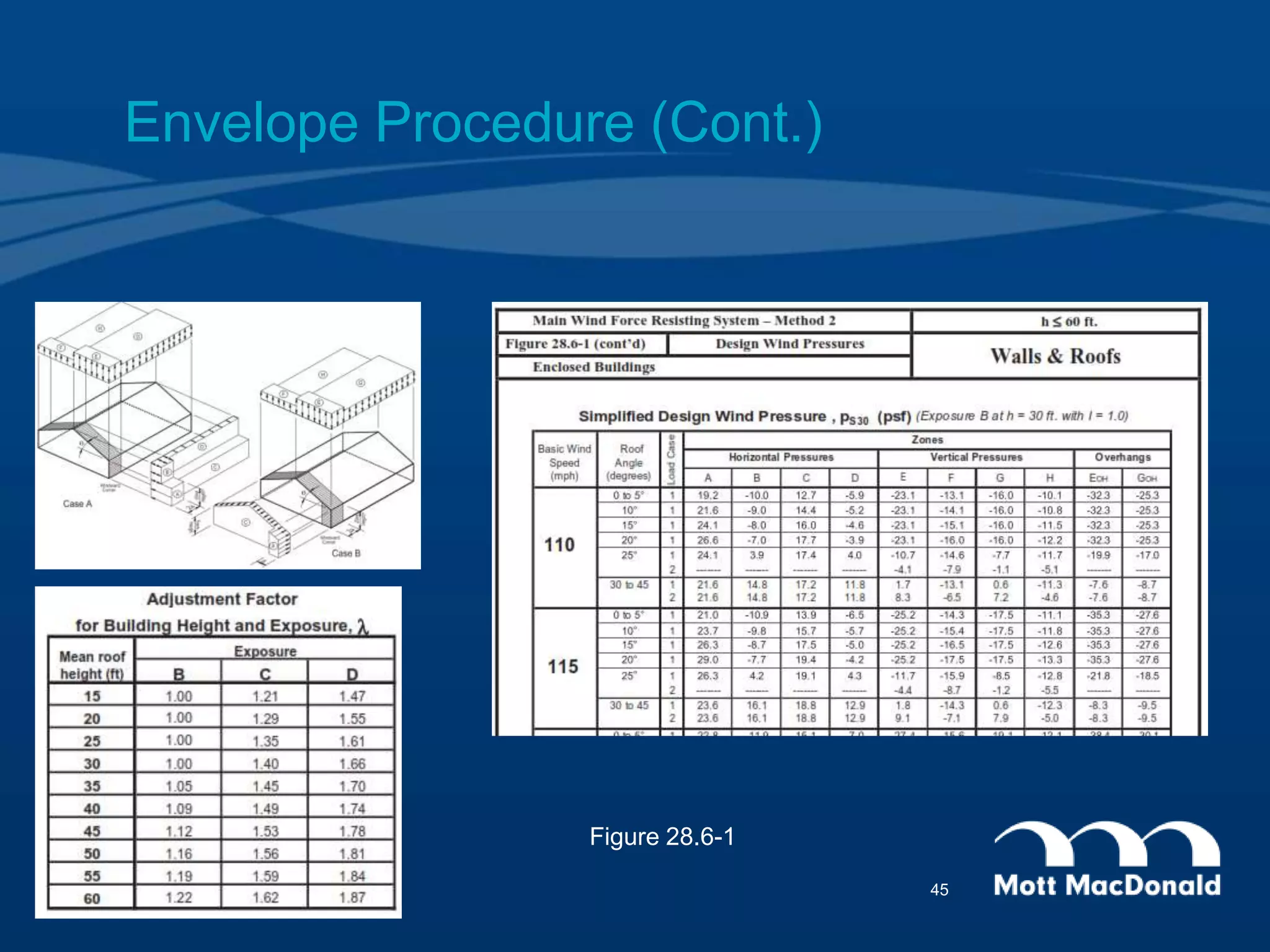
ps=lKztps30 (lb/ft2)(N/m2) …(Eq. 28.6-1)
l = adjustment factor for building height and exposure from
Fig. 28.6-1
ps30 = Simplified Design Wind Pressure (psf) , Fig. 28.6-1
44
Envelope Procedure (Cont.)
Figure 28.6-1
45
Envelope Procedure (Cont.)
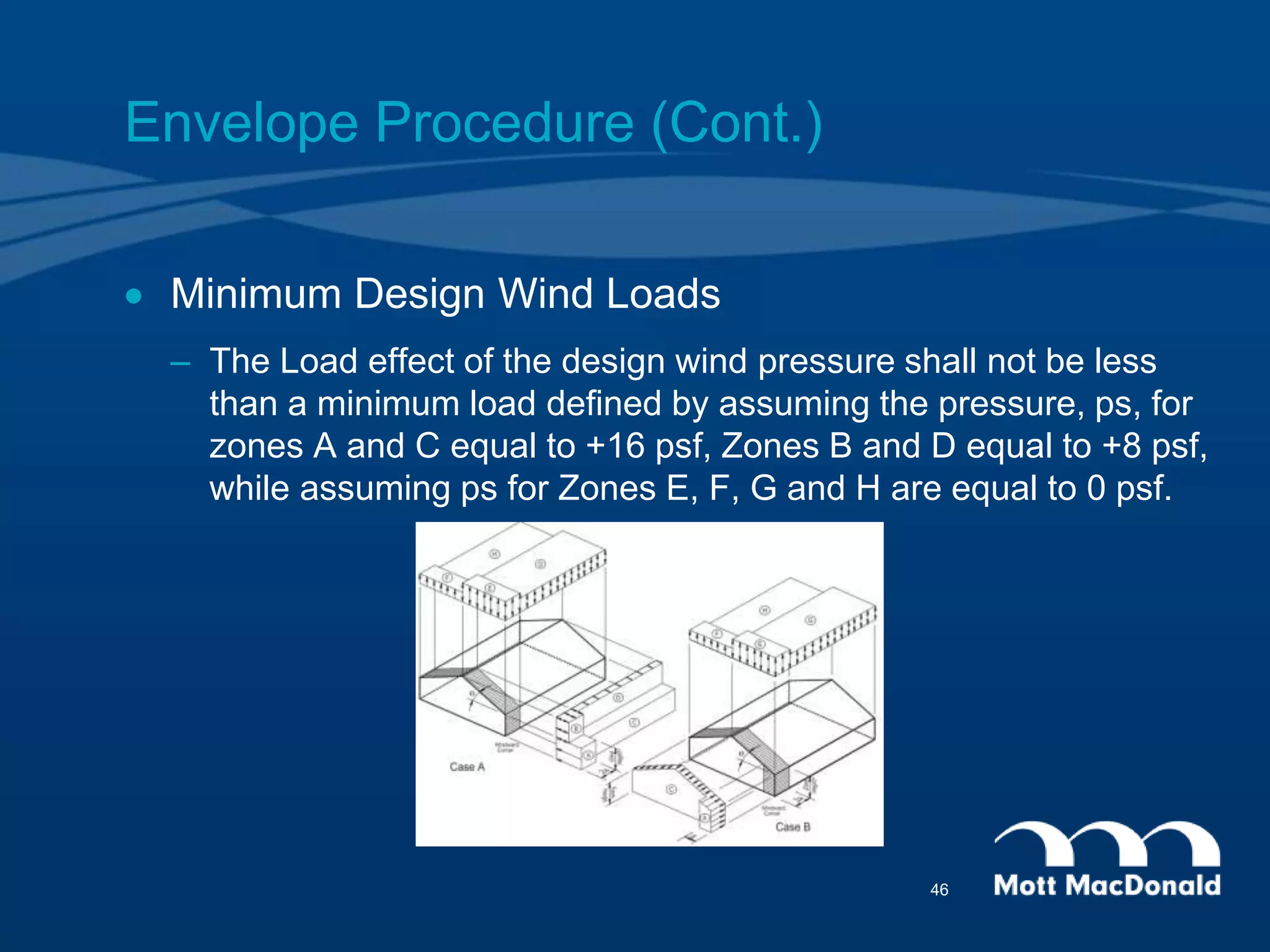
 Minimum Design Wind Loads
– The Load effect of the design wind pressure shall not be less
than a minimum load defined by assuming the pressure, ps, for
zones A and C equal to +16 psf, Zones B and D equal to +8 psf,
while assuming ps for Zones E, F, G and H are equal to 0 psf.
46
 For Wind Load calculation on building appurtenances
(rooftop structure and equipments) and other
structures of all heights (solid freestanding walls and
solid signs, chimneys, tanks, open signs, lattice
frameworks and trussed tower) using the Directional
Procedure.
 Condition – Same as Directional Procedure.
 Limitations – Same as Directional Procedure.
See ASCE 7-10 Chapter 29
Wind Loads on Other Structures and
Building Appurtenances
47
Wind Loads on Other Structures and
Building Appurtenances (Cont.)
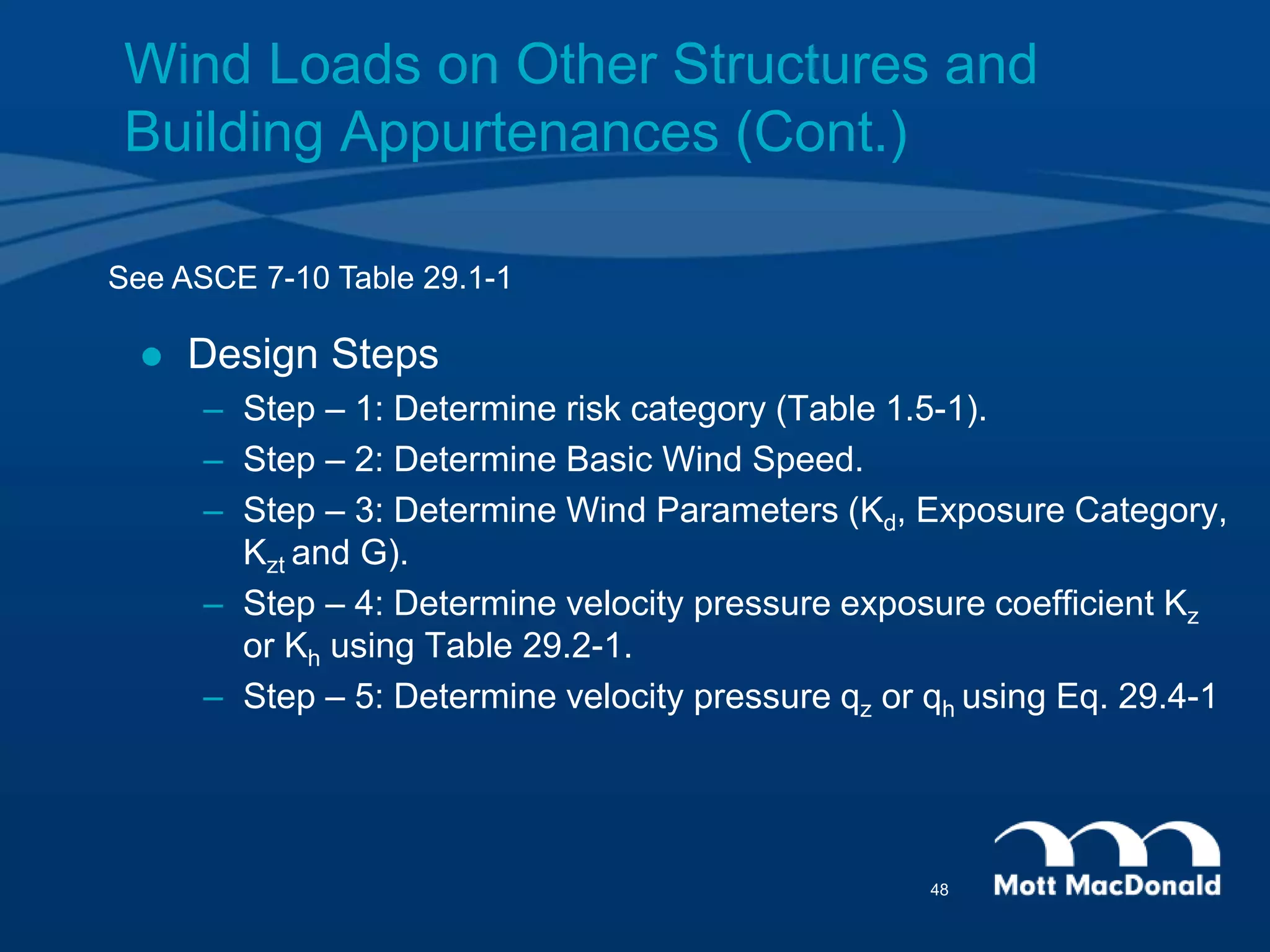
 Design Steps
– Step – 1: Determine risk category (Table 1.5-1).
– Step – 2: Determine Basic Wind Speed.
– Step – 3: Determine Wind Parameters (Kd, Exposure Category,
Kzt and G).
– Step – 4: Determine velocity pressure exposure coefficient Kz
or Kh using Table 29.2-1.
– Step – 5: Determine velocity pressure qz or qh using Eq. 29.4-1
See ASCE 7-10 Table 29.1-1
48
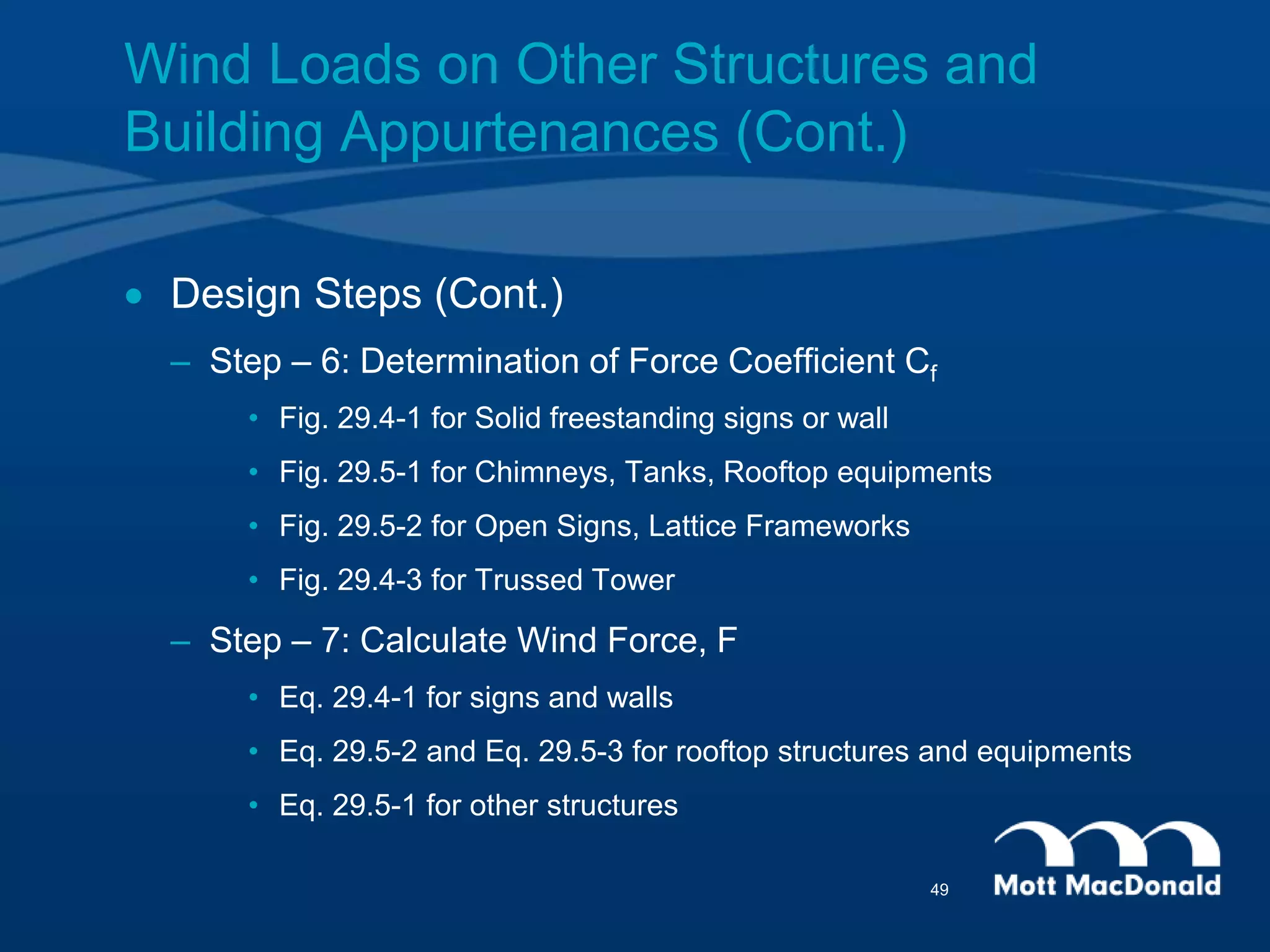
 Design Steps (Cont.)
– Step – 6: Determination of Force Coefficient Cf
• Fig. 29.4-1 for Solid freestanding signs or wall
• Fig. 29.5-1 for Chimneys, Tanks, Rooftop equipments
• Fig. 29.5-2 for Open Signs, Lattice Frameworks
• Fig. 29.4-3 for Trussed Tower
– Step – 7: Calculate Wind Force, F
• Eq. 29.4-1 for signs and walls
• Eq. 29.5-2 and Eq. 29.5-3 for rooftop structures and equipments
• Eq. 29.5-1 for other structures
Wind Loads on Other Structures and
Building Appurtenances (Cont.)
49
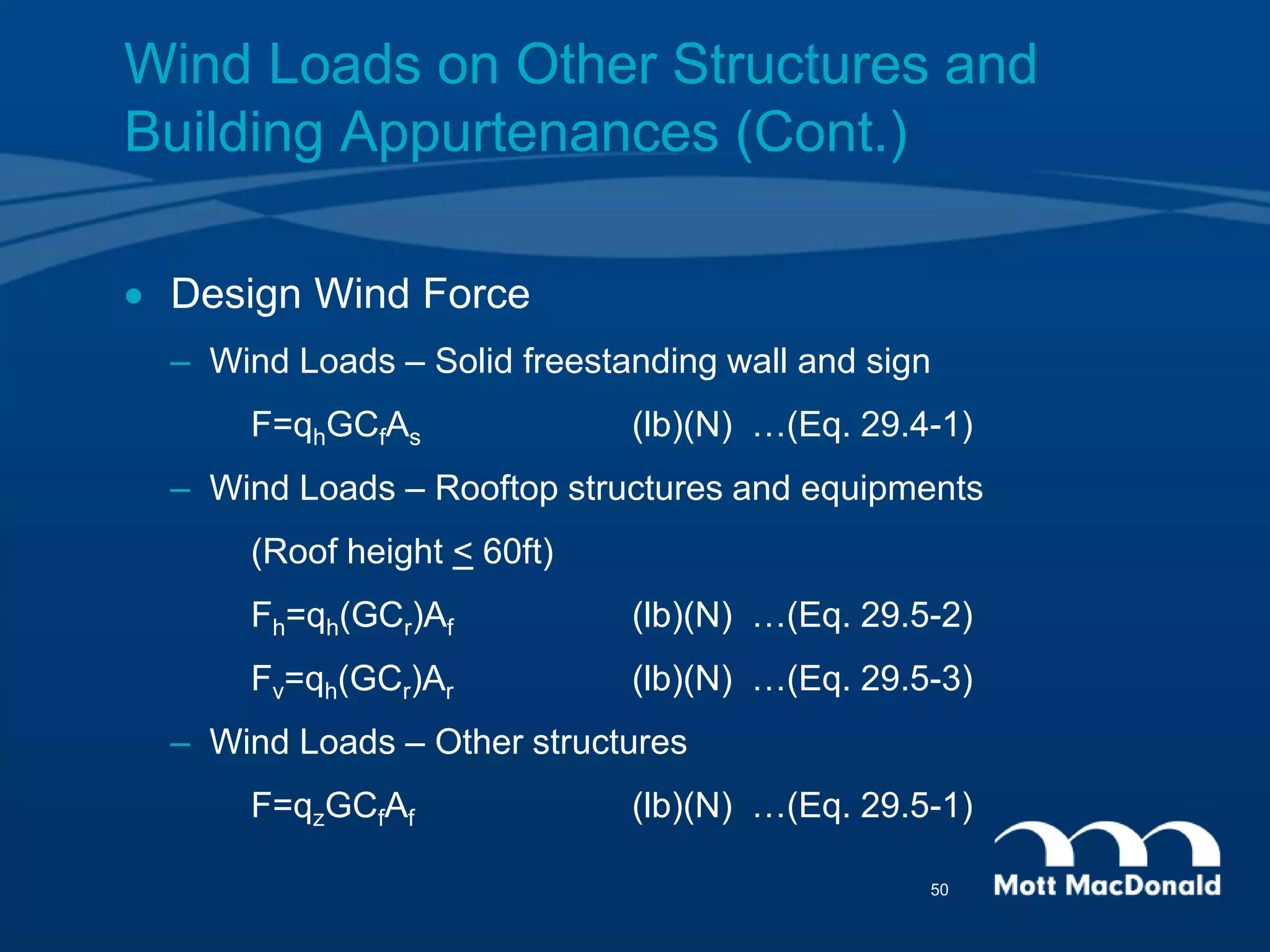
 Design Wind Force
– Wind Loads – Solid freestanding wall and sign
F=qhGCfAs (lb)(N) …(Eq. 29.4-1)
– Wind Loads – Rooftop structures and equipments
(Roof height < 60ft)
Fh=qh(GCr)Af (lb)(N) …(Eq. 29.5-2)
Fv=qh(GCr)Ar (lb)(N) …(Eq. 29.5-3)
– Wind Loads – Other structures
F=qzGCfAf (lb)(N) …(Eq. 29.5-1)
Wind Loads on Other Structures and
Building Appurtenances (Cont.)
50
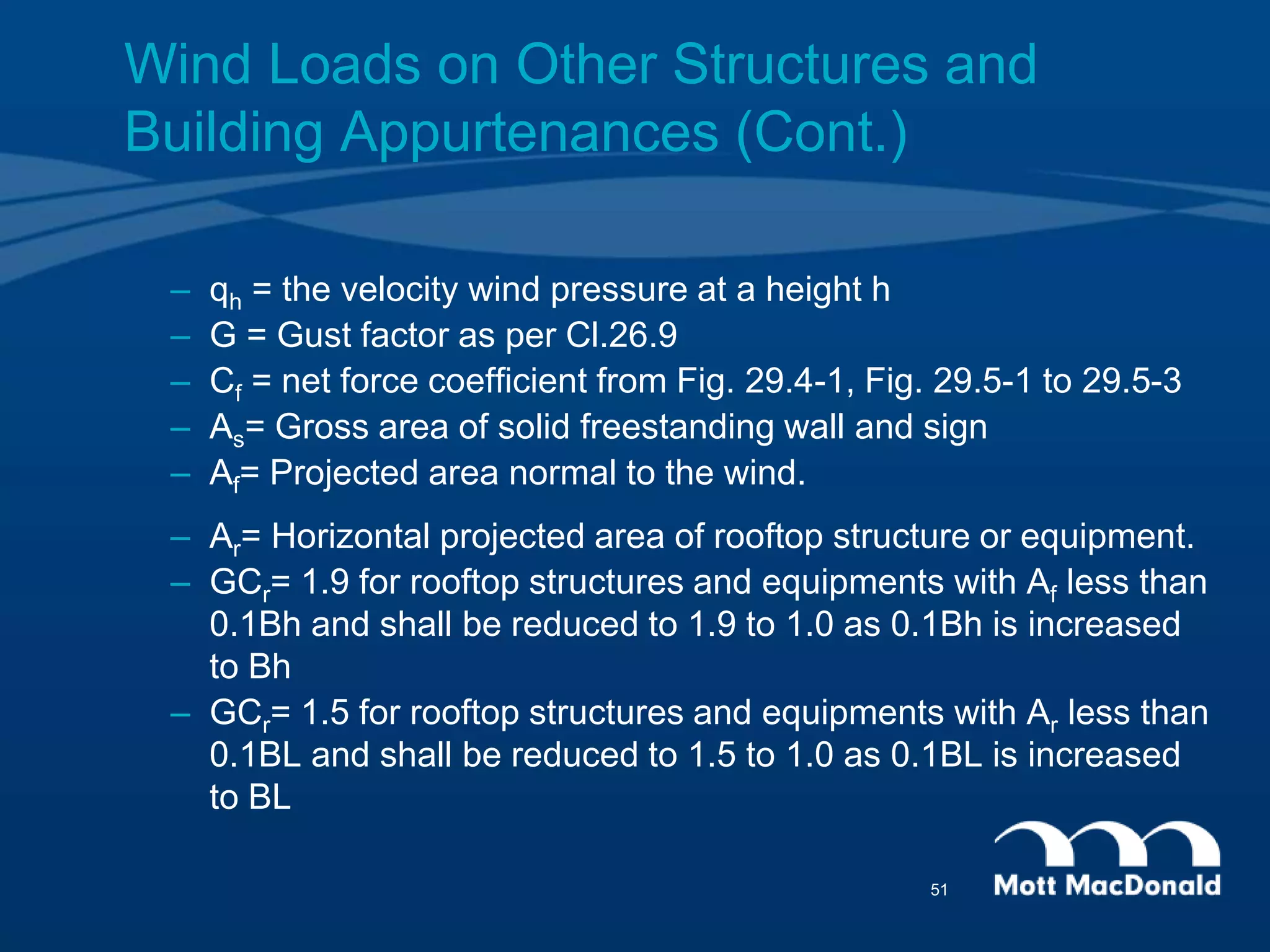
– qh = the velocity wind pressure at a height h
– G = Gust factor as per Cl.26.9
– Cf = net force coefficient from Fig. 29.4-1, Fig. 29.5-1 to 29.5-3
– As= Gross area of solid freestanding wall and sign
– Af= Projected area normal to the wind.
– Ar= Horizontal projected area of rooftop structure or equipment.
– GCr= 1.9 for rooftop structures and equipments with Af less than
0.1Bh and shall be reduced to 1.9 to 1.0 as 0.1Bh is increased
to Bh
– GCr= 1.5 for rooftop structures and equipments with Ar less than
0.1BL and shall be reduced to 1.5 to 1.0 as 0.1BL is increased
to BL
Wind Loads on Other Structures and
Building Appurtenances (Cont.)
51
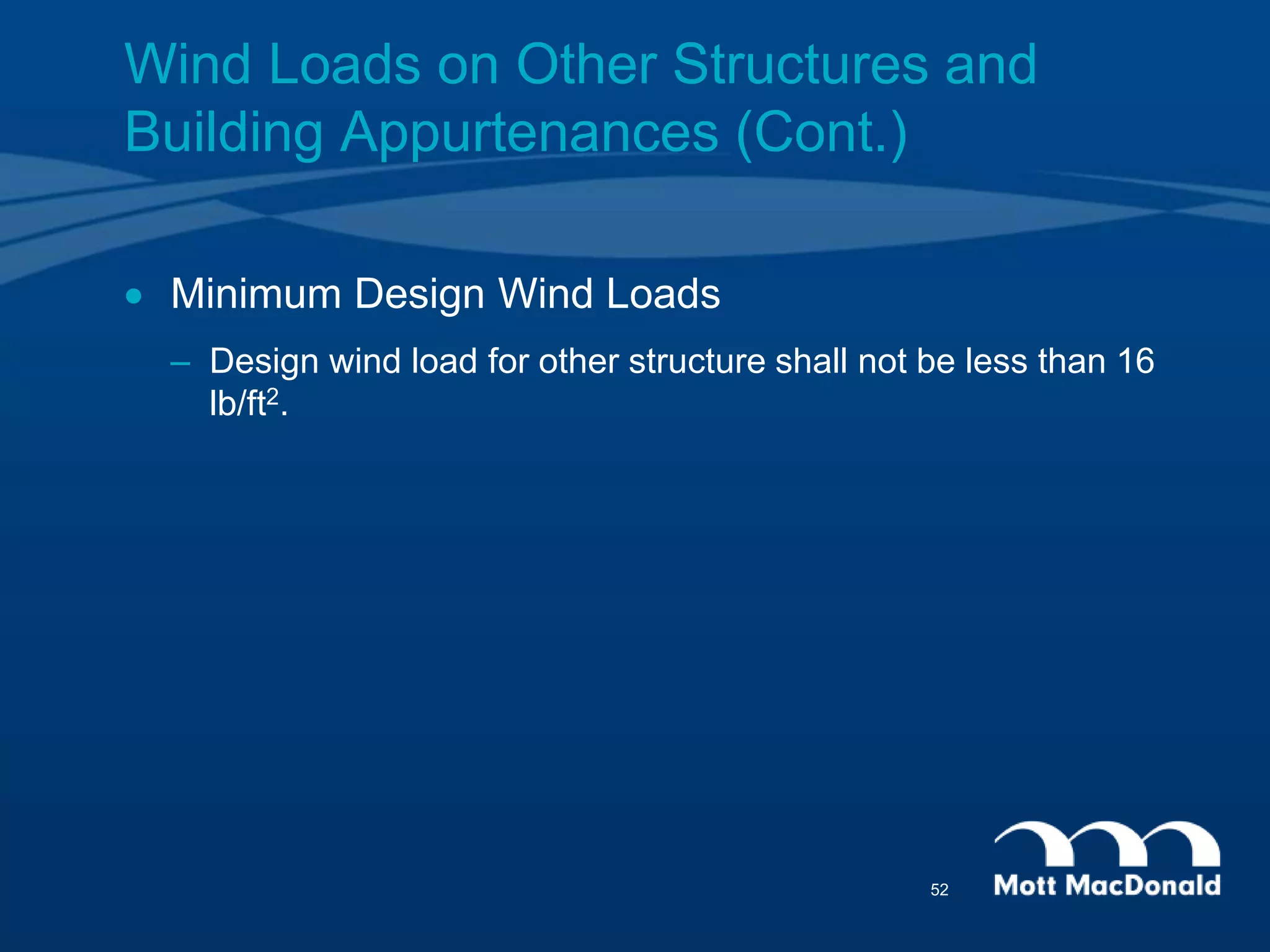
 Minimum Design Wind Loads
– Design wind load for other structure shall not be less than 16
lb/ft2.
Wind Loads on Other Structures and
Building Appurtenances (Cont.)
52
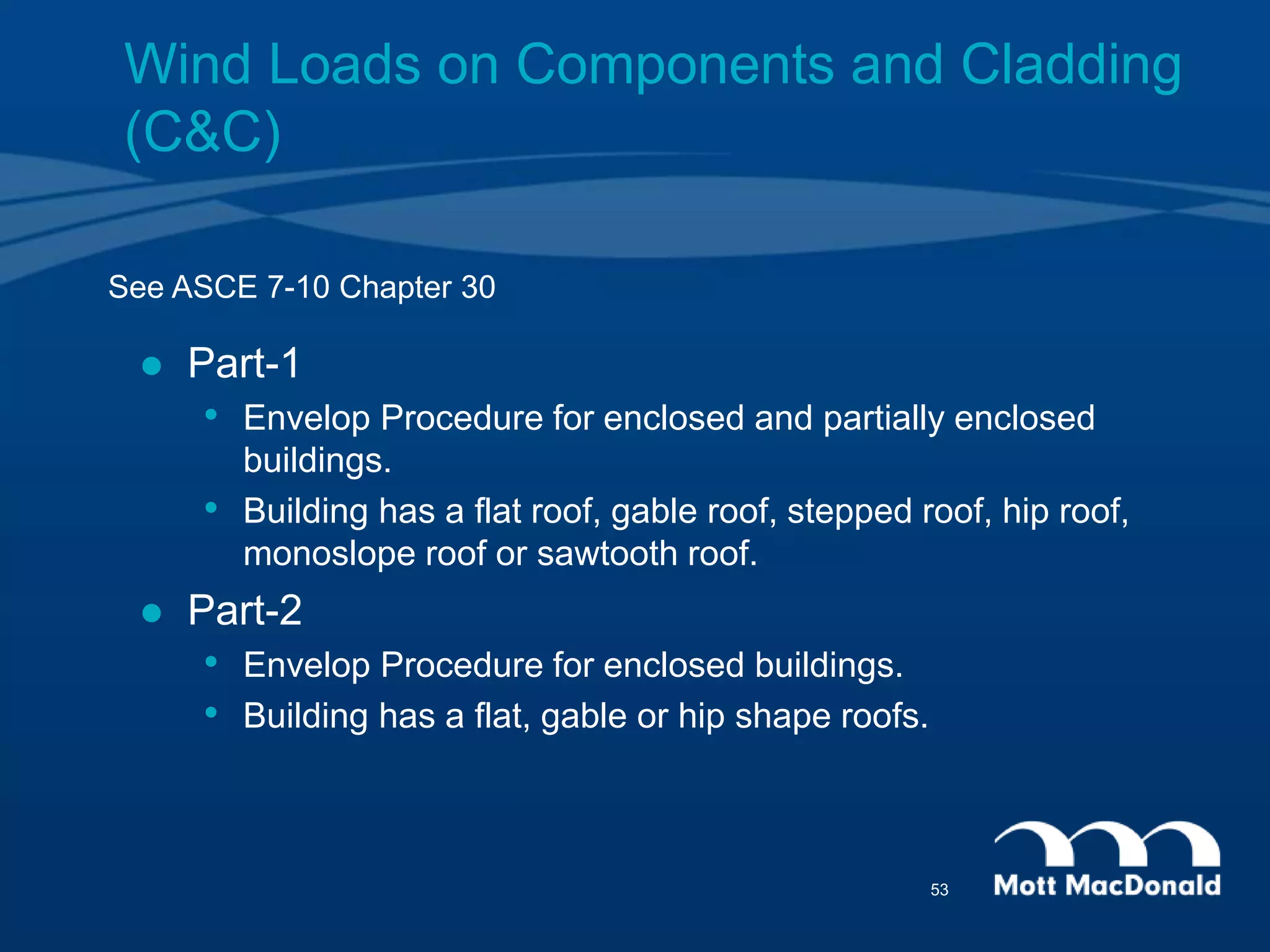
See ASCE 7-10 Chapter 30
 Part-1
• Envelop Procedure for enclosed and partially enclosed
buildings.
• Building has a flat roof, gable roof, stepped roof, hip roof,
monoslope roof or sawtooth roof.
 Part-2
• Envelop Procedure for enclosed buildings.
• Building has a flat, gable or hip shape roofs.
Wind Loads on Components and Cladding
(C&C)
53
Wind Loads on Components and Cladding
(C&C) (Cont.)
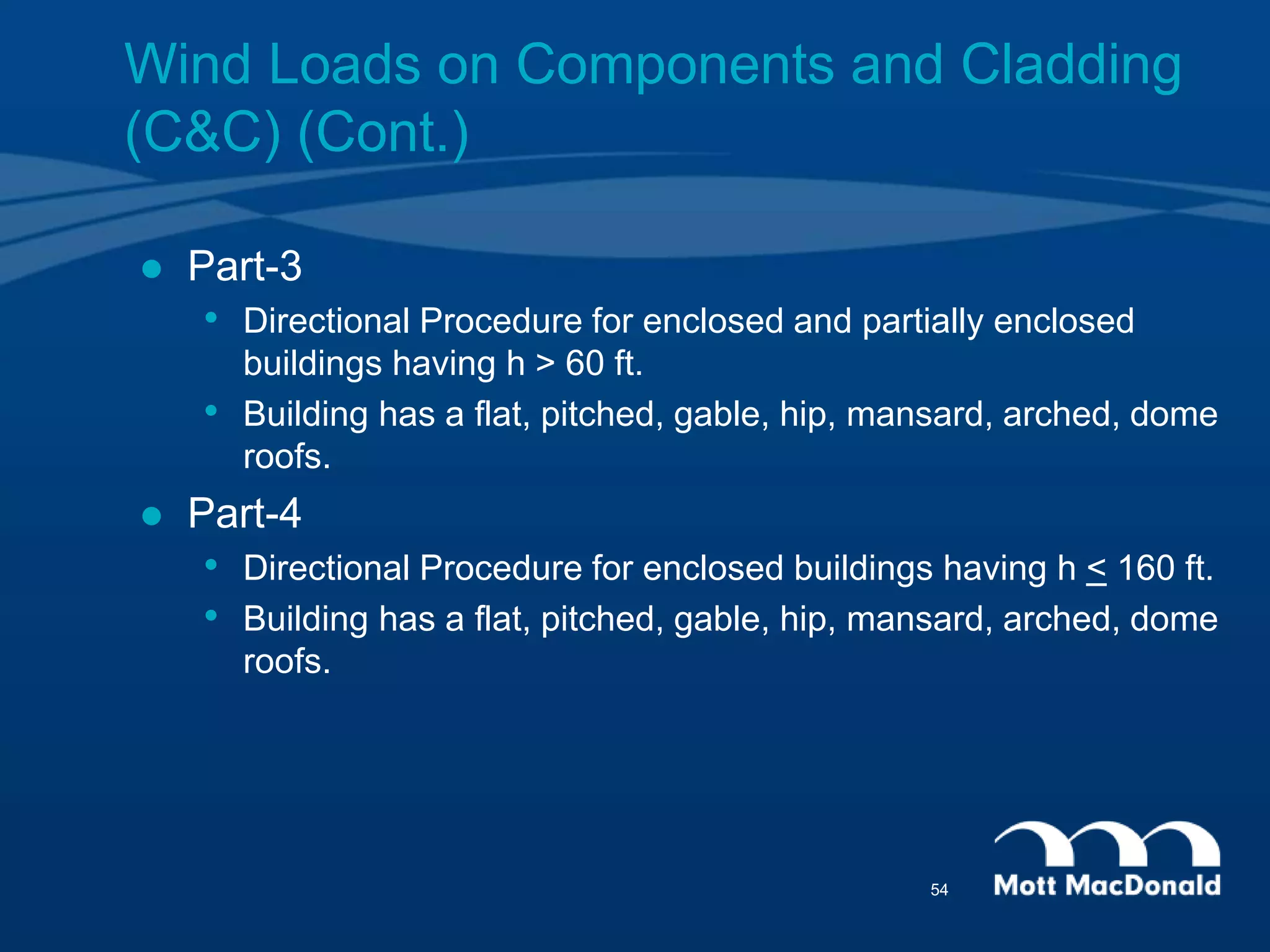
 Part-3
• Directional Procedure for enclosed and partially enclosed
buildings having h > 60 ft.
• Building has a flat, pitched, gable, hip, mansard, arched, dome
roofs.
 Part-4
• Directional Procedure for enclosed buildings having h < 160 ft.
• Building has a flat, pitched, gable, hip, mansard, arched, dome
roofs.
54
 Part-5
• Directional Procedure for open building having pitched,
monoslope or troughed roofs.
 Part-6
• Directional Procedure for roof overhangs and parapets of
buildings.
Wind Loads on Components and Cladding
(C&C) (Cont.)
55
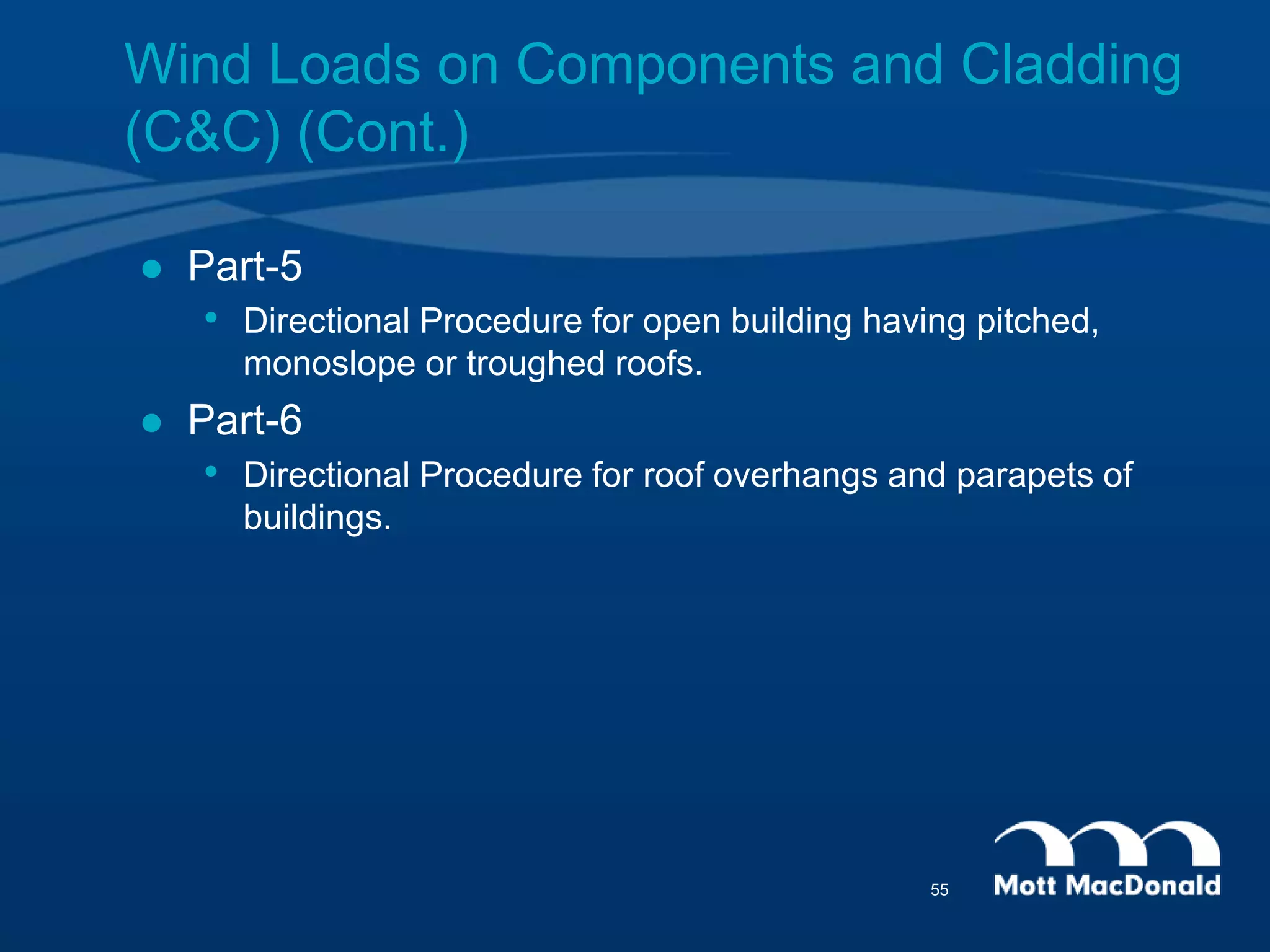
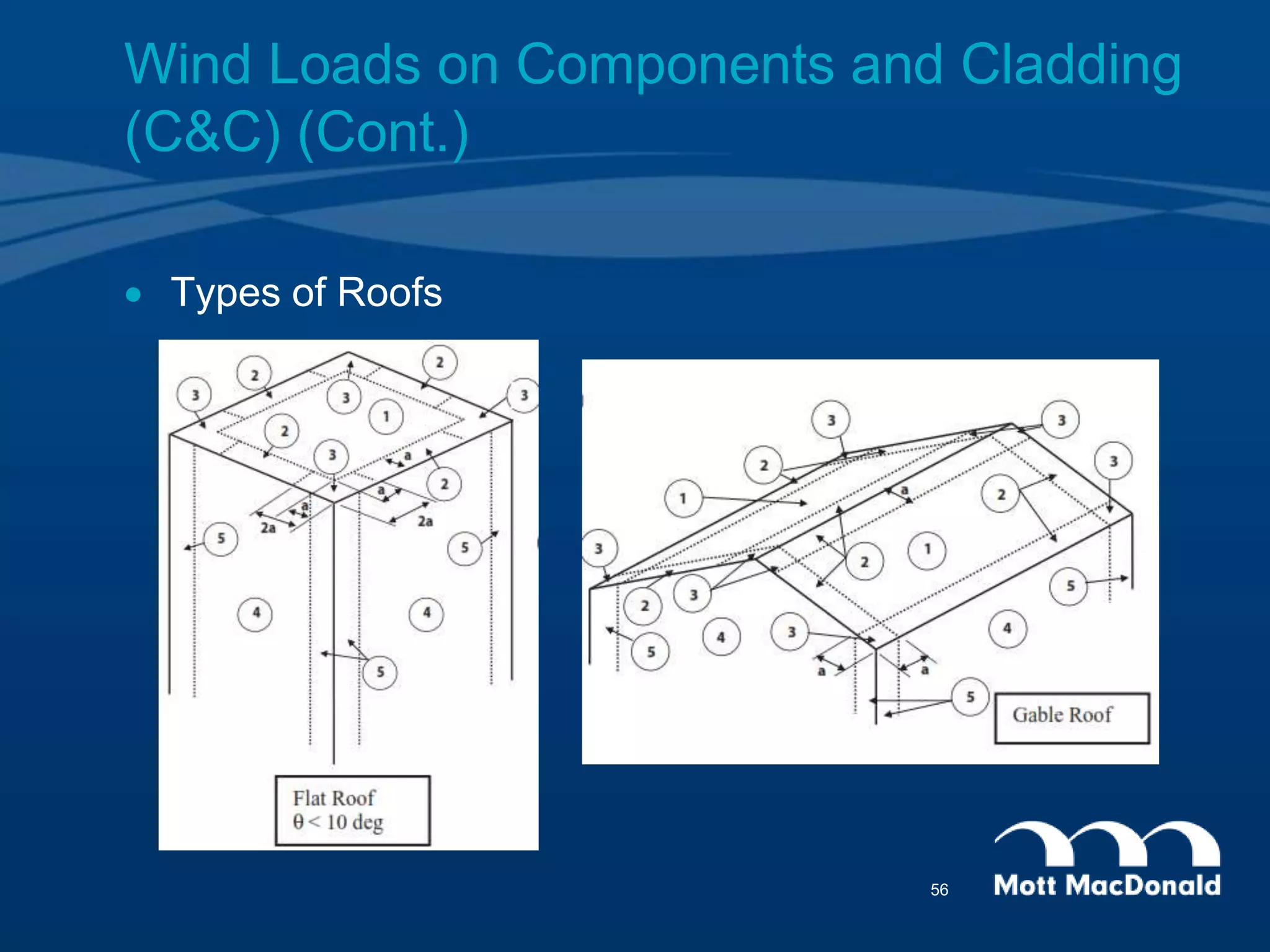
 Types of Roofs
Wind Loads on Components and Cladding
(C&C) (Cont.)
56
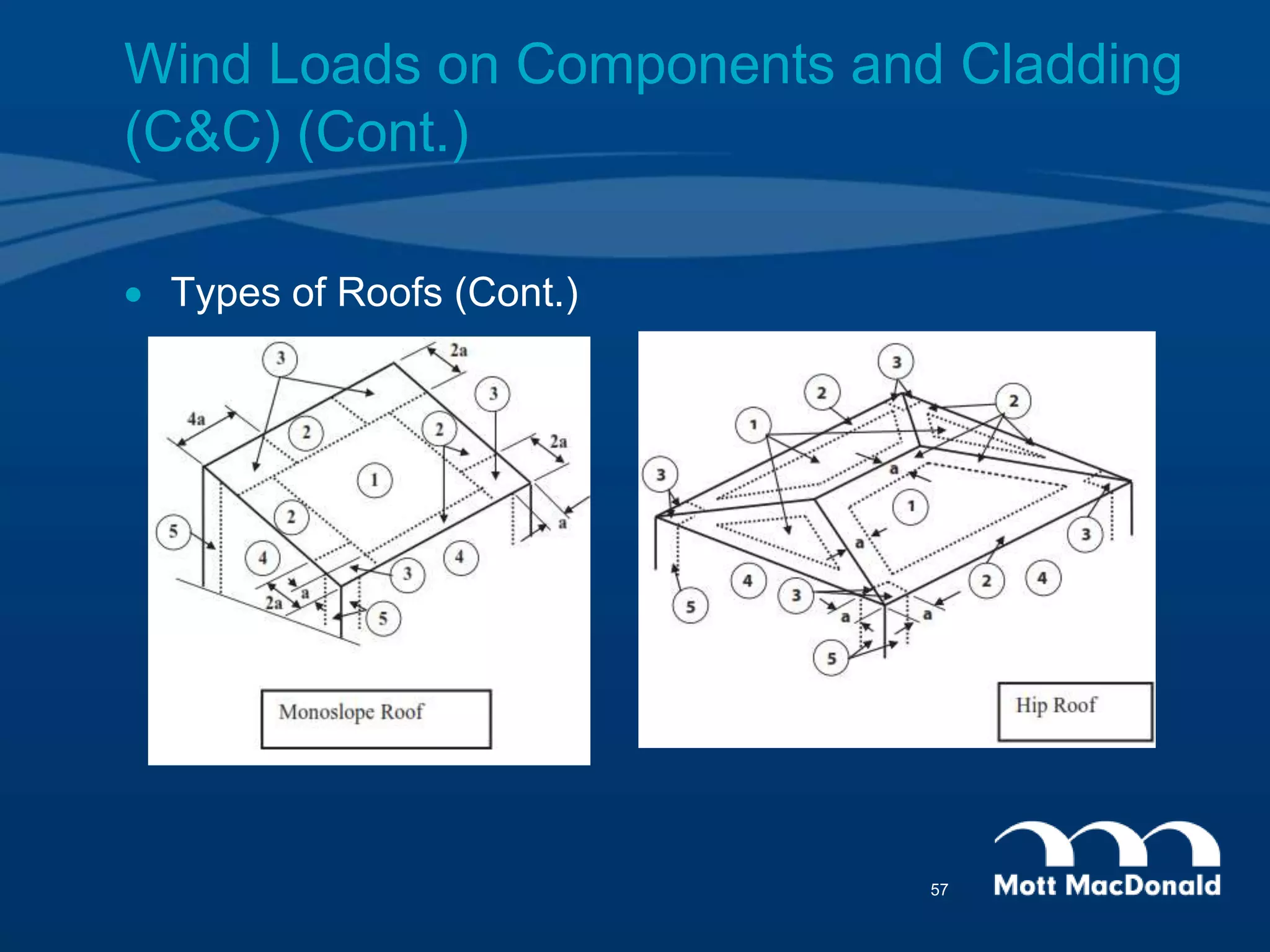
 Types of Roofs (Cont.)
Wind Loads on Components and Cladding
(C&C) (Cont.)
57
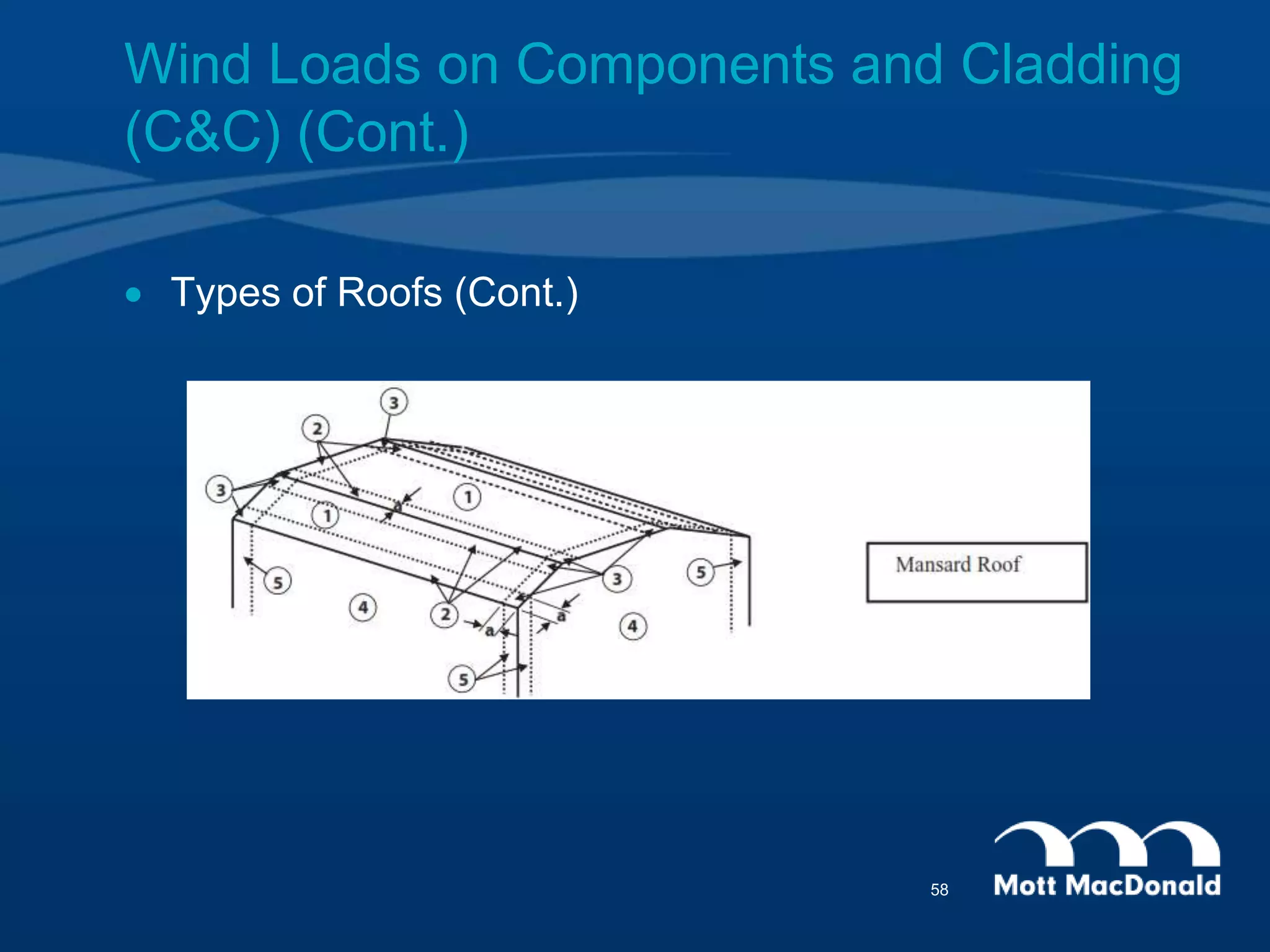
 Types of Roofs (Cont.)
Wind Loads on Components and Cladding
(C&C) (Cont.)
58
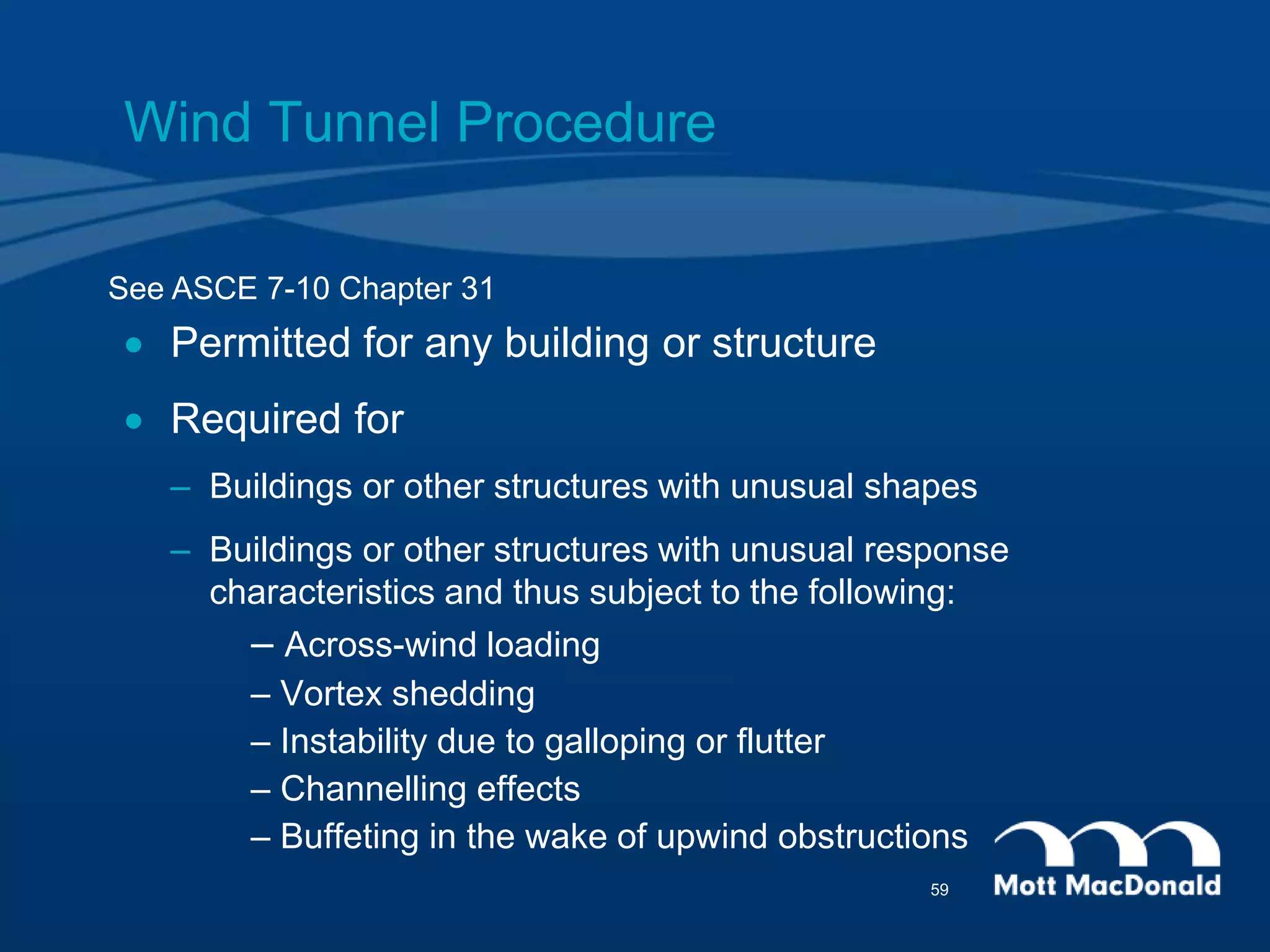
Wind Tunnel Procedure
 Permitted for any building or structure
 Required for
– Buildings or other structures with unusual shapes
– Buildings or other structures with unusual response
characteristics and thus subject to the following:
– Across-wind loading
– Vortex shedding
– Instability due to galloping or flutter
– Channelling effects
– Buffeting in the wake of upwind obstructions
See ASCE 7-10 Chapter 31
59
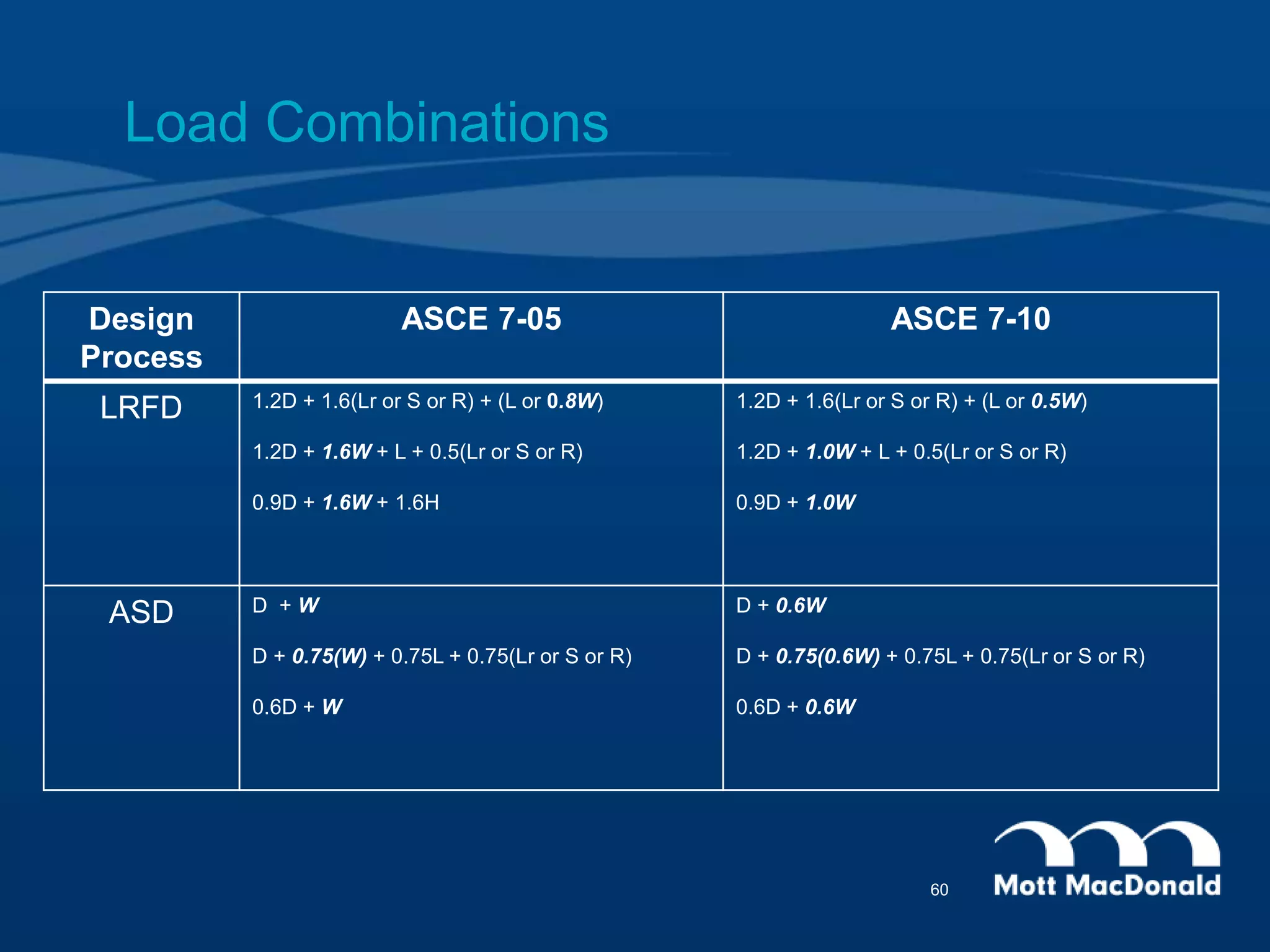
Load Combinations
Design
Process
ASCE 7-05 ASCE 7-10
LRFD 1.2D + 1.6(Lr or S or R) + (L or 0.8W)
1.2D + 1.6W + L + 0.5(Lr or S or R)
0.9D + 1.6W + 1.6H
1.2D + 1.6(Lr or S or R) + (L or 0.5W)
1.2D + 1.0W + L + 0.5(Lr or S or R)
0.9D + 1.0W
ASD D + W
D + 0.75(W) + 0.75L + 0.75(Lr or S or R)
0.6D + W
D + 0.6W
D + 0.75(0.6W) + 0.75L + 0.75(Lr or S or R)
0.6D + 0.6W
60
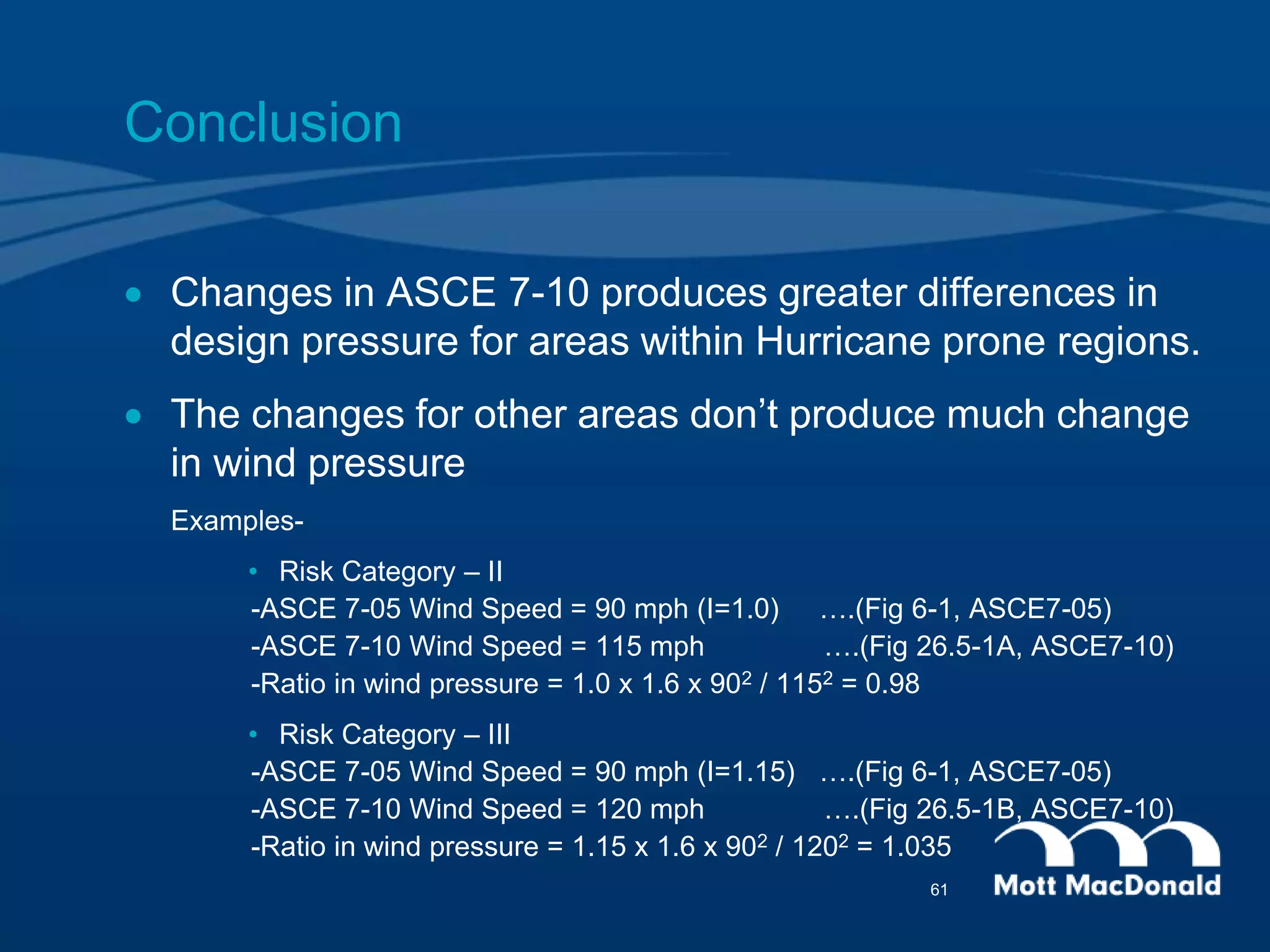
Conclusion
 Changes in ASCE 7-10 produces greater differences in
design pressure for areas within Hurricane prone regions.
 The changes for other areas don’t produce much change
in wind pressure
Examples-
• Risk Category – II
-ASCE 7-05 Wind Speed = 90 mph (I=1.0) ….(Fig 6-1, ASCE7-05)
-ASCE 7-10 Wind Speed = 115 mph ….(Fig 26.5-1A, ASCE7-10)
-Ratio in wind pressure = 1.0 x 1.6 x 902 / 1152 = 0.98
• Risk Category – III
-ASCE 7-05 Wind Speed = 90 mph (I=1.15) ….(Fig 6-1, ASCE7-05)
-ASCE 7-10 Wind Speed = 120 mph ….(Fig 26.5-1B, ASCE7-10)
-Ratio in wind pressure = 1.15 x 1.6 x 902 / 1202 = 1.035
61
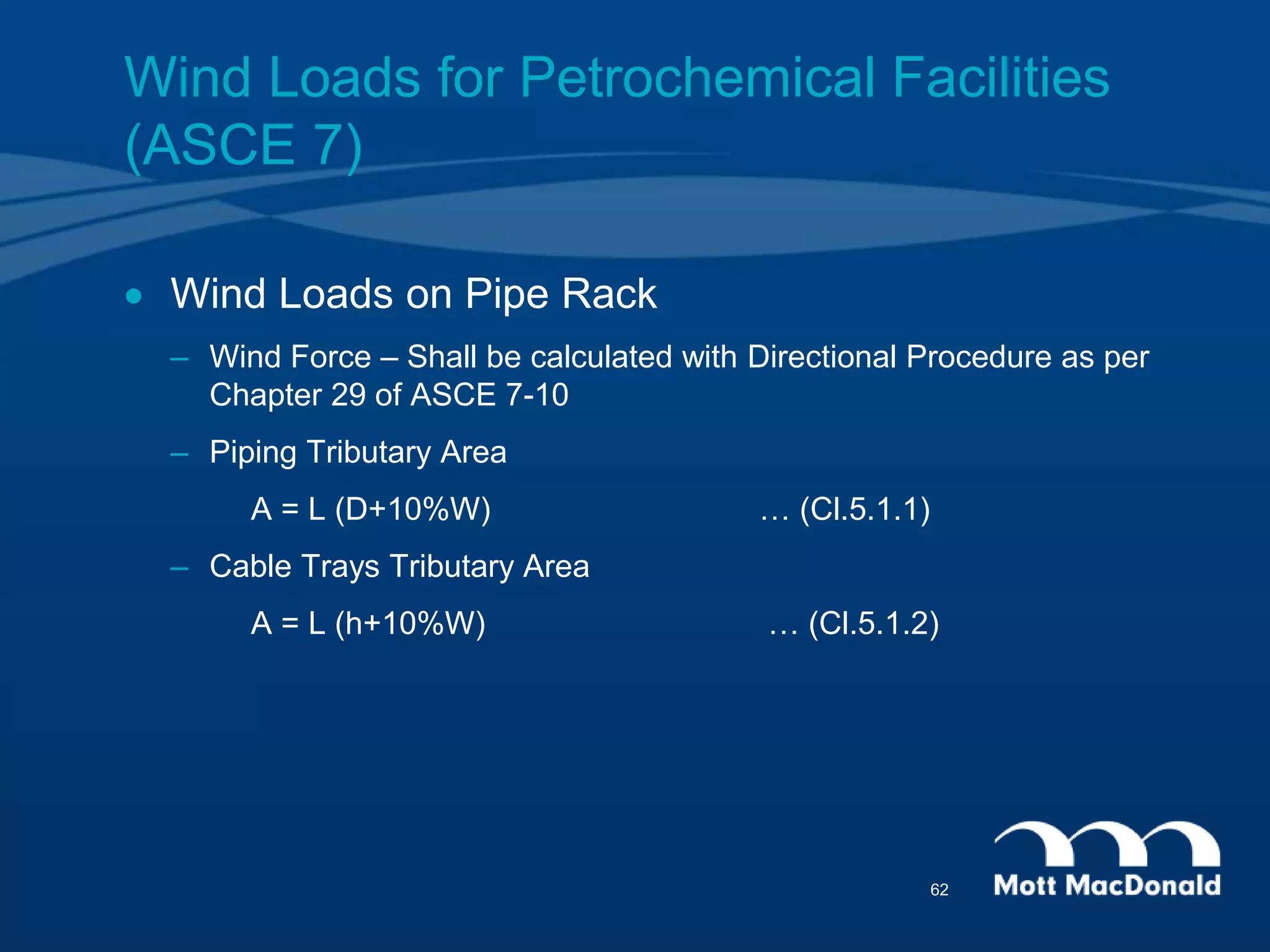
Wind Loads for Petrochemical Facilities
(ASCE 7)
 Wind Loads on Pipe Rack
– Wind Force – Shall be calculated with Directional Procedure as per
Chapter 29 of ASCE 7-10
– Piping Tributary Area
A = L (D+10%W) … (Cl.5.1.1)
– Cable Trays Tributary Area
A = L (h+10%W) … (Cl.5.1.2)
62
Wind Loads for Petrochemical Facilities
(ASCE 7) (Cont.)
 Wind Loads on Pipe Rack (Cont.)
– Force Coefficient
• For structural members … (Cl.5.1.3)
– Cf = 1.8 or
– Cf = 2.0 at and below first level and 1.6 for members above
first level
• For Pipes … (Cl.5.1.4)
– Cf = 0.7 as minimum
– Cf = shall be calculated as per Fig. 29.5-1
• For Trays … (Cl.5.1.5)
– Cf = 2.0
63
 Wind Loads on Open Structure (Process Structures,
Reactor Operating Structures)
– Frame Load – Shall be as per Eq. 29.5-1 of ASCE 7-10
– Force Coefficient of set of frames –
Cf = CDg / e
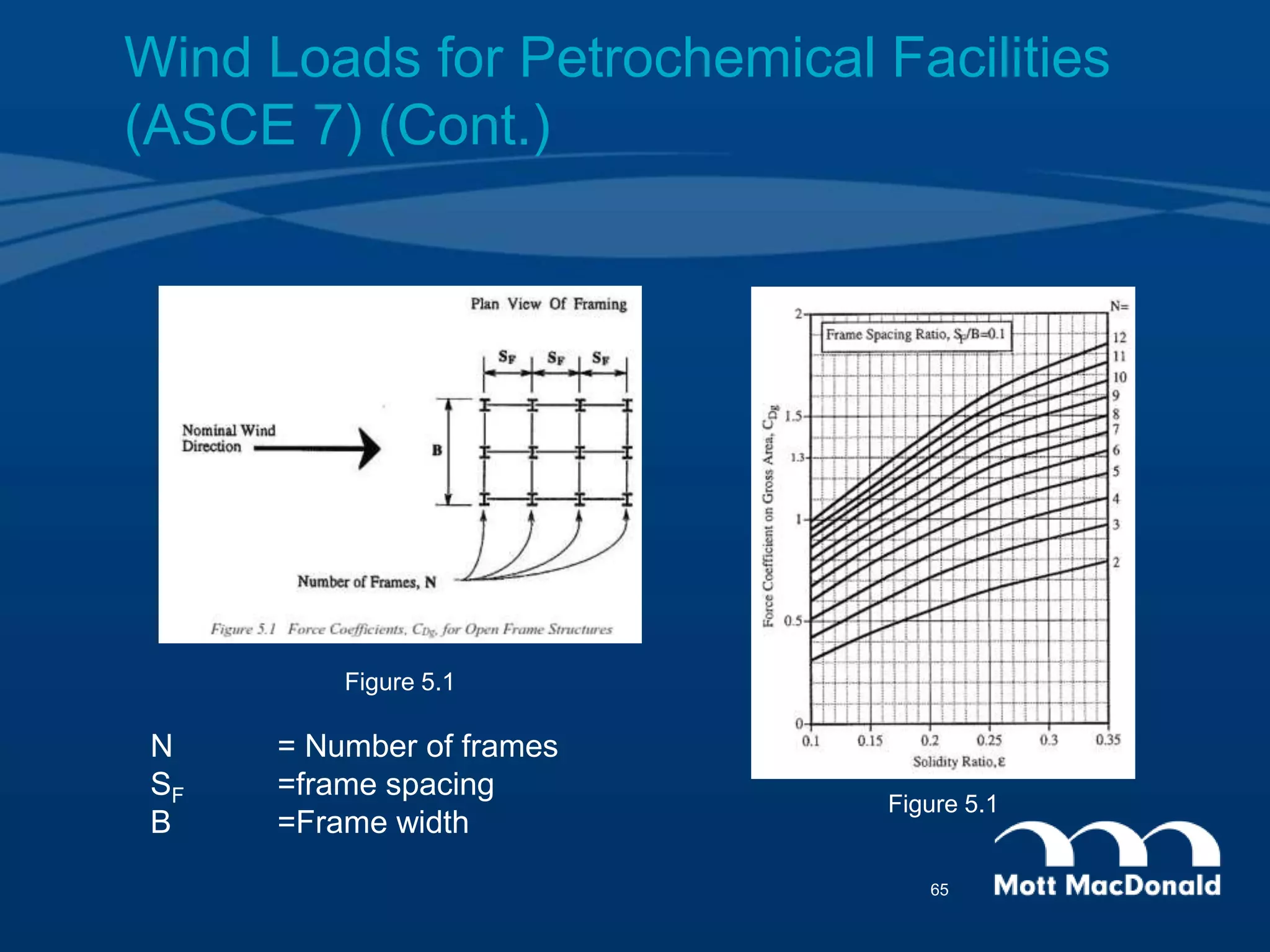
CDg= force coefficient for set of frames, from Fig. 5.1
e= effective solid area (As) / gross area of wind-ward frame
(Ag)
Wind Loads for Petrochemical Facilities
(ASCE 7) (Cont.)
64
N = Number of frames
SF =frame spacing
B =Frame width
Figure 5.1
Figure 5.1
Wind Loads for Petrochemical Facilities
(ASCE 7) (Cont.)
65
 Wind Loads on Open Structure (Process Structures,
Reactor Operating Structures) (Cont.)
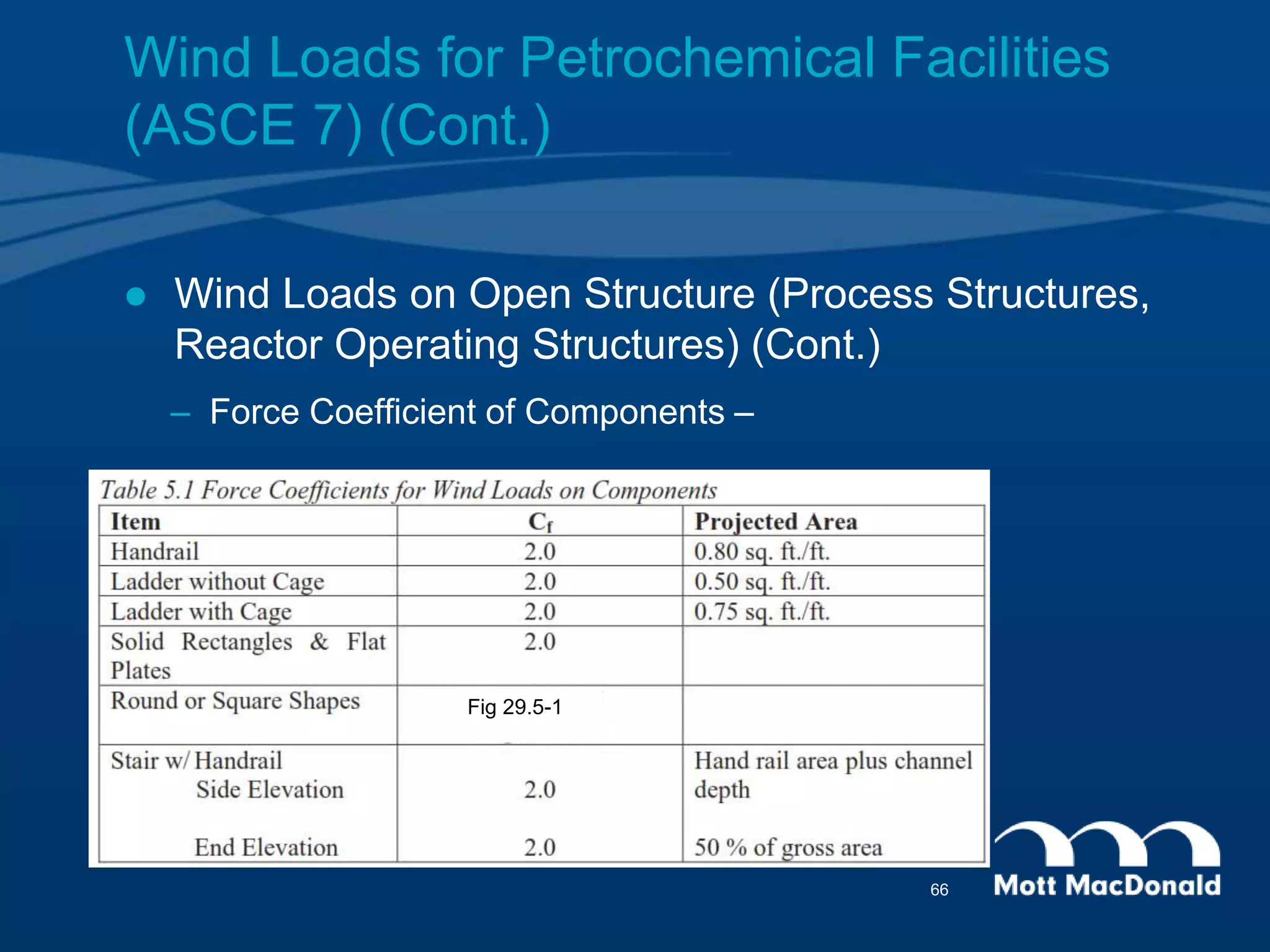
– Force Coefficient of Components –
Fig 29.5-1
Wind Loads for Petrochemical Facilities
(ASCE 7) (Cont.)
66
 Wind Loads on Open Structure (Process Structures,
Reactor Operating Structures) (Cont.)
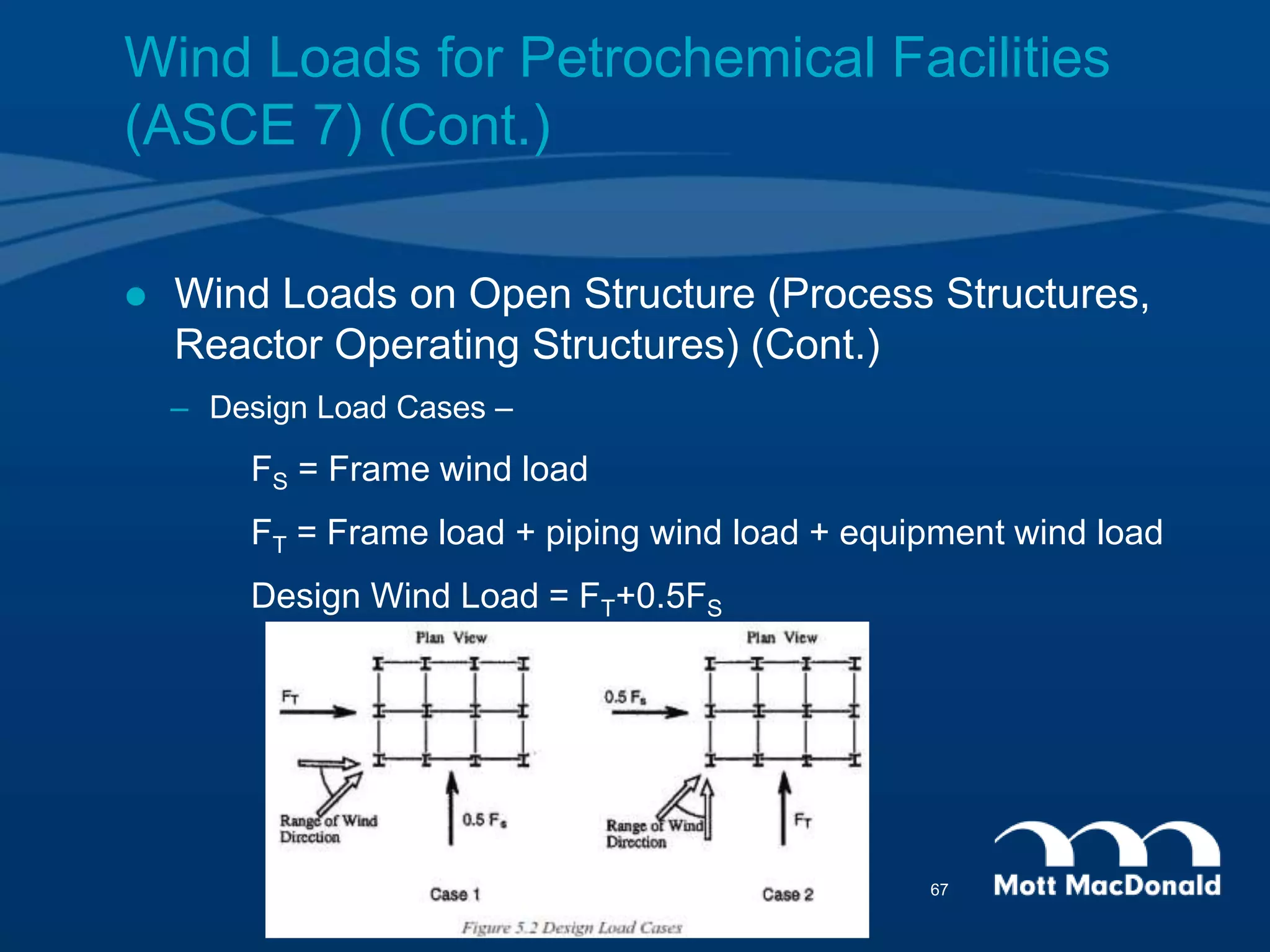
– Design Load Cases –
FS = Frame wind load
FT = Frame load + piping wind load + equipment wind load
Design Wind Load = FT+0.5FS
Wind Loads for Petrochemical Facilities
(ASCE 7) (Cont.)
67
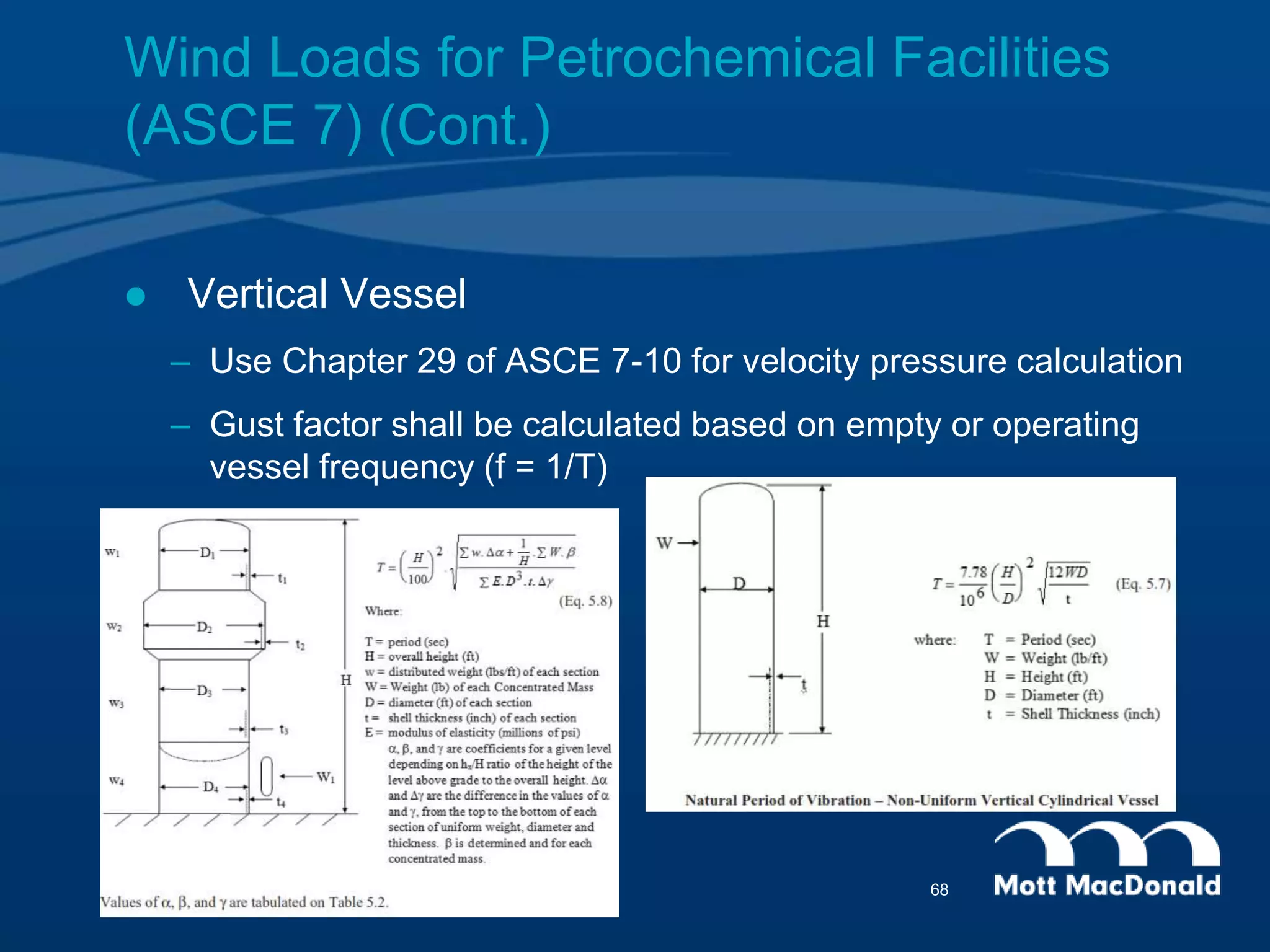
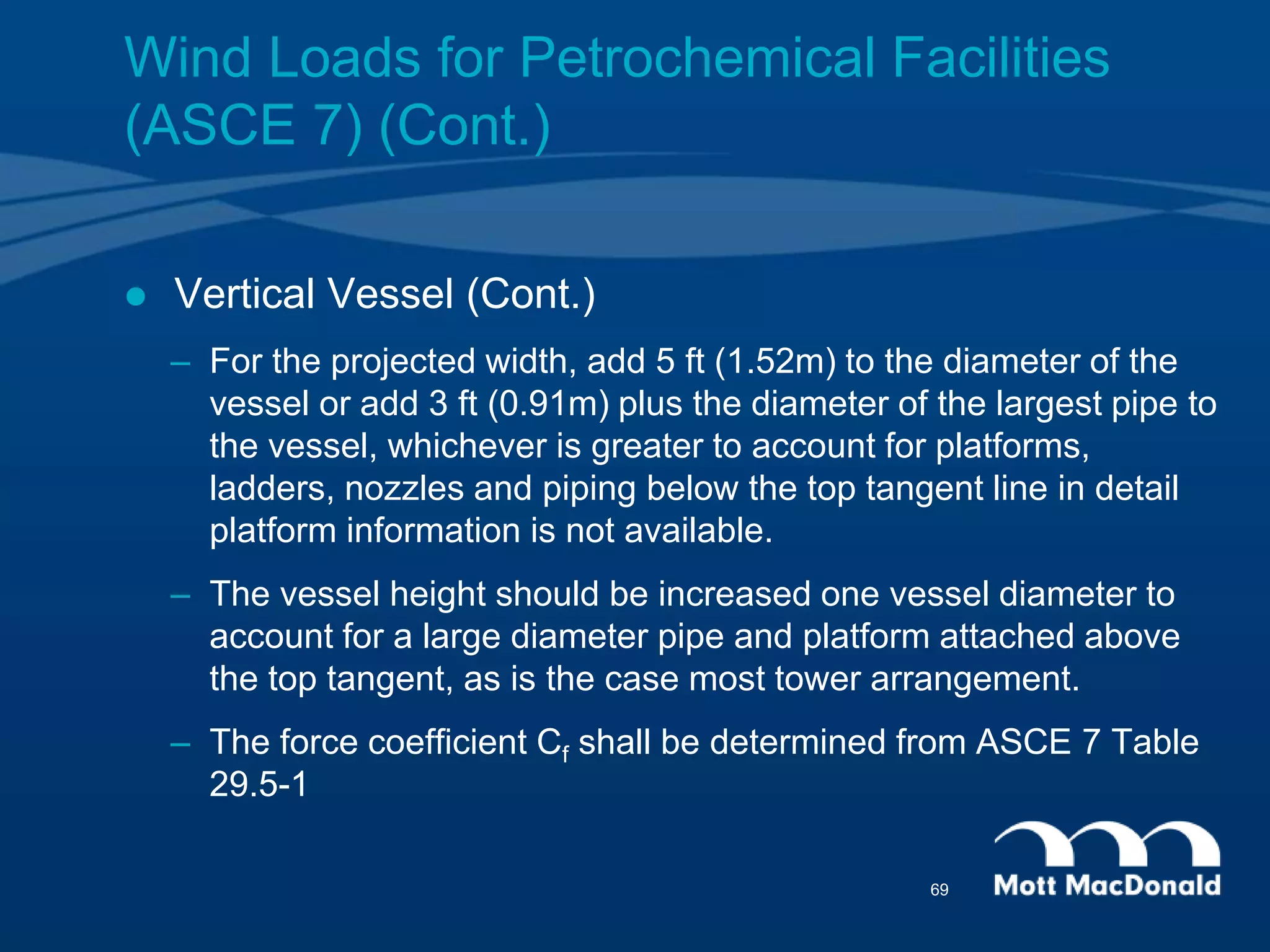
 Vertical Vessel
– Use Chapter 29 of ASCE 7-10 for velocity pressure calculation
– Gust factor shall be calculated based on empty or operating
vessel frequency (f = 1/T)
Wind Loads for Petrochemical Facilities
(ASCE 7) (Cont.)
68
 Vertical Vessel (Cont.)
– For the projected width, add 5 ft (1.52m) to the diameter of the
vessel or add 3 ft (0.91m) plus the diameter of the largest pipe to
the vessel, whichever is greater to account for platforms,
ladders, nozzles and piping below the top tangent line in detail
platform information is not available.
– The vessel height should be increased one vessel diameter to
account for a large diameter pipe and platform attached above
the top tangent, as is the case most tower arrangement.
– The force coefficient Cf shall be determined from ASCE 7 Table
29.5-1
Wind Loads for Petrochemical Facilities
(ASCE 7) (Cont.)
69
 Horizontal Vessel
– No check for dynamic properties is required.
– For the projected diameter add 1.5 ft (0.46m) to the insulated
diameter to account for ladders, nozzles and pipe 8 in and
smaller.
– For transverse wind, the for coefficient, Cf, shall be determined
from ASCE 7-10, Figure 29.5-1.
– For longitudinal wind, use Cf of 0.5 for a rounded head and 1.2
for a flat head.
– For platform, use the projected area of the support steel and
force coefficient Cf of 2.0. For handrails use the values in Table
5.1.
– For support, use the actual projected area. Cf should be 1.3 for
concrete pedestals. Steel support shall be same as platforms.
Wind Loads for Petrochemical Facilities
(ASCE 7) (Cont.)
70
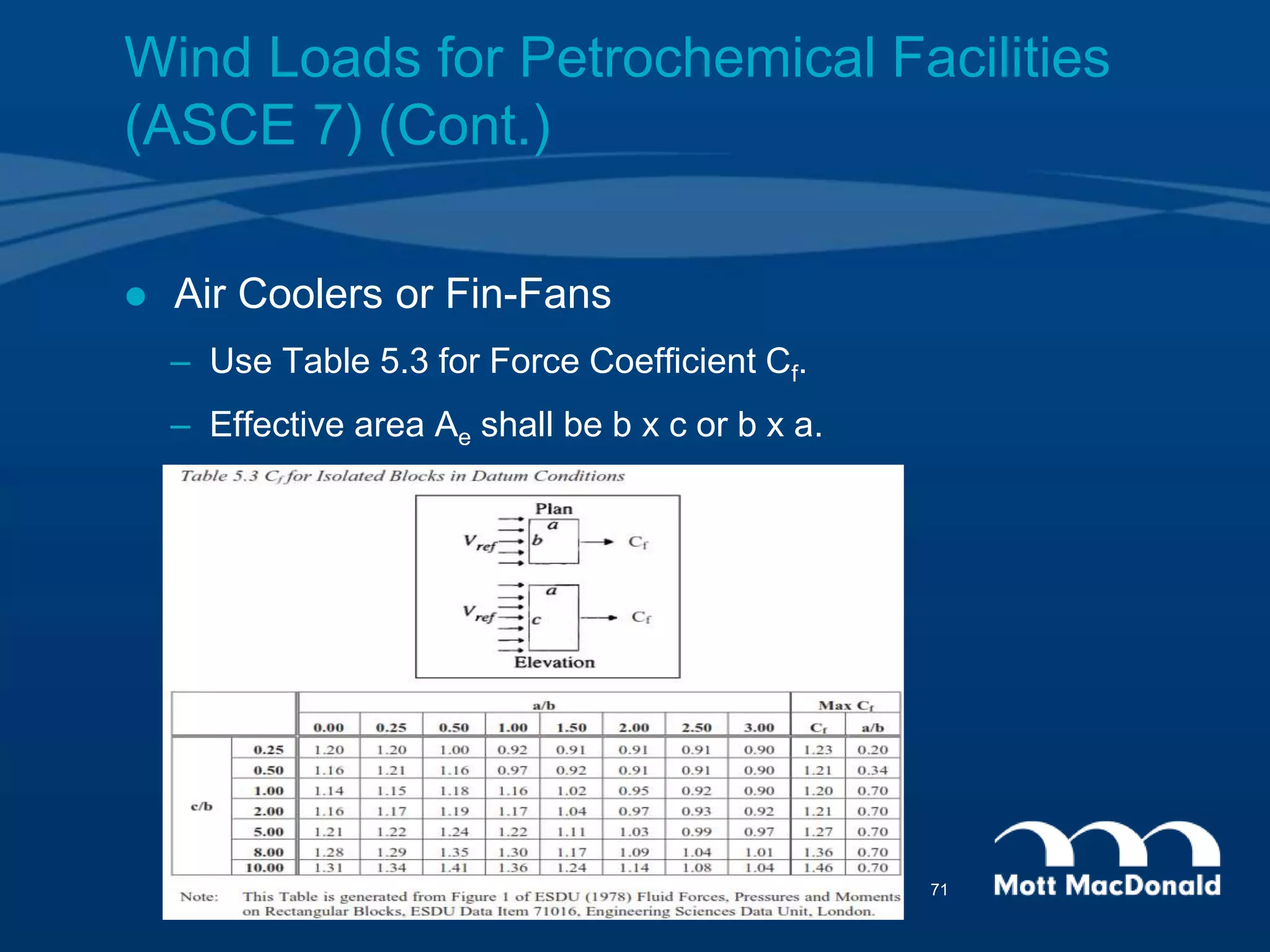
 Air Coolers or Fin-Fans
– Use Table 5.3 for Force Coefficient Cf.
– Effective area Ae shall be b x c or b x a.
Wind Loads for Petrochemical Facilities
(ASCE 7) (Cont.)
71
Q&A
72

Wind_Load

  • 1.
    Wind Load: TheIBC -2012 and ASCE 7 -10 Provisions Mithun Pal Civil/Structural Engineer 1
  • 2.
    Contents  Objectives  ImportantDefinitions  Major Changes in ASCE 7-10 from ASCE 7-05  Wind Load Calculation Procedure  Wind Load Calculation as per IBC-2012 and ASCE 7- 10 and Load Combinations  Conclusion  Wind Loads for Petrochemical Facilities  Q&A 2
  • 3.
    Objectives  Explain thedesign steps for Wind Load calculation as per IBC-2012 and ASCE 7-10  To demonstrate the changes made in ASCE 7-10 from ASCE 7-05  To explain ASCE guidelines for Wind Load calculation on Petrochemical Facilities. 3
  • 4.
    Important Definitions  BasicWind Speed – 3 sec gust speed at 10m above the ground in Exposure C.  Gust - A wind gust is a sudden, brief increase in the speed of the wind followed by a break.  Gust Factor – Factor to account the dynamics of wind fluctuation and load amplification by building dynamics. 4
  • 5.
    Important Definitions (Cont.) Type of buildings Enclosure Classification – Open Building – Building having each wall at least 80% open. Ao > 0.8Ag – Partially Enclosed Building – Ratio of total area of openings in a wall receiving positive external pressure and sum of total openings (roof and wall) is more than 10% and total area of openings receiving positive pressure is more than 4 sq.ft. • Ao > 1.10 Aoi, and • Ao > min[4 sqft , 0.01Ag], and • Aoi/Agi < 0.20 – Enclosed Building – A building that does not comply with the requirements for open or partially enclosed building. 5
  • 6.
     Type ofbuildings (Cont.) – Low Rise Building – Enclosed or partially enclosed building having mean roof height (h) less than or equal to 60 ft (18m) and mean roof height does not exceed the least horizontal dimension. – Simple Diaphragm – A building in which both windward and leeward wind loads are transmitted by roof and vertical spanning wall assemblies, through continuous floor and roof diaphragms to the MWFRS.  Flexible Structure – Structure having fundamental natural frequency less than 1 Hz Important Definitions (Cont.) 6
  • 7.
     Exposure Category– Adequately reflects the characteristics of ground surface irregularities. – Exposure A – Deleted in ASCE 7-02 and later. – Exposure B - Urban and suburban areas, wooded areas, areas with many closely spaced obstructions. This category includes terrains with numerous closely spaced obstruction that extends upto 1500 ft with building of height upto 30 ft and 2600 ft or 20 times the height, whichever is greater, for building of height more than 30 ft. – Exposure C - Open terrain with scatter obstructions. Airports, areas that are generally flat open country. – Exposure D - Flat, unobstructed areas and water surfaces. This category includes smooth mud flats, salt flats, and unbroken ice that extend 5,000 ft or 20 times the building height, whichever is greater, in the upwind direction. Important Definitions (Cont.) 7
  • 8.
     Risk Category– A categorization of buildings and other structures based on the risk associated with unacceptable performance. (Refer Table 1.5-1). – Risk Categories replace the Occupancy Categories of ASCE 7- 05 – Risk Category I Occupancy Category I – Risk Category II Occupancy Category II – Risk Category III Occupancy Category III – Risk Category IV Occupancy Category IV Important Definitions (Cont.) 8
  • 9.
    Changes in ASCE7 - 10  In ASCE 7-05 Wind Load is in Chapter-6, but in ASCE 7-10 Wind Load is in Chapter -26 to Chapter – 31.  Removal of the Occupancy Factor (Importance Factor) and introduction of Risk Category.  Revised Load Factor for wind in ASD and LRFD load combinations.  Revised pressure values for minimum design loads.  Reinstating applicability of Exposure D in hurricane prone regions.  Revised wind speed triggers for definition of hurricane prone region and wind-borne debris region.  Allowable building height for simplified procedure is increased from 60 ft to 160 ft. 9
  • 10.
    Wind Load CalculationProcedures  Method 1 — Directional Procedure – Buildings of all height (ASCE 7-10 Chapter 27)  Method 2 — Envelop Procedure – For low-rise buildings (ASCE 7-10 Chapter 28) .  Method 3 — Directional Procedure for Building Appurtenances – For building appurtenances (ASCE 7-10 Chapter 29).  Method 4 — Wind Tunnel Procedure – For any building (ASCE 7-10 Chapter 31). 10
  • 11.
    Wind Load CalculationProcedures (Cont.)  Directional Procedure – – Wind direction specific – External pressure Cp depends on wind direction. – Cp utilized are based on wind tunnel testing corresponding to wind direction.  Envelop Procedure – – Not dependent on wind direction – Pseudo-External pressure Cpf is derived from wind tunnel testing to produce maximum structural actions among all directions. – Pseudo-External pressure Cpf is lumped together with the gust factor, G, and GCpf is given for different areas of building. 11
  • 12.
    Wind Load CalculationProcedures (ASCE 7-05) Wind Load ASCE 7-05 Simplified Procedure (For low-rise diaphragm building) Section 6.4 MWFRS Section 6.4.1.1 C&C Section 6.4.1.2 Analytical Procedure (For all buildings) Section 6.5 Enclosed and Partially Enclosed Building Section 6.5.12 MWFRS Section 6.5.12.1.3 Rigid Buildings of All Height Section 6.5.12.2.1 Low-Rise Building Section 6.5.12.2.2 Flexible Building Section 6.5.12.2.3 Parapet Section 6.5.12.2.4 C&C Section 6.5.12.4 Low-Rise Building, h<60ft Section 6.5.12.4.1 Building, h > 60ft Section 6.5.12.4.2 Alternation for Buildings 60 ft < h < 90ft Section 6.5.12.4.3 Parapet Section 6.5.12.4.4 Open Building Section 6.5.13 MWFRS Section 6.5.13.1.2 C&C Section 6.5.13.3 Solid Freestanding Walls and Signs Section 6.5.14 Other Structures Section 6.5.15 Wind Turbine Procedure (For all building) Section 6.6 MWFRS – Main Wind Force Resisting System C&C – Components and Cladding 12
  • 13.
    Wind Load ASCE 7-10 DirectionalMethod for MWFRS Chapter 27 Part 1: For Enclosed, Partially Enclosed and Open Building of all heights (Analytical Procedure) Enclosed and Partially Enclosed Rigid Buildings Section 27.4.1 Enclosed and Partially Enclosed Flexible Buildings Section 27.4.2 Open Buildings with Roofs Section 27.4.3 Roof Overhangs Section 27.4.4 Parapets Section 27.4.5 Part 2: Enclosed Simple Diaphragm Buildings (Simplified Procedure) Walls and Roof Surfaces Sections 27.6.1 Parapets Section 27.6.2 Roof Overhangs Sections 27.6.3 Envelope Procedure for MWFRS Section 28 Part 1: Closed and Partially Enclosed Low- Rise Buildings (Analytical Procedure) Low-Rise Buildings Section 28.4.1 Parapets Sections 28.4.2 Roof Overhangs Section 28.4.3 Part 2: Enclosed Simple Diaphragm Low-Rise Buildings (Simplified Procedure) Directional Method for Building Appurtenances Chapter 29 Solid Freestanding Walls and Signs Section 29.4.1 Solid Attached Signs Section 29.4.2 Other Structure Section 29.5 Rooftop Structures and equipment for Buildings with h < 60ft Section 29.5.1 Wind Load on C&C Chapter 30 Part 1:Directional Method for Enclosed and Partially Enclosed Buildings h< 60ft Section 30.4 Part 2:Simplified Procedure for Enclosed Buildings h< 60ft Section 30.5 Part 3:Directional Method for Enclosed and Partially Enclosed Buildings h> 60ft Section 30.6 Part 4:Simplified Procedure for Enclosed Buildings h< 160ft Section 30.7 Part 5: Directional Procedure for Open Building of All Heights Section 30.8 Part 6: Directional Procedure for Building Appurtenances Section 30.9 Wind Tunnel Procedure Chapter 31 Wind Load Calculation Procedures (ASCE 7-10) 13
  • 14.
    ASCE 7-10 WindPressures  The basic form of the pressure equation: p = qGC  Where – p = a wind pressure on a surface – q = velocity pressure. This is the pressure due to a moving fluid on a flat plate – G = gust factor. The gust factor accounts for dynamic interaction between the flowing air and the structure – C = pressure coefficient. The pressure coefficient accounts for varying pressure across a surface. 14
  • 15.
    Velocity Pressure, q qz =Velocity Pressure = 0.613KzKzt KdV2 (N/m2) = 0.00256KzKzt KdV2 (lb/ft2) – V = Basic wind speed in mph – Kz = Exposure Coefficient – Kzt = Topographical Factor – Kd = Wind Directionality Factor  Evaluated at an elevation z: – qz = 0.00256V2 KzKztKd  Evaluated at the building mean roof elevation, h: – qh = 0.00256V2 KhKhtKd See ASCE 7-10 Cl.27.3.2, Cl.28.3.2 and Cl.29.3.2 15
  • 16.
    Basic Wind Speed,V  Use Fig. 26.5-1A for Risk Category II  Use Fig. 26.5-1B for Risk Category III & IV  Use Fig. 26.5-1C for Risk Category I See ASCE 7-10 Cl.26.5.1  Importance Factor, I – Deleted from ASCE 7-10 and accounted in Basic Wind Speed. 16
  • 17.
    Velocity Pressure Exposure Coefficients,Kz and Kh  Modifies basic wind pressure for heights other than 33 ft and exposures other than exposure C  Use Table 27.3-1, Table 28.3-1 and Table 29.3-1 for the value of KZ or Kh  Compute K directly from equations in the commentary for any height and/or exposure. See ASCE 7-10 Table 27.3-1, Table 28.3-1 and Table 29.3-1 17
  • 18.
    Kz & KhComputation K Computation 0.00 0.50 1.00 1.50 2.00 2.50 0 500 1000 1500 2000 Elevation, z (ft) K Exposure B Exposure C Exposure D When z > zg use z = zg When z < 15 use z = 15 ft Table 26.9-1 18
  • 19.
    Topographical Factor, Kzt Kzt = 1.0 when: – H/Lh < 0.2, or – H < 15' for Exposures C & D, or – H < 60' for Exposure B.  Kzt = (1+K1K2K3)2 See ASCE 7-10 26.8 & Fig. 26.8-1 19
  • 20.
    Kzt Constants See ASCE7-10 Fig 26.8-1 20
  • 21.
    Kzt Multipliers byEquation See ASCE 7-10 Fig 26.8-1 21
  • 22.
    Directionality Factor, Kd This factor shall only be applied when used in conjunction with load combinations specified in Sections 2.3 and 2.4. See ASCE 7-10 Cl.26.6 and Table 26.6-1 22
  • 23.
    Gust Factor, G For Rigid structures – G = 0.85  For flexible buildings and other structures – Calculate G as per Cl.26.9 or “by a rational analysis that incorporates the dynamic properties of the main wind-force resisting system.” See ASCE 7-10 Cl.26.9 23
  • 24.
    Pressure Coefficients, C The pressure coefficients are based on – The enclosure category of the structure – The location on a structure for which a pressure is to be computed.  The pressure coefficients have been determined experimentally from wind tunnel studies done on regular shaped structures  The coefficient represents the ratio between measured pressure and the computed basic velocity pressure. 24
  • 25.
    Location of Pressure ASCE 7 provides means for computing forces on various surfaces. – The building envelope surfaces experience pressure on both sides (i.e. external and internal). 25
  • 26.
    Internal Pressure Coefficients,GCpi  Internal pressure is fairly easy because the air is relatively stagnant and the shape of the structure does not affect it’s magnitude.  As gusting is not a concern internally, the gust factor and the pressure coefficient are combined. – GCpi  The magnitude of the internal pressure coefficient is strictly dependent on the enclosure classification.  The pressure can be both positive or negative (i.e. suction) depending on the direction of the wind relative to opening for partially enclosed or enclosed buildings. – Both internal pressures must be considered. See ASCE 7-10 Cl.26.11 & Table 26.11-1 26
  • 27.
  • 28.
    External Pressure Coefficients,Cp  As external surfaces are subject to “flowing” air, the pressure varies considerably on the building surface depending on structural configuration and direction of the wind.  Coefficients also depend on whether the resulting forces are to be used to design/analyze: – Main Wind-Force Resisting Systems (MWFRS) • The structural elements necessary to provide supports and stability of overall structure (foundation, column, beams, truss, bracing, wall diaphragm etc.). – Components & Cladding (C&C) • Elements of the building envelope that do not qualify as part of the MWFRS (Windows, doors, curtain walls, roof sheeting and coverings, overhangs, building attachments etc.). See ASCE 7-10 Table 27.4-1 to 27.4-3 and Table 28.4-1 28
  • 29.
    Directional Procedure  ForWind Load calculation for enclosed, partially enclosed and open buildings of all height.  Conditions – Building shall be of regular shape – Building does not have response characteristics making it subject to cross-wind loading, vortex, shedding, instability due to galloping or flutter or it does not have a location that creates channelling effect.  Limitations – Building having unusual shapes or response. See ASCE 7-10 Chapter 27 29
  • 30.
    Directional Procedure (Cont.) Part-1: Design Steps for MWFRS (Analytical Procedure) – Step – 1: Determine risk category (Table 1.5-1) – Step – 2: Determine Basic Wind Speed – Step – 3: Determine Wind Parameters (Kd, Exposure Category, Kzt, G, Enclosure Classification, GCpi) – Step – 4: Determine velocity pressure exposure coefficient Kz or Kh (Table 27.3-1) – Step – 5: Determine velocity pressure qz or qh (Eq. 27.3-1) See ASCE 7-10 Table 27.2-1 30
  • 31.
    Directional Procedure (Cont.) Part-1: Design Steps for MWFRS (Contd.) – Step – 6: Determine external pressure coefficient Cp or CN • Fig. 27.4-1 for walls and flat, gable, hip, monoslope • Fig. 27.4-2 for domed roofs • Fig. 27.4-3 for arched roofs • Fig. 27.4-4 for monoslope roof, open building • Fig. 27.4-5 for pitched roof, open building • Fig. 27.4-6 for troughed roof, open building • Fig. 27.4-7 for along-ridge / valley wind load case for monoslope, pitched or troughed roof – Step – 7: Wind pressure, p • Eq. 27.4-1 for rigid buildings • Eq. 27.4-2 for flexible buildings • Eq. 27.4-3 for open buildings 31
  • 32.
    Directional Procedure (Cont.) Finding Net Pressure – Wind Loads – Enclosed and partially enclosed Rigid Building p=qGCp-qi(GCpi ) (lb/ft2)(N/m2) …(Eq. 27.4-1) – Wind Loads – Enclosed and partially enclosed Flexible Building p=qGfCp-qi(GCpi ) (lb/ft2)(N/m2) …(Eq. 27.4-2) – Wind Loads – Open Building with monoslope, pitched or troughed roofs p=qGCN (lb/ft2)(N/m2) …(Eq. 27.4-3) (CN is net pressure coefficient from fig 27-4-4 to 27-4-7) 32
  • 33.
    Directional Procedure (Cont.) The net pressure is the vector sum of the internal and external pressure  Note the sign – positive pressure externally opposes positive pressure internally (i.e. they act in opposite directions) 33
  • 34.
    Directional Procedure (Cont.) Part-2: Design Steps for Diaphragm Building (h<160ft) (Simplified Procedure) – Step – 1: Determine risk category (Table 1.5-1). – Step – 2: Determine Basic Wind Speed. – Step – 3: Determine Wind Parameters (Kd, Exposure Category, Kzt, Enclosure Classification). – Step – 4: Enter Table to determine net pressure on walls at top and base of building ph and p0 (Table 27.6-1). – Step – 5: Enter Table to determine net roof pressure pz (Table 27.6-2). See ASCE 7-10 Table 27.5-1 34
  • 35.
    Directional Procedure (Cont.) Part-2: Design Steps for Diaphragm Building (h<160ft) (Simplified Procedure) (Cont.) – Step – 6: Determine topographical factor, Kzt and apply to wall and roof pressure. – Step – 7: Apply loads to walls and roofs simultaneously.  Diaphragm Flexibility – The design procedure applies to buildings having either rigid or flexible diaphragms. 35
  • 36.
  • 37.
    Directional Procedure (Cont.) Table to Calculate wind Pressure on walls Table 27.6-1 37
  • 38.
    Directional Procedure (Cont.) Table to Calculate wind Pressure on roof Table 27.6-2 38
  • 39.
    Directional Procedure (Cont.) Minimum Design Wind Loads – The Load effect of the design wind pressure shall not be less than a minimum load defined by assuming the pressure, ps, +16 psf for wall and +8 psf for roof onto a vertical plane normal to the assumed wind direction. Wall and roof loads shall be applied simultaneously. – The design pressure for open building shall not be less than 16 psf. 39
  • 40.
    Envelope Procedure  ForWind Load calculation for enclosed and partially enclosed low-rise buildings.  Condition – For building of height less than 60 ft – Building shall be of regular shape – Building does not have response characteristics making it subject to cross-wind loading, vortex, shedding, instability due to galloping or flutter or it does not have a location that creates channelling effect.  Limitations – Building having unusual shapes or response. See ASCE 7-10 Chapter 28 40
  • 41.
    Envelope Procedure (Cont.) Part-1: Design Steps for MWFRS – Step – 1: Determine risk category (Table 1.5-1). – Step – 2: Determine Basic Wind Speed. – Step – 3: Determine Wind Parameters (Kd, Exposure Category, Kzt, Enclosure Classification, GCpi). – Step – 4: Determine velocity pressure exposure coefficint Kz or Kh using Table 28.3-1. – Step – 5: Determine velocity pressure qz or qh. – Step – 6: Determine external pressure coefficient (GCp) using Fig 28.4-1. – Step – 7: Calculate wind pressure, p, from Eq. 28.4-1 See ASCE 7-10 Table 28.2-1 41
  • 42.
    Envelope Procedure (Cont.) Design Wind Pressure – Wind Loads – Enclosed and partially enclosed Rigid Building p=qh[(GCpf ) - (GCpi )] (lb/ft2)(N/m2) …(Eq. 28.4-1)  External Pressure Coefficient (GCpf ) – The combined gust effect factor and external pressure coefficients for low-rise buildings, (GCpf ), are not permitted to be separated. 42
  • 43.
    Envelope Procedure (Cont.) Part-2: Design Steps for Low-Rise Diaphragm Building (Simplified Procedure) – Step – 1: Determine risk category (Table 1.5-1). – Step – 2: Determine Basic Wind Speed. – Step – 3: Determine Wind Parameters (Exposure Category, Kzt). – Step – 4: Enter Table to determine net pressure on walls at top and base of building ph and p0, Table 27.6-1. – Step – 5: Enter Table to determine net roof pressure pz, Table 27.6-2 See ASCE 7-10 Table 28.5-1 43
  • 44.
    Envelope Procedure (Cont.) Design Wind Pressure – Wind Loads – Enclosed and partially enclosed Rigid Building ps=lKztps30 (lb/ft2)(N/m2) …(Eq. 28.6-1) l = adjustment factor for building height and exposure from Fig. 28.6-1 ps30 = Simplified Design Wind Pressure (psf) , Fig. 28.6-1 44
  • 45.
  • 46.
    Envelope Procedure (Cont.) Minimum Design Wind Loads – The Load effect of the design wind pressure shall not be less than a minimum load defined by assuming the pressure, ps, for zones A and C equal to +16 psf, Zones B and D equal to +8 psf, while assuming ps for Zones E, F, G and H are equal to 0 psf. 46
  • 47.
     For WindLoad calculation on building appurtenances (rooftop structure and equipments) and other structures of all heights (solid freestanding walls and solid signs, chimneys, tanks, open signs, lattice frameworks and trussed tower) using the Directional Procedure.  Condition – Same as Directional Procedure.  Limitations – Same as Directional Procedure. See ASCE 7-10 Chapter 29 Wind Loads on Other Structures and Building Appurtenances 47
  • 48.
    Wind Loads onOther Structures and Building Appurtenances (Cont.)  Design Steps – Step – 1: Determine risk category (Table 1.5-1). – Step – 2: Determine Basic Wind Speed. – Step – 3: Determine Wind Parameters (Kd, Exposure Category, Kzt and G). – Step – 4: Determine velocity pressure exposure coefficient Kz or Kh using Table 29.2-1. – Step – 5: Determine velocity pressure qz or qh using Eq. 29.4-1 See ASCE 7-10 Table 29.1-1 48
  • 49.
     Design Steps(Cont.) – Step – 6: Determination of Force Coefficient Cf • Fig. 29.4-1 for Solid freestanding signs or wall • Fig. 29.5-1 for Chimneys, Tanks, Rooftop equipments • Fig. 29.5-2 for Open Signs, Lattice Frameworks • Fig. 29.4-3 for Trussed Tower – Step – 7: Calculate Wind Force, F • Eq. 29.4-1 for signs and walls • Eq. 29.5-2 and Eq. 29.5-3 for rooftop structures and equipments • Eq. 29.5-1 for other structures Wind Loads on Other Structures and Building Appurtenances (Cont.) 49
  • 50.
     Design WindForce – Wind Loads – Solid freestanding wall and sign F=qhGCfAs (lb)(N) …(Eq. 29.4-1) – Wind Loads – Rooftop structures and equipments (Roof height < 60ft) Fh=qh(GCr)Af (lb)(N) …(Eq. 29.5-2) Fv=qh(GCr)Ar (lb)(N) …(Eq. 29.5-3) – Wind Loads – Other structures F=qzGCfAf (lb)(N) …(Eq. 29.5-1) Wind Loads on Other Structures and Building Appurtenances (Cont.) 50
  • 51.
    – qh =the velocity wind pressure at a height h – G = Gust factor as per Cl.26.9 – Cf = net force coefficient from Fig. 29.4-1, Fig. 29.5-1 to 29.5-3 – As= Gross area of solid freestanding wall and sign – Af= Projected area normal to the wind. – Ar= Horizontal projected area of rooftop structure or equipment. – GCr= 1.9 for rooftop structures and equipments with Af less than 0.1Bh and shall be reduced to 1.9 to 1.0 as 0.1Bh is increased to Bh – GCr= 1.5 for rooftop structures and equipments with Ar less than 0.1BL and shall be reduced to 1.5 to 1.0 as 0.1BL is increased to BL Wind Loads on Other Structures and Building Appurtenances (Cont.) 51
  • 52.
     Minimum DesignWind Loads – Design wind load for other structure shall not be less than 16 lb/ft2. Wind Loads on Other Structures and Building Appurtenances (Cont.) 52
  • 53.
    See ASCE 7-10Chapter 30  Part-1 • Envelop Procedure for enclosed and partially enclosed buildings. • Building has a flat roof, gable roof, stepped roof, hip roof, monoslope roof or sawtooth roof.  Part-2 • Envelop Procedure for enclosed buildings. • Building has a flat, gable or hip shape roofs. Wind Loads on Components and Cladding (C&C) 53
  • 54.
    Wind Loads onComponents and Cladding (C&C) (Cont.)  Part-3 • Directional Procedure for enclosed and partially enclosed buildings having h > 60 ft. • Building has a flat, pitched, gable, hip, mansard, arched, dome roofs.  Part-4 • Directional Procedure for enclosed buildings having h < 160 ft. • Building has a flat, pitched, gable, hip, mansard, arched, dome roofs. 54
  • 55.
     Part-5 • DirectionalProcedure for open building having pitched, monoslope or troughed roofs.  Part-6 • Directional Procedure for roof overhangs and parapets of buildings. Wind Loads on Components and Cladding (C&C) (Cont.) 55
  • 56.
     Types ofRoofs Wind Loads on Components and Cladding (C&C) (Cont.) 56
  • 57.
     Types ofRoofs (Cont.) Wind Loads on Components and Cladding (C&C) (Cont.) 57
  • 58.
     Types ofRoofs (Cont.) Wind Loads on Components and Cladding (C&C) (Cont.) 58
  • 59.
    Wind Tunnel Procedure Permitted for any building or structure  Required for – Buildings or other structures with unusual shapes – Buildings or other structures with unusual response characteristics and thus subject to the following: – Across-wind loading – Vortex shedding – Instability due to galloping or flutter – Channelling effects – Buffeting in the wake of upwind obstructions See ASCE 7-10 Chapter 31 59
  • 60.
    Load Combinations Design Process ASCE 7-05ASCE 7-10 LRFD 1.2D + 1.6(Lr or S or R) + (L or 0.8W) 1.2D + 1.6W + L + 0.5(Lr or S or R) 0.9D + 1.6W + 1.6H 1.2D + 1.6(Lr or S or R) + (L or 0.5W) 1.2D + 1.0W + L + 0.5(Lr or S or R) 0.9D + 1.0W ASD D + W D + 0.75(W) + 0.75L + 0.75(Lr or S or R) 0.6D + W D + 0.6W D + 0.75(0.6W) + 0.75L + 0.75(Lr or S or R) 0.6D + 0.6W 60
  • 61.
    Conclusion  Changes inASCE 7-10 produces greater differences in design pressure for areas within Hurricane prone regions.  The changes for other areas don’t produce much change in wind pressure Examples- • Risk Category – II -ASCE 7-05 Wind Speed = 90 mph (I=1.0) ….(Fig 6-1, ASCE7-05) -ASCE 7-10 Wind Speed = 115 mph ….(Fig 26.5-1A, ASCE7-10) -Ratio in wind pressure = 1.0 x 1.6 x 902 / 1152 = 0.98 • Risk Category – III -ASCE 7-05 Wind Speed = 90 mph (I=1.15) ….(Fig 6-1, ASCE7-05) -ASCE 7-10 Wind Speed = 120 mph ….(Fig 26.5-1B, ASCE7-10) -Ratio in wind pressure = 1.15 x 1.6 x 902 / 1202 = 1.035 61
  • 62.
    Wind Loads forPetrochemical Facilities (ASCE 7)  Wind Loads on Pipe Rack – Wind Force – Shall be calculated with Directional Procedure as per Chapter 29 of ASCE 7-10 – Piping Tributary Area A = L (D+10%W) … (Cl.5.1.1) – Cable Trays Tributary Area A = L (h+10%W) … (Cl.5.1.2) 62
  • 63.
    Wind Loads forPetrochemical Facilities (ASCE 7) (Cont.)  Wind Loads on Pipe Rack (Cont.) – Force Coefficient • For structural members … (Cl.5.1.3) – Cf = 1.8 or – Cf = 2.0 at and below first level and 1.6 for members above first level • For Pipes … (Cl.5.1.4) – Cf = 0.7 as minimum – Cf = shall be calculated as per Fig. 29.5-1 • For Trays … (Cl.5.1.5) – Cf = 2.0 63
  • 64.
     Wind Loadson Open Structure (Process Structures, Reactor Operating Structures) – Frame Load – Shall be as per Eq. 29.5-1 of ASCE 7-10 – Force Coefficient of set of frames – Cf = CDg / e CDg= force coefficient for set of frames, from Fig. 5.1 e= effective solid area (As) / gross area of wind-ward frame (Ag) Wind Loads for Petrochemical Facilities (ASCE 7) (Cont.) 64
  • 65.
    N = Numberof frames SF =frame spacing B =Frame width Figure 5.1 Figure 5.1 Wind Loads for Petrochemical Facilities (ASCE 7) (Cont.) 65
  • 66.
     Wind Loadson Open Structure (Process Structures, Reactor Operating Structures) (Cont.) – Force Coefficient of Components – Fig 29.5-1 Wind Loads for Petrochemical Facilities (ASCE 7) (Cont.) 66
  • 67.
     Wind Loadson Open Structure (Process Structures, Reactor Operating Structures) (Cont.) – Design Load Cases – FS = Frame wind load FT = Frame load + piping wind load + equipment wind load Design Wind Load = FT+0.5FS Wind Loads for Petrochemical Facilities (ASCE 7) (Cont.) 67
  • 68.
     Vertical Vessel –Use Chapter 29 of ASCE 7-10 for velocity pressure calculation – Gust factor shall be calculated based on empty or operating vessel frequency (f = 1/T) Wind Loads for Petrochemical Facilities (ASCE 7) (Cont.) 68
  • 69.
     Vertical Vessel(Cont.) – For the projected width, add 5 ft (1.52m) to the diameter of the vessel or add 3 ft (0.91m) plus the diameter of the largest pipe to the vessel, whichever is greater to account for platforms, ladders, nozzles and piping below the top tangent line in detail platform information is not available. – The vessel height should be increased one vessel diameter to account for a large diameter pipe and platform attached above the top tangent, as is the case most tower arrangement. – The force coefficient Cf shall be determined from ASCE 7 Table 29.5-1 Wind Loads for Petrochemical Facilities (ASCE 7) (Cont.) 69
  • 70.
     Horizontal Vessel –No check for dynamic properties is required. – For the projected diameter add 1.5 ft (0.46m) to the insulated diameter to account for ladders, nozzles and pipe 8 in and smaller. – For transverse wind, the for coefficient, Cf, shall be determined from ASCE 7-10, Figure 29.5-1. – For longitudinal wind, use Cf of 0.5 for a rounded head and 1.2 for a flat head. – For platform, use the projected area of the support steel and force coefficient Cf of 2.0. For handrails use the values in Table 5.1. – For support, use the actual projected area. Cf should be 1.3 for concrete pedestals. Steel support shall be same as platforms. Wind Loads for Petrochemical Facilities (ASCE 7) (Cont.) 70
  • 71.
     Air Coolersor Fin-Fans – Use Table 5.3 for Force Coefficient Cf. – Effective area Ae shall be b x c or b x a. Wind Loads for Petrochemical Facilities (ASCE 7) (Cont.) 71
  • 72.