
WiFi Analytics vs.
Beacon Analytics
Which is the best location intelligence
setup for retail stores?
2COPYRIGHT © 2017, JULY SYSTEMS, INC. ALL RIGHTS RESERVED
Introduction
E-commerce websites use analytic tools to
understand, track and improve their customer
loyalty and acquisition strategies. From a
customer’s shopping cart history to time spent on
product pages to the number of site visits — these
metrics are all tracked through web analytics.
In most retail stores today, customers are ghosts –
they remain completely unknown until they
checkout at POS.
So, how do you track similar
metrics at physical retail stores?
3COPYRIGHT © 2017, JULY SYSTEMS, INC. ALL RIGHTS RESERVED
Answer: Location based technology
Today, location based technology allows you to
understand (know) your visitors beyond footfalls and
give you a holistic view of in store customer behavior.
Analyzing visitors/customers at physical stores and
matching the customer experience of an ecommerce
store is now possible with these technologies.
WiFi and Beacons are the top two
technologies used in large physical spaces
to understand customer behavior and
engage them real-time using location data.
4COPYRIGHT © 2017, JULY SYSTEMS, INC. ALL RIGHTS RESERVED
How analytics are captured on WiFi
A first-time visitor connects to the free WiFi offered
by the store he is visiting. A location technology such
as Proximity MX integrated with the wifi network
starts capturing the customer behavior. In case of a
returning visitor, he automatically gets identified as
soon as he enters the store with his mobile device and
can be immediately engaged by the retailer.
Once the phone is connected to the WiFi network, the
user is shown the captive portal.
A captive portal is a Web page that the users of any
public-access network view in order to access the
internet. Retailers can capture customers data by
asking them to fill in their information through a form
on this portal.
5COPYRIGHT © 2017, JULY SYSTEMS, INC. ALL RIGHTS RESERVED
How analytics are captured on WiFi
WiFi network not only captures customer data
entered in the captive portal, but also captures
information like – when did the device connect to the
network, which device got connected, how long was
the connected session, which WiFi access point did it
first connect to, which was the last one it connected
to and so on.
These types of data points helps a marketer
understand how often a customer visits the store, at
what time of the day, where they spend most of their
time.
6COPYRIGHT © 2017, JULY SYSTEMS, INC. ALL RIGHTS RESERVED
Since WiFi is a popular technology,
retailers can acquire more than
70% of the visitor walk-ins their
stores. In most cases, additional
infrastructure is not required since
many retailers already offer free
WiFi to their customers
Visitors need not install native app
on their device
Better coverage throughout the
store since WiFi signals don’t get
obstructed by walls and pillars
WiFi Analytics Pros & Cons
Location precision is low
WiFi receiver on device has to be
switched on
Pros Cons
7COPYRIGHT © 2017, JULY SYSTEMS, INC. ALL RIGHTS RESERVED
How analytics are captured on Beacons
Beacons can facilitate only one-way communication.
That is, beacons can only transmit signals to your
smartphones and not receive signals from them.
Beacons signals can only trigger an action if a mobile
app is installed if Bluetooth is turned on and if the
phone is connected to the internet (in most cases).
When smartphones receive a beacon signal, how the
app reacts to the signal is dependent on how the
backend is designed. For example – you deploy 3
beacons at 3 different sections of your store, each
hard coded with a different message.
8COPYRIGHT © 2017, JULY SYSTEMS, INC. ALL RIGHTS RESERVED
How analytics are captured on Beacons
Depending on the location of the user in a store, the
beacon that is closest to him will push a notification
to the user’s smartphone, asking him to take the
necessary action. The moment an action is triggered,
the data begins to collect on the customer and is
stored in the backend. All these analytics can
eventually be accessed through a dashboard.
Beacons do not store any information or data. They
can perform functions like send a Push Notification
through an app and are mostly used for indoor
positioning, and navigation.
9COPYRIGHT © 2017, JULY SYSTEMS, INC. ALL RIGHTS RESERVED
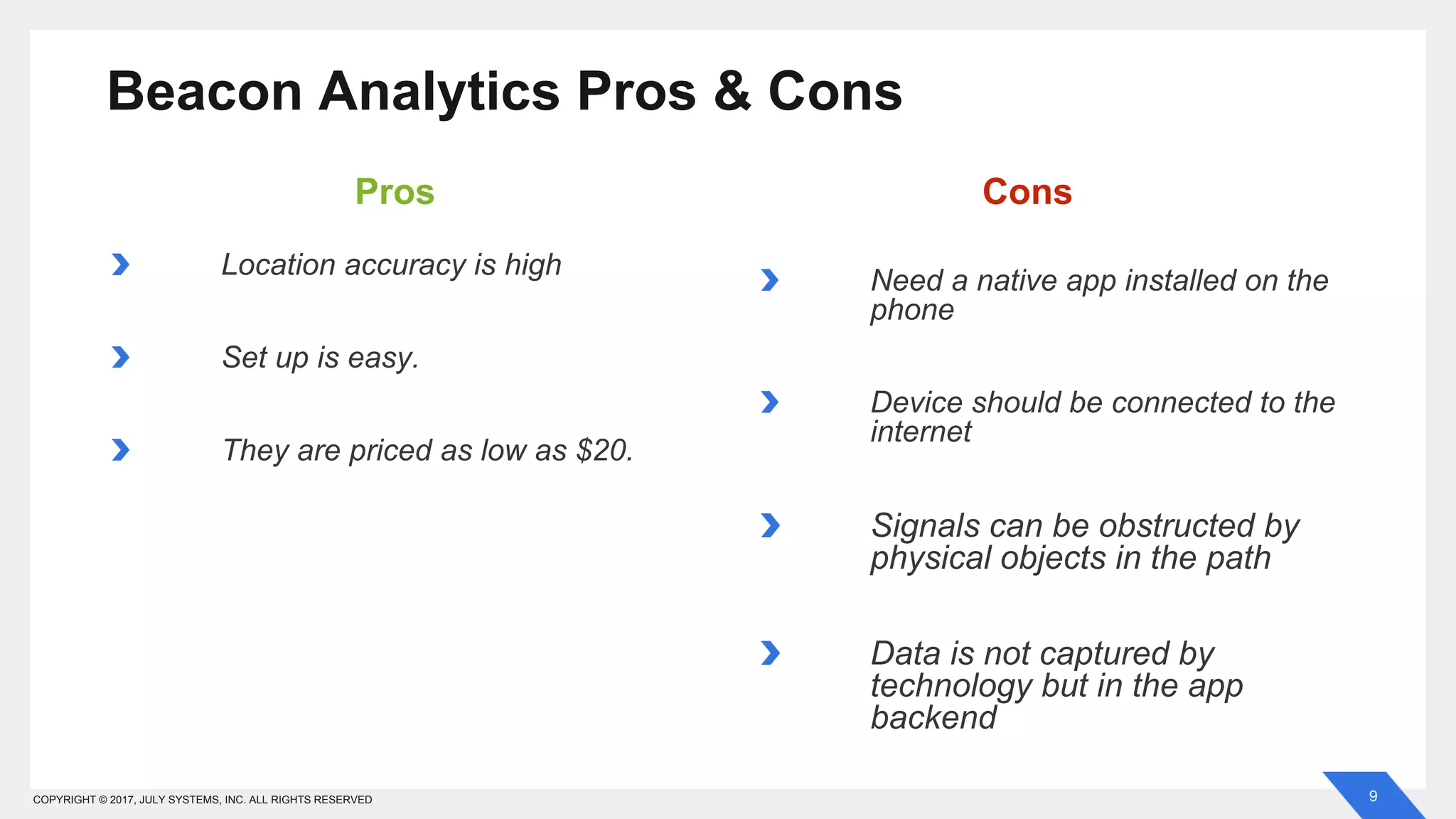
Location accuracy is high
Set up is easy.
They are priced as low as $20.
Beacon Analytics Pros & Cons
Need a native app installed on the
phone
Device should be connected to the
internet
Signals can be obstructed by
physical objects in the path
Data is not captured by
technology but in the app
backend
Pros Cons
10COPYRIGHT © 2017, JULY SYSTEMS, INC. ALL RIGHTS RESERVED
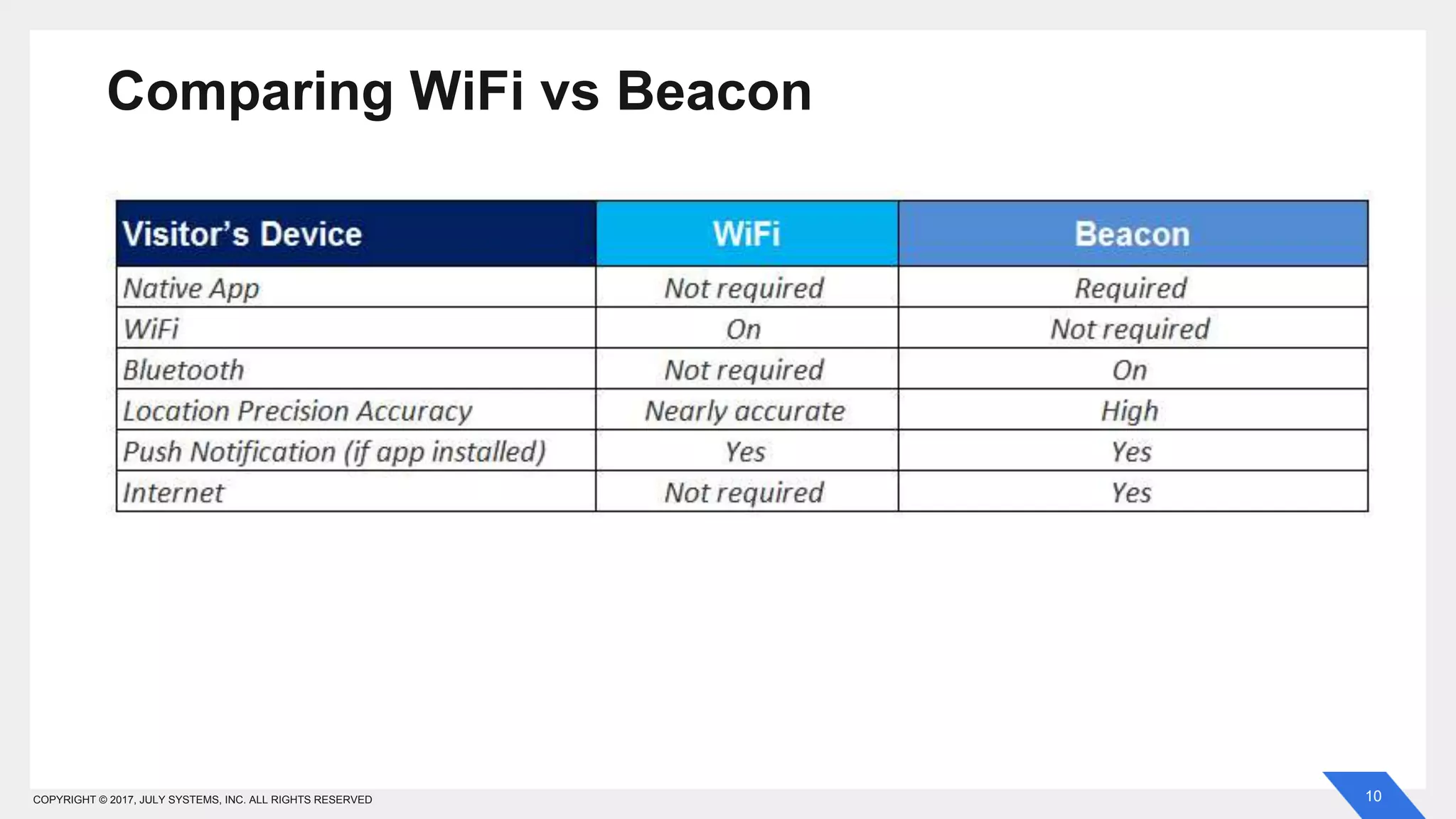
Comparing WiFi vs Beacon
11COPYRIGHT © 2017, JULY SYSTEMS, INC. ALL RIGHTS RESERVED
Conclusion
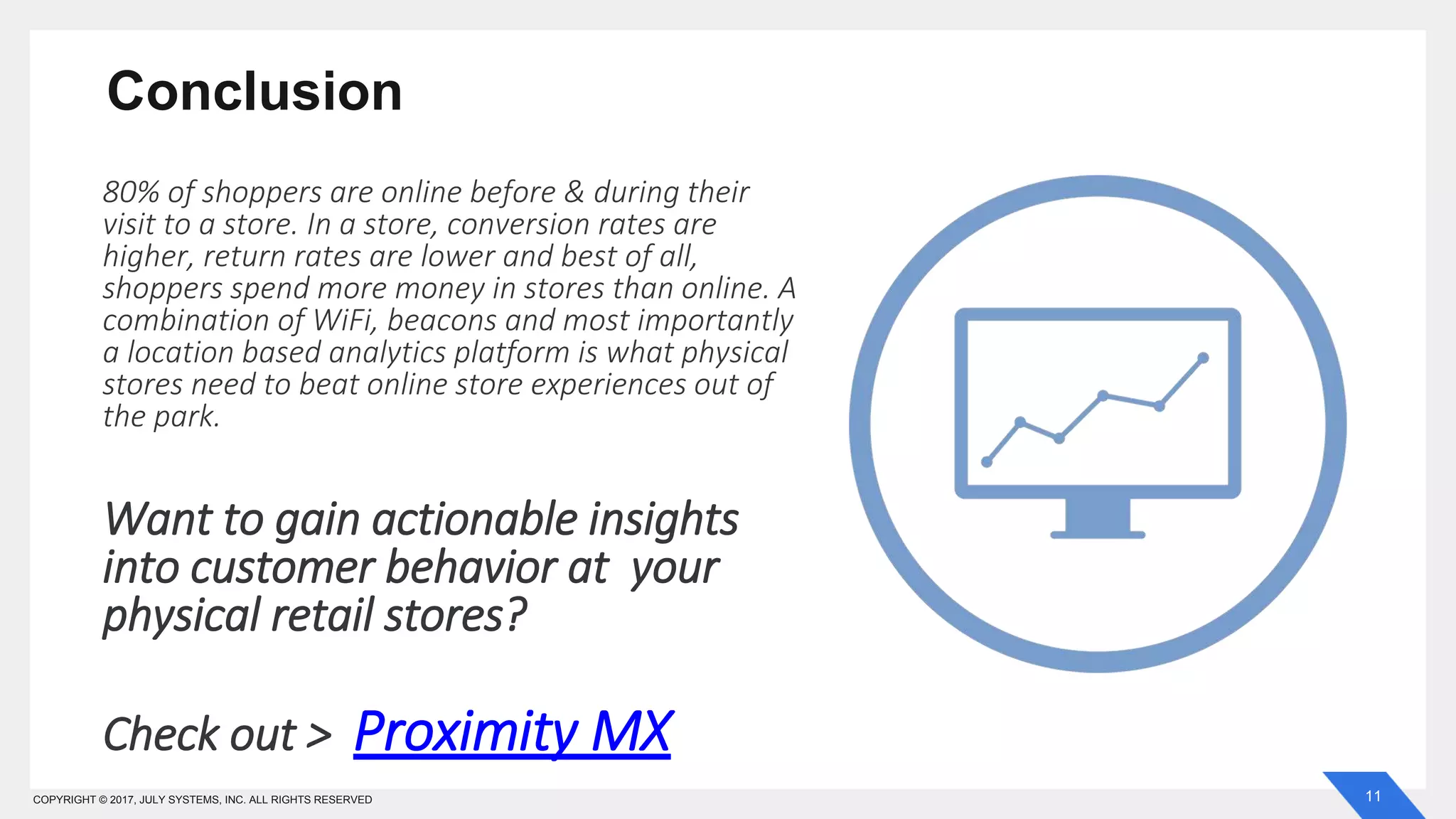
80% of shoppers are online before & during their
visit to a store. In a store, conversion rates are
higher, return rates are lower and best of all,
shoppers spend more money in stores than online. A
combination of WiFi, beacons and most importantly
a location based analytics platform is what physical
stores need to beat online store experiences out of
the park.
Want to gain actionable insights
into customer behavior at your
physical retail stores?
Check out > Proximity MX
12
About July Systems
Founded in 2001, we are pioneers in mobile experience
and engagement platforms. Through a process of
continuous innovation we have stayed ahead of the
curve in a fast changing mobile landscape. We’re now
on a mission to digitize physical spaces through our
latest product Proximity MX, a SaaS tool that provides
location analytics and mobile customer engagements
for physical spaces.
13
THANK YOU

WiFi Analytics vs. Beacon Analytics - Which is the best location intelligence setup for retail stores?

  • 1.
    WiFi Analytics vs. BeaconAnalytics Which is the best location intelligence setup for retail stores?
  • 2.
    2COPYRIGHT © 2017,JULY SYSTEMS, INC. ALL RIGHTS RESERVED Introduction E-commerce websites use analytic tools to understand, track and improve their customer loyalty and acquisition strategies. From a customer’s shopping cart history to time spent on product pages to the number of site visits — these metrics are all tracked through web analytics. In most retail stores today, customers are ghosts – they remain completely unknown until they checkout at POS. So, how do you track similar metrics at physical retail stores?
  • 3.
    3COPYRIGHT © 2017,JULY SYSTEMS, INC. ALL RIGHTS RESERVED Answer: Location based technology Today, location based technology allows you to understand (know) your visitors beyond footfalls and give you a holistic view of in store customer behavior. Analyzing visitors/customers at physical stores and matching the customer experience of an ecommerce store is now possible with these technologies. WiFi and Beacons are the top two technologies used in large physical spaces to understand customer behavior and engage them real-time using location data.
  • 4.
    4COPYRIGHT © 2017,JULY SYSTEMS, INC. ALL RIGHTS RESERVED How analytics are captured on WiFi A first-time visitor connects to the free WiFi offered by the store he is visiting. A location technology such as Proximity MX integrated with the wifi network starts capturing the customer behavior. In case of a returning visitor, he automatically gets identified as soon as he enters the store with his mobile device and can be immediately engaged by the retailer. Once the phone is connected to the WiFi network, the user is shown the captive portal. A captive portal is a Web page that the users of any public-access network view in order to access the internet. Retailers can capture customers data by asking them to fill in their information through a form on this portal.
  • 5.
    5COPYRIGHT © 2017,JULY SYSTEMS, INC. ALL RIGHTS RESERVED How analytics are captured on WiFi WiFi network not only captures customer data entered in the captive portal, but also captures information like – when did the device connect to the network, which device got connected, how long was the connected session, which WiFi access point did it first connect to, which was the last one it connected to and so on. These types of data points helps a marketer understand how often a customer visits the store, at what time of the day, where they spend most of their time.
  • 6.
    6COPYRIGHT © 2017,JULY SYSTEMS, INC. ALL RIGHTS RESERVED Since WiFi is a popular technology, retailers can acquire more than 70% of the visitor walk-ins their stores. In most cases, additional infrastructure is not required since many retailers already offer free WiFi to their customers Visitors need not install native app on their device Better coverage throughout the store since WiFi signals don’t get obstructed by walls and pillars WiFi Analytics Pros & Cons Location precision is low WiFi receiver on device has to be switched on Pros Cons
  • 7.
    7COPYRIGHT © 2017,JULY SYSTEMS, INC. ALL RIGHTS RESERVED How analytics are captured on Beacons Beacons can facilitate only one-way communication. That is, beacons can only transmit signals to your smartphones and not receive signals from them. Beacons signals can only trigger an action if a mobile app is installed if Bluetooth is turned on and if the phone is connected to the internet (in most cases). When smartphones receive a beacon signal, how the app reacts to the signal is dependent on how the backend is designed. For example – you deploy 3 beacons at 3 different sections of your store, each hard coded with a different message.
  • 8.
    8COPYRIGHT © 2017,JULY SYSTEMS, INC. ALL RIGHTS RESERVED How analytics are captured on Beacons Depending on the location of the user in a store, the beacon that is closest to him will push a notification to the user’s smartphone, asking him to take the necessary action. The moment an action is triggered, the data begins to collect on the customer and is stored in the backend. All these analytics can eventually be accessed through a dashboard. Beacons do not store any information or data. They can perform functions like send a Push Notification through an app and are mostly used for indoor positioning, and navigation.
  • 9.
    9COPYRIGHT © 2017,JULY SYSTEMS, INC. ALL RIGHTS RESERVED Location accuracy is high Set up is easy. They are priced as low as $20. Beacon Analytics Pros & Cons Need a native app installed on the phone Device should be connected to the internet Signals can be obstructed by physical objects in the path Data is not captured by technology but in the app backend Pros Cons
  • 10.
    10COPYRIGHT © 2017,JULY SYSTEMS, INC. ALL RIGHTS RESERVED Comparing WiFi vs Beacon
  • 11.
    11COPYRIGHT © 2017,JULY SYSTEMS, INC. ALL RIGHTS RESERVED Conclusion 80% of shoppers are online before & during their visit to a store. In a store, conversion rates are higher, return rates are lower and best of all, shoppers spend more money in stores than online. A combination of WiFi, beacons and most importantly a location based analytics platform is what physical stores need to beat online store experiences out of the park. Want to gain actionable insights into customer behavior at your physical retail stores? Check out > Proximity MX
  • 12.
    12 About July Systems Foundedin 2001, we are pioneers in mobile experience and engagement platforms. Through a process of continuous innovation we have stayed ahead of the curve in a fast changing mobile landscape. We’re now on a mission to digitize physical spaces through our latest product Proximity MX, a SaaS tool that provides location analytics and mobile customer engagements for physical spaces.
  • 13.