Why Cloud Data Visualization Matters
for Data-Driven Companies?
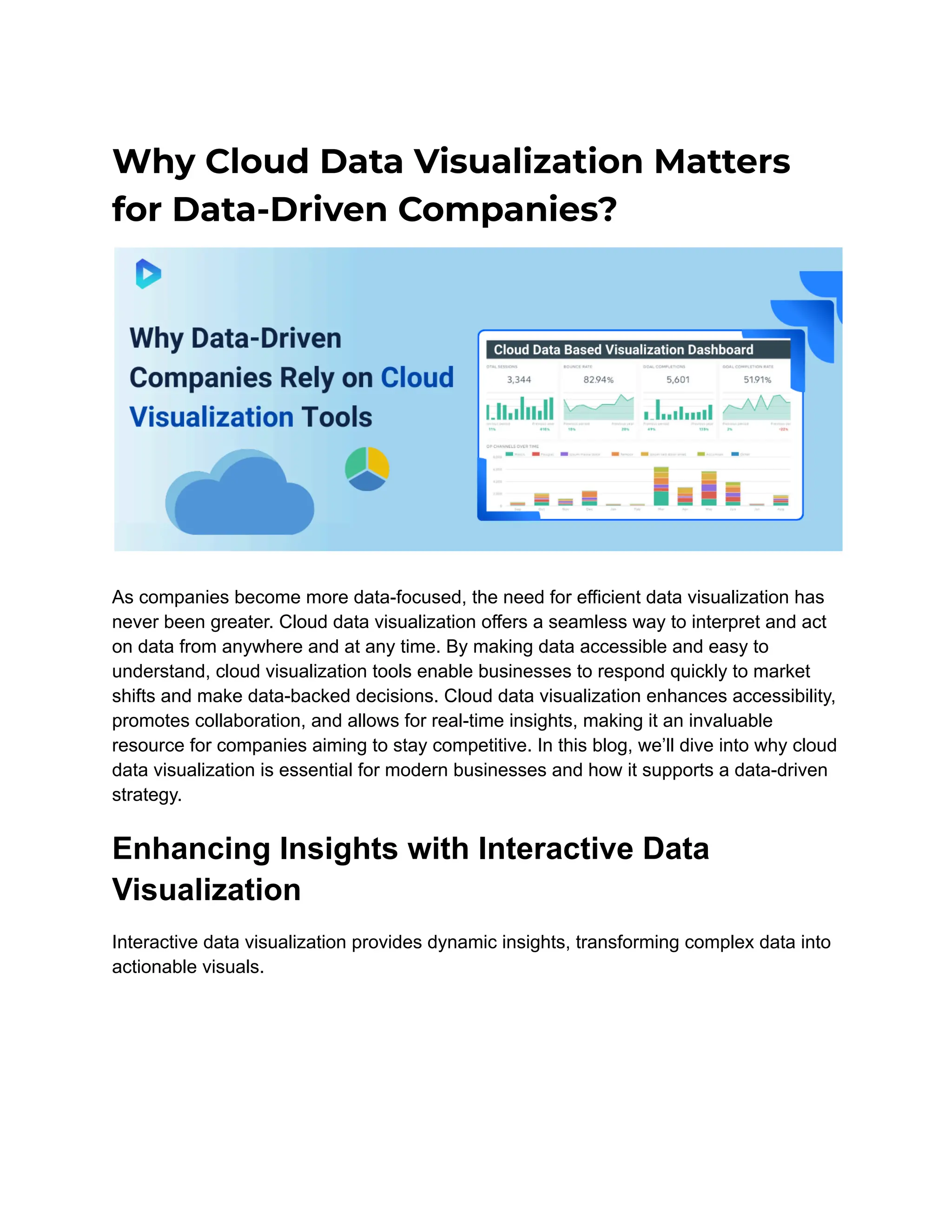
As companies become more data-focused, the need for efficient data visualization has
never been greater. Cloud data visualization offers a seamless way to interpret and act
on data from anywhere and at any time. By making data accessible and easy to
understand, cloud visualization tools enable businesses to respond quickly to market
shifts and make data-backed decisions. Cloud data visualization enhances accessibility,
promotes collaboration, and allows for real-time insights, making it an invaluable
resource for companies aiming to stay competitive. In this blog, we’ll dive into why cloud
data visualization is essential for modern businesses and how it supports a data-driven
strategy.
Enhancing Insights with Interactive Data
Visualization
Interactive data visualization provides dynamic insights, transforming complex data into
actionable visuals.
Key Benefits of Interactive Data Visualization for
Companies
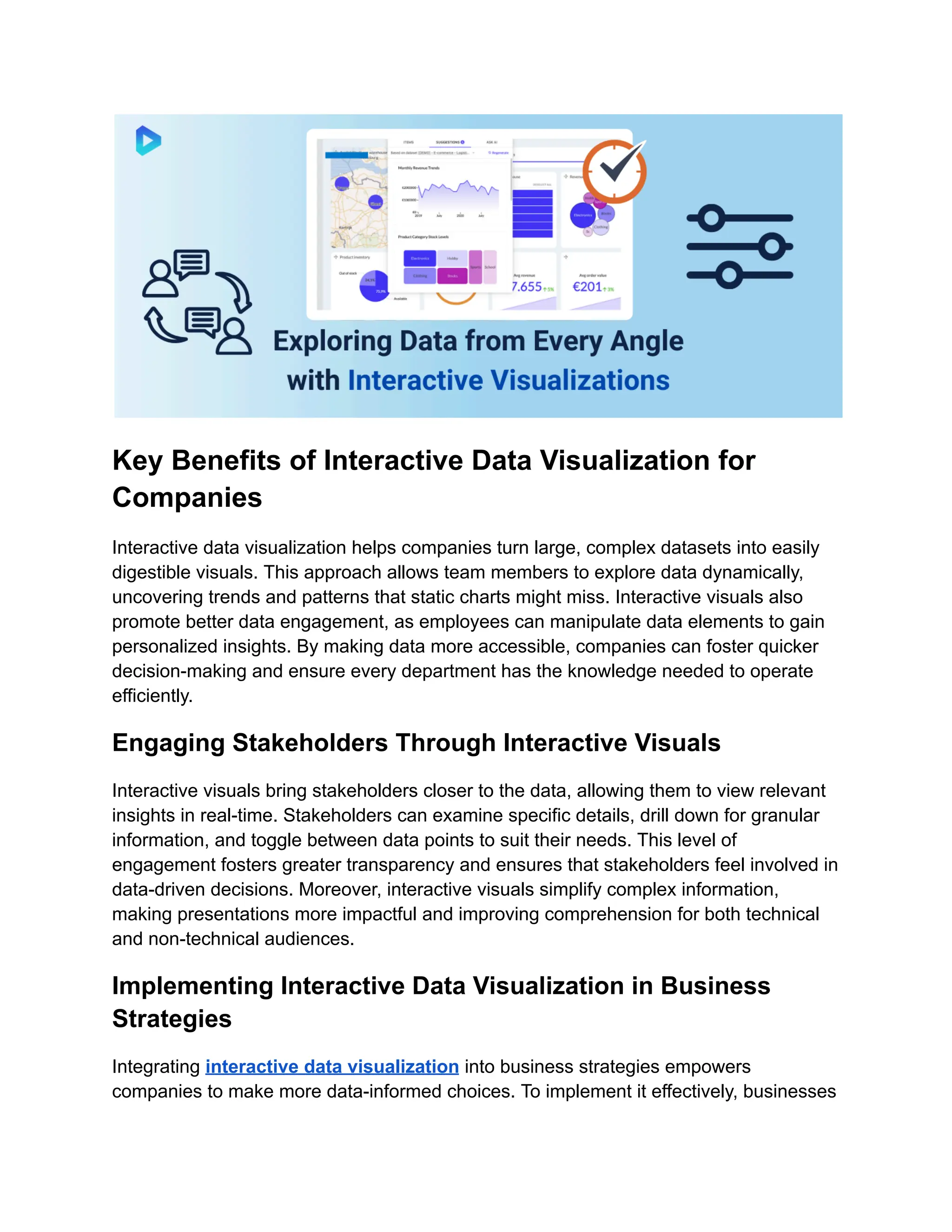
Interactive data visualization helps companies turn large, complex datasets into easily
digestible visuals. This approach allows team members to explore data dynamically,
uncovering trends and patterns that static charts might miss. Interactive visuals also
promote better data engagement, as employees can manipulate data elements to gain
personalized insights. By making data more accessible, companies can foster quicker
decision-making and ensure every department has the knowledge needed to operate
efficiently.
Engaging Stakeholders Through Interactive Visuals
Interactive visuals bring stakeholders closer to the data, allowing them to view relevant
insights in real-time. Stakeholders can examine specific details, drill down for granular
information, and toggle between data points to suit their needs. This level of
engagement fosters greater transparency and ensures that stakeholders feel involved in
data-driven decisions. Moreover, interactive visuals simplify complex information,
making presentations more impactful and improving comprehension for both technical
and non-technical audiences.
Implementing Interactive Data Visualization in Business
Strategies
Integrating interactive data visualization into business strategies empowers
companies to make more data-informed choices. To implement it effectively, businesses
should identify core metrics and decide how to present them interactively. Choosing
suitable visualization tools that align with company objectives is essential. Once
implemented, interactive visuals can streamline data analysis processes, offering
real-time insights that align with strategic goals. This shift helps businesses remain
agile, respond quickly to market changes, and optimize operations through a
data-driven approach.
Leveraging AI Data Visualization for Smart
Analytics
AI-driven data visualization enables deeper, more actionable insights for smarter
decision-making.
How AI Enhances Data Visualization for Deeper
Insights
AI-driven data visualization tools automate the analysis of massive datasets,
uncovering hidden patterns and trends that may be missed by traditional methods. With
AI’s ability to process data quickly and dynamically, companies can visualize data in
ways that reveal deeper insights, such as customer behavior and market trends. These
advanced visualizations allow users to explore data interactively, leading to informed
decisions and a more comprehensive understanding of complex datasets. AI-powered
visuals simplify data interpretation and make analysis more accessible across
departments.
Top AI Tools for Advanced Data Visualization
Several AI tools are transforming data visualization by offering advanced analytics and
customization. Tools like Tableau with AI integrations, Google Data Studio, and
Microsoft Power BI with AI capabilities provide dynamic data analysis options. These
platforms allow users to create visualizations that adapt to real-time data, giving
businesses a competitive edge by revealing actionable insights instantly. Many of these
tools also feature AI-driven suggestions for visual layouts, making complex data more
understandable and tailored to the viewer’s needs. Leveraging these tools ensures that
data visualization is not just informative but also strategically insightful.
Using AI-Powered Visuals to Predict Trends
AI-powered visuals can be used to predict future trends by analyzing historical and
real-time data. Through predictive modeling and machine learning, AI identifies trends
within datasets, allowing businesses to foresee market shifts, customer behavior
changes, and sales trends. These insights enable proactive strategy adjustments,
helping companies to stay ahead of competitors. AI-powered predictions in data
visualization give businesses a forward-looking perspective, equipping decision-makers
with the tools needed to adapt to potential challenges and capitalize on emerging
opportunities.
Building Powerful Business Intelligence
Dashboards
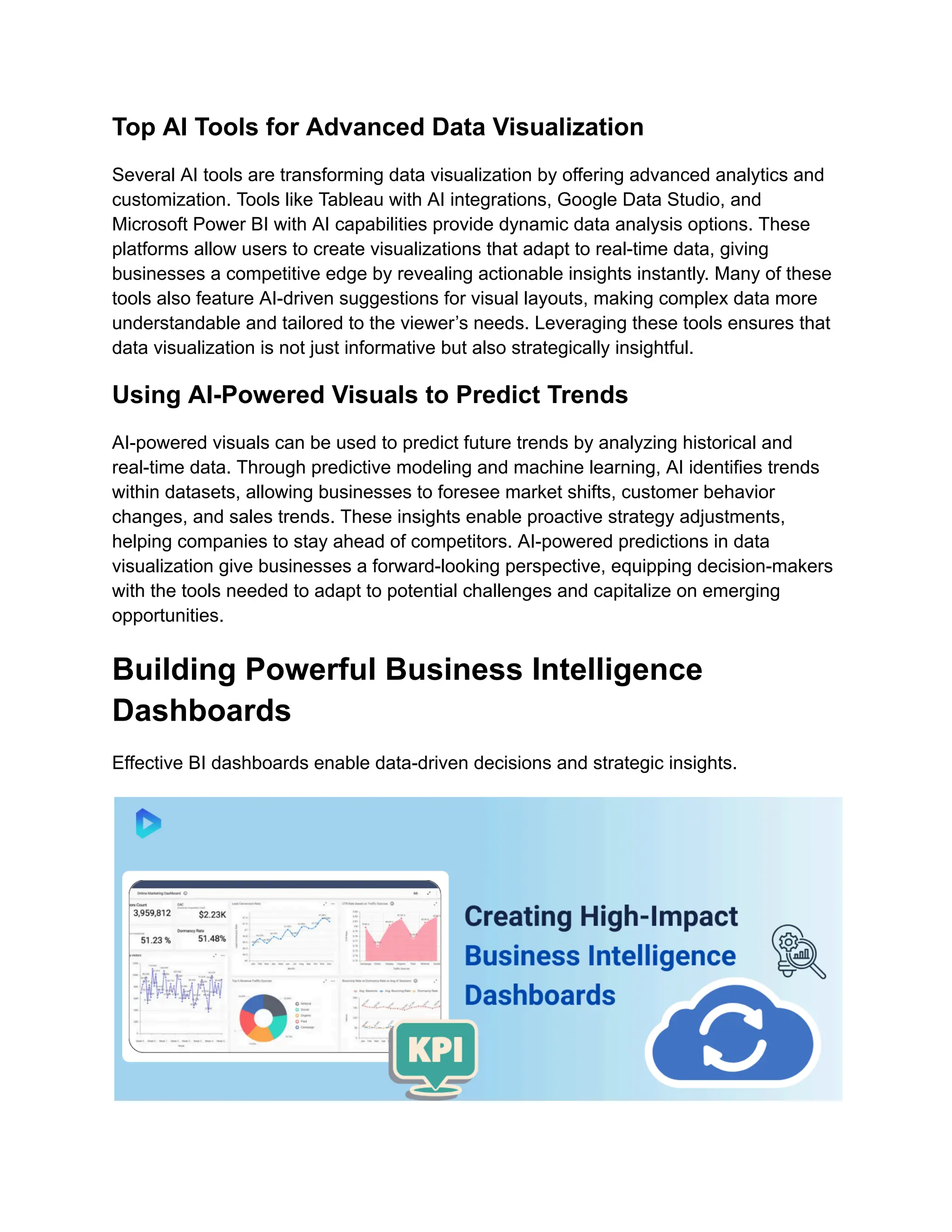
Effective BI dashboards enable data-driven decisions and strategic insights.
Essential Features of Effective BI Dashboards
A robust BI dashboard combines clarity, functionality, and customization. Key features
include real-time data updates, interactive visuals, and customizable metrics, allowing
users to focus on what’s relevant to their roles. An effective dashboard also provides
intuitive navigation, ensuring that users can access critical insights quickly without
extensive training. Additionally, features like drill-down capabilities, predictive analytics,
and data filtering allow users to explore data in depth, making complex information more
accessible and actionable across teams.
How BI Dashboards Drive Strategic Decision-Making
BI dashboards are crucial for strategic decision-making as they deliver a visual
overview of critical metrics. They enable leaders to monitor performance trends, track
KPIs, and identify patterns that inform decisions. With data presented visually,
dashboards allow businesses to see how different departments are performing and
where improvements are needed. The ability to analyze real-time data empowers
executives to make timely adjustments, enhancing responsiveness and alignment with
business goals. Ultimately, BI dashboards foster a data-driven culture that leads to more
strategic and confident decisions.
Customizing Dashboards for Better Business Insights
Customizable dashboards provide tailored insights that align with specific business
needs. By allowing users to select metrics and visuals that reflect their objectives,
customized dashboards offer a clear view of relevant data. Customization also
enhances usability, ensuring that team members see information that’s pertinent to their
roles, from sales to finance to operations. Businesses can adapt dashboards to evolving
strategies, making them a flexible tool for ongoing improvement. A personalized
dashboard enables more efficient analysis and ensures that insights drive meaningful
action across departments.
Utilizing Graph Visualization for Complex Data
Analysis
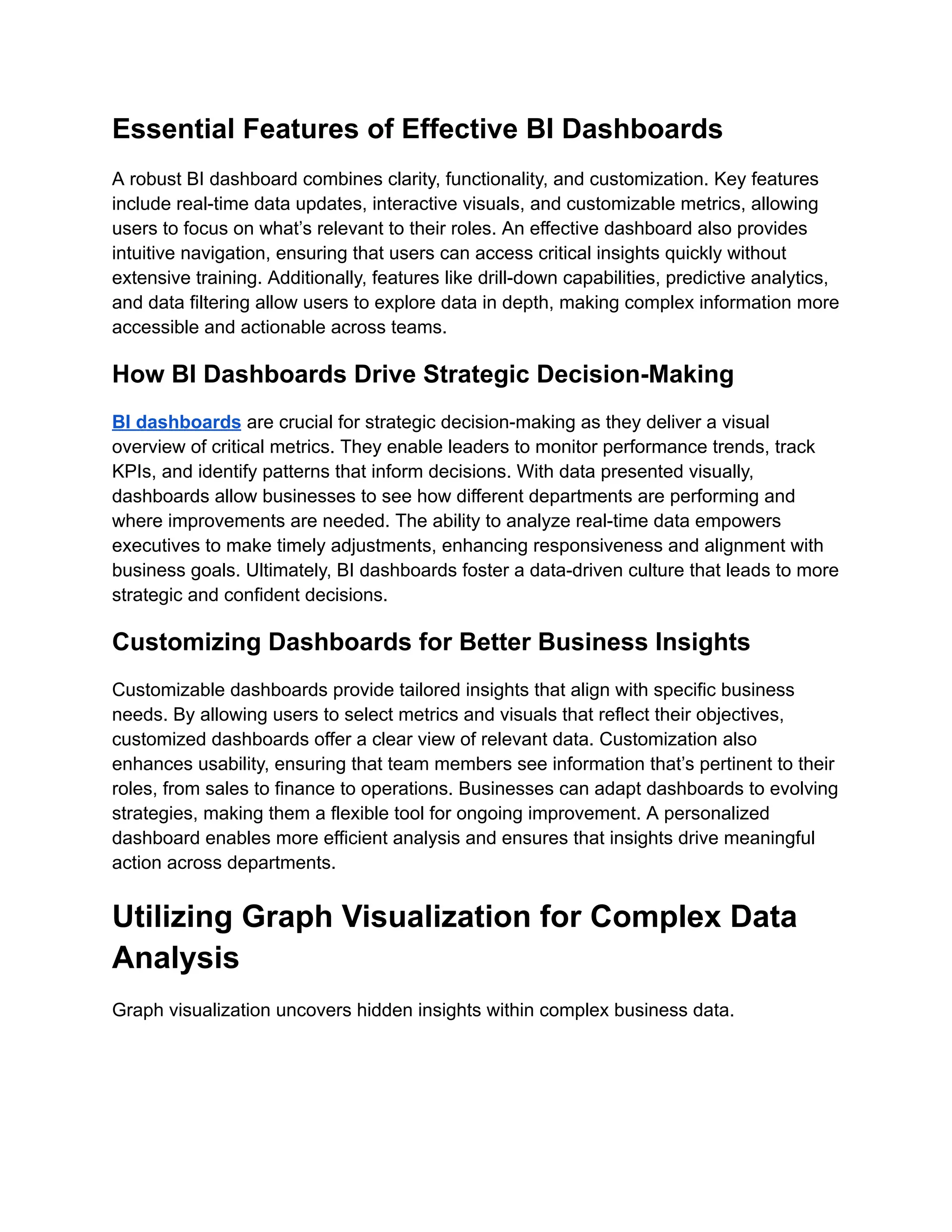
Graph visualization uncovers hidden insights within complex business data.
Advantages of Graph Visualization for Business Data
Graph visualization offers powerful advantages by turning intricate data relationships
into visual formats, making complex patterns more understandable. Unlike traditional
charts, graph visuals reveal connections and dependencies in real-time, helping
businesses identify clusters, hierarchies, and trends that inform strategic actions. For
organizations managing large datasets, graph visualization simplifies data
interpretation, supports faster analysis, and enhances collaboration by making complex
information accessible to non-technical team members. This approach allows
decision-makers to see beyond the numbers and tap into the data's relational potential.
Applying Graph Visualization to Spot Patterns
Graph visualization is invaluable for spotting patterns within datasets, especially
those with multiple, interconnected elements. By mapping relationships between data
points, it enables businesses to identify patterns such as recurring trends, associations,
or outliers that might go unnoticed with standard analytics. Graphs provide a holistic
view, showing how data interacts across different dimensions, which is crucial for fields
like network analysis, customer segmentation, and fraud detection. This visual pattern
recognition leads to more proactive decision-making, as it allows companies to predict
behaviors, optimize processes, and address challenges early.
Choosing Tools for Effective Graph Visualizations
Selecting the right graph visualization tool is essential for effectively analyzing complex
data. Tools like Gephi, Cytoscape, and Neo4j offer advanced graphing capabilities
tailored to different needs, from simple network maps to complex multi-dimensional data
visualization. Key factors in choosing a tool include ease of integration with existing
databases, interactive capabilities, and customization options. For businesses looking to
leverage data-driven insights, an ideal graph visualization tool should also offer
scalability, allowing it to handle growing datasets without compromising performance.
Effective tools empower teams to unlock deeper insights through clear, interactive
visuals.
Essential Tools for Data Governance and
Compliance
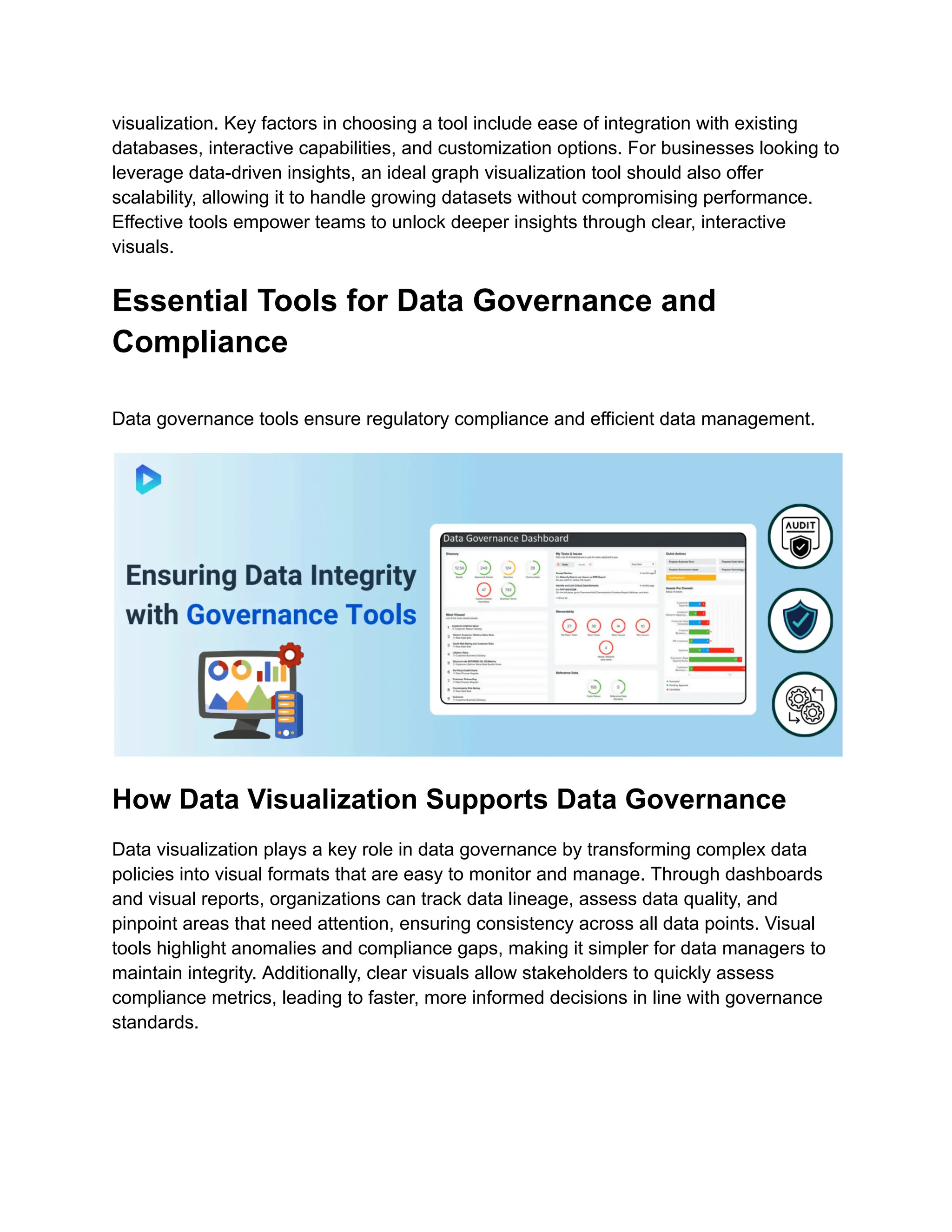
Data governance tools ensure regulatory compliance and efficient data management.
How Data Visualization Supports Data Governance
Data visualization plays a key role in data governance by transforming complex data
policies into visual formats that are easy to monitor and manage. Through dashboards
and visual reports, organizations can track data lineage, assess data quality, and
pinpoint areas that need attention, ensuring consistency across all data points. Visual
tools highlight anomalies and compliance gaps, making it simpler for data managers to
maintain integrity. Additionally, clear visuals allow stakeholders to quickly assess
compliance metrics, leading to faster, more informed decisions in line with governance
standards.
Selecting Data Governance Tools for Visualization
Choosing the right data governance tools for visualization is essential for effective data
management. Tools like Collibra, Alation, and Informatica offer robust visualization
features designed to map data flows, monitor data quality, and ensure compliance. Key
considerations include integration capabilities with existing data systems, scalability for
large datasets, and customization options to align with governance requirements. The
right tool provides a comprehensive view of data operations, enabling companies to
maintain governance standards, support transparency, and foster a data-driven culture
across all departments.
Ensuring Compliance Through Visual Data Management
Visual data management tools streamline compliance by offering real-time monitoring
and alerts on regulatory standards. By using visualization dashboards, organizations
can actively track adherence to data privacy laws, security protocols, and
industry-specific regulations. These tools simplify the process of identifying
non-compliance risks, allowing businesses to act quickly to resolve issues. With a clear
visual interface, compliance teams gain better insights into data policies, ensuring
accountability and reducing the risk of costly penalties. Effective visual management
strengthens a company's ability to uphold regulatory obligations seamlessly.
Maximizing Analytics with Power BI Data
Visualization
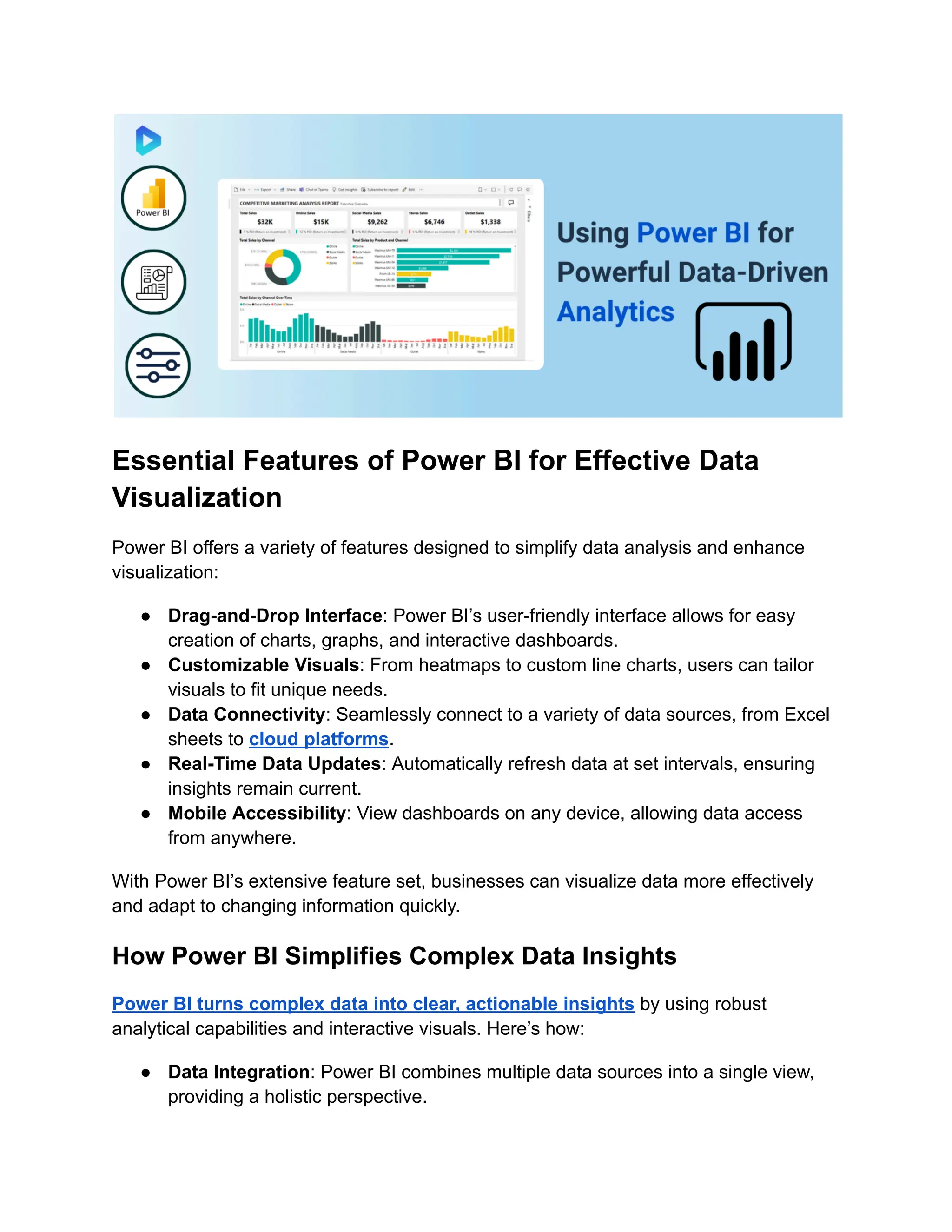
Power BI provides powerful visualization tools that transform raw data into clear
insights, empowering businesses to make data-driven decisions and achieve real-time
operational efficiency.
Essential Features of Power BI for Effective Data
Visualization
Power BI offers a variety of features designed to simplify data analysis and enhance
visualization:
● Drag-and-Drop Interface: Power BI’s user-friendly interface allows for easy
creation of charts, graphs, and interactive dashboards.
● Customizable Visuals: From heatmaps to custom line charts, users can tailor
visuals to fit unique needs.
● Data Connectivity: Seamlessly connect to a variety of data sources, from Excel
sheets to cloud platforms.
● Real-Time Data Updates: Automatically refresh data at set intervals, ensuring
insights remain current.
● Mobile Accessibility: View dashboards on any device, allowing data access
from anywhere.
With Power BI’s extensive feature set, businesses can visualize data more effectively
and adapt to changing information quickly.
How Power BI Simplifies Complex Data Insights
Power BI turns complex data into clear, actionable insights by using robust
analytical capabilities and interactive visuals. Here’s how:
● Data Integration: Power BI combines multiple data sources into a single view,
providing a holistic perspective.
● AI-Powered Analytics: Use AI features, like Q&A, to ask questions and instantly
generate visuals.
● Easy Data Filtering: Drill down into specifics by applying filters, allowing for
detailed data analysis.
● Advanced Calculations with DAX: Utilize Data Analysis Expressions (DAX) to
create complex calculations without complicated coding.
Power BI enables users to gain valuable insights from complex datasets, supporting
more strategic, data-driven decision-making.
Integrating Power BI Visuals for Real-Time Reporting
Real-time reporting in Power BI helps businesses stay on top of performance metrics
and respond proactively. Here’s how Power BI supports real-time visualization:
● Automatic Data Refresh: Schedule regular data updates to keep dashboards
updated with the latest information.
● Interactive Dashboards: Drill into data to explore trends, anomalies, and KPIs in
real-time.
● Collaboration Features: Share reports and dashboards with team members,
enhancing collaboration.
● Alerts and Notifications: Set up alerts for key metrics to receive notifications
when targets are met or require attention.
Integrating Power BI visuals for real-time reporting keeps decision-makers informed,
allowing for swift responses to emerging trends and potential challenges.
Driving Data Insights with Tableau Data
Visualization
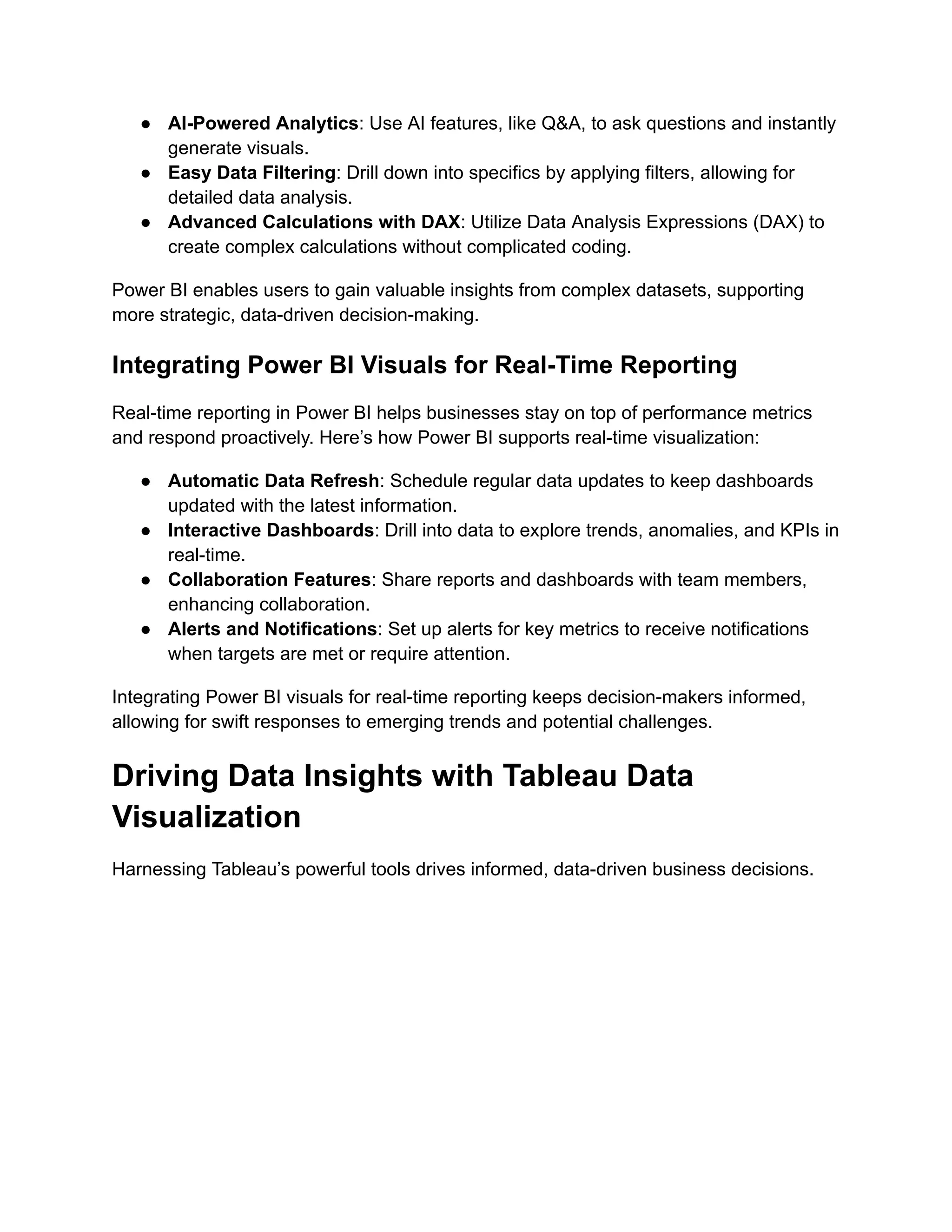
Harnessing Tableau’s powerful tools drives informed, data-driven business decisions.
Benefits of Tableau for Data-Driven Decision-Making
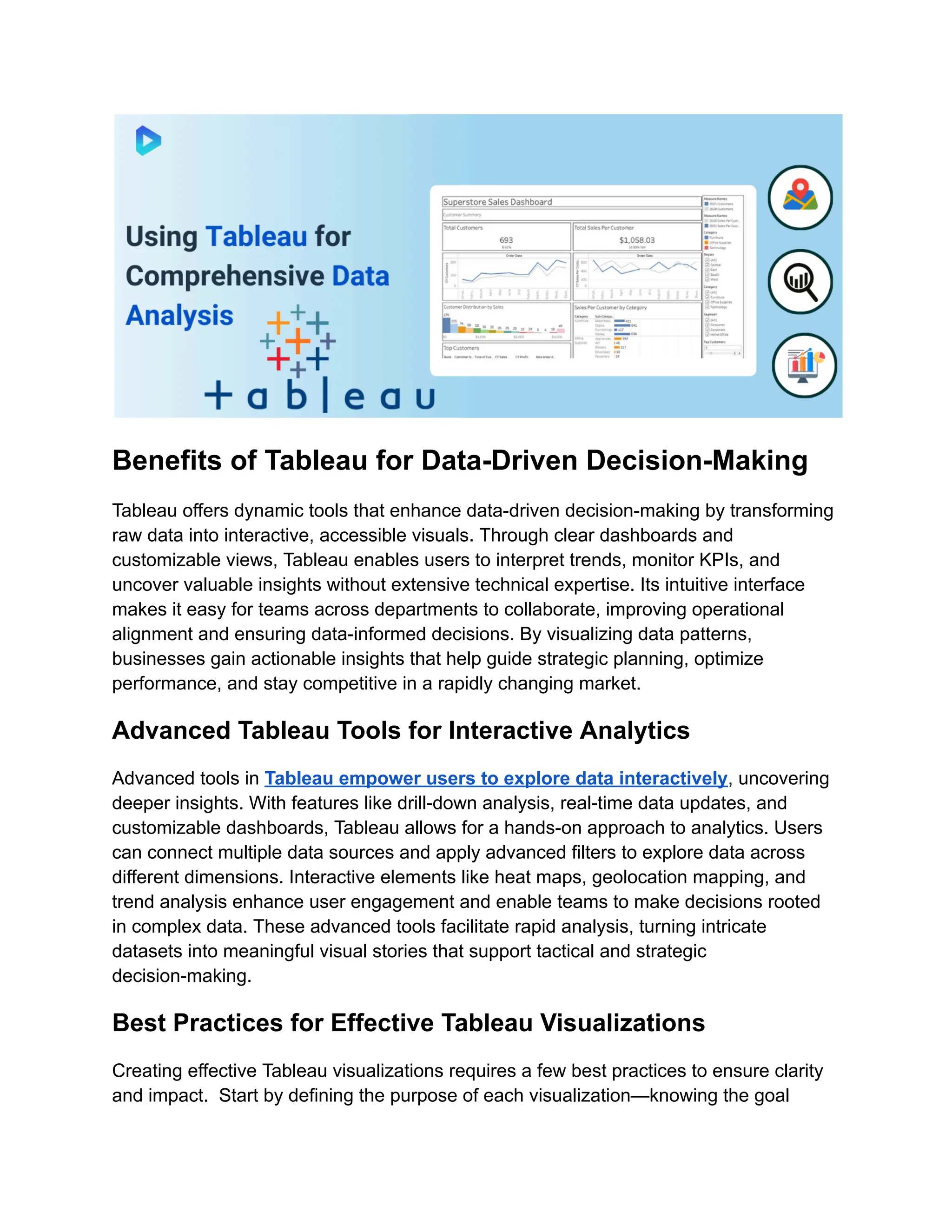
Tableau offers dynamic tools that enhance data-driven decision-making by transforming
raw data into interactive, accessible visuals. Through clear dashboards and
customizable views, Tableau enables users to interpret trends, monitor KPIs, and
uncover valuable insights without extensive technical expertise. Its intuitive interface
makes it easy for teams across departments to collaborate, improving operational
alignment and ensuring data-informed decisions. By visualizing data patterns,
businesses gain actionable insights that help guide strategic planning, optimize
performance, and stay competitive in a rapidly changing market.
Advanced Tableau Tools for Interactive Analytics
Advanced tools in Tableau empower users to explore data interactively, uncovering
deeper insights. With features like drill-down analysis, real-time data updates, and
customizable dashboards, Tableau allows for a hands-on approach to analytics. Users
can connect multiple data sources and apply advanced filters to explore data across
different dimensions. Interactive elements like heat maps, geolocation mapping, and
trend analysis enhance user engagement and enable teams to make decisions rooted
in complex data. These advanced tools facilitate rapid analysis, turning intricate
datasets into meaningful visual stories that support tactical and strategic
decision-making.
Best Practices for Effective Tableau Visualizations
Creating effective Tableau visualizations requires a few best practices to ensure clarity
and impact. Start by defining the purpose of each visualization—knowing the goal
guides design choices that enhance understanding. Use a clean layout and limit colors
to avoid overwhelming the viewer, focusing attention on critical data points. Interactive
features, such as drill-downs and filters, should be strategically applied to enable
deeper insights without clutter. Regularly updating data ensures the visualization
remains relevant. By following these practices, Tableau visualizations become powerful
tools for communicating insights clearly and aiding business growth through data-driven
clarity.
LET’S DISCUSS YOUR IDEA
HAVE QUESTION?
Call Us: +1 (347) 9739732, +91-90399-28143
Email Us: inquiry@digiprima.com, ashesh@digiprima.com

Why Cloud Data Visualization Matters for Data-Driven Companies?

  • 1.
    Why Cloud DataVisualization Matters for Data-Driven Companies? As companies become more data-focused, the need for efficient data visualization has never been greater. Cloud data visualization offers a seamless way to interpret and act on data from anywhere and at any time. By making data accessible and easy to understand, cloud visualization tools enable businesses to respond quickly to market shifts and make data-backed decisions. Cloud data visualization enhances accessibility, promotes collaboration, and allows for real-time insights, making it an invaluable resource for companies aiming to stay competitive. In this blog, we’ll dive into why cloud data visualization is essential for modern businesses and how it supports a data-driven strategy. Enhancing Insights with Interactive Data Visualization Interactive data visualization provides dynamic insights, transforming complex data into actionable visuals.
  • 2.
    Key Benefits ofInteractive Data Visualization for Companies Interactive data visualization helps companies turn large, complex datasets into easily digestible visuals. This approach allows team members to explore data dynamically, uncovering trends and patterns that static charts might miss. Interactive visuals also promote better data engagement, as employees can manipulate data elements to gain personalized insights. By making data more accessible, companies can foster quicker decision-making and ensure every department has the knowledge needed to operate efficiently. Engaging Stakeholders Through Interactive Visuals Interactive visuals bring stakeholders closer to the data, allowing them to view relevant insights in real-time. Stakeholders can examine specific details, drill down for granular information, and toggle between data points to suit their needs. This level of engagement fosters greater transparency and ensures that stakeholders feel involved in data-driven decisions. Moreover, interactive visuals simplify complex information, making presentations more impactful and improving comprehension for both technical and non-technical audiences. Implementing Interactive Data Visualization in Business Strategies Integrating interactive data visualization into business strategies empowers companies to make more data-informed choices. To implement it effectively, businesses
  • 3.
    should identify coremetrics and decide how to present them interactively. Choosing suitable visualization tools that align with company objectives is essential. Once implemented, interactive visuals can streamline data analysis processes, offering real-time insights that align with strategic goals. This shift helps businesses remain agile, respond quickly to market changes, and optimize operations through a data-driven approach. Leveraging AI Data Visualization for Smart Analytics AI-driven data visualization enables deeper, more actionable insights for smarter decision-making. How AI Enhances Data Visualization for Deeper Insights AI-driven data visualization tools automate the analysis of massive datasets, uncovering hidden patterns and trends that may be missed by traditional methods. With AI’s ability to process data quickly and dynamically, companies can visualize data in ways that reveal deeper insights, such as customer behavior and market trends. These advanced visualizations allow users to explore data interactively, leading to informed decisions and a more comprehensive understanding of complex datasets. AI-powered visuals simplify data interpretation and make analysis more accessible across departments.
  • 4.
    Top AI Toolsfor Advanced Data Visualization Several AI tools are transforming data visualization by offering advanced analytics and customization. Tools like Tableau with AI integrations, Google Data Studio, and Microsoft Power BI with AI capabilities provide dynamic data analysis options. These platforms allow users to create visualizations that adapt to real-time data, giving businesses a competitive edge by revealing actionable insights instantly. Many of these tools also feature AI-driven suggestions for visual layouts, making complex data more understandable and tailored to the viewer’s needs. Leveraging these tools ensures that data visualization is not just informative but also strategically insightful. Using AI-Powered Visuals to Predict Trends AI-powered visuals can be used to predict future trends by analyzing historical and real-time data. Through predictive modeling and machine learning, AI identifies trends within datasets, allowing businesses to foresee market shifts, customer behavior changes, and sales trends. These insights enable proactive strategy adjustments, helping companies to stay ahead of competitors. AI-powered predictions in data visualization give businesses a forward-looking perspective, equipping decision-makers with the tools needed to adapt to potential challenges and capitalize on emerging opportunities. Building Powerful Business Intelligence Dashboards Effective BI dashboards enable data-driven decisions and strategic insights.
  • 5.
    Essential Features ofEffective BI Dashboards A robust BI dashboard combines clarity, functionality, and customization. Key features include real-time data updates, interactive visuals, and customizable metrics, allowing users to focus on what’s relevant to their roles. An effective dashboard also provides intuitive navigation, ensuring that users can access critical insights quickly without extensive training. Additionally, features like drill-down capabilities, predictive analytics, and data filtering allow users to explore data in depth, making complex information more accessible and actionable across teams. How BI Dashboards Drive Strategic Decision-Making BI dashboards are crucial for strategic decision-making as they deliver a visual overview of critical metrics. They enable leaders to monitor performance trends, track KPIs, and identify patterns that inform decisions. With data presented visually, dashboards allow businesses to see how different departments are performing and where improvements are needed. The ability to analyze real-time data empowers executives to make timely adjustments, enhancing responsiveness and alignment with business goals. Ultimately, BI dashboards foster a data-driven culture that leads to more strategic and confident decisions. Customizing Dashboards for Better Business Insights Customizable dashboards provide tailored insights that align with specific business needs. By allowing users to select metrics and visuals that reflect their objectives, customized dashboards offer a clear view of relevant data. Customization also enhances usability, ensuring that team members see information that’s pertinent to their roles, from sales to finance to operations. Businesses can adapt dashboards to evolving strategies, making them a flexible tool for ongoing improvement. A personalized dashboard enables more efficient analysis and ensures that insights drive meaningful action across departments. Utilizing Graph Visualization for Complex Data Analysis Graph visualization uncovers hidden insights within complex business data.
  • 6.
    Advantages of GraphVisualization for Business Data Graph visualization offers powerful advantages by turning intricate data relationships into visual formats, making complex patterns more understandable. Unlike traditional charts, graph visuals reveal connections and dependencies in real-time, helping businesses identify clusters, hierarchies, and trends that inform strategic actions. For organizations managing large datasets, graph visualization simplifies data interpretation, supports faster analysis, and enhances collaboration by making complex information accessible to non-technical team members. This approach allows decision-makers to see beyond the numbers and tap into the data's relational potential. Applying Graph Visualization to Spot Patterns Graph visualization is invaluable for spotting patterns within datasets, especially those with multiple, interconnected elements. By mapping relationships between data points, it enables businesses to identify patterns such as recurring trends, associations, or outliers that might go unnoticed with standard analytics. Graphs provide a holistic view, showing how data interacts across different dimensions, which is crucial for fields like network analysis, customer segmentation, and fraud detection. This visual pattern recognition leads to more proactive decision-making, as it allows companies to predict behaviors, optimize processes, and address challenges early. Choosing Tools for Effective Graph Visualizations Selecting the right graph visualization tool is essential for effectively analyzing complex data. Tools like Gephi, Cytoscape, and Neo4j offer advanced graphing capabilities tailored to different needs, from simple network maps to complex multi-dimensional data
  • 7.
    visualization. Key factorsin choosing a tool include ease of integration with existing databases, interactive capabilities, and customization options. For businesses looking to leverage data-driven insights, an ideal graph visualization tool should also offer scalability, allowing it to handle growing datasets without compromising performance. Effective tools empower teams to unlock deeper insights through clear, interactive visuals. Essential Tools for Data Governance and Compliance Data governance tools ensure regulatory compliance and efficient data management. How Data Visualization Supports Data Governance Data visualization plays a key role in data governance by transforming complex data policies into visual formats that are easy to monitor and manage. Through dashboards and visual reports, organizations can track data lineage, assess data quality, and pinpoint areas that need attention, ensuring consistency across all data points. Visual tools highlight anomalies and compliance gaps, making it simpler for data managers to maintain integrity. Additionally, clear visuals allow stakeholders to quickly assess compliance metrics, leading to faster, more informed decisions in line with governance standards.
  • 8.
    Selecting Data GovernanceTools for Visualization Choosing the right data governance tools for visualization is essential for effective data management. Tools like Collibra, Alation, and Informatica offer robust visualization features designed to map data flows, monitor data quality, and ensure compliance. Key considerations include integration capabilities with existing data systems, scalability for large datasets, and customization options to align with governance requirements. The right tool provides a comprehensive view of data operations, enabling companies to maintain governance standards, support transparency, and foster a data-driven culture across all departments. Ensuring Compliance Through Visual Data Management Visual data management tools streamline compliance by offering real-time monitoring and alerts on regulatory standards. By using visualization dashboards, organizations can actively track adherence to data privacy laws, security protocols, and industry-specific regulations. These tools simplify the process of identifying non-compliance risks, allowing businesses to act quickly to resolve issues. With a clear visual interface, compliance teams gain better insights into data policies, ensuring accountability and reducing the risk of costly penalties. Effective visual management strengthens a company's ability to uphold regulatory obligations seamlessly. Maximizing Analytics with Power BI Data Visualization Power BI provides powerful visualization tools that transform raw data into clear insights, empowering businesses to make data-driven decisions and achieve real-time operational efficiency.
  • 9.
    Essential Features ofPower BI for Effective Data Visualization Power BI offers a variety of features designed to simplify data analysis and enhance visualization: ● Drag-and-Drop Interface: Power BI’s user-friendly interface allows for easy creation of charts, graphs, and interactive dashboards. ● Customizable Visuals: From heatmaps to custom line charts, users can tailor visuals to fit unique needs. ● Data Connectivity: Seamlessly connect to a variety of data sources, from Excel sheets to cloud platforms. ● Real-Time Data Updates: Automatically refresh data at set intervals, ensuring insights remain current. ● Mobile Accessibility: View dashboards on any device, allowing data access from anywhere. With Power BI’s extensive feature set, businesses can visualize data more effectively and adapt to changing information quickly. How Power BI Simplifies Complex Data Insights Power BI turns complex data into clear, actionable insights by using robust analytical capabilities and interactive visuals. Here’s how: ● Data Integration: Power BI combines multiple data sources into a single view, providing a holistic perspective.
  • 10.
    ● AI-Powered Analytics:Use AI features, like Q&A, to ask questions and instantly generate visuals. ● Easy Data Filtering: Drill down into specifics by applying filters, allowing for detailed data analysis. ● Advanced Calculations with DAX: Utilize Data Analysis Expressions (DAX) to create complex calculations without complicated coding. Power BI enables users to gain valuable insights from complex datasets, supporting more strategic, data-driven decision-making. Integrating Power BI Visuals for Real-Time Reporting Real-time reporting in Power BI helps businesses stay on top of performance metrics and respond proactively. Here’s how Power BI supports real-time visualization: ● Automatic Data Refresh: Schedule regular data updates to keep dashboards updated with the latest information. ● Interactive Dashboards: Drill into data to explore trends, anomalies, and KPIs in real-time. ● Collaboration Features: Share reports and dashboards with team members, enhancing collaboration. ● Alerts and Notifications: Set up alerts for key metrics to receive notifications when targets are met or require attention. Integrating Power BI visuals for real-time reporting keeps decision-makers informed, allowing for swift responses to emerging trends and potential challenges. Driving Data Insights with Tableau Data Visualization Harnessing Tableau’s powerful tools drives informed, data-driven business decisions.
  • 11.
    Benefits of Tableaufor Data-Driven Decision-Making Tableau offers dynamic tools that enhance data-driven decision-making by transforming raw data into interactive, accessible visuals. Through clear dashboards and customizable views, Tableau enables users to interpret trends, monitor KPIs, and uncover valuable insights without extensive technical expertise. Its intuitive interface makes it easy for teams across departments to collaborate, improving operational alignment and ensuring data-informed decisions. By visualizing data patterns, businesses gain actionable insights that help guide strategic planning, optimize performance, and stay competitive in a rapidly changing market. Advanced Tableau Tools for Interactive Analytics Advanced tools in Tableau empower users to explore data interactively, uncovering deeper insights. With features like drill-down analysis, real-time data updates, and customizable dashboards, Tableau allows for a hands-on approach to analytics. Users can connect multiple data sources and apply advanced filters to explore data across different dimensions. Interactive elements like heat maps, geolocation mapping, and trend analysis enhance user engagement and enable teams to make decisions rooted in complex data. These advanced tools facilitate rapid analysis, turning intricate datasets into meaningful visual stories that support tactical and strategic decision-making. Best Practices for Effective Tableau Visualizations Creating effective Tableau visualizations requires a few best practices to ensure clarity and impact. Start by defining the purpose of each visualization—knowing the goal
  • 12.
    guides design choicesthat enhance understanding. Use a clean layout and limit colors to avoid overwhelming the viewer, focusing attention on critical data points. Interactive features, such as drill-downs and filters, should be strategically applied to enable deeper insights without clutter. Regularly updating data ensures the visualization remains relevant. By following these practices, Tableau visualizations become powerful tools for communicating insights clearly and aiding business growth through data-driven clarity. LET’S DISCUSS YOUR IDEA HAVE QUESTION? Call Us: +1 (347) 9739732, +91-90399-28143 Email Us: inquiry@digiprima.com, ashesh@digiprima.com