SITUATION
Digital transformation isessential to business process effectiveness. It not only ensures quicker time-
to-value, but it allows for seamless collaboration across different functions and provides data-driven
insights for enterprises of all sizes.
Digital transformation innovations have a positive impact on the enterprise, but they also raise a
unique problem for companies adopting them – that of navigating a labyrinth of multiple, siloed, and
targeted digital systems.
Whether it is software-as-a-service (SaaS), infrastructure-platform-as-a-service (iPaaS), data-base-
platform-as-a-service (dbPaaS), application-platform-as-a-service (aPaaS) or some other type of
solution or platform, each system is unique, featuring its own user interface, data sources or data
modules. Most commonly, they are hardly aligned to enterprise-level architectures and need extensive
data manipulation to make sure they properly connect and communicate to one another.
In addition, when using such varied code-based systems to streamline multiple business functions,
enterprises need to maintain in-house expertise to develop, manage, and manipulate them.
To successfully adopt digital transformation, enterprises will need to learn how to navigate and tackle
the unique challenges posed by this ecosystem of siloed solutions.
Below are some of the main challenges of employing scattered systems and ways to address them.
CHALLENGES
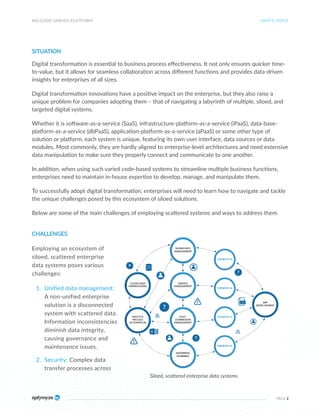
Employing an ecosystem of
siloed, scattered enterprise
data systems poses various
challenges:
1. Unified data management:
A non-unified enterprise
solution is a disconnected
system with scattered data.
Information inconsistencies
diminish data integrity,
causing governance and
maintenance issues.
2. Security: Complex data
transfer processes across
NO-CODE UNIFIED PLATFORM
PAGE 2
WHITE PAPER
Siloed, scattered enterprise data systems
3.
NO-CODE UNIFIED PLATFORM
PAGE3
platforms lead to security vulnerabilities. Legacy systems often force users to login to
multiple apps and databases, increasing the risk of potential breaches.
3. Business management: SaaS solutions have complex and time-consuming setup needs.
Using multiple ones creates segregated business processes, which impacts business
continuity and increases operational cost.
4. Communication: Compared to a unified solution, systems that are linked together are more
expensive and prone to error. Functions and data begin to overlap and conflict with one
another. IT issues become more frequent and may stall operations due to untimely upgrades
or different levels of support offered by vendors.
5. Change management and scalability: In an effort to meet changing operational
requirements, organizations find themselves spending more money and workforce resources
on system integration.
These challenges pose serious roadblocks to the overall digital transformation goal of the
enterprise. Fortunately, there is a way to eliminate them.
SOLUTION
To overcome these challenges, the enterprise needs to tackle two key elements of the
data ecosystem:
1. Platform unification
Enterprises can massively reduce overhead by eliminating multiple data systems, resulting in an
easier to manage unified data ecosystem.
A platform that empowers the enterprise to achieve end-to-end data management using cloud
data warehousing, data process automation, analytic modeling, collaborative planning, and
application development, will ensure the enterprise needs are met with reduced complexity,
while maintaining the true integrity of the overall enterprise IT architecture.
A unified platform with a mature software architecture that has embedded automated
governance and collaboration and master data management will allow for rapid deployment of
multi-faceted solutions with ease. Additionally, predefined artifacts for data models, process
automation, analytic models and standard applications support rapid deployment.
2. Empowering citizen developers
A no-code platform enables the enterprise to attain the desired scalability without investing a
great deal of time or energy and reducing costly system maintenance.
WHITE PAPER
4.
NO-CODE UNIFIED PLATFORMWHITE PAPER
No-code development enables quick deployment, onboarding, and scalable solutions, without
writing a single line of code, enabling citizen developers to assist more in automating the
business needs.
A no-code platform with integrated collaboration enables developers to work in teams to
make and integrate changes, which allows for streamlined collaboration between DataOps and
DevOps across multiple business functions.
The Optymyze unified, no-code, enterprise automation platform is fully PaaS-enabled and cloud-
ready. It requires minimal onboarding and upkeep, while supporting:
• enterprise-level architectures,
• out-of-the-box solutions,
• custom-builds,
• extensibility beyond initial business needs, and
• continuous automated governance.
Follow Optymyze:
Want to learn more? Visit optymyze.com
Optymyze provides a unified, no-code platform for enterprise sales performance management.
Why Optymyze Solutions Resources



![[DSC Europe 24] Josip Saban - Buidling cloud data platforms in enterprises](https://cdn.slidesharecdn.com/ss_thumbnails/josipsaban-buidlingclouddataplatformsinenterprises-250217194546-5568421d-thumbnail.jpg?width=640&height=640&fit=bounds)


![Hacking-Uncovered-How-People-Get-Hacked-and-How-to-Stay-Safe[1].pptx](https://cdn.slidesharecdn.com/ss_thumbnails/hacking-uncovered-how-people-get-hacked-and-how-to-stay-safe1-260130170011-4883a9c7-thumbnail.jpg?width=640&height=640&fit=bounds)


