White Box vs. Black Box Testing  Tor Stålhane
What is White Box testing  White box testing is testing where we use the info available from the code of the component to generate tests. This info is usually used to achieve coverage in one way or another – e.g. Code coverage Path coverage Decision coverage Debugging will always be white-box testing
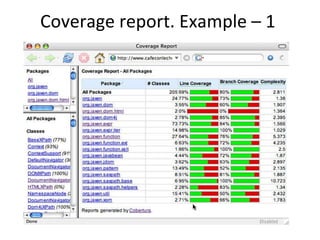
Coverage report. Example – 1
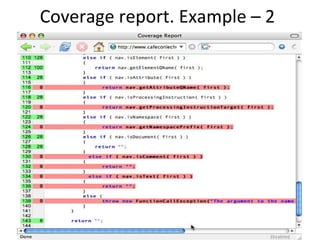
Coverage report. Example – 2                                                                                                                               
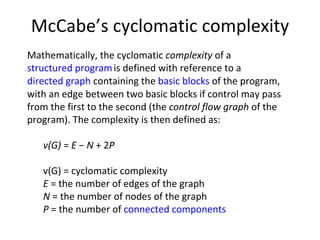
McCabe’s cyclomatic complexity Mathematically, the cyclomatic  complexity  of a  structured program   is defined with reference to a  directed graph  containing the  basic blocks  of the program, with an edge between two basic blocks if control may pass from the first to the second (the  control flow graph  of the program). The complexity is then defined as: v(G)  =  E  −  N  + 2 P v(G) = cyclomatic complexity E  = the number of edges of the graph N  = the number of nodes of the graph P  = the number of  connected components
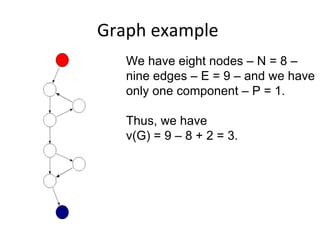
Graph example  We have eight nodes – N = 8 –  nine edges – E = 9 – and we have only one component – P = 1. Thus, we have  v(G) = 9 – 8 + 2 = 3.
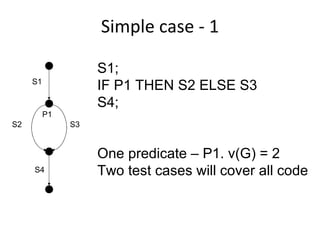
Simple case - 1 S1; IF P1 THEN S2 ELSE S3 S4; One predicate – P1. v(G) = 2 Two test cases will cover all code S4 S3 S2 S1 P1
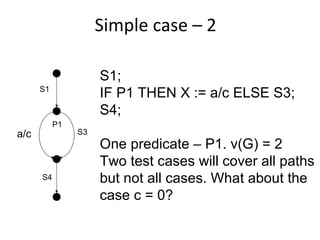
Simple case – 2  S1; IF P1 THEN X := a/c ELSE S3; S4; One predicate – P1. v(G) = 2 Two test cases will cover all paths but not all cases. What about the case c = 0? S4 S3 S1 a/c P1
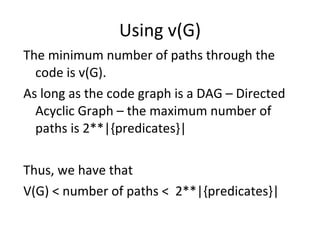
Using v(G) The minimum number of paths through the code is v(G). As long as the code graph is a DAG – Directed Acyclic Graph – the maximum number of paths is 2**|{predicates}| Thus, we have that V(G) < number of paths <  2**|{predicates}|
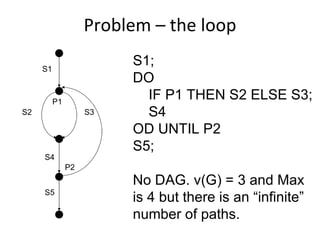
Problem – the loop S4 S2 S1 P1 S5 S3 P2 S1; DO IF P1 THEN S2 ELSE S3; S4 OD UNTIL P2 S5; No DAG. v(G) = 3 and Max  is 4 but there is an “infinite”  number of paths.
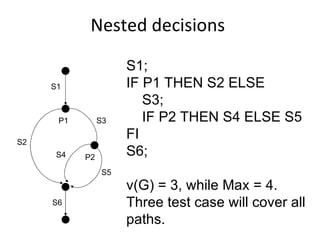
Nested decisions  S1; IF P1 THEN S2 ELSE S3; IF P2 THEN S4 ELSE S5 FI S6;  v(G) = 3, while Max = 4.  Three test case will cover all paths. P1 P2 S5 S4 S6 S3 S2 S1
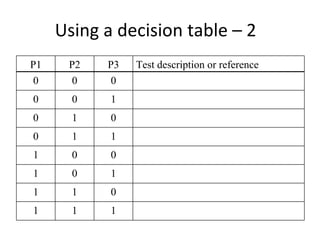
Using a decision table – 1 A decision table is a general technique for full path coverage. It will, however, in many cases, lead to over-testing.  The idea is simple.  Make a table of all predicates. Insert all combinations of True / False – 1 / 0 – for each predicate Construct a test for each combination.
Using a decision table – 2  1 1 1 0 1 1 1 0 1 0 0 1 1 1 0 0 1 0 1 0 0 0 0 0 Test description or reference  P3 P2 P1
Using a decision table – 3 Three things to remember: The approach as it is presented here will only work for Situations where we have binary decisions. Small chunks of code – e.g. class methods and small components. It will be too laborious for large chunks of code. Code that is difficult to reach may not be necessary.
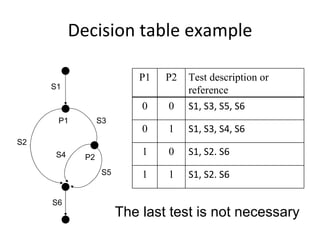
Decision table example The last test is not necessary  P1 P2 S5 S4 S6 S3 S2 S1 S1, S2. S6 1 1 S1, S2. S6 0 1 S1, S3, S4, S6 1 0 S1, S3, S5, S6 0 0 Test description or reference  P2 P1
What about loops Loops are the great problem in white box testing. It is common practice to test the system going through each loop  0 times – loop code never executed 1 time – loop code executed once 5 times – loop code executed several times 20 times – loop code executed “many” times
Error messages Since we have access to the code we should Identify all error conditions Provoke each identified error condition Check if the error is treated in a satisfactory manner – e.g. that the error message is clear, to the point and helpful for the intended users.
What is Black Box testing Black box testing is also called functional testing. The main ideas are simple: Define initial component state, input and expected output for the test. Set the component in the required state. Give the defined input Observe the output and compare to the expected output.
Info for Black Box testing That we do not have access to the code does not mean that one test is just as good as the other one. We should consider the following info: Algorithm understanding Parts of the solutions that are difficult to implement  Special – often seldom occurring – cases.
Clues from the algorithm We should consider two pieces of info: Difficult parts of the algorithm used Borders between different types of solution – e.g. if P1 then use S1 else use S2. Here we need to consider if the predicate is Correct, i.e. contain the right variables Complete, i.e. contains all necessary conditions
Black Box vs. White Box testing We can contrast the two methods as follows: White Box testing Understanding the implemented code. Checking the implementation  Debugging Black Box testing Understanding the algorithm used. Checking the solution – functional testing
Testing real time systems W-T. Tsai et al. have suggested a pattern based way of testing real time / embedded systems.  They have introduced eight patterns. Using these they have shown through experiments that, using these eight patterns, they identified on the average 95% of all defects. We will have a look at three of the patterns. Together, these three patterns discovered 60% of all defects found
Basic scenario pattern - BSP Check for  precondition   Check  post-condition   PreCondition == true / {Set activation time } IsTimeout == true / [report fail] PostCondition == true / [report success]
BSP – example  Requirement to be tested: If the alarm is disarmed using the remote controller, then the driver and passenger doors are unlocked. Precondition: the alarm is disarmed using the remote controller Post-condition: the driver and passenger doors are unlocked
Key-event service pattern - KSP Check for key  event Check  post-condition  Check  precondition  PreCondition == true PostCondition == true / [report success] KeyEventOccurred / [SetActivationTime] IsTimeout == true / [report fail]
KSP- example  Requirement to be tested: When either of the doors are opened, if the ignition is turned on by car key, then the alarm horn beeps three times  Precondition: either of the doors are opened Key-event: the ignition is turned on by car key Post-condition: the alarm horn beeps three times
Timed key-event service pattern - TKSP Check for key  event Check  post-condition  Check  precondition  PreCondition == true IsTimeout == true / [report fail] PostCondition == true / [report success] KeyEventOccurred / [SetActivationTime] DurationExpired / [report not exercised]
TKSP – example (1)  Requirement to be tested: When driver and passenger doors remain unlocked, if within 0.5 seconds after the lock command is issued by remote controller or car key, then the alarm horn will beep once
TKSP – example (2) Precondition: driver and passenger doors remain unlocked Key-event: lock command is issued by remote controller or car key Duration: 0.5 seconds  Post-condition: the alarm horn will beep once

White boxvsblackbox

  • 1.
    White Box vs.Black Box Testing Tor Stålhane
  • 2.
    What is WhiteBox testing White box testing is testing where we use the info available from the code of the component to generate tests. This info is usually used to achieve coverage in one way or another – e.g. Code coverage Path coverage Decision coverage Debugging will always be white-box testing
  • 3.
  • 4.
    Coverage report. Example– 2                                                                                                                            
  • 5.
    McCabe’s cyclomatic complexityMathematically, the cyclomatic complexity of a structured program is defined with reference to a directed graph containing the basic blocks of the program, with an edge between two basic blocks if control may pass from the first to the second (the control flow graph of the program). The complexity is then defined as: v(G) = E − N + 2 P v(G) = cyclomatic complexity E = the number of edges of the graph N = the number of nodes of the graph P = the number of connected components
  • 6.
    Graph example We have eight nodes – N = 8 – nine edges – E = 9 – and we have only one component – P = 1. Thus, we have v(G) = 9 – 8 + 2 = 3.
  • 7.
    Simple case -1 S1; IF P1 THEN S2 ELSE S3 S4; One predicate – P1. v(G) = 2 Two test cases will cover all code S4 S3 S2 S1 P1
  • 8.
    Simple case –2 S1; IF P1 THEN X := a/c ELSE S3; S4; One predicate – P1. v(G) = 2 Two test cases will cover all paths but not all cases. What about the case c = 0? S4 S3 S1 a/c P1
  • 9.
    Using v(G) Theminimum number of paths through the code is v(G). As long as the code graph is a DAG – Directed Acyclic Graph – the maximum number of paths is 2**|{predicates}| Thus, we have that V(G) < number of paths < 2**|{predicates}|
  • 10.
    Problem – theloop S4 S2 S1 P1 S5 S3 P2 S1; DO IF P1 THEN S2 ELSE S3; S4 OD UNTIL P2 S5; No DAG. v(G) = 3 and Max is 4 but there is an “infinite” number of paths.
  • 11.
    Nested decisions S1; IF P1 THEN S2 ELSE S3; IF P2 THEN S4 ELSE S5 FI S6; v(G) = 3, while Max = 4. Three test case will cover all paths. P1 P2 S5 S4 S6 S3 S2 S1
  • 12.
    Using a decisiontable – 1 A decision table is a general technique for full path coverage. It will, however, in many cases, lead to over-testing. The idea is simple. Make a table of all predicates. Insert all combinations of True / False – 1 / 0 – for each predicate Construct a test for each combination.
  • 13.
    Using a decisiontable – 2 1 1 1 0 1 1 1 0 1 0 0 1 1 1 0 0 1 0 1 0 0 0 0 0 Test description or reference P3 P2 P1
  • 14.
    Using a decisiontable – 3 Three things to remember: The approach as it is presented here will only work for Situations where we have binary decisions. Small chunks of code – e.g. class methods and small components. It will be too laborious for large chunks of code. Code that is difficult to reach may not be necessary.
  • 15.
    Decision table exampleThe last test is not necessary P1 P2 S5 S4 S6 S3 S2 S1 S1, S2. S6 1 1 S1, S2. S6 0 1 S1, S3, S4, S6 1 0 S1, S3, S5, S6 0 0 Test description or reference P2 P1
  • 16.
    What about loopsLoops are the great problem in white box testing. It is common practice to test the system going through each loop 0 times – loop code never executed 1 time – loop code executed once 5 times – loop code executed several times 20 times – loop code executed “many” times
  • 17.
    Error messages Sincewe have access to the code we should Identify all error conditions Provoke each identified error condition Check if the error is treated in a satisfactory manner – e.g. that the error message is clear, to the point and helpful for the intended users.
  • 18.
    What is BlackBox testing Black box testing is also called functional testing. The main ideas are simple: Define initial component state, input and expected output for the test. Set the component in the required state. Give the defined input Observe the output and compare to the expected output.
  • 19.
    Info for BlackBox testing That we do not have access to the code does not mean that one test is just as good as the other one. We should consider the following info: Algorithm understanding Parts of the solutions that are difficult to implement Special – often seldom occurring – cases.
  • 20.
    Clues from thealgorithm We should consider two pieces of info: Difficult parts of the algorithm used Borders between different types of solution – e.g. if P1 then use S1 else use S2. Here we need to consider if the predicate is Correct, i.e. contain the right variables Complete, i.e. contains all necessary conditions
  • 21.
    Black Box vs.White Box testing We can contrast the two methods as follows: White Box testing Understanding the implemented code. Checking the implementation Debugging Black Box testing Understanding the algorithm used. Checking the solution – functional testing
  • 22.
    Testing real timesystems W-T. Tsai et al. have suggested a pattern based way of testing real time / embedded systems. They have introduced eight patterns. Using these they have shown through experiments that, using these eight patterns, they identified on the average 95% of all defects. We will have a look at three of the patterns. Together, these three patterns discovered 60% of all defects found
  • 23.
    Basic scenario pattern- BSP Check for precondition Check post-condition PreCondition == true / {Set activation time } IsTimeout == true / [report fail] PostCondition == true / [report success]
  • 24.
    BSP – example Requirement to be tested: If the alarm is disarmed using the remote controller, then the driver and passenger doors are unlocked. Precondition: the alarm is disarmed using the remote controller Post-condition: the driver and passenger doors are unlocked
  • 25.
    Key-event service pattern- KSP Check for key event Check post-condition Check precondition PreCondition == true PostCondition == true / [report success] KeyEventOccurred / [SetActivationTime] IsTimeout == true / [report fail]
  • 26.
    KSP- example Requirement to be tested: When either of the doors are opened, if the ignition is turned on by car key, then the alarm horn beeps three times Precondition: either of the doors are opened Key-event: the ignition is turned on by car key Post-condition: the alarm horn beeps three times
  • 27.
    Timed key-event servicepattern - TKSP Check for key event Check post-condition Check precondition PreCondition == true IsTimeout == true / [report fail] PostCondition == true / [report success] KeyEventOccurred / [SetActivationTime] DurationExpired / [report not exercised]
  • 28.
    TKSP – example(1) Requirement to be tested: When driver and passenger doors remain unlocked, if within 0.5 seconds after the lock command is issued by remote controller or car key, then the alarm horn will beep once
  • 29.
    TKSP – example(2) Precondition: driver and passenger doors remain unlocked Key-event: lock command is issued by remote controller or car key Duration: 0.5 seconds Post-condition: the alarm horn will beep once