When is an article
actually published?
An analysis of online availability,
publication, and indexation dates
Stefanie Haustein, Timothy D. Bowman & Rodrigo Costas
@stefhaustein @timothydbowman @RodrigoCostas1
Introduction
Motivation and Questions
Methods
Results
Discussion and Conclusion
Outlook
Outline
?
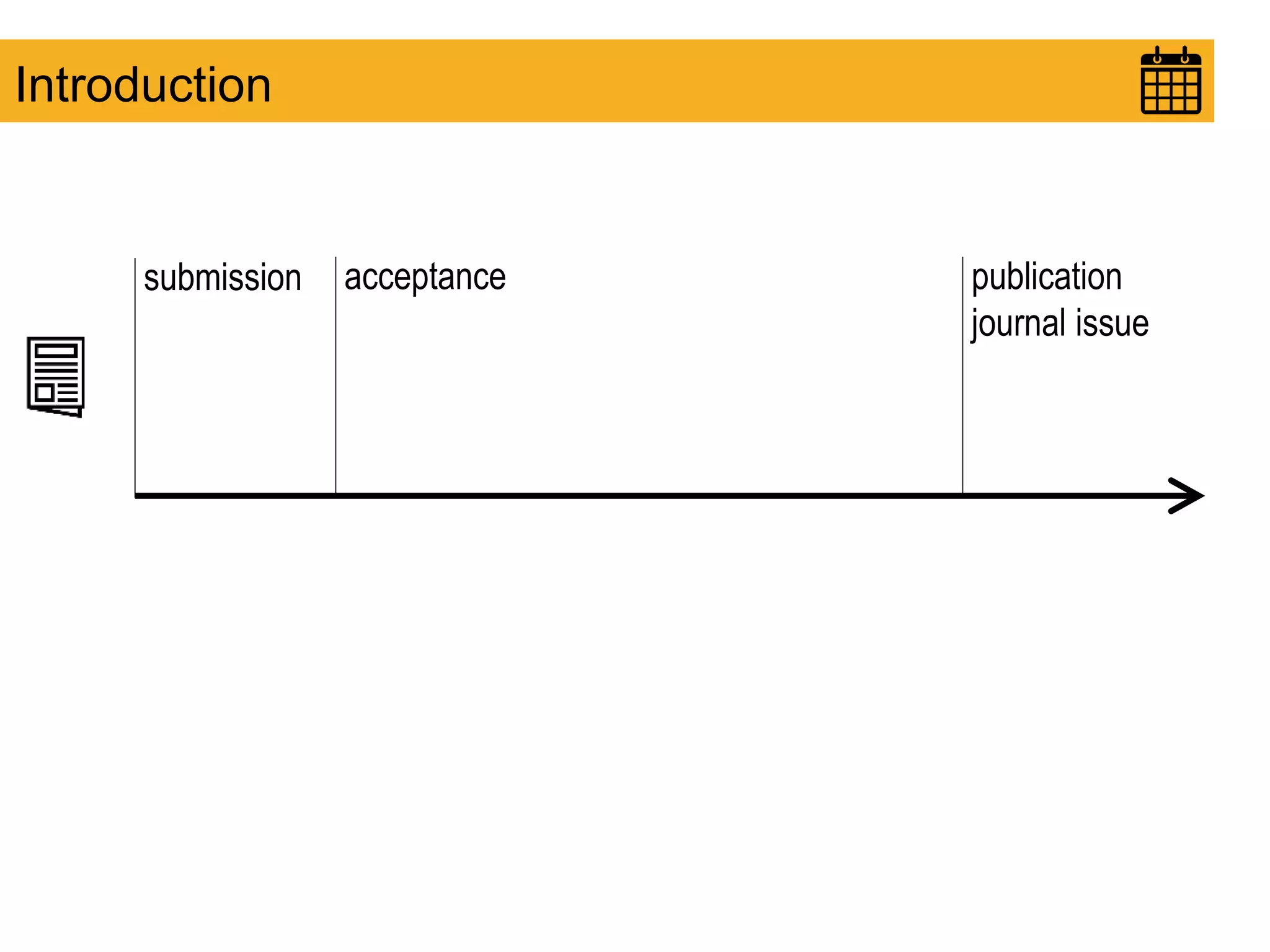
submission acceptance publication
journal issue
Introduction
submission acceptance publication
journal issue
Introduction
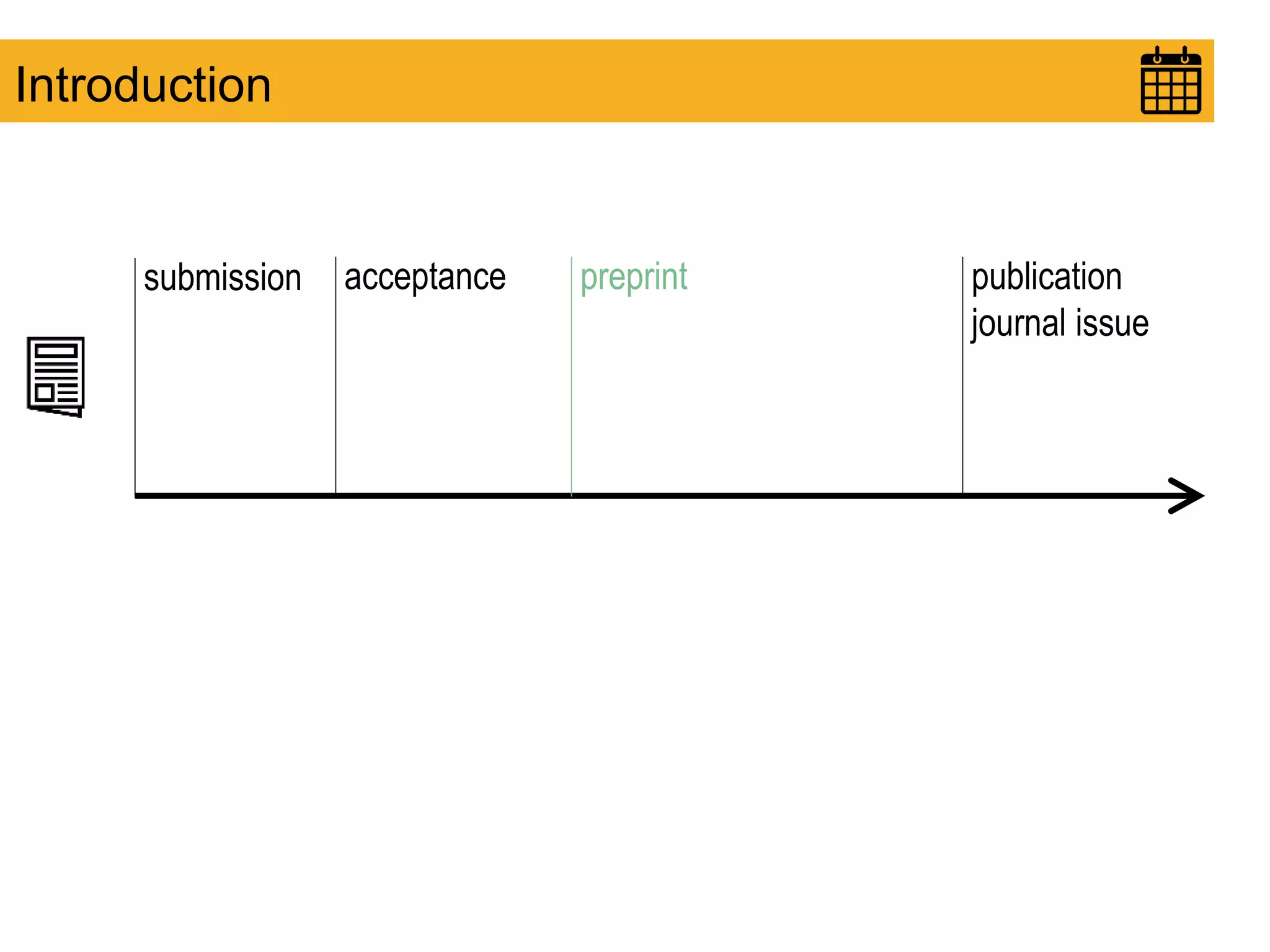
preprint
submission acceptance publication
journal issue
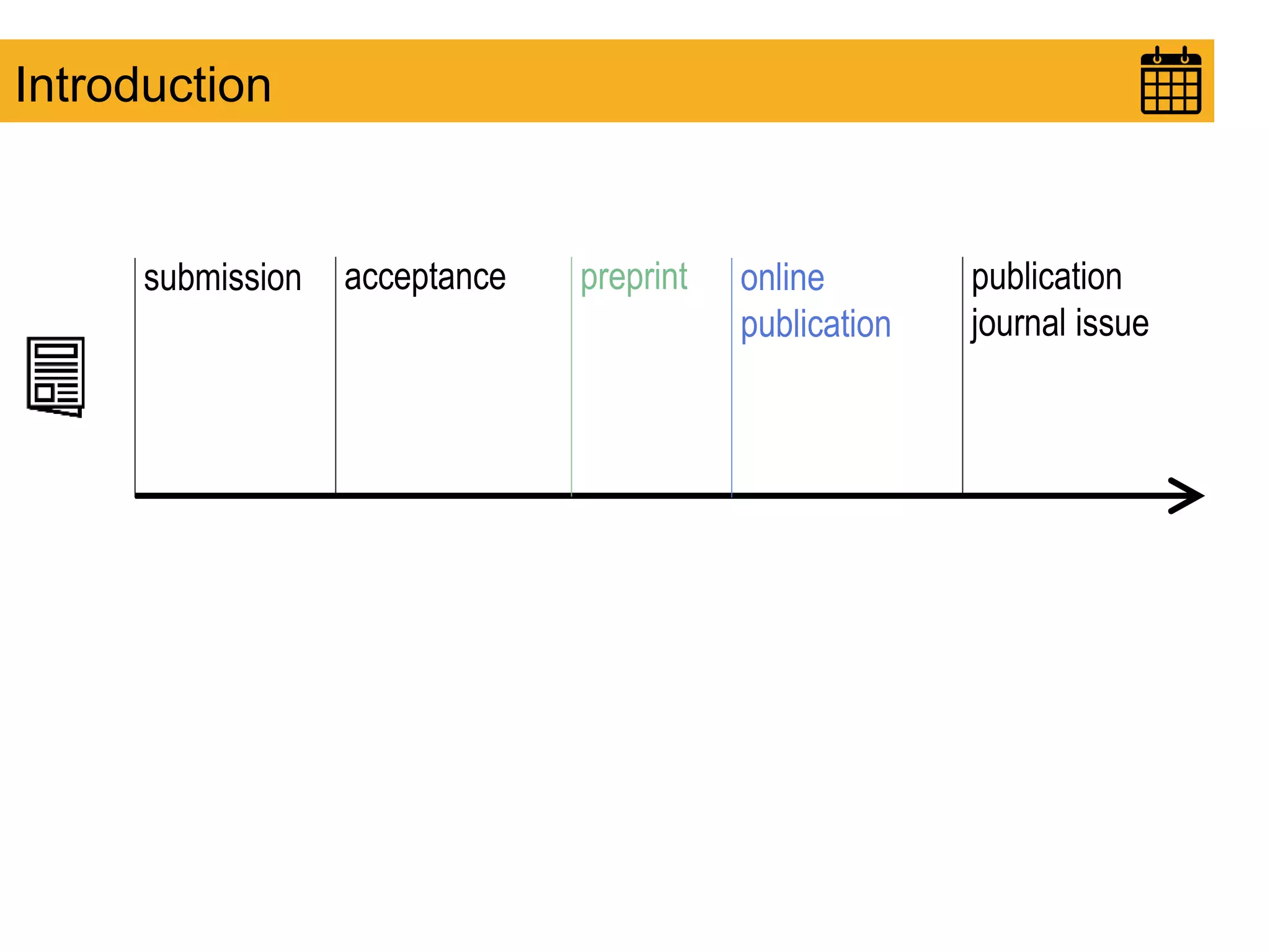
online
publication
Introduction
preprint
Introduction
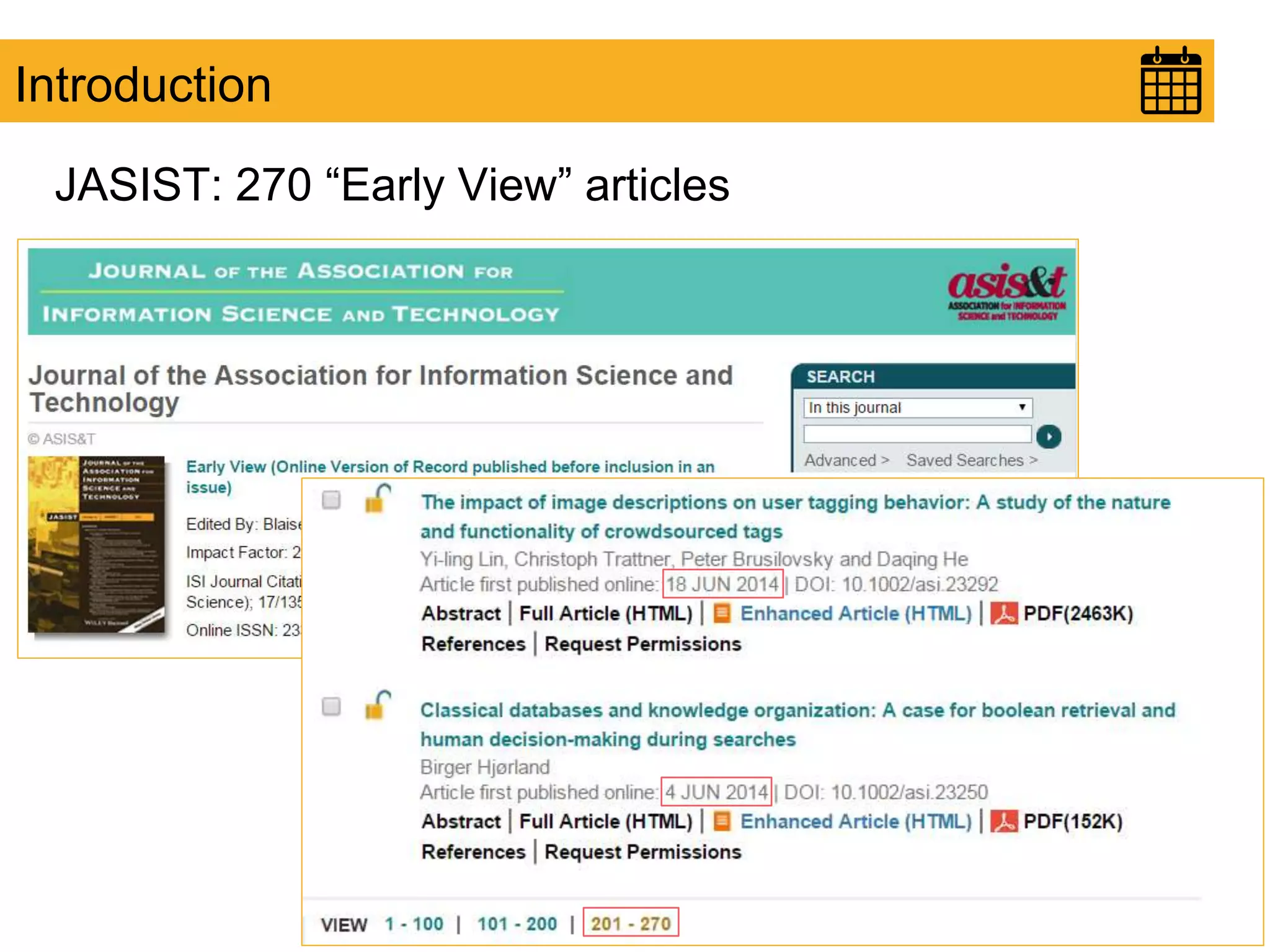
JASIST: 270 “Early View” articles
Introduction
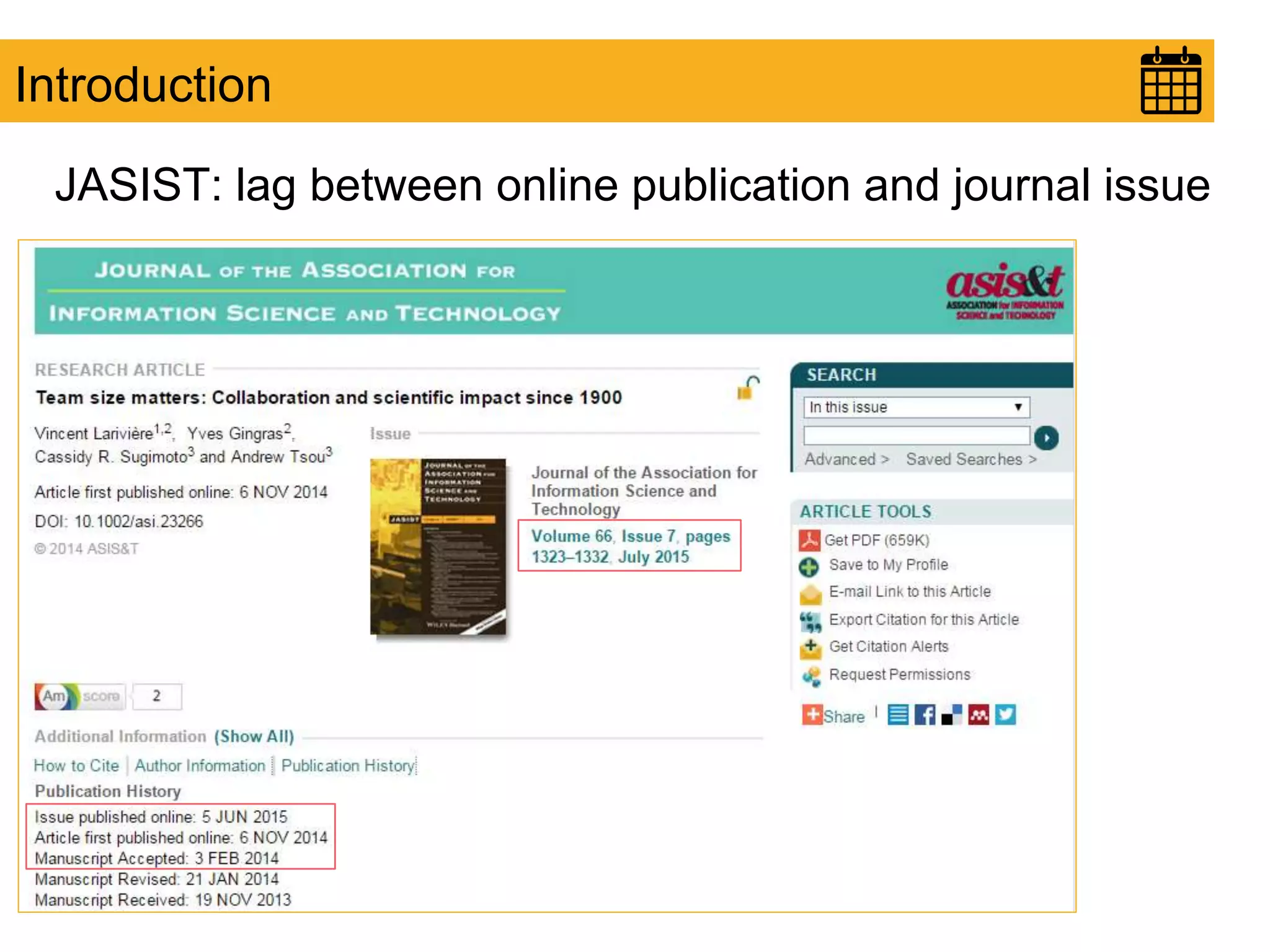
JASIST: lag between online publication and journal issue
Introduction
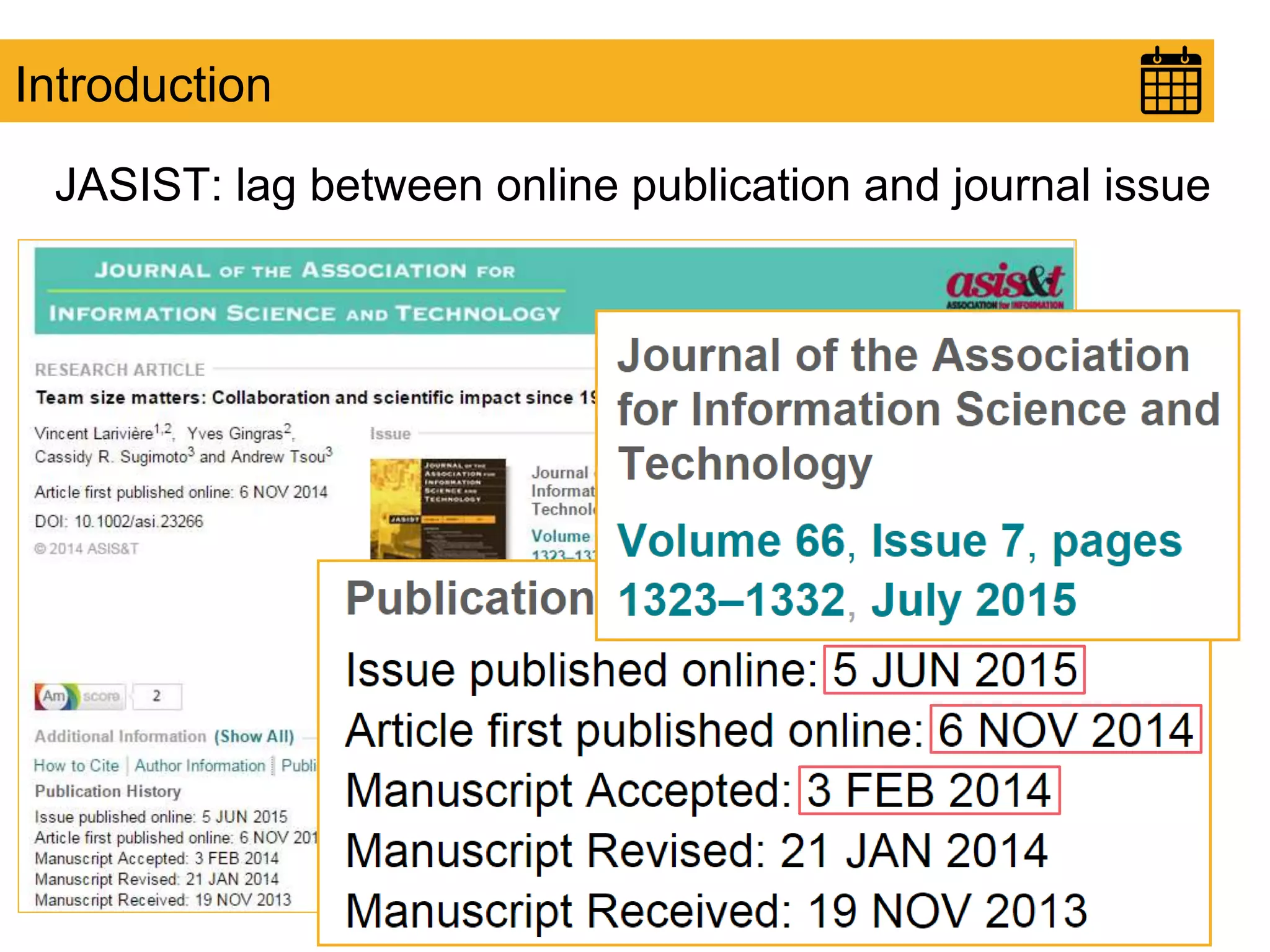
JASIST: lag between online publication and journal issue
Introduction
submission acceptance publication
journal issue
online
publication
preprint
publication
year
citations citations
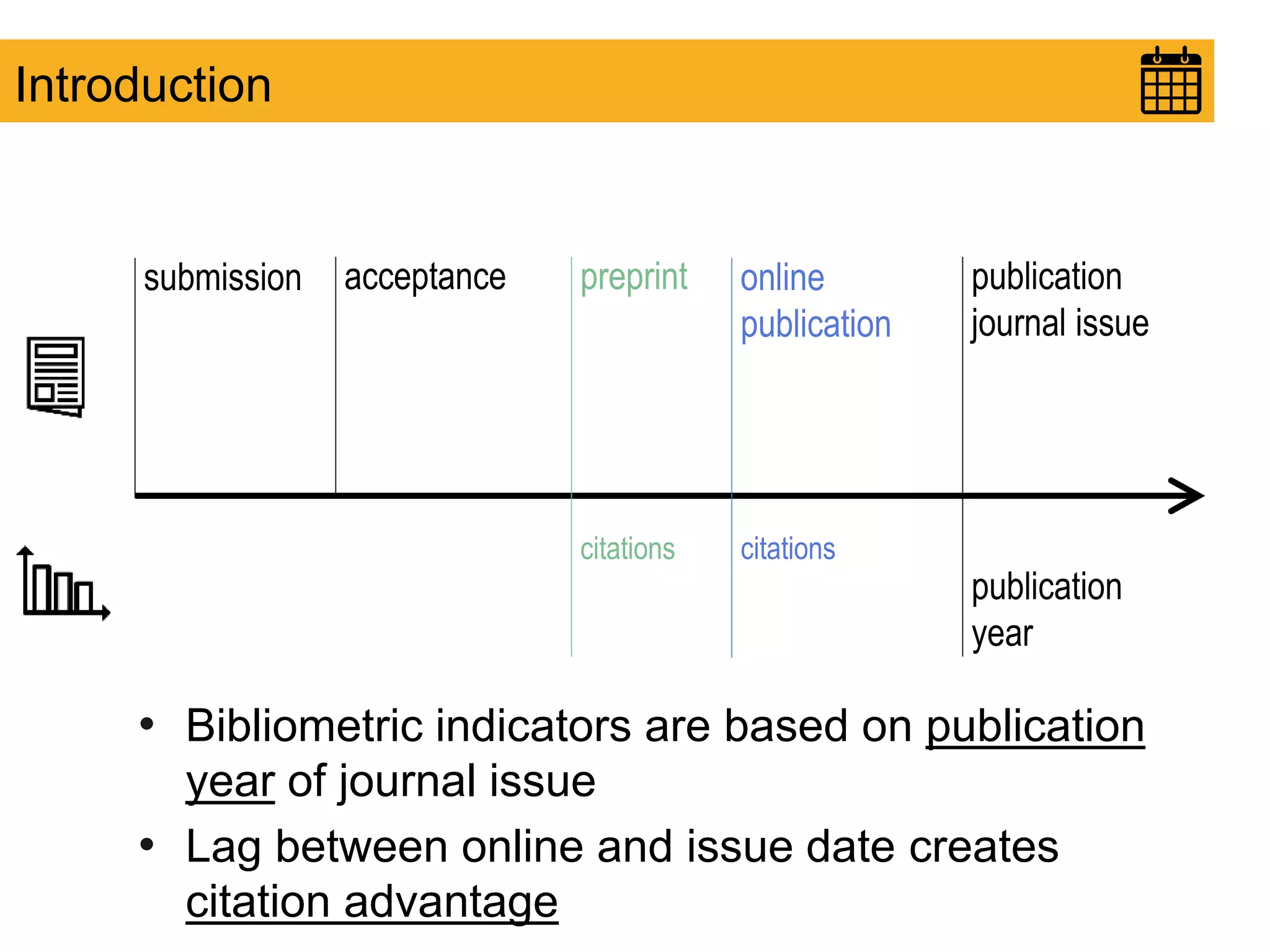
• Bibliometric indicators are based on publication
year of journal issue
• Lag between online and issue date creates
citation advantage
• Publication year insufficient for bibliometric indicators
• January vs. December papers
• Acceleration of read-cite-read cycle
• Online publication before journal issue
• Lags between online and issue date
 Online dates would allow for more accurate metrics
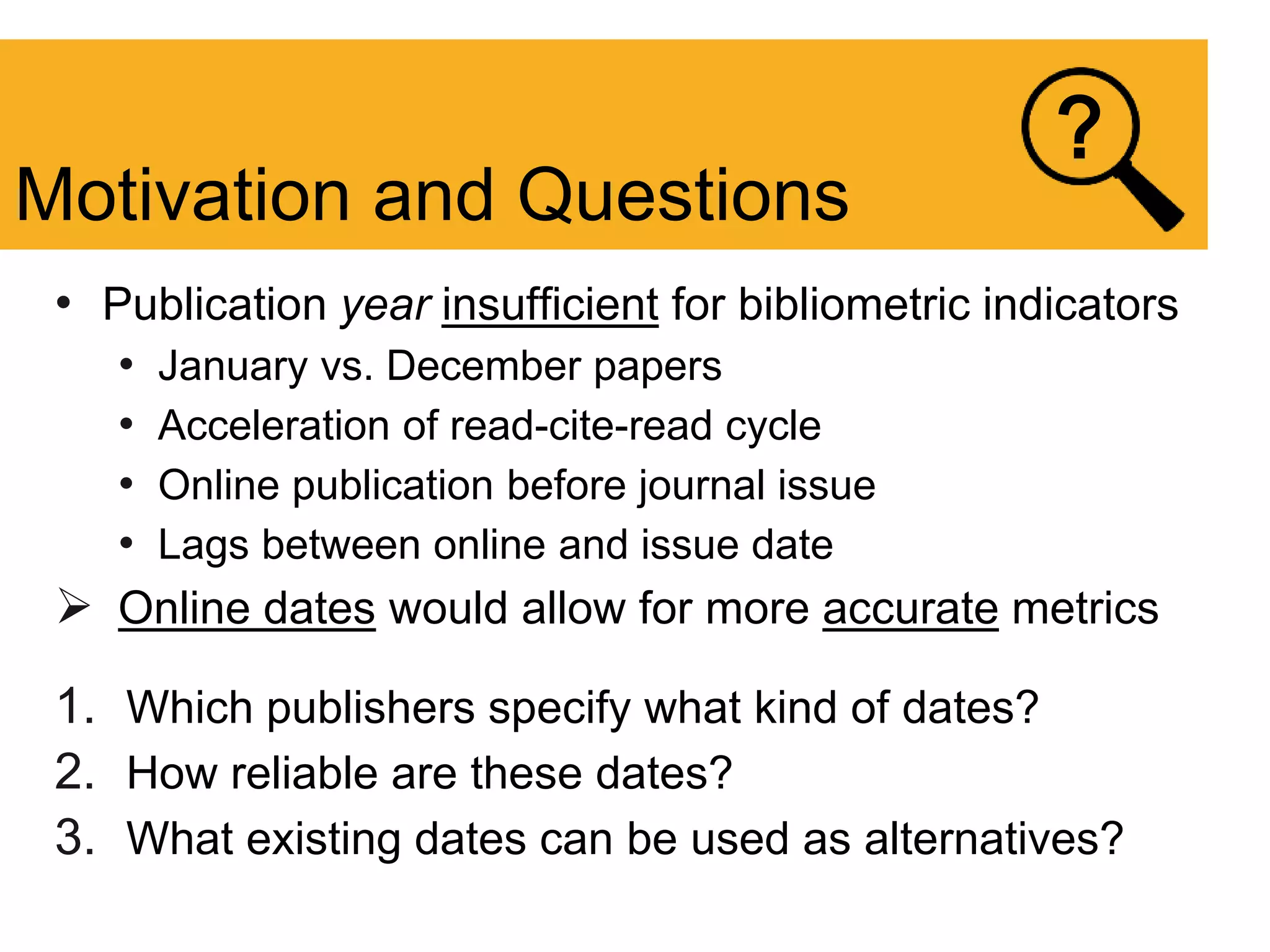
Motivation and Questions
?
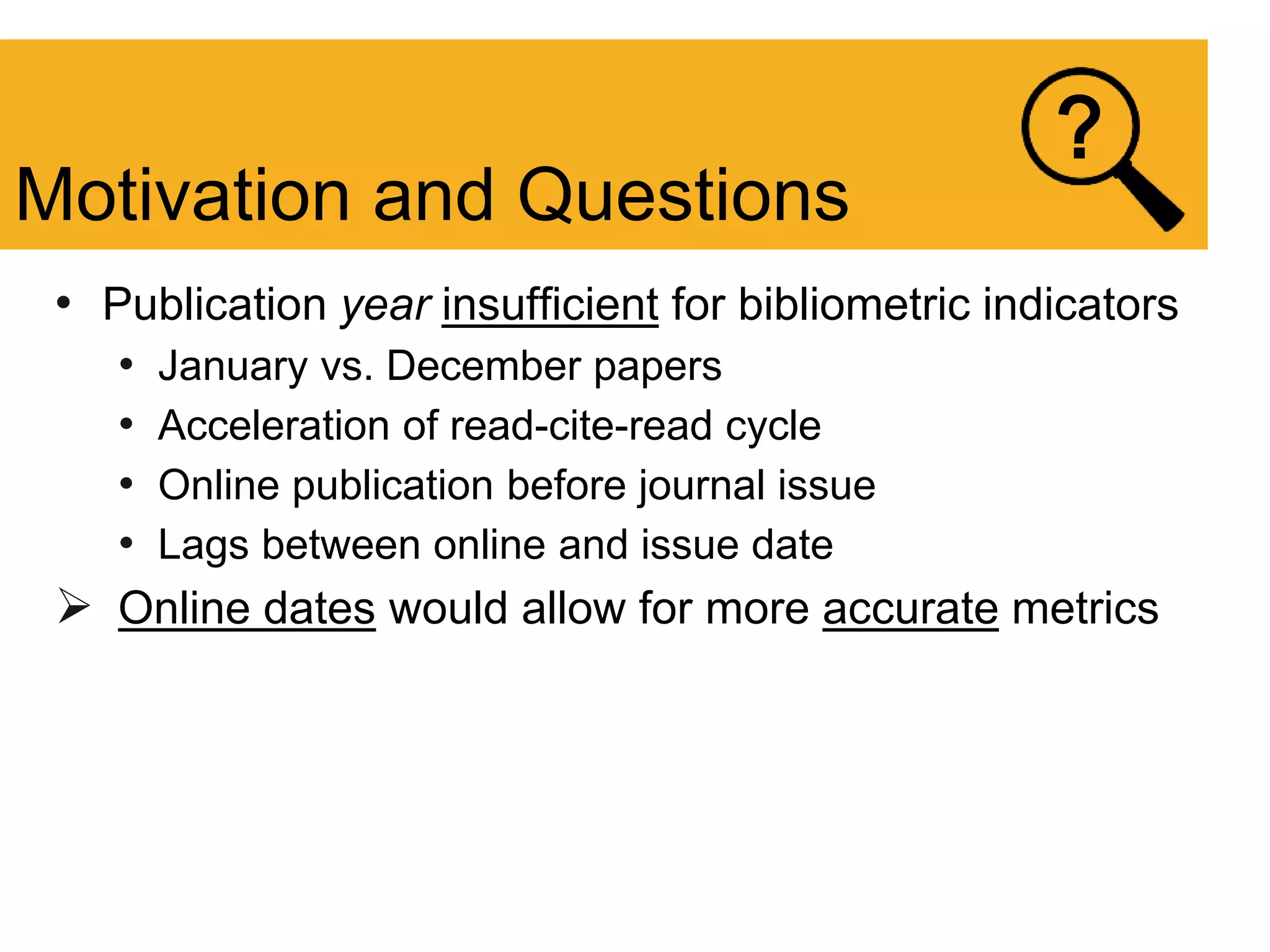
• Publication year insufficient for bibliometric indicators
• January vs. December papers
• Acceleration of read-cite-read cycle
• Online publication before journal issue
• Lags between online and issue date
 Online dates would allow for more accurate metrics
1. Which publishers specify what kind of dates?
2. How reliable are these dates?
3. What existing dates can be used as alternatives?
Motivation and Questions
?
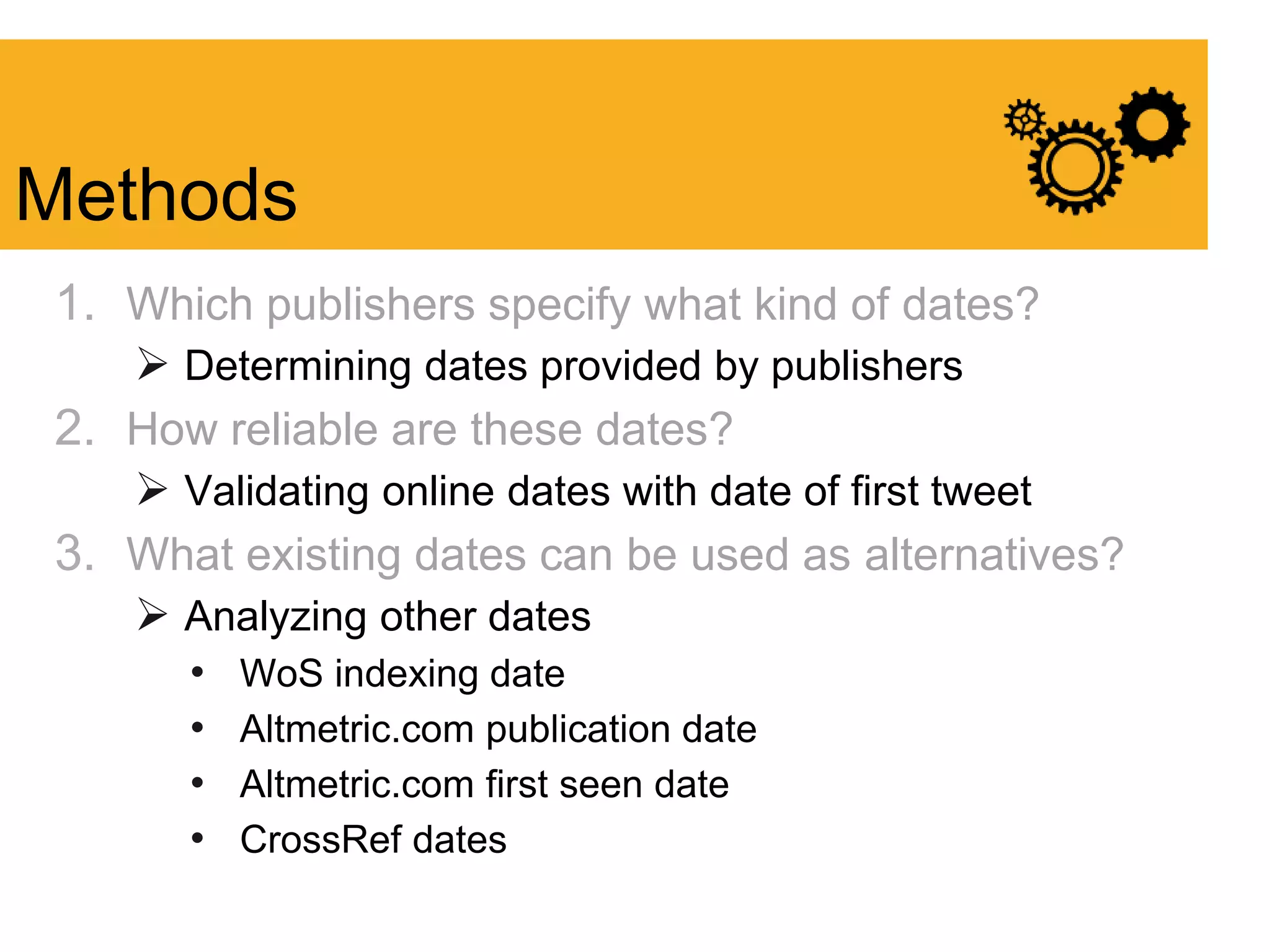
1. Which publishers specify what kind of dates?
 Determining dates provided by publishers
2. How reliable are these dates?
 Validating online dates with date of first tweet
3. What existing dates can be used as alternatives?
 Analyzing other dates
• WoS indexing date
• Altmetric.com publication date
• Altmetric.com first seen date
• CrossRef dates
Methods
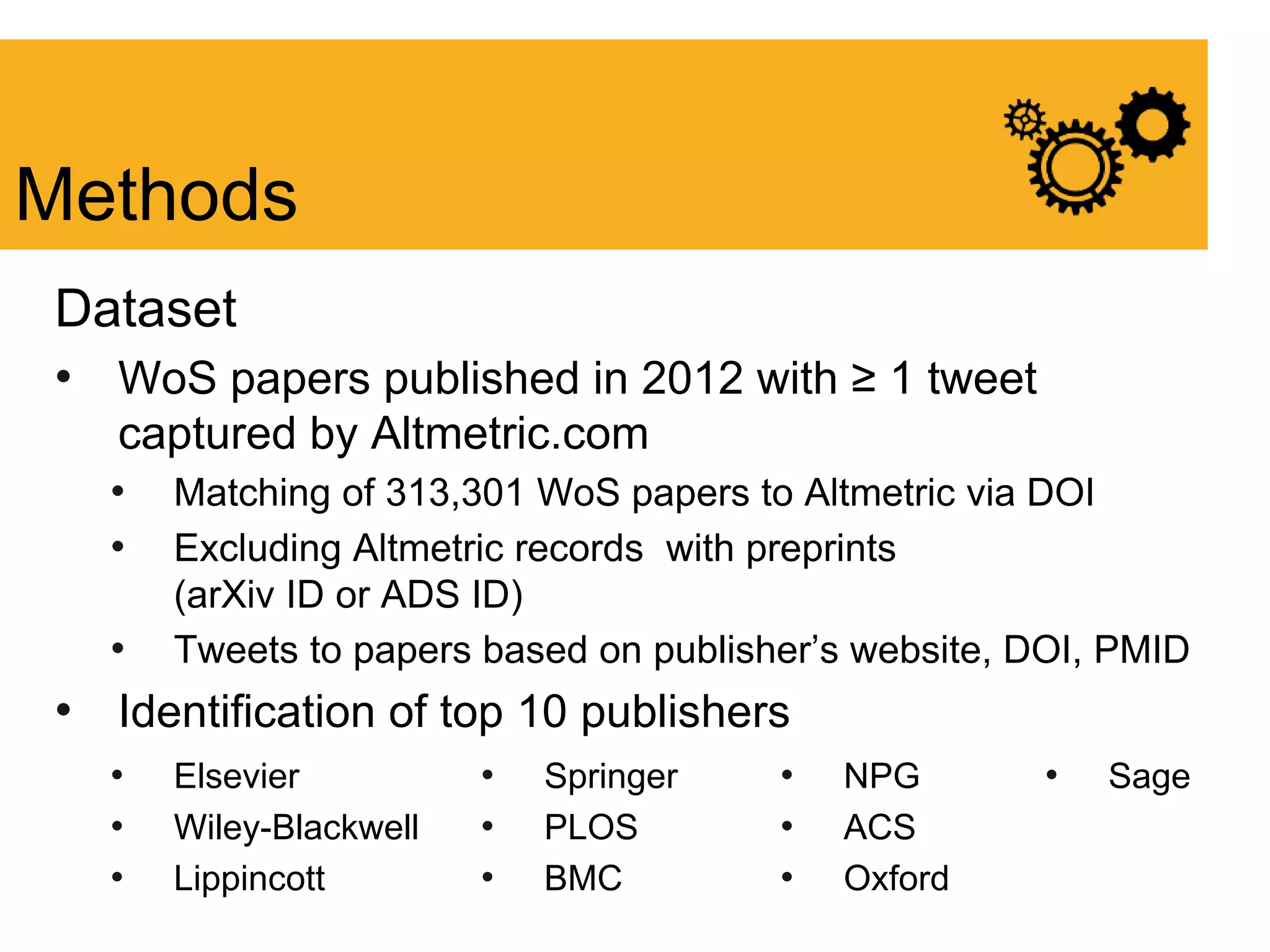
Dataset
• WoS papers published in 2012 with ≥ 1 tweet
captured by Altmetric.com
• Matching of 313,301 WoS papers to Altmetric via DOI
• Excluding Altmetric records with preprints
(arXiv ID or ADS ID)
• Tweets to papers based on publisher’s website, DOI, PMID
• Identification of top 10 publishers
Methods
• Elsevier
• Wiley-Blackwell
• Lippincott
• Springer
• PLOS
• BMC
• NPG
• ACS
• Oxford
• Sage
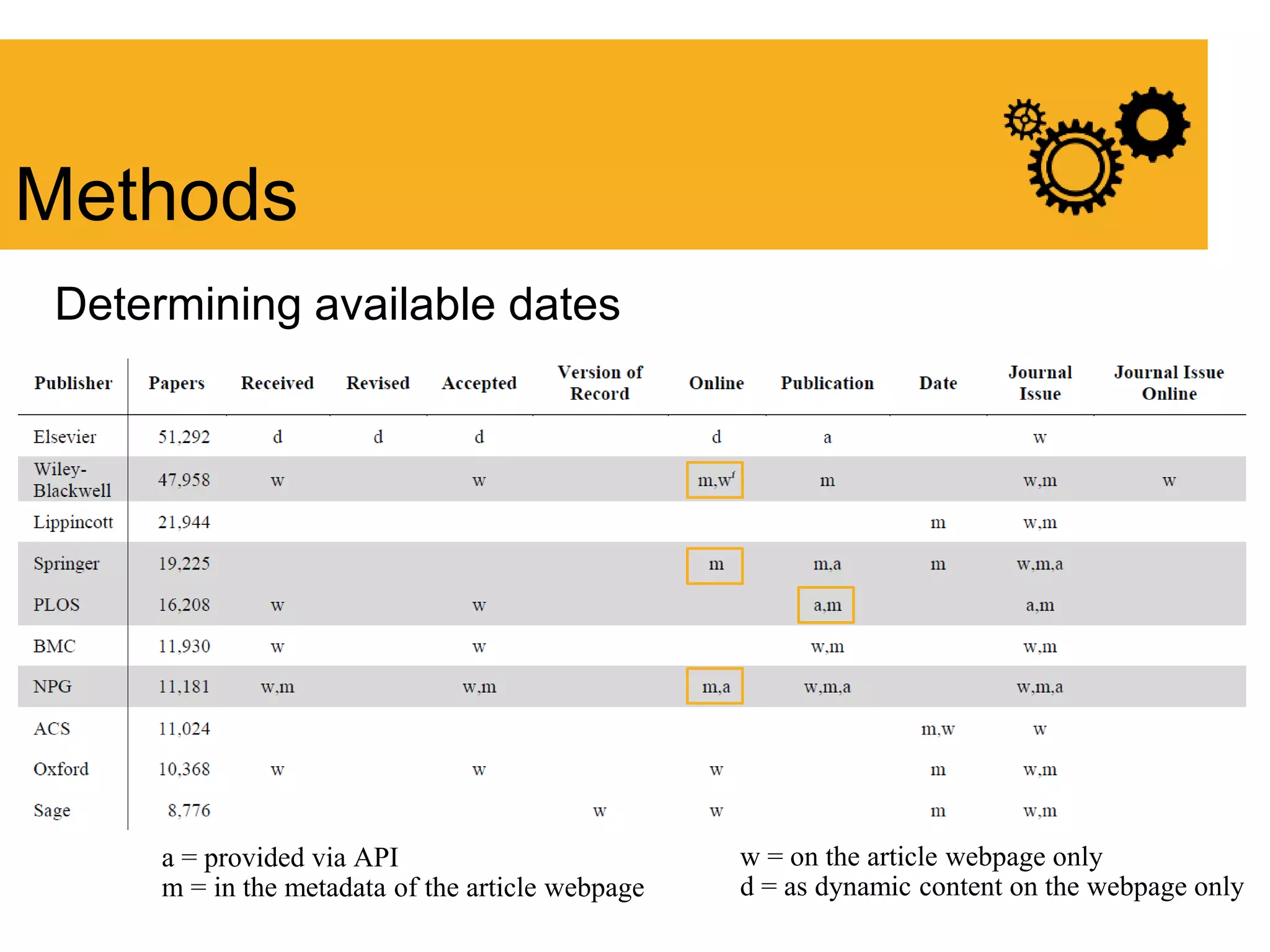
Determining available dates
Methods
a = provided via API
m = in the metadata of the article webpage
w = on the article webpage only
d = as dynamic content on the webpage only
Dataset
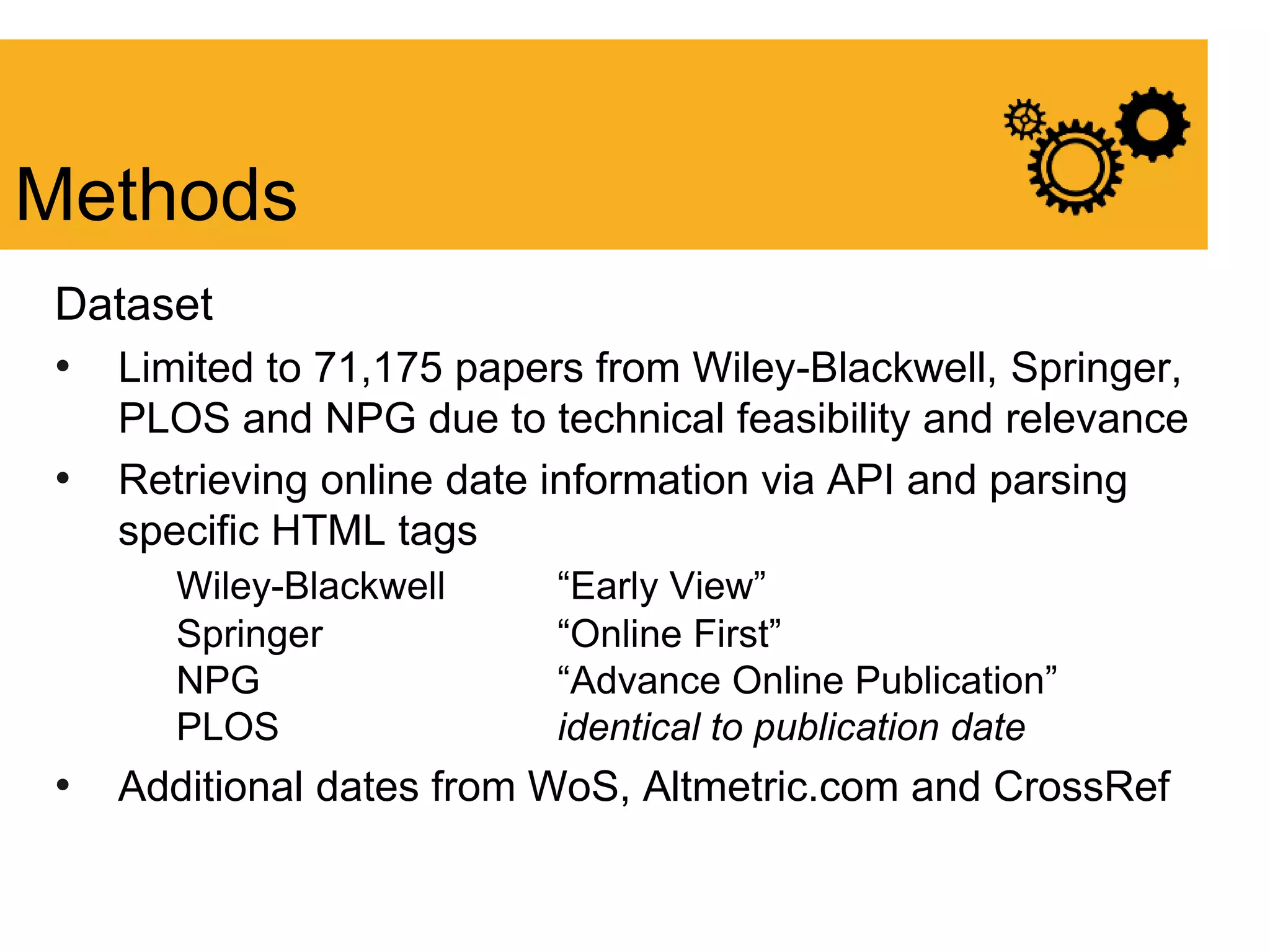
• Limited to 71,175 papers from Wiley-Blackwell, Springer,
PLOS and NPG due to technical feasibility and relevance
• Retrieving online date information via API and parsing
specific HTML tags
Wiley-Blackwell “Early View”
Springer “Online First”
NPG “Advance Online Publication”
PLOS identical to publication date
• Additional dates from WoS, Altmetric.com and CrossRef
Methods
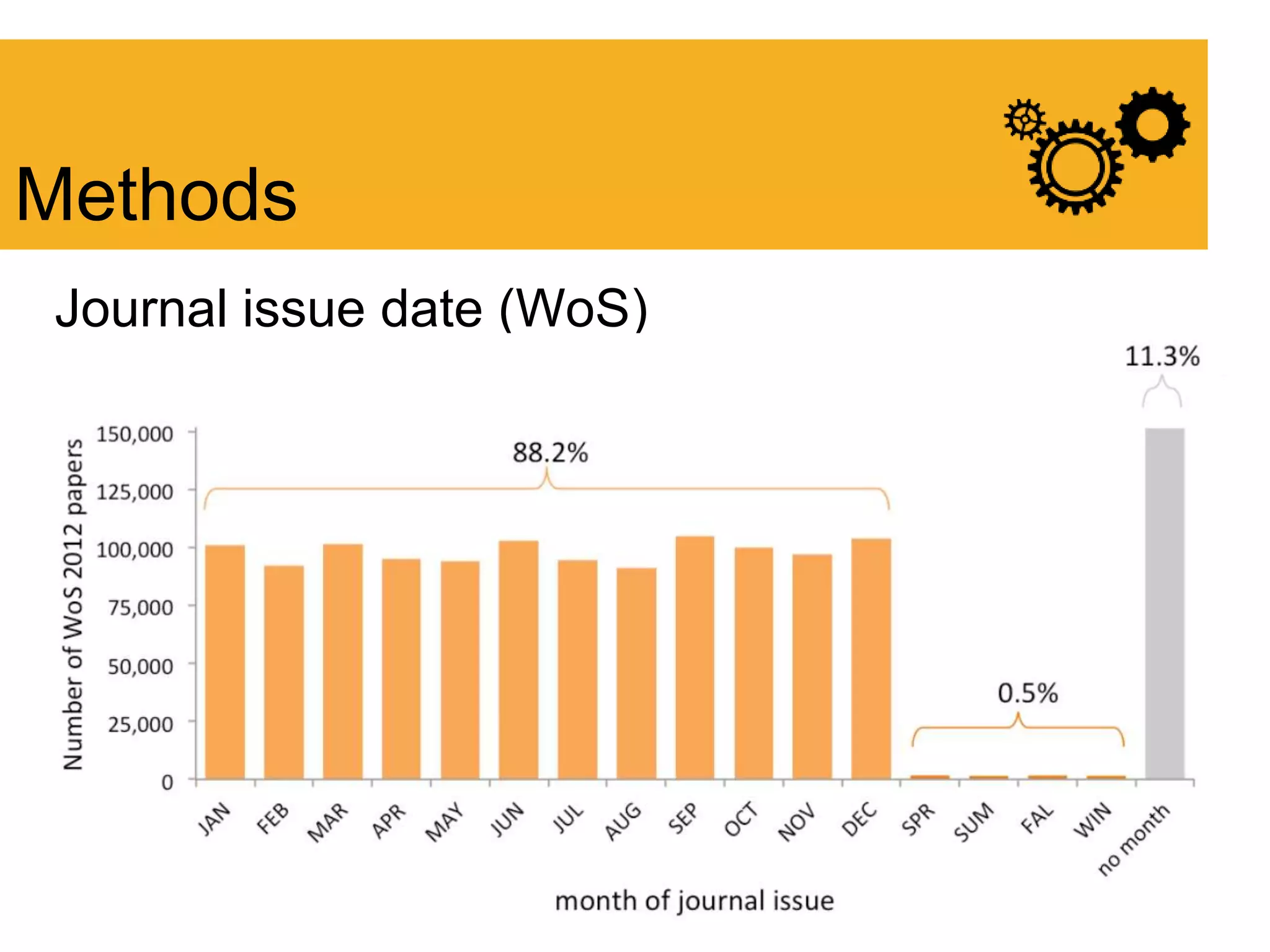
Journal issue date (WoS)
Methods
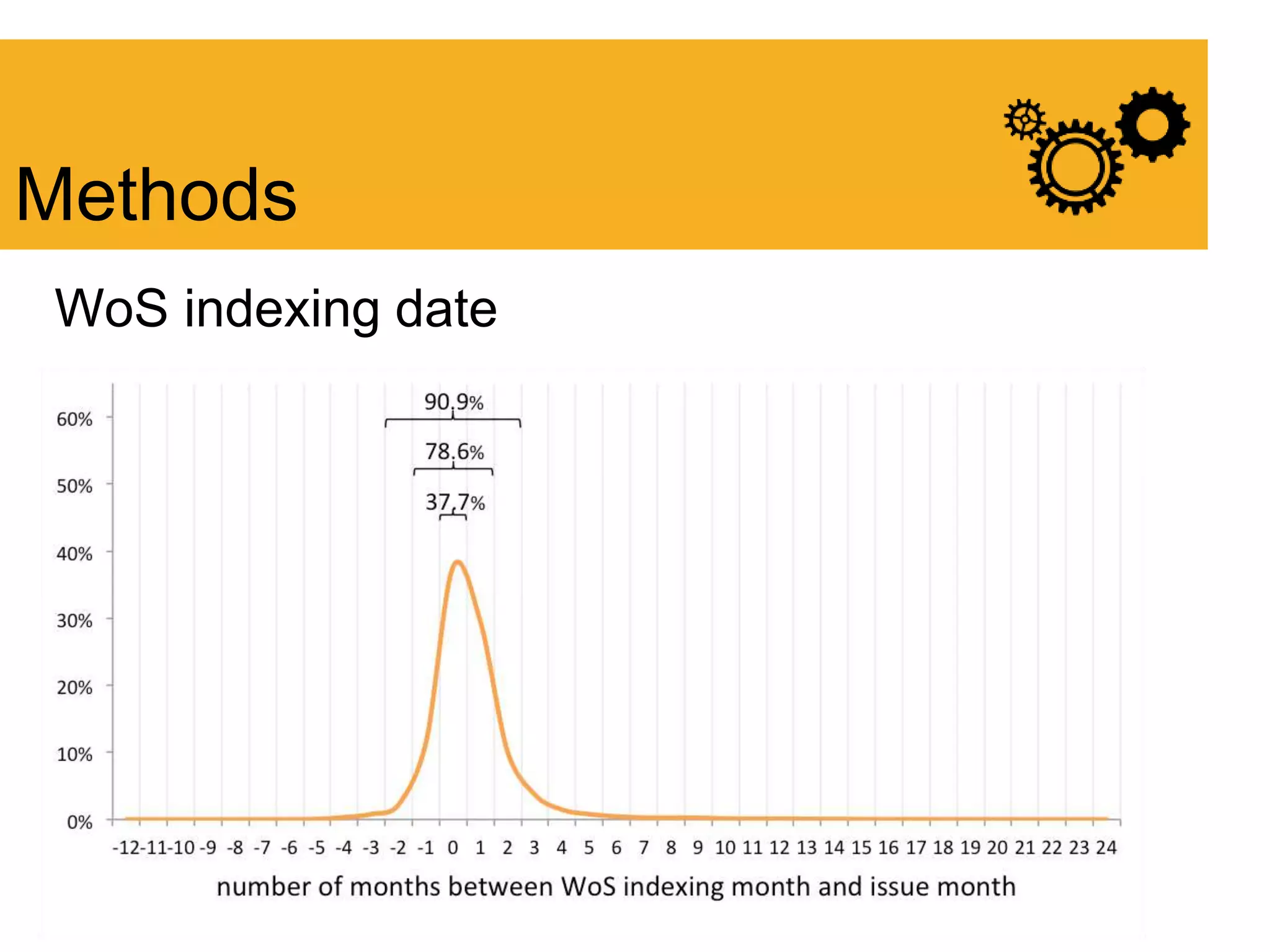
WoS indexing date
Methods
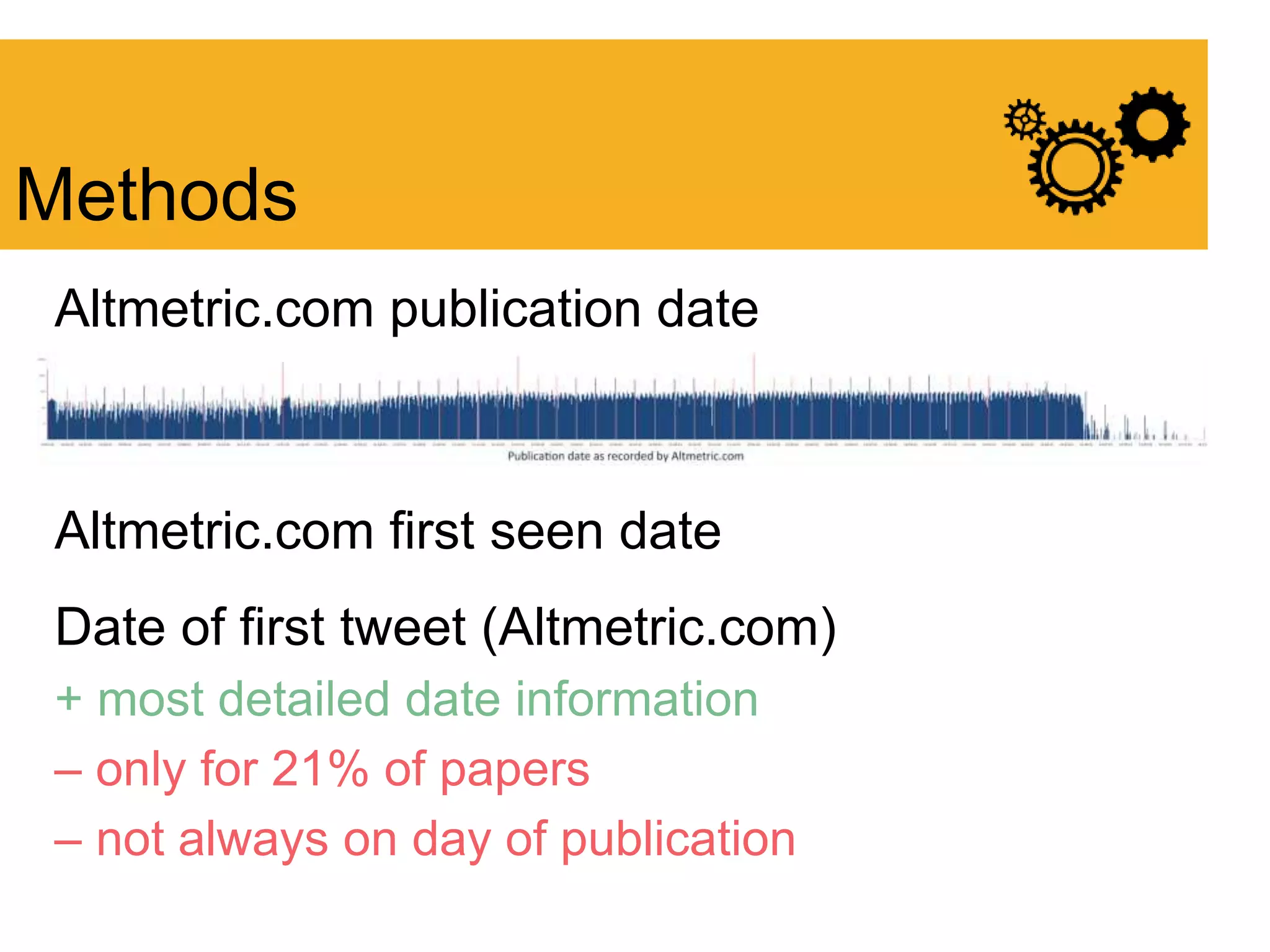
Altmetric.com publication date
Altmetric.com first seen date
Date of first tweet (Altmetric.com)
+ most detailed date information
‒ only for 21% of papers
‒ not always on day of publication
Methods
• Comparison of 58,896 papers with all 6 dates
• Comparing online date to:
• Date of first tweet
• Journal issue month (first of month)
• WoS indexing date
• Altmetric.com publication date
• Altmetric.com first seen date
• CrossRef deposit, first resolution
& update
Methods
validation
potential
alternatives
• Wiley-Blackwell: 27,432
• Springer: 14,473
• PLOS: 9,600
• NPG: 7,391
Results: Validation of Online Dates
3.5%
34.4%
62.2%
65
7
0.0%
37.2%
62.8%
15
1
0.1%
1.1%
98.9%
92
6
14.5%
15.2%
70.3%
97
68
n=7,391
n=9,600
n=14,473
n=27,432
Difference(days)betweenfirsttweetandonlinedate
Before:
Equal:
After:
Mean:
Median:
Results: Other Dates
Springer
online date
Journal issue
(first of issue month)
WoS indexing date
Altmetric.com publication date
Mean: 146
Std dev: 111
Min: -269
Max: 1850
Median: 120
Before: 3.5%
Equal: 0.1%
After: 96.4%
Mean: 163
Std dev: 113
Min: -252
Max: 1866
Median: 138
Before: 0.1%
Equal: 0.0%
After: 99.9%
Mean: 9
Std dev: 48
Min: -519
Max: 1850
Median: 1
Before: 43.4%
Equal: 34.1%
After: 22.5%
CrossRef dates as more reliable alternatives?
Results (preliminary)
submission acceptance publication
journal issue
online
publication
DOI deposit first resolution update
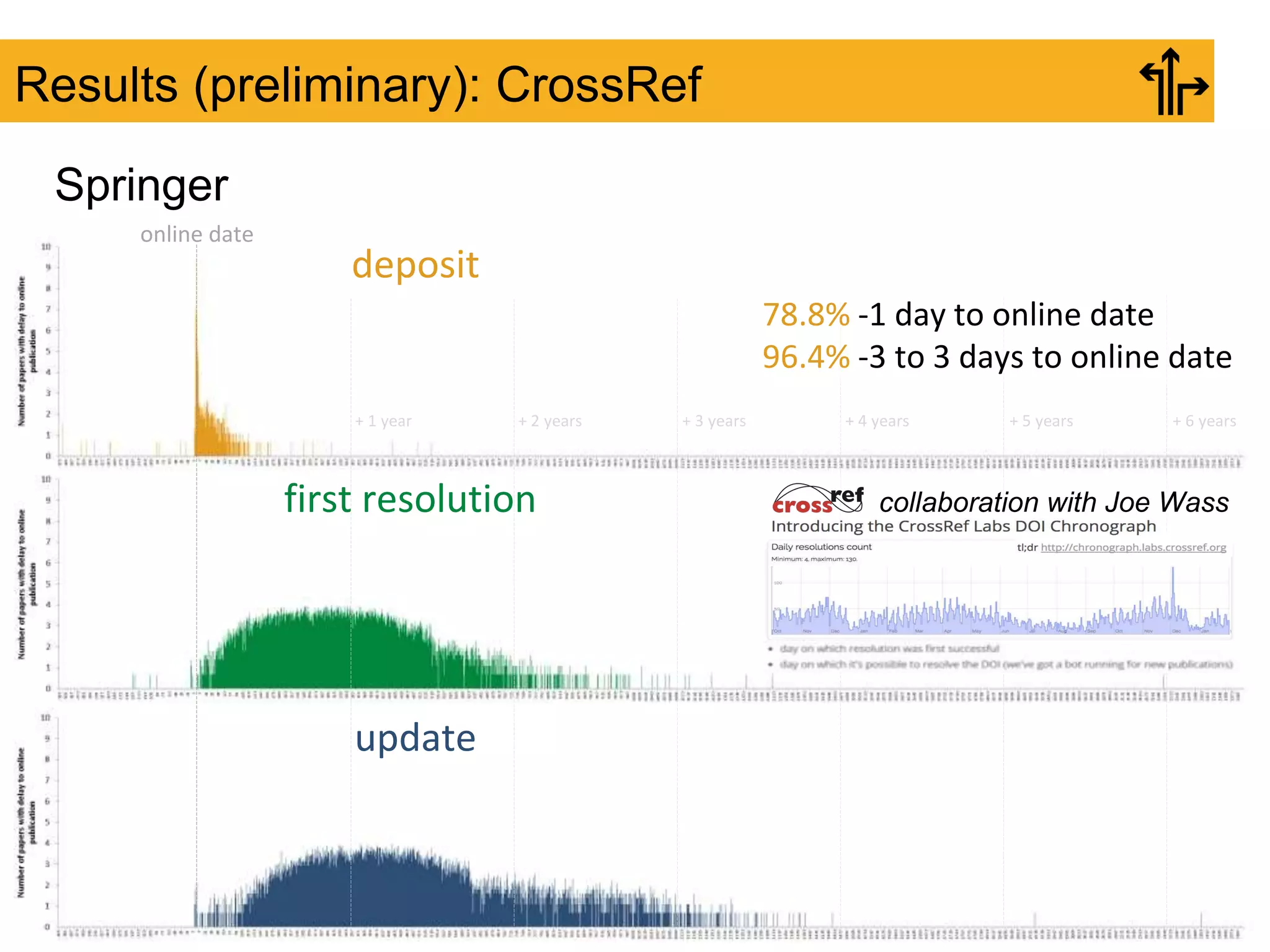
Results (preliminary): CrossRef
Springer
deposit
update
first resolution
online date
+ 1 year + 2 years + 3 years + 4 years + 5 years + 6 years
78.8% -1 day to online date
96.4% -3 to 3 days to online date
collaboration with Joe Wass
• Effect of online-issue lag on:
• Bibliometric indicators
• OA embargoes
“[T]he manuscript will not be posted [on PMC] until 12 months
after the official date of publication. […] The official publication
date may thus be considered the online publication date for some
journals and the print publication date for others.“
Wiley
“[The embargo period] begins from the publication date of the
issue the article appears in. Our embargo periods typically range
from 12 – 24 months […].”
Elsevier
Discussion and Conclusion
• Publishers should provide publication dates using
same terminology
• Inclusion of dates in metadata:
• Submission
• Acceptance
• Publication of preprint
• Publication of Version of Record (VoR)
• Publication of (print) issue
• Via CrossRef?
 Implementation of date standards
• Via NISO?
Discussion and Conclusion
Thank you
for your attention!
Stefanie Haustein, Timothy D. Bowman & Rodrigo Costas
@stefhaustein @timothydbowman @RodrigoCostas1

When is an article actually published? An analysis of online availability, publication, and indexation dates

  • 1.
    When is anarticle actually published? An analysis of online availability, publication, and indexation dates Stefanie Haustein, Timothy D. Bowman & Rodrigo Costas @stefhaustein @timothydbowman @RodrigoCostas1
  • 2.
  • 3.
  • 4.
    submission acceptance publication journalissue Introduction preprint
  • 5.
    submission acceptance publication journalissue online publication Introduction preprint
  • 6.
  • 7.
    Introduction JASIST: lag betweenonline publication and journal issue
  • 8.
    Introduction JASIST: lag betweenonline publication and journal issue
  • 9.
    Introduction submission acceptance publication journalissue online publication preprint publication year citations citations • Bibliometric indicators are based on publication year of journal issue • Lag between online and issue date creates citation advantage
  • 10.
    • Publication yearinsufficient for bibliometric indicators • January vs. December papers • Acceleration of read-cite-read cycle • Online publication before journal issue • Lags between online and issue date  Online dates would allow for more accurate metrics Motivation and Questions ?
  • 11.
    • Publication yearinsufficient for bibliometric indicators • January vs. December papers • Acceleration of read-cite-read cycle • Online publication before journal issue • Lags between online and issue date  Online dates would allow for more accurate metrics 1. Which publishers specify what kind of dates? 2. How reliable are these dates? 3. What existing dates can be used as alternatives? Motivation and Questions ?
  • 12.
    1. Which publishersspecify what kind of dates?  Determining dates provided by publishers 2. How reliable are these dates?  Validating online dates with date of first tweet 3. What existing dates can be used as alternatives?  Analyzing other dates • WoS indexing date • Altmetric.com publication date • Altmetric.com first seen date • CrossRef dates Methods
  • 13.
    Dataset • WoS paperspublished in 2012 with ≥ 1 tweet captured by Altmetric.com • Matching of 313,301 WoS papers to Altmetric via DOI • Excluding Altmetric records with preprints (arXiv ID or ADS ID) • Tweets to papers based on publisher’s website, DOI, PMID • Identification of top 10 publishers Methods • Elsevier • Wiley-Blackwell • Lippincott • Springer • PLOS • BMC • NPG • ACS • Oxford • Sage
  • 14.
    Determining available dates Methods a= provided via API m = in the metadata of the article webpage w = on the article webpage only d = as dynamic content on the webpage only
  • 15.
    Dataset • Limited to71,175 papers from Wiley-Blackwell, Springer, PLOS and NPG due to technical feasibility and relevance • Retrieving online date information via API and parsing specific HTML tags Wiley-Blackwell “Early View” Springer “Online First” NPG “Advance Online Publication” PLOS identical to publication date • Additional dates from WoS, Altmetric.com and CrossRef Methods
  • 16.
    Journal issue date(WoS) Methods
  • 17.
  • 18.
    Altmetric.com publication date Altmetric.comfirst seen date Date of first tweet (Altmetric.com) + most detailed date information ‒ only for 21% of papers ‒ not always on day of publication Methods
  • 19.
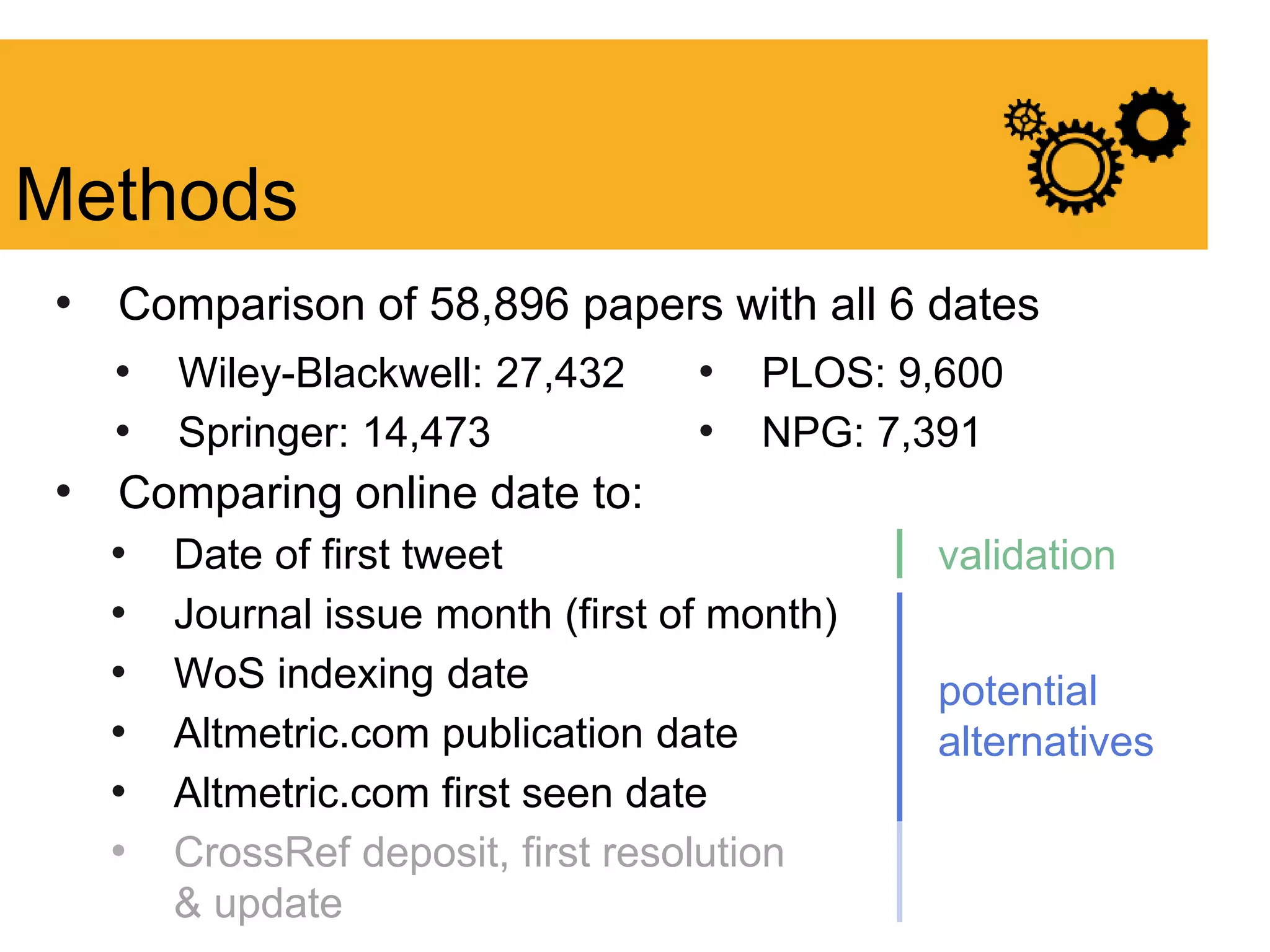
    • Comparison of58,896 papers with all 6 dates • Comparing online date to: • Date of first tweet • Journal issue month (first of month) • WoS indexing date • Altmetric.com publication date • Altmetric.com first seen date • CrossRef deposit, first resolution & update Methods validation potential alternatives • Wiley-Blackwell: 27,432 • Springer: 14,473 • PLOS: 9,600 • NPG: 7,391
  • 20.
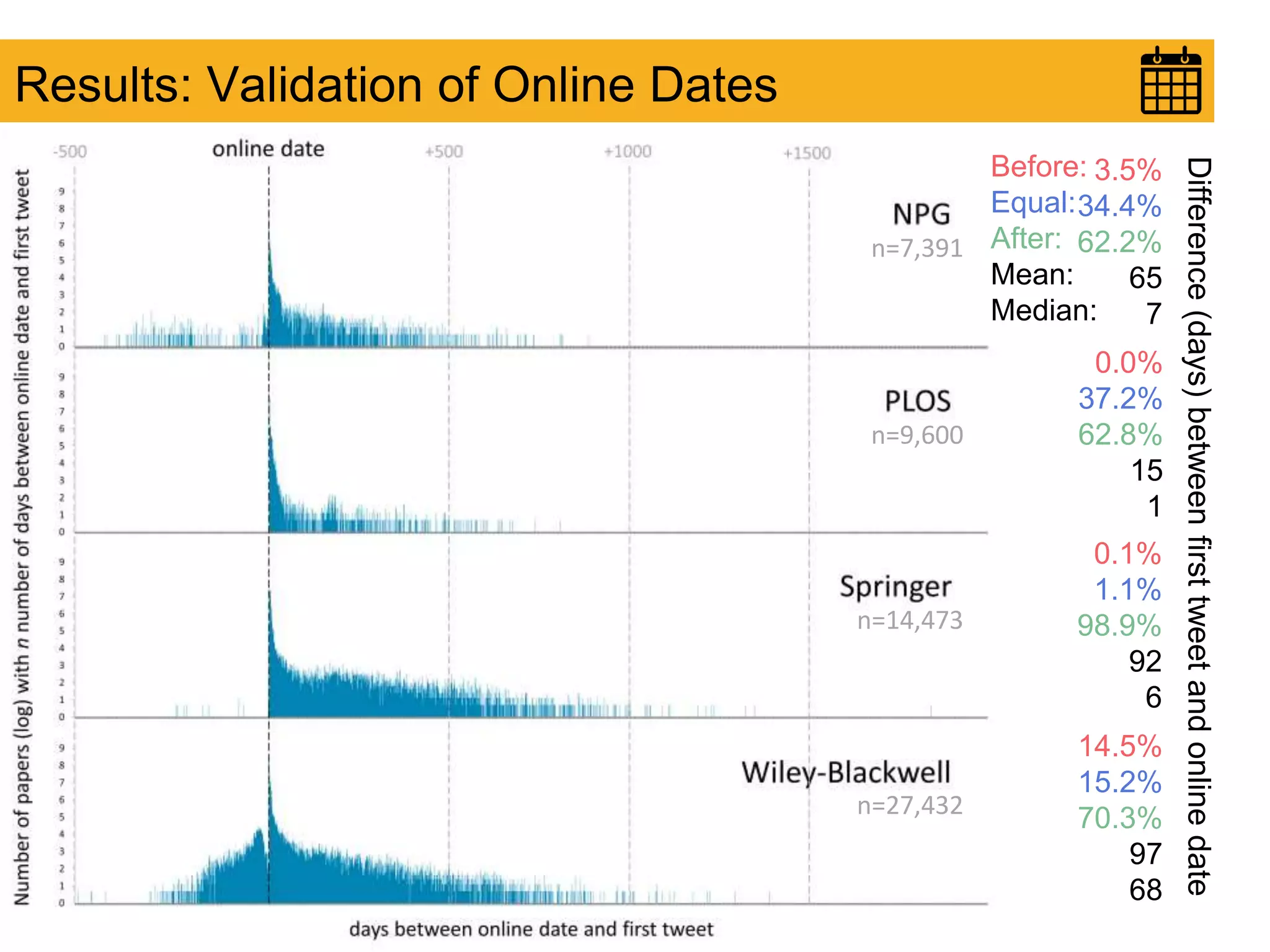
    Results: Validation ofOnline Dates 3.5% 34.4% 62.2% 65 7 0.0% 37.2% 62.8% 15 1 0.1% 1.1% 98.9% 92 6 14.5% 15.2% 70.3% 97 68 n=7,391 n=9,600 n=14,473 n=27,432 Difference(days)betweenfirsttweetandonlinedate Before: Equal: After: Mean: Median:
  • 21.
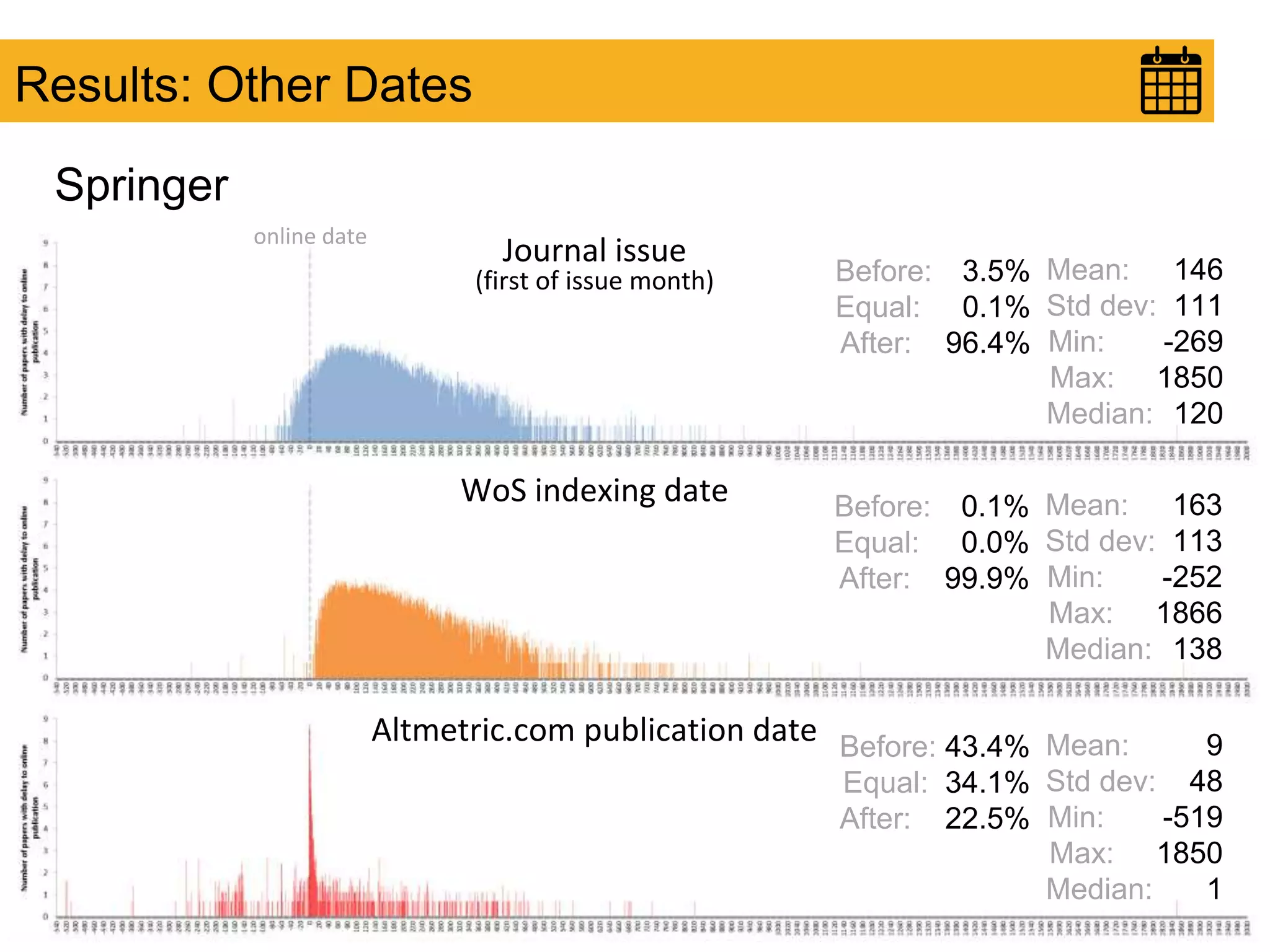
    Results: Other Dates Springer onlinedate Journal issue (first of issue month) WoS indexing date Altmetric.com publication date Mean: 146 Std dev: 111 Min: -269 Max: 1850 Median: 120 Before: 3.5% Equal: 0.1% After: 96.4% Mean: 163 Std dev: 113 Min: -252 Max: 1866 Median: 138 Before: 0.1% Equal: 0.0% After: 99.9% Mean: 9 Std dev: 48 Min: -519 Max: 1850 Median: 1 Before: 43.4% Equal: 34.1% After: 22.5%
  • 22.
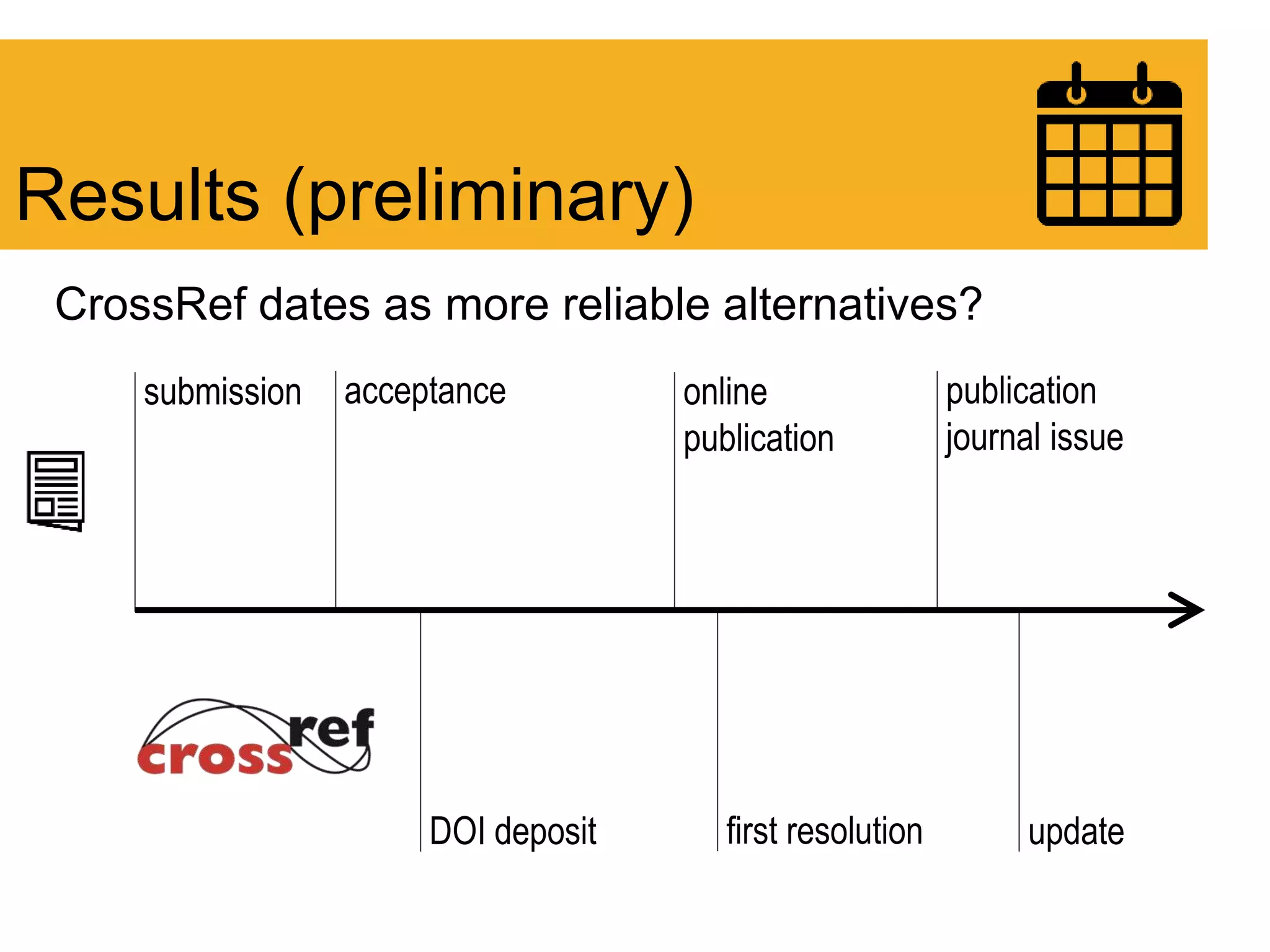
    CrossRef dates asmore reliable alternatives? Results (preliminary) submission acceptance publication journal issue online publication DOI deposit first resolution update
  • 23.
    Results (preliminary): CrossRef Springer deposit update firstresolution online date + 1 year + 2 years + 3 years + 4 years + 5 years + 6 years 78.8% -1 day to online date 96.4% -3 to 3 days to online date collaboration with Joe Wass
  • 24.
    • Effect ofonline-issue lag on: • Bibliometric indicators • OA embargoes “[T]he manuscript will not be posted [on PMC] until 12 months after the official date of publication. […] The official publication date may thus be considered the online publication date for some journals and the print publication date for others.“ Wiley “[The embargo period] begins from the publication date of the issue the article appears in. Our embargo periods typically range from 12 – 24 months […].” Elsevier Discussion and Conclusion
  • 25.
    • Publishers shouldprovide publication dates using same terminology • Inclusion of dates in metadata: • Submission • Acceptance • Publication of preprint • Publication of Version of Record (VoR) • Publication of (print) issue • Via CrossRef?  Implementation of date standards • Via NISO? Discussion and Conclusion
  • 26.
    Thank you for yourattention! Stefanie Haustein, Timothy D. Bowman & Rodrigo Costas @stefhaustein @timothydbowman @RodrigoCostas1

Editor's Notes

  • #2 Thank you very much for the invitation to talk! I am very happy to be here today and talk to you about: the way in which scholars communicate and how research is being evaluated
  • #19 Altmetric.com publication date peaks for first of month and first of year: could be caused by aggregating data without actual day (and month) information 15.1% of Altmetric.com records did not have any or incorrect dates Altmetric.com first seen date Mostly equals first tweet date 4% no first seen date
  • #27 Thank you very much for the invitation to talk! I am very happy to be here today and talk to you about: the way in which scholars communicate and how research is being evaluated