
1
Wheat Flour Fortification
Malik Tariq Sarwar Awan, Food Technologist,
Chairman Research Wing to Pakistan Flour
Mills Association,
Editor, Wheat Milling News, PFMA .
Member Pakistan Society of Food Scientists
and Technologists
&
Munawar Hussain
Program Manager Food Fortification
Global Alliance for Improved Nutrition (GAIN)
2
What is Food Security?
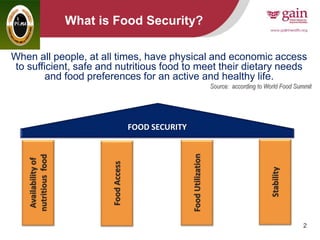
When all people, at all times, have physical and economic access
to sufficient, safe and nutritious food to meet their dietary needs
and food preferences for an active and healthy life.
Source: according to World Food Summit
FOOD SECURITY
Availabilityof
nutritiousfood
FoodAccess
Stability
FoodUtilization
3
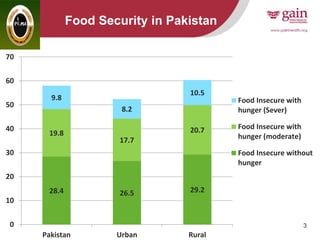
Food Security in Pakistan
28.4 26.5 29.2
19.8
17.7
20.7
9.8
8.2
10.5
0
10
20
30
40
50
60
70
Pakistan Urban Rural
Food Insecure with
hunger (Sever)
Food Insecure with
hunger (moderate)
Food Insecure without
hunger
4
Food Insecurity
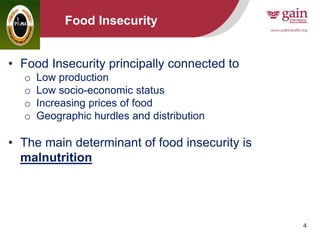
• Food Insecurity principally connected to
o Low production
o Low socio-economic status
o Increasing prices of food
o Geographic hurdles and distribution
• The main determinant of food insecurity is
malnutrition
5
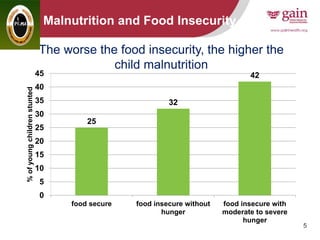
Malnutrition and Food Insecurity
25
32
42
0
5
10
15
20
25
30
35
40
45
food secure food insecure without
hunger
food insecure with
moderate to severe
hunger
%ofyoungchildrenstunted
The worse the food insecurity, the higher the
child malnutrition
6
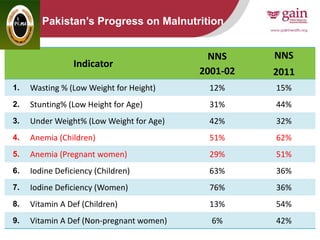
Pakistan’s Progress on Malnutrition
Indicator
NNS
2001-02
NNS
2011
1. Wasting % (Low Weight for Height) 12% 15%
2. Stunting% (Low Height for Age) 31% 44%
3. Under Weight% (Low Weight for Age) 42% 32%
4. Anemia (Children) 51% 62%
5. Anemia (Pregnant women) 29% 51%
6. Iodine Deficiency (Children) 63% 36%
7. Iodine Deficiency (Women) 76% 36%
8. Vitamin A Def (Children) 13% 54%
9. Vitamin A Def (Non-pregnant women) 6% 42%
7
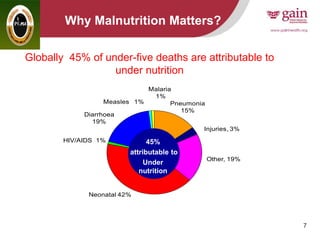
Why Malnutrition Matters?
Pneumonia
15%
Injuries, 3%
Other, 19%
Neonatal 42%
HIV/AIDS 1%
Diarrhoea
19%
Measles 1%
Malaria
1%
45%
attributable to
Under
nutrition
Globally 45% of under-five deaths are attributable to
under nutrition
8
Why Malnutrition Matters?
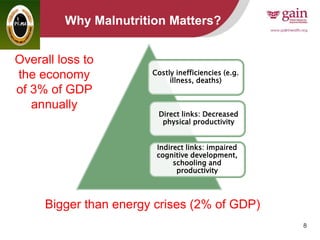
Costly inefficiencies (e.g.
illness, deaths)
Direct links: Decreased
physical productivity
Indirect links: impaired
cognitive development,
schooling and
productivity
Overall loss to
the economy
of 3% of GDP
annually
Bigger than energy crises (2% of GDP)
9
Micronutrient Deficiencies
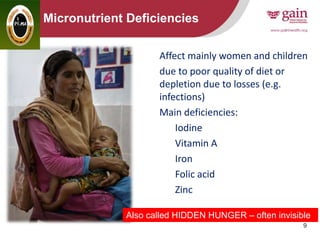
Affect mainly women and children
due to poor quality of diet or
depletion due to losses (e.g.
infections)
Main deficiencies:
Iodine
Vitamin A
Iron
Folic acid
Zinc
Also called HIDDEN HUNGER – often invisible
10
Consequences of Iron
and Folic Acid Deficiency
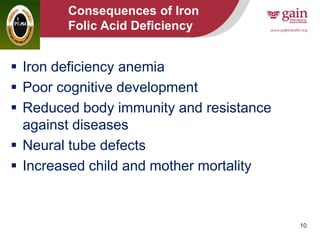
 Iron deficiency anemia
 Poor cognitive development
 Reduced body immunity and resistance
against diseases
 Neural tube defects
 Increased child and mother mortality
11
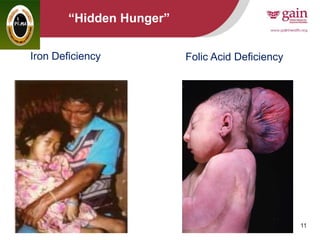
“Hidden Hunger”
Iron Deficiency Folic Acid Deficiency
12
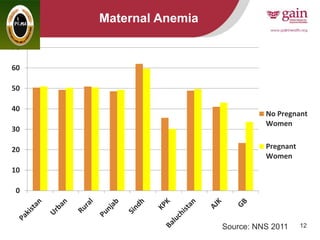
Maternal Anemia
Source: NNS 2011
0
10
20
30
40
50
60
70
No Pregnant
Women
Pregnant
Women
13
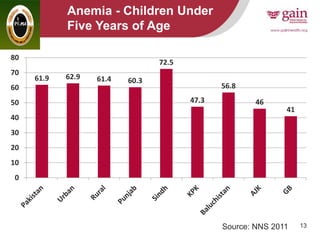
Anemia - Children Under
Five Years of Age
Source: NNS 2011
61.9 62.9 61.4 60.3
72.5
47.3
56.8
46
41
0
10
20
30
40
50
60
70
80
14
Addressing
Micronutrient Malnutrition
15
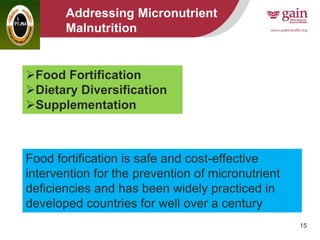
Addressing Micronutrient
Malnutrition
Food Fortification
Dietary Diversification
Supplementation
Food fortification is safe and cost-effective
intervention for the prevention of micronutrient
deficiencies and has been widely practiced in
developed countries for well over a century
16
Why Fortification?
Could target population at large
Technology - simple and well established
Global success history of addressing
deficiencies of micronutrients
Economical - very cost-effective
No need to change dietary habits of targeted
population
Fortification vehicles are easily accessible
17
Top 10 Investments for
advancing global welfare
1 Micronutrient supplements - Malnutrition
2 The Doha development agenda - Trade
3 Micronutrient fortification - Malnutrition
4 Expanded immunization coverage for children - Diseases
5 Agricultural R&D on micronutrients - Malnutrition
6 Deworming and nutrition programs at school - Malnutrition
7 Lowering the price of schooling - Education
8 Increase and improve girls’ schooling - Women
9 Community-based nutrition promotion - Malnutrition
10 Provide support for women’s reproductive role - Women
Copenhagen Consensus
18
Fortification - Key
Success Factors
Political commitment and support
Industry support
Adequate legislation
Consumer acceptance
No cultural or other objection
Availability of micronutrients and
fortification equipment/ dossifiers
Economically sustainable interventions
19
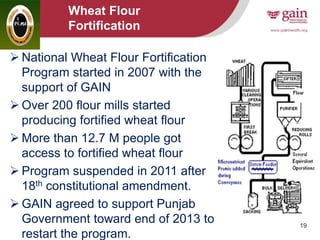
Wheat Flour
Fortification
 National Wheat Flour Fortification
Program started in 2007 with the
support of GAIN
 Over 200 flour mills started
producing fortified wheat flour
 More than 12.7 M people got
access to fortified wheat flour
 Program suspended in 2011 after
18th constitutional amendment.
 GAIN agreed to support Punjab
Government toward end of 2013 to
restart the program.
20
GAIN’s Support to
Project
 Training and capacity building of industry and regulatory
bodies
 Laboratory strengthening and provision of spot testing kits
 Set up supply chain mechanism for market based
availability of micronutrients in Pakistan
 BCC to increase the demand of fortified wheat flour
 Support government and industry for legislative and legal
framework
 Support in setting up monitoring and evaluation
mechanism
 Assist government and industry for mechanism to pass
through the fortification cost to consumer
21
PFMA’s Support to
Project
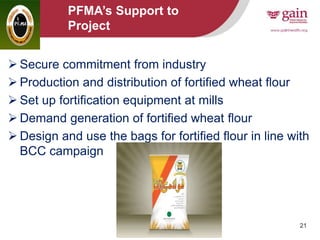
 Secure commitment from industry
 Production and distribution of fortified wheat flour
 Set up fortification equipment at mills
 Demand generation of fortified wheat flour
 Design and use the bags for fortified flour in line with
BCC campaign
22
Government Support to
Project
 Political commitment and patronage of the
program
 Legislation for mandatory fortification and legal
framework
 Allow industry to pass through the minor cost of
fortification to consumer
 Coordination and collaboration among
stakeholders
 Awareness raising through public services
messages
 Regulatory monitoring and enforcement of
23
Thank you

Wheat Flour Fortification

  • 1.
    1 Wheat Flour Fortification MalikTariq Sarwar Awan, Food Technologist, Chairman Research Wing to Pakistan Flour Mills Association, Editor, Wheat Milling News, PFMA . Member Pakistan Society of Food Scientists and Technologists & Munawar Hussain Program Manager Food Fortification Global Alliance for Improved Nutrition (GAIN)
  • 2.
    2 What is FoodSecurity? When all people, at all times, have physical and economic access to sufficient, safe and nutritious food to meet their dietary needs and food preferences for an active and healthy life. Source: according to World Food Summit FOOD SECURITY Availabilityof nutritiousfood FoodAccess Stability FoodUtilization
  • 3.
    3 Food Security inPakistan 28.4 26.5 29.2 19.8 17.7 20.7 9.8 8.2 10.5 0 10 20 30 40 50 60 70 Pakistan Urban Rural Food Insecure with hunger (Sever) Food Insecure with hunger (moderate) Food Insecure without hunger
  • 4.
    4 Food Insecurity • FoodInsecurity principally connected to o Low production o Low socio-economic status o Increasing prices of food o Geographic hurdles and distribution • The main determinant of food insecurity is malnutrition
  • 5.
    5 Malnutrition and FoodInsecurity 25 32 42 0 5 10 15 20 25 30 35 40 45 food secure food insecure without hunger food insecure with moderate to severe hunger %ofyoungchildrenstunted The worse the food insecurity, the higher the child malnutrition
  • 6.
    6 Pakistan’s Progress onMalnutrition Indicator NNS 2001-02 NNS 2011 1. Wasting % (Low Weight for Height) 12% 15% 2. Stunting% (Low Height for Age) 31% 44% 3. Under Weight% (Low Weight for Age) 42% 32% 4. Anemia (Children) 51% 62% 5. Anemia (Pregnant women) 29% 51% 6. Iodine Deficiency (Children) 63% 36% 7. Iodine Deficiency (Women) 76% 36% 8. Vitamin A Def (Children) 13% 54% 9. Vitamin A Def (Non-pregnant women) 6% 42%
  • 7.
    7 Why Malnutrition Matters? Pneumonia 15% Injuries,3% Other, 19% Neonatal 42% HIV/AIDS 1% Diarrhoea 19% Measles 1% Malaria 1% 45% attributable to Under nutrition Globally 45% of under-five deaths are attributable to under nutrition
  • 8.
    8 Why Malnutrition Matters? Costlyinefficiencies (e.g. illness, deaths) Direct links: Decreased physical productivity Indirect links: impaired cognitive development, schooling and productivity Overall loss to the economy of 3% of GDP annually Bigger than energy crises (2% of GDP)
  • 9.
    9 Micronutrient Deficiencies Affect mainlywomen and children due to poor quality of diet or depletion due to losses (e.g. infections) Main deficiencies: Iodine Vitamin A Iron Folic acid Zinc Also called HIDDEN HUNGER – often invisible
  • 10.
    10 Consequences of Iron andFolic Acid Deficiency  Iron deficiency anemia  Poor cognitive development  Reduced body immunity and resistance against diseases  Neural tube defects  Increased child and mother mortality
  • 11.
  • 12.
    12 Maternal Anemia Source: NNS2011 0 10 20 30 40 50 60 70 No Pregnant Women Pregnant Women
  • 13.
    13 Anemia - ChildrenUnder Five Years of Age Source: NNS 2011 61.9 62.9 61.4 60.3 72.5 47.3 56.8 46 41 0 10 20 30 40 50 60 70 80
  • 14.
  • 15.
    15 Addressing Micronutrient Malnutrition Food Fortification DietaryDiversification Supplementation Food fortification is safe and cost-effective intervention for the prevention of micronutrient deficiencies and has been widely practiced in developed countries for well over a century
  • 16.
    16 Why Fortification? Could targetpopulation at large Technology - simple and well established Global success history of addressing deficiencies of micronutrients Economical - very cost-effective No need to change dietary habits of targeted population Fortification vehicles are easily accessible
  • 17.
    17 Top 10 Investmentsfor advancing global welfare 1 Micronutrient supplements - Malnutrition 2 The Doha development agenda - Trade 3 Micronutrient fortification - Malnutrition 4 Expanded immunization coverage for children - Diseases 5 Agricultural R&D on micronutrients - Malnutrition 6 Deworming and nutrition programs at school - Malnutrition 7 Lowering the price of schooling - Education 8 Increase and improve girls’ schooling - Women 9 Community-based nutrition promotion - Malnutrition 10 Provide support for women’s reproductive role - Women Copenhagen Consensus
  • 18.
    18 Fortification - Key SuccessFactors Political commitment and support Industry support Adequate legislation Consumer acceptance No cultural or other objection Availability of micronutrients and fortification equipment/ dossifiers Economically sustainable interventions
  • 19.
    19 Wheat Flour Fortification  NationalWheat Flour Fortification Program started in 2007 with the support of GAIN  Over 200 flour mills started producing fortified wheat flour  More than 12.7 M people got access to fortified wheat flour  Program suspended in 2011 after 18th constitutional amendment.  GAIN agreed to support Punjab Government toward end of 2013 to restart the program.
  • 20.
    20 GAIN’s Support to Project Training and capacity building of industry and regulatory bodies  Laboratory strengthening and provision of spot testing kits  Set up supply chain mechanism for market based availability of micronutrients in Pakistan  BCC to increase the demand of fortified wheat flour  Support government and industry for legislative and legal framework  Support in setting up monitoring and evaluation mechanism  Assist government and industry for mechanism to pass through the fortification cost to consumer
  • 21.
    21 PFMA’s Support to Project Secure commitment from industry  Production and distribution of fortified wheat flour  Set up fortification equipment at mills  Demand generation of fortified wheat flour  Design and use the bags for fortified flour in line with BCC campaign
  • 22.
    22 Government Support to Project Political commitment and patronage of the program  Legislation for mandatory fortification and legal framework  Allow industry to pass through the minor cost of fortification to consumer  Coordination and collaboration among stakeholders  Awareness raising through public services messages  Regulatory monitoring and enforcement of
  • 23.