

































CARPE DIEM’12
WHATS THE GOOD WORD
       | sabi | ks|
ETYMOLOGY
1

• This word derives from the Old French word
  meaning "tail." The precise reference to tail is
  uncertain: it may be to an animal `turning tail'
  in flight, or to the habit in animals of drawing
  the tail between the hinder legs. A X is thus,
  literally, someone who turns his tail and runs.
ANSWER
COWARD
2
• The word X has its roots in Latin, and was used as a
  synonym for a pole or a stake. Since stakes are often
  used to mark boundaries, a X was a particular area
  within certain limits. The X or the English X, was the
  part of Ireland that was directly under the control of
  the English government in the late Middle Ages and
  the area was subject to British Law. Those who lived
  outside this area did not come under English
  jurisdiction and were thought to be uncivilized. This
  has led to a very common English phrase.
   ID the phrase
BEYOND THE PALE
3

This word comes from French, for a seller of
medicines who might advertise his presence with
music and an outdoor stage show. The best
known of the Parisian X's was Tabarin, who set up
a stage in the Place Dauphin, Paris way back in
1618. The word can also be traced to Spanish for
an indiscreetly talkative person, a chatterbox.
Ultimately, etymologists trace X from either the
Italian ciarlare, to prattle; or from Cerretano, a
resident of Cerreto, a village in Umbria, known
for its quacks.
ANSWER

CHARLATAN
4

X is a literary, dramatic or musical work intended to cause laughter
by caricaturing the manner or spirit of serious works, or by ludicrous
treatment of their subjects. The word derives from the Italian word
meaning - a joke, ridicule or mockery. X overlaps in meaning with
caricature, parody and travesty, and, in its theatrical sense, with
extravaganza, as presented during the Victorian era.X has been used
in English in this literary and theatrical sense since the late 17th
century. It has widely been applied retrospectively to works of
Chaucer and Shakespeare and to the Graeco-Roman classics. A later
use of the term, particularly in the United States, refers to
performances in a variety show format. These were popular from
the 1860s to the 1940s, often in cabarets and clubs, as well as
theatres, and featured bawdy comedy and female striptease. Some
Hollywood films attempted to recreate the spirit of these
performances from the 1930s to the 1960s, or included X-style
scenes within dramatic films, such as 1972's Cabaret and 1979's All
That Jazz, among others.
ANSWER
• BURLESQUE
5

This word derives from the Greek word
"bous," meaning ox. “Bous” eventually led to
"boukolos," meaning herdsman. The present
meaning of the word is used with regard to
idealized country life and means idyllically
rustic. Give the good word.
ANSWER
• Bucolic
6

The word ----------------- derives from the name of
Étienne de X, a French finance minister who, in
1759, was forced by France's credit crisis during
the Seven Years War to impose severe economic
demands upon the French people, particularly
the wealthy.Because of X’s austere economies, his
name became eponymous with anything done or
made cheaply and so with a type of outline
portrait.Prior to the advent of photography, -------
----- profiles cut from black card were the
cheapest way of recording a person's
appearance. FITB
ANSWER
Silhouette
7

The X was based on the 19th century upper-crust English habit of taking
tea at ______. Not that the notably upper-crust 7th Earl of Shaftesbury
had much time for it. He is reported in Edwin Hodder's biography, 1886, as
saying:
“______ tea, that pernicious, unprincipled and stomach-ruining habit.
Nevertheless, the teas became popular with the middle-classes and
became known as ‘________' and, when the habit travelled the Atlantic to
the USA, light late-afternoon meals were renamed ‘_______ dinners'.
In the 1930s, the marketing department of the Gem Company while
dreaming up a new advertising campaign, decided to try and convince
previously unsuspecting men that they suffered from 'ugly, afternoon
beard growth' and that this could only be countered by the purchase and
use of 'Gem Micromatic Blades'. Needing a snappy name for this late-
afternoon ailment, which would of course bar sufferers from any genteel
'_______ dinner', they chose to call it X.
 Give the term X.
ANSWER
5 o’clock shadow
8
  This idiom probably originates from an article
published on 14 February 1807 by radical journalist
William Cobbett in his polemical Political Register. In a
critique of the English press, which had mistakenly
reported Napoleon's defeat, Cobbett recounted that he
had once used a X to deflect hounds in pursuit of a
hare, adding "It was a mere transitory effect of the
political X; for, on the Saturday, the scent became as
cold as a stone." The present meaning is of a X is a clue
which is intentionally or unintentionally misleading or
distracting from the actual issue. The term is mostly
used to claim that the argument of another person is
not relevant to the issue being discussed..
ANSWER
Red Herring
9

This word is from latin, meaning liquid. The ancient philosophers believed
that four liquids entered into the makeup of our bodies, and that our
temperment was determined by the proportions of these four fluids,or
Xs, which they listed as blood, phlegm, bile, and black bile. If you had a
surplus of blood, the first X, you were of the optimistic and sanguine
temperament . A generous portion of phlegm, on the other hand made
you "phlegmatic", or slow and unexciteable. Too much yellow bile and you
saw the world through a "bilious" eye , and since the word "bile" is chole
in Latin, you were apt to be choleric and short tempered. The fourth X, the
non-existent black bile, was a little special invention of the ancient
physiologists. A too heavy proportion of this made you "melancholy," for
in latin melancholia meant " the state of having too much black bile." Any
imbalance of these Xs, therefore made a person unwell and perhaps
eccentric, and, as the years went by, the word X took on the meaning of
"oddness," and a X man was one that we now call a crank. And finally, the
word was applied to those who could provoke laughter at the oddities and
the incongruities of life.
ANSWER
Humour
10

This word is from the Greek word meaning, "the
act of distributing or apportioning" and later
became, wrath and retribution, righteous
indignation at the breach of rules. X was a deity
who restores the balance. If a bunch of
shipmakers were to launch a vessel without
saluting the gods, this act of hubris might call
forth a counter-reaction. There was no
judgmentalism or divine punishment involved,
simply a response from the other world to lapses
occurring in this one.
ANSWER
Nemesis
ANAGRAMS
1

Enhance worst photo
ANSWER

The Canon PowerShot
2

Huge water tale stuns. End had you tense
ANSWER

Twenty thousand leagues under the sea
3

Stroller on Go, Amasses Nothing
ANSWER

A Rolling Stone Gathers No Moss
4

Sad man's erotic craze
ANSWER

Actress Cameron Diaz
5

The children each try a lot of cacao!
ANSWER

Charlie and the Chocolate Factory
6

ETs choose drunk or indecent filth
ANSWER

Close Encounters of the Third Kind
7

A thin man ran; makes a large stride; left
planet, pins flag on moon! On to Mars!
ANSWER

"That's one small step for a man, one giant leap
 for mankind." Neil A. Armstrong
8

Oh, an UV atmosphere below
ANSWER

Houston, we have a problem
9

Play in any bosom
ANSWER

Playboy Mansion
10

hero's a fat gnome
ANSWER

A Game of Thrones
REBUSES
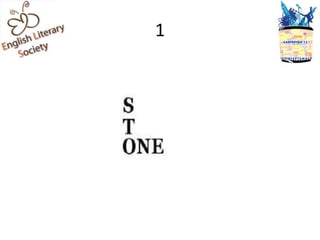
1
ANSWER

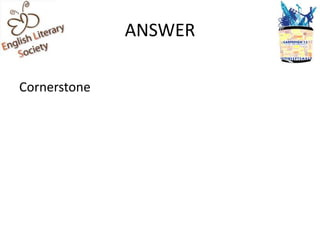
Cornerstone
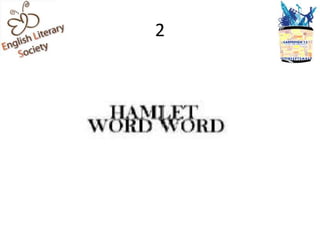
2
ANSWER

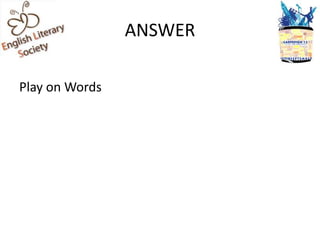
Play on Words
3
ANSWER
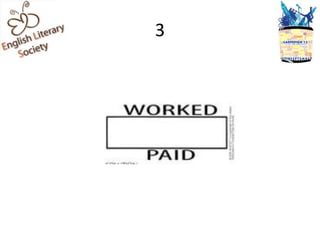
Overworked and Underpaid
4
ANSWER
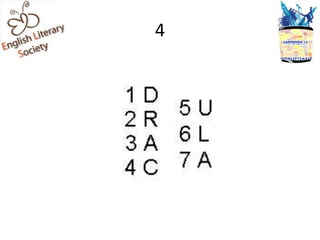
Count Dracula
5
ANSWER
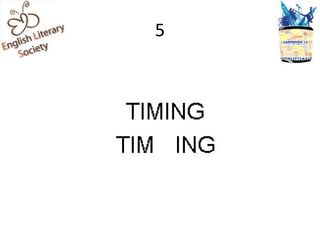
Split Second Timing
IT’S COMPLICATED!


(The title of this round is dedicated to Sabi in
honour of his relationship status)
 The above lines may be enclosed in
brackets, but, sabi sure doesn’t know how to put
bracket!
1

At some point in the implied time period, the
process of locomotion becomes a herculean
task resulting in the conjecture that, from that
point on, only the tenacious one's will be able
to execute the process without much
constrain.
ANSWER

When the going gets tough, the tough get going.


 ( This answer is in honour of the organizer with
  the British accent)
2

The probability that the verdure is more
verdant on the diametrically opposite portion
of a large inverted cone that came into
existence from the substratum due to some
intricate process of the Supreme Mother
Nature, is always one.
ANSWER

The grass is always greener on the other side
of the hill
3

On any given day, a delineation has the same
valuation as that of a millenary of lexemes
ANSWER

A picture is worth a thousand words
4

The process of performing the mathematical
operation of addition on any two elements
belonging to the universal set of sins, never
yields an element belonging to the set of fair
deeds
ANSWER

Two wrongs don't make a right
5

The sturdiness of a twisted and
interconnected cord, usually made of a metal
forged at the smithies, depends crucially on
the most frail connection
ANSWER

A chain is only as strong as its weakest link
WHATS THE GOOD WORD Finals

WHATS THE GOOD WORD Finals

  • 1.
    CARPE DIEM’12 WHATS THEGOOD WORD | sabi | ks|
  • 4.
  • 5.
    1 • This wordderives from the Old French word meaning "tail." The precise reference to tail is uncertain: it may be to an animal `turning tail' in flight, or to the habit in animals of drawing the tail between the hinder legs. A X is thus, literally, someone who turns his tail and runs.
  • 7.
  • 8.
    2 • The wordX has its roots in Latin, and was used as a synonym for a pole or a stake. Since stakes are often used to mark boundaries, a X was a particular area within certain limits. The X or the English X, was the part of Ireland that was directly under the control of the English government in the late Middle Ages and the area was subject to British Law. Those who lived outside this area did not come under English jurisdiction and were thought to be uncivilized. This has led to a very common English phrase. ID the phrase
  • 10.
  • 11.
    3 This word comesfrom French, for a seller of medicines who might advertise his presence with music and an outdoor stage show. The best known of the Parisian X's was Tabarin, who set up a stage in the Place Dauphin, Paris way back in 1618. The word can also be traced to Spanish for an indiscreetly talkative person, a chatterbox. Ultimately, etymologists trace X from either the Italian ciarlare, to prattle; or from Cerretano, a resident of Cerreto, a village in Umbria, known for its quacks.
  • 13.
  • 14.
    4 X is aliterary, dramatic or musical work intended to cause laughter by caricaturing the manner or spirit of serious works, or by ludicrous treatment of their subjects. The word derives from the Italian word meaning - a joke, ridicule or mockery. X overlaps in meaning with caricature, parody and travesty, and, in its theatrical sense, with extravaganza, as presented during the Victorian era.X has been used in English in this literary and theatrical sense since the late 17th century. It has widely been applied retrospectively to works of Chaucer and Shakespeare and to the Graeco-Roman classics. A later use of the term, particularly in the United States, refers to performances in a variety show format. These were popular from the 1860s to the 1940s, often in cabarets and clubs, as well as theatres, and featured bawdy comedy and female striptease. Some Hollywood films attempted to recreate the spirit of these performances from the 1930s to the 1960s, or included X-style scenes within dramatic films, such as 1972's Cabaret and 1979's All That Jazz, among others.
  • 16.
  • 17.
    5 This word derivesfrom the Greek word "bous," meaning ox. “Bous” eventually led to "boukolos," meaning herdsman. The present meaning of the word is used with regard to idealized country life and means idyllically rustic. Give the good word.
  • 19.
  • 20.
    6 The word -----------------derives from the name of Étienne de X, a French finance minister who, in 1759, was forced by France's credit crisis during the Seven Years War to impose severe economic demands upon the French people, particularly the wealthy.Because of X’s austere economies, his name became eponymous with anything done or made cheaply and so with a type of outline portrait.Prior to the advent of photography, ------- ----- profiles cut from black card were the cheapest way of recording a person's appearance. FITB
  • 22.
  • 23.
    7 The X wasbased on the 19th century upper-crust English habit of taking tea at ______. Not that the notably upper-crust 7th Earl of Shaftesbury had much time for it. He is reported in Edwin Hodder's biography, 1886, as saying: “______ tea, that pernicious, unprincipled and stomach-ruining habit. Nevertheless, the teas became popular with the middle-classes and became known as ‘________' and, when the habit travelled the Atlantic to the USA, light late-afternoon meals were renamed ‘_______ dinners'. In the 1930s, the marketing department of the Gem Company while dreaming up a new advertising campaign, decided to try and convince previously unsuspecting men that they suffered from 'ugly, afternoon beard growth' and that this could only be countered by the purchase and use of 'Gem Micromatic Blades'. Needing a snappy name for this late- afternoon ailment, which would of course bar sufferers from any genteel '_______ dinner', they chose to call it X. Give the term X.
  • 25.
  • 26.
    8 Thisidiom probably originates from an article published on 14 February 1807 by radical journalist William Cobbett in his polemical Political Register. In a critique of the English press, which had mistakenly reported Napoleon's defeat, Cobbett recounted that he had once used a X to deflect hounds in pursuit of a hare, adding "It was a mere transitory effect of the political X; for, on the Saturday, the scent became as cold as a stone." The present meaning is of a X is a clue which is intentionally or unintentionally misleading or distracting from the actual issue. The term is mostly used to claim that the argument of another person is not relevant to the issue being discussed..
  • 28.
  • 29.
    9 This word isfrom latin, meaning liquid. The ancient philosophers believed that four liquids entered into the makeup of our bodies, and that our temperment was determined by the proportions of these four fluids,or Xs, which they listed as blood, phlegm, bile, and black bile. If you had a surplus of blood, the first X, you were of the optimistic and sanguine temperament . A generous portion of phlegm, on the other hand made you "phlegmatic", or slow and unexciteable. Too much yellow bile and you saw the world through a "bilious" eye , and since the word "bile" is chole in Latin, you were apt to be choleric and short tempered. The fourth X, the non-existent black bile, was a little special invention of the ancient physiologists. A too heavy proportion of this made you "melancholy," for in latin melancholia meant " the state of having too much black bile." Any imbalance of these Xs, therefore made a person unwell and perhaps eccentric, and, as the years went by, the word X took on the meaning of "oddness," and a X man was one that we now call a crank. And finally, the word was applied to those who could provoke laughter at the oddities and the incongruities of life.
  • 31.
  • 32.
    10 This word isfrom the Greek word meaning, "the act of distributing or apportioning" and later became, wrath and retribution, righteous indignation at the breach of rules. X was a deity who restores the balance. If a bunch of shipmakers were to launch a vessel without saluting the gods, this act of hubris might call forth a counter-reaction. There was no judgmentalism or divine punishment involved, simply a response from the other world to lapses occurring in this one.
  • 34.
  • 35.
  • 36.
  • 38.
  • 39.
    2 Huge water talestuns. End had you tense
  • 41.
  • 42.
    3 Stroller on Go,Amasses Nothing
  • 44.
    ANSWER A Rolling StoneGathers No Moss
  • 45.
  • 47.
  • 48.
    5 The children eachtry a lot of cacao!
  • 50.
    ANSWER Charlie and theChocolate Factory
  • 51.
    6 ETs choose drunkor indecent filth
  • 53.
  • 54.
    7 A thin manran; makes a large stride; left planet, pins flag on moon! On to Mars!
  • 56.
    ANSWER "That's one smallstep for a man, one giant leap for mankind." Neil A. Armstrong
  • 57.
    8 Oh, an UVatmosphere below
  • 59.
  • 60.
  • 62.
  • 63.
  • 65.
  • 66.
  • 67.
  • 69.
  • 70.
  • 72.
  • 73.
  • 75.
  • 76.
  • 78.
  • 79.
  • 81.
  • 82.
    IT’S COMPLICATED! (The titleof this round is dedicated to Sabi in honour of his relationship status) The above lines may be enclosed in brackets, but, sabi sure doesn’t know how to put bracket!
  • 83.
    1 At some pointin the implied time period, the process of locomotion becomes a herculean task resulting in the conjecture that, from that point on, only the tenacious one's will be able to execute the process without much constrain.
  • 85.
    ANSWER When the goinggets tough, the tough get going. ( This answer is in honour of the organizer with the British accent)
  • 86.
    2 The probability thatthe verdure is more verdant on the diametrically opposite portion of a large inverted cone that came into existence from the substratum due to some intricate process of the Supreme Mother Nature, is always one.
  • 88.
    ANSWER The grass isalways greener on the other side of the hill
  • 89.
    3 On any givenday, a delineation has the same valuation as that of a millenary of lexemes
  • 91.
    ANSWER A picture isworth a thousand words
  • 92.
    4 The process ofperforming the mathematical operation of addition on any two elements belonging to the universal set of sins, never yields an element belonging to the set of fair deeds
  • 94.
  • 95.
    5 The sturdiness ofa twisted and interconnected cord, usually made of a metal forged at the smithies, depends crucially on the most frail connection
  • 97.
    ANSWER A chain isonly as strong as its weakest link