what’s the difference between:
a National Qualification
at College:
an Undergraduate Degree
at University:
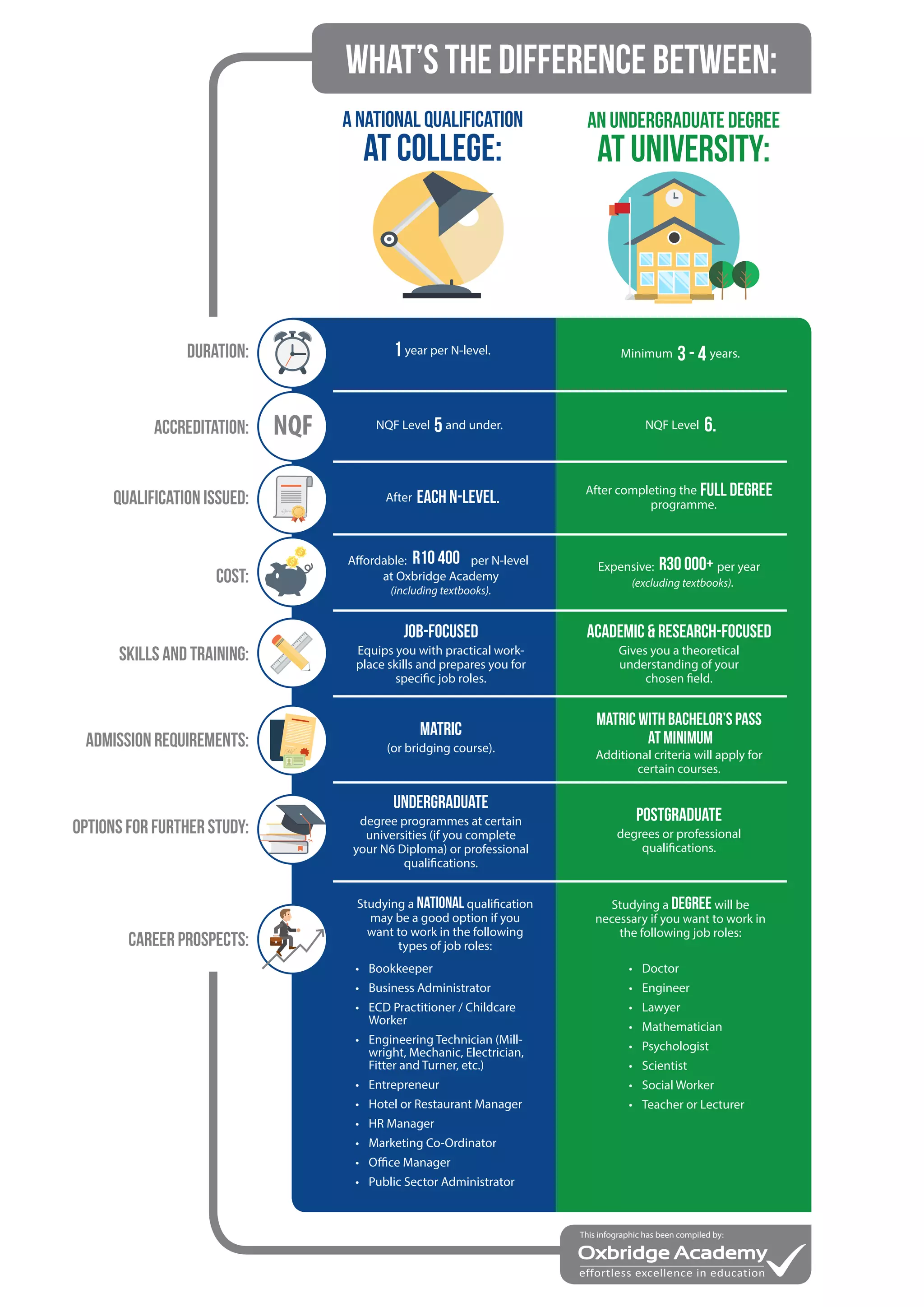
Duration: year per N-level.1
Accreditation: NQF Level 6.NQF
Qualification issued: After each N-level.
NQF Level 5and under.
Minimum 3 - 4 years.
After completing the full degree
programme.
cost:
Affordable: R10 400
at Oxbridge Academy
(including textbooks).
per N-level Expensive: R30 000+ per year
(excluding textbooks).
Job-focused
Equips you with practical work-
place skills and prepares you for
specific job roles.
Skills and training:
Academic & research-focused
Gives you a theoretical
understanding of your
chosen field.
matric
(or bridging course).Admission requirements:
Matric with Bachelor’s Pass
at minimum
Additional criteria will apply for
certain courses.
undergraduate
degree programmes at certain
universities (if you complete
your N6 Diploma) or professional
qualifications.
Options for further study:
postgraduate
degrees or professional
qualifications.
Career prospects:
Studying a national qualification
may be a good option if you
want to work in the following
types of job roles:
•	 Bookkeeper
•	 Business Administrator
•	 ECD Practitioner / Childcare
Worker
•	 Engineering Technician (Mill-
wright, Mechanic, Electrician,
Fitter and Turner, etc.)
•	 Entrepreneur
•	 Hotel or Restaurant Manager
•	 HR Manager
•	 Marketing Co-Ordinator
•	 Office Manager
•	 Public Sector Administrator
Studying a degree will be
necessary if you want to work in
the following job roles:
•	 Doctor
•	 Engineer
•	 Lawyer
•	 Mathematician
•	 Psychologist
•	 Scientist
•	 Social Worker
•	 Teacher or Lecturer
This infographic has been compiled by:

What’s the Difference Between:

  • 1.
    what’s the differencebetween: a National Qualification at College: an Undergraduate Degree at University: Duration: year per N-level.1 Accreditation: NQF Level 6.NQF Qualification issued: After each N-level. NQF Level 5and under. Minimum 3 - 4 years. After completing the full degree programme. cost: Affordable: R10 400 at Oxbridge Academy (including textbooks). per N-level Expensive: R30 000+ per year (excluding textbooks). Job-focused Equips you with practical work- place skills and prepares you for specific job roles. Skills and training: Academic & research-focused Gives you a theoretical understanding of your chosen field. matric (or bridging course).Admission requirements: Matric with Bachelor’s Pass at minimum Additional criteria will apply for certain courses. undergraduate degree programmes at certain universities (if you complete your N6 Diploma) or professional qualifications. Options for further study: postgraduate degrees or professional qualifications. Career prospects: Studying a national qualification may be a good option if you want to work in the following types of job roles: • Bookkeeper • Business Administrator • ECD Practitioner / Childcare Worker • Engineering Technician (Mill- wright, Mechanic, Electrician, Fitter and Turner, etc.) • Entrepreneur • Hotel or Restaurant Manager • HR Manager • Marketing Co-Ordinator • Office Manager • Public Sector Administrator Studying a degree will be necessary if you want to work in the following job roles: • Doctor • Engineer • Lawyer • Mathematician • Psychologist • Scientist • Social Worker • Teacher or Lecturer This infographic has been compiled by: