What Next? Sustaining Innovation
Presentation structure Defining the innovation challenge Identifying the most common obstacles to    ongoing innovation Providing some useful tools to overcome obstacles    and introduce and support ongoing innovation
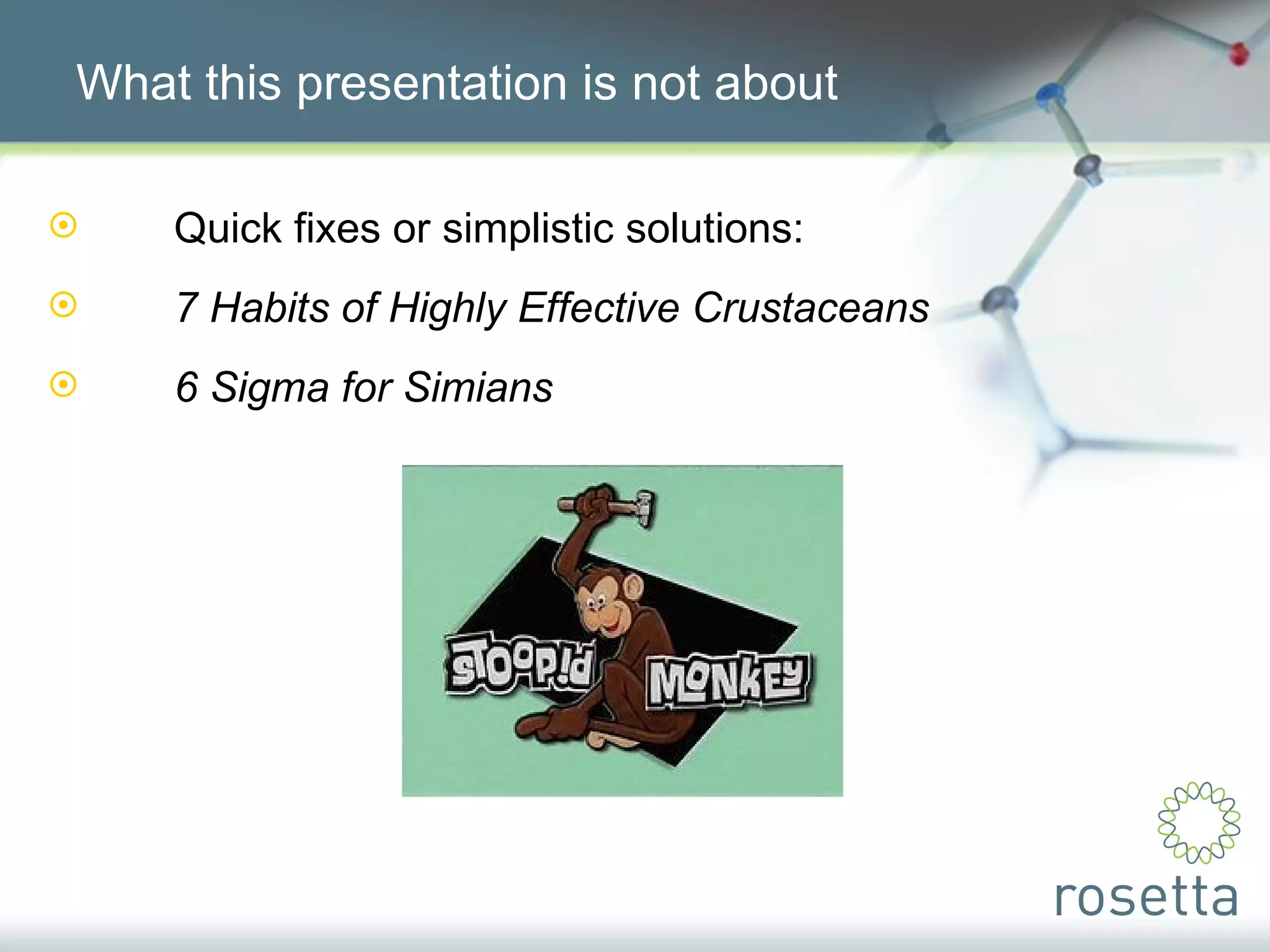
What this presentation is not about Quick fixes or simplistic solutions: 7 Habits of Highly Effective Crustaceans 6 Sigma for Simians
What this presentation is about It is the result of my research to answer a question: Why does an industry so reliant on discovery (the  ‘ what if? ’ question) not always innovate at later  stages of business? Why do we so often get stuck on the ‘ what next ?’  question? My answers focus more on leadership creating the  conditions for an innovation environment than on  managing processes
What if?
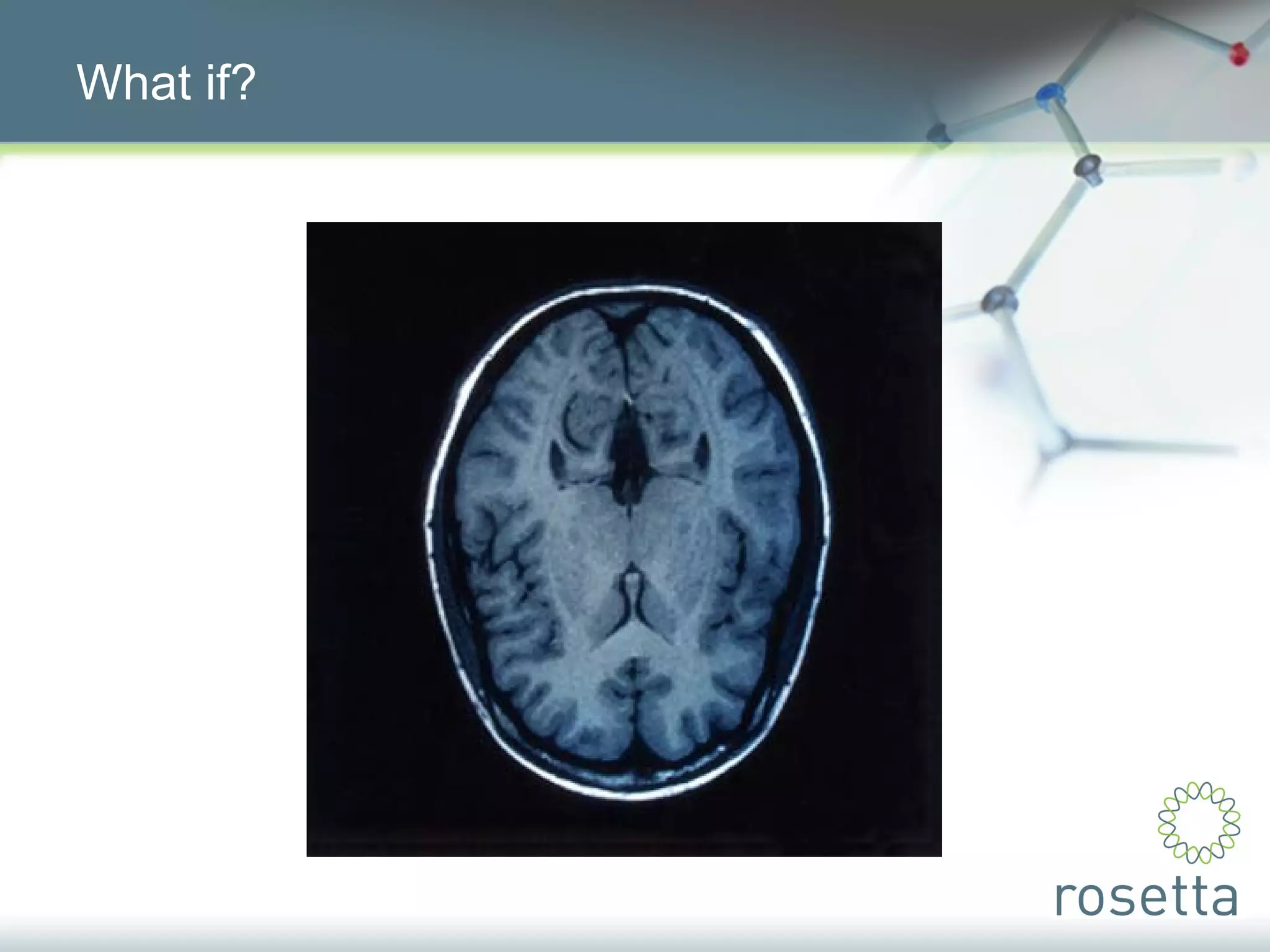
What if? What if we excited the protons in your body with a  giant magnet and then took a picture? Magnetic resonance imaging (MRI) Thanks Sir Peter Mansfield and Paul Lauterbur!
What if?
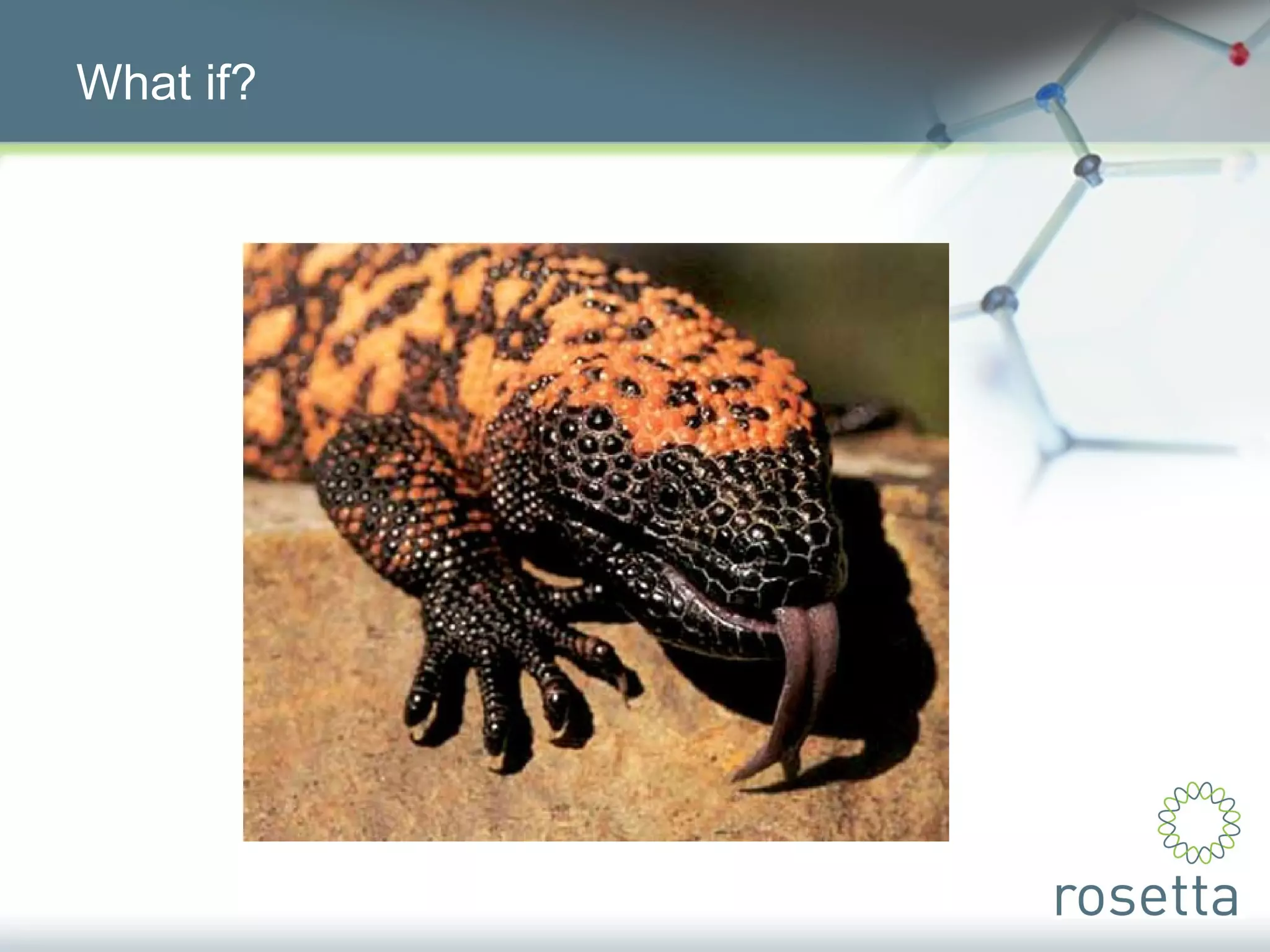
What if? What if we used the spit of a Gila Monster, a  venomous lizard, to treat type 2 diabetes? Byetta (exenatide)
What next? Innovation often declines after the first ‘big idea’ Routine sets in as we shepherd the big idea  through trials and approvals The inevitable question is what to do next to  capitalize on the innovation Put another way – how can we be innovative in  other aspects of the business in order to maximize  return on the original innovation?
A step back – what is innovation? Literally means ‘to make new’ A new idea or combination of ideas that  challenges the present order If efficiency is doing better what is already  being done then innovation is doing what is not  yet being done or doing it in a new way Drucker says it is the “instrument of  entrepreneurship” Innovation is not measured by the discovery of some  truth but by ‘performativity’ – usefulness
 
Hold on a minute… 1 st  objection: our work has no room for innovation Things like drug submissions are very rigorous – the  devil’s in the details We need to focus on getting it right We can’t risk screwing it up Even in routine work there is room for innovation
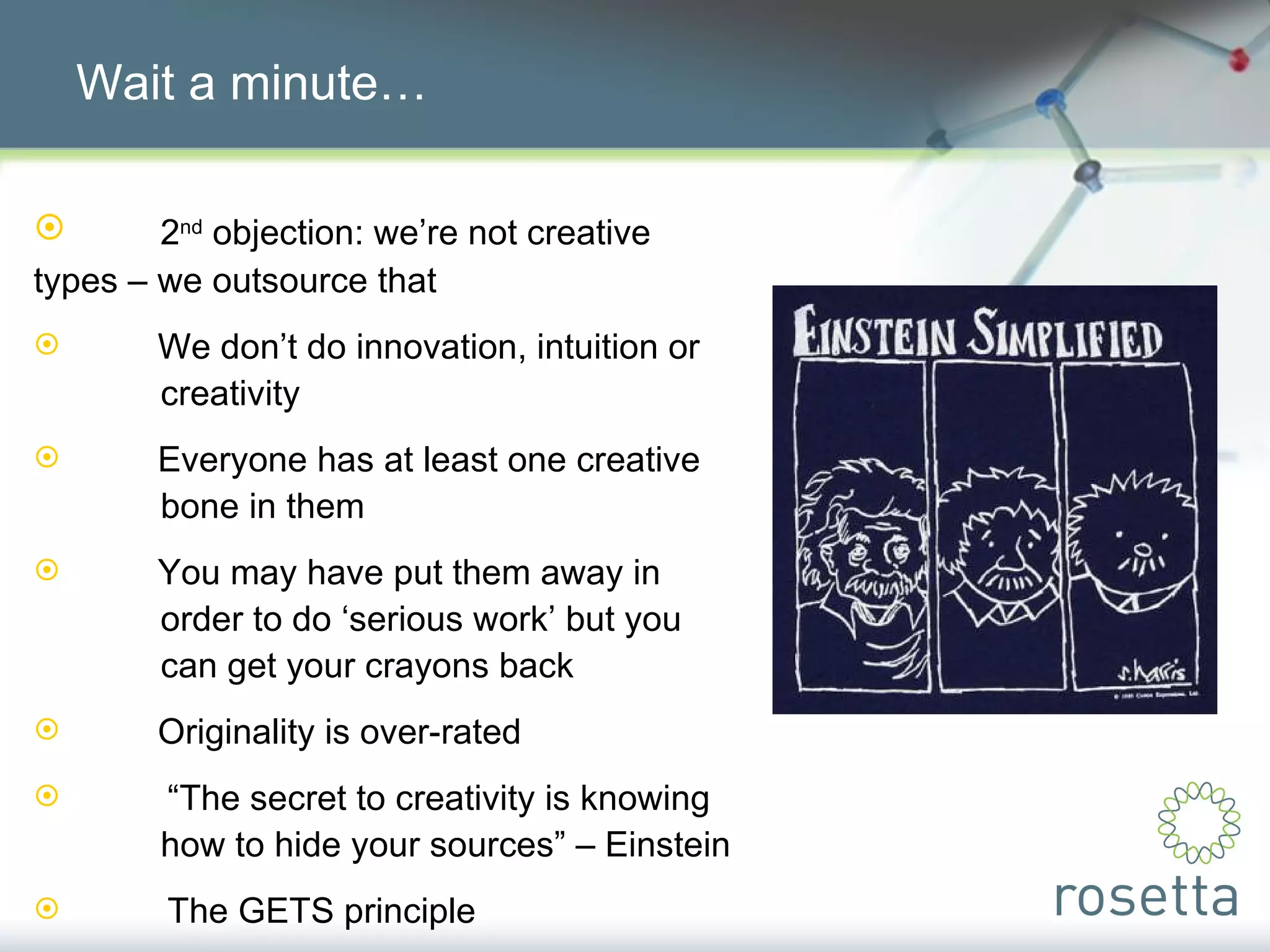
Wait a minute… 2 nd  objection: we’re not creative  types – we outsource that We don’t do innovation, intuition or  creativity Everyone has at least one creative  bone in them You may have put them away in  order to do ‘serious work’ but you  can get your crayons back Originality is over-rated “ The secret to creativity is knowing  how to hide your sources” – Einstein The GETS principle
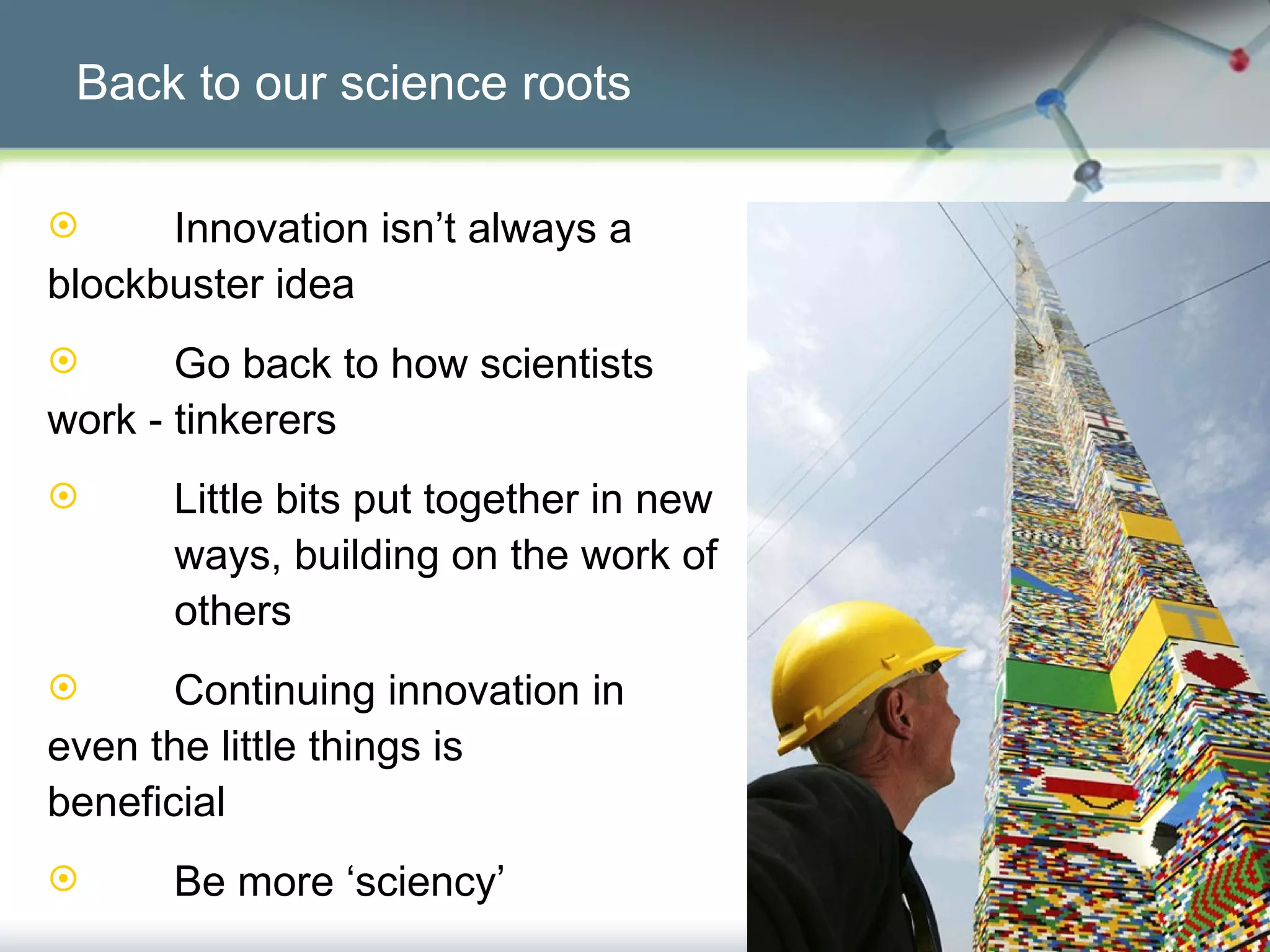
Back to our science roots Innovation isn’t always a  blockbuster idea Go back to how scientists  work - tinkerers Little bits put together in new  ways, building on the work of  others Continuing innovation in  even the little things is  beneficial Be more ‘sciency’
 
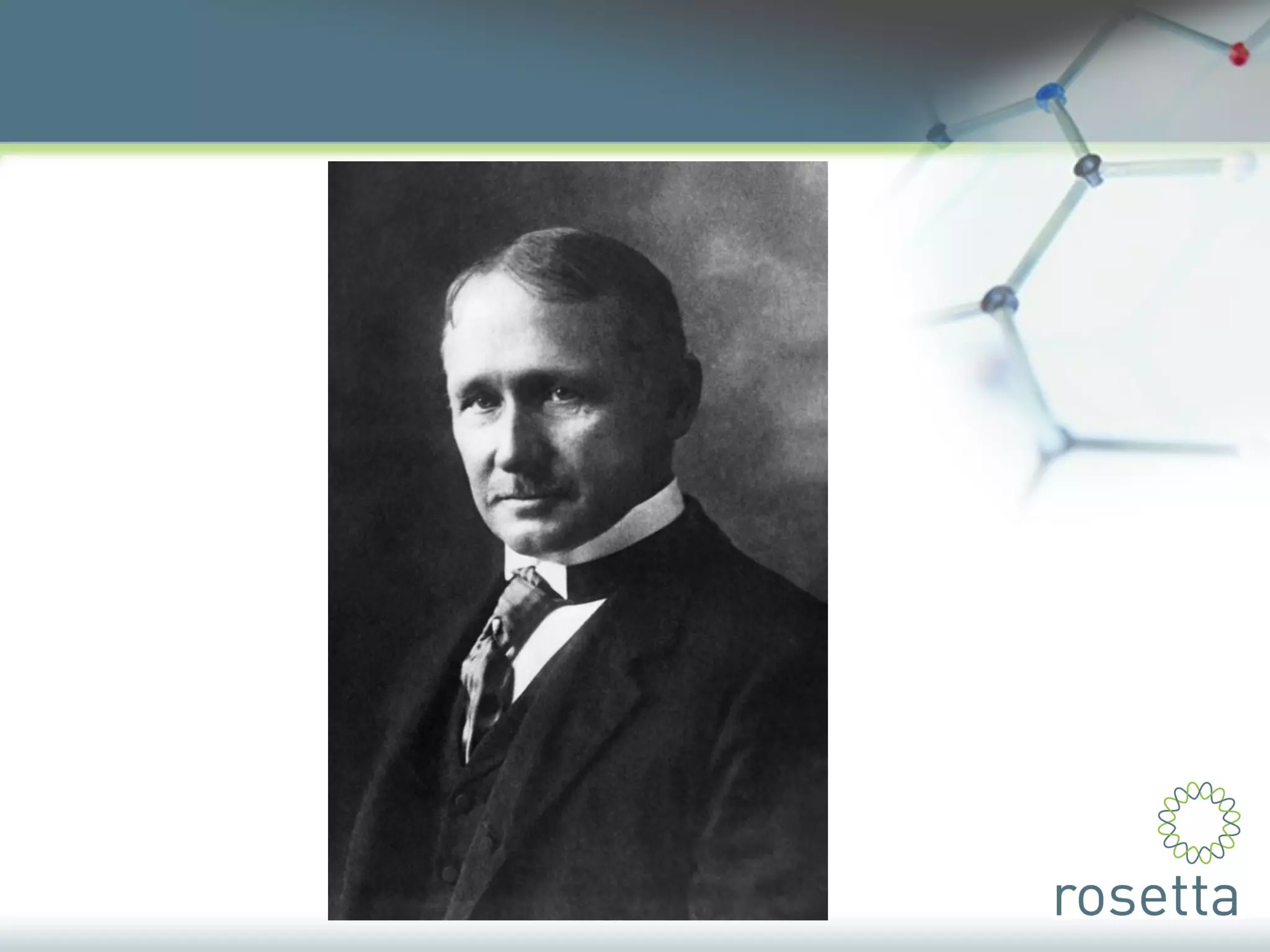
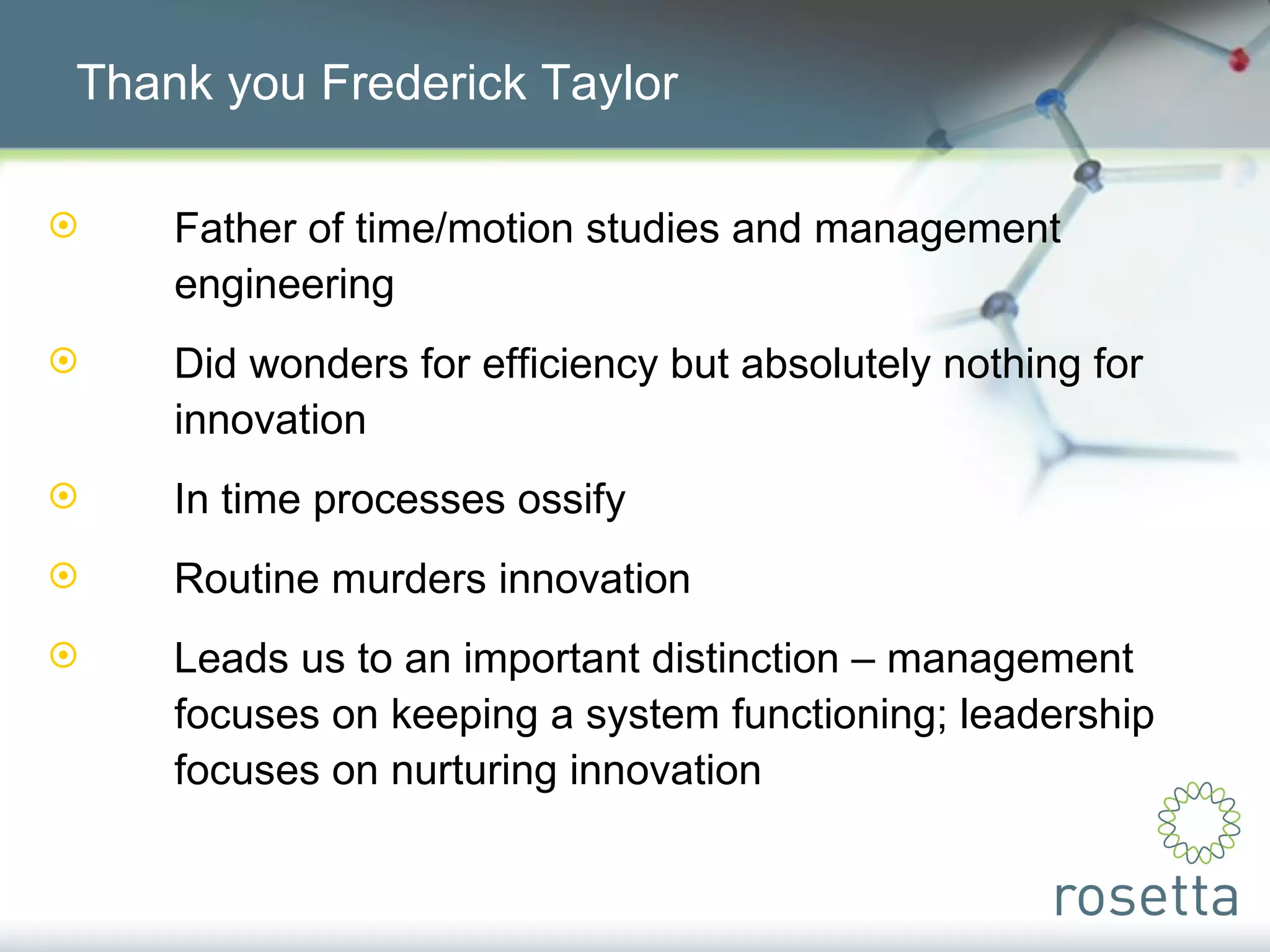
Thank you Frederick Taylor Father of time/motion studies and management  engineering Did wonders for efficiency but absolutely nothing for  innovation In time processes ossify Routine murders innovation Leads us to an important distinction – management  focuses on keeping a system functioning; leadership  focuses on nurturing innovation
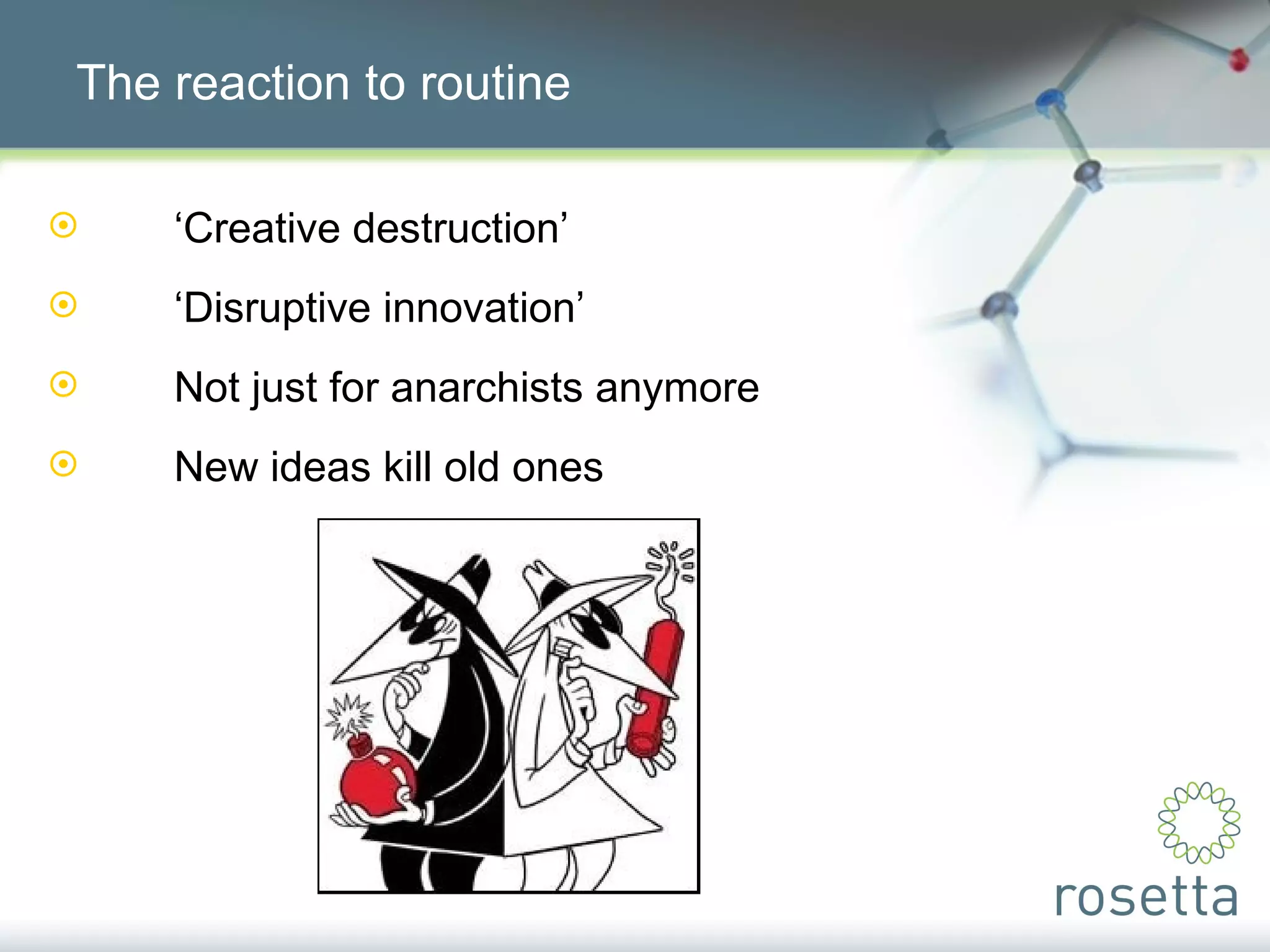
The reaction to routine ‘ Creative destruction’ ‘ Disruptive innovation’ Not just for anarchists anymore New ideas kill old ones
Disruptive innovation All innovation is corrosive to routine Q1: How much chaos can you take? Q2: How can we introduce innovation and still  preserve the fabric of the organization? Fear sparked by these 2 questions often quashes  innovation – continuity of the organization trumps  change The shock of the new can make us put the brakes  on innovation
Obstacles to ongoing innovation
Risk aversion What’s the missing word? Risk/_________
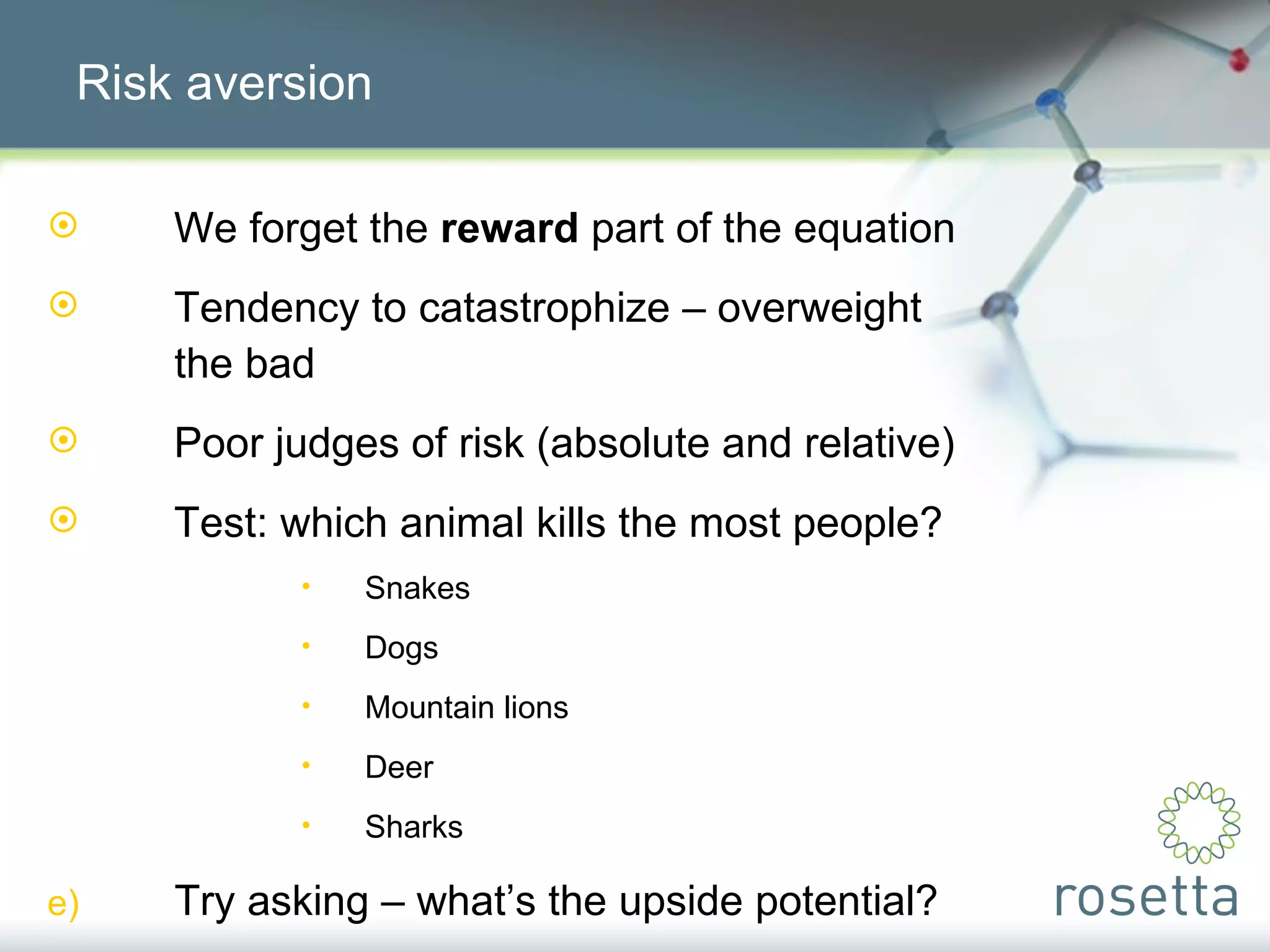
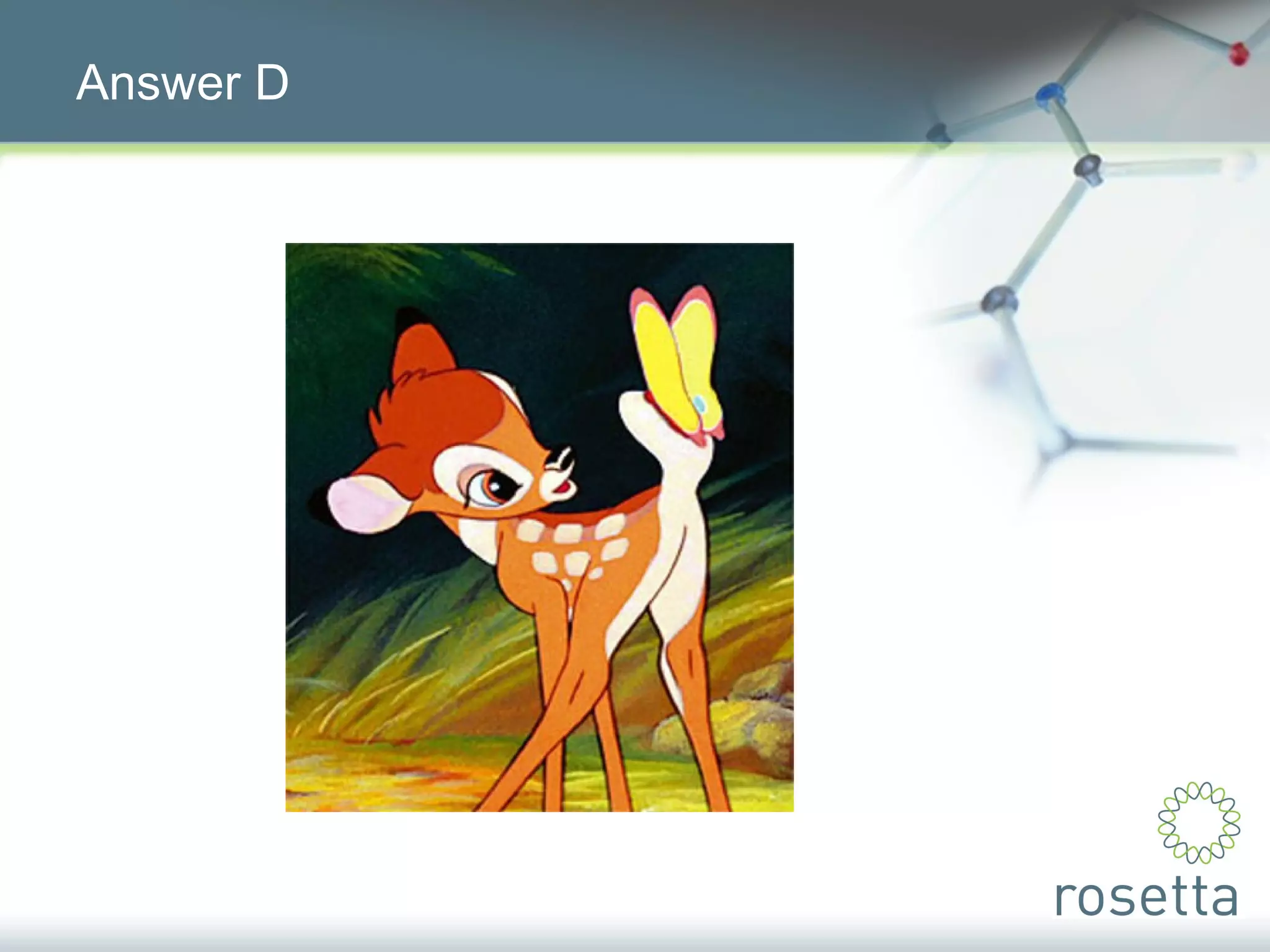
Risk aversion We forget the  reward  part of the equation Tendency to catastrophize – overweight  the bad Poor judges of risk (absolute and relative) Test: which animal kills the most people? Snakes Dogs Mountain lions Deer Sharks Try asking – what’s the upside potential?
Answer D
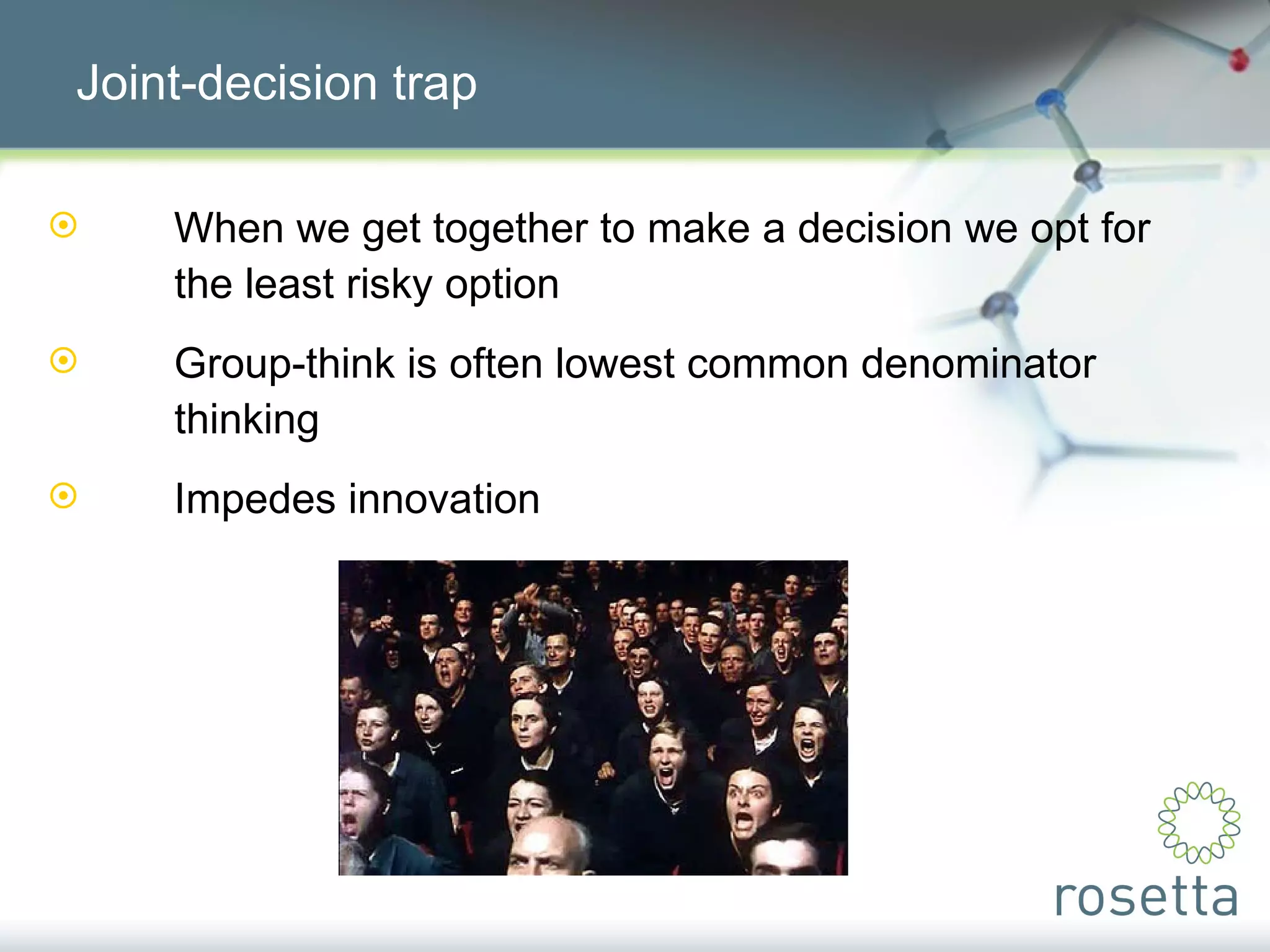
Joint-decision trap When we get together to make a decision we opt for  the least risky option Group-think is often lowest common denominator  thinking Impedes innovation
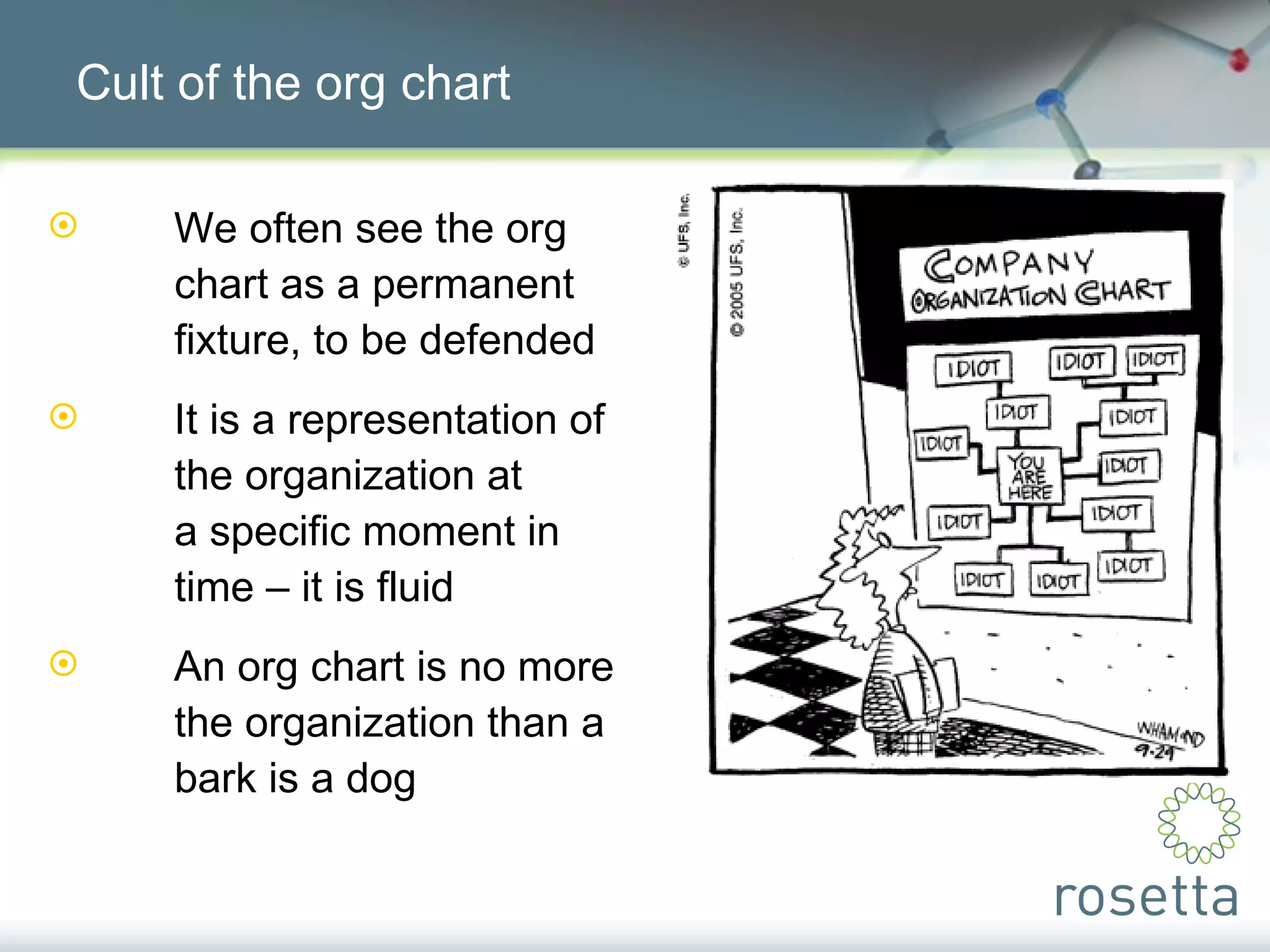
Cult of the org chart We often see the org  chart as a permanent  fixture, to be defended It is a representation of  the organization at  a specific moment in  time – it is fluid An org chart is no more  the organization than a  bark is a dog
Indeterminacy Not knowing what the results will be is profoundly  disturbing in a goal-oriented culture Ambiguity is destabilizing (a good thing, ultimately,  but disturbing) “ Creativity requires the courage to let go of  certainties” – Erich Fromm
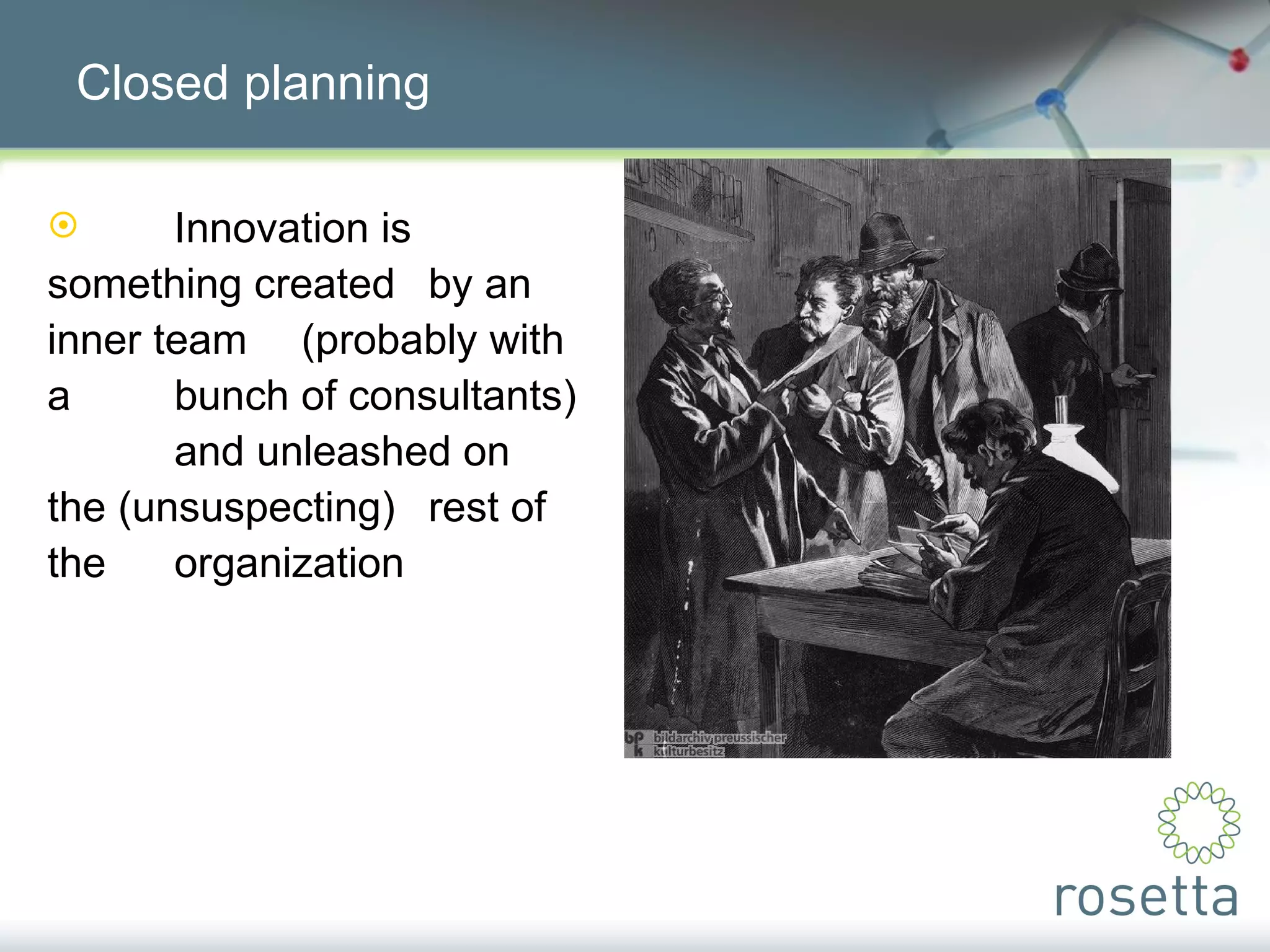
Closed planning Innovation is  something created  by an inner team  (probably with a  bunch of consultants)  and unleashed on  the (unsuspecting)  rest of the  organization
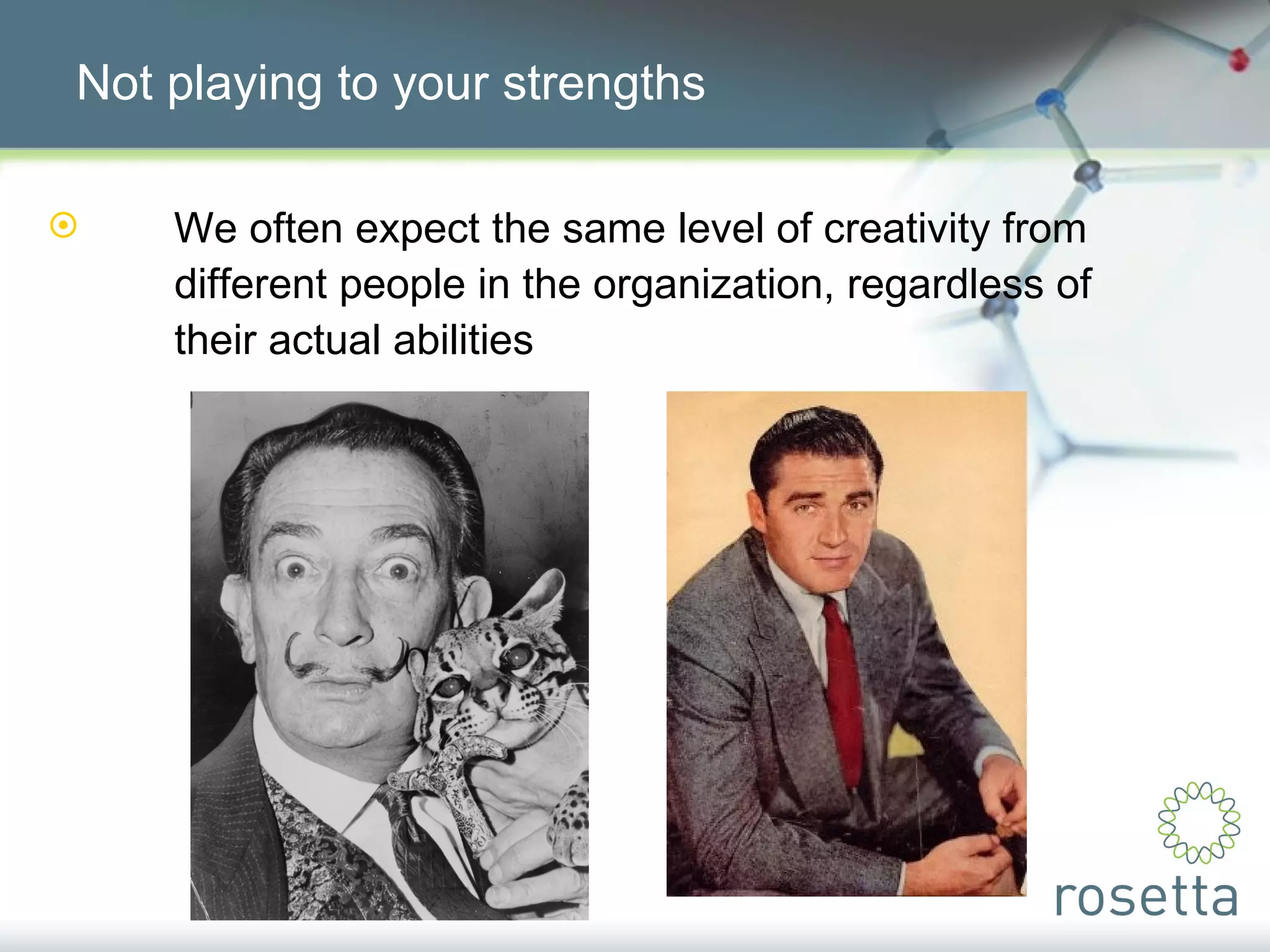
Not playing to your strengths We often expect the same level of creativity from  different people in the organization, regardless of  their actual abilities
Accepting assumptions Unchallenged biases obstruct innovation Ideas bring frames of reference with them “ Don’t think of an elephant” (George Lakoff)
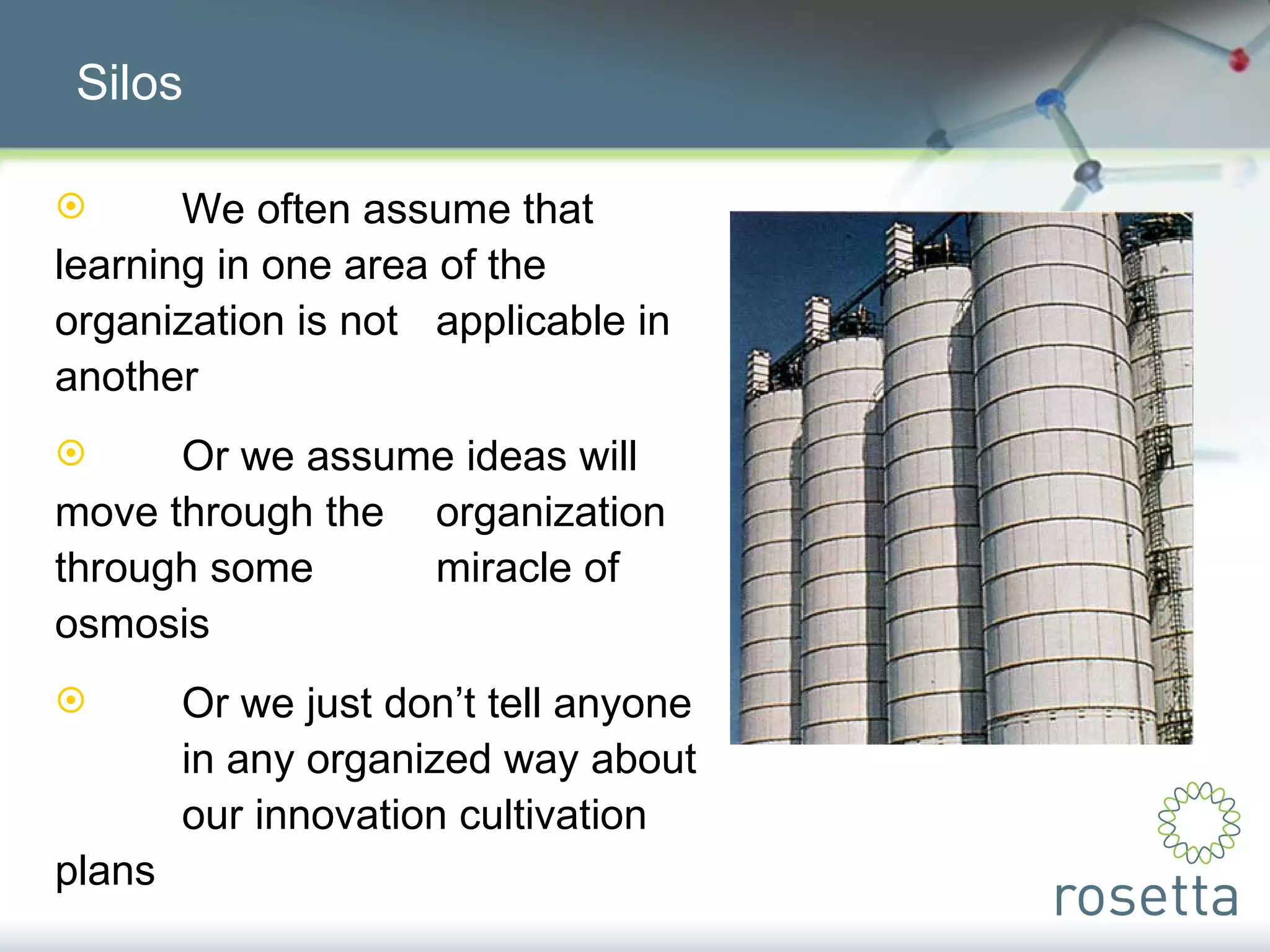
Silos We often assume that  learning in one area of the  organization is not  applicable in another Or we assume ideas will  move through the  organization through some  miracle of osmosis Or we just don’t tell anyone  in any organized way about  our innovation cultivation  plans
Misalignment & mis-measurement Organizational practices like HR don’t align with  innovation objectives or expectations For example – no real rewards for risk-taking We don’t measure innovation activity and  communicate our results to the organization at  large… or we measure the wrong things (successes,  for example, rather than total innovation activity)
Ways to cultivate ongoing innovation
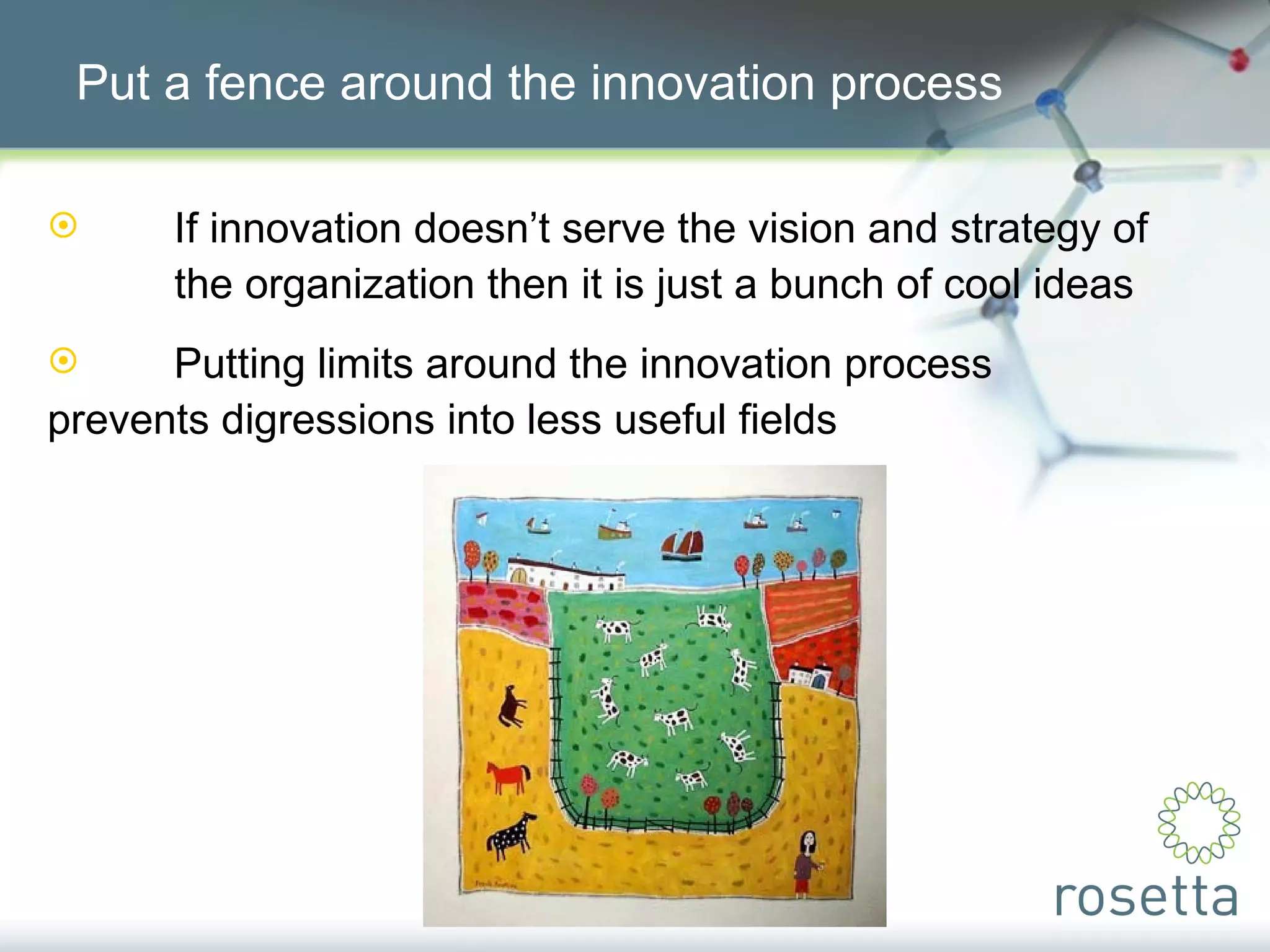
Put a fence around the innovation process If innovation doesn’t serve the vision and strategy of  the organization then it is just a bunch of cool ideas Putting limits around the innovation process  prevents digressions into less useful fields
People People are not stupid – most in this sector have  advanced degrees People choose organizations based on their own  comfort with risk and volatility – some go for large  pharma companies, some for tiny biotechs Work with what you’ve got Be honest when assessing your innovation  capability
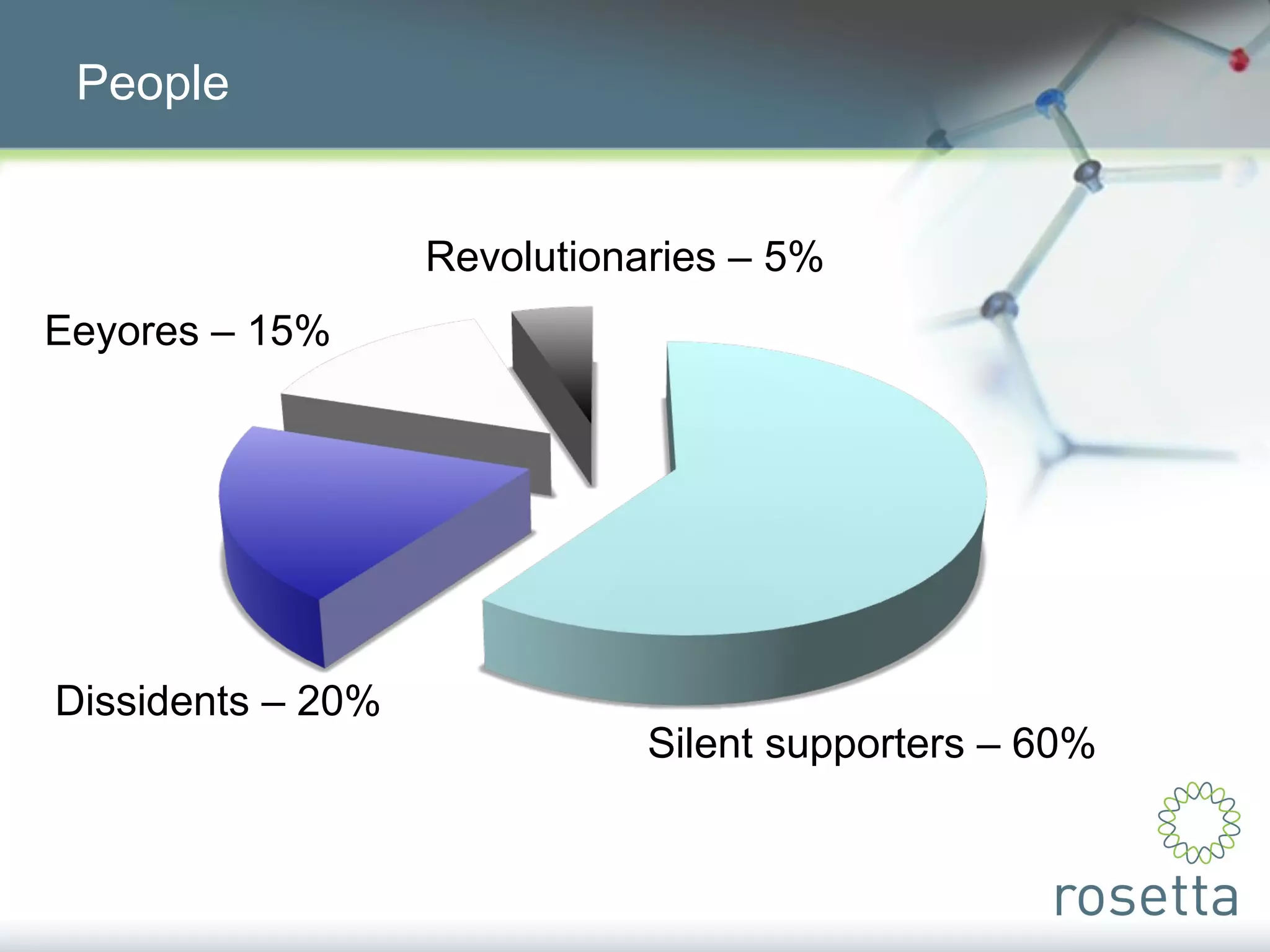
People Many ways to sort innovation capacity Revolutionaries – will take risks, have ideas Dissidents – have ideas but less likely to move on  them; easily rallied Silent supporters – will get behind innovation once  initiated Eeyores – immovable obstacles
People Revolutionaries  –  5% Silent supporters  –  60% Eeyores  –  15% Dissidents  –  20%
The environment Creating a supportive environment for innovation is  possibly the most important leadership task It is about creating the conditions for innovation, not  about some idiot-proof ‘9 steps to earth-shaking  ideas’ process If you do build innovation structures, remember they  are meant to be provisional – they should be torn  down when they have outlived their usefulness Use external resources to refresh innovation  environment or accelerate innovation
Innovation structures Expand mandate of existing training & development  teams in HR Create innovation advisory group internally to  nurture and evaluate innovations Build an innovation incubator with the capacity to  take innovations, develop them and sell them to  senior management (or hire someone to do it) Establish a fund or access to resources to enable  people to autonomously develop their innovations  (and give them the time to do so) Let everyone know what you are doing
 
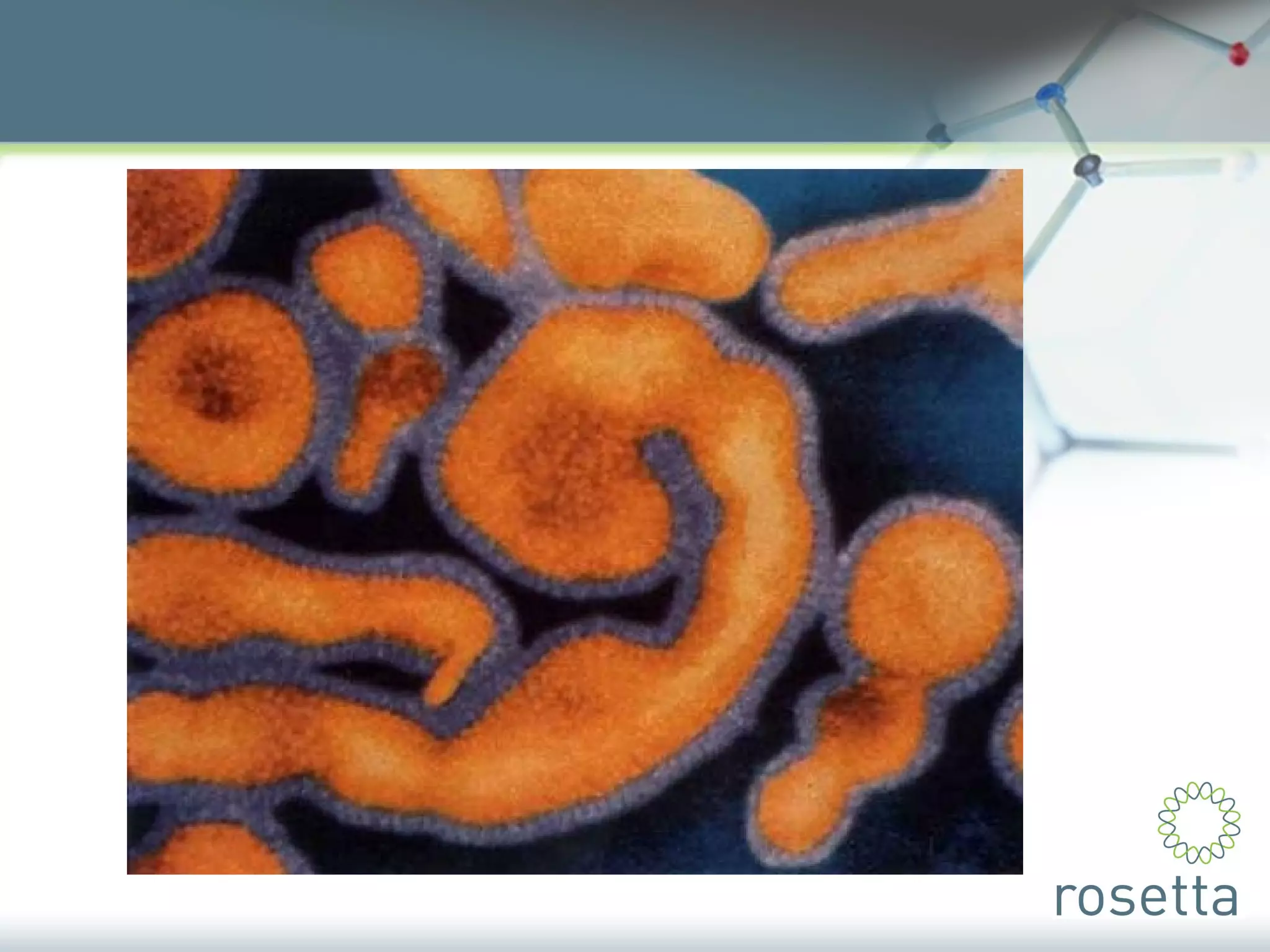
The Ebola example Highly contagious Remains highly virulent Spread the infection of your innovation throughout  the organization – as far as possible with maximum  effect
Openness Looping in with stakeholders and customers –  knowing what their challenges and  perspectives are can spark innovation Open innovation – most successful model  is Lilly’s Innocentive (now spun off) a virtual network  of problem solvers working on challenges – 30%  success rate P&G also notable for linking in all employees  globally to shared knowledge base Can be replicated on smaller scale
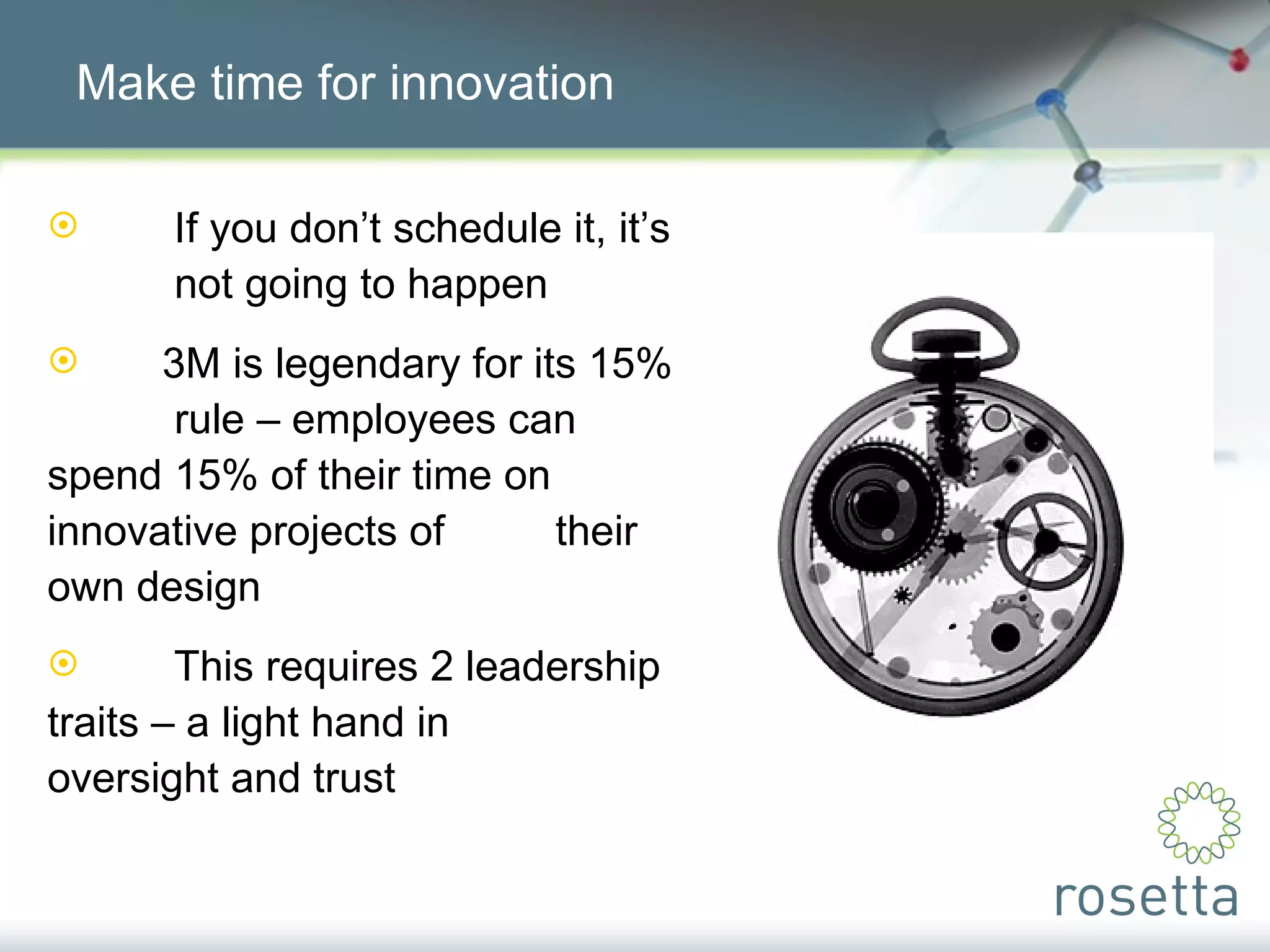
Make time for innovation If you don’t schedule it, it’s  not going to happen 3M is legendary for its 15%  rule – employees can  spend 15% of their time on  innovative projects of  their own design This requires 2 leadership  traits – a light hand in  oversight and trust
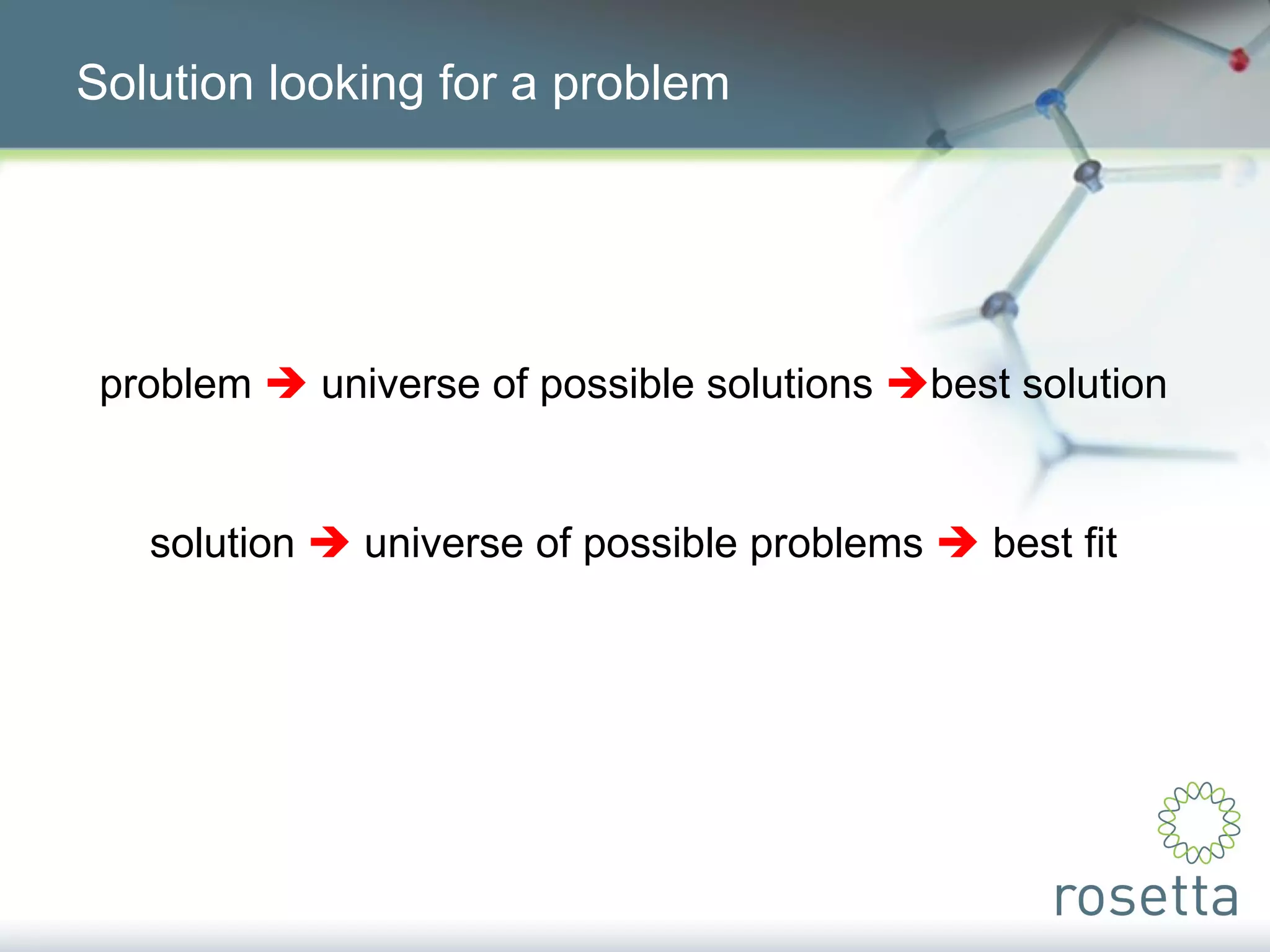
Solution looking for a problem problem    universe of possible solutions   best solution solution    universe of possible problems    best fit
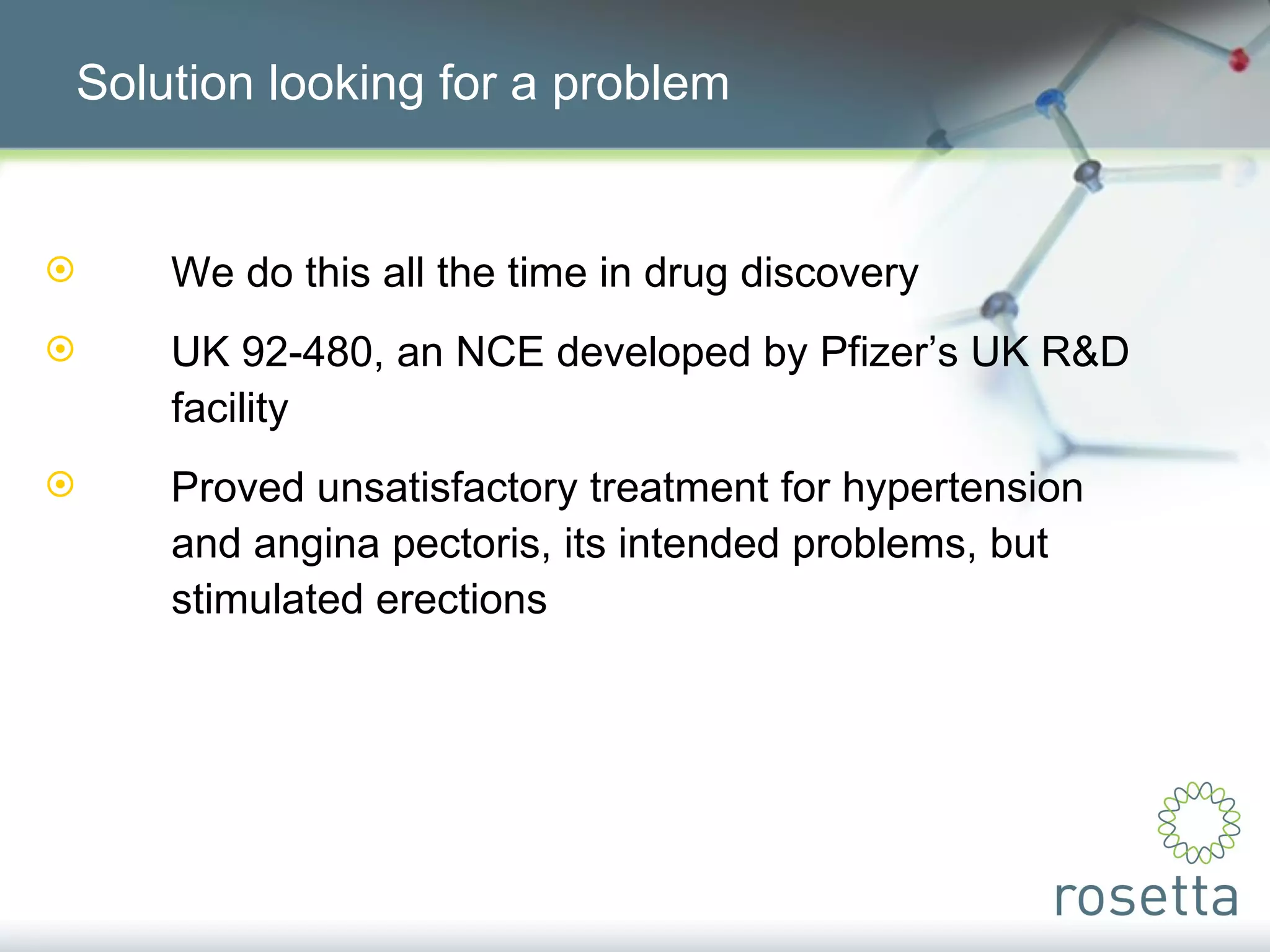
Solution looking for a problem We do this all the time in drug discovery UK 92-480, an NCE developed by Pfizer’s UK R&D  facility Proved unsatisfactory treatment for hypertension  and angina pectoris, its intended problems, but  stimulated erections
Fight inertia Inertia – things like to keep on doing what they’re  already doing… even if it’s nothing Reward success Reward failure Do not reward inaction Rationale: support risk-taking environment, spur  activity, fuel forward momentum
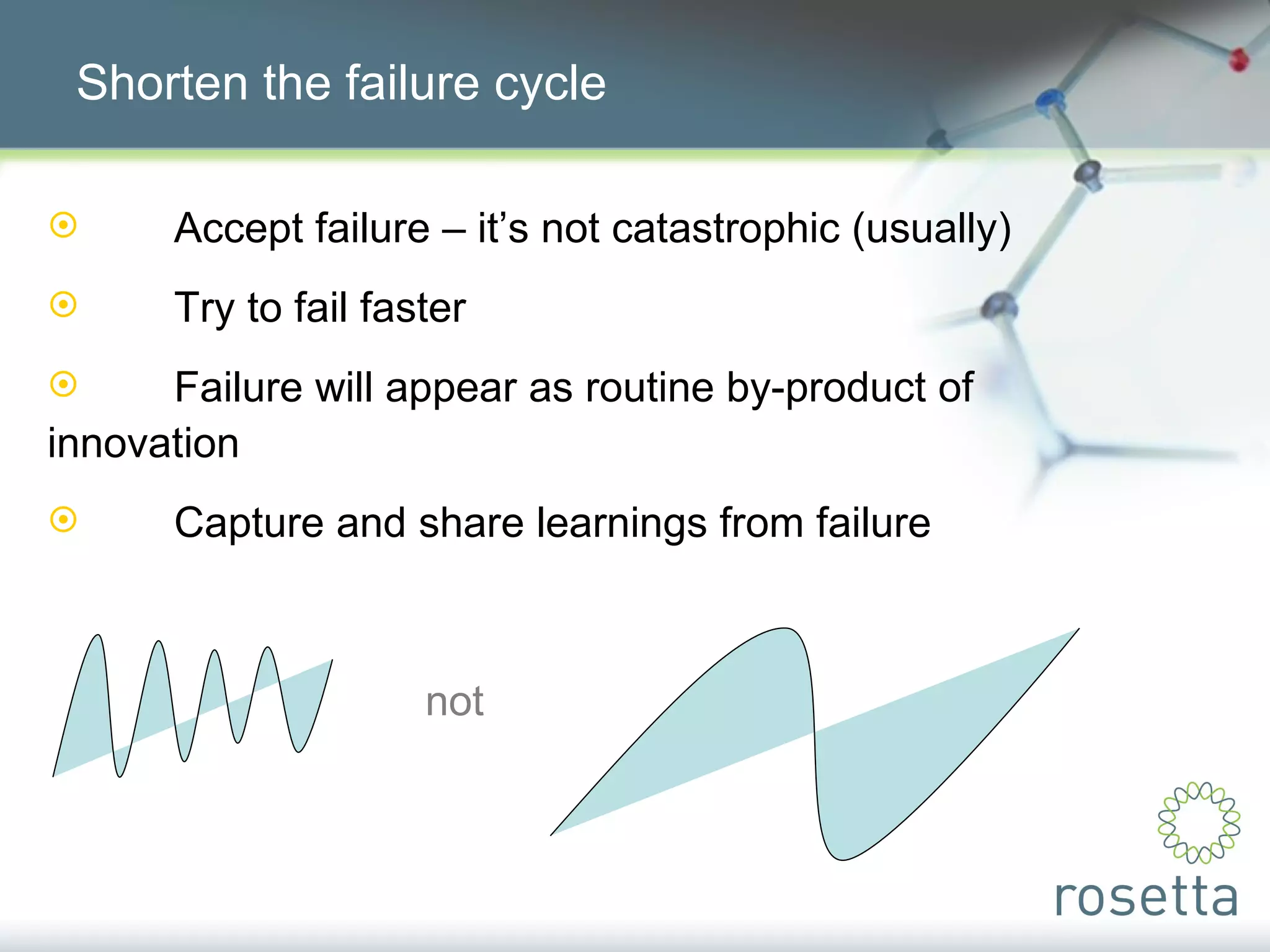
Shorten the failure cycle Accept failure – it’s not catastrophic (usually) Try to fail faster Failure will appear as routine by-product of  innovation Capture and share learnings from failure not
Sell the innovation “ Nothing happens until something gets sold” – Bob  Metcalfe, founder, 3Com Innovation needs take up in order to thrive Informal and formal opportunities need to be created  to sell ideas internally
Some ideas Build and launch an ongoing innovation team, best if  embedded in the front-line business units Create ways to reward innovation generation –  praise and recognition work! Establish channels to communicate innovation  vision and support across the organization and to  sell it to decision-makers Capitalize on social networks Re-connect with your science roots
Paul McIvor 416.516.7095 416.906.1276 C [email_address] 179 Fern Avenue Toronto, ON, Canada M6R 1K2 Contact

What Next? Sustaining Innovation

  • 1.
  • 2.
    Presentation structure Definingthe innovation challenge Identifying the most common obstacles to ongoing innovation Providing some useful tools to overcome obstacles and introduce and support ongoing innovation
  • 3.
    What this presentationis not about Quick fixes or simplistic solutions: 7 Habits of Highly Effective Crustaceans 6 Sigma for Simians
  • 4.
    What this presentationis about It is the result of my research to answer a question: Why does an industry so reliant on discovery (the ‘ what if? ’ question) not always innovate at later stages of business? Why do we so often get stuck on the ‘ what next ?’ question? My answers focus more on leadership creating the conditions for an innovation environment than on managing processes
  • 5.
  • 6.
    What if? Whatif we excited the protons in your body with a giant magnet and then took a picture? Magnetic resonance imaging (MRI) Thanks Sir Peter Mansfield and Paul Lauterbur!
  • 7.
  • 8.
    What if? Whatif we used the spit of a Gila Monster, a venomous lizard, to treat type 2 diabetes? Byetta (exenatide)
  • 9.
    What next? Innovationoften declines after the first ‘big idea’ Routine sets in as we shepherd the big idea through trials and approvals The inevitable question is what to do next to capitalize on the innovation Put another way – how can we be innovative in other aspects of the business in order to maximize return on the original innovation?
  • 10.
    A step back– what is innovation? Literally means ‘to make new’ A new idea or combination of ideas that challenges the present order If efficiency is doing better what is already being done then innovation is doing what is not yet being done or doing it in a new way Drucker says it is the “instrument of entrepreneurship” Innovation is not measured by the discovery of some truth but by ‘performativity’ – usefulness
  • 11.
  • 12.
    Hold on aminute… 1 st objection: our work has no room for innovation Things like drug submissions are very rigorous – the devil’s in the details We need to focus on getting it right We can’t risk screwing it up Even in routine work there is room for innovation
  • 13.
    Wait a minute…2 nd objection: we’re not creative types – we outsource that We don’t do innovation, intuition or creativity Everyone has at least one creative bone in them You may have put them away in order to do ‘serious work’ but you can get your crayons back Originality is over-rated “ The secret to creativity is knowing how to hide your sources” – Einstein The GETS principle
  • 14.
    Back to ourscience roots Innovation isn’t always a blockbuster idea Go back to how scientists work - tinkerers Little bits put together in new ways, building on the work of others Continuing innovation in even the little things is beneficial Be more ‘sciency’
  • 15.
  • 16.
    Thank you FrederickTaylor Father of time/motion studies and management engineering Did wonders for efficiency but absolutely nothing for innovation In time processes ossify Routine murders innovation Leads us to an important distinction – management focuses on keeping a system functioning; leadership focuses on nurturing innovation
  • 17.
    The reaction toroutine ‘ Creative destruction’ ‘ Disruptive innovation’ Not just for anarchists anymore New ideas kill old ones
  • 18.
    Disruptive innovation Allinnovation is corrosive to routine Q1: How much chaos can you take? Q2: How can we introduce innovation and still preserve the fabric of the organization? Fear sparked by these 2 questions often quashes innovation – continuity of the organization trumps change The shock of the new can make us put the brakes on innovation
  • 19.
  • 20.
    Risk aversion What’sthe missing word? Risk/_________
  • 21.
    Risk aversion Weforget the reward part of the equation Tendency to catastrophize – overweight the bad Poor judges of risk (absolute and relative) Test: which animal kills the most people? Snakes Dogs Mountain lions Deer Sharks Try asking – what’s the upside potential?
  • 22.
  • 23.
    Joint-decision trap Whenwe get together to make a decision we opt for the least risky option Group-think is often lowest common denominator thinking Impedes innovation
  • 24.
    Cult of theorg chart We often see the org chart as a permanent fixture, to be defended It is a representation of the organization at a specific moment in time – it is fluid An org chart is no more the organization than a bark is a dog
  • 25.
    Indeterminacy Not knowingwhat the results will be is profoundly disturbing in a goal-oriented culture Ambiguity is destabilizing (a good thing, ultimately, but disturbing) “ Creativity requires the courage to let go of certainties” – Erich Fromm
  • 26.
    Closed planning Innovationis something created by an inner team (probably with a bunch of consultants) and unleashed on the (unsuspecting) rest of the organization
  • 27.
    Not playing toyour strengths We often expect the same level of creativity from different people in the organization, regardless of their actual abilities
  • 28.
    Accepting assumptions Unchallengedbiases obstruct innovation Ideas bring frames of reference with them “ Don’t think of an elephant” (George Lakoff)
  • 29.
    Silos We oftenassume that learning in one area of the organization is not applicable in another Or we assume ideas will move through the organization through some miracle of osmosis Or we just don’t tell anyone in any organized way about our innovation cultivation plans
  • 30.
    Misalignment & mis-measurementOrganizational practices like HR don’t align with innovation objectives or expectations For example – no real rewards for risk-taking We don’t measure innovation activity and communicate our results to the organization at large… or we measure the wrong things (successes, for example, rather than total innovation activity)
  • 31.
    Ways to cultivateongoing innovation
  • 32.
    Put a fencearound the innovation process If innovation doesn’t serve the vision and strategy of the organization then it is just a bunch of cool ideas Putting limits around the innovation process prevents digressions into less useful fields
  • 33.
    People People arenot stupid – most in this sector have advanced degrees People choose organizations based on their own comfort with risk and volatility – some go for large pharma companies, some for tiny biotechs Work with what you’ve got Be honest when assessing your innovation capability
  • 34.
    People Many waysto sort innovation capacity Revolutionaries – will take risks, have ideas Dissidents – have ideas but less likely to move on them; easily rallied Silent supporters – will get behind innovation once initiated Eeyores – immovable obstacles
  • 35.
    People Revolutionaries – 5% Silent supporters – 60% Eeyores – 15% Dissidents – 20%
  • 36.
    The environment Creatinga supportive environment for innovation is possibly the most important leadership task It is about creating the conditions for innovation, not about some idiot-proof ‘9 steps to earth-shaking ideas’ process If you do build innovation structures, remember they are meant to be provisional – they should be torn down when they have outlived their usefulness Use external resources to refresh innovation environment or accelerate innovation
  • 37.
    Innovation structures Expandmandate of existing training & development teams in HR Create innovation advisory group internally to nurture and evaluate innovations Build an innovation incubator with the capacity to take innovations, develop them and sell them to senior management (or hire someone to do it) Establish a fund or access to resources to enable people to autonomously develop their innovations (and give them the time to do so) Let everyone know what you are doing
  • 38.
  • 39.
    The Ebola exampleHighly contagious Remains highly virulent Spread the infection of your innovation throughout the organization – as far as possible with maximum effect
  • 40.
    Openness Looping inwith stakeholders and customers – knowing what their challenges and perspectives are can spark innovation Open innovation – most successful model is Lilly’s Innocentive (now spun off) a virtual network of problem solvers working on challenges – 30% success rate P&G also notable for linking in all employees globally to shared knowledge base Can be replicated on smaller scale
  • 41.
    Make time forinnovation If you don’t schedule it, it’s not going to happen 3M is legendary for its 15% rule – employees can spend 15% of their time on innovative projects of their own design This requires 2 leadership traits – a light hand in oversight and trust
  • 42.
    Solution looking fora problem problem  universe of possible solutions  best solution solution  universe of possible problems  best fit
  • 43.
    Solution looking fora problem We do this all the time in drug discovery UK 92-480, an NCE developed by Pfizer’s UK R&D facility Proved unsatisfactory treatment for hypertension and angina pectoris, its intended problems, but stimulated erections
  • 44.
    Fight inertia Inertia– things like to keep on doing what they’re already doing… even if it’s nothing Reward success Reward failure Do not reward inaction Rationale: support risk-taking environment, spur activity, fuel forward momentum
  • 45.
    Shorten the failurecycle Accept failure – it’s not catastrophic (usually) Try to fail faster Failure will appear as routine by-product of innovation Capture and share learnings from failure not
  • 46.
    Sell the innovation“ Nothing happens until something gets sold” – Bob Metcalfe, founder, 3Com Innovation needs take up in order to thrive Informal and formal opportunities need to be created to sell ideas internally
  • 47.
    Some ideas Buildand launch an ongoing innovation team, best if embedded in the front-line business units Create ways to reward innovation generation – praise and recognition work! Establish channels to communicate innovation vision and support across the organization and to sell it to decision-makers Capitalize on social networks Re-connect with your science roots
  • 48.
    Paul McIvor 416.516.7095416.906.1276 C [email_address] 179 Fern Avenue Toronto, ON, Canada M6R 1K2 Contact