RAMADAN
Mustafa Aideed, Ruhena Ahmed, Razzia Gafur
WHAT IS RAMADAN?
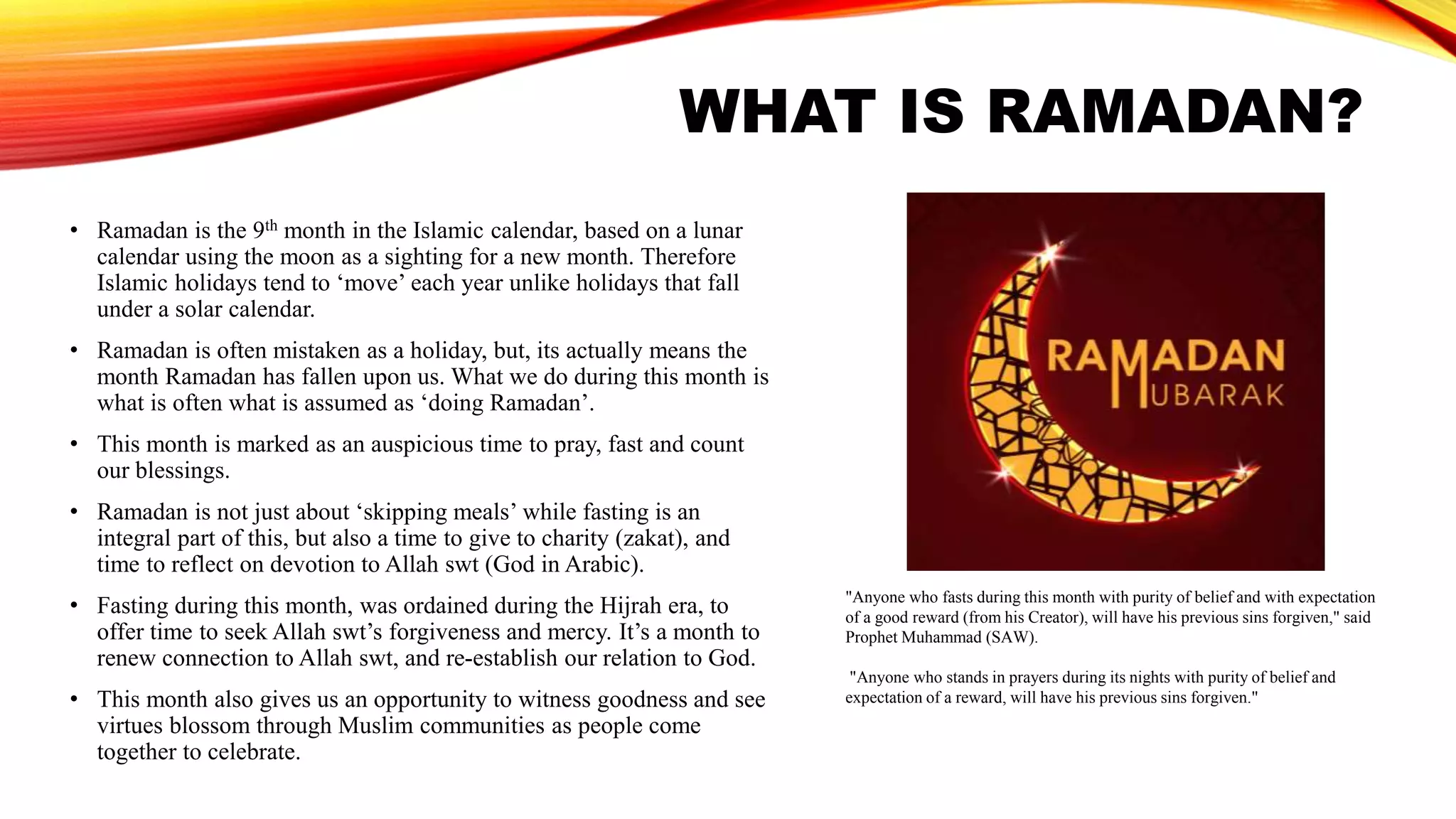
• Ramadan is the 9th month in the Islamic calendar, based on a lunar
calendar using the moon as a sighting for a new month. Therefore
Islamic holidays tend to ‘move’ each year unlike holidays that fall
under a solar calendar.
• Ramadan is often mistaken as a holiday, but, its actually means the
month Ramadan has fallen upon us. What we do during this month is
what is often what is assumed as ‘doing Ramadan’.
• This month is marked as an auspicious time to pray, fast and count
our blessings.
• Ramadan is not just about ‘skipping meals’ while fasting is an
integral part of this, but also a time to give to charity (zakat), and
time to reflect on devotion to Allah swt (God in Arabic).
• Fasting during this month, was ordained during the Hijrah era, to
offer time to seek Allah swt’s forgiveness and mercy. It’s a month to
renew connection to Allah swt, and re-establish our relation to God.
• This month also gives us an opportunity to witness goodness and see
virtues blossom through Muslim communities as people come
together to celebrate.
"Anyone who fasts during this month with purity of belief
and with expectation of a good reward (from his Creator),
will have his previous sins forgiven," said Prophet
Muhammad (SAW).
"Anyone who stands in prayers during its nights with
purity of belief and expectation of a reward, will have his
previous sins forgiven."
"Anyone who fasts during this month with purity of belief and with expectation
of a good reward (from his Creator), will have his previous sins forgiven," said
Prophet Muhammad (SAW).
"Anyone who stands in prayers during its nights with purity of belief and
expectation of a reward, will have his previous sins forgiven."
WHY THIS MONTH?
Muslims believe that during the month of Ramadan, Allah revealed the first
verses of the Quran, the holy book of Islam. Around 610 A.D., the prophet
Muhammad (pbuh), used to go out to the desert near Mecca (in today's Saudi
Arabia) to think about faith, society and God.
One night a voice called to him from the night sky. It was the angel Gabriel,
who told Muhammad (pbuh) he had been chosen to receive the word of
Allah. In the days that followed, Muhammad found himself speaking the
verses that would be transcribed as the Quran.
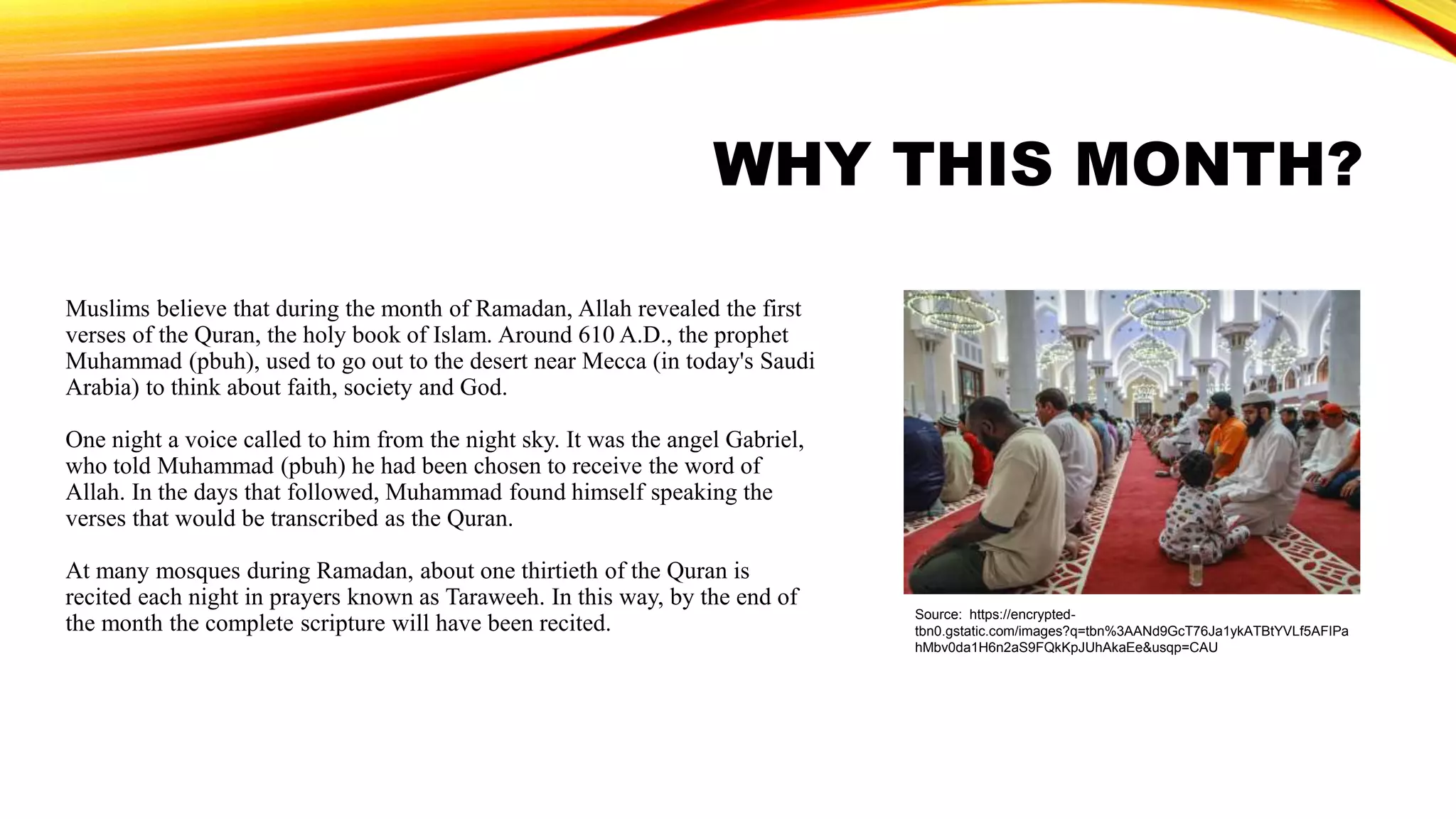
At many mosques during Ramadan, about one thirtieth of the Quran is
recited each night in prayers known as Taraweeh. In this way, by the end of
the month the complete scripture will have been recited. Source: https://encrypted-
tbn0.gstatic.com/images?q=tbn%3AANd9GcT76Ja1ykATBtYVLf5AFIPa
hMbv0da1H6n2aS9FQkKpJUhAkaEe&usqp=CAU
WHY DO MUSLIMS FAST?
THE ACT OF FASTING DEFINES A MUSLIM
Islam is based on 5 core pillars; believing in these principles is key to
being identified as a person of the Islamic faith. The five pillars of Islam
are; Shahadah (believing in one Allah swt), Salat (Prayer), Zakat
(charity), Sawn (to fast) and Hajj (pilgrimage). These are acts that Allah
swt has ordained compulsory. Fasting is one of the five pillars meaning
that to fast during the month of Ramadan is mandatory for all able
Muslims.
REAP THE BENEFITS OF THE NIGHT OF POWER
Lailat-ul-Qadr, also know as the Night of Power, is carefully concealed
within one of the odd nights in the last 10 days of Ramadan. Lailat-ul-
Qadr is the most sacred of nights within Islam as special blessings are
associated with this night. It is said that any deed in this night carries
more reward than the deeds of 1,000 months combined.
TO ATTAIN PIETY
As humans, we are susceptible to sins and transgressions of the
boundaries established by Islam and fasting teaches us to be pious
and restrain ourselves from worldly pleasures. The idea is to
ensure we are not led astray by materialistic desires and to be able
to control urges that can cloud judgement. Through fasting we also
taste – to some extent – the pain and suffering of those who are
less fortunate. This helps develop empathy and take away some of
our selfishness.
TO SEEK FORGIVENESS FOR PAST SINS
Islam preaches equality and Allah (SWT) made fasting during
Ramadan to make the rich and the poor equal in terms of asking
for forgiveness for their past sins. Ramadan is a month when many
prayers are listened to and answered.
“It is the month [of Ramadan] in which the first of it is mercy, the middle of it is forgiveness and the last of it being liberation from the
hell-fire.” – Stated Prophet Muhammad (SAW).
PRAYERS/EATING TIMES
- Fajr is the first morning prayer at sunrise, this
marks the time Muslims must stop eating and
marks the beginning of a new day of fasting
(This year this is usually around 4:00am).
- Zuhr is the 2nd prayer of the day which occurs
just after noon around 1pm
- Asr is 3rd prayer and a very important prayer
just before we break out fast- this occurs
around 6pm this year
- Maghrib- this prayer marks the time Muslims
can break their fast and this is at sunset (this
year this occurs around 8:20pm)
- Isha- marks the night prayers after a nice full
belly, with Isha, during Ramadan we perform
a congregational prayer called Taraweeh (this
prayer has special merits over other nights in
the year, seen as an expression of faith and to
seek reward from God)
• During Ramadan, most Muslims take this month to
ensure they complete their 5 daily prayers even if
its not a routine in their normal day to day
activities. As this month is all about connecting to
Islam and Allah swt (God), this is a great
opportunity to do so.
• This allows Muslims to reap the benefits of
Ramadan, one saying that is common is: “Ones
behaviour, attitude and outlook should not be the
same when one is fasting as when one isn’t”. There
should be a change where one is worshipping God
more.
• In Islam, there are 5 daily prayers- Fajr, Zuhr, Asr,
Maghrib and Isha. (Prayers don’t usually take more
than 15 mins to complete each, some are even short
as 5 mins).
• During Ramadan, we also have Taraweeh and
Tajahhud prayers.
COMMON MISCONCEPTIONS
AROUND RAMADAN AND FASTING
IT’S UNSAFE TO FAST
Not everybody is required to fast and if you fall unwell during your fast, it is permitted to stop fasting. (More on next slide)
ALL MUSLIMS MUST FAST
Someone suffering from an illness where fasting will either cause harm to their body, increase their illness, or delay their recovery is excused from
fasting. This also applies to pregnant and breastfeeding women in which they or their child may be put at risk if they were to fast. Those travelling
on long journeys may also be excused due to the difficulties and inconveniences associated with a journey. Fasts can be made up later in the year,
somebody can fast in your honour or you can donate meals to still earn the reward of fasting.
YOU MUST NOT EAT IN FRONT OF SOMEONE WHO IS FASTING
Eating in front of someone who is fasting is fine, and generally this will not bother Muslims, although of course this is subjective.
RAMADAN IS ONLY ABOUT NOT EATING AND DRINKING
Fasting is an exercise in self-control and refraining from three of the strongest human desires (food, drink and intercourse) teaches self-control that
can be applied to other aspects of life. You are given more time and opportunity for self-reflection and this instills the quality of being conscious of
God which is the purpose of fasting.
MYTHBUSTING
YOU’RE NOT ALLOWED TO EAT FOR A WHOLE MONTH?!?!?!?!
The requirement is to fast every day from dawn to sunset for the duration of a month.
YOU CAN’T BRUSH YOUR TEETH
Brushing your teeth is perfectly fine during Ramadan. In fact, maintaining good
personal hygiene is very important within the religion.
YOU'RE NOT ALLOWED TO SWALLOW YOUR OWN SALIVA
This is NOT a rule and would be impossible. Ramadan is not supposed to be
unrealistic, unattainable or unreasonable.
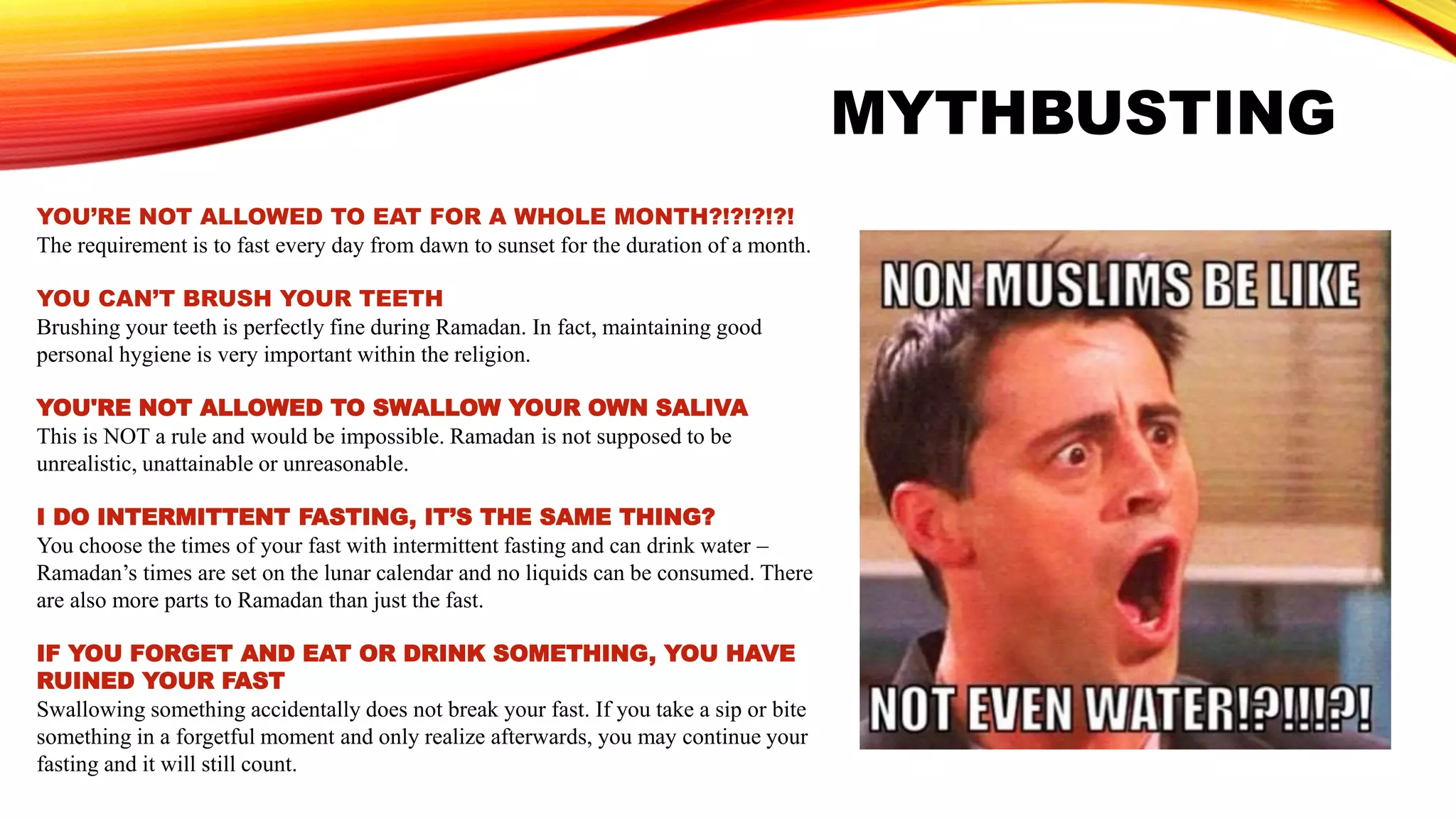
I DO INTERMITTENT FASTING, IT’S THE SAME THING?
You choose the times of your fast with intermittent fasting and can drink water –
Ramadan’s times are set on the lunar calendar and no liquids can be consumed. There
are also more parts to Ramadan than just the fast.
IF YOU FORGET AND EAT OR DRINK SOMETHING, YOU HAVE
RUINED YOUR FAST
Swallowing something accidentally does not break your fast. If you take a sip or bite
something in a forgetful moment and only realize afterwards, you may continue your
fasting and it will still count.
• Source:
https://www.google.com/url?sa=i&url=https%3A%2F%2Fwww.ikca.org.uk%2F
news%2Fphysical-health-benefits-
fasting%2F&psig=AOvVaw10qTQeaCP01ZOWBC5HGkBT&ust=1588700659
407000&source=images&cd=vfe&ved=0CAIQjRxqFwoTCJD-
ranhmukCFQAAAAAdAAAAABAJ
HOW DO MUSLIMS
CELEBRATE EID?
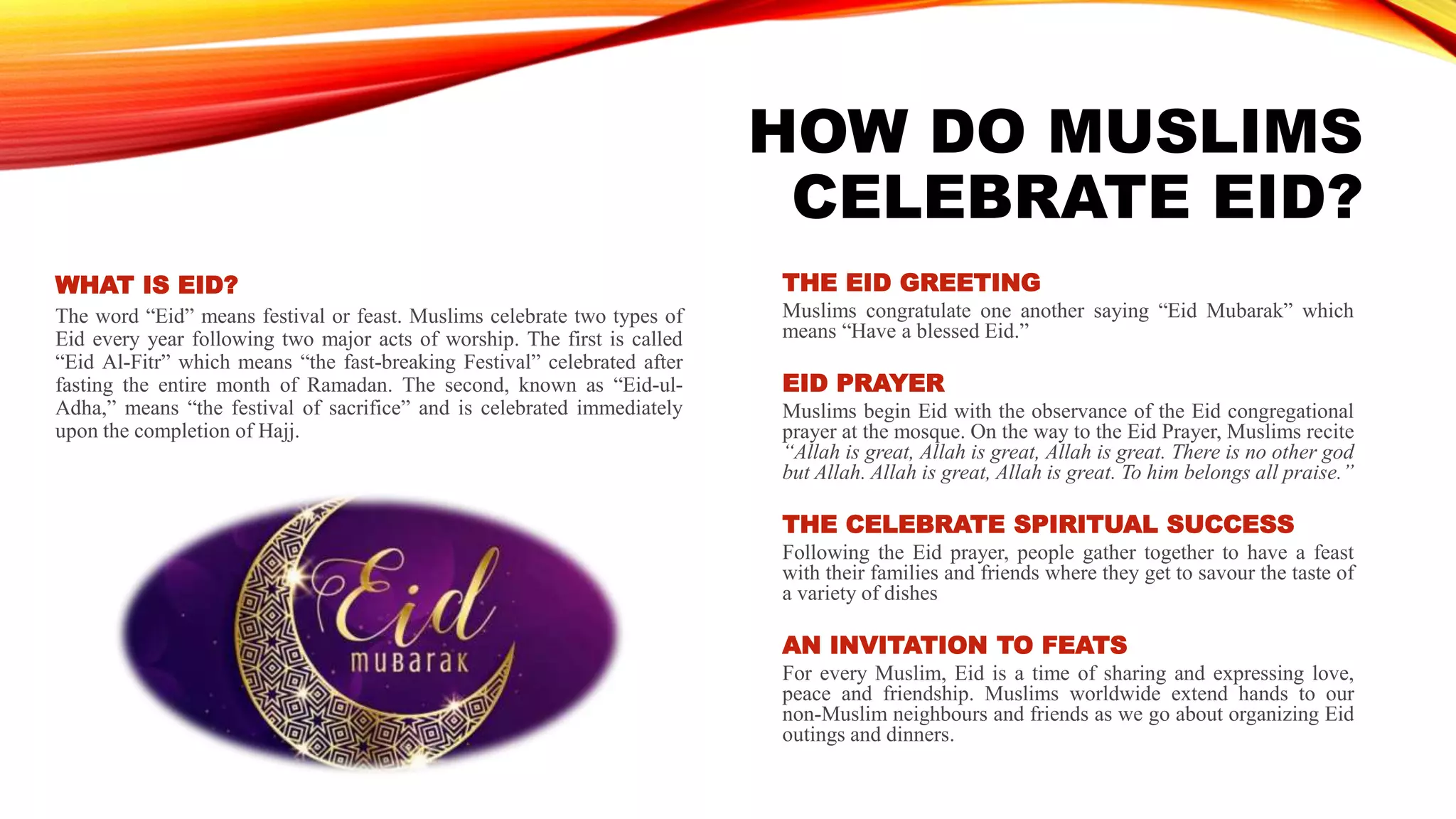
THE EID GREETING
Muslims congratulate one another saying “Eid Mubarak” which
means “Have a blessed Eid.”
EID PRAYER
Muslims begin Eid with the observance of the Eid congregational
prayer at the mosque. On the way to the Eid Prayer, Muslims recite
“Allah is great, Allah is great, Allah is great. There is no other god
but Allah. Allah is great, Allah is great. To him belongs all praise.”
THE CELEBRATE SPIRITUAL SUCCESS
Following the Eid prayer, people gather together to have a feast
with their families and friends where they get to savour the taste of
a variety of dishes
AN INVITATION TO FEATS
For every Muslim, Eid is a time of sharing and expressing love,
peace and friendship. Muslims worldwide extend hands to our
non-Muslim neighbours and friends as we go about organizing Eid
outings and dinners.
WHAT IS EID?
The word “Eid” means festival or feast. Muslims celebrate two types of
Eid every year following two major acts of worship. The first is called
“Eid Al-Fitr” which means “the fast-breaking Festival” celebrated after
fasting the entire month of Ramadan. The second, known as “Eid-ul-
Adha,” means “the festival of sacrifice” and is celebrated immediately
upon the completion of Hajj.

What is Ramadan?

  • 1.
    RAMADAN Mustafa Aideed, RuhenaAhmed, Razzia Gafur
  • 2.
    WHAT IS RAMADAN? •Ramadan is the 9th month in the Islamic calendar, based on a lunar calendar using the moon as a sighting for a new month. Therefore Islamic holidays tend to ‘move’ each year unlike holidays that fall under a solar calendar. • Ramadan is often mistaken as a holiday, but, its actually means the month Ramadan has fallen upon us. What we do during this month is what is often what is assumed as ‘doing Ramadan’. • This month is marked as an auspicious time to pray, fast and count our blessings. • Ramadan is not just about ‘skipping meals’ while fasting is an integral part of this, but also a time to give to charity (zakat), and time to reflect on devotion to Allah swt (God in Arabic). • Fasting during this month, was ordained during the Hijrah era, to offer time to seek Allah swt’s forgiveness and mercy. It’s a month to renew connection to Allah swt, and re-establish our relation to God. • This month also gives us an opportunity to witness goodness and see virtues blossom through Muslim communities as people come together to celebrate. "Anyone who fasts during this month with purity of belief and with expectation of a good reward (from his Creator), will have his previous sins forgiven," said Prophet Muhammad (SAW). "Anyone who stands in prayers during its nights with purity of belief and expectation of a reward, will have his previous sins forgiven." "Anyone who fasts during this month with purity of belief and with expectation of a good reward (from his Creator), will have his previous sins forgiven," said Prophet Muhammad (SAW). "Anyone who stands in prayers during its nights with purity of belief and expectation of a reward, will have his previous sins forgiven."
  • 3.
    WHY THIS MONTH? Muslimsbelieve that during the month of Ramadan, Allah revealed the first verses of the Quran, the holy book of Islam. Around 610 A.D., the prophet Muhammad (pbuh), used to go out to the desert near Mecca (in today's Saudi Arabia) to think about faith, society and God. One night a voice called to him from the night sky. It was the angel Gabriel, who told Muhammad (pbuh) he had been chosen to receive the word of Allah. In the days that followed, Muhammad found himself speaking the verses that would be transcribed as the Quran. At many mosques during Ramadan, about one thirtieth of the Quran is recited each night in prayers known as Taraweeh. In this way, by the end of the month the complete scripture will have been recited. Source: https://encrypted- tbn0.gstatic.com/images?q=tbn%3AANd9GcT76Ja1ykATBtYVLf5AFIPa hMbv0da1H6n2aS9FQkKpJUhAkaEe&usqp=CAU
  • 4.
    WHY DO MUSLIMSFAST? THE ACT OF FASTING DEFINES A MUSLIM Islam is based on 5 core pillars; believing in these principles is key to being identified as a person of the Islamic faith. The five pillars of Islam are; Shahadah (believing in one Allah swt), Salat (Prayer), Zakat (charity), Sawn (to fast) and Hajj (pilgrimage). These are acts that Allah swt has ordained compulsory. Fasting is one of the five pillars meaning that to fast during the month of Ramadan is mandatory for all able Muslims. REAP THE BENEFITS OF THE NIGHT OF POWER Lailat-ul-Qadr, also know as the Night of Power, is carefully concealed within one of the odd nights in the last 10 days of Ramadan. Lailat-ul- Qadr is the most sacred of nights within Islam as special blessings are associated with this night. It is said that any deed in this night carries more reward than the deeds of 1,000 months combined. TO ATTAIN PIETY As humans, we are susceptible to sins and transgressions of the boundaries established by Islam and fasting teaches us to be pious and restrain ourselves from worldly pleasures. The idea is to ensure we are not led astray by materialistic desires and to be able to control urges that can cloud judgement. Through fasting we also taste – to some extent – the pain and suffering of those who are less fortunate. This helps develop empathy and take away some of our selfishness. TO SEEK FORGIVENESS FOR PAST SINS Islam preaches equality and Allah (SWT) made fasting during Ramadan to make the rich and the poor equal in terms of asking for forgiveness for their past sins. Ramadan is a month when many prayers are listened to and answered. “It is the month [of Ramadan] in which the first of it is mercy, the middle of it is forgiveness and the last of it being liberation from the hell-fire.” – Stated Prophet Muhammad (SAW).
  • 5.
    PRAYERS/EATING TIMES - Fajris the first morning prayer at sunrise, this marks the time Muslims must stop eating and marks the beginning of a new day of fasting (This year this is usually around 4:00am). - Zuhr is the 2nd prayer of the day which occurs just after noon around 1pm - Asr is 3rd prayer and a very important prayer just before we break out fast- this occurs around 6pm this year - Maghrib- this prayer marks the time Muslims can break their fast and this is at sunset (this year this occurs around 8:20pm) - Isha- marks the night prayers after a nice full belly, with Isha, during Ramadan we perform a congregational prayer called Taraweeh (this prayer has special merits over other nights in the year, seen as an expression of faith and to seek reward from God) • During Ramadan, most Muslims take this month to ensure they complete their 5 daily prayers even if its not a routine in their normal day to day activities. As this month is all about connecting to Islam and Allah swt (God), this is a great opportunity to do so. • This allows Muslims to reap the benefits of Ramadan, one saying that is common is: “Ones behaviour, attitude and outlook should not be the same when one is fasting as when one isn’t”. There should be a change where one is worshipping God more. • In Islam, there are 5 daily prayers- Fajr, Zuhr, Asr, Maghrib and Isha. (Prayers don’t usually take more than 15 mins to complete each, some are even short as 5 mins). • During Ramadan, we also have Taraweeh and Tajahhud prayers.
  • 6.
    COMMON MISCONCEPTIONS AROUND RAMADANAND FASTING IT’S UNSAFE TO FAST Not everybody is required to fast and if you fall unwell during your fast, it is permitted to stop fasting. (More on next slide) ALL MUSLIMS MUST FAST Someone suffering from an illness where fasting will either cause harm to their body, increase their illness, or delay their recovery is excused from fasting. This also applies to pregnant and breastfeeding women in which they or their child may be put at risk if they were to fast. Those travelling on long journeys may also be excused due to the difficulties and inconveniences associated with a journey. Fasts can be made up later in the year, somebody can fast in your honour or you can donate meals to still earn the reward of fasting. YOU MUST NOT EAT IN FRONT OF SOMEONE WHO IS FASTING Eating in front of someone who is fasting is fine, and generally this will not bother Muslims, although of course this is subjective. RAMADAN IS ONLY ABOUT NOT EATING AND DRINKING Fasting is an exercise in self-control and refraining from three of the strongest human desires (food, drink and intercourse) teaches self-control that can be applied to other aspects of life. You are given more time and opportunity for self-reflection and this instills the quality of being conscious of God which is the purpose of fasting.
  • 7.
    MYTHBUSTING YOU’RE NOT ALLOWEDTO EAT FOR A WHOLE MONTH?!?!?!?! The requirement is to fast every day from dawn to sunset for the duration of a month. YOU CAN’T BRUSH YOUR TEETH Brushing your teeth is perfectly fine during Ramadan. In fact, maintaining good personal hygiene is very important within the religion. YOU'RE NOT ALLOWED TO SWALLOW YOUR OWN SALIVA This is NOT a rule and would be impossible. Ramadan is not supposed to be unrealistic, unattainable or unreasonable. I DO INTERMITTENT FASTING, IT’S THE SAME THING? You choose the times of your fast with intermittent fasting and can drink water – Ramadan’s times are set on the lunar calendar and no liquids can be consumed. There are also more parts to Ramadan than just the fast. IF YOU FORGET AND EAT OR DRINK SOMETHING, YOU HAVE RUINED YOUR FAST Swallowing something accidentally does not break your fast. If you take a sip or bite something in a forgetful moment and only realize afterwards, you may continue your fasting and it will still count.
  • 8.
  • 9.
    HOW DO MUSLIMS CELEBRATEEID? THE EID GREETING Muslims congratulate one another saying “Eid Mubarak” which means “Have a blessed Eid.” EID PRAYER Muslims begin Eid with the observance of the Eid congregational prayer at the mosque. On the way to the Eid Prayer, Muslims recite “Allah is great, Allah is great, Allah is great. There is no other god but Allah. Allah is great, Allah is great. To him belongs all praise.” THE CELEBRATE SPIRITUAL SUCCESS Following the Eid prayer, people gather together to have a feast with their families and friends where they get to savour the taste of a variety of dishes AN INVITATION TO FEATS For every Muslim, Eid is a time of sharing and expressing love, peace and friendship. Muslims worldwide extend hands to our non-Muslim neighbours and friends as we go about organizing Eid outings and dinners. WHAT IS EID? The word “Eid” means festival or feast. Muslims celebrate two types of Eid every year following two major acts of worship. The first is called “Eid Al-Fitr” which means “the fast-breaking Festival” celebrated after fasting the entire month of Ramadan. The second, known as “Eid-ul- Adha,” means “the festival of sacrifice” and is celebrated immediately upon the completion of Hajj.