What is Cluster Analysis?
• Cluster: a collection of data objects
– Similar to one another within the same cluster
– Dissimilar to the objects in other clusters
• Cluster analysis
– Grouping a set of data objects into clusters
• Clustering is unsupervised classification: no predefined
classes
• Typical applications
– As a stand-alone tool to get insight into data distribution
– As a preprocessing step for other algorithms
Examples of Clustering
Applications
• Marketing: Help marketers discover distinct groups in their customer
bases, and then use this knowledge to develop targeted marketing
programs
• Land use: Identification of areas of similar land use in an earth
observation database
• Insurance: Identifying groups of motor insurance policy holders with a
high average claim cost
• City-planning: Identifying groups of houses according to their house
type, value, and geographical location
• Earth-quake studies: Observed earth quake epicenters should be
clustered along continent faults
What Is Good Clustering?
• A good clustering method will produce high quality clusters with
– high intra-class similarity
– low inter-class similarity
• The quality of a clustering result depends on both the similarity
measure used by the method and its implementation.
• The quality of a clustering method is also measured by its ability to
discover some or all of the hidden patterns.
Requirements of Clustering in
Data Mining
• Scalability
• Ability to deal with different types of attributes
• Discovery of clusters with arbitrary shape
• Minimal requirements for domain knowledge to determine input
parameters
• Able to deal with noise and outliers
• Insensitive to order of input records
• High dimensionality
• Incorporation of user-specified constraints
• Interpretability and usability
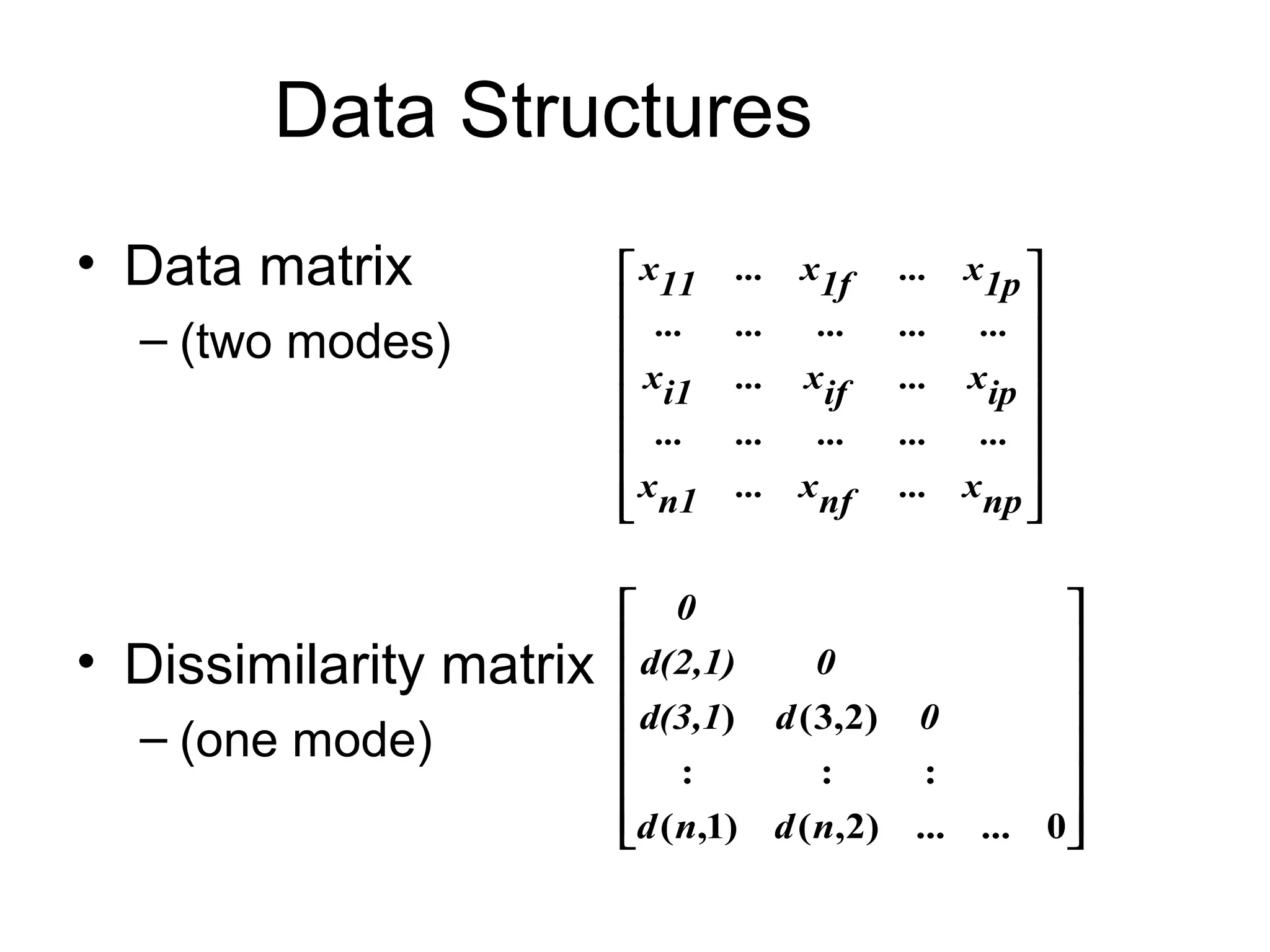
Data Structures
• Data matrix
– (two modes)
• Dissimilarity matrix
– (one mode)


















npx...nfx...n1x
...............
ipx...ifx...i1x
...............
1px...1fx...11x
















0...)2,()1,(
:::
)2,3()
...ndnd
0dd(3,1
0d(2,1)
0
Measure the Quality of
Clustering
• Dissimilarity/Similarity metric: Similarity is expressed in
terms of a distance function, which is typically metric:
d(i, j)
• There is a separate “quality” function that measures the
“goodness” of a cluster.
• The definitions of distance functions are usually very
different for interval-scaled, boolean, categorical, ordinal
and ratio variables.
• Weights should be associated with different variables
based on applications and data semantics.
• It is hard to define “similar enough” or “good enough”
– the answer is typically highly subjective.
Measure the Quality of
Clustering
• Dissimilarity/Similarity metric: Similarity is expressed in
terms of a distance function, which is typically metric:
d(i, j)
• There is a separate “quality” function that measures the
“goodness” of a cluster.
• The definitions of distance functions are usually very
different for interval-scaled, boolean, categorical, ordinal
and ratio variables.
• Weights should be associated with different variables
based on applications and data semantics.
• It is hard to define “similar enough” or “good enough”
– the answer is typically highly subjective.

What is cluster analysis

  • 1.
    What is ClusterAnalysis? • Cluster: a collection of data objects – Similar to one another within the same cluster – Dissimilar to the objects in other clusters • Cluster analysis – Grouping a set of data objects into clusters • Clustering is unsupervised classification: no predefined classes • Typical applications – As a stand-alone tool to get insight into data distribution – As a preprocessing step for other algorithms
  • 2.
    Examples of Clustering Applications •Marketing: Help marketers discover distinct groups in their customer bases, and then use this knowledge to develop targeted marketing programs • Land use: Identification of areas of similar land use in an earth observation database • Insurance: Identifying groups of motor insurance policy holders with a high average claim cost • City-planning: Identifying groups of houses according to their house type, value, and geographical location • Earth-quake studies: Observed earth quake epicenters should be clustered along continent faults
  • 3.
    What Is GoodClustering? • A good clustering method will produce high quality clusters with – high intra-class similarity – low inter-class similarity • The quality of a clustering result depends on both the similarity measure used by the method and its implementation. • The quality of a clustering method is also measured by its ability to discover some or all of the hidden patterns.
  • 4.
    Requirements of Clusteringin Data Mining • Scalability • Ability to deal with different types of attributes • Discovery of clusters with arbitrary shape • Minimal requirements for domain knowledge to determine input parameters • Able to deal with noise and outliers • Insensitive to order of input records • High dimensionality • Incorporation of user-specified constraints • Interpretability and usability
  • 5.
    Data Structures • Datamatrix – (two modes) • Dissimilarity matrix – (one mode)                   npx...nfx...n1x ............... ipx...ifx...i1x ............... 1px...1fx...11x                 0...)2,()1,( ::: )2,3() ...ndnd 0dd(3,1 0d(2,1) 0
  • 6.
    Measure the Qualityof Clustering • Dissimilarity/Similarity metric: Similarity is expressed in terms of a distance function, which is typically metric: d(i, j) • There is a separate “quality” function that measures the “goodness” of a cluster. • The definitions of distance functions are usually very different for interval-scaled, boolean, categorical, ordinal and ratio variables. • Weights should be associated with different variables based on applications and data semantics. • It is hard to define “similar enough” or “good enough” – the answer is typically highly subjective.
  • 7.
    Measure the Qualityof Clustering • Dissimilarity/Similarity metric: Similarity is expressed in terms of a distance function, which is typically metric: d(i, j) • There is a separate “quality” function that measures the “goodness” of a cluster. • The definitions of distance functions are usually very different for interval-scaled, boolean, categorical, ordinal and ratio variables. • Weights should be associated with different variables based on applications and data semantics. • It is hard to define “similar enough” or “good enough” – the answer is typically highly subjective.