1/5
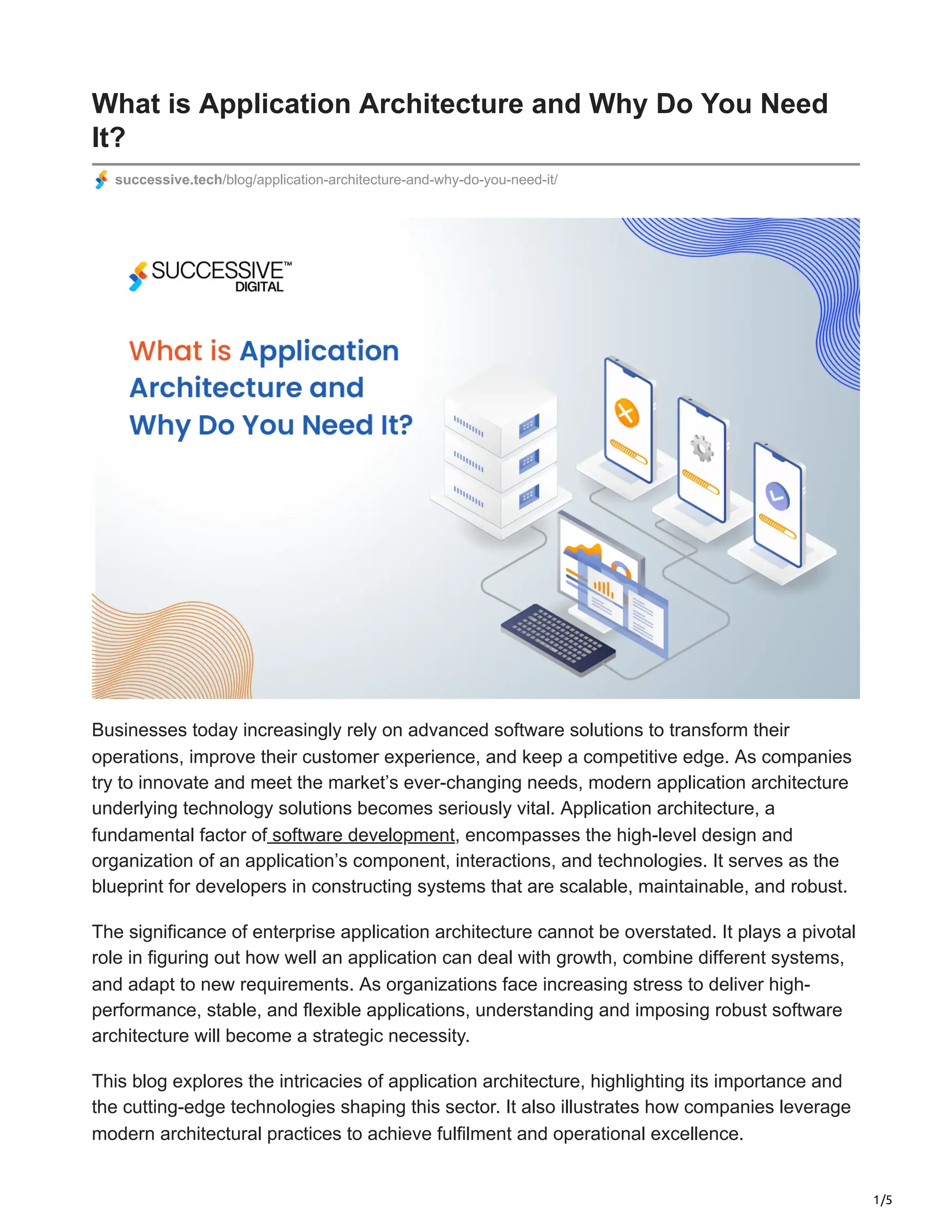
What is Application Architecture and Why Do You Need
It?
successive.tech/blog/application-architecture-and-why-do-you-need-it/
Businesses today increasingly rely on advanced software solutions to transform their
operations, improve their customer experience, and keep a competitive edge. As companies
try to innovate and meet the market’s ever-changing needs, modern application architecture
underlying technology solutions becomes seriously vital. Application architecture, a
fundamental factor of software development, encompasses the high-level design and
organization of an application’s component, interactions, and technologies. It serves as the
blueprint for developers in constructing systems that are scalable, maintainable, and robust.
The significance of enterprise application architecture cannot be overstated. It plays a pivotal
role in figuring out how well an application can deal with growth, combine different systems,
and adapt to new requirements. As organizations face increasing stress to deliver high-
performance, stable, and flexible applications, understanding and imposing robust software
architecture will become a strategic necessity.
This blog explores the intricacies of application architecture, highlighting its importance and
the cutting-edge technologies shaping this sector. It also illustrates how companies leverage
modern architectural practices to achieve fulfilment and operational excellence.
2/5
Understanding Application Architecture
Key elements of modern application architecture encompass components like databases,
user interfaces, and enterprise logic; interactions that ensure seamless communication and
data exchange between these components; patterns that offer standardized solutions to
common challenges; and technologies together with frameworks, programming languages,
and equipment used to build, install, and manage the application. This integrated method
confirms robustness, flexibility, and adaptability to evolving needs.
Components: These are the individual parts that make up the application. They can include:
Databases: Where data is stored and managed.
User Interfaces (UIs): The front-end elements through which users interact with the
application.
Business Logic: The core functionality that processes data and enforces business
rules.
Interactions: This aspect involves the communication and data exchange between
components, ensuring that they work together seamlessly to perform the application’s
functions.
Patterns: These are standardized solutions and best practices for common problems within
the architecture. Examples include Model-View-Controller (MVC) for structuring code and
microservices for breaking down applications into independent, deployable units.
Technologies: The tools, frameworks, and programming languages used to build and run
the application. This can include:
Frameworks: Such as Spring for Java or Django for Python.
Languages: Including JavaScript, Python, Java, and more.
Tools: For development, testing, and deployment like Docker, Kubernetes, and
Jenkins.
By integrating these components effectively, application architecture ensures that the system
is robust, flexible, and capable of evolving with technological advancements and changing
business needs.
Importance of Application Architecture
Enterprise application architecture is vital for the success and continuity of software program
systems. Its significance lies in a couple of key aspects:
3/5
Scalability: A properly designed application architecture allows applications to address
improved loads and needs without performance degradation. This is critical for businesses
experiencing rapid growth or fluctuating usage styles.
Maintainability: A clear, modern application architecture simplifies updates and
maintenance, empowering developers to easily understand, modify, and expand the system
without unintended consequences. This reduces technical debt and enhances long-term
sustainability, putting the control back in the hands of the business.
Security: Thoughtful architectural planning, particularly in mobile application architecture,
carries robust security measures, protecting the application in opposition to vulnerabilities
and ensuring data integrity and confidentiality.
Performance: An efficient structure ensures optimum overall performance by allowing
effective usage and decreasing latency. This results in a higher experience, which is
essential for maintaining and attracting customers.
Agility: A good application architecture supports adaptability, allowing quick responses to
changing business necessities or technological advancements. This flexibility is crucial in a
fast-paced, competitive market.
Risk Management: Proper risk management, particularly in cloud application architecture,
helps identify and mitigate dangers early in the development process, lowering the
probability of costly troubles.
By addressing these aspects, application architecture not only ensures the current
functionality and reliability of the software but also prepares it for future challenges and
opportunities, making it an essential part of modern software development. This forward-
thinking approach provides a sense of security and preparedness towards long-term
business continuity in digital age.
Latest Trends in Application Architecture
Microservices Architecture
Microservices architecture involves decomposing applications into small, unbiased services
that can be developed, deployed, and scaled independently. Each service encapsulates a
particular enterprise feature and communicates with others through APIs. This technique
enhances scalability, resilience, and versatility, permitting fast development and deployment
cycles.
Serverless Architecture
4/5
A serverless structure allows developers to build and run applications without coping with
infrastructure. In cloud application architecture, cloud vendors automatically deal with the
underlying servers, scaling, and renovation. Developers are entirely aware of writing code
that runs in response to events, leading to cost savings, simplified operations, and improved
scalability and flexibility.
Containerization
It includes packaging applications and their dependencies into lightweight, portable
containers using technologies like Docker. These containers run constantly throughout
distinct environments, ensuring seamless development, testing, and deployment. This
approach enhances portability, scalability, and isolation of the application, facilitating efficient,
helpful resource usage and streamlined DevOps processes.
Event-Driven Architecture
Event-driven application architecture is used for production, detection, and consumption of
events. Applications react to real-time events, such as user actions or device adjustments,
improving responsiveness and scalability. This decoupled layout allows for more flexible and
modular structures, capable of coping with dynamic workloads and enhancing system
efficiency.
API-First Design
API-first design prioritizes the development of application programming interfaces (APIs)
before developing the actual software. This approach ensures that APIs are well-designed,
consistent, and incorporated without problems. By specializing in APIs from the outset,
developers improve interoperability, streamline development, and create more flexible and
scalable programs that can easily interact with different systems.
Need For Application Architecture?
Future-Proofing: As your business grows, your application needs to scale. A well-
thought-out architecture accommodates growth and new technologies.
Efficiency: Efficient architecture reduces operational costs and improves performance,
leading to better user experiences.
Risk Management: Good architecture identifies and mitigates risks early in the
development process, reducing the likelihood of costly issues down the line.
Regulatory Compliance: Industries like finance and healthcare have strict regulations.
A solid architecture ensures compliance with data protection and security standards.
Competitive Advantage: Agile and robust applications can adapt to market changes
faster, giving businesses a competitive edge.
Conclusion
5/5
Application architecture is the backbone of modern software applications and systems
developed, ensuring that applications are scalable, maintainable, stable, and efficient. With
cloud transformation implementation and trends like microservices, serverless computing,
and event-driven design, enterprise application architecture keeps adapting, offering
practical tools and frameworks to meet the demands of today’s digital ecosystem. For any
business aiming to thrive in this age of advanced technology, understanding and
implementing modern application architecture is not just beneficial—it’s essential.

What is Application Architecture and Why Do You Need It?

  • 1.
    1/5 What is ApplicationArchitecture and Why Do You Need It? successive.tech/blog/application-architecture-and-why-do-you-need-it/ Businesses today increasingly rely on advanced software solutions to transform their operations, improve their customer experience, and keep a competitive edge. As companies try to innovate and meet the market’s ever-changing needs, modern application architecture underlying technology solutions becomes seriously vital. Application architecture, a fundamental factor of software development, encompasses the high-level design and organization of an application’s component, interactions, and technologies. It serves as the blueprint for developers in constructing systems that are scalable, maintainable, and robust. The significance of enterprise application architecture cannot be overstated. It plays a pivotal role in figuring out how well an application can deal with growth, combine different systems, and adapt to new requirements. As organizations face increasing stress to deliver high- performance, stable, and flexible applications, understanding and imposing robust software architecture will become a strategic necessity. This blog explores the intricacies of application architecture, highlighting its importance and the cutting-edge technologies shaping this sector. It also illustrates how companies leverage modern architectural practices to achieve fulfilment and operational excellence.
  • 2.
    2/5 Understanding Application Architecture Keyelements of modern application architecture encompass components like databases, user interfaces, and enterprise logic; interactions that ensure seamless communication and data exchange between these components; patterns that offer standardized solutions to common challenges; and technologies together with frameworks, programming languages, and equipment used to build, install, and manage the application. This integrated method confirms robustness, flexibility, and adaptability to evolving needs. Components: These are the individual parts that make up the application. They can include: Databases: Where data is stored and managed. User Interfaces (UIs): The front-end elements through which users interact with the application. Business Logic: The core functionality that processes data and enforces business rules. Interactions: This aspect involves the communication and data exchange between components, ensuring that they work together seamlessly to perform the application’s functions. Patterns: These are standardized solutions and best practices for common problems within the architecture. Examples include Model-View-Controller (MVC) for structuring code and microservices for breaking down applications into independent, deployable units. Technologies: The tools, frameworks, and programming languages used to build and run the application. This can include: Frameworks: Such as Spring for Java or Django for Python. Languages: Including JavaScript, Python, Java, and more. Tools: For development, testing, and deployment like Docker, Kubernetes, and Jenkins. By integrating these components effectively, application architecture ensures that the system is robust, flexible, and capable of evolving with technological advancements and changing business needs. Importance of Application Architecture Enterprise application architecture is vital for the success and continuity of software program systems. Its significance lies in a couple of key aspects:
  • 3.
    3/5 Scalability: A properlydesigned application architecture allows applications to address improved loads and needs without performance degradation. This is critical for businesses experiencing rapid growth or fluctuating usage styles. Maintainability: A clear, modern application architecture simplifies updates and maintenance, empowering developers to easily understand, modify, and expand the system without unintended consequences. This reduces technical debt and enhances long-term sustainability, putting the control back in the hands of the business. Security: Thoughtful architectural planning, particularly in mobile application architecture, carries robust security measures, protecting the application in opposition to vulnerabilities and ensuring data integrity and confidentiality. Performance: An efficient structure ensures optimum overall performance by allowing effective usage and decreasing latency. This results in a higher experience, which is essential for maintaining and attracting customers. Agility: A good application architecture supports adaptability, allowing quick responses to changing business necessities or technological advancements. This flexibility is crucial in a fast-paced, competitive market. Risk Management: Proper risk management, particularly in cloud application architecture, helps identify and mitigate dangers early in the development process, lowering the probability of costly troubles. By addressing these aspects, application architecture not only ensures the current functionality and reliability of the software but also prepares it for future challenges and opportunities, making it an essential part of modern software development. This forward- thinking approach provides a sense of security and preparedness towards long-term business continuity in digital age. Latest Trends in Application Architecture Microservices Architecture Microservices architecture involves decomposing applications into small, unbiased services that can be developed, deployed, and scaled independently. Each service encapsulates a particular enterprise feature and communicates with others through APIs. This technique enhances scalability, resilience, and versatility, permitting fast development and deployment cycles. Serverless Architecture
  • 4.
    4/5 A serverless structureallows developers to build and run applications without coping with infrastructure. In cloud application architecture, cloud vendors automatically deal with the underlying servers, scaling, and renovation. Developers are entirely aware of writing code that runs in response to events, leading to cost savings, simplified operations, and improved scalability and flexibility. Containerization It includes packaging applications and their dependencies into lightweight, portable containers using technologies like Docker. These containers run constantly throughout distinct environments, ensuring seamless development, testing, and deployment. This approach enhances portability, scalability, and isolation of the application, facilitating efficient, helpful resource usage and streamlined DevOps processes. Event-Driven Architecture Event-driven application architecture is used for production, detection, and consumption of events. Applications react to real-time events, such as user actions or device adjustments, improving responsiveness and scalability. This decoupled layout allows for more flexible and modular structures, capable of coping with dynamic workloads and enhancing system efficiency. API-First Design API-first design prioritizes the development of application programming interfaces (APIs) before developing the actual software. This approach ensures that APIs are well-designed, consistent, and incorporated without problems. By specializing in APIs from the outset, developers improve interoperability, streamline development, and create more flexible and scalable programs that can easily interact with different systems. Need For Application Architecture? Future-Proofing: As your business grows, your application needs to scale. A well- thought-out architecture accommodates growth and new technologies. Efficiency: Efficient architecture reduces operational costs and improves performance, leading to better user experiences. Risk Management: Good architecture identifies and mitigates risks early in the development process, reducing the likelihood of costly issues down the line. Regulatory Compliance: Industries like finance and healthcare have strict regulations. A solid architecture ensures compliance with data protection and security standards. Competitive Advantage: Agile and robust applications can adapt to market changes faster, giving businesses a competitive edge. Conclusion
  • 5.
    5/5 Application architecture isthe backbone of modern software applications and systems developed, ensuring that applications are scalable, maintainable, stable, and efficient. With cloud transformation implementation and trends like microservices, serverless computing, and event-driven design, enterprise application architecture keeps adapting, offering practical tools and frameworks to meet the demands of today’s digital ecosystem. For any business aiming to thrive in this age of advanced technology, understanding and implementing modern application architecture is not just beneficial—it’s essential.