Chapter 3 , Section
                                        World Geography


                                           Chapter 3
        Population and Culture


  Copyright © 2003 by Pearson Education, Inc., publishing as Prentice Hall, Upper Saddle River, NJ. All rights reserved.
Chapter 3 , Section
                                        World Geography


                               Chapter 3: Population and Culture


ction 1: The Study of Human Geography

ction 2: Political and Economic Systems


  Copyright © 2003 by Pearson Education, Inc., publishing as Prentice Hall, Upper Saddle River, NJ. All rights reserved.
Chapter 3 , Section 1

The Study of Human Geography

         • Why is population density distributed
           unevenly around the world?
         • What are some possible effects of
           population growth?
         • What are some of the elements of
           culture?
         • How do cultures change?
Chapter 3 , Section 1

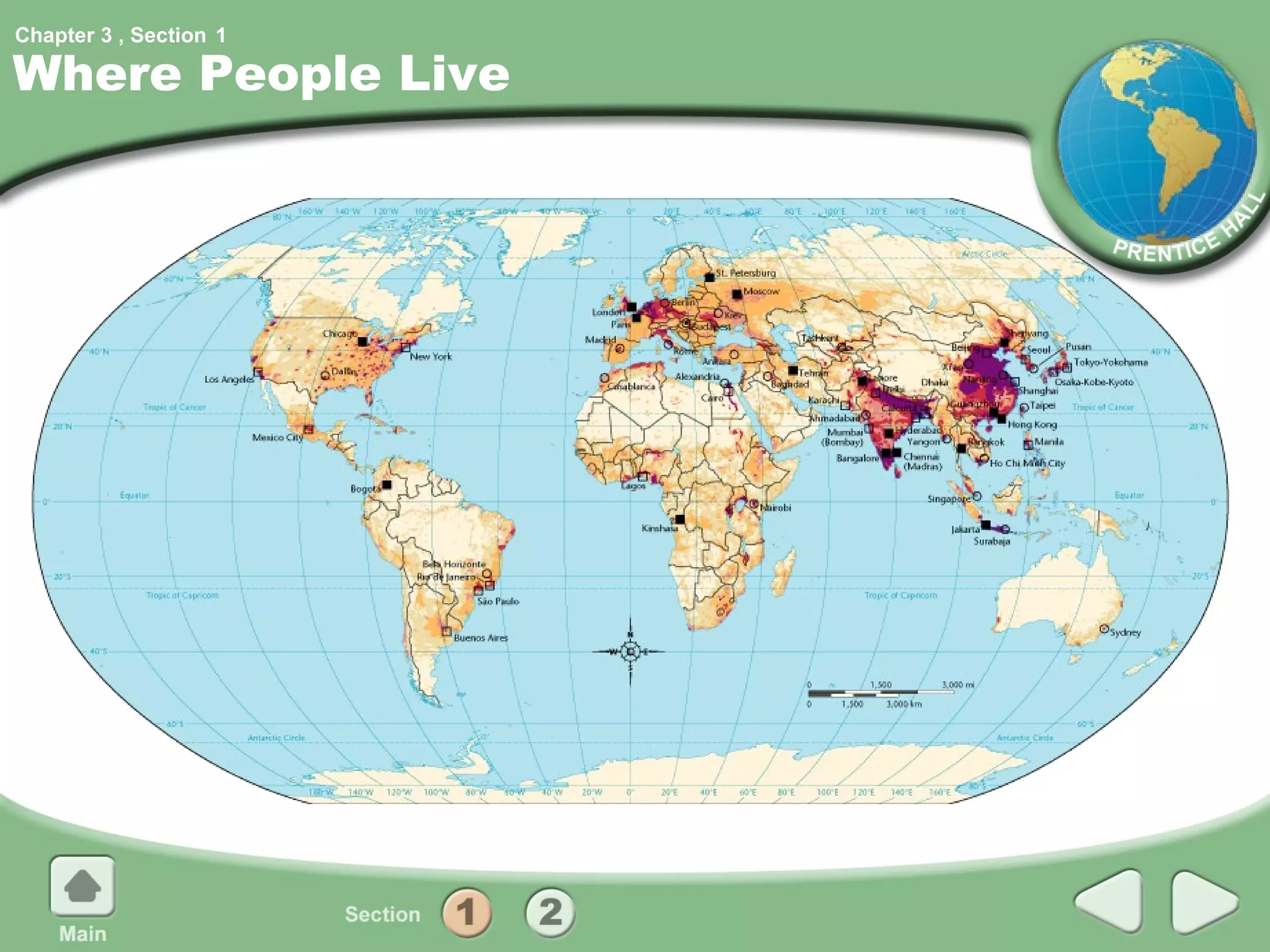
Where People Live
Chapter 3 , Section 1

Where People Live


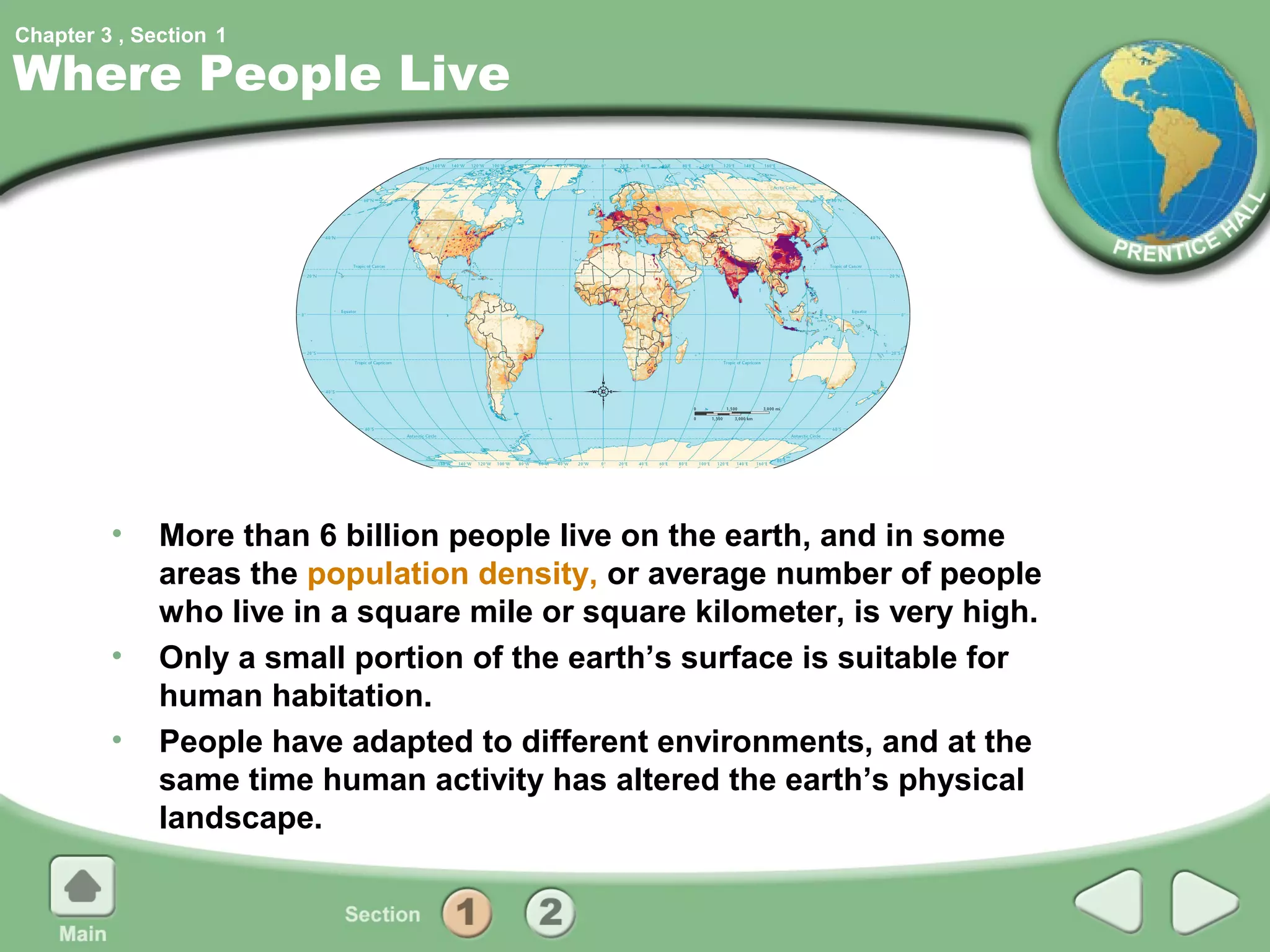
         •    More than 6 billion people live on the earth, and in some
              areas the population density, or average number of people
              who live in a square mile or square kilometer, is very high.
         •    Only a small portion of the earth’s surface is suitable for
              human habitation.
         •    People have adapted to different environments, and at the
              same time human activity has altered the earth’s physical
              landscape.
Chapter 3 , Section 1

Population Growth

         •    The world’s population has grown dramatically in recent
              centuries.
         •    Modern technology, such as improved medical care and
              increased food production, has enabled people to live much
              longer, but it poses a special problem for poorer countries.
         •    Some demographers predict population growth will bring
              famine, disease, and resource depletion, but others predict
              that levels of technology and creativity will increase.
         •    Different countries have different balances between the
              birthrate, or the number of live births per 1,000 people per year,
              and the death rate.
         •    Population is affected by the number of immigrants and
              emigrants.
         •    Many people live in metropolitan areas, and the process of
              growth of city populations, or urbanization, is going on
              throughout the world.
Chapter 3 , Section 1

The Nature of Culture

         •    Culture is reflected in material ways, such as food,
              clothing, and architecture, and in nonmaterial ways,
              such as language and government.
         •    A culture hearth is a place where important ideas begin
              and spread to surrounding cultures.
         •    Language is the cornerstone of culture and reflects a
              culture’s identity.
         •    Religion helps people understand basic questions
              about the meaning of life, and religious beliefs vary
              from culture to culture.
         •    Every culture has a way of organizing its society, and
              most have social classes that rank people in order of
              status.
         •    In many cultures, social mobility is restricted, and limits
              are often imposed upon women and ethnic or religious
              minorities.
Chapter 3 , Section 1

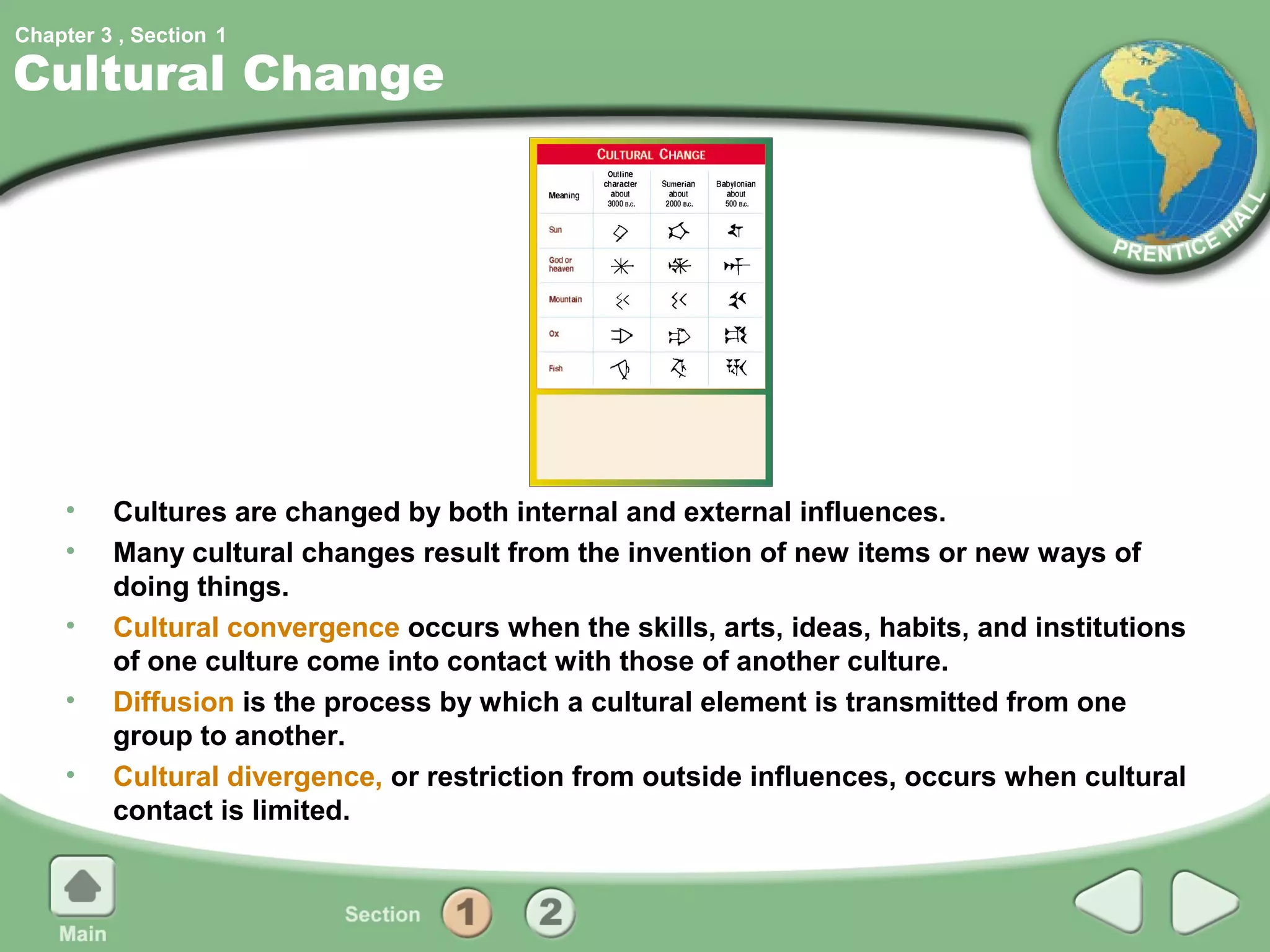
Cultural Change
Chapter 3 , Section 1

Cultural Change


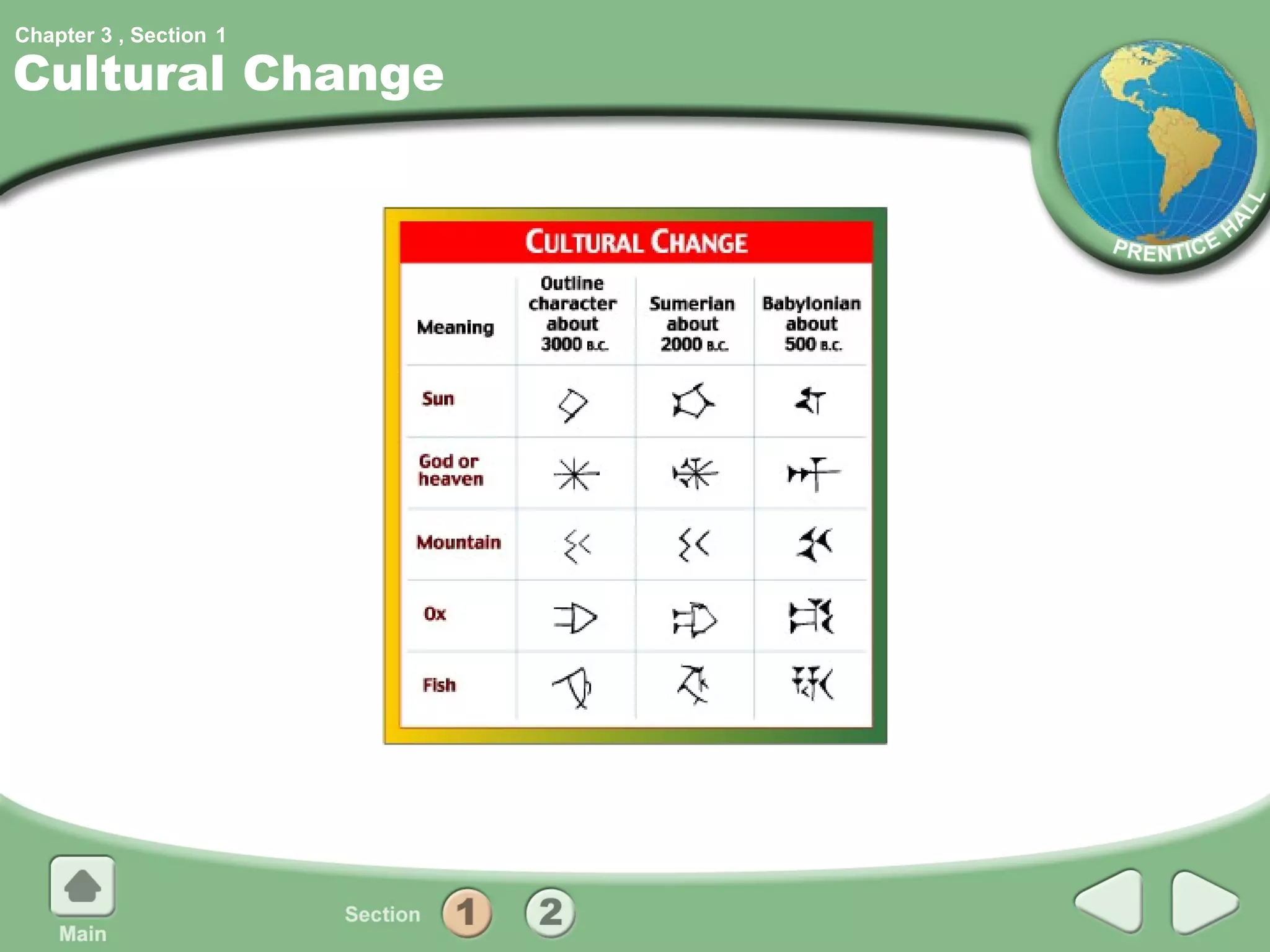
     •   Cultures are changed by both internal and external influences.
     •   Many cultural changes result from the invention of new items or new ways of
         doing things.
     •   Cultural convergence occurs when the skills, arts, ideas, habits, and institutions
         of one culture come into contact with those of another culture.
     •   Diffusion is the process by which a cultural element is transmitted from one
         group to another.
     •   Cultural divergence, or restriction from outside influences, occurs when cultural
         contact is limited.
Chapter 3 , Section 1

Section 1 Review

         How has improved medical care affected population growth?
            a) It has reduced population growth.
            b) It has dramatically increased population growth.
            c) It has led to a decline in population.
            d) It has had no effect on population growth.

         The process by which a cultural element is transmitted between
         groups is called
             a) convergence.
             b) divergence.
             c) diffusion.
             d) revolution.


         Want to connect to the World Geography link for this section? Click Here!
Chapter 3 , Section 1

Section 1 Review

         How has improved medical care affected population growth?
            a) It has reduced population growth.
            b) It has dramatically increased population growth.
            c) It has led to a decline in population.
            d) It has had no effect on population growth.

         The process by which a cultural element is transmitted between
         groups is called
             a) convergence.
             b) divergence.
             c) diffusion.
             d) revolution.


         Want to connect to the World Geography link for this section? Click Here!
Chapter 3 , Section 2

Political and Economic Systems

         • What are four characteristics shared by
           all countries?
         • How do various types of government
           differ from one another?
         • How do various types of economic
           systems differ from one another?
Chapter 3 , Section 2

The World’s Countries

         • Each country has four specific characteristics: a
           defined territory, a population, a sovereignty, and
           a government.
         • A country’s territory includes the land, water, and
           natural resources within its boundaries.
         • Natural resources can be more important than a
           country’s size.
         • In return for taxes, military service, or other
           obligations, citizens of countries are usually
           assured protection by their government.
         • Sovereignty is a nation’s freedom from outside
           control.
         • A sovereign country is one that determines its
           own policies and actions.
Chapter 3 , Section 2

Types of Government
            Government is the institution through which a society
           makes and enforces its public policies and provides for its
                               common needs.
         Government Structure              Government Authority
         • A unitary system is one in      • Until modern times, most
            which the central                 countries had authoritarian
            government makes                  governments.
            decisions for the entire       • A dictatorship is a government in
            country.                          which power is concentrated in
         • In a federation, the national      few people, and totalitarianism is
            government has some               the most extreme form of
            powers and others are             dictatorship.
            reserved for local             • The most common form of
            governments.                      authoritarian government has
         • Smaller political units keep       been monarchy.
            their sovereignty and give     • Any country in which people
            the central government few        choose their own leaders and set
            powers in a confederation.        government policy is a
                                              democracy.
Chapter 3 , Section 2

Types of Economic Systems

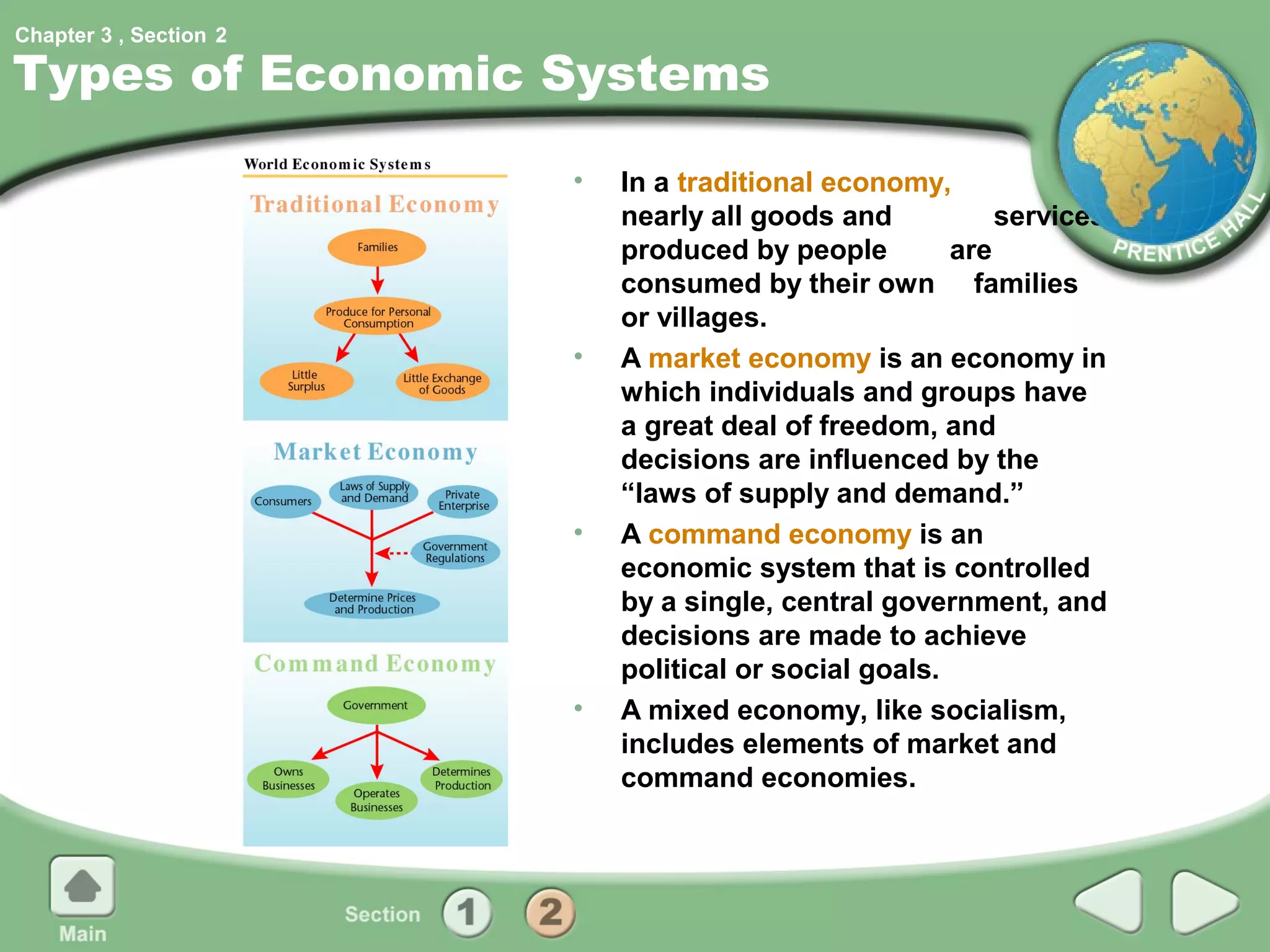
                        •   In a traditional economy,
                            nearly all goods and           services
                            produced by people         are
                            consumed by their own families
                            or villages.
                        •   A market economy is an economy in
                            which individuals and groups have
                            a great deal of freedom, and
                            decisions are influenced by the
                            “laws of supply and demand.”
                        •   A command economy is an
                            economic system that is controlled
                            by a single, central government, and
                            decisions are made to achieve
                            political or social goals.
                        •   A mixed economy, like socialism,
                            includes elements of market and
                            command economies.
Chapter 3 , Section 2

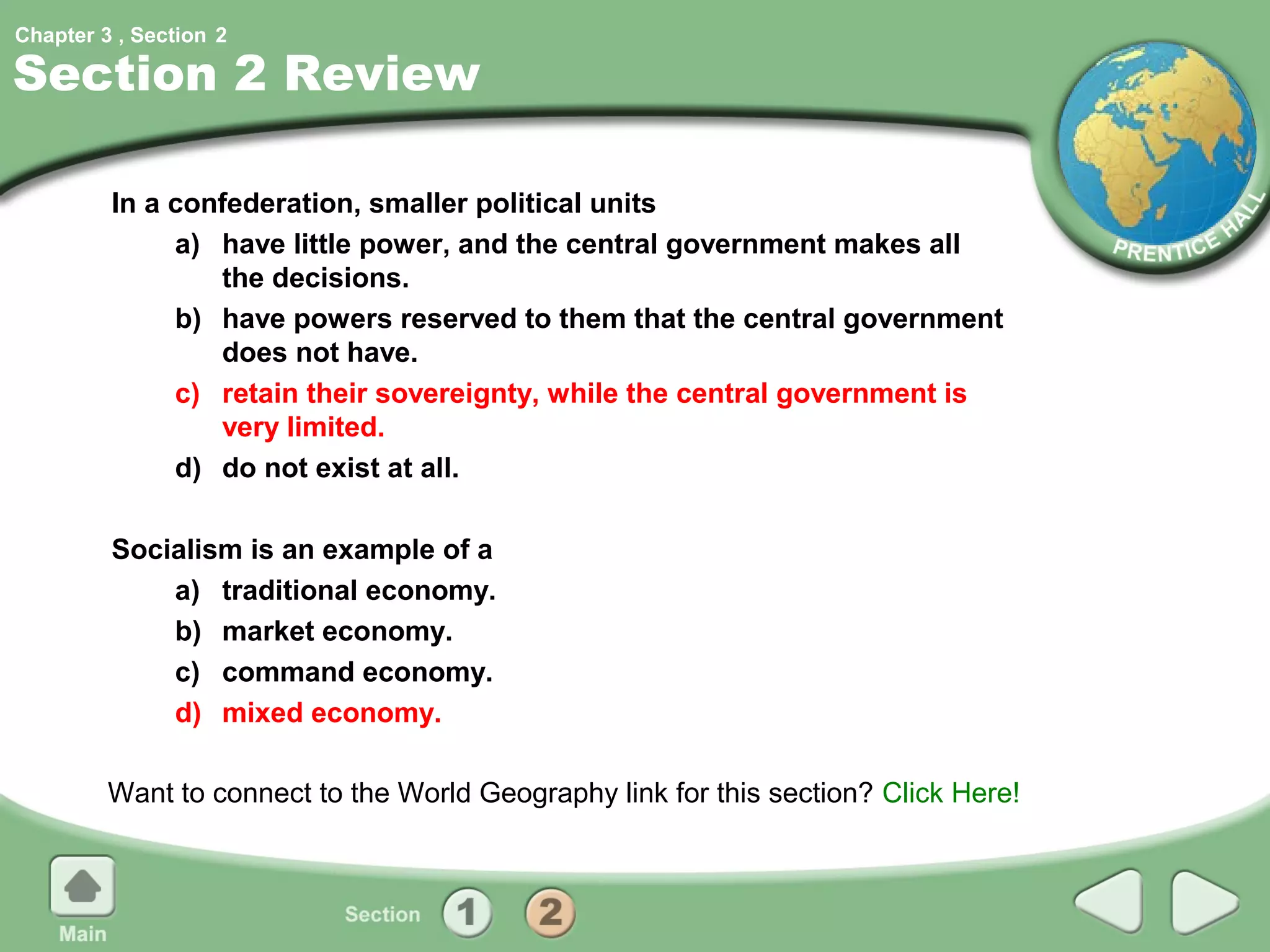
Section 2 Review

         In a confederation, smaller political units
              a) have little power, and the central government makes all
                 the decisions.
              b) have powers reserved to them that the central government
                 does not have.
              c) retain their sovereignty, while the central government is
                 very limited.
              d) do not exist at all.

         Socialism is an example of a
             a) traditional economy.
             b) market economy.
             c) command economy.
             d) mixed economy.

         Want to connect to the World Geography link for this section? Click Here!
Chapter 3 , Section 2

Section 2 Review

         In a confederation, smaller political units
              a) have little power, and the central government makes all
                 the decisions.
              b) have powers reserved to them that the central government
                 does not have.
              c) retain their sovereignty, while the central government is
                 very limited.
              d) do not exist at all.

         Socialism is an example of a
             a) traditional economy.
             b) market economy.
             c) command economy.
             d) mixed economy.

         Want to connect to the World Geography link for this section? Click Here!

Wg ch03

  • 1.
    Chapter 3 ,Section World Geography Chapter 3 Population and Culture Copyright © 2003 by Pearson Education, Inc., publishing as Prentice Hall, Upper Saddle River, NJ. All rights reserved.
  • 2.
    Chapter 3 ,Section World Geography Chapter 3: Population and Culture ction 1: The Study of Human Geography ction 2: Political and Economic Systems Copyright © 2003 by Pearson Education, Inc., publishing as Prentice Hall, Upper Saddle River, NJ. All rights reserved.
  • 3.
    Chapter 3 ,Section 1 The Study of Human Geography • Why is population density distributed unevenly around the world? • What are some possible effects of population growth? • What are some of the elements of culture? • How do cultures change?
  • 4.
    Chapter 3 ,Section 1 Where People Live
  • 5.
    Chapter 3 ,Section 1 Where People Live • More than 6 billion people live on the earth, and in some areas the population density, or average number of people who live in a square mile or square kilometer, is very high. • Only a small portion of the earth’s surface is suitable for human habitation. • People have adapted to different environments, and at the same time human activity has altered the earth’s physical landscape.
  • 6.
    Chapter 3 ,Section 1 Population Growth • The world’s population has grown dramatically in recent centuries. • Modern technology, such as improved medical care and increased food production, has enabled people to live much longer, but it poses a special problem for poorer countries. • Some demographers predict population growth will bring famine, disease, and resource depletion, but others predict that levels of technology and creativity will increase. • Different countries have different balances between the birthrate, or the number of live births per 1,000 people per year, and the death rate. • Population is affected by the number of immigrants and emigrants. • Many people live in metropolitan areas, and the process of growth of city populations, or urbanization, is going on throughout the world.
  • 7.
    Chapter 3 ,Section 1 The Nature of Culture • Culture is reflected in material ways, such as food, clothing, and architecture, and in nonmaterial ways, such as language and government. • A culture hearth is a place where important ideas begin and spread to surrounding cultures. • Language is the cornerstone of culture and reflects a culture’s identity. • Religion helps people understand basic questions about the meaning of life, and religious beliefs vary from culture to culture. • Every culture has a way of organizing its society, and most have social classes that rank people in order of status. • In many cultures, social mobility is restricted, and limits are often imposed upon women and ethnic or religious minorities.
  • 8.
    Chapter 3 ,Section 1 Cultural Change
  • 9.
    Chapter 3 ,Section 1 Cultural Change • Cultures are changed by both internal and external influences. • Many cultural changes result from the invention of new items or new ways of doing things. • Cultural convergence occurs when the skills, arts, ideas, habits, and institutions of one culture come into contact with those of another culture. • Diffusion is the process by which a cultural element is transmitted from one group to another. • Cultural divergence, or restriction from outside influences, occurs when cultural contact is limited.
  • 10.
    Chapter 3 ,Section 1 Section 1 Review How has improved medical care affected population growth? a) It has reduced population growth. b) It has dramatically increased population growth. c) It has led to a decline in population. d) It has had no effect on population growth. The process by which a cultural element is transmitted between groups is called a) convergence. b) divergence. c) diffusion. d) revolution. Want to connect to the World Geography link for this section? Click Here!
  • 11.
    Chapter 3 ,Section 1 Section 1 Review How has improved medical care affected population growth? a) It has reduced population growth. b) It has dramatically increased population growth. c) It has led to a decline in population. d) It has had no effect on population growth. The process by which a cultural element is transmitted between groups is called a) convergence. b) divergence. c) diffusion. d) revolution. Want to connect to the World Geography link for this section? Click Here!
  • 12.
    Chapter 3 ,Section 2 Political and Economic Systems • What are four characteristics shared by all countries? • How do various types of government differ from one another? • How do various types of economic systems differ from one another?
  • 13.
    Chapter 3 ,Section 2 The World’s Countries • Each country has four specific characteristics: a defined territory, a population, a sovereignty, and a government. • A country’s territory includes the land, water, and natural resources within its boundaries. • Natural resources can be more important than a country’s size. • In return for taxes, military service, or other obligations, citizens of countries are usually assured protection by their government. • Sovereignty is a nation’s freedom from outside control. • A sovereign country is one that determines its own policies and actions.
  • 14.
    Chapter 3 ,Section 2 Types of Government Government is the institution through which a society makes and enforces its public policies and provides for its common needs. Government Structure Government Authority • A unitary system is one in • Until modern times, most which the central countries had authoritarian government makes governments. decisions for the entire • A dictatorship is a government in country. which power is concentrated in • In a federation, the national few people, and totalitarianism is government has some the most extreme form of powers and others are dictatorship. reserved for local • The most common form of governments. authoritarian government has • Smaller political units keep been monarchy. their sovereignty and give • Any country in which people the central government few choose their own leaders and set powers in a confederation. government policy is a democracy.
  • 15.
    Chapter 3 ,Section 2 Types of Economic Systems • In a traditional economy, nearly all goods and services produced by people are consumed by their own families or villages. • A market economy is an economy in which individuals and groups have a great deal of freedom, and decisions are influenced by the “laws of supply and demand.” • A command economy is an economic system that is controlled by a single, central government, and decisions are made to achieve political or social goals. • A mixed economy, like socialism, includes elements of market and command economies.
  • 16.
    Chapter 3 ,Section 2 Section 2 Review In a confederation, smaller political units a) have little power, and the central government makes all the decisions. b) have powers reserved to them that the central government does not have. c) retain their sovereignty, while the central government is very limited. d) do not exist at all. Socialism is an example of a a) traditional economy. b) market economy. c) command economy. d) mixed economy. Want to connect to the World Geography link for this section? Click Here!
  • 17.
    Chapter 3 ,Section 2 Section 2 Review In a confederation, smaller political units a) have little power, and the central government makes all the decisions. b) have powers reserved to them that the central government does not have. c) retain their sovereignty, while the central government is very limited. d) do not exist at all. Socialism is an example of a a) traditional economy. b) market economy. c) command economy. d) mixed economy. Want to connect to the World Geography link for this section? Click Here!