Diversity of Entrepreneurships
ENTREPRENEURIAL SUCCESS AND
FAILURE
DR. HEBA BALATIA
heba.balatia@glasgow.ac.uk
1
Intended Learning Objectives
 Who are entrepreneurs? what do they do? and are they born or
made?
 Why do some start-ups succeed better than others?
 Who is responsible for entrepreneurial success and failure? The
entrepreneur or other factors such as context, industry sector,
financing, customer preferences, or timing?
 What are the psychological and emotional qualities for dealing with
success? Or dealing with failure or with initial struggles?
2
Are entrepreneurs born or made?
(a) The Personality/Individual –based Approach
‘entrepreneurs have distinctive personality traits, hence a substantial
proportion of entrepreneurial behaviour is genetically determined – (they
have an ‘enterprise gene’)’ (Fisher &Kock, 2008)
The literature suggests that there are many personality traits that are
associated with entrepreneurship (high nAch, internal locus of control, need
for autonomy, risk-taking, tolerance for ambiguity and many others ...) and
may lead to the success of the entrepreneurial adventurer.
Critique: Descriptive, measurement issues….?
3
Are entrepreneurs born or made?
(b)The Cognitive Theories of Entrepreneurship
1- It focuses on what entrepreneurs do, rather than on who they are
(Gartner, 1988) and how do entrepreneurs make sense of the world around
them. How do they assess opportunities, and risks and process
information?
2- Perception (Seeking and seeing opportunities) vs. Intentionality (acting
on opportunities).
3- Entrepreneurship is not a personality trait but information-based.
4
Are entrepreneurs born or made?
(c) Sociological theories of Entrepreneurship
Social background and environment form the entrepreneurs.
E.g.:
1- Social marginality (mismatch between skills, attitudes and
social position, which may create psychological discomfort).
2- Family influences.
3- Situational influences (industry, occupation, professional
experience, role models in the environment, Availability of
entrepreneurial resources).
5
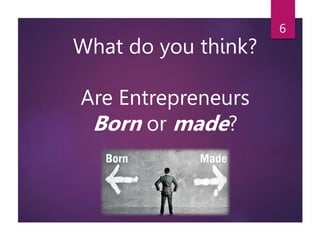
What do you think?
Are Entrepreneurs
Born or made?
6
Entrepreneurial Success
and Failure
Can the personality, cognitive and social approaches explain
entrepreneurial success and failure?
 According to (Markman & Baron, 2003), certain individual-based
factors of entrepreneurs is influential to their success: ‘the greater the
person–entrepreneurship fit, the higher the likelihood of
entrepreneurial success’. Personality Approach.
 Other literature may support or refute this proposition, though!
 For instance (Sjögren & Yusuf, 2021) claims that ‘entrepreneurial
success is something that is built throughout the life of the
entrepreneur, rather than linked to a certain business activity or firm’
Social approach.
7
Entrepreneurial Success
and Failure
 Start-ups (entrepreneurial businesses) may have a short life span.
 VAT statistics show around half of the small businesses cease trading
in the first 3 years.
 Most firms last about 10 years; 1 out of 3 survive into a second
generation and 16% into a third generation.
 Success and failure may be interrelated:
1- Failed business may not be the same as a failed individual.
(Discontinuance)
2- Some businesses may discontinue despite being economically and
financially successful. (Continuation)
8
Types of Discontinuance
 Voluntary Discontinuance:
 Performance of the business below the entrepreneur’s expectations. (but maybe still successful
economically)
 Perception that returns (financial and non-financial) are lower than expected utility.
 30% to 50% of discontinued businesses are voluntary i.e. profitable at the point of closure.
 Personal considerations – ill-health, family considerations, retirement.
 Involuntary Discontinuance:
 The owner closes their business or is forced to do so because it is not financially viable.
 Businesses which are no longer able to pay their creditors, which may lead to compulsory or voluntary
liquidation.
(Coad, 2014) and (Jenkins & McKelvie, 2016)
9
Why Voluntary Discontinuance?
 Age and health issues.
 Boredom or burnout.
 To overcome growth constraints – e.g.
 operating and growth capital.
 access to markets.
 access to new management.
 Desire to pursue other business opportunities.
 Desire to pursue other types of activity – e.g. philanthropy, business
angel, mentor.
 External investors want to sell their shares to realise a financial return.
10
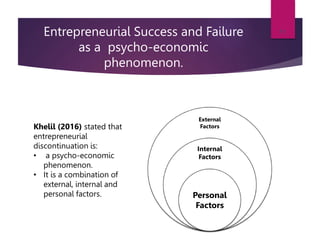
Entrepreneurial Success and Failure
as a psycho-economic
phenomenon.
External
Factors
Internal
Factors
Personal
Factors
11
Khelil (2016) stated that
entrepreneurial
discontinuation is:
• a psycho-economic
phenomenon.
• It is a combination of
external, internal and
personal factors.
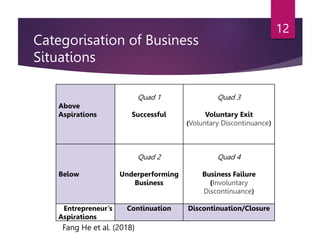
Categorisation of Business
Situations
12
Above
Aspirations
Quad 1
Successful
Quad 3
Voluntary Exit
(Voluntary Discontinuance)
Below
Quad 2
Underperforming
Business
Quad 4
Business Failure
(Involuntary
Discontinuance)
Entrepreneur’s
Aspirations
Continuation Discontinuation/Closure
Fang He et al. (2018)
Quad 1
Successful Business
 Nakheel Palestine
(3) Nakheel Palestine - Who We Are (English Version) –
YouTube
(4) Nakheel Palestine - Success Story - YouTube
13
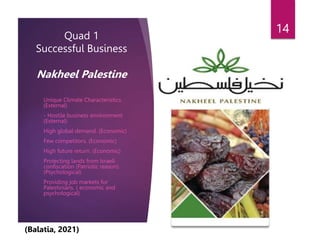
Quad 1
Successful Business
Nakheel Palestine
- Unique Climate Characteristics.
(External)
- - Hostile business environment
(External)
- High global demand. (Economic)
- Few competitors. (Economic)
- High future return. (Economic)
- Protecting lands from Israeli
confiscation (Patriotic reason).
(Psychological)
- Providing job markets for
Palestinians. ( economic and
psychological)
14
(Balatia, 2021)
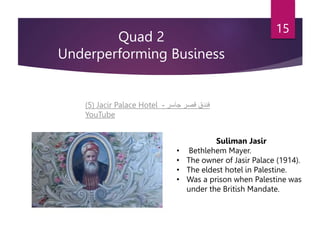
Quad 2
Underperforming Business
15
(5) Jacir Palace Hotel ‫جاسر‬ ‫قصر‬ ‫فندق‬
-
YouTube
Suliman Jasir
• Bethlehem Mayer.
• The owner of Jasir Palace (1914).
• The eldest hotel in Palestine.
• Was a prison when Palestine was
under the British Mandate.
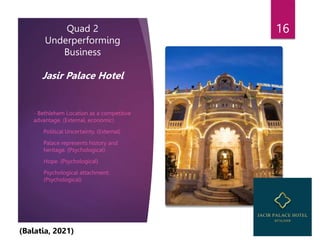
Quad 2
Underperforming
Business
Jasir Palace Hotel
- Bethlehem Location as a competitive
advantage. (External, economic)
- Political Uncertainty. (External)
- Palace represents history and
heritage. (Psychological)
- Hope. (Psychological)
- Psychological attachment.
(Psychological)
16
(Balatia, 2021)
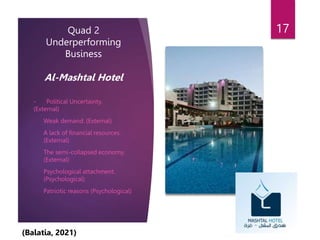
Quad 2
Underperforming
Business
Al-Mashtal Hotel
- Political Uncertainty.
(External)
- Weak demand. (External)
- A lack of financial resources.
(External)
- The semi-collapsed economy.
(External)
- Psychological attachment.
(Psychological)
- Patriotic reasons (Psychological)
17
(Balatia, 2021)
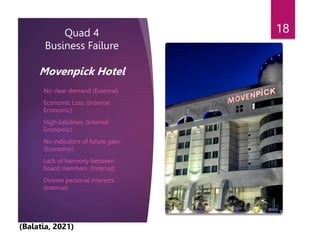
Quad 4
Business Failure
Movenpick Hotel
- No clear demand (External)
- Economic Loss. (Internal
Economic)
- High liabilities. (Internal
Economic)
- No indicators of future gain.
(Economic)
- Lack of harmony between
board members. (Internal)
- Diverse personal interests.
(Internal)
18
(Balatia, 2021)
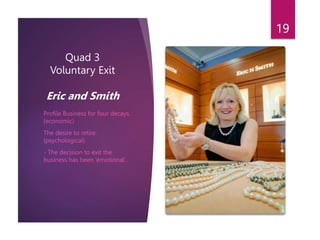
Quad 3
Voluntary Exit
Eric and Smith
- Profile Business for four decays.
(economic)
- The desire to retire.
(psychological)
- - The decision to exit the
business has been ‘emotional’.
19
The Role of emotions in
Entrepreneurship
 Emotions lie at the heart of the entrepreneurial experience.
 Entrepreneurs’ emotions influence entrepreneurs’ personalities that are
identifies with their ventures and constantly face the unknown, they are
inherently likely to feel strong emotions – both negative and positive.
 Success and failure are two emotional events.
 Emotions may influence the entrepreneur’s decision to retain or
terminate failed and successful businesses.
 Business failure is an emotionally-charged experience because may be
deeply attached to their businesses.
(Morris et al., 2012;Fang He et al. 2018; Delgado Garc´ıa et al 2015,Vaestfjaell & Slovic, 2013)
20
Continued
 Loss of a business can produce grief which, in turn has psychological,
behavioural and physiological symptoms.
 During and after failure events, negative emotions may be signalled as
a goal not achieved or an aspiration not met by the entrepreneur.
 These negative emotions can motivate entrepreneurs’ to exert
additional efforts to close the gap between their current and desired
states, which may result in some negative emotions (i.e.
disappointment, sorrow, fear, and shame) that could block future-
oriented behaviours (Fang He et al., 2018).
 Other negative emotions such as anger may on the contrary support
the continuation of businesses till success is accomplished (Balatia,
2021).
21
Emotions, Business Success and
Failure: A example from history.
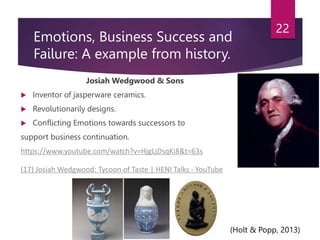
Josiah Wedgwood & Sons
 Inventor of jasperware ceramics.
 Revolutionarily designs.
 Conflicting Emotions towards successors to
support business continuation.
https://www.youtube.com/watch?v=HjgLjDsqKi8&t=63s
(17) Josiah Wedgwood: Tycoon of Taste | HENI Talks - YouTube
22
(Holt & Popp, 2013)
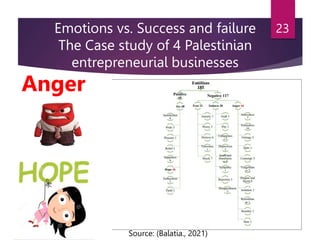
Emotions vs. Success and failure
The Case study of 4 Palestinian
entrepreneurial businesses
23
Source: (Balatia., 2021)
Anger
Emotionally Mature Entrepreneurs
 Challenges were endless and not easy …I remember in the first two
years of the project; the mortality rate of planted saplings was 90%...
And this alone was enough to stop the project and to cause
frustration as we started to think that we were wasting our time,
money and effort…” RET-NP03 (Anger)
 “There is definitely a high risk in this project but also a reasonable
return that drives us to invest in such a high-risk product…This means
that there is potential in the project. Hence, if the project did not gain
profits now, there is potential to gain profits in the future…” RET-
NP02 (Hope)
(Balatia., 2021)
24
Emotionally Rebellious
Entrepreneurs
 “No one is happy about the closure of the hotel. We felt sad and
angry although we know that we can do nothing to support the
hotel. Also, we felt that hatred of the Israel occupation is intensified
due to such challenges that they impose on us …” SCE-JC03 (Anger)
 “Closing the hotel permanently was never our choice but the
decision to continue was and still our ambition as continuation
might drive us towards future financial rewards. This is what has
happened after waiting patiently for a long time, we finally started
to gain profits” SCE-JC03 (Hope)
(Balatia., 2021)
25
EmotionallyHeartfelt
Entrepreneurs
 “We are not angels or gods; we sometimes feel frustrated
especially when days pass without dealing with any customer,
given that we have running costs anyway and no reward at all. …”
SCE-MASH02 (Anger)
 “We look forward, hoping for returns even if they come late. We
usually wait for a glimmer of hope that may come any time
through a political agreement or a new government to revive the
market or to receive governmental bodies as our clients...” SCE-
MASH02 (Hope)
(Balatia., 2021)
26
Emotionally Anti-Compliant
Entrepreneurs
 “The last period before termination helped us in taking the decision to
terminate. It was due to how much we were frustrated by the board of
directors. Especially that we frankly felt that the more we advised them the
less they were taking our advice…Oh yeah… we got frustrated” TER-
MOV02 (Anger)
 “A person turns mad. It is difficult to work in a project and to invest
heavily in money and effort and then the effect is reversed. It is really
difficult…” TER-MOV03 (Anger)
(Balatia., 2021)
27
The Personal Consequences
of Failure
 Moving on from failure requires the repairing
of the damage caused
 Financial loss – some cope with this easier than other.
 Emotional costs.
 Psychological costs – stress, psychological and emotional exhaustion
 Social costs – feeling of guilt (e.g. because people have lost money);
impact on personal and social relationships
 Loss of self-esteem - decline in social status in their own eyes
 Entrepreneurial costs – negative impact on entrepreneurial self-efficacy
and risk taking propensity
(Cope, 2011, JBV)
28
Recovery and Learning
from Failure
 Recovery
 Failed entrepreneurs needed time to make come to terms with
the failure before engaging in sense-making efforts.
 Critical reflection – Reflective action – move on.
 Learning from failure
 Learning about oneself – has negative and positive dimensions.
 Contextually sensitive reflection on why the business failed.
 Learning about relationships and networking.
 Leaning about venture management.
29
Beyond the failure – what next?
 Entrepreneurial recycling: recycling of financial capital, social
capital and learning by:
 Start another business – serial entrepreneurs.
 Invest in other businesses – business angel.
 Entrepreneurial institution building – e.g. venture capital fund, business
incubator/accelerator.
 Mentoring new entrepreneurs (Advisor to entrepreneurs).
 Leadership role in the entrepreneurial community.
 (or a combination of these roles).
 Example: Radiant 6 (see an article on Moodle).
(Mason and Harrison, 2006)
30
Summary
 The causes of success and failure can be external to the business,
internal, personal, or a combination of all.
 There is a continuum of business closure from, at one extreme, voluntary
discontinuance of a profitable business, through ‘failure to make a
success of it and to loss-making ventures.
 Redefining business failure: need to move beyond narrow concept of
failure as bankruptcy and liquidation to include failure to ‘make a go of it.
Not all closures are (financial) failures.
 Alternative definition of failure failure is the termination of a business
that has fallen short of its goals, so failing to satisfy the principal
shareholder’s expectations.
31
Main References
 Balatia, H. (2021). The influence of anger and sunk cost effect on project
status: an extension to portfolios of projects. PhD dissertation, University
of Glasgow.
 Burns, P (2016) Entrepreneurship and Small Business, 4th edition, pp
414-424.
 Bridge, S and O’Neill, K (2018) Understanding Enterprise, Palgrave 5th
edition, pp 124-132.
 Khelil, N. (2016). ‘The Many Faces of Entrepreneurial Failure: Insights
from an Empirical Taxonomy’, Journal of Business Venturing, 31(1), pp.
72–94.
 Robin Holt & Andrew Popp (2013) Emotion, succession, and the family
firm: Josiah Wedgwood & Sons, Business History, 55:6, 892-909.
32
Tutorial Questions
 Read the two cases and prepare the following questions:
1- Luke Johnson (2011) mentioned “I’ve argued that entrepreneurs are the
product of nurture rather than nature; that environment more than inheritance
shapes them. The skills to build companies “are acquired through practical
experience …” Do you agree or disagree with this and why? How does this
relate to the two cases and the born-made debate?
2- What are the factors behind being entrepreneurial in the two cases?
3-What are the success and failure factors that contribute to the
continuation or discontinuation of entrepreneurs and their businesses in
these cases?
3- What are the mentioned psychological dimensions for dealing with
success, failure or with initial struggles? What is the role of emotions in
entrepreneurial success and factors?
4- What are the entrepreneurial recycling techniques that entrepreneurs
follow?
33

Week 2 Entrepreneural Sucess anf Failure.ppt

  • 1.
    Diversity of Entrepreneurships ENTREPRENEURIALSUCCESS AND FAILURE DR. HEBA BALATIA heba.balatia@glasgow.ac.uk 1
  • 2.
    Intended Learning Objectives Who are entrepreneurs? what do they do? and are they born or made?  Why do some start-ups succeed better than others?  Who is responsible for entrepreneurial success and failure? The entrepreneur or other factors such as context, industry sector, financing, customer preferences, or timing?  What are the psychological and emotional qualities for dealing with success? Or dealing with failure or with initial struggles? 2
  • 3.
    Are entrepreneurs bornor made? (a) The Personality/Individual –based Approach ‘entrepreneurs have distinctive personality traits, hence a substantial proportion of entrepreneurial behaviour is genetically determined – (they have an ‘enterprise gene’)’ (Fisher &Kock, 2008) The literature suggests that there are many personality traits that are associated with entrepreneurship (high nAch, internal locus of control, need for autonomy, risk-taking, tolerance for ambiguity and many others ...) and may lead to the success of the entrepreneurial adventurer. Critique: Descriptive, measurement issues….? 3
  • 4.
    Are entrepreneurs bornor made? (b)The Cognitive Theories of Entrepreneurship 1- It focuses on what entrepreneurs do, rather than on who they are (Gartner, 1988) and how do entrepreneurs make sense of the world around them. How do they assess opportunities, and risks and process information? 2- Perception (Seeking and seeing opportunities) vs. Intentionality (acting on opportunities). 3- Entrepreneurship is not a personality trait but information-based. 4
  • 5.
    Are entrepreneurs bornor made? (c) Sociological theories of Entrepreneurship Social background and environment form the entrepreneurs. E.g.: 1- Social marginality (mismatch between skills, attitudes and social position, which may create psychological discomfort). 2- Family influences. 3- Situational influences (industry, occupation, professional experience, role models in the environment, Availability of entrepreneurial resources). 5
  • 6.
    What do youthink? Are Entrepreneurs Born or made? 6
  • 7.
    Entrepreneurial Success and Failure Canthe personality, cognitive and social approaches explain entrepreneurial success and failure?  According to (Markman & Baron, 2003), certain individual-based factors of entrepreneurs is influential to their success: ‘the greater the person–entrepreneurship fit, the higher the likelihood of entrepreneurial success’. Personality Approach.  Other literature may support or refute this proposition, though!  For instance (Sjögren & Yusuf, 2021) claims that ‘entrepreneurial success is something that is built throughout the life of the entrepreneur, rather than linked to a certain business activity or firm’ Social approach. 7
  • 8.
    Entrepreneurial Success and Failure Start-ups (entrepreneurial businesses) may have a short life span.  VAT statistics show around half of the small businesses cease trading in the first 3 years.  Most firms last about 10 years; 1 out of 3 survive into a second generation and 16% into a third generation.  Success and failure may be interrelated: 1- Failed business may not be the same as a failed individual. (Discontinuance) 2- Some businesses may discontinue despite being economically and financially successful. (Continuation) 8
  • 9.
    Types of Discontinuance Voluntary Discontinuance:  Performance of the business below the entrepreneur’s expectations. (but maybe still successful economically)  Perception that returns (financial and non-financial) are lower than expected utility.  30% to 50% of discontinued businesses are voluntary i.e. profitable at the point of closure.  Personal considerations – ill-health, family considerations, retirement.  Involuntary Discontinuance:  The owner closes their business or is forced to do so because it is not financially viable.  Businesses which are no longer able to pay their creditors, which may lead to compulsory or voluntary liquidation. (Coad, 2014) and (Jenkins & McKelvie, 2016) 9
  • 10.
    Why Voluntary Discontinuance? Age and health issues.  Boredom or burnout.  To overcome growth constraints – e.g.  operating and growth capital.  access to markets.  access to new management.  Desire to pursue other business opportunities.  Desire to pursue other types of activity – e.g. philanthropy, business angel, mentor.  External investors want to sell their shares to realise a financial return. 10
  • 11.
    Entrepreneurial Success andFailure as a psycho-economic phenomenon. External Factors Internal Factors Personal Factors 11 Khelil (2016) stated that entrepreneurial discontinuation is: • a psycho-economic phenomenon. • It is a combination of external, internal and personal factors.
  • 12.
    Categorisation of Business Situations 12 Above Aspirations Quad1 Successful Quad 3 Voluntary Exit (Voluntary Discontinuance) Below Quad 2 Underperforming Business Quad 4 Business Failure (Involuntary Discontinuance) Entrepreneur’s Aspirations Continuation Discontinuation/Closure Fang He et al. (2018)
  • 13.
    Quad 1 Successful Business Nakheel Palestine (3) Nakheel Palestine - Who We Are (English Version) – YouTube (4) Nakheel Palestine - Success Story - YouTube 13
  • 14.
    Quad 1 Successful Business NakheelPalestine - Unique Climate Characteristics. (External) - - Hostile business environment (External) - High global demand. (Economic) - Few competitors. (Economic) - High future return. (Economic) - Protecting lands from Israeli confiscation (Patriotic reason). (Psychological) - Providing job markets for Palestinians. ( economic and psychological) 14 (Balatia, 2021)
  • 15.
    Quad 2 Underperforming Business 15 (5)Jacir Palace Hotel ‫جاسر‬ ‫قصر‬ ‫فندق‬ - YouTube Suliman Jasir • Bethlehem Mayer. • The owner of Jasir Palace (1914). • The eldest hotel in Palestine. • Was a prison when Palestine was under the British Mandate.
  • 16.
    Quad 2 Underperforming Business Jasir PalaceHotel - Bethlehem Location as a competitive advantage. (External, economic) - Political Uncertainty. (External) - Palace represents history and heritage. (Psychological) - Hope. (Psychological) - Psychological attachment. (Psychological) 16 (Balatia, 2021)
  • 17.
    Quad 2 Underperforming Business Al-Mashtal Hotel -Political Uncertainty. (External) - Weak demand. (External) - A lack of financial resources. (External) - The semi-collapsed economy. (External) - Psychological attachment. (Psychological) - Patriotic reasons (Psychological) 17 (Balatia, 2021)
  • 18.
    Quad 4 Business Failure MovenpickHotel - No clear demand (External) - Economic Loss. (Internal Economic) - High liabilities. (Internal Economic) - No indicators of future gain. (Economic) - Lack of harmony between board members. (Internal) - Diverse personal interests. (Internal) 18 (Balatia, 2021)
  • 19.
    Quad 3 Voluntary Exit Ericand Smith - Profile Business for four decays. (economic) - The desire to retire. (psychological) - - The decision to exit the business has been ‘emotional’. 19
  • 20.
    The Role ofemotions in Entrepreneurship  Emotions lie at the heart of the entrepreneurial experience.  Entrepreneurs’ emotions influence entrepreneurs’ personalities that are identifies with their ventures and constantly face the unknown, they are inherently likely to feel strong emotions – both negative and positive.  Success and failure are two emotional events.  Emotions may influence the entrepreneur’s decision to retain or terminate failed and successful businesses.  Business failure is an emotionally-charged experience because may be deeply attached to their businesses. (Morris et al., 2012;Fang He et al. 2018; Delgado Garc´ıa et al 2015,Vaestfjaell & Slovic, 2013) 20
  • 21.
    Continued  Loss ofa business can produce grief which, in turn has psychological, behavioural and physiological symptoms.  During and after failure events, negative emotions may be signalled as a goal not achieved or an aspiration not met by the entrepreneur.  These negative emotions can motivate entrepreneurs’ to exert additional efforts to close the gap between their current and desired states, which may result in some negative emotions (i.e. disappointment, sorrow, fear, and shame) that could block future- oriented behaviours (Fang He et al., 2018).  Other negative emotions such as anger may on the contrary support the continuation of businesses till success is accomplished (Balatia, 2021). 21
  • 22.
    Emotions, Business Successand Failure: A example from history. Josiah Wedgwood & Sons  Inventor of jasperware ceramics.  Revolutionarily designs.  Conflicting Emotions towards successors to support business continuation. https://www.youtube.com/watch?v=HjgLjDsqKi8&t=63s (17) Josiah Wedgwood: Tycoon of Taste | HENI Talks - YouTube 22 (Holt & Popp, 2013)
  • 23.
    Emotions vs. Successand failure The Case study of 4 Palestinian entrepreneurial businesses 23 Source: (Balatia., 2021) Anger
  • 24.
    Emotionally Mature Entrepreneurs Challenges were endless and not easy …I remember in the first two years of the project; the mortality rate of planted saplings was 90%... And this alone was enough to stop the project and to cause frustration as we started to think that we were wasting our time, money and effort…” RET-NP03 (Anger)  “There is definitely a high risk in this project but also a reasonable return that drives us to invest in such a high-risk product…This means that there is potential in the project. Hence, if the project did not gain profits now, there is potential to gain profits in the future…” RET- NP02 (Hope) (Balatia., 2021) 24
  • 25.
    Emotionally Rebellious Entrepreneurs  “Noone is happy about the closure of the hotel. We felt sad and angry although we know that we can do nothing to support the hotel. Also, we felt that hatred of the Israel occupation is intensified due to such challenges that they impose on us …” SCE-JC03 (Anger)  “Closing the hotel permanently was never our choice but the decision to continue was and still our ambition as continuation might drive us towards future financial rewards. This is what has happened after waiting patiently for a long time, we finally started to gain profits” SCE-JC03 (Hope) (Balatia., 2021) 25
  • 26.
    EmotionallyHeartfelt Entrepreneurs  “We arenot angels or gods; we sometimes feel frustrated especially when days pass without dealing with any customer, given that we have running costs anyway and no reward at all. …” SCE-MASH02 (Anger)  “We look forward, hoping for returns even if they come late. We usually wait for a glimmer of hope that may come any time through a political agreement or a new government to revive the market or to receive governmental bodies as our clients...” SCE- MASH02 (Hope) (Balatia., 2021) 26
  • 27.
    Emotionally Anti-Compliant Entrepreneurs  “Thelast period before termination helped us in taking the decision to terminate. It was due to how much we were frustrated by the board of directors. Especially that we frankly felt that the more we advised them the less they were taking our advice…Oh yeah… we got frustrated” TER- MOV02 (Anger)  “A person turns mad. It is difficult to work in a project and to invest heavily in money and effort and then the effect is reversed. It is really difficult…” TER-MOV03 (Anger) (Balatia., 2021) 27
  • 28.
    The Personal Consequences ofFailure  Moving on from failure requires the repairing of the damage caused  Financial loss – some cope with this easier than other.  Emotional costs.  Psychological costs – stress, psychological and emotional exhaustion  Social costs – feeling of guilt (e.g. because people have lost money); impact on personal and social relationships  Loss of self-esteem - decline in social status in their own eyes  Entrepreneurial costs – negative impact on entrepreneurial self-efficacy and risk taking propensity (Cope, 2011, JBV) 28
  • 29.
    Recovery and Learning fromFailure  Recovery  Failed entrepreneurs needed time to make come to terms with the failure before engaging in sense-making efforts.  Critical reflection – Reflective action – move on.  Learning from failure  Learning about oneself – has negative and positive dimensions.  Contextually sensitive reflection on why the business failed.  Learning about relationships and networking.  Leaning about venture management. 29
  • 30.
    Beyond the failure– what next?  Entrepreneurial recycling: recycling of financial capital, social capital and learning by:  Start another business – serial entrepreneurs.  Invest in other businesses – business angel.  Entrepreneurial institution building – e.g. venture capital fund, business incubator/accelerator.  Mentoring new entrepreneurs (Advisor to entrepreneurs).  Leadership role in the entrepreneurial community.  (or a combination of these roles).  Example: Radiant 6 (see an article on Moodle). (Mason and Harrison, 2006) 30
  • 31.
    Summary  The causesof success and failure can be external to the business, internal, personal, or a combination of all.  There is a continuum of business closure from, at one extreme, voluntary discontinuance of a profitable business, through ‘failure to make a success of it and to loss-making ventures.  Redefining business failure: need to move beyond narrow concept of failure as bankruptcy and liquidation to include failure to ‘make a go of it. Not all closures are (financial) failures.  Alternative definition of failure failure is the termination of a business that has fallen short of its goals, so failing to satisfy the principal shareholder’s expectations. 31
  • 32.
    Main References  Balatia,H. (2021). The influence of anger and sunk cost effect on project status: an extension to portfolios of projects. PhD dissertation, University of Glasgow.  Burns, P (2016) Entrepreneurship and Small Business, 4th edition, pp 414-424.  Bridge, S and O’Neill, K (2018) Understanding Enterprise, Palgrave 5th edition, pp 124-132.  Khelil, N. (2016). ‘The Many Faces of Entrepreneurial Failure: Insights from an Empirical Taxonomy’, Journal of Business Venturing, 31(1), pp. 72–94.  Robin Holt & Andrew Popp (2013) Emotion, succession, and the family firm: Josiah Wedgwood & Sons, Business History, 55:6, 892-909. 32
  • 33.
    Tutorial Questions  Readthe two cases and prepare the following questions: 1- Luke Johnson (2011) mentioned “I’ve argued that entrepreneurs are the product of nurture rather than nature; that environment more than inheritance shapes them. The skills to build companies “are acquired through practical experience …” Do you agree or disagree with this and why? How does this relate to the two cases and the born-made debate? 2- What are the factors behind being entrepreneurial in the two cases? 3-What are the success and failure factors that contribute to the continuation or discontinuation of entrepreneurs and their businesses in these cases? 3- What are the mentioned psychological dimensions for dealing with success, failure or with initial struggles? What is the role of emotions in entrepreneurial success and factors? 4- What are the entrepreneurial recycling techniques that entrepreneurs follow? 33

Editor's Notes

  • #4 The personality/individual based perspective of entrepreneurship aims at a better understanding of the entrepreneur’s psychological background, personality traits, motivations and behaviours (Fayolle, 2007) Personality traits: patterns of thoughts, emotions, and behaviours that creates a disposition to act in certain ways. -A high nAch leads to – Risk taking – Confidence in achieving success – Desire for independence – Energetically pursue goals – Wealth is a measure of their success -Entrepreneurs have an internal locus of control belief: they can exercise control over their environment, and ultimately their destiny, through their own actions and behaviour Need for autonomy – Strong desire for independence – Want freedom to create their own futures Risk taking propensity – Perception of risk varies between individuals – One person’s risk is another’s opportunity Tolerance for ambiguity – Comfortable in complex situations – Comfortable in situations where there is a lack of information – Comfortable in situations in which there are no obvious right and wrong answers
  • #9 Entrepreneurial success is an existing achievement by a professional individual actor resulting in various types of innovation (technological, market, logistic, social), an increase in number of employees in one or more firms managed by the entrepreneur, in combination with recognition by society, and being chosen and portrayed as an entrepreneur in an official biographical dictionary or similar. (Sjögren & Yusuf, 2021)
  • #13 A closure can be defined as an independent trading entity that stops its activities and does not transfer its ownership to another business.