+


    Week 10 Class 2

    EWRT 211
+
    AGENDA

       Common Writing Errors: Spelling out or using figures for numbers incorrectly

       In-class essay: choosing one for the portfolio

       Out of class essay: choosing one for the portfolio

       Out of class essay: revision strategies
           Works Cited page
           In-text Citations

       Reflective Essay : Essay 5
           Lecture: Content and Format
           In-class writing: Reflective Essay
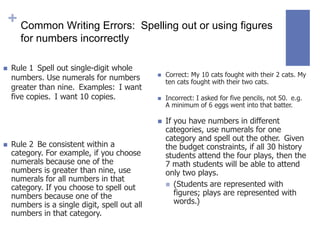
+ Common Writing Errors:               Spelling out or using figures
      for numbers incorrectly

   Rule 1
Spell out single-digit whole
    numbers. Use numerals for numbers             Correct: My 10 cats fought with their 2 cats. My
                                                   ten cats fought with their two cats.
    greater than nine.
Examples:
I want
    five copies.
I want 10 copies.                Incorrect: I asked for five pencils, not 50.
e.g.
                                                   A minimum of 6 eggs went into that batter.

                                                  If you have numbers in different
                                                   categories, use numerals for one
                                                   category and spell out the other.
Given
   Rule 2
Be consistent within a                  the budget constraints, if all 30 history
    category. For example, if you choose           students attend the four plays, then the
    numerals because one of the                    7 math students will be able to attend
    numbers is greater than nine, use              only two plays.
    numerals for all numbers in that
                                                    (Students are represented with
    category. If you choose to spell out
    numbers because one of the                        figures; plays are represented with
    numbers is a single digit, spell out all          words.)
    numbers in that category.
+
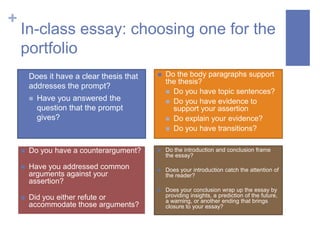
    In-class essay: choosing one for the
    portfolio
       Does it have a clear thesis that      Do the body paragraphs support
                                               the thesis?
        addresses the prompt?
                                                Do you have topic sentences?
           Have you answered the               Do you have evidence to
            question that the prompt             support your assertion
            gives?                              Do explain your evidence?
                                                Do you have transitions?


       Do you have a counterargument?        Do the introduction and conclusion frame
                                               the essay?

       Have you addressed common             Does your introduction catch the attention of
        arguments against your                 the reader?
        assertion?
                                              Does your conclusion wrap up the essay by
       Did you either refute or               providing insights, a prediction of the future,
                                               a warning, or another ending that brings
        accommodate those arguments?           closure to your essay?
+
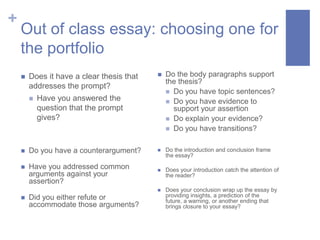
    Out of class essay: choosing one for
    the portfolio
       Does it have a clear thesis that      Do the body paragraphs support
                                               the thesis?
        addresses the prompt?
                                                Do you have topic sentences?
           Have you answered the               Do you have evidence to
            question that the prompt             support your assertion
            gives?                              Do explain your evidence?
                                                Do you have transitions?


       Do you have a counterargument?        Do the introduction and conclusion frame
                                               the essay?

       Have you addressed common             Does your introduction catch the attention of
        arguments against your                 the reader?
        assertion?
                                              Does your conclusion wrap up the essay by
       Did you either refute or               providing insights, a prediction of the
                                               future, a warning, or another ending that
        accommodate those arguments?           brings closure to your essay?
+
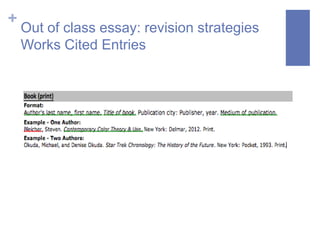
    Out of class essay: revision strategies
    Works Cited Entries
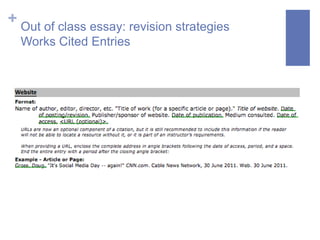
+ Out of class essay: revision strategies
  Works Cited Entries
+
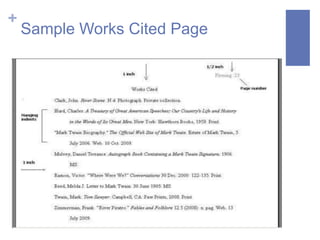
    Sample Works Cited Page
+
     In-Text Citations
     Whether you quote, summarize, or paraphrase, you MUST cite
     your sources.
Generally, the first time we use a source in a paper, whether it be through a
paraphrase or a quote, it's a good idea to use the author(s) full name(s) and the
title of the source we are using in the actual sentence so that readers feel that we
have introduced the source to them. After we have introduced the source, it's
perfectly acceptable to refer to the author by his or her last name or even to leave
the name out of the body of our text and simply include it in the citation.
First use:
In his Narrative of the Life of Frederick Douglass, An American Slave, Written by
Himself, Frederick Douglass argues that "Slavery proved as injurious [to slave holders]
as it did to me" (31).
Second use:
Douglass earlier argues that slavery was "a fatal poison of irresponsible power" to slave
holders (29).
Third use:
The use of the word "hypocrites!" suggests that even the religious faith of the slave
holders was tainted by their ownership of other humans (Douglass 77).
+
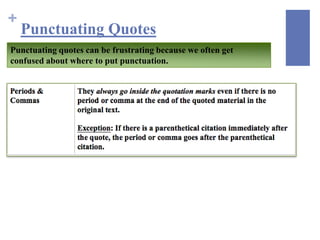
    Punctuating Quotes
Punctuating quotes can be frustrating because we often get
confused about where to put punctuation.
+
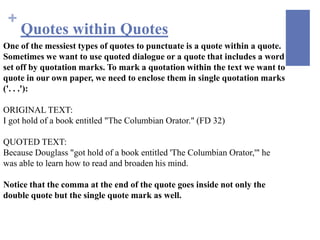
     Quotes within Quotes
One of the messiest types of quotes to punctuate is a quote within a quote.
Sometimes we want to use quoted dialogue or a quote that includes a word
set off by quotation marks. To mark a quotation within the text we want to
quote in our own paper, we need to enclose them in single quotation marks
('. . .'):

ORIGINAL TEXT:
I got hold of a book entitled "The Columbian Orator." (FD 32)

QUOTED TEXT:
Because Douglass "got hold of a book entitled 'The Columbian Orator,'" he
was able to learn how to read and broaden his mind.

Notice that the comma at the end of the quote goes inside not only the
double quote but the single quote mark as well.
+
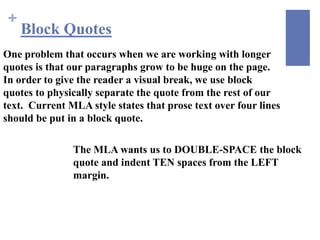
     Block Quotes
One problem that occurs when we are working with longer
quotes is that our paragraphs grow to be huge on the page.
In order to give the reader a visual break, we use block
quotes to physically separate the quote from the rest of our
text. Current MLA style states that prose text over four lines
should be put in a block quote.

               The MLA wants us to DOUBLE-SPACE the block
               quote and indent TEN spaces from the LEFT
               margin.
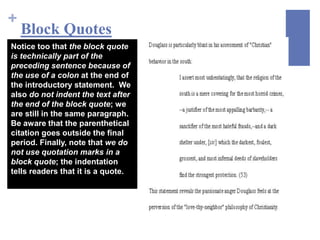
+
    Block Quotes
Notice too that the block quote
is technically part of the
preceding sentence because of
the use of a colon at the end of
the introductory statement. We
also do not indent the text after
the end of the block quote; we
are still in the same paragraph.
Be aware that the parenthetical
citation goes outside the final
period. Finally, note that we do
not use quotation marks in a
block quote; the indentation
tells readers that it is a quote.
+
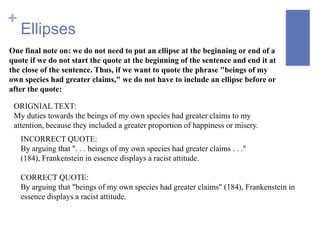
    Ellipses
One final note on: we do not need to put an ellipse at the beginning or end of a
quote if we do not start the quote at the beginning of the sentence and end it at
the close of the sentence. Thus, if we want to quote the phrase "beings of my
own species had greater claims," we do not have to include an ellipse before or
after the quote:

 ORIGNIAL TEXT:
 My duties towards the beings of my own species had greater claims to my
 attention, because they included a greater proportion of happiness or misery.
    INCORRECT QUOTE:
    By arguing that ". . . beings of my own species had greater claims . . ."
    (184), Frankenstein in essence displays a racist attitude.

    CORRECT QUOTE:
    By arguing that "beings of my own species had greater claims" (184), Frankenstein in
    essence displays a racist attitude.
+
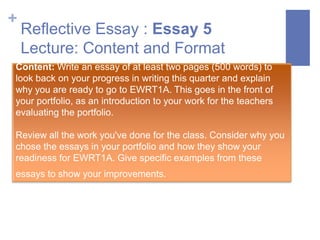
    Reflective Essay : Essay 5
    Lecture: Content and Format
Content: Write an essay of at least two pages (500 words) to
look back on your progress in writing this quarter and explain
why you are ready to go to EWRT1A. This goes in the front of
your portfolio, as an introduction to your work for the teachers
evaluating the portfolio.

Review all the work you've done for the class. Consider why you
chose the essays in your portfolio and how they show your
readiness for EWRT1A. Give specific examples from these
essays to show your improvements.
+
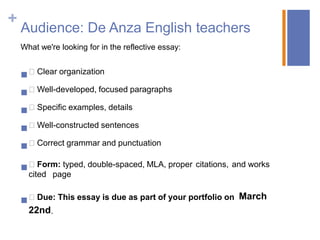
    Audience: De Anza English teachers
    What we're looking for in the reflective essay:


     Clear organization
     Well-developed, focused paragraphs
     Specific examples, details
     Well-constructed sentences
     Correct grammar and punctuation

     Form: typed, double-spaced, MLA, proper citations, and works
      cited page


     Due: This essay is due as part of your portfolio on March
      22nd.
+
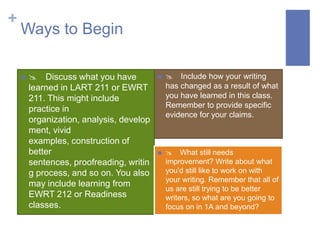
    Ways to Begin

        Discuss what you have               Include how your writing
        learned in LART 211 or EWRT           has changed as a result of what
        211. This might include               you have learned in this class.
                                              Remember to provide specific
        practice in
                                              evidence for your claims.
        organization, analysis, develop
        ment, vivid
        examples, construction of
        better                                What still needs
        sentences, proofreading, writin       improvement? Write about what
        g process, and so on. You also        you'd still like to work on with
                                              your writing. Remember that all of
        may include learning from
                                              us are still trying to be better
        EWRT 212 or Readiness                 writers, so what are you going to
        classes.                              focus on in 1A and beyond?
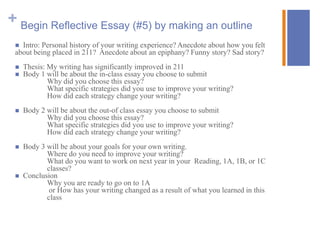
+ Begin Reflective Essay (#5) by making an outline
  Intro: Personal history of your writing experience? Anecdote about how you felt
 about being placed in 211? Anecdote about an epiphany? Funny story? Sad story?
    Thesis: My writing has significantly improved in 211
    Body 1 will be about the in-class essay you choose to submit
             Why did you choose this essay?
             What specific strategies did you use to improve your writing?
             How did each strategy change your writing?
    Body 2 will be about the out-of class essay you choose to submit
            Why did you choose this essay?
            What specific strategies did you use to improve your writing?
            How did each strategy change your writing?
    Body 3 will be about your goals for your own writing.
            Where do you need to improve your writing?
            What do you want to work on next year in your Reading, 1A, 1B, or 1C
            classes?
    Conclusion
            Why you are ready to go on to 1A
             or How has your writing changed as a result of what you learned in this
            class
+
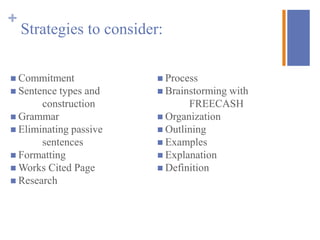
    Strategies to consider:

 Commitment               Process
 Sentence types and       Brainstormingwith
       construction              FREECASH
 Grammar                  Organization
 Eliminating passive      Outlining
       sentences           Examples
 Formatting               Explanation
 Works Cited Page         Definition
 Research
+
    Reflective Essay : Essay 5
    In-class writing: Reflective Essay


           Get out your
           computer, your outline, or
           a clean piece of paper
           and begin writing!
+
    Homework


    1. Revise one in-class essay for your
       portfolio
    2. Write your reflective essay
    3. Get a folder to serve as your portfolio

Week 10 class 2 ewrt211

  • 1.
    + Week 10 Class 2 EWRT 211
  • 2.
    + AGENDA  Common Writing Errors: Spelling out or using figures for numbers incorrectly  In-class essay: choosing one for the portfolio  Out of class essay: choosing one for the portfolio  Out of class essay: revision strategies  Works Cited page  In-text Citations  Reflective Essay : Essay 5  Lecture: Content and Format  In-class writing: Reflective Essay
  • 3.
    + Common WritingErrors: Spelling out or using figures for numbers incorrectly  Rule 1
Spell out single-digit whole numbers. Use numerals for numbers  Correct: My 10 cats fought with their 2 cats. My ten cats fought with their two cats. greater than nine.
Examples:
I want five copies.
I want 10 copies.  Incorrect: I asked for five pencils, not 50.
e.g. A minimum of 6 eggs went into that batter.  If you have numbers in different categories, use numerals for one category and spell out the other.
Given  Rule 2
Be consistent within a the budget constraints, if all 30 history category. For example, if you choose students attend the four plays, then the numerals because one of the 7 math students will be able to attend numbers is greater than nine, use only two plays. numerals for all numbers in that  (Students are represented with category. If you choose to spell out numbers because one of the figures; plays are represented with numbers is a single digit, spell out all words.) numbers in that category.
  • 4.
    + In-class essay: choosing one for the portfolio  Does it have a clear thesis that  Do the body paragraphs support the thesis? addresses the prompt?  Do you have topic sentences?  Have you answered the  Do you have evidence to question that the prompt support your assertion gives?  Do explain your evidence?  Do you have transitions?  Do you have a counterargument?  Do the introduction and conclusion frame the essay?  Have you addressed common  Does your introduction catch the attention of arguments against your the reader? assertion?  Does your conclusion wrap up the essay by  Did you either refute or providing insights, a prediction of the future, a warning, or another ending that brings accommodate those arguments? closure to your essay?
  • 5.
    + Out of class essay: choosing one for the portfolio  Does it have a clear thesis that  Do the body paragraphs support the thesis? addresses the prompt?  Do you have topic sentences?  Have you answered the  Do you have evidence to question that the prompt support your assertion gives?  Do explain your evidence?  Do you have transitions?  Do you have a counterargument?  Do the introduction and conclusion frame the essay?  Have you addressed common  Does your introduction catch the attention of arguments against your the reader? assertion?  Does your conclusion wrap up the essay by  Did you either refute or providing insights, a prediction of the future, a warning, or another ending that accommodate those arguments? brings closure to your essay?
  • 6.
    + Out of class essay: revision strategies Works Cited Entries
  • 7.
    + Out ofclass essay: revision strategies Works Cited Entries
  • 8.
    + Sample Works Cited Page
  • 9.
    + In-Text Citations Whether you quote, summarize, or paraphrase, you MUST cite your sources. Generally, the first time we use a source in a paper, whether it be through a paraphrase or a quote, it's a good idea to use the author(s) full name(s) and the title of the source we are using in the actual sentence so that readers feel that we have introduced the source to them. After we have introduced the source, it's perfectly acceptable to refer to the author by his or her last name or even to leave the name out of the body of our text and simply include it in the citation. First use: In his Narrative of the Life of Frederick Douglass, An American Slave, Written by Himself, Frederick Douglass argues that "Slavery proved as injurious [to slave holders] as it did to me" (31). Second use: Douglass earlier argues that slavery was "a fatal poison of irresponsible power" to slave holders (29). Third use: The use of the word "hypocrites!" suggests that even the religious faith of the slave holders was tainted by their ownership of other humans (Douglass 77).
  • 10.
    + Punctuating Quotes Punctuating quotes can be frustrating because we often get confused about where to put punctuation.
  • 11.
    + Quotes within Quotes One of the messiest types of quotes to punctuate is a quote within a quote. Sometimes we want to use quoted dialogue or a quote that includes a word set off by quotation marks. To mark a quotation within the text we want to quote in our own paper, we need to enclose them in single quotation marks ('. . .'): ORIGINAL TEXT: I got hold of a book entitled "The Columbian Orator." (FD 32) QUOTED TEXT: Because Douglass "got hold of a book entitled 'The Columbian Orator,'" he was able to learn how to read and broaden his mind. Notice that the comma at the end of the quote goes inside not only the double quote but the single quote mark as well.
  • 12.
    + Block Quotes One problem that occurs when we are working with longer quotes is that our paragraphs grow to be huge on the page. In order to give the reader a visual break, we use block quotes to physically separate the quote from the rest of our text. Current MLA style states that prose text over four lines should be put in a block quote. The MLA wants us to DOUBLE-SPACE the block quote and indent TEN spaces from the LEFT margin.
  • 13.
    + Block Quotes Notice too that the block quote is technically part of the preceding sentence because of the use of a colon at the end of the introductory statement. We also do not indent the text after the end of the block quote; we are still in the same paragraph. Be aware that the parenthetical citation goes outside the final period. Finally, note that we do not use quotation marks in a block quote; the indentation tells readers that it is a quote.
  • 14.
    + Ellipses One final note on: we do not need to put an ellipse at the beginning or end of a quote if we do not start the quote at the beginning of the sentence and end it at the close of the sentence. Thus, if we want to quote the phrase "beings of my own species had greater claims," we do not have to include an ellipse before or after the quote: ORIGNIAL TEXT: My duties towards the beings of my own species had greater claims to my attention, because they included a greater proportion of happiness or misery. INCORRECT QUOTE: By arguing that ". . . beings of my own species had greater claims . . ." (184), Frankenstein in essence displays a racist attitude. CORRECT QUOTE: By arguing that "beings of my own species had greater claims" (184), Frankenstein in essence displays a racist attitude.
  • 15.
    + Reflective Essay : Essay 5 Lecture: Content and Format Content: Write an essay of at least two pages (500 words) to look back on your progress in writing this quarter and explain why you are ready to go to EWRT1A. This goes in the front of your portfolio, as an introduction to your work for the teachers evaluating the portfolio. Review all the work you've done for the class. Consider why you chose the essays in your portfolio and how they show your readiness for EWRT1A. Give specific examples from these essays to show your improvements.
  • 16.
    + Audience: De Anza English teachers What we're looking for in the reflective essay:  Clear organization  Well-developed, focused paragraphs  Specific examples, details  Well-constructed sentences  Correct grammar and punctuation  Form: typed, double-spaced, MLA, proper citations, and works cited page  Due: This essay is due as part of your portfolio on March 22nd.
  • 17.
    + Ways to Begin   Discuss what you have   Include how your writing learned in LART 211 or EWRT has changed as a result of what 211. This might include you have learned in this class. Remember to provide specific practice in evidence for your claims. organization, analysis, develop ment, vivid examples, construction of better   What still needs sentences, proofreading, writin improvement? Write about what g process, and so on. You also you'd still like to work on with your writing. Remember that all of may include learning from us are still trying to be better EWRT 212 or Readiness writers, so what are you going to classes. focus on in 1A and beyond?
  • 18.
    + Begin ReflectiveEssay (#5) by making an outline  Intro: Personal history of your writing experience? Anecdote about how you felt about being placed in 211? Anecdote about an epiphany? Funny story? Sad story?  Thesis: My writing has significantly improved in 211  Body 1 will be about the in-class essay you choose to submit Why did you choose this essay? What specific strategies did you use to improve your writing? How did each strategy change your writing?  Body 2 will be about the out-of class essay you choose to submit Why did you choose this essay? What specific strategies did you use to improve your writing? How did each strategy change your writing?  Body 3 will be about your goals for your own writing. Where do you need to improve your writing? What do you want to work on next year in your Reading, 1A, 1B, or 1C classes?  Conclusion Why you are ready to go on to 1A or How has your writing changed as a result of what you learned in this class
  • 19.
    + Strategies to consider:  Commitment  Process  Sentence types and  Brainstormingwith construction FREECASH  Grammar  Organization  Eliminating passive  Outlining sentences  Examples  Formatting  Explanation  Works Cited Page  Definition  Research
  • 20.
    + Reflective Essay : Essay 5 In-class writing: Reflective Essay Get out your computer, your outline, or a clean piece of paper and begin writing!
  • 21.
    + Homework 1. Revise one in-class essay for your portfolio 2. Write your reflective essay 3. Get a folder to serve as your portfolio