OW2 Webinar

            May 14, 2009


 Open Source Based
  Business Models
       Francois Letellier - fl@flet.fr
(Freelance consultant – OW2 board/ELC
                 member)
Agenda

● Market dynamics in software
● Free/Libre/Open-Source

  Software based business
  models
● The FLOSS “marketing mix”

● Q&A
Terminology
●   FLOSS: Free / Libre / Open Source Software

●   Free « as in free speech, not free beer »
●   Open Source: term coined to avoid the
    ambiguities of « free » (in English)
●   Libre: latin origin, EU prefered term for « free »

●   Free ≈ Libre ≈ Open Source Software
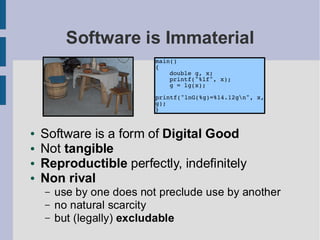
Software is Immaterial
                           main()
                           {
                               double g, x;
                               printf("%lf", x);
                               g = lg(x);

                           printf("lnG(%g)=%14.12gn", x,
                           g);
                           }


●   Software is a form of Digital Good
●   Not tangible
●   Reproductible perfectly, indefinitely
●   Non rival
    –   use by one does not preclude use by another
    –   no natural scarcity
    –   but (legally) excludable
Software Protection:
                  Legal Framework
●   Copyright / Author's rights: the Berne Convention
    –  Protection of Literary and Artistic Works
     – Principle of national treatment
     – Protection over a work is automatic, not subject to
       registration
     – The work must be original and creative
●   To use copyrighted work (e.g. Software):
    –   Must enter a contract (« license ») with the author
        or copyright owner
         ●   No right granted unless explicitely specified
         ●   No obligation of the licensee to accept
●   This is the basis of legal excludability
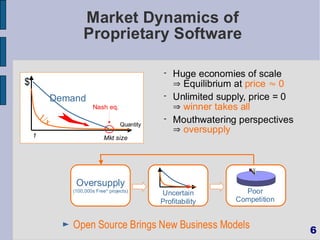
Market Dynamics of
                        Proprietary Software

                                                        Huge economies of scale
$                                                         Equilibrium at price  0
              Demand                                    Unlimited supply, price = 0
                            Nash eq.                      winner takes all
        1/x                                             Mouthwatering perspectives
                                         Quantity
                                                          oversupply
    1                            Mkt size


                     Oversupply
                    (100,000s Free* projects)
                                                    Uncertain            Poor
                                                    Profitability      Competition


                ►   Open Source Brings New Business Models                             6
FLOSS: a Collective Strategy
 for Software Development
Because sooner or later, publishers of proprietary software
have to compete against vendors of (almost) free substitutes

Because software production costs can be reduced through
collaborative engineering

Because opening the source code is the best way to
maximize the potential of collaboration

And because collaborating when competing is pointless is
the best way to keep innovating


                                                               7
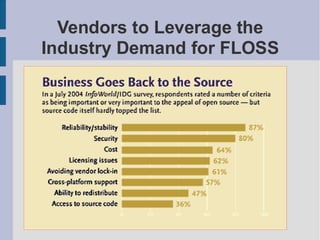
Vendors to Leverage the
Industry Demand for FLOSS
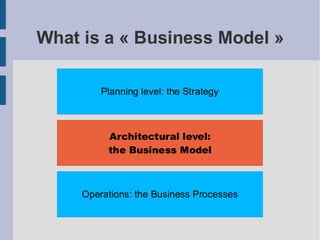
What is a « Business Model »

         Planning level: the Strategy


          Architectural level:
          the Business Model


     Operations: the Business Processes
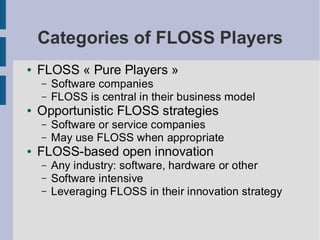
Categories of FLOSS Players
●   FLOSS « Pure Players »
    –   Software companies
    –   FLOSS is central in their business model
●   Opportunistic FLOSS strategies
    –   Software or service companies
    –   May use FLOSS when appropriate
●   FLOSS-based open innovation
    –   Any industry: software, hardware or other
    –   Software intensive
    –   Leveraging FLOSS in their innovation strategy
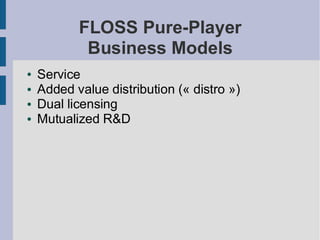
FLOSS Pure-Player
            Business Models
●   Service
●   Added value distribution (« distro »)
●   Dual licensing
●   Mutualized R&D
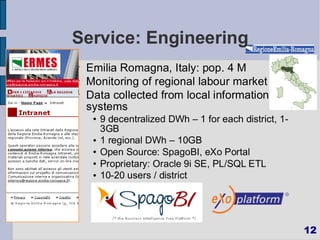
Service: Engineering
   Emilia Romagna, Italy: pop. 4 M
   Monitoring of regional labour market
   Data collected from local information
    systems
      9 decentralized DWh – 1 for each district, 1-
       3GB
      1 regional DWh – 10GB

      Open Source: SpagoBI, eXo Portal

      Proprietary: Oracle 9i SE, PL/SQL ETL

      10-20 users / district


                                                       12
Major Linux Distros
    Community Maintained
●   Slackware Linux 1992 (Patrick
    Volkerding)
    –   oldest distro still maintained
    –   highly stable, clean and bug-free, strong
        adherence to UNIX principles
    –   limited number of supported applications;
        complex upgrade procedure
Major Linux Distros
        Commercially Maintained
●   Red Hat 1994 (Bob Young & Marc Ewing)
    –   enterprise edition: Red Hat Enterprise Linux;
        maintained by FLOSS forerunner and pure
        player
    –   targeted to corporate IT departments (servers)
        more concerned about support than cost
    –   community edition: Fedora
Dual Licensing: eXo
                          Platform
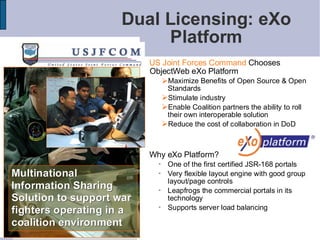
                          US Joint Forces Command Chooses
                          ObjectWeb eXo Platform
                             Maximize Benefits of Open Source & Open
                                 Standards
                                Stimulate industry
                                Enable Coalition partners the ability to roll
                                 their own interoperable solution
                                Reduce the cost of collaboration in DoD


                          Why eXo Platform?
                                One of the first certified JSR-168 portals
Multinational                   Very flexible layout engine with good group
                                 layout/page controls
Information Sharing             Leapfrogs the commercial portals in its
Solution to support war          technology
                                Supports server load balancing
fighters operating in a
coalition environment
                                                                                 15
Mutualized Development:
Eclipse
●   Nonprofit, EU, incepted in 2003 on IBM's
    initiative
●   Focus on the Eclipse development platform
    (Java)
●   Corporate membership, high level of
    membership fee, different value proposition
    for developers and for consumers
●   Formalized governance all the way down to
    project management
Opportunistic FLOSS Strategies
●   Agnostic service companies and VARs
●   Externally funded ventures
●   (Hype)


    FLOSS-based open innovation will be dealt
                with separately
“Agnostic” Service
Company


 ● IBM Global Services
 ● $ 91B revenue

 ● #1 in number of US patents


   granted/y
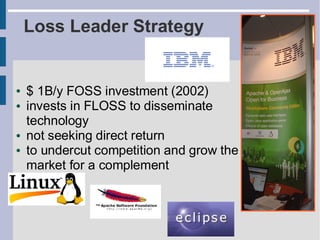
Loss Leader Strategy


●   $ 1B/y FOSS investment (2002)
●   invests in FLOSS to disseminate
    technology
●   not seeking direct return
●   to undercut competition and grow the
    market for a complement
FLOSS Based Business Models

             Key messages:

  Business models form a continuum from
         proprietary to free software

There are about as many business models as
                 companies

 You may create your own: innovation also
       happens in business models
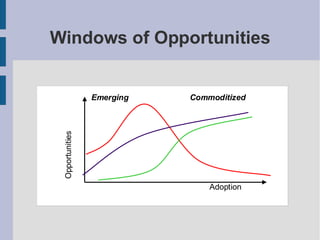
Windows of Opportunities


                 Emerging   Commoditized
 Opportunities


                                Adoption
FLOSS Based Business Models

              Key messages:

There is no single business model for FLOSS

 There are many possible business models
   based on FLOSS or leveraging FLOSS

 The key is not to chose between proprietary
 and FLOSS, but to always evaluate FLOSS
   as an option in a corporate environment
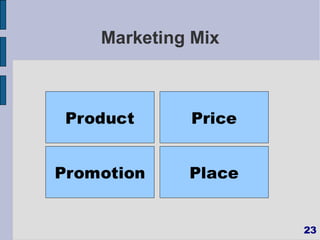
Marketing Mix


 Product     Price


Promotion    Place


                     23
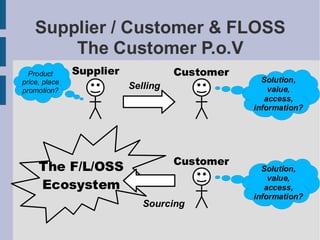
Supplier / Customer & FLOSS
        The Customer P.o.V
  Product      Supplier             Customer
price, place                                     Solution,
promotion?
                          Selling                  value,
                                                  access,
                                               information?


                                    Customer
     The F/L/OSS                                 Solution,
                                                   value,
     Ecosystem                                    access,
                                               information?
                             Sourcing
What are the FLOSS «4 P's»
              (NOT)?
●   Product: FLOSS project
●   Price: zero
●   Promotion: none, only word-of-mouth
●   Placement: online, full-stop

●   These mis-conceptions lead to the classical
    question:
    « but how can you make money with
    software you give away for free ? »
FLOSS – Product / Solution
●   The product is
    –   A superset
         ●   Eg: Embedded; SaaS...
    –   A complement
         ●   Eg: Professional services; Distros with subscriptions...
    –   A substitute
         ●   Eg: Dual-licensing; Bait-and-hook...
of the FLOSS project
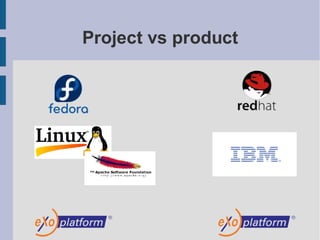
Project vs product
FLOSS – Pricing / Value
●   Monetary
    –   In few models, comes from FLOSS
    –   Usually, comes from complements/superset
        (hardware, doc, services) or non-FLOSS
        substitutes
●   Non-monetary
    –   Adoption leads to sustainability
    –   Contributions, peer-to-peer support
    –   Direct user feedback enhances the product
        marketing process
FLOSS – Promotion /
         Information
● Urban legend: the natural selection
  of FLOSS projects (the widely
  adopted are the technically superior
  ones)
● Reality: promotion is a huge effort

● A healty FLOSS project may be the


  promotion channel for product(s)
FLOSS – Placement / Access
●   Since the product is not the FLOSS project
    ... the access point is not just the Internet
●   Scalability issues apply to some models...
     – Eg: FLOSS enabled consumer
       electronics
     – Less to others, eg: Online support
       subscription
●   Ecosystem leverage: go to market jointly
    with partners
FLOSS - Competitors
●   Reminder: the product is not the FLOSS
    project...
●   Product competitors depend on the product
●   Competitors to the FLOSS project
     – Proprietary or FLOSS substitute
     – May jeopardize project image,
       sustainability
●   FLOSS free riders may not be competitors
    even though they benefit and do not pay
     – Because the product is not the project
Recap / Take-aways
●   Collaboration on software development makes
    economical sense – hence FLOSS
●   Industry demands gave opportunities for new
    business models
●   There's a wide variety of FLOSS-based business
    models...
●   ...in most of them, the product is NOT the FLOSS
    project, but a superset, complement or substitute

●   To be cont'd (open innovation in software – June
    11, 2009) – and we'll see where OW2 fits!
More : “Open Source Software: the Role of Nonprofits in Federating
Business and Innovation Ecosystems”,
F. Letellier, AFME Conference 2008
http://flet.netcipia.net/xwiki/bin/download/Main/publications%2Dfr/GEM2008%2DF
Letellier%2DSubmittedPaper.pdf


 Thank you for your attention


        Questions

                   ?                             And Answers
                                                Le middleware
                                                     from
                                                 est partout ?
  Francois Letellier - fl@flet.fr             “Sunny” Grenoble
                                                                            33

Webinar Bm V4[1]

  • 1.
    OW2 Webinar May 14, 2009 Open Source Based Business Models Francois Letellier - fl@flet.fr (Freelance consultant – OW2 board/ELC member)
  • 2.
    Agenda ● Market dynamicsin software ● Free/Libre/Open-Source Software based business models ● The FLOSS “marketing mix” ● Q&A
  • 3.
    Terminology ● FLOSS: Free / Libre / Open Source Software ● Free « as in free speech, not free beer » ● Open Source: term coined to avoid the ambiguities of « free » (in English) ● Libre: latin origin, EU prefered term for « free » ● Free ≈ Libre ≈ Open Source Software
  • 4.
    Software is Immaterial main() { double g, x; printf("%lf", x); g = lg(x); printf("lnG(%g)=%14.12gn", x, g); } ● Software is a form of Digital Good ● Not tangible ● Reproductible perfectly, indefinitely ● Non rival – use by one does not preclude use by another – no natural scarcity – but (legally) excludable
  • 5.
    Software Protection: Legal Framework ● Copyright / Author's rights: the Berne Convention – Protection of Literary and Artistic Works – Principle of national treatment – Protection over a work is automatic, not subject to registration – The work must be original and creative ● To use copyrighted work (e.g. Software): – Must enter a contract (« license ») with the author or copyright owner ● No right granted unless explicitely specified ● No obligation of the licensee to accept ● This is the basis of legal excludability
  • 6.
    Market Dynamics of Proprietary Software  Huge economies of scale $  Equilibrium at price  0 Demand  Unlimited supply, price = 0 Nash eq.  winner takes all 1/x  Mouthwatering perspectives Quantity  oversupply 1 Mkt size Oversupply (100,000s Free* projects) Uncertain Poor Profitability Competition ► Open Source Brings New Business Models 6
  • 7.
    FLOSS: a CollectiveStrategy for Software Development Because sooner or later, publishers of proprietary software have to compete against vendors of (almost) free substitutes Because software production costs can be reduced through collaborative engineering Because opening the source code is the best way to maximize the potential of collaboration And because collaborating when competing is pointless is the best way to keep innovating 7
  • 8.
    Vendors to Leveragethe Industry Demand for FLOSS
  • 9.
    What is a« Business Model » Planning level: the Strategy Architectural level: the Business Model Operations: the Business Processes
  • 10.
    Categories of FLOSSPlayers ● FLOSS « Pure Players » – Software companies – FLOSS is central in their business model ● Opportunistic FLOSS strategies – Software or service companies – May use FLOSS when appropriate ● FLOSS-based open innovation – Any industry: software, hardware or other – Software intensive – Leveraging FLOSS in their innovation strategy
  • 11.
    FLOSS Pure-Player Business Models ● Service ● Added value distribution (« distro ») ● Dual licensing ● Mutualized R&D
  • 12.
    Service: Engineering  Emilia Romagna, Italy: pop. 4 M  Monitoring of regional labour market  Data collected from local information systems  9 decentralized DWh – 1 for each district, 1- 3GB  1 regional DWh – 10GB  Open Source: SpagoBI, eXo Portal  Proprietary: Oracle 9i SE, PL/SQL ETL  10-20 users / district 12
  • 13.
    Major Linux Distros Community Maintained ● Slackware Linux 1992 (Patrick Volkerding) – oldest distro still maintained – highly stable, clean and bug-free, strong adherence to UNIX principles – limited number of supported applications; complex upgrade procedure
  • 14.
    Major Linux Distros Commercially Maintained ● Red Hat 1994 (Bob Young & Marc Ewing) – enterprise edition: Red Hat Enterprise Linux; maintained by FLOSS forerunner and pure player – targeted to corporate IT departments (servers) more concerned about support than cost – community edition: Fedora
  • 15.
    Dual Licensing: eXo Platform US Joint Forces Command Chooses ObjectWeb eXo Platform Maximize Benefits of Open Source & Open Standards Stimulate industry Enable Coalition partners the ability to roll their own interoperable solution Reduce the cost of collaboration in DoD Why eXo Platform?  One of the first certified JSR-168 portals Multinational  Very flexible layout engine with good group layout/page controls Information Sharing  Leapfrogs the commercial portals in its Solution to support war technology  Supports server load balancing fighters operating in a coalition environment 15
  • 16.
    Mutualized Development: Eclipse ● Nonprofit, EU, incepted in 2003 on IBM's initiative ● Focus on the Eclipse development platform (Java) ● Corporate membership, high level of membership fee, different value proposition for developers and for consumers ● Formalized governance all the way down to project management
  • 17.
    Opportunistic FLOSS Strategies ● Agnostic service companies and VARs ● Externally funded ventures ● (Hype) FLOSS-based open innovation will be dealt with separately
  • 18.
    “Agnostic” Service Company ●IBM Global Services ● $ 91B revenue ● #1 in number of US patents granted/y
  • 19.
    Loss Leader Strategy ● $ 1B/y FOSS investment (2002) ● invests in FLOSS to disseminate technology ● not seeking direct return ● to undercut competition and grow the market for a complement
  • 20.
    FLOSS Based BusinessModels Key messages: Business models form a continuum from proprietary to free software There are about as many business models as companies You may create your own: innovation also happens in business models
  • 21.
    Windows of Opportunities Emerging Commoditized Opportunities Adoption
  • 22.
    FLOSS Based BusinessModels Key messages: There is no single business model for FLOSS There are many possible business models based on FLOSS or leveraging FLOSS The key is not to chose between proprietary and FLOSS, but to always evaluate FLOSS as an option in a corporate environment
  • 23.
    Marketing Mix Product Price Promotion Place 23
  • 24.
    Supplier / Customer& FLOSS The Customer P.o.V Product Supplier Customer price, place Solution, promotion? Selling value, access, information? Customer The F/L/OSS Solution, value, Ecosystem access, information? Sourcing
  • 25.
    What are theFLOSS «4 P's» (NOT)? ● Product: FLOSS project ● Price: zero ● Promotion: none, only word-of-mouth ● Placement: online, full-stop ● These mis-conceptions lead to the classical question: « but how can you make money with software you give away for free ? »
  • 26.
    FLOSS – Product/ Solution ● The product is – A superset ● Eg: Embedded; SaaS... – A complement ● Eg: Professional services; Distros with subscriptions... – A substitute ● Eg: Dual-licensing; Bait-and-hook... of the FLOSS project
  • 27.
  • 28.
    FLOSS – Pricing/ Value ● Monetary – In few models, comes from FLOSS – Usually, comes from complements/superset (hardware, doc, services) or non-FLOSS substitutes ● Non-monetary – Adoption leads to sustainability – Contributions, peer-to-peer support – Direct user feedback enhances the product marketing process
  • 29.
    FLOSS – Promotion/ Information ● Urban legend: the natural selection of FLOSS projects (the widely adopted are the technically superior ones) ● Reality: promotion is a huge effort ● A healty FLOSS project may be the promotion channel for product(s)
  • 30.
    FLOSS – Placement/ Access ● Since the product is not the FLOSS project ... the access point is not just the Internet ● Scalability issues apply to some models... – Eg: FLOSS enabled consumer electronics – Less to others, eg: Online support subscription ● Ecosystem leverage: go to market jointly with partners
  • 31.
    FLOSS - Competitors ● Reminder: the product is not the FLOSS project... ● Product competitors depend on the product ● Competitors to the FLOSS project – Proprietary or FLOSS substitute – May jeopardize project image, sustainability ● FLOSS free riders may not be competitors even though they benefit and do not pay – Because the product is not the project
  • 32.
    Recap / Take-aways ● Collaboration on software development makes economical sense – hence FLOSS ● Industry demands gave opportunities for new business models ● There's a wide variety of FLOSS-based business models... ● ...in most of them, the product is NOT the FLOSS project, but a superset, complement or substitute ● To be cont'd (open innovation in software – June 11, 2009) – and we'll see where OW2 fits!
  • 33.
    More : “OpenSource Software: the Role of Nonprofits in Federating Business and Innovation Ecosystems”, F. Letellier, AFME Conference 2008 http://flet.netcipia.net/xwiki/bin/download/Main/publications%2Dfr/GEM2008%2DF Letellier%2DSubmittedPaper.pdf Thank you for your attention Questions ? And Answers Le middleware from est partout ? Francois Letellier - fl@flet.fr “Sunny” Grenoble 33