Kimberly A. Reed
Dominican University
          12/26/09
How can I see through the grey areas in web
pages when there are so many to choose from?
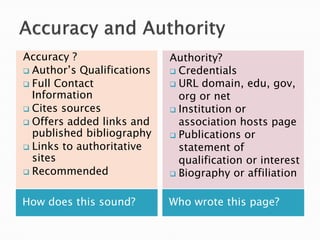
Accuracy ?                  Authority?
 Author’s Qualifications    Credentials
 Full Contact               URL domain, edu, gov,
  Information                 org or net
 Cites sources              Institution or
 Offers added links and      association hosts page
  published bibliography     Publications or
 Links to authoritative      statement of
  sites                       qualification or interest
 Recommended                Biography or affiliation


How does this sound?        Who wrote this page?
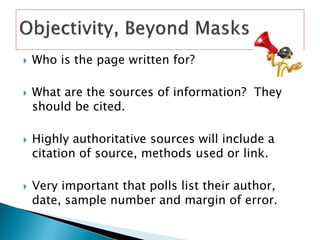
   Who is the page written for?

   What are the sources of information? They
    should be cited.

   Highly authoritative sources will include a
    citation of source, methods used or link.

   Very important that polls list their author,
    date, sample number and margin of error.
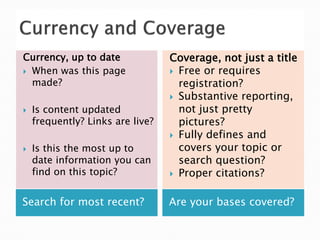
Currency, up to date              Coverage, not just a title
 When was this page               Free or requires
  made?                             registration?
                                   Substantive reporting,
   Is content updated              not just pretty
    frequently? Links are live?     pictures?
                                   Fully defines and
   Is this the most up to          covers your topic or
    date information you can        search question?
    find on this topic?            Proper citations?


Search for most recent?           Are your bases covered?
   Kapoun, Jim. "Teaching undergrads WEB
    evaluation: A guide for library instruction."
    C&RL News (July/August 1998): 522-523;
    reprinted at
   “Five Criteria for Evaluating Web Pages,”
    http://www.library.cornell.edu/olinuris/ref/w
    ebcrit.html
   “Evaluating Web Pages: Techniques to Apply
    and Questions to Ask,”
    http://www.lib.berkeley.edu/TeachingLib/Gui
    des/Internet/Evaluate.html

Web page evaluation Kim Reed

  • 1.
    Kimberly A. Reed DominicanUniversity 12/26/09
  • 2.
    How can Isee through the grey areas in web pages when there are so many to choose from?
  • 3.
    Accuracy ? Authority?  Author’s Qualifications  Credentials  Full Contact  URL domain, edu, gov, Information org or net  Cites sources  Institution or  Offers added links and association hosts page published bibliography  Publications or  Links to authoritative statement of sites qualification or interest  Recommended  Biography or affiliation How does this sound? Who wrote this page?
  • 4.
    Who is the page written for?  What are the sources of information? They should be cited.  Highly authoritative sources will include a citation of source, methods used or link.  Very important that polls list their author, date, sample number and margin of error.
  • 5.
    Currency, up todate Coverage, not just a title  When was this page  Free or requires made? registration?  Substantive reporting,  Is content updated not just pretty frequently? Links are live? pictures?  Fully defines and  Is this the most up to covers your topic or date information you can search question? find on this topic?  Proper citations? Search for most recent? Are your bases covered?
  • 6.
    Kapoun, Jim. "Teaching undergrads WEB evaluation: A guide for library instruction." C&RL News (July/August 1998): 522-523; reprinted at  “Five Criteria for Evaluating Web Pages,” http://www.library.cornell.edu/olinuris/ref/w ebcrit.html  “Evaluating Web Pages: Techniques to Apply and Questions to Ask,” http://www.lib.berkeley.edu/TeachingLib/Gui des/Internet/Evaluate.html