Web 2.0 and Higher Education Marika Pineda Lane Community College Library
The Shift (around 2004) Web 1.0   Static  Directories Software on desktops Institutional publication   Web 2.0   Dynamic  Tagging Web as platform User-generated content            
Major Applications of Web 2.0 Blogging Micro-blogging  Social networking Photograph sharing Cloud computing Video sharing  Wikis Mash-ups
Participant Economy         “ This artificial distinction between a consumer and a producer is dissolving; I call it the  participant economy ... Web 2.0 is about people . ” David Sifry, CEO of Technorati   August 6, 2006
Consider the pedagogical framework Web 2.0 movement emphasizes: active participation collaboration customization sharing user-generated content    Constructivism becomes “ connectivism ”
Connectivism A new educational theory Reflects the social, interconnected and community-based characteristics of learning in contemporary times.    knowledge is networked teamwork provides learning opportunities knowledge generation is participatory  learning through generating ideas personal networks enable learning engagement in experiential tasks     This translates  to life & learning beyond school Student-generated content
Personal Learning Environment An environment in which learners  manage their own learning landscape  use various software and services adjust their options based on needs and interests   These Web 2.0 services can be used within Moodle.  Or not.   This translates  to life & learning beyond school skills used in the workplace   
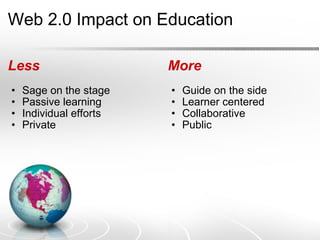
Web 2.0 Impact on Education  Less Sage on the stage Passive learning Individual efforts Private More Guide on the side Learner centered Collaborative Public
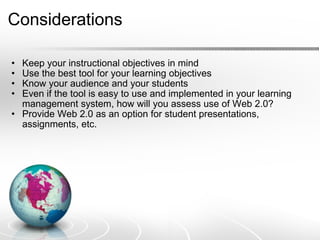
Considerations Keep your instructional objectives in mind Use the best tool for your learning objectives Know your audience and your students Even if the tool is easy to use and implemented in your learning management system, how will you assess use of Web 2.0? Provide Web 2.0 as an option for student presentations, assignments, etc.
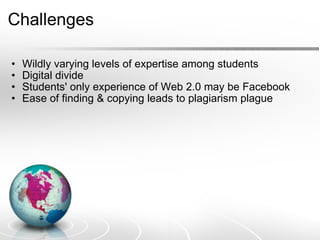
Challenges Wildly varying levels of expertise among students Digital divide  Students' only experience of Web 2.0 may be Facebook Ease of finding & copying leads to plagiarism plague
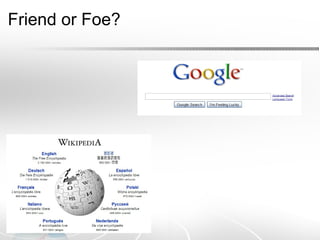
Friend or Foe?  
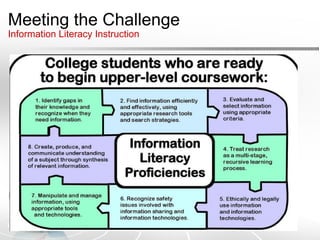
Meeting the Challenge Information Literacy Instruction  
Bibliography Lee, Mark J. W., Charlynn Miller, and Leon Newnham. "RSS and content syndication in higher education: subscribing to a new model of teaching and learning."  Educational Media International  45.4 (2008): 311-322.  Professional Development Collection . EBSCO. Web. 11 Feb. 2010.

Web 2.0 and higher ed

  • 1.
    Web 2.0 andHigher Education Marika Pineda Lane Community College Library
  • 2.
    The Shift (around2004) Web 1.0 Static Directories Software on desktops Institutional publication   Web 2.0   Dynamic Tagging Web as platform User-generated content            
  • 3.
    Major Applications ofWeb 2.0 Blogging Micro-blogging Social networking Photograph sharing Cloud computing Video sharing Wikis Mash-ups
  • 4.
    Participant Economy        “ This artificial distinction between a consumer and a producer is dissolving; I call it the participant economy ... Web 2.0 is about people . ” David Sifry, CEO of Technorati   August 6, 2006
  • 5.
    Consider the pedagogicalframework Web 2.0 movement emphasizes: active participation collaboration customization sharing user-generated content   Constructivism becomes “ connectivism ”
  • 6.
    Connectivism A neweducational theory Reflects the social, interconnected and community-based characteristics of learning in contemporary times.    knowledge is networked teamwork provides learning opportunities knowledge generation is participatory learning through generating ideas personal networks enable learning engagement in experiential tasks     This translates  to life & learning beyond school Student-generated content
  • 7.
    Personal Learning EnvironmentAn environment in which learners  manage their own learning landscape  use various software and services adjust their options based on needs and interests   These Web 2.0 services can be used within Moodle. Or not.   This translates  to life & learning beyond school skills used in the workplace  
  • 8.
    Web 2.0 Impacton Education Less Sage on the stage Passive learning Individual efforts Private More Guide on the side Learner centered Collaborative Public
  • 9.
    Considerations Keep yourinstructional objectives in mind Use the best tool for your learning objectives Know your audience and your students Even if the tool is easy to use and implemented in your learning management system, how will you assess use of Web 2.0? Provide Web 2.0 as an option for student presentations, assignments, etc.
  • 10.
    Challenges Wildly varyinglevels of expertise among students Digital divide Students' only experience of Web 2.0 may be Facebook Ease of finding & copying leads to plagiarism plague
  • 11.
  • 12.
    Meeting the ChallengeInformation Literacy Instruction  
  • 13.
    Bibliography Lee, MarkJ. W., Charlynn Miller, and Leon Newnham. "RSS and content syndication in higher education: subscribing to a new model of teaching and learning." Educational Media International 45.4 (2008): 311-322. Professional Development Collection . EBSCO. Web. 11 Feb. 2010.