
We Can Do Better
The Power of the Story in Patient Advocacy
Presented by -Regina Holliday
Wife
Mother
Daughter
Sales Clerk
Art Teacher
Caregiver
Widow
Artist
Poet
PhD
Father
Husband
Professor of Film
Video Clerk
Writer
Son
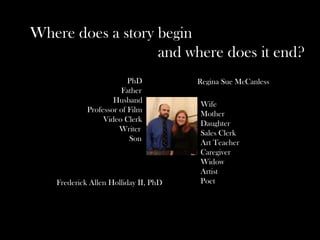
Where does a story begin
and where does it end?
Frederick Allen Holliday II, PhD
Regina Sue McCanless
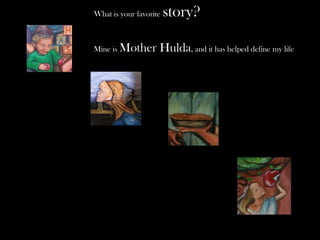
What is your favorite story?
Mine is Mother Hulda, and it has helped define my life
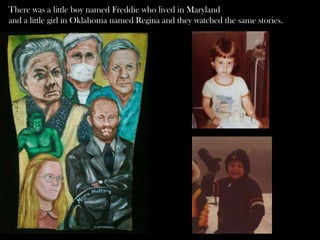
There was a little boy named Freddie who lived in Maryland
and a little girl in Oklahoma named Regina and they watched the same stories.
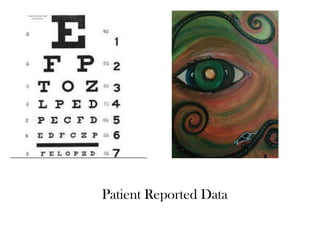
Patient Reported Data
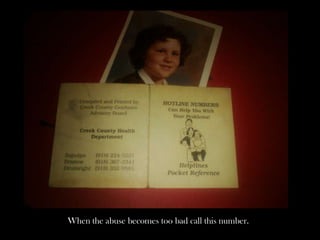
When the abuse becomes too bad call this number.
Fred and Imet in a scenic painting class at
Oklahoma State University.
We would talk of Stephen King’s Dark Tower.
We would fall in love.
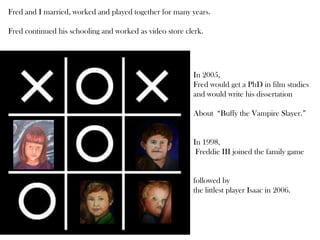
Fred and I married, worked and played together for many years.
Fred continued his schooling and worked as video store clerk.
In 2005,
Fred would get a PhD in film studies
and would write his dissertation
About “Buffy the Vampire Slayer.”
In 1998,
Freddie III joined the family game
followed by
the littlest player Isaac in 2006.
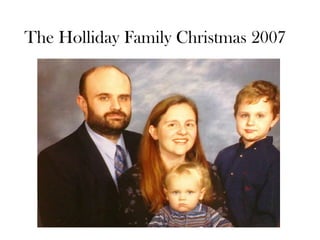
The Holliday Family Christmas 2007
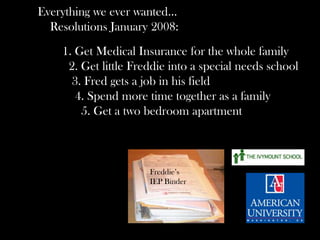
Everything we ever wanted…
Resolutions January 2008:
1. Get Medical Insurance for the whole family
2. Get little Freddie into a special needs school
3. Fred gets a job in his field
4. Spend more time together as a family
5. Get a two bedroom apartment
Freddie’s
IEP Binder
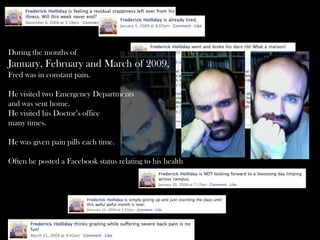
During the months of
January, February and March of 2009,
Fred was in constant pain.
He visited two Emergency Departments
and was sent home.
He visited his Doctor’s office
many times.
He was given pain pills each time.
Often he posted a Facebook status relating to his health
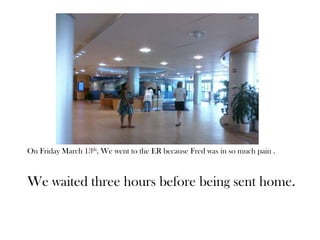
On Friday March 13th, We went to the ER because Fred was in so much pain .
We waited three hours before being sent home.
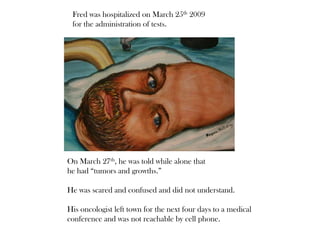
Fred was hospitalized on March 25th 2009
for the administration of tests.
On March 27th, he was told while alone that
he had “tumors and growths.”
He was scared and confused and did not understand.
His oncologist left town for the next four days to a medical
conference and was not reachable by cell phone.
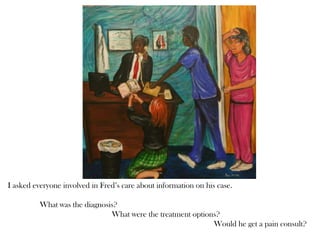
I asked everyone involved in Fred’s care about information on his case.
What was the diagnosis?
What were the treatment options?
Would he get a pain consult?
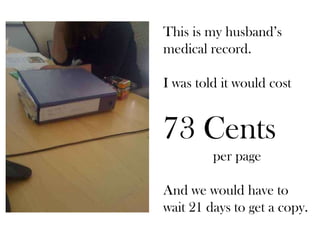
This is my husband’s
medical record.
I was told it would cost
73 Cents
per page
And we would have to
wait 21 days to get a copy.
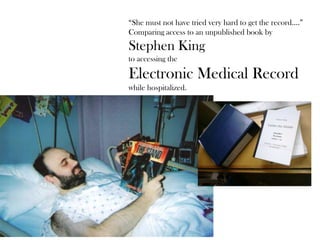
“She must not have tried very hard to get the record….”
Comparing access to an unpublished book by
Stephen King
to accessing the
Electronic Medical Record
while hospitalized.
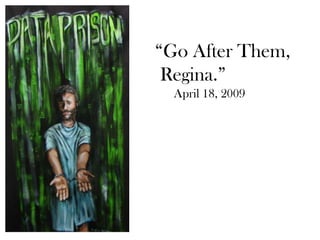
“Go After Them,
Regina.”
April 18, 2009
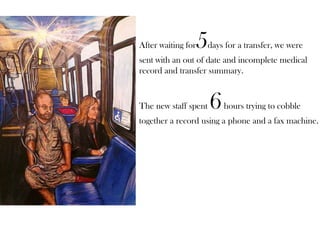
After waiting for5days for a transfer, we were
sent with an out of date and incomplete medical
record and transfer summary.
The new staff spent 6hours trying to cobble
together a record using a phone and a fax machine.
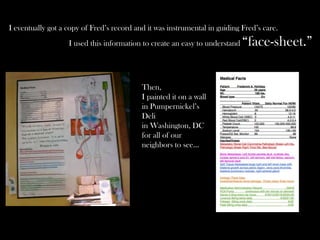
I eventually got a copy of Fred’s record and it was instrumental in guiding Fred’s care.
I used this information to create an easy to understand “face-sheet.”
Then,
I painted it on a wall
in Pumpernickel’s
Deli
in Washington, DC
for all of our
neighbors to see…
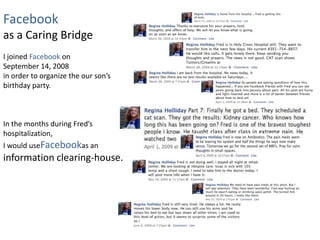
Facebook
as a Caring Bridge
I joined Facebook on
September 14, 2008
in order to organize the our son’s
birthday party.
In the months during Fred’s
hospitalization,
I would useFacebookas an
information clearing-house.
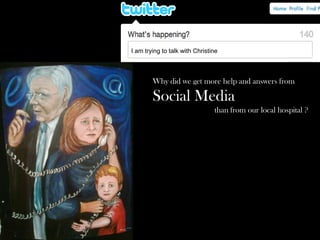
I am trying to talk with Christine Kraft and epatient Dave.
Why did we get more help and answers from
Social Media
than from our local hospital ?
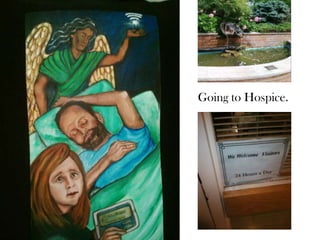
Going to Hospice.
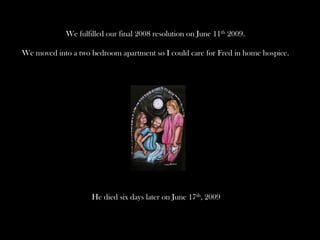
We fulfilled our final 2008 resolution on June 11th 2009.
We moved into a two bedroom apartment so I could care for Fred in home hospice.
He died six days later on June 17th, 2009
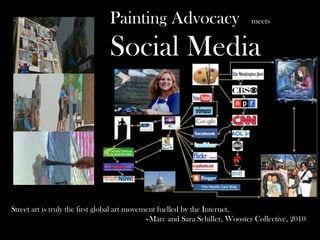
Painting Advocacy meets
Social Media
Street art is truly the first global art movement fuelled by the Internet.
–Marc and Sara Schiller, Wooster Collective, 2010
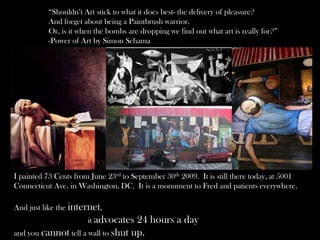
“Shouldn’t Art stick to what it does best- the delivery of pleasure?
And forget about being a Paintbrush warrior.
Or, is it when the bombs are dropping we find out what art is really for?”
-Power of Art by Simon Schama
I painted 73 Cents from June 23rd to September 30th 2009. It is still there today, at 5001
Connecticut Ave. in Washington, DC. It is a monument to Fred and patients everywhere.
And just like the internet,
it advocates 24 hours a day
and you cannot tell a wall to shut up.
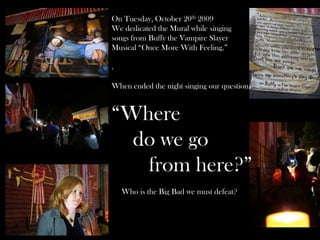
On Tuesday, October 20th 2009
We dedicated the Mural while singing
songs from Buffy the Vampire Slayer
Musical “Once More With Feeling.”
.
When ended the night singing our question,
“Where
do we go
from here?”
Who is the Big Bad we must defeat?
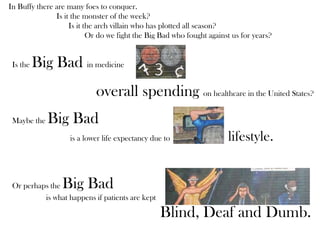
In Buffy there are many foes to conquer.
Is it the monster of the week?
Is it the arch villain who has plotted all season?
Or do we fight the Big Bad who fought against us for years?
Is the Big Bad in medicine
overall spending on healthcare in the United States?
Maybe the Big Bad
is a lower life expectancy due to lifestyle.
Or perhaps the Big Bad
is what happens if patients are kept
Blind, Deaf and Dumb.
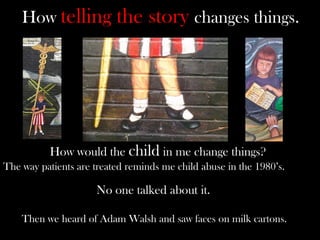
How telling the story changes things.
How would the child in me change things?
The way patients are treated reminds me child abuse in the 1980’s.
No one talked about it.
Then we heard of Adam Walsh and saw faces on milk cartons.
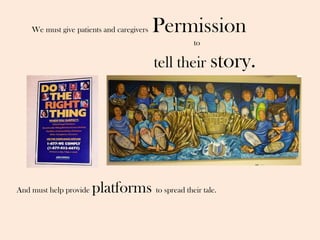
We must give patients and caregivers Permission
to
tell their story.
And must help provide platforms to spread their tale.
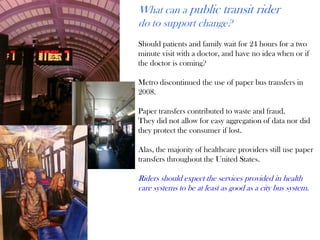
What can a public transit rider
do to support change?
Should patients and family wait for 24 hours for a two
minute visit with a doctor, and have no idea when or if
the doctor is coming?
Metro discontinued the use of paper bus transfers in
2008.
Paper transfers contributed to waste and fraud.
They did not allow for easy aggregation of data nor did
they protect the consumer if lost.
Alas, the majority of healthcare providers still use paper
transfers throughout the United States.
Riders should expect the services provided in health
care systems to be at least as good as a city bus system.
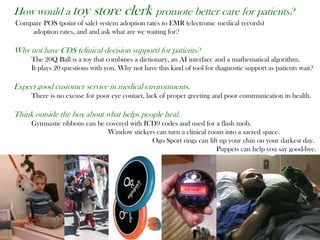
How would a toy store clerk promote better care for patients?
Compare POS (point of sale) system adoption rates to EMR (electronic medical records)
adoption rates, and and ask what are we waiting for?
Why not have CDS (clinical decision support) for patients?
The 20Q Ball is a toy that combines a dictionary, an AI interface and a mathematical algorithm.
It plays 20 questions with you. Why not have this kind of tool for diagnostic support as patients wait?
Expect good customer service in medical environments.
There is no excuse for poor eye contact, lack of proper greeting and poor communication in health.
Think outside the box about what helps people heal.
Gymnastic ribbons can be covered with ICD9 codes and used for a flash mob.
Window stickers can turn a clinical room into a sacred space.
Ogo Sport rings can lift up your chin on your darkest day.
Puppets can help you say good-bye.
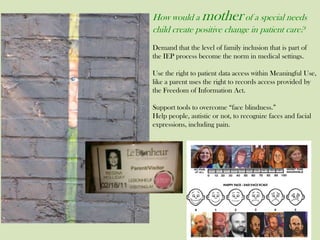
How would a motherof a special needs
child create positive change in patient care?
Demand that the level of family inclusion that is part of
the IEP process become the norm in medical settings.
Use the right to patient data access within Meaningful Use,
like a parent uses the right to records access provided by
the Freedom of Information Act.
Support tools to overcome “face blindness.”
Help people, autistic or not, to recognize faces and facial
expressions, including pain.
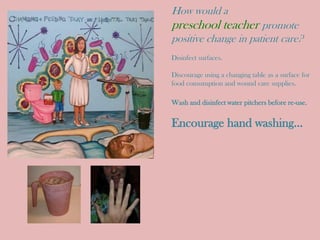
How would a
preschool teacher promote
positive change in patient care?
Disinfect surfaces.
Discourage using a changing table as a surface for
food consumption and wound care supplies.
Wash and disinfect water pitchers before re-use.
Encourage hand washing…
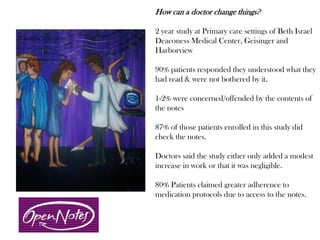
How can a doctor change things?
2 year study at Primary care settings of Beth Israel
Deaconess Medical Center, Geisinger and
Harborview
90% patients responded they understood what they
had read & were not bothered by it.
1-2% were concerned/offended by the contents of
the notes
87% of those patients enrolled in this study did
check the notes.
Doctors said the study either only added a modest
increase in work or that it was negligible.
80% Patients claimed greater adherence to
medication protocols due to access to the notes.
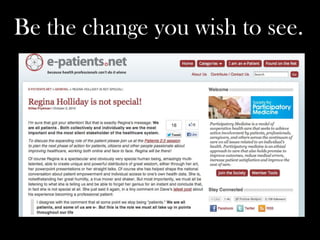
Be the change you wish to see.
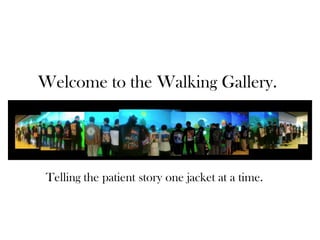
Welcome to the Walking Gallery.
Telling the patient story one jacket at a time.
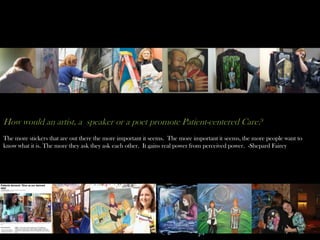
How would an artist, a speaker or a poet promote Patient-centered Care?
The more stickers that are out there the more important it seems. The more important it seems, the more people want to
know what it is. The more they ask they ask each other. It gains real power from perceived power. -Shepard Fairey
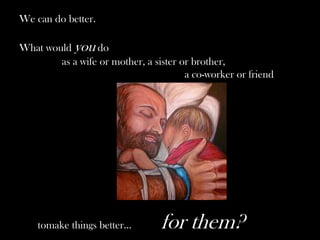
We can do better.
What would you do
as a wife or mother, a sister or brother,
a co-worker or friend
tomake things better... for them?

We can do better

  • 1.
    We Can DoBetter The Power of the Story in Patient Advocacy Presented by -Regina Holliday
  • 2.
    Wife Mother Daughter Sales Clerk Art Teacher Caregiver Widow Artist Poet PhD Father Husband Professorof Film Video Clerk Writer Son Where does a story begin and where does it end? Frederick Allen Holliday II, PhD Regina Sue McCanless
  • 3.
    What is yourfavorite story? Mine is Mother Hulda, and it has helped define my life
  • 4.
    There was alittle boy named Freddie who lived in Maryland and a little girl in Oklahoma named Regina and they watched the same stories.
  • 5.
  • 6.
    When the abusebecomes too bad call this number.
  • 7.
    Fred and Imetin a scenic painting class at Oklahoma State University. We would talk of Stephen King’s Dark Tower. We would fall in love.
  • 8.
    Fred and Imarried, worked and played together for many years. Fred continued his schooling and worked as video store clerk. In 2005, Fred would get a PhD in film studies and would write his dissertation About “Buffy the Vampire Slayer.” In 1998, Freddie III joined the family game followed by the littlest player Isaac in 2006.
  • 9.
    The Holliday FamilyChristmas 2007
  • 10.
    Everything we everwanted… Resolutions January 2008: 1. Get Medical Insurance for the whole family 2. Get little Freddie into a special needs school 3. Fred gets a job in his field 4. Spend more time together as a family 5. Get a two bedroom apartment Freddie’s IEP Binder
  • 11.
    During the monthsof January, February and March of 2009, Fred was in constant pain. He visited two Emergency Departments and was sent home. He visited his Doctor’s office many times. He was given pain pills each time. Often he posted a Facebook status relating to his health
  • 12.
    On Friday March13th, We went to the ER because Fred was in so much pain . We waited three hours before being sent home.
  • 13.
    Fred was hospitalizedon March 25th 2009 for the administration of tests. On March 27th, he was told while alone that he had “tumors and growths.” He was scared and confused and did not understand. His oncologist left town for the next four days to a medical conference and was not reachable by cell phone.
  • 14.
    I asked everyoneinvolved in Fred’s care about information on his case. What was the diagnosis? What were the treatment options? Would he get a pain consult?
  • 15.
    This is myhusband’s medical record. I was told it would cost 73 Cents per page And we would have to wait 21 days to get a copy.
  • 16.
    “She must nothave tried very hard to get the record….” Comparing access to an unpublished book by Stephen King to accessing the Electronic Medical Record while hospitalized.
  • 17.
  • 18.
    After waiting for5daysfor a transfer, we were sent with an out of date and incomplete medical record and transfer summary. The new staff spent 6hours trying to cobble together a record using a phone and a fax machine.
  • 19.
    I eventually gota copy of Fred’s record and it was instrumental in guiding Fred’s care. I used this information to create an easy to understand “face-sheet.” Then, I painted it on a wall in Pumpernickel’s Deli in Washington, DC for all of our neighbors to see…
  • 20.
    Facebook as a CaringBridge I joined Facebook on September 14, 2008 in order to organize the our son’s birthday party. In the months during Fred’s hospitalization, I would useFacebookas an information clearing-house.
  • 21.
    I am tryingto talk with Christine Kraft and epatient Dave. Why did we get more help and answers from Social Media than from our local hospital ?
  • 22.
  • 23.
    We fulfilled ourfinal 2008 resolution on June 11th 2009. We moved into a two bedroom apartment so I could care for Fred in home hospice. He died six days later on June 17th, 2009
  • 24.
    Painting Advocacy meets SocialMedia Street art is truly the first global art movement fuelled by the Internet. –Marc and Sara Schiller, Wooster Collective, 2010
  • 25.
    “Shouldn’t Art stickto what it does best- the delivery of pleasure? And forget about being a Paintbrush warrior. Or, is it when the bombs are dropping we find out what art is really for?” -Power of Art by Simon Schama I painted 73 Cents from June 23rd to September 30th 2009. It is still there today, at 5001 Connecticut Ave. in Washington, DC. It is a monument to Fred and patients everywhere. And just like the internet, it advocates 24 hours a day and you cannot tell a wall to shut up.
  • 26.
    On Tuesday, October20th 2009 We dedicated the Mural while singing songs from Buffy the Vampire Slayer Musical “Once More With Feeling.” . When ended the night singing our question, “Where do we go from here?” Who is the Big Bad we must defeat?
  • 27.
    In Buffy thereare many foes to conquer. Is it the monster of the week? Is it the arch villain who has plotted all season? Or do we fight the Big Bad who fought against us for years? Is the Big Bad in medicine overall spending on healthcare in the United States? Maybe the Big Bad is a lower life expectancy due to lifestyle. Or perhaps the Big Bad is what happens if patients are kept Blind, Deaf and Dumb.
  • 28.
    How telling thestory changes things. How would the child in me change things? The way patients are treated reminds me child abuse in the 1980’s. No one talked about it. Then we heard of Adam Walsh and saw faces on milk cartons.
  • 29.
    We must givepatients and caregivers Permission to tell their story. And must help provide platforms to spread their tale.
  • 30.
    What can apublic transit rider do to support change? Should patients and family wait for 24 hours for a two minute visit with a doctor, and have no idea when or if the doctor is coming? Metro discontinued the use of paper bus transfers in 2008. Paper transfers contributed to waste and fraud. They did not allow for easy aggregation of data nor did they protect the consumer if lost. Alas, the majority of healthcare providers still use paper transfers throughout the United States. Riders should expect the services provided in health care systems to be at least as good as a city bus system.
  • 31.
    How would atoy store clerk promote better care for patients? Compare POS (point of sale) system adoption rates to EMR (electronic medical records) adoption rates, and and ask what are we waiting for? Why not have CDS (clinical decision support) for patients? The 20Q Ball is a toy that combines a dictionary, an AI interface and a mathematical algorithm. It plays 20 questions with you. Why not have this kind of tool for diagnostic support as patients wait? Expect good customer service in medical environments. There is no excuse for poor eye contact, lack of proper greeting and poor communication in health. Think outside the box about what helps people heal. Gymnastic ribbons can be covered with ICD9 codes and used for a flash mob. Window stickers can turn a clinical room into a sacred space. Ogo Sport rings can lift up your chin on your darkest day. Puppets can help you say good-bye.
  • 32.
    How would amotherof a special needs child create positive change in patient care? Demand that the level of family inclusion that is part of the IEP process become the norm in medical settings. Use the right to patient data access within Meaningful Use, like a parent uses the right to records access provided by the Freedom of Information Act. Support tools to overcome “face blindness.” Help people, autistic or not, to recognize faces and facial expressions, including pain.
  • 33.
    How would a preschoolteacher promote positive change in patient care? Disinfect surfaces. Discourage using a changing table as a surface for food consumption and wound care supplies. Wash and disinfect water pitchers before re-use. Encourage hand washing…
  • 34.
    How can adoctor change things? 2 year study at Primary care settings of Beth Israel Deaconess Medical Center, Geisinger and Harborview 90% patients responded they understood what they had read & were not bothered by it. 1-2% were concerned/offended by the contents of the notes 87% of those patients enrolled in this study did check the notes. Doctors said the study either only added a modest increase in work or that it was negligible. 80% Patients claimed greater adherence to medication protocols due to access to the notes.
  • 35.
    Be the changeyou wish to see.
  • 36.
    Welcome to theWalking Gallery. Telling the patient story one jacket at a time.
  • 37.
    How would anartist, a speaker or a poet promote Patient-centered Care? The more stickers that are out there the more important it seems. The more important it seems, the more people want to know what it is. The more they ask they ask each other. It gains real power from perceived power. -Shepard Fairey
  • 38.
    We can dobetter. What would you do as a wife or mother, a sister or brother, a co-worker or friend tomake things better... for them?