Quantum Phenomena

                             Wave-particle duality
                             De Broglie wavelength


Thursday, 03 November 2011
The Particle nature of EM radiation
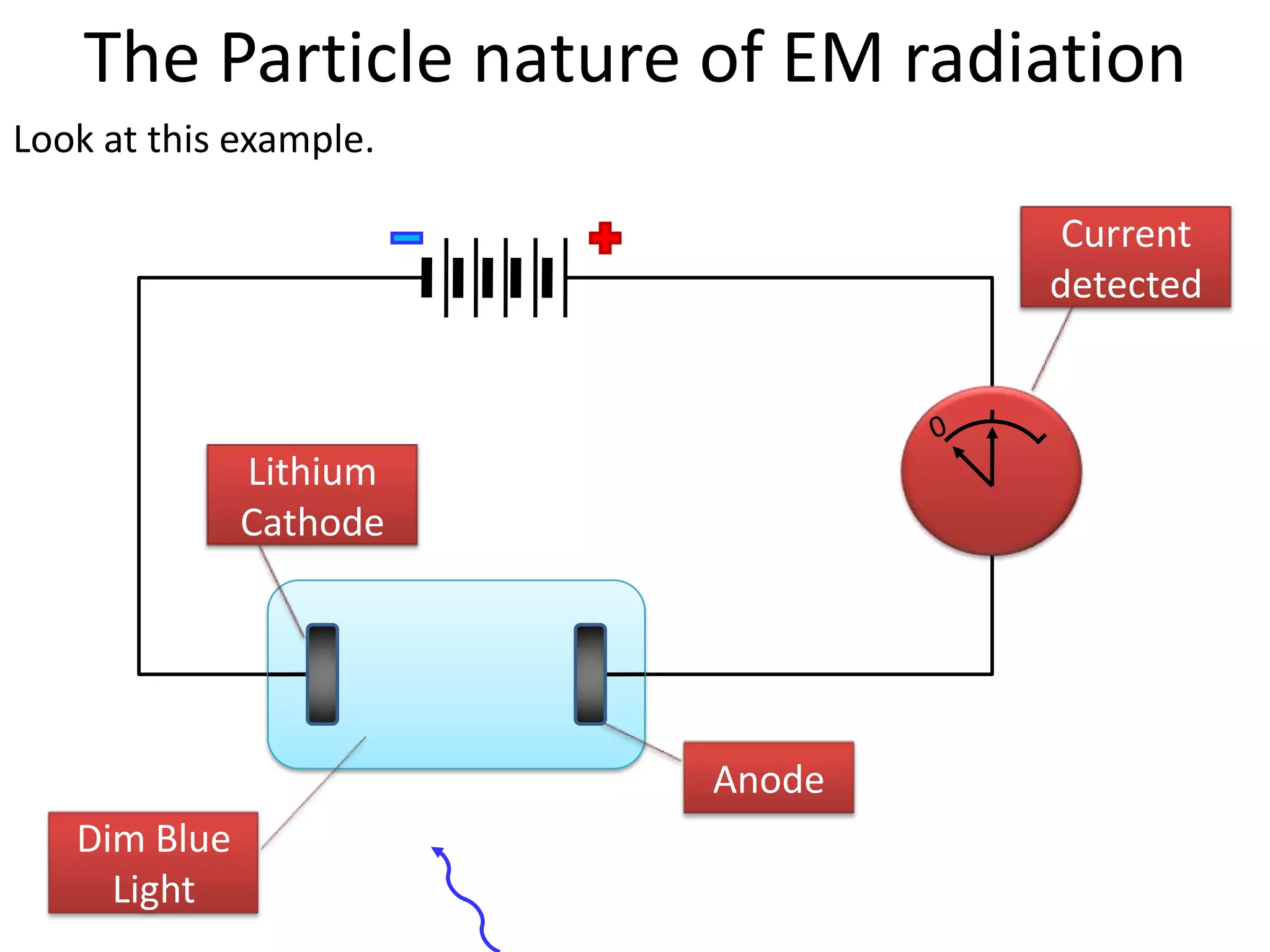
Look at this example.

                                  Current
                                  detected


              Lithium
              Cathode


                        Anode
   Dim Blue
     Light
The Particle nature of EM radiation
Look at this example.

                                 No Current
                                  detected


             Lithium
             Cathode


                        Anode
   Bright Red
      Light
The Particle nature of EM radiation
Explain why a current is detected when dim blue light is shone on the
  lithium cathode, but not when bright red light is used.
•   Blue light is made of photons with enough energy to eject the
    electrons from the lithium
•   Red light is made of photons with low energy (not enough to cause
    photoelectric emission)
•   The energy of EM radiation depends on its frequency, not on its
    intensity (amplitude)
What does this example suggest about the nature of EM radiation?
•   EM radiation has a particle nature, because photoelectricity can only
    be explained with photons, i.e. “lumps” of electromagnetic
    radiation/energy called Quanta.
The dual nature of EM radiation
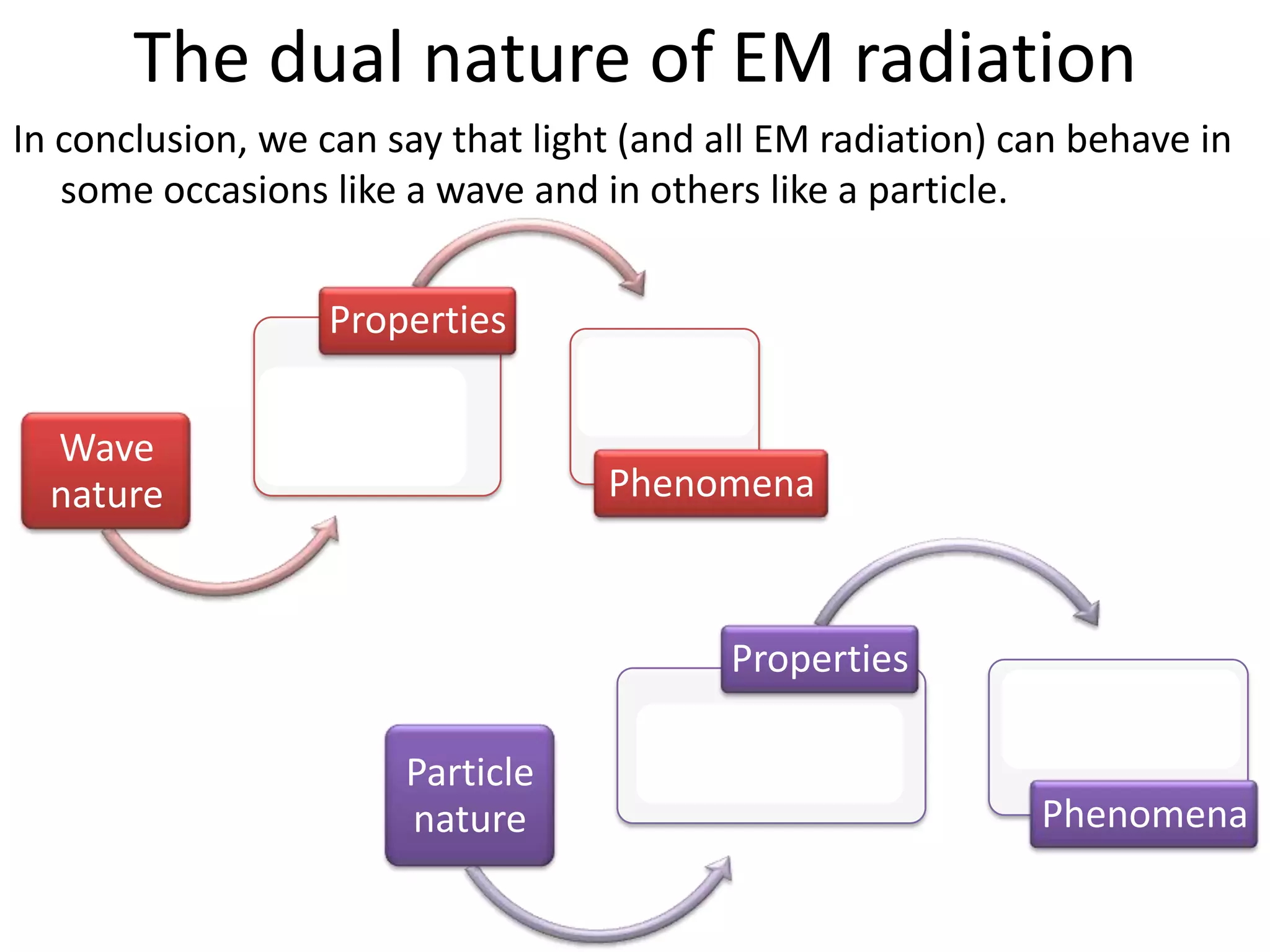
In conclusion, we can say that light (and all EM radiation) can behave in
   some occasions like a wave and in others like a particle.


                   Properties
                                   • Diffraction
               • Wavelength
                                   • Refraction
               • Frequency
  Wave         • Massless
  nature                             Phenomena


                                              Properties
                                                           • Photoelectric
                                       • Kinetic Energy      effect
                        Particle       • Linear Momentum
                        nature                               Phenomena
The Wave-Particle duality
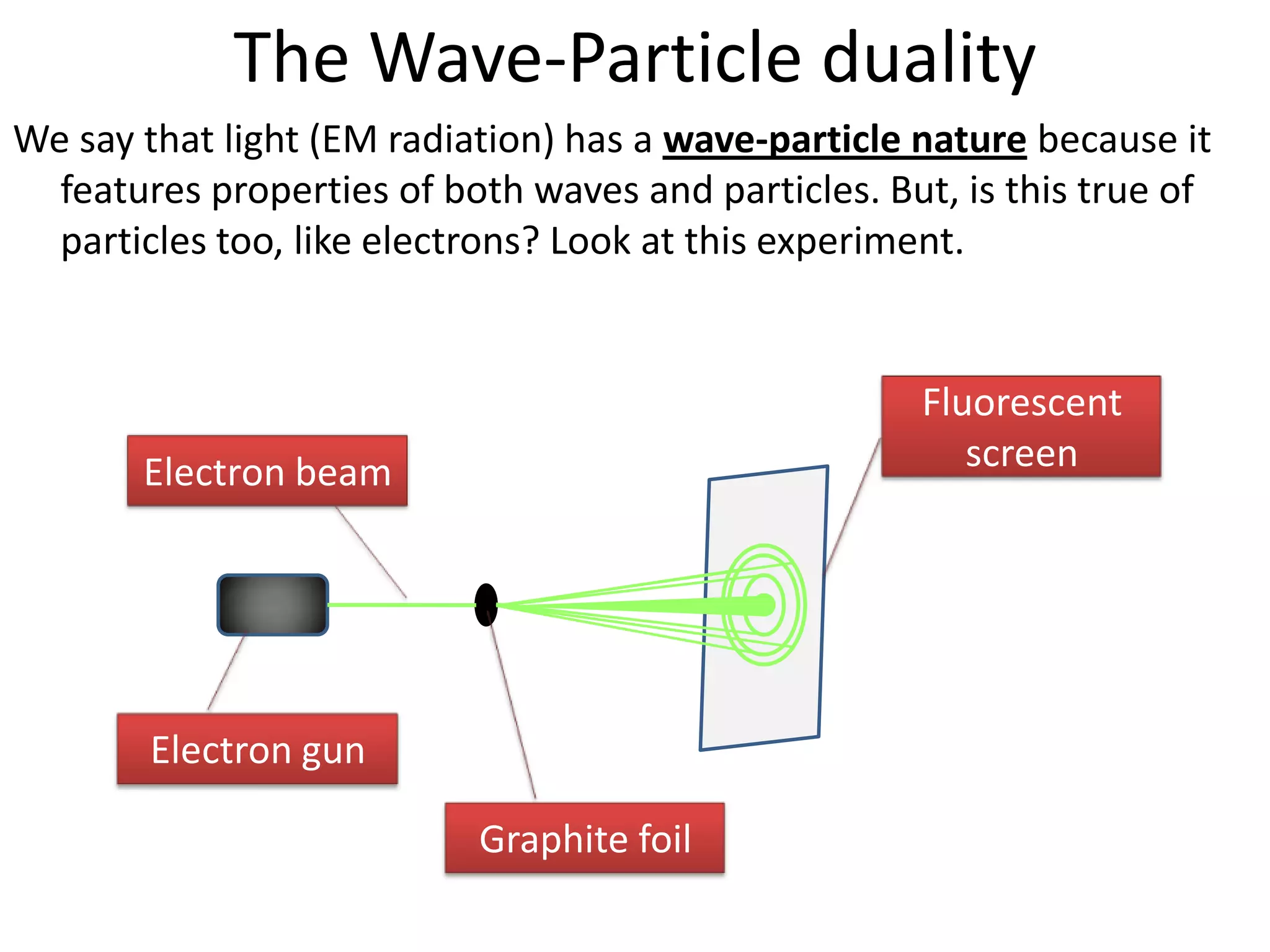
We say that light (EM radiation) has a wave-particle nature because it
  features properties of both waves and particles. But, is this true of
  particles too, like electrons? Look at this experiment.


                                                     Fluorescent
       Electron beam                                    screen


        Electron gun

                           Graphite foil
The Wave-Particle duality
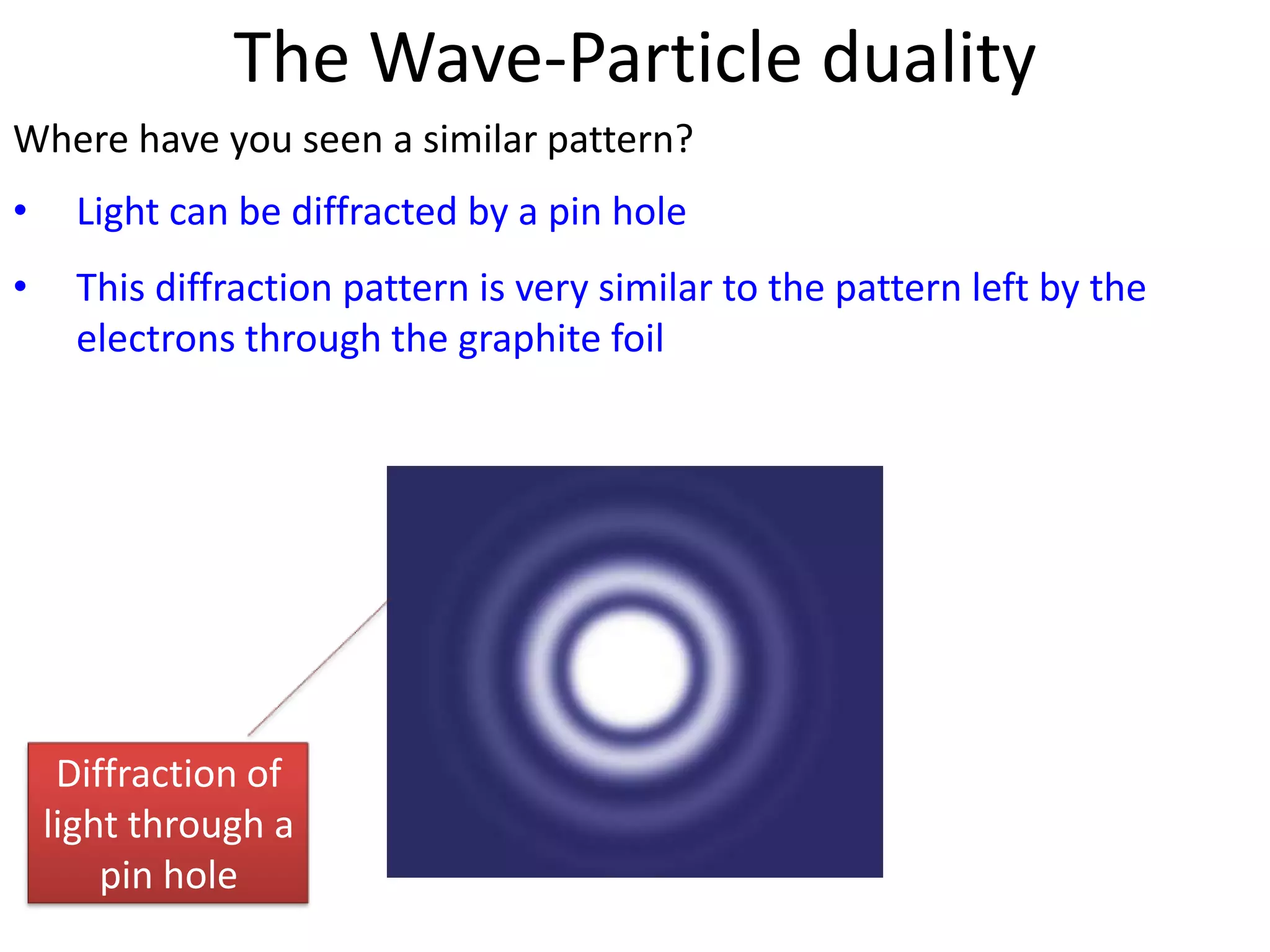
Where have you seen a similar pattern?
•    Light can be diffracted by a pin hole
•    This diffraction pattern is very similar to the pattern left by the
     electrons through the graphite foil


     Diffraction of
    light through a
        pin hole
The Wave nature of electrons
But if electrons can be diffracted like light, what does this suggest?
•   Electrons behave like a wave through a graphite foil
•   Electrons must have a wavelength just like any other wave

What is the condition for diffraction to occur?
• The wavelength of the wave (particle) must be similar in size to the
  gap the wavelength goes through
What is the atomic spacing of the graphite then?
• The atoms of carbon are at the same distance apart as the
  wavelength of the incident electrons


                                                                Click here for
                                                                flash activity
De Broglie’s Equation
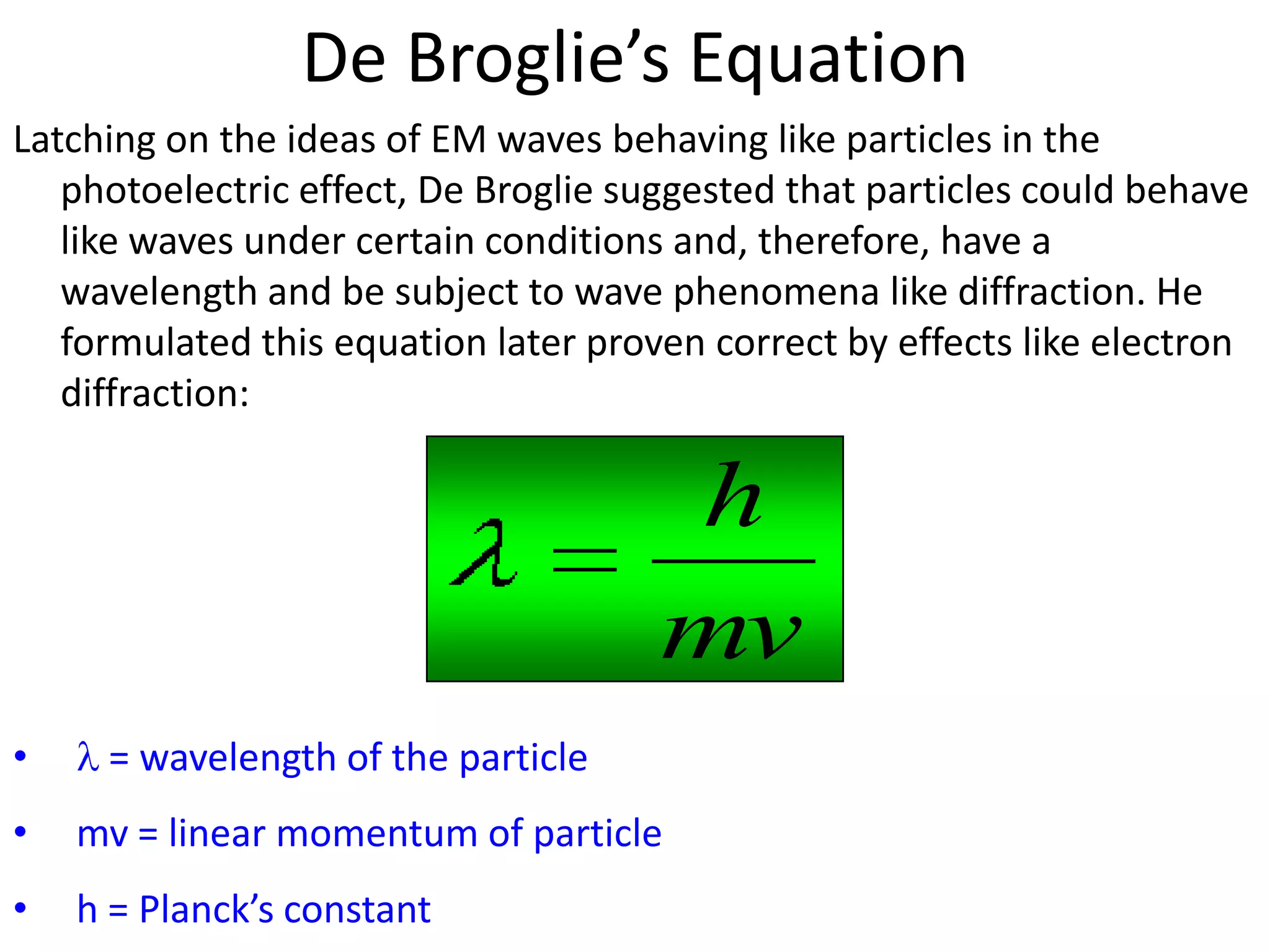
Latching on the ideas of EM waves behaving like particles in the
   photoelectric effect, De Broglie suggested that particles could behave
   like waves under certain conditions and, therefore, have a
   wavelength and be subject to wave phenomena like diffraction. He
   formulated this equation later proven correct by effects like electron
   diffraction:

                                       h
                                      mv
•    = wavelength of the particle
•   mv = linear momentum of particle
•   h = Planck’s constant
De Broglie’s Equation
Work out the wavelength of an electron of mass 0.9 x
 10-30 kg travelling at a speed of 106 m/s, and a tennis
 ball of mass 0.05 kg travelling at a speed of 10 m/s.
          e   = 7 x 10⁻¹⁰ m            b   = 10-33 m
What EM wave has a similar wavelength?
X-rays.

Wave particle duality

  • 1.
    Quantum Phenomena Wave-particle duality De Broglie wavelength Thursday, 03 November 2011
  • 2.
    The Particle natureof EM radiation Look at this example. Current detected Lithium Cathode Anode Dim Blue Light
  • 3.
    The Particle natureof EM radiation Look at this example. No Current detected Lithium Cathode Anode Bright Red Light
  • 4.
    The Particle natureof EM radiation Explain why a current is detected when dim blue light is shone on the lithium cathode, but not when bright red light is used. • Blue light is made of photons with enough energy to eject the electrons from the lithium • Red light is made of photons with low energy (not enough to cause photoelectric emission) • The energy of EM radiation depends on its frequency, not on its intensity (amplitude) What does this example suggest about the nature of EM radiation? • EM radiation has a particle nature, because photoelectricity can only be explained with photons, i.e. “lumps” of electromagnetic radiation/energy called Quanta.
  • 5.
    The dual natureof EM radiation In conclusion, we can say that light (and all EM radiation) can behave in some occasions like a wave and in others like a particle. Properties • Diffraction • Wavelength • Refraction • Frequency Wave • Massless nature Phenomena Properties • Photoelectric • Kinetic Energy effect Particle • Linear Momentum nature Phenomena
  • 6.
    The Wave-Particle duality Wesay that light (EM radiation) has a wave-particle nature because it features properties of both waves and particles. But, is this true of particles too, like electrons? Look at this experiment. Fluorescent Electron beam screen Electron gun Graphite foil
  • 7.
    The Wave-Particle duality Wherehave you seen a similar pattern? • Light can be diffracted by a pin hole • This diffraction pattern is very similar to the pattern left by the electrons through the graphite foil Diffraction of light through a pin hole
  • 8.
    The Wave natureof electrons But if electrons can be diffracted like light, what does this suggest? • Electrons behave like a wave through a graphite foil • Electrons must have a wavelength just like any other wave What is the condition for diffraction to occur? • The wavelength of the wave (particle) must be similar in size to the gap the wavelength goes through What is the atomic spacing of the graphite then? • The atoms of carbon are at the same distance apart as the wavelength of the incident electrons Click here for flash activity
  • 9.
    De Broglie’s Equation Latchingon the ideas of EM waves behaving like particles in the photoelectric effect, De Broglie suggested that particles could behave like waves under certain conditions and, therefore, have a wavelength and be subject to wave phenomena like diffraction. He formulated this equation later proven correct by effects like electron diffraction: h mv • = wavelength of the particle • mv = linear momentum of particle • h = Planck’s constant
  • 10.
    De Broglie’s Equation Workout the wavelength of an electron of mass 0.9 x 10⁻³⁰ kg travelling at a speed of 106 m/s, and a tennis ball of mass 0.05 kg travelling at a speed of 10 m/s. e = 7 x 10⁻¹⁰ m b = 10-33 m What EM wave has a similar wavelength? X-rays.