Wastewater Treatment
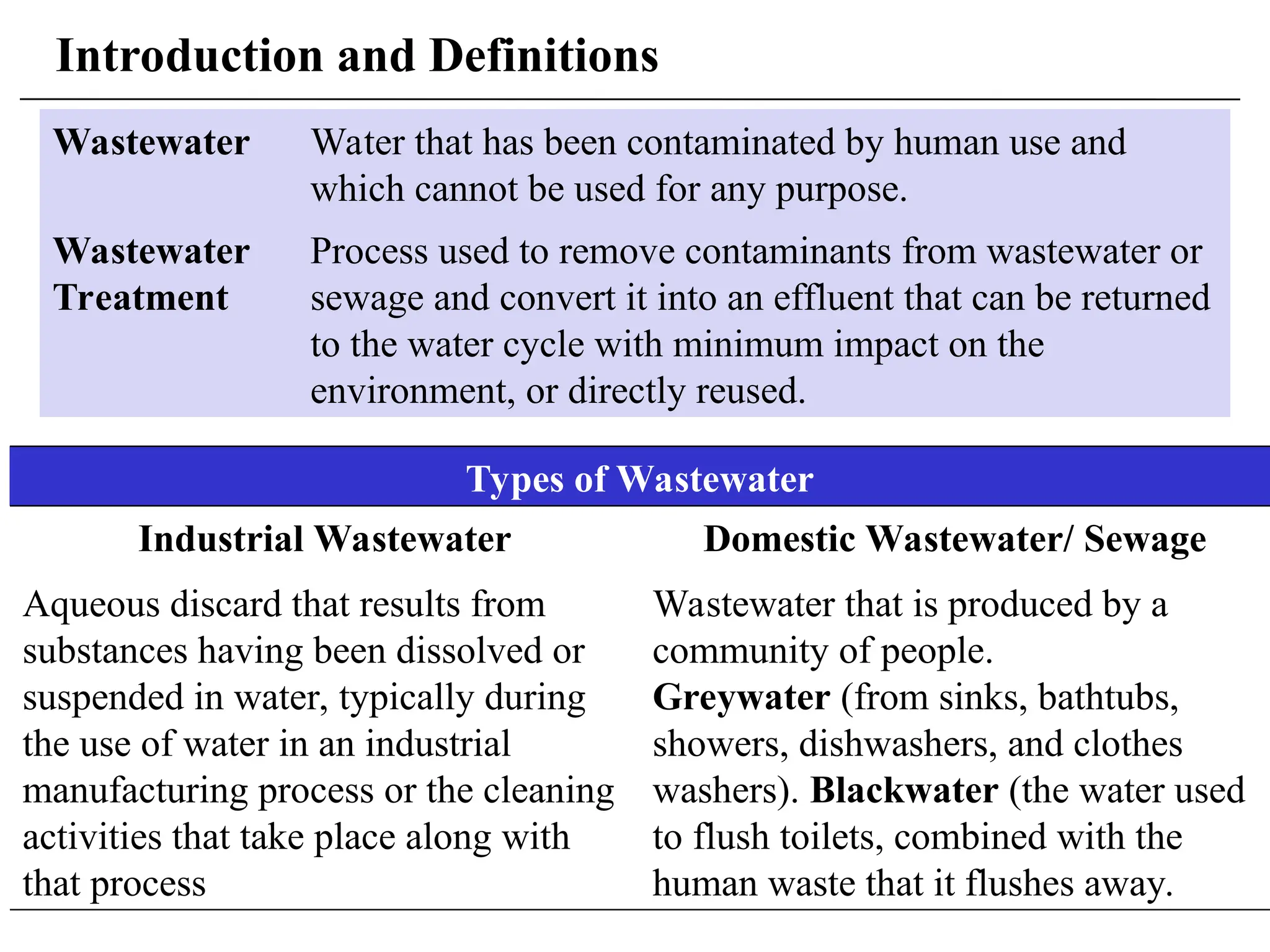
Introduction and Definitions
Wastewater Water that has been contaminated by human use and
which cannot be used for any purpose.
Wastewater
Treatment
Process used to remove contaminants from wastewater or
sewage and convert it into an effluent that can be returned
to the water cycle with minimum impact on the
environment, or directly reused.
Types of Wastewater
Industrial Wastewater Domestic Wastewater/ Sewage
Aqueous discard that results from
substances having been dissolved or
suspended in water, typically during
the use of water in an industrial
manufacturing process or the cleaning
activities that take place along with
that process
Wastewater that is produced by a
community of people.
Greywater (from sinks, bathtubs,
showers, dishwashers, and clothes
washers). Blackwater (the water used
to flush toilets, combined with the
human waste that it flushes away.
Necessity of wastewater treatment
Contaminant Major Source Environmental Significance
Suspended solids Domestic use, industrial wastes,
erosion by infiltration/inflow
Cause sludge deposits and anaerobic
conditions in aquatic environment
Biodegradable
organics
Domestic & Industrial waste Cause biological degradation, which may
use up oxygen in receiving water and
result in undesirable, unhygienic
conditions
Pathogens Domestic waste Transmit communicable diseases
Nutrients Domestic & industrial waste;
surface runoff
May cause eutrophication
Refractory
organics
Industrial waste May cause taste and odour problems, may
be toxic or carcinogenic
Heavy metals Industrial waste, mining, etc. Are toxic, may interfere with effluent
reuse
Dissolved
inorganic solids
Domestic and industrial waste May interfere with effluent reuse
(particularly for irrigation)
Classification of Solids
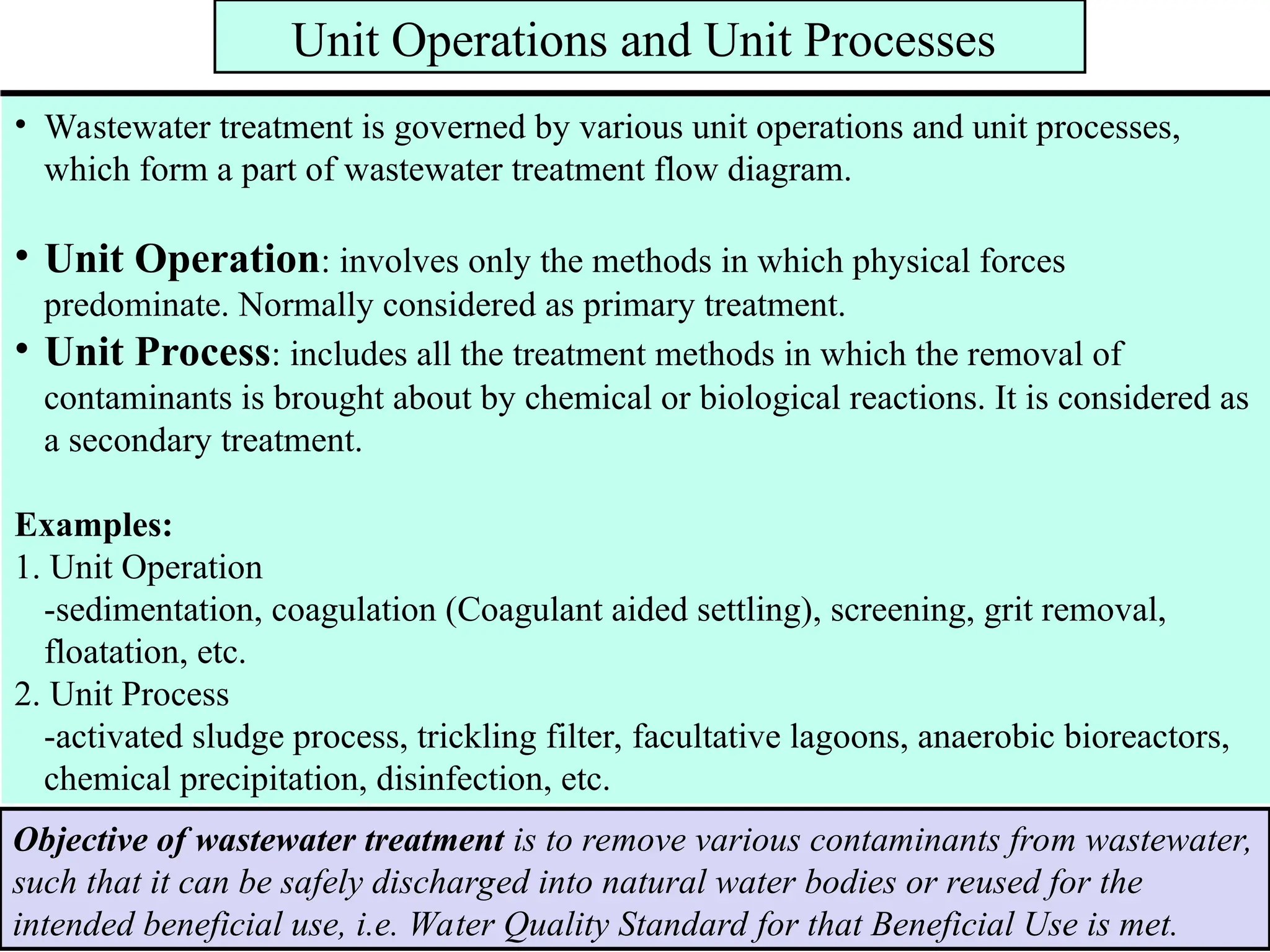
Unit Operations and Unit Processes
• Wastewater treatment is governed by various unit operations and unit processes,
which form a part of wastewater treatment flow diagram.
• Unit Operation: involves only the methods in which physical forces
predominate. Normally considered as primary treatment.
• Unit Process: includes all the treatment methods in which the removal of
contaminants is brought about by chemical or biological reactions. It is considered as
a secondary treatment.
Examples:
1. Unit Operation
-sedimentation, coagulation (Coagulant aided settling), screening, grit removal,
floatation, etc.
2. Unit Process
-activated sludge process, trickling filter, facultative lagoons, anaerobic bioreactors,
chemical precipitation, disinfection, etc.
Objective of wastewater treatment is to remove various contaminants from wastewater,
such that it can be safely discharged into natural water bodies or reused for the
intended beneficial use, i.e. Water Quality Standard for that Beneficial Use is met.
Classification of treatment units based on type of process involved
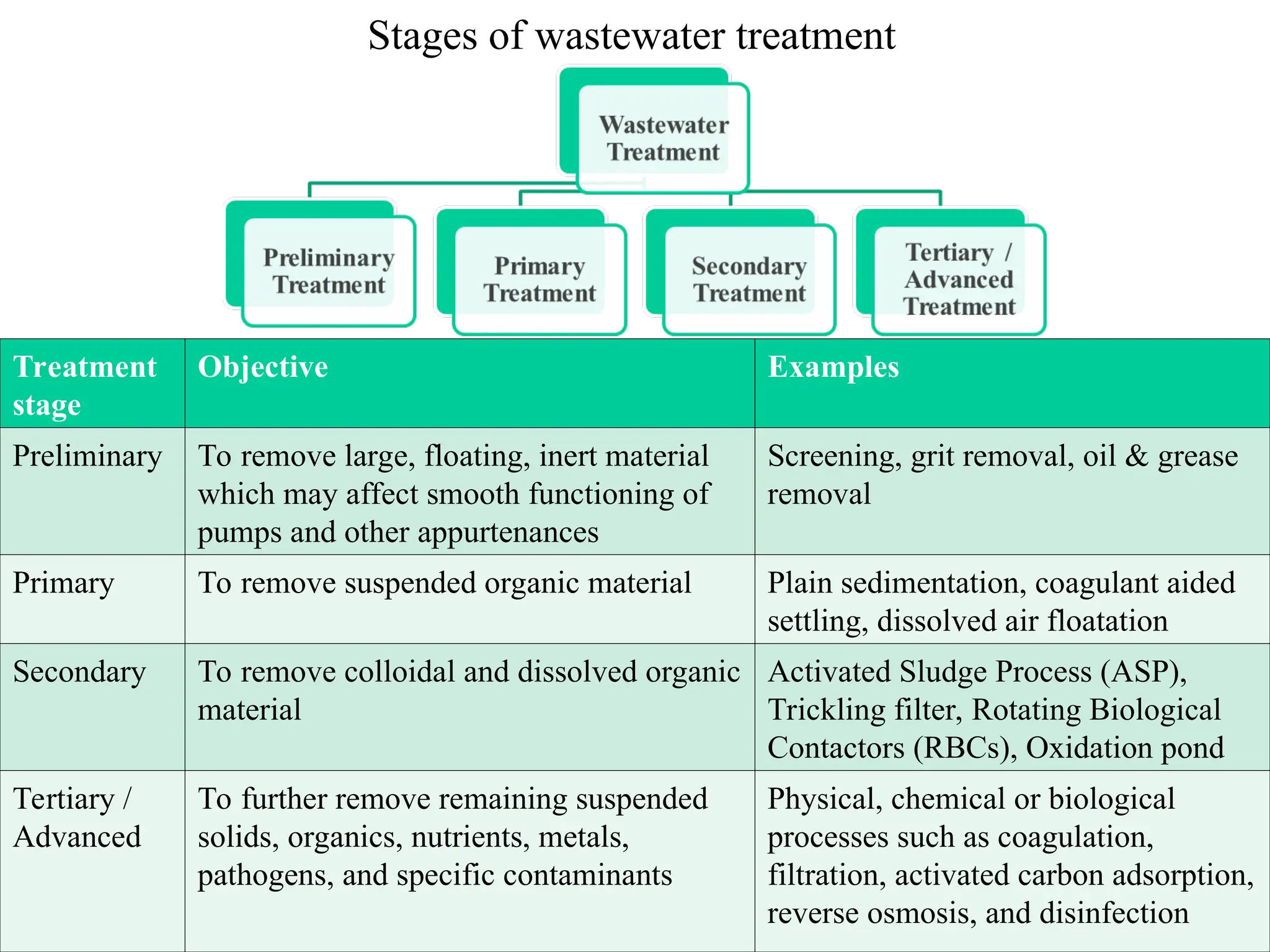
Stages of wastewater treatment
Treatment
stage
Objective Examples
Preliminary To remove large, floating, inert material
which may affect smooth functioning of
pumps and other appurtenances
Screening, grit removal, oil & grease
removal
Primary To remove suspended organic material Plain sedimentation, coagulant aided
settling, dissolved air floatation
Secondary To remove colloidal and dissolved organic
material
Activated Sludge Process (ASP),
Trickling filter, Rotating Biological
Contactors (RBCs), Oxidation pond
Tertiary /
Advanced
To further remove remaining suspended
solids, organics, nutrients, metals,
pathogens, and specific contaminants
Physical, chemical or biological
processes such as coagulation,
filtration, activated carbon adsorption,
reverse osmosis, and disinfection
Contaminant Treatment unit
Suspended solids Sedimentation (coagulant aided settling); Screening & comminution;
Filtration variants; Floatation; Chemical-polymer addition; Land treatment
systems
Biodegradable
organics
Activated sludge variants; Fixed film systems (trickling filter, rotating
biological contactors); Lagoon and pond variants; Land treatment systems;
Physical-chemical systems
Pathogens Chlorination; Ozonation
Nutrients
Nitrogen
Suspended growth nitrification & denitrification variants; Fixed film
nitrification & denitrification variants; Ammonia stripping; Ion exchange;
Land treatment systems
Nutrients
Phosphorous
Metal salt addition; Lime coagulation / sedimentation; Biological-chemical
phosphorous removal; Land treatment systems
Refractory
organics
Carbon adsorption; Tertiary ozonation; Land treatment systems
Heavy metals Chemical precipitation; Ion exchange; Land treatment systems
Dissolved
inorganic solids
Ion exchange; Reverse Osmosis; Electrodialysis
TREATMENT
UNIT
PROCESS
PROCESS DESCRIPTION
Preliminary Treatment
Screening To remove large floating material and other debris; to protect pumps and
ancillary equipment
Grit Removal To remove inorganic grit
Flow Metering To measure flowrate
Primary Treatment
Sedimentation
and Flotation
To remove settleable organic solids
Secondary Treatment
Biological
Treatment
To remove dissolved and remaining colloidal (non-settleable) organic matter
using biological process.
TREATMENT
PROCESS
PROCESS DESCRIPTION
Secondary Treatment
Chemical
treatment
To remove dissolved and colloidal impurities using chemical process
Secondary
sedimentation
To separate biomass and chemical precipitates produced during secondary
treatment
Tertiary (Advanced) Treatment
Chemical /
biological
To remove nutrients (Nitrogen & phosphorous) and other specific
contaminants
Filtration To remove residual suspended solids
Disinfection To kill pathogenic organisms
Sludge Treatment
Aerobic /
anaerobic
digestion
To condition and stabilizes the sludge for ultimate disposal
Sludge
thickening &
To remove excess water from the sludge for easy handling and disposal
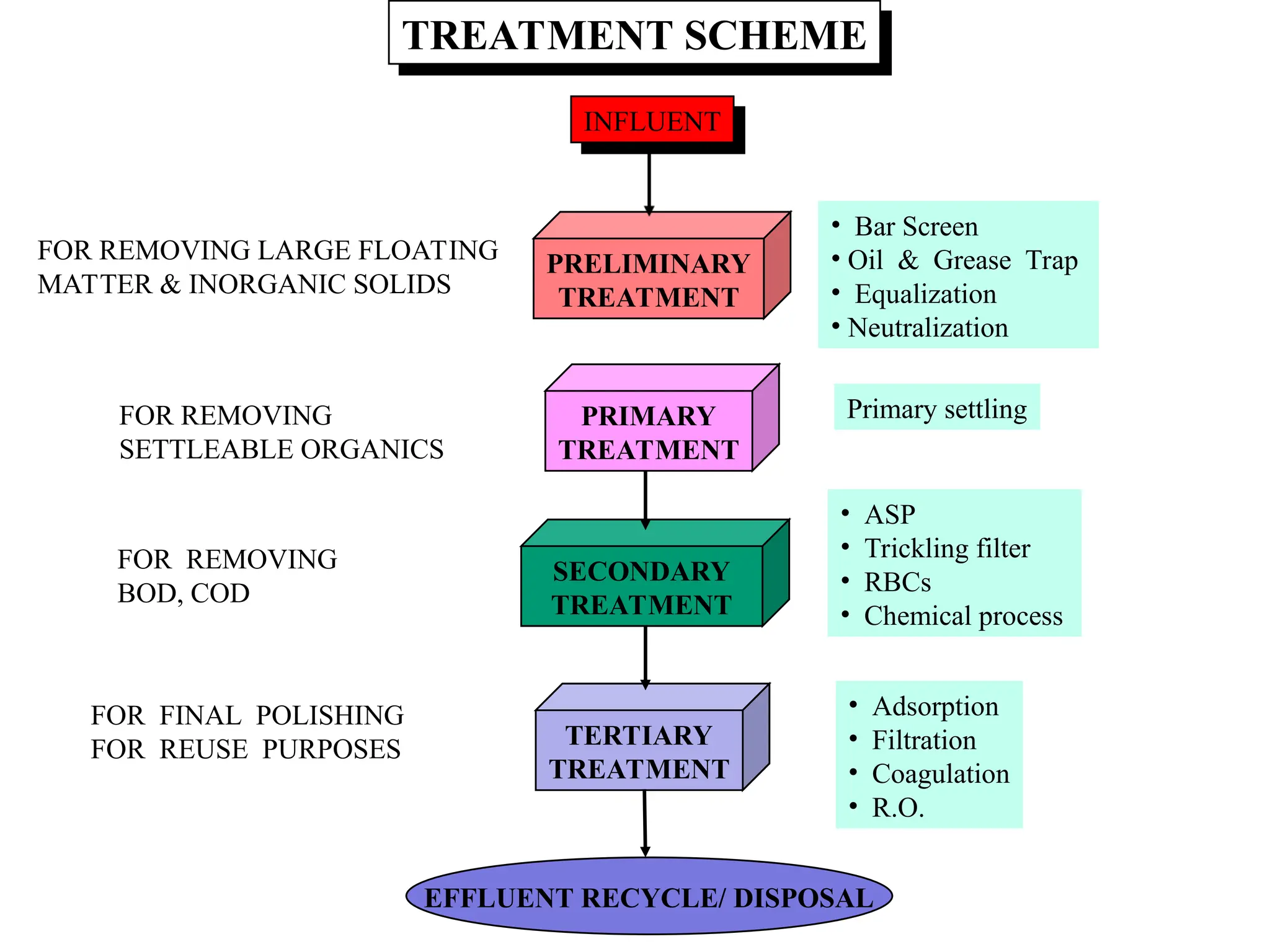
INFLUENT
PRELIMINARY
TREATMENT
SECONDARY
TREATMENT
TERTIARY
TREATMENT
EFFLUENT RECYCLE/ DISPOSAL
Primary settling
FOR REMOVING
BOD, COD
FOR FINAL POLISHING
FOR REUSE PURPOSES
• Bar Screen
• Oil & Grease Trap
• Equalization
• Neutralization
• ASP
• Trickling filter
• RBCs
• Chemical process
• Adsorption
• Filtration
• Coagulation
• R.O.
PRIMARY
TREATMENT
FOR REMOVING
SETTLEABLE ORGANICS
FOR REMOVING LARGE FLOATING
MATTER & INORGANIC SOLIDS
TREATMENT SCHEME
Sewage treatment flow diagram with ASP
Screen Chamber A unit operation provided to separate
large floating material from entering
wastewater treatment plant facilities.
Objective
To protect pumps, valves, pipeline and
other appurtenances from damage or
clogging.
Grit Chamber
Grit chambers are long narrow
tanks that are designed to slow
down the flow so that inorganic
solids such as sand, silt, bone
chips, and eggshells will settle out
of the water
Objective
To remove inorganic grit which
may damage the pumps & other
plant equipment, and which may
occupy space in sludge digesters.
Designed as a settling tank to
specifically remove heavier
inorganic material with a detention
time of @ 1-1.5 min., provided
with a velocity control device.
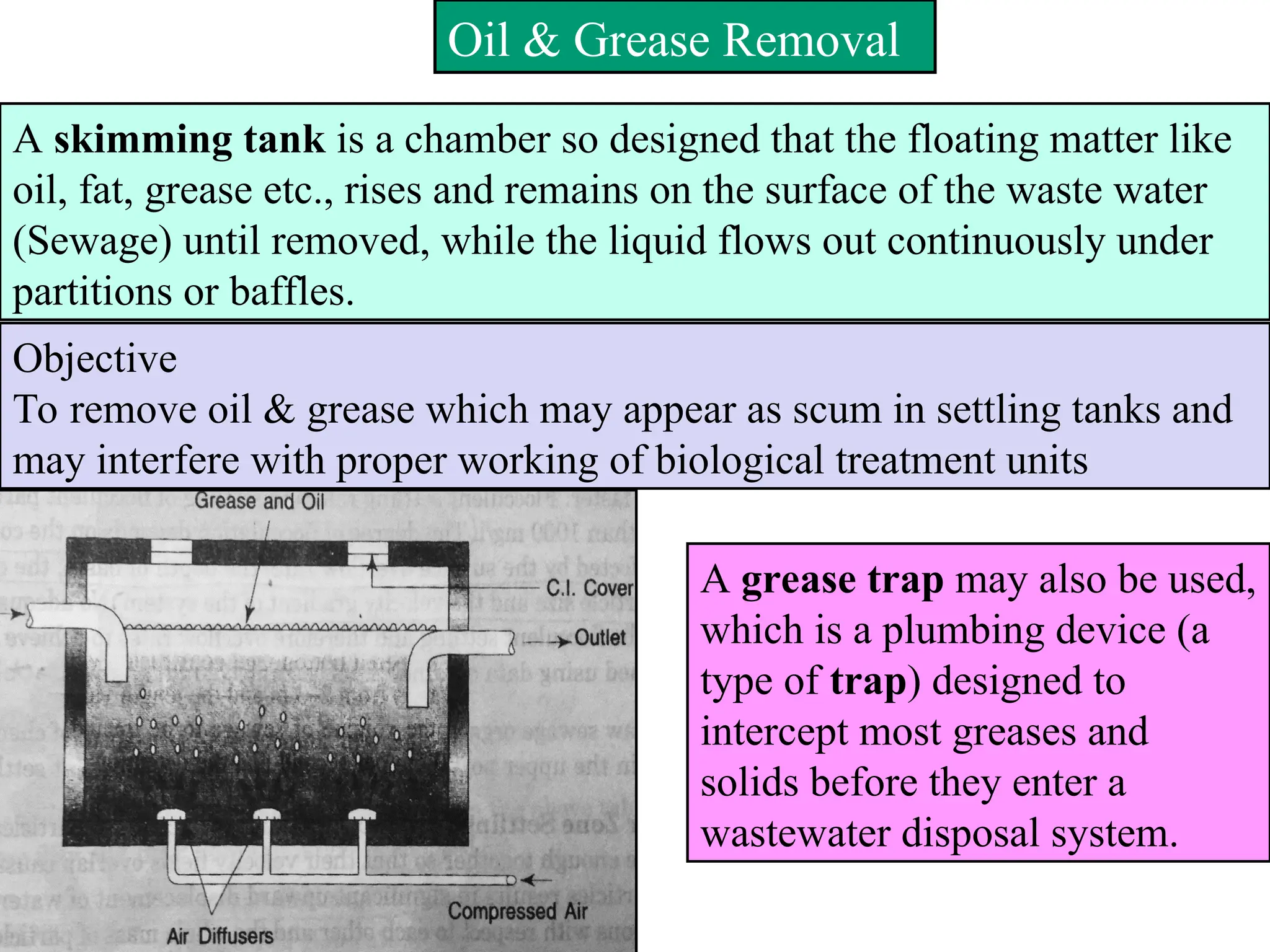
Oil & Grease Removal
A skimming tank is a chamber so designed that the floating matter like
oil, fat, grease etc., rises and remains on the surface of the waste water
(Sewage) until removed, while the liquid flows out continuously under
partitions or baffles.
Objective
To remove oil & grease which may appear as scum in settling tanks and
may interfere with proper working of biological treatment units
A grease trap may also be used,
which is a plumbing device (a
type of trap) designed to
intercept most greases and
solids before they enter a
wastewater disposal system.
Primary Sedimentation
Primary sedimentation tanks are provided to remove settleable
suspended organic material (lighter than grit).
Detention time = 1.5 – 2.5 hrs.
Approximately 60% of suspended solids and 35% of BOD removal
efficiency can be achieved at this stage.
Conventional Activated Sludge Process
• The settled wastewater is introduced into a specially designed bioreactor where
under aerobic or anaerobic conditions, the organic matter is utilized by
microorganisms such as bacteria (aerobically or anaerobically), algae, and fungi
(aerobically).
• The bioreactor provides appropriate bioenvironmental conditions (food (organic
matter) and oxygen (for aerobic process)) for the microorganisms to reproduce and
use the dissolved organic matter as energy for themselves.
• The bacteria convert colloidal and dissolved organic matter into thick bacterial
biomass.
• Subsequently, the microbial biomass is separated from the treated wastewater
through secondary sedimentation.
• The microorganisms decompose the organic matter through two different biological
processes biological oxidation and biosynthesis.
1. The biological oxidation forms some end-products, such as minerals, that
remain in the solution and are discharged with the effluent.
2. The biosynthesis transforms the colloidal and dissolved organic matter into
new cells that form in turn the dense biomass that can be then removed by
sedimentation.
Biological Unit Process Mechanism
Activated Sludge Process
Influent with high
organic matter i.e.
BOD
Microbes i.e.
activated sludge
eat the BOD and
produce CO2 and
more microbes
Some microbes are recycled as
inoculum
Activated Sludge Process
Diffused Aerator
Inside an Activated sludge basin
Disk aerators

Wastewater treatment.ppt , unit process unit reactors

  • 1.
  • 2.
    Introduction and Definitions WastewaterWater that has been contaminated by human use and which cannot be used for any purpose. Wastewater Treatment Process used to remove contaminants from wastewater or sewage and convert it into an effluent that can be returned to the water cycle with minimum impact on the environment, or directly reused. Types of Wastewater Industrial Wastewater Domestic Wastewater/ Sewage Aqueous discard that results from substances having been dissolved or suspended in water, typically during the use of water in an industrial manufacturing process or the cleaning activities that take place along with that process Wastewater that is produced by a community of people. Greywater (from sinks, bathtubs, showers, dishwashers, and clothes washers). Blackwater (the water used to flush toilets, combined with the human waste that it flushes away.
  • 3.
    Necessity of wastewatertreatment Contaminant Major Source Environmental Significance Suspended solids Domestic use, industrial wastes, erosion by infiltration/inflow Cause sludge deposits and anaerobic conditions in aquatic environment Biodegradable organics Domestic & Industrial waste Cause biological degradation, which may use up oxygen in receiving water and result in undesirable, unhygienic conditions Pathogens Domestic waste Transmit communicable diseases Nutrients Domestic & industrial waste; surface runoff May cause eutrophication Refractory organics Industrial waste May cause taste and odour problems, may be toxic or carcinogenic Heavy metals Industrial waste, mining, etc. Are toxic, may interfere with effluent reuse Dissolved inorganic solids Domestic and industrial waste May interfere with effluent reuse (particularly for irrigation)
  • 4.
  • 5.
    Unit Operations andUnit Processes • Wastewater treatment is governed by various unit operations and unit processes, which form a part of wastewater treatment flow diagram. • Unit Operation: involves only the methods in which physical forces predominate. Normally considered as primary treatment. • Unit Process: includes all the treatment methods in which the removal of contaminants is brought about by chemical or biological reactions. It is considered as a secondary treatment. Examples: 1. Unit Operation -sedimentation, coagulation (Coagulant aided settling), screening, grit removal, floatation, etc. 2. Unit Process -activated sludge process, trickling filter, facultative lagoons, anaerobic bioreactors, chemical precipitation, disinfection, etc. Objective of wastewater treatment is to remove various contaminants from wastewater, such that it can be safely discharged into natural water bodies or reused for the intended beneficial use, i.e. Water Quality Standard for that Beneficial Use is met.
  • 6.
    Classification of treatmentunits based on type of process involved
  • 7.
    Stages of wastewatertreatment Treatment stage Objective Examples Preliminary To remove large, floating, inert material which may affect smooth functioning of pumps and other appurtenances Screening, grit removal, oil & grease removal Primary To remove suspended organic material Plain sedimentation, coagulant aided settling, dissolved air floatation Secondary To remove colloidal and dissolved organic material Activated Sludge Process (ASP), Trickling filter, Rotating Biological Contactors (RBCs), Oxidation pond Tertiary / Advanced To further remove remaining suspended solids, organics, nutrients, metals, pathogens, and specific contaminants Physical, chemical or biological processes such as coagulation, filtration, activated carbon adsorption, reverse osmosis, and disinfection
  • 8.
    Contaminant Treatment unit Suspendedsolids Sedimentation (coagulant aided settling); Screening & comminution; Filtration variants; Floatation; Chemical-polymer addition; Land treatment systems Biodegradable organics Activated sludge variants; Fixed film systems (trickling filter, rotating biological contactors); Lagoon and pond variants; Land treatment systems; Physical-chemical systems Pathogens Chlorination; Ozonation Nutrients Nitrogen Suspended growth nitrification & denitrification variants; Fixed film nitrification & denitrification variants; Ammonia stripping; Ion exchange; Land treatment systems Nutrients Phosphorous Metal salt addition; Lime coagulation / sedimentation; Biological-chemical phosphorous removal; Land treatment systems Refractory organics Carbon adsorption; Tertiary ozonation; Land treatment systems Heavy metals Chemical precipitation; Ion exchange; Land treatment systems Dissolved inorganic solids Ion exchange; Reverse Osmosis; Electrodialysis
  • 9.
    TREATMENT UNIT PROCESS PROCESS DESCRIPTION Preliminary Treatment ScreeningTo remove large floating material and other debris; to protect pumps and ancillary equipment Grit Removal To remove inorganic grit Flow Metering To measure flowrate Primary Treatment Sedimentation and Flotation To remove settleable organic solids Secondary Treatment Biological Treatment To remove dissolved and remaining colloidal (non-settleable) organic matter using biological process.
  • 10.
    TREATMENT PROCESS PROCESS DESCRIPTION Secondary Treatment Chemical treatment Toremove dissolved and colloidal impurities using chemical process Secondary sedimentation To separate biomass and chemical precipitates produced during secondary treatment Tertiary (Advanced) Treatment Chemical / biological To remove nutrients (Nitrogen & phosphorous) and other specific contaminants Filtration To remove residual suspended solids Disinfection To kill pathogenic organisms Sludge Treatment Aerobic / anaerobic digestion To condition and stabilizes the sludge for ultimate disposal Sludge thickening & To remove excess water from the sludge for easy handling and disposal
  • 11.
    INFLUENT PRELIMINARY TREATMENT SECONDARY TREATMENT TERTIARY TREATMENT EFFLUENT RECYCLE/ DISPOSAL Primarysettling FOR REMOVING BOD, COD FOR FINAL POLISHING FOR REUSE PURPOSES • Bar Screen • Oil & Grease Trap • Equalization • Neutralization • ASP • Trickling filter • RBCs • Chemical process • Adsorption • Filtration • Coagulation • R.O. PRIMARY TREATMENT FOR REMOVING SETTLEABLE ORGANICS FOR REMOVING LARGE FLOATING MATTER & INORGANIC SOLIDS TREATMENT SCHEME
  • 12.
    Sewage treatment flowdiagram with ASP
  • 13.
    Screen Chamber Aunit operation provided to separate large floating material from entering wastewater treatment plant facilities. Objective To protect pumps, valves, pipeline and other appurtenances from damage or clogging.
  • 14.
    Grit Chamber Grit chambersare long narrow tanks that are designed to slow down the flow so that inorganic solids such as sand, silt, bone chips, and eggshells will settle out of the water Objective To remove inorganic grit which may damage the pumps & other plant equipment, and which may occupy space in sludge digesters. Designed as a settling tank to specifically remove heavier inorganic material with a detention time of @ 1-1.5 min., provided with a velocity control device.
  • 15.
    Oil & GreaseRemoval A skimming tank is a chamber so designed that the floating matter like oil, fat, grease etc., rises and remains on the surface of the waste water (Sewage) until removed, while the liquid flows out continuously under partitions or baffles. Objective To remove oil & grease which may appear as scum in settling tanks and may interfere with proper working of biological treatment units A grease trap may also be used, which is a plumbing device (a type of trap) designed to intercept most greases and solids before they enter a wastewater disposal system.
  • 16.
    Primary Sedimentation Primary sedimentationtanks are provided to remove settleable suspended organic material (lighter than grit). Detention time = 1.5 – 2.5 hrs. Approximately 60% of suspended solids and 35% of BOD removal efficiency can be achieved at this stage.
  • 17.
  • 18.
    • The settledwastewater is introduced into a specially designed bioreactor where under aerobic or anaerobic conditions, the organic matter is utilized by microorganisms such as bacteria (aerobically or anaerobically), algae, and fungi (aerobically). • The bioreactor provides appropriate bioenvironmental conditions (food (organic matter) and oxygen (for aerobic process)) for the microorganisms to reproduce and use the dissolved organic matter as energy for themselves. • The bacteria convert colloidal and dissolved organic matter into thick bacterial biomass. • Subsequently, the microbial biomass is separated from the treated wastewater through secondary sedimentation. • The microorganisms decompose the organic matter through two different biological processes biological oxidation and biosynthesis. 1. The biological oxidation forms some end-products, such as minerals, that remain in the solution and are discharged with the effluent. 2. The biosynthesis transforms the colloidal and dissolved organic matter into new cells that form in turn the dense biomass that can be then removed by sedimentation. Biological Unit Process Mechanism
  • 19.
    Activated Sludge Process Influentwith high organic matter i.e. BOD Microbes i.e. activated sludge eat the BOD and produce CO2 and more microbes Some microbes are recycled as inoculum
  • 20.
    Activated Sludge Process DiffusedAerator Inside an Activated sludge basin Disk aerators