Objectives:
 Identify the classification of solid waste and the 3R’s of
solid waste management.
 Perform proper waste disposal and management.
 Value the importance of the approaches to ecological
solid waste management for safety and healthy
environment.
Review Questions:
 What are the differences between cleaning and
sanitation?
 What are the different types of sanitation?
 How proper sanitation is important in our daily lives?
Solid Waste are the discarded household,
commercial waste, industrial waste, street sweeping,
construction debris, agricultural waste and
nonhazardous and non-toxic solid waste are the
concerns of reduction.
Republic Act 9003 (Ecological Solid
Waste Management)
refers to the systematic administration of activities,
which provide for segregation for segregation at source,
segregated transportation, storage, transfer processing,
treatment and disposal of solid waste and all other waste
management activities which do not harm the environment.
Classifications of Solid Waste
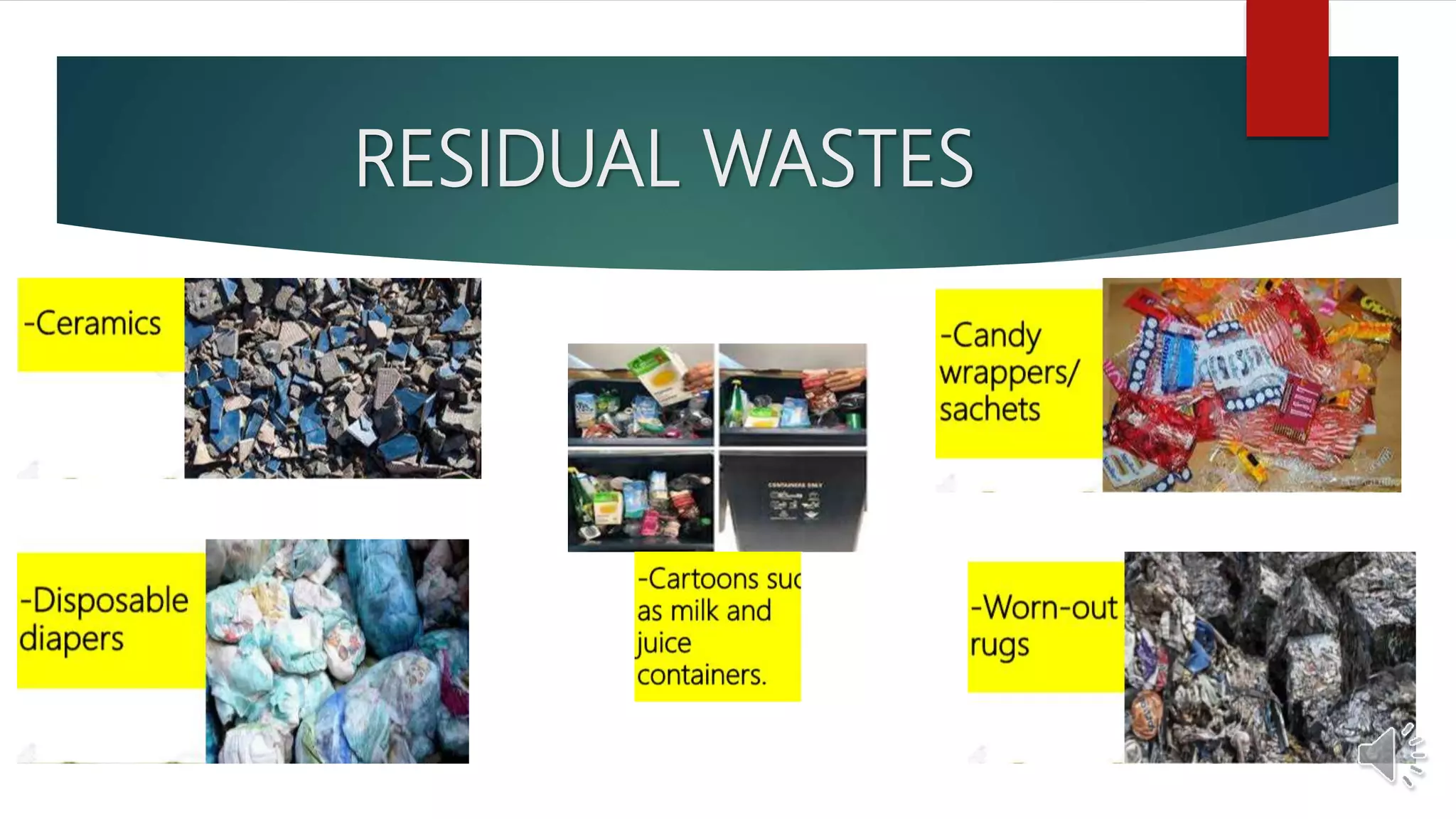
RESIDUAL WASTES are solid waste materials
that are non-compostable and non-recyclable. They
should be ecologically managed through the use of
Alternative Technologies or disposed through an
ecologically sound disposal facility.
RESIDUAL WASTES
Classifications of Solid Waste
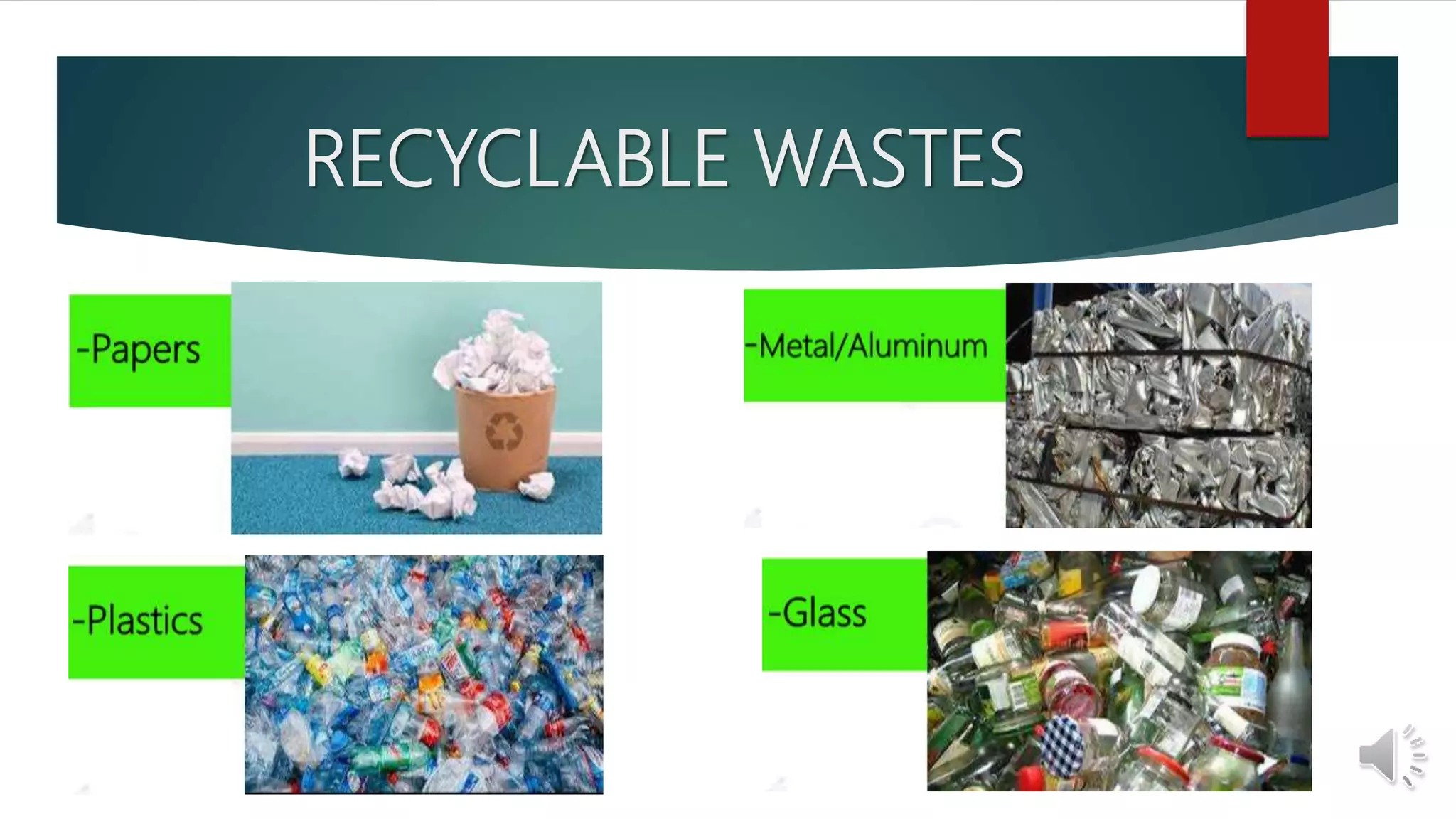
RECYCLABLE WASTES refers to any waste
material retrieved from the waste stream and free from
contamination that can still be converted into suitable
beneficial use. These may be transformed into new
products in such a manner that the original product may
lose.
RECYCLABLE WASTES
Classifications of Solid Waste
SPECIAL WASTES refer to household
hazardous wastes.
SPECIAL WASTES
SPECIAL WASTES
3R’s of Solid Waste Management
Reduce- to lessen the amount produced.
Ex:
1. Take a reusable shopping bag or ecobag when going to
markets and malls instead of using cellophane.
2. You can use metal straws, spoon and fork instead of
availing plastic utensils from food restaurants.
3R’s of Solid Waste Management
Reuse- to use materials again for a different purpose.
Ex:
1. Reusing plastic bottles, containers and jars for your drinks
and for freezing and storing food items.
2. Save wrapping papers and boxes to use again.
3R’s of Solid Waste Management
Recycle- to create new product out of the waste
material.
Ex:
1. We can create flower design out of plastic spoon.
2. We can create origami out of old magazine and
newspapers.
Approaches to Ecological Solid Waste
Management
 Segregation of wastes at source. All the members of the household
must be informed how to segregate wastes into compostable,
residual, recyclable and special or hazardous wastes.
 There must be a separate container for each type of waste.
Segregate recyclables must be properly cleaned before storing
them in their respective container.
Approaches to Ecological Solid Waste
Management
 Recyclable waste materials should be taken to the Materials Recovery
Facility (MRF) in every barangay or cluster of barangay where they received,
sorted processed and stored efficiently and in an environmentally sound
manner.
 The residual wastes or the non-recyclable and non-compostable wastes
shall be transferred to a long-term storage or disposal facility of sanitary
landfill.
Assessment
1. It refers to the systematic administration of activities, which provide for
segregation for segregation at source, segregated transportation, storage, transfer
processing, treatment and disposal of solid waste and all other waste management
activities which do not harm the environment.
2. It refer to household hazardous waste.
3. It is the process of recovering and converting materials that can be used as raw
materials to produce another new products.
4. A waste material that can decay and be composted.
5. A method that you will practice when you lessen the amount of your garbage at
home.
Agreement/Assignment:
Make a video of yourself illustrating the proper ways of
waste disposal through executing the approaches to
ecological solid waste management in your own homes
within a minimum time frame of 3 minutes.
RUBRICS

waste disposal COT2.pptx

  • 2.
    Objectives:  Identify theclassification of solid waste and the 3R’s of solid waste management.  Perform proper waste disposal and management.  Value the importance of the approaches to ecological solid waste management for safety and healthy environment.
  • 3.
    Review Questions:  Whatare the differences between cleaning and sanitation?  What are the different types of sanitation?  How proper sanitation is important in our daily lives?
  • 4.
    Solid Waste arethe discarded household, commercial waste, industrial waste, street sweeping, construction debris, agricultural waste and nonhazardous and non-toxic solid waste are the concerns of reduction.
  • 5.
    Republic Act 9003(Ecological Solid Waste Management) refers to the systematic administration of activities, which provide for segregation for segregation at source, segregated transportation, storage, transfer processing, treatment and disposal of solid waste and all other waste management activities which do not harm the environment.
  • 6.
    Classifications of SolidWaste RESIDUAL WASTES are solid waste materials that are non-compostable and non-recyclable. They should be ecologically managed through the use of Alternative Technologies or disposed through an ecologically sound disposal facility.
  • 7.
  • 8.
    Classifications of SolidWaste RECYCLABLE WASTES refers to any waste material retrieved from the waste stream and free from contamination that can still be converted into suitable beneficial use. These may be transformed into new products in such a manner that the original product may lose.
  • 9.
  • 10.
    Classifications of SolidWaste SPECIAL WASTES refer to household hazardous wastes.
  • 11.
  • 12.
  • 13.
    3R’s of SolidWaste Management Reduce- to lessen the amount produced. Ex: 1. Take a reusable shopping bag or ecobag when going to markets and malls instead of using cellophane. 2. You can use metal straws, spoon and fork instead of availing plastic utensils from food restaurants.
  • 14.
    3R’s of SolidWaste Management Reuse- to use materials again for a different purpose. Ex: 1. Reusing plastic bottles, containers and jars for your drinks and for freezing and storing food items. 2. Save wrapping papers and boxes to use again.
  • 15.
    3R’s of SolidWaste Management Recycle- to create new product out of the waste material. Ex: 1. We can create flower design out of plastic spoon. 2. We can create origami out of old magazine and newspapers.
  • 16.
    Approaches to EcologicalSolid Waste Management  Segregation of wastes at source. All the members of the household must be informed how to segregate wastes into compostable, residual, recyclable and special or hazardous wastes.  There must be a separate container for each type of waste. Segregate recyclables must be properly cleaned before storing them in their respective container.
  • 17.
    Approaches to EcologicalSolid Waste Management  Recyclable waste materials should be taken to the Materials Recovery Facility (MRF) in every barangay or cluster of barangay where they received, sorted processed and stored efficiently and in an environmentally sound manner.  The residual wastes or the non-recyclable and non-compostable wastes shall be transferred to a long-term storage or disposal facility of sanitary landfill.
  • 18.
    Assessment 1. It refersto the systematic administration of activities, which provide for segregation for segregation at source, segregated transportation, storage, transfer processing, treatment and disposal of solid waste and all other waste management activities which do not harm the environment. 2. It refer to household hazardous waste. 3. It is the process of recovering and converting materials that can be used as raw materials to produce another new products. 4. A waste material that can decay and be composted. 5. A method that you will practice when you lessen the amount of your garbage at home.
  • 19.
    Agreement/Assignment: Make a videoof yourself illustrating the proper ways of waste disposal through executing the approaches to ecological solid waste management in your own homes within a minimum time frame of 3 minutes.
  • 20.